Category: Environment

Rain stops play.

Or, to be more precise, any form of post for today.

The weather forecast for Southern Oregon for yesterday included very significant rain.

They were not wrong.

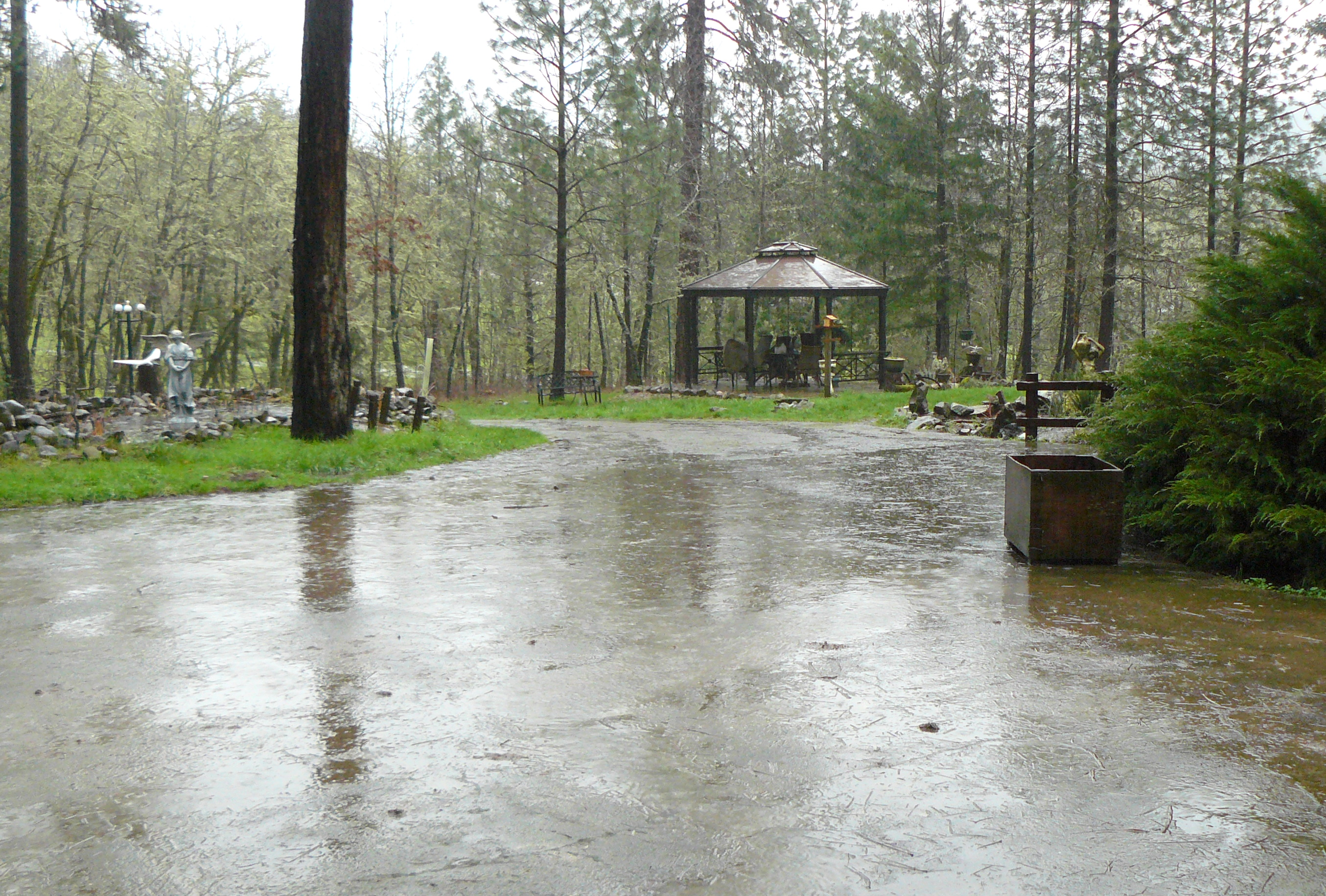
By the time I sat down to think about Saturday’s post, around 2pm, we had already had 3.2 inches of rain (8.1 cm) and our attention, understandably, was on more important matters, such as the integrity of our driveway bridge over Bummer Creek.

So if you will forgive me, I’ll just offer a few pictures and leave it at that.

Starting with a picture that Jean expressly said I couldn’t publish!

I shall probably be denied access to the bedroom after showing you all how my wife likes to dress up!

What lucky horses to have such a devoted ‘Mum’ that feeds them every morning; whatever the weather.

Only one way in or out: over the bridge!

Neighbours who have been here much longer than us say they haven’t seen so much rain fall in such a short time.

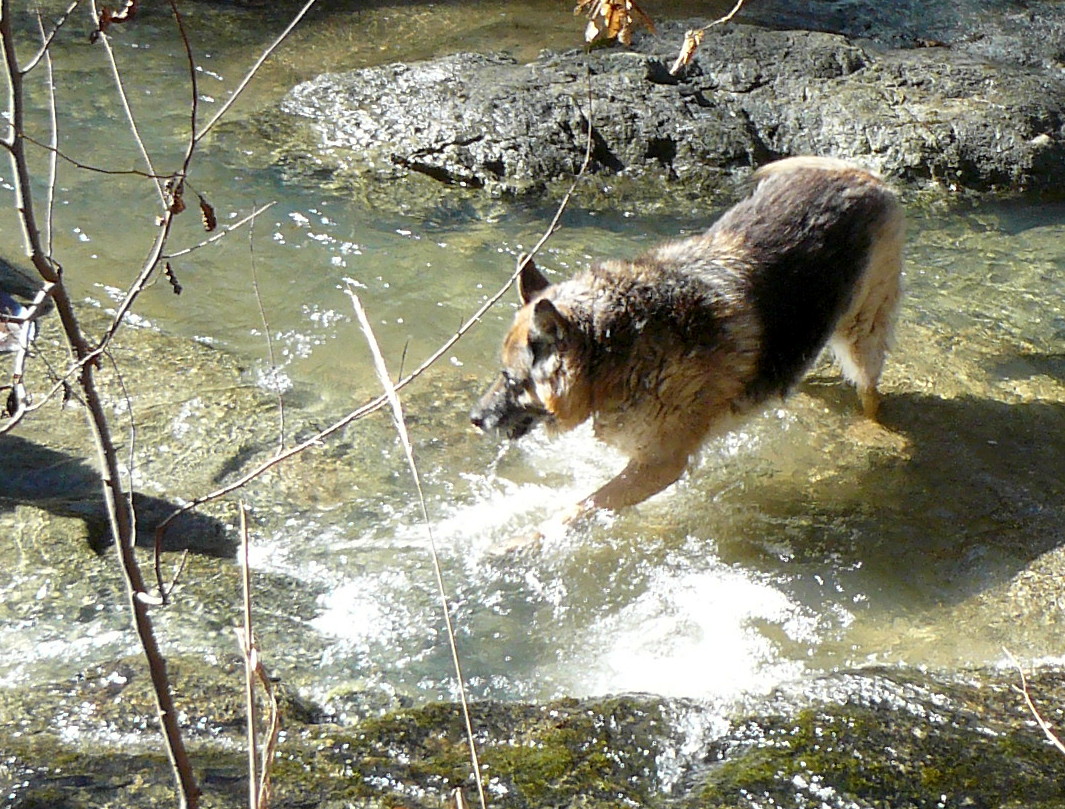
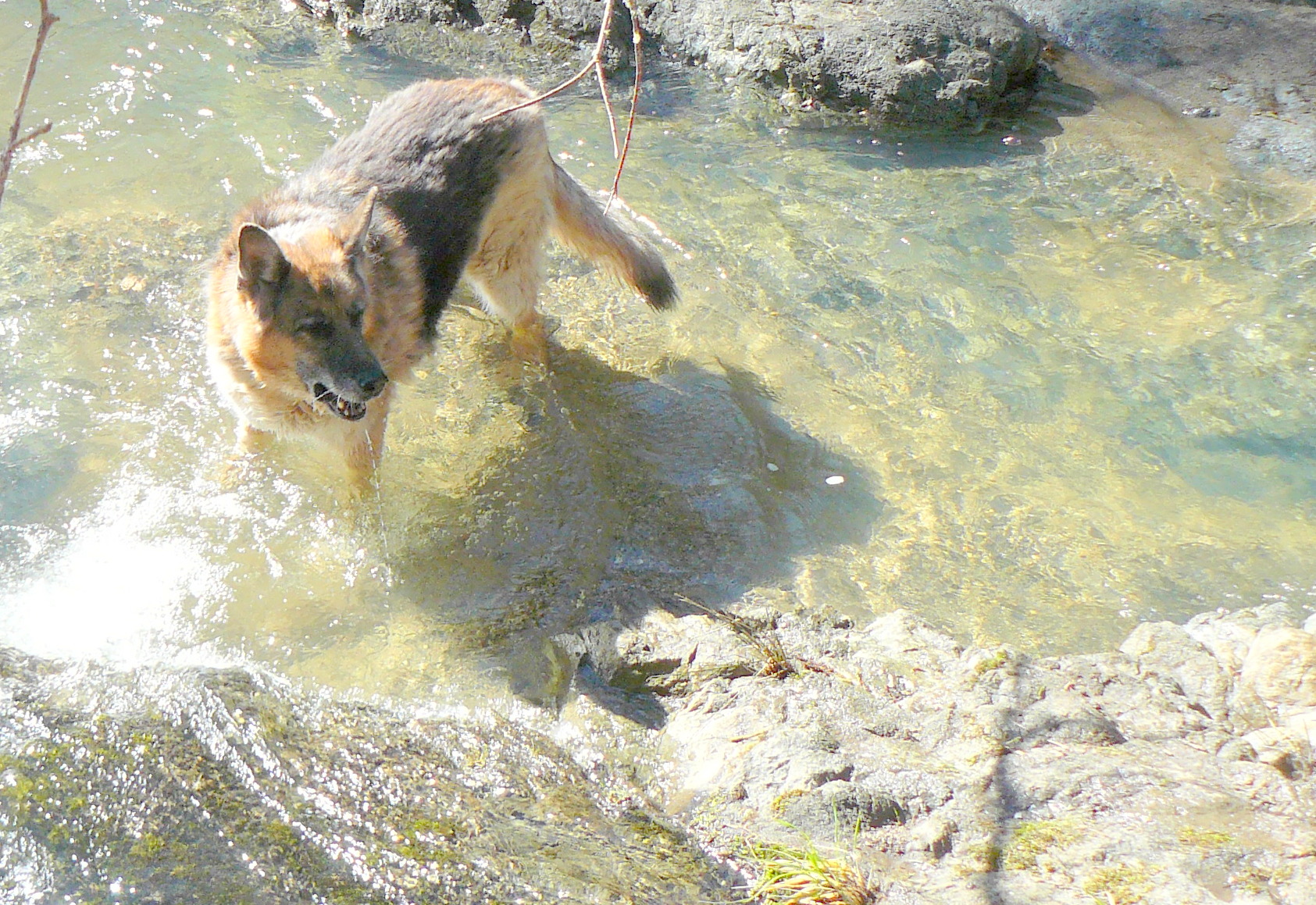
Bummer Creek in full flood - this photograph is of the Creek just 50 yards upstream of the bridge.
Bummer Creek in full flood – this photograph is of the Creek just 50 yards upstream of the bridge.

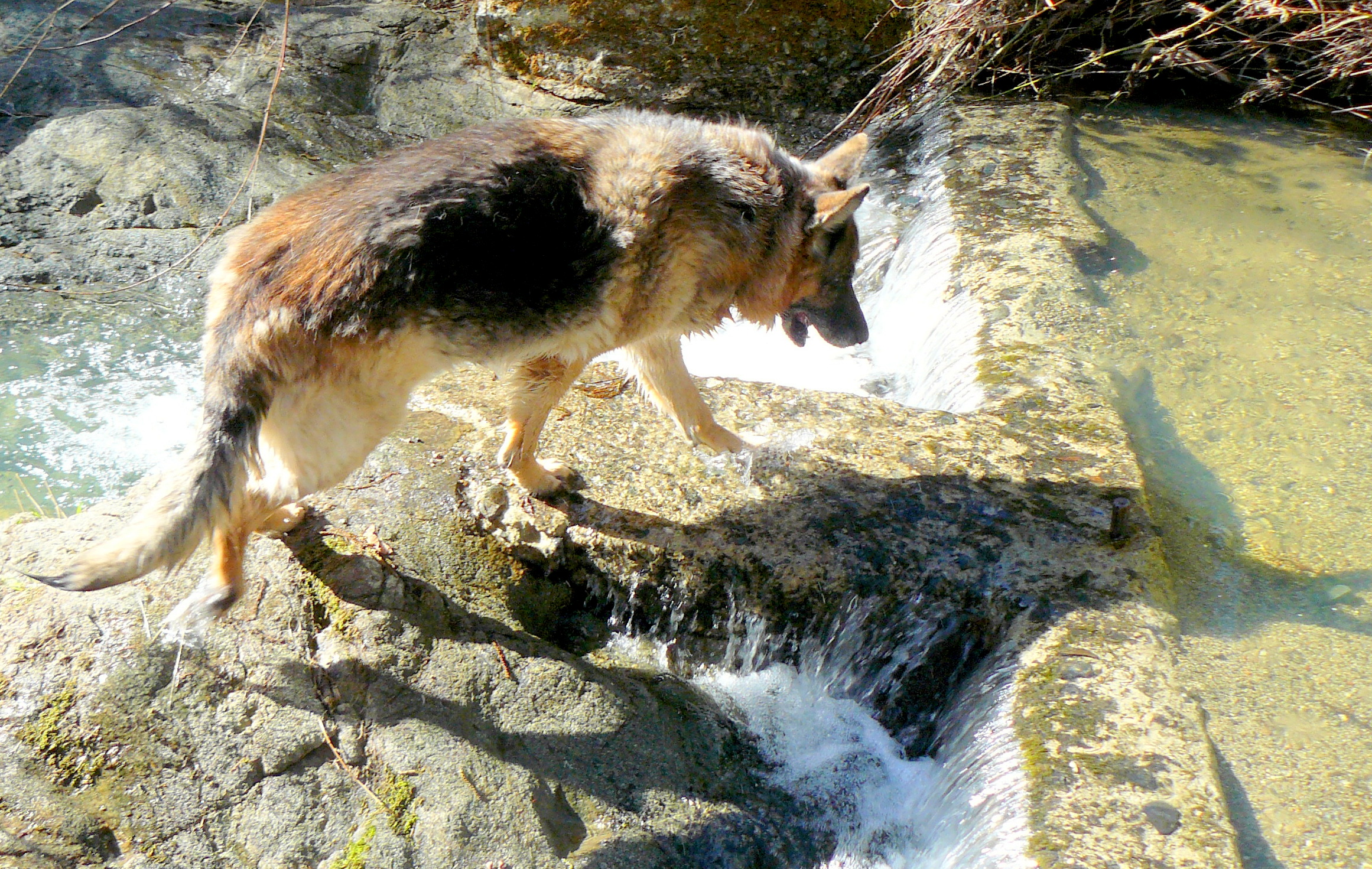
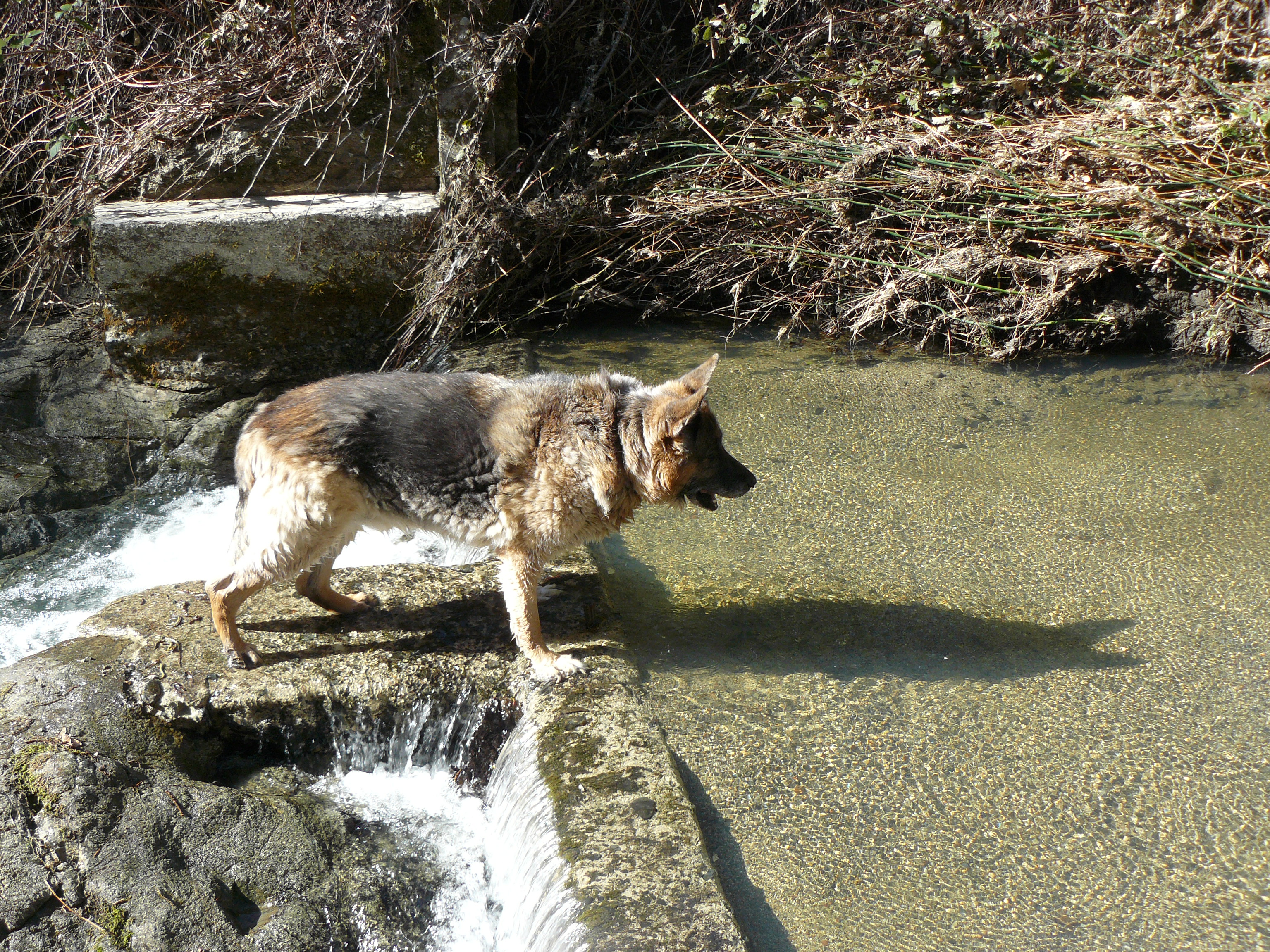
This is an old dam for irrigation purposes. One doesn’t want to reflect too long that a cubic yard of water weighs a ton!

Luckily the house and immediate surroundings are elevated.
Luckily the house (off picture to the right) and immediate surroundings are elevated.

So that’s it for today.

Another  picture parade for tomorrow assuming I haven’t been lynched by my lovely wife for showing that earlier photograph.

Oh, which reminds me! I took a couple!

She is rather cute, don't you think!
She is rather cute, don’t you think!

Voting for hope.

Considered reflections to yesterday’s post.

Yesterday, I published Bitter Lake ripples, a post that, in turn, was my response to the fabulous comments left by readers of my earlier post Oil, money, banks, guns and blood.  The overall feeling I read in those comments was one of terrible uncertainty about these present times. Or in the words of Sue Dreamwalker in response to a comment left by Patrice Ayme.

I have to say Patrice.. I agree with your comment here… And yes people are not understanding the whole of what is going on.. The Truth of it would seem unbelievable..

Patrice, in a post published on Monday entitled Arm Ukraine, Disarm Bankers sent shivers down my spine with the suggestion, the strong suggestion, that Ukraine, if not handled properly by ‘the West’ could be a tipping point into another major war between Europe (and the USA?) and Russia.  Here’s an extract from Patrice’s post:

The way it was said, in conjunction with Putin’s recent admission that Russian “volunteers” were fighting in Ukraine, is basically a declaration of war. On top of this, the head of the Eastern Ukraine rebels declared that he was raising a 100,000 men army. This means he expect tens of thousands of Russian troops (Putin’s “volunteers”) to cross the border.

This is not contained. Putin is billowing out of control, all by himself. One has to see what the combination of Putin’s dictatorial powers, media control, psychology and sinking economy leads to. Let me spell it out.

Once Putin has conquered Ukraine, he will push for more: he is already partly occupying Moldavia, WEST of Ukraine. Putin is also messing up with Hungary: there were street demonstrations about this, just yesterday, in Budapest. Putin uses the fact that Hungary is extremely dependent upon Russia’s fossil fuels. Merkel, who desperately wants to avoid war with Putin, flew to Budapest in emergency, to sort the situation out.

Patrice continues the warning of possible terrible times ahead in a subsequent post: Mental Inertia, Evil’s Friend, published yesterday.

Just as it takes a long time to erect, or change a vast building, so it is with the brain. The brain has inertia. Thus psychological inertia.

This mental inertia is why human beings tend to go on with a task, or with an attitude, once they got launched into it (a Jihadist laden with explosives just flew by).

Once a force is applied to an object, for example a propaganda to a brain, it tends to gather momentum, and develop ever more inertia.

Putin of course creates his own propaganda, and then can listen to it, reinforcing his deviance, in a self-reflective way. It’s all the more efficient if others repeat his ideas, and he listens to them. Actually that’s not just a problem with Putin, but with all Great Leaders. (And that’s one reason why Great Leadership has to be discontinued, and replaced by Direct Democracy.)

This amplifies the inertia.

By not fiercely opposing Putin, one collaborates with him. It is not just a question of sanctions. Putin is a liar, and an aggressive one, he should be publicly called for what he is.

Thus in terms of my own personal ideas, I freely admit to struggling to see things clearly.  Simply because I find it very difficult to get to the heart of these international issues through not having access to clear, impartial commentators who know what they are speaking about. As Patrice infers much of the media is corrupted by self-serving agendas.

However, on balance, despite Patrice Ayme being a ‘nom-de-plume’ and me having no idea who the person behind the label really is, I do trust his (?) writings and believe that Patrice writes from a position of having very good access to the inner workings of the US Government. (I am not privy to anything to support my proposition; just my guess.)

The other commentator whose opinions and judgements are trusted by me in equal fashion is George Monbiot. Mr. Monbiot has been gracious to grant permission to me for his essays to be republished here on Learning from Dogs.

On the 28th January, Mr. Monbiot published an essay that in words better than I could write encapsulates my response to the comments left on my Bitter Lake ripples post. Here is that post from George Mobiot.

ooOOoo

The Lamps Are Coming On All Over Europe

28th January 2015

By George Monbiot, published in the Guardian 28th January 2015

Here is the first rule of politics: if you never vote for what you want, you never get it. We are told at every election to hold our noses, forget the deficiencies and betrayals and vote Labour yet again, for fear of something worse(1). And there will, of course, always be something worse. So at what point should we vote for what we want, rather than keep choosing between two versions of market fundamentalism? Sometime this century? Or in the next? Follow the advice of the noseholders and we will be lost forever in Labour’s Bermuda triangulation.

Perhaps there was a time when this counsel of despair made sense. No longer. The lamps are coming on all over Europe. As in South America, political shifts that seemed impossible a few years earlier are now shaking the continent. We knew that another world was possible. Now, it seems, another world is here: the sudden death of the neoliberal consensus. Any party that claims to belong to the left but does not grasp this is finished.

Syriza, Podemos, Sinn Fein, the SNP; now a bright light is shining in England too, as the Green party stokes the radical flame that Labour left to gutter. On Tuesday morning, its membership in England and Wales passed 50,000(2); a year ago it was less than 15,000. A survey by the website voteforpolicies.org.uk reports that in blind tests (the 500,000 people it has polled were unaware of which positions belong to which parties), the Green Party’s policies are more popular than those of any other. If people voted for what they want, the Greens would be the party of government.

There are many reasons for this surge, but one of them must be a sense of popular ownership. Green party policies are determined democratically. Emerging from debates led mostly by younger members(3), they feel made for their time, while those of the major parties appear trapped in the 1980s.

Let me give you a flavour of the political transformation the Green Party seeks. There would be no prime minister of the kind we have today, no secretaries of state. Instead, Parliament would elect policy committees which in turn appoint convenors(4). It would also elect a First Minister, to chair the convenors’ committee. Parliament, in other words, would be sovereign rather than subject to the royal prerogative prime ministers abuse, leaders would be elected by the whole body and its various parties would be obliged to work together, rather than engage in perennial willy-waving.

Local authorities would set the taxes they chose. Local currencies, which have proved elsewhere to have transformative effects in depressed areas (see Bernard Lietaer’s book The Future of Money(5)) would become legal tender(6). Private banks would no longer be permitted to create money(7) (at the moment they issue 97% of our money supply, in the form of debt). Workers in limited companies would have the legal right, following a successful ballot, to buy them out and create cooperatives(8), with funding from a national investment bank.

The hideously unfair council tax system would be replaced by land value taxation(9), through which everyone would benefit from the speculative gains now monopolised by a few. All citizens would receive, unconditionally, a basic income(10), putting an end to insecurity and fear and to the punitive conditions attached to benefits, which have reduced recipients almost to the status of slaves.

Compare this vision of hope to Labour’s politics of fear. Compare it to a party so mesmerised by the City and the Daily Mail that it has promised to sustain the Tory cuts for “decades ahead”(11) and to “finish that task on which [the Chancellor] has failed”: eradicating the deficit.

Far too late, a former Labour minister, Peter Hain, now recognises that, inasmuch as the books need balancing, it can be done through measures like a financial transaction tax and a reform of national insurance(12), rather than through endless cuts. These opportunities have been dangling in front of Labour’s nose since 2008(13), but because appeasing the banks and the corporate press was deemed more important than preventing pain and suffering for millions, they have not been taken. Hain appears belatedly to have realised that austerity is a con, a deliberate rewriting of the social contract to divert our common wealth to the elite. There’s no evidence that the frontbench is listening.

Whether it wins or loses the general election, Labour is probably finished. It would take a generation to replace the sycophants who let Blair and Brown rip their party’s values to shreds. By then it will be history. If Labour wins in May, it is likely to destroy itself faster and more surely than if it loses, through the continued implementation of austerity. That is the lesson from Europe.

Fearful voting shifts the whole polity to the right. Tony Blair’s obeisance to corporate power enabled the vicious and destructive policies the Coalition now pursues(14). The same legacy silences Labour in opposition, as it pioneered most of the policies it should oppose. It is because we held our noses before that there is a greater stink today. So do we keep voting for a diluted version of Tory politics, for fear of the concentrate? Or do we start to vote for what we want? Had the people of this nation heeded the noseholders a century ago, we would still be waiting for the Liberal Party to deliver universal healthcare and the welfare state.

Society moves from the margins, not the centre. Those who wish for change must think of themselves as the sacrificial margin: the pioneering movement that might not succeed immediately, but that will eventually deliver sweeping change. We cannot create a successful alternative to the parties that have betrayed us until we start voting for it. Do we start walking, or just keep talking about the journey we might one day take?

Power at the moment is lethal. Whichever major party wins this election, it is likely to destroy itself through the pursuit of policies that almost no one wants. Yes, it might mean five more years of pain, though I suspect in these fissiparous times it won’t last so long. And then it all opens up. This is what we must strive for; this is the process that begins in May by voting, regardless of tactical considerations, for parties offering a genuine alternative. Change arises from conviction. Stop voting in fear. Start voting for hope.

http://www.monbiot.com

References:

1. http://www.theguardian.com/commentisfree/2014/dec/09/labour-tories-vote-osborne

2. Green Party office, by email, 27th January 2015

3. http://bright-green.org/green-movement/how-the-green-party-changed-itself-to-make-the-greensurge-possible/

4. http://policy.greenparty.org.uk/pa.html

5. http://www.lietaer.com/writings/books/the-future-of-money/

6. http://policy.greenparty.org.uk/ec.html#EC678

7. http://policy.greenparty.org.uk/ec.html

8. http://policy.greenparty.org.uk/in.html

9. http://policy.greenparty.org.uk/ec.html

10. http://policy.greenparty.org.uk/ec.html

11. http://press.labour.org.uk/post/87284550049/long-termism-in-public-finance-speech-by-chris

12. http://www.theguardian.com/politics/2015/jan/22/labour-radical-counter-greens-peter-hain

13. I was not the first to propose these alternatives to austerity Peter Hain has just discovered, but even I had got there by 2011: http://www.theguardian.com/commentisfree/2011/mar/06/march-26-protest-aims-first-draft

14. http://www.monbiot.com/books/captive-state/

ooOOoo

I said that Mr. Monbiot’s words were much finer than my own. No better illustrated than by his closing three sentences:

“Change arises from conviction. Stop voting in fear. Start voting for hope.”

How NOT to sell beer!

Adding to the chorus of voices criticising Budweiser.

I’m going to republish in full what arrived in my ‘in-box’ yesterday from Howling For Justice.

But before I do that, let’s consider the ancient history of the wolf and the connection with our dogs of today. I shall do that by offering a small extract from something that I will be presenting at a meeting in Grants Pass on February, 10th.

Dogs are part of the Canidae species, a family including wolves, coyotes and foxes, thought to have evolved some sixty million years ago. There is no hard evidence as to when dogs and man came together but dogs were certainly around when man developed speech and set out from Africa; about fifty thousand years ago.

What is clear is that the dog represents man’s longest domesticated animal companion; by far. Some scientists believe that we have had the benefits of dogs in our lives for thirty thousand years. Indeed, some have proposed that the benefits of having tame wolves around us humans helped man be so successful a hunter and gatherer that it was instrumental, a mere ten thousand years ago, in humans first discovering how to cultivate crops and domesticate animals. Becoming the most significant single development in human history.

Because reflect that for a previous three million years Stone Age man, the hunter-gatherer, had engaged in activities as natural as the swoop of a hawk or the grazing of a horse.

ooOOoo

OK, on to that Budweiser advertisement.

Budweiser Takes Low Road – Demonizes Wolves To Sell Suds

thumbs-down

February 1, 2015

We all know about the Budweiser ad, a little lost puppy being threatened by a wolf. I won’t show the ad because it’s BS and I don’t want to give it any publicity but Budweiser should be ashamed. Are they that desperate to sell beer?

Get a grip Budweiser, very poorly played. Beer drinkers around the country should boycott Bud if the ad is not pulled. It’s a low blow to wolves, one of the most persecuted animals on the planet.

Please click the link below and sign the petition to tell Budweiser what you think of their blatant demonizing of wolves.

===

Tell Budweiser: Don’t Demonize Wolves to Sell Beer

872023-1422494607-wide

author: Center for Biological Diversity

target: Anheuser-Busch CEO, Thomas W. Sante

Purposefully demonizing an animal that is part of America’s natural heritage is no way to sell beer.

But that hasn’t stopped Budweiser from crafting a commercial for this year’s Superbowl that intentionally drums up anti-wolf sentiment to try and capitalize on our culture’s outsized fear of wolf attacks.

The ad pits a cute puppy against a snarling, evil-looking wolf. In the ad the puppy is saved from the vicious wolf by the arrival of a team of Clydesdale horses.

Here’s a reality check: 1.2 million dogs are euthanized in shelters in the United States each year while another 1.2 million dogs are hit and killed by cars on America’s roads.

By comparison, wolves are a virtually non-existent threat to our furry canine friends, only in very rare instances attacking dogs if they feel threatened or perceive them as competitors. The real threat to both dogs and wolves, as these numbers show and as Budweiser’s cynical attempt to boost sales indicates, is people.

Take action — tell Budweiser to pull its wolf-hating ad, demonizing an endangered species is no way to sell beer.

http://www.thepetitionsite.com/takeaction/872/023/837/

ooOOoo

Please feel free to share this post to spread the word that animal and nature lovers are not amused by this!

Picture parade eighty-one

Something a little different for this week.

Mother Nature Network put out an email earlier in January that opened, thus:

Dear friend of Mother Nature,

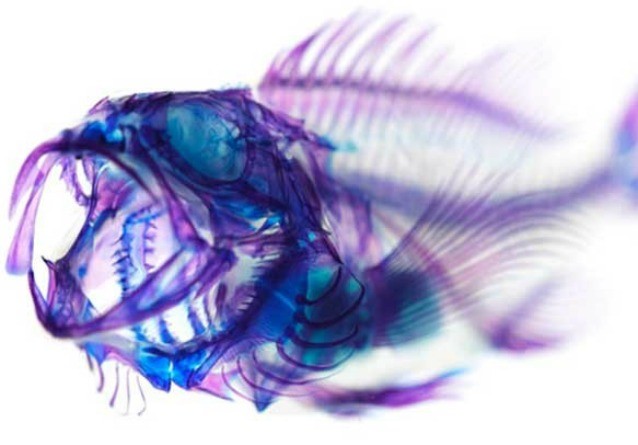
We all see the beauty in a sunset or in a gorgeous painting, but can you appreciate the art in bacteria, climate images or preserved animal remains? These beautiful examples show how for centuries, art and science have danced a well-choreographed routine. The result has been some breathtaking creativity.

The pictures were so wonderful that I have offered the first six for today and the balance in a week’s time.

Finding the link Who doesn't find beauty in nature? But can you find the art in bacteria or global warming or in the interesting forms of dead animal remains? For centuries, art and science have danced a careful routine. As each has informed the other, the result has been some spectacular creativity. (Text: Mary Jo DiLonardo)
Finding the link
Who doesn’t find beauty in nature? But can you find the art in bacteria or global warming or in the interesting forms of dead animal remains? For centuries, art and science have danced a careful routine. As each has informed the other, the result has been some spectacular creativity. (Text: Mary Jo DiLonardo)

oooo

Sonic sculptures Already known for his blown-glass microbes and bacteria, U.K. artist Luke Jerram also makes creations motivated by the science of sound. In Jerram's sonic sculptures, "invisible sound waves are visualized as silent, three-dimensional experiences," says science writer Joe Hanson, host of PBS's "It's Okay To Be Smart." One striking example is Aeolus, a giant stringed musical instrument with harp-like cables that vibrate and make music, responding to changes in the wind. The sculpture (also shown at left) was designed "to make audible the silent shifting patterns of the wind and to visually amplify the ever changing sky," says Jerram.
Sonic sculptures
Already known for his blown-glass microbes and bacteria, U.K. artist Luke Jerram also makes creations motivated by the science of sound. In Jerram’s sonic sculptures, “invisible sound waves are visualized as silent, three-dimensional experiences,” says science writer Joe Hanson, host of PBS’s “It’s Okay To Be Smart.” One striking example is Aeolus, a giant stringed musical instrument with harp-like cables that vibrate and make music, responding to changes in the wind. The sculpture (also shown at left) was designed “to make audible the silent shifting patterns of the wind and to visually amplify the ever changing sky,” says Jerram.

oooo

Albrecht Dürer Albrecht Dürer was a German painter, printmaker and theorist who many say was the greatest German artist of the Northern Renaissance. Although he was most well-known for his woodcuts and watercolors, Dürer was also revered for his anatomical and cartographic work, says Harvard art historian Susan Dackerman. She says his groundbreaking terrestrial map was “the first perspectival rendering of a terrestrial hemisphere.” His other science-inspired works include a map showing how the brain works and a woodcut of a rhinoceros so detailed that until the 18th century, it was the go-to scientific reference for the animal.
Albrecht Dürer
Albrecht Dürer was a German painter, printmaker and theorist who many say was the greatest German artist of the Northern Renaissance. Although he was most well-known for his woodcuts and watercolors, Dürer was also revered for his anatomical and cartographic work, says Harvard art historian Susan Dackerman. She says his groundbreaking terrestrial map was “the first perspectival rendering of a terrestrial hemisphere.” His other science-inspired works include a map showing how the brain works and a woodcut of a rhinoceros so detailed that until the 18th century, it was the go-to scientific reference for the animal.

oooo

Bioluminescent art Who knew bacteria could be so beautiful? In a mash-up of nature and design, bioluminescent art uses naturally glowing bacteria to create intricate designs that you can see only in the dark. Showing off these creations, BIOGLYPHS is an art and science collaboration by members of the Center for Biofilm Engineering and the Montana State University School of Art. The group "painted" bioluminescent bacterium naturally present in marine environments onto petri dishes to come up with the spectacular glow-in-the-dark creations. Read more: http://www.mnn.com/lifestyle/arts-culture/photos/11-beautiful-examples-of-art-inspired-by-science/bioluminescent-art#ixzz3QRM4dVEt
Bioluminescent art
Who knew bacteria could be so beautiful? In a mash-up of nature and design, bioluminescent art uses naturally glowing bacteria to create intricate designs that you can see only in the dark. Showing off these creations, BIOGLYPHS is an art and science collaboration by members of the Center for Biofilm Engineering and the Montana State University School of Art. The group “painted” bioluminescent bacterium naturally present in marine environments onto petri dishes to come up with the spectacular glow-in-the-dark creations.

oooo

Microscopic art It's amazing how incredible something can look when you magnify it. Florida State researcher Michael Davidson has a catalog of lovely microscopic images of beer, wine and cocktails. Davidson started his company, BevShots, as a way to raise funds for his lab. Scientific photographer Martin Oeggerli (known as Micronaut) uses scanning electron microscopy to produce images of pollen, microbes, insects and fungi with 500,000 magnification or more. An interesting combination, Oeggerli is a scientific photographer who holds a doctorate in molecular biology. His images often appear in National Geographic where he says, "I also want to broaden people’s awareness that even the smallest living organisms are perfectly 'designed' and well worth … our attention." Read more: http://www.mnn.com/lifestyle/arts-culture/photos/11-beautiful-examples-of-art-inspired-by-science/microscopic-art#ixzz3QRMHN1hO
Microscopic art
It’s amazing how incredible something can look when you magnify it. Florida State researcher Michael Davidson has a catalog of lovely microscopic images of beer, wine and cocktails. Davidson started his company, BevShots, as a way to raise funds for his lab. Scientific photographer Martin Oeggerli (known as Micronaut) uses scanning electron microscopy to produce images of pollen, microbes, insects and fungi with 500,000 magnification or more. An interesting combination, Oeggerli is a scientific photographer who holds a doctorate in molecular biology. His images often appear in National Geographic where he says, “I also want to broaden people’s awareness that even the smallest living organisms are perfectly ‘designed’ and well worth … our attention.”

oooo

Fibonacci art Math fans know the Fibonacci sequence as an important series of numbers used in all sorts of key mathematical scenarios. The first nine numbers in the Fibonacci sequence are: 0, 1, 1, 2, 3, 5, 8, 13, 21. The sequence — which ironically was explained by Fibonacci himself using the multiplication of rabbits — also appears in nature. MNN's Shea Gunther writes that the Fibonacci sequence can be found in the formation of sunflowers, galaxies, cellular structure, hurricanes and honeybees. Artists have also been intrigued by the number series. It has inspired everything from sculpture to furniture. Read more: http://www.mnn.com/lifestyle/arts-culture/photos/11-beautiful-examples-of-art-inspired-by-science/fibonacci-art#ixzz3QRMQoz1a
Fibonacci art
Math fans know the Fibonacci sequence as an important series of numbers used in all sorts of key mathematical scenarios. The first nine numbers in the Fibonacci sequence are: 0, 1, 1, 2, 3, 5, 8, 13, 21. The sequence — which ironically was explained by Fibonacci himself using the multiplication of rabbits — also appears in nature. MNN’s Shea Gunther writes that the Fibonacci sequence can be found in the formation of sunflowers, galaxies, cellular structure, hurricanes and honeybees. Artists have also been intrigued by the number series. It has inspired everything from sculpture to furniture.

The final set to be published in a week’s time.


Oil, money, banks, guns and blood.

The history of power, control, those who wield it, and where it has taken us all.

There is a real pain in me as I start into today’s post. A pain that comes from agonising over whether or not to write in this vein. A pain that has its roots in me being forced to accept that global politics, money and power-plays are much worse than I ever wanted to believe.

What, you must be asking, has got me plunging so far into this dark place? When just twenty-four hours ago I was writing of peace, calm and deep meditation?

Simply a film!

A film that was uploaded by the BBC a few days ago exclusively on to their BBC iPlayer platform.

The film is called Bitter Lake and here’s the trailer.

The full film is 2 hours, 20 minutes long. (But note that the film is age-restricted for obvious reasons.)

I can’t encourage you to watch it. For if you do, the world may never seem the same to you.

But Jeannie and I did watch it and think it should be shared widely. And, yes, it has changed the world for us.

Here’s how it is described by Adam Curtis and the BBC.

Published on Jan 26, 2015
Shown exclusively on the BBC iPlayer service in the UK
This upload is for those outside of the UK

http://www.bbc.co.uk/blogs/adamcurtis

Politicians used to have the confidence to tell us stories that made sense of the chaos of world events.

But now there are no big stories and politicians react randomly to every new crisis – leaving us bewildered and disorientated.

And journalism – that used to tell a grand, unfurling narrative – now also just relays disjointed and often wildly contradictory fragments of information.

Events come and go like waves of a fever. We – and the journalists – live in a state of continual delirium, constantly waiting for the next news event to loom out of the fog – and then disappear again, unexplained.

And the formats – in news and documentaries – have become so rigid and repetitive that the audiences never really look at them.

In the face of this people retreat from journalism and politics. They turn away into their own worlds, and the stories they and their friends tell each other.

I think this is wrong, sad, and bad for democracy – because it means the politicians become more and more unaccountable.

I have made a film that tries to respond to this in two ways.

It tells a big story about why the stories we are told today have stopped making sense.

But it is also an experiment in a new way of reporting the world. To do this I’ve used techniques that you wouldn’t normally associate with TV journalism. My aim is to make something more emotional and involving – so it reconnects and feels more real.

BBC iPlayer has given me the opportunity to do this – because it isn’t restrained by the rigid formats and schedules of network television. It’s a place you can go to experiment and try out new ideas.

It is also liberating – both because things can be any length, and also because it allows the audience to watch the films in different ways.

The film is called Bitter Lake. It is a bit of an epic – it’s two hours twenty minutes long.

It tells a big historical narrative that interweaves America, Britain, Russia and Saudi Arabia. It shows how politicians in the west lost confidence – and began to simplify the stories they told. It explains why this happened – because they increasingly gave their power away to other forces, above all global finance.

But there is one other country at the center of the film.

Afghanistan.

This is because Afghanistan is the place that has repeatedly confronted politicians, as their power declines, with the terrible truth – that they cannot understand what is going on any longer. Let alone control it.

The film shows in detail how all the foreigners who went to Afghanistan created an almost totally fictional version of the country in their minds.

They couldn’t see the complex reality that was in front of them – because the stories they had been told about the world had become so simplified that they lacked the perceptual apparatus to see reality any longer.

And this blindness led to a terrible disaster – support for a blatantly undemocratic government, wholesale financial corruption and thousands of needless deaths.

A horrific scandal that we, in our disconnected bubble here in Britain, seem hardly aware of. And even if we are – it is dismissed as being just too complex to understand.

But it is important to try and understand what happened. And the way to do that is to try and tell a new kind of story. One that doesn’t deny the complexity and reduce it to a meaningless fable of good battling evil – but instead really tries to makes sense of it.

I have got hold of the unedited rushes of almost everything the BBC has ever shot in Afghanistan. It is thousands of hours – some of it is very dull, but large parts of it are extraordinary. Shots that record amazing moments, but also others that are touching, funny and sometimes very odd.

These complicated, fragmentary and emotional images evoke the chaos of real experience. And out of them I have tried to build a different and more emotional way of depicting what really happened in Afghanistan.

A counterpoint to the thin, narrow and increasingly destructive stories told by those in power today.

And I must include this comment from the relevant page on BBC Blogs:

Quite simply one of the best films I’ve ever watched. The theme and content made so many connections linking events of the last 40 years. It’s perhaps time to reflect on power ,control and those who wield it . The official narrative is not our narrative , we have a choice to decide what we believe . Time to reflect and make that choice.
Thanks for such an informing film.

Here is the film.

http://www.youtube.com/watch?v=UM8W87UcO2U

Our thoughts make us human

Serendipity strikes again!

Recently I read a post from Val Boyco over on her delightful blog Find Your Middle Ground.  Her topic was about breathing. Here’s a flavour of her post:

I’ve written before about how our breath is connected with our wellbeing and emotional state. Noticing how we are breathing is a tool that we can use to monitor how we are doing.

There is another pause that comes with our breath which is also revealing. The pause at the end of the exhale before we take in more air. When we are distracted, stressed or in an anxious state, there is no pause. We don’t trust we have enough air and we don’t allow ourself to relax and let go.

Just take a moment to tune into how you are breathing right now. Just notice without judgment.

Pausing at the end of an exhale can only happen when we are relaxed and in tune with our mind and body. When our body and mind are aligned in the present moment.

I then left a reply in the comments section:

Excellent advice. For the last few weeks I have been using a biofeedback unit that through guiding one to breathe in harmony with a musical phrase allows one to slow the whole body down. Down to about 4.8 breaths per minute. It really underlines how slow one’s breathing rate can be and, supporting your post, the glorious pauses after each inhale and exhale.

And offered to write a post about the unit and my experiences. (Coming out tomorrow.)

However, what I wanted to do as a ‘lead-in’ to that post was to discover if there was any research into the benefits, as in scientific benefits, of slowing one’s body down in this fashion. What is surely nothing more than a form of meditation. Where to start looking? Needn’t have worried; there were many items on YouTube that covered the benefits of meditation.

There was a video from the AsapSCIENCE guys Mitchell Moffit and Gregory Brown, but I found it too jazzy and irritating, rather ironically! Then there was one from physicist John Hagelin that seemed much more appropriate to my tastes (and that is featured tomorrow as well).

By now it was coming up to 4:30pm and I had a dozen other things to do, plus try and fit in a biofeedback session – I could feel the stress rising within me.

Then I dipped into Terry Hershey’s latest Sabbath Moment and, guess what! Here’s what I read:

Learning to let go

January 26, 2015

Hershey2

Some of us think holding on makes us strong, but sometimes it is letting go. Herman Hesse

Uncertainty is the only certainty there is, and knowing how to live with insecurity is the only security. John Allen Paulos

When you let go of trying to get more of what you don’t really need, it frees up oceans of energy to make a difference with what you have. Lynne Twist

——-

Today I am sitting in a café (and bar) in Vaison-la-Romaine, in the Provence region of France, nursing my espresso.

No, wait… that was last week.

It just sounds sexier than saying, “Today I’m looking out my window at a gloomy winter sky, here in the Pacific Northwest, with a Thesaurus in hand hoping for a gushing synonym for gray.”

Welcome home. Home for me is always awaited and valued, but still elicits a bout of scotoma (selective vision), where we end up comparing the life we have, for the “life we deserve” (the actual wording for a recent advertised e-course).

My favorite part of my recent France trip was visiting family run wineries, spending time with the owner / wine-maker, with the permission to linger, sensing a comfort grounded in story and connection. Said one (when we asked him about being a small winery–in a world where big is everything), “I am glad. I am not alone. I work with family.” (Referring to his son and three daughters.)
And it makes me wonder about this mental sleight of hand we use, thinking about the life we are destined for, as somehow different (or better) from the life we now we live.

There is a Tibetan story about an earnest young man seeking enlightenment. (Earnest people must think this quite unfair–since they play a central role in most parables and stories about enlightenment.)

A famous sage passes through the man’s village. The man asks the sage to teach him the art of meditation. The sage agrees. He tells the man, “Withdraw from the world. Mediate every day in the specific way I will teach you. Do not waver and you will attain enlightenment.”

The earnest man follows the sage’s instructions to the letter. Time passes — and no enlightenment. Two years, five, ten, twenty pass.

It happens that the sage once again passes through the man’s village. The man seeks him out, grumbling that despite his best intentions and devotion and diligent efforts, he does not achieve enlightenment. “Why?”
The sage asks, “What type of meditation did I teach you?”
The man tells him.
The sage says, “Oh, what a terrible mistake I made! That is not the right meditation for you. You should have done another kind altogether. Too bad, for now it is too late.”

Disconsolate, the man returns to his cave. Staking his life on the sage’s instructions, and now believing he is without hope, the man abandons all his wishes and efforts and need to control his road to enlightenment. He does not know what to do. So, he does what he knows best: he begins meditating. And in a short while, much to his astonishment, his confusion begins to dissolve, and his inner world comes to life. A weight falls away and he feels lighter, and regenerated. When he walks out of the cave, the sky is bluer, the snow capped mountains whiter, and the world around him more vivid.

There is no doubt that all too often, our efforts–to succeed or achieve or attain–get in the way of our living. It brings to mind my favorite Robert Capon quote, “We live life like ill-taught piano students. So inculcated with the flub that will get us in dutch, we don’t hear the music, we only play the right notes.”

I understand. I was weaned on a spirituality that predicated itself on artifice. In other words, the importance is placed upon appearance, rather that just being. (It was vital to “look spiritual.” Which begs the question, “What do spiritual people look like?” As a boy, I always thought the “spiritual people” looked as if some part of their clothing was a size too small.)

What is it we are holding on to–so rigid, so firm, white-knuckled in our determination?
At some point, we’ve got to breathe.
Just breathe.
Without realizing it (and after the sage’s disheartening news), the man in the story “let go.”

He let go of the need to see life as a problem to be solved.
He let go of the need to have the correct answers (or experiences) for his “enlightenment.”
He let go of the need to see his spiritual life in terms of a formula.
He let go of the restraints that come from public opinion.

Abandon your masterpiece, sink into the real masterpiece. Leonard Cohen

Without realizing it, he took Leonard Cohen’s advice. He abandoned his “masterpiece”–the perception of what he needed to accomplish, or how he needed to appear, or what he needed to feel–in order to allow himself to sink down into this life, this moment, even with all of its uncertainty and insecurity.

For the first many years, meditation or prayer was a requirement or compulsion. In his emptiness, meditation and prayer was an offering of thanks, freely given, and without constraint. True spiritual enlightenment, it seems, happens when you are not trying to impress anyone, or score any points with heavenly bookkeepers.
It sounds easy doesn’t it?
But here’s the deal: My best intentions to play the right notes can fabricate an armor that keeps me from the vividness of life–whether it be to pray or meditate or notice or give or mourn or dance or play or grieve or laugh or celebrate or love… or just to walk.

I never did find a good enough synonym for the gray (although I’ll keep looking). Gladly, the sun has broken through. And there is enough warmth to persuade us that spring may arrive tomorrow. Daffodil shoots everywhere–up through the leaves and debris–help the ruse. So it’s garden time this afternoon, turning manure into the vegetable garden beds, beginning to cut back and clean some of the perennial beds. Enough work for the back to call a time out and request reprieve. I’m headed to the swing under the maple, when I look up to see the sun illuminating the red-twig dogwood shrubs, 10 foot canes glowing, a bright cranberry red. It catches my breath. And I am glad to be alive.

People say that what we’re all seeking is a meaning for life. I don’t think that’s what we’re really seeking. I think what we’re seeking is an experience of being alive… of the rapture of being alive. Joseph Campbell

Such power in those words. Then how moments later what I had read from Terry made so much sense to me. So perfectly connected with yesterday’s post Animals make us human. So relevant that quotation yesterday about animal happiness. This one:

Neuroscience key to animal happiness

…research in neuroscience has been showing that emotions drive behavior, and my thirty-five years of experience working with animals have shown me that this is true. Emotions come first. You have to go back to the brain to understand animal welfare.

Animals Make Us Human : Creating the best life for Animals

by Temple Grandin & Catherine Johnson

Such a close parallel with that well-known saying about us humans: ‘we are what we think‘. How our own happiness, just as it is with our animals, has its roots in our emotions.

How letting go, how staying in the present, is so good for us. How dogs do that so perfectly.

How we humans have so much to learn from our dogs.

Pure, deep peace radiating out from Hazel's loving eyes.
Pure, deep peace radiating out from Hazel’s loving eyes.


Picture parade eighty.

Winter wonderland four, the last of the series. (One was here, two was here, and three was here.)

Background information is after the last photograph.

Bambi22

oooo

Bambi23

oooo

Bambi24

oooo

Bambi25

oooo

Bambi26

oooo

Bambi28

oooo

Bambi29

oooo

Bambi30

These animals were photographed just north of the Barber Lake on a highway near Mine Center, Ontario, Canada. The odds of seeing an albino moose are astronomically rare; let alone seeing two of them. It really doesn’t matter the colour of their fur; white or dark brown.

Once in a while there is an opportunity to take in a piece of nature that most of us may never see ‘in the wild’.

A huge thank you to Dordie for forwarding all the pictures featured over the last four weeks.


Out of this world!

Literally!

I noticed the other day a series of photographs of the moon and Venus that were included in an item on EarthSky News. All I am going to do is to republish a selection of the photographs so if you would like to read the full item, including all the photographs, then here is the link.

Mohamed Laaïfat Photographies in Normandy, France caught the little planet Mercury, too, along with the moon and Venus, on January 21.

oooo

João Pedro Marques caught bright Venus and the waxing moon on the evening of January 22, 2015, from Portugal. The reddish “star” above and to the left of the moon is Mars.

In the above image, Mars may only be seen by viewing a bigger image here.

One Horse Media in Lolo, Montana wrote: “What a cool moon and view of Venus this evening! I was happy to have just enough time to take a few photos as soon as I got home!”

oooo

Hecktor Barrios in Hermosillo, Mexico wrote: “Venus, Moon and Mercury, the latter barely visible."
Hecktor Barrios in Hermosillo, Mexico wrote: “Venus, Moon and Mercury, the latter barely visible.”

oooo

Planet Venus and young moon on January 21, 2015, as captured by Cathy Emmett Palmer in Panama City Beach, Florida.

Won’t add any more thoughts from me because each and every one of you will have your own feelings and responses to these photographs. Don’t want my ideas to get in the way of your own thoughts.

Just all of you have a wonderful and peaceful weekend.

Loving life unreservedly!

The appalling attitudes of those who kill wild animals for fun!

You will recall that in yesterday’s post, I referred to the fact that Jean and I are supporters of Oregon Wild. If you drop in on the OW blog, one of the items you will read is A New Year for Oregon’s Wolves.  Here’s how it starts:

Jan 12, 2015 | Rob Klavins

Photo of a young wolf from the Walla Walla Pack taken on Feb 5, 2014. Photo courtesy of ODFW.

A new year provides opportunities for reflection – and prognostication. For wolves in Oregon, 2014 was a good year. Journey finally found his mate and Oregon continued a management paradigm where killing remained an option of last resort. The result was a small but expanding wolf population and a continued decrease in conflict.

However, it’s not an understatement to say that 2015 is poised to be among the most consequential years for Oregon’s wolf recovery since the passage of the Endangered Species Act in 1973.

After a hard-fought legal settlement, Oregon’s fragile wolf recovery is back on track under the most progressive plan in the country. Though the plan is working for all but the most extreme voices, the Oregon Department of Fish & Wildlife (ODFW) is re-igniting old conflicts by caving to political pressure and giving serious consideration to weakening basic protections for wolves.

Moving on but staying in theme; so to speak.

For a few months now, I have been subscribing to a blog called Exposing the Big Game.  Here’s a little from their About page.

front-cover-low-res6

This blog site is a haven for wildlife and animal advocates, a wildlife refuge of sorts, that’s posted “No Hunting,” as any true sanctuary should be. Just as a refuge is patrolled to keep hunters and poachers from harassing the wildlife, this blog site is monitored to keep hunters from disturbing other people’s quiet enjoyment of the natural world.

It is not a message board or a chat room for those wanting to argue the supposed merits of animal exploitation or to defend the act of hunting or trapping in any way, shape or form. There are plenty of other sites available for that sort of thing.

Hunters and trappers: For your sake, I urge you not to bother wasting your time posting your opinions in the comments section. This blog is moderated, and pro-hunting statements will not be tolerated or approved. Consider this fair warning—if you’re a hunter, sorry but your comments are going straight to the trash can. This is not a public forum for animal exploiters to discuss the pros and cons of hunting.

We’ve heard all the rationalizations for killing wildlife so many times before; there’s no point in wasting everyone’s time with more of that old, tired hunter PR drivel. Any attempt to justify the murder of our fellow animals will hereby be jettisoned into cyberspace…

Well two days ago, Lydia Millet wrote an opinion piece for the New York Times that was republished on Exposing the Big Game. It was about the American Gray Wolf.  I asked permission to republish it in full here.

ooOOoo

Opinion: High Noon for the Gray Wolf

By LYDIA MILLET JAN. 18, 2015

In December 2011, a wild gray wolf set foot in California, the first sighting in almost a century. He’d wandered in from Oregon, looking for a mate. In October 2014, for the first time in almost three-quarters of a century, a gray wolf was seen loping along the forested North Rim of the Grand Canyon, in Arizona. She had walked hundreds of miles, probably from Wyoming or Idaho.

The return of these animals to the homes of their ancestors — however fleeting — was a result of their 40-year protection under the Endangered Species Act.

OR-7, or “Journey,” as schoolchildren named the first wolf, had been born to the Imnaha pack, the first one in Oregon for many decades. When he wandered south, his brother, OR-9, wandered east. Shortly after he crossed into Idaho (where wolves are not protected), he was shot dead. OR-7 lived on, after his repeated incursions into California (where wolves are protected), to sire a litter of pups just north of the state line. He became the subject of a documentary — in California, even a wolf can be a star.

The story of the Grand Canyon wolf, though, may be over: Three days after Christmas, it appears, she was shot and killed in Utah by a man media outlets have called a “coyote hunter.” (A DNA test is pending.)

For almost two centuries, American gray wolves, vilified in fact as well as fiction, were the victims of vicious government extermination programs. By the time the Endangered Species Act was passed, in 1973, only a few hundred of these once-great predators were left in the lower 48 states. After numerous generations of people dedicated to killing wolves on the North American continent, one generation devoted itself to letting wolves live. The animals’ number has now risen to almost 5,500, thanks to their legal protection, but they still occupy less than 5 percent of their ancient home range.

Since 1995, the act has guided efforts to raise wolves in captivity, release them, and follow them in the wild. Twenty years ago this month, the first gray wolves were reintroduced to Yellowstone National Park.

But this fragile progress has been undermined. Since 2011, the federal government has moved to remove federal protection for gray wolves in the Northern Rocky Mountains (Idaho, Montana and Wyoming) and in the western Great Lakes (Minnesota, Wisconsin and Michigan), the two population centers. Management of the species was turned over to these states, which responded with a zeal that looks like blood lust.

Relying on the greatly exaggerated excuse that wolves threaten cattle and sheep, the states opened their doors to the killing of wolves. (In some states, bait can be used to lure the animals to their deaths; in Montana, private landowners can each kill 100 wolves each year; in Wisconsin, up to six hunting dogs on a single wolf is considered fair play.) Legions of wolf killers rose to the challenge, and the toll has been devastating: In just three and a half years, at least 3,500 wolves have been mowed down.

There’s been an outcry from conservationists, ecologists and people who simply like wolves, but this has not stopped the killers. Some say wolves are a threat to their livestock investments (despite the existence of generous rancher-compensation programs in all wolf states save Alaska); others invoke fear of wolves; still others appear to revel in killing. Online, you can find pictures of wolf carcasses held up proudly as trophies and men boasting of running over wolves with their cars. Judges have started to step in. In September, a federal court decided that wolf management in Wyoming — which had allowed people to kill as many wolves as they wanted, throughout 84 percent of the state — should be returned to the federal government. In December, also in response to a lawsuit, another federal court reinstated protections for wolves in the western Great Lakes. These decisions should make clear that the states alone simply can’t be entrusted with the future of our wolves.

In Washington, the threats persist. The Fish and Wildlife Service is considering a proposal that would strip federal protection from almost all gray wolves in the lower 48 states, not just the ones in the Rockies and the Midwest. Meanwhile, right-wing Republicans in the new Congress are champing at the bit to remove the wolves from protection under the act — politics trumping science.

President Obama should direct the Fish and Wildlife Service to retain protection for wolves; if it doesn’t, they could be wiped off the face of the American landscape forever. A unified wolf-recovery plan for the nation is required. Not only do wolves play an important role in keeping wilderness wild, but they were here long before we were, and deserve to remain. Not for nothing was the environmentalist Aldo Leopold transformed by the sight of a “fierce green fire” in a dying wolf’s eyes.

I’ve seen wild gray wolves only once, as they trotted across a dirt road in front of my own family car in a New Mexican forest. There were three of them on the road, no doubt a wolf family, and three of us in the car: my husband, my daughter and me. In the back seat, my little girl was engrossed in a picture book and didn’t look up fast enough. I want her to have another chance; I want her to keep living in a world where something beautiful and wild lurks at the edge of sight.

Lydia Millet is the author, most recently, of the novel “Mermaids in Paradise.”

ooOOoo

Going back to that blog post over on Exposing the Big Game, I was inspired by many of the comments. Here are two examples:

From Rosemary Lowe (who blogs over on EARTH for Animals)

I so agree with your comments, Roger. Here we are, staring at the Faces of Extinction, while, so-called “wildlife groups” grovel, hat in hand, to these agencies, and to the ranchers and hunters, offering yet another “collaboration” or “compromise” so we “can all work together.” I am sickened as to how many of these groups make no apology about having hunters/ranchers on their boards and on their staff. An all out War against these special interests, and their agencies does not seem to be on group’s agenda. So much has already been lost. As you stated, so little is left: the massive slaughter of native wild animals & wild habitats since the 1800’s is criminal, yet there seems to be little passion about it.

Here from Sharon Lee Davies-Tight (who blogs over on Word Warrior Davies-Tight)

Thanks for the article. Strange isn’t it – the killing spree for sport against the wolves for their predatory behavior, yet these same people aren’t calling their behavior or the behavior of hunting dogs predatory?

Finally, here’s the trailer to that film about the wolf OR7

Please do all you can to ensure that federal protection for gray wolves in all US states is maintained.

How we treat wild animals defines how we treat the planet – the only one we have!

Picture parade seventy-nine

Winter wonderland three (One was here, and two was here.)

Bambi15

oooo

Bambi16

oooo

Bambi17

oooo

Bambi18

oooo

Bambi19

Now a change of scene and temperature! But still the pictures sent in by Dordie.

Bambi20

oooo

Bambi21

The fourth and final group of winter wonderland pictures in a week’s time. Enjoy!