Our internet service has been down, more or less the last several days.
It was restored some five minutes ago. Apparently down to the fact that our internet provider, Outreach Internet, had to purchase two snowmobiles to get access to the generators powering two of their masts!
The foul weather continues but fingers crossed so does our internet service.
Thus I hope Learning from Dogs returns to “normal service” starting with a new post at midnight PST tonight.
We humans take self-awareness for granted. The key measure, as I understand it, is our ability to recognise ourselves, as in a mirror or photograph, for example.
I have more than once mentioned in posts in this place, that the evolutionary journey for us humans and our canine companions has resulted in the two species now sharing a number of psychological and physical ailments.
But what has been implicitly understood is that the one thing that dogs and us do not share is self-awareness. Hitherto, it has been believed that dogs do not recognise themselves in the mirror test.
All of which is an introduction to an item that was recently posted on the ScienceAlert website and was brought to my attention by dear friend Dan Gomez.
ooOOoo
Guise Barbiani, Flickr
Dogs show signs of self-consciousness in new ‘sniff test’ We knew it!
BEC CREW 10 DEC 2015
Self-awareness might seem like the most basic part of life to us humans, but it’s a surprisingly rare concept when it comes to other animals. While great apes, dolphins, orcas, rhesus macaques, Eurasian magpies, and a single Asiatic elephant have all passed the self-recognition test, everything from pandas and pigeons to sea lions, gorillas, and several species of monkey have failed to show signs of consciousness.
Dogs were also on that list of failures – until now. Traditionally, self-consciousness is evaluated via the ‘mirror test’. If an animal uses its own reflection to examine or touch a red mark that’s been applied to its body without its knowledge, scientists can confirm that they possess some sense of self. But what if the animal isn’t that visually oriented?
“I believed that because dogs are much less sensitive to visual stimuli with respect to what, for example, humans and many apes are, it is likely that the failure of this and of other species in the mirror test is mainly due to the sensory modality chosen by the investigator to test the self-awareness and not, necessarily, to the absence of this latter,” says evolutionary biologist Roberto Cazzolla Gatti from Tomsk State University in Russia.
Gatti was prompted into this line of thinking by the fact that in past mirror tests, dogs have shown no interest in looking at their reflection in the mirror, but they will go ahead and sniff the area and possibly even urinate around it. While this got them a big old “fail” in previous studies, Gatti thought the behaviour warranted a closer look.
Back in 2001, renowned animal behaviour expert, Marc Bekoff, investigated the ‘mirror sniffing’ phenomenon via an experiment dubbed the ‘yellow snow test’. Yep it’s exactly what it sounds like. Over a five-year period, Bekoff took his dog Jethro on walks during the winter months, and timed how long he would sniff clumps of snow soaked in his own or other dogs’ urine.
“Bekoff would wait until Jethro or other known female and male dogs urinated on snow, and then scoop up the clump of yellow snow as soon as Jethro was elsewhere and did not see him pick it up or move it (Bekoff used clean gloves each time and took other precautions to minimise odour and visual cues).
Bekoff then moved the yellow snow varying distances down the path so that Jethro would run across the displaced urine: (i) within about 10 seconds, (ii) between 10 and 120 seconds later, or (iii) between 120 and 300 seconds later. After Jethro arrived, Bekoff recorded how long he sniffed at the yellow snow, whether he urinated over it using the typical male raised-leg posture, and whether urination immediately followed the sniffing (‘scent marking’).”
Not surprisingly, Jethro paid a lot less attention to his own urine than he did to that of other dogs, so Bekoff concluded that his pet had to have some sense of self to be able to distinguish between scents. But with a sample size of one, the experiment wasn’t exactly going to set the scientific community on fire.
Gatti decided to come up with something a little more convincing. Called the Sniff Test of Self-Recognition (STSR), the experiment involved collecting urine samples from four stray dogs and systematically exposing them to the scents. He repeated this four times a year at the beginning of every season.
“I placed within a fence five urine samples containing the scent of each of the four dogs and a ‘blank sample’, filled only with cotton wool odourless,” he says. “The containers were then opened and each dog was individually introduced to the inside of the cage and allowed to freely move for 5 minutes. The time taken by each dog to sniff each sample was recorded.”
Just like Jethro, each dog spent way more time smelling the urine samples of other dogs than their own, which supports the hypothesis that they know their own scent and aren’t that interested in it. The result was stronger the older the dog, which suggests that self-awareness develops with age.
It might seem obvious that dogs would know their own scent, but if you’ve ever seen a dog bark at its own reflection, or completely ignore it – totally unaware of its own appearance and movements – you can see the significance.
“I demonstrated that even when applying it to multiple individuals living in groups and with different ages and sexes, this test provides significant evidence of self-awareness in dogs and can play a crucial role in showing that this capacity is not a specific feature of only great apes, humans, and a few other animals, but it depends on the way in which researchers try to verify it,” says Gatti.
Now, I know what you’re thinking: that sample size of four is pretty crap. And yep, it is, so we can’t really call this an official “pass” just yet. But the fact that we may well need to rethink the mirror test and figure out how to better align it with how certain species see the world is certainly worthy of a proper investigation. Certain behaviours such as empathy have been linked to self-awareness, and thanks to the ‘yawn test’, there’s evidence that dogs feel empathy towards their owners.
We’ll just have to wait and see if scientists are prepared to conduct a giant yellow snow test to put this conundrum to bed once and for all. In the meantime, here’s dolphins passing the mirror test adorably:
ooOOoo
Speaking of self-awareness, today, December 12th, is the centenary of the birth of Frank Sinatra.
Photo of Frank SINATRA, posed, c.early 1960s (Photo by GAB Archive/Redferns)
Published on Nov 6, 2015
Another try at a slow motion video of Abbey shaking the water off after a bath
Published on Apr 24, 2014
Stunning, Perfection, Breathtaking – just a few words that describe this 3 minute surfing clip that shows Ian Walsh catching huge waves and making it look effortless.
Well over two million viewings.
Music: Versailles
Warner // Chappell Production Music
Published on Oct 22, 2014
This is a clip from our movie “THE SECRET LIFE OF TREES”.
More on www.homan.pl
Finally, back to slow animal shakes! (And I must acknowledge Mother Nature News for the idea for today’s picture parade.)
Published on Mar 21, 2013
Why do wet furry mammals shake? Si and Sam give some of their favourite animals a shower to uncover the science behind the ‘wet dog shake’. Sam caught up with Andrew Dickerson from Georgia Institute of Technology to find out more about the science… we’ll have the full interview for you soon.
Locavore or vegetarian? What’s the best way to reduce climate impact of food?
With Thanksgiving Day just behind us and Christmas just around the corner, this is the season of feasting.
Just last Monday I published an essay written by George Monbiot, Pregnant Silence, that highlighted the impact on our climate of modern food production. Here are a couple of paragraphs from that essay:
Freshwater life is being wiped out across the world by farm manure. In England, as I reported last week, the system designed to protect us from the tide of crap has comprehensively broken down. Dead zones now extend from many coasts, as farm sewage erases ocean life across thousands of square kilometres.
Livestock farming causes around 14% of the world’s greenhouse gas emissions: slightly more than the output of the world’s cars, lorries, buses, trains, ships and planes. If you eat soya, your emissions per unit of protein are 20 times lower than eating pork or chicken, and 150 times lower than eating beef.
Thus it seemed both timely and appropriate to republish a further essay on the topic. This one published in The Conversation by Elliott Campbell, who is Associate Professor, Environmental Engineering, at the University of California. It is republished here under the terms of essays published in The Conversation.
ooOOoo
Locavore or vegetarian? What’s the best way to reduce climate impact of food?
This year’s Thanksgiving feast falls only a few days before the start of the global climate summit in Paris. Although the connections are not always obvious, the topic of food – and what you choose to eat – has a lot to do with climate change.
Our global agriculture system puts food on the table but it also puts greenhouse gases (GHG) in the air, which represent a huge portion of global emissions. GHG emissions come directly from farms such as methane from cows and nitrous oxide from fertilized fields, while other emissions come from the industries that support agriculture, such as fertilizer factories that consume fossil fuels.
Still other emissions come from natural lands, which have massive stocks of natural carbon stored in plants and soils. When natural lands are cleared to make room for more food production, the carbon in those natural pools is emitted to the atmosphere as carbon dioxide.
Adding all these emissions together makes agriculture responsible for between roughly one fifth and one third of all global anthropogenic, or man-made, greenhouse gas emissions.
Undoubtedly, broad emissions reductions must come from political action and industry commitments. Nevertheless, an enlightened consumer can also help achieve meaningful reductions in GHG emissions, particularly for the case of food. The trick is to understanding what food means for your personal carbon footprint and how to effectively shrink this footprint.
On par with electricity
Zooming in from the global picture on emissions to a single home reveals how important our personal food choices are for climate change. You can use carbon footprint calculators, such as the University of California CoolClimate Tool, to get an idea of how important food is in relation to choices we make about commuting, air travel, home energy use, and consumption of other goods and services.
For the average U.S. household, food consumption will be responsible for about the same GHG emissions as home electricity consumption for the average US household.
Measuring the greenhouse gas impact of different foods is complex but in general, it’s commonly agreed that plant-based diets have a lower carbon footprint. davidwoliver/flickr, CC BY-NC
That’s a significant portion of an individual’s GHG footprint but it could be seen as a blessing in disguise. While you may be stuck with your home or your vehicle for some time and their associated GHG emissions, food is something we purchase with great frequency. And every trip to the grocery store or farmer’s market is another opportunity for an action that has a significant and lasting impact on our climate.
Making concrete decisions, though, is not always straight-forward. Many consumers are faced with a perplexing array of options from organic to conventional foods, supermarkets to farmers markets, and genetically modified organisms to more traditional varieties.
And in truth, the carbon footprint of many food options is disputed in the scientific literature. Despite the need for more research, there appears to be a very clear advantage for individuals to chose a more plant-based diet. A meat-intensive diet has more than twice the emissions of a vegan diet. Reducing the quantity of meat (particularly red meat) and dairy on the table can go a long way to reducing the carbon footprint of your food.
Food miles and water recycling
Local food systems are popularly thought to reduce GHG emissions through decreased food transport or food miles. But in many cases food miles turn out to be a meaningful but small piece of the overall GHG emissions from food.
For example, a broad analysis of the US food supply suggests that food miles may be responsible for less than 10% of the GHG emissions associated with food. This general trend suggests that where you get your food from is much less important than first-order issues, such as shifting to a more plant-based diet.
A little-appreciated way of reducing the carbon footprint of food is to recycle nearby water rather than pump it long distances. The Pajaro Valley Water Management Agency (PVWMA) Water Resources Center in California sanitizes wastewater for direct use or blending with ground (well) water. US Department of Agriculture, CC BY
Where, then, does this leave a rapidly emerging local food movement?
For starters, there are some cases where food miles have greater importance. For example, food miles can play a big part in the carbon footprint of foods when airplanes or refrigeration are required during transport.
There is, however, untapped potential for locally produced food to deliver carbon savings around water and fertilizers.
When water is pumped long distances, it can add to food’s carbon footprint. Re-use of purified urban wastewater for irrigating crops represents one strategy for addressing this challenge but is only economically and environmentally feasible when food production is in close proximity to cities.
Using fossil fuels to produce fertilizers, such as ammonia, can also be a big piece of the carbon footprint of food. Nutrients in reclaimed wastewater and urban compost may provide a low-carbon alternative to fossil fuel-based fertilizers. But similar to water re-use, reusing nutrients is most easily done when there is a short distance between food production and consumption.
To be sure, buying local food doesn’t imply that food or nutrient recycling has happened. But developing local food systems could certainly be a first step towards exploring how to close the water and nutrient loop.
ooOOoo
I am sure many, as with me, tend not to follow through on all the links in an online essay. But there was one that really caught my eye. It was the CoolClimate Calculator on the Berkeley Edu website. It allows one to fill in a number of figures in terms of living, travel, food and more, and determine one’s total tons CO2/year emitted and how that compares with other people in your neighbourhood. Unfortunately, it only calculates CO2/year for US locations. Does anyone know of similar calculators online in, say, the United Kingdom? Would love to know.
Yesterday, I wrote a post under the title of You couldn’t make it up! It featured a recent essay Pregnant Silence from George Monbiot about the consequences and implications of the widespread consumption of meat and dairy products.
Now look at this example of what nature does make up.
A Sunset with Searchlights
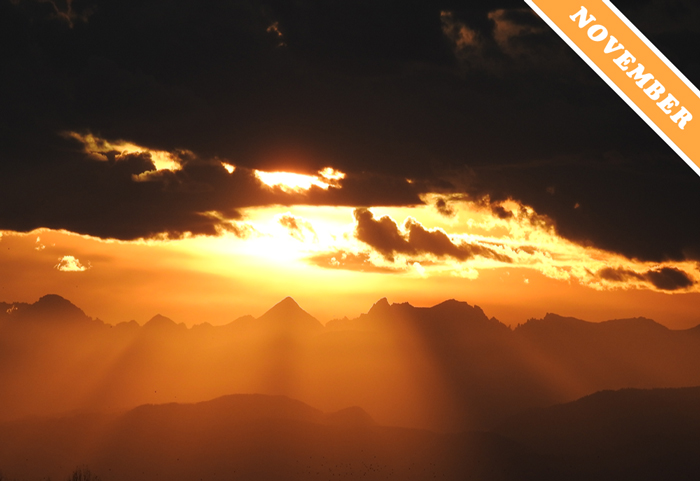
You know those glorious fingers of sunlight that sometimes burst out from behind clouds? They’re called ‘crepuscular rays’, they form when light and shadow are rendered visible by haze in the atmosphere and these photographed by Alli Bush over Fort Collins, Colorado, US, are the Cloud of the Month for November.
The haze giving rise to crepuscular rays can be due to the air being filled with fine particles such as sand, dust or pollen. Or it can result from a delicate mist of water droplets – plentiful enough to scatter the sunlight but too scarce to show up as a cloud. The scattering is the important bit. Since we only see light that shines directly into our eyes, rays of sunlight shining in other directions are not visible unless they encounter something that scatters light towards us. Think of shining a torch beam on a clear night. The light only appears where it strikes a surface such as the ground. But on a foggy night, the full torch beam shows up because some light is also scattered towards us by the droplets of fog in the air it passes through. This is why a hazy sky renders rays of sunlight visible.
The other requisite for crepuscular rays besides haze is something to cast the shadows. Most commonly it is a cloud blocking the sunlight that creates the regions of light and shadow we see in the sky. But the crepuscular rays in Alli’s photograph are cast not by clouds but by the peaks of the Rocky Mountains. The rays fan outwards because they are coming towards the camera. In fact, the Sun’s rays are actually pretty much parallel by the time they reach Earth. They only appear to spread out like this because of the effect of perspective. It is just like looking down the length of train tracks. Even though they are parallel, they appear to spread outwards the nearer they are. Only when the sun is high in the sky so that its rays are pointing more directly downwards do crespuscular rays look parallel.
The photograph comes from the website of The Cloud Appreciation Society of which I am a lowly member. Thus it was that in my in-box yesterday was their latest newsletter. In that newsletter there was the following stunning film, described thus:
This month, we were sent an amazing film of storms over Arizona, US. It was made by Davo Laninga, Cloud Appreciation Society Member No 1,095. You can learn a lot about how storms develop by watching time-lapse videos. Well done, Davo, for this stunning example, showing the monumental power that drives our atmosphere.
Do drop in to Dave’s website and admire his incredible photographs and videos.
In Chapter Eight, Behaviours and Relationships, I speak of how the development of humans has been, unsurprisingly, the result of our human behaviours. Adding that it is likely that our behaviours have been damaging, in varying degrees, to the survival of our species and countless others for a very long time. Continuing:
But 2,000 years ago, the global population of man was only 300 million persons[1]. It took 1,200 years for that global population to become 1 billion persons; in 1800. Now track the intervals as we come forward in time.
In 1927, just 127 years later, the two-billionth baby was born. In 1960, only 33 years on, came the birth of the three-billionth baby. Just 16 years later, in 1974, the four-billionth baby was born. In 1987, now only 13 years later, we have a population of five billion persons. Around October 1999, the sixth-billionth baby was born.
The growth rate of global population is slowing[2] but nevertheless it is trending to a billion additional persons every decade. In other words, a 100-million population growth every year, or about 270,000 more persons every single day.
Combine man’s behaviours rooted in times way back with this growth in population and we have the present situation. A totally unsustainable situation for one basic and fundamental reason. We all live on a finite planet.
[1] http://en.wikipedia.org/wiki/Population_growth
[2] According to UN’s 2010 revision to its population projections, world population will peak at 10.1bn in 2100 compared to 7bn in 2011. A 2014 paper by demographers from several universities and the United Nations Population Division forecast that the world’s population will reach about 10.9 billion in 2100 and continue growing thereafter. However, some experts dispute the UN’s forecast and have argued that birthrates will fall below replacement rate in the 2020s. According to these forecasters, population growth will be only sustained till the 2040s by rising longevity but will peak below 9bn by 2050.
A growth of about 270,000 more persons every single day!
I am sure that I am not alone in seeing this growth in our population as something that is both unsustainable and a critical component of long-term damage to our planet.
But George Monbiot in a recent essay, in true Monbiot style, highlights an aspect of our human population and the damage resulting that would have never previously occurred to me.
Read it and see if you don’t agree likewise. (Again, there are just too many links in George’s essay to reconstruct in this republishing and, as the other day, I have highlighted those phrases that are a link to other material in red. Go here if you wish to further investigate those links.)
ooOOoo
Pregnant Silence
19th November 2015
It’s about time we discussed the real population crisis.
By George Monbiot, published in the Guardian 18th November 2015
This column is about the population crisis. About the breeding that’s laying waste to the world’s living systems. But it’s probably not the population crisis you’re thinking of. This is about another one, that we seem to find almost impossible to discuss.
You’ll hear a lot about population in the next three weeks, as the Paris climate summit approaches. Across the airwaves and on the comment threads it will invariably be described as “the elephant in the room”. When people are not using their own words, it means they are not thinking their own thoughts. Ten thousand voices each ask why no one is talking about it. The growth in human numbers, they say, is our foremost environmental threat.
At their best, population campaigners seek to extend women’s reproductive choices. Some 225 million women have an unmet need for contraception. If this need were answered, the impact on population growth would be significant, though not decisive: the annual growth rate of 83 million would be reduced to 62m (1). But contraception is rarely limited only by the physical availability of contraceptives. In most cases, it’s about power: women are denied control of their wombs. The social transformations they need are wider and deeper than donations from the other side of the world are likely to achieve.
At their worst, they seek to shift the blame from their own environmental impacts. Perhaps it’s no coincidence that so many post-reproductive white men are obsessed with human population growth, as it’s about the only environmental problem of which they can wash their hands. Nor, I believe, is it a coincidence that of all such topics this is the least tractable. When there is almost nothing to be done, there is no requirement to act.
Such is the momentum behind population growth, an analysis in the Proceedings of the National Academy of Sciences discovered, that were every government to adopt the one-child policy China has just abandoned, there would still be as many people on Earth at the end of this century as there are today. If two billion people were wiped out by a catastrophe in mid-century, the planet would still hold a billion more by 2100 than it does now.
If we want to reduce our impacts this century, the paper concludes, it’s consumption we must address. Population growth is outpaced by the growth in our consumption of almost all resources. There is enough to meet everyone’s need, even in a world of 10 billion people. There is not enough to meet everyone’s greed, even in a world of 2 billion people.
So let’s turn to a population crisis over which we do have some influence. I’m talking about the growth in livestock numbers. Human numbers are rising at roughly 1.2% a year. Livestock numbers are rising at around 2.4% a year. By 2050, the world’s living systems will have to support about 120m tonnes of extra human, and 400m tonnes of extra farm animals(2).
Raising them already uses three quarters of the world’s agricultural land. One third of our cereal crops are used to feed them. This may rise to roughly half by 2050. More people will starve as a result, because the poor rely mainly on grain for their subsistence, and diverting it to livestock raises the price. Now the grain that farm animals eat is being supplemented by oil crops, particularly soya, for which the forests and savannahs of South America are being cleared at shocking rates.
This might seem counter-intuitive, but were we to eat soya, rather than meat, the clearance of natural vegetation required to supply us with the same amount of protein would decline by 94%. Producing protein from chickens requires three times as much land as protein from soybeans. Pork needs nine times, beef 32 times.
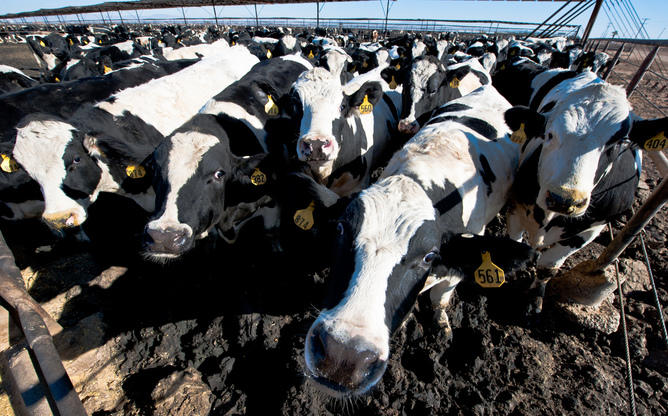
A recent paper in the journal Science of the Total Environment suggests that our consumption of meat is likely to be “the leading cause of modern species extinctions”. Not only is livestock farming the major reason for habitat destruction and the killing of predators, but its waste products are overwhelming the world’s capacity to absorb them. Factory farms in the US generate 13 times as much sewage as the human population. The dairy farms in Tulare county, California produce five times as much as New York City.
Freshwater life is being wiped out across the world by farm manure. In England, as I reported last week, the system designed to protect us from the tide of crap has comprehensively broken down. Dead zones now extend from many coasts, as farm sewage erases ocean life across thousands of square kilometres.
Livestock farming causes around 14% of the world’s greenhouse gas emissions: slightly more than the output of the world’s cars, lorries, buses, trains, ships and planes. If you eat soya, your emissions per unit of protein are 20 times lower than eating pork or chicken, and 150 times lower than eating beef.
So why is hardly anyone talking about the cow, pig, sheep and chicken in the room? Why are there no government campaigns to reduce the consumption of animal products, just as they sometimes discourage our excessive use of electricity? A survey by the Royal Institute of International Affairs found that people are not unwilling to change their diets, once they become aware of the problem, but that many have no idea that livestock farming damages the living world.
It’s not as if eating less meat and dairy will harm us. If we did as our doctors advise, our environmental impacts would decline in step with heart disease, strokes, diabetes and cancer. British people eat, on average, slightly more than their bodyweight in meat every year, while Americans consume another 50%: wildly more, in both cases, than is good for us or the rest of life on Earth.
But while plenty in the rich world are happy to discuss the dangers of brown people reproducing, the other population crisis scarcely crosses the threshold of perception. Livestock numbers present a direct moral challenge, as in this case we have agency. Hence the pregnant silence.
While the number of unintended pregnancies would fall by 52m (or 70%), this does not mean that the number of babies would fall by the same amount. The Guttmacher/UNFPA report breaks down the outcome thus: “21 million fewer unplanned births; 24 million fewer abortions; six million fewer miscarriages; and 0.6 million fewer stillbirths.”
Additional global meat consumption by this date is estimated to be roughly 200 million tonnes. Boned meat comprises roughly half the weight of a living animal. So total additional livestock biomass will be in the order of 400 million tonnes, or 400 billion kg. The average human weight is 52 kg and the anticipated rise in population by 2050 is 2.3 billion (the median estimate is 9.7 billion by that date). So the additional human weight is likely to be somewhere around 120 billion kg.
ooOOoo
Powerful reasons to turn vegetarian or vegan. And well done if you are already there. Well done, indeed!
A video on YouTube raises some fundamental questions about our changing climate.
Let me say straight away that my belief in Anthropogenic Global Warming (AGW) is based on instinct, and not on me understanding the science, simply because I am not a scientist; far from it! As I share on this blog:
Paul Handover is a child of the post-war era in Great Britain having been born in London a few months before the end of WWII. After a rather shaky attempt at being educated, including 2 years studying for a Diploma in Electrical Engineering, Paul’s first job was as a commercial apprentice at the British Aircraft Corporation. He then joined the sales desk of British Visqueen, a polythene film and products manufacturer located in Stevenage, Hertfordshire, and part of ICI Plastics Division. In 1968, he travelled out to Sydney, Australia and became part of the sales team at ICIANZ’s Inorganic Chemicals Division.
I am a fundamentally a retired salesman/entrepreneur with a very out-of-date knowledge of electrical engineering and radio communications (G3PUK), and now struggling to be an author. 😉
Plus, my generally sceptical view of how countries are governed, my awareness of a terrible lack of integrity in politicians, plays to those instincts of mine that humanity is, indeed, responsible primarily for our changing climate. And there is no shortage of supporting evidence!
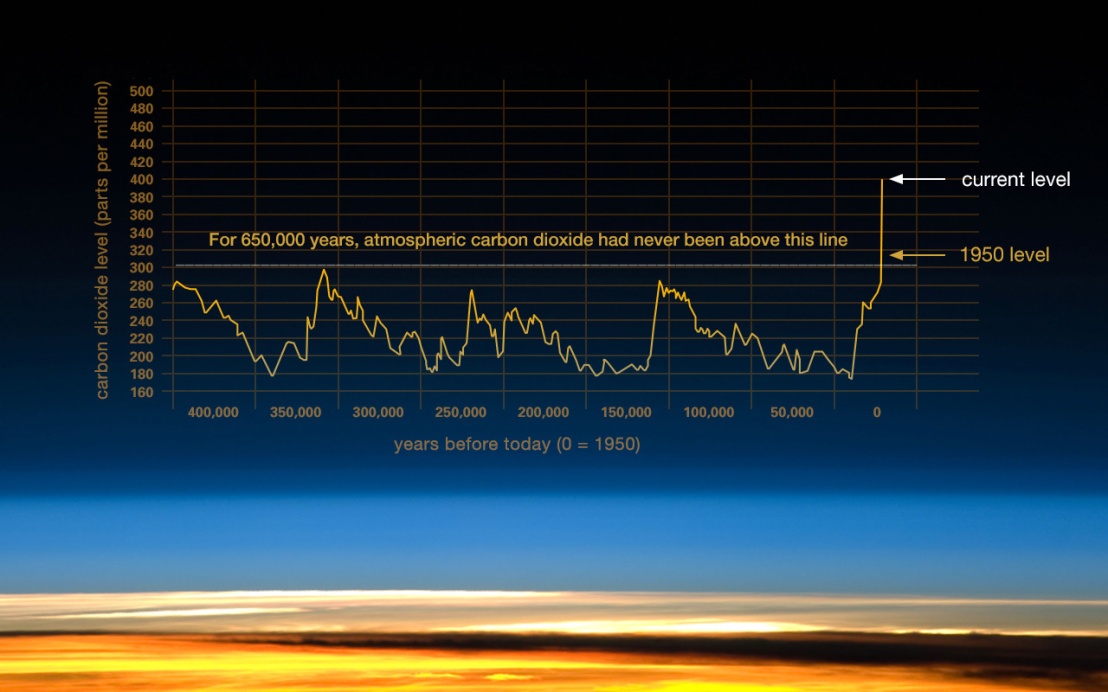
A very quick web search found this NASA site that included the following graph and text (in part):
This graph, based on the comparison of atmospheric samples contained in ice cores and more recent direct measurements, provides evidence that atmospheric CO2 has increased since the Industrial Revolution. (Credit: Vostok ice core data/J.R. Petit et al.; NOAA Mauna Loa CO2 record.)
The Earth’s climate has changed throughout history. Just in the last 650,000 years there have been seven cycles of glacial advance and retreat, with the abrupt end of the last ice age about 7,000 years ago marking the beginning of the modern climate era — and of human civilization. Most of these climate changes are attributed to very small variations in Earth’s orbit that change the amount of solar energy our planet receives.
Scientific Consensus
Ninety-seven percent of climate scientists agree that climate-warming trends over the past century are very likely due to human activities, and most of the leading scientific organizations worldwide have issued public statements endorsing this position.
Click here for a partial list of these public statements and related resources.
However, a dear and close friend of nearly 40 years, Dan Gomez, is sceptical and simply says to me: “Paul, follow the money!” Dan is a very widely-read person and a great thinker.
Plus, among our wonderful neighbours there is a couple, Dordie and Bill, that we get on with extremely well. Bill is a sceptic of AGW and recently sent me the link to the following video.
Please watch it. If you have evidence that all or many of the facts on this video are incorrect then I would love to hear from you.
For this is way too important for the truth not to be widely promoted.
Sometimes, one just has to hold one’s head in shame ….
… at the madness that we humans are capable of.
I included this sub-heading in the draft of this post last Thursday intending to make it Friday’s post then changed my mind. Hence the reason behind me writing in Friday’s post:
I was looking at a recent George Monbiot essay and getting myself all wound up about it, thinking that it should be today’s post. Then I thought, “Come on, Paul, end the week on a gentle tone.”
In the light of events in Paris last Friday, I had no idea how pertinent my sub-heading was!
What wound me up, so to speak, was a recent essay from George Monbiot about the damage being done to a Devon river; the River Culm. This river was known to me in the days that I lived in South Devon and had my Piper Super Cub based at Dunkeswell Airfield that was not far from the Culm.
Dunkeswell Airfield
So with no further ado, here is George Monbiot’s essay republished with Mr. Monbiot’s kind permission.
ooOOoo
Strategic Incompetence
12th November 2015
The agencies supposed to protect the living world have been neutered, and polluters and wildlife destroyers now have a free hand.
By George Monbiot, published on the Guardian’s website 12th November 2015
It could scarcely have been a starker case. The river I came across in Devon six weeks ago, and described in the Guardian, was so polluted that I could smell it from 50 metres away. Farm slurry pouring into the water, from a pipe that I traced back to a dairy farm, had wiped out almost all the life in the stretch of River Culm I explored.
All that now grew on the riverbed were long, feathery growths of sewage fungus. An expert on freshwater pollution I consulted told me that the extent of these growths showed the poisoning of the river was “chronic and severe”.
Here, as a reminder of what I saw, are some of the pictures I took:
Sewage fungus covering the river bed.
Slurry pouring from a pipe cut into the riverbank:
Slurry outfall just above the river.
And mingling with the clear water of the river:
The slurry entering the river.
I reported the pollution to the Environment Agency’s hotline. It told me it was taking the matter seriously. So when I received its report on the outcome of its investigation, I nearly fell off my chair.
It had decided to take no action against the farmer, as “the long term ecological impacts on the environment were fortunately low”. How did it know? Because there was “no evidence of a fish kill”.
Why in the name of all that’s holy should there be evidence of a fish kill? This is a chronic pollution case, not an acute one. Fish kills are what you see when a sudden poisoning occurs, as pollutants are flushed into a healthy living system. Chronic pollution deprives fish of their habitats and prey, but no investigator in their right mind would expect to see them floating belly up in the river as a result. They are simply absent from places where you would otherwise have found them.
And if a riverbed covered in nothing but sewage fungus suggests a “low” ecological impact, I dread to think what a high one looks like.
The same inability to distinguish between an acute event and a chronic one was revealed by another of the agency’s statements: the pollution “had a short term impact”. The slurry had plainly been pouring out of the pipe for months, as the luxuriant growths of sewage fungus show. It would doubtless have continued, had I not reported it.
The Environment Agency also told me that it had inspected the farm, and found no problems with the infrastructure, as there was plenty of space for slurry storage under the floor of the barn where the cows were kept. But, the problem, as I had explained to them, had nothing to do with slurry storage in the barn. It was caused by leakage from the outdoor slurry lagoons, where I found cow manure pouring down the hill.
They could scarcely have made a bigger mess of their investigation if they had tried. The mistakes the agency made are so fundamental and so obvious that it makes me wonder whether they are mistakes at all. What does a farmer have to do to get prosecuted these days, detonate an atom bomb?
If this were an isolated case, you could put it down to ineptitude, albeit ineptitude raised to the status of an Olympic sport. But responses like this are now the norm at the Environment Agency. It has been so brutally disciplined by cuts and by ministers’ demands that it leave farms and other businesses alone that it is now almost incapable of enforcement.
Even when the fish kills it appears to see as the only real proof of pollution do occur, in the great majority of cases it doesn’t even bother to assess them, let alone investigate and prosecute. Freedom of information requests by the environmental group Fish Legal reveal that the agency sent its investigators to visit just 16% of reported fish kills.
There was massive regional variation. While in the Anglian Central region, covering parts of Norfolk, Cambridgeshire and surrounding counties, the agency inspected 61% of these events, in Devon they investigated only 3%. (I suspect that it was only because I’m a journalist for a national newspaper that they came out at all in the case I reported). In the fishery areas on either side of it – Cornwall and Wessex – the inspection rate was, er, 0%. If you want to pollute rivers in these regions, there’s nothing stopping you.
The Environment Agency no longer prosecutes even some of the most extreme pollution events. In 2013, a farmer in Somerset released what the agency called a “tsunami of slurry” into the Wellow Brook. One inspector said it was the worst pollution she had seen in 17 years. But the agency dithered for a year before striking a private agreement with the farmer, allowing him to avoid prosecution, a criminal record, a massive fine and court costs, by giving £5000 to a local charity.
New rules imposed by the government means that such under-the-counter deals, which now have a name of their own – enforcement undertakings – are likely to become more common. They are a parody of justice: arbitrary, opaque and wide open to influence-peddling, special pleading and corruption.
I see the agency’s farcical investigation of the pollution incident I reported as strategic incompetence, designed to avoid conflict with powerful landowners. Were it to follow any other strategy, it would run into trouble with the government.
These problems are likely to become even more severe, when the new cuts the environment department (Defra) has just agreed with the Treasury take effect. An analysis by the RSPB and the Wildlife Trusts reveals that, once the new reductions bite, the government’s spending on wildlife conservation, air quality and water pollution will have declined by nearly 80% in real terms since 2009/10.
It’s all up for grabs now: if you want to wreck the living world, the government is not going to stop you. Those who have power, agency, money or land can – metaphorically and literally – dump their crap on the rest of us.
Never mind that the government is now breaking European law left right and centre, spectacularly failing, for example, to ensure that all aquatic ecosystems are in good health by the end of this year, as it is supposed to do under the water framework directive. It no longer seems to care. It would rather use your tax money to pay fines to the European Commission than enforce the law against polluters.
I’ve heard the same description of Liz Truss, the secretary of state for environment, who oversees the work of the Environment Agency, from several people over the past few months. “Worse than Owen Paterson”. At first, I refused to take it seriously. It’s the kind of statement that is usually employed as hyperbole, such as “somewhere to the right of Genghis Khan”, or “more deluded than Tony Blair”. But in this case, they aren’t joking. Preposterous as the notion of any environment secretary being worse than Mr Paterson might seem, they mean it.
Nowhere, as far as I can discover, in Liz Truss’s speeches or writing before she was appointed, is there any sign of prior interest in the natural world or its protection. What we see instead is perhaps the most extreme manifestation of market fundamentalism on this side of the Atlantic. She founded the Conservative Free Enterprise Group, and was co-author of the book Britannia Unchained, that laid out a terrifying vision of a nation run by raw economic power, without effective social or environmental protection. Now she has a chance to put that vision into practice.
Those who have tried to engage with her describe her as indissolubly wedded to a set of theories about how the world should be, that are impervious to argument, facts or experience. She was among the first ministers to put her own department on the block in the latest spending review, volunteering massive cuts. She seems determined to dismantle the protections that secure our quality of life: the rules and agencies defending the places and wildlife we love.
Bureaucracy and regulation are concepts we have been taught to hate, through relentless propaganda in the media. But they are essential pillars of civilisation. They make the difference between a decent society and a barbarous one.
While this essay from Monbiot clearly concerns a river in the South-West of England and may therefore not relate to readers in other parts of the UK or the world, those closing sentences [my emphasis] do relate to all of us wherever we are on this planet.
Bureaucracy and regulation are concepts we have been taught to hate, through relentless propaganda in the media. But they are essential pillars of civilisation. They make the difference between a decent society and a barbarous one.
Tomorrow, I will return to Piper Cubs flying out of Dunkeswell!













 Learning from Dogs