Category: Environment

The Lost World of Lake Vostok

A breath-taking film from the BBC Horizon series about a vast hidden lake under the Antarctic ice sheet.

My apologies for putting very little effort into today’s Post.  It’s because Jean and I will be in Phoenix for much of Tuesday (I’m writing this on Monday, 7th!) and it felt easier on me to drop this in for your elucidation than try and write something in a scrabble on Tuesday evenning.

Jean and I watched this last week-end and, …. well just watch it!

It sometimes seems as if our planet has no secrets left – but deep beneath the great Antarctic ice sheet scientists have made an astonishing discovery. They’ve found one of the largest lakes in the world. It’s very existence defies belief. Scientists are desperate to get into the lake because its extreme environment may be home to unique flora and fauna, never seen before, and NASA are excited by what it could teach us about extraterrestrial life. But 4 kilometers of ice stand between the lake and the surface, and breaking this seal without contaminating the most pristine body of water on the planet is possibly one of the greatest challenges science faces in the 21st century.

In 1957 the Russians established a remote base in Antarctica – the Vostok station. It soon became a byword for hardship – dependent on an epic annual 1000km tractor journey from the coast for its supplies. The coldest temperature ever found on Earth (-89°C) was recorded here on the 21st July 1983. It’s an unlikely setting for a lake of liquid water. But in the 1970’s a British team used airborne radar to see beneath the ice, mapping the mountainous land buried by the Antarctic ice sheet. Flying near the Vostok base their radar trace suddenly went flat. They guessed that the flat trace could only be from water. It was the first evidence that the ice could be hiding a great secret.

But 20 years passed before their suspicions were confirmed, when satellites finally revealed that there was an enormous lake under the Vostok base. It is one of the largest lakes in the world – at 10,000 square km it’s about the extent of Lake Ontario, but about twice as deep (500m in places). The theory was that it could only exist because the ice acts like a giant insulating blanket, trapping enough of the earth’s heat to melt the very bottom of the ice sheet.

That little old word ‘truth’.

Truth: the true or actual state of a matter.

Well nothing complicated about the definition, is there!  If only society was equally motivated by getting to the truth of climate change.  Yes, I know I’m being naive!

Why my mini-rant?

I’m well in to James Hansen’s book Storms of my Grandchildren and it’s confirming my fears about the issues that are facing mankind now!  But more of that later.

What triggered me putting ‘pen to paper’ was a recent report from the Yale forum on climate change and the media.  Here’s how it opened,

Scientific Consensus Stronger than Scientists Thought?

Bruce Lieberman   May 2, 2012

More than two decades after the Intergovernmental Panel on Climate Change (IPCC) began publishing the latest scientific consensus on the globe’s changing climate, widespread doubts persist in the U.S. over whether there really is widespread agreement among scientists. It’s the primary argument of those who deny basic scientific foundations of warming.

But new and innovative survey results suggest the consensus among scientists might actually be stronger than the scientists themselves had thought.

The battles to define and debunk scientific consensus over climate change science have been fought for years. In 2004, University of California San Diego science historian Naomi Oreskes wrote about a broad consensus she found after studying 928 scientific papers published between 1993 and 2003.

But what I found deeply fascinating was that later on Bruce Lieberman, the report’s author, lists in detail the actual levels of agreement compared to the perceived levels.  To make it easier to take in, I have amended the telling differences to italic.

In sum, the newly released poll results identified surprisingly common points of agreement among climate scientists; and yet for each point, those scientists underestimated the amount of agreement among their colleagues. The results:

  • Human activity has been the primary cause of increases in global average air and ocean temperatures in the last 250 years. (About 90 percent of respondents agreed with this characterization, but those respondents estimated that less than 80 percent of their scientist colleagues held that view.)
  • If governmental policies do not change, the CO2 concentration in the atmosphere will exceed 550 parts per million between 2050 and 2059. (More than 30 percent agreed, but those respondents estimated that just over 20 percent of their peers held that view.)
  • If and when atmospheric CO2 concentrations reach 550 ppm, the increase in global average surface temperature relative to the year 2000 will be 2-3 degrees Celsius, or 3.2-4.8 F. (More than 40 percent agreed, but those respondents estimated that less than 30 percent held that view.)
  • If governmental policies do not change, in the year 2050, the increase in global average surface temperature relative to the year 2000 will be 1.5-2 degrees Celsius, or 2.4-3.2 F). (More than 35 percent agreed, but those respondents estimated that just over 30 percent held that view.)
  • The likelihood that global average sea level will rise more during this century than the highest level given in the 2007 assessment of the IPCC (0.59 meters, 23.2 inches) is more than 90 percent. (More than 30 percent agreed, but those respondents estimated that less than 20 percent held that view.)
  • Since 1851, the U.S. has experienced an average of six major hurricane landfalls (> 111 mph) per decade. The total number of major hurricane landfalls in the U.S. from 2011-2020 will be seven to eight. (Nearly 60 percent agreed, but those respondents estimated that just over 30 percent held that view.)
  • The total number of major hurricane landfalls in the U.S. from 2041 to 2050 will be seven to eight. (About 35 percent agreed, but those respondents estimated that less than 30 percent held that view.)
  • Given increasing levels of human activity, the concentration of CO2 in the atmosphere can be kept below 550 ppm with current technology — but only with changes in government policy. (Nearly 70 percent agreed, but those respondents estimated that just over 50 percent held that view.)

Now back to Hansen’s book.  Here’s what Hansen writes starting on p.144,

Getting to the truth!

Sea level rise is one of the two climate impacts that I believe should be at the top of the list that defines what is “dangerous,” on any time scale that humanity can imagine.  Ice sheets take thousands of years to build up from snowfall.  Reasonable “adaptation” to a large sea level rise is nearly impossible, because once ice sheets begin to rapidly disintegrate, sea level would be continually changing for centuries.  Coastal cities would become impractical to maintain.

The other climate change impact at the top of my “dangerous” list is extermination of species.  Human activities already have increased the rate of species extinctions far above the natural level.  Extinctions are occurring as humans take over more and more of the habitat of animal and plant species.  We deforest large regions, replace biologically diverse grasslands and forests with monoculture crops, and introduce foreign, invasive animal and plant species that sometimes wipe out the native ones.

Hansen points out that about a billion people live at elevations less than 25 metres (81 feet).

I included a short video of James Hansen in a Learning from Dogs Post just a few days ago.  You’ll find it here – go and watch it – and think about the truth!

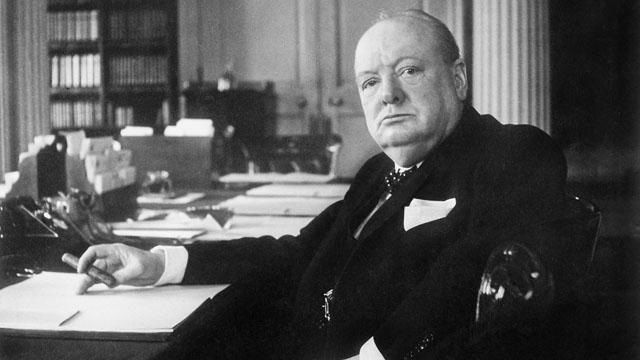
Photo: Winston Churchill, photographed by Cecil Beaton, at 10 Downing Street, London, in 1940.

Men stumble over the truth from time to time, but most pick themselves up and hurry off as if nothing happened.– Winston Churchill

Planet Earth is whispering to us!

Just because it’s non-verbal doesn’t mean it isn’t clear!

This is another full republication of a recent Tomgram from Tom Engelhardt.  As I have said previously, I count myself as very lucky to have had Tom give me blanket permission to reproduce his excellent essays.  This one is no exception to the others that I have presented on Learning from Dogs.

But before I go to the Tomgram that was published on Tom Dispatch last Thursday, let me gently expand on what was on my mind when I wrote the sub-heading: Just because it’s non-verbal doesn’t mean it isn’t clear!

The animals that man forms close relationships with are able to ‘read’ us in many exquisite ways.  Dogs, in particular, seem to sense the mood and temperament of humans especially well.  Indeed, I am frequently open-mouthed at the way that Pharaoh senses, almost before I am conscious of it, that I am a little mentally ‘pre-occupied’.  Most of the dogs that live around me and Jean show very clearly that they know when life isn’t running normally.

The reason I have strayed into this rather subjective place is that it doesn’t take too much to drift away and imagine that our beautiful planet is ‘speaking’ to us that she is hurting.  OK, better stop there and let Tom and Bill McKibben speak better sense!

Oh, and because this was written ahead of the global day of action last Saturday, you will need to take that into account about two-thirds of the way through.

oooOOOooo

Tomgram: Bill McKibben, The Most Important Story of Our Lives

Posted by Bill McKibben at 9:39am, May 3, 2012.

By now, it’s already deep election season, the beginning of the culmination of a cycle that commenced the day after (or even the day before) the previous presidential election. In the meantime, the endless polls appear — you can check Obama’s approval rating or the state of the presidential horserace any time, night or day — and the media goes ballistic handicapping the odds or discussing the presidential cat fight.  Each side’s handlers take out after the other’s, and increasingly, the corporate dollars pour in (another form of handicapping, or maybe just plain old knee-capping).  You know the routine.  These days, with the election a mere six months away, Romney/Obama “analysis” and prediction is already in the stratosphere and no issue, from war to a blind self-taught Chinese lawyer escaping to the American embassy in Beijing, is election-proof.

It’s all grist for the mill and who in Washington isn’t reading the polls the way a New Ager might read Tarot cards?  So when President Obama suddenly starts talking — quite voluntarily — about global warming as a campaign issue, you know something’s up.  What’s up, it turns out, is public concern over climate change after years of polling in which Americans claimed to be ever less worried about the phenomenon.

No one should be surprised, given this overheated year in North America, as Bill McKibben points out in today’s post.  In fact, in the latest climate-change polling, 63% of respondents believe “the United States should move forward to reduce greenhouse gas emissions, regardless of what other countries do.”  In another recent poll, 65% of Americans backed the idea of “imposing mandatory controls on carbon dioxide emissions/other greenhouse gases” (as 75% now support regulating carbon dioxide as a “pollutant”).

This is something new in America.  Times, like the weather, are evidently a-changin’. And the president has noticed this, especially since he’s facing an opponent who, last fall, went on the record this way: “My view is that we don’t know what’s causing climate change on this planet.  And the idea of spending trillions and trillions of dollars to try to reduce CO2 emissions is not the right course for us.”

So this may be a bullish campaign season for climate change.  “I suspect,” said the president, “that over the next six months, this is going to be a debate that will become part of the campaign, and I will be very clear in voicing my belief that we’re going to have to take further steps to deal with climate change in a serious way.”  It could even help win him the election, if this summer and fall prove just as weather-freaky as our North American winter and spring have been, leaving Republican climate-change deniers and prevaricators in the dust.

If, in a far less propitious political moment, one person put climate change back on the White House agenda and made the president attend to it, that would be TomDispatch regular Bill McKibben.  The campaign of mass action he launched against the Keystone XL Pipeline and the particularly “dirty” form of energy it was slated to bring from Canada to the U.S. Gulf coast proved crucial. Let’s hope, like the cavalry, that he arrived in the nick of time. Tom

Too Hot Not to Notice?
A Planet Connected by Wild Weather 

By Bill McKibben

The Williams River was so languid and lovely last Saturday morning that it was almost impossible to imagine the violence with which it must have been running on August 28, 2011. And yet the evidence was all around: sand piled high on its banks, trees still scattered as if by a giant’s fist, and most obvious of all, a utilitarian temporary bridge where for 140 years a graceful covered bridge had spanned the water.

The YouTube video of that bridge crashing into the raging river was Vermont’s iconic image from its worst disaster in memory, the record flooding that followed Hurricane Irene’s rampage through the state in August 2011.  It claimed dozens of lives, as it cut more than a billion-dollar swath of destruction across the eastern United States.

I watched it on TV in Washington just after emerging from jail, having been arrested at the White House during mass protests of the Keystone XL pipeline.  Since Vermont’s my home, it took the theoretical — the ever more turbulent, erratic, and dangerous weather that the tar sands pipeline from Canada would help ensure — and made it all too concrete. It shook me bad.

And I’m not the only one.

New data released last month by researchers at Yale and George Mason universities show that a lot of Americans are growing far more concerned about climate change, precisely because they’re drawing the links between freaky weather, a climate kicked off-kilter by a fossil-fuel guzzling civilization, and their own lives. After a year with a record number of multi-billion dollar weather disasters, seven in ten Americans now believe that “global warming is affecting the weather.” No less striking, 35% of the respondents reported that extreme weather had affected them personally in 2011.  As Yale’s Anthony Laiserowitz told theNew York Times, “People are starting to connect the dots.”

Which is what we must do. As long as this remains one abstract problem in the long list of problems, we’ll never get to it.  There will always be something going on each day that’s more important, including, if you’re facing flood or drought, the immediate danger.

But in reality, climate change is actually the biggest thing that’s going on every single day.  If we could only see that pattern we’d have a fighting chance. It’s like one of those trompe l’oeil puzzles where you can only catch sight of the real picture by holding it a certain way. So this weekend we’ll be doing our best to hold our planet a certain way so that the most essential pattern is evident. At 350.org, we’re organizing a global day of action that’s all about dot-connecting; in fact, you can follow the action at climatedots.org.

The day will begin in the Marshall Islands of the far Pacific, where the sun first rises on our planet, and where locals will hold a daybreak underwater demonstration on their coral reef already threatened by rising seas. They’ll hold, in essence, a giant dot — and so will our friends in Bujumbura, Burundi, where March flooding destroyed 500 homes. In Dakar, Senegal, they’ll mark the tidal margins of recent storm surges.  In Adelaide, Australia, activists will host a “dry creek regatta” to highlight the spreading drought down under.

Pakistani farmers — some of the millions driven from their homes by unprecedented flooding over the last two years — will mark the day on the banks of the Indus; in Ayuthaya, Thailand, Buddhist monks will protest next to a temple destroyed by December’s epic deluges that also left the capital, Bangkok, awash.

Activists in Ulanbataar will focus on the ongoing effects of drought in Mongolia.  In Daegu, South Korea, students will gather with bags of rice and umbrellas to connect the dots between climate change, heavy rains, and the damage caused to South Korea’s rice crop in recent years. In Amman, Jordan, Friends of the Earth Middle East will be forming a climate dot on the shores of the Dead Sea to draw attention to how climate-change-induced drought has been shrinking that sea.

In Herzliya, Israel, people will form a dot on the beach to stand in solidarity with island nations and coastal communities around the world that are feeling the impact of climate change. In newly freed Libya, students will hold a teach-in.  In Oman, elders will explain how the weather along the Persian Gulf has shifted in their lifetimes. There will be actions in the cloud forests of Costa Rica, and in the highlands of Peru where drought has wrecked the lives of local farmers.  In Monterrey, Mexico, they’ll recall last year’s floods that did nearly $2 billion in damage. In Chamonix, France, climbers will put a giant red dot on the melting glaciers of the Alps.

And across North America, as the sun moves westward, activists in Halifax, Canada, will “swim for survival” across its bay to highlight rising sea levels, while high-school students in Nashville, Tennessee, will gather on a football field inundated by 2011’s historic killer floods.

In Portland, Oregon, city dwellers will hold an umbrella-decorating party to commemorate March’s record rains. In Bandelier, New Mexico, firefighters in full uniform will remember last year’s record forest fires and unveil the new solar panels on their fire station.  In Miami, Manhattan, and Maui, citizens will line streets that scientists say will eventually be underwater. In the high Sierra, on one of the glaciers steadily melting away, protesters will unveil a giant banner with just two words, a quote from that classic of western children’s literature, The Wizard of Oz. “I’m Melting” it will say, in letters three-stories high.

This is a full-on fight between information and disinformation, between the urge to witness and the urge to cover-up. The fossil-fuel industry has funded endless efforts to confuse people, to leave an impression that nothing much is going on.  But — as with the tobacco industry before them — the evidence has simply gotten too strong.

Once you saw enough people die of lung cancer, you made the connection. The situation is the same today.  Now, it’s not just the scientists and the insurance industry; it’s your neighbors. Even pleasant weather starts to seem weird.  Fifteen thousand U.S. temperature records were broken, mainly in the East and Midwest,in the month of March alone, as a completely unprecedented heat wave moved across the continent.  Most people I met enjoyed the rare experience of wearing shorts in winter, but they were still shaking their heads. Something was clearly wrong and they knew it.

The one institution in our society that isn’t likely to be much help in spreading the news is… the news. Studies show our papers and TV channels paying ever less attention to our shifting climate.  In fact, in 2011 ABC, CBS, NBC, and Fox spent twice as much time discussing Donald Trump as global warming. Don’t expect representatives from Saturday’s Connect the Dots day to show up on Sunday’s talk shows.  Over the last three years, those inside-the-Beltway extravaganzas have devoted 98 minutes total to the planet’s biggest challenge. Last year, in fact, all the Sunday talk shows spent exactly nine minutes of Sunday talking time on climate change — and here’s a shock: all of it was given over to Republican politicians in the great denial sweepstakes.

So here’s a prediction: next Sunday, no matter how big and beautiful the demonstrations may be that we’re mounting across the world, “Face the Nation” and “Meet the Press” won’t be connecting the dots. They’ll be gassing along about Newt Gingrich’s retirement from the presidential race or Mitt Romney’s coming nomination, and many of the commercials will come from oil companies lying about their environmental efforts. If we’re going to tell this story — and it’s the most important story of our time — we’re going to have to tell it ourselves.  

Bill McKibben, TomDispatch regular, and the author, most recently, of Eaarth: Making a Life on a Tough New Planet, is the founder of 350.org, which is coordinating Saturday’s Connect the Dots day.  You can find the event nearest you by checking climatedots.org.

Follow TomDispatch on Twitter @TomDispatch and join us on Facebook.

Copyright 2012 Bill McKibben

Couple of footnotes from yours truly.

Here’s that video that Bill mentions earlier,


This is an email that came from Bill McKibben earlier on Sunday morning (Arizona time).

Dear Friends,

This is a thank you note, a thank you note to the whole planet.

Except for the hours when I went out to the events nearest my home in Vermont, I’ve been by the computer, transfixed by the images streaming in.

From every corner of the earth people have been doing their best to Connect the Dots on climate change. And their best has been pretty amazing — we have photos from beneath the ocean waves and from high-altitude glaciers, from the middle of big cities fighting sea level rise and remote deserts battling drought.

Here’s one of the most vivid photos of the bunch — just a taste of what it feels like to have the water rising around you, and the tip of the iceberg of the creative masterworks of the past 24 hours:

Click here to see the amazing photos from the daywww.climatedots.org

We’re going to need you soon to fight the political battles that will make use of these images, but for the next day or two just relax, and enjoy the feeling of solidarity that comes from knowing there are millions of people thinking the same way, harboring the same fears and, more importantly, the same hopes.

On we go together.

With such gratitude,

Bill McKibben

P.S. There’s still time to submit photos for our slideshow and compilation video — just send your best photo as an email attachment to photos@350.org. Make your city and country the subject line of the email, and put your story and description in the body. So many thanks in advance!

A very full moon

Biggest full moon of 2012 occurs today!*

There are a number of news stories about this extra-special full moon but I’ve chosen to republish some of what appeared on the Mother Nature Network website.

In terms of the timing of this full moon, rather than give you times for various places around the world, as this website does, I will simply offer the UTC/GMT time:

Sunday 6th May 2012 at 03:35:06 am

If you want to covert that to your local time wherever you are on this beautiful planet The World Time Server is as good a website as any.

BIGGER THAN YOUR AVERAGE MOON: Skywatcher Tim McCord of Entiat, Washington caught this amazing view of the March 19, 2011 supermoon. (Photo: Tim McCord)

Skywatchers take note: The biggest full moon of the year is due to arrive this weekend.  And because this month’s full moon coincides with the moon’s perigee — its closest approach to Earth — it will also be the year’s biggest.

The moon will swing in 221,802 miles (356,955 kilometers) from our planet, offering skywatchers a spectacular view of an extra-big, extra-bright moon, nicknamed a supermoon.

And not only does the moon’s perigee coincide with full moon this month, but this perigee will be the nearest to Earth of any this year, as the distance of the moon’s close approach varies by about 3 percent, according to meteorologist Joe Rao, SPACE.com’s skywatching columnist. This happens because the moon’s orbit is not perfectly circular.

The full Moon will be up to 14% larger and 30% brighter than others during the year. The reason for this phenomenon is that the Moon becomes full on its closest approach to Earth on May 5, 2012, also known as the perigee full Moon.

So enjoy this most beautiful sight if you are somewhere on this planet where the moon will be visible at night.  And double-check the time and the day so you don’t miss it!  Finally, let me close by ‘spoiling’ my many readers in Arizona, and to serve as a good reminder for yours truly by saying that anyone on US Mountain Standard Time will see this moon at:

Saturday, 5th May 2012 at 20:35:06

Aim for the moon. If you miss, you may hit a star.” W. Clement Stone.

Not so common sense!

Sometimes one wonders what happened to common sense!

Today’s Post is motivated by a number of items that have crossed my screen over the last few days which when looked at collectively might remind one of the old saw, “You don’t have to be mad to work here, but it does help!

Sit with me, metaphorically, and allow me to muse.

First was a recent Post on 350 or bust that included the March 2012 TED Conference in Long Beach, California where NASA climate scientist Dr. James Hansen explains why he must speak out about climate change. (See the video later on.)  That Post refers to an item on Martin Lack’s Blog, Lack of Environment, where Martin as well as including the video below also lists the challenges that we on this single, finite planet face.  Here is that list,

  1. The Earth’s current energy imbalance is 0.6 Watts per sq.m.; a rate of energy input 20 times greater than the energy output of all human activity; and equivalent to the detonation of 400,000 Hiroshima-type atomic bombs every day.
  2. Since measurements began in 2003, there has been a noticeable acceleration in the annual rate of mass loss from both the Greenland and Antarctica ice caps.
  3. The last time atmospheric CO2 was 390 ppm, sea levels were 15 m higher than they are today, which implies even if we stopped burning all fossil fuels tomorrow, this is where they would end up several centuries from now because the warming “is already in the pipeline” (i.e. because the Earth must warm-up in order to restore its energy balance).
  4. Unless we stop burning fossil fuels soon, sea level rise will continue to accelerate, which is likely to cause between 1 and 5 metre rise by 2100AD (depending on how quickly we now decide to stop burning them).
  5. Palaeoclimatology tells us that 350 ppm is the safe limit for avoiding significant disruption to the planet’s ecological carrying capacity (i.e. in terms of both populations of individual species and overall biodivesity); and it now seems likely that between 20%-50% of all species will be “ticketed for extinction” by the end of the century.
  6. If we push the Earth beyond it’s “tipping point” (i.e. allow all the emerging positive feedback mechanisms to take hold); ACD will become unstoppable; and the ensuing socio-economic damage will be almost unimaginable. The total global cost of mitigation is already put at somewhere between 35 and 70 Trillion US Dollars depending on how soon we choose to act.
  7. If we had started to get off fossil fuels in 2005, it would have required 3% reduction per year in order to restore energy imbalance by 2100AD. If we start next year, it will require 6% p.a. If we wait 10 years it will require 15% p.a.
  8. Recent droughts in Texas, Oklahoma and New Mexico were 3 Standard Deviations outside the norm. Events such as these cannot therefore be ascribed to natural variability; anthropogenic climate disruption (ACD) is happening just as Hansen said it would 24 years ago (if we did not change course – which we haven’t).
  9. Pursuing emissions limits (i.e. Cap and Trade) will not work because there is no actual incentive to reduce emissions without any self-imposed restraint being to the advantage of others who do not do the same (i.e. the Tragedy of the Commons problem).
  10. Hansen uses the analogy of an approaching asteroid – the longer we wait to prevent it hitting us the harder it becomes to do so.

Do watch that Hansen video,

Second is that yesterday Martin Lack published an item that really does seem to endorse the view that there is no sign of intelligent life living on Planet Earth (not counting dogs!).

Think about it.  The planet is warming up.  The use of carbon-based fuels is a strong suspect, putting it mildly, of the rising levels of CO2 in our atmosphere, 394.45 on April 5th, so rather than change the incentives for using such fuels, we are taking advantage of  this warming planet causing the melt of the Arctic ice cap by allowing Shell to drill for oil in the Arctic.  But even crazier than that, Shell have contracted for a Finnish icebreaker to assist them in breaking up the ice!  (I really do feel a headache coming on!)

Greenpeace in the UK are running a campaign to stop this.

Sign up to save the Arctic

Let Shell know your feelings.

The pristine and beautiful Arctic: Shell wants to exploit it for oil. We want it protected.

Dozens of Greenpeace Nordic activists have boarded and occupied a Shell-contracted icebreaker in Helsinki harbour as it prepares to leave for the Alaskan Arctic.

Drilling in this fragile ecosystem – home to the polar bear, narwhal, Arctic fox and other iconic species – is unacceptable. A spill or accident in these waters would be disastrous and the harsh conditions would make responding to such a disaster almost impossible.

Demand Shell stop their plans to put the fragile Arctic and its biodiversity at risk.  We’ll keep you updated on our campaigns.

Write to Mr. Peter Voser.

Mr Peter Voser, Shell

The Arctic isn’t a place you can exploit, it’s a place we have to protect. Time and time again, experts have expressed serious doubts about the possibility of cleaning up an oil spill in the Arctic. The technical challenges posed by drilling there are obvious and no matter how much you try to convince people that your company can operate safely in such a harsh environment, we know the truth.

Because of this, I demand that you scrap your Arctic plans immediately.

Yours sincerely,

————–

By the end of this week we want 500,000 people shouting at Shell that it must end its campaign of Arctic destruction. Click here now[N.B. This is a time-sensitive campaign response – please visit Greenpeace website and enter your name and email address and they will email Shell on your behalf.]

We can change things! Together we can stop Shell and other oil companies from destroying the Arctic. Not everyone can board a ship to demand that change. But today, you can email Shell and ask them to stop drilling for oil and ask 10 of your friends to do the same. Together, we can save the Arctic!

Rosa Gierens
Greenpeace Nordic activist from Finland.

It’s not just an isolated instance of madness! Just a little over 10 days ago, I reported on President Obama’s support for the oil companies that threatens the polar bears, see “President Obama’s proposal for these magnificent and imperiled animals is a gift to Big Oil

In closing, luckily there are many voices being raised about putting an end to this madness; see the recent item from Patrice Ayme.  Hopefully, all these voices will bring about the changes to the way so many of us are governed.  As Patrice commented recently on Learning from Dogs, “Hope is the breathing of the planet“.  Maybe, just maybe, hope will win through.  No better put than by James Hansen,

Most impressive is the work of the Citizens Climate Lobby, a relatively new, fastgrowing, nonpartisan, nonprofit group with 46 chapters across the United States and Canada. If you want to join the fight to save the planet, to save creation for your grandchildren, there is no more effective step you could take than becoming an active member of this group.”
– Dr. James Hansen, head of Goddard Institute for Space Studies, NASA

Oh, and before I forget, a tornado touched down in Southern France!  Not common and not making sense!

More on healing.

Reflecting more than a casual interest in this fascinating topic.

Yesterday, I referred to a recent visit to my doctor and the ‘system’ not being able to address two aspects at the same time, Vestibular Migraine and possible memory issues.  Then later on, in response to a comment from Michelle of Dogkisses Blog, I owned up to having been advised that I may have early-onset Alzheimer’s Disease.

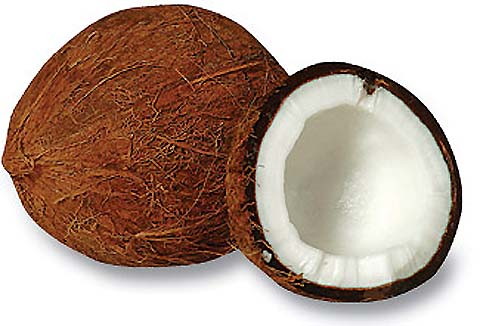
But very quickly friends responded to that ‘news’ by asking me if I had come across the information about coconut oil.  So here are my findings about the possible curative effects of coconut oil and, clearly, I wanted to draw this to the attention of as many people as I can.  Please feel free to republish this information; all I would ask is that you link back to the URL for this Post – thank you.

Let me take you to a website called Coconut Ketones and to a page on that website where there are a number of articles on the possible major healing effect of coconut oil.  The primary article, written in 2008, starts thus,

WHAT IF THERE WAS A CURE FOR ALZHEIMER’S DISEASE AND NO ONE KNEW?

A Case Study by Dr. Mary Newport

July 22, 2008

There is a growing epidemic of obesity, type II diabetes, cardiovascular disease, and predictions that 15,000,000 people in the United States alone will have Alzheimer’s Disease by the year 2050.

In 2001, Dr. Richard L. Veech of the NIH, and others, published an article entitled, “Ketone bodies, potential therapeutic uses.”1 In 2003, George F. Cahill, Jr. and Richard Veech authored, “Ketoacids? Good Medicine?”2 and in 2004, Richard Veech published a review of the therapeutic implications of ketone bodies.3 These articles are not found in journals that the average physician would read, much less the lay public. Unless you are researching the topic, it is unlikely that you would ever randomly come across this information.

My husband Steve, age 58, has had progressive dementia for at least five years. He had an MRI in May 2008 showing a diffuse involutional change of the frontal and parietal lobes and moderate left-sided and severe right-sided amygdala and hippocampal atrophy with no ischemic change, which would support a clinical diagnosis of Alzheimer’s Disease. For non-medical people, this means that he has shrunken areas of the brain. Many days, often for several days in a row, he was in a fog; couldn’t find a spoon or remember how to get water out of the refrigerator. Some days were not so bad; he almost seemed like his former self, happy, with his unique sense of humor, creative, full of ideas. One day I would ask if a certain call came that I was expecting and he would say, “No.” Two days later he would remember the message from so-and-so from a couple of days earlier and what they said. Strange to have no short-term memory and yet the information was filed somewhere in his brain. My gut feeling is that diet has something to do with the fluctuation, but what. I knew that he was locked up in there somewhere, if only there was a key to open up the areas of his brain that he didn’t have access to.

The article goes on to show the amazing and positive differences that came about for Steve as a result of incorporating coconut oil and other dietary aspects.  Please go here to view and download a pdf of the full article.  But I will give you the closing paragraphs.

If you are using any type of hydrogenated vegetable oil or any oil with transfat, do not use any more and get rid of it! Extra virgin olive oil, butter and other natural, non-hydrogenated oils are okay to use along with the coconut oil. It is possible to use coconut oil in place of all other oils, however, since it contains no omega-3 fatty acids, it is very important to eat salmon twice a week or get enough omega-3 fatty acid from other rich sources such as fish oil capsules, flax meal, flax oil (not for cooking) or walnuts.

It is inconceivable that a potential dietary prevention and cure for Alzheimer’s disease, and other neurodegenerative diseases, has been out there for so many years, and yet has gone unnoticed. It is very likely that these diseases are becoming more prevalent due our current diet. The American diet has changed drastically from what it was before the 1950’s, when our parents and grandparents used lard and coconut oil to cook. Cardiovascular disease was rare at the beginning of the 20th century, and has skyrocketed, along with other devastating diseases, such as Alzheimer’s, diabetes type II, obesity, since mass produced hydrogenated vegetable oils containing trans fats were introduced into our diets and replaced these other natural fats. Sadly, the incidences of cardiovascular and other serious diseases are becoming more and more common among people in other areas of the world who have changed over from their indigenous foods to the “western” diet.

I plan to tell everyone I can and get this information to persons in positions to investigate this with the hope that Dr. Veech and other MCT oil and ketone body researchers get the funding they need. Feel free to make copies and pass this write-up on. If you have a loved one or a patient with Alzheimer’s or one of these other degenerative neurologic diseases, consider trying coconut oil. Dr. Veech suggests that, if possible, a videotape of the person before starting and at various points after starting the coconut oil would be very useful to document change. He suggests including segments of the persons face, speech and gait (walking). He also advises to have ketone bodies measured. What have you got to lose?

So in between eating spoonfulls of cold-compressed coconut oil, let me also give you some more information.

Here’s a video of Dr. Newport on CBN,

And here’s Part One of a video series all about Dr. Newport’s effective work on memory loss and Alzheimer’s with coconut oil.

Then I came across a paper delivered by  Mary G. Enig, PhD on the Weston A. Price Foundation website.  Here’s a flavour, pardon the pun, of this paper,

A New Look at Coconut Oil
Written by Mary G. Enig, PhD
January 1, 2000
Health and Nutritional Benefits from Coconut Oil: An Important Functional Food for the 21st Century

Presented at the AVOC Lauric Oils Symposium, Ho Chi Min City, Vietnam, 25 April 1996

Abstract

Coconut oil has a unique role in the diet as an important physiologically functional food. The health and nutritional benefits that can be derived from consuming coconut oil have been recognized in many parts of the world for centuries. Although the advantage of regular consumption of coconut oil has been underappreciated by the consumer and producer alike for the recent two or three decades, its unique benefits should be compelling for the health minded consumer of today. A review of the diet/heart disease literature relevant to coconut oil clearly indicates that coconut oil is at worst neutral with respect to atherogenicity of fats and oils and, in fact, is likely to be a beneficial oil for prevention and treatment of some heart disease. Additionally, coconut oil provides a source of antimicrobial lipid for individuals with compromised immune systems and is a nonpromoting fat with respect to chemical carcinogenesis.

The long and detailed document ends, thus,

Among the critical foods and nutrition “buzz words” for the 21st Century is the term “functional foods.” Clearly coconut oil fits the designation of a very important functional food.

Last October, Dr. Mary Newport released a book, entitled Alzheimer’s Disease: What If There Was a Cure? The Story of Ketones.

Dr. Newport has a Blog which, despite not being added to since December 28th last, still has much interesting information.

Finally, I came across an Organic Coconut Oil Information website that opens up with,

Organic Coconut Oil is rich in vitamins and minerals and especially rich (60%+) in important fatty acids, the medium chain triglycerides (MCTs).  It has been used by Asian and Pacific populations both as a source of dietary oil and in their traditional medical practices.  Praised for its many and various healing properties, to a Pacific Islander, Coconut Oil is believed to be the cure of all illnesses and is so highly valued they refer to the coconut palm as “The Tree of Life.”  Western modern science has only recently begun to uncover and understand the miracle healing value of the coconut.

Indeed, the website provides links to the health benefits of coconut oil for more than 17 other issues and, without lowering the tone too far, reminds me of an old joke.

Doctor, I’ve come to you about a bladder problem.

Sit down, Mr. Smith and tell me the details.

Well it’s just that I’m passing urine regularly every morning at 7am.

Mr. Smith, at your age that’s commendable having such a regular control, why would you regard that as a problem?

I’m not waking up until 8am!

Now where did I leave that last coconut!!

Our most beautiful planet.

Revisiting the wonderful NASA time-lapse film.

Last November, I published a Post on Learning from Dogs under the title of This is rocket science!  It included the film Walking on Air shot from the International Space Station.

Anyway, a few days ago, Ginger I. here in Payson, sent me an email with the YouTube version of the film and I decided to include it as the only item in today’s post.

Enjoy.

Time lapse sequences of photographs taken with a 4K-camera by Ron Garan fragileoasis.org/bloggernauts/Astro_Ron and the crew of expedition 28 & 29 onboard the International Space Station from August to October, 2011. All credit goes to them, who to my knowledge shot these pictures at an altitude of around 350 km.  I intend to upload a FullHD-version presently.

HD, refurbished, smoothed, retimed, denoised, deflickered, cut, etc.  All in all I tried to keep the looks of the material as original as possible, avoided adjusting the colors and the like, since in my opinion the original footage itself already has an almost surreal and aestethical visual nature.

Music: Jan Jelinek | Do Dekor, faitiche back2001 w+p by Jan Jelinek, published by Betke Edition janjelinek.com | faitiche.de

Image Courtesy of the Image Science & Analysis Laboratory, NASA Johnson Space Center, The Gateway to Astronaut Photography of Earth eol.jsc.nasa.gov

Editing: Michael König | koenigm.com

Shooting locations in order of appearance:

1. Aurora Borealis Pass over the United States at Night
2. Aurora Borealis and eastern United States at Night
3. Aurora Australis from Madagascar to southwest of Australia
4. Aurora Australis south of Australia
5. Northwest coast of United States to Central South America at Night
6. Aurora Australis from the Southern to the Northern Pacific Ocean
7. Halfway around the World
8. Night Pass over Central Africa and the Middle East
9. Evening Pass over the Sahara Desert and the Middle East
10. Pass over Canada and Central United States at Night
11. Pass over Southern California to Hudson Bay
12. Islands in the Philippine Sea at Night
13. Pass over Eastern Asia to Philippine Sea and Guam
14. Views of the Mideast at Night
15. Night Pass over Mediterranean Sea
16. Aurora Borealis and the United States at Night
17. Aurora Australis over Indian Ocean
18. Eastern Europe to Southeastern Asia at Night

It’s an ill wind …

It’s an ill wind that blows nobody any good!

Amazing to find that the saying was recorded as  far back as 1546 when it is first recorded in John Heywood’s A dialogue conteinyng the nomber in effect of all the prouerbes in the Englishe tongue: “An yll wynde that blowth no man to good, men say.”

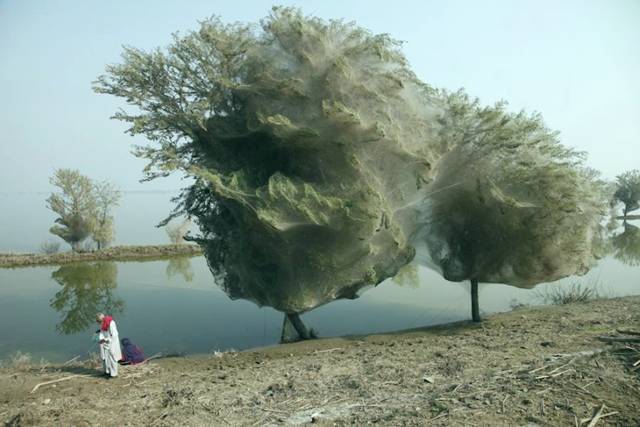
The reason this comes to mind is that good friend, John H. from here in Payson, recently sent me a piece under the title of Spider’s Web.  This is how it started,

An unexpected side-effect of the flooding in parts of Pakistan has been
that millions of spiders climbed up into the trees to escape the rising flood
waters.

A quick web search came across the item in National Geographic online, from which I republish this:

Cocooned Trees, Pakistan

DECEMBER 14, 2011

Cocooned Trees, Pakistan
Photograph by Russell Watkins

This Month in Photo of the Day: 2011 National Geographic Photo Contest Images

An unexpected side effect of the 2010 flooding in parts of Sindh, Pakistan, was that millions of spiders climbed up into the trees to escape the rising flood waters; because of the scale of the flooding and the fact that the water took so long to recede, many trees became cocooned in spiderwebs. People in the area had never seen this phenomenon before, but they also reported that there were fewer mosquitoes than they would have expected, given the amount of standing water that was left. Not being bitten by mosquitoes was one small blessing for people that had lost everything in the floods.

(This photo and caption were submitted to the 2011 National Geographic Photo Contest.)

John’s email also included more images, that are reproduced below.

So it looks as though we have much to learn from spiders as well as from dogs!

Or maybe, it’s just another example of the beauty, magic and mystery of nature!

Common sense!

Some people seem to have a knack for saying it how it should be!

My sub-heading, above, applies to many people right across the world.  But the reason that this was triggered in my mind for today’s post, was a recent item on Christine’s excellent Blog, 350 or bust.  Read more about that Blog here.  I subscribe to that Blog.

A couple of days ago, there was an article with the title of Live Long And Prosper, Already.  It started thus,

Gene Roddenberry, the creator of the amazingly popular Star Trek series, was a man ahead of his time. Here is one of the things he  had to say about humanity and our problems (with one editorial comment from me!):

“I believe in humanity. We are an incredible species. We’re still just a child creature, and we’re still being nasty to each other [Stephen Harper: are you listening?].  And all children go through those phases. We’re moving into adolescence now. When we grow up, man, we’re going to be something!”

But what caught my eye were these comments to the Post.

The first one from a Mickey Haist that read,

It’s a nice goal, but would clenching our teeth and willing progress be of any effect? After all, children don’t spontaneously mature – they’re raised.

Have to say that I was left unsure by what Mr. Haist was trying to convey.  But not so Christine!  This was the first of her two replies,

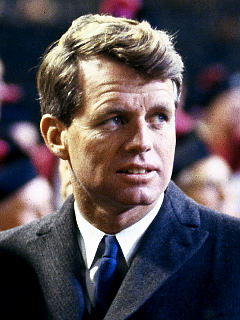
No teeth clenching allowed! Robert Kennedy once said “Each time a person stands up for an ideal, or acts to improve the lot of others, or strikes out against injustice, he or she sends forth a tiny ripple of hope. And crossing each other from a million different centers of energy and daring, those ripples build a current that can sweep down the mightiest walls of oppression and resistance.”

It’s not about everyone doing everything, it’s about each of us doing what we can. Not taking action because the problem is too big is not the answer.

And her second reply,

And Mickey – if the challenge of climate change/ocean acidification/biodiversity loss that we are facing as a species (taking the rest of the natural world with us) doesn’t make us mature, then nothing will.  But I believe it will – as Paul Gilding says, humans are slow but not stupid!

Paul Gilding’s excellent website is always a great read, by the way.

But do reread those words of Robert Kennedy, they are powerfully inspiring.

Robert Kennedy

Each time a person stands up for an ideal, or acts to improve the lot of others, or strikes out against injustice, he or she sends forth a tiny ripple of hope. And crossing each other from a million different centers of energy and daring, those ripples build a current that can sweep down the mightiest walls of oppression and resistance.

Despite the fact that these words were said in response when South Africans suffered the tyranny of apartheid, the words are, perhaps, even more relevant today.  Mankind has to combine the many ‘ripples of hope’ and build that current that will sweep away the crazy selfishness that is preventing us from living in harmony with this beautiful planet for hundreds of years ahead.

Thanks Christine.

Cleo’s progress!

Now 19 days since our young German Shepherd puppy joined us.

On the 9th April, I wrote a Post about the arrival of young Cleo who became part of our family on the 8th.  Here’s a couple of photographs from that Post.

Little bit of bonding going on!
Welcome, young lady. I'm the boss around here!

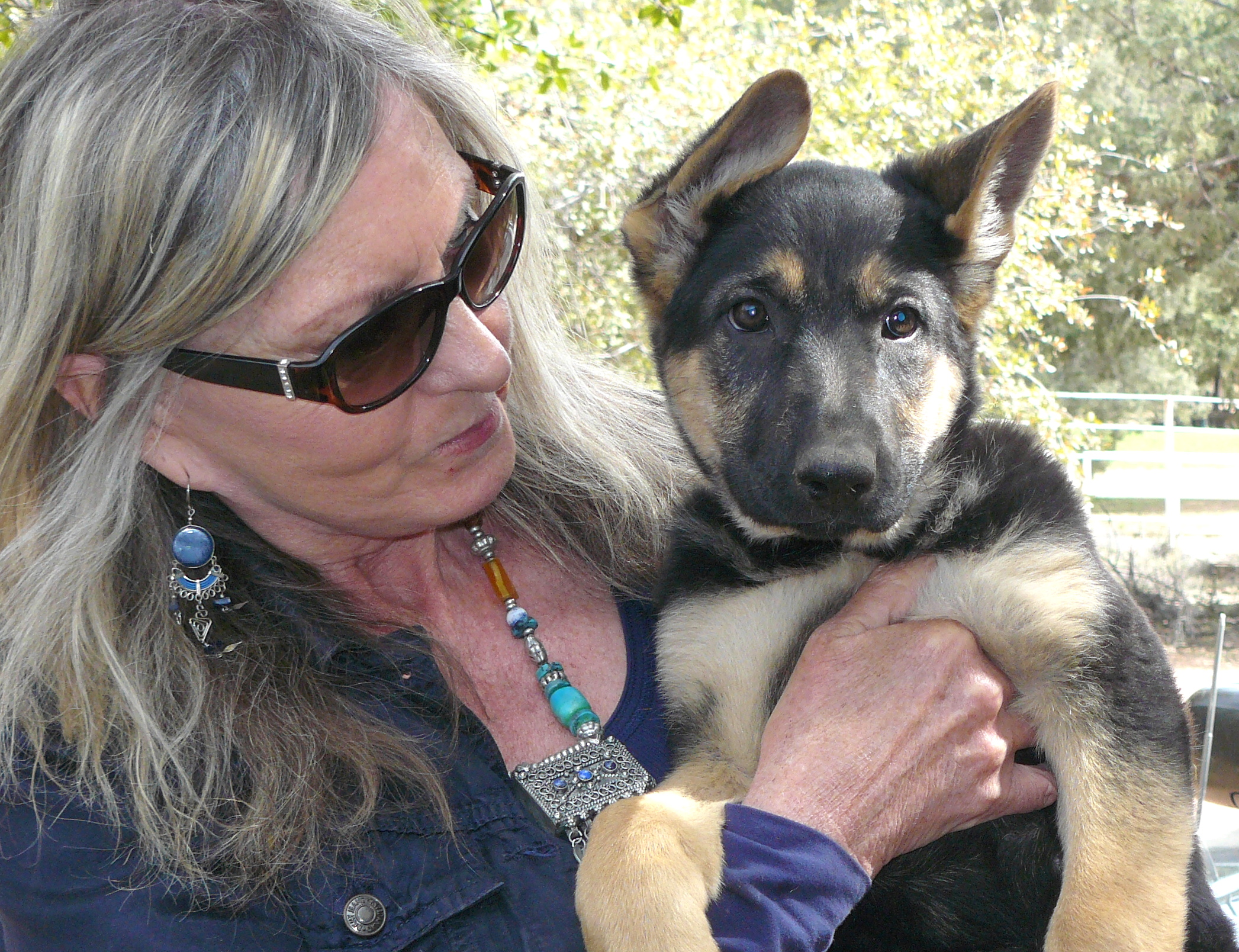
So here are a couple more taken yesterday afternoon, the 25th. Cleo was weighed last Monday and was 28 lbs, some 6 lbs gain since the 8th.

Two very loving ladies!
Pharaoh and Cleo already inseparable.

Must say that Cleo has settled in very well with her other four pack mates. Indeed, Cleo, like Sweeny, mixes easily with all the other dogs, not just Pharaoh’s group.