In gratitude to Roger Davis, long-time friend from my UK days, who forwarded me the link to the following. (Caution, the video does contain some coarse language probably unsuitable for those below the age of 16.)
Our internet service was reinstated at approximately 15:00 PDT Thursday, 11th June
Thank you for your kind and supportive comments to my previous post advising you that we lost our internet connection last Monday afternoon.
It is a little before 6pm PDT today, Thursday, and I shall return to my usual pattern of a daily post, technology notwithstanding, with effect from Saturday.
Outreach Internet had over 5 masts struck by lightning on Monday afternoon so, all things considered, did well to get me and my local neighbours back on line in three days.
Have to say it was beautifully quiet! 🙂
But I haven’t even opened my email inbox – leave that for the morning! 😦
Loss of internet service as of 14:00 PDT 8th June.
Dear Readers and Followers,
Around 2:30pm yesterday our wireless internet service we use went down. It reveals the only disadvantage of living in a rather rural location! It is now twenty-four hours since our service failed and not only is it still down but the provider, Outreach Internet, are not giving any indication as to the nature of the problem and when they expect to be back online.
So for the first time in approaching six years there has not been a daily post today. More to the point I am incapable of letting you know when I will back to blogging!
I’m grateful to neighbours Jim and Janet for allowing me to use their computer and internet connection to publish this post.
Hopefully normal service will be resumed before too long!
Happy Birthday Dan! (And that word is ‘fortnight’!)
Back in September, 2013 I wrote a post called Closing my windows. It explained how I first met Dan Gomez; now some thirty-six years ago. Let me republish the relevant section:
Earlier on I wrote about launching Wordcraft, the word-processing software for personal computers. That was in early 1979 and later that year I was invited to present Wordcraft at an international gathering of Commodore dealers held in Boston, Mass.
During my presentation, I used the word ‘fortnight’ unaware that Americans don’t use this common English word. Immediately, someone about 10 rows back in the audience called out, “Hey, Handover! What’s a fortnight?”
It released the presenter’s tension in me and I really hammed up my response in saying, “Don’t be so silly, everybody knows the word fortnight!” Seem to remember asking the audience at large who else didn’t know the word. Of course, most raised their arms!
Now on a bit of a roll, I deliberately started using as many bizarre and archaic English words that came to me. Afterwards, the owner of the voice came up to me and introduced himself. He was Dan Gomez, a Californian based in Costa Mesa near Los Angeles and also involved in developing software for the Commodore.
Dan became my US West Coast distributor for Wordcraft and was very successful. When Dataview was sold, Dan and I continued to see each other regularly and I count him now as one of my dear friends. Through knowing Dan I got to know Dan’s sister Suzann and her husband Don. It was Su that invited me to spend Christmas 2007 with her and Don at their home in San Carlos, Mexico. Jean also lived in San Carlos and was close friends with Su. Together they had spent many years rescuing feral dogs from the streets of San Carlos and finding new homes for them.
Thus it was that I met Jean. Discovering that Jean and I were born 23 miles apart in London!
So from ‘Hey, what’s a fortnight’ to living as happily as I have ever been in the rural countryside of Oregon. Funny old world!
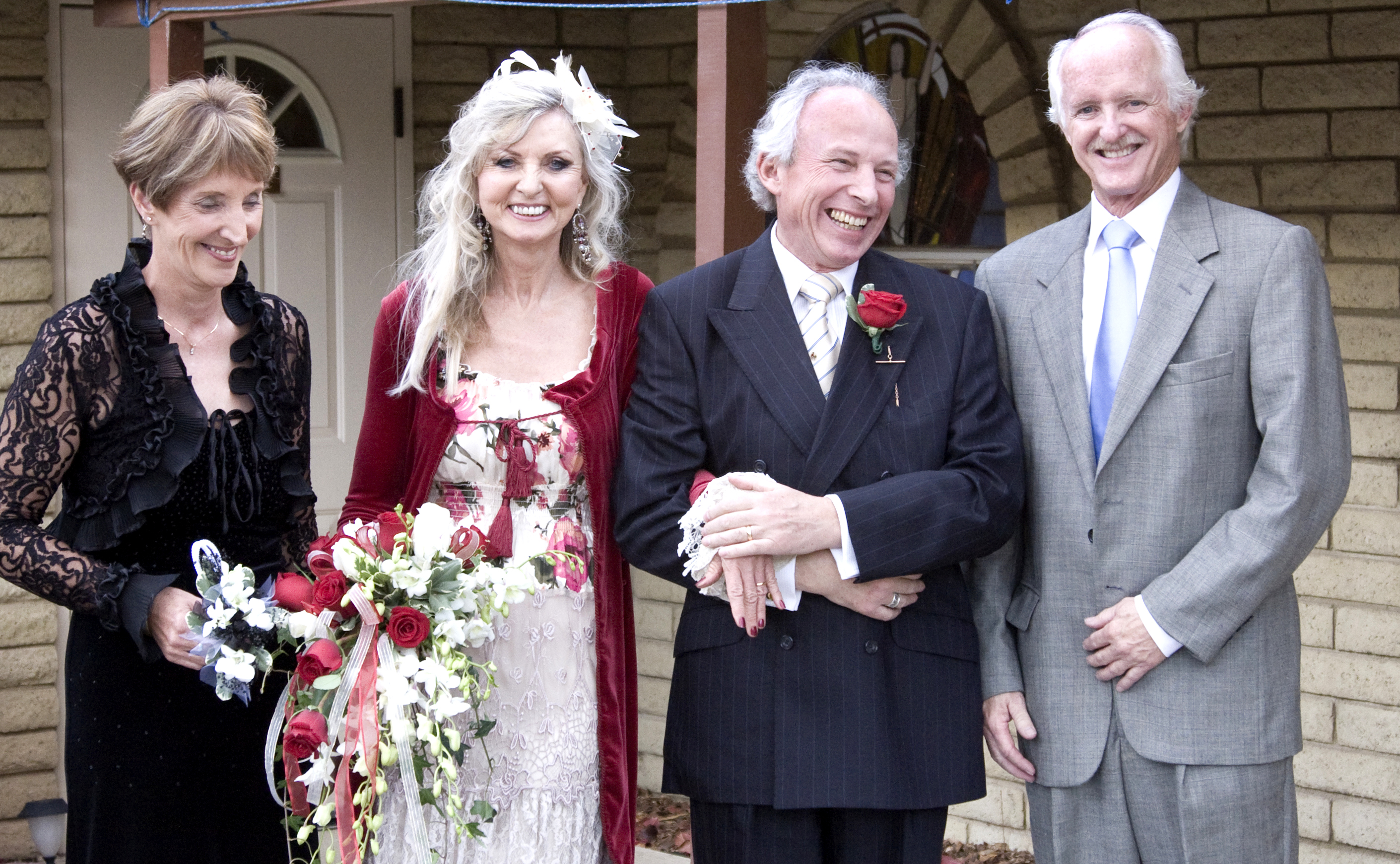
Dan Gomez – Best Man, and Diane Jackson – Bridesmaid when Jean and I were married; November 20th 2010.
It is Dan’s birthday today. One of those big birthday milestones in life. (And it would be wrong for me to openly state his age today but just let me say that Dan would be seeing a sixties birthday again!)
Tomorrow, I want to offer the example of someone who has been sufficiently strong to take one small step back to sanity.
What I am offering is the reposting of an item in 2013 on Transition Network over in the UK. As you read it, do bear in mind that the references to Amazon are, in the main, to Amazon in the United Kingdom.
I’ve done it. I’ve closed my Amazon account. I now stand before you as an ex-Amazon account-holder. I feel curiously shaky, but at the same time empowered, excited even. While opening a new Amazon account is easy as pie, closing one is another matter altogether. I’d like to share with you how, and why, I did it.
Was it the recent Panorama programme about working conditions in those vast Amazon ‘fulfilment centres’ that tipped me across into doing something? Was it the stories about the appallingly low levels of tax Amazon pay in the UK? Was it the recent video showing Amazon’s plans to be delivering across the UK within 30 minutes through the use of drones? Was it hearing the level of taxpayers’ money that goes in sweeteners to attracting Amazon to open up in different communities, while the profits generated pour out of those same places? What actually tipped me across was a conversation I had with a book seller in my town. It was that that led me, finally, to build the steely resolve needed to close down my Amazon account.
Yes, I confess, I had an Amazon account. I buy music from my local record shop, I support my local book shops, but there are times when I need a book quickly, or feel I do, and it’s just easier and more convenient. And, if I’m honest, I love getting exciting parcels in the post. And isn’t it cheap? But as Carole Cadwalladr, who went undercover in Amazon’s Swansea ‘fulfilment centre’ for The Guardian puts it:
Our lust for cheap, discounted goods delivered to our doors promptly and efficiently has a price. We just haven’t worked out what it is yet.
I’ve always had that nagging conscience that it’s not OK really, but I have just had it ticking away in the background and carried on using it on occasion. The conversation that tipped it for me, with my local bookseller, was around “what would it take for you to stop supporting Amazon?” His example was Primark, recently implicated in child labour in the manufacturing of some its clothes. We know that’s the case, but we still shop there. If we knew that 8 year olds work there, would we stop shopping there? Or 5 year olds? If we knew that every day they arrive for work they get hit with a stick, would we still pop in there for a cheap new shirt? And if they got hit 3 times, and then again in the middle of the day? Where do we draw the line?
Our tendency is to draw a line, but then for that line to slip. What swung it for me was thinking that actually, what I already know should be enough to make me withdraw my support. Also, it was thinking about where the world will be in 5 years time if we continue to give Amazon our support. More and more low paid jobs, with little Union protection, in conditions described in the BBC documentary as “… all the bad stuff at once. The characteristics of this type of job, the evidence shows increased risk of mental illness and physical illness.”
We’ll see Amazon ‘fulfilment centres’ that look like a wasp’s nest, with drones flying in and out. High streets swept clean of bookshops, indeed of most shops, as Amazon spread into selling virtually everything that local economies sell, but far cheaper. It made me think about what kind of a world I’m creating for my sons as they enter the work place. What kind of opportunities will Amazon offer them, as they gut local economies and focus economic activity into vast warehouses along the side of motorways?
I give so much of my time every day to trying to create a different, more just, more resilient world, yet my shopping decisions undermine that. There is also an extraordinary arrogance to thinking that it is OK for you to fill peoples’ airspace, the sky above their heads, with your drones, delivering your products to people for your profit. What happens for a company to get so huge that that is considered acceptable? It is about getting too big. Amazon is too big. Far too big. But it clearly sees that it has only just started. That’s not good.
So, decision made, and with a commitment to source those things in other ways, I went to the website to close my account. Closing an account with Amazon is like breaking up with a girlfriend whose level of obsessive denial is such that the possibility you might want to split up with her doesn’t even enter her consciousness. It’s a fascinating process. Opening an account with Amazon is so easy. Closing an account is, as my 15 year-old son might put it, a right mission.
Click on ‘Your account’ and there is no option anywhere of “Close my account”. Nothing. Like it’s not even a possibility that it might entertain. I had to Google (and don’t get me started on them) “closing your Amazon account”. If you search the Amazon site for “close my account” it yields no results. See below:
The Google link took me to their Help section, on pages that bear the slogan “we’re the people with the smile on the box”, prompting the thought that the inside of their box-like warehouses are probably somewhat bereft of smiles. If offers you a drop-down menu under the helpful title “what can we help you with?”. Surely that’s where I’ll find “Close my Account”? No. You get a range of choices, “An order I placed”, “Kindle”, “Digital services” and, er, “Something else”. Guess I’m “something else” then. So I click that.
I’m then given another 4 options, none of which are “Close my account”. I’m asked to “tell us more about your issue”, and given another list where my option is “other non-order question”. Given that still, the idea that I might have got this far could mean I want to close my account is clearly unimaginable, I am then given an option to email, to phone, or to “chat”. So I click on “chat”, and am told “a customer service associate will be here in a moment”.
A charming man then begins to chat with me. Here’s how our conversation went:
Me: I want to close my account please. How do I do that?
Tom (not his real name): Thank you for contacting Amazon.co.uk. My name is Tom. May I know your name, please?
Me: Rob
Tom: Thank you. I’m sorry to hear that you want to close the account. May I know the reason for closing the account please?
Me: Certainly. I am appalled by the way Amazon operate as highlighted in the recent BBC Panorama programme. I am appalled at the recent story on Amazon considering deliveries in future by drone. I am appalled by the low level of tax Amazon pay in the UK. I have been a customer for years, but I feel Amazon has become too big, and eats everything in its path. It is no longer something I wish to support.
Tom: I’m sorry for the situation. For confidentiality reasons, I’m not able to close your account for you in chat, so I’m going to send you an e-mail with the information to close the account. When you receive it, please respond to that e-mail so that we will close your account.
Me: Thank you Tom. I would really like my reasons for leaving to be registered somehow, as I think a lot more people will be closing their accounts for similar reasons, and it would be good for that to be noted by those in charge. Will that be possible?
Tom: Unfortunately we will not be able to comment on this issue. However, I will send you an email regarding the closing of the account. Is there any thing else I can help you with?
Me: I am not asking you to comment on the issue. I am asking you to make sure that the reasons for my closing my account are passed on to management. If I ran a business I would want to know why my customers were closing their accounts. Is that not the case at Amazon?
Tom: Sure, all the information’s will be recorded and forwarded to the appropriate department.
Me: Thank you Tom. I appreciate your help.
Tom: Thanks for your understanding. We hope to see you again soon! Have a Nice Day!
I later received an email from Customer Support to say:
“We appreciate your feedback and have forwarded it to the appropriate team internally. We are proud to provide a safe and positive working environment for all of our associates. Information about working at our fulfilment centres can be found at the following link: www.amazon.co.uk/fcpractices“
Amazon may be cheap, but cheap comes at a cost for someone else. And, after all, much of what is bought on there is throwaway rubbish. As Carole Cadwalladr puts it:
The warehouse is 800,000 square feet, or, in what is Amazon’s standard unit of measurement, the size of 11 football pitches (its Dunfermline warehouse, the UK’s largest, is 14 football pitches). It is a quarter of a mile from end to end. There is space, it turns out, for an awful lot of crap.
Me, I resolve to buy less, but better. Less, but longer-lasting. Less, but local. The thought of where we will end up in 5 years time, 10 years time, 20 years time, if companies like Amazon continue as they are, really frightens me. It’s not good, it’s not right. It’s not about our needs, it’s about the needs of huge investors. I want a different world for my boys.
I can’t, on my own, do that much about it. I can’t insist that the UK government legislate so that, as in Holland, the Recommended Retail Price (RRP) is the legal minimum at which any book can be sold, although I think that is grounds for a really timely campaign. Because of that, Amazon don’t really operate in Holland. Bring back the RRP for books here, and let’s have a level playing field. As I say, I can’t do much, but I can withdraw my support. I just have withdrawn my support. It feels surprisingly unsettling, as one does after ending a relationship, but it was the right thing to do. It may be a drop in the ocean, but if enough people do it….
ooOOoo
As you might expect, I do have an Amazon account but will look closely into alternatives. In that regard, I just want to expand on the link underneath the earlier phrase, “commitment to source those things in other ways“. The link takes you to an article in the Guardian newspaper, online version, dated the 16th May, 2013. Here are the opening paragraphs:
Amazon’s tax bill is in the news again, after a Guardian investigation put the spotlight on its financial arrangements. There’s a growing swell of people who want to use an alternative place to buy – including my colleague Patrick Collinson who wrote about his attempts to kick the Amazon habit in November.
But it is not always easy to find good alternatives online: if you want to buy either the latest Dan Brown novel (and clearly some people do), Mad Men series five on DVD, or even a packet of Pampers nappies, Amazon seems to come top of the search pages.
To close today’s post, just spend four minutes watching the following video.
Why growth and the environment can’t coexist
Published on Feb 9, 2015
Featuring: Sam Bliss
Production: Daniel Penner
Animation + Illustration: Amelia Bates
Music: “Nincompoop (No Vocals)” by Josh Woodward (http://www.joshwoodward.com/)
“Favorite Secrets” by Waylon Thornton (http://waylonthornton.tumblr.com)
Footage: Prelinger Archives
The background to the video, first seen referred to on the Grist blogsite, is republished here:
Watch our juicy explainer about the environment’s growing economics problem.
Consume less, share more. Those are some basic principles behind degrowth, an idea and movement that rejects economic growth as a goal for society. This video explains degrowth with oranges, juice, and peels.
But wait, you ask, isn’t growth a good thing? In an age when we’re conditioned to equate growth with progress, degrowth sounds insane. In reality, pursuing endless exponential expansion of the economy is insane — and impossible. Humans already use resources faster than Earth can replenish them and produce wastes, like carbon emissions, faster than Earth can assimilate them. Hence, degrowth.
Degrowth isn’t about making everyone poorer; it’s about redefining wealth to acknowledge that real well-being can’t be measured in dollars. It’s about breaking down the artificial barrier between life and work; it’s about valuing cooperation over competition; it’s about democracy, autonomy, solidarity, and climate justice. Most importantly, degrowth means sharing society’s surplus for awesome art projects and epic, week-long gatherings.
Like thousands of others, Jean and I are regular viewers of the TED Talks.
So first the old. Here’s a reminder of the inspiring nature of mathematics; in this case Fibonacci numbers.
Published on Nov 8, 2013
Math is logical, functional and just … awesome. Mathemagician Arthur Benjamin explores hidden properties of that weird and wonderful set of numbers, the Fibonacci series. (And reminds you that mathematics can be inspiring, too!)
Now to the new. Innovation at its very best.
Published on Jul 11, 2013
The development of new medicine is problematic because laboratories cannot replicate the human body’s environment, making it difficult to determine how patients will respond to treatment. At TEDxBoston, Geraldine Hamilton demonstrates how scientists can implant living human cells into microchips that mimic the body’s conditions. These “organs-on-a-chip” can be used to study drug toxicity, identify potential new therapies, and could lead to safer clinical trials.
Perhaps the last frontier, the one underneath our feet?
Can’t recall where I came across this BBC program but so what! The fact is that the BBC have had a long and well-deserved reputation for making some fabulous programmes on nature and wildlife. So it was with a recent programme from the BBC Nature stable. The one that caught my eye and the motivation for today’s LfD post was called The Burrowers: Animals Underground.
Here is the trailer.
Published on Aug 9, 2013 Discover with BBC Two the secret life of Rabbits, Badgers and Water Voles.
Offering us this:
The Burrowers: Animals Underground
Chris Packham continues his underground journey investigating the world of some of the UK’s most iconic burrowing animals. Filmmakers and scientists cannot investigate animal behaviour inside wild burrows without disturbing them so The Burrowers’ team found ingenious ways to film this secret world by recreating full-scale replicas. It’s now spring in the burrows and the new babies are having to grow up fast. The seven orphan badgers are learning to communicate with each other, young rabbits must take their first steps outside, and young water voles their first swim. Chris also meets the most elusive burrower of them all – an animal which almost never comes above ground – the mole. He reveals the moles’ survival techniques, its method of burrowing and the food it eats. Finally, the team unveils a science first: the excavation of a massive abandoned wild rabbit warren… Back in winter it was filled with concrete and left to set. Now a small army of volunteers and diggers have excavated it, revealing a three-dimensional model of a complex system of tunnels and chambers.
So despite it being at the other end of the scale compared to the cosmos, we still know so little about what goes on beneath our feet.
Mind you, that doesn’t stop some of us from trying to find out!
Sweeny digging in the ground after yesterday’s heavy rain!
The TED Talk link was sent to me by friend, Lee Crampton.
Published on Jun 11, 2013
In a robot lab at TEDGlobal, Raffaello D’Andrea demos his flying quadcopters: robots that think like athletes, solving physical problems with algorithms that help them learn. In a series of nifty demos, D’Andrea show drones that play catch, balance and make decisions together — and watch out for an I-want-this-now demo of Kinect-controlled quads.
There’s more on Raffaello here where you can read this:
My work is focused on the creation of systems that leverage technological innovations, scientific principles, advanced mathematics, algorithms, and the art of design in unprecedented ways, with an emphasis on advanced motion control.
By their very nature, these creations require a team to realize. Many are enabled by the research I conduct with my graduate students. Many are also the fruit of collaborations with architects, entrepreneurs, and artists.
My hope is that these creations inspire us to rethink what role technology should have in shaping our future.
Raffaello D’Andrea
and where you can also find this further video – Zurich Minds – doubly fascinating.
In my recent post Electrosensitivity, I wrote about “spending a number of years studying for a Diploma in Electrical Engineering at Faraday House, Southampton Row, London and becoming a UK Radio Amateur at the age of 17 (G3PUK)“.
In reverse order, I shall start with becoming a UK Radio Amateur, now rather back in the mists of time!
After my father died in 1956 my mother subsequently remarried. Her new husband was Richard Mills and he was very knowledgeable about radio matters; he was a technical author in the radio-communications industry. It was Richard, my step-dad, who showed me how to make a crystal set and I started listening to the strange world of wireless radio. It fascinated me and motivated me to save up my pennies and buy an ex-military radio receiver known as a R1155.
I had joined the Harrow Radio Society who, amazingly, are still active today, as their website demonstrates.
Under the fabulous tutelage of many of the older ‘hams’ I went on to sit my exams and on Valentine’s Day 1962 was awarded the Postmaster-General’s Amateur Radio Certificate. I applied for a call-sign and was allocated G3PUK. I was just 17 years old!
oooOOOooo
Now some memories of Faraday House. I can do no better than refer you to an article that appeared on the Electrical Review website in the UK. As the article was published over three years ago, I think republishing it on Learning from Dogs isn’t being too naughty.
Faraday House Association closes after 105 years
FRIDAY, 29 JANUARY 2010
It is with sadness we report the Faraday House Old Students Association (FHOSA) is to close after operating continuously over the last 105 years. It had been host to thousands of chartered electrical engineers. The Association membership is derived from old students of Faraday House.
In 1888 the revised Electric Lighting Act encouraged many local authorities to apply for Parliamentary Powers to establish generating stations to transmit power. Faraday House was founded to train engineers in this new practice. The college started life as the Electrical Standardising, Testing and Training Institution at Charing Cross but in June 1890 used the name Faraday House. It was located in the Charing Cross area, and fees were 100 guineas per annum. The first Faraday House Dinner was held in 1895 – it was free and some 170 attended. In 1905 the FHOSA was formed and 100 old students joined. A move was then made to Southampton Row. By now the college had 110 students.
In 1909 Dr Russell was appointed principal, and pioneered the sandwich course. This meant students had a year or so of theory and then experienced work in industry, returning again to more theory. By 1914 many old students joined up and a crash course was started to aid the war effort. By 1919 some 350 had been in the services and 34 had died. In 1920 the fees had risen to 300 guineas.
By 1928 1000 students had joined the Old Students Association and in 1929 a 40th anniversary dinner was held. In 1939 a discussion with the governors resulted in a decision to evacuate the college to Thurlestone in Devon. A new principal, Dr WRC Coode-Adams, took over from Dr Russell. Faraday House took over the Links Hotel. Staff and students who were married lived in the hotel or in houses that had been taken over by the college.
In 1942 the college returned to Southampton Row. After the war Faraday House had difficulty in recruiting, students were lured to other colleges and universities by grants. In 1957 Mr GH Randolph Martin was appointed Principal. He had been a lecturer at the college since 1948. The college closed its doors in 1967 as losses were now running at £20,000 per year.
During its lifetime Faraday House produced a succession of engineers who attained the most senior positions in industry and electrical supply in many countries, and six old students have been president of the Institution of Electrical Engineers (now the IET).
The Old Students Association has a membership that is steadily growing older and shrinking as members die. The closure was inevitable without younger people coming forward to run it. The FHOSA will shut its doors finally after the Annual General Meeting in March 2010.
Hopefully, you were able to watch the Amory Lovins talk in yesterday’s post? If not, then do find time to watch how Professor Lovins sets out the powerful argument that the USA could soon, relatively speaking, be energy self-sufficient.
So on top of the Lovins presentation, I wanted to draw your attention to an item on Climate Crocks last October 5th.
One of the great stories untold in the American media is the ongoing revolution in one of the world’s most advanced economies – as Germany undertakes a bold and serious transition from powering a great engine of prosperity on fossil fuels, to plentiful and inexhaustible renewable energy.
Listening to Mitt Romney double and triple down on the bogus Fox/Fossil narrative about “clean coal” and failed renewables, it might be well to consider how one of our toughest manufacturing competitors is going all-in on the high stakes renewable energy revolution of the new century.
The article is a detailed analysis of how Germany is powering ahead, pardon the pun, in the provision of non carbon-based power, as this reference illustrates,
German use of coal to generate electricity has declined steadily from 1990 to 2011, according to readily available statistics on the German electricity system. The percentage of coal-fired electricity in German electricity generation has fallen from 56.7% in 1990 to 43.5% last year–a decrease of more than 10% despite a increase in total electricity generation during the same period of about 10%. At the same time the share of renewable energy in the electricity mix has increased from 3.6% to 19.9%, mostly due to the rapid development of wind energy and biomass.
Here is one for you- http://www.solarroadways.com/intro.shtml – the idea is totally leftfield, but it fulfils certain issues such as distribution, decentralisation of power and offers a recharge network for electric cars and it has received a big chunk of government funding. It is so out there that I wonder if it could possibly be the answer but you never know.
Very quickly one finds that Solar Roadways are involved in something VERY interesting, namely,
Years ago, when the phrase “Global Warming” began gaining popularity, we started batting around the idea of replacing asphalt and concrete surfaces with solar panels that could be driven upon. We thought of the “black box” on airplanes: We didn’t know what material that black box was made of, but it seemed to be able to protect sensitive electronics from the worst of airline crashes.
Suppose we made a section of road out of this material and housed solar cells to collect energy, which could pay for the cost of the panel, thereby creating a road that would pay for itself over time. What if we added LEDs to “paint” the road lines from beneath, lighting up the road for safer night time driving? What if we added a heating element in the surface (like the defrosting wire in the rear window of our cars) to prevent snow/ice accumulation in northern climates? The ideas and possibilities just continued to roll in and the Solar Roadway project was born.
Now watch this!
and then watch this, as nearly 1.5 million others have!
The Solar Roadways project is working to pave roads with solar panels that you can drive on. Co-founder Scott Brusaw has made some major steps forward since our first visit back in 2007, so we visited him again for an exclusive update on the project, including the first ever video recorded of the Solar Roadways prototype! For more information visit http://www.solarroadways.com . This Solar Roadway project is highlighted as one of many planet-friendly solutions in the feature film by YERT – Your Environmental Road Trip. To learn more about YERT, visit http://yert.com .
 empowered, excited even. While opening a new Amazon account is easy as pie, closing one is another matter altogether. I’d like to share with you how, and why, I did it.

Chris Packham continues his underground journey investigating the world of some of the UK’s most iconic burrowing animals. Filmmakers and scientists cannot investigate animal behaviour inside wild burrows without disturbing them so The Burrowers’ team found ingenious ways to film this secret world by recreating full-scale replicas. It’s now spring in the burrows and the new babies are having to grow up fast. The seven orphan badgers are learning to communicate with each other, young rabbits must take their first steps outside, and young water voles their first swim. Chris also meets the most elusive burrower of them all – an animal which almost never comes above ground – the mole. He reveals the moles’ survival techniques, its method of burrowing and the food it eats. Finally, the team unveils a science first: the excavation of a massive abandoned wild rabbit warren… Back in winter it was filled with concrete and left to set. Now a small army of volunteers and diggers have excavated it, revealing a three-dimensional model of a complex system of tunnels and chambers.



 Learning from Dogs