Category: Electronics

The building blocks of numbers

We are talking of prime numbers.

Science and mathematics have been a long interest of mine and I regret that I did not go to university to study science. But that was a long time ago!

However, thanks to The Conversation I can write about mathematics, in this case Prime Numbers.

ooOOoo

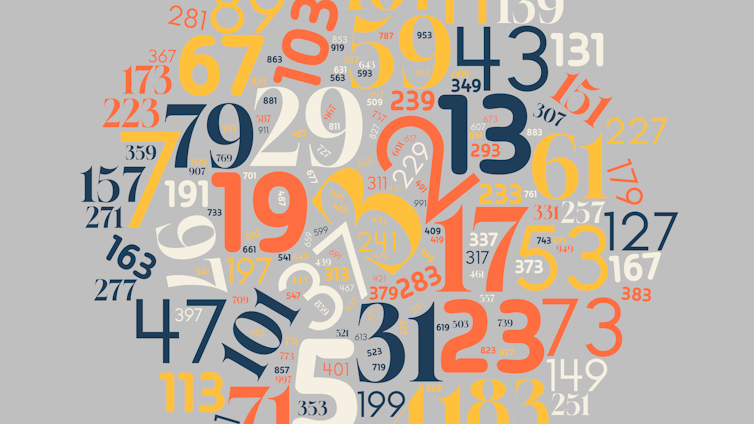
Prime numbers, the building blocks of mathematics, have fascinated for centuries − now technology is revolutionizing the search for them

Prime numbers are numbers that are not products of smaller whole numbers. Jeremiah Bartz

Jeremiah Bartz, University of North Dakota

A shard of smooth bone etched with irregular marks dating back 20,000 years puzzled archaeologists until they noticed something unique – the etchings, lines like tally marks, may have represented prime numbers. Similarly, a clay tablet from 1800 B.C.E. inscribed with Babylonian numbers describes a number system built on prime numbers.

As the Ishango bone, the Plimpton 322 tablet and other artifacts throughout history display, prime numbers have fascinated and captivated people throughout history. Today, prime numbers and their properties are studied in number theory, a branch of mathematics and active area of research today.

A history of prime numbers

A long, thin shard of bone with small lines scratched into it.
Some scientists guess that the markings on the Ishango bone represent prime numbers. Joeykentin/Wikimedia Commons, CC BY-SA

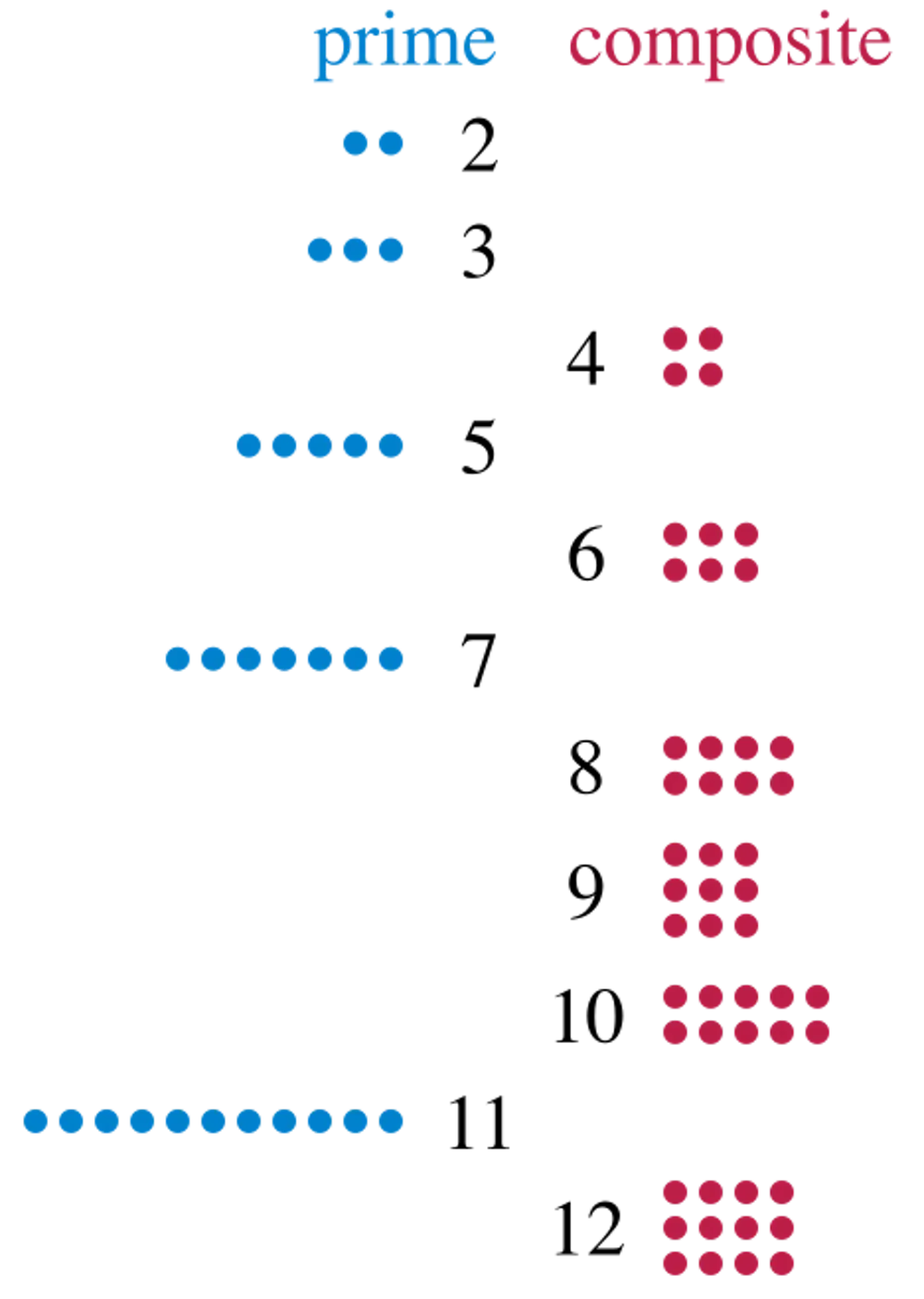
Informally, a positive counting number larger than one is prime if that number of dots can be arranged only into a rectangular array with one column or one row. For example, 11 is a prime number since 11 dots form only rectangular arrays of sizes 1 by 11 and 11 by 1. Conversely, 12 is not prime since you can use 12 dots to make an array of 3 by 4 dots, with multiple rows and multiple columns. Math textbooks define a prime number as a whole number greater than one whose only positive divisors are only 1 and itself.

Math historian Peter S. Rudman suggests that Greek mathematicians were likely the first to understand the concept of prime numbers, around 500 B.C.E.

Around 300 B.C.E., the Greek mathematician and logician Euler proved that there are infinitely many prime numbers. Euler began by assuming that there is a finite number of primes. Then he came up with a prime that was not on the original list to create a contradiction. Since a fundamental principle of mathematics is being logically consistent with no contradictions, Euler then concluded that his original assumption must be false. So, there are infinitely many primes.

The argument established the existence of infinitely many primes, however it was not particularly constructive. Euler had no efficient method to list all the primes in an ascending list.

a diagram showing prime numbers as dots in rows, with composite numbers as dots arranged in rectangles of at least two rows of dots, with the same number of dots in each row.
Prime numbers, when expressed as that number of dots, can be arranged only in a single row or column, rather than a square or rectangle. David Eppstein/Wikimedia Commons

In the middle ages, Arab mathematicians advanced the Greeks’ theory of prime numbers, referred to as hasam numbers during this time. The Persian mathematician Kamal al-Din al-Farisi formulated the fundamental theorem of arithmetic, which states that any positive integer larger than one can be expressed uniquely as a product of primes.

From this view, prime numbers are the basic building blocks for constructing any positive whole number using multiplication – akin to atoms combining to make molecules in chemistry.

Prime numbers can be sorted into different types. In 1202, Leonardo Fibonacci introduced in his book “Liber Abaci: Book of Calculation” prime numbers of the form (2p – 1) where p is also prime.

Today, primes in this form are called Mersenne primes after the French monk Marin Mersenne. Many of the largest known primes follow this format.

Several early mathematicians believed that a number of the form (2p – 1) is prime whenever p is prime. But in 1536, mathematician Hudalricus Regius noticed that 11 is prime but not (211 – 1), which equals 2047. The number 2047 can be expressed as 11 times 89, disproving the conjecture.

While not always true, number theorists realized that the (2p – 1) shortcut often produces primes and gives a systematic way to search for large primes.

The search for large primes

The number (2p – 1) is much larger relative to the value of p and provides opportunities to identify large primes.

When the number (2p – 1) becomes sufficiently large, it is much harder to check whether (2p – 1) is prime – that is, if (2p – 1) dots can be arranged only into a rectangular array with one column or one row.

Fortunately, Édouard Lucas developed a prime number test in 1878, later proved by Derrick Henry Lehmer in 1930. Their work resulted in an efficient algorithm for evaluating potential Mersenne primes. Using this algorithm with hand computations on paper, Lucas showed in 1876 that the 39-digit number (2127 – 1) equals 170,141,183,460,469,231,731,687,303,715,884,105,727, and that value is prime.

Also known as M127, this number remains the largest prime verified by hand computations. It held the record for largest known prime for 75 years.

Researchers began using computers in the 1950s, and the pace of discovering new large primes increased. In 1952, Raphael M. Robinson identified five new Mersenne primes using a Standard Western Automatic Computer to carry out the Lucas-Lehmer prime number tests.

As computers improved, the list of Mersenne primes grew, especially with the Cray supercomputer’s arrival in 1964. Although there are infinitely many primes, researchers are unsure how many fit the type (2p – 1) and are Mersenne primes.

By the early 1980s, researchers had accumulated enough data to confidently believe that infinitely many Mersenne primes exist. They could even guess how often these prime numbers appear, on average. Mathematicians have not found proof so far, but new data continues to support these guesses.

George Woltman, a computer scientist, founded the Great Internet Mersenne Prime Search, or GIMPS, in 1996. Through this collaborative program, anyone can download freely available software from the GIMPS website to search for Mersenne prime numbers on their personal computers. The website contains specific instructions on how to participate.

GIMPS has now identified 18 Mersenne primes, primarily on personal computers using Intel chips. The program averages a new discovery about every one to two years.

The largest known prime

Luke Durant, a retired programmer, discovered the current record for the largest known prime, (2136,279,841 – 1), in October 2024.

Referred to as M136279841, this 41,024,320-digit number was the 52nd Mersenne prime identified and was found by running GIMPS on a publicly available cloud-based computing network.

This network used Nvidia chips and ran across 17 countries and 24 data centers. These advanced chips provide faster computing by handling thousands of calculations simultaneously. The result is shorter run times for algorithms such as prime number testing.

A small rectangle metal chip reading 'nVIDIA'
New and increasingly powerful computer chips have allowed prime-number hunters to find increasingly larger primes. Fritzchens Fritz/Flickr

The Electronic Frontier Foundation is a civil liberty group that offers cash prizes for identifying large primes. It awarded prizes in 2000 and 2009 for the first verified 1 million-digit and 10 million-digit prime numbers.

Large prime number enthusiasts’ next two challenges are to identify the first 100 million-digit and 1 billion-digit primes. EFF prizes of US$150,000 and $250,000, respectively, await the first successful individual or group.

Eight of the 10 largest known prime numbers are Mersenne primes, so GIMPS and cloud computing are poised to play a prominent role in the search for record-breaking large prime numbers.

Large prime numbers have a vital role in many encryption methods in cybersecurity, so every internet user stands to benefit from the search for large prime numbers. These searches help keep digital communications and sensitive information safe.

Jeremiah Bartz, Associate Professor of Mathematics, University of North Dakota

This article is republished from The Conversation under a Creative Commons license. Read the original article.

ooOOoo

I find it unbelievable that there are prizes for the first 100 million-digit prime number and also the first 1 billion-digit prime number. It is so far away from my understanding of these numbers that all I can say is: I find it unbelievable!

Our interconnected world

Penny Martin offers another post, but first comment on the rain.

With this day being the 1st February I can tell you what we received in rainfall for January: it was 11.99 inches (30.45 cms). That is a record for the years that we have been living here.

Now over to Penny.

Penny Martin is now a regular contributor to these pages, and I am grateful for that. Simply because I have been blogging for a long time and having this resource is most welcome. Not that I consider Penny a ‘resource’ she is much more than that: Penny is a brilliant contributor.

Here is her latest offering, talking about the new world so many of us are now living in.

ooOOoo

Image: Freepik

Laptop and Leash: Succeeding as a Pet-Loving Digital Nomad

By Penny Martin.

In today’s interconnected world, the allure of becoming a digital nomad resonates with many. This lifestyle promises the freedom to explore the world while staying professionally active. However, for those who cherish the company of their pets, this dream presents unique challenges. This guide from Learning from Dogs is designed to navigate the complexities of adopting a digital nomad lifestyle with your pet, ensuring a seamless transition that caters to both your needs and those of your animal companion.

Establishing a Financial Foundation

Embarking on a journey with your pet as a digital nomad begins with the fundamental step of securing a reliable income. This financial stability is the cornerstone of your nomadic life, ensuring that both you and your pet’s needs are adequately met. Whether it’s through remote employment, freelance work, or managing an online business, a consistent income stream is essential. It provides peace of mind and the freedom to fully embrace the nomadic lifestyle with your furry friend.

Advancing Digital Skills

In today’s rapidly changing digital environment, the skills you possess are of paramount importance. It’s essential to devote time to bolstering your digital expertise. One way to do this is by pursuing further education, such as enrolling in online courses that offer specialized training. Notably, a cybersecurity degree can be earned online, providing an avenue to deepen your understanding of protecting data and computer networks. Additionally, acquiring skills in fields like digital marketing or web development can be immensely beneficial. These skills are invaluable not just for career growth and stability but also for ensuring you can work effectively from any corner of the globe. 

Finding Pet-Friendly Living Spaces

Transitioning to a nomadic lifestyle with a pet requires thoughtful planning, particularly when it comes to accommodations. It is essential to find living spaces that are not just comfortable for you but also welcoming to your pet. This means prioritizing pet-friendly hotels, apartments, and co-living spaces in your travel planning. Ensuring a comfortable and safe environment for your pet is key to a successful journey, allowing both of you to settle in and adapt to new surroundings with ease.

Navigating Legalities and Regulations

As you traverse different regions and countries, it’s important to stay informed about the varying legal requirements related to pet travel and ownership. This includes understanding entry regulations, quarantine rules, and local leash laws. Being well-versed in these legalities ensures that you avoid any complications or surprises during your travels. It also demonstrates a commitment to responsible pet ownership, reflecting a respect for the regulations of each place you visit.

Emphasizing Pet Health and Safety

The health and safety of your pet should always be a top priority. This includes ensuring that all vaccinations are up-to-date and that your pet has a microchip with current contact information. Additionally, researching veterinary services and emergency clinics in each new location provides peace of mind. Being proactive about your pet’s health needs and prepared for any emergencies are crucial aspects of traveling safely and responsibly with your pet.

Access to Veterinary Services

Before setting off on your nomadic adventure, investigate the availability of veterinary care in your planned destinations. Identifying reputable clinics and hospitals ensures that you have access to necessary health services for your pet. In addition, carrying a basic first-aid kit for pets can help manage minor health issues that may arise during your travels. Being prepared in this regard is a testament to your commitment to your pet’s well-being.

Efficient Management of Pet Documents

Organizing your pet’s documents is as important as managing your own. This includes keeping a digital record of your pet’s medical history, identification, and travel permits. Utilizing mobile applications for document scanning and storage offers a convenient solution to keep these vital records accessible at all times. Efficient document management streamlines the process of crossing borders and accessing services, ensuring a smoother travel experience for both you and your pet.

The journey of a digital nomad with a pet is a path filled with rewarding experiences and unique challenges. By laying a solid financial foundation, enhancing your digital capabilities, and meticulously planning for your pet’s needs, this lifestyle becomes not only feasible but deeply fulfilling. It’s a journey that goes beyond mere travel – it’s about building a life rich with experiences and memories, shared with your loyal companion every step of the way.

ooOOoo

These are key tips from Penny and ones that all people who are regular users of digital devices should employ; and that is a huge number these days.

Jean and I are still coming to terms with Monday’s loss of Brandy. We will never forget the incident for the rest of our lives. Hearing that Brandy’s body had been found would be very helpful but, personally, I think that is very unlikely.

Moore’s Law

In memory of Gordon Moore.

From Wikipedia:

Gordon Earle Moore (January 3, 1929 – March 24, 2023) was an American businessman, engineer, and the co-founder and emeritus chairman of Intel Corporation.

It was in 1965 that Gordon Moore suggested that every year there would be a doubling of the number of components per integrated circuit. In 1975 he revised his forecast to a doubling every two years; that prediction has become a reliable outcome and became known as Moore’s Law.

Just look at the left-hand scale of that graph above and ponder on the figures. From less than 10,000 in 1971 to more than 10 billion in 2021!

Incredible!

Gordon Earle Moore in 1978. He died on March 24th, 2023 aged 94 years.

What an amazing man!

New Years’ Resolutions

Finding one that really works.

Whatever age we are and in many different cultures the New Year holds out so much hope. It seems an opportunity to start anew, to put the habits of last year behind us, to embrace a new start. Yet all the evidence is that a New Year’s Resolution will not make it through to February.

That is why I picked up on a recent article in The Conversation, that they kindly allow to be republished.

ooOOoo

Why you should give the gift of mindfulness this New Year

By Jeremy David Engels

Professor of Communication Arts and Sciences, Penn State. Published: January 3, 2023.

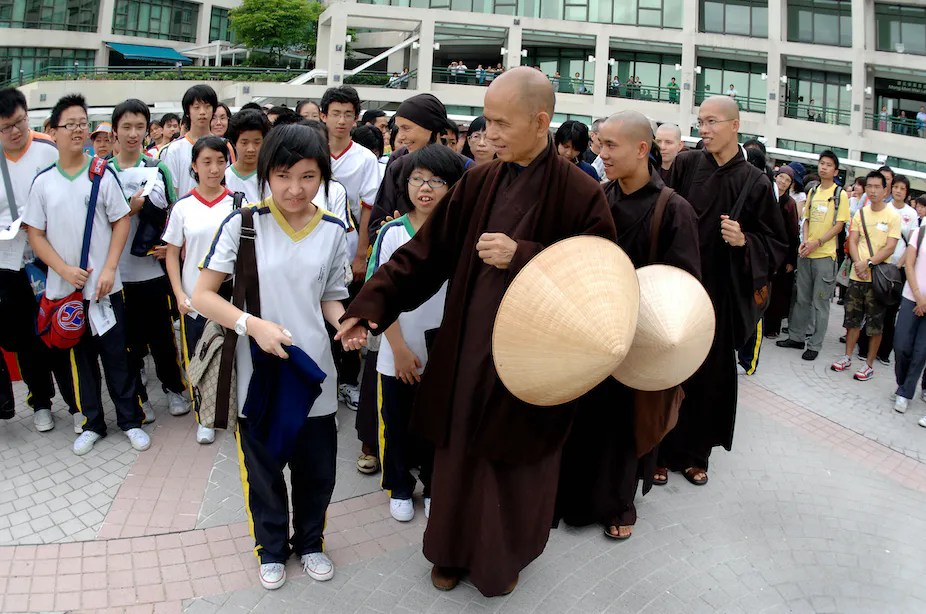
The late Zen master Thich Nhat Hanh leading a meditation walk. Steve Cray/South China Morning Post via Getty Images

The start of another year can feel magical to many of us. Even though the days remain short and dark, the flip of the calendar can make it seem new beginnings with new resolutions are possible. 

Mindfulness scholars and teachers like me call resolutions “habit breakers,” as they can overcome patterns that no longer serve individuals. However, research suggests that many resolutions fail by the end of January. 

But a key to ensuring that resolutions stick is to choose one that will make a meaningful difference in your life. Seeing a real, tangible benefit can provide inspiration to keep going when all of life is telling us to let things go back to how they were before. 

Living more mindfully is a common New Year’s resolution. This year, try gifting it to others.

The meaning of mindfulness

Mindfulness has been shown to have a number of meaningful health benefits – it can help reduce anxiety and promote healing in those suffering from long-term chronic illness. 

The practice is based on an insight first described by ancient Buddhist texts that human beings have the capacity to observe experience without being caught up in it. This means, simply and wonderfully, that it is possible to observe ourselves having a craving, or a happy thought, or even a scary emotion, without reacting in the moment in a way that amplifies the feeling or sends the mind spiraling off into thinking about old memories or anticipating events.

This practice can help calm the mind and the body as we learn not to react to experience with likes and dislikes or judgments of good and bad. It does not make us cold or apathetic but more fully present

Mindfulness in a distracted world

One of the challenges of practicing mindfulness in our contemporary world is that there has been a profound transformation in human attention. The artist Jenny Odell argues that in our “attention economy” human attention has been transformed into a commodity that big corporations buy and sell. This economy rests on a technological revolution of mobile phones and social media that makes it possible for corporations to reach us with content that can capture and monetize our focus, at every moment, every day, and no matter where we may be.

The constant need to be checking our phones keeps us from being fully present. Abdulhamid Hosbas/Anadolu Agency via Getty Images

The needy little devices most people carry in their pockets and wear on their wrists, incessantly beeping and buzzing and chirping, are a perpetual diversion from the present moment. The result is that it can feel as though our ability to focus, and be fully present, has been stolen

But mindfulness can help us resist the attention economy and savor the things that make life special, like being together with those we love. 

The gift of mindfulness

While most mindfulness research focuses on the individual benefits of the practice, scholars like me argue that we not only practice mindfulness for ourselves but that we can also practice it for others. It can help us build stronger, healthier relationships. 

The sad truth is that living in the attention economy, most of us have become bad listeners. However, just as it is possible to watch ourselves having an experience without reacting, it’s possible to watch another person have an experience without getting tied up in reactivity and judgment. It’s possible simply to be present. 

The gift of mindfulness is a practice of listening with compassion to another person describe their experiences. To give this gift means putting away your phone, turning off social media, and setting aside other common distractions. It means practicing being fully present in another person’s presence and listening to them with complete attention, without reacting with judgment, while resisting the urge to make the interaction about you. 

If we judge the value of gifts based on how much they cost, this gift may seem worthless. But in a distracted world, I argue, it is a precious one

It is not a gift that you will wrap, or put inside a card; it’s not one you will have to name as a gift or draw attention to. It’s something you can do right now.

ooOOoo

Professor David Engels is spot on. The number of people who are wedded to their cell phone, especially the younger ones of us, is frightening. Many years ago I was fortunate to have a counsellor who was into mindfulness and some of the good practices have stayed with me.

So, please, if you are thinking that your use of a cell phone is intrusive, even slightly, then let this New Year present a new you!

P.S.

Belinda sent in the following attached to one of her comments. It’s perfect! Thank you, Belinda!

And while we are on the subject of New Year’s Resolutions try this one. It is not a long video but it is extremely important; it concerns our diet and our health!

A very small step.

But an important one!

From the 21st November until the 23rd Sunshine Solar installed a solar panel system. But we were then told to wait until Pacific Power had come to the house to put in a new electricity meter. Last Thursday, 1st December, Brent from Pacific Power called by and replaced our electricity meter. He replaced it with a bi-directional meter that when we were producing more power than we are consuming then the surplus would be ‘banked’ to be used at times when we required the surplus.

This was the result of us investing in a ground-mounted solar system.

We purchased the system from Solar Sunshine after doing a great deal of research. Indeed Brent said that they were a great company.

The other thing that we had no choice over was to install a ground-mounted system some 120 feet from the house. Because neither the house nor the roof face East and therefore are no use for solar. But as Brent pointed out last Thursday the ground-mounted system, despite being more expensive, was a good alternative to the roof system because new roof tiles were irrelevant.

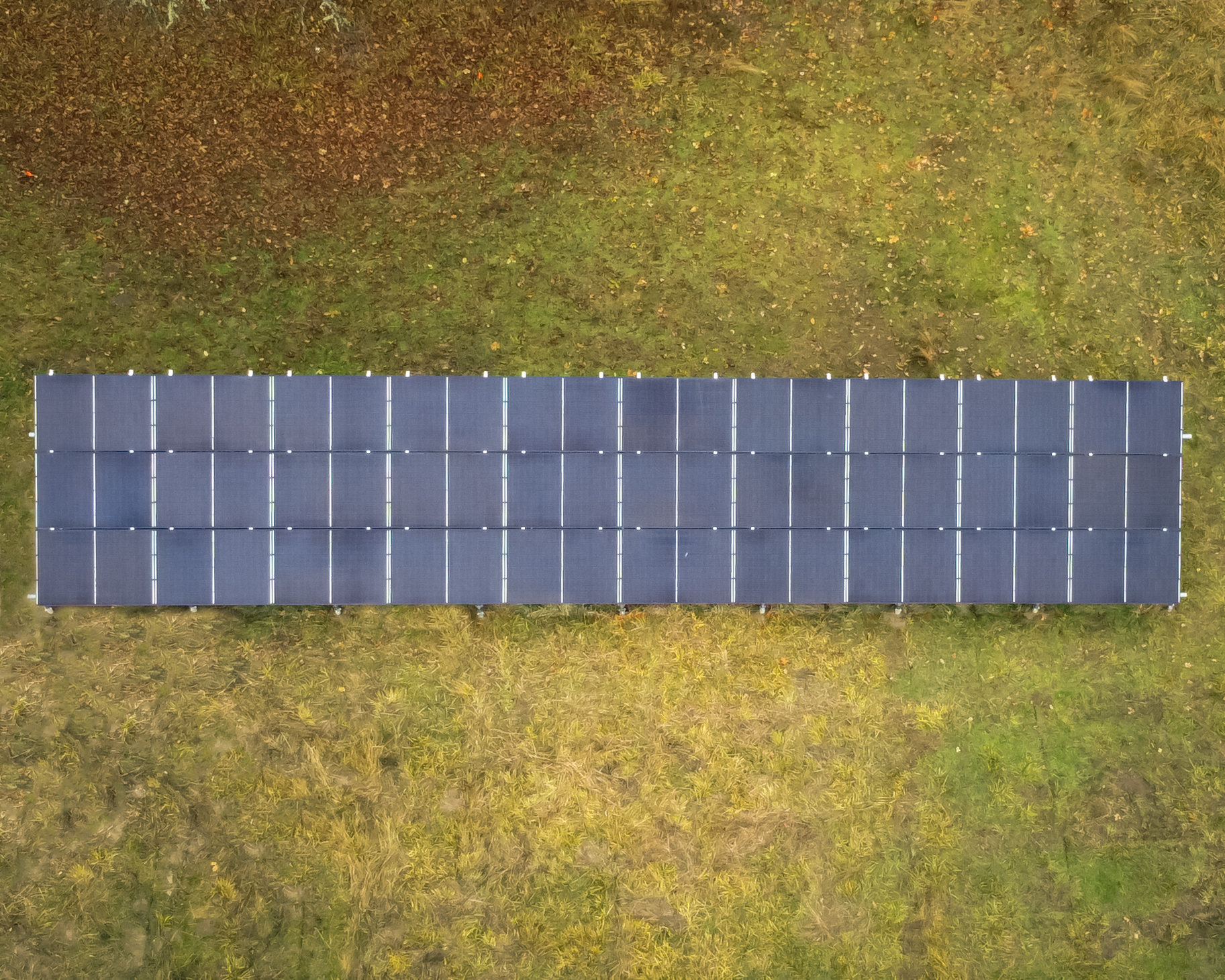
The system consists of 30 individual panels capable of producing a maximum output of 65 amps at 240 volts; in other words 15,600 watts!

Yesterday, Cory and Brandon (sp?) came out to the system and checked that it was alright. Plus they gave us an digital application so we could see how much power we were generating, plus more, and they also took some photographs, that I offer you now.

oooo

oooo

oooo

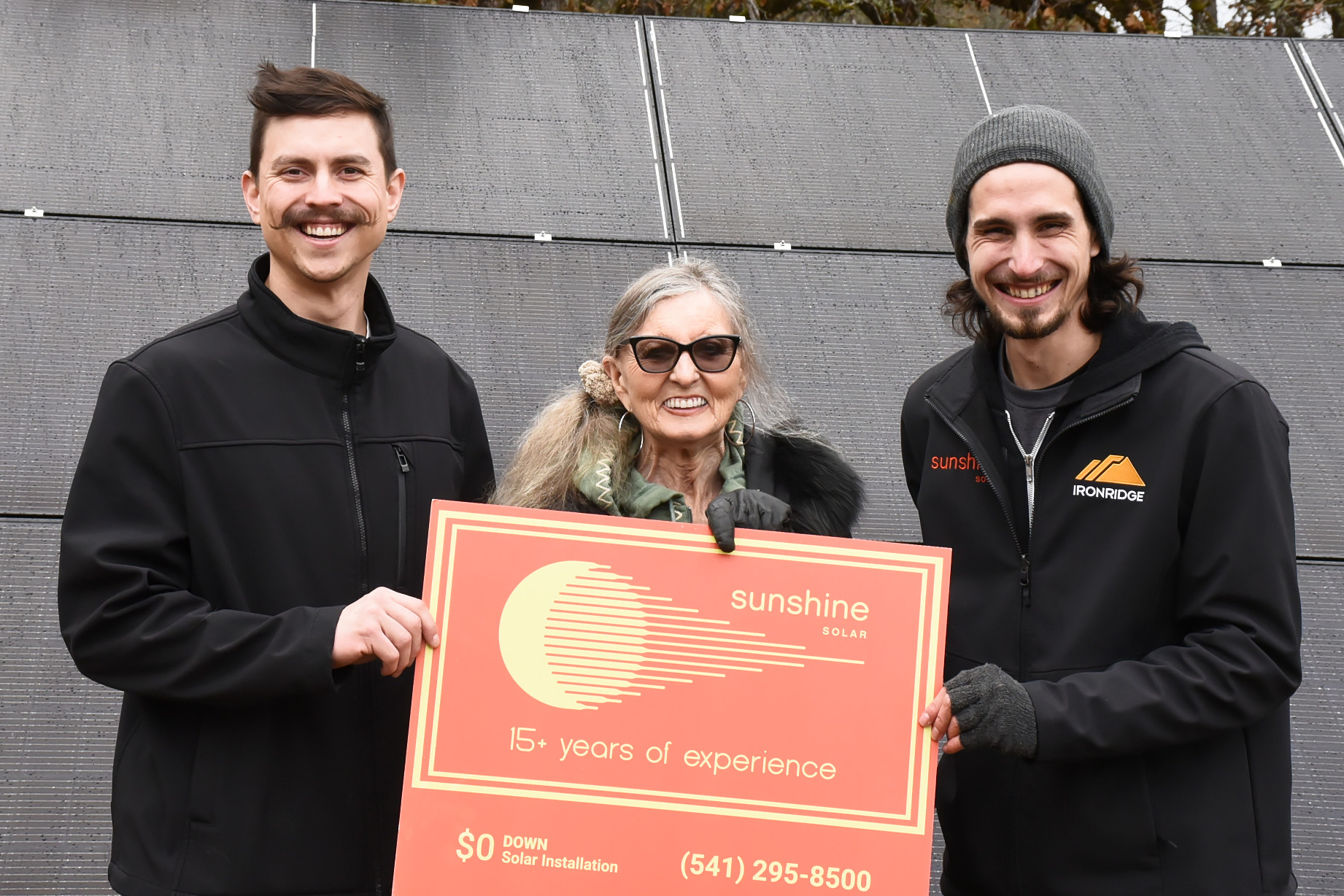
This last photograph was one taken by yours truly with Cory on the left and Brandon on the right with Jeannie in the middle.

Finally, the ‘app’ is going to be very useful.

Already it shows that last Saturday the array produced 29 kilowatts and then yesterday, the 4th December, the array produced 22.9 kilowatts and these were by no means sunlit days all the time. That brings the total for all 5 days in December, in other words since the system went live, to 91.1 kilowatts as of 15:27 PT on the 5th.

We are most pleased with the company and the installation.

Far, far back in time.

Nasa’s James Webb telescope is awesome beyond words.

The recent launch of this telescope, as a successor to Hubble, can see right back more than 13.5 billion years. The universe was formed 13.78 billion years ago. The reach of the James Webb telescope is therefore 98% (97.96) of the life of the universe. But the superlatives about this telescope are almost never-ending. For example it will, in time, be able to explore the tiny planetary worlds far, far away. We may in time see signs of life, as in water, vegetation, or industrialisation, connected with those planets.

The James Webb is in orbit some million miles away from Earth and will, in fact, be orbiting the sun.

One could go on and on speaking about this achievement but I will resist. I want to share a three things with you.

First the release of this early image and a portion of the associated text:

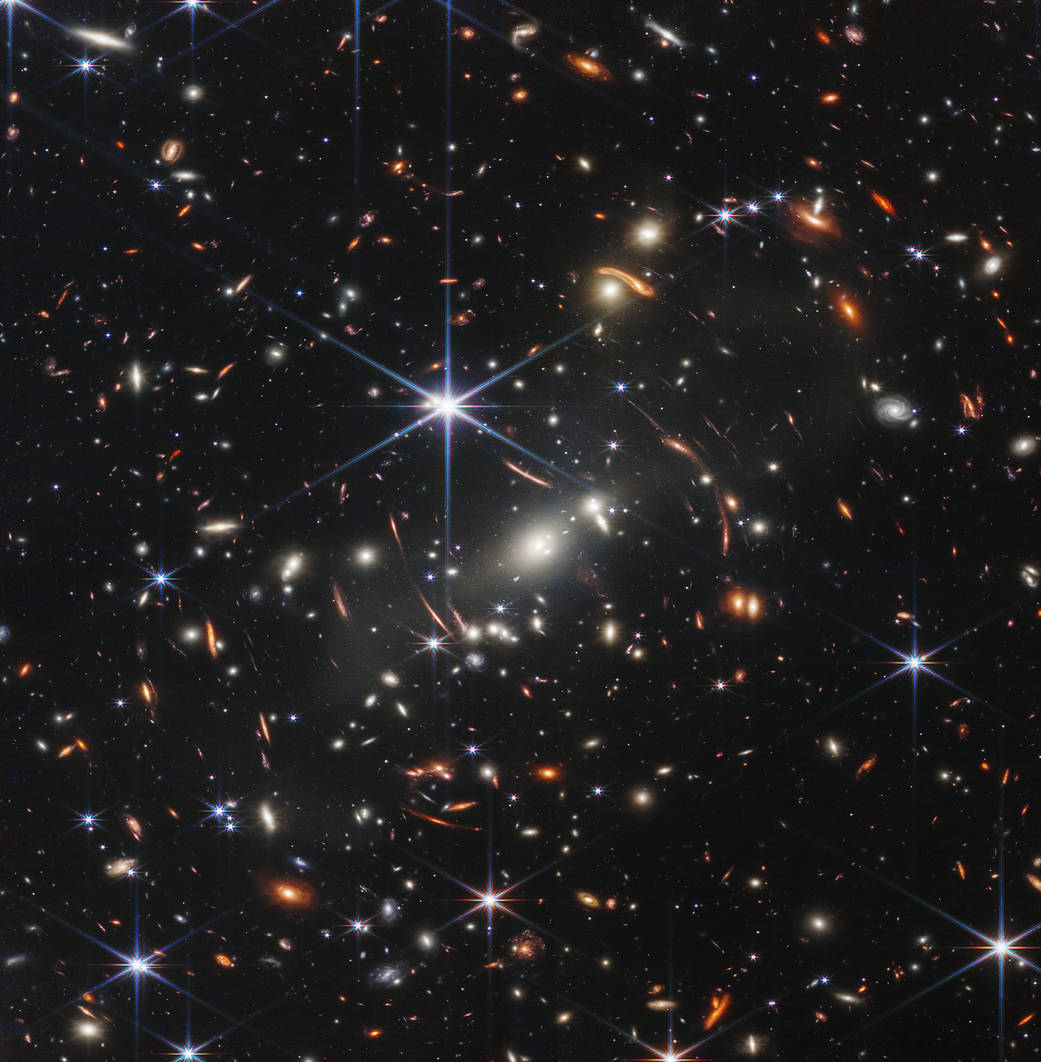
NASA’s James Webb Space Telescope has delivered the deepest and sharpest infrared image of the distant universe so far. Webb’s First Deep Field is galaxy cluster SMACS 0723, and it is teeming with thousands of galaxies – including the faintest objects ever observed in the infrared.

Webb’s image is approximately the size of a grain of sand held at arm’s length, a tiny sliver of the vast universe. The combined mass of this galaxy cluster acts as a gravitational lens, magnifying more distant galaxies, including some seen when the universe was less than a billion years old. This deep field, taken by Webb’s Near-Infrared Camera (NIRCam), is a composite made from images at different wavelengths, totaling 12.5 hours – achieving depths at infrared wavelengths beyond the Hubble Space Telescope’s deepest fields, which took weeks. And this is only the beginning. Researchers will continue to use Webb to take longer exposures, revealing more of our vast universe.

Second, why is it named after James E. Webb (1906- 1992)? James Webb was NASA’s second administrator and known for leading Apollo, the series of lunar exploration programs that landed the first humans on the Moon. (A good Q&A is here: https://www.jwst.nasa.gov/content/about/faqs/faq.html )

Last thing to share is some music! ‘Floating in Heaven’ by Graham Gouldman and Brian May

It is indeed wonderful to be alive at this time!

Off air for the time being.

My Mac is playing up.

Dear good people,

Yesterday I updated my iMac and ended up with a dark screen.

Apple Support recommended me downloading and reinstalling the latest O.S.

This morning I still can’t get my Apple to behave normally.

I have no option other than to take it into a local Grants Pass computer technician and see if he can make sense of the issue.

In the meantime normal service will be somewhat curtailed.

Well done the team at NASA.

What an outstanding feat.

Many, many congratulations!

On Feb. 18, 2021, NASA’s Mars Perseverance rover makes its final descent to the Red Planet.

A little more information:

Landed: Feb. 18, 2021, 12:55 p.m. PST (3:55 p.m. EST), (20:55 UTC)

Landing Site: Jezero Crater, Mars

Mission Duration: At least one Mars year (about 687 Earth days)

Main Job: The Perseverance rover will seek signs of ancient life and collect rock and soil samples for possible return to Earth.

As someone who watched the television non-stop in 1969 to see man’s remarkable achievement, NASA has been an organisation of considerable interest all my life.

At 10:56 p.m. EDT Armstrong is ready to plant the first human foot on another world. With more than half a billion people watching on television, he climbs down the ladder and proclaims: “That’s one small step for a man, one giant leap for mankind.

What an achievement!

Magnetic rivers!

Yes, you heard that correctly.

There was an article on the website EarthSky News yesterday that, literally, took me out of this world. It described the role of magnetic rivers in newly forming star clusters.

There’s not a dog in sight but nevertheless I wanted to share this article with you.

ooOOoo

Magnetic rivers feed star birth

Astronomers have learned that the pull of gravity can sometimes overcome the strong magnetic fields found in great star-forming clouds in space. The resulting weakly magnetized gas flow can feed the growth of new stars.

See the lines – called streamlines by scientists – in this composite image of the Serpens South star cluster? They’re from magnetic fields in this great star-forming cloud. Notice the lower left, where magnetic fields have been dragged into alignment with a narrow, dark filament. In that area, astronomers say, material from interstellar space is flowing into the star-forming cloud and fueling star formation. Image via NASA/ SOFIA/ T. Pillai/ JPL-Caltech/ L. Allen/ USRA.

Astronomers have known for decades that stars like our sun form when giant clouds of gas and dust in space – sometimes called molecular clouds – collapse under their own gravity. But how does the material from interstellar space flow into these clouds, and what controls the collapse? The image above helps illustrate an answer to these questions. It’s a composite, made with data from SOFIA – an airborne telescope designed for infrared astronomy – overlaid on an image from the now-retired Spitzer Space Telescope. This composite shows that the pull of gravity can sometimes overcome the strong magnetic fields found in great star-forming clouds in space. And it shows that, when that happens, weakly magnetized gas can flow – as on a conveyor belt – to feed the growth of newly forming star clusters.

A statement from the Max Planck Institute in Bonn, Germany, explained:

A major finding in the last decade has been that extensive networks of filaments permeate every molecular cloud. A picture has emerged that stars like our own sun form preferentially in dense clusters at the intersection of filaments.

Now look back at the image above, which shows the Serpens South star cluster, a star-forming region located some 1,400 light-years from Earth. In that image, you see a dark filament in the lower left. Now notice the “stripes” on the image, which astronomers call streamlines. They represent magnetic structures, discovered by SOFIA. The astronomers said these magnetic structures act like rivers, channeling material into the great star-forming cloud.

As you can see in the image, these magnetic streamlines have been dragged by gravity to align with the narrow, dark filament on the lower left. Astronomers say this configuration helps material from interstellar space flow into the cloud.

This is different from the upper parts of the image, where the magnetic fields are perpendicular to the filaments; in those regions, the magnetic fields in the cloud are opposing gravity.

Astrophysicist Thushara Pillai led the study showing that magnetic rivers feed star birth in the Serpens South star-forming region.

The scientists said in a statement from Universities Space Research Association (USRA) that they are:

… studying the dense cloud to learn how magnetic fields, gravity and turbulent gas motions contribute to the creation of stars. Once thought to slow star birth by counteracting gravity, SOFIA’s data reveals magnetic fields may actually be working together with gravity as it pulls the fields into alignment with the filaments, nourishing the birth of stars.

The results were published in the peer-reviewed journal Nature Astronomy on August 17. The lead author of the new study is Thushara Pillai of Boston University and the Max Planck Institute for Radio Astronomy in Bonn, Germany.

In 1835, the French philosopher Auguste Comte wrote of the unknowable nature of stars:

On the subject of stars, all investigations which are not ultimately reducible to simple visual observations are … necessarily denied to us. While we can conceive of the possibility of determining their shapes, their sizes, and their motions, we shall never be able by any means to study their chemical composition or their mineralogical structure … Our knowledge concerning their gaseous envelopes is necessarily limited to their existence, size … and refractive power, we shall not at all be able to determine their chemical composition or even their density…

He was, famously, wrong.

He couldn’t have envisioned the range of tools available to modern astronomers. It’s a beautiful thing that, nowadays, astronomers can not only learn about the compositions of stars via their studies of their spectra, but also probe the deeper mysteries, going all the way to the births of these colossal, self-luminous balls in space.

SOFIA, the Stratospheric Observatory for Infrared Astronomy. The HAWC+ polarimeter on board SOFIA was used for the observations of the magnetic field in the Serpens South star-forming region. Image via NASA/ C. Thomas/ Max Planck Institute.

Bottom line: Astronomers have learned that the pull of gravity can sometimes overcome the strong magnetic fields found in great star-forming clouds in space. The resulting weakly magnetized gas flow can feed the growth of new stars.

Source: Magnetized filamentary gas flows feeding the young embedded cluster in Serpens South

ooOOoo

Just read that paragraph just before the end of the article: “He couldn’t have envisioned the range of tools available to modern astronomers. It’s a beautiful thing that, nowadays, astronomers can not only learn about the compositions of stars via their studies of their spectra, but also probe the deeper mysteries, going all the way to the births of these colossal, self-luminous balls in space.”

What a long way we have come from just, say, 50 years ago.

It would be easy to get lost in the article in a scientific manner, and that would be entirely appropriate.

But there’s another beautiful way to get lost in the article; by dreaming of outer space and forgetting just for a moment or two this Earthly planet we all live on!


Off line for maybe a few days

My iMac needs an upgrade!

I have been having some tiny problems mainly with the Apple Photos app and the good folks over at Ugly Hedgehog were incredibly helpful. This led to me taking my machine into Dick Webster Computers here in Grants Pass for a potential upgrade.

So I am going to republish some earlier posts for the next two days, which I hope will be long enough to come to a conclusion about whether this machine may be upgraded or whether I am looking at a new iMac.

Footnote:

I called in to Dick Webster, a good, local computer repair shop, earlier today. Took my iMac with me.

They told me that that particular iMac cannot have the RAM upgraded to 16GB but they could install a SSD. However, they looked up the Apple Photos app and said there were a number of complaints from others that it was freezing.

I was told to save my money, the iMac was perfectly good and to choose a photo editing application that supplied my needs.

My only outstanding query is whether all the relevant software programs, i.e. the photo editing apps, will run without any bother on 8GB.