Category: Education

The scent of danger.

A reflection on our reptilian brains.

Now of all the things I am not, I am neither a biologist nor a scientist of any description.  However, general knowledge told me years ago that the human brain is composed of three areas, as the following diagram shows.
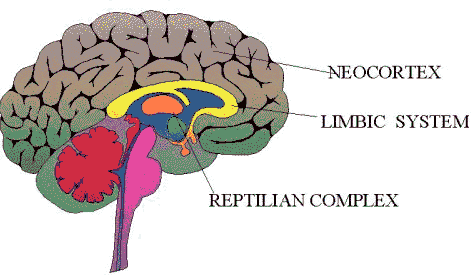
The constituents of the human brain.

A quick web search brings up THE EVOLUTIONARY LAYERS OF THE HUMAN BRAIN, from which I quote:

The first time you observe the anatomy of the human brain, its many folds and overlapping structures can seem very confusing, and you may wonder what they all mean. But just like the anatomy of any other organ or organism, the anatomy of the brain becomes much clearer and more meaningful when you examine it in light of the evolutionary processes that created it.

The most efficient model for understanding the brain in terms of its evolutionary history is the famous triune brain theory developed by Paul MacLean. According to this theory, the following three distinct brains emerged successively in the course of evolution and now co-inhabit the human skull:

The reptilian brain, the oldest of the three, controls the body’s vital functions such as heart rate, breathing, body temperature and balance. Our reptilian brain includes the main structures found in a reptile’s brain: the brainstem and the cerebellum. The reptilian brain is reliable but tends to be somewhat rigid and compulsive.

The limbic brain emerged in the first mammals. It can record memories of behaviours that produced agreeable and disagreeable experiences, so it is responsible for what are called emotions in human beings. The main structures of the limbic brain are the hippocampus, the amygdala, and the hypothalamus. The limbic brain is the seat of the value judgments that we make, often unconsciously, that exert such a strong influence on our behaviour.

The neocortex first assumed importance in primates and culminated in the human brain with its two large cerebral hemispheres that play such a dominant role. These hemispheres have been responsible for the development of human language, abstract thought, imagination, and consciousness. The neocortex is flexible and has almost infinite learning abilities. The neocortex is also what has enabled human cultures to develop.

These three parts of the brain do not operate independently of one another. They have established numerous interconnections through which they influence one another. The neural pathways from the limbic system to the cortex, for example, are especially well developed.

I’m well into reading the book Waking The Tiger: Healing Trauma authored by Peter A. Levine.  As early as Chapter One, Peter Levine explains [my emphasis]:

The involuntary and instinctual portions of the human brain and nervous system are virtually identical to those of mammals and even reptiles. Our brain, often called the ‘triune brain,’ consists of three integral systems. The three parts are commonly known as the ‘reptilian brain’ (instinctual), the ‘mammalian or limbic brain (emotional), and the ‘human brain or neo-cortex’ (rational). Since the parts of the brain that are activated by a perceived life threatening situation are the parts we share with animals, much can be learned by studying how certain animals, like the impala, avoid traumatization. To take this one step further, I believe that the key to healing traumatic symptoms in humans lies in our being able to mirror the fluid adaptation of wild animals as they ‘shake out’ and pass through the immobility response and become fully mobile and functional.

Unlike wild animals, when threatened, we humans have never found it easy to resolve the dilemma of whether to fight or flee. This dilemma stems, at least in part, from the fact that our species has played the role of both predator and prey. Prehistoric peoples, though many were hunters, spent long hours each day huddled together in cold caves with the certain knowledge that they could be snatched up at any moment and torn to shreds.

Anyway, to get back to what triggered today’s post.

If you read yesterday’s post you will recall me chatting with Jon Lavin and Jon reminding me that humans are drawn to positive messages.  But in stark contrast, the news media industry excels in promoting ‘doom and gloom’.  Why is this?  Why are we so fascinated by danger?

Well here’s my theory.

That is our evolution would not have succeeded if early man didn’t become pretty smart at identifying animal behaviours and plants and fruits that had the capacity to harm or even kill.  For example, what parent hasn’t made it a priority to teach their children the difference between harmful fungi and edible mushrooms.  Indeed to the extent that most of us would think long and hard before eating any fungi found in the wild unless we were 150% certain it was edible.  Look at the following picture.  Your instinct tells you if it’s safe to eat or not – it’s not!
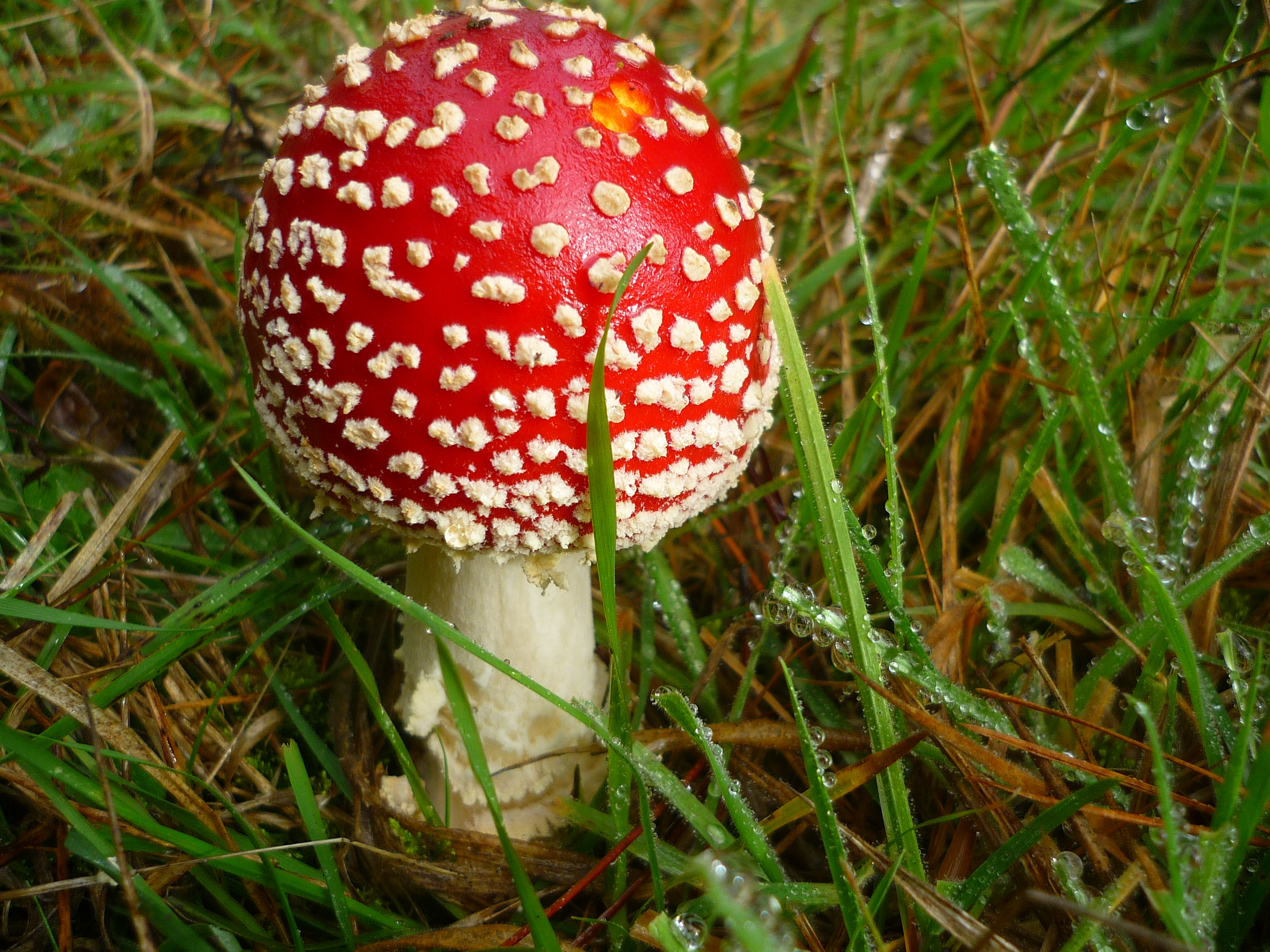
Amanita muscaria photo © Michael Wood

So early man became over-sensitised to dangers to his health for his own good and continued existence. While modern man functions in ways almost unrecognisable from early man, that good old reptilian brain still is doing it’s best to protect us (flight, fight or freeze).  Think how we all respond to a sudden alarming sound, such as a gun shot or a scream, to know that the old reptilian brain is still alive and well.

Thus while all of us hate negativity we all seem to have this fascination with doom and gloom – just in case it helps us and our loved ones survive.

Back to Jon Lavin.  He makes it very clear that anything more than a small amount of ‘doom and gloom’ speaking to our consciousness increases the odds of depression and introversion.

Thus the message is that we humans should allow our Neocortex to tell our Reptilian ‘neighbour’ to go easy on the bad news, go and open a beer and watch the world go by! Whoops! Watch the world go by with a smile!

Oh, and Happy Valentine’s Day to you all.

Science and understanding

Our weather systems are entirely driven by the laws of science.

Come forth into the light of things, let nature be your teacher.

So wrote William Wordsworth.

The last twelve months has been a period of untypical weather in many parts of the world.  It’s easy to scratch one’s head with puzzlement and blame it on the most convenient and fashionable theory of the moment.  Unusual jet stream pattern; polar vortex; aliens! You get the idea! However, the principle behind what is happening to the weather systems across our planet is very straightforward.  Our weather systems are described by the laws of science.

Thus it is a great pleasure to offer the following guest post from a scientist: Martin Lack.  Martin should be no stranger to readers of Learning from Dogs; his most recent contribution was the major three-part essay From Environmentalism to Ecologism.

Martin is the author of the blog Lack of Environment and this essay was first published there on the 11th July, 2012.

ooOOoo

Conserving mass, water, and energy

I must admit that I am rather fond of quoting Sir Arthur Eddington as having once said, “…if your theory is found to be against the Second Law of Thermodynamics, I can give you no hope; there is nothing for it but to collapse in deepest humiliation.” Without quibbling over the detail, the Law of Conservation of Mass is pretty darn close; but what, you may ask, has this got to do with climate change denial?

Conservation of mass of water
Well, consider for a moment that scientists seem to agree that there has been a 4% increase in the average moisture content of the Earth’s atmosphere since 1970. That being the case, I am bound to say that this extra 4% is making its presence felt in the UK at the moment! This year we have had the wettest 3 months (April – June) in over 100 years; the wettest June on record; the rain is still falling (sometimes as much as 80mm in a day); and – we are now being told – there is no change anticipated in coming weeks. So, if you’re coming over for the Olympics, expect to get wet!

However, whilst the UK suffers from near Biblical levels of flooding, if the Law of Conservation of Mass is to be upheld and – all other things like terrestrial ice volume remaining equal(!) – the volume of water in the oceans is to remain constant, then it must be failing to rain somewhere else. If so, is there any evidence to support this theory Law? Well, funnily enough, there is: Whilst the UK continues to receive more rain than it wants or needs (all hose pipe bans and drought restrictions have now been lifted), many parts of the World continue to suffer from persistent drought (in sub-Saharan West Africa) and/or record-breaking temperatures (in most of North America).

Sadly, none of this seems to stop self-confessed scientifically-illiterate English graduates such as James Delingpole from ridiculing the entire notion of global warming simply because it is raining a lot here at the moment. It may seem that he has just got a nasty case of tunnel vision and/or short-term memory loss but this is what the fake sceptics always do; they never look at the big picture: Rather than look at daily, monthly, or even annual average temperatures over multi-decadal periods to determine significant long-term trends; they just cherry pick data to reach fallacious conclusions such as “global warming stopped in 1998″.

I am therefore left hoping that the 57% of the British adult population that seem to fall for this kind of nonsense will soon decide that it is time to stop running down the up escalator and, by embracing the reality of what is happening, decide to become part of the solution rather than being part of the problem. If not, climate change denial may well lead to a failure to conserve mass; with the mass in question being the sustainable number of humans this planet can support in the long-term.

Conservation of mass of carbon
If the Law of Conservation of Mass explains why anthropogenic global warming climate disruption is not invalidated by any amount of cold weather or torrential rainfall in one place; can it be used to validate concern regarding a 40% increase CO2 in the Earth’s atmosphere? Funnily enough, it can: Since the Industrial Revolution began in the mid-18th Century, a vast amount of fossilised carbon has been burnt; with the carbon it contained combining with oxygen in the air to form CO2. Note here that the oxygen was in the air anyway; whereas the carbon had been out of circulation for hundreds of millions of years. All this new carbon has to go somewhere and, given that it will be many more millions of years before any of it gets taken back out of circulation by nature, it is either making the atmosphere warm-up or it is reducing the pH of seawater (just enough to make life very difficult for corals and shellfish).

So then, what is the human response to all this? Shall we stop burning the fossil fuels now we know we’re causing a problem? It doesn’t look like it! It seems far more likely that we shall gamble the future habitability of all the planets diverse ecosystems on finding a way to defeat the Law of Conservation of Mass by artificially removing this carbon from the biosphere: Carbon Capture and Storage (CCS). And do you know what I find most astonishing about CCS? It is the fact that our governments are spending huge sums of money on long-term tests to simulate the effects of CO2 leaking from a submarine CCS repository – to see if it has any noticeable effects on marine life?

Errr, hello-oh? If any CO2 ever escapes from any CCS repository, the entire exercise will have been a complete waste of time and money! The CO2 will be back in circulation and the Law of Conservation of Mass will have won (again). If the genie will not stay in the bottle we will all be in big trouble: Rather than being likely to“collapse in deepest humiliation”; such a failure to defeat the Law of Conservation of Mass will probably result in the collapse of the entire planetary ecosystem; because of our other big problem – the Law of Conservation of Energy: The reason the atmosphere is warming up in the first place; more energy is coming in from the Sun than is getting out into Space!

Conclusions
So, this year’s weather should be a wake-up call to all of us: Irrespective of the actual kind of extreme weather being experienced in any one place, the impacts on agriculture seem to be equally destructive and spiralling food costs the inevitable end result: All just as was predicted by people dismissed for decades as doomsayers: People like Garrett Hardin, Paul Ehrlich, Dennis Meadows, E.F. Schumacher, William Ophuls, Mathis Wackernagel, Ernest Callenbach, and Lester Brown… It looks like that darn ‘wolf’ finally showed up!

Funnily enough, it turns out that a doubling in the size of the global human economy every 50 years is not sustainable after all; and worshipping at the Temple of the God of Growth has got us in some serious trouble; otherwise known as a global debt crisis (see the short video embedded below). We thought we could just lend imaginary money to each other indefinitely but someone blinked and the spell was broken. Sadly, it turns out the Emperor was naked after all; it’s just a shame that by the time we realised this we were all completely sold on the latest fashion ourselves: The New Clothes are everywhere; and we have all been left looking for fig leaves to cover our genitals.

Just as The Limits to Growth (Meadows et al) predicted all those years ago, the Earth is running out of the ability to cope with the effects of our chronically dysfunctional mis-management of it. This was why, as I pointed out six months ago, the failure of food harvests in 2010 led to the Arab Spring of 2011… Are you, like me, wondering what is going to happen this time around? My prediction is that some economist such as Tim Worstall will get himself on TV and tell everyone that the Second Law of Thermodynamics is a load of old rubbish; and that technology will save us from the consequences of our selfish pursuit of profit at any cost; and from our failure to recognise that we humans are not superior to nature – we are part of it – and we cannot survive without it. Or, to put it another way, as a Native American tribal leader once did:
When all the trees have been cut down, when all the animals have been hunted, when all the waters are polluted, when all the air is unsafe to breathe, only then will you discover you cannot eat money.

ooOOoo

I can add nothing to the above other than to thank Martin for giving me the opportunity to republish his post.

How we feed our dogs?

An opportunity to learn about dog food.

I have a policy of not allowing Learning from Dogs to promote commercial interests.  I need those who visit this place to trust the integrity of what they find here.

Then back on the 19th December last, in came the following email.

Dear LearningfromDogs (I think Paul!),

Greetings from Florence, Tuscany!

We are sending you a piece that we hope will be considered for publication on your blog: we begin by talking about making pet food at home (and then go on to list some of the risks – essentially the message here is don’t do it!), we then talk about buying products off the shelf, and explain about food labeling and what different types of labeling will mean in terms of the meat content. I’ve also included some pictures that we purchased from DepositPhotos to help support with its publication. You can verify the usage terms on Deposit photos, but I can tell you that for your website they will be considered appropriate use.

Our shop first opened it doors in 1962 and we’ve just started an English website where we (wait for it!) are making dog beds, and collars to order. We’ve got the most amazing fabrics from a town in Tuscany that has been producing fabrics from the 13th Century. The quality is (as I hope you will take a look) of the highest standard.

Please take a read through the article and if you would like to publish it we would be thrilled.

Best regards from Tuscany,

Glyn

The email offered me a potential conflict.  Glyn was clearly promoting his company and yet the information struck me as valuable to pet owners.  On balance, it seemed worthwhile to publish the article.

ooOOoo

We only want what's best for our dogs.
We only want what’s best for our dogs.

There have been substantial changes in the market of pet foods over the last decade, and so this article sets out to demystify pet food labelling in layman’s terms. We also consider whether or not preparing the food your pet eats in your own home is really a viable option, if you want to have a healthy pet.

Preparing food at home

If you have decided to undertake the mission of preparing your pet’s food at home, it’s important that you take some time to look up what exactly is needed in your pet’s diet. You have to ensure that your pet gets all the nutrients it needs, and that you don’t provide it with too much of one food group or another as this could cause it serious health problems (Hypervitaminosis A, Hypervitaminosis D).

A short thought for the cat!

Cats require a varied diet, consisting mainly of meat. One of the most important amino acids for cats is Taurine which is only found in meat – a lack of this in a cat’s diet could cause cardiac dysfunction, blindness, etc. Other essential nutrients for our feline friend include: arginine (also important for dogs too), arachidonic acid, niacin, vitamin A, vitamin D, vitamin E. You should not forget to provide the right amount of calcium, phosphorus, and magnesium. Reading this you probably get the sense that taking on the task of being your pet’s personal cook is not as simple as it sounds. Our pets have very specific dietary needs, just like us, and you wouldn’t want to risk endangering them with the wrong food. The plate of scraps after a large meal is clearly not enough.

Purchasing food off the shelf

As the vast majority of consumers opt for buying their food from either the supermarket or their local pet store, it’s important to highlight that the range of dietary foods being produced today means that, if you don’t read the label carefully, you can really do harm to your pet feeding them food that is not matched to their actual dietary needs. We’ve seen dogs that look emaciated and thin simply because they have not been given the correct advice when feeding their dog (we then saw the same dog a few weeks later looking great!).

For example, ‘ash’ is often included in the ingredient list of pet foods. This refers to the inorganic component of the food, and it shouldn’t make up more than 6.5%-7% of dry foods and 1%-2% of wet foods. The lower the concentration of ash, the higher the quality of the food.

Labelling in pet food and what it means

Specifically regarding meat in packaged pet foods, there are a few things to keep an eye open for while studying the labels. The amount of meat included in pet food changes from brand to brand, but as a general rule the following serves as a guide:

– products that have the word ‘flavour’ or ‘aroma’ in their name contain under 4% of meat;

– when the product name declares ‘with meat’ it should contain over 4% of meat;

– when the name contains ‘rich in meat’ or ‘extra meat’ the percentage of meat is between 14% and 25%. Anything above 14% and 25% and the product takes on the name of the meat it’s made up of.

In dry foods, sometimes meat flour or fish flour are included. These sometimes contain offal and discarded meat so a better option is dehydrated meat.

Author Bi line

We hope that this article has provided you the reader with greater detail on some of the nuances involved in planning your pet’s diets. At ZEIPET in Florence, Tuscany, we have been serving customers in our little pet shop since 1962. We are most known for our luxury dog beds which are made to order and from some of the finest fabrics in Italy. So, after you pet has eaten and it’s time to stretch out, they are guaranteed to do so on a bed of doggie paradise.

Now what!
Now what!

ooOOoo

Hope this has been helpful.  If you have any questions, leave them as comments and I’ll ask Glyn to reply.

The Big Edit!

The start of phase two of ‘The Book’!

Back on the 1st November, I started out on the journey to write, before the end of November, a novel of a minimum of 50,000 words.  It was part of the NaNoWriMo annual encouragement for new writers.  To my amazement, I completed a first draft.

However, now comes the hard work!  For as Stephen King explains in his book, On Writing,

When you write a story, you’re telling yourself the story, when you rewrite, your main job is taking out all the things that are not the story. (p. 57)

Or as I read somewhere else: Your first write is for you, your rewrite is for your readers.

Either way it doesn’t get around the fact that for the next several weeks I need to be spending hours rewriting the first draft.

Which is my way of saying that until that rewrite is complete I won’t be able to spend so much time writing posts for Learning from Dogs.  In other words, there will be more republication of other articles and essays that catch my interest, repeat posts back from the earlier days of the blog and the publication of essays that you, dear reader, have sent me (hint!!).

TED Talks is an amazing resource that thousands use.  Not infrequently, a TED Talk finds its way to these pages; as indeed one on dieting will be offered tomorrow.

For today, however, enjoy this wonderful, and powerful, TED Talk by Benjamin H. Bratton.

An echo in the hills!

Patterns in the ether.

On Monday and Tuesday of the week I posted Legitimate Anger and Legitimate Hope.  (And please see the footnote to today’s post)

Patrice Ayme left the following comment to the Legitimate Hope post:

It’s hard to live with elephants, especially in poor, crowded conditions. I remember bathing in Africa as a child with a bull elephant 200 meters away, on the other side of a stream, and being extremely worried, with all in attendance.

Europe used to have elephants, and North America, two species. Time to reintroduce them, and live according to our discourse.

Rewilding Euramerica can be done, and should be done, for the deepest philosophical and emotional reasons, and will create new, very productive jobs.
PA

Then on Friday came an email from reader and blogger Martin Lack:

Hi Paul,
I saw this on The Conversation website – ‘Restore large carnivores to save struggling ecosystems’ (by Oregon State University’s Prof. William Ripple ) –  and thought of you.

Cheers,

Martin Lack

Author of Denial of Science: Analysing climate change scepticism in the UK; and of the Lack of Environment blog.   Follow me on Twitter @LackMartin

It was but a moment to go across to The Conversation website (rather liked what I saw, by the way) and find the article that Martin linked to. It is republished here within the terms of The Conversation site.

ooOOoo

Restore large carnivores to save struggling ecosystems

By William Ripple, Oregon State University
We are losing our large carnivores. In ecosystems around the world, the decline of large predators such as lions, bears, dingoes, wolves, and otters is changing landscapes, from the tropics to the Arctic. Habitat loss, persecution by humans and loss of prey have combined to inflict great losses on these populations.

In fact more than 75% of the 31 largest carnivore species are declining, and 17 species now occupy less than half their former ranges. Southeast Asia, southern and East Africa, and the Amazon are among areas in which multiple large carnivore species are declining. And with only a few exceptions, large carnivores have already been exterminated from much of the developed world, including areas of Western Europe, and the eastern United States.

Top dogs keep ecosystems in order

Many of these large carnivore species are endangered and some are at risk of extinction, either in specific regions or entirely. Ironically, they are vanishing just as we are learning about their important ecological effects, which is what led us to write a new paper in the journal Science to document their role.

From a review of published reports, we singled out seven species that have been studied for their important ecological role and widespread effects, known as trophic cascades. These are the African lion, leopard, Eurasian lynx, cougar, gray wolf, sea otter and dingo.

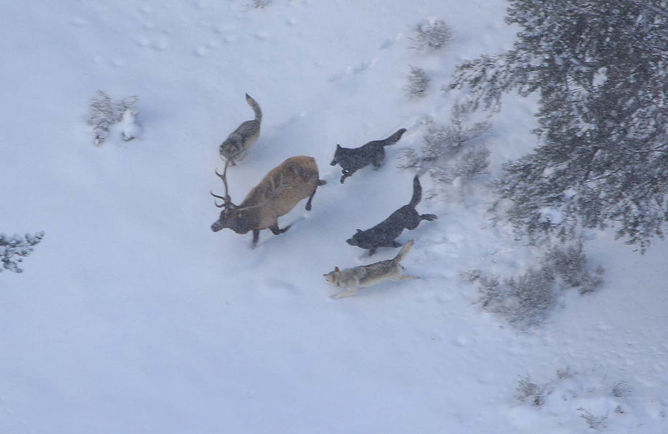
Based on field research, my Oregon State University co-author Robert Beschta and I documented the impact of cougars and wolves on the regeneration of forest tree stands and riverside vegetation in Yellowstone and other national parks in western North America. Fewer predators, we found, lead to an increase in browsing animals such as deer and elk. More browsing disrupts vegetation, reduces birds and some mammals and changes other parts of the ecosystem. From the actions of the top predator, widespread impacts cascade down the food chain.

Similar effects were found in studies of Eurasian lynx, dingoes, lions and sea otters. For example in Europe, absence of lynx has been closely tied to the abundance of roe deer, red fox and hare. In Australia, the construction of a 3,400-mile dingo-proof fence has enabled scientists to study ecosystems with and without dingoes which are closely related to gray wolves. They found that dingoes control populations of herbivores and exotic red foxes. The suppression of these species by dingoes reduces predation pressure, benefiting plants and smaller native prey.

In some parts of Africa, the decrease of lions and leopards has coincided with a dramatic increase in olive baboons, which threaten crops and livestock. In the waters off southeast Alaska, a decline in sea otters through killer whale predation has led to a rise in sea urchins and loss of kelp beds.

Predators are integral, not expendable

We are now obtaining a deeper appreciation of the impact of large carnivores on ecosystems, a view that can be traced back to the work of landmark ecologist Aldo Leopold. The perception that predators are harmful and deplete fish and wildlife is outdated. Many scientists and wildlife managers now recognise the growing evidence of carnivores’ complex role in ecosystems, and their social and economic benefits. Leopold recognised these relationships, but his observations were ignored for decades after his death in 1948.

op carnivores, at work keeping things in check. Doug Smith
Top carnivores, at work keeping things in check. Doug Smith

Human tolerance of these species is the major issue. Most would agree these animals have an intrinsic right to exist, but additionally they provide economic and ecological services that people value. Among the services documented in other studies are carbon sequestration, restoration of riverside ecosystems, biodiversity and disease control. For example, wolves may limit large herbivore populations, thus decreasing browsing on young trees that sequester carbon when they escape browsing and grow taller. Where large carnivore populations have been restored – such as wolves in Yellowstone or Eurasian lynx in Finland – ecosystems appear to be bouncing back.

I am impressed with how resilient the Yellowstone ecosystem is, and while ecosystem restoration isn’t happening quickly everywhere in this park, it has started. In some cases where vegetation loss has led to soil erosion, for example, full restoration may not be possible in the near term. What is certain is that ecosystems and the elements of them are highly interconnected. The work at Yellowstone and other places shows how species affect each another through different pathways. It’s humbling as a scientist to witness this interconnectedness of nature.

My co-authors and I have called for an international initiative to conserve large carnivores in co-existence with people. This effort could be modelled after a couple of other successful efforts including the Large Carnivore Initiative for Europe, a non-profit scientific group affiliated with the International Union for the Conservation of Nature, and the Global Tiger Initiative which involves all 13 of the tiger-range countries. With more tolerance by humans, we might be able to avoid extinctions. The world would be a scary place without these predators.

William Ripple does not work for, consult to, own shares in or receive funding from any company or organisation that would benefit from this article, and has no relevant affiliations.

The Conversation

This article was originally published at The Conversation.
Read the original article.

ooOOoo

Footnote – Please help the elephants

Tuesday’s Legitimate Hope included this:

Also what needs to be highlighted are the organisations that are actively working on behalf of the elephants.

The Independent Newspaper have their own elephant campaign.

Elephant Crisis

In 2011, more African elephants were killed than any other year in history. The figures for 2012 and 2013 are not yet known, but are likely to be even higher. At current rates, in twelve years, there will be none left.

It is a familiar cause, but it has never been more urgent. Poaching has turned industrial. Armed militia fly in helicopters over jungle clearings, machine gunning down entire herds. Their tusks are then sold to fund war and terrorism throughout the continent and the wider world. Ivory is still illegal, but as China booms, it is more popular than ever.

This campaign will raise money to support rangers on the ground to protect Kenya’s elephants from armed poachers, together with Space for Giants’ longer term work to create new wildlife sanctuaries where elephants will be safe, forever. More can be found about the charity at Space for Giants

The article above includes two videos.  A shorter one that can be viewed on the paper’s campaign website. Then there is a longer, five-minute, video also on YouTube and included below.

Offering a donation to help is only a click away.

Jean and I wanted to make a donation but found that without a UK bank account/UK Visa card it wasn’t possible.  We contacted Space for Giants and received the following email from Amy.

TUSK

Hi Paul

Sorry for the difficulties and thank you for your perseverance!
You can donate in USD through our CrowdRise page at www.crowdrise.com/spaceforgiants1. These funds are sent to TUSK USA who will then allocate them to us.
Alternatively, you can make out a cheque to ‘TUSK USA’  and send to TUSK USA, 40 East 94th Street, Apt 3A, New York, NY 10128 – please attach a covering note confirming that you would like your donation to be used to support the work of Space for Giants.
Many thanks,
Amy.
So if there’s anyone else out there not in the UK who would like to donate, here’s another option.
Please, for all our sakes, help these beautiful creatures.

Synchronicity of minds, part two

“There IS very intelligent life, but somehow it can’t seem to achieve dominance over the other kind.” Chris Snuggs.

In yesterday’s Part One, I offered three independent essays, about the USA, the UK and Europe, that contained a common message.  A message of “the abject failure of modern nation-state democracy — not only in Europe, but across the globe.“ (In the words of one of the essayists: Don Quijones.)

As with Part One, Part Two brings together disconnected commentators offering an interconnected theme.

One of the commentators was Chris Snuggs who writes the blog Nemo Insula Est.  It was his post about the slaughter of elephants for their tusks that I featured last Tuesday: Legitimate anger.  Chris and I recently exchanged emails on the curious issue of why those who are charged with governing our democratic societies so often fail to do so in a fair and balanced manner; to put it mildly.

Here’s some of that exchange from Chris:

My theory is that intelligent people are too nice. Take you, for example – someone so intelligent, informed and civilised should be in government, but you are not ruthless, nasty and/or ambitious enough!!!

Another way to put it is that people like you – and I on a more modest, brutish and disorganised level – are doing their bit to spread civility in general, but we have NO POWER because we are too nice.

A related theory is that most people are in fact basically nice but that the rest have a disproportionate influence, both because a greater proportion of them have power and because of the “rotten apple” theory – one apple rots the barrel eventually.

I should open a school to teach nice and intelligent people how to be more nasty to nasty people! ………. Indeed, it is our duty to be more ruthless to stand up to the bad guys.

Moving swiftly over the flattery of yours truly, there is a strong message from Chris.  The message that nice people are not being sufficiently active in registering their disgust over what is being done in the supposed name of the people.

The next item, as part of this theme, was a recent article on Permaculture News.  The article was called Majority Voting is Inadequate and was based around an interview with Peter Emerson.  I hadn’t heard of Mr. Emerson before but very quickly established that Peter Emerson is the director of the de Borda Institute in Belfast, Northern Ireland. He is a leading authority on voting systems for use in both decision-making and elections.

Here is a flavour of that interview.

Marcin Gerwin (Poland): There are many divisions and even hostility in the Polish parliament. The ruling coalition currently has 232 votes in a parliament with 460 seats. This slight majority allows them to run all the ministries, and they can pass almost any bill they want. Do you think that creating an all-inclusive government, where all parties have their representatives, could help to tone down the atmosphere and create a more cooperative environment?


Peter Emerson

Peter Emerson: In a word – yes. However, I think I should argue the other point first. There is no justification for majority rule. When I was in Russia, it was quite interesting, because when Gorbachev started perestroika, all sorts of experts rushed over to Moscow, to tell him what to do to be democratic. They advised the system that we have here in Northern Ireland and that you now have in Poland and pretty well everyone else has as well – and that is that you elect your parliament by one of many electoral systems, apparently they all are democratic, even though some are bad and some are worse. But when it comes to what happens in parliament, nearly every parliament in the world debates things and then takes a majority vote.

These experts talked in Russia about majority rule but Mikhail Sergeyevich doesn’t speak English, so they had to use the Russian word. And the Russian word for majoritarianism is bolshevism. It comes from the Russian word for majority which is bolshinstvo, so the member of the majority was a bolshevik and a member of the minority was a menshevik. The decision to split into bolsheviks and mensheviks was taken in 1903 in London by the mathematical accident of just one vote. The whole thing was nonsense. But God, such a dangerous one.

MG: If not a majority vote, what are the other ways that decisions can be made?

PE: There are lots of voting methodologies – Borda countCondorcet…. One of these could be used. And in fact Dublin City Council recently took a vote by means of a Borda count, which is brilliant. It was partly because they had more than two options on the agenda, so you almost have to move beyond majority voting.

And when you look at it, the majority vote is actually the most inaccurate measure of collective opinion ever invented. It’s over two thousand years old, it was used by the Greeks and the Chinese. But there is no justification to for its use today because it’s so inaccurate.

You did register what Peter said in that last paragraph? “the majority vote is actually the most inaccurate measure of collective opinion ever invented.

If you have only the slightest curiosity about better methods of voting then do read the interview in full.  For the interview contains links to other voting systems, most of which I hadn’t heard of before.  There is the Borda count, the Condorcet method, the Ranked voting system (otherwise known as Preferential voting), and the proportional voting process known as the Matrix vote.

Moving on.

The final coincidence was John Hurlburt sending me the following essay, that is published with his permission.

ooOOoo

Apocalypse and Epiphany

Apocalypse, n. [Gr. apokalypsis, from apokalypto, to disclose and to discover.] Revelation; discovery; disclosure.  (The New Webster Encyclopedic Dictionary)

Apocalypse is a word which describes a human awakening to change.  Change is a constant. Our species has been living through apocalypse for fourteen million years.  Conservative groups deny change.  For example financial interests spent 14 million dollars to refute the scientific reality of climate change during 2013.  We are in the midst of worldwide financial wars, energy wars, cultural wars, and political wars.  Has there been progress in emerging human species intelligence?

Perhaps more importantly, has there been progress in human morality?   We’ve been around as a species for roughly 14 million years.  Have we truly learned anything in the process?   For the last two hundred years we’ve been industrially poisoning the environment which sustains our existence at a steadily increasing rate.

We’re needlessly killing ourselves and a significant portion of the life on our shared garden planet in the pursuit of artificial symbols of trust we call money.   No one knows for sure how deep and how devastating an impending economic, cultural, political and geophysical collapse may become.

We’ve reached a critical tipping point between species survival and a severely diminished quality of human life. We’re in the process of falling off the edge.  The good news is that we know what needs to be done and we know how to do it.  So why don’t we do what we know needs to be done?

There are a variety of reasons.  The seven deadly sins are a starting point for systemic corruption.  The seven deadly sins are pride, greed, lust, anger, gluttony, envy and sloth.  Add ignorance, denial and indifference.  Serve bread and circuses for dessert.  In terms of action, compete more than cooperate.  Rush ever faster without reflection, contemplation or meditation.  As a final touch, become consumed by “now” without regard for the future.

Epiphany, n. [Gr. epiphaneia, appearance; from epiphanio, to appear] an appearance or a becoming manifest. (The New Webster Encyclopedic Dictionary)  Epiphany provides us a way to deal with apocalypse.  As what’s going on is revealed, we realize that something needs to be done about it and that we are capable of creating and implementing solutions in concert with Nature.

To paraphrase Shakespeare’s “Hamlet”, “The fault, Dear Brutus, lies not in our stars but in ourselves.” What do we need to personally change both spiritually and practically?  Today is the tomorrow – we imagined yesterday.

Considering our steadily increasing demographic and our systemic global failure, it’s half past time to clean house.  We begin with our “self”.  We take inventory.  We honestly look at our thoughts and actions.  What do we personally have to offer that’s useful and productive in terms of a resilient tomorrow?  What’s standing in our way today?

We accept that we are a very young consciously aware species on a fragile garden planet that’s 14 Billion years old in a universe that’s roughly 33 billion years old.  We accept that we are a species component of the matter and energy of Creation. We accept responsibility for sustaining our being and by extension responsibility for the being of life on earth.

We realize our purpose as stewards of Creation.

an old lamplighter

ooOOoo

So put those three perspectives together and the message is clear.  This is a period of significant change and, as with previous periods in history, change only comes along when there is dissatisfaction with the present.  Ergo, there is widespread acceptance that the present way of life is not working for millions and millions around the world.

Reinforced only this morning (Thursday) by a recent announcement from Gallup regarding the voting intentions of Americans.

January 8, 2014

Record-High 42% of Americans Identify as Independents

Republican identification lowest in at least 25 years

by Jeffrey M. Jones

PRINCETON, NJ — Forty-two percent of Americans, on average, identified as political independents in 2013, the highest Gallup has measured since it began conducting interviews by telephone 25 years ago. Meanwhile, Republican identification fell to 25%, the lowest over that time span. At 31%, Democratic identification is unchanged from the last four years but down from 36% in 2008.

Let me include this section:

Fourth Quarter Surge in Independence

The percentage of Americans identifying as independents grew over the course of 2013, surging to 46% in the fourth quarter. That coincided with the partial government shutdown in October and the problematic rollout of major provisions of the healthcare law, commonly known as “Obamacare.”

gallup

The 46% independent identification in the fourth quarter is a full three percentage points higher than Gallup has measured in any quarter during its telephone polling era.

Taking everything into consideration, from yesterday’s evidence and what is presented today, it’s hardly surprising to read in that Gallup report [my italics]:

The rise in political independence is likely an outgrowth of Americans’ record or near-record negative views of the two major U.S. parties, of Congress, and their low level of trust in government more generally.

The increased independence adds a greater level of unpredictability to this year’s congressional midterm elections. Because U.S. voters are less anchored to the parties than ever before, it’s not clear what kind of appeals may be most effective to winning votes. But with Americans increasingly eschewing party labels for themselves, candidates who are less closely aligned to their party or its prevailing doctrine may benefit.

Fascinating times!  Thank goodness there’s always a dog to remind us of how to cope!

Cleo dealing with stress!
Cleo coping with these fascinating times!

Food and health

How less can be so much more.

I came at today’s post from a number of directions.

A few days ago I was catching up with a good friend back in the UK, Peter M.  We hadn’t spoken in a couple of months.  One of the items from my end was mentioning that I had converted to a vegetarian diet, verging on trying to be a vegan.  Jeannie has been a vegetarian for almost her entire life. Having made the change to a vegetarian diet, to my surprise I had gained 12 lbs (5.4 kgs) in the last month.  Peter then mentioned that he, too, had put on 8 kgs before deciding to try and cut back.  Peter and I are of the same age and motivated to stay as fit and healthy as we can.  Anyway, Peter’s route for losing some weight was to commit to the fasting arrangement promoted and recommended by Dr. Michael Mosley – more of this later.

The conversation also reminded me of an essay by George Monbiot back at the end of November: Wrong About Being Wrong. Mr. Monbiot wrote of his mind changes about being vegetarian.  With his permission, here is that essay.

oooOOOooo

Wrong About Being Wrong

November 27, 2013

The argument seems, once more, decisively to favour veganism.

By George Monbiot, published on the Guardian’s website 27th November 2013

He did it quietly, and the decision is the better for that: Al Gore, according to reports in the US press, has gone vegan.

Certain things could be said about other aspects of his lifestyle: his enormous houses and occasional use of private jets, for example. While we can’t demand that everyone who espouses green causes should live like a Jain monk, I think we can ask that they don’t live like Al Gore. He’s a brilliant campaigner, but I find the disjunction between the restraint he advocates and the size of his ecological footprint disorienting.

So saying, if he is managing to sustain his vegan diet, in this respect he puts most of us to shame. I tried it for 18 months and almost faded away. I lost two stone, went as white as a washbasin and could scarcely concentrate. I think I managed the diet badly; some people appear to thrive on it. Once, after I had been unnecessarily rude about vegans and their state of health (prompted no doubt by my own failure), I was invited to test my views in an unconventional debate with a vegan cage fighter. It was a kind invitation, but unfortunately I had a subsequent engagement.

In 2010, after reading a fascinating book by Simon Fairlie, a fair part of which was devoted to attacking my views, I wrote a column in which I maintained that I’d been wrong to claim that veganism is the only ethical response to what is arguably the world’s most urgent social justice issue. Diverting grain that could have fed human beings to livestock, I’d argued, is grotesque when 800 million go hungry.

Fairlie does not dispute this, and provides many examples of the madness of the current livestock production system. But he points out that plenty of meat can be produced from feed which humans cannot eat, by sustaining pigs on waste and grazing cattle and sheep where crops can’t grow. I was swayed by his argument. But now I find myself becoming unswayed. In the spirit of unceasing self-flagellation I think I might have been wrong about being wrong.

Part of the problem is that while livestock could be fed on waste and rangelands, ever less of the meat we eat in the rich nations is produced this way. Over the past week, a row has erupted between chefs and pig farmers over the issue of swill. The chefs point out – as Simon Fairlie does – that it is ridiculous to feed pigs on soya grown at vast environmental cost in the Amazon instead of allowing them to dispose of our mountain of waste food. Feeding pigs on swill has been forbidden since the foot and mouth outbreak of 2001.

The farmers respond that the risks of spreading disease are too great and that pigs fed on waste grow more slowly than pigs fed on soya. I side with the chefs: I believe that a society capable of identifying the Higgs boson should be able to sterilise waste food. But I suspect that they’re not going to win: the industry and its regulators are firmly against them.

I should have seen it coming, but I watched in horror as the meat industry used my article to justify the consumption of all meat, however it was produced, rather than just the meat raised on food that humans can’t eat. A potential for good is used to justify harm.

While researching my book Feral, I also came to see extensive livestock rearing as a lot less benign than I – or Simon Fairlie – had assumed. The damage done to biodiversity, to water catchments and carbon stores by sheep and cattle grazing in places unsuitable for arable farming (which means, by and large, the hills) is out of all proportion to the amount of meat produced. Wasteful and destructive as feeding grain to livestock is, ranching appears to be even worse.

The belief that there is no conflict between this farming and arable production also seems to be unfounded: by preventing the growth of trees and other deep vegetation in the hills and by compacting the soil, grazing animals cause a cycle of flash floods and drought, sporadically drowning good land downstream and reducing the supply of irrigation water.

So can I follow Al Gore, and do it better than I did before? Well I intend at least to keep cutting my consumption of animal products, and to see how far I can go. It’s not easy, especially for a person as greedy and impetuous as I am, but there has to be a way.

http://www.monbiot.com

oooOOOooo

Back to the conversation with Peter M. about fasting.  He spoke enthusiastically about Dr. Mosley who one quickly discovers,

Dr. Michael Mosley.
Dr. Michael Mosley.

Michael J. Mosley (born 22 March 1957) is a British journalist, medical doctor, producer and TV presenter. He is probably best known as a television presenter of programmes on biology and medicine, particularly his series on the workings of the human body, Inside the Human Body and his regular appearances as the friendly medic on The One Show.

He was interviewed by Steve Wright of BBC Radio 2 back in January, 2012 and that interview is on YouTube:

That BBC Horizon programme is no longer available to watch but a 4-minute extract may be seen here:

Inevitably, Dr. Mosley has a website Fast Diet that is packed full of valuable information.

So just as soon as we have the water back to the house and I can have a long, hot shower I intend to adopt the 5:2 diet.

Magic!

The old and the new.

Like thousands of others, Jean and I are regular viewers of the TED Talks.

So first the old. Here’s a reminder of the inspiring nature of mathematics; in this case Fibonacci numbers.

Published on Nov 8, 2013

Math is logical, functional and just … awesome. Mathemagician Arthur Benjamin explores hidden properties of that weird and wonderful set of numbers, the Fibonacci series. (And reminds you that mathematics can be inspiring, too!)

Now to the new. Innovation at its very best.

Published on Jul 11, 2013

The development of new medicine is problematic because laboratories cannot replicate the human body’s environment, making it difficult to determine how patients will respond to treatment. At TEDxBoston, Geraldine Hamilton demonstrates how scientists can implant living human cells into microchips that mimic the body’s conditions. These “organs-on-a-chip” can be used to study drug toxicity, identify potential new therapies, and could lead to safer clinical trials.

Smart animals!

It’s not just dogs who can read us so well.

Millions of dog owners know how well their animals can read us humans; it’s been mentioned on Learning from Dogs many times before.

Try elephants.

There was a fascinating article on the BBC news website a few weeks ago that went on to explain:

10 October 2013

Elephants ‘understand human gesture’

By Victoria GillScience reporter, BBC News
African elephants have demonstrated what appears to be an instinctive understanding of human gestures, according to UK scientists. In a series of tests, researcher Ann Smet, of the University of St Andrews, offered the animals a choice between two identical buckets, then pointed at the one containing a hidden treat.

From the first trial, the elephants chose the correct bucket.

The results are published in the journal Current Biology.

The item included a short video that I am delighted to say is on YouTube.  Here it is:

Published on Oct 10, 2013

African elephants have demonstrated what appears to be an instinctive understanding of human gestures, according to UK scientists.

In a series of tests, researcher Ann Smet, of the University of St Andrews, offered the animals a choice between two identical buckets, then pointed at the one containing a hidden treat.

From the first trial, the elephants chose the correct bucket.

The results are published in the journal Current Biology.

The scientists worked with captive elephants at a lodge in Zimbabwe.

Prof Richard Byrne, a co-author on the research, said the elephants had been rescued from culling operations and trained for riding.

“They specifically train the elephants to respond to vocal cues. They don’t use any gestures at all,” said Prof Byrne.

“The idea is that the handler can walk behind the elephant and just tell it what to do with words.”

Despite this, the animals seemed to grasp the meaning of pointing from the outset.

Ms Smet added that she had been impressed by the animals’ apparently innate understanding of the gesture.

“Of course we had hoped that the elephants would be able to learn to follow human pointing, or we wouldn’t have done the experiment in the first place,” she said.

“But it was really surprising that they didn’t seem to have to learn anything.

“It seems that understanding pointing is an ability elephants just possess naturally and they are cognitively much more like us than has been realised.”

Prof Byrne said studying elephants helped build a map of part of the evolutionary tree that is very distant from humans.

“They’re so unrelated to us,” he told BBC News. “So if we find human-like abilities in an animal like an elephant, that hasn’t shared a common ancestor with people for more than 100 million years , we can be pretty sure that it’s evolved completely separately, by what’s called convergent evolution.”

The researchers said their findings might explain how elephants have successfully been tamed and have “historically had a close bond with humans, in spite of being potentially dangerous and unmanageable due to their great size”.

But the scientists added the results could be a hint that the animals gesture to one another in the wild with their “highly controllable trunks”.

Ms Smet told BBC News: “The next step [in our research] is to test whether when an elephant extends its trunk upwards and outwards – as they regularly do, such as when detecting a predator, this functions as a point.”

That BBC article goes on to highlight:

Prof Byrne said studying elephants helped build a map of part of the evolutionary tree that is very distant from humans.

“They’re so unrelated to us,” he told BBC News. “So if we find human-like abilities in an animal like an elephant, that hasn’t shared a common ancestor with people for more than 100 million years , we can be pretty sure that it’s evolved completely separately, by what’s called convergent evolution.”

The researchers said their findings might explain how elephants have successfully been tamed and have “historically had a close bond with humans, in spite of being potentially dangerous and unmanageable due to their great size”.

But the scientists added the results could be a hint that the animals gesture to one another in the wild with their “highly controllable trunks”.

Ms Smet told BBC News: “The next step [in our research] is to test whether when an elephant extends its trunk upwards and outwards – as they regularly do, such as when detecting a predator, this functions as a point.”

Now just where did I pack my old trunk.