This is a post that you will have to settle down to watch; it’s 1 hour and 20 minutes long. (But see note underneath.)
The link was provided by my good friend of many years, Dan Gomez, and I haven’t yet watched the video. That will be the night of the 22nd when Jeannie and I will watch it.
But I sense it’s a good video!
Enjoy!
21:15 We watched the video. It is very interesting but at the 40-minute mark it comes to the end and then restarts. So you only need to watch it for about 40 minutes.
This doesn’t really have a link to dogs. However, I sense that dog lovers across the world have less of a problem with depression.
ooOOoo
In a moving talk, journalist Johann Hari shares fresh insights on the causes of depression and anxiety from experts around the world — as well as some exciting emerging solutions. “If you’re depressed or anxious, you’re not weak and you’re not crazy — you’re a human being with unmet needs,” Hari says.
Why you should listen
Johann Hari’s first book, Lost Connections: Why You’re Depressed and How to Find Hope, is being translated into 27 languages and has been praised by a broad range of people — from Elton John (who said it “will change your life”) to the British Journal of General Practice, who called it “one of the most important texts in recent years.” His second book, Chasing the Scream: The First and Last Days of the War on Drugs, has been translated into 15 languages and is currently being adapted into a major Hollywood film by Oscar-winning director Lee Daniels, and into a non-fiction documentary series.
Hari graduated from Cambridge University with the highest degree grade, a Double First, in social and political sciences. He grew up in London, with a Swiss father who was a bus driver and a Scottish mother who worked in a shelter for victims of domestic violence. Today, he lives half the year in London, and he spends the other half of the year traveling to research his books.
Hari has written over the past eight years for some of the world’s leading newspapers and magazines, including the New York Times, the Los Angeles Times, the Guardian, the Spectator, Le Monde Diplomatique, the Melbourne Age and Politico. He has also appeared on leading TV shows, including HBO’s Realtime With Bill Maher. He was twice named “National Newspaper Journalist of the Year” by Amnesty International. He has also been named “Cultural Commentator of the Year” and “Environmental Commentator of the Year” at the Comment Awards, and “Gay Journalist of the Year” at the Stonewall Awards. Read about what Johann is working on now.
About Johann Hari
I’m indebted to Wikipedia from which I have drawn some of the following:
Early Career
Hari was born in Glasgow, Scotland, to a Scottish mother and Swiss father, before his family relocated to London when he was an infant. Hari was physically abused in his childhood while his father was away and his mother was ill.
In January 2012, after leaving The Independent, Hari announced that he was writing a book on the war on drugs, which was subsequently published as Chasing the Scream: The First and Last Days of the War on Drugs.
His 2015 T.E.D. talk entitled “Everything you think you know about addiction is wrong” has been viewed over 9.4 million times (as of July 12, 2018), and lays out the idea that most addictions are functional responses to experiences and a lack of healthy supportive relationships, rather than a simple biological need for a particular substance.
In January 2018, Hari’s book Lost Connections on depression and anxiety was published, with Hari citing his childhood issues, career crisis, and experiences with antidepressants and psychotherapy as fuelling his curiosity in the subject.Kirkus Reviews praised the book. Material from the book was criticised by neuroscientist and Guardian writer Dean Burnett, who pointed out that Hari appeared to be reporting as his own discoveries material — such as the biopsychosocial model – that has been common knowledge for decades, and for misrepresenting the medical, psychiatric and scientific establishments as “some shadowy monolithic organisation, in thrall to the drug industry”.
I was chatting to my very old friend, as in the number of years, Richard Maugham yesterday and shortly after the call he sent me an email with a link to a recent item on the BBC News website.
Most of you regulars know that Jeannie was diagnosed with Parkinson’s disease (PD) in December, 2015 and coincidentally at the same time Richard was also diagnosed with PD.
I’m sure there are a few who read this blog that either have PD of know or someone who has it.
ooOOoo
Prostate drug may slow Parkinson’s disease
By Michelle Roberts,
Health editor, BBC News online
17th September, 2019
A drug used to treat enlarged prostates may be a powerful medicine against Parkinson’s disease, according to an international team of scientists.
Terazosin helps ease benign prostatic hyperplasia (BPH) by relaxing the muscles of the bladder and prostate.
But researchers believe it has another beneficial action, on brain cells damaged by Parkinson’s.
They say the drug might slow Parkinson’s progression – something that is not possible currently.
Cell death
They studied thousands of patients with both BPH and Parkinson’s.
Their findings, published in the Journal of Clinical Investigation, suggest the alpha-blocker drug protects brain cells from destruction.
Parkinson’s is a progressive condition affecting the brain, for which there is currently no cure.
Existing Parkinson’s treatments can help with some of the symptoms but can’t slow or reverse the loss of neurons that occurs with the disease.
Terazosin may help by activating an enzyme called PGK1 to prevent this brain cell death, the researchers, from the University of Iowa, in the US and the Beijing Institute for Brain Disorders, China, say.
Clinical trials
When they tested the drug in rodents it appeared to slow or stop the loss of nerve cells.
To begin assessing if the drug might have the same effect in people, they searched the medical records of millions of US patients to identify men with BPH and Parkinson’s.
They studied 2,880 Parkinson’s patients taking terazosin or similar drugs that target PGK1 and a comparison group of 15,409 Parkinson’s patients taking a different treatment for BPH that had no action on PGK1.
Patients on the drugs targeting PGK1 appeared to fare better in terms of Parkinson’s disease symptoms and progression, which the researchers say warrants more study in clinical trials, which they plan to begin this year.
‘Exciting area’
Lead researcher Dr Michael Welsh says while it is premature to talk about a cure, the findings have the potential to change the lives of people with Parkinson’s.
“Today, we have zero treatments that change the progressive course of this neurodegenerative disease,” she says.
“That’s a terrible state, because as our population ages Parkinson’s disease is going to become increasingly common.
“So, this is really an exciting area of research.”
‘Disease modifying’
Given that terazosin has a proven track record for treating BPH, he says, getting it approved and “repurposed” as a Parkinson’s drug should be achievable if the clinical trials go well.
The trials, which will take a few years, will compare the drug with a placebo to make sure it is safe and effective in Parkinson’s.
Co-researcher Dr Nandakumar Narayanan, who treats patients with Parkinson’s disease said: “We need these randomised controlled trials to prove that these drugs really are disease modifying.
“If they are, that would be a great thing.”
Prof David Dexter from Parkinson’s UK said: “These exciting results show that terazosin may have hidden potential for slowing the progression of Parkinson’s, something that is desperately needed to help people live well for longer.
“While it is early days, both animal models and studies looking at people who already take the drug show promising signs that need to be investigated further.”
Interestingly, if one goes to the website of the JCI then one reads the following on the ‘About’ page:
The Journal of Clinical Investigation is a premier venue for discoveries in basic and clinical biomedical science that will advance the practice of medicine.
I’m going to try and publish some posts on a whole range of topics. The one common denominator is that they are of interest to yours truly. Hopefully I am not alone in this!
It’s going to be a bit ad hoc including responding to comments from a week today until October 8th/9th.
But today’s post is a short video that nonetheless makes for fascinating viewing.
It’s not exactly a ball of fun growing old. But while somethings inevitable decline writing isn’t one of them. This is a fascinating article from The Conversation.
When Toni Morrison died on Aug. 5, the world lost one of its most influential literary voices.
But Morrison wasn’t a literary wunderkind. “The Bluest Eye,” Morrison’s first novel, wasn’t published until she was 39. And her last, “God Help the Child,” appeared when she was 84. Morrison published four novels, four children’s books, many essays and other works of nonfiction after the age of 70.
Morrison isn’t unique in this regard. Numerous writers produce significant work well into their 70s, 80s and even their 90s. Herman Wouk, for example, was 97 when he published his final novel, “The Lawgiver.”
Such literary feats underscore an important point: Age doesn’t seem to diminish our capacity to speak, write and learn new vocabulary. Our eyesight may dim and our recall may falter, but, by comparison, our ability to produce and to comprehend language is well preserved into older adulthood.
In our forthcoming book, “Changing Minds: How Aging Affects Language and How Language Affects Aging,” my co-author, Richard M. Roberts, and I highlight some of the latest research that has emerged on language and aging. For those who might fear the loss of their language abilities as they grow older, there’s plenty of good news to report.
Language mastery is a lifelong journey
Some aspects of our language abilities, such as our knowledge of word meanings, actually improve during middle and late adulthood.
One study, for example, found that older adults living in a retirement community near Chicago had an average vocabulary size of over 21,000 words. The researchers also studied a sample of college students and found that their average vocabularies included only about 16,000 words.
In another study, older adult speakers of Hebrew – with an average age of 75 – performed better than younger and middle-aged participants on discerning the meaning of words.
On the other hand, our language abilities sometimes function as a canary in the cognitive coal mine: They can be a sign of future mental impairment decades before such issues manifest themselves.
In 1996, epidemiologist David Snowdon and a team of researchers studied the writing samples of women who had become nuns. They found that the grammatical complexity of essays written by the nuns when they joined their religious order could predict which sisters would develop dementia several decades later. (Hundreds of nuns have donated their brains to science, and this allows for a conclusive diagnosis of dementia.)
While Toni Morrison’s writing remained searingly clear and focused as she aged, other authors have not been as fortunate. The prose in Iris Murdoch’s final novel, “Jackson’s Dilemma,” suggests some degree of cognitive impairment. Indeed, she died from dementia-related causes four years after its publication.
Toni Morrison published her last novel, ‘God Help the Child,’ when she was 84 years old. AP Photo/Michel Euler
Don’t put down that book
Our ability to read and write can be preserved well into older adulthood. Making use of these abilities is important, because reading and writing seem to prevent cognitive decline.
Keeping a journal, for example, has been shown to substantially reduce the risk of developing various forms of dementia, including Alzheimer’s disease.
Reading fiction, meanwhile, has been associated with a longer lifespan. A large-scale study conducted by the Yale University School of Public Health found that people who read books for at least 30 minutes a day lived, on average, nearly two years longer than nonreaders. This effect persisted even after controlling for factors like gender, education and health. The researchers suggest that the imaginative work of constructing a fictional universe in our heads helps grease our cognitive wheels.
Language is a constant companion during our life journey, so perhaps it’s no surprise that it’s interwoven into our health and our longevity. And researchers continue to make discoveries about the connections between language and aging. For example, a study published in July 2019 found that studying a foreign language in older adulthood improves overall cognitive functioning.
A thread seems to run through most of the findings: In order to age well, it helps to keep writing, reading and talking.
While few of us possess the gifts of a Toni Morrison, all of us stand to gain by continuing to flex our literary muscles.
Richard M. Roberts, a U.S. diplomat currently serving as the Public Affairs Officer at the U.S. Consulate General in Okinawa, Japan, is a contributing author of this article.
Roger J. Kreuz and Richard M. Roberts are the authors of:
A sobering article about the unacceptable face of dogs!
Jim Goodbrod recently sent me an email that included a copy of a recent article in the Washington Post.
Here’s what Jim wrote:
Hey Paul…..
I read this article in the Washington Post a couple weeks ago: it’s not something we want to hear or admit to, but I thought you’d find it interesting nonetheless.
Regards, Jim
Jim got it in one when he said that it’s not something we want to admit to.
But it deserves sharing with you.
ooOOoo
The dog is one of the world’s most destructive mammals. Brazil proves it.
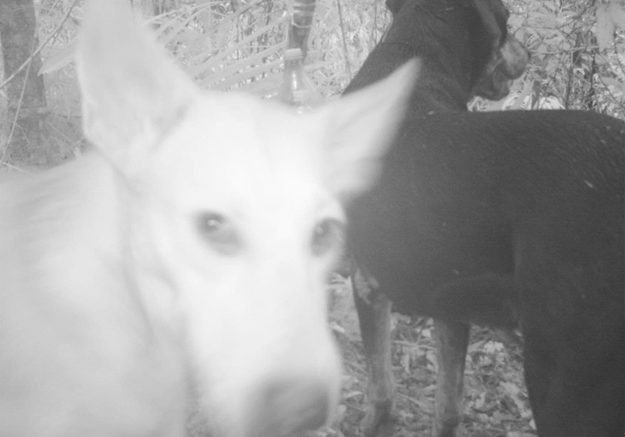
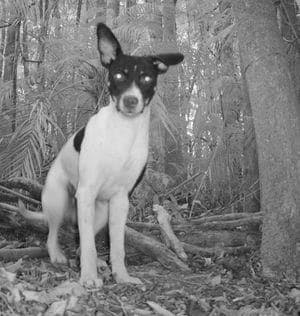
Surveillance cameras placed by researchers in Brazil’s Tijuca National Park capture a pair of dogs. (Courtesy of Katyucha Silva)
RIO DE JANEIRO — High above this Brazilian city, in a jungle blanketing a mountain, the turtles were out, and the scene was hopeful.
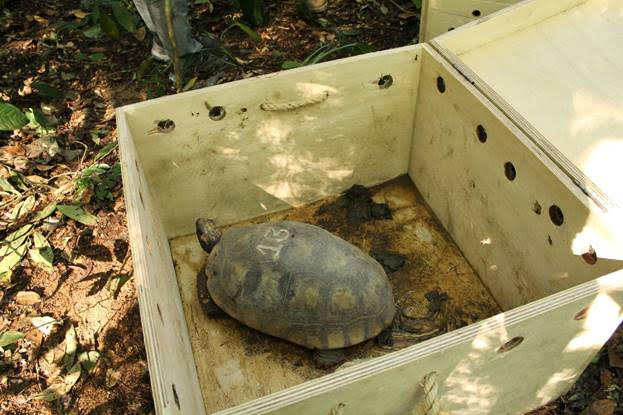
Scientists were reintroducing 15 mud-caked tortoises to this urban forest where they had once been plentiful. Children were running around. People were oohing and aahing. A stern-looking security guard appeared to briefly smile.
But not government biologist Katyucha Silva. She was thinking about dogs.
What would they do to these turtles? What were they doing to Brazil?
It’s a question more researchers are beginning to ask in a country where there are more dogs than children — and where dogs are quickly becoming the most destructive predator. They’re invading nature preserves and national parks. They’re forming packs, some 15 dogs strong, and are hunting wild prey. They’ve muscled out native predators such as foxes and big cats in nature preserves, outnumbering pumas 25 to 1 and ocelots 85 to 1.
Every year, they become still more plentiful, spreading diseases, disrupting natural environments, goosing scientists who set up elaborate camera systems to photograph wild animals, only to come away with pictures of curious canines.
“It’s a difficult thing for people to hear,” said Isadora Lessa, a Rio de Janeiro biologist who wrote her doctoral dissertation on domestic dogs causing environmental mayhem. “They love dogs too much.”
How the dog became one of the world’s most harmful invasive mammalian predators is as much a global story as a Brazilian one. Over the last century, as the human population exploded, so did the dog population, growing to an estimated 1 billion.
That has been great for people — and even better for dogs — but less so for nature, according to a growing body of academic research implicating canines, particularly the free-roaming ones, in environmental destruction.
“The global impacts of domestic dogs on wildlife are grossly underestimated,” researchers concluded in a 2017 study published in the journal Biological Conservation. The researchers, based in Australia, convicted dogs in the extinction of 11 species and declared them the third-most-damaging mammal, behind only cats and rodents.
The International Union for Conservation of Nature maintains a list of animals whose numbers dogs are culling. There are 191, and more than half are classified as either endangered or vulnerable. They range from lowly iguanas to the famed Tasmanian devil, from doves to monkeys, a diversity of animals with nothing in common beyond the fact that dogs enjoy killing them. In New Zealand, the organization reported, a single German shepherd once did in as many as 500 kiwis — and that was the conservative estimate.
“Unfortunately, we have a big problem,” said Piero Genovesi, chair of the agency’s invasive species unit. “There is a growing number of dogs.”
People all over the world are — begrudgingly — beginning to take note.
In Chile, stray dogs were the top concern among city dwellers surveyed this year, topping deteriorating sidewalks and theft. In New Zealand, some communities moved last year to restrict the movement of dogs in a gambit to save little blue penguins. In India, farmers are complaining about stray dogs killing their livestock, just as other predators once had.
And in Brazil, atop a mountain outside of Rio de Janeiro, 15 tortoises were nestling into the forest floor, oblivious to the danger of the forest’s leading predator.
‘A complex problem’
And in Brazil, atop a mountain outside of Rio de Janeiro, 15 tortoises were nestling into the forest floor, oblivious to the danger of the forest’s leading predator.
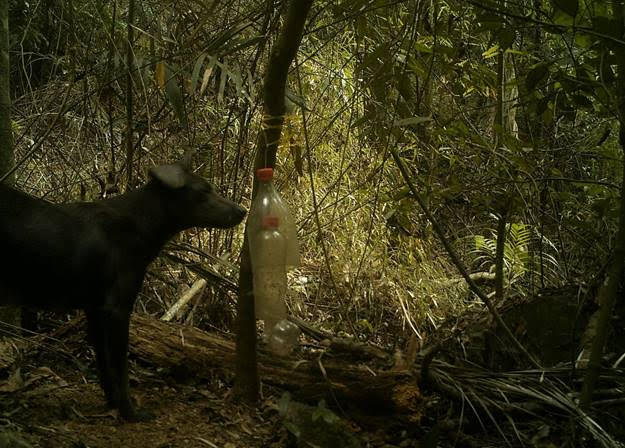
Researchers estimate there are more than 100 dogs in Tijuca National Park outside Rio de Janeiro, where they hunt and kill wild animals in packs. (Courtesy of Katyucha Silva)
Brazil is home to an estimated 52 million dogs, according to the most recent government statistics — more than anywhere in Latin America — but their lives vary widely. In a nation defined by inequality, where the rich fly in helicopters over the poor in the favelas below, the dog has become one more way of understanding the divide.
In wealthy cities, the dog is everywhere, strolling through fancy shopping malls, sitting in the laps of restaurant patrons, even riding paddle boards out on the surf. Some people wheel their dogs around in little strollers.
“The dog brings to Brazilians some things that Brazilians appreciate in themselves,” said Alexandre Rossi, a television personality more commonly known as Dr. Pet. “To be friendly, to want to socialize with everyone . . . and be there and be close to your family. These are perceived as very good Brazilian qualities.”
On the streets of trendy Ipanema one recent afternoon, few people could believe that a dog — or at least their dog — could be much of predator.
“The dog is a friend!” sputtered Philipe Soares, the furball Bobby at his feet. “No, I’ve never thought of him that way.”
“Difficult to imagine,” said Carlos Alberto Vicente, peering down at his own pooch.
“In her case,” said Flavio Vilela, a shirtless man striding through a park with a small mutt named Nicoli, “they’d hunt her.”
The problem, researchers say, isn’t these dogs, who lead the coddled lives of European or American pets.
The problem is the dogs in poorer and more rural communities, where the life of the dog is more frequently the life of hunger. They prowl the streets day and night with neither a collar nor an owner, looking for food wherever it can be found — in trash heaps, alongside roads, and in forests and fields, where they form packs to hunt and kill.
“It’s a very complex problem,” said Silva, the government biologist.
A stunning discovery
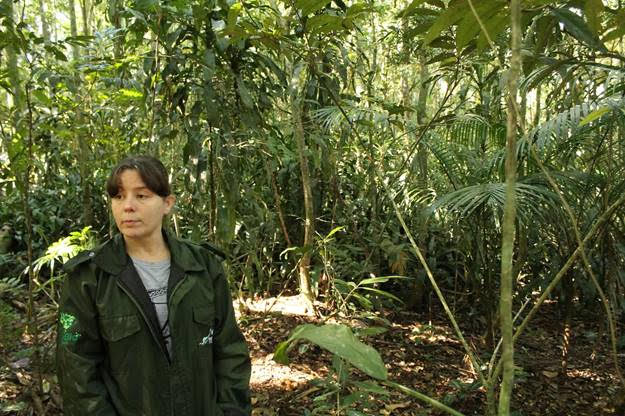
Katyucha Silva, a government researcher, has discovered dozens of dogs in Tijuca National Park. (Terrence McCoy/The Washington Post)
Ana Maria Paschoal, a researcher at the Federal University of Minas Gerais, remembers when she first started thinking about the dog differently. She was out in the Atlantic Forest in Southeast Brazil around a decade ago when she noticed there were an awful lot of them.
She wondered: How many dogs are using the protected areas? Are these feral or domestic dogs? Is their presence changing the occurrence of wild species?
So she set up cameras across 2,400 acres of forest to find out. What she discovered, published in 2012 in the scientific journal Mammalia, stunned her.
“The presence of the domestic dog is a threat,” Paschoal and her co-authors concluded.
The research, subsequently confirmed in a larger survey, laid the groundwork for a growing field of study here. One researcher linked Brazil’s dogs to the spread of diseases. Another accused the dogs in the National Park of Brasilia, where they hunted in massive packs, of scaring off natural predators. It was found that the closer humans lived to a nature preserve, the more likely dogs had penetrated it.
The International Union for Conservation of Nature has counted 191 species whose numbers dogs are culling. More than half are endangered or vulnerable. (Courtesy of Katyucha Silva)
But perhaps most striking? The dogs were neither feral nor domestic — but somewhere in between.
“All the dogs we detected had an ‘owner’ or a person that the animal has a bond with,” Paschoal said. “The species population increases following human populations, exacerbating their potential impact on wildlife.”
It was something Fernando Fernandez, an ecology professor at the Federal University of Rio de Janeiro, learned the hard way. For the last decade, he has been reintroducing native animals to the Tijuca forest, one of the world’s largest urban woodlands, which spills across Rio de Janeiro’s mountains.
First came the agouti, a squirrel-like rodent. Then followed a problem: “Dogs.”
They started killing the agouti, and not for food. It was just for fun.
Fernandez and Silva wanted to learn more. They set up cameras and discovered dozens of dogs in the forest. They estimated more than 100 dogs were in the park — not residents, it turned out, so much as frequent visitors, tracking in from nearby favelas.
“These are people who are very poor,” said Silva, who has six dogs at home. “They don’t have money to build walls. . . . When the owners leave for work, the dog leaves, too, and only returns when the owner comes back to the house from work.”
The owners often have no idea what their dogs are up to. Even if they were told, Rob Young said, they almost certainly wouldn’t believe it.
Young, chairman of wildlife conservation at the University of Salford in Britain, witnessed the psychology at work after seeing dogs kill flightless birds in the state of Minas Gerais.
“We’d do interviews with the farmers: ‘Have you seen these dogs?’
“And they’d say, ‘Yeah, but my dogs aren’t the problem; it’s my neighbor’s dogs.’
“Every farmer would say the same thing.”
These factors — inability to see aggression in dogs, intractable inequality, the rapid expansion of humanity — left Silva feeling apprehensive as she watched the tortoises being reintroduced into the Tijuca forest.
In the long term, she didn’t know how the problem of dogs laying waste to the world’s environments would realistically improve.
And in the short term: Could dogs kill these tortoises, just as they’d dispatched a few agouti?
“Yes,” she said. “They could.”
Silva worries that tortoises reintroduced in the park could fall prey to dogs. (Terrence McCoy/The Washington Post)
ooOOoo
It’s a tough read and there doesn’t appear to be a solution, not in the short-term at least.
As was reported in the article it is as much a global problem with something of the order of a billion dogs roaming the planet.
One of the most frequent questions dog and cat owners get asked is how old is he or she. The pet that is!
And one of the most frequent concerns we have for our pets is how long will they live, as in what is their natural life span. Certainly, most of us realise that the larger dogs live slightly shorter lives but is that borne out in practice.
Well a recent professional article on The Conversation blogsite answered those questions.
ooOOoo
How old is my pet in dog years or cat years? A veterinarian explains
Clinical Instructor of Veterinary Medicine, Mississippi State University
July 23rd, 2019
“Just how old do you think my dog is in dog years?” is a question I hear on a regular basis. People love to anthropomorphize pets, attributing human characteristics to them. And most of us want to extend our animal friends’ healthy lives for as long as possible.
It may seem like sort of a silly thing to ponder, born out of owners’ love for their pets and the human-animal bond between them. But determining a pet’s “real” age is actually important because it helps veterinarians like me recommend life-stage specific healthcare for our animal patients.
There’s an old myth that one regular year is like seven years for dogs and cats. There’s a bit of logic behind it. People observed that with optimal healthcare, an average-sized, medium dog would on average live one-seventh as long as its human owner – and so the seven “dog years” for every “human year” equation was born.
Not every dog is “average-sized” though so this seven-year rule was an oversimplification from the start. Dogs and cats age differently not just from people but also from each other, based partly on breed characteristics and size. Bigger animals tend to have shorter life spans than smaller ones do. While cats vary little in size, the size and life expectancy of dogs can vary greatly – think a Chihuahua versus a Great Dane.
Human life expectancy has changed over the years. And vets are now able to provide far superior medical care to pets than we could even a decade ago. So now we use a better methodology to define just how old rule of thumb that counted every calendar year as seven “animal years.”
Based on the American Animal Hospital Association Canine Life Stages Guidelines, today’s vets divide dogs into six categories: puppy, junior, adult, mature, senior and geriatric. Life stages are a more practical way to think about age than assigning a single number; even human health recommendations are based on developmental stage rather than exactly how old you are in years.
Canine life stages
Veterinarians divide a dog’s expected life span into six life stages based on developmental milestones. These age ranges are for a medium-sized dog; smaller dogs tend to live longer, while larger dogs tend to have shorter life expectancies.
STAGE
AGE (YEARS)
CHARACTERISTICS
Puppy
0 – 0.5
Birth to sexual maturity
Junior
0.5 – 0.75
Reproductively mature, still growing
Adult
0.75 – 6.5
Finished growing, sexually and structurally mature
“Organic” is more than just a passing fad. Organic food sales totaled a record US$45.2 billion in 2017, making it one of the fastest-growing segments of American agriculture. While a small number of studies have shown associations between organic food consumption and decreased incidence of disease, no studies to date have been designed to answer the question of whether organic food consumption causes an improvement in health.
I’m an environmental health scientist who has spent over 20 years studying pesticide exposures in human populations. Last month, my research group published a small study that I believe suggests a path forward to answering the question of whether eating organic food actually improves health.
What we don’t know
According to the USDA, the organic label does not imply anything about health. In 2015, Miles McEvoy, then chief of the National Organic Program for USDA, refused to speculate about any health benefits of organic food, saying the question wasn’t “relevant” to the National Organic Program. Instead, the USDA’s definition of organic is intended to indicate production methods that “foster cycling of resources, promote ecological balance, and conserve biodiversity.”
While some organic consumers may base their purchasing decisions on factors like resource cycling and biodiversity, most report choosing organic because they think it’s healthier.
Sixteen years ago, I was part of the first study to look at the potential for an organic diet to reduce pesticide exposure. This study focused on a group of pesticides called organophosphates, which have consistently been associated with negative effects on children’s brain development. We found that children who ate conventional diets had nine times higher exposure to these pesticides than children who ate organic diets.
Our study got a lot of attention. But while our results were novel, they didn’t answer the big question. As I told The New York Times in 2003, “People want to know, what does this really mean in terms of the safety of my kid? But we don’t know. Nobody does.” Maybe not my most elegant quote, but it was true then, and it’s still true now.
Studies only hint at potential health benefits
Health-conscious people want to buy organic for its health benefits, but it’s not yet clear whether such benefits exist. Goran Bogicevic/Shutterstock.com
Since 2003, several researchers have looked at whether a short-term switch from a conventional to an organic diet affects pesticide exposure. These studies have lasted one to two weeks and have repeatedly shown that “going organic” can quickly lead to dramatic reductions in exposure to several different classes of pesticides.
Still, scientists can’t directly translate these lower exposures to meaningful conclusions about health. The dose makes the poison, and organic diet intervention studies to date have not looked at health outcomes. The same is true for the other purported benefits of organic food. Organic milk has higher levels of healthy omega fatty acids and organic crops have higher antioxidant activity than conventional crops. But are these differences substantial enough to meaningfully impact health? We don’t know. Nobody does.
Some epidemiologic research has been directed at this question. Epidemiology is the study of the causes of health and disease in human populations, as opposed to in specific people. Most epidemiologic studies are observational, meaning that researchers look at a group of people with a certain characteristic or behavior, and compare their health to that of a group without that characteristic or behavior. In the case of organic food, that means comparing the health of people who choose to eat organic to those who do not.
Several observational studies have shown that people who eat organic food are healthier than those who eat conventional diets. A recent French study followed 70,000 adults for five years and found that those who frequently ate organic developed 25% fewer cancers than those who never ate organic. Other observational studies have shown organic food consumption to be associated with lower risk of diabetes, metabolic syndrome, pre-eclampsia and genital birth defects.
The problem with drawing firm conclusions from these studies is something epidemiologists call “uncontrolled confounding.” This is the idea that there may be differences between groups that researchers cannot account for. In this case, people who eat organic food are more highly educated, less likely to be overweight or obese, and eat overall healthier diets than conventional consumers. While good observational studies take into account things like education and diet quality, there remains the possibility that some other uncaptured difference between the two groups – beyond the decision to consume organic food – may be responsible for any health differences observed.
What next?
Often, new medical and health knowledge comes from carefully designed clinical trials, but no such trial has been conducted for organic food. Anyaivanova/Shutterstock.com
When clinical researchers want to figure out whether a drug works, they don’t do observational studies. They conduct randomized trials, where they randomly assign some people to take the drug and others to receive placebos or standard care. By randomly assigning people to groups, there’s less potential for uncontrolled confounding.
My research group’s recently published study shows how we could feasibly use randomized trial methods to investigate the potential for organic food consumption to affect health.
We recruited a small group of pregnant women during their first trimesters. We randomly assigned them to receive weekly deliveries of either organic or conventional produce throughout their second and third trimesters. We then collected a series of urine samples to assess pesticide exposure. We found that those women who received organic produce had significantly lower exposure to certain pesticides (specifically, pyrethroid insecticides) than those who received conventional produce.
On the surface, this seems like old news but this study was different in three important ways. First, to our knowledge, it was the longest organic diet intervention to date – by far. It was also the first to occur in pregnant women. Fetal development is potentially the most sensitive period for exposures to neurotoxic agents like pesticides. Finally, in previous organic diet intervention studies, researchers typically changed participants’ entire diets – swapping a fully conventional diet for a fully organic one. In our study, we asked participants to supplement their existing diets with either organic or conventional produce. This is more consistent with the actual dietary habits of most people who eat organic food – occasionally, but not always.
Even with just a partial dietary change, we observed a significant difference in pesticide exposure between the two groups. We believe that this study shows that a long-term organic diet intervention can be executed in a way that is effective, realistic and feasible.
The next step is to do this same study but in a larger population. We would then want to assess whether there were any resulting differences in the health of the children as they grew older, by measuring neurological outcomes like IQ, memory and incidence of attention-deficit disorders. By randomly assigning women to the organic and conventional groups, we could be sure any differences observed in their children’s health really were due to diet, rather than other factors common among people who consume organic food.
The public is sufficiently interested in this question, the organic market is large enough, and the observational studies suggestive enough to justify such a study. Right now, we don’t know if an organic diet improves health, but based on our recent research, I believe we can find out.
Texas Tripe Recalls Pet Food Due to Salmonella and Listeria
August 14, 2019 — The U.S. Food and Drug Administration is warning dog owners not to feed certain lots of Texas Tripe raw pet food after samples tested positive for Salmonella and/or Listeria monocytogenes.
The FDA is issuing this alert because these lots of Texas Tripe Inc. raw pet food represent a serious threat to human and animal health.
Because these products are sold and stored frozen, FDA is concerned that people may still have them in their possession.
What’s Being Recalled?
The recalled products are sold frozen in 20-pound and 40-pound cases.
Each case contains multiple plastic pouches.
Lot codes to help identify recalled product are printed on the outside of the cases. But the lot codes are not printed on the individual sealed plastic pouches, also known as chubs.
So, if the case has been discarded, there are no unique identification numbers on the individual chubs that allow customers to determine that they possess the recalled products.
These products are manufactured by Texas Tripe Inc. and were sold direct to consumers online and by phone.
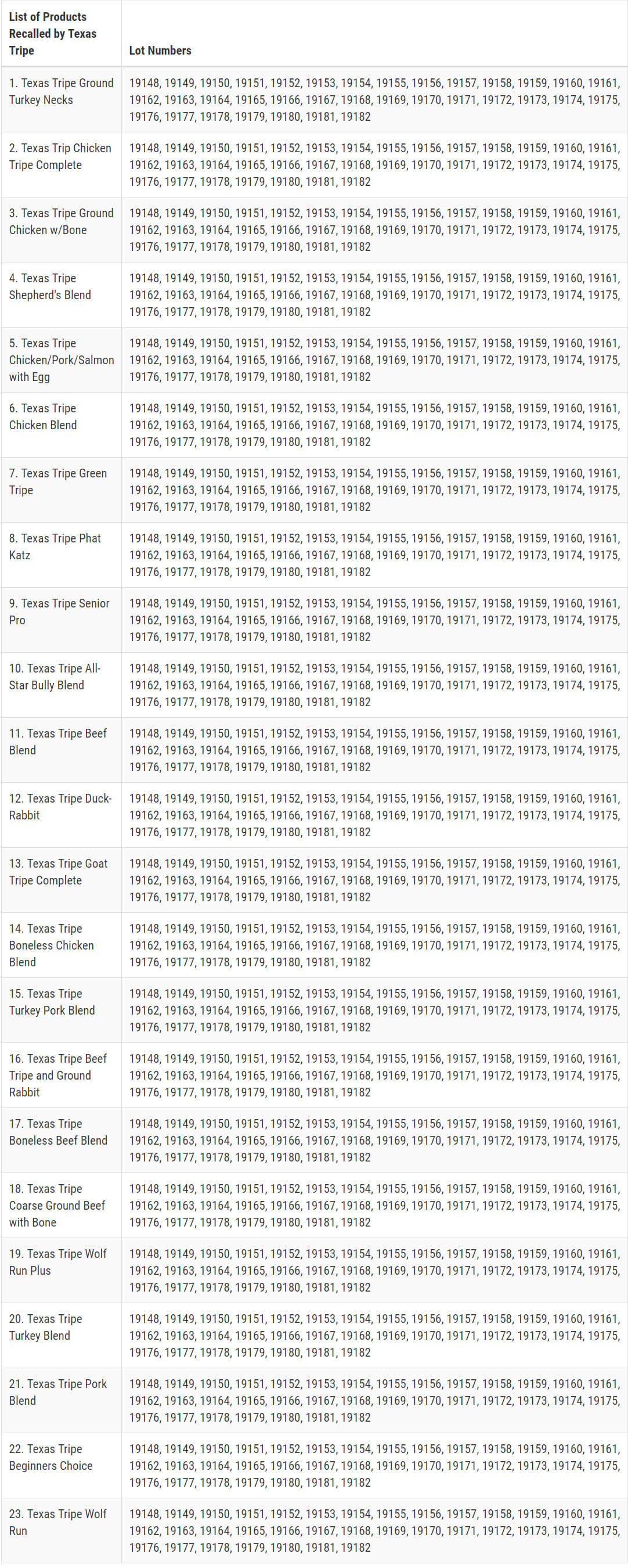
The chart below lists the recalled products and lot numbers provided by the firm to FDA on 8/6/2019. These include 35 lots for each of the following 23 product varieties.
The FDA-sampled products below tested positive for Salmonella and/or Listeria monocytogenes (as of 8/13/19) but have not been recalled.
Texas Tripe Chicken Blend: Lot 19196-6
Texas Tripe Pork Blend: Lot 19190-09
Texas Tripe Beef Blend: Lot 19191-05
Where Were the Products Sold?
According to the company, recalled products have been sold directly to consumers in the following states:
Alabama
Arizona
Arkansas
California
Colorado
Florida
Georgia
Illinois
Kansas
Kentucky
Louisiana
Michigan
Mississippi
Missouri
New Jersey
New Mexico
New York
North Carolina
Ohio
Oklahoma
Pennsylvania
Tennessee
Texas
Virginia
What Caused the Recall?
The Office of the Texas State Chemist (OTSC) collected 23 finished product samples at Texas Tripe Inc. Of the 23 samples, 16 tested positive for Listeria and/or Salmonella.
The FDA followed up these findings with an inspection and collected and analyzed samples of unopened finished product, after the firm performed corrective actions, from additional lots of some of the same products tested by OTSC.
FDA testing showed some of the samples contained Salmonella and/or L. mono.
FDA and OSTC shared their test results with Texas Tripe Inc. The firm initiated a recall on July 3, 2019 by directly notifying some of its customers via email.
Why FDA Is Concerned
Pet foods and treats contaminated with Salmonella and L. mono are of particular public health importance because they can affect both human and animal health.
Pets can get sick from these pathogens and may also be carriers of the bacteria and pass it on to their human companions without appearing to be ill.
People can get sick from handling contaminated pet foods and treats or touching surfaces that have had contact with the contaminated pet foods and treats.
Additionally, if a person gets Salmonella or L. mono on their hands, they can spread the bacteria to other people, objects, and surfaces.
The FDA is aware of recent cases in which humans and/or animals have gotten sick from exposure to Salmonella-contaminated pet foods (Salmonella-human cases, Salmonella-kitten, Salmonella-kitten and dog).
Although FDA is not aware of a documented case of a person acquiring L. mono infection from a pet food, once Salmonella or L. mono get established in the pet’s gastrointestinal tract, the animal can shed the bacteria in the feces when it has a bowel movement, and the contamination may continue to spread.
Because animals can shed the bacteria in the feces when they have bowel movements, it’s particularly important to clean up the animal’s feces in yards or parks where people or other animals may become exposed, in addition to cleaning items in the home.
The Federal Food, Drug, and Cosmetic Act requires that all animal food, like human food, be safe to eat, produced under sanitary conditions, contain no harmful substances, and be truthfully labeled.
Without an effective control for pathogens, such as cooking, animal food is more likely to contain pathogens such as Salmonella and L. mono.
Refrigeration or freezing does not kill the bacteria.
About Salmonella
Salmonella is a bacterium that can cause illness and death in humans and animals, especially those who are very young, very old, or have weak immune systems.
According to the CDC, people infected with Salmonella can develop diarrhea, fever and abdominal cramps.
Most people recover without treatment, but in some people, the diarrhea may be so severe that they need to be hospitalized.
In some patients, the Salmonella infection may spread from the intestines to the blood stream and then to other body sites unless the person is treated promptly with antibiotics.
Consult your health care provider if you have symptoms of Salmonella infection.
Pets do not always display symptoms when infected with Salmonella, but signs can include vomiting, diarrhea (which may be bloody), fever, loss of appetite and/or decreased activity level.
If your pet has these symptoms, consult a veterinarian promptly.
You should also be aware that infected pets can shed the bacteria in their feces and saliva without showing signs of being sick, further contaminating the household environment.
About Listeria
Listeria monocytogenes (L. mono) is a bacterium that can cause illness and death in humans and animals, especially those who are pregnant, very young, very old, or have weak immune systems.
According to CDC, listeriosis in humans can cause a variety of symptoms, depending on the person and the part of the body affected.
Symptoms can include headache, stiff neck, confusion, loss of balance, and convulsions in addition to fever and muscle aches.
Pregnant women typically experience only fever and other flu-like symptoms, such as fatigue and muscle aches.
However, infections during pregnancy can lead to miscarriage, stillbirth, premature delivery, or life-threatening infection of the newborn.
Pregnant women and their newborns, adults age 65 and older, and people with weakened immune systems are more likely to get sick with listeriosis.
Anyone with symptoms of listeriosis should contact a health care provider.
L. mono infections are uncommon in pets, but they are possible.
Symptoms may include mild to severe diarrhea, anorexia, fever, nervousness, muscular and respiratory signs, abortion, depression, shock and death.
Pets do not need to display symptoms to be able to pass L. mono on to their human companions.
Once L. mono gets established in the pet’s gastrointestinal tract, the animal can shed the bacteria in the feces when it has a bowel movement…
And the contamination may continue to spread, further contaminating the household environment.
What to Do?
If you have any recalled product, stop feeding it to your pets and throw it away in a secure container where other animals, including wildlife, cannot access it.
Consumers who have had this product in their homes should clean refrigerators/freezers where the product was stored and clean and disinfect all bowls, utensils, food prep surfaces, pet bedding, toys, floors, and any other surfaces that the food or pet may have had contact with.
Clean up the pet’s feces in yards or parks where people or other animals may become exposed.
Consumers should thoroughly wash their hands after handling the recalled product or cleaning up potentially contaminated items and surfaces.
If you believe you have symptoms of Salmonella and L. mono, consult your health care provider.
People who think their pets have become ill after consuming contaminated pet food should first contact their veterinarians.
Veterinarians who wish to have pets tested for Salmonella may do so through the Veterinary Laboratory Investigation and Response Network (Vet-LIRN Network) if the pet is from a household with a person infected with Salmonella.
U.S. citizens can report complaints about FDA-regulated pet food products by calling the consumer complaint coordinator in your area.
I just happened to click on the ‘signature’ of a follower that took me to a blog where I was truly enthralled. It was called Who Will Let the Dogs Out? and I was fascinated by what was being written.
Now I already follow this blog but had been very reluctant to go across to their place and read the posts. Shame on me! I have no idea why!
How about this post, that I am taking the liberty of republishing.
Ian and I are still processing what we saw and what we learned in Tennessee, each in our own way.
He is taking a break and feels he can’t look at the pictures for a bit. His pictures capture the emotion of the dogs caught in our human failure, and that is hard to look at. I know eventually he will be ready to edit them and to hopefully share more here on the blog. He took thousands of pictures. My big son has a very big heart, and it truly broke in Tennessee.
For me, seeing the conditions in western Tennessee made me furious. This should not be happening. We should not be leaving the responsibility for lost and surrendered animals to a handful of citizens who are quite literally standing in the gap left by a government that neglects its duties and an unaware public.
I cannot look away. So, I am doing what I do– writing and talking and making a nuisance of myself. I’m working on articles, blog posts (like this one), and even a book. I am in the midst of signing a publishing contract for 100 Dogs and Counting, a follow up to Another Good Dog: One Family and Fifty Foster Dogs that will recount more of our fostering adventures, and then take the reader south to discover where these dogs come from and what they can do about it.
I am also planning another trip in September– this time back to Tennessee, and then on to Alabama. Ian will be in school, but I will bring along another talented photographer and excellent co-pilot, Nancy Slattery.
One of the people I am excited to see on this next trip is a rescue hero of mine — Aubrie Kavanaugh. I’m excited to introduce you to her today in the following interview. Aubrie is not only an expert in the fight for a No-Kill nation, but a talented writer, a wickedly smart and funny person, and a dog-hearted woman relentlessly and methodically committed to changing the situation.
Enjoy!
The biggest first – the question everyone asks me – Why are there so many unwanted dogs in the south?
I honestly try to avoid the word “unwanted” because it implies that no one wants the animals when that is not necessarily true. Having said that, we have so many in need of homes for a host of reasons, some of which I’ll explain.
In many locations, there is a complete disconnect between animal control agencies/animal shelters which have animals needing new homes and the general public who could provide those homes. The shelters presume no one wants the animals and the public presumes the animals all find homes. The chasm between the agencies and the public is wide and leads to animals who otherwise may be saved being destroyed.
We have issues with most municipalities who manage animal shelters continuing to use the outdated “catch and kill” method of sheltering because they have not learned about or embraced No Kill programs and philosophies which could both reduce shelter intake and increase shelter output. Rather than educate themselves on how to keep animals alive which still ensure public safety, they hold firm to the status quo with the mindset of, “its’ not broken, so don’t fix it.” But the shelter system is broken and it does need to be fixed.
Many people are quick to ascribe what has been called “The Bubba Factor” to the south which essentially means that people here are too woefully stupid or callous to care about what happens to animals in need. We do have cultural differences regarding the value of animals in our lives (“it’s just a dog”) or where animals live (inside v. outside) and there are some people who could care less about animal welfare. Most people, however, do care at most about the welfare of animals and at least about how their tax dollars are spent. People can be informed not only about how their tax dollars can be best used, but also about how they can make better personal choices which affect how shelters operate (like the value of spay/neuter, how to keep pets contained, how to rehome pets in the event of their death or some life crisis, etc.). Many see themselves as stewards of the species we have domesticated and for them this is an issue of ethics, but they need to be informed of the need to address the need.
In many parts of the south, there is also very limited access to spay/neuter at all, let alone at a reasonable cost. This means that in some places, pet populations are not contained and just continue to grow over time. The more animals there are in any particular community, the more animals are apt to end up in animal control systems.
Define what ‘no-kill’ means to you.
No kill means we don’t kill healthy and treatable shelter animals using our tax dollars or donations.
Some try to portray the phrase as controversial or complicated when it really is not. When we use the intended meanings of words like “euthanasia” and “kill,” the phrase makes more sense.
If you have ever made The Terrible Decision to euthanize a beloved pet who is suffering, you know exactly what euthanasia means. It is an act of mercy to end or alleviate suffering. If a shelter ends the life of a healthy dog, that is not euthanasia no matter how many times we call it that. If someone outside an animal shelter setting were to end the lives of healthy animals, we would not say those animals were euthanized. We would say they were killed. We should not alter the meaning of words based on the location where the act takes place.
There will always be animals in shelters who are suffering and for whom euthanasia is the only responsible action as an act of mercy. There will also always be a very small number of dogs who are so broken as to be genuinely dangerous (as opposed to scared, traumatized or undersocialized) and who cannot be adopted out because they present a public safety risk and those dogs must, unfortunately, be euthanized. No Kill does not mean animals do not die. It means we keep the healthy and treatable animals alive because that’s what the public expects and because it is possible using a progressive business model.
We had our 16-year old German Sheppard mix euthanized on Earth Day of 2006. We knew for years that the day was coming, but it was heart-wrenching. I found I was not coping well in the wake of our loss. I began donating to the animal shelter in the city where I work in her honor and to help me cope with the loss by doing something positive.
I was on the shelter website a few months later when I came across a promotional video which began harmlessly but then transitioned to footage of an outwardly healthy dog being taken from his kennel to be killed. It shocked me. I had no real clue prior to that that the shelter was destroying healthy and treatable animals. When I later asked if the dog in the video had actually died, I was told five words that changed my life: “nobody wants Beagles these days.”
I got upset, then I got angry and then I began educating myself about why this was happening not just in my area, but all over the country. I wanted to do all I could to make it stop. I now consider myself an unapologetic No Kill advocate. For me, this is an issue about free speech and municipal accountability. I see my advocacy as a moral imperative. Shelters operate using tax dollars and it is up to us to hold those places accountable for how they spent our money and in our name (while sometimes blaming us for the process). As a country, we are better than this.
Is no-kill truly possible and if so, what will it take?
I absolutely believe that any community can become a No Kill Community and that as more places take this step, we move closer to a time when the killing of healthy and treatable animals will become part of our shameful past. Change can come in one of two ways. Municipalities can get ahead of this issue by adopting progressive programs. If they will not do so, the burden passes to citizens to educate themselves and then speak out to demand better of elected and appointed officials. If elected officials will not listen to the will of the people, they need to be replaced.
I support and promote the No Kill Equation which is a one-size-fits-all DIY solution for any community which was first published by Nathan Winograd in 2007. It is an all-in series of programs which work in concert with each other to reduce shelter intake and then move animals who are in the shelter through the system as quickly as possible. I group them into “keep them out” and “get them out” programs. Anyone can learn about the No Kill Equation by reading Nathan’s book, “Redemption: The Myth of Pet Overpopulation and the No Kill Revolution in America.” They can also read about the equation on numerous websites including those for the No Kill Advocacy Center, No Kill Movement, No Kill Learning, my Paws4Change website or our No Kill Huntsville website. I also go into a lot of detail about the Equation in my book and explain a bit about how each of the programs works.
What can someone who is not in the rural south do to help?
Every area can improve. If you live outside the south, find out how your local shelter is functioning using your tax dollars. Many shelters claim to have high release rates when, in fact, they are playing a numbers game or are using words in different ways than they are used by the public to condone or excuse killing. If you don’t like what you learn, speak out and ask for better. Only when more places across our country change will those changes ultimately become infectious everywhere, including in the south.
Even if your local area is doing a great job, you can connect with people you know in the south and encourage them to educate themselves and perhaps become politically active about their local shelter. It often falls to the public to speak out and demand better. Only those who live in the area can speak out for better use of their tax dollars in ways which are consistent with their values.
If you don’t know anyone in the south, you can help rescue and advocacy organizations in the south which are doing some of the heavy lifting to keep animals alive. If that is the help you choose to provide, please also encourage the rescue group or advocates with whom you engage to speak out to seek better. While I have the utmost respect for people “in the trenches,” who are keeping animals alive, they are doomed to provide that role indefinitely unless the system is forced to change through public demand. I have a section in my book called “For Rescuers,” which addresses this need to go beyond saving X dog and Y cat to becoming a catalyst for change so there are fewer animals in need of rescue or help. As simple as it sounds, nothing will change unless something changes to alter the process.
I love the title of your book because that’s what I’ve concluded, too – It’s not Rocket Science. Tell me a little about why you wrote the book and what you hope people take from it.
I formed an advocacy group called No Kill Huntsville in 2012 to speak with one voice to persuade the City of Huntsville, Alabama, to stop destroying healthy and treatable animals using tax dollars. The live release rate at the shelter at the time was about 34% and my individual efforts going back to 2008 to bring about change had failed. Fast forward a few years and things have changed remarkably. The live release rate at the shelter has been above 90% for more than four years and while there is still work to be done, the culture at our shelter has changed. It was an incredible struggle for a long time. It got ugly with some strong opposition from some unlikely sources. But we’re proud of what we did working together as a coalition.
One day last fall after a city council meeting which set some new guidelines for the shelter, I was thinking back to all the times people have contacted us asking for help or asking what we recommend. People contact us from the south, from other regions and even from other countries. I decided to write the book to help others learn from our path. We didn’t get everything we wanted and our work is not over, but the worst is behind us and I think people may learn something from our methods and from our mistakes. I think the content in the book about the opposition we faced is almost as important as the No Kill Equation we promoted and still promote. If advocates are not prepared to counter opposition, their arguments in support of animal shelter reform may fall short.
Anything else you’d like to add?
The phrase No Kill is on the public radar and is not going away. We do better to educate people on what it means and to help people learn how to promote change than to try to sugarcoat what is happening in our shelters using our money. We should be respectful in our advocacy, but there truly is no polite way to say, “please stop killing healthy and treatable animals using our money.” No Kill advocates are not the enemy of shelters any more than the public is the enemy. I always encourage people to focus not on the messenger, but the fact that the message is necessary in the first place.
There are some who use the phrase No Kill and do so in ways which are inconsistent with our social movement. Some of these people engage in criminal acts for which they should be prosecuted. We should absolutely call out those bad actors when we find them. Those people who co-opt the phrase No Kill for illegal or unethical purposes are no more representative of our social movement than unethical breeders of animals represent all breeders. If an organization calls itself No Kill and destroys a lot of animals, keeps them for years, or does not provide for their care, they are using the words without the actions to support them. My book covers this topic and I touch on it in the No Kill Movement blog.
I believe a time will come when all shelters in America will be No Kill shelters. How long that takes is up to all of us. We must educate ourselves on what his happening in our own communities so we can decide if our money is being spent in ways of which we approve. When it is not, it is up to us to ask for better and, when necessary, be advocates for change. The lives of animals depend on it.
Aubrie Kavanaugh is an Army veteran who has worked for decades as a litigation paralegal doing defense work; her clients are mostly municipalities and law enforcement officials.
Aubrie became an animal welfare advocate in 2006 after learning about the deaths of animals at her local animal shelter. She manages the Paws4Change educational website, blogs on animal welfare issues, creates video productions and public service announcements for animal shelters and nonprofit organizations across the country, and is involved in advancing animal welfare legislation on the local and state level. She also leads an advocacy group called No Kill Huntsville. She lives in northern Alabama with her husband, their dog, and the enduring inspiration of their dogs to whom they have said farewell for now.
America is an animal friendly society. Approximately sixty-eight percent of U.S. households own a pet – about 85 million families. Most of us consider our companion animals family members. We recognize that they enrich our lives in countless ways, improve our physical and mental health, and make us better people. We value the fact that they don’t care what we look like, where we live, what we do for a living or how much money we make; their love for us is unconditional. And we agonize over our decisions when the time comes to say farewell to them due to advanced age or disease.
But there is a dark side to our relationship with companion animals which is our collective shame. We destroy millions of healthy and treatable animals in our tax-funded animal shelters every year. Many people simply do not know about what happens at their local animal shelter using their money and in their name. Some who know about this tragedy believe there is no other way to function. There is.
“Not Rocket Science” is a story of no kill animal shelter advocacy in Huntsville, Alabama, which explains how a group of animal welfare advocates joined forces to speak with one voice to save the lives of healthy and treatable animals in the municipal animal shelter. This advocacy helped change the shelter from one which destroyed more than half of the animals entrusted to its care to a shelter which saves the lives of all healthy and treatable animals instead.
Any community can be a no kill community. Sometimes it just takes the courage to try something new. And sometimes it just takes a group of people willing to band together and speak out with one voice to say “enough. We are better than this.”
The book is priced at $5.52. I have ordered a copy!










 defense work; her clients are mostly municipalities and law enforcement officials.

