Category: Education

Earth Day!

I simply forgot it was Earth Day yesterday!

I wanted to let the post on Tuesday run for a couple of days because it really made the point about dogs, in particular, being animals who love to love!

But I then forgot, until I woke up on the 22nd, that yesterday was Earth Day.

So what to publish?

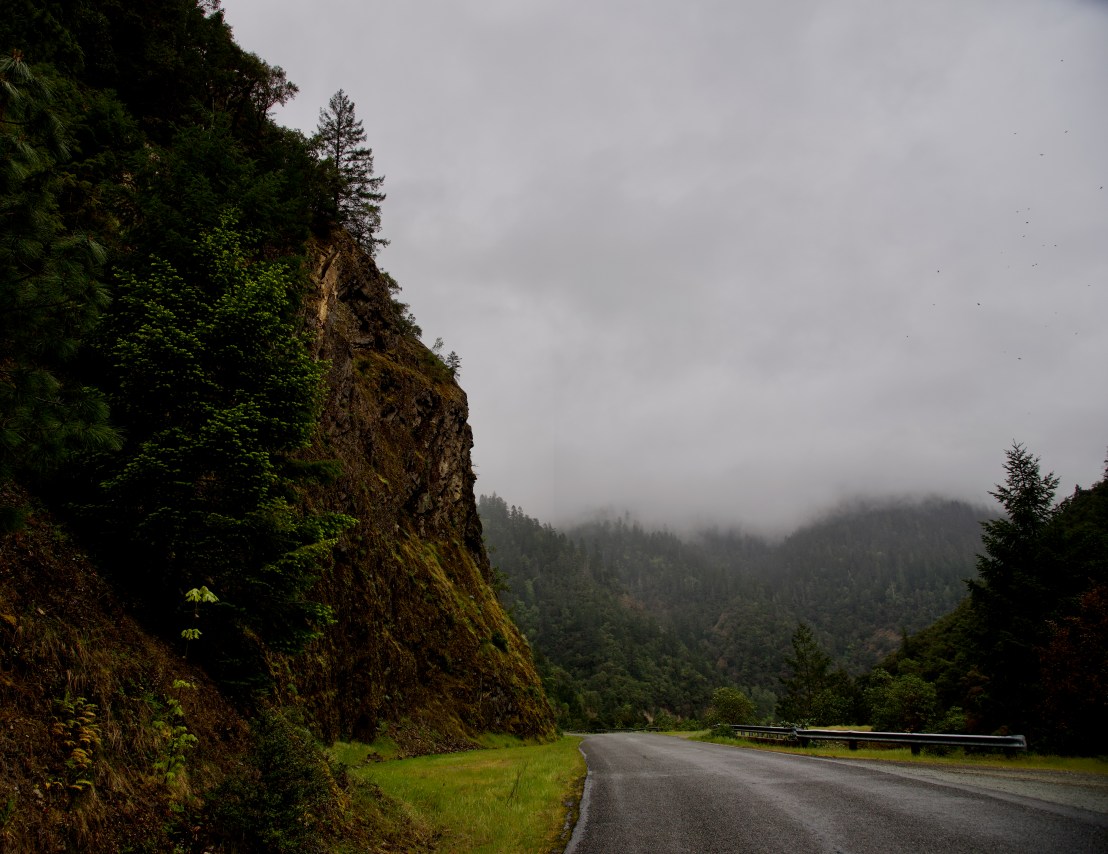
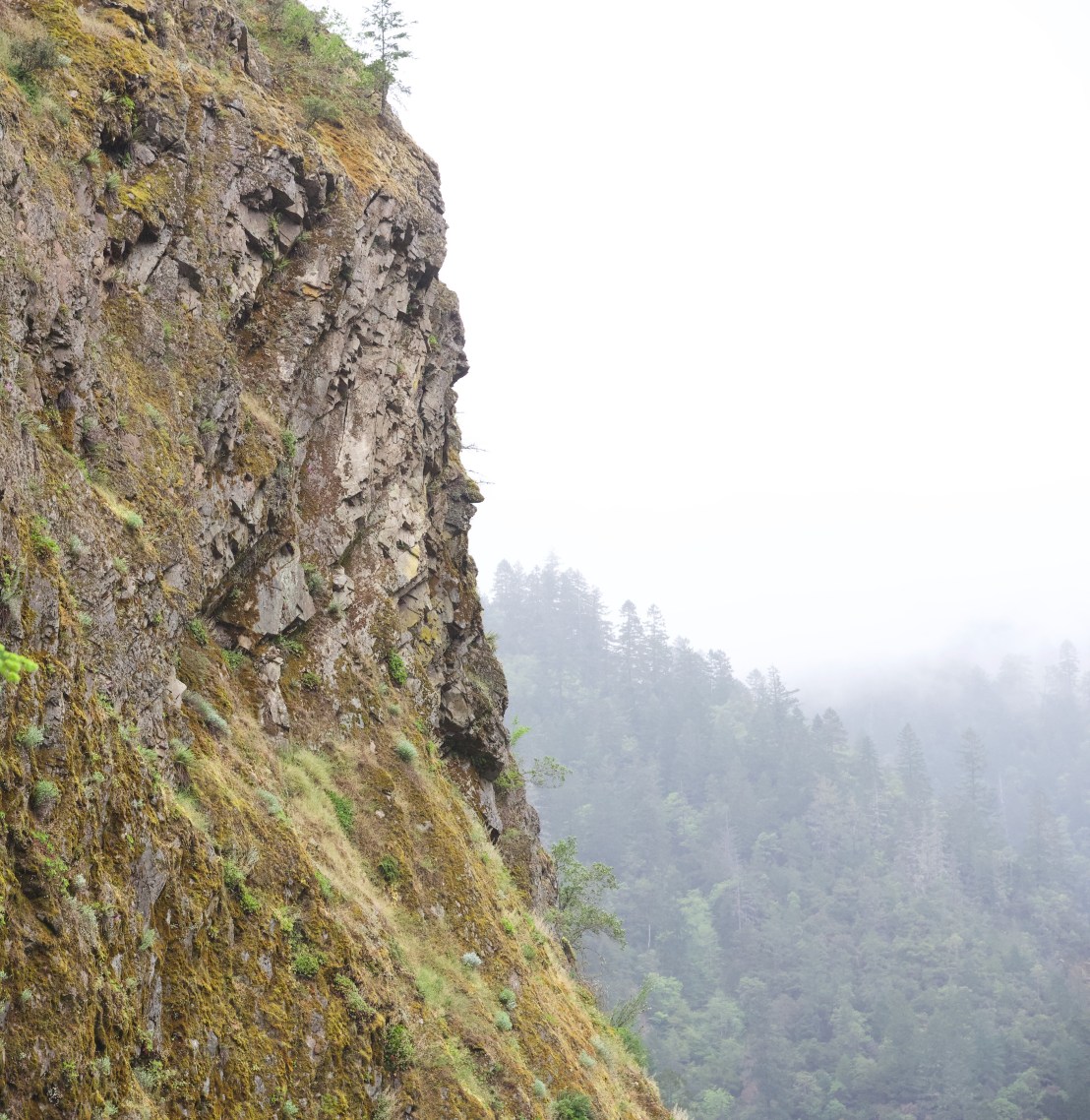
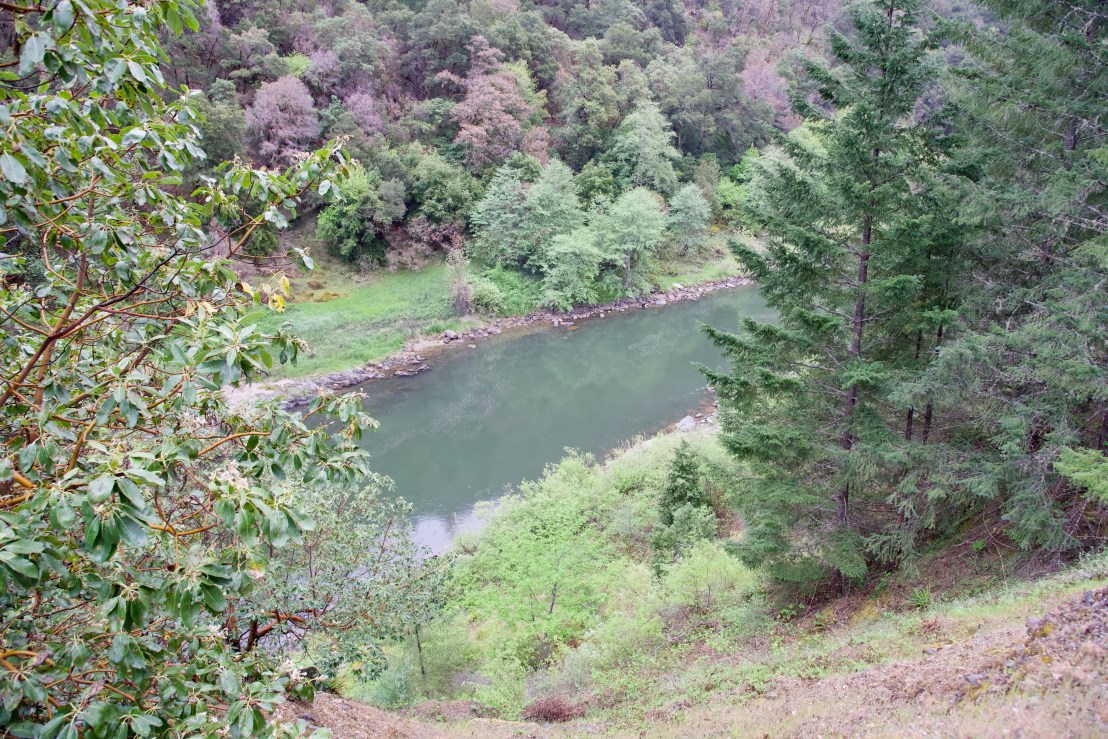
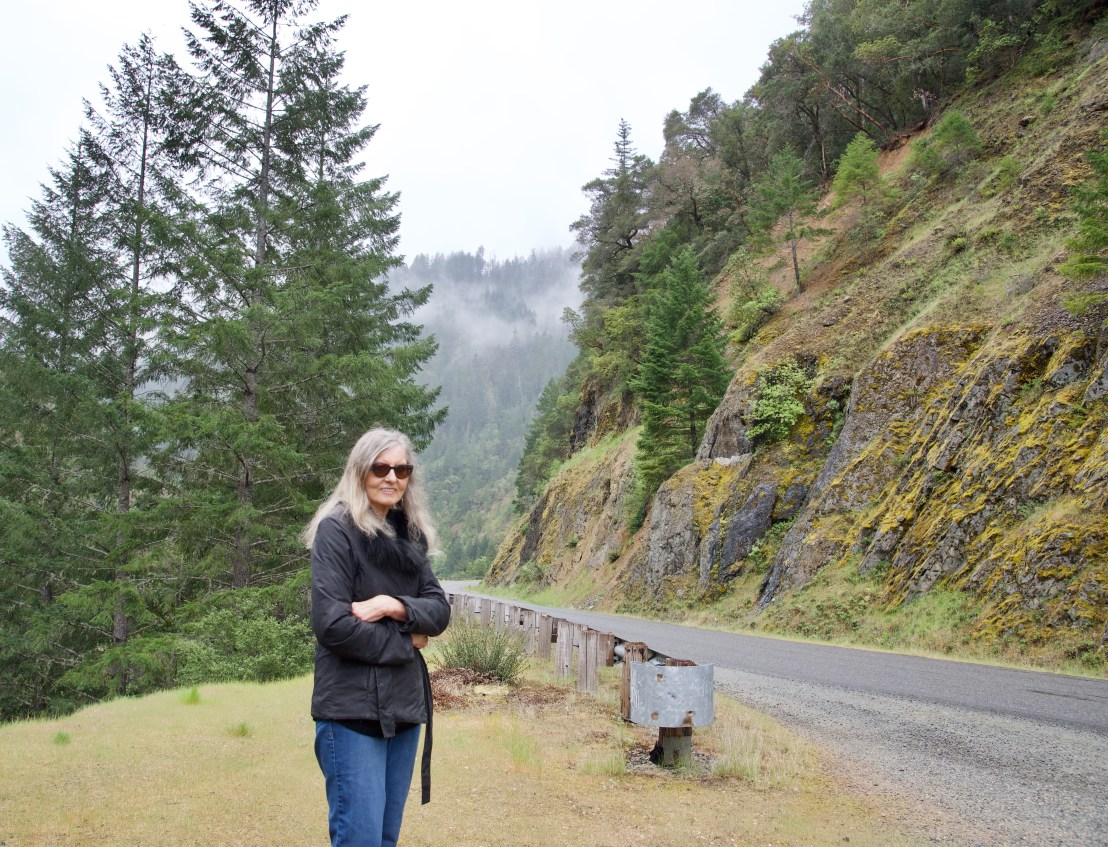
Yesterday in Merlin was a damp day with a steady rain coming down in the morning. About 10am I volunteered the idea that we should drive the shortish distance to Galice; just 10 miles from where we live. Galice is a very small settlement on the Western bank of the Rogue River. Then we drove on for a few more miles. It was incredible scenery. The misty, damp forest and the river running below in the gorge.

I had my camera with me and the following are some of the photographs that were taken.

Just for a change! All within 15 miles of home!
oooo
oooo

oooo
oooo
oooo

oooo

For those interested in learning more, I am publishing the WikiPedia account of the Rogue River.

The Rogue River (Tolowa: yan-shuu-chit’ taa-ghii~-li~’,[7] Takelma: tak-elam[8]) in southwestern Oregon in the United States flows about 215 miles (346 km) in a generally westward direction from the Cascade Range to the Pacific Ocean. Known for its salmon runs, whitewater rafting, and rugged scenery, it was one of the original eight rivers named in the Wild and Scenic Rivers Act of 1968. Beginning near Crater Lake, which occupies the caldera left by the explosive volcanic eruption of Mount Mazama, the river flows through the geologically young High Cascades and the older Western Cascades, another volcanic province. Further west, the river passes through multiple exotic terranes of the more ancient Klamath Mountains. In the Kalmiopsis Wilderness section of the Rogue basin are some of the world’s best examples of rocks that form the Earth’s mantle. Near the mouth of the river, the only dinosaur fragments ever discovered in Oregon were found in the Otter Point Formation, along the coast of Curry County.

People have lived along the Rogue River and its tributaries for at least 8,500 years. European explorers made first contact with Native Americans (Indians) toward the end of the 18th century and began beaver trapping and other activities in the region. Clashes, sometimes deadly, occurred between the natives and the trappers and later between the natives and European-American miners and settlers. These struggles culminated with the Rogue River Wars of 1855–56 and removal of most of the natives to reservations outside the basin. After the war, settlers expanded into remote areas of the watershed and established small farms along the river between Grave Creek and the mouth of the Illinois River. They were relatively isolated from the outside world until 1895, when the Post Office Department added mail-boat service along the lower Rogue. As of 2010, the Rogue has one of the two remaining rural mail-boat routes in the United States.

Dam building and removal along the Rogue has generated controversy for more than a century; an early fish-blocking dam (Ament) was dynamited by vigilantes, mostly disgruntled salmon fishermen. By 2009, all but one of the main-stem dams downstream of a huge flood-control structure 157 miles (253 km) from the river mouth had been removed. Aside from dams, threats to salmon include high water temperatures. Although sometimes too warm for salmonids, the main stem Rogue is relatively clean, ranking between 85 and 97 (on a scale of 0 to 100) on the Oregon Water Quality Index (OWQI).

Although the Rogue Valley near Medford is partly urban, the average population density of the Rogue watershed is only about 32 people per square mile (12 per km2). Several historic bridges cross the river near the more populated areas. Many public parks, hiking trails, and campgrounds are near the river, which flows largely through forests, including national forests. Biodiversity in many parts of the basin is high; the Klamath-Siskiyou temperate coniferous forests, which extend into the southwestern Rogue basin, are among the four most diverse of this kind in the world.
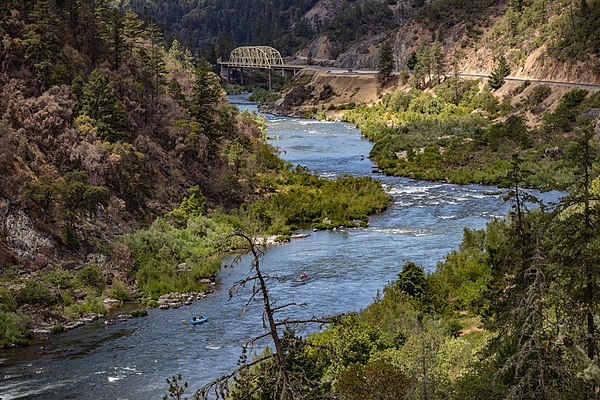
Rogue River from Hellgate Canyon
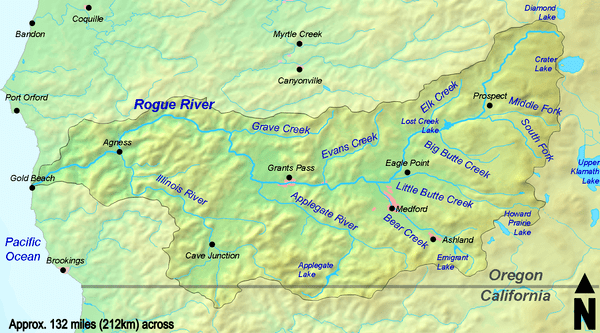
Map of the Rogue River watershed
Location of the mouth of the Rogue River in Oregon

Just to reflect on the fact that people have lived along the Rogue River and its tributaries for 8,500 years!

Is it any wonder we love dogs!

A brilliant yet very touching post to be shared.

This story came out on Mother Nature Network quite recently.

I really cannot add any words at the present time. The article says it all!

ooOOoo

Removed because of an alleged copyright infringement.

ooOOoo

This is a very ’rounded’ story about Tricycle, one that shows that love in the dog community is never very far away. Actually, I would go on to say that we adults who also love our dogs, probably putting them above our own needs, offer something very special.

Time; beyond imagination!

I don’t know what is was that engaged me; to the point that I have written this blog post.

We rise around 4:30 am, thanks to the dogs, and after they have been out we retire to the bedroom and lay on the top of the bed and have a couple of cups of tea. Come 5am, week days, we listen to BBC Radio 4 and the World at One. Then immediately after the World at One, at the moment, is a fascinating series on A History Of The World in 100 objects.

A few days ago, after the end of the programme, I drifted off into some form of introspective gaze about the past. I mean the past big time!

The Universe

When and how did it all start? That seems to be the Big Bang. The Big Bang was an incredibly long time ago, some 14 billion years ago (rounding it up!).

Here’s an extract from Wikipedia:

The current measurement of the age of the universe is around 13.8 billion years (as of 2015[1]) – 13.799±0.021 billion years within the Lambda-CDM concordance model.[2] The uncertainty has been narrowed down to 20 million years, based on a number of studies which all gave extremely similar figures for the age.

That’s 13.8 times 10 to the power of 9!

Our solar system

Again, pretty old by human standards; 4.6 billions years ago.

Again, an extract from Wikipedia:

The Solar System formed 4.6 billion years ago from the gravitational collapse of a giant interstellar molecular cloud. The vast majority of the system’s mass is in the Sun, with the majority of the remaining mass contained in Jupiter. The four smaller inner planets, Mercury, Venus, Earth and Mars, are terrestrial planets, being primarily composed of rock and metal. The four outer planets are giant planets, being substantially more massive than the terrestrials. The two largest, Jupiter and Saturn, are gas giants, being composed mainly of hydrogen and helium; the two outermost planets, Uranus and Neptune, are ice giants, being composed mostly of substances with relatively high melting points compared with hydrogen and helium, called volatiles, such as water, ammonia and methane. All eight planets have almost circular orbits that lie within a nearly flat disc called the ecliptic.

So our solar system came along 9 billion years after the formation of the Universe.

Planet Earth

Our planet formed not long after our solar system. That’s pretty obvious if you ask me.

Thus Planet Earth formed 4.5 billion years ago. Again, thanks to Wikipedia.

Life on Planet Earth

Southampton University have published an extremely interesting chart of the timeline of the human condition. In it is revealed that the earliest atmospheric oxygen was 3.5 billion years ago, a necessary prerequisite to air-breathing life. But it took an extremely long time before monkeys appeared; some 36 million years ago. That’s 36 times 10 to the power of 6, or 383 times shorter than the start of the universe.

The earliest hominins (Australopithecus spp) among the hominids in Africa, bipedal, larger brain came along some 4.2 million years ago.

Among them were humans using stone tools, some 2.5 million years ago. Then 2 million years ago came the earliest direct ancestor of modern humans, Homo erectus (South Africa), co-habiting with Australopithecus and Paranthropus.

Then 40,000 years ago Neanderthals make flutes from bone, then 14,000 years ago the domestication of dogs in China, 7,000 years ago the world population passed 5 million souls, and 3,500 years ago the earliest alphabet (North Semitic, Palestine and Syria).

3,000 years ago the world population passed 50 million.

Come forward to just 195 years ago and the first public railway for steam locomotives (George Stephenson, UK, 1825) came into existence. In 1945, Alan Turing created the world’s first programmable calculator which lead directly to the first computer.

Then just 34 years ago the total population passed 5 billion souls (1986).

This and much more in the timeline which really is a fascinating read. Put together by C. Patrick Doncaster,  7 April 2020, one of the then 7,641,557,720 (rising by 148 per minute, 77 million per year).

But …

The discovery of quarks in 1968 caused us humans to think again about matter.

Wikipedia:

A quark (/kwɔːrk, kwɑːrk/) is a type of elementary particle and a fundamental constituent of matter. Quarks combine to form composite particles called hadrons, the most stable of which are protons and neutrons, the components of atomic nuclei.[1] Due to a phenomenon known as color confinement, quarks are never directly observed or found in isolation; they can be found only within hadrons, which include baryons (such as protons and neutrons) and mesons.[2][3] For this reason, much of what is known about quarks has been drawn from observations of hadrons.

Then there’s antimatter, now that’s really weird.

Again, an extract from Wikipedia:

There is strong evidence that the observable universe is composed almost entirely of ordinary matter, as opposed to an equal mixture of matter and antimatter.[4] This asymmetry of matter and antimatter in the visible universe is one of the great unsolved problems in physics.[5] The process by which this inequality between matter and antimatter particles developed is called baryogenesis.

So, to put it in layman’s terms, the fact that I am sitting here at a computer trying to make sense of it all and failing is just down to luck. The observable universe and my perception of it comes down to matter as opposed to antimatter!

I’ve got a headache!

N.B. It’s a little after 12:30 am (PDT) on the Saturday and I am going to leave this post up as the latest for tomorrow as well. There have been so many wonderful comments.

The making of a scent dog.

A repeat of the guest post from Bryony Ravate.

Once again, I am having a struggle to come up with something original. Once again it is at these times of life that I am very grateful for the offer of a guest post. Take Bryony for example. This is not the first time that I have presented her work but I am grateful to her.

This is her article on scent dogs.

ooOOoo

The making of a scent dog.

By Bryony Ravate, January 2nd, 2020

If you’ve been lucky enough to be around dogs, you will have probably noticed how their noses are always moving. By possessing a nose up to 15x times more sensitive than our own, with 600,00 neurones, they can sniff out different components in every room. When you’re cooking a meal, you will be able to recognise the smell of a dish. But when your dog smells the meal, he can smell each individual spice and seasoning, the oils, the crockery and even any water.
You can use your dogs’ keen sense of smell for play – laying out different scents for them to explore. But their noses can also be used for working environments– such as in airports, with the police and in search and rescue missions. They can track down suitcases hiding illegal substances, follow the suspect of a crime and sniff out the victims of a snowstorm. To become scent dogs, the canines go through vigorous training. However, although all dogs have an exceptional sense of smell, not all dogs make it through training.

It makes sense to analyse what leads to success and failure in scent dog training. So, a keen researcher at University College Cork, Ireland performed a literature review in which factors behind success and failure in scent dog training were analysed. A literature review is the process whereby you search a database full of information (usually research articles published in reputable journals) and you extrapolate the information to create your own source. Here, I’m going to pull together some of the points I found the most interesting, points you may not think would affect the making of a scent dog.

Personality

Dogs with strong motivation to play or search, dogs which were bold rather than shy, and dogs which can adapt and cope with stressful stimuli are more likely to become scent dogs. High motivation to play or search, makes a dog easier to train. Play can be used as a reward, by allowing the dog to pull on a chew toy after being successful in a trial. Finding scents may be perceived as a game to the dog, increasing his motivation to engage. Bold dogs are less unnerved by new surroundings and situations. A nervous dog may be hesitant about pursuing an unknown scent – but a bold dog will take little hesitation. Adaptable dogs may be able to apply their knowledge to different situations and they will be unphased by commotions and will keep working when faced with distractions.

Housing Standards

Dogs that live in enriched environments throughout their training have increased ability in trials. Like children, the more opportunities you offer your dogs to learn, explore and interact with their environment, the more it allows them to develop and grow. Dogs should feel secure in their home environment when not working; keeping them with other dogs and in bright rooms without using loud cleaning equipment (such as hoovers) will make them less anxious, leading to better accuracy in scent trials.

The Human Partner

Dogs emotions are often intertwined with their handlers. When a dog’s owner gets angry, the stress hormones in the dog increase as a result. If a dog handler is happy, the dogs will perform better. The bond between dogs and their handlers can affect the accuracy of scent trials. If the dog lives at the owners’ home when he’s not working, obedience and accuracy are increased. Although the bond between scent dog and handler is important, they must be independent thinkers. When faced with a problem- solving task, they must be able to manipulate the environment themselves to find a solution, rather than looking at their handler for cues about the answer.
These are some factors which can alter the likelihood of a dog being a successful, as reviewed by Camille A Trosi and her team. What we must keep in mind is that all dogs are individuals. We cannot use this information to ensure all dogs in the future will pass scent dog training. However, we can use this knowledge to give potential scent dogs the best possible start to life; providing enrichment, an affectionate bond with their handler, and a suitable home environment. Canine personalities are not always determined by genetics, and a suitable environment can give a dog a metaphorical push in the right direction to ensure he is the best he can be, whether that be as a scent dog, a guide dog or even a lap dog.

Original Source : Troisi, C. A., Mills, D. S., Wilkinson, A. and Zulch, H. E. 2019. Behavioral and Cognitive Factors That Affect the Success of Scent Detection Dogs. Comparative Cognition & Behavior Reviews, 14, pp. 51-76. doi: 10.3819/ccbr.2019.140007

ooOOoo

Now what I haven’t done before but intend to do straightaway is to reproduce an extract from Bryony’s CV.

I currently hold a Pass with Distinction in MSc Animal Behaviour and Welfare from Queen’s University Belfast. I also have a BSc in Animal Behaviour and Welfare from Plymouth University. As well as holding two degrees relevant to the field, I currently have 2+ years of work experience. I possess the core attributes required when pursuing a career in the scientific industry; dedication, independence and initiative. I am highly passionate and believe that with my unique skillset I can have a valuable impact in the field of Science Communication.

Plus Bryony has her own blog, BrynsteinScience, and is also on Instagram, of the same name.

We wish Bryony much success in her work life and in her caring and interest for animals in general and dogs in particular!

There is an extensive article on Wikipedia in the UK on scent dog and the link to that article is here.

Finally to close with this wonderful photograph of a scent dog.

By Taz80 / SEDIRI Eddy – Personal picture, CC BY-SA 3.0, https://commons.wikimedia.org/w/index.php?curid=15094727

That’s perfect!

Questions; questions; questions!

About the position of our pet dogs and cats in this current pandemic.

So many of us are spending time at home. Lots of time!

And so many are asking questions about CORVID-19 and out pets.

Therefore I think it’s worthwhile to republish this article that appeared on Mother Nature Network yesterday.

ooOOoo

Removed because of an alleged copyright infringement.

ooOOoo

Now it is quite a long article but then again you probably have much more time to read this post! And, frankly, there is a lot of good information contained within it!

So, be safe and look after your pets!

How are these present times affecting pet owners?

A timely post on pets and COVID-19

I have chosen up to now to leave the topic of the COVID-19 pandemic to others to write about.

However, the following article published by Mother Nature Network on April 1st seemed relevant to the many hundreds who read this blog and have pets.

ooOOoo

Removed because of an alleged copyright infringement.

ooOOoo

Mother Nature Network are pretty good in terms of the accuracy of their work so, on balance, you can regard this information as legitimate .

These are very strange times for millions of us spread all over the place.

It will eventually be behind us and I, for one, can’t see it come too soon!

Day Twenty-Five of Tom and Chica’s walk

The third episode this week.

Tom’s walk continues!

He is in Granada and his stop was at Arenas del Rey. He now continues along GR7 to Jayena.

As always, taken from here with the permission of Tom and Gilliwolfe.

Read on!

ooOOoo

Day 25: Arenas del Rey (Rio Anales) to Jayena (El Bacal) 16k

By Tom and Chica, 2nd March, 2020.

Written by Tom’s wife.

As I woke in the morning, I was greeted by a couple of squirrels who ran by the tent, up a little tree and gawked at me. Clearly, not convinced about what they saw, they did another circuit and came back for second look. No doubt, this wouldn’t have happened if Chica had been with me.

I was surprised and pleased to find that this spot I had chosen in the dark was right by a ford over the river and actually on the GR7 route. Worked my way steadily uphill through scrub until I reached the pines. The conditions were ideal: cool, fresh and pine fragrant air. Great views down into the river valley below.

The rest of the day was similar – lots of ups and downs and more pines, though in one area there was evidence of these being cleared for cultivation, probably olives or almonds. I also found an old lime kiln and more information about resin extraction.

By now, the shop had opened and I bought tuna, chocolate and a strawberry milkshake. Not a particularly healthy or satisfying meal so I grumpily headed out of town and found a sign to the El Bacal camping area so made for that. Lit a fire, made a brew and settled down at around 9.30pm.

Beautiful morning – wonderful smell of pine.
Pines being felled and ground being prepared, probably for more olives
A few lonesome pines left.
More about resin extraction – a way of life.
An old lime kiln site.
The limewash was use on the houses – hence the Pueblos Blancos (white villages) of Andalucia
Jayena – today’s destination.

ooOOoo

Wall to wall interest.

Come back next week for another trio of daily walks by Tom, Chica and Merlin!

Day Twenty-Four of Tom and Chica’s walk.

The walk with Chica and Merlin continues.

I must say that this walk along GR7 takes in a great deal of fabulous countryside.

Just look at the opening photograph of the almond blossom and the snow caps in the distance. All credit to the team!

Taken from here with Tom and Gilliwolfe’s permission.

ooOOoo

Day 24: Camp site* to Arenas del Rey and beyond 17k

By Tom and Chica, 26th February, 2020

Written by Tom’s wife.

Woke this morning to find hoar frost on inner and outer of the tent fly sheet. Porridge made for a warming breakfast along with strong coffee and parrots (sic. He means paracetamol. Ed).

As I was packing up, I was joined by marauding dogs, two of which decided to follow me all day to the next village whereupon they promptly disappeared. Bit of a relief as I was rather taken with the cute young Jack Russell bitch, a very endearing dog.

Arenas del Rey was apparently closed for the day so I spent a bit of quality time in the town square brewing coffee, drying my tent and washing my feet at the fuente directly beneath the holy shrine at the front of the church. Fortunately, there was no-one around to witness this disrespectful behaviour!

After foot repairs and a light lunch I set off on route to Jayena. Once it got dark, route finding became trying so at 8pm I pitched the tent by a river. I went to sleep to the ever-present chorus of distant barking dogs.

Ice on the tent.
Bee hives.
Beware! Bees at work.
Stone threshing circle.
Almond Blossom for the bees.
Snow caps getting closer.
Finally wearing that hat. Does the job!

ooOOoo

I have just about muttered all the ooh’s and aah’s I can about this walk and the stupendous photographs.

Just loving it as much as everyone else!

Day Twenty-Three of Tom and Chica’s Walk

Tom travels on his own.

As you will read below, Tom took the opportunity to travel without Chica and Merlin today.

It was going to be too hot for the dogs.

Taken from here and republished with Tom and Gilliwolfe’s permission.

ooOOoo

Day 23: Alhama de Granada to camp position* 10k

By Tom and Chica, 26th February, 2020

Written by Tom’s wife.

Although Chica is much better and Merlin a very willing substitute, the forecast suggested quite high daytime temperatures so we decided it was best that I do a stretch on my own to try and make up lost time.

I caught the early train from Jimera to Granada where I got a tram to the bus station. The bus to the coast via Alhama de Granada didn’t leave until 3:30 so I had lunch at a pavement restaurant opposite. Later, I sat on a park bench in the sun to read but it wasn’t long before an ancient bucolic type decided to join me and make loud incomprehensible conversation. Eventually, I gave up and went for coffee. Returning to the bus station, I found him fast asleep presumably waiting for a bus. Not mine, fortunately, so a peaceful ride to Alhama but that was shattered as I found myself in the midst of a carnival with everyone in mad fancy dress!

After wandering around taking it all in, I headed to the top of town and filled my water bottles at a fuente then headed off at 6 pm. An hour later I was walking through poplar plantations on a pitch black lane trying to find a suitable camping spot. It was another hour before I picked up a GR7 sign in my torchlight which pointed uphill, too steep to try in the dark.

Luckily, I found a perfect spot above a stream which was only marred by the broken bottles left by previous visitors. By now, it was very chilly so I went straight to bed, glad to have put in at least a couple of hours walking.

Carnival fancy dress – strange!
The theme isn’t evident!
Leaving the party.

ooOOoo

Day Twenty-Four tomorrow!

I must say these are fabulous posts and I shall miss them when they eventually come to an end!

Start your day with music – a guest post!

More on mindfulness!

I opened my email box a couple of days ago and there was an email from Sarah.

It said:

Hi there!
I would be honored to be a guest writer for your blog and of course would reciprocate.  I hope you don’t mind that I shared your link in my last post.  I am not totally sure if blogging etiquette.  😀
Sarah Kinneavy
MyAmazing2ndChapter.com

Of course I said yes!

Sarah’s background is sociology and she has a degree in the subject. Just as important she owns a dog walking business. I will let her finish her background:

I believe in living life to the fullest.

My daughter is a Cancer survivor- and as a result of that journey- It put my life into perspective. I learned to never take anything for granted- you never know what’s around the next corner. I am continuing to work on becoming the best version of me, while making the most of each and everyday.

Frankly, I do not really know what it is like to have a daughter, or a son come to it, go down with cancer. The nearest I have come to the disease was when I had just turned 12 and my father died of lung cancer.

So here’s her guest post.

ooOOoo

Start your day with music- not the News! Surviving the Coronavirus with mindfulness Day 2

By Sarah Kinneavy, March 28th, 2020

As I continue to try to stay calm with mass panic happening across the globe 🌎 with this pandemic. As I mentioned in yesterday’s post:

https://myamazing2ndchapter.com/2020/03/27/surviving-the-coronavirus-with-mindfulness/

I am using mindfulness to train my brain in how it reacts to stress. The more we do these exercises the better we get at them.

Start your day with music rather than the news! Borrowed from https://musicoomph.com

Yesterday one of my friends posted on Facebook to start the day off with music – rather than the news! What a great idea!!! So, yesterday, as I got ready for a job interview and I waited until it was late enough in Hawaii to do my daily well check on my daughter there (she is in isolation in a dorm room – I am not sure if she has the dreaded virus or not). I used music as the focal point of this mindfulness exercise. This 15 minutes of focusing on the music- listening to the rhythm helped keep me present. I wasn’t worrying about getting the job or how my daughter was doing. I was just in that moment of getting ready with the accompaniment of music. It was honestly 15 minutes of pure happiness. What a great way to start my day! One thing I have to add – I try to not let myself think about what the words of the songs mean to me, or when I first heard the song. I just listen and enjoy. Okay- I may have danced around my apartment a bit too!

I can tell you – I did not feel anxious going to my interview like I normally would. I didn’t panic about my daughter’s health – I was able to wait until after my interview to check in on her. Mindfulness does not keep me from ever worrying about my kiddo or the world around me. No – I still worry – but It isn’t swallowing me up whole. And this is key!

Heading to my job interview.

I can’t wait to talk to you again tomorrow . How are you coping with all the stress and anxiety?

ooOOoo

That’s a lovely guest post!
And the message is clear and powerful: “No – I still worry – but It isn’t swallowing me up whole. And this is key!