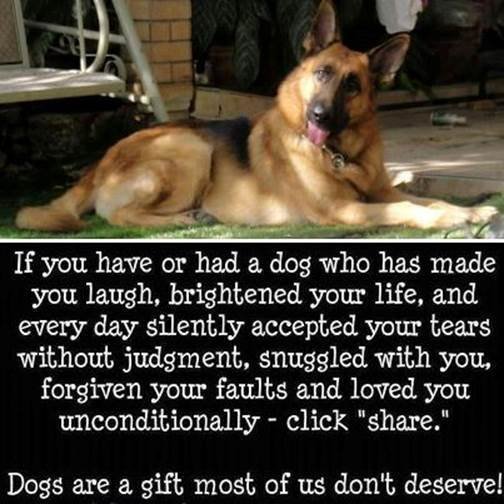
S. Korea is the only country in the world with large-scale, commercial dog meat farms.
Frankly, I wasn’t planning to publish a post today. But then in came an email from John Zande, he of the blog The Superstitious Naked Ape, and this is what I read: “Paul, hi… Really good news. The following email links to a petition supporting a bill that will end the dog meat trade in Korea. I know you’ll want to sign it. Share it around, too.”
S. Korea is the only country in the world with large-scale, commercial dog meat farms. The animals live in disease and filth, and at slaughter are often savagely beaten just because people believe torture makes the meat taste better.
But a new bill could finally stop the cruelty. Rep. Lee Sang-don of the Bareunmirae Party has proposed legislation to exclude dogs from the Livestock Industry Act, effectively prohibiting dog farming.
The bill comes just before summer, a season of terror for dogs in South Korea — and we must speak out to help this lifesaving legislation succeed.
This time of year brings the gruesome Bok Nal Dog Eating Days, when millions of dogs are strung up, hung by the neck in a slow, painful death, and butchered for meat.
During Bok Nal — which occurs over three days believed to be the hottest of the season — more dogs are killed and eaten in the country than during the entire rest of the year, usually in the form of boshintang, or dog meat soup.
The dog meat is wrongly thought to have a “cooling effect” — even though in other parts of Asia, it is believed to have the opposite effect, and is eaten in winter instead.
S. Korea’s current leader, President Moon Jae-In, has compassion for animals and has even adopted a dog rescued from the meat trade, named Tory. Furthermore, activists throughout S. Korea are calling for an end to dog and cat meat, which is not only horrifically cruel, but tarnishes their international reputation. Most S. Koreans are against dog meat, and want the cruelty to end.
Sign this petition to urge S. Korean Ambassador Joe Yoon Je and President Moon to show the world they are a great and compassionate nation, and work to pass this bill and end all dog and cat meat in the nation.
I should add the closing part of that email that John sent to me.
There is simply no reason for this horrific industry to go on. Be part of our voice to DEFEAT DOG MEAT.
Thank you for doing your part to help stop animal cruelty.

Lady Freethinker is a registered 501(c)(3) nonprofit media organization dedicated to creating a free and compassionate world for all species. Your donation is tax deductible to the fullest extent allowed by law.

The weather at 6am didn’t bode well with a brisk wind blowing clouds across the summit of Mt. Sexton.
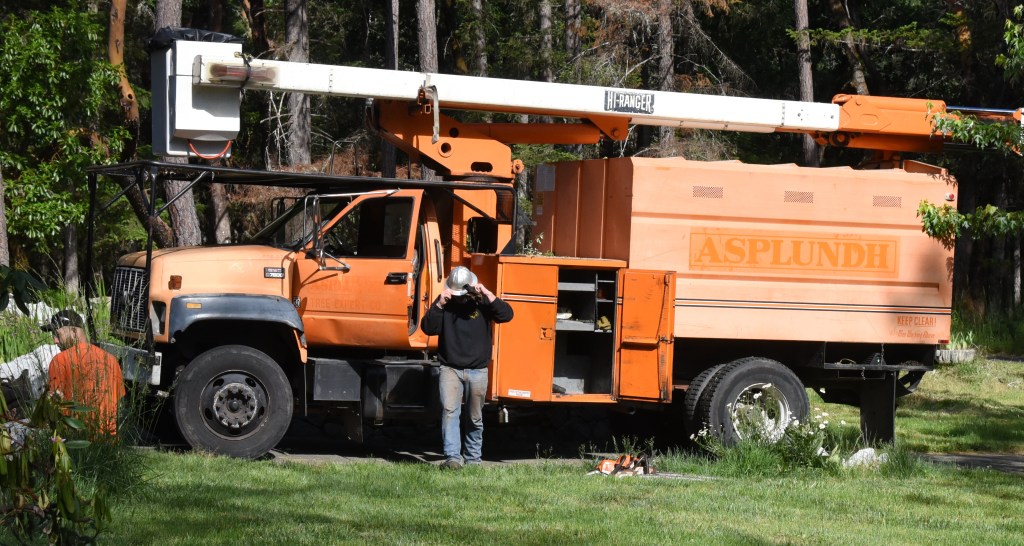
Lyman from Liberty Tree Enterprises arrived bright and early on Wednesday morning to set about felling the dead fir close to the North-East corner of our rear deck.
It was this dead fir, pictured to the left, that had had the wireless antenna installed on it soon after we moved in to Merlin, OR, back in 2012.
How the day would go was a bit of a guessing game: Would we need a new antenna because it would be broken when the tree hit the ground?; Would Outreach be out to see us reasonably soon after we called them to say that the tree was down?; Would there be complications that were unforeseen at this early stage of the ‘project’?
Well we wouldn’t have long to find out.
Lyman and his assistant were very careful in ensuring that the face of the cut, that would direct exactly where the tree fell, was aligned perfectly. I was very impressed with the care and attention put into this aspect of the felling process.
Then it was time to make the cut on the other side of the trunk and hammer in the wedges that would cause the tree to fall. At one point there was a gust of wind that had the tall trunk rocking on the base. We all held our breath.
But at 09:33 down it came!
Down it came perfectly. (Later I counted the rings to discover that the tree was 65 years old!)
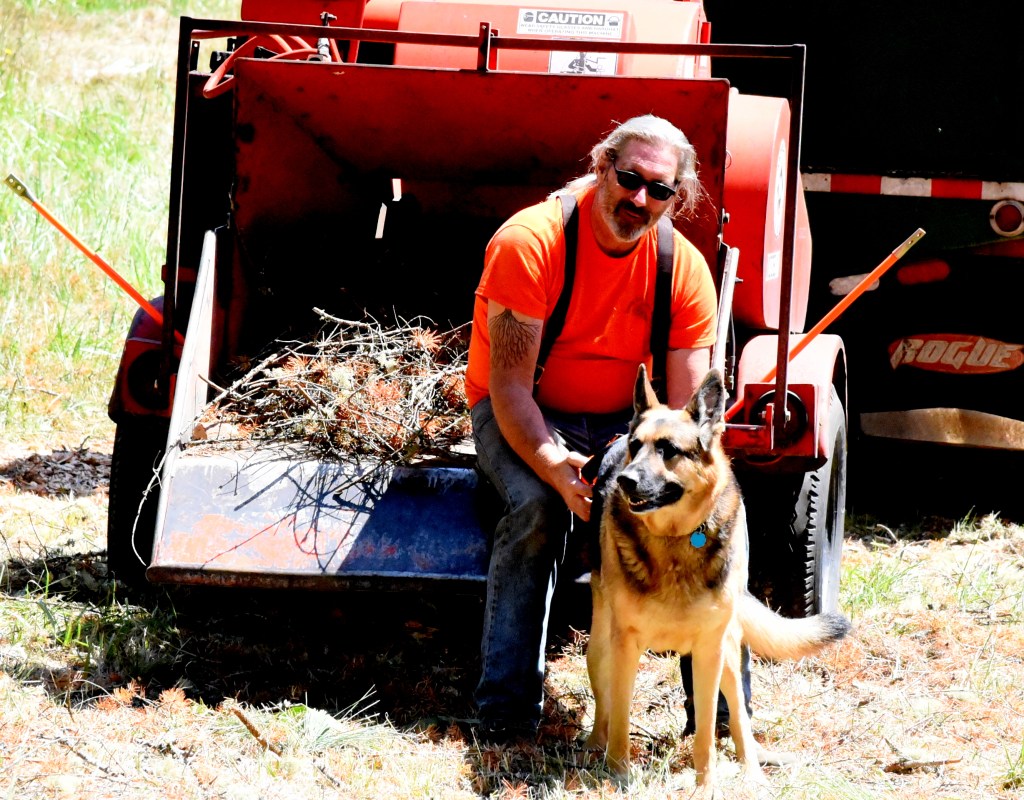
Then it was a case of cutting off all the limbs and shredding them up on site. Inevitably the dogs took an interest!
Here’s Cleo making friends with Lyman.
On to stage two.
Outreach had been called and to our great relief we were told that Doug and Jennifer, the Outreach rigging crew, should be along later in the afternoon.
The two of them arrived and quickly established that the existing antenna had survived the drop!
Therefore, it wasn’t long before Doug was climbing another fir also conveniently close to the deck.
Doug earning his living big time!
And within the hour it was time to power up the router, switch on my iMAC and test for a signal!
The old antenna installed in its new home!
Yes!
All was working and working well.
As you good people will understand it was too late in the day to sort out a post for yesterday.
Plus I needed a few hours to catch up on emails and stuff and then sort out the photographs that I had taken that day.
Then, yesterday afternoon, I sat down and ‘penned’ today’s post for you all.
This wonderful guest post from Zara Lewis adds real weight to the title.
There is no doubt in my mind that hundreds of you good people out there love and care for dogs that were first seen in a dog shelter or rescue centre.
But at the same time, inevitably, there are those who want to learn more about adopting a dog.
Zara Lewis has written another guest post that is a real help to those who are uncertain as to how to care for a newly-adopted dog.
ooOOoo
Five Tips on Making Your Adopted Dog Feel at Home
by Zara Lewis, May 24th, 2018
Adopting a dog is one of the noblest and most rewarding decisions you can make. With dog shelters filled to the brim with pooches in need of a loving home, there is really no reason to support the inhumane ways of the puppy mill industry; instead, welcoming a shelter dog into your family will save not one, but two lives.
However, sometimes welcoming an adopted dog into your home can seem like a daunting task. How do you banish their fears of abandonment, their anxiety, and the instilled behavioral patterns that define them yet are unsuited for domesticated life? How do you truly make them feel at home, loved, and most importantly, safe? Here to answer these questions are the five tips that will make this transition as pleasant and rewarding as possible.
Set the stage for the pooch
First things first, there’s a lot to be done before your pooch actually arrives at what will be their new, loving home. You want to make sure you have covered all the basics, from deciding where the dog will sleep and eat, all the way to buying a sizable crate and all of the necessities your new furry friend might need.
This includes getting in touch with a trusted veterinarian and making an appointment for the following day. You can never be too careful, no matter how trustworthy the shelter staff are. For the time being, you will want to roll up all of your carpets so that the dog gets used to walking around the house (they tend to stick to carpets when confronted by sleek surfaces), and don’t forget to buy a leash, plenty of toys, and most importantly, dog treats for those long training sessions ahead.
Let them explore the place one day at a time
One of the biggest mistakes new dog owners inadvertently make is letting their new companion explore the new surroundings freely the minute they bring them home. Although completely understandable and very nice of you to want to make your new dog feel welcome, this is a common mistake that will result in plenty of pee stains on the floor you’ll have to scrub out.
Moreover, you might even frighten the pooch, so you want to let them familiarize themselves with the surroundings gradually. It’s always an excellent idea to buy a crate so that they can have their “safe space”, and explore the household one day at a time.
Banish anxiety and set some ground rules
Being adopted is a thrilling, wonderful, joyous experience for a dog, but it’s also a traumatic one. More often than not, your new pooch will come with some emotional baggage you will want to eliminate as soon as possible to avoid behavioral issues induced by anxiety, stress, and fear. It’s also never a bad idea to let a professional lend a helping hand. In Australia, for instance, dog training is sort of a must among homeowners.
In the Land Down Under, adopting a dog is a serious matter involving thorough preparation and planning, and professional dog training in Sydney and across the country is readily available to all homeowners looking to instill positive habits in their new dog, and banish their fears. Remember, dogs ,above all, require firm but loving guidance in order to find their place in the pack, and feel like a part of the family.
Let them have their personal space
It often seems as if dogs haven’t the faintest idea what personal space is, as attested to by thousands of pet videos circling the web; but in fact, they do. And they cherish their personal space very much. Your new furry compadre needs time to heal, to reflect on their past experiences, and take in this new scenario they’re in. Needless to say, this is a stressful time for them and although they require plenty of time and attention, it’s important to recognize the moments when peace and quiet are all they need.
Make your dog feel loved and safe
Finally, this is not the time to be going through other important chapters in your life. This is the time you want to devote solely to the upbringing of your new pooch, so if you’re having personal issues you need to resolve, do it before you get a dog. Remember that they need your undivided attention and lots of it.
You will be spending plenty of time quietly stroking their back to make them feel safe, playing with them to develop a trusting bond, and plenty of time teaching them to behave. This requires patience and positivity, so make sure you’re ready and willing to take on this beautiful responsibility.
There is an ideal dog out there for you. And while a purebred dog would make an amazing lifelong companion as well, there is not quite a feeling as magnificent and rewarding as adopting a shelter dog. With these essential tips, you will have no problem making your new best friend feel right at home.
Our arborist called early afternoon yesterday to say that they had ended up too late with their prior job for them to fell our tree that day. It has been re-scheduled for next Wednesday.
Conveniently, there was another dog food recall notice issued yesterday and that is the topic of today’s post.
Dear Fellow Dog Lover,Because you signed up on our website and asked to be notified, I’m sending you this special recall alert. If you no longer wish to receive these emails, please click the “unsubscribe” link at the bottom of this message.
Merrick Pet Care of Amarillo, Texas, is voluntarily recalling a limited amount of its dog treats due to elevated levels of naturally occurring beef thyroid hormone.
Please share the news of this alert with other pet owners.
Mike Sagman, Editor
The Dog Food Advisor
P.S. Get instant access to a list of The Dog Food Advisor’s safest and most recommended dog food brands. Click here for details.
That link offers much more information that is re-published here.
ooOOoo
Merrick Recalls Multiple Dog Treats
May 23, 2018 – Merrick Pet Care, of Amarillo, Texas, is initiating a voluntary recall of a limited amount of beef dog treat varieties due to the potential that they contain elevated levels of a naturally-occurring beef thyroid hormone.
What’s Recalled?
Batch Information
The voluntary recall is limited to the production codes listed below.

To locate the production code, consumers should look on the lower back of the treat bag.
No other production codes, sizes or varieties of these products are affected. The voluntary recall covers only specific production codes of the following beef treat products:
About Beef Thyroid
Dogs consuming high levels of beef thyroid hormone may exhibit the following symptoms: increased thirst and urination, weight loss, increased heart rate and restlessness.
These symptoms may resolve when consumption decreases.
If a dog consumes high levels for a long period of time, these symptoms may increase in severity and may include vomiting, diarrhea and rapid or labored breathing.
If your pet has consumed the product listed and has exhibited any of these symptoms, please discontinue feeding and contact your veterinarian.
What Caused the Recall?
This potential health risk was brought to Merrick’s attention as a result of the FDA sharing one consumer complaint where the dog’s health was temporarily impacted while eating Merrick Backcountry Great Plains Real Beef Jerky 4.5 ounce.
The dog’s health improved and fully recovered after discontinuing consumption of the treat.
Message from Merrick
Pet owners should know there is limited risk given treats are not intended for full nutrition and should only be occasionally consumed.
However, out of an abundance of caution and to maintain trust with our consumers, we are withdrawing all potentially impacted product.
We have not received any similar reports to date from consumers about issues with these products.
As a company of pet owners and pet lovers, we know our consumers place a tremendous amount of trust in us when their pet uses our products.
The quality and safety of our products are the top priority for our company.
We apologize to our retail customers and consumers and sincerely regret any inconvenience and concerns caused by this voluntary recall.
We are working with the U.S. Food and Drug Administration on this voluntary recall and will cooperate with them fully.
What to Do?
If you have product, please contact Merrick at 800-664-7387 from 8 am to 5 pm Central Time Monday through Friday.
Or by email at customerservice@merrickpetcare.com so we can provide a refund.
No other Merrick or Castor & Pollux products are impacted. These treats are distributed in the U.S. through pet specialty, grocery and online retailers with limited distribution in Canada.
Will you, please, consider taking one of these puppies!
I closed last Saturday’s post with this plea: “If only there wasn’t a single dog in need of adoption in the world!”
That plea is being used to introduce today’s post. An article that was recently read on the Smart News section from The Smithsonian magazine website.
I have republished it, hopefully without infringing copyrights, because it’s a story that needs to be circulated as far and wide as possible.
ooOOoo
Chernobyl Puppies Going Up for Adoption in the U.S.
Now in quarantine, the pups are expected to come to the U.S. this summer in search of their forever homes.
Please for to adopt us, Comrade. (Chernobyl Exclusion Zone Authority) By Jason Daleysmithsonian.com , May 16, 2018
In 1986, the Chernobyl nuclear power plant melted down, sending nearby residents fleeing the disaster zone. And sadly, most pets got left behind. Over the last 32 years, the surviving pups have multiplied, creating a community of hundreds that live in the Chernobyl Exclusion Zone and another 250 that live on the grounds of the former power plant itself.
Now, a dozen of those homeless puppies will head to the United States for adoption, reports Matt Novak at Gizmodo.
According to the Russian website Meduza, Ukrainian authorities have captured 200 of the stray Chernobyl puppies. They are currently keeping them in a 45-day quarantine in the city of Slavutych, and then a dozen will be shipped to the United States.
“We have rescued the first puppies, they are now in our adoption shelter going through the quarantine and decontamination process,” Lucas Hixson, co-founder of the U.S.-based Clean Futures Fund, a non-profit created to take care of Chernobyl clean-up workers, their families and the dogs tells Novak. “The goal is 200 dogs but will likely be more in the long run. My hope is to get 200 dogs rescued and adopted in the next 18 months and then go from there.”
The pups have a heartbreaking story, as The Guardian’s Julie McDowell detailed earlier this year. During the evacuation, more than 120,000 people were herded onto buses to escape the meltdown of the Unit 4 reactor, leaving most of their valuables and their pets behind. Many dogs tried to follow their owners onto the buses but were kicked off. People left notes on their doors asking authorities not to kill their animals, but Soviet Army squads were dispatched to put down as many contaminated animals as they could find.
Some of the dogs survived the army and the radiation, rebuilding their community as a pack. The Clean Futures Fund reports that the 250 dogs living on the grounds of the former power plant were likely driven out of the surrounding forests by wolves and a lack of food. Another 225 dogs roam Chernobyl City and hundreds of others live and scrounge at security checkpoints and throughout the woods and abandoned communities in the Exclusion Zone. Most of the dogs around the plant are under the age of 4 or 5, and clean-up workers at the site sometimes feed and tend to sick animals.
But last year, after becoming aware of the animals, The Clean Futures Fund decided the pups needed a more permanent solution. That’s why they’ve implemented a three-year program in the Exclusion Zone to spay and neuter 1,000 animals and vaccinate them against rabies. At their first clinic last August, the Fund spayed and neutered 350 dogs and cats in the area. Each animal was tested for radiation, given antibiotics, vaccinated for rabies and microchipped. Each dog’s vital data was also recorded.
For the next clinic scheduled for June, the Fund has also partnered with researchers from the University of South Carolina. The team will study the dogs for signs of radiation poisoning as well as genetic damage and disruptions to the dogs’ microbiomes, reports Mary Katherine Wildeman at The Post and Courier. The team will sedate the dogs and look for tumors and cataracts, which can signal radiation poisoning.
Understanding the impacts of radiation exposure is becoming increasingly important, says Timothy Mousseau, a researcher who has studied radiation in the birds, insects and small animals of Chernobyl and will lead the project. Exposure rates in daily life from medical treatments and other sources are on the rise, with the average yearly dose Americans receive doubling in the last 20 years alone.
There is no word when or where the dozen Chernobyl pups will go up for adoption. But even if you’re not lucky enough to have one of the reminders of Soviet-era nuclear power at the foot of your bed, it’s still possible to see the place for yourself and hand out treats to some of the remaining pups. There’s a booming tourism industry in the area to visit the eerie ghost towns and surprisingly quiet and beautiful green space that has overtaken the Zone.
ooOOoo
I am going to contact The Clean Futures Fund to see how one can register a potential interest in taking one of these puppies.
In the meantime, is there any reader who would be interested in having a puppy? Send me an email if so.
Already there are some places in the USA that are experiencing some pretty hot days. For instance, at the time of me writing this introduction, around 2pm last Friday, the temperature in Phoenix, Arizona is 97 deg F. (36 deg C.) That’s perfectly hot enough for us humans even before we think of dogs. Especially dogs that have thicker coats.
Over to Wendy!
ooOOoo
Regulating the Body Temperature of Your Thick-Haired Dog during the Summer.
by Wendy Lipscomb, May 9th, 2018
Summer brings in many outdoor activities such as hiking, swimming, running and going for a picnic or maybe going out just for a walk. There is nothing wrong with taking your dog out with you if you know how to regulate your pet’s body temperature.
Humans regulate their body temperature by sweating but animals do not have this property. Dogs do sweat very slightly from their nose and paws but that cannot help them regulate their body temperature. Dogs regulate their body temperature by panting; when a dog breathes through his mouth the saliva evaporates cooling down the blood in the veins. Put another way, the air that a dog breathes passes through its nasal passage before reaching its lungs. The air is cooled when it is passed through that nasal passage.
Therefore, it becomes even harder for dogs to regulate their body temperature when the sun is shining down, and also when the humidity in the air increases. This builds up a pressure on the dog’s lungs and heart as he breathes in and out more frequently to regulate his body temperature.
But you can take some measures to help your pet to regulate his body temperature during summer outdoors.
No doubt about it that dogs are super active animals and love to go outdoors. But while taking them out in those summer months it is easy to forget that the paws of our dogs are very sensitive and they can be burned by walking on the pavement and roads in the daytime. So, invest in good protective booties or apply paw wax to protect your dog’s paws.
In addition, your dog can also get sunburned by excessive exposure to the sun. Therefore, either limit the exposure of sun for your four footers or visit your vet clinic so that they can recommend a good sunscreen for your dog.
Another thing that you can consider while going out in the summer is that if you are traveling in a car and stop for rest never ever leave your furry companion in a locked or closed car. Because in summer your car becomes extremely hot by trapping the heat inside. If you leave your pet inside a hot car it can suffocate within minutes. Yes, within minutes!
Always carry a bottle of water to keep your dog hydrated. Create breeze for your dog to make the hot temperature tolerable for them. The breeze helps in cooling sweat and will make your dog feel relaxed. For this purpose buy a shop fan that is portable; a good option to create a breeze to keep yourself and your dog cool.
The above-mentioned tips are general tips that you must keep in your mind to implement in the summer. However, thick-haired dogs require a little more attention to maintain their safe body temperature.
People have the misconception that a dog with thick hair will suffer more during summer but let me tell you that thick-haired dogs are good at regulating their body temperatures. The fur of thick-coated dogs helps them to stay warm in winter and in summer their fur works as insulators and protects their skin from direct exposure to the sun. Bathing For Thick-Haired Dog:
Well, fleas and ticks are around all of the year. Fleas can survive outside for long periods of time, particularly in a warm and sticky climate. As mentioned previously, summer bring in more heat, humidity and more outdoor time. Thus, it is the peak time for your thick-haired dog to catch fleas or ticks. Therefore, bathing your dog regularly is as important as anything else because it will not only help your dog to regulate his body temperature but bathing will also help you and your puppy be rid of these tiny crawlies as flea bites can cause redness, irritation, allergy and even illness such as Lyme diseases. It is recommended to use a good quality flea shampoo to get rid of fleas. Always examine the ingredients of the shampoo to avoid buying one with harsh chemicals because it may cause a reaction to your dog’s skin. You should not Shave Your Dog in summer:
People ask me if I am going to shave my thick-haired dog in the summer? The answer to this question is “No”. Thick-haired dogs have two layers of hairs. The long-guard hairs protect the dogs in the winter from snow and the inner layer helps them to stay warm in those same winters. However, these dogs shed their undercoat in the summer and they are left with only long-guard hairs that insulate dogs from heat and protects them from sunburn.
Shaving your double-coated dog is not a good idea because shaving changes the texture of the coat. Your dog sheds off his inner coat in the summer. If you shave his coat his hair will soon start growing back and you will see that the soft and fluffy inner coat will grow first and later on the guard-hairs will combine with them. In addition to this, the texture of the new coat will be sticky and your dog will bring in whatever he passes through and that sticks to his new coat.
Moreover, the combination of the new growing inner and outer coat will also make your dog feel hotter on summer days. Brush Your Dog Frequently:
Instead of shaving your dog’s coat, try to brush it every alternate day. Brushing your dog’s coat with a fine-toothed comb will untangle the hairs and it will also help in removing the winter undercoat of your thick-haired four-footer. This will increase air circulation and will make your dog feel cool and comfortable.
ooOOoo
I asked Wendy for a little about herself. This is what she sent in:
Wendy is a self-employed beauty therapist, mother of two; life-long pet parent and lover of dogs who somehow manages to squeeze in the time to satisfy another of her loves – writing. Wendy is the founder, main contributor to and editor of TotallyGoldens.com
So no other way than to close this post with the message: Stay Cool Peeps!
(Brandy! Take Note!)
Jean and Brandy at a local yard sale back in June 2016.
Alex drove us across to Bristol airport mid-morning on the 18th April for our flight, courtesy of easyJet, from Bristol to Nice.
The days with Alex and Lisa had been so wonderful yet had gone by so very quickly. Thank goodness that Alex and Lisa had already made plans to come and see us again in Merlin sometime during August. It made the parting a little less painful.
Our flight was a good one and departed on time and quickly climbed into a beautiful Spring sky.
Looking down on the beautiful planet underneath us I tried very hard not to think of the 8,000 or so litres of aviation fuel that Alex estimated our Airbus would burn on this 90-minute flight. (Alex is a Commercial pilot flying for an airline out of Bristol.)
But no time to get too introspective about the wake we humans are leaving on the face of Planet Earth because before Jean and I had really got our heads around the fact that we would shortly be seeing Reggie and his wife, Chris, our aircraft was positioning itself over Nice in readiness for landing at Nice airport.
The metropolis that is present-day Nice.
Reggie and Christine’s house was situated at La Croix des Luques, about an hour’s drive from Nice and up in the beautiful countryside that lay inland from the Cote d’Azur; that famous coastal region to the East of Toulon that boasted such places as Cannes, St. Tropez, Monaco and, of course, Nice itself. It was glorious countryside and in some ways familiar with the forested country back in Merlin, Oregon.
By 5pm French time we were at the house and Jean and Reggie were catching up in earnest!
I had a very strong sense that the next six days were going to be very relaxing and very entertaining.
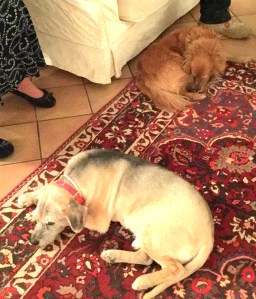
Merlin curled up on the carpet below Hugo.
Plus Reggie and Chris had two dogs; two wonderful dogs. But talk about the fickle finger of fate. For their two dogs were named Merlin and Hugo! And, I should hasten to add, named before we moved from Arizona to Oregon in 2012.
Seriously!
To put that into context for any new readers of this place, where Jean and I live in Southern Oregon is on Hugo Road, Merlin!
Tomorrow will be the last day of sharing the details with you all of our vacation.
It will cover the balance of the time that we spent with Reggie and Chris in the South of France, a most amazing ‘blast from the past’ for yours truly, our return to England and another stay, just for 36 hours this time with Maija, Marius and Morten, then on the 26th our return flight to Portland.