The immensity of the universe and what it means for Planet Earth.
Jean and I have been watching the astounding BBC Series Wonders of Life presented by Professor Brian Cox. Here’s the BBC trailer:
and there are more clips from the programmes on the relevant part of the BBC website. There is so much about the series that is breath-taking. So much that reminds one of what a beautiful and fragile planet we live on. Quite rightly, the series received great reviews. Here, for example, is a little of what the UK Daily Telegraph newspaper wrote:
Wonders of Life, BBC Two, review
Sarah Crompton reviews the first episode of Brian Cox’s latest series, Wonders of Life (BBC Two).
When it comes to presenting styles, Professor Brian Cox is hard to keep still. There isn’t a beach he won’t feel compelled to stroll on, a mountain he won’t climb, or a river he won’t jump into. And what does he carry in that bag?
Once you got beyond these irritating stylistic tropes, however, Wonders of Life (BBC Two) was Cox at his absolute best, using his natural enthusiasm to communicate complicated ideas in very simple ways. He decided, for example, to show us his own DNA by spitting in a test tube – and missed.
“A physicist doing an experiment,” he giggled, with unforced charm. But when he actually succeeded, those little strands of white that you suddenly see brought everything he subsequently said to life.
He was brilliant at explaining his thesis, which was actually about the second law of thermodynamics, so not that much of a doddle to grasp. If I’ve got it right, what Cox thinks is that life itself may have been the inevitable consequence of the laws of physics and can be explained in the same terms as we explain “the falling of the rain and the shining of the stars”.
Sarah rounds off her review, thus:
The programme’s sophisticated use of graphics, and Cox’s patient repetition of his conclusions, all added to the sensation that this is a series that is actually going to tell you something. For the BBC to unveil both this and The Story of Music over a single weekend reveals a pretty impressive commitment to public service broadcasting. Long may it last.
One of the clear messages that comes from the program is the fact that our universe and the formation of life are intimately connected. That the ‘big bang’ some 3.2 billion years ago, the huge interstellar gas clouds, the formation of the carbon atom and the subsequent long-chained molecules, the collapse of those gas clouds to form suns and planets, the start of life, evolution through natural selection to ever more complex life forms, and on and on and on were and are inevitable. The science is clear. There is nothing mystical about it.
Yes, of course, anyone with half-an-ounce of sensitivity will be in awe of it all; the power and beauty of nature and of the natural world.
But here’s the rub.
As another BBC television programme explained, the universe is bigger than beyond imagination. That was from the BBC Horizon broadcast of August, 2012: How Big is the Universe? Here’s the trailer for that programme.
Stay with me a little longer! Just look at the following image.
The Andromeda galaxy.
This image of the Andromeda galaxy, taken in infrared and X-ray, consists of over a trillion stars.
The detailed Spitzer Space Telescope view above features infrared light from dust (red) and old stars (blue) in Andromeda, a massive spiral galaxy a mere 2.5 million light-years away. In fact, with over twice the diameter of our own Milky Way, Andromeda is the largest nearby galaxy. Andromeda’s population of bright young stars define its sweeping spiral arms in visible light images, but here the infrared view clearly follows the lumpy dust lanes heated by the young stars as they wind even closer to the galaxy’s core. Constructed to explore Andromeda’s infrared brightness and stellar populations, the full mosaic image is composed of about 3,000 individual frames. Two smaller companion galaxies, NGC 205 (below) and M32 (above) are also included in the combined fields. The data confirm that Andromeda (aka M31) houses around 1 trillion stars, compared to 4 hundred billion for the Milky Way.
Please stay with me for a few more minutes. Keeping the Andromeda galaxy in mind, now read this:
ESA astronomers say that for every ten far galaxies observed, a hundred go undetected.
Astronomers estimate that there are between 100 billion and 200 billion galaxies in the known universe. A single galaxy such as the Milky Way contain upwards of 200 billion normal stars. About 75 percent of all stars in the Milky Way are less than half as massive as our Sun. In the universe at large, the majority of galaxies are classified as dwarfs, each with less than a few hundred million stars. The image above is a computer simulation of a colliding dwarf galaxy triggering the formation of the Milky Ways spiral arms.
The largest project ever undertaken to map out the Universe in three dimensions using ESO telescopes has reached the halfway stage. An international team of astronomers has used the VIMOS instrument on the ESO Very Large Telescope to measure the distances to 55,000 galaxies as part of the VIPERS survey (VIMOS Public Extragalactic Redshift Survey). This has already allowed them to create a remarkable three-dimensional view of how galaxies were distributed in space in the younger Universe.This reveals the complex web of the large-scale structure of the Universe in great detail. The light of each galaxy is spread out into its component colours within VIMOS. Follow up analysis then allows astronomers to work out how fast the galaxy appears to move away from us — its redshift. This in turn reveals its distance and, when combined with its position on the sky, its location in the Universe.
Wow!
Millions of galaxies, trillions of suns, inconceivable numbers of planets.
Please pause and let the numbers sink in.
Now back to that Wonders of Life BBC series, during which Professor Brian Cox, said, “that it is inconceivable that there isn’t life elsewhere, that life is not present on countless other planets circling countless other suns …“.
In other words, if mankind is so intent on ‘fouling our nest’ on this most beautiful of planets, so what!
In the bigger scheme of things, it matters not. Find that tough? Then go and hug a dog and enjoy the moment. For tomorrow may never come.
Perhaps the last frontier, the one underneath our feet?
Can’t recall where I came across this BBC program but so what! The fact is that the BBC have had a long and well-deserved reputation for making some fabulous programmes on nature and wildlife. So it was with a recent programme from the BBC Nature stable. The one that caught my eye and the motivation for today’s LfD post was called The Burrowers: Animals Underground.
Here is the trailer.
Published on Aug 9, 2013 Discover with BBC Two the secret life of Rabbits, Badgers and Water Voles.
Offering us this:
The Burrowers: Animals Underground
Chris Packham continues his underground journey investigating the world of some of the UK’s most iconic burrowing animals. Filmmakers and scientists cannot investigate animal behaviour inside wild burrows without disturbing them so The Burrowers’ team found ingenious ways to film this secret world by recreating full-scale replicas. It’s now spring in the burrows and the new babies are having to grow up fast. The seven orphan badgers are learning to communicate with each other, young rabbits must take their first steps outside, and young water voles their first swim. Chris also meets the most elusive burrower of them all – an animal which almost never comes above ground – the mole. He reveals the moles’ survival techniques, its method of burrowing and the food it eats. Finally, the team unveils a science first: the excavation of a massive abandoned wild rabbit warren… Back in winter it was filled with concrete and left to set. Now a small army of volunteers and diggers have excavated it, revealing a three-dimensional model of a complex system of tunnels and chambers.
So despite it being at the other end of the scale compared to the cosmos, we still know so little about what goes on beneath our feet.
Mind you, that doesn’t stop some of us from trying to find out!
Sweeny digging in the ground after yesterday’s heavy rain!
My name is Noella and I am a writer and dog enthusiast from Portland, Maine. I am reaching out to you in hopes of contributing to Learning from Dogs as a guest blogger. I have an original, unpublished piece about Top Five Reasons to Pet a Pitbull Today, that I think would fit nicely with the current offering of blog topics you post. I would also be open to writing you a new piece, if there’s a specific topic you’d like covered.
Please let me know if you’d be interested in having a look at my piece and hopefully fitting it into your editorial calendar.
I hope to hear back from you soon!
Thanks,
Noella
Now to be honest, this type of writing offer is not that rare but almost without exception is connected to some form of commercial organisation seeking to advance their profile. My responses are ‘not interested’! Initially, that was my first impression of this email from Noella. But in reply to my query along that vein, Noella sent me this:
Paul,
You’re right, there will be revenue earned from dog friendly businesses that want to get involved and have ads featured on Harry’s Picks. As you can see, presently we have one dog bakery featured. The idea is to keep the website running and give back to the canine community. We are not affiliated with any brand or company.
Thank you,
Noella
Thus on that basis I was happy to go ahead with the guest post. Influenced in great part by the gorgeous temperament of our Casey, a Pit Bull that we adopted February, 2012 when we were still living in Payson, Arizona. Casey, as he was named, had been living in the Humane Centre for nearly a year with no-one taking a liking to him, and his days as a rescue dog were running out.
Jean loved Casey from first sight and in due course brought him home. He quickly settled into the most wonderful, caring and gregarious dog one could imagine. He continues to be a happy, warm dog with all of us here in Oregon.
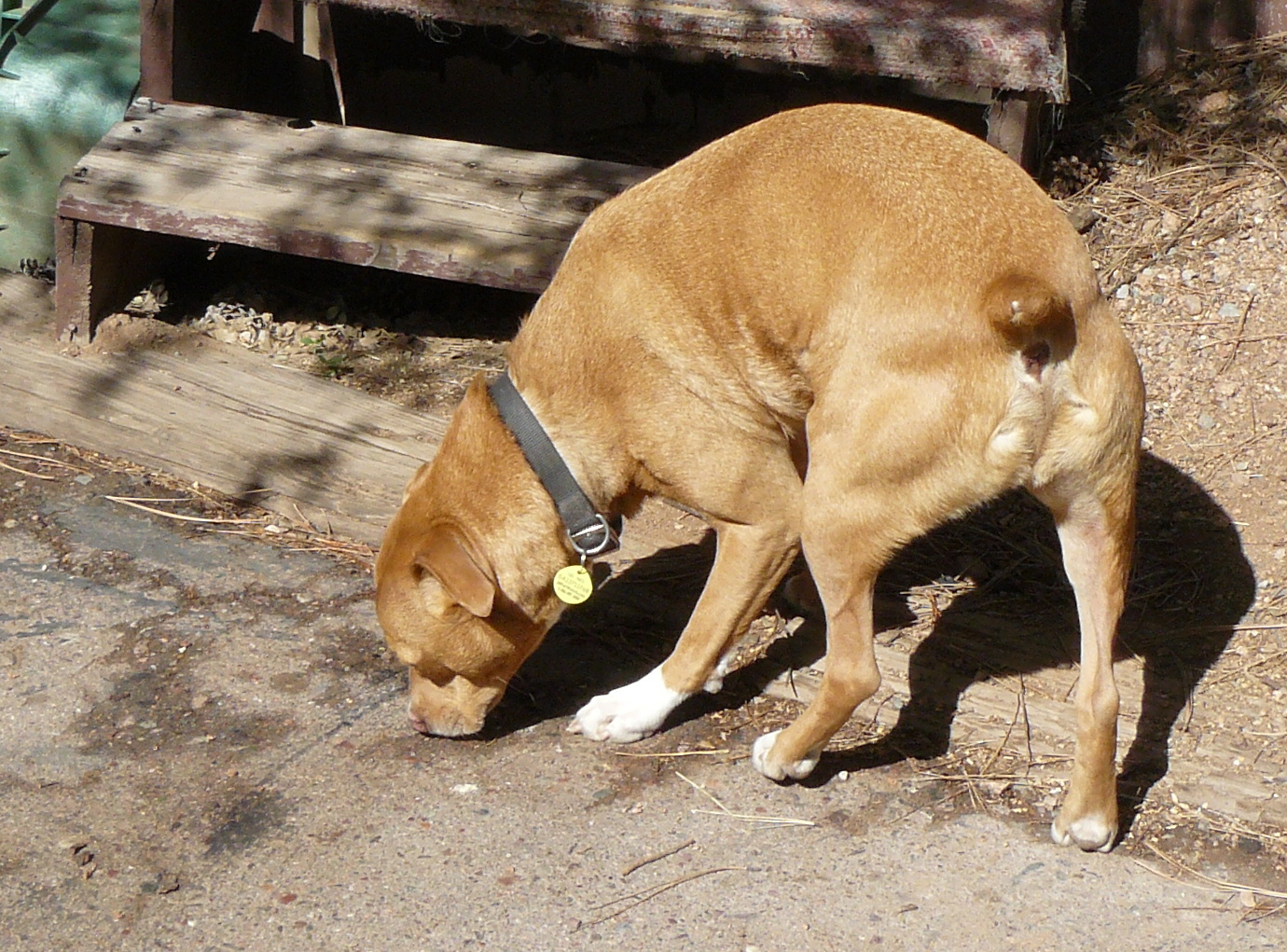
Casey doing what dogs do so well – picking up scents of his new home. (28th February, 2012)
So with all that, let me turn to Noella’s guest post.
oooOOOooo
Top 5 Reasons To Love a Pittie
Sweet Addie.
This is Addie. She is my best friend. She is a Pit Bull mix and the sweetest dog I have ever known. I really didn’t know much about Pit Bulls when I adopted her. I hadn’t been spoiled by tales of their viciousness and I had not yet been brought into the fold by a devotee. So I had to learn fast!
Everything I know about Pit Bulls now has been through her or inspired by her.
Here are the top 5 things I love about Addie and Pit Bulls:
5) They are incredibly strong and athletic. They come in pretty small packages but they are dynamos. Addie can jump five feet straight up in the air from standing still. It’s awe inspiring to watch.
4) You will always be missed! They fuss when you come home. I’m sure lots of dogs do this, but I’ve noticed it in a lot of pitties. They whine and wiggle and snort in the most adorable way. They love people and are always ecstatic to see you. I’m lucky to get a raised eyebrow from my hound dog.
3) They love to play. Pitties are a very determined breed. They will play until you are completely worn out and they will be fully engaged and inquisitive the entire time.
2) THEY LOVE PEOPLE. In my experience Pit Bulls are the most affectionate breed. They are snuggle monsters and will use their gigantic noggins to nose their way into your personal space whether you are seeking their attention or not.
1) THEY NEED THE LOVE. Sadly Pit Bulls and Pit Bull mixes makeup 30%-40% of shelter intakes nationwide and that number goes up in urban areas (interesting article on the subject here). Pit Bulls are misunderstood and often times fall into the hands of the wrong people. They need good owners that have the love and patience to provide them solid training and safe homes.
Noella Schink, writes from Portland, Maine, where she lives and plays with her 3-year-old pit bull mix, Addie, 8-year old shih-tzu, Brutus, and 2-year old hound, Lula. For great tips and reviews about dog friendly businesses around the country, she recommends Harry’s Picks, a new online community for dog lovers.
I have often noticed how ideas come along and are then reinforced by other materials and comments. This struck me (again) as follows. In my post about the fabulous, loving bond between Jeff Guidry and his eagle Freedom one of the comments was from Patrice Ayme, and I quote:
Birds have completely different brains. Still, the smartest birds are more clever than most primates. And many parrots speak (although we have not learned their language yet).
Then going on to add:
Parrot language studies have progressed enough to tell us that there is something huge going on. They apparently use names, as dolphins do.
Certainly Jean would verify the amount of talking that goes on between our two budgerigars here at home!
Mr. Green and Mr. Blu!
Then in yesterday’s post The knowing of dogs, I referred to research that indicated that empathy between those that we know and trust, (a) can be measured, and (b) that “our minds are partly defined by their intersections with other minds.” I went on in that post to speculate that maybe dogs ‘reading’ the minds of humans that they know and trust wasn’t so far-fetched.
Wolves Howl Because They Care: Social Relationship Can Explain Variation in Vocal Production
Aug. 22, 2013 — When a member of the wolf pack leaves the group, the howling by those left behind isn’t a reflection of stress but of the quality of their relationships. So say researchers based on a study of nine wolves from two packs living at Austria’s Wolf Science Center that appears in Current Biology, a Cell Press publication, on August 22.
The findings shed important light on the degree to which animal vocal production can be considered as voluntary, the researchers say.
“Our results suggest the social relationship can explain more of the variation we see in howling behavior than the emotional state of the wolf,” says Friederike Range of the Messerli Research Institute at the University of Veterinary Medicine Vienna. “This suggests that wolves, to a certain extent, may be able to use their vocalizations in a flexible way.”
Scientists have known very little about why animals make the sounds that they do. Are they uncontrollable emotional responses? Or do animals have the ability to change those vocalizations based on their own understanding of the social context?
At the Wolf Science Center, human handlers typically take individual wolves out for walks on a leash, one at a time. On those occasions, they knew, the remaining pack mates always howl.
To better understand why, Range and her colleagues measured the wolves’ stress hormone levels. They also collected information on the wolves’ dominance status in the pack and their preferred partners. As they took individual wolves out for long walks, they recorded the reactions of each of their pack mates.
Those observations show that wolves howl more when a wolf they have a better relationship with leaves the group and when that individual is of high social rank. The amount of howling did not correspond to higher levels of the stress hormone cortisol.
“Our data suggest that howling is not a simple stress response to being separated from close associates but instead may be used more flexibly to maintain contact and perhaps to aid in reuniting with allies,” Range says.
For those that want to read the original research paper then it is available over at Current Biology, a Cell Press publication.
Wolf Howling Is Mediated by Relationship Quality Rather Than Underlying Emotional Stress
We investigated the influence of social and physiological factors on wolf howling
Wolves howl more to keep contact with affiliated partners and with pack leaders
Howling is mediated by the social relationship not cortisol level of the howlers
This pattern indicates that wolves have some voluntary control of their howling
Summary
While considerable research has addressed the function of animal vocalizations, the proximate mechanisms driving call production remain surprisingly unclear. Vocalizations may be driven by emotions and the physiological state evoked by changes in the social-ecological environment [1,2], or animals may have more control over their vocalizations, using them in flexible ways mediated by the animal’s understanding of its surrounding social world [3,4]. While both explanations are plausible and neither excludes the other, to date no study has attempted to experimentally investigate the influence of both emotional and cognitive factors on animal vocal usage. We aimed to disentangle the relative contribution of both mechanisms by examining howling in captive wolves. Using a separation experiment and by measuring cortisol levels, we specifically investigated whether howling is a physiological stress response to group fragmentation [5] and whether it is driven by social factors, particularly relationship quality [6,7]. Results showed that relationship quality between the howler and the leaving individual better predicted howling than did the current physiological state. Our findings shed important light on the degree to which animal vocal production can be considered as voluntary.
So, don’t know about you, but it all seems to be suggesting how little we know about how animals communicate with the world around them.
A fascinating study on human empathy strikes a chord with man and dog, perhaps.
Let me start with a true account from the evening of Monday, 19th August.
That evening, at 7pm, I had an appointment with my doctor in Grants Pass. Jean stayed at home looking after our guests and preparing the evening meal.
The journey from the doctor’s clinic back to home, a distance of 20 miles, takes a little over half-an-hour. The last 3 miles are along Hugo Road; about 6 minutes including opening and closing the gate across our driveway.
Anyway, according to Jean shortly after 8pm Pharaoh sprang up barking and went across to put his nose against one of the windows that looks out over our front drive and garden. Jeannie looked at the clock on the kitchen wall and made a note of the time: it was 8:10pm. She also came over to the window that Pharaoh was looking out of and searched for any reason for his outburst of barking: squirrels, deer, any kind of wildlife or other distraction. There was none.
A little before 8:20pm Jeannie saw the headlights of my car pull up and moments later I came in through the front door.
It appeared that Pharaoh had sensed the point where I had turned into Hugo Road.
One could easily dismiss this, perhaps by thinking that Jean had unconsciously signalled to Pharaoh that I was on my way home. But Jean had only the vaguest idea of when I might be back.
Or one could be drawn to the research undertaken by Dr. Rupert Sheldrake, as this extract from a post back in May, 2011 explains.
What an amazing book this is.
Amazing!
I have written about Dr Rupert Sheldrake a few times on Learning from Dogs for pretty obvious reasons! You can do a search on the Blog under ‘sheldrake’ but here are a couple of links. Serious Learning from Dogs on January 10th, 2011 and Time for a rethink on the 14th April, 2011.
Anyway, I am now well towards the end of Sheldrake’s revised book, Dogs That Know When Their Owners Are Coming Home and it is more than fascinating. Bit short of time just now so please forgive me if I do no more than show this video which sets out some of the background to the book. Sheldrake’s website is here, by the way.
Anyway, what’s this all leading up to?
I can’t recall where it was that I read about a report posted on the Forbes website about the new findings of the power of human empathy.
Study: To The Human Brain, Me Is We
A new study from University of Virginia researchers supports a finding that’s been gaining science-fueled momentum in recent years: the human brain is wired to connect with others so strongly that it experiences what they experience as if it’s happening to us.
This would seem the neural basis for empathy—the ability to feel what others feel—but it goes even deeper than that. Results from the latest study suggest that our brains don’t differentiate between what happens to someone emotionally close to us and ourselves, and also that we seem neurally incapable of generating anything close to that level of empathy for strangers.
The research revealed:
“The correlation between self and friend was remarkably similar,” said James Coan, a psychology professor in U.Va.’s College of Arts & Sciences who co-authored the study. “The finding shows the brain’s remarkable capacity to model self to others; that people close to us become a part of ourselves, and that is not just metaphor or poetry, it’s very real. Literally we are under threat when a friend is under threat. But not so when a stranger is under threat.”
The findings back up an assertion made by the progenitor and popularizer of “Interpersonal Neurobiology,” Dr. Daniel Siegel, who has convincingly argued that our minds are partly defined by their intersections with other minds. Said another way, we are wired to “sync” with others, and the more we sync (the more psycho-emotionally we connect), the less our brains acknowledge self-other distinctions.
Later in that Forbes article Professor Coan is reported:
“A threat to ourselves is a threat to our resources,” said Coan. “Threats can take things away from us. But when we develop friendships, people we can trust and rely on who in essence become we, then our resources are expanded, we gain. Your goal becomes my goal. It’s a part of our survivability.”
So if science is discovering that our subconscious minds are connecting “psycho-emotionally” with the minds of others whom we trust, then it doesn’t seem like too great a leap to embrace human minds psycho-emotionally connecting with the animals that we trust, and vice versa. Because for thousands upon thousands of years, the domesticated dog and man have depended on each other for food, protection, warmth, comfort and love.
Footnote.
References for those who wish to follow up on this article are:
Professor Robin Ian MacDonald Dunbar, British anthropologist, evolutionary psychologist and a specialist in primate behaviour. His theory known as Dunbar’s Numberexplained here.
Back in July, I published a post reviewing Traveling Light, the novel by Andrea Thalasinos. At the end of that post, I made the following offer.
Now here’s an offer.
Wiley has offered a free copy of Andrea’s book as a ‘give-away’ from Learning from Dogs. Here’s the plan.
Would you like to write a story about any aspect of the relationship that dogs can have with humans?
Any length, truth or fiction; it doesn’t matter. Email your story to me to be received by the end of Wednesday, 31st July 2013, Pacific Daylight Time …… [and] I will publish every one received.
Just one story was received, from Wendy, and the promised free copy of Andrea’s book has been mailed to her.
So here is that short story.
oooOOOooo
I Am Leader
The water was angry today. I watched as it tore the tall trees from their roots, thundering, roaring, snapping them, toppling them.
I watched as the angry water shredded the shore. I watched as its fury snatched my pup, my baby, sweeping her away like a dying twig torn from the mother tree.
I am hunter. I am leader.
But now I am nothing.
I ran after my pup, tried to grab her by the nape, take her back. But I failed. I saw her paddle in the froth, scramble atop a long gnarled broken bole that was once a tree. My pup shook, her ears flattened, her tail tucked. She cried. I watched the cold, angry froth take her.
My mind sang with the cry of my little grey pup that I could not save, the little one who would never learn about the hunter, the leader.
I picked my way, shivering, along a path — it used to be our way to good hunting, to the forest edge where the deer grazed as near as yesterday. Now…
My left shoulder ached where the water nearly took me, hurled a branch at me in frustration. I fell and dragged myself away from the collapsing shore, to higher ground. The rain poured and sleeted to drench the shambles left by water that continued to roar and foam. Mud slid through my feet, gusts took my breath.
It was very cold. My ears twitched, hearing nothing beyond the roar of the fury. Water is very noisy when it is angry. The others, my sisters, my mate, I could not scent them, hear them, see them.
The day retreated. I blinked to see better, my eyes wide, but they saw nothing that I could recognise. My nose and ears twitched and twisted — nothing. I could hear my little grey one, my pup; she shivered and cried in my mind, but my eyes and ears, my nose … she was gone.
I stumbled over broken branches, a drowned fox, mice flushed from their holes, a broken-necked bird, bushes overturned and torn apart, walls of fallen trees. Daylight was lost in a twilight.
Now, I scented a 2-legged. I stilled. Crackling. Smoke, deep and hard to breath. Rabbit, burnt. These were the smells I knew of the 2-leggeds. One was near.
I crouched and crept. Yellow-orange light bounced and throbbed through the jumble of once-forest. I remained low, but now I could hear. The 2-legged rustled. It was noisy and careless while its fire snapped. And the rabbit smell was very faint, distorted.
I could see it now, this 2-legged, seated in that foolish way 2-leggeds have, crossing one foot over the other. It rustled again and held a big stick over its fire — the stick jabbed through the rabbit. The rabbit’s fur was gone from its blackened body, abandoned near the 2-legged’s thigh.
My stomach twitched. My mouth filled with hunger. I took another step.
The 2-legged looked up and over. He saw me, then quickly looked away.
I am hunter, I am leader — you do not meet my gaze unless you want to be punished.
I crouched, readied myself to spring.
The 2-legged stood. I eased back. My back paws met the tangled once-forest left of the water’s anger and stopped me. I tensed.
But the 2-legged lifted the big stick with its rabbit, tore a haunch with its hand. It looked directly at me again — no, I am hunter, I am leader — and threw the haunch at me. The burnt meat landed close to my feet.
The 2-legged looked away and returned to its foolish, awkward sitting. It tore ragged bites from the burnt rabbit, holding the big stick between the paws of its upper limbs.
My stomach demanded food. I scented the burnt rabbit, the smell of blood faint and smoky. I did not hunt the rabbit, I am not like the vultures and scavengers … but I was hungry. I nosed it, picked it up and turned away from the 2-legged. The flesh was warm. It sated. I licked my paws, swiped my whiskers and jowls to groom.
For a moment, my mind tricked me. I heard my pup. I scented my mate, my others, we were sated, we curled together, our warm bodies close, to sleep through the long cold night.
I opened my eyes. I was alone.
Except the 2-legged. Its odour was unmistakable, deer hide, rabbit, something sweetly sour I thought must be its own scent, not the ones borrowed by the other animals it ate or draped over its body.
I studied the 2-legged. It had curled on its side. The fire beside it throbbed yellow and orange, throwing strange shadows where they should not be. When I looked away, my sight was poor. I would not look directly at the fire again.
All was silent, save the angry water behind us. We lived. Nothing else lived. The water took everything.
I dreamed of my mate, his powerful howls alerting our cousins of our hunt; the deer was warm, its blood and flesh giving us another day of life. The deer was old and slow, an easy hunt. Its time had come; we knew that, understood it, this deer and our pack.
I dreamed of my sisters, nipping at my pup, teasing her to chase them in mock hunts. I dreamed of my brothers, circling and securing our family. My pack. My life.
We slept.
The day hung low and grey. Overnight, the angry water had become a sussurrating hiss behind us.
With its strange flat feet and its big stick, the 2-legged was tossing dirt and wet leaves over the ash where the fire and the rabbit had been. The old fire flared briefly. A cool damp gust caught some of the sparks and swept them high. A bird swooped near to see, then lost interest, flapped its wings to gain height.
The smell in the air was smoke and faint rabbit scent. It was upturned earth and rot and rain.
The 2-legged’s odour wore the smoke and long-dead deer.
The 2-legged came close. It looked at me — no — I am hunter, I am leader, you do not meet my gaze. But it was stupid and foolish, this 2-legged, like a pup that had not yet learned. It neared me. I growled, prepared to attack.
Surely it could see my flattened ears, my lowered shoulders?
No, it was stupid. It walked passed me.
I watched. The 2-legged paused and turned. It swung one of its upper limbs down low, then away, a sweeping motion. Strange language. It did not lower its ears, or roll on its belly. It made noises with its mouth. The noises were terrible, low, rumbling, but they were not threatening. I watched.
It made the motion again, then turned and walked on.
I sat on my haunches.
I am leader, I am hunter. But this 2-legged did not understand. It had not learned from its pack.
We two were the only ones I scented. We were alone. The angry water had taken the others.
The 2-legged stopped, made the strange sweeping motion and noises again. I took a step in its direction.
I am hunter. I am leader.
My pup cries in my mind. My mate howls. My sisters tease, my brothers scout. But around me is silence, the scents dirty and empty, the forest destroyed, the deer gone. We two are alone.
The 2-legged’s head bobs up and down. I take another step.
We walk on, stepping carefully over the tangled mess that was once our home, our feet slipping in mud, scratched in dying brambles, struggling in the unfamiliar path before us. 2-legged uses the big stick as if it were a third leg.
It is learning. I am patient.
I am hunter. I am leader.
oooOOOooo
Don’t know about you but I found that story by Wendy more than compelling. Found it hauntingly beautiful. A ancient account of the first meeting between man and wolf.
Therefore, can’t close without again reproducing this short extract and images of the grey wolf posted on the 20th May Musings on love.
oooo
While we were looking at the animals, along the pathway came a couple of the volunteer staff walking a Grey Wolf (Canis Lupus).
An afternoon walk for Tundra.
I was utterly captivated by this beautiful animal. Her story was that she was born in captivity and owned by an individual who soon decided he didn’t want her! Not long thereafter Tundra, as she became named, was brought to the Sarvey Wildlife Center in Washington and thence to Wildlife Images when she was just 8 weeks old.
Tundra turned to look at me. I stood perfectly still and quiet. Tundra seemed to want to come closer. As one would with a strange dog, I got down on my knees and turned my eyes away from Tundra’s. I sensed she was coming towards me so quickly held up my camera and took the picture below.
Wolf greets man.
I kept my gaze averted as I felt the warm breath of this magnificent animal inches from my face. Then the magic of love across the species! Tundra licked my face! The tears came to my eyes and were licked away. I stroked her and became lost in thought.
Was this an echo of how thousands and thousands of years ago, a wolf and an early man came together out of trust and love and started the journey of the longest animal-human relationship, by far?
Yesterday, I published a recent Tomgram essay by William deBuys: Goodbye to All That (Water). The essence of what William was presenting was that, “The crucial question for Phoenix, for the Colorado, and for the greater part of the American West is this: How long will the water hold out?”
Also in yesterday’s Learning from Dogs post, I closed with the statement, “If readers will forgive me, I will continue the theme tomorrow with a rather more personal perspective.”
I have decided to delay the ‘personal’ aspect to today’s post until the very end. So back to Arizona’s water.
As an indication that this is not a new problem, I recently came across an article that was published in The Arizona Republic by Shaun McKinnon in August 2009. It was called Unabated use of groundwater threatens Arizona’s future. Here’s how that article opened:
Thirty years after Arizona tried to stop cities and towns from using up their groundwater, the state still can’t shake its thirst for one of its most finite resources.
The steady drain on underground reserves grows out of two realities: Canals and pipelines don’t reach far enough to deliver surface water to everyone, and laws don’t reach far enough to stop people from drilling.
If the groundwater addiction continues unabated and under-regulated, the effects will be broad and potentially disastrous: Scarcer supplies could push rates higher and create uncertainty about water availability, discouraging new business and slowing economic growth. If wells start to run dry and aquifers collapse, the landscape could be dotted with fissures and sinkholes.
Lawmakers adopted some of the nation’s most progressive water-protection laws to avert such crises, but the laws excluded rural areas and allowed changes that let cities and subdivisions resume well-drilling, further depleting exhaustible aquifers.
Meanwhile, the renewable resource intended to replace groundwater – surface water fed by the annual runoff of mountain snow – can’t meet the demand of urban areas too far from the delivery canals.
The result is holes in the state’s water bucket that are spreading as fast as the holes in the ground.
Then good friend, Dan Gomez sent me this link: Arizona’s Water: Uses and Sources. I would like to cover some of the information contained on that website.
Arizona’s Water: Uses and Sources
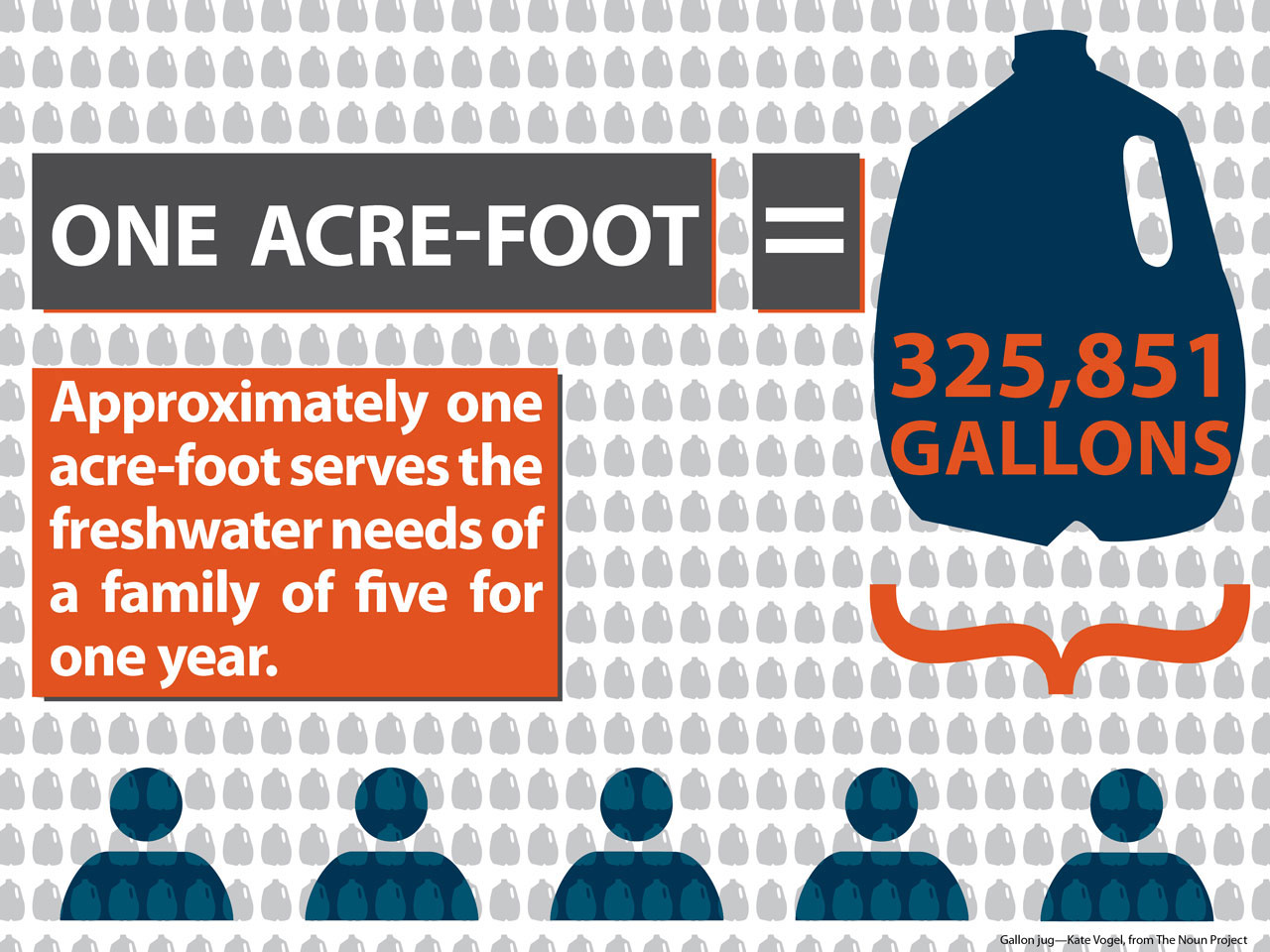
One acre-foot of water.
A land’s carrying capacity has always been determined by its access to usable water. Humans use water primarily for irrigation, industry, drinking water, and sanitation. Millions of non-human species depend on water for life itself. Only 1% of the earth’s water is freshwater, to be shared among more than 7 billion people and all freshwater aquatic ecosystems in the world. It is perhaps the most precious resource on the planet.
Large volumes of water are most commonly measured in acre-feet. One acre-foot is the amount of water required to cover one acre of area to the depth of one foot: 325,851 gallons. Approximately one acre-foot serves the needs of a family of five for one year. Arizona is one of the driest states in the U.S., and one of the fastest-growing. Arizona’s current population is over 6 million (2010 Census) and is projected to grow to as many as 9.5 million people by 2025. Encompassing four deserts, Arizona receives a statewide average of only 12.5 inches of rain per year. Our climate presents intense challenges in balancing our water needs between ourselves, our neighbors, and our riparian ecosystems. Water has defined our past and will determine our future.
“Water has defined our past and will determine our future”!
Let me skip a couple of paragraphs and continue, thus:
Water in Arizona is used for cultural purposes (for and by people) and for in-stream uses, such as for the support of fish and riparian ecosystems.
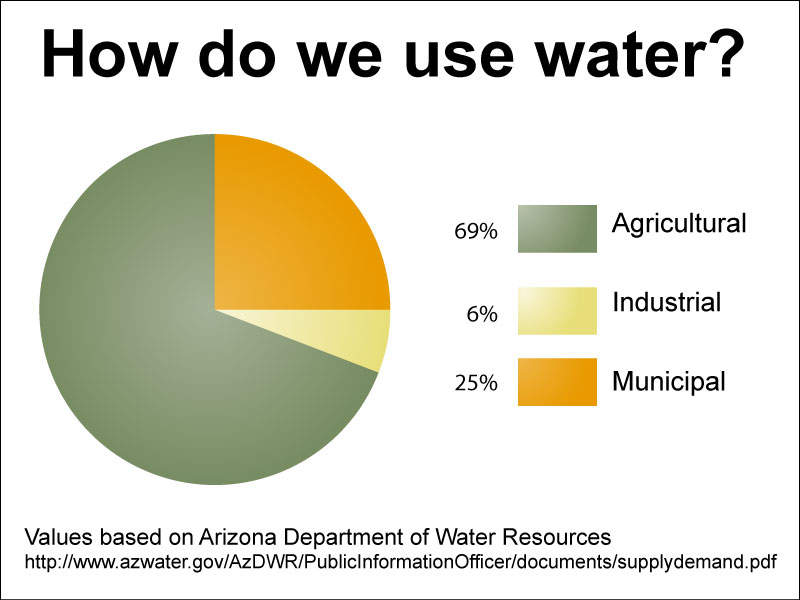
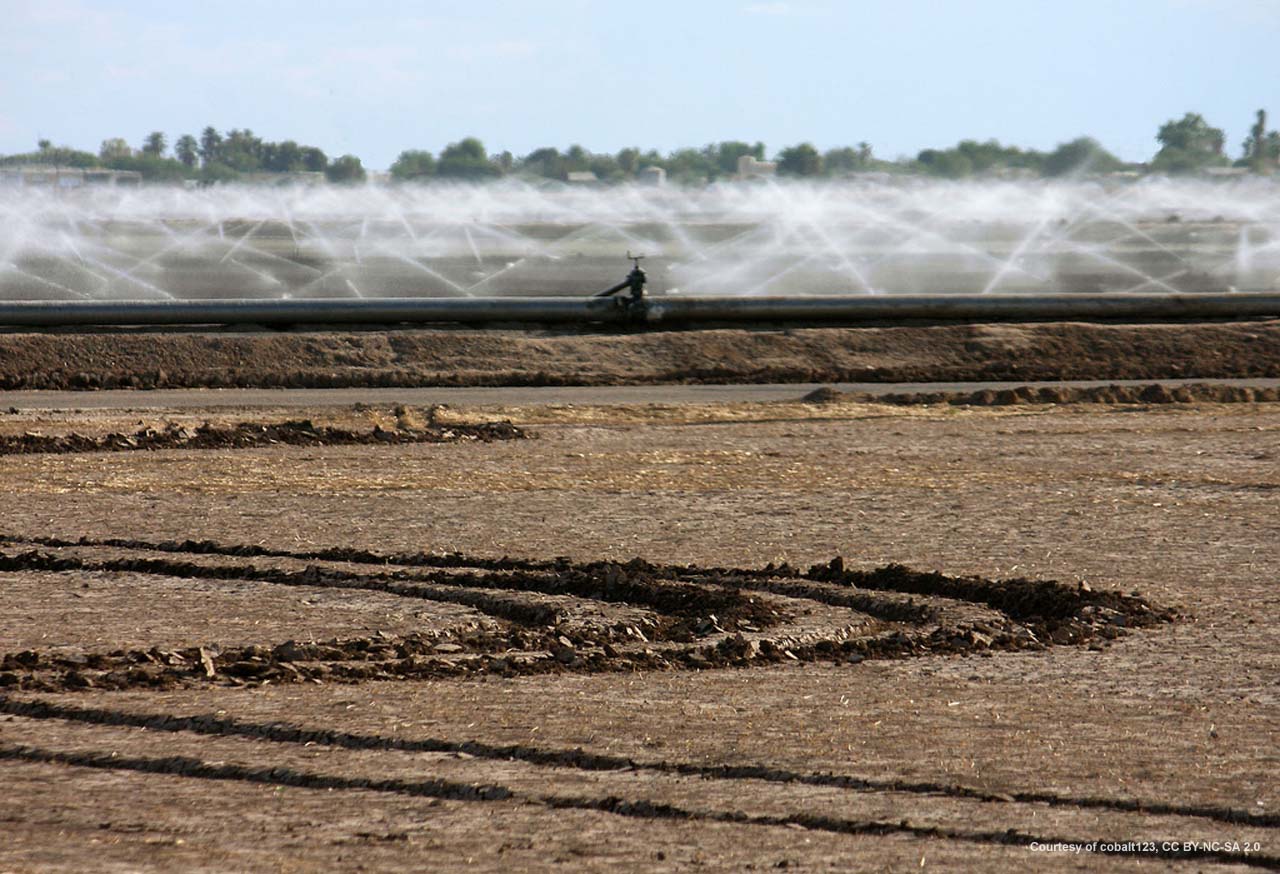
Arizona’s cultural use of water. Values based on Arizona Department of Water Resources.Approximately 69% of the available water supply in Arizona is used for agriculture.
Again, skipping forward.
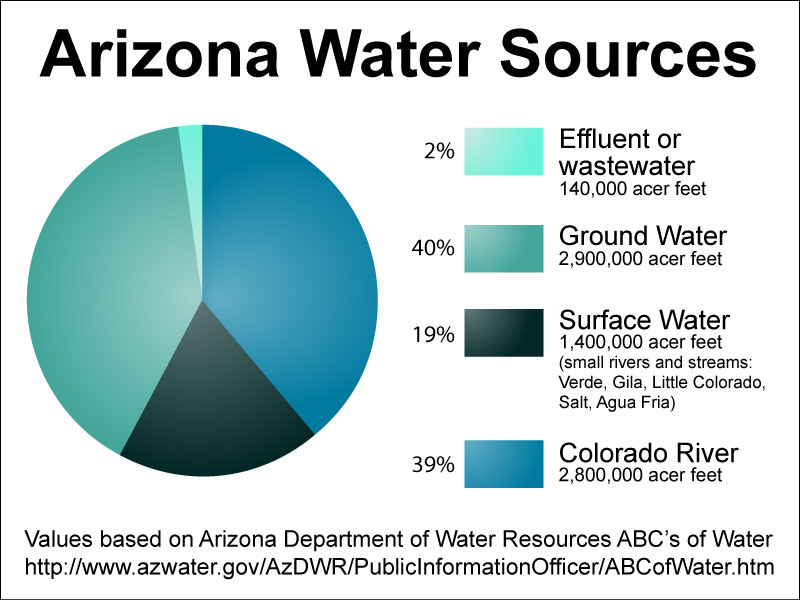
Values based on Arizona Department of Water Resources ABC’s of Water.
Water Sources
Arizona gets water from three major sources: surface water (which includes Colorado River water and water from other major rivers and streams), groundwater, and effluent or reclaimed water.
Groundwater
About 43% of the state’s water use comes from groundwater sources. Groundwater is found beneath the earth’s surface in natural reservoirs called aquifers. In most cases the aquifers that store water have been in place for millions of years. Throughout the 20th and 21st centuries, groundwater has been pumped out more rapidly than it has been replenished, creating a condition called overdraft. Though a large amount of water remains stored in Arizona’s aquifers, its availability is limited by location, depth and quality. By continuing to overdraft the state’s groundwater supplies, we challenge our ability to ensure a secure water supply for the future. In recognition of this threat, Arizona implemented the Groundwater Management Code in 1980. The Groundwater Code promotes water conservation and long-range planning of our water resources.
Colorado River Water
A separate category of surface water in Arizona is the water supplied through the Colorado River. The federal government constructed a system of reservoirs on the river to harness its supplies for use in several states. Arizona, California, Nevada, New Mexico, Utah, Colorado, Wyoming, and Mexico share the river’s resources. Rights to use Colorado River water are quantified by a string of legal authorities known as the “Law of the River.” Based on this body of law, Arizona has the right to use 2.8 million acre-feet annually of Colorado River water. Mohave, La Paz, and Yuma county water users rely on Colorado River as their principal water supply. When fully utilized, the Central Arizona Project (CAP) will deliver an annual average of 1.5 million acre-feet of Colorado River water to Maricopa, Pinal and Pima Counties.
Other Surface Water
Surface water from lakes, rivers, and streams is Arizona’s major renewable water resource. However, because of our desert climate, the amount of surface water available can vary dramatically from year to year, season to season, and place to place. In order to make the best use of the surface water when and where it is needed, storage reservoirs and delivery systems have been constructed throughout the state. Most notable are the major reservoir storage systems located on the Salt, Verde, Gila and Agua Fria rivers. Almost all of the natural surface water in Arizona has been developed.
Since it is impossible to measure the exact values of water used across a state, some variance of values must be tolerated.
oooOOOooo
So take the message from yesterday’s post and then from above: “Throughout the 20th and 21st centuries, groundwater has been pumped out more rapidly than it has been replenished, creating a condition called overdraft. Though a large amount of water remains stored in Arizona’s aquifers, its availability is limited by location, depth and quality. By continuing to overdraft the state’s groundwater supplies, we challenge our ability to ensure a secure water supply for the future.“, and remember that 2 + 2 = 4! I.e. the power of logic.
Now to close with that personal perspective.
When Jean and I were living in Payson, Arizona, we were close to town but not so close as to be on Payson City’s water supply. Thus we had a well on our land. If I recall, the depth of the drilled well was about 250 feet and the water level was about 80 feet below ground surface. We had been told from the house survey that the ‘normal’ water level was about 35 feet down. While we were there the water level slowly, but steadily, continued to drop.
We were both very happy in Payson; indeed it is where Jean and I were married.
However, one night, I would guess last June, 2012, I had this weird dream that I had gone to the bathroom during the night, turned on the cold-water tap and nothing had flowed out. Bizarre dream, wouldn’t you say! But even more bizarre was that the image of no water was in my mind when I awoke in the morning, and I couldn’t shrug off a distinct feeling of disquiet. That all lead to us coming up to Oregon, finding this wonderful property with an all-year creek, Bummer Creek, running through our land, and moving in on October 25th, 2012.
It really is absurd to think that animals don’t have feelings!
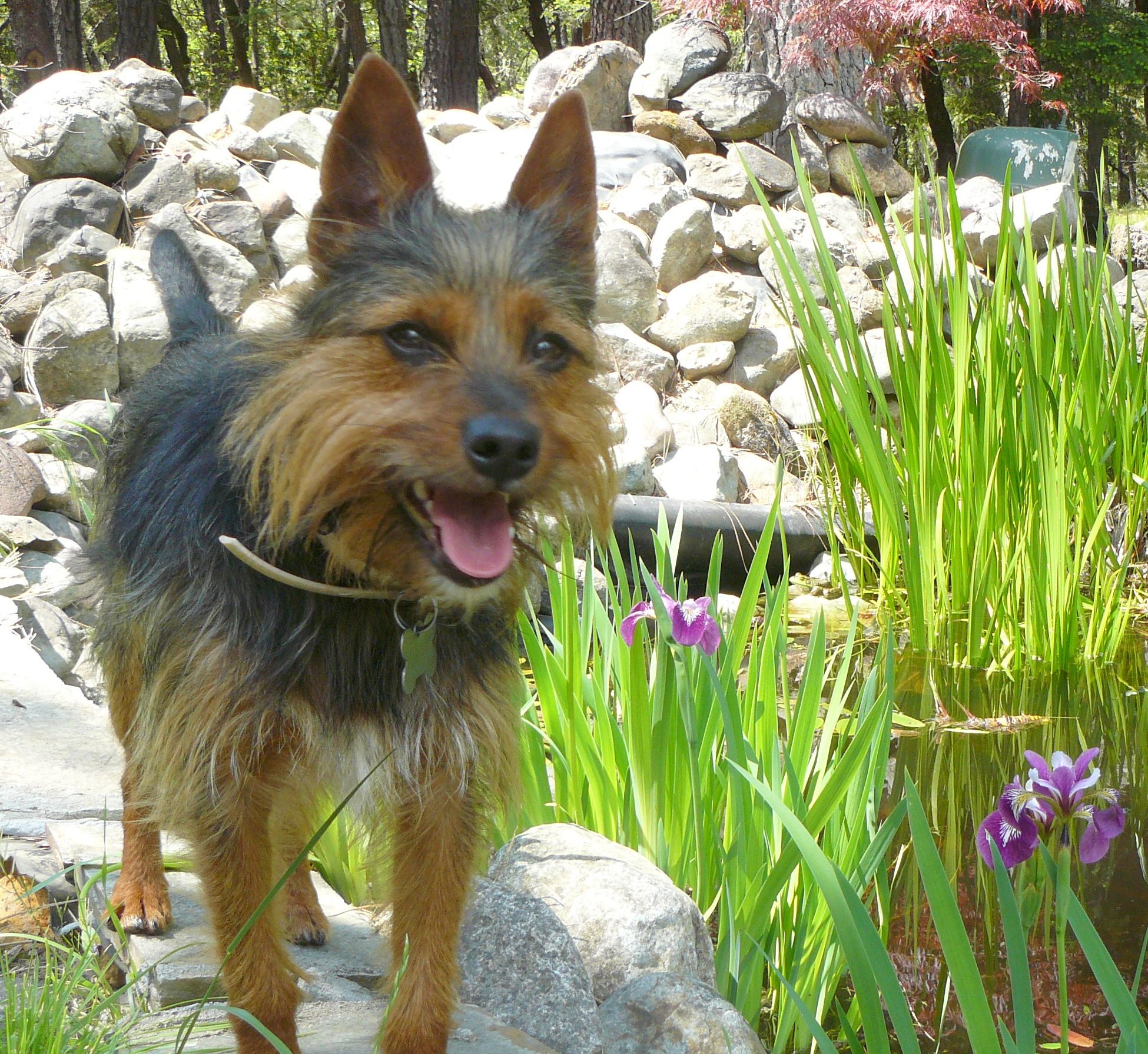
Surely, a smiling Sweeny?
Many thousands of animal owners will intuitively know that animals have feelings. Not only expressed through their behaviour but also through many other subtle signs including facial expressions. But what about the science behind this?
Back towards the end of May, there was an item on the BBC News website that was headlined: Ape tantrums: Chimps and bonobos emotional about choice. It caught my eye.
Ape tantrums: Chimps and bonobos emotional about choice
Like many humans, chimpanzees and bonobos react quite emotionally when they take risks that fail to pay off.
This is according to researchers from Duke University in the US, who developed decision-making games that the apes played to earn edible treats.
Some animals that lost the game – receiving a bland piece of cucumber rather than a preferred piece of banana – reacted with what looked like the ape equivalent of a tantrum.
It was then only a matter of a couple of ‘mouse clicks‘ to go to that Plos One publication of the findings.
Chimpanzees and Bonobos Exhibit Emotional Responses to Decision Outcomes
Abstract
The interface between cognition, emotion, and motivation is thought to be of central importance in understanding complex cognitive functions such as decision-making and executive control in humans. Although nonhuman apes have complex repertoires of emotional expression, little is known about the role of affective processes in ape decision-making. To illuminate the evolutionary origins of human-like patterns of choice, we investigated decision-making in humans’ closest phylogenetic relatives, chimpanzees (Pan troglodytes) and bonobos (Pan paniscus). In two studies, we examined these species’ temporal and risk preferences, and assessed whether apes show emotional and motivational responses in decision-making contexts. We find that (1) chimpanzees are more patient and more risk-prone than are bonobos, (2) both species exhibit affective and motivational responses following the outcomes of their decisions, and (3) some emotional and motivational responses map onto species-level and individual-differences in decision-making. These results indicate that apes do exhibit emotional responses to decision-making, like humans. We explore the hypothesis that affective and motivational biases may underlie the psychological mechanisms supporting value-based preferences in these species.
Wonderfully, just a short time later I found on Psychology Today an article about the emotions felt by dogs. It was written by Stanley Coren, Ph.D., F.R.S.C., who is Professor Emeritus in the Department of Psychology at the University of British Columbia. (As an aside, a quick search revealed that Prof. Coren was mentioned in a blog post back in October, 2011 in this place: The power of joy.)
So imagine my pleasure and delight at receiving written permission from the Professor to republish his article in full. So without further ado, here it is.
oooOOOooo
Which Emotions Do Dogs Actually Experience?
Dogs have the same emotions as a human 2 year-old child.
Since most of us routinely read emotions in our dogs (wagging tail means happy, cringing means afraid and so forth) it may be difficult to believe that the existence of real emotions in dogs was, and in some places still is, a point of scientific controversy. In the distant past it was presumed that dogs had very rich mental lives with feelings much like those of humans. However with the rise of science things began to change. We learned enough about the principles of physics and mechanics, so that we could build complex machines, and began to notice that living things (both people and animals) were also based upon by systems governed by mechanical rules and chemical processes. In the face of such discoveries, religions stepped in to suggest that there must be more to human beings than simply mechanical and chemical events. Church scholars insisted that people have souls, and the evidence they gave for this was the fact that humans have consciousness and feelings. Animals might have the same mechanical systems, but they did not have a divine spark, and therefore they do not have the ability to experience true feelings.
Since most research at the time was church sponsored it is not surprising that prominent scholars, such as the French philosopher and scientist René Descartes adopted this viewpoint. In a highly influential set of analyses, Descartes suggested that animals like dogs were simply some kind of machine. He would thus describe my Beagle, Darby, as simply being a dog-shaped chassis, filled with the biological equivalent of gears and pulleys. Although this machine doesn’t have consciousness and emotions it can still be programmed to do certain things.
In recent times science has progressed a long way beyond Descartes and we now understand that dogs have all of the same brain structures that produce emotions in humans. Dogs also have the same hormones and undergo the same chemical changes that humans do during emotional states. Dogs even have the hormone oxytocin, which, in humans, is involved with feeling love and affection for others. With the same neurology and chemistry that people have, it seems reasonable to suggest that dogs also have emotions that are similar to ours. However it is important to not go overboard and immediately assume that the emotional ranges of dogs and humans are the same.
To understand what dogs feel we must turn to research which was done to explore the emotions of humans. Not all people have the full range of all possible emotions. In fact at some points in your life you did not have the full complement of emotions that you feel and express today. Research shows that infants and very young children have a more limited range of emotions, but over time the child’s emotions begin to differentiate and they come to be able to experience different and more complex emotional states.
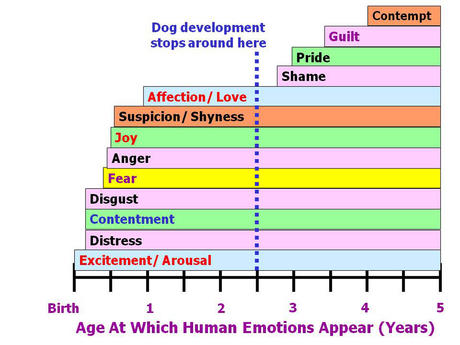
This data is important to our understanding of the emotional lives of dogs because researchers have come to believe that the mind of a dog is roughly equivalent to that of a human who is two to two-and-a-half years old. This conclusion holds for most mental abilities — including emotions. Thus we can look to the human research to see what we might expect of our dogs. Like a young child, dogs will clearly have emotions, but many fewer kinds of emotions than we find in adults.
I’ve illustrated this in the accompanying illustration. At birth a human infant only has an emotion that we might call excitement. This indicates how aroused he is, ranging from very calm up to a state of frenzy. Within the first weeks of life the excitement state comes to take on a positive or a negative flavor, so we can now detect the general emotions of contentment and distress. In the next couple of months disgust, fear, and anger, become detectable in the infant. Joy often does not appear until the infant is nearly six months of age and it is followed by the emergence of shyness or suspicion. True affection (the sort that it makes sense to use the label “love” for) does not fully emerge until nine or ten months of age.
The complex social emotions, those which have elements that must be learned, don’t appear until late. Shame and pride take more than three years to appear, while guilt appears around six months after these. A child must be nearly four years of age before it feels contempt.
This developmental sequence is the golden key to understanding the emotions of dogs. Dogs go through their developmental stages much more quickly than humans do, and have all of the emotional range that they will ever achieve by the time they are four to six months of age (depending on the rate of maturing in their breed). However, we know that the assortment of emotions available to the dog will not exceed that which is available to a human who is two to two-and-a-half years old. This means that a dog will have all of the basic emotions: joy, fear, anger, disgust and even love. However based on current research it seems likely that your dog will not have those more complex emotions like guilt, pride and shame.
Now many people might argue that they have seen evidence which indicates that their dog is capable of experiencing guilt. The usual situation is where you come home and your dog starts slinking around and showing discomfort, and you then find that he or she has left a smelly brown deposit on your kitchen floor. It is natural to conclude that the dog was acting in a way that shows that it is feeling guilty about its transgression. However this is not guilt, but simply the more basic emotion of fear. The dog has learned that when you appear and his droppings are visible on the floor, bad things happen to him. What you see is his fear of punishment—he will never feel guilt.
So what does this mean for those of us who live with, and interact with dogs? The good news is that you can feel free to dress your dog in that silly costume for a party. He will not feel shame, regardless how ridiculous he looks. He will also not feel pride at winning a prize at a dog show or an obedience competition. However your dog can still feel love for you, and contentment when you are around, and aren’t these the emotions we truly value?
So going to return to that BBC News item. I broke off after that reference to the findings being published in Plos One. This is how the BBC item continued:
The researchers worked with 23 chimps and 15 bonobos in two ape sanctuaries in the Republic of Congo.
“The animals were all [rescued] orphans of the bushmeat trade,” explained lead researcher Alexandra Rosati, now at Yale University.
“They’re sort of in semi-captivity, but it’s possible to play games with them.
“It’s as close as we can come to wild animals without actually being in the wild.”
Dr Rosati, who studies problem-solving in apes in order to examine the origins of human behaviour, designed two games.
In the first, the animals could choose between receiving a relatively small food reward immediately, or receiving a larger reward but having to wait for it.
The second game involved choosing between a “safe” and a “risky” option. The safe option was six peanuts hidden under a bowl. But a second bowl concealed either a slice of cucumber or a highly favoured portion of banana.
Many of the apes – both bonobos and chimps – became emotional when they had to wait or took a gamble that did not pay off.
The researchers recorded some very tantrum-like responses: vocalisations including “pout moans” and “screams”, as well as anxious scratching and banging on the bars of the enclosure.
“Some of the reactions look similar to a kid [shouting] ‘no, I wanted it!’,” said Dr Rosati.
Emotional decisions
The results, Dr Rosati explained, suggest that the emotional component of decision-making – feelings of frustration and regret that are so fundamental to our own decisions – are intrinsic to ape society and are not uniquely human.
Emotions may have shaped the way great apes, including chimpanzees and bonobos, live.
The researchers also found differences in the way the two species responded to the games; chimps were more willing to take risks, and also more patient than bonobos.
This could suggest that the apes’ capacity for emotion may have helped shape the way they live.
“These differences might be reflected in differences in how the apes choose to forage in the wild,” said Dr Rosati.
“This might be why chimpanzees are more likely to engage in risky strategies like hunting, in that you could spend all day pursuing a monkey, but end up with nothing.
Overall, she said that the results suggested that decision-making in apes involved moods and motivations similar to our own.
OK, better let the dogs outside now – I’m on the receiving end of that look!
“Until one has loved an animal, a part of one’s soul remains unawakened.” Anatole France
This gorgeous video has been doing the rounds and came to me thanks to Suzann.
Enjoy!
Very Talented Russian Bear and His Awesome Friend
This unbelievably talented and cute Russian bear can roll over, play the trumpet, sit on a lawn chair, play the trumpet, you name it. Leave it to a random Russian guy to train such an awesome bear.
I was doing some research for another writing project about the history of the domestication of the dog and came across a peer-reviewed article on The National Center for Biotechnology Information website, here in the USA. The article was entitled: Genome-wide SNP and haplotype analyses reveal a rich history underlying dog domestication. The website link is here. (As an aside, if you drop in here and look at the NCBI sitemap it may well serve as an excellent resource.)
Anyway, the dog domestication article is, of necessity, highly scientific but nonetheless worth the read. Here’s a taste from the Abstract.
Advances in genome technology have facilitated a new understanding of the historical and genetic processes crucial to rapid phenotypic evolution under domestication 1,2. To understand the process of dog diversification better, we conducted an extensive genome-wide survey of more than 48,000 single nucleotide polymorphisms in dogs and their wild progenitor, the grey wolf. Here we show that dog breeds share a higher proportion of multi-locus haplotypes unique to grey wolves from the Middle East, indicating that they are a dominant source of genetic diversity for dogs rather than wolves from east Asia, as suggested by mitochondrial DNA sequence data 3
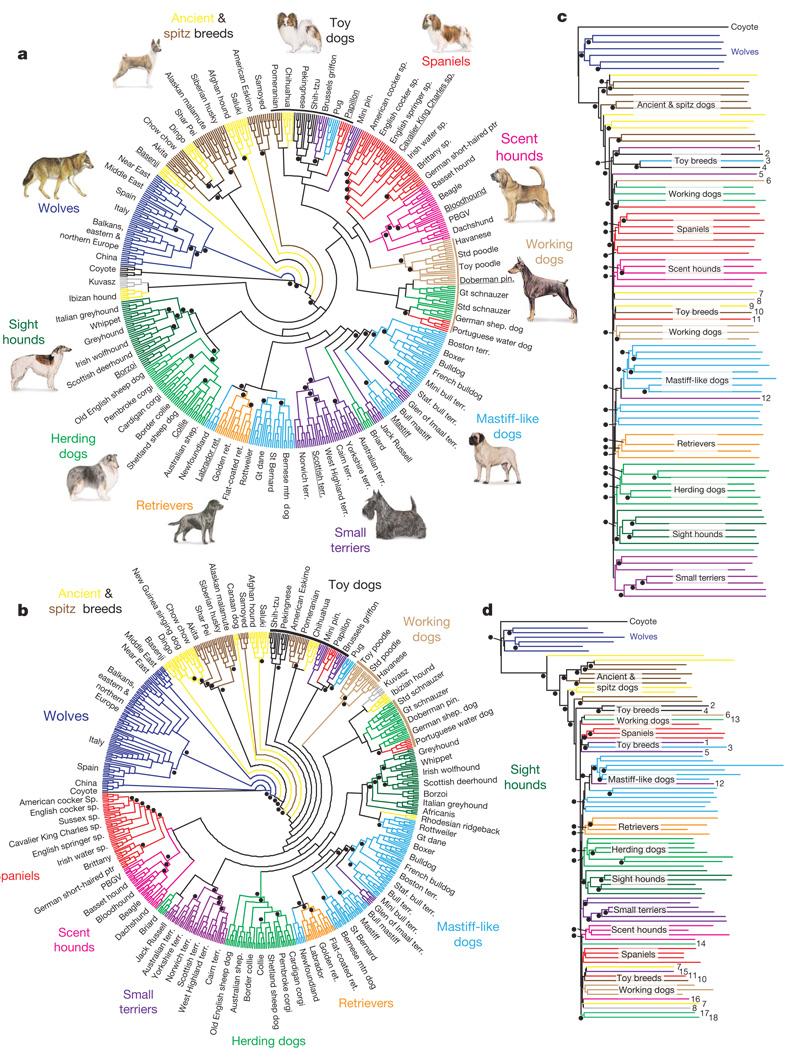
But what really caught my eye was Figure 1, a wonderful illustration of the links between all the breeds of dogs and the grey wolf.
Neighbour-joining trees of domestic dogs and grey wolves.
Branch colour indicates the phenotypic/functional designation used by dog breeders 8,9. A dot indicates ≥95% bootstrap support from 1,000 replicates. a, Haplotype-sharing cladogram for 10-SNP windows (n = 6 for each breed and wolf population). b, Allele-sharing cladogram of individuals based on individual SNP loci. c, Haplotype-sharing phylogram based on 10-SNP windows of breeds and wolf populations. d, Allele-sharing phylogram of individual SNPs for breeds and wolf populations. For c and d, we note breeds where genetic assignments conflict with phenotypic/functional designations as follows: 1, Brussels griffon; 2, Pekingese; 3, pug; 4, Shih-tzu; 5, miniature pinscher; 6, Doberman pinscher; 7, Kuvasz; 8, Ibizian hound; 9, chihuahua; 10, Pomeranian; 11, papillon; 12, Glen of Imaal; 13, German shepherd; 14, Briard; 15, Jack Russell; 16, dachshund; 17, great schnauzer; and 18, standard schnauzer. Gt, great; mtn, mountain; PBGV, petit basset griffon vendeen; pin., pinscher; ptr, pointer; ret., retriever; shep., shepherd; sp., spaniel; Staf., Staffordshire; std, standard; terr., terrier. Canine images not drawn to scale. Wolf image adapted from ref. 31; dog images from the American Kennel Club (http://www.akc.org).
The diagram on its own was a bit of a struggle but looked at in conjunction with the research paper was much better understood. Another reason for going to the original article on the NCBI website is the interesting range of links to other scientific papers that may be seen to the right-hand side of the screen. For example:
The mean sequence distance to ancestral haplotypes indicates an origin 5,400-16,300 years ago (ya) from at least 51 female wolf founders. These results indicate that the domestic dog originated in southern China less than 16,300 ya, from several hundred wolves. The place and time coincide approximately with the origin of rice agriculture, suggesting that the dogs may have originated among sedentary hunter-gatherers or early farmers, and the numerous founders indicate that wolf taming was an important culture trait.
Mitochondrial DNA sequences isolated from ancient dog remains from Latin America and Alaska showed that native American dogs originated from multiple Old World lineages of dogs that accompanied late Pleistocene humans across the Bering Strait. One clade of dog sequences was unique to the New World, which is consistent with a period of geographic isolation. This unique clade was absent from a large sample of modern dogs, which implies that European colonists systematically discouraged the breeding of native American dogs.
If you needed a reminder of the Pleistocene period, as I did, there’s a helpful Wikipedia entry here.
The final link that I wanted to highlight was this one, for all dog owners who worry about the health of our dogs.
Dogs exhibit more phenotypic variation than any other mammal and are affected by a wide variety of genetic diseases. However, the origin and genetic basis of this variation is still poorly understood. We examined the effect of domestication on the dog genome by comparison with its wild ancestor, the gray wolf. We compared variation in dog and wolf genes using whole-genome single nucleotide polymorphism (SNP) data. The d(N)/d(S) ratio (omega) was around 50% greater for SNPs found in dogs than in wolves, indicating that a higher proportion of nonsynonymous alleles segregate in dogs compared with nonfunctional genetic variation. We suggest that the majority of these alleles are slightly deleterious and that two main factors may have contributed to their increase. The first is a relaxation of selective constraint due to a population bottleneck and altered breeding patterns accompanying domestication. The second is a reduction of effective population size at loci linked to those under positive selection due to Hill-Robertson interference. An increase in slightly deleterious genetic variation could contribute to the prevalence of disease in modern dog breeds.
Have to say that there are some fabulous learning opportunities from the enormous range of websites available nowadays.





 Learning from Dogs