Sorry, folks, the headline was half-designed to set you off down the wrong road. Because the television series Antiques Roadshow is well known both sides of the Atlantic.
No, today’s post is a lovely silly story sent to me by dear friend Richard Maugham back in England. Prompted by the guest post on Tuesday about the risks to dogs of throwing sticks for them.
This is what he sent me:
Antique Road Show.
Paddy took two stuffed dogs to the Antiques Roadshow.
”Ooh”, said the presenter. “This is a very rare set produced by the celebrated Johns Brothers taxidermists who operated in London at the turn of the last century.
Do you have any idea what they would fetch if they were in good condition?”
Hot on the heels of yesterday’s post The power of hope comes this wonderful story about the increasing population of wolves in Europe. I can’t recall what led me to the item in the UK’s Guardian newspaper but this is what I read:
Incredible journey: one wolf’s migration across Europe
Slavc is a wolf. In 2011, he began an epic 2,000 kilometre migration across Europe from Slovenia to Italy via the Austrian Alps. Several months earlier, he had been fitted with a collar that allowed his movements to be tracked in incredible detail. I talked to Hubert Potočnik, the biologist whose work made this possible.
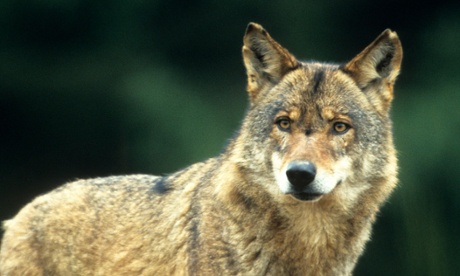
It has been estimated that there are now around 10,000 wolves in Europe. Photograph: tbkmedia.de/Alamy
Every year, Hubert Potočnik and his colleagues at the University of Ljubljana in Slovenia capture and collar a number of wolves in order to get a handle on the movements of these much-misunderstood creatures. In July 2011, he collared a young male that became known as Slavc. In June, I spoke to Potočnik for a feature that appears in New Scientist this week and he told me about Slavc’s extraordinary journey across Europe. What follows is an edited transcript of the interview …
HN: After you captured and collared Slavc in July 2011, he stayed with his pack for several months. Then, on 19 December 2011, he began to move. How did you know?
HP: We knew something was different because the GPS points showed that he had crossed two large motorways far outside of his natural territory.
Tell me about these collars. How do they work?
The collar is equipped with three types of different technology. It has a GPS receiver, a GSM modem to send SMS and also with a VHF radio transmitter as a back-up. We programme all our wolves to send a GPS signal every three hours, so we get about seven locations a day to give us continuous location sampling data.
Hubert Potočnik fits Slavc with the collar in July 2011, a device that will reveal the wolf’s incredible 2000-km migration from Slovenia to Italy. Photograph: Nina Ražen
To read the rest of this fascinating article then you will need to go here. Please do so as the article is breathtakingly interesting. It closes, thus:
HN: How would you sum up this experience?
There are lots of data about long-distance dispersal of wolves but there are very few cases where we have had the opportunity to follow an animal in such detail. Following Slavc across Europe offered a rare insight into the secret life of the wolf. It was one of the most amazing events in my life.
A quick web search came across this short but wonderful video; albeit without sound.
Published on Aug 26, 2013
Two wolf cubs were documented in Lessinia Regional Nature Park on August 7, 2013. At the end of the video it is possible to partially see an adult wolf, the mother of the cubs, that was recognized as Giulietta. Giulietta and Slavc became famous because they brought together two wolf populations that were separated for over 150 years. Wolf Slavc originates from the Dinaric-Balkan wolf population and was collared in Slovenia. He travelled over 1500km over Austria to Italy, where he met Giulietta, originating from the wolf population from the western Alps (Piemonte region).
Yesterday, the guest post published by Suzan from Romania touched many of you. In that guest post there was mention of the dog Joe.
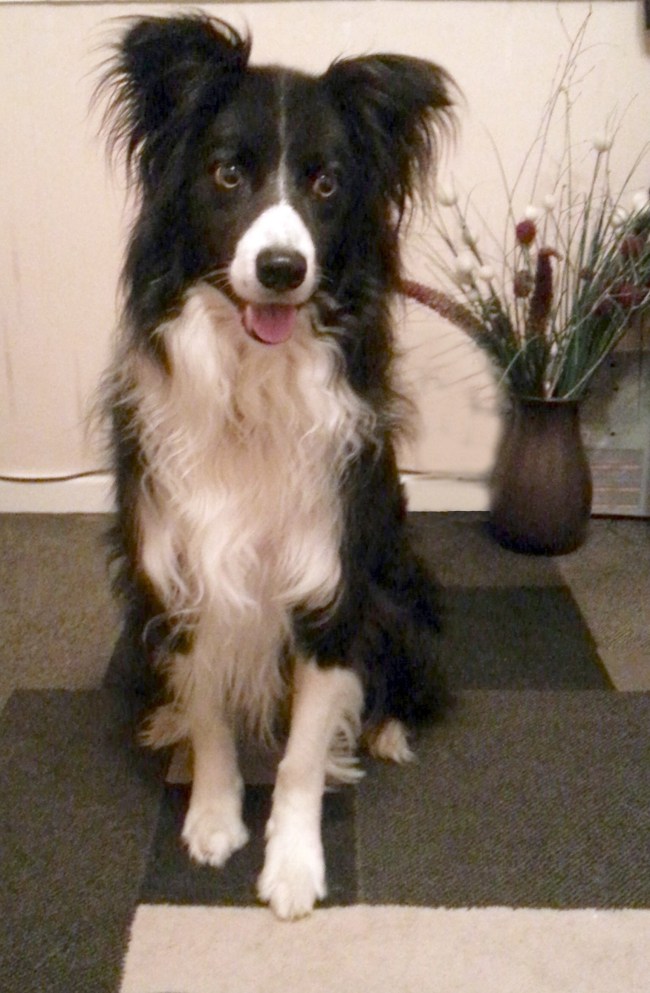
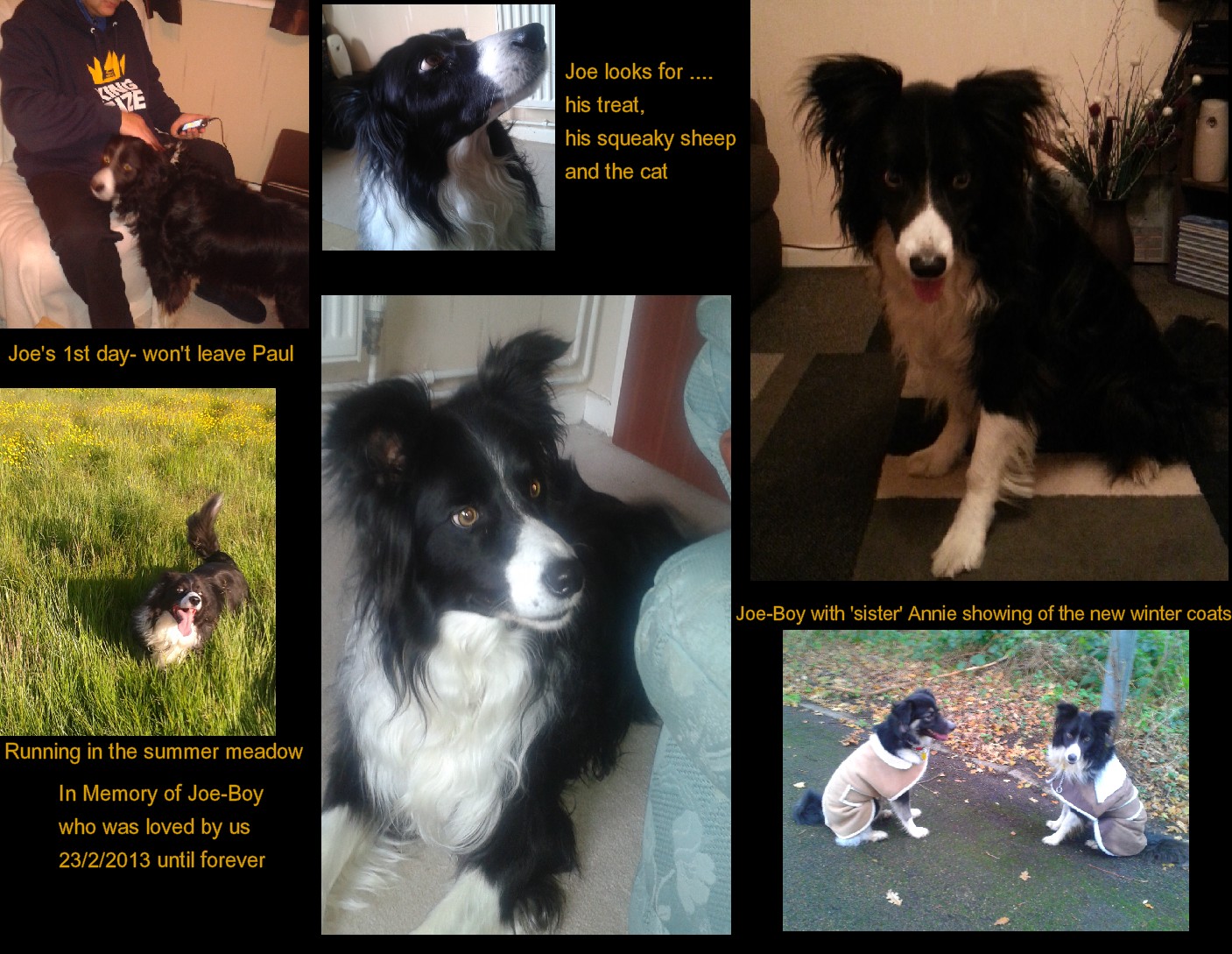
Take Joe. Joe had been sold on Facebook and bought by dog-baiters, bitten so severely vets thought he would die. You’d think that’s turned him off to humans? But no! He was a beautiful 6yr-old Collie. He was awesome. He obeyed, loved and cherished us, giving cuddles, playing gently … I’ve never had such a beauty under my roof.
I also wrote that I would publish more today. Taken directly from Mrs Skeats’ blog.
ooOOoo
Joe died but his death is still carrying a message.
It’s 19th June 2014. Joe died 6 months ago on 23rd December 2013.
Joe was a 6 year old beautiful boy taken from us after only 10 months by a cruel twist .. an accident due to a lack of information .. so I started a mini campaign. And I’ve just read about another poor soul, a friend of a friend, having to wait to see if his dog will survive a stick injury. Heartbreaking.
Ok so writing about it channelled my grief but the whole thing goes beyond that.
What was to be thought a rare, freak accident turned out to be all too familiar to vets and families worldwide. What was thought to be a personal kick in the nuts turns out to be a case of ignorance that is most definitely not bliss.
I received hundreds of comments on my first post after Joe died. I received hundreds of facebook and twitter comments too. The current ‘WordPress’ views are at over 139,000 which is great, and yet not enough. Dogs are still being treated for nasty stick injuries, vets see a few each month. I can’t preach and say stop it, but I can let anyone and everyone who cares know what a potential danger stick throwing is: better than being totally ignorant of the risks.
What happened to Joe, and happens to dogs all over the world at a frighteningly too-often rate, was borne of ignorance, stupidity, even years of “that’s what we do with dogs”. We simply never thought about the consequences it could bring.
Historically, when man decided to have dogs as pets and not merely working companions (not all that long ago in the UK) chasing a stick was a favourite game. We’ve all seen the old adverts in faded yellows and reds with a boy, stick in hand and his faithful dog panting happily as he waits for the ‘toy’ to be thrown. Why should we think it’s dangerous? We see things like celebs on the One Show with their dog, happily throwing it a stick, or in videos…. Dogs and stick throwing seems synonomous.
These are but a few stories of reasons why we should try and change this ……………..
Please think twice before you throw a stick for your dog to chase.
In memory of a beautiful dog, whose life will not ever have been in vain, but will mean so much more if we save others from pain.
ooOOoo
Please follow those links that Suzan included and read the articles. The message is clear. If you are the owner of a dog or play with dogs, don’t ever throw them a stick to catch.
As with yesterday’s post, please share this as widely as you can.
Jealous wags: Dogs show envy is ‘primordial’ emotion
By Matt McGrath – Environment correspondent, BBC News
These border collies inspired the study on jealousy in dogs.
Jealousy is not just a human condition according to researchers, as it appears to be hard wired into the brains of dogs as well.
Scientists in California found that canines succumbed to the green eyed monster when their owners showed affection to a stuffed dog in tests.
Some experts have argued that jealousy requires complex cognition and is unique to people.
But the authors say their work shows it may also come in a more basic form.
These findings probably won’t be a major surprise to anyone who’s ever owned a dog, but the team say this is the first experimental test of jealous behaviours in man’s best friend.
Human jealousy is a complicated emotion, requiring a “social triangle” and usually arising when an interloper threatens an important relationship.
It is said to be the third leading cause of non-accidental homicide across cultures.
Building on research that shows that six month old infants display jealousy, the scientists studied 36 dogs in their homes and video recorded their actions when their owners displayed affection to a realistic-looking stuffed canine.
Faux fido
Over three quarters of the dogs were likely to push or touch the owner when they interacted with the decoy.
The envious mutts were more than three times as likely to do this for interactions with the stuffed dog compared to when their owners gave their attention to other objects including a book.
Around a third tried to get between the owner and the faux fido, while a quarter of the put-upon pooches snapped at the dummy dog.
“Our study suggests not only that dogs do engage in what appear to be jealous behaviours but also that they were seeking to break up the connection between the owner and a seeming rival,” said Prof Christine Harris from University of California in San Diego.
“We can’t really speak to the dogs’ subjective experiences, of course, but it looks as though they were motivated to protect an important social relationship.”
The researchers believe that the dogs understood that the stuffed dog was real. The authors cite the fact that 86% of the dogs sniffed the toy’s rear end, during and after the experiment.
Jealousy, according to the authors, may have evolved in species that have multiple dependent young that concurrently compete for food and affection.
The argue that jealousy might give an advantage to a young animal that is not only alert to the interactions between its siblings and its parents but is motivated to intervene.
“Many people have assumed that jealousy is a social construction of human beings – or that it’s an emotion specifically tied to sexual and romantic relationships,” said Prof Harris.
“Our results challenge these ideas, showing that animals besides ourselves display strong distress whenever a rival usurps a loved one’s affection.”
As I have been intimating previously, today is the start of my mother from London visiting us here in Oregon. Thus, as one would expect, time for blogging is going to be restricted. Then in a week’s time, we are also joined by my sister, Elizabeth, who lives in Tokyo. So, dear reader, you will understand if there is a deficit of creative writing, assuming you find some of it creative, why that is.
Thus today, I’m leaning heavily on a recent item I read on the EarthSky blogsite. It’s all about pronking! Yes, I hadn’t come across the word before.
ooOOoo
Does your dog pronk?
Among wild animals, pronking may be a way of avoiding predators. But when you see an animal pronk, you can’t but think it’s leaping for joy.
Alpacas, gazelles, some deer and baby lambs are all known to pronk. That is, they leap into the air as if leaping for joy, lifting all four feet off the ground at once. The fact that – in some species like sheep – young animals do it more than older ones does suggest playfulness. But, among wild animals, pronking may be a way of avoiding predators. It means something like, “Hey, I’m very fit so don’t bother chasing me.”
But how about dogs? I didn’t find much online discussion about true dog-pronking, although many of us, at one time or another, may have seen our dog leaping for joy. I recall my own dog Snoop (rest his soul) released from the car in a South Dakota meadow, leaping and running like crazy through the long grass for maybe 20 minutes, until we called him back. It was one of the most joyful things I’ve ever seen, and definitely one of my best memories of Snoop.
So enjoy the videos below. And, by the way, although it is a survival strategy for some, the very word pronk comes from an Afrikaans verb pronk-, which means show off or strut. It has the same linguistic derivation as our English verb prance.
“Pronking” seems to occur when an animal gets excited and jumps around his field, leaving the ground with all four feet simultaneousl, almost as though he had springs attached to his feet..Often these jumps can be high in the air.No-one really knows why llamas pronk. Certainly it is the response to some sort of excitement or disturbance. It is often infectious; sometimes my entire herd will take off. I am told that it isn’t only llamas but sheep and goats. Those of you old enough to remember BBC’s Magic Roundabout may well recall that Zebedee was a “pronker”. We never had a telly as kids, but I believe Zebedee was a dog (??).
Okay, well, maybe some sheep and wild animals like this young springbok – in Etosha National Park, Namibia – are the only true pronkers. Maybe true pronking has to have the downward-pointing head and stiff-leggedness. But if you ever see your dog do what the dogs in these videos do … you’ll feel happy. Image via Wikipedia.
Bottom line: Among wild animals, pronking seems to be a way of avoiding predators. But when you see an animal pronk, you can’t but think it’s leaping for joy.
ooOOoo
So there you go. Don’t say that Learning from Dogs doesn’t teach you some new words from time to time!
A fascinating essay courtesy of Transition Network in the UK
I have very little doubt that I share with the majority of ‘common folk’ out there a feeling of these being dark and desperate times. I’m not even going to list the things that, on an almost daily basis, come along under the category of ‘doom and gloom’.
Yet it is also pretty widely known that change is embraced much more easily through reward. In other words, we commit to change, in a thousand different ways, from the expectation of reward: reward in many varied and numerous ways, many of them non-financial, of course.
The challenge for us all is that the negative has great pulling power. If we read news websites, watch television, read newspapers, and more, we are exposed essentially to wall-to-wall bad news.
So how on earth do we keep our spirits up? How on earth do we maintain hope in there being a positive way forward? Whatever ‘way forward’ translates to in terms of the individual?
Over in the UK there is the website of the Transition Network. From that home page one can link across to a number of blogs. Anyway, recently on Rob Hopkins’ blog there was a very interesting essay by Chris Johnstone about the power of celebration. Read it and reward yourself for so doing! 😉
Chris Johnstone works in the area of the psychology of resilience, sustainable happiness and is co-author, with Joanna Macy, of Active Hope: how to face the mess we’re in without going crazy. [1.] Chris appeared at both the Unleashing of Transition Town’s Totnes and Lewes, and has interacted with different Transition groups ever since. He’s also an accomplished musician (you can hear him playing briefly at the end of the podcast of our interview). I started by asking him why celebration matters:
“I’m just thinking about how important food is. Without food, we wither away. Food is nourishment. We also have needs for psychological nourishment or psycho-spiritual nourishment, emotional nourishment. I see celebration as one of those things that nourishes us psychologically, emotionally, spiritually. I was thinking about this also in terms of how important celebration is in keeping us going.
One of the thought blocks that people bump into sometimes is the voice that says “well what’s the point of doing this?” What celebration does is it gives us an answer to that. I think of it as helping shifting us from a going nowhere story where we feel we’re making no progress and have no direction to what I think of as a going somewhere story, where we feel that we’re on the way somewhere because we’re celebrating and marking important steps along the way.
What are the risks of not pausing to celebrate, do you think?
If you don’t pause to first of all notice that you’ve made any progress, it’s very easy to feel that you’re not making any progress. If you’re not making any progress, one of the risks for burnout is that loss of meaning where you lose the sense that there’s a point to what you do. Basically you run dry.
I see one of the parallels here as sustainable agriculture. One of the keys of sustainable agriculture is to nourish the soil. If you look after the soil, you get good crops. In terms of personal productivity, I think it would be to have sustainable activism. The parallel to topsoil is, I guess, our enthusiasm. We need to look after our enthusiasm for something. If we don’t, our enthusiasm gets thin like thin topsoil and you can get to a point where there’s no enthusiasm left and you just have that sense of, well what’s the point. You lose the oomph, you lose the energy, and you lose the plot.
What does good celebration look like? What for you would be the ingredients of a good celebration?
You can do it alone. It’s good to have ways where we notice the steps that we’re taking by ourselves and find some way of marking those and reinforcing those, but I’d say that celebration generally is much better in company. It’s also socially bonding and there’s very interesting research here about what really makes a difference in relationships.
There’s a psychologist called Shelley Gable who worked at the University of California, Los Angeles, and she was trying to work out what are the vital things that really make a difference and she recorded lots and lots of relationships. One area of communication that seemed to make a key difference in relationships was the response to good news.
If one person had good news and shared it with the other and the other person responded to the good news by being ‘joy in the joy of another’, by celebrating the good news, that deepened trust, that deepened the sense of satisfaction in the relationship. But if somebody shared good news and it passed by without notice or even worse, the person tried to persuade them that really it was bad news, that led to a drop in the level of satisfaction in the relationship that was so strong that Shelley Gable found that she could work who was at higher risk of breaking up over the next 12 months just by looking at their response to good news, whether somebody celebrated the good news when it was shared, or whether somebody passed it by or poured cold water on it.
There was a thing that I wrote for this month’s framing editorial that was my attempt at what some of the ingredients of good group celebrations might look like. What does celebration on a more day to day basis in a group like a Transition group – how can we design it into our meetings, our everyday rather than having something we just do once a year?
I’d say there’s something here about celebration needing to be meaningful. It’s asking yourself “what exactly is it that we are celebrating?” What we’re doing with celebration is celebrating the things we appreciate, the things that we value. By having a shared celebration, what you’re doing is reinforcing the system of values, the shared system of values within that group. In terms of what keeps us going, it’s really important to celebrate success. So what comes up there is we need to look at how do we notice success, how do we notice progress and how do we define that?
It’s particularly important when working for social change, for social and ecological justice, that we can often have a lot of disappointment and frustration along the way. If we only celebrate the really big things, the really big victories, we can have long gaps between the celebrations which makes us feel that we’re losing, that we’re not making progress. And so therefore I think what’s really important is to look at the mini victories along the way, and to both celebrate the positive outcomes that happen, but also to celebrate the effort put in, and one way of doing that is just to find some way of appreciating what has been done, so for example research on our mood shows that one of the things that improves mood is both the experience and also the expression of gratitude.
One of the ways that you can build celebration into everyday meetings and things is just finding some way to appreciate each other, appreciate the steps that we’ve been taking. If you’ve noticed that someone’s worked really hard on something, to have some gap in a meeting, some agenda item in the meeting where you just notice the things that have been done and the effort put in, and find some way of valuing them, marking them, noting them.
It might be first of all there’s a slot for anyone who’s got any good news to share and then to celebrate that, but also has anyone got any appreciations of gratitude to express. To actually build that into part of a group culture that we take time to notice and celebrate the steps we notice each other taking, and also if somebody has noticed a step that we’ve taken, for it to be completely more than fine, I’d say brilliant, for us to step forward and say – one thing I’m pleased about, you may not have seen this but one thing I’ve done is… where we take time to notice and to celebrate the steps we’ve taken ourselves.
It’s great when other people can notice it, but we don’t want to end up feeling resentful because no one cheered for this hard piece of work I did. We actually get better at stepping out there and saying – yes, I’m really pleased that I did this, I’m really pleased that I did that, because when we mark the steps that we’re taking, we reinforce that in a way that helps us keep taking those steps.
The environmental movement, in as much as I’ve been around it for the last 25 years or so, feels to be fairly spectacularly bad at stopping and celebrating. The culture is like a marathon, “got to keep going, got to keep going”, so there’s lots of burnout. Why do you think the environmental movement has been so poor at that?
Partly it’s the scale of the tasks that we face. We can’t have a party to celebrate climate change being sorted out, because that’s probably not going to happen in our lifetime. There’s already problems in the post, as it were, from the carbon that’s already been released into the atmosphere. The task is so huge that we could be working, well, there’s 168 hours in the week and we could be working all of those for a whole year and still feel that there’s more and more to do. There’s two things here.
There’s the to-date thinking which is where we look at what we’ve done so far, but there’s also to-go thinking where we look at what we’ve still got to go, the distance we’ve still got to cover. When we look at the distance we’ve still got to cover, it’s further than we can get in our lifetime, so that’s the trouble as I see it. We can just be working, working, working, and feel that there’s always more to go.
But also if we only focus on the work that’s still to be done, the danger is we just get exhausted. We become like what we’re doing to the fields of wheat around the world – we harvest them unsustainably and end up depleting the soil. I’d say that activist enthusiasm is a vital renewable resource, and we need to get much more skilful about how we treasure it. How we look after it in a way that can help it grow.
My last question is, can you think of one celebratory event that you were particularly moved by or inspired by which could be a story that might be useful for Transition groups to hear?
I’ve shared a number with you that I really delight in. One that comes to mind is when the two of us spoke together at the launch of Transition Town Totnes. It was the official unleashing of Transition Town Totnes and that was years ago now. But I think that was in 2006, so eight years ago now. What we do is celebrate launches of things in a way that we’re marking them and saying – hey, this is the beginning of something. We don’t know what will happen, but we’re marking our very clear intention.
There’s a form of energy, I call it ACACI which means A Clear and Committed Intention. It’s like a form of psychological energy. When you have strong, clear and committed intention, it drives you on. One of the ways of building that up is to have a launching celebration. I really enjoyed that event with you. We spoke together at the unleashing of Transition Town Lewes as well and we’ve both been back there since then. You wrote recently in your July 1st blog about being at their 7 year celebration and I was there at their 5 year celebration.
If you have a party to begin something, then you can also revisit that point some years on. So they become markers in time. We can say yes, we were here when this began, we celebrated the launch of this. And now here we are meeting again, this number of years later and we also celebrate the effort put in and the steps taken and the distance covered in that between time.
What you do there is build in the journey approach to change. This sense that we’re on a cultural migration. That’s why I love the term Transition. Transition is about moving from one place to another and we mark the steps along the way. So we celebrate when we begin this journey with the unleashing, the launch, but we keep coming back to that at periodic intervals and say – hey, we’re still on this journey. It’s still important to us.
While there might be some steps forward and some steps back and frustrations and disappointments along the way, there will always be things that we can look at and say yeah, that’s what we did and I feel really good about that.
When you mark the things that you feel good about, you get something which I call afterglow. This is the warm feeling of satisfaction after you’ve done something or noticed something that you feel good about. That’s what keeps us going, it’s fuel for the journey. So back to that original idea that celebration is a form of psychological nourishment and it’s absolutely vital to keep ourselves going.
You’re a very gifted musician and you managed to weave music and getting everybody moving and joining in as well. What’s the role of music in that, do you think?
It’s so interesting, because they’ve found bits of bone that have been turned into flutes that are 20,000 years old. I see music as a form of social glue. It draws people together. There’s something very remarkable that can happen when people move rhythmically together. It’s where we shift out of just seeing ourselves as separate individuals to where we sing and dance together it reinforces our connectivity, our sense of being part of something larger.
That’s great – actually ‘great’ is an understatement. I talked about psychological nourishment, also how do we reinforce and grow social capital? Social capital is the wealth that comes out of relationships. Shared music and dance is one of the ways that happens.
I wanted to know more about Chris and very quickly came to this place, from where I read:
Chris Johnstone
Chris Johnstone is a medical doctor, author, and coach who worked for nearly twenty years as an addictions specialist in the UK National Health Service. A former Senior Teaching Fellow at Bristol University Medical School, he trains health professionals in behavioral medicine and gives courses exploring the psychological dimensions of planetary crisis. Chris is known for his work pioneering the role of resilience training in promoting positive mental health, developing self-help resources and setting up the Bristol Happiness Lectures. He is author of Find Your Power: A Toolkit for Resilience and Positive Change (2nd Ed, 2010) and co-presenter of The Happiness Training Plan CD (2010).
Chris has been a trainer in the Work That Reconnects for more than two decades, working with Joanna on many occasions and running facilitator trainings in the United Kingdom. In 2004 he set up the free email newsletter [2.] The Great Turning Times, which is now read by thousands of people throughout the world. He has been active in the Transition movement since its very beginnings and contributed to a chapter on the psychology of change in The Transition Handbook by Rob Hopkins.
After many years living in Bristol, Chris recently moved to the North of Scotland, where he lives with his wife, Kirsty, their dogs and chickens, pursuing his love of growing fruit in their evolving forest garden. He continues his coaching and training work, as well as his writing and music. His website is at www.chrisjohnstone.info
He runs workshops and a facilitator training in the Work That Reconnects in the UK. Details at: www.facilitationforlifeonearth.org.
He also offers online courses in Active Hope, Resilience, Sustainable Happiness and Change-Making Skills at www.resiliencehappinesschange.com.
[1.] The following video is from the Active Hope theme.
[2.] If you wish to subscribe to the newsletter, then the link may be found on this page. (I have just done so.)
A republication of an essay on the history of dogs.
Dr. George Johnson
For some time I have been aware of an essay authored by Dr. George Johnson under his On Scienceseries page umbrella. As that page explains:
ON SCIENCE is a weekly science column written by me (George Johnson), published initially in the St. Louis Post Dispatch, and now in the online newspaper St. Louis Beacon (stlbeacon.org). For over 30 years I taught biology to college students at Washington University. For the last decade of these years, I taught a freshman course that introduced nonscience majors to current issues where science plays a key role, issues such as AIDS, the environment, cloning, genetic engineering, and evolution.
The course was intended to give them the tools to think about these issues as citizens and voters. I write my column as a way of teaching the general public about these same issues.
Most people are very interested in science, but put off by the terminology. When you don’t know what the words mean, it’s easy to slip into thinking that the matter is difficult, when actually the ideas are simple, easy to grasp, and fun to consider. It’s the terms that get in the way, that stand as a wall between citizens and science.
It is the intent of my column to turn those walls into windows, so that readers can peer in and join the fun. Analogies are my tool. In each column I look for simple analogies that relate the matter at hand to things we all know. As science, analogies are not exact, but I do not count myself compromised. Analogies trade precision for clarity. If I do my job right, the key idea is not compromised by the analogy I use to explain it, but rather revealed.
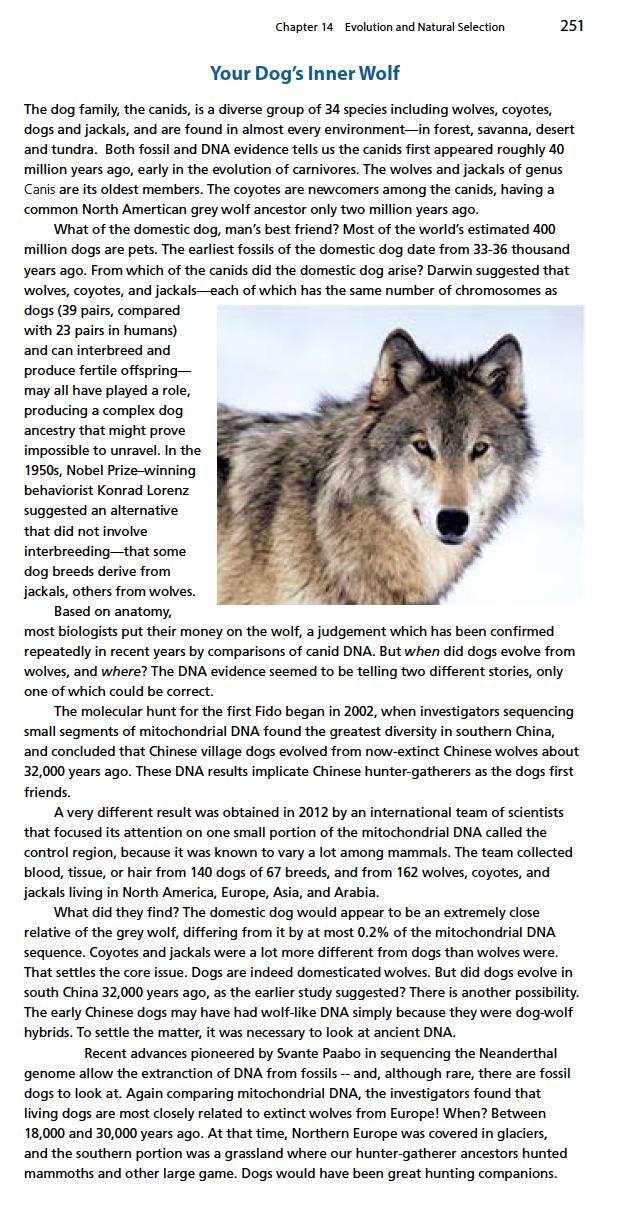
Anyway, the particular essay that I was very interested in was, unsurprisingly, one about the history of the domestic dog.
I wrote Dr. Johnson asking for permission to publish his essay here on Learning from Dogs and promptly received such permission. Indeed, better than that, here is his reply email:
By all means, but please cite a revised version of the article (in ESSENTIALS OF THE LIVING WORLD, 5e, George B Johnson, McGraw Hill Publ., 2015). It is somewhat shorter, but more up-to-date. I enclose a copy of the relevant page below.
When you are a WordPress user, as is Learning from Dogs, you can pay $30 a year to stop advertisements from appearing on one’s blogsite.
This is how WordPress explain their policy on advertising:
We sometimes display advertisements on your blog to help pay the bills. This keeps free features free! We only run them in limited places, and we do not show ads to logged-in readers, which means only a very small percentage of your page views will actually contain ads. To eliminate ads on your blog entirely, you can purchase the No-Ads Upgrade for a single blog (per year).
I choose not to pay that upgrade, despite the ads being annoying; of that I have no doubt.
For this reason.
WordPress pay an amount of their advertising income to the owner of the blog. Thus twenty-four hours ago, WordPress sent me an email:
Just thought you’d like to know WordPress.com sent you $106.23 USD.
I’m not sure but I think that covers the last twelve months.
That $106 will be divided into two with $53 staying with Jean and me and $53 going to our nearest humane society; Rogue Valley Humane Society.








 Learning from Dogs