Because you signed up on our website and asked to be notified, I’m sending you this special recall alert.
On September 23, 2015, The U.S. Food and Drug Administration announced the recall of certain lots of Dingo brand dog chews because the product has the potential to contain amantadine.
Amantadine is a human antiviral drug not approved for use in animal food.
Forget about the big world out there, be loved by our dogs.
Monday’s post about the precariousness of man’s future on this planet if we don’t prevent the melting of the Antarctic ice sheet was a bit gloomy, however true it might be. The gloom continued with yesterday’s post about the VW scandal illustrating the “unethical culture endemic in business”.
So what a nice change to think about the way that our pets keep us bright, cheerful and healthy.
All of which is my way of introducing a guest post from Vee Cecil. Now I am fairly cautious about guest posts from those who want to promote their businesses, for obvious reasons. But Vee’s essay is so lovely that it truly deserves to be shared.
Firstly, here is the email that Vee sent me back in August,
Hi!
In the U.S., 91 percent of pet owners say they consider their pet to be a member of the family. And for good reason! Our pets are constant sources of comfort and companionship.
What many pet owners may not realize is how great their furry family members are for their physical and mental health. For example, studies have shown that pet owners have lower blood pressure than people who don’t have pets and that being around pets also makes us “less anxious and less stressed.” And that’s just the beginning. There are many other wonderful health benefits that result from owning a pet.
May I write an article for learningfromdogs.com on this topic? The article will be approximately 500 words, unique to your site, and complete with resources.
Please let me know – I am always looking to spread the word about how we can be healthier and happier and having a pet is a great way to achieve both!
Best,
Vee
Here then is that article.
ooOOoo
Feeling Under the Weather? Learn More About the Amazing Healing Powers of Pets
Ask any dog owner and you’ll find out just how remarkable a dog can be. They can turn a terrible day into an amazing one with one lick of the face or wag of the tail. But more and more studies are showing that our four-legged friends might be even more awesome than we previously thought.
As TheWashington Post explains, research is showing that being around dogs can help us feel better and less stressed, while also improving our physical health. For example, the article cites studies which found that our pets can lead to “lower blood pressure, lower resting heart rates and less risk of hypertension.”
And that’s not all. Here are four other health issues and how dogs help their human companions:
Cancer. As this CBSNews.com article explains, a recent study at Mount Sinai Beth Israel found that therapy dogs had a very positive impact on patients receiving chemo therapy. The patients showed improvements in “emotional well-being and quality of life.” The director of the program that provided the therapy dogs also noted that patients felt less stressed and anxious. The article notes that this was a ground-breaking study as the impact of therapy dogs on cancer patients hadn’t been examined before.
Alzheimer’s Disease. Therapy dogs are also proving to be extremely helpful for patients with Alzheimer’s. In this article, a man with early on-set Alzheimer’s explains how his therapy dog helps him with daily tasks. Through the help of his therapy dog, the man says his stress and anxiety levels have significantly reduced.
Surgery recovery. Chances are if you were recovering from a painful surgery you wouldn’t turn down a snuggle from a pet. But, as The Telegraph shows, researchers have found that pets can do more than just provide you with a little tender loving care. A study led by a researcher from Loyola University found that pet therapy can reduce the amount of pain patients experience after surgery. In fact, according to the article, the patients in the study, who had had joint replacement surgery, “needed 50 per cent less pain medication if they used pet therapy.”
Diabetes. And perhaps most remarkable of all is what therapy dogs can be trained to do for diabetics. In this case, dogs put their acute sense of smell to good use. As this article explains, dogs exhibiting a better-than-average sense of smell can be trained to help diabetics. Once trained these dogs use their sense of smell to detect signs of hypoglycemia and low blood sugar (based on their human companion’s breath). They’re also trained to get a sugary food for their diabetic, get help if the person goes into diabetic shock, and more.
As more research is conducted to see the benefits of not only service dogs, but pets too, it will be interesting to see how dogs are woven into more medical treatments. They are truly amazing creatures, who can help us mind, body, and soul.
***
Vee Cecil keeps busy by being a wellness coach, personal trainer and bootcamp instructor in Kentucky. She also recently launched a blog where she shares her passion for health by writing about her favorite tips, activities and recipes.
ooOOoo
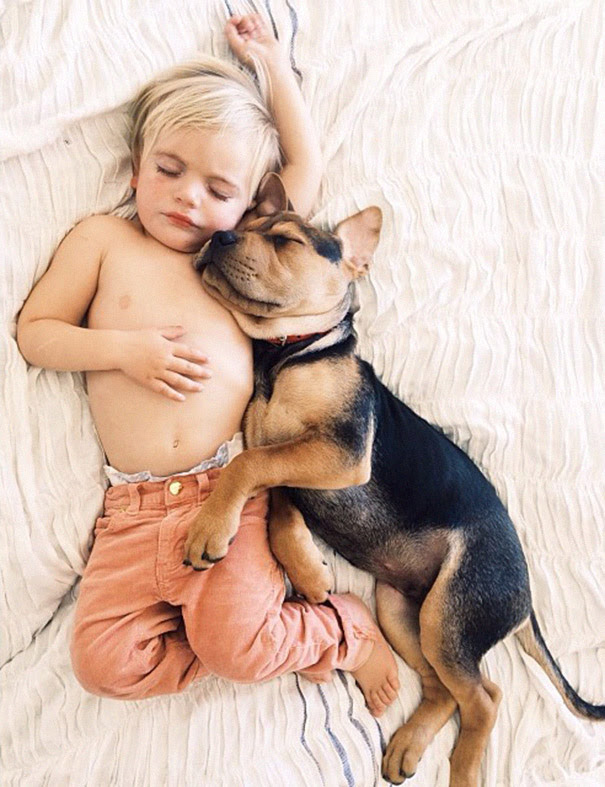
Here’s a republication of a picture from a recent Picture Parade. It has health stamped all over it, for the young boy and the Shepherd Dog!
Republished for the wider promotion of this alert.
Dear Fellow Dog Lover,
Because you signed up on our website and asked to be notified, I’m sending you this special recall alert.
On September 25, OC Raw Dog of Rancho Santa Margarita, CA, announced it is recalling its OC Raw Chicken, Fish and Produce Raw Frozen Canine Formulation because it has the potential to be contaminated with Salmonella.
To learn which products are affected, please visit the following link:
The openness of dogs, and cats, to new ways of living.
Today’s picture parade needs a short introduction.
When Jean and I moved from San Carlos in Mexico to Payson, Arizona, we came with twelve dogs and seven cats of which all but one (Pharaoh) were rescues from the Mexican streets over the years; many from before Jean and I met each other.
That was five years ago and, inevitably, some of the dogs and cats have died of old age.
Since we arrived here in Merlin, Oregon, three years ago this October, the five cats we came with have been living in our largish double garage that, as you can imagine, is pretty cold during the winter. One cat died last year and Jean and I were thinking how nice it would be to bring the remaining four cats into the house.
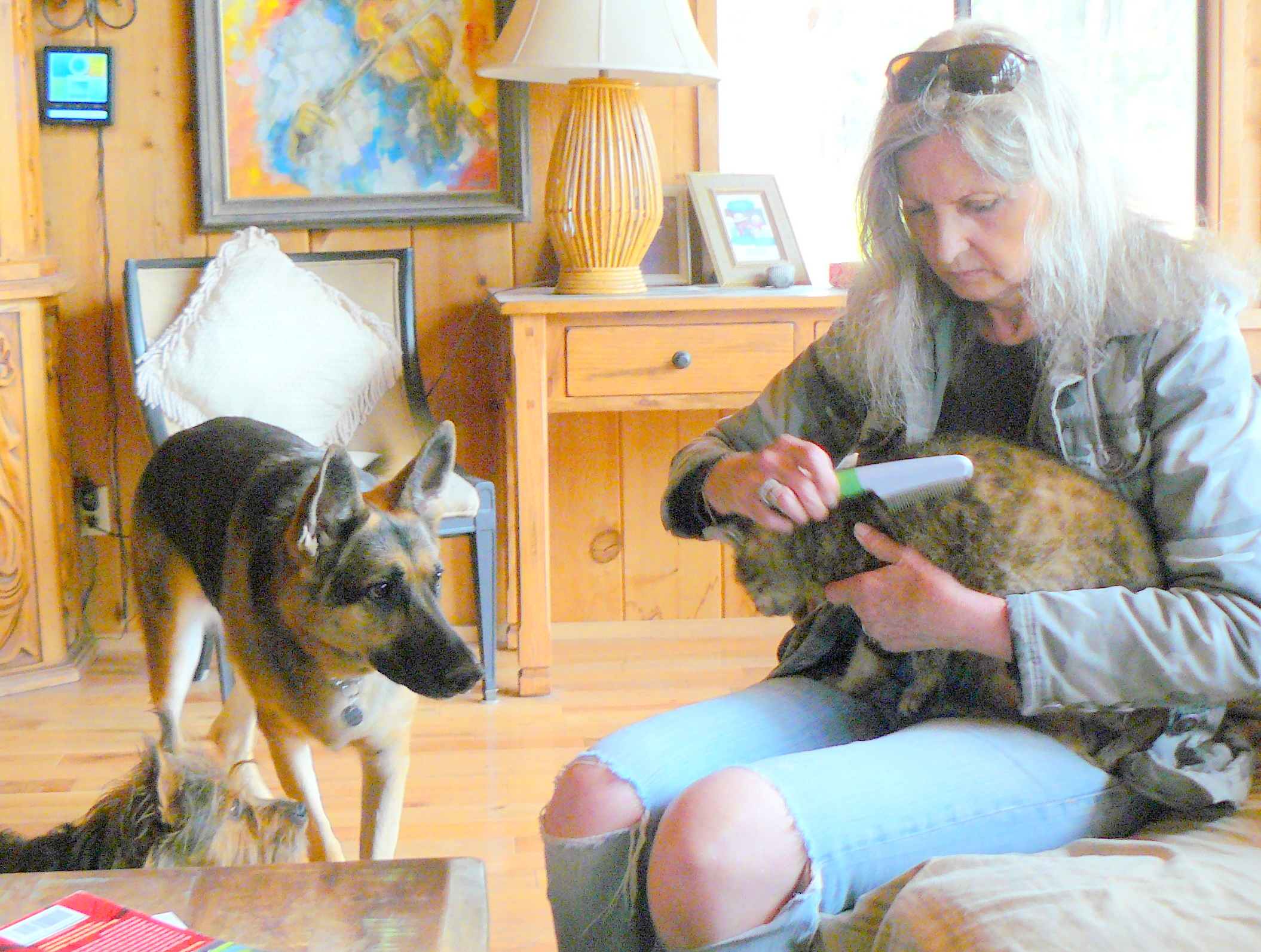
Thus, just over a week ago, we brought two of the cats, George and Mitts, across to the house and the following pictures reveal a little of how that has gone.
Wow! What’s this that Mummy is holding? A guess at what Cleo could be thinking!
oooo
Jean combing Mitts very soon after it came into the house much to the interest of Cleo and Sweeny (whose head can just be seen by the edge of the table). Mitts has not a single tooth in her head, by the way.
oooo
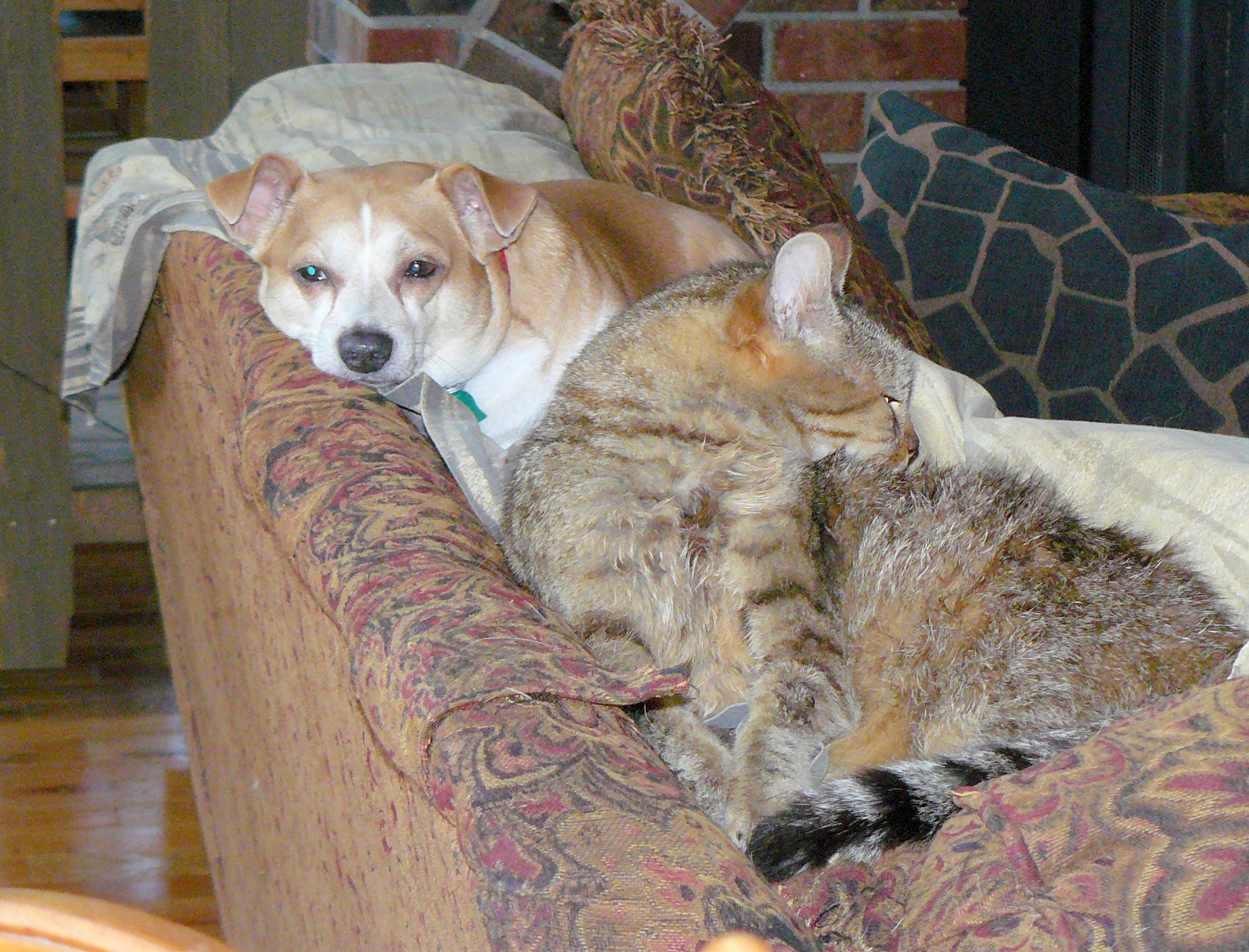
Little Pedy was totally nonchalant about the arrival of Mitts right from the start.
oooo
As this photograph underscores.
oooo
Pedy is just as happy with George.
oooo
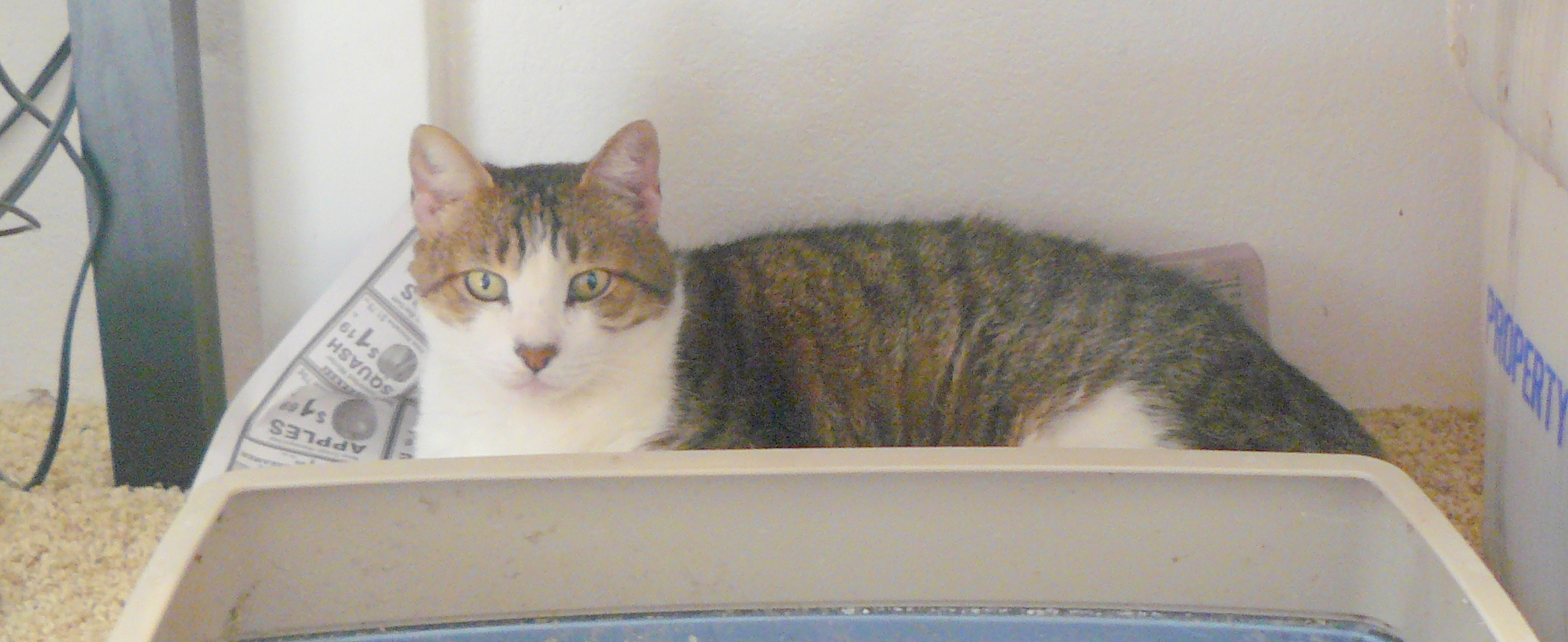
The cats have adopted my office as their new home, with Mitts demonstrating how to fit a cat into a small bin!
oooo
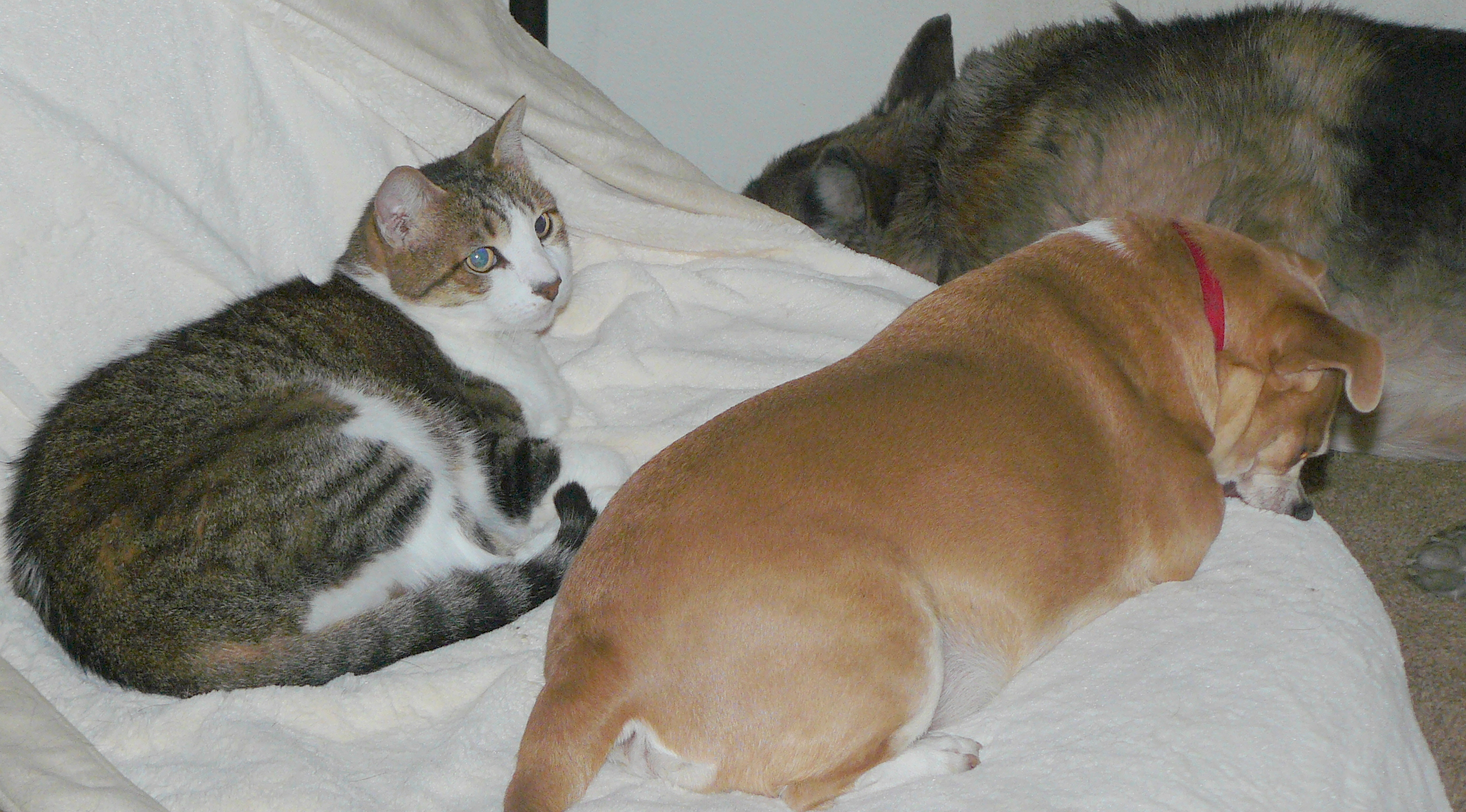
Meanwhile, George has found his resting spot under a small table.
oooo
But not if the settee in the den is vacant.
oooo
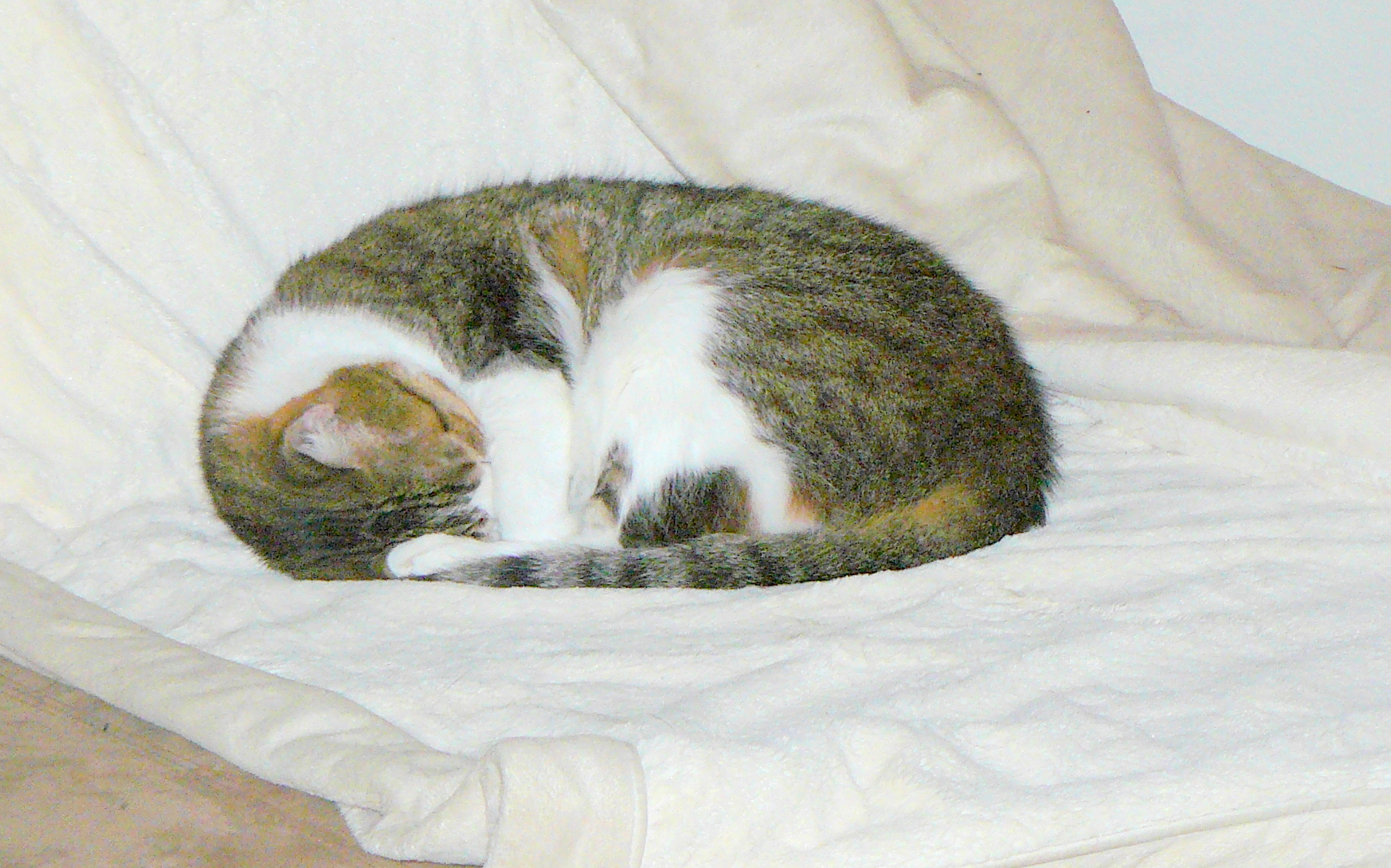
Plus, a sunny area of the carpet suits Mitts better than the bin.
oooo
I hope to update you with the news of how the final two cats make the transition into the house in two or three weeks time.
Previously, I have mentioned the authors’ group AIM, that meets monthly in Grants Pass.
One of the authors is Frank Morin and he and I have a monthly chit-chat lunch together. Not so long ago, Frank posted a link on his Facebook page to the following video that shows the truth about Pit Bull dogs.
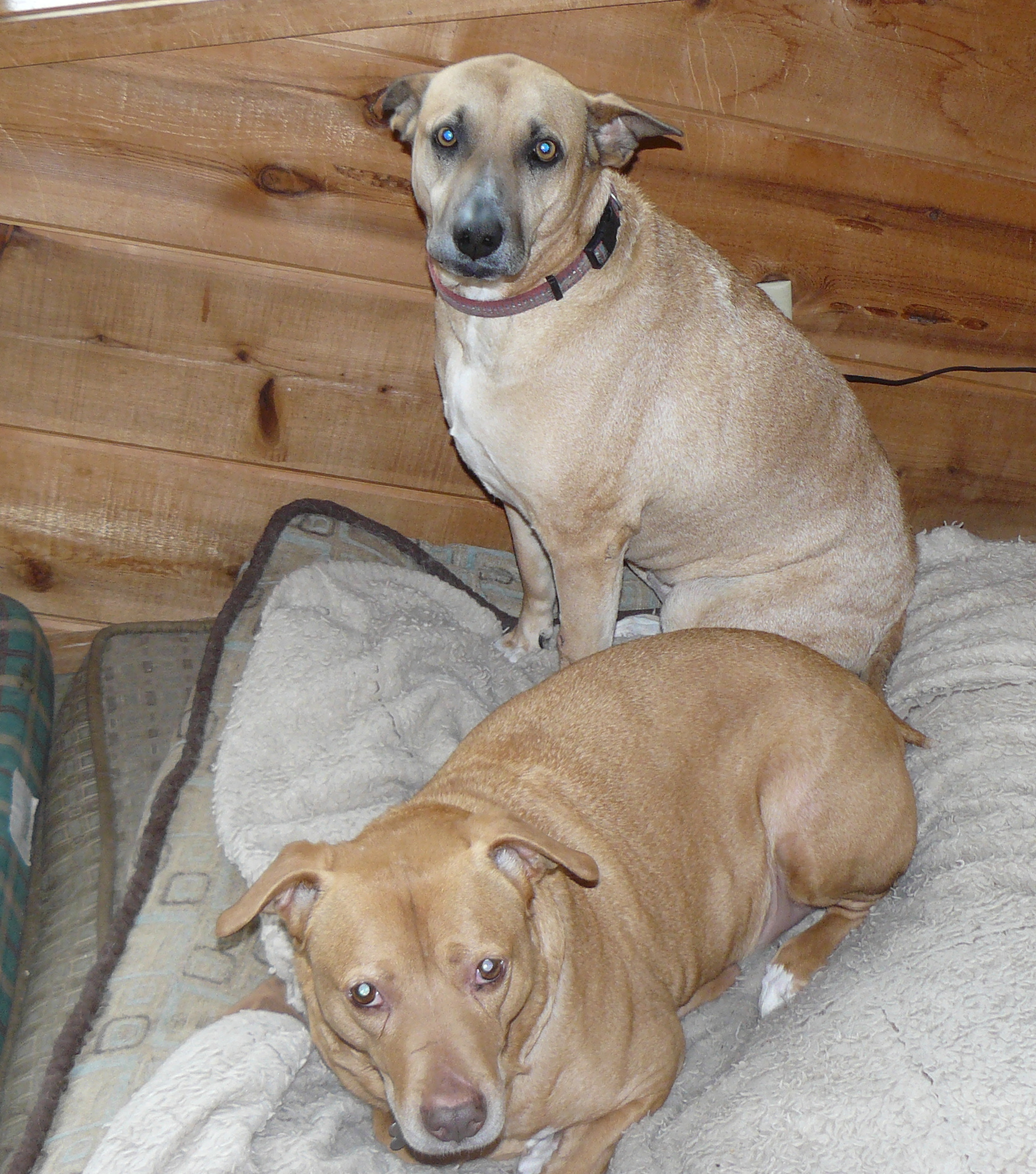
We have a Pit Bull here at home. His name is Casey and he is the perfect gentleman. You would never know that he was in a care centre for over a year because no one would give him a home, for there is not an emotional scar on him!
Casey, in the foreground, sharing Ruby’s bed as they are great friends.
Please ensure you and your dogs have a great weekend.
Continuing the message of that special bond between us humans and our dogs.
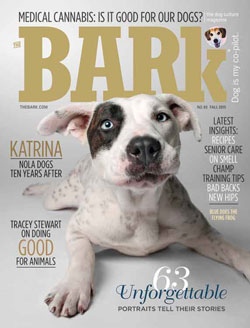
Yesterday’s post regarding the dog saved from the Texas floods came to mind when earlier today (Tuesday) I was reading the Fall issue of The Bark magazine.
Cover of the Fall 2015 issue.
Reading the magazine took me across to The Bark website and from there I ended up reading about dogs being mentioned in people’s obituaries. Here’s a snippet of that article:
Dogs in Obituaries
Included as cherished family members
Karen B. London, PhD | September 18, 2015
It’s been a long time since the majority of people with dogs considered them property, but the inclusion of them in the celebrations and events of life associated with family continues to grow. Birthday parties and gifts for dogs have become increasingly common in recent years, and the number of dogs included in family photos or in signatures on greeting cards is bigger than ever. It’s really old news to say that many people consider dogs to be family members, but interesting studies of the ways in which that’s true continue to be published.
Earlier this year, a study called Companion Animals in Obituaries: An Exploratory Study was published in the journal Anthrozoös. The study illuminated the importance of companion animals, including dogs, based on the frequency and manner in which they were mentioned in obituaries.
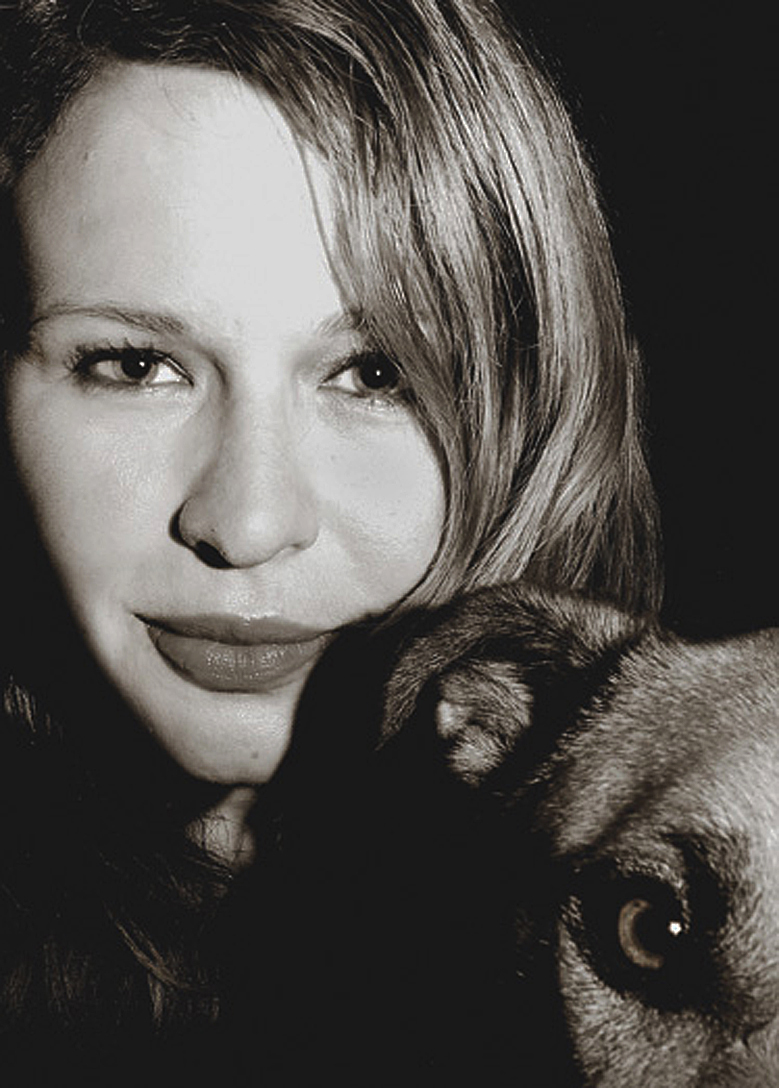
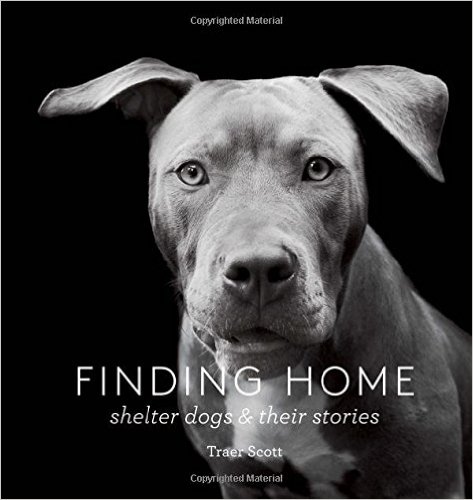
Another article in that same issue of The Bark was by photographer Traer Scott. Scott is the author of the book Shelter Dogs and has just launched a new book called Finding Home: shelter dogs & their stories. (Her blogsite is here.) As is detailed on her website:
Traer Scott is an award winning fine art and commercial photographer and author of six books including “Nocturne: Creatures of the Night” (Princeton Architectural Press, 2014) and her newest release “Finding Home; Shelter Dogs and Their Stories” (Princeton Architectural Press, Fall 2015). Her work has been exhibited in several countries and featured in National Geographic, Life, Vogue, People, O, on the NY Times Lens Blog, “Behold” and dozens of other national and international print and online publications. Her first solo museum show Natural History opens at the University of Maine Museum of Art in October 2015. Traer was the recipient of the Rhode Island State Council for the Arts 2010 Photography Fellowship Grant and the 2008 Helen Woodward Humane Award for animal welfare activism. She lives in Providence, Rhode Island with her husband, daughter and adopted dogs: a pit bull and a baby basset hound.
A quick mouse-click took me to Amazon and to Scott’s latest book. Where one reads:
Bold, retiring, serious, sparkling, quirky, or lovable—the dogs in Traer Scott’s remarkable photographs regard us with humor, dignity, and an abundance of feeling. Scott began photographing these dogs in 2005 as a volunteer at animal shelters. Her first book, Shelter Dogs, was a runaway success, and in this follow-up, Scott introduces a new collection of canine subjects, each with indomitable character and spirit: Morrissey, a pit bull, who suffered from anxiety related behaviors brought on by shelter life until adopted by a family with four children; Chloe, a young chocolate Lab mix, surrendered to a shelter by a family with allergies; Gabriel and Cody, retired racing greyhounds; and Bingley, a dog who lost his hearing during a drug bust but was brought home by a loving family that has risen to the challenge of living with a deaf dog. Through extended features we become better acquainted with the personalities and life stories of selected dogs and watch as they experience the sometimes rocky and always emotional transition to new homes. The portraits in Finding Home form an eloquent plea for the urgent need for more adoptive families, as well as a tribute to dogs everywhere.
Further down that Amazon page there was a review by The Bark magazine and what they wrote is the perfect way of heading to the close of today’s post. [My emphasis]
“Photographer Traer Scott follows up her groundbreaking book Shelter Dogs with a new work of equal grace and sensitivity. The portraits in Finding Home not only showcase a collection of canines with indomitable character and spirit, they are also an eloquent plea for more adoptive families, and a tribute to all dogs everywhere.” – The Bark
Please, howsoever you can, share the benefits of adopting a dog from your nearest animal care centre.
Proof positive of the love that flows between Jean and our Oliver.
We can never be reminded too often of this most special bond.
Again, the pressures of the book and the fact that Jean and I were away from the house until early afternoon, made it difficult for me to spend time writing a post from scratch.
Then in my blog folder, I saw this lovely story reported by the British Daily Mail newspaper; to be honest, probably quite some time ago.
But so what!
The bond between humans and dogs is timeless.
ooOOoo
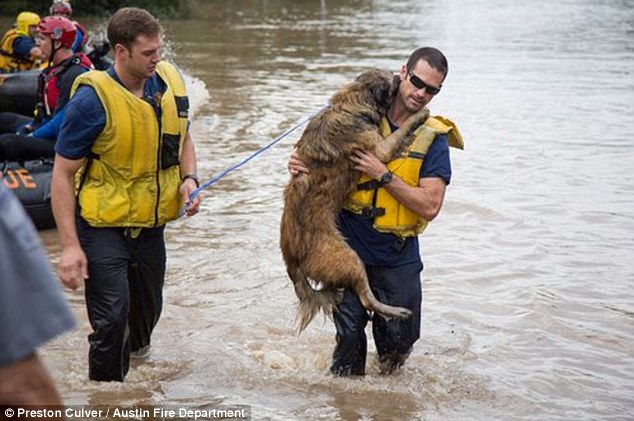
Touching moment as firefighters save this dog from flood waters.
Two firefighters with the Austin Fire Department were pictured saving a dog from flood waters in central Texas yesterday.
The department posted the picture of firefighters Matt Harvey and Michael Cooper with the animal to their Facebook page, saying: ‘We don’t just rescue two-legged victims…we love our four-legged friends as well.”
The animal looks like it’s been through a lot, and clings to one of the firefighters as if they’re hugging.
There was a bonus in waiting a while before publishing this. For the story of the dog being reunited with its owner made television news.
You may recall that back on the 15th of this month, I posted a Note to Readers that spoke about my need to be focused on the editing of my manuscript. Here’s part of that note:
Dear readers, we are talking hours of revisions that I need, and want, to make.
All of which is my way of saying that if my posts over the next couple of weeks more strongly lean on the republishing of other material then you will understand why. In all cases I will endeavour to republish articles that are likely to interest you, of course!
Late yesterday, I completed the many revisions to the manuscript recommended by Joni Wilson but still have more days of formatting changes ahead.
Thus another republication of an item, this time an article that appeared on the Smithsonian website.
ooOOoo
Domestication Seems to Have Made Dogs a Bit Dim
Thanks to their relationship with us, dogs are less adept at solving tricky puzzles than their wolf relatives
It’s OK, buddy. We’re here to help. (stelo/iStock)
By Rachel Nuwer, smithsonian.com, September 15, 2015
Dogs are considered some of the most intelligent animals on the planet. Thanks to a relationship with humans that dates back tens of thousands of years, dogs can respond to emotions, recognize numerous words and be trained to follow commands.
Notably, these seemingly smart accomplishments all hinge on the partnership between our two species. Now, however, tests of canine problem-solving skills indicate that dogs rely on humans so much that we actually seem to be dumbing them down.
Most studies that investigate dog intelligence assume that certain interactions with humans are indicative of higher cognitive function. In one experiment, for example, dogs and human-socialized wolves were presented with a canine version of the Kobayashi Maru — an unopenable box that contained food.
When confronted with a difficult task, dogs often turn to us—their human masters—for guidance, indicating their puzzlement with a cock of the head and eyes that seem to implore for help. Indeed, the dogs in the study quickly gave up and simply stared at the nearest human. The wolves, on the other hand, sought out no such help and persisted at trying to solve the impossible puzzle on their own.
Researchers usually interpret such findings as a sign of dogs’ intelligence; the wolves kept trying to win the no-win scenario, while the dogs knew that humans could help out with tasks they themselves could not solve.
But depending on humans for help is not necessarily a cognitive asset, points out Monique Udell, an assistant professor of animal and rangeland sciences at Oregon State University.
If dogs only turn to humans when presented with an impossible task—not a solvable one—then their “look back” behavior would indeed be advantageous. On the other hand, if they simply throw their paws up at the slightest hint of cognitive challenge, then that could indicate “a conditioned inhibition of problem-solving behavior,” as Udell puts it. Like a child whose parents always give away the answers to homework, dogs may be overly reliant on us, she surmised.
To test this hypothesis, Udell presented ten pet dogs and ten human-socialized wolves with a solvable puzzle. Sausage was placed inside a sealed plastic tub with a lid that included a bit of rope. With some paw and mouth finagling, the lid could be opened.
She also included ten shelter dogs in the study, because past research shows that shelter dogs are initially less responsive to humans compared to established pets. These animals acted as a sort of intermediary between hyper-socialized dogs and wolves.
Crazy smart, like a wolf. (Kaphoto/iStock)
Udell presented the canines with the puzzle box both in the presence of humans—an owner, caretaker or familiar person—and without any person nearby. Each time, the animals had two minutes to figure out how to get at the sausage. Subjects that failed in both trials were given a third and final try in which they also received verbal encouragement from their human friend.
Udell’s findings, reported today in the journalBiology Letters, were telling. In the presence of humans, just one pet dog and none of the shelter dogs managed to open the box. Eight out of ten of the wolves, however, succeeded in enjoying the sausage treat inside.
Wolves also spent more time chipping away at the problem and more time staring at the box, as if working out how to open it. Both pet and shelter dogs, on the other hand, did the opposite—they gave up more quickly and stared at humans instead of the box, seemingly asking for help.
When humans were not around, the findings were similar—nearly all of the wolves figured out how to open the box, while just one shelter dog and no pet dogs succeeded. In the third and final trial, dogs that had failed in both of the prior tests performed a bit better when humans encouraged them.
With some human cheerleading, four of nine shelter animals and one of eight pet dogs opened the box, and all spent more time trying to open the box and looking at the box than they did when they were either alone or when their human friends remained silent.
Udell’s results indicate that dogs do seem to be overly dependent on us compared to their wild relatives, although the cause of this—whether biological, environmental or both—still needs to be worked out.
Lucky for pet pooches, however, we humans will no doubt always be there to help them navigate all of life’s tricky plastic containers.
Picking up on that last sentence, luckily for us humans our dogs will always be there to help us in innumerable ways, especially giving us unconditional love.
I came across the following video as a result of my brother-in-law, Warwick Hamilton, posting it on his Facebook page. In turn, it had been published by Jason Fechner on his FB page, describing it:
Your Tuesday Moment of Zen — Diesel, the English Bulldog who has found a new toy… and won’t let go! 🙂
In contrast to yesterday’s post highlighting the disgusting way humans kill wildlife, today is all about humans saving life. Specifically, the life of a seven-year-old French bulldog.
I came across a news item reported by Citynews in Canada on the BBC News website. This is how the news story opened:
Air Canada flight diverted to save dog from freezing
16 September 2015
Picture copyright CityNews, Toronto.
An Air Canada flight was diverted after the pilot realised that a cargo hold heating unit failed, threatening the life of a pet dog.
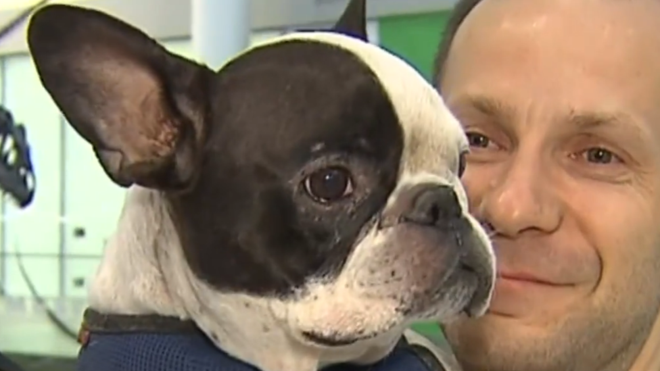
Simba, a seven-year-old French bulldog, was riding in the cargo hold where – without heating – temperatures can become very cold at high altitude.
The Sunday flight from Tel Aviv, Israel, to Toronto, Canada, and was diverted to Frankfurt, Germany.
It was then a simple process to go to that CityNews website in Canada and read the original story. It contained these delightful messages:
With the dog’s well-being in peril the pilot decided to land the plane in Frankfurt, Germany.
Simba was placed on another flight and the plane continued on to Toronto.
The dog’s owner was more than grateful.
“It’s my dog, it’s like my child. It’s everything to me,” he said after they were reunited at Pearson Airport.
Aviation expert Phyl Durby said the pilot made the right call, despite tacking on about $10,000 in fuel costs and delaying the flight by 75 minutes.
“If you look at the outside temperature, if it’s minus 50 or 60, there is some insulation but it will probably still get down to below freezing (in the cargo area),” Durby said.
“The captain is responsible for all lives on board, whether it’s human or K-9.”
The owner of the dog, German Kontorovich, was thankful for the pilot’s rapid actions, “It’s my dog, it’s like my child. It’s everything to me,” Mr Kontorovich told the Canadian news website CityNews.
To close today’s good news story, watch the following:






 Learning from Dogs