A deeply fascinating essay from an individual at the University of Oxford.
I have long read the daily output from The Conversation. It’s a very useful way of keeping one’s brain cells functioning in some sort of fashion.
Yesterday morning I read an essay put out by Thomas Moynihan, a PhD Candidate at the University of Oxford.
It was fascinating and I am republishing it here.
Now it’s not for everyone. It is also long and it also has a number of videos to watch. And there’s not a dog mentioned!
But if you are interested in where we, as in human beings, are ‘going’, so to speak, then this is for you.
And I’m ready to admit that it may be an age thing; something that is of much interest to me because I shall be 75 in November and one naturally wonders about the end of life. Both individually and of society!
ooOOoo
The end of the world: a history of how a silent cosmos led humans to fear the worst.
It is 1950 and a group of scientists are walking to lunch against the majestic backdrop of the Rocky Mountains. They are about to have a conversation that will become scientific legend. The scientists are at the Los Alamos Ranch School, the site for the Manhattan Project, where each of the group has lately played their part in ushering in the atomic age.
They are laughing about a recent cartoon in the New Yorker offering an unlikely explanation for a slew of missing public trash cans across New York City. The cartoon had depicted “little green men” (complete with antenna and guileless smiles) having stolen the bins, assiduously unloading them from their flying saucer.
By the time the party of nuclear scientists sits down to lunch, within the mess hall of a grand log cabin, one of their number turns the conversation to matters more serious. “Where, then, is everybody?”, he asks. They all know that he is talking – sincerely – about extraterrestrials.
The question, which was posed by Enrico Fermi and is now known as Fermi’s Paradox, has chilling implications.
Bin-stealing UFOs notwithstanding, humanity still hasn’t found any evidence of intelligent activity among the stars. Not a single feat of “astro-engineering”, no visible superstructures, not one space-faring empire, not even a radio transmission. It has beenargued that the eerie silence from the sky above may well tell us something ominous about the future course of our own civilisation.
Such fears are ramping up. Last year, the astrophysicist Adam Frank implored an audience at Google that we see climate change – and the newly baptised geological age of the Anthropocene – against this cosmological backdrop. The Anthropocene refers to the effects of humanity’s energy-intensive activities upon Earth. Could it be that we do not see evidence of space-faring galactic civilisations because, due to resource exhaustion and subsequent climate collapse, none of them ever get that far? If so, why should we be any different?
A few months after Frank’s talk, in October 2018, the Intergovernmental Panel on Climate Change’s update on global warming caused a stir. It predicted a sombre future if we do not decarbonise. And in May, amid Extinction Rebellion’s protests, a new climate report upped the ante, warning: “Human life on earth may be on the way to extinction.”
Meanwhile, NASA has been publishing press releases about an asteroid set to hit New York within a month. This is, of course, a dress rehearsal: part of a “stress test” designed to simulate responses to such a catastrophe. NASA is obviously fairly worried by the prospect of such a disaster event – such simulations are costly.
Space tech Elon Musk has also been relaying his fears about artificial intelligence to YouTube audiences of tens of millions. He and others worry that the ability for AI systems to rewrite and self-improve themselves may trigger a sudden runaway process, or “intelligence explosion”, that will leave us far behind – an artificial superintelligence need not even be intentionally malicious in order to accidentally wipe us out.
In 2015, Musk donated to Oxford’s Future of Humanity Institute, headed up by transhumanist Nick Bostrom. Nestled within the university’s medieval spires, Bostrom’s institute scrutinises the long-term fate of humanity and the perils we face at a truly cosmic scale, examining the risks of things such as climate, asteroids and AI. It also looks into less well-publicised issues. Universe destroying physics experiments, gamma-ray bursts, planet-consuming nanotechnology and exploding supernovae have all come under its gaze.
So it would seem that humanity is becoming more and more concerned with portents of human extinction. As a global community, we are increasingly conversant with increasingly severe futures. Something is in the air.
But this tendency is not actually exclusive to the post-atomic age: our growing concern about extinction has a history. We have been becoming more and more worried for our future for quite some time now. My PhD research tells the story of how this began. No one has yet told this story, yet I feel it is an important one for our present moment.
I wanted to find out how current projects, such as the Future of Humanity Institute, emerge as offshoots and continuations of an ongoing project of “enlightenment” that we first set ourselves over two centuries ago. Recalling how we first came to care for our future helps reaffirm why we should continue to care today.
Extinction, 200 years ago
In 1816, something was also in the air. It was a 100-megaton sulfate aerosol layer. Girdling the planet, it was made up of material thrown into the stratosphere by the eruption of Mount Tambora, in Indonesia, the previous year. It was one of the biggest volcanic eruptions since civilisation emerged during the Holocene.
Mount Tambora’s crater. Wikimedia Commons/NASA
Almost blotting out the sun, Tambora’s fallout caused a global cascade of harvest collapse, mass famine, cholera outbreak and geopolitical instability. And it also provoked the first popular fictional depictions of human extinction. These came from a troupe of writers including Lord Byron, Mary Shelley and Percy Shelley.
The group had been holidaying together in Switzerland when titanic thunderstorms, caused by Tambora’s climate perturbations, trapped them inside their villa. Here they discussed humanity’s long-term prospects.
Clearly inspired by these conversations and by 1816’s hellish weather, Byron immediately set to work on a poem entitled “Darkness”. It imagines what would happen if our sun died:
I had a dream, which was not all a dream
The bright sun was extinguish’d, and the stars
Did wander darkling in the eternal space
Rayless, and pathless, and the icy earth
Swung blind and blackening in the moonless air
Detailing the ensuing sterilisation of our biosphere, it caused a stir. And almost 150 years later, against the backdrop of escalating Cold War tensions, the Bulletin for Atomic Scientists again called upon Byron’s poem to illustrate the severity of nuclear winter.
Two years later, Mary Shelley’s Frankenstein (perhaps the first book on synthetic biology) refers to the potential for the lab-born monster to outbreed and exterminate Homo sapiens as a competing species. By 1826, Mary went on to publish The Last Man. This was the first full-length novel on human extinction, depicted here at the hands of pandemic pathogen.
Boris Karloff plays Frankenstein’s monster, 1935. Wikimedia Commons
Beyond these speculative fictions, other writers and thinkers had already discussed such threats. Samuel Taylor Coleridge, in 1811, daydreamed in his private notebooks about our planet being “scorched by a close comet and still rolling on – cities men-less, channels riverless, five mile deep”. In 1798, Mary Shelley’s father, the political thinker William Godwin, queried whether our species would “continue forever”?
While just a few years earlier, Immanuel Kant had pessimistically proclaimed that global peace may be achieved “only in the vast graveyard of the human race”. He would, soon after, worry about a descendent offshoot of humanity becoming more intelligent and pushing us aside.
Earlier still, in 1754, philosopher David Hume had declared that “man, equally with every animal and vegetable, will partake” in extinction. Godwin noted that “some of the profoundest enquirers” had lately become concerned with “the extinction of our species”.
In 1816, against the backdrop of Tambora’s glowering skies, a newspaper article drew attention to this growing murmur. It listed numerous extinction threats. From global refrigeration to rising oceans to planetary conflagration, it spotlighted the new scientific concern for human extinction. The “probability of such a disaster is daily increasing”, the article glibly noted. Not without chagrin, it closed by stating: “Here, then, is a very rational end of the world!”
So if people first started worrying about human extinction in the 18th century, where was the notion beforehand? There is enough apocalypse in scripture to last until judgement day, surely. But extinction has nothing to do with apocalypse. The two ideas are utterly different, even contradictory.
For a start, apocalyptic prophecies are designed to reveal the ultimate moral meaning of things. It’s in the name: apocalypse means revelation. Extinction, by direct contrast, reveals precisely nothing and this is because it instead predicts the end of meaning and morality itself – if there are no humans, there is nothing humanly meaningful left.
And this is precisely why extinction matters. Judgement day allows us to feel comfortable knowing that, in the end, the universe is ultimately in tune with what we call “justice”. Nothing was ever truly at stake. On the other hand, extinction alerts us to the fact that everything we hold dear has always been in jeopardy. In other words, everything is at stake.
Extinction was not much discussed before 1700 due to a background assumption, widespread prior to the Enlightenment, that it is the nature of the cosmos to be as full as moral value and worth as is possible. This, in turn, led people to assume that all other planets are populated with “living and thinking beings” exactly like us.
Although it only became a truly widely accepted fact after Copernicus and Kepler in the 16th and 17th centuries, the idea of plural worlds certainly dates back to antiquity, with intellectuals from Epicurus to Nicholas of Cusa proposing them to be inhabited with lifeforms similar to our own. And, in a cosmos that is infinitely populated with humanoid beings, such beings – and their values – can never fully go extinct.
Star cluster Messier 13 in Hercules, 1877. Wikimedia Commons
In the 1660s, Galileo confidently declared that an entirely uninhabited or unpopulated world is “naturally impossible” on account of it being “morally unjustifiable”. Gottfried Leibniz later pronounced that there simply cannot be anything entirely “fallow, sterile, or dead in the universe”.
Along the same lines, the trailblazing scientist Edmond Halley (after whom the famous comet is named) reasoned in 1753 that the interior of our planet must likewise be “inhabited”. It would be “unjust” for any part of nature to be left “unoccupied” by moral beings, he argued.
Around the same time Halley provided the first theory on a “mass extinction event”. He speculated that comets had previously wiped out entire “worlds” of species. Nonetheless, he also maintained that, after each previous cataclysm “human civilisation had reliably re-emerged”. And it would do so again. Only this, he said could make such an event morally justifiable.
Later, in the 1760s, the philosopher Denis Diderot was attending a dinner party when he was asked whether humans would go extinct. He answered “yes”, but immediately qualified this by saying that after several millions of years the “biped animal who carries the name man” would inevitably re-evolve.
This is what the contemporary planetary scientist Charles Lineweaver identifies as the “Planet of the Apes Hypothesis”. This refers to the misguided presumption that “human-like intelligence” is a recurrent feature of cosmic evolution: that alien biospheres will reliably produce beings like us. This is what is behind the wrong-headed assumption that, should we be wiped out today, something like us will inevitably return tomorrow.
Back in Diderot’s time, this assumption was pretty much the only game in town. It was why one British astronomer wrote, in 1750, that the destruction of our planet would matter as little as “Birth-Days or Mortalities” do down on Earth.
This was typical thinking at the time. Within the prevailing worldview of eternally returning humanoids throughout an infinitely populated universe, there was simply no pressure or need to care for the future. Human extinction simply couldn’t matter. It was trivialised to the point of being unthinkable.
For the same reasons, the idea of the “future” was also missing. People simply didn’t care about it in the way we do now. Without the urgency of a future riddled with risk, there was no motivation to be interested in it, let alone attempt to predict and preempt it.
It was the dismantling of such dogmas, beginning in the 1700s and ramping up in the 1800s, that set the stage for the enunciation of Fermi’s Paradox in the 1900s and leads to our growing appreciation for our cosmic precariousness today.
But then we realised the skies are silent
In order to truly care about our mutable position down here, we first had to notice that the cosmic skies above us are crushingly silent. Slowly at first, though soon after gaining momentum, this realisation began to take hold around the same time that Diderot had his dinner party.
One of the first examples of a different mode of thinking I’ve found is from 1750, when the French polymath Claude-Nicholas Le Cat wrote a history of the earth. Like Halley, he posited the now familiar cycles of “ruin and renovation”. Unlike Halley, he was conspicuously unclear as to whether humans would return after the next cataclysm. A shocked reviewer picked up on this, demanding to know whether “Earth shall be re-peopled with new inhabitants”. In reply, the author facetiously asserted that our fossil remains would “gratify the curiosity of the new inhabitants of the new world, if there be any”. The cycle of eternally returning humanoids was unwinding.
In line with this, the French encyclopaedist Baron d’Holbach ridiculed the “conjecture that other planets, like our own, are inhabited by beings resembling ourselves”. He noted that precisely this dogma – and the related belief that the cosmos is inherently full of moral value – had long obstructed appreciation that the human species could permanently “disappear” from existence. By 1830, the German philosopher F W J Schelling declared it utterly naive to go on presuming “that humanoid beings are found everywhere and are the ultimate end”.
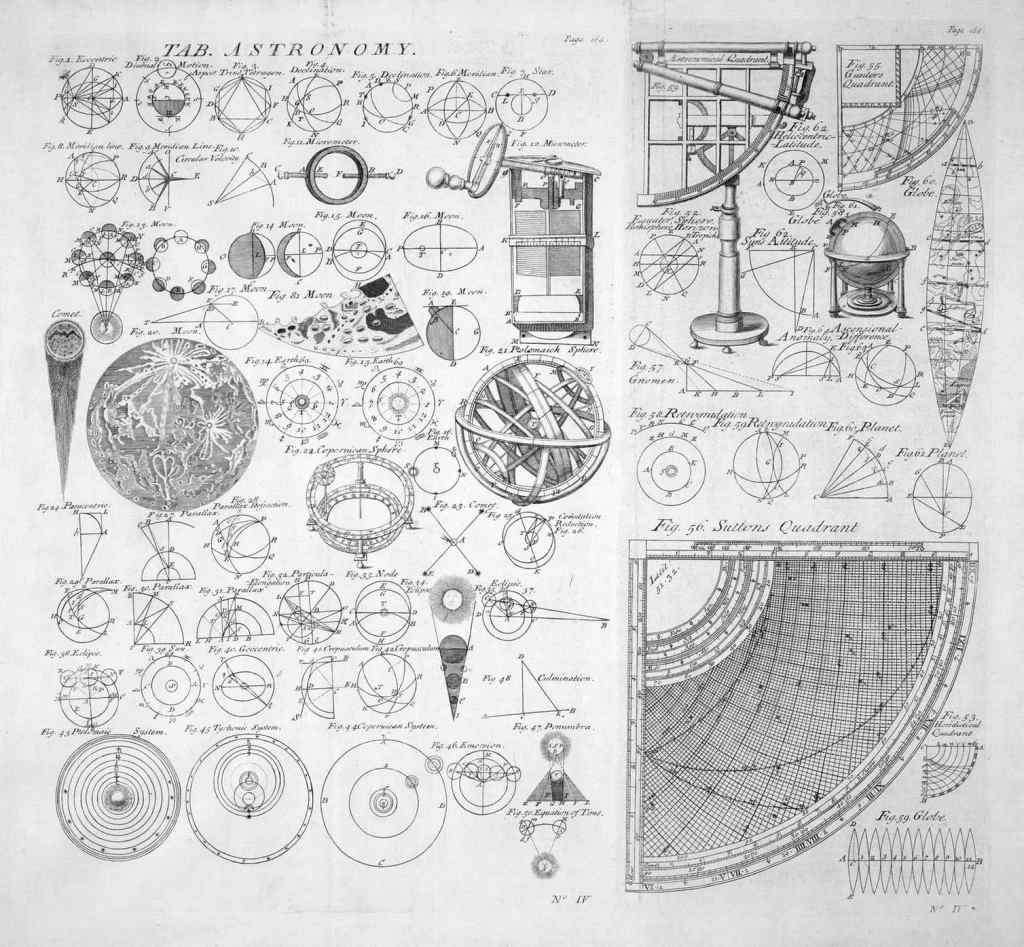
Figures illustrating articles on astronomy, from the 1728 Cyclopaedia. Wikimedia Commons
And so, where Galileo had once spurned the idea of a dead world, the German astronomer Wilhelm Olbers proposed in 1802 that the Mars-Jupiter asteroid belt in fact constitutes the ruins of a shattered planet. Troubled by this, Godwin noted that this would mean that the creator had allowed part of “his creation” to become irremediably “unoccupied”. But scientists were soon computing the precise explosive force needed to crack a planet – assigning cold numbers where moral intuitions once prevailed. Olbers calculated a precise timeframe within which to expect such an event befalling Earth. Poets began writing of “bursten worlds”.
The cosmic fragility of life was becoming undeniable. If Earth happened to drift away from the sun, one 1780s Parisian diarist imagined that interstellar coldness would “annihilate the human race, and the earth rambling in the void space, would exhibit a barren, depopulated aspect”. Soon after, the Italian pessimist Giacomo Leopardi envisioned the same scenario. He said that, shorn of the sun’s radiance, humanity would “all die in the dark, frozen like pieces of rock crystal”.
Galileo’s inorganic world was now a chilling possibility. Life, finally, had become cosmically delicate. Ironically, this appreciation came not from scouring the skies above but from probing the ground below. Early geologists, during the later 1700s, realised that Earth has its own history and that organic life has not always been part of it. Biology hasn’t even been a permanent fixture down here on Earth – why should it be one elsewhere? Coupled with growing scientific proof that many species had previously become extinct, this slowly transformed our view of the cosmological position of life as the 19th century dawned.
Copper engraving of a pterodactyl fossil discovered by the Italian scientist Cosimo Alessandro Collini in 1784. Wikimedia Commons
Seeing death in the stars
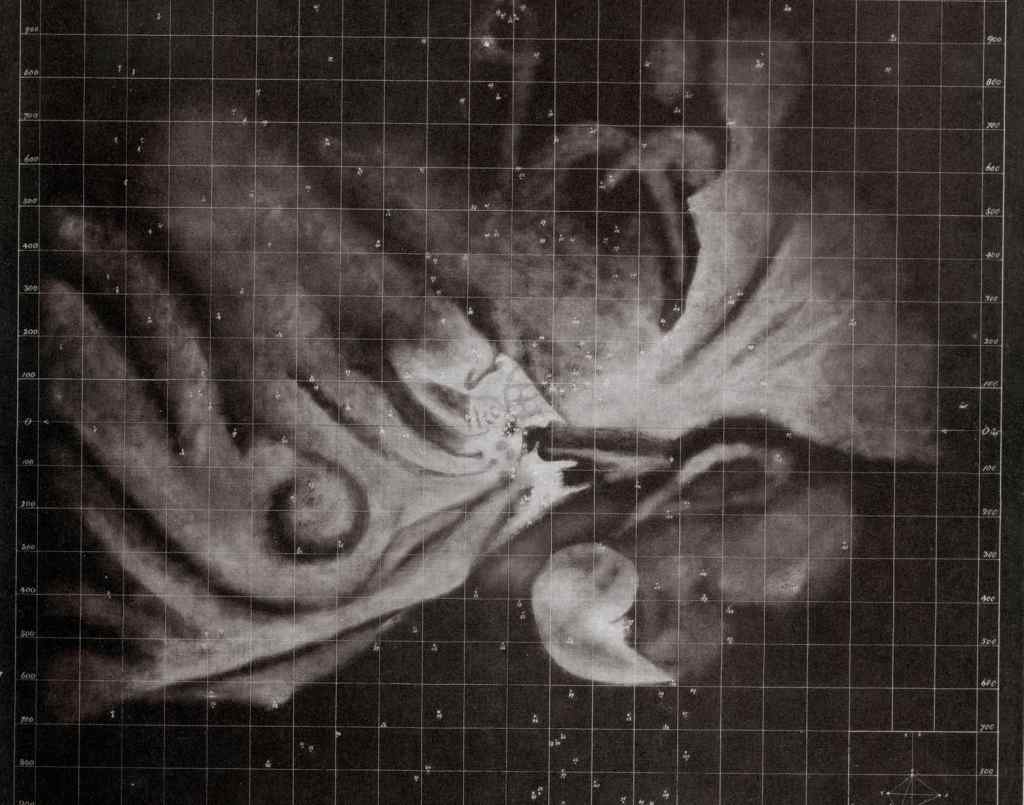
And so, where people like Diderot looked up into the cosmos in the 1750s and saw a teeming petri dish of humanoids, writers such as Thomas de Quincey were, by 1854, gazing upon the Orion nebula and reporting that they saw only a gigantic inorganic “skull” and its lightyear-long rictus grin.
The astronomer William Herschel had, already in 1814, realised that looking out into the galaxy one is looking into a “kind of chronometer”. Fermi would spell it out a century after de Quincey, but people were already intuiting the basic notion: looking out into dead space, we may just be looking into our own future.
People were becoming aware that the appearance of intelligent activity on Earth should not be taken for granted. They began to see that it is something distinct – something that stands out against the silent depths of space. Only through realising that what we consider valuable is not the cosmological baseline did we come to grasp that such values are not necessarily part of the natural world. Realising this was also realising that they are entirely our own responsibility. And this, in turn, summoned us to the modern projects of prediction, preemption and strategising. It is how we came to care about our future.
As soon as people first started discussing human extinction, possible preventative measures were suggested. Bostrom now refers to this as “macrostrategy”. However, as early as the 1720s, the French diplomat Benoît de Maillet was suggesting gigantic feats of geoengineering that could be leveraged to buffer against climate collapse. The notion of humanity as a geological force has been around ever since we started thinking about the long-term – it is only recently that scientists have accepted this and given it a name: “Anthropocene”.
Will technology save us?
It wasn’t long before authors began conjuring up highly technologically advanced futures aimed at protecting against existential threat. The eccentric Russian futurologist Vladimir Odoevskii, writing in the 1830s and 1840s, imagined humanity engineering the global climate and installing gigantic machines to “repulse” comets and other threats, for example. Yet Odoevskii was also keenly aware that with self-responsibility comes risk: the risk of abortive failure. Accordingly, he was also the very first author to propose the possibility that humanity might destroy itself with its own technology.
Acknowledgement of this plausibility, however, is not necessarily an invitation to despair. And it remains so. It simply demonstrates appreciation of the fact that, ever since we realised that the universe is not teeming with humans, we have come to appreciate that the fate of humanity lies in our hands. We may yet prove unfit for this task, but – then as now – we cannot rest assured believing that humans, or something like us, will inevitably reappear – here or elsewhere.
Beginning in the late 1700s, appreciation of this has snowballed into our ongoing tendency to be swept up by concern for the deep future. Current initiatives, such as Bostrom’s Future of Humanity Institute, can be seen as emerging from this broad and edifying historical sweep. From ongoing demands for climate justice to dreams of space colonisation, all are continuations and offshoots of a tenacious task that we first began to set for ourselves two centuries ago during the Enlightenment when we first realised that, in an otherwise silent universe, we are responsible for the entire fate of human value.
It may be solemn, but becoming concerned for humanity’s extinction is nothing other than realising one’s obligation to strive for unceasing self-betterment. Indeed, ever since the Enlightenment, we have progressively realised that we must think and act ever better because, should we not, we may never think or act again. And that seems – to me at least – like a very rational end of the world.
ooOOoo
I hope you have read it all. There’s much to engage one. And the message to me is very clear: We have to regard this race, correction: our race, as unique. As is put in the penultimate paragraph:
“Enlightenment when we first realised that, in an otherwise silent universe, we are responsible for the entire fate of human value.”
Now there’s a thought for an atheist on a Saturday morning!
I am not a great Facebook user. I have nothing against the app just prefer not to be active in terms of my comings and goings. However, I do automatically send posts from this blog across to Facebook. Some of my followers come from FB.
As was the case with Michelle Orcutt.
I went across to her FB ‘page’ to leave my thanks for her follow and read a wonderful account of Diya.
Michelle kindly gave me permission to republish the article in this place. Here it is.
ooOOoo
Diya’s Story
By Michelle Orcutt
Most of my friends know I adopted Diya, originally a street puppy from India (aka a desi dog, an Indie, a native Indian dog, pariah dog, or a streetie), almost 4 years ago. I wrote this for her rescue’s private Facebook group a year ago, in hopes of encouraging a better understanding of street dogs, and have had some requests to make it public, so here it is:
What follows are my own musings, not anything coming from ISDF. I think about dogs a lot!😁 Through Diya’s rescuer’s visit to the Twin Cities, I was able to meet and observe 7 other Indian-Minnesotan dogs. Thinking about some common difficulties voiced by these dogs’ people, and also about some of the worries and frustrations recently expressed in group and my own challenges with Diya, I feel like sharing my perspective.
To a person, the Desi adopters I met here have been patient and accommodating towards their dogs, yet most of the dogs continue to have difficulty in certain situations. These are dogs, working from what their DNA and experience gives them to go on, in a wholly other environment from where they emerged into the world. Especially with random-bred, pariah type dogs like many from India, Oman, and Thailand, these dogs’ lives center around finding food and water, protecting themselves and their territory, avoiding harm, and successfully breeding, bearing, and raising pups. Certainly the pursuit of pleasure and comfortable resting spots plays into their lives too.
We ask these dogs, who are dogs as dogs are truly meant to be—to become “ours” when they arrive in America. We subject them to foreign constraints like crates and leashes, and saddle them with our own expectations. We spend a lot of time telling dogs they are good and that they are bad. But bottom line, they’re dogs, not just our fur babies, or our charges, but entities deserving of respect in their own right. This isn’t to minimize the difficulty and emotional toll of trying to change worrisome behaviors.
Our dogs think hard to get a handle on us; they interpret and build their own sense of the meanings behind our facial expressions, movements, words, tone, touch, habits, clothing, and smells. Their language is far broader than English, Hindi, Arabic, or Thai. They are another form of intelligent life in our midst, in our cars, on our sofas, under the covers and curled into the bend of our knees. Yet they can also be incredibly distressing as they bark at our friends, growl at our guests, lung at terriers, chase cats, and destroy door frames.
Dogs are incredibly adaptable; this is one of the reasons for their success as a species. A terrified dog rescued from meat trade smugglers in Thailand can transform into a remarkable beauty at ease in a Chanel boutique (😉😉Sparkle Stern); a dog from torrid Muscat can thrive in snow (you Omani pups know who you are). A Delhi puppy fated to starve in the same spot her mother died, can instead run miles through the Michigan woods and “go to work” in an air-conditioned office with her human mom and other people with their own dogs (yes, that’s you, Miss Lily). These changes don’t happen magically or automatically (except in the case of snow), but through initial acts of grace followed by steady and hope-fueled progression.
The things that come easiest to most of these former street puppies and dogs, are the ones that overlap with their natural instincts. Bonding with people who treat them well and provide their food, comfort, and positive mental stimulation is relatively straightforward, though many of our dogs retain more of a capacity for independence than common American companion breeds. Diya is always watching for suspicious people and crows; I live in a part of St. Paul where it’s not uncommon for neighborhood Facebook group posts to start out, “Was that gunshots or fireworks?” so I appreciate her sharp eyes and formidable-sounding bark (I love my city neighborhood, by the way. I love crows too—this is one of the points at which Diya and I differ).
It’s the things that are really weird for street dogs that are hard: being expected to be outgoing, friendly, and trusting of all people and other dogs…always having to stifle your growl…tolerating being left in a wire or plastic box for hours…not being able to run away when you get nervous or to sniff as many spots as you think you need to gather information…to have people decide what you need…going to the vet, going to dog parks, etc. Dogs are social animals, but their idea of social life is different from ours (and also very different from wolves’), and each has their own unique relationship with their person or people, and to the other animals in the household.
So when you are flustered and upset by your dog’s behavior, step back, and think of all we are expecting them to learn and all we are asking them to put aside. Learning new things can be very uncomfortable and anxiety-provoking, especially when going against strong instincts. Living alone with my dogs and cats, and being an introvert by nature, I’ve tended to avoid some trying situations that other families have to work through, but Diya and I have still come a long way. I look forward to finding out where all we’ll go and what we’ll teach each other.
ooOOoo
If you just glanced at this post then make a note, a firm note, to come back and read it fully and carefully.
For Michelle captures precisely what it is to be a dog, especially a street dog.
It is a profoundly wise article and it is a great honour to be able to republish it in this place.
Humans have the ability of selective hearing, enabling us to tune in to one person speaking, for instance, even in the middle of a noisy room. This phenomenon, dubbed the cocktail party effect, is not unique to humans, however.
Research published in the journal Animal Cognition revealed that not only can dogs recognize their names in noisy conditions, they may do so better than human infants in a similar situation.1 It’s a finding that could be particularly useful for handlers of working or service dogs, who may find themselves needing to attract their dog’s attention in a chaotic environment.
It’s been suggested that hand signals may be best for this, but a vocal command may be preferable, especially since dog’s may miss hand signals as they pay attention to what’s going on in their environment.2
Dogs pick up their names even in noisy environments
For the study, researchers from the University of Maryland used a variety of dog breeds, including pets, service dogs and search-and-rescue dogs, and their owners. The dogs were placed in a booth with their owner, where background noise was played at increasingly loud levels.
Amidst the background noise, a loudspeaker played recordings of a woman speaking the dog’s name or another dog’s similar-sounding name. The dogs listened more intently to the speaker playing their own name and were able to recognize it at varying levels of background noise, up until the noise became louder than the recording of their names.3
“This surpasses the performance of 1-year-old infants,” the researchers noted. Comparatively, adult humans can pick their names out even when background noise is louder than their name. Perhaps not surprisingly, in the study the working dogs performed better at the name recognition than pet dogs.
“I suspect one of the reasons working dogs do better is because people use their names more consistently,” study co-author Rochelle Newman, Ph.D., told National Geographic. “We often end up using nicknames so much.”4 In addition, the researchers concluded:5
“Overall, we find better performance at name recognition in dogs that were trained to do tasks for humans, like service dogs, search-and-rescue dogs, and explosives detection dogs. These dogs were of several different breeds, and their tasks were widely different from one another.
This suggests that their superior performance may be due to generally more training and better attention. In summary, these results demonstrate that dogs can recognize their name even in relatively difficult levels of multitalker babble, and that dogs who work with humans are especially adept at name recognition in comparison with companion dogs.”
Dogs also cue in on other dog and human emotions
Dogs are very in tune with their environments, including the actions and emotions of those around them — both dogs and people. For instance, dogs have been found to display rapid mimicry of the other dogs’ body movements, particularly a play bow and facial expression (a relaxed, open mouth).6
When dogs mimicked each other, their play sessions lasted longer, which suggests it increased the dogs’ motivation to play and possibly strengthened the dogs’ relationship. Given that dogs mimic the emotional states of other dogs, dogs may also be able to mimic their owners’ facial expressions, especially if they’re closely bonded.
“Emotional contagion is a basic form of empathy that makes individuals able to experience others’ emotions. In human and non-human primates, emotional contagion can be linked to facial mimicry, an automatic and fast response (less than 1 second]) in which individuals involuntary mimic others’ expressions,” researchers wrote in Royal Society Open Science. “… All these findings concur in supporting the idea that a possible linkage between rapid mimicry and emotional contagion (a building-block of empathy) exists in dogs.”
The fact that dogs may mimic their owner’s facial expressions and are capable of selective hearing to pick their name out of a host of background noise adds even more understanding of why dogs and humans share such strong bonds.
Dogs associate words with objects
In dog and human communication, it remains a bit of a mystery whether dogs are responding to humans’ words, tone of voice, gestures or other cues — or all of the above.
The featured study suggests dogs do, indeed, respond to their names when spoken verbally, and past research has also shown dogs associate certain words with objects and seem able to form mental pictures that correspond to words they’ve been taught.7 Dogs also tune in to the tone of your voice,8 and may have a heightened response to praise delivered in an upbeat tone. There’s still some debate, though, over whether dogs really understand what you’re saying.
“Some of the old guard say the name is just a bit of noise that is made by the handler, and the dog is familiar with the handler’s voice, so anything the handler says is going to get their attention,” Stanley Coren, Ph.D., professor emeritus of psychology at the University of British Columbia, told National Geographic.9
Yet in the featured study, the dogs responded even though a stranger’s voice said their names, adding more evidence that dogs may understand more than we give them credit for. And, for anyone wondering, there’s evidence that cats also know their names, much like dogs and even when spoken by someone other than their owner.
ooOOoo
That dogs, perhaps not all dogs, understand far more than we give them credit is no real surprise. For a creature that bonds so close to humans and has done for a long time we still don’t really know how they function. Well certainly in the head department!
But that doesn’t reduce by one iota our love for them. They are a very special animal.
The new Covering Climate Now project will help media “tell the story so people get it.”
This is how the speech by Bill Moyers is introduced in this issue of The Nation:
The following is an abridged version of the speech by the iconic TV newsman Bill Moyers, as prepared for delivery at a conference at the Columbia Journalism School on April 30. A video of the speech can be seen at TheNation.com/moyers-speech.
Well, we have the advantage of going straight to the video.
“What is journalism for, if not to awaken the world to looming catastrophes?“
Sean Coughlan wrote a most delightful piece on the BBC News website the other day.
No matter how many times dogs are referred to it always cheers me up to read about them, especially on a major news website.
ooOOoo
Dogs ‘prevent stressed students dropping out’
By Sean Coughlan, BBC News family and education correspondent
July 2nd, 2019
Therapy dogs are used in more than 1,000 universities and colleges in the US – Getty Images
Stress among students really can be reduced by spending time with animals, according to research from the US.
It has become increasingly common for universities to bring “therapy dogs” on to campus – but claims about their benefits have often been anecdotal.
Now, scientists say they have objective evidence to support the use of dogs.
Patricia Pendry, from Washington State University, said her study showed “soothing” sessions with dogs could lessen the negative impact of stress.
Dogs are also used to help people with post-traumatic stress disorder – Getty Images
The study of more than 300 undergraduates had found weekly hour-long sessions with dogs brought to the university by professional handlers had made stressed students at “high risk of academic failure” or dropping out “feel relaxed and accepted”, helping them to concentrate, learn and remember information, she said.
A children’s hospital in California got its first therapy dog this year – Getty Images
“Students most at risk, such as those with mental health issues, showed the most benefit,” said Dr Pendry.
The dog therapy research team at Washington State University
It has also become more common in the UK, with Buckingham, University College London, Cambridge, Nottingham Trent, London Metropolitan and Swansea among those deploying dogs.
The University of Middlesex has even put “canine teaching assistants” on to the staff, to stop lonely students dropping out.
The university study involved 300 undergraduates at Washington State
Previous research has suggested stroking pets can reduce stress hormone levels.
Students spent an hour with dogs, brought to the university by professional handlers
“There does seem to be something specific about the reducing of anxiety from the petting of animals,” said Dr Pendry.
Middlesex University has put dogs on the staff as “canine teaching assistants”
“Do we fully understand the mechanism? No,” said Prof Nancy Gee, a psychologist at the State University of New York and researcher from the Waltham Centre for Pet Nutrition, also part of the project.
But students appeared to “feel calmer and more socially supported”, giving them more confidence in their studies.
Even just looking at animals could sometimes lighten the mood, Prof Gee added.
ooOOoo
This is such a lovely piece. Professor Nancy Gee sums up what we feel when we are close to a dog and yet ponders on the precise science of it.
It’s true! Even just looking at a dog, or more in our case, definitely lightens the mood.
Just look at the exchange of softness in that third photograph from the top. The one about a children’s hospital in California that took on its first therapy dog.
I haven’t been a follower of Cara’s blog Who Will Let The Dogs Out? for a very long time but her posts are powerful and good. I have every intention of remaining a follower.
We are home and settled in for the holiday week, but in some ways, I feel like I’m still in Tennessee. The pull is so strong. The stories down there break my heart but they also fire up my desire to fix this situation.
It is SO fixable. It does not need to be happening. There are more than enough of us to help the women struggling to help the dogs in western Tennessee. Once more, there are more than enough homes for those dogs, too.
From Kim Kavin’s excellent, well-researched book, The Dog Merchants:
“The notion that America’s homeless dogs face an ‘overpopulation problem’ does not match up against the available statistics. Supply is not exceeding demand. Americans want about 8 million dogs a year as new pets, while only about 4 million dogs are entering shelters….If just half the Americans already getting a dog went the shelter route, then statistically speaking, every cage in US animal control facilities could be emptied. Right now.”
And Tabi and Amber and Kim and Anne and Laura wouldn’t spend their every waking moment fighting to keep animals alive.
I’m not trying to guilt those of you who chose to buy your dog, particularly if you bought that dog from a reputable breeder and/or intend to show your dog. What I am saying is that if the next time you decide you’d like another pet (especially a cat), you’d consider looking at your local shelter or rescue.
And the next time a friend of yours or just an acquaintance tells you they adopted a dog from a shelter or rescue, thank that person for choosing to save a dog.
I’ve been home for five days now and already I’ve heard of more heartbreaking stories landing in the lap of both Karin’ 4 Kritters and Red Fern. Puppies abandoned and struggling, three dogs rescued by a woman who has them kenneled on her front porch to keep neighbors from poisoning them, dogs and puppies simply dumped. I can’t keep count of how many are in desperate need of rescue, so I asked for a summary from Laura (who handles transports from the area for OPH and many other rescues across our country).
The list here of calls for help in one day is:
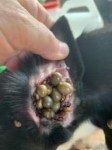
– 3 pups dumped at Red Fern (that may go to Greenfield pound) – the picture of the ear with ticks is one of these puppies.
– 2 choc pups dumped in the country that they put at the city pound for now
– 2 pittie teens they’re being asked to take. (Crockett and Tyke)
– 3 strays in Sharon, TN that a lady caught because the neighbors were threatening to poison them because they’ve been running loose for months.
– pittie pup in Greenfield that the owner wants to surrender because it’s getting to be “too much”
– 2 three month old pups someone is asking her to take
– a 6 month injured beagle. The owner was going to “put it on the street” so her brother went and picked it up but he thinks it has a broken rib and it’s in pain and he doesn’t have money to treat it so he wants to dump it on Tabi.
That’s just in a day. Multiply that times all the little towns and counties all over western Tennessee that rely on rescues like Red Fern and Karin’ 4 Kritters and their minimalist dog pounds. Places where there is no safety net and dogs are suffering and dying daily. Places where there is no real, reasonable, low-cost access to spay/neuter. Places where dogs (and cats) are not valued or loved, and where their local government will not spend money because it’s ‘just a dog’ or ‘just a cat.’
We seem to have ‘solved’ the problem in the northeast and many metropolitan areas, but we are far from a solution in the rural south and Midwest. We cannot forget them.
The need is so real. Something has got to change. Someone has got to let these dogs out.
Thanks for reading and for caring.
Blessings,
Cara
If you’d like to help, page back through these posts for contact information, but if you’d really like to help, TELL someone. Spread the word – I remain convinced, that the problem is not that people don’t care, it’s that they don’t know. Please help us tell them.
ooOOoo
Bear in mind that the above list is for One Day!
Is it true that people don’t know about this?
I was at the Club NorthWest yesterday wearing my ‘U.S.’ shorts and Piper Cub T-shirt, something that I exercise in regularly, and Austin, my trainer, said why don’t you wear them tomorrow.
But then I couldn’t put a photograph in a post that came out at midnight, Oregon summer time, so I busied myself with a camera yesterday afternoon.
Here are the results!
And one to show the colours of the shorts a little better.
The bodies of Salvadoran migrant Oscar Alberto Martínez Ramírez and his daughter lie on the bank of the Rio Grande in Matamoros, Mexico. AP Photo/Julia Le Duc
This is a terrible photograph. It has been widely shown but that doesn’t make it any less terrible.
When the Associated Press published Julia Le Duc’s photograph of a drowned Salvadoran man, Óscar Alberto Martínez Ramírez, and his 23-month old daughter Valeria, it sparked outrage on social media. According to Le Duc, Ramírez had attempted to cross the Rio Grande after realizing he couldn’t present himself to U.S. authorities to request asylum.
But beyond raising awareness via Twitter and Facebook feeds, does an image like this one have the power to sway public opinion or spur politicians to take action?
As journalism and psychology scholars interested in the effects of imagery, we study the ability of jarring photos and videos to move people from complacency to action. While graphic imagery can have an immediate impact, the window of action – and caring – is smaller than you’d think.
A political catalyst?
Photographs and videos – through their perceived authenticity – can have an effect on people.
But not all scholars agree. A recent article argued that it was a “myth” that the iconic “napalm girl” photo swayed public opinion and hastened the end of the Vietnam War.
Did the ‘napalm girl’ significantly shift public opinion on the Vietnam War? manhhai/flickr, CC BY
We must also look to psychology to understand the impacts of emotional news content. Research demonstrates that audiences need an emotional connection – and not merely a “just-the-facts” reporting approach – as “prerequisite for political action” when it comes to appreciating the importance of distant mass suffering. And imagery can trigger this emotional connection by overcoming the psychic numbing that occurs when casualties mount, images blur and lost lives become merely dry statistics.
Images from Syria
In April 2017, gut-wrenching images seem to have awakened the world to the human atrocities happening in Syria. Following a chemical bomb attack in the town of Khan Sheikhoun, graphic photos and videos documented the horrific effects of the banned nerve agent sarin. Millions bore witness to excruciating human suffering: gasping, choking, writhing and dying. More than 500 people were injured, with at least 86 deaths, including 28 children.
The vivid, closeup images of sarin attack victims were resonant enough to break through the complacency of people and politicians accustomed to bad news emerging from the war-torn nation. In President Trump’s response – which included a retaliatory missile strike – he seemed to recognize the value of the Syrian lives depicted in the horrific photos and videos.
Syrian doctors treat a child following a suspected chemical attack in the town of Khan Sheikhoun, northern Idlib province, Syria. Edlib Media Center, via AP, File
“When you kill innocent children,” he said during a news conference, “that crosses many, many lines, beyond a red line – many, many lines.”
The limits of an image
Nonetheless, even though the attacks may have briefly heightened U.S. concerns over the wars in Syria, the photographic documentation of the suffering in Syria wasn’t new.
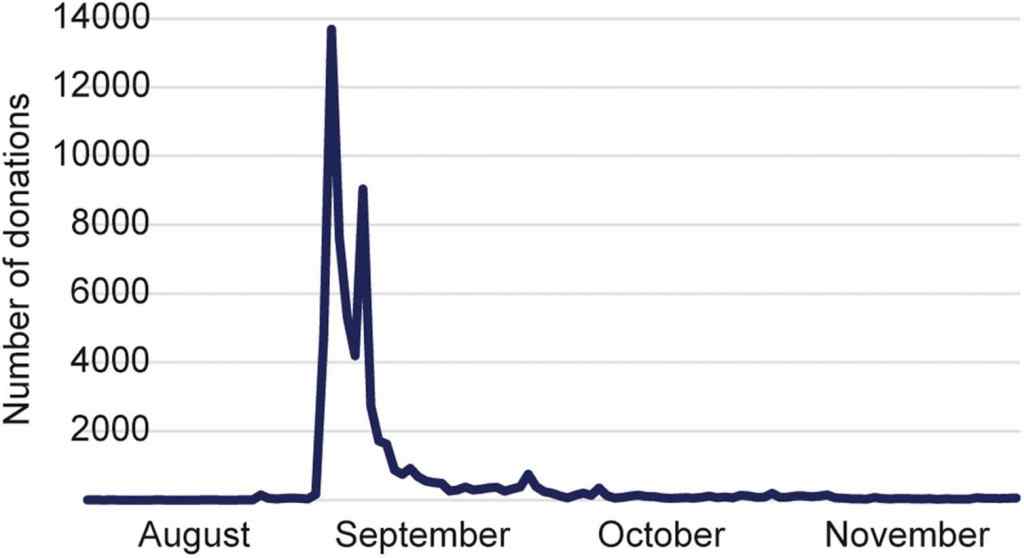
But the emotional and compassionate responses to both photographs were short-lived. The bombing of civilians in Syria continued. Refugees continued risking their lives to escape the war zone.
After a photograph of a dead Syrian boy went viral in 2015, the number of daily donations to a Swedish Red Cross campaign designated specifically for aiding Syrian refugees spiked dramatically – but only for a brief window. Proceedings of the National Academy of Sciences of the United States of America, CC BY-SA
Since the publication of Le Duc’s photo of the dead migrants, supportive politicians may feel emboldened to sound the alarm on the plight of Central American migrants. Donations to immigrant aid organizations might briefly spike.
But it seems that a photograph, no matter how emotionally devastating, can only do so much.
Yes, it can create a window of time when we’re motivated to act, and we’ll usually do so if we have effective options to pursue. This could mean a charitable donation at the individual level or, collectively, a surge of political will. However, psychology research from the “arithmetic of compassion” suggests that sympathy for distant human suffering declines when we’re presented with rising body counts. Sometimes we’re discouraged by the scope of the problem and this stops us from doing things that actually make a difference – even if partial solutions can save lives. Other times, if the options for helping others seem too narrow or ineffective, we’ll turn away and stop caring.
Images can alert us to the horrors of violence, mass migration and poverty. But as we have seen time and again, photographs and news footage of human suffering generally precipitate a short-term emotional reaction, rather than a sustained humanitarian response.
ooOOoo
As one reads the article it is much more than a comment on a single image despite how terrible that photograph may be.
The two scientists set out to show that the period that we are alarmed or terrified or just plain sad at the state of nations is rather short.
Maybe it’s the self-protective nature of our species that does this.
But it still doesn’t diminish the horror of that top photograph.
This is the post (and I trust I can share it with you!)
ooOOoo
If you have ever wondered what it must be like to be a bird flying alongside them is about as close as you can come.
Christian Moullec takes us some amazing flights with his birds in this wonderful video. He has been helping birds migrate from Germany to Sweden since 1995. His efforts have raised awareness about the disappearance of migratory birds in Europe. I hope you enjoy this beautiful video as much as I did!




















 Learning from Dogs