Category: Core thought

Having the dog of a day!

Maybe there’s a new twist to that rather derogatory phrase!

For the life of me, I can’t remember how this story came to my ‘in-box’ but most likely it was from my Big Think subscription.  But I do know that the story has spread like wild-fire (poor choice of simile for Arizona!) and not without good reason.

Here’s how it was promoted on Science Daily,

Benefits of Taking Your Dog to Work May Not Be Far-Fetched

Man’s best friend may make a positive difference in the workplace by reducing stress and making the job more satisfying for other employees, according to a Virginia Commonwealth University study.

Stress is a major contributor to employee absenteeism, morale and burnout and results in significant loss of productivity and resources. But a preliminary study, published in the March issue of the International Journal of Workplace Health Management, found that dogs in the workplace may buffer the impact of stress during the workday for their owners and make the job more satisfying for those with whom they come into contact.

The VCU researchers compared employees who bring their dogs to work, employees who do not bring their dogs to work and employees without pets in the areas of stress, job satisfaction, organizational commitment and support.

Then over at the New York Daily News, it was presented thus,

Bring your dog to work to lower stress; Companies that allow pooches have happier workers

Amazon, Ben & Jerry’s and Zynga all have pup-friendly policies

A new study supports the stress-reducing benefits of bringing your pooch to work — to play with, look at, and pet while working.

According to a Virginia Commonwealth University study, having a dog at work not only reduces the owners’ stress level but also increased the level of job satisfaction for other employees as well. The study, announced Thursday, was published in the International Journal of Workplace Health Management.

“Dogs in the workplace can make a positive difference,” said head researcher Randolph T. Barker. “The differences in perceived stress between days the dog was present and absent were significant. The employees as a whole had higher job satisfaction than industry norms.”

Here’s a great example.  The photograph below,

One hand for the desk and one for the dog!

comes from the website of Interior Design Hound (seriously) where the by-line is Good Design with a Canine Twist! (No, I’m not making it up!)

Anyway, back to that NY Daily News item,

The study took place at Replacements Ltd, a service-manufacturing-retail company located in North Carolina, which employs approximately 550 people. The company has a dog friendly policy, similar to other  companies such as Amazon, Ben & Jerry’s and Zynga, according to CBS News, with around 20 to 30 dogs romping through the office every day. The study took place over a period of one work week, and subjects completing both surveys and saliva samples to measure stress levels.

According to The Humane Society of the United States, there are numerous benefits to having dogs at work, including improved staff morale, worker productivity, and camaraderie among employees.

Numerous studies have shown that having a pet is a good investment for your health. One study found that having a pet lowered your risk factors for heart disease, and another found that dogs encourage more consistent walking and exercise.

Seems pretty obvious to me.

Another tough day at the office!

Mind you, going back to the metaphorical ‘having a dog of a day‘ here’s one woman who probably wished she hadn’t got out of bed that morning,

Woman has a dog of a day in court

Sydney – If you have a phobia about dogs and hurt yourself running away from one, is it your own fault or should the owner of the dog pay compensation?

An Australian judge on Wednesday ruled against a woman who had put that case to him and ordered her to pay substantial legal costs.

Mileva Novakovic took her brother, Michael Stekovic, and his wife to the New South Wales Court of Appeal to try to overturn a lower court verdict that found they were not liable for injuries she sustained at his house in 2008.

Novakovic slipped and fell in a panic over finding a dog in their lounge room. She admitted to a fear of dogs and said she was compelled to run despite Cougar, a mastiff, showing no aggression towards her.


Very scary!

More wisdom!

Further reflections on where next for US Energy policy.

Pumping our way to extinction!

On the 28th March, I republished a powerful essay from Patrice Ayme under my Post title of Questions are never stupid.  In fact, Patrice’s essay was called Energy Question For The USA and concluded thus:

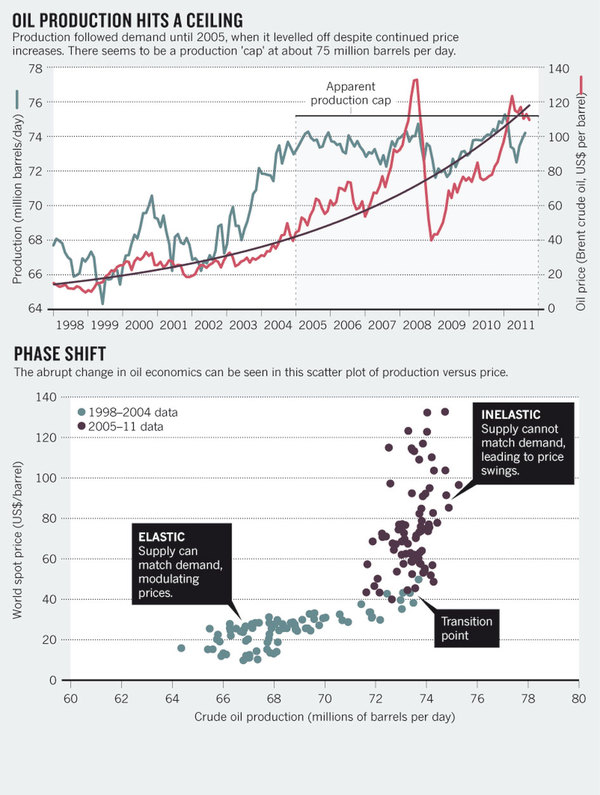
Total oil sales, per day are about 100 million barrels (in truth the cap is lower, see graph above), at, say $100, so ten billion dollars a day, 3.6 trillion a year. The USA uses about 25% of that. Some have incorporated the price of the part of the gigantic American war machine and (what are truly) bribes to feudal warlords insuring Western access to the oil fields, and found a much higher cost up to $11 a gallon.

Ultimately, and pretty soon, in 2016, specialists expect oil prices to explode up, from the exhaustion of the existing oil fields. Then what?

Moreover, in 2016, the dependence upon OPEC, or, more exactly Arab regimes, is going to become much greater than now. What’s the plan of the USA? Extend ever more the security state, and go occupy the Middle East with a one million men army? To occupy, or not to occupy, that is the question.

Is it time for a better plan? And yes, any better plan will require consumers to pay higher energy prices. As consumers apparently want the army to procure the oil, they ought to pay for it.

So when Michael Klare published an essay just two days ago on TomDispatch entitled, Welcome to the New Third World of Energy, the U.S. it seemed highly relevant to have that follow-on from Patrice’s essay.  Again I am very grateful to Tom Engelhardt for giving me permission to republish.  Readers may like to know a little of Michael Klare’s background, from here:

Michael T. Klare is a professor of peace and world security studies at Hampshire College and the author of Resource Wars and Blood and Oil. Consider this essay a preview of his newest book, Rising Powers, Shrinking Planet: The New Geopolitics of Energy, which has just been published by Metropolitan Books. A brief video of Klare discussing key subjects in his new book can be viewed by clicking here.

So here is that essay.  I’m going to include Tom’s introduction because it’s fair to so do!

Tomgram: Michael Klare, Welcome to the New Third World of Energy, the U.S.

[Note for TomDispatch Readers:With today’s Michael Klare piece, you get your last chance to receive a signed, personalized copy of his new book, The Race for What’s Left: The Global Scramble for the World’s Last Resources, in return for a contribution of $100 or more to this website.  (Visit our donation page to check it out.)  The offer will end later this week.  Many thanks to those of you who have already given.  Klare’s book is little short of prophetic and the dollars you so generously send in really do help keep TomDispatch afloat! Tom]

Here’s a simple rule of thumb when it comes to energy disasters: if it’s the nuclear industry and something begins to go wrong — from Three Mile Island in Pennsylvania in 1979 to Fukushima, Japan, after the 2011 tsunami — whatever news is first released, always relatively reassuring, will be a lie, pure and simple.  And as the disaster unrolls, it’s not likely to get much better.  The nuclear industry is incapable of telling the truth about the harm it does.  So when the early stories appear about the next nuclear plant in trouble, whatever you hear or read, just assume that you don’t know the half, not even the quarter, of it.

When it comes to the oil and gas industry and disasters, a similar rule of thumb follows: however bad it first sounds, the odds are it’s going to sound a lot worse before it’s over.  (See BP, Deepwater Horizon.)  So when you first hear about an oil leak from a Chevron well off the coast of Brazil or from a natural gas well in the North Sea operated by the French oil giant Total and you getthose expectable reassurances, they, too, are likely to be nothing but gas.

And here’s the sad thing, you’re going to get all too many chances to test out these simple rules when it comes to bad energy news.  After all, as Michael Klare has been writing at this site for years, we’re entering the “tough energy” era.  The big energy companies are going to be extracting hydrocarbons in ever more hazardous, difficult-to-reach places like the Arctic and they’re going to be using ever uglier methods to do so.

It’s a guarantee that, however bad the environmental damage we’ve seen so far, it’s only going to get worse as the energy industry despoils various regions to give us our fossil-fuel fix and theirmega-profits.  As Klare points out, one of those regions is slated to be not in distant Africa, the Persian Gulf, or the Caspian Sea, but right here in the U.S.  Klare has been ahead of the energy curve ever since, in the late 1990s, he suggested that we would soon be on a planet embroiled in“resource wars.”  His new book, The Race for What’s Left: The Global Scramble for the World’s Last Resources, catches the nightmarish nature of the planet’s last energy boom in a way no one else has.  And don’t be surprised if that nightmare lands squarely in your backyard. Tom

A New Energy Third World in North America?
How the Big Energy Companies Plan to Turn the United States into a Third-World Petro-State 

By Michael T. Klare

The “curse” of oil wealth is a well-known phenomenon in Third World petro-states where millions of lives are wasted in poverty and the environment is ravaged, while tiny elites rake in the energy dollars and corruption rules the land.  Recently, North America has been repeatedly hailed as the planet’s twenty-first-century “new Saudi Arabia” for “tough energy” — deep-sea oil, Canadian tar sands, and fracked oil and natural gas.  But here’s a question no one considers: Will the oil curse become as familiar on this continent in the wake of a new American energy rush as it is in Africa and elsewhere?  Will North America, that is, become not just the next boom continent for energy bonanzas, but a new energy Third World?

Once upon a time, the giant U.S. oil companies — Chevron, Exxon, Mobil, and Texaco — got their start in North America, launching an oil boom that lasted a century and made the U.S. the planet’s dominant energy producer.  But most of those companies have long since turned elsewhere for new sources of oil.

Eager to escape ever-stronger environmental restrictions and dying oil fields at home, the energy giants were naturally drawn to the economically and environmentally wide-open producing areas of the Middle East, Africa, and Latin America — the Third World — where oil deposits were plentiful, governments compliant, and environmental regulations few or nonexistent.

Here, then, is the energy surprise of the twenty-first century: with operating conditions growing increasingly difficult in the global South, the major firms are now flocking back to North America. To exploit previously neglected reserves on this continent, however, Big Oil will have to overcome a host of regulatory and environmental obstacles.  It will, in other words, have to use its version of deep-pocket persuasion to convert the United States into the functional equivalent of a Third World petro-state.

Knowledgeable observers are already noting the first telltale signs of the oil industry’s “Third-Worldification” of the United States.  Wilderness areas from which the oil companies were once barred are being opened to energy exploitation and other restraints on invasive drilling operations are being dismantled.  Expectations are that, in the wake of the 2012 election season, environmental regulations will be rolled back even further and other protected areas made available for development.  In the process, as has so often been the case with Third World petro-states, the rights and wellbeing of local citizens will be trampled underfoot.

Welcome to the Third World of Energy

Up until 1950, the United States was the world’s leading oil producer, the Saudi Arabia of its day. In that year, the U.S. produced approximately 270 million metric tons of oil, or about 55% of the world’s entire output. But with a postwar recovery then in full swing, the world needed a lot more energy while America’s most accessible oil fields — though still capable of growth — were approaching their maximum sustainable production levels.  Net U.S. crude oil output reached a peakof about 9.2 million barrels per day in 1970 and then went into decline (until very recently).

This prompted the giant oil firms, which had already developed significant footholds in Indonesia, Iran, Saudi Arabia, and Venezuela, to scour the global South in search of new reserves to exploit — a saga told with great gusto in Daniel Yergin’s epic history of the oil industry, The Prize. Particular attention was devoted to the Persian Gulf region, where in 1948 a consortium of American companies — Chevron, Exxon, Mobil, and Texaco — discovered the world’s largest oil field, Ghawar, in Saudi Arabia.  By 1975, Third World countries were producing 58% of the world’s oil supply, while the U.S. share had dropped to 18%.

Environmental concerns also drove this search for new reserves in the global South. On January 28, 1969, a blowout at Platform A of a Union Oil Company offshore field in California’s Santa Barbara Channel produced a massive oil leak that covered much of the area and laid waste to local wildlife. Coming at a time of growing environmental consciousness, the spill provoked an outpouring of public outrage, helping to inspire the establishment of Earth Day, first observed one year later. Equally important, it helped spur passage of various legislative restraints on drilling activities, including the National Environmental Policy Act of 1970, theClean Water Act of 1972, and the Safe Drinking Water Act of 1974. In addition, Congress banned new drilling in waters off the Atlantic and Pacific coasts and in the eastern Gulf of Mexico near Florida.

During these years, Washington also expanded areas designated as wilderness or wildlife preserves, protecting them from resource extraction. In 1952, for example, President Eisenhower established the Arctic National Wildlife Range and, in 1980, this remote area of northeastern Alaska was redesignated by Congress as theArctic National Wildlife Refuge (ANWR). Ever since the discovery of oil in the adjacent Prudhoe Bay area, energy firms have been clamoring for the right to drill in ANWR, only to be blocked by one or another president or house of Congress.

For the most part, production in Third World countries posed no such complications. The Nigerian government, for example, has long welcomed foreign investment in its onshore and offshore oil fields, while showing little concern over the despoliation of its southern coastline, where oil company operations have produced a massive environmental disaster. As Adam Nossiter of the New York Timesdescribed the resulting situation, “The Niger Delta, where the [petroleum] wealth underground is out of all proportion with the poverty on the surface, has endured the equivalent of the Exxon Valdez spill every year for 50 years by some estimates.”

As vividly laid out by Peter Maass in Crude World, a similar pattern is evident in many other Third World petro-states where anything goes as compliant government officials — often the recipients of hefty bribes or other oil-company favors — regularly look the other way. The companies, in turn, don’t trouble themselves over the human rights abuses perpetrated by their foreign government “partners” — many of them dictators, warlords, or feudal potentates.

But times change.  The Third World increasingly isn’t what it used to be.  Many countries in the global South are becoming more protective of their environments, ever more inclined to take ever larger cuts of the oil wealth of their own countries, and ever more inclined to punish foreign companies that abuse their laws. In February 2011, for example, a judge in the Ecuadorean Amazon town of Lago Agrio ordered Chevron to pay $9 billion in damages for environmental harm caused to the region in the 1970s by Texaco (which the company later acquired).  Although the Ecuadorians are unlikely to collect a single dollar from Chevron, the case is indicative of the tougher regulatory climate now facing these companies in the developing world.  More recently, in a case resulting from an oil spill at an offshore field, a judge in Brazil hasseized the passports of 17 employees of Chevron and U.S. drilling-rig operator Transocean, preventing them from leaving the country.

In addition, production is on the decline in some developing countries like Indonesia and Gabon, while others have nationalized their oil fields or narrowed the space in which private international firms can operate. During Hugo Chávez’s presidency, for example, Venezuela has forced all foreign firms to award a majority stake in their operations to the state oil company, Petróleos de Venezuela S.A.  Similarly, the Brazilian government, under former President Luiz Inácio Lula da Silva, instituted a rule that all drilling operations in the new “pre-salt” fields in the Atlantic Ocean — widely believed to be the biggest oil discovery of the twenty-first century — be managed by the state-controlled firm, Petróleo de Brasil (Petrobras).

Fracking Our Way to a Toxic Planet

Such pressures in the Third World have forced the major U.S. and European firms — BP, Chevron, ConocoPhillips, ExxonMobil, Royal Dutch Shell, and Total of France — to look elsewhere for new sources of oil and natural gas.  Unfortunately for them, there aren’t many places left in the world that possess promising hydrocarbon reserves and also welcome investment by private energy giants. That’s why some of the most attractive new energy markets now lie in Canada and the United States, or in the waters off their shores.  As a result, both are experiencing a remarkable uptick in fresh investment from the major international firms.

Both countries still possess substantial oil and gas deposits, but not of the “easy” variety (deposits close to the surface, close to shore, or easily accessible for extraction).  All that remains are “tough” energy reserves (deep underground, far offshore, hard to extract and process). To exploit these, the energy companies must deploy aggressive technologies likely to cause extensive damage to the environment and in many cases human health as well.  They must also find ways to gain government approval to enter environmentally protected areas now off limits.

The formula for making Canada and the U.S. the “Saudi Arabia” of the twenty-first century is grim but relatively simple: environmental protections will have to be eviscerated and those who stand in the way of intensified drilling, from landowners to local environmental protection groups, bulldozed out of the way.  Put another way, North America will have to be Third-Worldified.

Consider the extraction of shale oil and gas, widely considered the most crucial aspect of Big Oil’s current push back into the North American market. Shale formations in Canada and the U.S. are believed to house massive quantities of oil and natural gas, and their accelerated extraction is already helping reduce the region’s reliance on imported petroleum.

Both energy sources, however, can only be extracted through a process known as hydraulic fracturing (“hydro-fracking,” or just plain “fracking”) that uses powerful jets of water in massive quantities to shatter underground shale formations, creating fissures through which the hydrocarbons can escape. In addition, to widen these fissures and ease the escape of the oil and gas they hold, the fracking water has to be mixed with a variety of often poisonous solvents and acids. This technique produces massive quantities of toxic wastewater, which can neither be returned to the environment without endangering drinking water supplies nor easily stored and decontaminated.

The rapid expansion of hydro-fracking would be problematic under the best of circumstances, which these aren’t.  Many of the richest sources of shale oil and gas, for instance, are located in populated areas of Texas, Arkansas, Ohio, Pennsylvania, and New York. In fact, one of the most promising sites, the Marcellus formation, abuts New York City’s upstate watershed area.  Under such circumstances, concern over the safety of drinking water should be paramount, and federal legislation, especially the Safe Drinking Water Act of 1974, should theoretically give the Environmental Protection Agency (EPA) the power to oversee (and potentially ban) any procedures that endanger water supplies.

However, oil companies seeking to increase profits by maximizing the utilization of hydro-fracking banded together, put pressure on Congress, and managed to get itself exempted from the 1974 law’s provisions. In 2005, under heavy lobbying from then Vice President Dick Cheney — formerly the CEO of oil services contractor Halliburton — Congress passed the Energy Policy Act, which prohibited the EPA from regulating hydro-fracking via the Safe Drinking Water Act, thereby eliminating a significant impediment to wider use of the technique.

Third Worldification

Since then, there has been a virtual stampede to the shale regions by the major oil companies, which have in many cases devoured smaller firms that pioneered the development of hydro-fracking. (In 2009, for example, ExxonMobil paid $31 billion to acquire XTO Energy, one of the leading producers of shale gas.)   As the extraction of shale oil and gas has accelerated, the industry has faced other problems. To successfully exploit promising shale formations, for instance, energy firms must insert many wells, since each fracking operation can only extend several hundred feet in any direction, requiring the establishment of noisy, polluting, and potentially hazardous drilling operations in well-populated rural and suburban areas.

While drilling has been welcomed by some of these communities as a source of added income, many have vigorously opposed the invasion, seeing it as an assault on neighborhood peace, health, and safety. In an effort to protect their quality of life, some Pennsylvania communities, for example, have adopted zoning laws that ban fracking in their midst. Viewing this as yet another intolerable obstacle, the industry has put intense pressure on friendly members of the state legislature to adopt a law depriving most local jurisdictions of the right to exclude fracking operations. “We have been sold out to the gas industry, plain and simple,” saidTodd Miller, a town commissioner in South Fayette Township who opposed the legislation.

If the energy industry has its way in North America, there will be many more Todd Millers complaining about the way their lives and worlds have been “sold out” to the energy barons.  Similar battles are already being fought elsewhere in North America, as energy firms seek to overcome resistance to expanded drilling in areas once protected from such activity.

In Alaska, for example, the industry is fighting in the courts and in Congress to allow drilling in coastal areas, despite opposition from Native American communities which worry that vulnerable marine animals and their traditional way of life will be put at risk. This summer, Royal Dutch Shell is expected to begin test drilling in the Chukchi Sea, an area important to several such communities.

And this is just the beginning. To gain access to additional stores of oil and gas, the industry is seeking to eliminate virtually all environmental restraints imposed since the 1960s and open vast tracts of coastal and wilderness areas, including ANWR, to intensive drilling. It also seeks the construction of the much disputed Keystone XL pipeline, which is to transport synthetic crude oil made from Canadian tar sands — a particularly “dirty” and environmentally devastating form of energy which has attracted substantial U.S. investment — to Texas and Louisiana for further processing. According to Jack Gerard, president of the American Petroleum Institute (API), the preferred U.S. energy strategy “would include greater access to areas that are currently off limits, a regulatory and permitting process that supported reasonable timelines for development, and immediate approval of the Keystone XL pipeline.”

To achieve these objectives, the API, which claims to represent more than 490 oil and natural gas companies, has launched a multimillion-dollar campaign to sway the 2012 elections, dubbed “Vote 4 Energy.” While describing itself as nonpartisan, the API-financed campaign seeks to discredit and marginalize any candidate, including President Obama, who opposes even the mildest version of its drill-anywhere agenda.

“There [are] two paths that we can take” on energy policy, the Vote 4 Energy Web site proclaims. “One path leads to more jobs, higher government revenues and greater U.S. energy security — which can be achieved by increasing oil and natural gas development right here at home. The other path would put jobs, revenues and our energy security at risk.” This message will be broadcast with increasing frequency as Election Day nears.

According to the energy industry, we are at a fork in the road and can either chose a path leading to greater energy independence or to ever more perilous energy insecurity. But there is another way to characterize that “choice”: on one path, the United States will increasingly come to resemble a Third World petro-state, with compliant government leaders, an increasingly money-ridden and corrupt political system, and negligible environmental and health safeguards; on the other, which would also involve far greater investment in the development of renewable alternative energies, it would remain a First World nation with strong health and environmental regulations and robust democratic institutions.

How we characterize our energy predicament in the coming decades and what path we ultimately select will in large measure determine the fate of this nation.

Michael T. Klare is a professor of peace and world security studies at Hampshire College, a TomDispatch regular, and the author of The Race for What’s Left: The Global Scramble for the World’s Last Resourcesjust published by Metropolitan Books.  To listen to Timothy MacBain’s Tomcast audio interview in which Klare discusses his new book and what it means to rely on extreme energy, click here, or download it to your iPod here.  Klare can be followed on Facebook.

Follow TomDispatch on Twitter @TomDispatch and join us on Facebook.

Copyright 2012 Michael T. Klare

Fascinating times indeed!

Questions are never stupid!

A powerful guest post from Patrice Ayme on where next for American energy.

Introduction.

I must have spent an age musing over what to call this Post.  Patrice called it simply ‘Energy Question For The USA’ and it’s a highly appropriate question.  But in the end I chose the title ‘Questions are never stupid’ because I was mindful of the well-known saying, “There is no such thing as a stupid question, only a stupid answer!

So the smart question raised by Patrice is not only very highly appropriate for 2012, it’s also a question that just has to have a smart answer.  Because we are on the brink of it being too late to be flirting with stupid answers.  What many scientists are saying, in one form or another, is that if we don’t embrace the journey of moving away from carbon-based sources of energy for society now and find those alternate sustainable sources by the end of this decade then the laws of unintended consequences will kick in with a vengeance.  The end of the decade is eight years away!

Here’s a picture of my grandson who was one-year-old just a week ago.

Trusting his elders!

That picture reminds me of the comment early on in James Hansen’s book, Storms of my Grandchildren, where he writes ‘I did not want my grandchildren, someday in the future, to look back and say, “Opa understood what was happening, but he did not make it clear.

So on to the Guest post from Patrice.  It’s not an easy, quick read but I’ll tell you what it is!  It’s the sort of ‘wake-up’ call this fine Nation and this even finer Planet should be getting from countless politicians and leaders.  So do read it and, even better, add your comments, and wonder why we seem so content on fiddling while Rome burns!

oooOOOooo

Energy Question For The USA

THE AGE OF OIL PRODUCED THE AMERICAN CENTURY. NOW WHAT?

No Vision, No Mission, No Energy

***

Another editorial of Paul Krugman firing volleys at republican “paranoia” for accusing Obama of driving up oil prices. As he observes in “Paranoia Strikes Deeper“: …“the president of the United States doesn’t control gasoline prices, or even have much influence over those prices. Oil prices are set in a world market, and America, which accounts for only about a tenth of world production, can’t move those prices much. Indeed, the recent rise in gas prices has taken place despite rising U.S. oil production and falling imports.”

American households tend to borrow as much as they can. Thus, when oil prices increase markedly, Americans have to cut in crucial budgets, such as house payments. I said at the time that it would lead to a peak in housing prices, and it did.

Why such a drastic influence of oil prices on the economy of the USA? Because Americans, except in a few places such as New York, commute by private car to work. So Americans have to feed the car, if they want to feed themselves.

It was not this way a century ago, or so. At the time public transportation systems using electric tramways and trains were found all over, even in Los Angeles. Car companies put an end to that outrage in the late fifties by buying, and then destroying, all the public transportation system they could put their greedy hands on.  Fossil fuel plutocrats were delighted.

But let’s set aside Krugman’s fake indignation. He is smart enough to know that Romney will do what Romney needs to do to win the Obama, I mean, the election. Waxing lyrical about Romney doing as Obama, does not beat going lyrical about sunrise.

Gasoline prices in the USA are way down in real dollars to what they used to be, decades ago. And so is the gas tax. This means that, far from adapting to the gathering multiply-pronged world ecological and energy crisis, the USA has gone the other way, denying there is any crisis. “What? Me worry?” That’s got to be anti-American indeed.  No, real blooded Americans are all into strip searches and the death panel at the White House.

In Europe, gas prices are more than twice that of the USA, thanks to heavy taxes (stations in France have sported two euros a liter, that is 8 euros per gallon, or more than $10.50). [UK unleaded petrol price, as of today, is the equivalent of $8.70 per gallon, Ed.]

This means that far from being down and out, Europe is efficient enough to operate at that high price level. It also means that Europe is much more motivated than the USA to get much more efficient. In other words, high gasoline prices in Europe are a safety margin. The high prices force the European free market to adapt to a situation that the free market of the USA will encounter someday. Adaptation takes decades: new energies take on the average, historically speaking, 50 years to become dominant. Same, one would guess, for energy efficiencies.

Basically, if oil prices doubled from here, gasoline prices would double in the USA. Whereas, even if the Europeans decided to keep the same high taxes, gasoline prices would only augment by 50%. And, in the much more efficient European economy, with plenty of public electric transportation available, the noxious effects on the European economy would be much less than one would expect from a 50% oil price rise.

The world gets 55 × 1018 joules of useful energy from 475 × 1018 joules of primary energy produced by fossil fuels, biomass and nuclear power plants. That tremendous inefficiency (less than 13%!)  needs to be corrected. It will be, if, and only if, prices are kept high. Thus energy taxes are necessary to adapt to the looming penury.

Why looming penury? Because the reserves of other fossil fuels may have been vastly overestimated (by a factor of 5 in the case of coal). Various fossil fuel lobbies have an interest to over-estimate the reserves (because it keeps the world addicted, as they present their industry as a long range solution, which it is not).

Looking at the raw production numbers, as exhibited below in the graphs, paints a completely different story: production from existing fields is going down dramatically (at 5% rate, per year).  In other words we are in the treachorous waters between the catastrophe of CO2 poisoning and the disaster of running out of energy to burn.

The unavoidable rise of fuel prices will be less grave in Europe than in the USA, because many Europeans would opt for the available electric-based public transportation system (the combination of much more efficient electric motors and central generation is much more efficient than distributing oil to put in SUVs all over, as done in the USA; SUVs, because there are too many holes in the asphalt. A problem partly related to high oil prices!).

Yet, the increase of the cost of imported oil corresponds exactly to the Italian deficit ($55 billion). Although that deficit increase had many causes, oil price increase was by far the most important. And the same for other Southern European countries. So the rise of oil prices was the barrel that broke the back of European debt.

In the USA, ten out of 11 post WWII recessions were followed by oil price spikes. Why are American minds so closed up to the looming strangulation of their economy by oil? Because the fossil fuel plutocracy is on a rampage in the USA. It uses a red hot propaganda to persuade the vast American public of undifferentiated sheep that there is no CO2 ecological crisis, and no energy crisis. (Although the latest polls indicate that two thirds of the public, in a splendid turn-around, believe that there is indeed a man-made climate change crisis; never mind that the New York Times had the latest tornado rampage, with 40 dead, presented as discreetly as possible.)

Why are the fossil plutocrats hysterical? Well we are past Peak Cheap Oil. Moreover, the “majors“, the world’s largest oil companies, have been pushed out of more and more countries, and replaced by national oil companies. Desperate, the majors have gone for riskier and riskier drilling in the deep ocean. Now Chevron, and Transocean, after a 4-day leak off Brazil, see prosecutors asking for lengthy prison sentences and enormous fines.

Most of these oil companies are American, so they have pushed forfracking (destroying the underground with poisons to extract fossil fuels). Superficially, it works: USA imports of fossil fuels went quickly from 60% down to 40%.

However, that did not make a dent in the world price situation, because the demand keeps rising, but the world, overall, is PAST PEAK OIL (as I have long argued and the Nature article alluded to below confirmed, using the obvious argument found in the graphs).

So, basically, American fracking finances Chinese oil consumption. Here are some graphs extracted from Nature and the USA government:

When the horrid sun of diminishing resources rises over the parched American oil desert, while fracking reveals itself to be an unfathomable catastrophe, the howling is going to be very great, and one more reason for a depression will blossom.

Much of the USA’s superiority, in the last 150 years, has come from abundant and cheap oil. First in the North-East, then down to Oklahoma, Texas, Colorado, California. Compare with Western Europe, which had basically no oil.

Oil was not just a question of cheap, convenient energy. Oil has, short of nuclear energy, the highest energy density of any material (OK, nuclear energy is millions of time more energy dense).

Oil gave the USA enormous diplomatic and conspiratorial leverage. American oil plutocrats helped Lenin and Stalin develop their colossal fields in the Caucasus and Caspian. One of those plutocrats, Harriman, son of a railroad magnate, and brother of another Harriman, was one of the main operators of the democratic party. Let alone banker to Hitler. He was decorated both by Stalin, and by Hitler. He then went on as U.S. ambassador to major European capitals, and stayed one the main operators of the government of the USA for decades. “Democrats” have long been impure.

Interestingly, I searched the Internet for a document mentioning Harriman’s Stalino-Hitlerian decorations, but could not find it (I have seen the pictures in the past). All I could read is how much Harriman resisted Stalin each time they met, and that was all the time (a total lie that Harriman resisted Hitler, or Stalin: Harriman was an accomplice of Stalin, and helped give him half of Europe, in exchange for manganese and other stuff. But now Internet agents are obviously paid to reconstruct a truth where American plutocrats look good,  knights in shining armor, fighting Stalin or Hitler, each time they met for tea, dinner, lunch, breakfast, and interminable conferences, for years on end, decade after decade).

A famous example of the clout oil provided the USA with: Texaco fueled Hitler’s conquest of the Spanish republic (this one is hard to hide, because the U.S. Congress slapped Texaco with a symbolic fine, well after the deed was done). That used to amuse Hitler a lot (Hitler gave elaborated reasons to his worried supporters for being in bed with American plutocrats; as the Nazi Party was officially socialist, and anti-plutocratic, that awkward situation may have led him to declare war to the USA on December 11, 1941, to ward off the German generals’ argument that he was just a little corporal in above his head).

Another example: Mussolini was hanged from an American gas station in Milan. Italian communists hanged him from his sponsors’ works.

The fueling of the fascists by American fossil fuel companies helped bring the American Century to the world in general, and Europe in particular. Without Stalin and American plutocratic oil, Hitler’s Panzers could not have moved in 1939 or 1940.

The dignified Elie Wiesel, instead of crying crocodiles tears, wondering how such a thing as Auschwitz was possible, should ask how and why the Nazi extermination machine was fuelled by American plutocrats, and how come he, himself, never talks about that.

Wiesel got the Nobel Peace Prize, just as Jimmy Carter (who launched the American attack on Afghanistan). Was it for disinformation? (And how come waging war in Afghanistan is a big plus for the Peace Prize? Is it related to the same mood which made Sweden help Hitler before and during WWII, and never having a serious look at that, ever since? I know the prize is ostensibly given by Norwegians.)

Wikipedia is big on the notion of “weasel words“, and rightly so. Deeper than that is what I would call weasel logic. And ever deeper, weasel worlds. To talk about Hitler without ever wondering who his sponsors were, and what they were after, is to live in a weasel world.

I like Elie Wiesel personally. Yet, just as I like Krugman, Obama, and countless others, such as the infamous Jean-Paul Sartre, he likes power even more than truth. OK, It is unfair to put Sartre, who really espoused the most abject terrorism, with the others… As long as individuals prefer power to truth, the spontaneous generation of infamy is insured.

Total oil sales, per day are about 100 million barrels (in truth the cap is lower, see graph above), at, say $100, so ten billion dollars a day, 3.6 trillion a year. The USA uses about 25% of that. Some have incorporated the price of the part of the gigantic American war machine and (what are truly) bribes to feudal warlords insuring Western access to the oil fields, and found a much higher cost up to $11 a gallon.

Ultimately, and pretty soon, in 2016, specialists expect oil prices to explode up, from the exhaustion of the existing oil fields. Then what?

Moreover, in 2016, the dependence upon OPEC, or, more exactly Arab regimes, is going to become much greater than now. What’s the plan of the USA? Extend ever more the security state, and go occupy the Middle East with a one million men army? To occupy, or not to occupy, that is the question.

Is it time for a better plan? And yes, any better plan will require consumers to pay higher energy prices. As consumers apparently want the army to procure the oil, they ought to pay for it.

***

Patrice Ayme

***

Note 1: Flying cost at least ten times more in CO2 creation than taking a train. And jet fuel is not taxed, at least until the carbon plan of the European Union starts charging next year, in 2013. In spite of the screaming from the USA and its proxies: it’s funny how attached to subsidies American society can be.

Note 2: Refusing to pay for necessary military expenses through taxation and mobilization, was a big factor in the downfall of the Roman Principate.

The Principate then tried to accomplish defense on the cheap, by using more and more mercenaries. Many of these mercenaries or their children and descendants were poorly integrated in Roman republican culture (say emperors Diocletian or Constantine, let alone Stilicho the Vandal, a century later), so they established theDominate, itself a negation of the Roman republic. Amusingly the Western Franks, those salt water (“Salian“) Franks remembered the Roman republic better than all these imports from the savage East… who could not remember it, they, and their ancestors, having never known it.

Guess what? The USA’s army presently employs 300,000 “private contractors” (aka, mercenaries). Curiously, in that case, it’s not so much to save money, than to extract more money from the system (but that’s another story). Still, it will have the same effect.

oooOOOooo

Meating climate change!

An interesting reflection on the rearing of cattle and an ‘Anti-Meat pill!  No kidding!

I was vaguely aware of the contribution of cattle towards the overall rise in greenhouse gases.  A very quick web search found this news item from the United Nations which included,

29 November 2006 – Cattle-rearing generates more global warming greenhouse gases, as measured in CO2 equivalent, than transportation, and smarter production methods, including improved animal diets to reduce enteric fermentation and consequent methane emissions, are urgently needed, according to a new United Nations report released today.

“Livestock are one of the most significant contributors to today’s most serious environmental problems,” senior UN Food and Agriculture Organization (FAO) official Henning Steinfeld said. “Urgent action is required to remedy the situation.”

But what prompted me to look a little closer at this was a recent article on the Big Think website that was entitled, The Anti-Meat Pill: Human Engineering to Combat Climate Change.

Let me quote a little from the article, presented on the Big Think website by Daniel Honan.

NYU Bio-ethicist Matthew Liao has caused a stir recently with a forthcoming paper that explores the biomedical modification of humans in order to stop us from consuming red meat.

and a paragraph later continued with,

In a forthcoming paper to be published in Ethics, Policy and the Environment, Liao suggests that humans might take pills to bring about mild nausea to rid ourselves of our appetite for red meat. This would have a mitigating effect on climate change, he argues.

Liao refers to studies such as a widely-sited UN report that estimates 18 percent of greenhouse emissions come from livestock, which is a higher share than transportation. Another report, from 2009, estimates livestock emissions are significantly higher, at 50 percent. Fact of life: cows fart. Other negative impacts of increased livestock farming includes deforestation and a drain on water supplies.

The Internet rapidly found Matthew Liao’s website and from there the paper referred to above, which is introduced thus,

Professor Matthew Liao of New York University

Anthropogenic climate change is arguably one of the biggest problems that confront us today. There is ample evidence that climate change is likely to affect adversely many aspects of life for all people around the world, and that existing solutions such as geoengineering might be too risky and ordinary behavioural and market solutions might not be sufficient to mitigate climate change. In this paper, we consider a new kind of solution to climate change, what we call human engineering, which involves biomedical modifications of humans so that they can mitigate and/or adapt to climate change. We argue that human engineering is potentially less risky than geoengineering and that it could help behavioural and market solutions succeed in mitigating climate change. We also consider some possible ethical concerns regarding human engineering such as its safety, the implications of human engineering for our children and for the society, and we argue that these concerns can be addressed. Our upshot is that human engineering deserves further consideration in the debate about climate change.

Now if we go back to that UN article, we can see that emissions from cattle and livestock in general is not a minor issue.

When emissions from land use and land use change are included, the livestock sector accounts for 9 per cent of CO2 deriving from human-related activities, but produces a much larger share of even more harmful greenhouse gases. It generates 65 per cent of human-related nitrous oxide, which has 296 times the Global Warming Potential (GWP) of CO2. Most of this comes from manure.

And it accounts for respectively 37 per cent of all human-induced methane (23 times as warming as CO2), which is largely produced by the digestive system of ruminants, and 64 per cent of ammonia, which contributes significantly to acid rain.

With increased prosperity, people are consuming more meat and dairy products every year, the report notes. Global meat production is projected to more than double from 229 million tonnes in 1999/2001 to 465 million tonnes in 2050, while milk output is set to climb from 580 to 1043 million tonnes.

But modifying humans, frankly, misses the point.

That is unless we wholeheartedly embrace the need to change, to sustain the only planet we can call home, and do it because we care, Planet Earth will do the bioengineering for us – engineering us into extinction.  For example, just cut back on eating meat!  And if you don’t want to do it for the planet, do it for the health of your children as this Health Petition underlines in spades.

So I’m sorry Professor Liao but this seems like a step too far – by a long way.

Optimistically unrealistic!

A reflection of our unconscious minds – and the potential perils ahead.

Last Monday, March 12th, the BBC aired a programme under their excellent Horizon science series.  This programme was entitled, Out of Control?  Here’s how the programme was introduced,

We all like to think we are in control of our lives – of what we feel and what we think. But scientists are now discovering this is often simply an illusion.

Surprising experiments are revealing that what you think you do and what you actually do can be very different. Your unconscious mind is often calling the shots, influencing the decisions you make, from what you eat to who you fall in love with. If you think you are really in control of your life, you may have to think again.

The whole 60 minute programme was fascinating right from the start when Professor Nobre introduced the secret world of our unconscious mind.  Professor Anna Nobre heads The Brain & Cognition Laboratory, a cognitive neuroscience research group at the Department of Experimental Psychology in the University of Oxford.

For starters, how much of your mind do you think is your conscious mind as opposed to your unconscious mind?  Watch this clip and be amazed!

“Are you in control of your unconscious, or is it in control of you?”

So let me link how our mind works to something more relevant today than possibly any other aspect of life.

I’m thinking of the fundamental question that bothers me and, perhaps millions of others.  That question being: “Why, with the overwhelming scientific evidence that man is critically threatening the planet’s biosphere upon which we all depend, is there not an equally overwhelming global commitment for change to a sustainable way of life?

Take, for example, this compelling story.

Last Saturday the BBC News website published a report by Richard Black, the BBC’s Environment correspondent, that opened thus,

An eminent UK engineer is suggesting building cloud-whitening towers in the Faroe Islands as a “technical fix” for warming across the Arctic.

Scientists told UK MPs this week that the possibility of a major methane release triggered by melting Arctic ice constitutes a “planetary emergency“. [my emboldening]

The Arctic could be sea-ice free each September within a few years.

and later goes into this detail (do please read it all, it’s only a few minutes of quiet reading),

On melting ice

The area of Arctic Ocean covered by ice each summer has declined significantly over the last few decades as air and sea temperatures have risen.

For each of the last four years, the September minimum has seen about two-thirds of the average cover for the years 1979-2000, which is used a baseline. The extent covered at other times of the year has also been shrinking.

What more concerns some scientists is the falling volume of ice.

Analysis from the University of Washington, in Seattle, using ice thickness data from submarines and satellites, suggests that Septembers could be ice-free within just a few years.

Data for September suggests the Arctic Ocean could be free of sea ice in a few years

“In 2007, the water [off northern Siberia] warmed up to about 5C (41F) in summer, and this extends down to the sea bed, melting the offshore permafrost,” said Peter Wadhams, professor of ocean physics at Cambridge University.

Among the issues this raises is whether the ice-free conditions will quicken release of methane currently trapped in the sea bed, especially in the shallow waters along the northern coast of Siberia, Canada and Alaska.

Methane is a much more potent greenhouse gas than carbon dioxide, though it does not last as long in the atmosphere.

Several teams of scientists trying to measure how much methane is actually being released have reported seeing vast bubbles coming up through the water – although analysing how much this matters is complicated by the absence of similar measurements from previous decades.

Nevertheless, Prof Wadhams told MPs, the release could be expected to get stronger over time.  “With ‘business-as-usual’ greenhouse gas emissions, we might have warming of 9-10C in the Arctic.  That will cement in place the ice-free nature of the Arctic Ocean – it will release methane from offshore, and a lot of the methane on land as well.”

This would – in turn – exacerbate warming, across the Arctic and the rest of the world.

Abrupt methane releases from frozen regions may have played a major role in two events, 55 and 251 million years ago, that extinguished much of the life then on Earth.

Meteorologist Lord (Julian) Hunt, who chaired the meeting of the All Party Parliamentary Group on Climate Change, clarified that an abrupt methane release from the current warming was not inevitable, describing that as “an issue for scientific debate”.

But he also said that some in the scientific community had been reluctant to discuss the possibility.

“There is quite a lot of suppression and non-discussion of issues that are difficult, and one of those is in fact methane,” he said, recalling a reluctance on the part of at least one senior scientists involved in the Arctic Climate Impact Assessment to discuss the impact that a methane release might have.

Reams of other factual evidence shows that mankind may have only a few years left to stop the planet going into a runaway condition that would then extinguish much of the life on Earth!

So what’s stopping us?

Dr. Sharot

Well back to that Horizon programme.  In the programme, Dr. Tali Sharot of University College London explains how we are all optimists despite the risks.  I.e. our unconscious mind deliberately prevents negative information from affecting our conscious mind, our conscious judgment.

In an experiment, an individual is asked to guess the likelihood of a whole range of outcomes, 80 in all.  Ergo, you see a gentleman guessing the likelihood of cancer as 18%, of a bone fracture as 10%, of Alzheimer’s as 2%, and so on.

In some cases he guessed a pessimistic probability, in others an optimistic probability.  After each guess he was shown the correct probability.  E.g. cancer 30% vs his estimate of 18%, for a bone fracture 34% vs his guess of 10%, and the risk in reality of Alzheimer’s is 10% versus his instinct of just 2%.   I’ve just quoted his optimistic guesses, in many questions his guess was a pessimistic view, i.e. he guessed a higher likelihood than the statistical reality.

Then he was asked all 80 questions again, having seen the accurate probability compared to his intuitive guess.

So here’s the fascinating outcome.

Where his instinct was a negative guess versus the statistical probability then he adjusted his mind and was able to quote a more accurate figure the second time around.  But where the reality was more pessimistic than his first guess, then that adjusted knowledge wasn’t retained.  In other words, our beliefs only change when we can adjust to a more positive view of the future.

I just hope I have made that clear.  Readers may like to view an article written by Dr. Sharot published in TIME Magazine in May, 2011, called The Optimism Bias or read the introduction to a lecture given in Seattle in June, 2011;  “A sunny outlook doesn’t just make you a more pleasant companion: Tali Sharot argues that optimism is a tool for survival and happiness that gets us through hard times—even an economic recession. Sharot, author of The Optimism Bias, uncovers myths about optimism, illuminates the ways it can affect our lives, examines why optimism is necessary for us to function, and illustrates how the human brain is extremely adept at turning lead into gold.

A summary of a publication, Sharot, T. (2011). The optimism bias. Curr Biol 21(23), R941-R945, reads,

The ability to anticipate is a hallmark of cognition. Inferences about what will occur in the future are critical to decision making, enabling us to prepare our actions so as to avoid harm and gain reward. Given the importance of these future projections, one might expect the brain to possess accurate, unbiased foresight. Humans, however, exhibit a pervasive and surprising bias: when it comes to predicting what will happen to us tomorrow, next week, or fifty years from now, we overestimate the likelihood of positive events, and underestimate the likelihood of negative events. For example, we underrate our chances of getting divorced, being in a car accident, or suffering from cancer. We also expect to live longer than objective measures would warrant, overestimate our success in the job market, and believe that our children will be especially talented. This phenomenon is known as the optimism bias, and it is one of the most consistent, prevalent, and robust biases documented in psychology and behavioral economics.

More fascinating information can be found at the Affective Brain Lab.

So here’s the crunch!

Our bias towards an optimistic future is a “tool for survival and happiness that gets us through hard times.”  But if that ancient bias is preventing mankind from recognising just how close we may be to some form of ‘tipping point’ then this tool for survival may be our undoing.

But if on the other hand, we now unite in changing our ways, first by community then by town then by country our future is incredibly optimistic.

 “A single candle may light a thousand others and they in turn many thousands more” – Buddha

Cutting edge technology!

But not quite as you might expect!

Big thanks to Katie S. from here in Payson for emailing me this hilarious clip.

Reading Planet Earth, part Three

The third of an unmissable series of four 1-hour videos from National Geographic.

The first episode plus the introduction can be seen here, the second episode can be seen here.

By now if you have watched the first two episodes, you will be aware of the huge commitment made by National Geographic and PBS in putting this production together.  That’s a strong indicator to my mind that getting the message out there is being taken more and more seriously.

The third episode is called Predator and underscores an important element of the change process.  That of properly understanding the nature of a problem before attempting a solution.  This episode has some very positive messages, so do watch it.

National Geographic – Strange Days on Planet Earth – Part 3 of 4 – Predator

Reading Planet Earth, part Two

The second of an unmissable series of four 1-hour videos from National Geographic.

The background and introduction to the first episode was published yesterday.  So I won’t natter on today saying more or less the same thing.

But I will add this thought.

The videos are tough viewing but compelling because they show the complexity and inter-relatedness of all forms of life on our Planet.  It shows that the debate about climate change/global warming/call it what you will is not a simplistic do you or do you not believe mankind is at the root of the changes.  No it’s a much more complex question about the threat to our whole biosphere, as Patrice Ayme so eloquently spelt out on March 2nd.  These videos make that crystal clear.

Here’s the second episode,

National Geographic – Strange Days on Planet Earth – Part 2 of 4 – One Degree Factor

Reading Planet Earth, part One.

An unmissable series of four 1-hour videos from National Geographic.

In my summary yesterday of what had come out of the Posts about man’s influence on the planet, I wrote, “But one of the most wonderful aspects for me was the incredible sharing of ideas and resources.”  I then gave many details of those resources.  One of the great links was a blogsite called Dogs of Doubt.  On that blogsite I came across an item published on the 8th March, called Strange Days on Planet Earth.  With permission I repost how that item was introduced.

While the average global temperature on Earth has increased by 1 degree Celsius in the last century, in some places on Earth the temperature has increased by a phenomenal 11 Degrees, for some species, already adapted to life as it has been for millions of years such changes puts them in great danger.

Inter-species transfer from one continent to another through what many thought were harmless human activities has placed great pressures on the survival of local animals, insects and even plants, all of which were not prepared for the arrival of newer, more aggressive species.

In many areas of the world some ocean species are actually relocating themselves in order to survive the loss of their food resources and habitats due to the warming of the oceans.

Herds of animals are vanishing as they struggle with warming temperatures which bring in longer breeding seasons for many insects in turn affecting the living standards and health of the many animals they attack.

On land and across the world entire lakes are either disappearing or being reduced in size through the effects of long lasting droughts, the lack of rain waters in some parts is changing much of our surrounding environment and the dust this causes in some parts of the world is affecting the health of children thousands of miles away.

In the oceans plankton are down 20% to what they were in the 1950s, when the waters are cold they do well but now that the waters are warmer their numbers are falling drastically.

Every little change that occurs on earth through global warming might not mean much to some, but all these changes will eventually add together until our environment reaches a breaking point from which none of us may survive.

This video series from National Geographic aims to create an innovative type of environmental awareness by revealing a cause and effect relationship between what we as humans do to the Earth and what that in turn does to our environment and ecosystems, the series creates a new sense of environmental urgency.

Each of the four episodes is constructed as a high-tech detective story, with the fate of the planet at stake.

Jean and I have watched the first two episodes in full and are about 60% through the third.  They are both spell-binding and eye-opening.  I believe they were first aired by PBS back in 2005 but, no matter, they are even more relevant today.

So for today and the rest of the week I shall provide a link to the YouTube copy of each programme.  Please, if you can, do put aside an hour to watch each video and, even better, please give us your feedback to Learning from Dogs.

The first episode is called Invaders.

National Geographic – Strange Days on Planet Earth – Part 1 of 4 – Invaders

Around the globe, scientists are racing to solve a series of mysteries. Unsettling transformations are sweeping across the planet, and clue by clue, investigators around the world are assembling a new picture of Earth, discovering ways that seemingly disparate events are connected. Crumbling houses in New Orleans are linked to voracious creatures from southern China. Vanishing forests in Yellowstone are linked to the disappearance of wolves. An asthma epidemic in the Caribbean is linked to dust storms in Africa. Scientists suspect we have entered a time of global change swifter than any human being has ever witnessed. Where are we headed? What can we do to alter this course of events? National Geographic’s Strange Days on Planet Earth, premiered on PBS, explores these questions. Drawing upon research being generated by a new discipline, Earth System Science (ESS), the series aims to create an innovative type of environmental awareness. By revealing a cause and effect relationship between what we as humans do to the Earth and what that in turn does to our environment and ecosystems, the series creates a new sense of environmental urgency. Award-winning actor, writer and director Edward Norton (Primal Fear, American History X, Italian Job) hosts the series. A dedicated environmental activist, Norton has a special interest in providing solar energy to low income families. Each of the four one-hour episodes is constructed as a high-tech detective story, with the fate of the planet at stake.

More interlude pics!

More ‘switch-off’ material!

There was a fantastic response to the Interlude Post that came out on the 6th March so I thought I would offer some more of those wonderful pictures.  As I said in that earlier Post, ” Cynthia, the wife of Dan Gomez, emailed me a set of wonderful photographs that had come to her from sister-in-law Suzann.”  So here are some more.  Have a peaceful and relaxed Sunday!

Did you see that!
Hey, I heard that comment!
Mummy, are we nearly there?
We can't go on meeting like this!
Well you guys don't taste that different!
One more time! I'm in charge around here!

Suzann/Cynthia – Please, please, please send more!