We were out with our guests until late afternoon yesterday leaving me no time to offer anything original. (Of course, there’s an inherent assumption in that last sentence! 😉 )
So I am reposting an essay about a Japanese dog that has been a long-term favourite of many readers of Learning from Dogs. Apologies if you have read this before.
oooo
Faithful dog Hachikō
30th August, 2010
More than a film, a message from dogs to mankind.
Richard Gere and Hachi
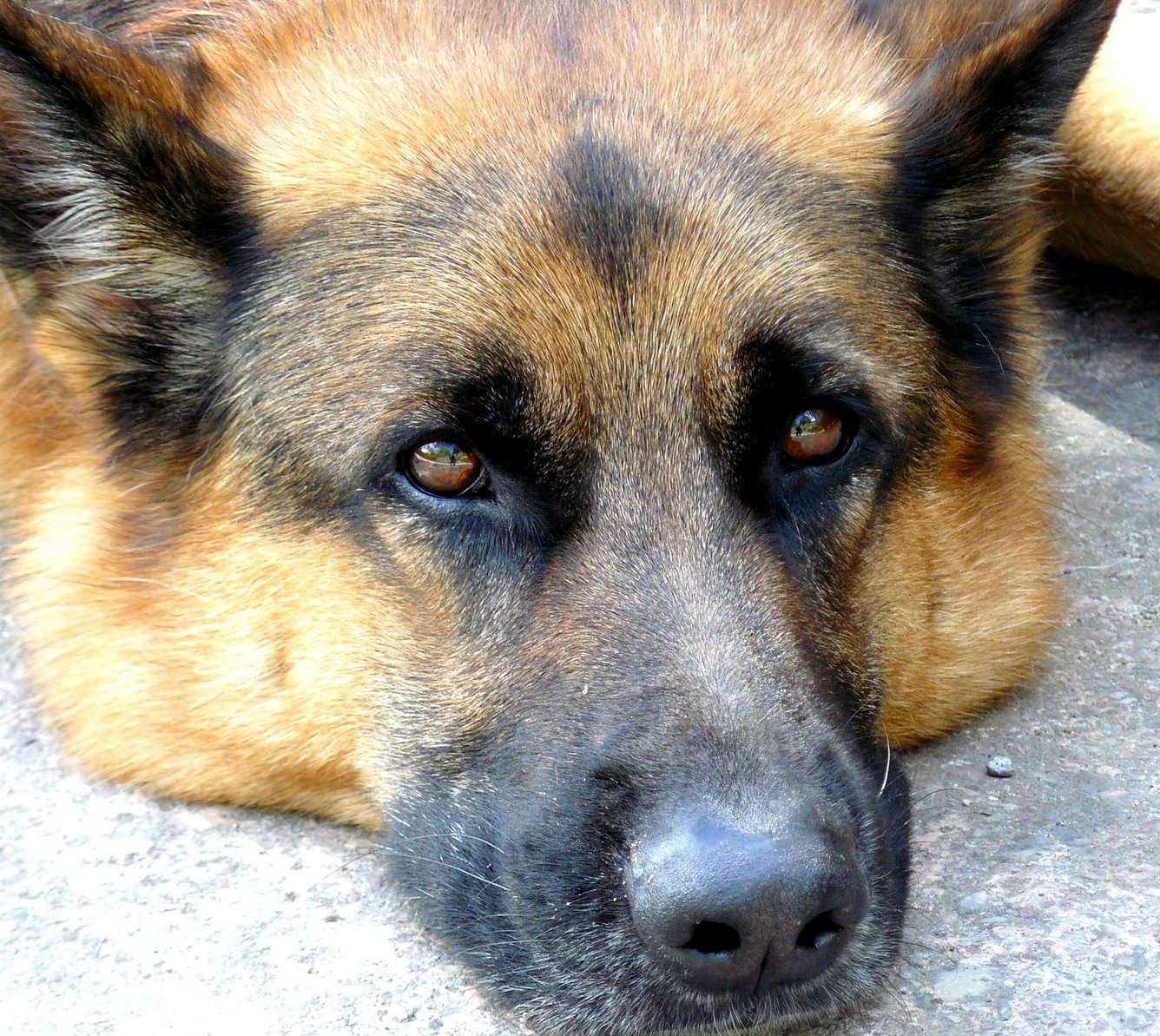
We recently watched a film about an Akita dog called Hachi, Hachikō in Japanese, that demonstrates the loyalty that dogs can have for their human owners.
Here’s the official movie trailer.
It’s a very moving film – seriously so! Expect to shed many tears. Even more so when one reflects that the Hollywood film is based, reasonably accurately, on a true story. The details of this story are in Wikipedia from which is quoted:
In 1924, Hidesaburō Ueno, a professor in the agriculture department at the University of Tokyo took in Hachikō as a pet. During his owner’s life Hachikō saw him out from the front door and greeted him at the end of the day at the nearby Shibuya Station. The pair continued their daily routine until May 1925, when Professor Ueno did not return on the usual train one evening. The professor had suffered from a cerebral hemorrhage at the university that day. He died and never returned to the train station where his friend was waiting. Hachikō was loyal and every day for the next nine years he waited sitting there amongst the town’s folk.
Hachikō was given away after his master’s death, but he routinely escaped, showing up again and again at his old home. Eventually, Hachikō apparently realized that Professor Ueno no longer lived at the house. So he went to look for his master at the train station where he had accompanied him so many times before. Each day, Hachikō waited for Professor Ueno to return. And each day he did not see his friend among the commuters at the station.
The permanent fixture at the train station that was Hachikō attracted the attention of other commuters. Many of the people who frequented the Shibuya train station had seen Hachikō and Professor Ueno together each day. They brought Hachikō treats and food to nourish him during his wait.
This continued for nine years with Hachikō appearing precisely when the train was due at the station
This hasn’t been the only film about this dog. See below:
Back to the Wikipedia entry:
That same year, another of Ueno’s faithful students (who had become something of an expert on the Akita breed) saw the dog at the station and followed him to the Kobayashi home (the home of the former gardener of Professor Ueno — Kikuzaboro Kobayashi) where he learned the history of Hachikō’s life. Shortly after this meeting, the former student published a documented census of Akitas in Japan. His research found only 30 purebred Akitas remaining, including Hachikō from Shibuya Station.
Professor Ueno’s former student returned frequently to visit the dog and over the years published several articles about Hachikō’s remarkable loyalty. In 1932 one of these articles, published in Tokyo’s largest newspaper, threw the dog into the national spotlight. Hachikō became a national sensation. His faithfulness to his master’s memory impressed the people of Japan as a spirit of family loyalty all should strive to achieve. Teachers and parents used Hachikō’s vigil as an example for children to follow. A well-known Japanese artist rendered a sculpture of the dog, and throughout the country a new awareness of the Akita breed grew.
Eventually, Hachiko’s legendary faithfulness became a national symbol of loyalty.
Hachikō died on March 8, 1935. He was found on a street in Shibuya. His heart was infected with filarial worms and 3-4 yakitori sticks were found in his stomach. His stuffed and mounted remains are kept at the National Science Museum of Japan in Ueno, Tokyo.
Hachiko
The Akita breed has a great reputation for loyalty. But knowing that doesn’t in any way weaken the power of the message for the present times.
A dog offers loyalty, trust and love in exchange for being treated with integrity and compassion.
I guess that it would be difficult to find a greater change in topic than going from America’s relationship with war to the secret of happiness! But that’s what’s on offer today!
I don’t want to brag, but while I was on sabbatical I discovered the secret to happiness.
The crazy thing is, it was lying right there in the open. It’s been revealed dozens, hundreds of times over the course of human history. It’s revealed every day in ordinary human affairs, if you’re paying attention.
What is it? Let’s ask George Vaillant.
Vaillant is a Harvard psychologist who has been working for over 40 years on the Grant Study, one of the longest-running longitudinal studies in scientific history. It began tracking a set of 268 (white, physically and mentally healthy) men when they were sophomores at Harvard in 1939 and has been tracking them ever since, for 75 years, with exhaustive regular physical and psychological tests. It has followed them as they’ve grown, gone to war, married, divorced, worked, been fired, gotten sick, found God, and so on. (The ups and downs of the study’s history are recounted in this classic Atlantic piece, one of my favorite magazine stories ever.)
Vaillant has spent most of his adult life analyzing the data from the study, attempting to determine which factors most reliably correlate with well-being. He’s probably studied happiness longer, and in greater depth, than any other single human being. So what is it, George Vaillant? What’s the secret to a happy life?
“That the only thing that really matters in life are your relationships to other people.”
Wow. That’s pretty straightforward. But can you boil it down just a little more?
“Happiness is love. Full stop.”
All right then! There you have it. The secret to happiness, revealed. It’s love.
If you want to break it down a little more, there’s plenty of social science research on it. We live longer, healthier, happier lives when we are at the center of overlapping social networks, when we have a devoted life partner, close family and friends (and pets), extensive “weak ties” with acquaintances and colleagues, peer and professional networks that value our skills, and a sense of autonomy balanced with a sense of involvement in something larger than ourselves. We are happiest when we have a place in the world, when we love and are loved, when we make the most of our gifts.
This is all obvious, of course, and has been said a million times. But that’s the point. People want there to be a what of happiness, a secret, an epiphany that once you learn it changes you forever. But the what of happiness is banal. It’s been confirmed by research. It’s in a kajillion self-help books. It’s cliché.
The what of happiness is not the hard part. The how is the hard part. As a million deathbed testimonials have taught us, when we look back on our lives, we won’t wish we’d worked harder, maintained Inbox Zero, finished those reports on deadline, gotten more promotions, owned a nicer car. We’ll wish we’d spent more time appreciating the ones we love and who love us, that we’d done more meaningful work, that we’d traveled more and had more memorable experiences.
We all know this. But it is no easy matter to translate that knowledge into action. Why? Vaillant is insightful about that, too, as The Atlantic explains:
Vaillant [says] positive emotions make us more vulnerable than negative ones. One reason is that they’re future-oriented. Fear and sadness have immediate payoffs—protecting us from attack or attracting resources at times of distress. Gratitude and joy, over time, will yield better health and deeper connections—but in the short term actually put us at risk. That’s because, while negative emotions tend to be insulating, positive emotions expose us to the common elements of rejection and heartbreak.
Gratitude and joy are emotions we can muster when we don’t feel threatened, when our lizard brain calms and our prefrontal cortex takes over. But it’s very difficult when our egos feel under siege. Relationships are more meaningful the more we open and extend ourselves (and are reciprocated), but our degree of openness is also our degree of vulnerability. Often we close off, deciding, consciously or not, that it’s not worth the risk of getting hurt; our lizard-brain fear overpowers us.
We cannot control this dynamic entirely. As the Atlantic piece explains, researchers believe that about 50 percent of our happiness is determined by our internal “set point,” which is shaped by genetics and early childhood and mostly fixed in place. About 10 percent is determined by circumstances. But that other 40 percent comes from how we react to circumstances, and over that we do have some control.
We can learn to detach from fear and anger, to let them go, to take deep breaths, return our focus to the present, and choose positive emotions. That, as I wrote yesterday, is what mindfulness is all about. It’s what the entire discipline of positive psychology (which counts Vaillant as a founding father) is about: strengthening the prefrontal cortex so that it’s more able to override instinctual fear and anger. The more inclement the circumstances we face, the more we need it. That’s why mindfulness training is catching on in low-income communities, the military, and elderly care.
So when people ask, as they have many times in the last week, “What did you learn over your break?” … the honest answer is, nothing. I already knew the what of happiness, just as you already know it. The break was about more consciously practicing the how, and on that score I’m afraid I have no grand epiphanies, only a few baby steps down a road I’ll be walking all my life.
ooOOoo
The original Grist article was headed with a picture of a group of happy dogs and it seemed almost an automatic response from me to close today’s post with a picture of happy dogs here in Oregon. But rather obvious, don’t you think!
Instead, I’m going to use a photograph of me being ‘loved’ by Ben so soon after he came to us in April; Ben being one of the two horses (Ben and Ranger) to come here that were rescued by Darla Clark, as explained here.
Now going to offer my own reflection on happiness.
Animals that are comfortable being around us readily display unconditional affection to humans. All that these dogs, cats, horses, and others, require is trust in us. The knowledge that we are there to care for them, to comfort them, to cuddle them, to love them for the majority of the interactions between the person and the creature. That doesn’t rule out chastisement, far from it, just that it comes from a heartfelt desire to care for the animal.
I now have a life surrounded by loving animals. It has been that way since I started living with Jean back in 2008. Yes, I had had Pharaoh in my life since 2003. Still have him; the precious animal. But the one-on-one bond that existed between Pharaoh and me hadn’t previously opened my heart in the way that all 14 dogs and 5 cats did that were living with Jean when I joined her.
The unconditional love shown by those animals in my life for the last six years has profoundly affected me. We are now ‘down’ to 9 dogs and 4 cats plus we have the 4 horses (2 rescue quarter-horses and 2 miniature horses). Still there are very few moments in the whole of my day, either day or night, where I am not in the company of, or in contact with, an animal that offers me unconditional love.
Recall earlier in the David Roberts article: “We are happiest when we have a place in the world, when we love and are loved, when we make the most of our gifts.“
Of course, I have ‘off’ days!
But down to my core, I know that being loved by Jean and all the animals and returning that love provides me with a deep happiness unimaginable prior to 2008.
“It is better to have a heart that makes love than a mind that makes sense.” Robert Keck
Sunday: 10:30 PDT. Won’t rabbit on too long as we are due out with our guests in the next thirty minutes. Just dipped into the online BBC News headlines and, frankly, was more than disappointed to see that the Climate March in New York, and many other cities all around the world, was the third headline after Afghanistan and Yemen.
Oh well!
What I read earlier in the morning was the most fabulous essay over on the Transition Times blogsite written by Jennifer Browdy. It is republished in full with her kind permission.
This should be read in full!
ooOOoo
The People’s Climate March: Taking the Evolutionary Leap of Radical Democracy
The People’s Climate March in New York City is just one manifestation of a huge sea-change sweeping through our culture. Or perhaps “seeping” would be a better verb—this shift in awareness is not happening with the tsunami force of a revolution, but more with the steady, determined drip-drip-drip of water undermining rock.
Humans are paradoxical. On the one hand, we love everything that’s new and innovative, we all want to be out ahead of the curve when it comes to technological breakthroughs and new ideas. On the other hand, we hold tight to the received wisdom of our forebears, living by enshrined writings thousands of years old (the Bible, the Koran, the Mahabharata, Confucius, etc.) or hundreds of years old (the Declaration of Independence, the Constitution, the Bill of Rights).
We have established elaborate educational, political and legal systems designed to hold us to a particular form of society, permitting free, innovative thinking only along narrow channels carefully defined by the interests of business and commerce.
The arts and humanities, traditionally the realm of creative, imaginative exploration, have been steadily starved in this brave new world, which can only imagine creativity in the service of profit.
What happens to a society that can only envision creative energy in an instrumental, utilitarian light?
We become a society of robots. We lose our connection to the soul of the world, the anima mundi that sustains us humans along with all other living beings on the planet.
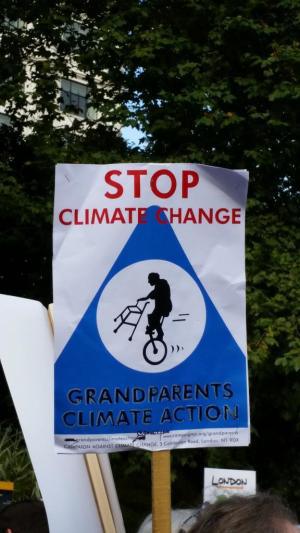
The People’s Climate March, which is happening not only in New York City but worldwide, with 2,808 marches and events in 166 countries, bears welcome witness to the fact that the sparks of creative, independent thinking have not totally gone out.
There are many, many people worldwide who are aware, and aghast, at the failure of our political and business leaders to act in the best interests of the people and all the beautiful, innocent creatures who are slipping away into the night of extinction day by day due to the relentless human assault on our shared planet.
We are here, we are aware, and we are engaged. We are not going to stand by silently and let corporate greed and shortsightedness overwhelm us.
It is true that business and government have a stranglehold on official channels of communication, education and social change.
They control the curricula taught in our schools, what appears on our major media channels, and what projects and areas of creative exploration are funded. They keep us in line with the debt bondage of school loans, mortgages, car payments and the fear of not having enough money in the bank for a comfortable old age. We’re so busy running on the treadmills they’ve set up we have no time or energy to think about changing the system.
Or do we?
We saw it happen in the Arab Spring, where people used cell phones and texts to organize themselves to resist oppression.
We saw those people get beaten back, the promise of their revolution squashed by the entrenched power of men with guns and tear gas.
The rise of the Islamic State, like the rise of Al Quaeda and the Taliban, is all about conservative forces resisting change.
I am just as afraid of men with guns and tear gas as the next woman. I am happier making revolution on my laptop than in the streets. But at some point we have to come out from behind our screens, get off the treadmills of debt bondage, look around us at the beauty of the world, and say: this is what I want to live for, and this is what I’m willing to die for.
So far, the one social area that has not been overtaken by corporate/governmental control is the World Wide Web. It’s still a Wild West space, a place where you can find everything and everyone, from dangerous sadists to beneficent spiritual leaders. There’s room for every kind of idea out there to percolate through our collective consciousness. And make no mistake: the energy we’re seeing in the People’s Climate March is fueled in large part by the distribution power of the Web, the ability to get the word out and get people fired up to come together to take a stand.
Environmental activist and writer Terry Tempest Williams, in her book The Open Space of Democracy, says that the time has come to “move beyond what is comfortable” (81) in pursuit of what she calls a “spiritual democracy.”
“We have made the mistake of confusing democracy with capitalism and have mistaken political engagement with a political machinery we all understand to be corrupt,” she says.
“It is time to resist the simplistic, utilitarian view that what is good for business is good for humanity in all its complex web of relationships. A spiritual democracy is inspired by our own sense of what we can accomplish together, honoring an integrated society where the social, intellectual, physical and economic well-being of all is considered, not just the wealth and health of the corporate few” (87).
Williams calls for a radical recognition of the interdependence of all life on Earth. “The time has come to demand an end to the wholesale dismissal of the sacredness of life in all its variety and forms,” she says. “At what point do we finally lay our bodies down to say this blatant disregard for biology and wild lives is no longer acceptable?” (86)
If we humans could step into our destiny as the stewards of our planet, the loving gardeners and caretakers of all other living beings, we would harness our incredible intelligence and creativity to re-stabilize our climate and do what needs to be done to ensure the well-being of all.
Williams calls this “the next evolutionary leap” for humanity: “to recognize the restoration of democracy as the restoration of liberty and justice for all species, not just our own” (89).
If we are able to take this leap, we will not only avert climate-related disaster on a Biblical scale, we will also overcome many of the social problems that we currently struggle with. “To be in the service of something beyond ourselves—to be in the presence of something other than ourselves, together—this is where we can begin to craft a meaningful life where personal isolation and despair disappear through the shared engagement of a vibrant citizenry,” says Williams (89).
Williams’ small gem of a book grew out of a speech she gave at her alma mater, the University of Utah, in the spring of 2003, as America was rushing into its ill-conceived War on Terror in Iraq. She describes her heart pounding as she got up to make a speech advocating a different form of democracy than that embraced and espoused by all the conservative friends and family sitting in the audience before her.
Challenging one’s own friends and family, betraying one’s own tribe, is the hardest aspect of being a social revolutionary. You have to question the very people you love most, who have given you so much and made your whole life possible.
But if we become aware that the social systems that gave birth to us are the very social systems that are undermining the possibility of a livable future on this planet, can we continue to just go with the flow, to avoid asking the difficult questions?
Or will we become change agents who work slowly and steadily, drip by drip, to awaken those around us, those we love most, to the necessity of undertaking “the next evolutionary leap” in the human saga on the planet?
ooOOoo
From that BBC News website:
On Tuesday, the UN will host a climate summit at its headquarters in New York with 125 heads of state and government – the first such gathering since the unsuccessful climate conference in Copenhagen in 2009.
So world leaders, are you going to reflect the wishes of millions of your peoples across the world and step up to the mark? We will see.
A thank you to all those that work so hard to stop fires from getting out of control.
I am drafting this post at a little after noon on the 4th., i.e. early afternoon yesterday.
It is yet another dry, hot day in a long run of hot, dry days. Our local online weather service, GrantsPassWeather.com, informs me that the temperature this afternoon (i.e. yesterday) is forecast to be a high of 93 deg F. or 34 deg C. We last had monthly rain totals of more than an inch back in March. At the top of the home page of Grants Pass Weather is a bold red banner proclaiming a Red Flag Warning for three counties: Jackson, Josephine and Eastern Curry. We live in Josephine County and clicking that banner reveals:
Details:
…RED FLAG WARNING REMAINS IN EFFECT UNTIL 10 PM PDT THIS EVENING FOR COMBINATION OF STRONG WINDS AND LOW RELATIVE HUMIDITIES FOR FIRE WEATHER ZONES 280…281…617…619…620…621…622 AND 623…
* AFFECTED AREA: FIRE WEATHER ZONES 80…281…617…619…620…621…622 AND 623.
* HUMIDITY…MINIMUM RELATIVE HUMIDITY AT 10 TO 20 PERCENT FOLLOWED BY RECOVERIES TONIGHT AT 20 TO 40 PERCENT.
* WIND…NORTHEAST TO EAST WINDS 10 TO 20 MPH THROUGH THIS EVENING THEN 5 TO 15 MPH OVERNIGHT.
* IMPACTS…POSSIBLE PLUME DOMINATED BEHAVIOR ON ACTIVE FIRES AS STRONG WINDS AND LOW RELATIVE HUMIDITIES THROUGH THIS EVENING WILL CAUSE FIRES TO SPREAD VERY RAPIDLY.
STRONG WINDS AND LOW RELATIVE HUMIDITIES WILL CAUSE FIRES TO SPREAD VERY RAPIDLY.
Little after 7am a few weeks ago – looking out to North-East. Picture taken from the rear deck of our house near Merlin, Oregon.
Does this focus the mind? You bet! The trees in the foreground of the above photograph are within our property. Our house is surrounded by tall oaks, pines and fir trees.
Now stay with me through what, at first, may seem like a disconnected change of topic.
Long, long time ago Jean met Ira Weisenfeld, a young vet making his way in the world. Jean’s passion for rescuing feral street dogs meant that she was a more active user of a vet’s services than the average pet owner. Jean and Ira became very good friends.
Earlier on this year, we had the pleasure of the company of Ira’s daughter, Amber, who came to see us with the man in her life, Ben Elkind.
Fast forward to the 1st September and Amber sent us the following email:
Hello Paul and Jean!
Hope you guys are doing well. Here is a BBC story about smokejumpers in Redding, CA where Ben works, he is interviewed too. Thought you might like it! Hope you had a wonderful summer. I just finished the boundary water canoe trip with Dad, it was very good.
Take care,
Amber
Forest fires kept at bay in US by elite ‘smokejumpers’
26 August 2014 Last updated at 00:48 BST
The drought that has gripped much of the American West shows no sign of abating – yet despite the tinder-box conditions, so far less land in the region has been lost to wildfires in 2014 than in recent years.
That is partly due to an aggressive strategy to stop smaller forest fires before they become too big to handle.
At the frontline of this effort are the smokejumpers, airborne firefighters who parachute into the wilderness to get the blazes under control.
It’s a dangerous job for an elite group of highly-trained men and women. The BBC spoke to three smokejumpers – Ben Elkind, Gretchen Stumhofer and Luis Gomez – at their base in Redding, California.
Produced by the BBC’s Jack Garland.
Additional footage courtesy of Ben Elkind and Tye Erwin
New studies indicate the complex language used by animals.
There is so much of interest ‘out there’ that one could spend every hour of the day just reading and learning. Here’s a wonderful example.
Via a route that now escapes me, recently I came across a report entitled, The ABC’s of animal speech: Not so random after all. It was published on the PHYS.ORG website and knowing the leanings of readers of Learning from Dogs, I am confident that republishing it will be of interest to many.
The calls of many animals, from whales to wolves, might contain more language-like structure than previously thought, according to study that raises new questions about the evolutionary origins of human language.
The study, published today [August 20th] in the journal Proceedings of the Royal Society B, analyzed the vocal sequences of seven different species of birds and mammals and found that the vocal sequences produced by the animals appear to be generated by complex statistical processes, more akin to human language.
Many species of animals produce complex vocalizations – consider the mockingbird, for example, which can mimic over 100 distinct song types of different species, or the rock hyrax, whose long string of wails, chucks and snorts signify male territory. But while the vocalizations suggest language-like characteristics, scientists have found it difficult to define and identify the complexity.
Typically, scientists have assumed that the sequence of animal calls is generated by a simple random process, called a “Markov process.” Using the Markov process to examine animal vocalization means that the sequence of variables—in this case, the vocal elements—is dependent only on a finite number of preceding vocal elements, making the process fairly random and far different from the complexity inherent in human language.
Yet, assuming a Markov process exists raises questions about the evolutionary path of animal language to human language—if animal vocal sequences are Markovian, how did human language evolve so quickly from its animal origins?
In this Science Minute from NIMBioS, Dr. Arik Kershenbaum explains new research that suggests the calls of many animals might contain more language-like structure than previously thought. Credit: NIMBioS
Indeed, the study found no evidence for a Markovian process. The researchers used mathematical models to analyze the vocal sequences of chickadees, finches, bats, orangutans, killer whales, pilot whales and hyraxes, and found most of the vocal sequences were more consistent with statistical models that are more complex than Markov processes and more language-like.
Human language uses what’s called “context-free grammars,” whereby certain grammatical rules apply regardless of the context, whereas animal language uses simple or “regular” grammar, which is much more restrictive. The Markov process is the most common model used to examine animal vocal sequences, which assumes that a future occurrence of a vocal element is entirely determined by a finite number of past vocal occurrences.
The findings suggests there may be an intermediate step on the evolutionary path between the regular grammar of animal communication and the context-free grammar of human language that has not yet been identified and explored.
“Language is the biggest difference that separates humans from animals evolutionarily, but multiple studies are finding more and more stepping stones that seem to bridge this gap. Uncovering the process underlying vocal sequence generation in animals may be critical to our understanding of the origin of language,” said lead author Arik Kershenbaum, a postdoctoral fellow at the National Institute for Mathematical and Biological Synthesis.
More information: Kershenbaum A, Bowles A, Freeburg T, Dezhe J, Lameira A, Bohn K. 2014. Animal vocal sequences: Not the Markov chains we thought they were. Proceedings of the Royal Society B. rspb.royalsocietypublishing.or… .1098/rspb.2014.1370
If you wanted a reminder to be careful about what you say in front of the animals, then that study underlines that in spades, as does the closing picture!
I have written previously on Learning from Dogs about the future having to be local if we are to stand any chance of coping with what is ahead. So it was a delight to read this post from Alex’s blog The Liberated Way. In my opinion, Alex is spot on the mark.
ooOOoo
The rise of localism
Posted on August 6, 2014
Globalism and central control is coming to an end.
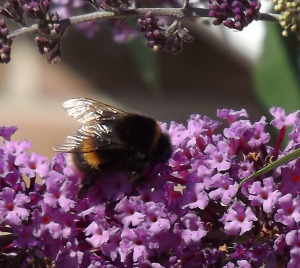
Bees are localised, sustainable and self-reliant, something humanity will learn the hard way.
The first of a series of debates on Scottish independence from the UK took place yesterday, the vote for independence takes place next month. The campaign for Scottish independence is part of a larger paradigm shift away from globalism to localism around the world. Cornwall, Wales, Mercia, Yorkshire and Wessex are all campaigning for independence in the UK. Even in my town of Colchester we want to take back control of highways from external authorities.
The European elections this year resulted in a surge in anti-EU nationalistic parties doing well. UKIP which wants the UK to leave the EU was the clear winner in the UK in the European elections. The UN is increasingly seen as ineffective in the face of international crisis, often used by a few powerful nations, and ignored by practically everyone. Israel recently expressed the contempt nations now have for the UN by bombing UN schools in Gaza.
The USSR has broken up into small nations, as has Yugoslavia. Sudan split into two and Georgia into three nations. There is talk of California in the USA breaking into six states, and a growing but still small movements for other states breaking away from the Union altogether. The fighting in East Ukraine is as much about local Russians wanting to determine their own future as the international games of chess between the superpowers.
Flanders is seeking to break from Belgium; Catalonia and the Basque Country want to break from Spain; the city of Venice wants to break from Italy; Quebec is looking to break from Canada; Kurdistan and many other Peoples are seeking to form their own nation states out of the chaos of Iraq, Syria and Libya.
New forms of local currency such as the Totnes pound and electronic currencies such as Bitcoin challenge the bankers. Until recently my local council Essex Council was talking about creating its own bank for local people. Corporates such as Starbucks are considering creating their own currencies, in effect becoming their own banks. Multiple non-banking payment systems such as PayPal are now part of internet commerce. In the face of sanctions Russia has created their own version of VISA for citizens to pay their bills.
The internet has helped to break up the power of information monopolies where the citizen blogger is as effective as a journalist in the New York Times. The internet places greater power in the hands of the individual on the local level.
Water, energy, food and debt are the four great forces now driving the world politically, economically and socially. The many chasing a diminishing amount of resources drives people to fight or conserve their resources. Huge growing public and private debt is destroying nation states, driving the momentum to think local rather than global. The Greek economic crisis drove local people back to the land, to become self-sufficient, and create systems of trade outside of the global financial system.
I support localism, and I designed my business with localism in mind. The growing international crisis will force people to become local, sustainable and self-reliant. As the money runs out nations, communities and individuals will quickly learn that it is down to themselves to live or die.
I’m preparing this post on Sunday; i.e. three days ago. Reason is that my sister, Elizabeth, and friend, Merle, are arriving on Monday afternoon (as in two days ago) bringing us up to three guests in the house. My mother leaves on tomorrow morning and then Elizabeth and Merle depart on Friday morning. So for all the right reasons, Learning from Dogs is taking a backstage. Hence me doing as much as I can ahead of time.
In Monday’s post, The tracks we leave, towards the end I wrote, “The utter madness of mankind’s group blindness is beyond comprehension.” Many know that there is something very badly wrong with the way politics is operating today. Yet, at the same time, many intuitively know the political changes that mankind has to see if there is to be any chance of a sustainable future for mankind on this planet.
Thus George Monbiot’s essay published on the 29th July makes encouraging reading in the context of the growing confidence of the UK Green Party. It is republished here with the kind permission of George Monbiot.
ooOOoo
Unmasked
July 29, 2014
The justifications for extreme inequality have collapsed. But only the Green Party is prepared to take the obvious step
By George Monbiot, published in the Guardian 30th July 2014
When inequality reaches extreme and destructive levels, most governments seek not to confront it but to accommodate it. Wherever wealth is absurdly concentrated, new laws arise to protect it.
In Britain, for example, successive governments have privatised any public asset which excites corporate greed. They have cut taxes on capital and high incomes. They have legalised new forms of tax avoidance (1). They have delivered exotic gifts like subsidised shotgun licences and the doubling of state support for grouse moors (2). And they have dug a legal moat around the charmed circle, criminalising, for example, the squatting of empty buildings (3) and most forms of peaceful protest (4). However grotesque inequality becomes, however closely the accumulation of inordinate wealth resembles legalised theft, political norms shift to defend it.
None of this should surprise you. The richer the elite becomes, and the more it has to lose, the greater the effort it makes to capture public discourse and the political system. It scarcely bothers to disguise its wholesale purchase of political parties, by means of an utterly corrupt and corrupting funding system (5,6). You can feel its grip not only on policy but also on the choice of parliamentary candidates and appointments to the cabinet. The very rich want people like themselves in power, which is why we have a government of millionaires (7).
But that describes only one corner of their influence. They fund lobby groups, thinktanks and economists to devise ever more elaborate justifications for their seizure of the nation’s wealth (8). These justifications are then amplified by the newspapers and broadcasters owned by the same elite.
Among the many good points Thomas Piketty makes in Capital in the 21st Century – his world-changing but surprisingly mild book – is that extreme inequality can be sustained politically only through an “apparatus of justification.” (9) If voters can be persuaded that insane levels of inequality are sane, reasonable and even necessary, then the concentration of income can keep growing. If they can’t, then either states are forced to act, or revolutions happen.
For the notion that inequalities must be justified sits at the heart of democracy. It is possible to accept that some can have much more than others if one of two conditions are met: either that they reached this position through the exercise of their unique and remarkable talent; or that this inequality is good for everyone. So the network of think tanks, economists and tame journalists must make these justifications plausible.
It’s a tough job. If wages reflect merit, why do they seem so arbitrary? Are the richest executives 50 or 100 times better at their jobs than their predecessors were in 1980? Are they 20 times more skilled and educated than the people immediately below them, even though they went to the same business schools? Are US executives several times as creative and dynamic as those in Germany? If so, why are their results so unremarkable?
It is, of course, all rubbish. What we see is not meritocracy at work at all, but a wealth grab by a nepotistic executive class which sets its own salaries, tests credulity with its ridiculous demands and discovers that credulity is an amenable customer. They must marvel at how they get away with it.
Moreover, as education and even (in the age of the intern) work becomes more expensive, the opportunities to enter the grabbers’ class diminish. The nations which pay the highest top salaries, such as the US and Britain, are also among the least socially mobile (10). Here, you inherit not only wealth but opportunity.
Aha, they say, but extreme wealth is good for all of us. All will be uplifted by their god’s invisible hand. Their creed is based on the Kuznet’s curve, the graph which appears to show that inequality automatically declines as capitalism advances, spreading wealth from the elite to the rest.
When Piketty took the trouble to update the curve, which was first proposed in 1955, he discovered that the redistribution it documented was an artefact of the peculiar circumstances of its time. Since then the concentration of wealth has reasserted itself with a vengeance (11). The reduction in inequality by 1955 was not an automatic and inherent feature of capitalism, but the result of two world wars, a great depression and the fierce response of governments to these disruptions.
For example, the top federal income tax rate in the US rose from 25% in 1932 to 94% in 1944. The average top rate throughout the years 1932 to 1980 was 81%. In the 1940s, the British government imposed a top income tax of 98% (12). The invisible hand? Hahaha. As these taxes were slashed by Reagan and Thatcher and the rest, inequality boomed once more, and is exploding today. This is why the neoliberals hate Piketty with such passion and poison: he has destroyed with data the two great arguments with which the apparatus of justification seeks to excuse the inexcusable.
So here we have a perfect opportunity for progressive parties: the moral and ideological collapse of the system of thought to which they were previously in thrall. What do they do? Avoid the opportunity like diphtheria. Cowed by the infrastructure of purchased argument, Labour fiddles and dithers (13).
But there is another party, which seems to have discovered the fire and passion that moved Labour so long ago: the Greens. Last week they revealed that their manifesto for the general election will propose a living wage, the renationalisation of the railways, a maximum pay ratio (no executive should receive more than 10 times the salary of the lowest paid worker), and, at the heart of their reforms, a wealth tax of the kind Piketty recommends (14).
Yes, it raises plenty of questions, but none of them are unanswerable, especially if this is seen as one step towards the ideal position: a global wealth tax, that treats capital equally, wherever it might lodge. Rough as this proposal is, it will start to challenge the political consensus and draw people who thought they had nowhere to turn. Expect the billionaires’ boot boys to start screaming, once they absorb the implications. And take their boos and jeers as confirmation that it’s onto something. You wanted a progressive alternative? You’ve got it.
My draft book of the same name as this blog is slowly coming together and I’m at the 30,000-word mark. A while ago, John Hurlburt, a good friend of this blog, was chatting to me and he spoke about the “interconnectedness of all conscious life”. It immediately appealed to me as a chapter in the book.
But while it was obvious to me that all conscious life is connected, for some time I struggled to achieve any clarity about what I wanted to write. Seeing that proverb kicked off the journey towards clarity.
Thus, today, I wanted to share the steps of that journey so far.
Over on the Skeptical Science blogsite there is a post, dated 15th April, 2010, with the title of Earth’s five mass extinction events. The author, John Cook, opens:
As climate changes, a major question is whether nature can adapt to the changing conditions? The answer lies in the past. Throughout Earth’s history, there have been periods where climate changed dramatically. The response was mass extinction events, when many species went extinct followed by a very slow recovery. The history of coral reefs gives us an insight into the nature of these events as reefs are so enduring and the fossil record of corals is relatively well known (Veron 2008). What we find is reefs were particularly impacted in mass extinctions, taking many millions of years to recover. These intervals are known as “reef gaps”.
Figure 1: Timeline of mass extinction events. The five named vertical bars indicate mass extinction events. Black rectangles (drawn to scale) represent global reef gaps and brick-pattern shapes show times of prolific reef growth (Veron 2008).
So what, one might ask?
Well, forget about millions of years ago. Just 12 days ago, there was a news item released by Stanford University. It read in full:
July 24, 2014
Stanford biologist warns of early stages of Earth’s 6th mass extinction event
Stanford Biology Professor Rodolfo Dirzo and his colleagues warn that this “defaunation” could have harmful downstream effects on human health.
The planet’s current biodiversity, the product of 3.5 billion years of evolutionary trial and error, is the highest in the history of life. But it may be reaching a tipping point.
In a new review of scientific literature and analysis of data published in Science, an international team of scientists cautions that the loss and decline of animals is contributing to what
Elephants and other large animals face an increased risk of extinction in what Stanford Biology Professor Rodolfo Dirzo terms “defaunation.” (Claudia Paulussen/Shutterstock)
appears to be the early days of the planet’s sixth mass biological extinction event.
Since 1500, more than 320 terrestrial vertebrates have become extinct. Populations of the remaining species show a 25 percent average decline in abundance. The situation is similarly dire for invertebrate animal life.
And while previous extinctions have been driven by natural planetary transformations or catastrophic asteroid strikes, the current die-off can be associated to human activity, a situation that the lead author Rodolfo Dirzo, a professor of biology at Stanford, designates an era of “Anthropocene defaunation.”
Across vertebrates, 16 to 33 percent of all species are estimated to be globally threatened or endangered. Large animals – described as megafauna and including elephants, rhinoceroses, polar bears and countless other species worldwide – face the highest rate of decline, a trend that matches previous extinction events.
Larger animals tend to have lower population growth rates and produce fewer offspring. They need larger habitat areas to maintain viable populations. Their size and meat mass make them easier and more attractive hunting targets for humans.
Although these species represent a relatively low percentage of the animals at risk, their loss would have trickle-down effects that could shake the stability of other species and, in some cases, even human health.
For instance, previous experiments conducted in Kenya have isolated patches of land from megafauna such as zebras, giraffes and elephants, and observed how an ecosystem reacts to the removal of its largest species. Rather quickly, these areas become overwhelmed with rodents. Grass and shrubs increase and the rate of soil compaction decreases. Seeds and shelter become more easily available, and the risk of predation drops.
Consequently, the number of rodents doubles – and so does the abundance of the disease-carrying ectoparasites that they harbor.
“Where human density is high, you get high rates of defaunation, high incidence of rodents, and thus high levels of pathogens, which increases the risks of disease transmission,” said Dirzo, who is also a senior fellow at the Stanford Woods Institute for the Environment. “Who would have thought that just defaunation would have all these dramatic consequences? But it can be a vicious circle.”
The scientists also detailed a troubling trend in invertebrate defaunation. Human population has doubled in the past 35 years; in the same period, the number of invertebrate animals – such as beetles, butterflies, spiders and worms – has decreased by 45 percent.
As with larger animals, the loss is driven primarily by loss of habitat and global climate disruption, and could have trickle-up effects in our everyday lives.
For instance, insects pollinate roughly 75 percent of the world’s food crops, an estimated 10 percent of the economic value of the world’s food supply. Insects also play a critical role in nutrient cycling and decomposing organic materials, which helps ensure ecosystem productivity. In the United States alone, the value of pest control by native predators is estimated at $4.5 billion annually.
Dirzo said that the solutions are complicated. Immediately reducing rates of habitat change and overexploitation would help, but these approaches need to be tailored to individual regions and situations. He said he hopes that raising awareness of the ongoing mass extinction – and not just of large, charismatic species – and its associated consequences will help spur change.
“We tend to think about extinction as loss of a species from the face of Earth, and that’s very important, but there’s a loss of critical ecosystem functioning in which animals play a central role that we need to pay attention to as well,” Dirzo said. “Ironically, we have long considered that defaunation is a cryptic phenomenon, but I think we will end up with a situation that is non-cryptic because of the increasingly obvious consequences to the planet and to human wellbeing.”
The coauthors on the report include Hillary S. Young, University of California, Santa Barbara; Mauro Galetti, Universidade Estadual Paulista in Brazil; Gerardo Ceballos, Universidad Nacional Autonoma de Mexico; Nick J.B. Isaac, of the Natural Environment Research Council Centre for Ecology and Hydrology in England; and Ben Collen, of University College London.
For more Stanford experts on ecology and other topics, visit Stanford Experts.
It hardly requires any imagination to realise that what we humans need in order to live, air, food, and clean water, is utterly dependant on us humans caring for the planet that sustains us. It’s all too easy just to take for granted that we will always have air, food and clean water. Now go back and read that last sentence from Professor Dirzo. [my emphasis]
We tend to think about extinction as loss of a species from the face of Earth, and that’s very important, but there’s a loss of critical ecosystem functioning in which animals play a central role that we need to pay attention to as well. Ironically, we have long considered that defaunation is a cryptic phenomenon, but I think we will end up with a situation that is non-cryptic because of the increasingly obvious consequences to the planet and to human wellbeing.
The tracks we leave! H’mmm.
Let me move on in my journey.
Over on the EarthSky blogsite there was an item about the mysterious giant crater that appeared suddenly in Siberia.
Mystery crater in Yamal peninsula probably caused by methane release
Thawing permafrost likely allowed methane gas to be released, creating the large hole in permafrost found in northern Russia, says the Russian team that investigated it.
UPDATE July 31, 2014.
Stories are popping up fast in various media this afternoon about a likely source of a reported, mysterious hole in permafrost in the Yamal region of northern Russia. This hole was
The first mysterious crater spotted by helicopter in the Yamal region of northern Russia. Image via Nature.
spotted by a helicopter pilot in mid-July; reindeer herders reported a second hole some days later. Eric Holthaus of Slate said that there is now:
… new (and definitive) evidence … that the Siberian holes were created via methane released from warming permafrost.
The evidence has come via the journal Nature, which published a story on its website today (July 31) featuring the findings of Andrei Plekhanov, a senior researcher at the Scientific Centre of Arctic Studies in Salekhard, Russia, and his team. This is the team that was sent in to investigate the first hole shortly after it was found. Holthaus said:
That team measured methane concentrations up to 50,000 times standard levels inside the crater.
The story in Nature said:
Air near the bottom of the crater contained unusually high concentrations of methane — up to 9.6% — in tests conducted at the site on 16 July … Plekhanov, who led an expedition to the crater, says that air normally contains just 0.000179% methane …
Plekhanov and his team believe that it is linked to the abnormally hot Yamal summers of 2012 and 2013, which were warmer than usual by an average of about 5°C. As temperatures rose, the researchers suggest, permafrost thawed and collapsed, releasing methane that had been trapped in the icy ground.
Holthaus pointed out:
Last week, the New York Times’ Andrew Revkin interviewed a Russian scientist who had also visited the hole and came to similar conclusions.
This newly reported evidence, just coming to light today, seems particularly scary given the story earlier this week about what the University of Stockholm called “vast methane plumes” found by scientists aboard the icebreaker Oden, which is now exploring and measuring methane release from the floor of the Arctic Ocean.
Build-up and release of gas from thawing permafrost most probable explanation, says Russian team.
My last step in the journey about our interconnectedness involves water.
Water scarcity may be the most underrated resource issue the world is facing today.
Seventy percent of world water use is for irrigation.
Each day we drink nearly 4 liters of water, but it takes some 2,000 liters of water — 500 times as much — to produce the food we consume.
1,000 tons of water is used to produce 1 ton of grain.
Between 1950 and 2000, the world’s irrigated area tripled to roughly 700 million acres. After several decades of rapid increase, however, the growth has slowed dramatically, expanding only 9 percent from 2000 to 2009. Given that governments are much more likely to report increases than decreases, the recent net growth may be even smaller.
The dramatic loss of momentum in irrigation expansion coupled with the depletion of underground water resources suggests that peak water may now be on our doorstep.
Today some 18 countries, containing half the world’s people, are overpumping their aquifers. Among these are the big three grain producers — China, India, and the United States.
Saudi Arabia is the first country to publicly predict how aquifer depletion will reduce its grain harvest. It will soon be totally dependent on imports from the world market or overseas farming projects for its grain.
While falling water tables are largely hidden, rivers that run dry or are reduced to a trickle before reaching the sea are highly visible. Among this group that has limited outflow during at least part of the year are the Colorado, the major river in the southwestern United States; the Yellow, the largest river in northern China; the Nile, the lifeline of Egypt; the Indus, which supplies most of Pakistan’s irrigation water; and the Ganges in India’s densely populated Gangetic basin.
(The rest of this important article including the many useful links may be read here.)
Now, despite the despondent theme of the contents of this post, I am not beating a ‘doom and gloom’ drum. What I am trying to point out is that we are all interconnected. Not just all of mankind but all conscious life. Ergo, the destruction of natural habitats, the loss of every species, even the unwarranted killing of a wild animal is, in a very real and tangible way, the destruction of our habitat, the loss of our species and the unwarranted killing of future generations of homo sapiens.
It seems that whichever way we look the interconnectedness of all conscious life is staring us full in the face. The utter madness of mankind’s group blindness is beyond comprehension.
It takes an ancient proverb from a people that lived in harmony with the planet to speak the truth. We ignore it at our peril.
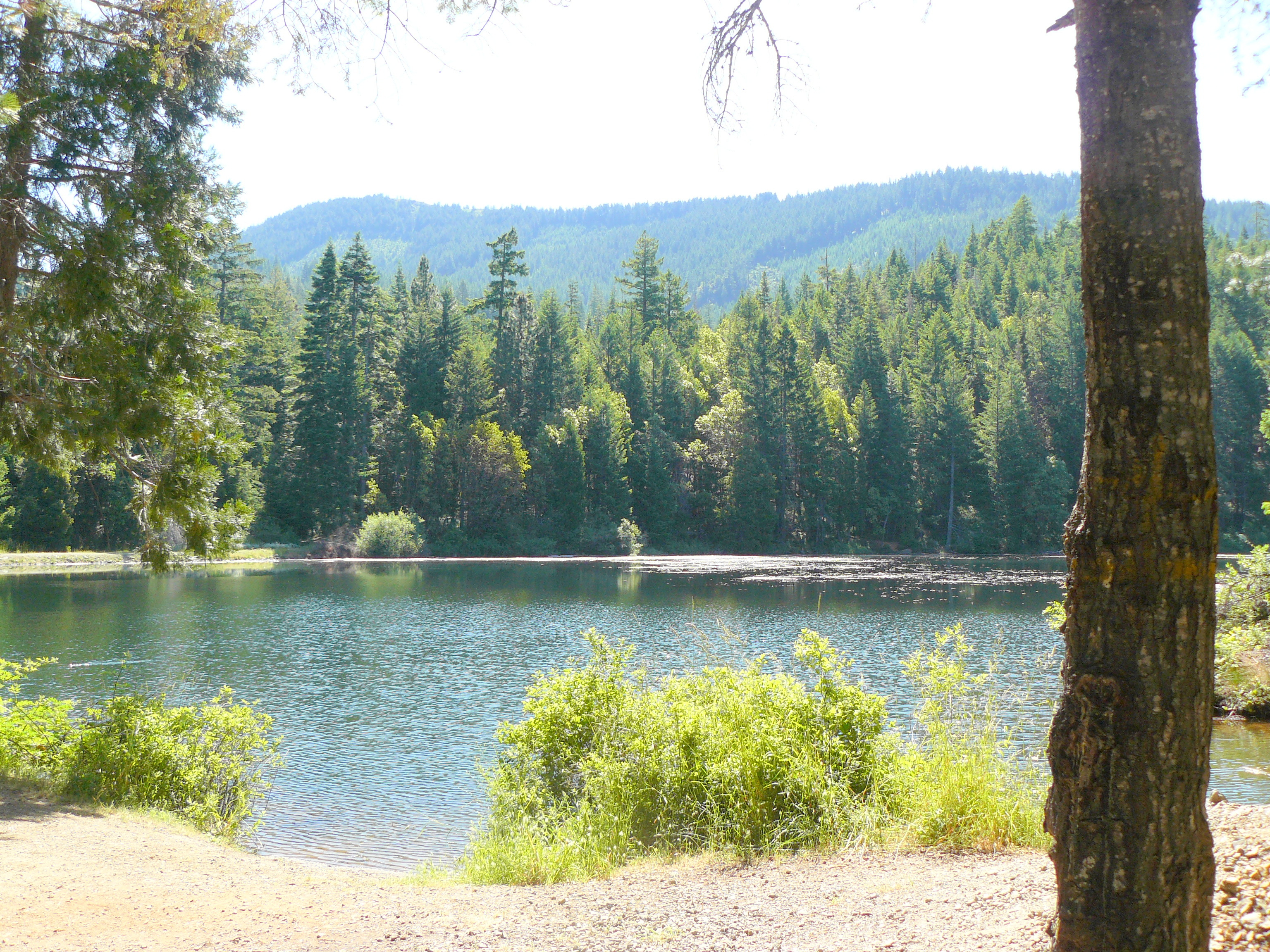
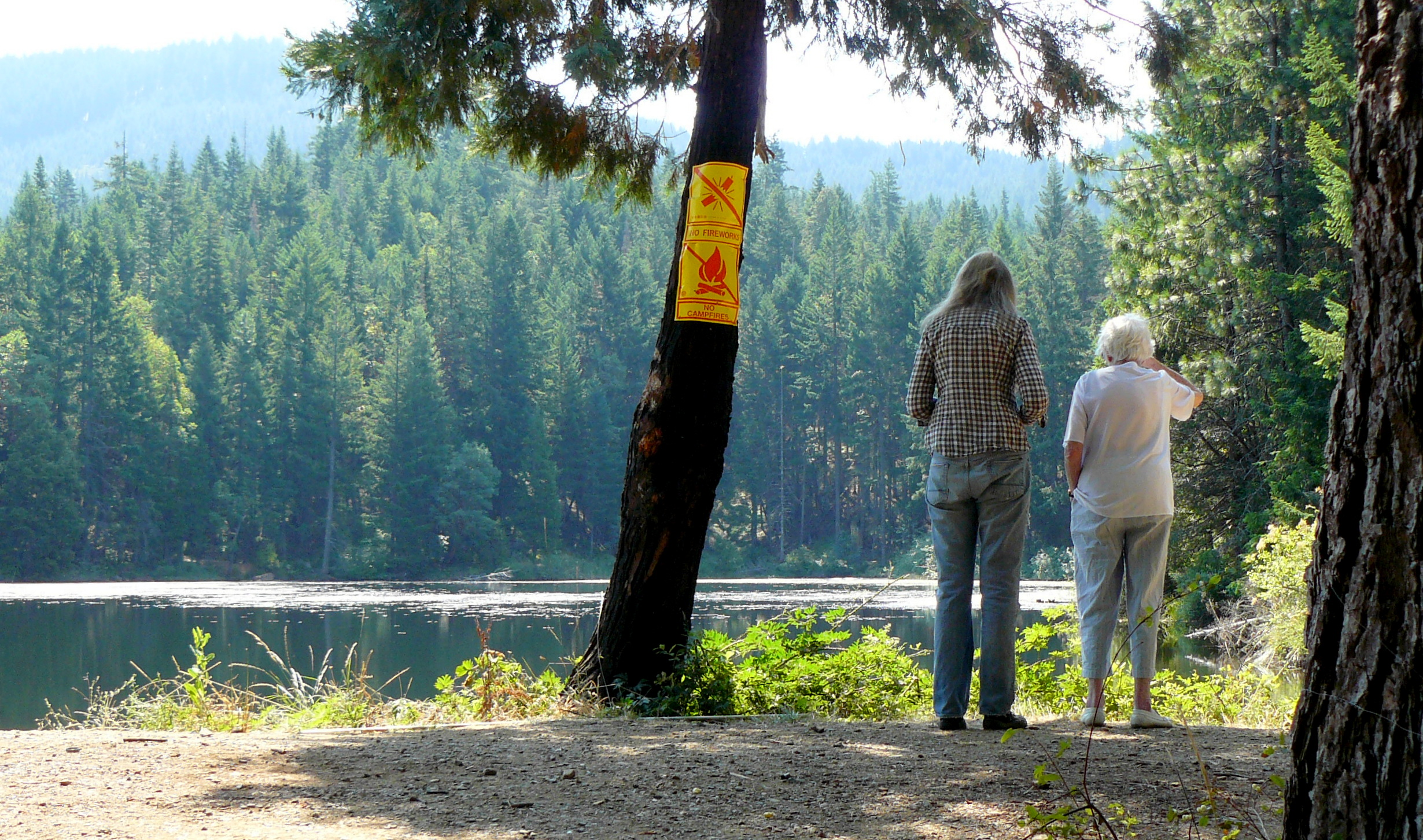
Many of you will know that Elizabeth, my mother from North-West London, is staying with us for a short while. Last Friday, it was decided to drive the 20 miles to the North and along Speaker Road into BLM land and thence up to Secesh Reservoir. This beautiful spot was previously written about in June when we first went to find Secesh. It seemed a perfect spot to take my mother.
Secesh Reservoir.
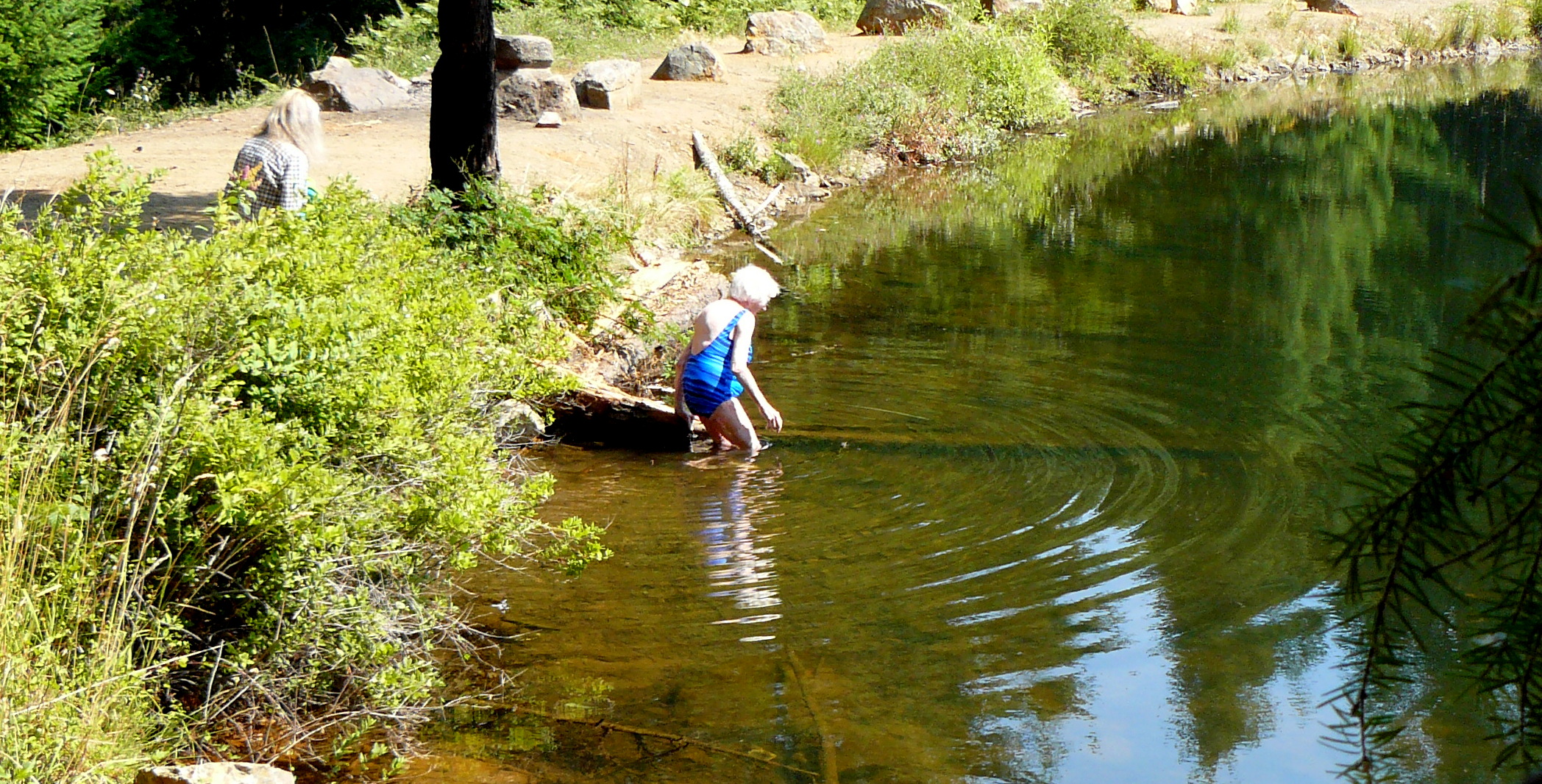
What neither Jean nor I had anticipated was that my mother was determined to swim in Secesh; the remote reservoir is at an altitude of 2,870 feet.
Checking out the best way in!
oooo
Gently does it!
oooo
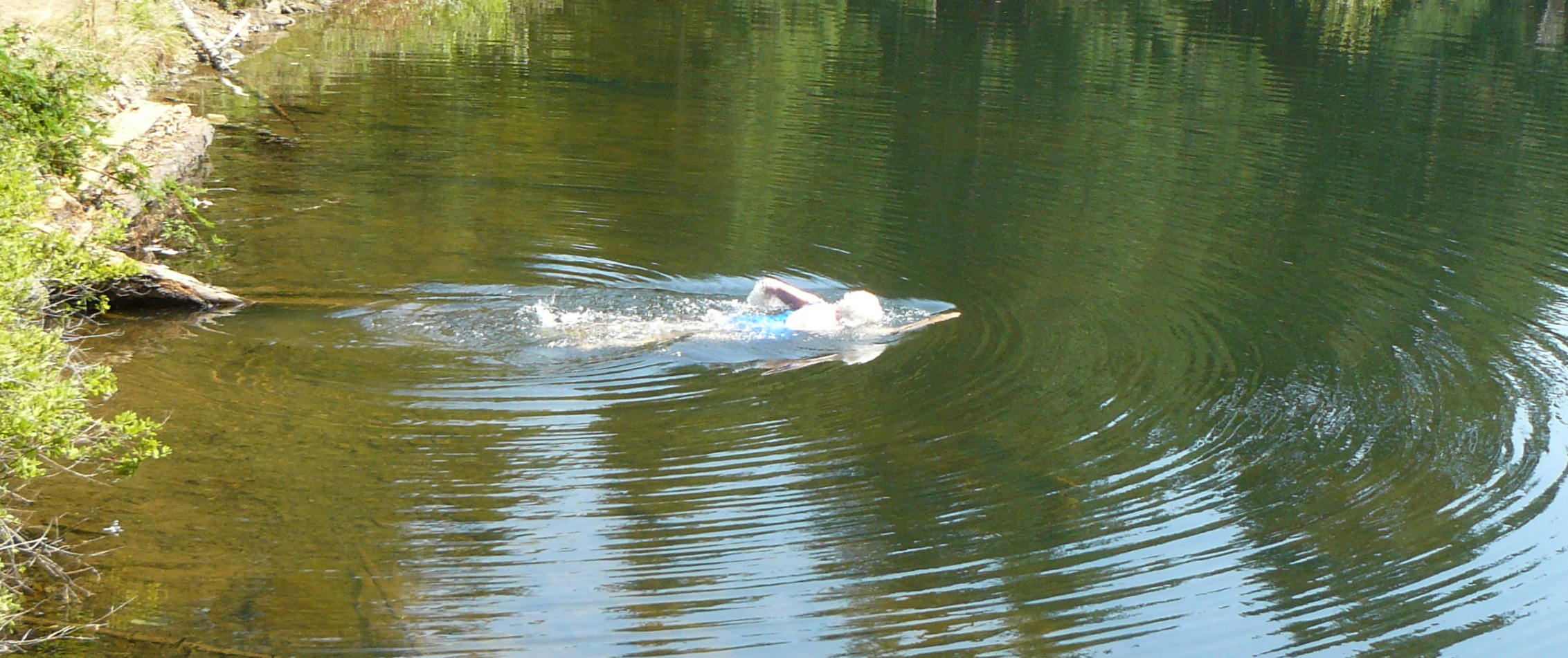
And away we go!
oooo
Fearless!
oooo
And safely back to the shore.
oooo
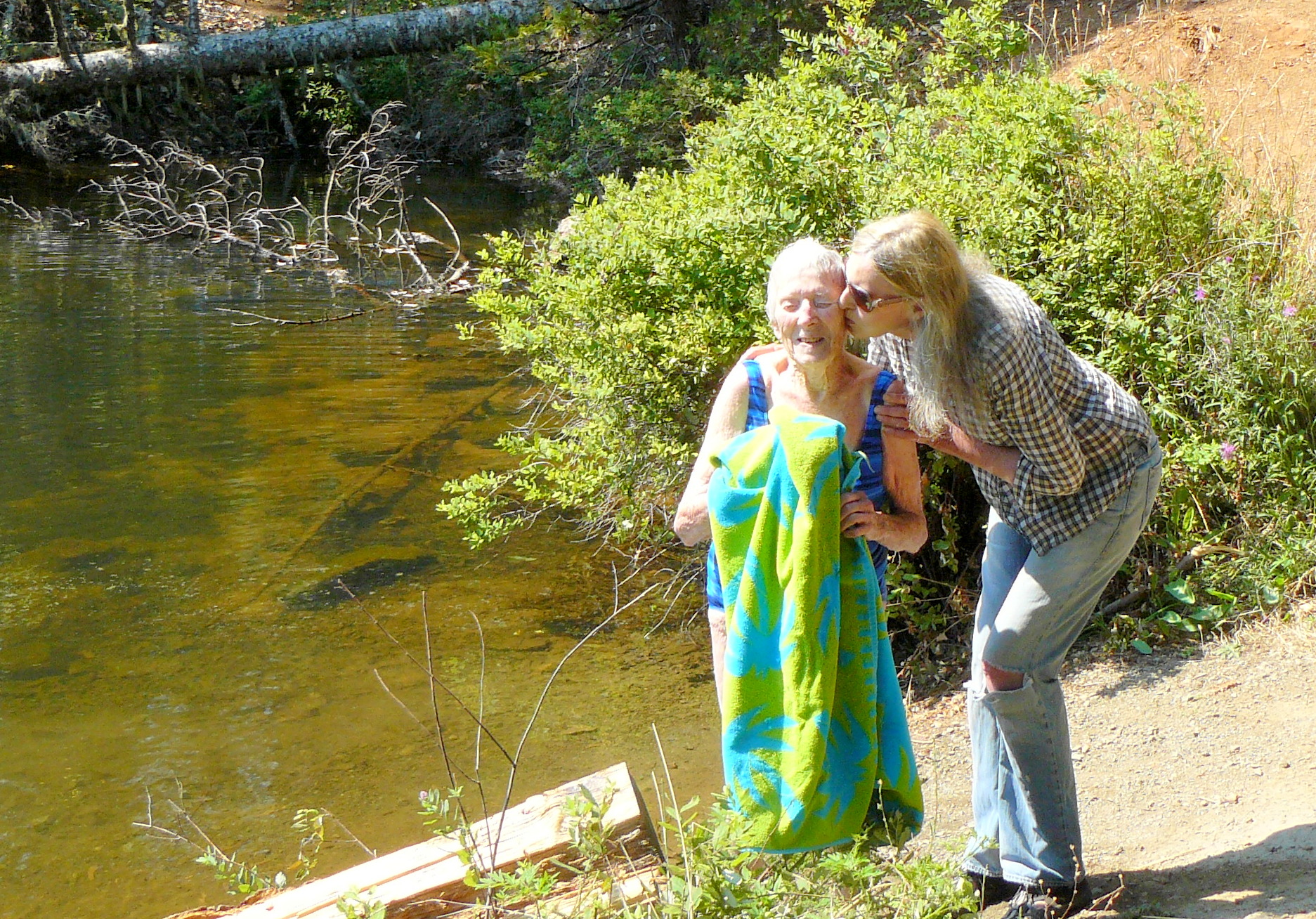
Jean expressing her love and admiration.
oooo
All good things come to a close.
oooo
Pity about the traffic noise! 😉
Oh, nearly forgot to mention that Elizabeth was born in 1919! That’s 94, by the way!
As I said in the sub-title, this takes some beating!
Jealous wags: Dogs show envy is ‘primordial’ emotion
By Matt McGrath – Environment correspondent, BBC News
These border collies inspired the study on jealousy in dogs.
Jealousy is not just a human condition according to researchers, as it appears to be hard wired into the brains of dogs as well.
Scientists in California found that canines succumbed to the green eyed monster when their owners showed affection to a stuffed dog in tests.
Some experts have argued that jealousy requires complex cognition and is unique to people.
But the authors say their work shows it may also come in a more basic form.
These findings probably won’t be a major surprise to anyone who’s ever owned a dog, but the team say this is the first experimental test of jealous behaviours in man’s best friend.
Human jealousy is a complicated emotion, requiring a “social triangle” and usually arising when an interloper threatens an important relationship.
It is said to be the third leading cause of non-accidental homicide across cultures.
Building on research that shows that six month old infants display jealousy, the scientists studied 36 dogs in their homes and video recorded their actions when their owners displayed affection to a realistic-looking stuffed canine.
Faux fido
Over three quarters of the dogs were likely to push or touch the owner when they interacted with the decoy.
The envious mutts were more than three times as likely to do this for interactions with the stuffed dog compared to when their owners gave their attention to other objects including a book.
Around a third tried to get between the owner and the faux fido, while a quarter of the put-upon pooches snapped at the dummy dog.
“Our study suggests not only that dogs do engage in what appear to be jealous behaviours but also that they were seeking to break up the connection between the owner and a seeming rival,” said Prof Christine Harris from University of California in San Diego.
“We can’t really speak to the dogs’ subjective experiences, of course, but it looks as though they were motivated to protect an important social relationship.”
The researchers believe that the dogs understood that the stuffed dog was real. The authors cite the fact that 86% of the dogs sniffed the toy’s rear end, during and after the experiment.
Jealousy, according to the authors, may have evolved in species that have multiple dependent young that concurrently compete for food and affection.
The argue that jealousy might give an advantage to a young animal that is not only alert to the interactions between its siblings and its parents but is motivated to intervene.
“Many people have assumed that jealousy is a social construction of human beings – or that it’s an emotion specifically tied to sexual and romantic relationships,” said Prof Harris.
“Our results challenge these ideas, showing that animals besides ourselves display strong distress whenever a rival usurps a loved one’s affection.”