Category: Core thought

The book! Part Three: Greed, inequality and poverty

Note:

I read this out aloud to Jeannie last night, as I do with every post that is published, and found this chapter really didn’t flow.  I’m making the mistake of including too many words of direct quotations, many of which are not easy to follow.

So just wanted to let you know that if this strikes you the same way, you are not alone! 😉

It is, of course, just the first draft, but nonetheless …. wanted you to read this first.

oooo

Greed, inequality and poverty

Just three words: greed; inequality; poverty.

Just three words that metaphorically come to me like a closed, round, wooden lid hiding a very deep, dark well. That lifting this particular lid, the metaphorical one, exposes an almost endless drop into the vastness of where our society appears to have fallen.

That this dark well, to stay with the metaphor, is lined with example after example of greed, inequality and poverty is a given.

One might conclude that examining any of those examples is pointless, not in terms of the reality of our world, but in terms of influencing the views of a reader. If you are a reader who is uncertain about the current levels of greed, inequality and poverty then it’s unlikely that a few examples, or a few hundred examples, are going to change minds. (One might argue that you wouldn’t be reading this book in the first place!)

Thus when I was digging around, looking for insight into how and why we, as in society, are in such times, I was looking for core evidence. Very quickly, it struck me that the chapter title really should simply have been: Inequality. Because inequality, by implication, is the result of greed and results in poverty.

In November, 2014, at the time I was drafting this book, a new report was issued by the Center of Economic Policy Research (CEPR) on the latest (American) Survey of Consumer Finances. It painted a picture very familiar to many: the rich becoming richer while those with less wealth are falling further and further behind.

David Rosnick of the CEPR, and one of the report co-authors, made this important observation:

The decline in the position of typical households is even worse than the Consumer Finances survey indicates. In 1989, many workers had pensions. Far fewer do now. The value of pensions isn’t included in these surveys due to the difficulty of determining what they are worth on a current basis. But they clearly are significant assets that relatively few working age people have now.

Sharmini Peries, of The Real News Network, in an interview with David Rosnick, asked:

PERIES: David, just quickly explain to us what is the Consumer Finance Survey. I know it’s an important survey for economists, but why is it important to ordinary people? Why is it important to us?

ROSNICK: So, every three years, the Federal Reserve interviews a number of households to get an idea of what their finances are like, do they have a lot of wealth, how much are their house’s worth, how much they owe on their mortgages, how much they have in the bank account, how much stocks do wealthy people own. This gives us an idea of their situations, whether they’re going to be prepared for retirement. And we can see things like the effect of the housing and stock bubbles on people’s wealth, whether they’ve been preparing for eventual downfalls, how they’ve reacted to various economic circumstances, how they’re looking to the long term. So it’s a very useful survey in terms of finding out how households are prepared and what the distribution of wealth is like.

PERIES: So your report is an analysis of the report. And what are your key findings?

ROSNICK: So, largely over the last 24 years there’s been a considerable increase in wealth on average, but it’s been very maldistributed. Households in the bottom half of the distribution have actually seen their wealth fall, but the people at the very top have actually done very well. And so that means that a lot of people who are nearing retirement at this point in time are actually not well prepared at all for retirement and are going to be very dependent on Social Security in order to make it through their retirement years.

PERIES: So, David, address the gap. You said there’s a great gap between those that are very wealthy and those that are not. Has this gap widened over this period?

ROSNICK: It absolutely has. As, say, the top 5 percent in wealth, the average wealth for people in the top 5 percent is about 66 percent higher in 2013, the last survey that was completed, compared to 1989. By comparison, for the bottom 20 percent, their wealth has actually fallen 420 percent. They basically had very little to start with, and now they have less than little.

PERIES: So the poorer is getting poorer and the richer is getting extremely richer.

ROSNICK: Very much so.

To my way of thinking, if in the period 1989 through to 2013 “the average wealth for (American) people in the top 5 percent is about 66 percent higher” and “for the bottom 20 percent, their wealth has actually fallen 420 percent” it’s very difficult not to see the hands of greed at work and a consequential devastating increase in inequality.

In other words, the previous few paragraphs seemed to present, and present clearly, the widening gap between the ‘haves’ and the ‘have-nots’, comparatively speaking, and that it was now time for society to understand the trends, to reflect on where this is taking us, if left unchallenged, and to push back as hard as we can both politically and socially.

I wrote that shortly before another item appeared in my email ‘in-box’ in the middle of November (2014), a further report about inequality that, frankly, emotionally speaking, just smacked me in the face. It seemed a critical addition to the picture I was endeavouring to present.

Namely, on the 13th October, 2014, the US edition of The Guardian newspaper published a story entitled: US wealth inequality – top 0.1% worth as much as the bottom 90%. The sub-heading enlarged the headline: Not since the Great Depression has wealth inequality in the US been so acute, new in-depth study finds.

The study referred to was a paper released by the National Bureau of Economic Research, Cambridge, MA, based on research conducted by Emmanuel Saez and Gabriel Zucman. The paper’s bland title belied the reality of the research findings: Wealth Inequality in the United States since 1913.

As the Guardian reported:

Wealth inequality in the US is at near record levels according to a new study by academics. Over the past three decades, the share of household wealth owned by the top 0.1% has increased from 7% to 22%. For the bottom 90% of families, a combination of rising debt, the collapse of the value of their assets during the financial crisis, and stagnant real wages have led to the erosion of wealth. The share of wealth owned by the top 0.1% is almost the same as the bottom 90%.

The picture actually improved in the aftermath of the 1930s Great Depression, with wealth inequality falling through to the late 1970s. It then started to rise again, with the share of total household wealth owned by the top 0.1% rising to 22% in 2012 from 7% in the late 1970s. The top 0.1% includes 160,000 families with total net assets of more than $20m (£13m) in 2012.

In contrast, the share of total US wealth owned by the bottom 90% of families fell from a peak of 36% in the mid-1980s, to 23% in 2012 – just one percentage point above the top 0.1%.

The report was not exclusively about the USA. As the closing paragraphs in The Guardian’s article illustrated:

Among the nine G20 countries with sufficient data, the richest 1% of people (by income) have increased their income share significantly since 1980, according to Oxfam. In Australia, for example, the top 1% earned 4.8% of the country’s income in 1980. That had risen to more than 9% by 2010.

Oxfam says that in the time that Australia has held the G20 presidency (between 2013 and 2014) the total wealth in the G20 increased by $17tn but the richest 1% of people in the G20 captured $6.2tn of this wealth – 36% of the total increase.

I find it incredibly difficult to have any rational response to those figures. I am just aware that there is a flurry of mixed emotions inside me and, perhaps, that’s how I should leave it. Nonetheless, there’s one thing that I can’t keep to myself and that this isn’t the first time that such inequality has arisen, the period leading up the the Great Depression of the 1930s comes immediately to mind, and I doubt very much that it will be the last.

Unless!

Unless the growing catalogue of unsustainable aspects of this 21st century, a few of which have been the focus of this Part Three, brings about, perhaps in many different ways, a force for change that is unstoppable.

But before that is explored in Part Four, there is the one final element of the greed, inequality and poverty theme of this chapter that must be aired; the issue of poverty.

Contrary to my anticipation, the figures for poverty trends can be read in many ways and don’t give a clear-cut uniform picture. Nevertheless, it does’t take a genius to work out that the future, especially for young people, could be alarming.

Today, the poor people are the young. Today, the young are heading into a future that has many frightening aspects.

Take the present population numbers, the mind-boggling scale of the use of energy in these times, not to mention the levels of debt across so many countries (on the 14th November, 2014, the Federal Debt of the USA was about $18,006,100,032,000), possible unsustainable global climate change trends, and is it any wonder that those born in the period 1928 to 1945 (I was born in 1944), the generation that has been called the Silent Generation, must be wondering what the future holds for their children and grandchildren and what they or anyone can do today and tomorrow, to prevent these future generations sinking into oblivion.

I came across a quotation from Simon Caulkin, the award winning management writer: “It’s all the product of human conduct!”

Yes, Simon is right. Only human conduct will find that sustainable, balanced relationship with each other and, critically, with the planet upon which all our futures depend. Yet, something nags at me; a half-conscious doubt that starts with the word ‘but!’ Not that it doesn’t all come down to human conduct; not a moment’s hesitation on that one. But there’s still that half-conscious doubt. A doubt that starts to take shape on the back of that wonderful quotation from Einstein: “Insanity: doing the same thing over and over again and expecting different results.

Then from that half-conscious place in one’s head comes another word. The word: Faith. Faith in us, as in faith in humanity. Faith that not only can we change our relationship with ourselves, with our communities and, above all, with our planet, but that we will. Faith that we, as in mankind, will embrace the many beautiful qualities of the animal that is so special to so many millions of us: our dogs. Not just embrace but pin our future on the premise that adopting the qualities of love, trust, honesty, openness and more, qualities that we see daily in our closest animal companions, is our potential salvation.

Thus comes the end of this set of depressing aspects of our 21st century. Time to move on in this story of learning from dogs and envelope ‘Of change in thoughts and deeds’; the title of the next section of this book. For we truly need a change to a better future.

1923 words Copyright © 2014 Paul Handover
The book! Part Three: Power and Corruption

I am using the software Scrivener to write this book. I fail to recall how I came across Scrivener but, boy of boy, am I glad I did. It is fabulous. One can set out the raw structure of the book, section by section, chapter by chapter, much helping keep one’s mind on the construction of the book as the writing progresses.

All of which is a preamble for me telling you that when I clicked on the chapter ‘folder’ that was named Power and corruption, a folder empty of any words, my heart sank. Power and corruption! Where, oh where, does one start!

Then almost immediately kicked myself; metaphorically speaking! Simply for the reason that one of the most famous sayings is surely that of Lord Acton, the 19th-century British historian: “Power tends to corrupt; Absolute power corrupts absolutely.That is the place to start this essay on power and corruption.

History has plenty of examples of the tendency of power to corrupt. Of course, when the word ‘power’ is used on its own it misses its natural companion words; the words ‘other people’. Ergo: Power over other people tends to corrupt; Absolute power over other people corrupts absolutely. Napoleon Bonaparte declaring himself as emperor comes to mind, as does further back in time, the Roman emperors, who declared themselves gods, demonstrated absolute corruption from the absolute power, over other people, that they wielded.

Anyway, returning to Lord Acton, or to give him his full name, John Emerich Edward Dalberg Acton. He was the 19th century historian and moralist who was otherwise known more simply as Lord Acton, as in the first Baron Acton (Lord Acton lived from 1834 until 1902). His expression, “Absolute power corrupts absolutely; ……” arose expressed in a letter to Bishop Mandell Creighton in 1887:

Power tends to corrupt, and absolute power corrupts absolutely. Great men are almost always bad men.

Great men are almost always bad men: Now there’s a statement to play with!

Despite the text written in Lord Acton’s letter to the Bishop having become a favourite of the many collectors of quotations, it is probable that Lord Acton didn’t invent the idea; quotations very similar had been uttered by several authors well before 1887.

Let us explore the central question as to why it is that power has a corrupting characteristic; a largely corrupting characteristic might be more accurate. For in the Smithsonian magazine of October, 2012, there was an article that examined the social science behind why power brings out both the worst in some people, but also, at times, the best in people.

Why Power Corrupts

His [Lord Acton’s] maxim has been vividly illustrated in psychological studies, notably the 1971 Stanford Prison Experiment, which was halted when one group of students arbitrarily assigned to serve as “prison guards” over another group began to abuse their wards.

But new scholarship is bringing fresh subtlety to psychologists’ understanding of when power leads people to take ethical shortcuts — and when it doesn’t. Indeed, for some people, power seems to bring out their best. After all, good people do win elective office, says Katherine A. DeCelles, a professor of management at the University of Toronto, and no few business executives want to do good while doing well. “When you give good people power,” DeCelles says she wondered, are they more able than others “to enact that moral identity, to do what’s right?”

In a study recently published in the Journal of Applied Psychology, DeCelles and her co-authors found that the answer is yes. People’s sense of “moral identity”—the degree to which they thought it was important to their sense of self to be “caring,” “compassionate,” “fair,” “generous” and so on—shaped their responses to feelings of power.

Christopher Shea, the author of the Smithsonian article, went on to explain that:

DeCelles and her colleagues developed moral identity scores for two groups, 173 working adults and 102 undergraduates, by asking the participants to rate how important those ethically related attributes were to them. The researchers had some participants write an essay recalling an incident in which they felt powerful, while others wrote about an ordinary day. Then the participants took part in lab experiments to probe how they balanced self-interest against the common good.

Christopher Shea then concluded:

The experiment involving the adults found a similar relationship between moral identity, ethical behavior and innate aggressiveness. Assertive people who scored low on the moral-identity scale were more likely to say they’d cheated their employer in the past week than more passive types with similar moral-identity scores. But among those with high moral-identity scores, the assertive people were less likely to have cheated.

In sum, the study found, power doesn’t corrupt; it heightens pre-existing ethical tendencies. Which brings to mind another maxim, from Abraham Lincoln: “Nearly all men can stand adversity, but if you want to test a man’s character, give him power.

Yet despite the evidence presented that power does not automatically corrupt, the news is so often full of stories of powerful men, well predominantly men, behaving badly in all manner of ways: sex with their staff, assaulting others, such as hotel maids, cheating and lying. So if there is no direct wiring between power and corruption, that power does not automatically corrupt, it still leaves open the question of why power so often does corrupt. What motivates people in power to behave so badly?

In my research, I came across an article in WIRED magazine, How Power Corrupts, that revealed:

Psychologists refer to this [Why does power corrupt] as the paradox of power. The very traits that helped leaders accumulate control in the first place all but disappear once they rise to power. Instead of being polite, honest and outgoing, they become impulsive, reckless and rude. According to psychologists, one of the main problems with authority is that it makes us less sympathetic to the concerns and emotions of others. For instance, several studies have found that people in positions of authority are more likely to rely on stereotypes and generalizations when judging other people. They also spend much less time making eye contact, at least when a person without power is talking.

Then later on Jonah Lehrer, the author of the article, explained:

Although people almost always know the right thing to do — cheating is wrong — their sense of power makes it easier to rationalize away the ethical lapse. For instance, when the psychologists asked the subjects (in both low- and high-power conditions) how they would judge an individual who drove too fast when late for an appointment, people in the high-power group consistently said it was worse when others committed those crimes than when they did themselves. In other words, the feeling of eminence led people to conclude that they had a good reason for speeding — they’re important people, with important things to do — but that everyone else should follow the posted signs.

Concluding:

The larger lesson is that Foucault had a point: The dynamics of power can profoundly influence how we think. When we climb the ladder of status, our inner arguments get warped and our natural sympathy for others is vanquished. Instead of fretting about the effects of our actions, we just go ahead and act. We deserve what we want. And how dare they resist. Don’t they know who we are?

At this point, I sat staring at the screen for some time, wondering what to make of my research findings. Just ‘hearing’ my mind coming up with questions, questions that were rhetorical in nature, not hearing hard, clear questions that could command hard, clear answers. Questions such as:

• Is this characteristic of power warping our judgment, profoundly influencing how we think, as Foucault is recorded as saying, ‘hard-wired’ in humans?
• If so, has it always been this way?
• If not having always been this way with man, then what brought it on?
• Irrespective of the scale of an emergency affecting mankind, either on a regional or global scale, would power always have a tendency to corrupt?
• What cultural changes would need to take place to break the link between power and corruption?
• Indeed, could there be any changes that would achieve this?

Readers will have realised that I have not offered a single example, over and above the fleeting mentions of Napoleon Bonaparte and the Roman emperors, of power and corruption in recent times. For the straightforward reason that there are too many examples of the abuses of power around and picking, almost randomly, one from here and one from there, in no way adds anything to this chapter. That’s my view and I’m sticking to it!
1,443 words. Copyright © 2014 Paul Handover

Kevin Richardson – a repeat posting.

Taking a shortcut and reposting something from 2009

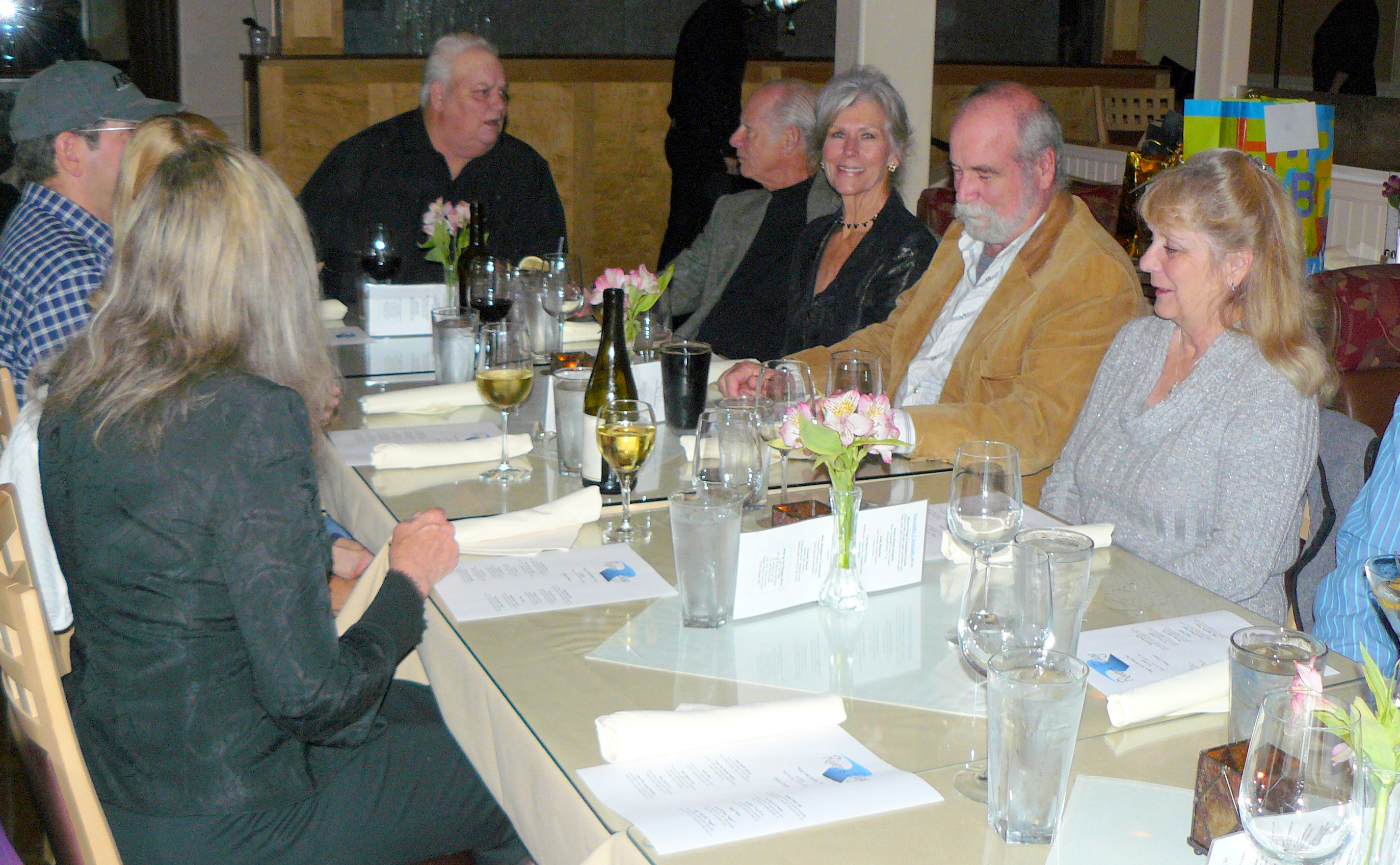
Yesterday, Sunday, was a quiet day. For several good reasons.  Firstly, on Saturday evening Jean and I and eleven of our close neighbours enjoyed a glorious birthday meal at the River’s Edge restaurant in Grants Pass.

P1150242

That meant, inevitably, that Jean and I were a little jaded yesterday.

Secondly, I needed to get my head down and put a few thousand words under my belt in terms of NaNoWriMo and ‘the book’.

Lastly, a comment from a new reader to a post that was published nearly five years ago reminded me of how special a person is Kevin Richardson.  Here’s that comment:

Paul, this article is amazing. Thank you so much for taking the time to write this, I’m a huge fan of Kevin. So is my Marine boyfriend who actually told me to look him up, this man is truly remarkable. I’ve always wanted to work with animals, my dream is to be a veterinary pathologist but lately I’ve been so stressed with school and college I wasn’t sure if I could make it. But Kevin is the one who has motivated me to continue to pursue my dream, so you think there’s a way I could contact him? I know it’s kinda crazy but I would love to get to speak to him. My boyfriend looks up to him alot too and I’ve tried looking for it but I had no luck. If there’s the possibility that you may know where I could find it or somehow contact him I would greatly appreciate it. Thank you so much. Maria.

So here is that post, and can anyone find a way to help Maria? (I have her email address.)

oooo

Remarkable people – Kevin Richardson

December 30th, 2009

Trust is both taught and learnt!

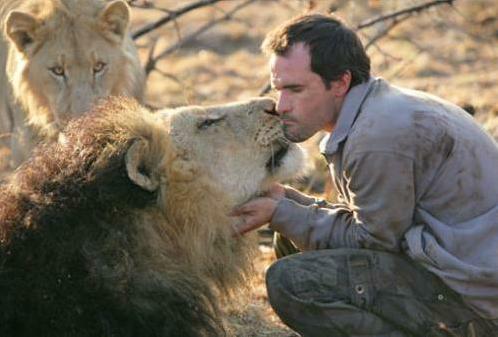
Thanks to Naked Capitalism, we posted an item on the 19th December about an unknown wild-life ranger working in the wildlife refuge area of Lanseria, South Africa.  Here was one of the pictures included in that Post:

The Post finished with an appeal to anyone that knew the name of this Ranger.  Many of you did and responded; thank you!

His name is Kevin Richardson and there is an interesting account of how he works and some of his ‘experiences’ in Revolution Magazine, luckily with online content.  That article is here.  It starts thus:

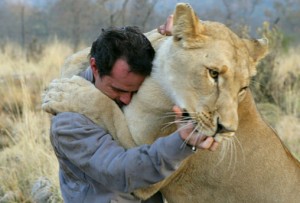
To do this he does not use the common methods of breaking the animal’s spirit with sticks and chains, instead he uses love, understanding and trust. With this unusual method of training he has developed some exceptionally personal bonds with his students. He sleeps with lions, cuddles newborn hyenas, swims with lionesses.  Kevin can confidently look into their eyes, crouch to the their level and even lie down with them – all taboos in the normal world of wild animal handling – yet he doesn’t get  mauled or attacked.

The article goes on to say that Kevin often works with the animals when they are very young.  Thus he is demonstrating very powerfully that how we behave, especially with our children when they are young, creates the environment for building trust out of consistency of deed and thought.  (By the way, do read some of the comments posted at the end of that Magazine article – some of them make for powerful reading.)

Kevin Richardson at ‘work’.

Luckily, thanks to this wired world we now live in, there is also video of Kevin available on YouTube.  A quick search under Kevin Richardson on YouTube will quickly find a number of videos but here are two that I wanted to share with you.

The first will leave you speechless and possibly wet-eyed!

The second is a promotional video by Kevin encouraging us to buy his recent book – and why not!

This is a very remarkable person and it’s an honour to share this with you.  We have so much to learn from all animals.

oooo

Beats many ‘day’ jobs!

Maybe this is how it started?

I mean the first meeting between man and wolf.

Again, another long day of hammering away at the keyboard.

One of the items that I incorporated into ‘the book’ was a story told to me back in 2009.  I had forgotten just how wonderful this true story was.

So it is repeated today. You will love it; of that I have no doubt!

oooo

An amazing true story of a relationship between a wild wolf and a man.

This is a story of a particular event in the life of Tim Woods told to me by his brother, DR.  It revolves around the coming together of a man sleeping rough, with his dog, on Mingus Mountain, and a fully grown female Grey Wolf.  Mingus is in the Black Hills mountain range between Cottonwood and Prescott in Arizona, USA.

DR and his brother, Tim, belong to a large family; there are 7 sons and 2 daughters.  Tim had a twin brother, Tom, and DR knew from an early age that Tim was different.

As DR explained,

Tim was much more enlightened than the rest of us.  I remember that Tim and Tom, as twin brothers, could feel each other in almost a mystical manner.  I witnessed Tom grabbing his hand in pain when Tim stuck the point of his knife into his (Tim’s) palm.  Stuff like that!  Tim just saw more of life than most other people.

The incident involving the wolf was when Tim was in his late 40s and, as mentioned, was living in a rough shack on the mountain.  The shack was simply a plywood shelter with an old couch and a few blankets for the cold nights.  The dog was companion, guard and a means of keeping Tim in food; the dog was a great hunter.  But Tim was no stranger to living in the wild.

DR again,

Tim was ex-US Army and a great horseman.  There was a time when he was up in the Superstition Mountains, sleeping rough, riding during the day.  At night Tim would get the horse to lay down and Tim would sleep with his back next to the horse for warmth.

Anyway, Tim was up on Mingus Mountain using an old disk from an agricultural harrow as both a cook-pan and plate.  After he had finished eating, Tim would leave his ‘plate’ outside his shack.  It would be left out in the open over night.

Tim became aware that a creature was coming by and licking the plate clean and so Tim started to leave scraps of food on the plate.  Then one night, Tim was awoken to to the noise of the owner of the ‘tongue’ and saw that it was a large, female gray wolf.

The wolf became a regular visitor and Tim became sure that the wolf, now having been given the name Luna by Tim, was aware that she was being watched by a human.

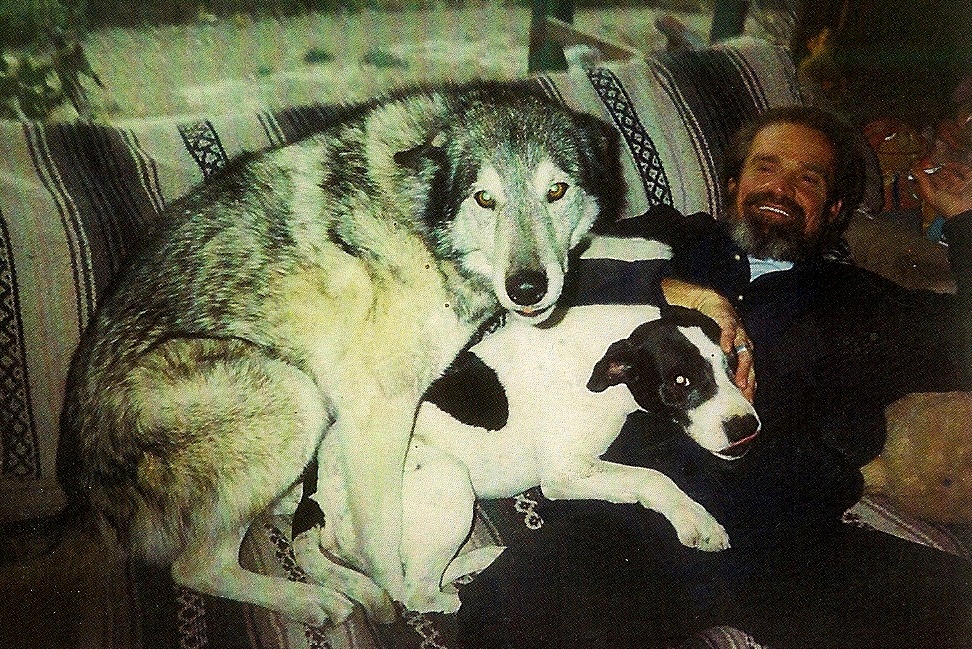
Over many, many months Luna built up sufficient trust in Tim that eventually she would take food from Tim’s outstretched hand.  It was only now a matter of time before Luna started behaving more like a pet dog than the wild wolf that she was.  The photo below is a scan from a traditional photograph and is unaltered.

Luna, the wild wolf, taken in 2006.

From now on, Luna would stay the night with Tim and his dog, keeping watch over them.

DR also recalls,

I remember Tim being distraught because, without warning, Luna stopped coming by. Then a few months later back she was. Tim never did know what lay behind her absence but guessed it might have been because she went off to have pups.

Unfortunately, this wonderful tale does have a sad ending.

About two years ago, Tim lost his dog. He was awakened to hear a pack of coyotes yelping and his dog missing.

Then tragically some 6 months later Tim contracted a gall bladder infection. Slowly it became worse.

By the time he realised that it was sufficiently serious to require medical treatment, it was too late. Despite the best efforts of modern medicine, Tim died on June 25th, 2009, just 51 years young.

So if you are ever out on Mingus Mountain and hear the howl of a wolf, reflect that it could just be poor Luna calling out for her very special man friend.

With very grateful thanks to DR for sharing such a special story.

The power of stillness

The value of doing nothing!

Like many who read yesterday’s post about this possibly being an age of loneliness I was struck by a terrible sense of sadness in George Monbiot’s words. Take these sentences:

Three months ago we read that loneliness has become an epidemic among young adults. Now we learn that it is just as great an affliction of older people. A study by Independent Age shows that severe loneliness in England blights the lives of 700,000 men and 1.1m women over 50, and is rising with astonishing speed.

Ebola is unlikely ever to kill as many people as this disease strikes down. Social isolation is as potent a cause of early death as smoking 15 cigarettes a day; loneliness, research suggests, is twice as deadly as obesity. Dementia, high blood pressure, alcoholism and accidents – all these, like depression, paranoia, anxiety and suicide, become more prevalent when connections are cut. We cannot cope alone.

It’s my proposition that not being able to cope with being alone derives from being unable to be fully at peace with oneself.

Yet, as dogs remind us so incredibly well, the ability to be on one’s own, to allow the brain to quieten down, to meditate in other words, is essential to our mental well-being.  It is an essential part of the journey to find and like oneself.  (I hasten to add that I write this without the benefit of any relevant professional knowledge!)

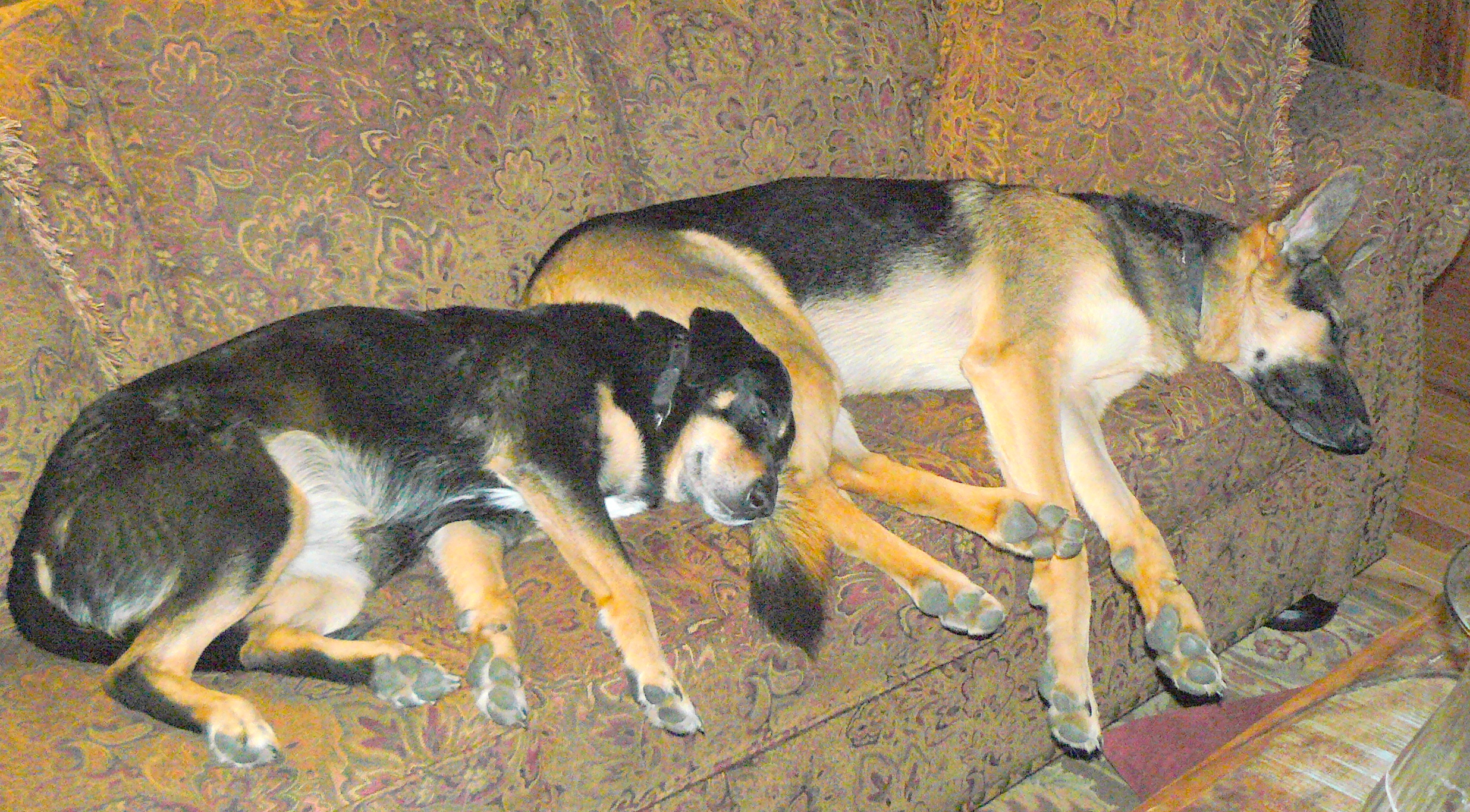
Hazel asleep alongside Cleo. (Hazel to the left.)

For a while I have subscribed to the newsletter called Just One Thing published, freely, by Dr. Rick Hanson.  On Dr. Hanson’s About page, he explains:

I am a neuropsychologist and have written and taught about the essential inner skills of personal well-being, psychological growth, and contemplative practice – as well as about relationships, family life, and raising children.Probably like you, there’s been a lot of to-ing and fro-ing in my life these days. Change can be interesting, exciting, and fun – but after awhile you start to long for something quieter, more stable.

A couple of weeks ago, the Just One Thing newsletter was all about stillness.  It is republished below.

ooOOoo

Just One Thing (JOT) is the free newsletter that suggests a simple practice each week for more joy, more fulfilling relationships, and more peace of mind.

A small thing repeated routinely adds up over time to produce big results.

Just one thing that could change your life.

(© Rick Hanson, 2014)

What doesn’t change?

The Practice

Find stillness.

Why?

Things keep changing. The clock ticks, the day unfolds, trees grow, leaves turn brown, hair turns gray, children grow up and leave home, attention skitters from this to that, the cookie is delicious but then it’s all gone, you’re mad about something for awhile and then get over it, consciousness streams on and on and on.

Many changes are certainly good. Most people are glad to put middle school behind them. I’m still happy about shifting thirty years ago from single to married. Painkillers, flush toilets, and the internet seem like pretty good ideas. It’s lovely to watch grass waving in the wind or a river passing. Fundamentally, if there were no change, nothing could happen, reality would be frozen forever. I once asked my friend Tom what he thought God was and he said “possibility.”

On the other hand, many changes are uncomfortable, even awful. The body gets creaky, and worse. We lose those we love and eventually lose life itself. Families drift apart, companies fail, dictators tighten their grip, nations go to war. The planet warms at human hands, as each day we pour nearly a billion tons of carbon into the atmosphere. Countless species go extinct. As William Yeats wrote: “Things fall apart; the centre cannot hold.”

And change itself is often – maybe innately – stressful. When you really open to the fact always in front of our noses that each moment of now decays and disappears in the instant it arises – it can feel rather alarming. Life and time sweep us along. As soon as something pleasant occurs in the mind’s flow we reach for it but whoosh it passes away right through our fingers leaving disappointment behind. Inherently, anything that changes is not a reliable basis for enduring contentment and fulfillment.

Yet it is also true that some things remain always the same. In their stillness you can find a refuge, an island in the stream of changes, a place to stand for perspective and wisdom about events and your reactions to them, a respite from the race, quiet amidst the noise. Perhaps even find a sense of something transcendental, outside the frame of passing phenomena.

How?

Stillness, a sense of the unchanging, is all around, and at different levels. Look for it, explore its effects on you, and let it sink in.

For example, it’s not the ultimate stillness, but there is that lovely feeling when the house is quiet and you’re sitting in peace, the dishes are done and the kids are fine (or the equivalent), and you can really let down and let go. In your character, you have enduring strengths and virtues and values; situations change, but your good intentions persist. In relationships, love abides – even for people who drive you crazy!

More subtly, there is the moment at the very top of a tossed ball’s trajectory when it’s neither rising nor falling, the pause before the first stroke of the brush, that space between exhalation and inhalation, the silence in which sounds occur, or the discernible gap between thoughts when your mind is quiet.

In your mind there is always an underlying calm and well-being that contains emotional reactions, like a riverbed that is still even as the flood rushes over it (if you’re not aware of this, truly, with practice you can find and stabilize a sense of it). There is also the unchanging field of awareness, itself never altered by the thoughts passing through it.

More abstractly, 2+2=4 forever; the area of a circle will always be pi times the radius squared; etc. The fact that something has occurred will never change. The people who have loved you will always have loved you; they will always have found you lovable. Whatever is fundamentally true – including, ironically, the truth of impermanence – has an unchanging stillness at its heart. Things change, but the nature of things – emergent, interdependent, transient – does not.

Moving toward ultimate matters, and where language fails, you may have a sense of something unchangingly transcendental, divine. Or, perhaps related, an intuition of that which is unconditioned always just prior to the emergence of conditioned phenomena.

Wherever you find it, enjoy stillness and let it feed you. It’s a relief from the noise and bustle, a source of clarity and peace. Give yourself the space, the permission, to be still – at least in your mind – amidst those who are busy. To use a traditional saying:

May that which is still
be that in which your mind delights.

ooOOoo

Still-Waters-header

The struggle between the forces of light and dark.

At least dogs can go off and find new homes!

Let’s start with the Ebola outbreak with the latest news from the BBC suggesting:

The death toll from the Ebola virus outbreak has risen to 4,447, with the large majority of victims in West Africa, the World Health Organization (WHO) says.

WHO assistant director-general Bruce Aylward also said there could be up to 10,000 new cases a week within two months if efforts were not stepped up,

But the rate of new infections in some areas has slowed down, he added.

Next up.

I’ve been musing as to whether or not I was going to republish a recent essay from George Monbiot.  The one in question being The Kink in the Human Brain.  It opens, thus:

Pointless, joyless consumption is destroying our world of wonders.

By George Monbiot, published in the Guardian 2nd October 2014

This is a moment at which anyone with the capacity for reflection should stop and wonder what we are doing.

If the news that in the past 40 years the world has lost over 50% of its vertebrate wildlife (mammals, birds, reptiles, amphibians and fish) fails to tell us that there is something wrong with the way we live, it’s hard to imagine what could. Who believes that a social and economic system which has this effect is a healthy one? Who, contemplating this loss, could call it progress?

In fairness to the modern era, this is an extension of a trend that has lasted some two million years. The loss of much of the African megafauna – sabretooths and false sabretooths, giant hyaenas and amphicyonids (bear dogs), several species of elephant – coincided with the switch towards meat eating by hominims (ancestral humans). It’s hard to see what else could have been responsible for the peculiar pattern of extinction then.

My spirits continued downward, especially when I clicked on that first link and read this from the Guardian website:

Rubbish dumped on the tundra outside llulissat in Greenland stand in stark contrast to icebergs behind from the Sermeq Kujullaq or llulissat Ice fjord – a Unesco world heritage site. Photograph: Global Warming Images/WWF-Canon

The number of wild animals on Earth has halved in the past 40 years, according to a new analysis. Creatures across land, rivers and the seas are being decimated as humans kill them for food in unsustainable numbers, while polluting or destroying their habitats, the research by scientists at WWF and the Zoological Society of London found.

“If half the animals died in London zoo next week it would be front page news,” said Professor Ken Norris, ZSL’s director of science. “But that is happening in the great outdoors. This damage is not inevitable but a consequence of the way we choose to live.” He said nature, which provides food and clean water and air, was essential for human wellbeing.

“We have lost one half of the animal population and knowing this is driven by human consumption, this is clearly a call to arms and we must act now,” said Mike Barratt, director of science and policy at WWF. He said more of the Earth must be protected from development and deforestation, while food and energy had to be produced sustainably.

Then a few days ago, one of our neighbours sent me an email with his latest news about ISIS.  This is what he sent:

Got this from one of my closest friends today, it came from his brother so I’m pretty confident that it’s true. There is some really bad stuff on the horizon and it’s probably gonna come this way like a runaway train!! Everybody better start thinking about where they want to stand when push comes to shove!

With “this’ being in part:

Missionaries who are in the areas that are being attacked by ISIS. ISIS has taken over the town they are in today. He said ISIS is systematically going house to house to all the Christians and asking the children to denounce Jesus. He said so far not one child has. And so far all have consequently been killed. But not the parents. The UN has withdrawn and the missionaries are on their own. They are determined to stick it out for the sake of the families – even if it means their own deaths. They are very afraid, have no idea how to even begin ministering to these families who have had seen their children martyred. Yet he says he knows God has called them for some reason to be His voice and hands at this place at this time. Even so, they are begging for prayers for courage to live out their vocation in such dire circumstances. And like the children, accept martyrdom if they are called to do so. These brave parents instilled such a fervent faith in their children that they chose martyrdom. Please surround them in their loss with your prayers for hope and perseverance.

One missionary was able to talk to her brother briefly by phone. She didn’t say it, but I believe she believes it will be their last conversation. Pray for her too. She said he just kept asking her to help him know what to do and do it. She told him to tell the families we ARE praying for them and they are not alone or forgotten — no matter what. Please keep them all in your prayers.

I didn’t and still don’t know how to reply.  That is until Maria Matthews left a comment to yesterday’s post.

Love the poem/verse Illusion. The lines, Following the herd, bleating like sheep, Held captive, half asleep. hit a strong note with me.

As we often wonder why people can’t think for themselves outside the box but then again maybe that is part of being human. Life is a mystery isn’t it? Enjoyed the post,

Maria’s comment about life being a mystery was interpreted by me as humans being a mystery and the realisation that it has ever been so. For it resonated with a recent programme over on the BBC that included information on the ancient Teotihuacan people who ruled in what is present-day Mexico some 2,000 years ago.  From Wikipedia:

View of the Avenue of the Dead and the Pyramid of the Sun, from Pyramid of the Moon (Pyramide de la Luna).

Teotihuacan /teɪˌoʊtiːwəˈkɑːn/, also written Teotihuacán (Spanish About this sound teotiwa’kan (help·info)), was a pre-Columbian Mesoamerican city located in the Valley of Mexico, 30 miles (48 km) northeast of modern-day Mexico City, known today as the site of many of the most architecturally significant Mesoamerican pyramids built in the pre-Columbian Americas. Apart from the pyramids, Teotihuacan is also anthropologically significant for its complex, multi-family residential compounds, the Avenue of the Dead, and the small portion of its vibrant murals that have been exceptionally well-preserved. Additionally, Teotihuacan exported a so-called “Thin Orange” pottery style and fine obsidian tools that garnered high prestige and widespread utilization throughout Mesoamerica.

The city is thought to have been established around 100 BC, with major monuments continuously under construction until about AD 250. The city may have lasted until sometime between the 7th and 8th centuries AD, but its major monuments were sacked and systematically burned around 550 AD. At its zenith, perhaps in the first half of the 1st millennium AD, Teotihuacan was the largest city in the pre-Columbian Americas, with a population estimated at 125,000 or more, making it at minimum the sixth largest city in the world during its epoch. Teotihuacan began as a new religious center in the Mexican Highland around the first century AD. This city came to be the largest and most populated center in the New World. Teotihuacan was even home to multi-floor apartment compounds built to accommodate this large population. The civilization and cultural complex associated with the site is also referred to as Teotihuacan or Teotihuacano.

That BBC programme also included the fact that almost on a daily basis the Teotihuacan authorities viewed the assassinations of often hundreds of lower class people as perfectly normal.

In other words, despicable cruelty of man upon man, not to mention an utter disregard for the natural world, has been going on for thousands of years!

Thus it underlined to me, in spades, that what ‘other people’ get up to is, to a very great extent, irrelevant.  Because whatever the circumstances we have a choice: we always have a choice.  Or if you will forgive me for repeating my closing sentences in yesterday’s post:

Whatever is going on in the world, whatever has the power to create fear in our minds, in the end it comes down to another power, the power of thought, and our choice of the behaviors that we offer the world.

That is why dogs are so important. Because they almost predominantly love sharing and living their lives in the company of humans.


evil

Men, Women and Memory!

Are men’s brains the same as women’s?

The wonderful BBC science programme, BBC Horizon, recently showed a fascinating programme entitled: Is your Brain Male or Female?  The programme is introduced on the Horizon website:

Dr
Dr. Mosley and Prof. Roberts.

Dr Michael Mosley and Professor Alice Roberts investigate if male and female brains really are wired differently.

New research suggests that the connections in men and women’s brains follow different patterns, patterns which may explain typical forms of male and female behaviour. But are these patterns innate, or are they shaped by the world around us?

Using a team of human lab rats and a troop of barbary monkeys, Michael and Alice test the science and challenge old stereotypes. They ask whether this new scientific research will benefit both men and women – or whether it could drive the sexes even further apart.

Now I haven’t a clue as to how long this fascinating programme will remain on YouTube, but if you aren’t in the UK or don’t have access to the BBC iPlayer then don’t hesitate to watch it now.

Essentially, science shows that the ‘hard-wired’ differences are minute and the vast bulk of the preferences between the genders, trucks versus dolls, for example, is subtle conditioning from parents and the wider world; for instance, advertisements.

One thing that did jump ‘off the page’ at me was the evidence supporting how malleable or plastic is the brain.  In other words, we are never too old to learn.

As if to reinforce that aspect of the flexibility of our brain, just yesterday morning I read an item on the BBC News website about memory.

As someone whose memory is a long way from where it used to be, this item really caught my attention:

How to save your memory

By David Robson from Headsqueeze.

Are there ways to stop yourself losing your memory? The latest brain research suggests there’s hope for the forgetful…

Memory loss has to be one of our biggest fears. Names, words, facts and faces – nothing is spared.

As the latest video from the Head Squeeze team describes above, mental deterioration was once thought to be an inevitable consequence of ageing, thanks to the steady erosion of our brain matter: we lose about 0.5% of our brain volume every year. The hippocampus – the region responsible for memory and learning – was thought to weather particularly badly; by the time we are 90, many of us have lost around a third of its grey matter.

Fortunately, recent research has shown that the brain is not concrete, but certain regions can adapt and grow. In 2000, a study of London taxi drivers, for instance, showed that the 4-year training of London’s 25,000 streets showed a remarkable growth in the hippocampus compared to bus drivers who early learnt a fixed number of routes. The scientists think that, by memorising the maps of London, the brain had built many more of the “synaptic connections” that allow the brain cells to communicate with each other. In other words, it may be possible to train the brain to compensate for some of the neural decline that accompanies our expanding waistlines and receding hairlines.

Challenging your brain could be one way of preserving your recollections – though the value of commercial brain training apps is debatable; some experiments seem to show that while people may become a whizz at the games on their screen, the improvements fail to transfer to daily life. But other, more traditional activities – like learning a musical instrument or a second language – do seem to have some protective benefits, at least on short-term recall. Ideally, it is probably best to keep your brain active throughout your life, well before you begin to approach your dotage.

Exercise and a healthy diet are also thought to offer some protection against dementia. As can an active social life – since regular contact with other people is also thought to excite our neurons and preserve our synapses. Ensuring that you regularly get a good night’s sleep helps too.

Of course, nothing can guarantee health and vitality in old age. But these few simple measures might give you the best possible chances of preserving your wits against the ravages of time.

For more videos subscribe to the Head Squeeze channel on YouTube. This video is part of a series produced in partnership with the European Union’s Hello Brain project, which aims to provide easy-to-understand information about the brain and brain health.

If you would like to comment on this video or anything else you have seen on Future, head over to our Facebook page or message us on Twitter.

So it’s clear now.

All I need to do is to learn a new language while in between my training to be the oldest trainee cabbie in London and applying for second violin position at the Royal Philharmonic Orchestra and I’ll never forget anything else in my life.

Oh, anyone seen where I left my car keys?

Or perhaps, harking back to the opening question of the differences between our sexes, I should be closing, thus:

Anyone seen where I left my dolls?

Please find Lucy!

A dear dog has gone missing.

food3

With a sub-title regarding a missing dog, why on earth would I lead with a picture of fine food?

I will tell you.

In the last hour, Jean and I have come back from a meeting with the General Manager of a restaurant nearby in Grants Pass: the River’s Edge restaurant.  That picture is on the home page of the restaurant’s website.

The GM’s name is Missy Clements and she is also the banqueting manager.  Jean and I have previously enjoyed wonderful meals at the River’s Edge and the reason for meeting up with Missy was to kick around some ideas for a future event at the restaurant.

Anyway …..

During the meeting the conversation inevitably led to dogs and Missy, with obvious pain in her voice, explained that her six-year-old Boxer mix, Lucy, had recently gone missing.

I offered to post an item in this place, hence this coming out an an unusual time.

Please do all you can to share this, especially if you are in the Southern Oregon area.  The address where Lucy was last seen was Crooks Creek Road, a few miles North-East of Selma in Oregon; Selma being 20 miles to the South-West of  Grants Pass.  If you have any questions or, even better, think you have some information on the whereabouts of Lucy then Missy has given me permission to publish her email address; that is: clements (dot) missy57 (at) gmail (dot) com

Finally, here is a recent photograph of Lucy.

Please stay alert for Lucy.

Please hold Lucy in your heart.

Truth and integrity

“Honesty is the first chapter in the book of wisdom.”

Thus spoke Thomas Jefferson who died nearly 200 years ago (April 13th, 1743 – July 4th, 1826).

But some essays that have passed my eyes in the last few days have profoundly disturbed me.  Because they illustrate, well to me anyway, the parlous state of wisdom in today’s world.  Or better put, the parlous state of truth and integrity in today’s world.

The first essay was the latest one from Tom Engelhardt over at TomDispatch. Normally I republish TomDispatch essays in full, with permission I hasten to add, because they seem such a fine commentary of where we are as a ‘modern’ society.  I used the word ‘we’ in the context of a global ‘we’.

But the latest essay was so disheartening that I couldn’t bring myself to republish it in full.  Plus, if I am to be brutally honest (in line with the theme of today’s blog post!) I didn’t want to ‘make waves’ as a non-US citizen albeit a valid US resident (Green Card holder).  I want to live freely and openly in the USA for the rest of my natural days!

Then in the last twenty-four hours up popped the latest essay from George Monbiot and I was struck by the harmony, the terrible harmony, between Tom and George.

See if you agree with me.

Tom Engelhardt published on Tuesday a TomGram about American Intelligence.  It was called Failure Is Success – How American Intelligence Works in the Twenty-First Century.

Here’s a flavour of Tom’s essay.

What are the odds? You put about $68 billion annually into a maze of 17 major intelligence outfits. You build them glorious headquarters. You create a global surveillance state for the ages. You listen in on your citizenry and gather their communications in staggering quantities. Your employees even morph into avatars and enter video-game landscapes, lest any Americans betray a penchant for evil deeds while in entertainment mode. You collect information on visits to porn sites just in case, one day, blackmail might be useful. You pass around naked photos of them just for… well, the salacious hell of it. Your employees even use aspects of the system you’ve created to stalk former lovers and, within your arcane world, that act of “spycraft” gains its own name: LOVEINT.

You listen in on foreign leaders and politicians across the planet. You bring on board hundreds of thousands of crony corporate employees, creating the sinews of an intelligence-corporate complex of the first order. You break into the “backdoors” of the data centers of major Internet outfits to collect user accounts. You create new outfits within outfits, including an ever-expanding secret military and intelligence crew embedded inside the military itself (and not counted among those 17 agencies). Your leaders lie to Congress and the American people without, as far as we can tell, a flicker of self-doubt. Your acts are subject to secret courts, which only hear your versions of events and regularly rubberstamp them — and whose judgments and substantial body of lawmaking are far too secret for Americans to know about.

Then a few paragraphs later, Tom holds up his mirror:

Whatever the case, while taxpayer dollars flowed into your coffers, no one considered it a problem that the country lacked 17 overlapping outfits bent on preventing approximately 400,000 deaths by firearms in the same years; nor 17 interlocked agencies dedicated to safety on our roads, where more than 450,000 Americans have died since 9/11. (An American, it has been calculated, is 1,904 times more likely to die in a car accident than in a terrorist attack.) Almost all the money and effort have instead been focused on the microscopic number of terrorist plots — some spurred on by FBI plants — that have occurred on American soil in that period. On the conviction that Americans must be shielded from them above all else and on the fear that 9/11 bred in this country, you’ve built an intelligence structure unlike any other on the planet when it comes to size, reach, and labyrinthine complexity.

It’s quite an achievement, especially when you consider its one downside: it has a terrible record of getting anything right in a timely way. Never have so many had access to so much information about our world and yet been so unprepared for whatever happens in it.

Tough words indeed!

But it gets worse.

Let’s focus for a moment, however, on a case where more is known. I’m thinking of the development that only recently riveted the Obama administration and sent it tumbling into America’s third Iraq war, causing literal hysteria in Washington. Since June, the most successful terror group in history has emerged full blown in Syria and Iraq, amid a surge in jihadi recruitment across the Greater Middle East and Africa. The Islamic State (IS), an offshoot of al-Qaeda in Iraq, which sprang to life during the U.S. occupation of that country, has set up a mini-state, a “caliphate,” in the heart of the Middle East. Part of the territory it captured was, of course, in the very country the U.S. garrisoned and occupied for eight years, in which it had assumedly developed countless sources of information and recruited agents of all sorts. And yet, by all accounts, when IS’s militants suddenly swept across northern Iraq, the CIA in particular found itself high and dry.

The IC seems not to have predicted the group’s rapid growth or spread; nor, though there was at least some prior knowledge of the decline of the Iraqi army, did anyone imagine that such an American created, trained, and armed force would so summarily collapse. Unforeseen was the way its officers would desert their troops who would, in turn, shed their uniforms and flee Iraq’s major northern cities, abandoning all their American equipment to Islamic State militants.

Nor could the intelligence community even settle on a basic figure for how many of those militants there were. In fact, in part because IS assiduously uses couriers for its messaging instead of cell phones and emails, until a chance arrest of a key militant in June, the CIA and the rest of the IC evidently knew next to nothing about the group or its leadership, had no serious assessment of its strength and goals, nor any expectation that it would sweep through and take most of Sunni Iraq. And that should be passing strange. After all, it now turns out that much of the future leadership of IS had spent time together in the U.S. military’s Camp Bucca prison just years earlier.

All you have to do is follow the surprised comments of various top administration officials, including the president, as ISIS made its mark and declared its caliphate, to grasp just how ill-prepared 17 agencies and $68 billion can leave you when your world turns upside down.

Leaving Tom to offer the following sorry conclusions:

Clearly, having a labyrinth of 17 overlapping, paramilitarized, deeply secretive agencies doing versions of the same thing is the definition of counterproductive madness. Not surprisingly, the one thing the U.S. intelligence community has resembled in these years is the U.S. military, which since 9/11 has failed to win a war or accomplish more or less anything it set out to do.

On the other hand, all of the above assumes that the purpose of the IC is primarily to produce successful “intelligence” that leaves the White House a step ahead of the rest of the world. What if, however, it’s actually a system organized on the basis of failure? What if any work-product disaster is for the IC another kind of win.

Perhaps it’s worth thinking of those overlapping agencies as a fiendishly clever Rube Goldberg-style machine organized around the principle that failure is the greatest success of all. After all, in the system as it presently exists, every failure of intelligence is just another indication that more security, more secrecy, more surveillance, more spies, more drones are needed; only when you fail, that is, do you get more money for further expansion.

Keep in mind that the twenty-first-century version of intelligence began amid a catastrophic failure: much crucial information about the 9/11 hijackers and hijackings was ignored or simply lost in the labyrinth. That failure, of course, led to one of the great intelligence expansions, or even explosions, in history. (And mind you, no figure in authority in the national security world was axed, demoted, or penalized in any way for 9/11 and a number of them were later given awards and promoted.) However they may fail, when it comes to their budgets, their power, their reach, their secrecy, their careers, and their staying power, they have succeeded impressively.

You could, of course, say that the world is simply a hard place to know and the future, with its eternal surprises, is one territory that no country, no military, no set of intelligence agencies can occupy, no matter how much they invest in doing so. An inability to predict the lay of tomorrow’s land may, in a way, be par for the course. If so, however, remind me: Why exactly are we supporting 17 versions of intelligence gathering to the tune of at least $68 billion a year?

So over to George Monbiot. Yesterday, he published an essay in the UK’s Guardian newspaper entitled: Bomb Everyone. I am going to republish this in full, with the kind permission of George.

ooOOoo

Bomb Everyone

Humanitarian arguments, if consistently applied, could be used to flatten the entire Middle East

By George Monbiot, published in the Guardian 1st October 2014

Let’s bomb the Muslim world – all of it – to save the lives of its people. Surely this is the only consistent moral course? Why stop at blowing up Islamic State, when the Syrian government has murdered and tortured so many? This, after all, was last year’s moral imperative. What’s changed?

How about blasting the Shia militias in Iraq? One of them selected 40 people from the streets of Baghdad in June and murdered them for being Sunnis(1). Another massacred 68 people at a mosque in August(2). They now talk openly of “cleansing” and “erasure”(3), once Islamic State has been defeated. As a senior Shia politician warns, “we are in the process of creating Shia al-Qaida radical groups equal in their radicalisation to the Sunni Qaida.”(4)

What humanitarian principle instructs you to stop there? In Gaza this year, 2,100 Palestinians were massacred: including people taking shelter in schools and hospitals. Surely these atrocities demand an air war against Israel? And what’s the moral basis for refusing to liquidate Iran? Mohsen Amir-Aslani was hanged there last week for making “innovations in the religion” (suggesting that the story of Jonah in the Qu’ran was symbolic rather than literal)(5). Surely that should inspire humanitarian action from above? Pakistan is crying out for friendly bombs: an elderly British man, Mohammed Asghar, who suffers from paranoid schizophrenia, is, like other blasphemers, awaiting execution there after claiming to be a holy prophet(6). One of his prison guards has already shot him in the back.

Is there not an urgent duty to blow up Saudi Arabia? It has beheaded 59 people so far this year, for offences that include adultery, sorcery and witchcraft(7). It has long presented a far greater threat to the west than Isis now poses. In 2009 Hillary Clinton warned in a secret memo that “Saudi Arabia remains a critical financial support base for al-Qa’ida, the Taliban … and other terrorist groups.”(8) In July, the former head of MI6, Sir Richard Dearlove, revealed that Prince Bandar bin Sultan, until recently the head of Saudi intelligence, told him: “The time is not far off in the Middle East, Richard, when it will be literally ‘God help the Shia’. More than a billion Sunnis have simply had enough of them.”(9) Saudi support for extreme Sunni militias in Syria during Bandar’s tenure is widely blamed for the rapid rise of Isis(10,11). Why take out the subsidiary and spare the headquarters?

The humanitarian arguments aired in parliament last week(12), if consistently applied, could be used to flatten the entire Middle East and West Asia. By this means you could end all human suffering, liberating the people of these regions from the vale of tears in which they live.

Perhaps this is the plan: Barack Obama has now bombed seven largely-Muslim countries(13), in each case citing a moral imperative. The result, as you can see in Libya, Iraq, Pakistan, Afghanistan,Yemen, Somalia and Syria, has been the eradication of jihadi groups, of conflict, chaos, murder, oppression and torture. Evil has been driven from the face of the earth by the destroying angels of the west.

Now we have a new target, and a new reason to dispense mercy from the sky, with similar prospects of success. Yes, the agenda and practices of Isis are disgusting. It murders and tortures, terrorises and threatens. As Obama says, it is a “network of death”(14). But it’s one of many networks of death. Worse still, a western crusade appears to be exactly what it wants(15).

Already Obama’s bombings have brought Isis and Jabhat al-Nusra, a rival militia affiliated to Al Qaeda, together(16). More than 6,000 fighters have joined Isis since the bombardment began(17). They dangled the heads of their victims in front of the cameras as bait for war planes. And our governments were stupid enough to take it.

And if the bombing succeeds? If – and it’s a big if – it manages to tilt the balance against Isis, what then? Then we’ll start hearing once more about Shia death squads and the moral imperative to destroy them too – and any civilians who happen to get in the way. The targets change; the policy doesn’t. Never mind the question, the answer is bombs. In the name of peace and the preservation of life, our governments wage perpetual war.

While the bombs fall, our states befriend and defend other networks of death. The US government still refuses – despite Obama’s promise – to release the 28 redacted pages from the Joint Congressional Inquiry into 9/11, which document Saudi Arabian complicity in the attack on America(18). In the UK, in 2004 the Serious Fraud Office began investigating allegations of massive bribes paid by the British weapons company BAE to Saudi ministers and middlemen. Just as the crucial evidence was about to be released, Tony Blair intervened to stop the investigation(19). The biggest alleged beneficiary was Prince Bandar, mentioned above. The Serious Fraud Office was investigating a claim that, with the approval of the British government, he received £1bn in secret payments from BAE(20).

And still it goes on. Last week’s Private Eye, drawing on a dossier of recordings and emails, alleges that a British company has paid £300m in bribes to facilitate weapons sales to the Saudi National Guard(21). When a whistleblower in the company reported these payments to the British ministry of defence, instead of taking action it alerted his bosses. He had to flee the country to avoid being thrown into a Saudi jail. Smirking, lying, two-faced bastards – this scarcely begins to touch it.

There are no good solutions that military intervention by the UK or the US can engineer. There are political solutions in which our governments could play a minor role: supporting the development of effective states that don’t rely on murder and militias, building civic institutions that don’t depend on terror, helping to create safe passage and aid for people at risk. Oh, and ceasing to protect and sponsor and arm selected networks of death. Whenever our armed forces have bombed or invaded Muslims nations, they have made life worse for those who live there. The regions in which our governments have intervened most are those which suffer most from terrorism and war. That is neither coincidental nor surprising.

Yet our politicians affect to learn nothing. Insisting that more killing will magically resolve deep-rooted conflicts, they scatter bombs like fairy dust.

http://www.monbiot.com

References:

1. http://www.theguardian.com/guardianweekly/story/0,,1818778,00.html

2. http://www.theguardian.com/world/2014/aug/22/shia-attack-sunni-mosque-iraq

3. http://www.theguardian.com/world/2014/aug/24/iraq-frontline-shia-fighters-war-isis

4. http://www.theguardian.com/world/2014/aug/24/iraq-frontline-shia-fighters-war-isis

5. http://www.theguardian.com/world/2014/sep/29/iran-executes-man-heresy-mohsen-amir-aslani

6. http://www.theguardian.com/commentisfree/2014/sep/29/stand-up-for-blasphemers-like-mohammed-asghar-frankie-boyle

7. http://www.amnesty.se/upload/apps/webactions/urgentaction/2014/09/23/52302414.pdf

8. http://www.theguardian.com/world/us-embassy-cables-documents/242073

9. http://www.independent.co.uk/voices/comment/iraq-crisis-how-saudi-arabia-helped-isis-take-over-the-north-of-the-country-9602312.html

10. http://www.theatlantic.com/international/archive/2014/06/isis-saudi-arabia-iraq-syria-bandar/373181/

11. http://www.independent.co.uk/news/world/politics/islamic-state-us-failure-to-look-into-saudi-role-in-911-has-helped-isis-9731563.html

12. http://www.publications.parliament.uk/pa/cm201415/cmhansrd/cm140926/debtext/140926-0001.htm#1409266000001

13. https://firstlook.org/theintercept/2014/09/23/nobel-peace-prize-fact-day-syria-7th-country-bombed-obama/

14. http://www.publications.parliament.uk/pa/cm201415/cmhansrd/cm140926/debtext/140926-0001.htm#1409266000001

15. http://www.theguardian.com/commentisfree/2014/sep/26/west-isis-crusade-britain-iraq-syria

16. http://www.theguardian.com/world/2014/sep/28/isis-al-qaida-air-strikes-syria

17. http://www.haaretz.com/news/middle-east/1.616730

18. http://nypost.com/2013/12/15/inside-the-saudi-911-coverup/

19. http://www.theguardian.com/world/bae

20. http://www.theguardian.com/world/2010/feb/05/bae-saudi-yamamah-deal-background

21. Richard Brooks and Andrew Bousfield, 19th September 2014. Shady Arabia and the Desert Fix. Private Eye.

ooOOoo

Two journalists reporting from two very different countries separated by thousands of miles.

Yet together they illustrate the very low regard for truth, for truth and integrity I should add, held by two major western Governments.  That old saying of never underestimate the power of unintended consequences is hammering inside my head.

What very strange times we live in just now.

The sooner the concepts of truth and integrity are adopted by those with the power, money and influence, the sooner this world will turn away from what looks eminently like future self-destruction.

Let’s turn to dogs for some examples of beautiful ways of living.

Truth and integrity: It’s in those eyes!

That faithful dog; again!

We were out with our guests until late afternoon yesterday leaving me no time to offer anything original.  (Of course, there’s an inherent assumption in that last sentence! 😉 )

So I am reposting an essay about a Japanese dog that has been a long-term favourite of many readers of Learning from Dogs. Apologies if you have read this before.

oooo

Faithful dog Hachikō

30th August, 2010

More than a film, a message from dogs to mankind.

Richard Gere and Hachi

We recently watched a film about an Akita dog called Hachi, Hachikō in Japanese, that demonstrates the loyalty that dogs can have for their human owners.

Here’s the official movie trailer.

It’s a very moving film – seriously so!  Expect to shed many tears.  Even more so when one reflects that the Hollywood film is based, reasonably accurately, on a true story.  The details of this story are in Wikipedia from which is quoted:

In 1924, Hidesaburō Ueno, a professor in the agriculture department at the University of Tokyo took in Hachikō as a pet. During his owner’s life Hachikō saw him out from the front door and greeted him at the end of the day at the nearby Shibuya Station. The pair continued their daily routine until May 1925, when Professor Ueno did not return on the usual train one evening. The professor had suffered from a cerebral hemorrhage at the university that day. He died and never returned to the train station where his friend was waiting. Hachikō was loyal and every day for the next nine years he waited sitting there amongst the town’s folk.

Hachikō was given away after his master’s death, but he routinely escaped, showing up again and again at his old home. Eventually, Hachikō apparently realized that Professor Ueno no longer lived at the house. So he went to look for his master at the train station where he had accompanied him so many times before. Each day, Hachikō waited for Professor Ueno to return. And each day he did not see his friend among the commuters at the station.

The permanent fixture at the train station that was Hachikō attracted the attention of other commuters. Many of the people who frequented the Shibuya train station had seen Hachikō and Professor Ueno together each day. They brought Hachikō treats and food to nourish him during his wait.

This continued for nine years with Hachikō appearing precisely when the train was due at the station

This hasn’t been the only film about this dog.  See below:

Back to the Wikipedia entry:

That same year, another of Ueno’s faithful students (who had become something of an expert on the Akita breed) saw the dog at the station and followed him to the Kobayashi home (the home of the former gardener of Professor Ueno — Kikuzaboro Kobayashi) where he learned the history of Hachikō’s life. Shortly after this meeting, the former student published a documented census of Akitas in Japan. His research found only 30 purebred Akitas remaining, including Hachikō from Shibuya Station.

Professor Ueno’s former student returned frequently to visit the dog and over the years published several articles about Hachikō’s remarkable loyalty. In 1932 one of these articles, published in Tokyo’s largest newspaper, threw the dog into the national spotlight. Hachikō became a national sensation. His faithfulness to his master’s memory impressed the people of Japan as a spirit of family loyalty all should strive to achieve. Teachers and parents used Hachikō’s vigil as an example for children to follow. A well-known Japanese artist rendered a sculpture of the dog, and throughout the country a new awareness of the Akita breed grew.

Eventually, Hachiko’s legendary faithfulness became a national symbol of loyalty.

Hachikō died on March 8, 1935. He was found on a street in Shibuya. His heart was infected with filarial worms and 3-4 yakitori sticks were found in his stomach. His stuffed and mounted remains are kept at the National Science Museum of Japan in Ueno, Tokyo.

Hachiko

The Akita breed has a great reputation for loyalty.  But knowing that doesn’t in any way weaken the power of the message for the present times.

A dog offers loyalty, trust and love in exchange for being treated with integrity and compassion.

That’s why we have so much to learn from dogs.

Smarter than we realise!

By Paul Handover