Category: Core thought

Britain before humans.

A remarkable look at the extraordinary history of the British Isles.

Now on first sight, any reasonable follower of my scribblings who lived outside Britain might wonder why this post was so focussed on one particular country, the country of my birth: Great Britain.

My justification, however, for including this George Monbiot essay is that many residents of many other countries, not just North Americans, have roots and family ties in GB. Plus, so typical of a Monbiot essay, the subject will be of interest to anyone, wherever they live in the world, who wonders about time before we shaped our environment. (I have converted some of the figures used in the essay within square brackets [ …] )

Could I also mention that from Thursday through to the end of the year, my posts in this place are going to be a mix of trivial, humorous and repeat posts. I need a bit of a break as much as you good people need a break from Learning from Dogs! 😉

Monbiot’s essay is republished here with the kind permission of George Monbiot.

ooOOoo

Walk on the Wild Side

17th December 2015

Rewilding, hillwalking and the extraordinary history of these islands.

George Monbiot, interviewed by Dan Bailey for UKHillwalking.com, 11th December 2015

What would a natural upland habitat have looked like in Britain before humans started having the dominant influence?

This is a particularly interesting question, because we have two completely different baselines in Britain. The more recent one is the situation that prevailed after the ice retreated, and a temperate climate returned. I’m talking about parts of the Boreal and Atlantic stages, roughly between 9000 and 5000 years ago. It seems that during this period, Britain was more or less covered by closed canopy rainforest from top to toe. I’m using the term rainforest precisely: to denote forests that are wet enough to support epiphytes, plants that grow on other plants. Wherever you see polypody, the many-footed fern, growing along the branches of a tree, it’s a reminder that you are looking at rainforest fragment.

Hardly any land in this country would have been treeless at this time. With the exception of the summits of the Cairngorms, Ben Nevis and one or two other mountains, there is nowhere here that is too high for them to grow. Our bare and rocky hills are an artefact of deforestation, heavy grazing and the subsequent loss of soil.

But even that state arguably reflected the dominant influence of humans. To see what the land would have been like without them, you would have to go back to the previous interglacial period, the Eemian. At this time, the climate was almost identical to ours, but for some reason the people driven out by the previous ice age appear not to have returned to this country. At this stage, there was plenty of forest, but it seems that it was not continuous. The closed canopy rainforest was punctuated by more open forest, as well as wood pasture and savannah. Why? Because humans had not wiped out the dominant species. During the Eemian, Britain had a fairly similar collection of wildlife to the one we know today. You know: foxes, badgers, hedgehogs, deer, robins, jackdaws, elephants, rhinos, hippos, scimitar cats, hyenas and lions.

Ah yes, not the same in all respects. Like everywhere else on earth, we had a megafauna, and this shaped the ecosystem. The large herbivores were driven out of Britain by the ice, then driven to extinction in southern Europe about 30,000 years ago when modern humans arrived. (The hyenas and lions, incidentally, persisted throughout the ice age, hunting reindeer across the frozen tundra, and it seems that they survived here until about 10,000 years ago, when Mesolithic hunters turned up).

What does a typical British upland habitat look like now, and how does it differ from uplands in Mainland Europe?

In almost all other European countries (Ireland is an exception), the pattern of tree cover is what you would expect to see. The lowlands, where the land is worth farming, are largely treeless. The uplands, where the land is infertile and the climate is harsh, largely forested. This is why Europe has an average forest cover of 37%. In Britain, the lowlands are largely treeless, as you might expect, but the uplands are even barer. This peculiarity explains the fact that Britain has only 13% tree cover. Instead of a rich ecosystem in the hills, a mosaic of trees, scrub and glades (which is what would occur now, on our depleted soils, if the land were allowed to recover), the uplands are almost entirely treeless, and therefore remarkably poor in birds, insects and all the other lifeforms you might expect to find there. The parts of the country which would otherwise function as our great wildlife reserves – those places, in other words, where hardly anyone lives and there is almost no economic activity – have even less wildlife than the places that are intensely habited and farmed.

What are the people and processes responsible for keeping our hills bare in England and Wales? Who’s more to blame in Scotland?

In England and Wales, the cause is simply stated. Sheep, which originated in Mesopotamia, are wildly, disproportionately destructive. In many of our hills, they are kept at densities of no more than one per hectare or even less. But because they selectively browse out tree seedlings, they ensure that no recovery can take place. Even where remaining woods exist, they are often dying on their feet, because there are no young trees with which to replace the old ones. In terms of food production, upland sheep farming makes a minuscule contribution. It is hard to think of any industry where there is a higher ratio of destruction to production.

The denuding of our hills by sheep is supplemented by the burning of grouse moors, a fantastically destructive activity carried out for the benefit of a very small number of exceedingly rich people. These two activities ensure that in England and Wales there are scarcely any trees above around 200 m. [Ed: 656 feet]

Both are also important factors in Scotland, but in the Highlands the dominant cause of destruction is the deer stalking estates. By keeping the numbers of red deer very high, so that a banker waddling up the hillside in tweed pantaloons is almost guaranteed to make a kill, these estates have a similar effect to sheep farms. Like sheep, deer seek out the seedlings, and when their numbers rise above five or ten per square kilometre, they ensure that no forest can grow.

So why the difference between Britain and the rest of Europe? The answer seems to be the size of land holdings. Because, unlike most other European countries, Britain never had a successful revolution, we have, on one estimate, the second highest concentration of landholding in the world, after Brazil. This grants landowners inordinate power. It also leads to the situation I’ll describe in the next answer.

Where does subsidy farming come in?

People farming the uplands claimed to make their money by raising sheep. But in economic terms, sheep are ornamental. Sheep farming throughout our hills is a loss-making activity, and persists only as a result of public money, that takes the form of farm subsidies. We pay £3.6 billion [Ed: 5.33 billion US dollars] a year in this country to have our watersheds destroyed and our wildlife wiped out. The reason why the hills are kept bare here but not in the rest of Europe is that the landholdings in Britain are big enough to make subsidy harvesting a worthwhile activity: you are paid by the hectare. The more land you own, the more public money you receive. Some people take millions of pounds in these benefit payments every year. It’s extraordinary, when such restrictions are placed upon the ordinary recipients of social security, that this situation has not yet become politically explosive.

And culturally – how does our idealised view of the upland landscape feed into land management?

Our idealised, romanticised view of sheep farming, that bears almost no relationship to reality, but that is constantly drilled into our minds by programmes like Countryfile, makes it hard for us to see what is really going on. It’s because of this view that we fail to grasp a vast and obvious fact. That by denuding our hills, this economically-tiny industry has done more damage to our ecosystems and wildlife than all the building that has taken place in Britain.

Can you explain, in a nutshell, what you mean by re-wilding, and why you’d like to see it in the British hills?

Rewilding is the mass restoration of ecosystems and the re-establishment of missing species. I’m not arguing for the blanket rewilding of our hills by any means. But I believe that Britain would be greatly enriched, in terms of both wildlife and human experience, if significant areas were allowed to recover; if trees were allowed to grow in some of our denuded places, and some of the wonderful species we have lost were permitted to return. In particular, I’m thinking of beavers, boar, lynx, wolves and species that we retain in small numbers but that were once widespread, such as wildcat, pine martens, capercaillie, eagles and goshawks.

The other great benefit of allowing trees to return to the hills is the restoration of watersheds. In one study in Wales, the soil beneath woodland was found to absorb water at 67 times the rate of the soil beneath sheep pasture. The rain flashes off sheep pasture as if it were concrete, instantly causing floods downstream. Trees hold back the water and release it gradually, smoothing out the cycle of flood and drought.

Could you talk us through the stages of a habitat restoration process that could take a bare hillside and return it to woodland?

Many of our hillsides have been so thoroughly sheepwrecked that there are now no remaining seed sources. In these circumstances, we would need to plant islands of trees, using seed taken from the nearest surviving pockets of woodland in order to sustain local genetic diversity. Short of greatly reducing stocking levels or temporarily keeping herbivores off altogether, there is not a lot more that needs to be done. In some places, all that is required is temporary exclusion of grazing animals.

What is a trophic cascade, and how is this idea relevant in the British context?

A trophic cascade is an ecological process that tumbles from the top of the foodchain to the bottom. It turns out that in many places, large carnivores regulate the entire ecosystem; ecosystems that retain them behave in radically different ways to ecosystems from which they have been lost. This presents a powerful challenge to British models of conservation, as we have lost all our large carnivores here, with the result that ecological processes, and their dynamic and ever-shifting successional patterns, have been curtailed.

Critics sometimes suggest that proponents of re-wilding are advocating turning the clock back to an arbitrary point in history and then keeping things permanently fixed in this state. Is that fair?

It is precisely the opposite. Our current model of conservation fixes ecosystems at an arbitrary point and then keeps them in a state of arrested development through extreme management of the kind that everywhere else on earth we recognise as destruction, not protection: namely cutting, burning and grazing. There is no intelligible reason behind the choices that have been made by conservationists of the ecosystems and species they choose to maintain by these means. Rewilding, by contrast, has no fixed outcomes. It seeks to restore ecological processes by bringing back some of the key elements of ecosystems and the key drivers: species that trigger trophic cascades. To the greatest extent possible, it then seeks to stand back and allow natural processes to take their course.

What would a healthy population of deer look like? How about sheep – do you have a figure for environmentally supportable grazing densities?

In the infertile uplands, it is roughly 5 per square kilometre (in other words per 100 ha). [Ed: 247 acres] Beyond that point, there is almost no regeneration of trees.

The debate often seems to be framed in absolute terms – either we re-wild everywhere, and get rid of all the farmers and deer, or not at all. How big would be big enough to please you? Are you talking about re-foresting every hill, moor and mountain, from valley to summit?

The aim of the group Rewilding Britain, that I helped to found but do not run, is to allow natural ecological processes and key species to return to at least one million hectares (4.5%) of Britain’s land and 30% of our territorial waters over the next 100 years. It would like to see at least one large rewilded area to connect both land and sea – descending from the mountaintops to our coastal waters.

In somewhere as crowded as Britain are vast re-created wildernesses a viable prospect, or would it be more realistic to go for smaller scale projects in which re-wilding is just part of a mixed land use picture – projects such as Wild Ennerdale perhaps, where habitat restoration is being managed in conjunction with forestry, leisure, water extraction and livestock?

The British population is highly concentrated. Some parts of the country are exceedingly crowded; others remarkably empty. Most British uplands have a far lower population density than many parts of Europe in which wolves, lynx, bear and other species are found. Wolves have even been appearing in countries such as Belgium, the Netherlands and Denmark, where there is very little land that is unsuitable for intensive farming, and the rural population density tends to be much higher. Their arrival has been greeted by most sectors of society with delight.

Many hill-goers will recognise your picture of the degraded upland environment, but some may simply be making a different aesthetic judgement to you, valuing the barren wide open spaces for the experience they provide. If they just happen to prefer grass and heather landscape on some romantic level, and don’t much care about botany and wildlife, how might you seek to convert them?

I believe we should have both. At the moment those who value a wild, self-willed landscape have nowhere to turn in Britain. We have to travel abroad to find it and to experience magnificent encounters with wildlife. I believe this deprives us of the wonder and delight that can enhance our lives and of choice and freedom. We have nowhere in which to escape the order and control that governs all other aspects of our lives.

Hillwalkers and climbers have fought long and hard against vested landowning interests for our right to roam. There is a worry that conservation could be used to curtail these freedoms, and some evidence to support that concern. What place does public access on open upland have in a re-wilded landscape, and which would take precedence – amenity or conservation?

I was heavily involved in campaigns for the right to roam, through another group I helped to found, The Land Is Ours, and I would be dismayed by any scheme which sought to keep people out of the hills. I believe that rewilding and access are entirely compatible. While it may be necessary in some places temporarily to fence out grazing animals, the fencing required is no different from that which is already found across the uplands, and exactly the same arrangements can be made to cross it as are used today. My hope is that in some places, as a result of rewilding, in some places there will one day be no fencing at all: in other words it will mean better access than there is today.

On a related note, could public support for re-wilding have unintended consequences? Might it, for instance, be a gift to landowners and conservation bodies with priorities quite other than public access?

I would be surprised if there were no unintended consequences. But if problems arise, the policies should be modified. No good policy emerges from the egg mature and complete. It must be constantly assessed and adjusted to head off any problems that emerge.

What sort of reception have your ideas met from folk in rural communities such as hill farmers and shooting estate workers?

I think it’s fair to say that they have been mixed. There has been a fair bit of hostility from some farming and shooting groups, but also support from surprising quarters, including landowners’ representatives and a large number of individual farmers and estate owners. In the wider countryside, there is often strong support. We would do well to remember that farmers are a very small minority even of the rural population, though this often gets forgotten because of their powerful influence on policy.

Can you offer a fully thought-through transition from sheep farming and shooting to an alternative model for the rural economy, one in which rural residents still have a secure place in a re-wilded countryside? Can you understand people’s aversion to risking this?

I certainly can understand people’s concerns. But there is going to be a major transition in the countryside before long, with or without rewilding, when farm subsidies are either scrapped or greatly reduced, as they inevitably will be. When essential public services are being cut, giving €55 billion [Ed: 61 billion USD] a year from the public purse across the EU to landowners, while helping to destroy both human communities and ecological resilience is surely as unsustainable politically as it is environmentally. So what are farmers whose livelihood is sustained only as a result of farm subsidies going to do?

I have two proposals. The first is that we start campaigning for the retention of some subsidies, whose purpose would be changed to that of ecological restoration and the support of communities. Landowners and tenants would be paid to restore watersheds, woodlands, rivers and wildlife. It’s hard to see how else continued subsidies could remain publicly acceptable. Rewilding could be a way out for struggling rural communities.

The second proposal is to start investigating means by which rural people can enhance their livelihoods by enhancing the ecosystem. There are plenty of examples from around the world of eco-tourism and associated activities reviving communities by generating income and employment. Given that the traditional industries have manifestly failed to sustain jobs and incomes, in some cases it will not be hard to show the alternatives might work better. But more research is needed, and we have to remember that the same approach is not going to work everywhere. Different local circumstances demand different strategies.

“We have an incredibly narrow and restrictive vision of cultural heritage and cultural landscapes” – your words. What would a broader vision look like?

I would love to see rural culture becoming more inclusive. It’s often highly hierarchical, with the landowners and farmers sitting at the top of the pyramid, dictating policy. In some respects, democracy is a stranger to the countryside; the old, landed powers still wield disproportionate influence over the lives of others. But I don’t want to invent a new culture. I believe that democratisation and pluralism creates its own cultures, that will evolve and develop independently in different places. I’m calling on people to challenge cultural hegemony in the countryside – perhaps we could call it agricultural hegemony – and for a much wider range of voices to be heard.

Farming and shooting are supported by the current dominant countryside culture. But wouldn’t a shift to re-wilding simply be replacing this set of special interests with another, a sort of cultural colonisation of the countryside by urbanites?

That’s certainly not how I see it. And this has nothing whatever to do with the presumed urban-rural divide. Many of rewilding’s most ardent proponents live in the countryside, perhaps unsurprisingly. We are repeatedly told that the countryside is at war with the towns and vice versa. But I see no evidence of this. What I see is certain dominant interests in the countryside in conflict with other rural interests. And those dominant interests often have either one or both feet in the cities.

A few years ago there was an article in the Telegraph that sought to characterise authentic rural people. These people apparently don’t care about “newts, trees and bats”: such matters are of interest only in London. It described David Cameron as “at heart, a rural Tory”, who “still grumbles to his wife about what, for him, are ‘banned activities’ – notably shooting”. Authentic rural people, in other words, spend their adult lives in Notting Hill and drive out to their second homes for a shooting party at the weekend. People who live in the countryside and care about wildlife, on the other hand, are, “at heart”, Londoners. The rural-urban divide, as characterised in such papers, has nothing to do with location. It’s really about class.

What chance is there of significant progress being made in the current funding climate? You’ve recently written about the ‘toothless’ Environment Agency in this regard. Given the squeeze on public bodies would it be more effective to promote the out-sourcing of re-wilding to non-governmental organisations, private philanthropists and large corporate landowners such as water companies?

There is a real problem here. Government agencies are being gutted and re-centralised. Cameron’s devolution agenda is a con: he is even more of a micromanager than Tony Blair was. The current environment secretary, Liz Truss, has put her department’s head on the block, volunteering for early execution. Statutory bodies like the Environment Agency are now, in terms of what they can do, almost dead. But the crazy situation that prevails today might not – should not – last forever. It is true to say however, that we cannot rely on government alone to deliver these changes, whatever form a government might take.

Are our National Park Authorities a help or a hindrance?

At the moment, they are a real drag on progress. This is partly because of policy, such as the Lake District National Park’s application for World Heritage status, which, as currently framed, will ensure that destructive practices are locked in (and continue to contribute to flooding). And it’s partly because of the way they frame the issues. They go to great lengths to persuade us that current land management is not only compatible with the protection of nature, but actually essential to it! All their brochures and display boards and websites create the impression that these ecological disaster zones are rich and thriving ecosystems, so people are constantly misled and misdirected. They are led to believe that all is well in our national parks, that these wastelands, which are in most cases little more than sheep ranches, are magnificent wildernesses. Our national parks are a disgrace, a shame upon the nation, and park authorities with an ounce of intellectual honesty would recognise this and seek to address it.

Re-wilding seems to be moving up the agenda of the large conservation organisations, and gaining a space in the public discourse. Do you see grounds for optimism?

It certainly is. Before Feral was published, I visited all the principal conservation groups, and received responses that varied from mild interest to outright rejection. The change over the past three years has been astonishing. Rewilding appears to have moved from the fringe of the mainstream, and I’m delighted to see how these groups have begun to pick it up and engage with it. There’s still a long way to go, and plenty of daft practices still in play, but change among the conservation groups is certainly happening, albeit slowly. We will see rewilding in this country. The question is how far and how fast it will go.

ooOOoo

Much of my adopted country, the United States, is still wild and the Bureau of Land Management state that they manage “over 245 million surface acres ..”. However, to put that into perspective the area of the USA is 2.436 billion acres so the BLM managed area is just a fraction over 10%.

Finally, Monbiot refers to his book Feral. I have read it and can recommend it.

Feral-665x1024

More details of his book may be found here.

This is much more than an issue for just Great Britain.
Dog Food Product Alert

Please share.

Dear Fellow Dog Lover,

According to a notice posted at PetSmart retail stores, Hill’s Science Diet is in the process of conducting a voluntary market withdrawal of some of its canned dog food products for unspecified reasons.

To learn which products are affected, please visit the following link:

Hill’s Science Diet Dog Food Market Withdrawal

Please be sure to share the news of this alert with other pet owners.

Mike Sagman, Editor
The Dog Food Advisor

P.S. Not already on our dog food recall notification list yet? Sign up to get critical dog food recall alerts sent to you by email. There’s no cost for this service.

You couldn’t make it up!

However hard one tried to!

LfDFrontCoverebook
In Chapter Eight, Behaviours and Relationships, I speak of how the development of humans has been, unsurprisingly, the result of our human behaviours. Adding that it is likely that our behaviours have been damaging, in varying degrees, to the survival of our species and countless others for a very long time. Continuing:

But 2,000 years ago, the global population of man was only 300 million persons[1]. It took 1,200 years for that global population to become 1 billion persons; in 1800. Now track the intervals as we come forward in time.

In 1927, just 127 years later, the two-billionth baby was born. In 1960, only 33 years on, came the birth of the three-billionth baby. Just 16 years later, in 1974, the four-billionth baby was born. In 1987, now only 13 years later, we have a population of five billion persons. Around October 1999, the sixth-billionth baby was born.
The growth rate of global population is slowing[2] but nevertheless it is trending to a billion additional persons every decade. In other words, a 100-million population growth every year, or about 270,000 more persons every single day.

Combine man’s behaviours rooted in times way back with this growth in population and we have the present situation. A totally unsustainable situation for one basic and fundamental reason. We all live on a finite planet.

[1] http://en.wikipedia.org/wiki/Population_growth
[2] According to UN’s 2010 revision to its population projections, world population will peak at 10.1bn in 2100 compared to 7bn in 2011. A 2014 paper by demographers from several universities and the United Nations Population Division forecast that the world’s population will reach about 10.9 billion in 2100 and continue growing thereafter. However, some experts dispute the UN’s forecast and have argued that birthrates will fall below replacement rate in the 2020s. According to these forecasters, population growth will be only sustained till the 2040s by rising longevity but will peak below 9bn by 2050.

A growth of about 270,000 more persons every single day!

I am sure that I am not alone in seeing this growth in our population as something that is both unsustainable and a critical component of long-term damage to our planet.

But George Monbiot in a recent essay, in true Monbiot style, highlights an aspect of our human population and the damage resulting that would have never previously occurred to me.

Read it and see if you don’t agree likewise. (Again, there are just too many links in George’s essay to reconstruct in this republishing and, as the other day, I have highlighted those phrases that are a link to other material in red. Go here if you wish to further investigate those links.)

ooOOoo

Pregnant Silence

19th November 2015

It’s about time we discussed the real population crisis.

By George Monbiot, published in the Guardian 18th November 2015

This column is about the population crisis. About the breeding that’s laying waste to the world’s living systems. But it’s probably not the population crisis you’re thinking of. This is about another one, that we seem to find almost impossible to discuss.

You’ll hear a lot about population in the next three weeks, as the Paris climate summit approaches. Across the airwaves and on the comment threads it will invariably be described as “the elephant in the room”. When people are not using their own words, it means they are not thinking their own thoughts. Ten thousand voices each ask why no one is talking about it. The growth in human numbers, they say, is our foremost environmental threat.

At their best, population campaigners seek to extend women’s reproductive choices. Some 225 million women have an unmet need for contraception. If this need were answered, the impact on population growth would be significant, though not decisive: the annual growth rate of 83 million would be reduced to 62m (1). But contraception is rarely limited only by the physical availability of contraceptives. In most cases, it’s about power: women are denied control of their wombs. The social transformations they need are wider and deeper than donations from the other side of the world are likely to achieve.

At their worst, they seek to shift the blame from their own environmental impacts. Perhaps it’s no coincidence that so many post-reproductive white men are obsessed with human population growth, as it’s about the only environmental problem of which they can wash their hands. Nor, I believe, is it a coincidence that of all such topics this is the least tractable. When there is almost nothing to be done, there is no requirement to act.

Such is the momentum behind population growth, an analysis in the Proceedings of the National Academy of Sciences discovered, that were every government to adopt the one-child policy China has just abandoned, there would still be as many people on Earth at the end of this century as there are today. If two billion people were wiped out by a catastrophe in mid-century, the planet would still hold a billion more by 2100 than it does now.

If we want to reduce our impacts this century, the paper concludes, it’s consumption we must address. Population growth is outpaced by the growth in our consumption of almost all resources. There is enough to meet everyone’s need, even in a world of 10 billion people. There is not enough to meet everyone’s greed, even in a world of 2 billion people.

So let’s turn to a population crisis over which we do have some influence. I’m talking about the growth in livestock numbers. Human numbers are rising at roughly 1.2% a year. Livestock numbers are rising at around 2.4% a year. By 2050, the world’s living systems will have to support about 120m tonnes of extra human, and 400m tonnes of extra farm animals(2).

Raising them already uses three quarters of the world’s agricultural land. One third of our cereal crops are used to feed them. This may rise to roughly half by 2050. More people will starve as a result, because the poor rely mainly on grain for their subsistence, and diverting it to livestock raises the price. Now the grain that farm animals eat is being supplemented by oil crops, particularly soya, for which the forests and savannahs of South America are being cleared at shocking rates.

This might seem counter-intuitive, but were we to eat soya, rather than meat, the clearance of natural vegetation required to supply us with the same amount of protein would decline by 94%. Producing protein from chickens requires three times as much land as protein from soybeans. Pork needs nine times, beef 32 times.

A recent paper in the journal Science of the Total Environment suggests that our consumption of meat is likely to be “the leading cause of modern species extinctions”. Not only is livestock farming the major reason for habitat destruction and the killing of predators, but its waste products are overwhelming the world’s capacity to absorb them. Factory farms in the US generate 13 times as much sewage as the human population. The dairy farms in Tulare county, California produce five times as much as New York City.

Freshwater life is being wiped out across the world by farm manure. In England, as I reported last week, the system designed to protect us from the tide of crap has comprehensively broken down. Dead zones now extend from many coasts, as farm sewage erases ocean life across thousands of square kilometres.

Livestock farming causes around 14% of the world’s greenhouse gas emissions: slightly more than the output of the world’s cars, lorries, buses, trains, ships and planes. If you eat soya, your emissions per unit of protein are 20 times lower than eating pork or chicken, and 150 times lower than eating beef.

So why is hardly anyone talking about the cow, pig, sheep and chicken in the room? Why are there no government campaigns to reduce the consumption of animal products, just as they sometimes discourage our excessive use of electricity? A survey by the Royal Institute of International Affairs found that people are not unwilling to change their diets, once they become aware of the problem, but that many have no idea that livestock farming damages the living world.

It’s not as if eating less meat and dairy will harm us. If we did as our doctors advise, our environmental impacts would decline in step with heart disease, strokes, diabetes and cancer. British people eat, on average, slightly more than their bodyweight in meat every year, while Americans consume another 50%: wildly more, in both cases, than is good for us or the rest of life on Earth.

But while plenty in the rich world are happy to discuss the dangers of brown people reproducing, the other population crisis scarcely crosses the threshold of perception. Livestock numbers present a direct moral challenge, as in this case we have agency. Hence the pregnant silence.

www.monbiot.com

Footnotes:

  1. While the number of unintended pregnancies would fall by 52m (or 70%), this does not mean that the number of babies would fall by the same amount. The Guttmacher/UNFPA report breaks down the outcome thus: “21 million fewer unplanned births; 24 million fewer abortions; six million fewer miscarriages; and 0.6 million fewer stillbirths.”
  2. Additional global meat consumption by this date is estimated to be roughly 200 million tonnes. Boned meat comprises roughly half the weight of a living animal. So total additional livestock biomass will be in the order of 400 million tonnes, or 400 billion kg. The average human weight is 52 kg and the anticipated rise in population by 2050 is 2.3 billion (the median estimate is 9.7 billion by that date). So the additional human weight is likely to be somewhere around 120 billion kg.

ooOOoo

Powerful reasons to turn vegetarian or vegan. And well done if you are already there. Well done, indeed!

Playfulness in dogs!

A perfect follow-on to yesterday’s post.

Those that read my post from yesterday will understand that it was both a busy and wonderful day. Topped off beautifully by arriving home to find four proof copies of The Book!

Four copies of The Book rather hastily assembled under my desk light.

So it was well after 5pm yesterday when I sat down to publish today’s post.

It seemed very appropriate to offer a recent item that appeared on Mother Nature Network and is republished here within MNN’s terms.

(Please note that I didn’t have the time to copy and insert the many interesting links in the original but have coloured the words or phrases to indicate that by going here you can access those links.)

ooOOoo

The science behind how dogs play

When dogs bow or let another dog ‘win’ the wrestling match, there’s a good reason.

By: Laura Moss, October 29, 2015.

If a dog plays too rough, other dogs may exclude him from play. (Photo: Brad Armentor/flickr)

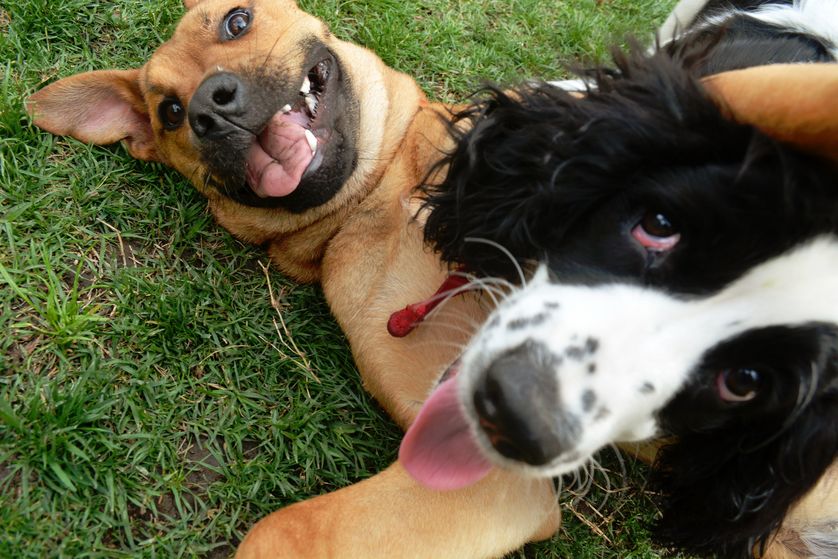
Dogs play by chasing, tackling and nipping at each other, but there’s more to their lively antics than meets the eye. The way dogs interact with one another reveals that dogs have a language as well as a moral code, and they don’t engage in play simply to establish dominance.

Marc Bekoff, professor emeritus at the University of Colorado at Boulder, has been studying animal behavior for more than 40 years. After reviewing four years’ worth of footage of dogs, wolves and coyotes, he discovered that even dogs’ wild relatives play by chasing each other, rolling over and jumping on one another.

“Play is a major expenditure of energy, and it can be dangerous,” Bekoff told The Washington Post. “You can twist a shoulder or break a leg, and it can increase your chances of being preyed upon. So why do they do it? It has to feel good.”

Bekoff and other researchers have conducted numerous studies on how these animals play and what their actions mean. What they’ve found is that dogs’ behavior during play is a language all its own, and every shift of the eyes or wag of the tail is a form of communication.

Play even has a set of rules, and if a dog breaks them — by playing too rough, for example — that dog may be excluded from group play. Bekoff says this response suggests that dogs enforce moral conduct, which means they’re capable of experiencing a range of emotions and even of recognizing these emotions in other canines.

What exactly do their different play behaviors mean?

The bow is a signal for play to commence — but there's more to it than that. (Photo: Mike McCune/flickr)
The bow is a signal for play to commence — but there’s more to it than that. (Photo: Mike McCune/flickr)

Play bow

When a dog lowers the front of its body in a bow-like stance, this is an invitation to play. If your dog often bows to other canines you meet while out on a walk, it’s a good indication that your pup would like a playmate.

However, this stance doesn’t only invite play. It also communicates to other dogs that the jump, nip or roughhousing that follows the bow isn’t an act of aggression. It’s simply a dog’s way of saying, “I’m just playing around.”

See my belly? That has meaning too. (Photo: Eric Sonstroem/flickr)

Rolling over

When a dog rolls over onto its back during play, it’s often considered a submissive gesture; however, research suggests it could mean something else entirely.

Earlier this year, scientists at the University of Lethbridge and the University of South Africa observed 33 play sessions between two dogs, and they also studied 20 YouTube videos of dogs playing together.

While not all the dogs rolled over during play, those that did weren’t necessarily the smaller or weaker of the two dogs, nor were the dogs that rolled over exhibiting submissive behaviors such as decreasing play.

In fact, smaller dogs were no more likely to roll over than larger ones, and the pups that did roll over used the position to evade a nip or to get into position to playfully bite the other dog.

The researchers found that none of the 248 rollovers were submissive during play and concluded that rolling over is actually meant to facilitate play.

There's a lot of communication going on here — though to human watchers it may simply induce giggles. (Photo: WilleeCole Photography/Shutterstock)
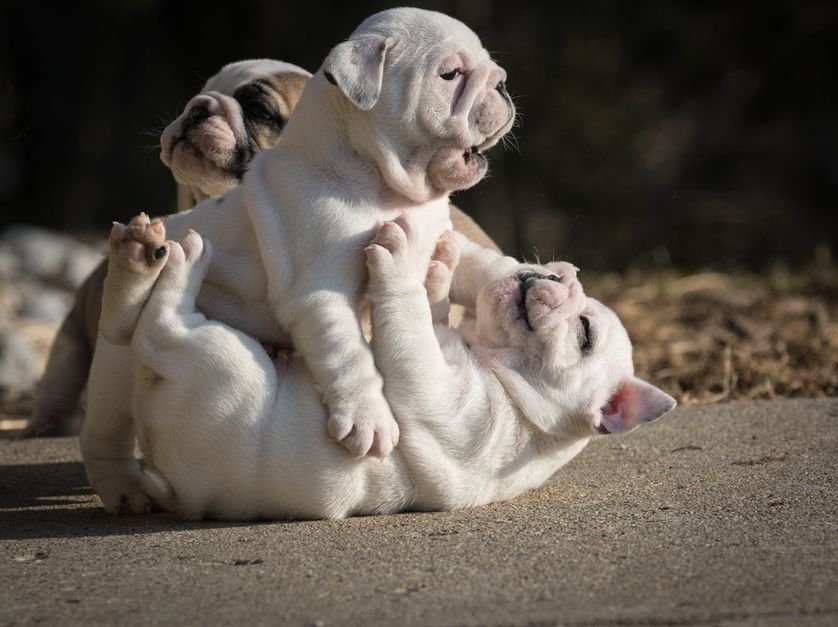
There’s a lot of communication going on here — though to human watchers it may simply induce giggles. (Photo: WilleeCole Photography/Shutterstock)

Letting female puppies win

A 2008 study found that male puppies frequently let their female puppy playmates win during play, even when the males were bigger and stronger.

The male dogs would even put themselves in positions that left them vulnerable to attack. For example, the male puppies would occasionally lick their playmates’ muzzles, which provided the female puppies with an opportunity to easily bite in return.

Why? Researchers say the act of playing may be more important to the male dogs than winning.

“Perhaps males use self-handicapping with females in order to learn more about them and to form close relationships with them — relationships that might later help males to secure future mating opportunities,” Camille Ward, lead author of the study, told NBC News.

ooOOoo

How lucky we are in this modern world to read and share such interesting essays.

You all have a lovely weekend.

Our changing climate – what is the truth?

A video on YouTube raises some fundamental questions about our changing climate.

Let me say straight away that my belief in Anthropogenic Global Warming (AGW) is based on instinct, and not on me understanding the science, simply because I am not a scientist; far from it! As I share on this blog:

Paul Handover is a child of the post-war era in Great Britain having been born in London a few months before the end of WWII. After a rather shaky attempt at being educated, including 2 years studying for a Diploma in Electrical Engineering, Paul’s first job was as a commercial apprentice at the British Aircraft Corporation. He then joined the sales desk of British Visqueen, a polythene film and products manufacturer located in Stevenage, Hertfordshire, and part of ICI Plastics Division. In 1968, he travelled out to Sydney, Australia and became part of the sales team at ICIANZ’s Inorganic Chemicals Division.

I am a fundamentally a retired salesman/entrepreneur with a very out-of-date knowledge of electrical engineering and radio communications (G3PUK), and now struggling to be an author. 😉

Plus, my generally sceptical view of how countries are governed, my awareness of a terrible lack of integrity in politicians, plays to those instincts of mine that humanity is, indeed, responsible primarily for our changing climate. And there is no shortage of supporting evidence!

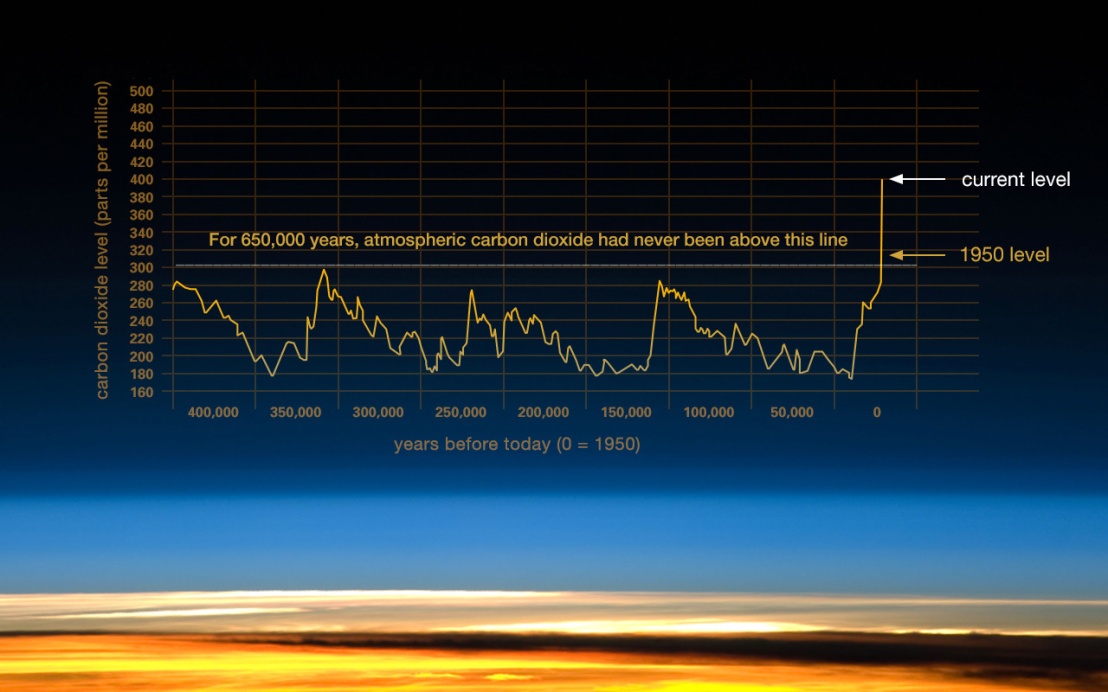
A very quick web search found this NASA site that included the following graph and text (in part):

This graph, based on the comparison of atmospheric samples contained in ice cores and more recent direct measurements, provides evidence that atmospheric CO2 has increased since the Industrial Revolution. (Credit: Vostok ice core data/J.R. Petit et al.; NOAA Mauna Loa CO2 record.)

The Earth’s climate has changed throughout history. Just in the last 650,000 years there have been seven cycles of glacial advance and retreat, with the abrupt end of the last ice age about 7,000 years ago marking the beginning of the modern climate era — and of human civilization. Most of these climate changes are attributed to very small variations in Earth’s orbit that change the amount of solar energy our planet receives.

Scientific Consensus
Ninety-seven percent of climate scientists agree that climate-warming trends over the past century are very likely due to human activities, and most of the leading scientific organizations worldwide have issued public statements endorsing this position.

Click here for a partial list of these public statements and related resources.

However, a dear and close friend of nearly 40 years, Dan Gomez, is sceptical and simply says to me: “Paul, follow the money!” Dan is a very widely-read person and a great thinker.

Plus, among our wonderful neighbours there is a couple, Dordie and Bill, that we get on with extremely well. Bill is a sceptic of AGW and recently sent me the link to the following video.

Please watch it. If you have evidence that all or many of the facts on this video are incorrect then I would love to hear from you.

For this is way too important for the truth not to be widely promoted.

Man, dog and Piper Cub

A small dose of nostalgia.

In yesterday’s post, I referred to Dunkeswell Airfield in South Devon and the fact that I was part of a group that owned a Piper Super Cub that was based at that airfield.

So while the bulk of this post has been previously published in this place it was over three years ago and, perhaps, may be shown again.

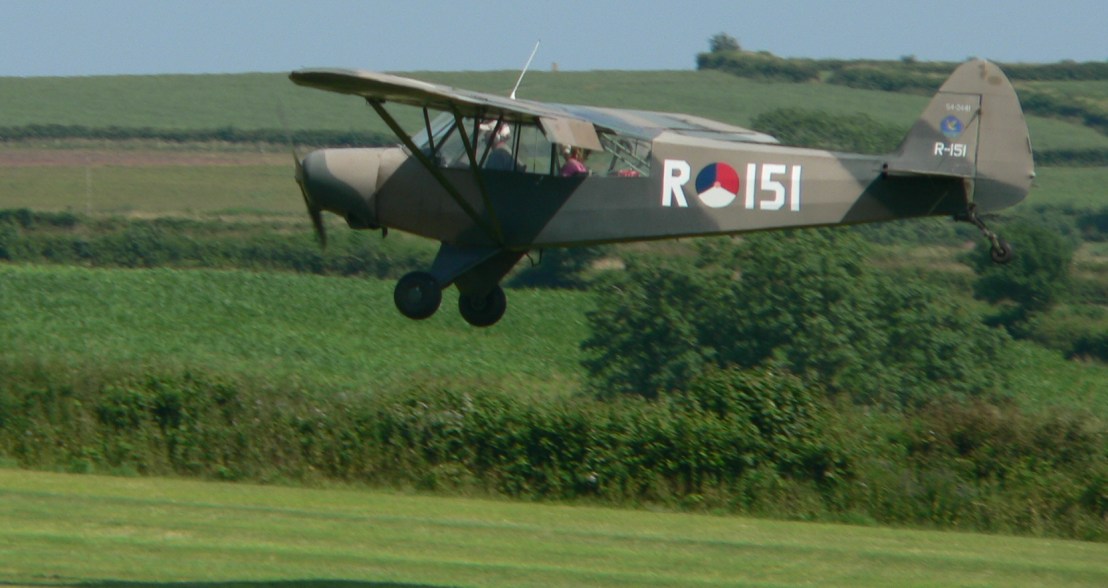
The photograph below was taken in 2006 when Pharaoh was 3 years old.  The aircraft, by the way, is an L21B, the military variant of the Piper Super Cub.  The aircraft was originally delivered to the Dutch Air Force in 1954 and has dispensation from the UK CAA to retain the original registration and callsign of R151.

P1000357.s

More on the aircraft.

Originally when the post was published readers asked for more information on the aircraft.

So here it is.

Piper Super Cub, L-21B, R-151

A/C Construction No. 18-3841, Frame No. 18-3843

Original Engine, Lycoming 135 Type 0-290-D2, 54/2441

Romeo 151 was one of a batch of 298 L-21’s delivered in 1954. There were 584 L-21B’s produced by Piper for military use, the ‘L’ standing for Liaison. The L-21B’s were PA-18-135’s with civil Lycoming 0-290-D2 engines, glasswork as most L-21A’s and L-18’s and a gross weight of 1760 lbs.

This aircraft was delivered to Koninklijke Luchtmacht, Dutch Air Force, on the 1st July, 1954 and registered R-151. After various homes R-151 transferred to the Dutch civil register as PH-GER, 1st April 1976 with 4,458 hours and shortly thereafter was registered to Vlieclub Hoogeveen, Certificate Number 2380.

On the 27th March, 1981 the aircraft was delivered to the UK with a total time of 5,043 hours and in September, 1981 became G-BIYR. In April, 1983 YR was the first of type to be given a Public Transport CofA and was used for training at Tollaton. YR reverted to a Private CofA in January, 1984 when purchased by Mike and Barbara Fairclough at 5,120 hours.

In 1992 YR was re-engined with a Lycoming 150HP, 0320-A2B No. L49809-27A (zero hours). Finally on the 2nd June, 1995 the a/c was repainted in original Dutch insignia and given CAA (UK Civil Aviation Authority) permission to use the original call-sign, Romeo 151.

The aircraft is based in South Devon, England and owned by the five members of the Delta Foxtrot Flying Group.

A few photos of the aircraft.

Approaching home in South Devon, England
Approaching home airfield in South Devon, England
Flying in the French Alps, Mt Blanc in sight
9,300 ft up in the French Alps

Really takes me back does this!


Having fun with history.

Nothing to do with dogs but, nonetheless, a neat way to finish the week.

I was looking at a recent George Monbiot essay and getting myself all wound up about it, thinking that it should be today’s post. Then I thought, “Come on, Paul, end the week on a gentle tone.”

So with that in mind, let me offer you an item on British history that Su sent me a week ago. I can’t authenticate the details but my instinct is that everything mentioned is correct.

ooOOoo

There is an old Pub in Marble Arch, London, which used to have a gallows adjacent to it. Prisoners were taken to the gallows (after a “fair” trial of course) to be hanged. The horse-drawn dray, carting the prisoner, was accompanied by an armed guard, who would stop the dray outside the pub and ask the prisoner if he would like ”ONE LAST DRINK.” If he said YES, it was referred to as ONE FOR THE ROAD. If he declined, that prisoner was ON THE WAGON.

So there you go … On with some more history.

They used to use urine to tan animal skins, so families used to all pee in a pot and then once a day the pot was taken and sold to the tannery. If you had to do this to survive you were “piss poor”, but worse than that were the really poor folk, who couldn’t even afford to buy a pot, they “didn’t have a pot to piss in” and were the lowest of the low. The next time you are washing your hands and complain because the water temperature isn’t just how you like it, think about how things used to be.

Here are some more facts about the 1500s:

Most people got married in June, because they took their yearly bath in May and they still smelled pretty good by June. However, since they were starting to smell, brides carried a bouquet of flowers to hide the body odor. Hence the custom today of carrying a bridal bouquet when getting married.

Baths consisted of a big tub filled with hot water. The man of the house had the privilege of the nice clean water, then all the other sons and men, then the women and finally the children. Last of all came the babies. By then the water was so dirty you could actually lose someone in it. Hence the saying, “Don’t throw the baby out with the bath water!”

Houses had thatched roofs, thick straw piled high on the rafters, with no wood underneath. It was the only place for animals to get warm, so all the cats and other small animals (mice, bugs) lived in the roof. When it rained it became slippery and sometimes the animals would slip and fall off the roof. Hence the saying “It’s raining cats and dogs.” There was nothing to stop things from falling into the house.

This posed a real problem in the bedroom, where bugs and other droppings could mess up your nice clean bed. Hence, a bed with four big posts and a sheet hung over the top afforded some protection. That’s how canopy beds came into existence.

The floor was dirt. Only the wealthy had something other than a dirt floor. Hence the saying, “dirt poor.” The wealthy had slate floors that would get slippery in winter when wet, so they spread thresh (straw) on floor to help keep their footing. As the winter wore on they added more thresh until, when you opened the door, it would all start slipping outside. A piece of wood was placed in the entrance. Hence: a threshold.

In those old days, they cooked in the kitchen with a big kettle that always hung over the fire. Every day they lit the fire and added things to the pot. They ate mostly vegetables and did not get much meat. They would eat the stew for dinner, leaving leftovers in the pot to get cold overnight, then start over the next day. Sometimes stew had food in it that had been there for quite a while. Hence the rhyme: ”Peas porridge hot, peas porridge cold, peas porridge in the pot, nine days old.” Sometimes they could get pork, which made them feel quite special. When visitors came over they would hang up their bacon, to show off.

It was a sign of wealth that a man could, “Bring home the bacon.” They would cut off a little to share with their guests and would all sit around talking and ”chew the fat.”

Those with money had plates made of pewter. Food with high acid content caused some of the lead to leach onto the food, causing lead poisoning and death. This happened most often with tomatoes, so for the next 400 years or so, tomatoes were considered poisonous.

Bread was divided according to status. Workers got the burnt bottom of the loaf, the family got the middle, and guests got the top, or ”The Upper Crust.”

Lead cups were used to drink ale or whisky. The combination would sometimes knock the imbibers out for a couple of days. Someone walking along the road would take them for dead and prepare them for burial. They were laid out on the kitchen table for a couple of days and the family would gather around and eat and drink and wait and see if they would wake up. Hence the custom of ”Holding a Wake.”

England is old and small and the local folks started running out of places to bury people, so they would dig up coffins and would take the bones to a bone-house and reuse the grave site. When reopening these coffins, 1 out of 25 coffins were found to have scratch marks on the inside and they realised they had been burying people alive. So they would tie a string on the wrist of the corpse, thread it out through the coffin and up through the ground and tie it to a bell. Someone would have to sit out in the graveyard all night (the graveyard shift) to listen for the a bell; thus someone could be, ”Saved by the Bell ”or was considered a ”Dead Ringer.” And that’s the truth.

Now, whoever said history was boring ! ! !
So ….. get out there and educate someone!

ooOOoo

Just out of curiosity, I did a web search on that Pub in Marble Arch. Quickly came across this, from which I quote, in part:

The site of the Tyburn Tree is said to be at what is now Marble Arch, at the north-east corner of Hyde Park. Some historians give a more precise location as slightly to the north-west at Connaught Square. In fact, many bodies were found there when the square was being built in the 1820s, so it’s possible that some Tyburn victims were buried right where they died.

Mass executions took place on Mondays, when prisoners were transported from Newgate Prison to Tyburn in an open wagon, often in their finest clothes. The procession, which was watched by a large and enthusiastic crowd, wound down Snow Hill, across Holborn Bridge into Holborn, down Broad St Giles into Oxford Street and on to Tyburn.

And it was but a moment to find a photograph of the place.

Tyburn

 You all have a wonderful, relaxing week-end and don’t lose your head over anything!

What a show of fireworks this would be!

Asteroid 2015 TB145 will pass by Planet Earth – just!

Back in my old country, Halloween is not celebrated in the same style that it is here in America. The Brits tend to favour the evening of November 5th and Guy Fawkes Night. That evening, Bonfire Night, sees fireworks parties in many places.

nov5th

However, if one starts to think of the dimensions and distances of outer space then our planet is just being spared the firework show to beat all other shows.

I’m referring to Asteroid TB145, a huge asteroid, that will pass Earth at 310,000 miles (498,896 km) or 1.3 times the Earth-moon distance.

asteroid20151021

UPDATE OCTOBER 30, 2015. A newly found asteroid of notable size – known as asteroid 2015 TB145 – will safely pass Earth on October 31, 2015, according to clocks in North America. It should be visible moving in front of the stars, with the help of a telescope, tonight (October 30). It is the biggest known asteroid that will come this close to Earth until 2027. The asteroid – found as recently as October 10 – will fly past Earth at a safe distance, or about 1.3 times the moon’s distance. Closest approach to Earth will be October 31 at 1 p.m. EDT (1700 UTC). Translate to your time zone here.

Paul Chodas, manager of the Center for Near Earth Object Studies at NASA’s Jet Propulsion Laboratory, Pasadena, California, said:

The trajectory of 2015 TB145 is well understood. At the point of closest approach, it will be no closer than about 300,000 miles – 480,000 kilometers or 1.3 lunar distances. Even though that is relatively close by celestial standards, it is expected to be fairly faint, so night-sky Earth observers would need at least a small telescope to view it.

So how big is this asteroid?

Scientists are continuing to estimate the size at 1,300 feet (400 meters) wide.

If the size is correct, the new found asteroid is 28 times bigger in diameter than the Chelyabinsk meteor that penetrated the atmosphere over Russia in February, 2013. An incoming asteroid’s potential to do damage on Earth depends on various factors, including its size, its angle of entry, and the point on Earth over which it enters the atmosphere. The shock wave from the 2013 Chelyabinsk meteor broke windows and did other damage to some 7,200 buildings in six Russian cities. Some 1,500 people were injured seriously enough to seek medical treatment, mainly from broken glass from windows.

For those of you that want to catch a glimpse of TB145, then:

TB145at350amET0750UT10312015-e1446201004409

Asteroid position at 3:50 a.m. ET (0750 UTC) Point a Go To computerized telescope to HIP 24197 or SAO 94377) a naked-eye star with a magnitude of 5 in Orion. At 3:50 a.m. ET on October 31 (Saturday morning), the space rock passes close to this star. The asteroid will appear as a slowly moving ‘star’ passing very close to this star. By this time the asteroid should appear to move faster because it will be closer to Earth than earlier on the night of October 30. This illustration shows a half degree field of view (about the size of a full moon). A pair of double stars visible in this area should confirm you are pointing at the correct direction. Alternatively, you can point your telescope to these coordinates: RA 05h 11m 41.6s / DEC +16º 02′ 44.5″. Illustration by Eddie Irizarry using Stellarium.

Full details and answers to most of your questions may be found here.

All I can say is I hope the number crunchers have got their sums right!

If not, then it’s goodnight from her and goodnight from me.

o-NASA-ASTEROIDS-facebook

It was nice knowing you all!

P.S. If you think this is all a bit far-fetched, then this video sent to me by Dan Gomez will bring you down to earth.

New insight into the history of our dogs.

Our dogs have come a very long way.

I feel a little guilty at just dropping this full article in your path, and running away, so to speak, but yesterday was one of those days where Jean and I were “full on” for most of the day, and then out from the house from 4pm onwards.

It doesn’t lessen the interest, in my humble opinion, of this essay, that was recently published by The Conversation, and is republished within their terms.

ooOOoo

New DNA analysis says your pooch’s ancestors were Central Asian wolves

October 20, 2015

Author: Laura Shannon, Postdoctoral Research Associate in Biological Sciences, Cornell University

Dogs’ origin story goes something like this: sometime between 16,000 and 30,000 years ago, there were some stressed-out hungry wolves whose hunting territory had been encroached upon by humans. Luckily, these wolves were resourceful and they noticed human beings have a tendency to leave delicious things lying around. Scavenging leftovers seemed significantly easier than going out and hunting, so they hung around the people.

Wolves make unnerving neighbors. However, some are less unnerving than others. The humans were a lot more inclined to tolerate the proximity of less aggressive, more people-oriented wolves. As an added bonus, other predators are less likely to harass you when you are surrounded by wolves. So the people and the nicest wolves came to an agreement – the people tolerated and fed the tamest and most helpful wolves.

Smart, tame wolves have smarter, tamer wolf cubs, and so over time the wolves became more and more pleasant to have around. Obviously, friendly, helpful wolves hanging around people and eating leftovers aren’t really wolves; we have a word for those things – they’re dogs.

That’s biologists’ reasonable guess for how dogs came about. We have some idea when it all happened, but it’s been harder to figure out where. Who first took in scavenging gray wolves and turned them into dogs?

Dogs still know a good thing when they see it – warmth and food with people ‘round the campfire. Camping image via www.shutterstock.com.
Dogs still know a good thing when they see it – warmth and food with people ‘round the campfire. Camping image via http://www.shutterstock.com.

Investigating this wheredunit

Scientists have looked at DNA inherited exclusively from the mother (called mitochondrial) and DNA inherited exclusively from the father (the Y-chromosome) and suggested that dogs were first domesticated in China, south of the Yangtze River.

However, the oldest dog bones anyone has found are from the other end of Eurasia, all the way in Northern Europe. Furthermore, the mitochondria of modern dogs are closely related to the mitochondria of ancient European wolves.

Finally, Middle Eastern wolves share the most genetic sequences with today’s dogs, which makes it seem like maybe Middle Eastern wolves are the ancestral wolf population.

All these threads of evidence broadly agree that dogs are from somewhere in Eurasia. But my colleagues and I wanted to narrow that down a bit – and to do that, we decided we needed DNA from as many dogs as possible for our new study.

Team members sampling a village dog in the Pacific Islands. Adam Boyko, CC BY-ND

Modern dogs cover the globe

Dogs are found almost everywhere people are, and over time we have bred them to do everything from guarding livestock to going fishing. The breeds we’ve created come in many shapes and sizes, ranging from tiny Chihuahuas to giant Great Danes. The vast majority of these breeds are less than 200 years old and come from Europe. But these purebred dogs or even mixes of these breed dogs are the minority of dogs on the planet.

Most dogs are free-ranging village dogs, which live around and among people but aren’t necessarily what you’d think of as pets. You can learn more about ancient dogs by studying these village dogs (as compared to studying breed dogs) because village dogs have more genetic diversity; the number of different versions of the same genes in village dogs is higher than it is in breed dogs.

All dogs were formed from a select group of wolves, and therefore have a subset of the genetic diversity found in wolves. But breeds were formed from a subset of dogs so they have only a further subset of the diversity found in dogs.

In the cradle of dogkind? Coss and Johanna, CC BY-NC

Tracing the trail through DNA sequences

Members of our lab traveled to collect blood or spit from dogs in a variety of locales, and collaborators sent us fluids from places to which we didn’t manage to travel. Village dogs are fairly easy to find for researchers carrying food. In total, we extracted DNA from the fluids of 549 dogs from 38 countries spanning the majority of the globe as well as 4,676 purebred dogs. Our lab at Cornell is conveniently located in the same building as a veterinary hospital, so most of our purebred dogs were patients.

Once we had our samples, we then determined each dog’s genotype at about 180,000 distinct points in the genome. This is the largest data set anyone has used to address the question of dog origins so far.

We were looking for a very specific pattern of historical genetic diversity. When a select group of wolves became dogs, those dogs contained only the genetic diversity present in that subset of wolves. When people took some of the dogs and moved on to new regions of the globe, or traded dogs with people in other regions, they took only a subset of the total dogs, and by extension a subset of the total diversity.

Therefore, we expect the original population of dogs to be the most diverse. There would be a gradient of decreasing diversity in all populations as they move away from the center of origin.

And this is the pattern we observed when we compared the genetics of dogs from different populations. Dogs from Central Asia, Mongolia and Nepal are the most diverse, with genomes that correspond to the early, original variation in the population right after domestication happened. When we look at the same DNA markers in dogs from neighboring regions, diversity decreases. It decreases further corresponding to the location’s increasing distance from Central Asia. This is the pattern we would expect if the people who first took in scavenging gray wolves and turned them into dogs were located in Central Asia.

Even dogs we sampled in the Pacific Islands traced their forebears back to Central Asia. Adam Boyko, CC BY-ND

Looking at the largest data set of dogs amassed so far, we observe a very clear signal that most dogs alive today descended from dogs in Central Asia. However, we only looked at dogs alive right now. We have no information about historical populations of dogs that have no living descendants. Furthermore, the patterns of diversity we observe are reflective of the origins of dogs but also of everything that has happened to dog populations since domestication.

Other research groups are extracting DNA from bones of ancient dogs, and these sequences will provide exciting new insights from time points closer to domestication. However, ancient DNA studies are limited by the availability of ancient dog bones – which is affected by many factors other than the distribution of historic populations; for instance, some environments are more conducive to the preservation of bone and DNA than others, some regions have been more extensively investigated by archaeologists than others, and so on. If we see similar patterns in ancient and modern dogs, that will add clarity to the history of dogs and the people who love them.

ooOOoo

 Ultimately, it doesn’t matter one hoot, in a non-scientific sense, from where our dogs are descended. Just that they did evolve.

For human life without our dogs would be unthinkable.

Picture parade one hundred and nineteen.

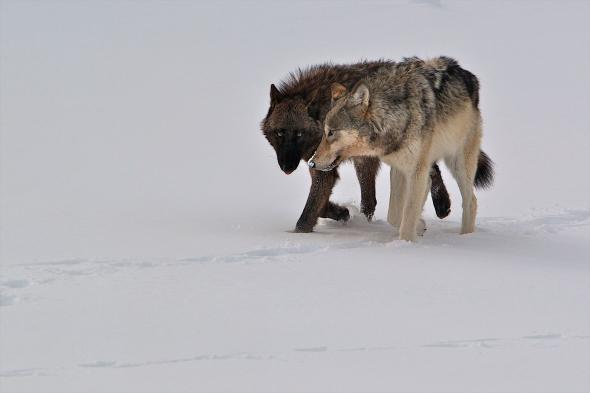
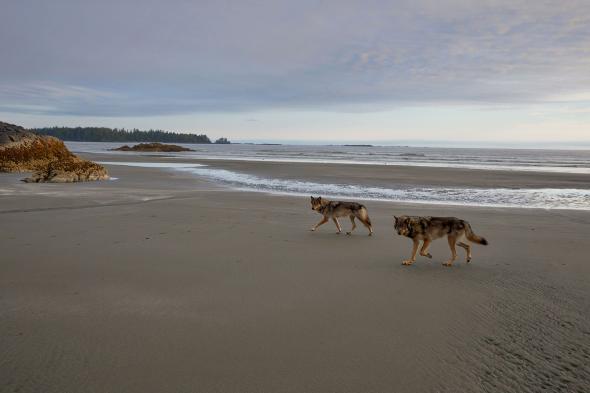
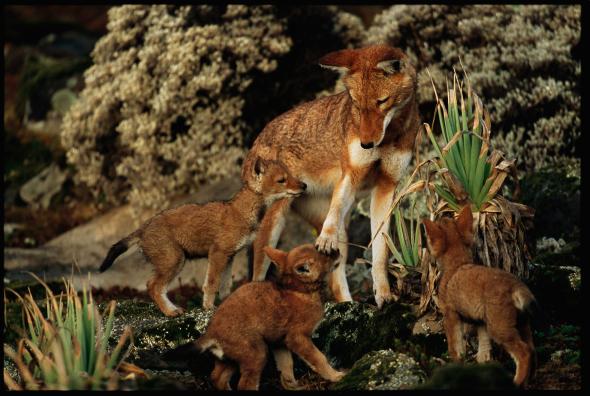
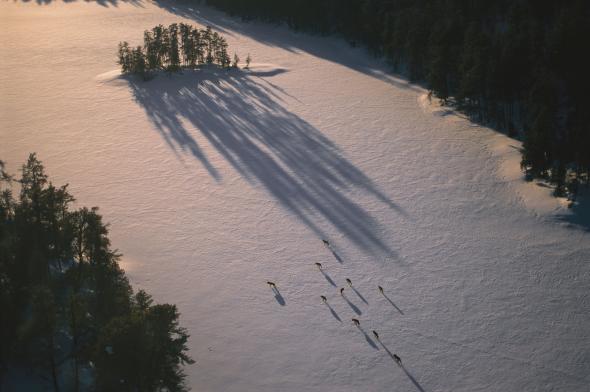
In further recognition of our wonderful wolves.

The background to these photographs, and the first set of six, was a week ago.

wolf7

oooo

wolf8

oooo

wolf9

oooo

wolf10

oooo

wolf11

oooo

wolf12

oooo

You all have a great week.