Category: consciousness

It really is a very simple message!

Repeat after me: We are of this planet!  It’s really very simple!

There are times when I look back at my writings on Learning from Dogs, now well over 1,500 posts (1,633 as of today, to be anal about it!) and ponder if the fundamental message behind the name of the blog often gets overlooked.  The Welcome page states:

As man’s companion, protector and helper, history suggests that dogs were critically important in man achieving success as a hunter-gatherer. Dogs ‘teaching’ man to be so successful a hunter enabled evolution, some 20,000 years later, to farming, thence the long journey to modern man. But in the last, say 100 years, that farming spirit has become corrupted to the point where we see the planet’s plant and mineral resources as infinite. Mankind is close to the edge of extinction, literally and spiritually.

Dogs know better, much better! Time again for man to learn from dogs!

Elsewhere on the blog, I underpin that proposition by listing the attributes of dogs:

Dogs:

  • are integrous ( a score of 210) according to Dr David Hawkins
  • don’t cheat or lie
  • don’t have hidden agendas
  • are loyal and faithful
  • forgive
  • love unconditionally
  • value and cherish the ‘present’ in a way that humans can only dream of achieving
  • are, by eons of time, a more successful species than man.

Now this is all fine and dandy but of what relevance is this to the mess that homo sapiens now finds itself in? Two parts to that answer come to mind.

The first part is that watching a dog out in the open countryside quickly brings home the fact that these animals are part of nature and, if push comes to shove, can live in the wild and fend for themselves.  Not saying that a domestic dog would enjoy the experience but that their wild dog and grey wolf roots still rest somewhere in a dog’s consciousness.

The second part of the answer is that all animals instinctively live in harmony, in balance, with their surroundings; with their environment.

For the incredibly obvious reason that dogs, as with all other animal species, are an evolutionary consequence of the natural history of Planet Earth.  That evolutionary journey from the Grey Wolf (Canis lupus) part of the Canidae family, a family including wolves, coyotes and foxes, thought to have evolved 60 million years ago.  That journey all the way to the domestic dog (Canis lupus familiaris).

That ancient journey where the African wild dog (Lycaon pictuspainted dog) came together with early man. No one knows when but the African wild dog was certainly around when man developed speech and set out from Africa, about 50,000 years ago!

Two vastly different natural species, dog and man, evolving compatibly with each other for so many thousands of years.

Back to the attributes of dogs, in particular a dog’s ability to cherish the present.  Earlier this week I was chatting with Kevin Dick, friend from Payson, AZ days, about the ‘interesting’ times we are living in.  Kevin thought there was a significant difference between the generations born in the 1940’s and 1950’s and those born in later times.  Most people over the age of, say 55, were brought up to save for ‘a rainy day’ and, possibly, be able to leave a legacy to their offspring.  Kevin then went on to reflect that more recent generations exhibit a ‘buy today, don’t delay’ mentality.

A by-product of this materialistic instant gratification approach is that the whole damn consumer machine has created a total disconnect with the fact that we humans are of this planet.

The earth is the mother of all people..

(Chief Joseph 1840 – 1904, leader of the Wallowa band, a Native American tribe

indigenous to the Wallowa Valley in northeastern Oregon)

Humans today fail to comprehend this fundamental fact: Our ability to harm the planet and think that it won’t affect our species is complete madness!  If only we could learn how to cherish the present in the way that our dogs do!

I’m now going to offer an essay from John Hurlburt.  I knew John had written this essay but didn’t get round to reading it properly until I had finished the introduction above.  I’m blown away by the resonance between the two but, as always, John’s words are so much more eloquent.

Inside Out

Climate change, religion, economics, government, politics and social issues are topics which create strong personal opinions and cultural divisions. We have difficulty accepting ideas which may conflict with our personal understandings. As usual, it’s an ego thing. The arrogance of our species is inclusive. We all suffer the consequences.

To counter our ego, we know that everything fits together. We exist in a unified cosmos with fluctuations and diversities that emerge around and through us.

Our present transformative state is as a biological form of energy and matter which possesses a conscious awareness of the natural order. We choose to ignore or deny the essential nature of our being at our own peril. Do we live only for the moment or do we live to insure our species future? That’s our fundamental choice.

Seek the truth and identify the common good.” Zoroaster [also known as Zarathustra, Ed.]

We are a consciously aware component of a living world in an isolated corner of a remote galaxy. Everything within and on the earth has an extraterrestrial origin. We live on an incubator we call the earth. We rarely truly communicate with or fully understand the energy of nature in our lives. Our critical thinking ability has become enveloped by an electronic cloud.

We generally agree that the actions of many religions and most politics are based upon short term human interests rather than upon the long term well being of our planet and its disappearing life forms. The fact is that we only began to emerge as a species about 100,000 years ago. Hubble telescope observations have dated our universal origin to roughly 13,002,000,000 years ago.

Could it be that we only imagine ourselves as independent beings? Could it be that beyond the mind games we play there is a vast reality greater that we can understand with our limited sensory apparatus and our finite minds?

Life is a transformative experience. All species, tribes, races and genders are united by the nature of life. We pass through a period of being selfish and ambitious during our journey. Many of us choose to move into these familiar ruts and furnish them. We do not always walk the way we talk.

Nature favors species which adapt to constant change in an emerging universe.

If we agree that our intelligence is judged by choices we make, there is some question about intelligent human life on earth. A recent Harvard University study of species in relation to change estimates that the life span of the human species is approximately 100,000 years. Sound familiar?

The wisdom of our brief human history tells us that we are on a careless and needless path to self destruction. All that’s necessary to verify this assertion is to turn on the news of the day. The systemic paradigm that has been imprinted on our psyches is in constant flux. As we live and learn, we realize that our purpose is to leave life better than we found it.

A delicate balance is necessary to maintain an even strain of faith in the natural process rather than dwelling upon our self centered fears of losing something we imagine we own or not attaining something we believe we want. The earth heals itself from the inside out. We can do the same as a species. Today is the tomorrow we dreamed of yesterday. What have we done to fulfill the true purpose of our lives?

an old lamplighter

So, yes, we have much to learn from dogs.

I will close as I started. We are of this planet!  It’s really very simple!

Can you give a dog a home?

Please take two minutes to read this now.

Back over two years ago, when Jean and I were living in Payson, Arizona, I wrote a post called Tara’s Babies.  Here’s a flavour of that post:

oooOOOooo

Many who follow this Blog will know that my beautiful wife, Jean, is totally devoted to dogs, especially rescue dogs.  Over the years that she and her previous husband Ben lived in Mexico, Jean must have rescued at least 70 dogs.  Even today, we have 11 ex-rescue dogs enjoying a fabulous life in our mountain home here in Payson, Arizona.

So it was a big surprise to come across a dog rescue organisation called Tara’s Babies and find that their sanctuary is in our neighbourhood.

Photo by Wib Middleton

Here’s a description of the organisation taken from the local newspaper from September 9th, 2009.

By Alan R. Hudson
Gazette/Connection Correspondent
It has been nearly five years since Tara’s Babies Animal Welfare began rescuing animals displaced by Hurricane Katrina. Tara’s Babies operates a no-kill animal rescue and sanctuary “off the grid” at the Ellinwood Ranch, near Young.

oooOOOooo

Anyway, Alan Hudson left a comment a few minutes ago to the effect that Tara’s Babies is closing.  Confirmed by going to their website.

The reason why this post is being published straightaway is because of the urgent need to find homes for 24 dogs.  Take a look at those dogs; please!

I’m republishing what you can read on the Tara’s Babies website – please share this news as far and wide as you can.  These dogs need good homes.

oooOOOooo

Tara’s Babies Animal Welfare

No Kill Animal Rescue and Sanctuary

Practice kindness, save a life…change the world

Tara’s Babies began in 2005 as a desperate cry from New Orleans after Hurricane Katrina left thousands of dogs and cats, homeless and suffering. Our founder sent a crew of volunteers to search the flooded buildings for animals in need. We rescued 17 dogs and a kitten. and thus began Tara’s Babies Animal Welfare (TBAW).

While down there, we paired with Best Friends and arranged an airlift to bring 150 dogs and cats from Tylertown, MS to Phoenix, AZ. Waiting at the airport when we arrived was a cattle transporter, volunteers and SUV’s to take the animals to Dakini Valley, AZ.

Our sanctuary at Dakini Valley is located on 157 acres in the remote Hell’s Gate Wilderness. Here the dogs and cats were cared for with love and attention three full-time volunteers until every one of the Katrina dogs were re-homed or found forever homes, with the exception of 15 dogs who were non-adoptable needing lifetime sanctuary. As the original Katrina animals were placed, we found our true mission evolve into saving animals from death row.

Since then we have worked tirelessly networking with other rescues, shelters, and sanctuaries to continuously save dogs from death row. Connections were made as far as Taiwan! Pipi, a Taiwanese dog, was brought to our sanctuary through this connection.

We have had as many as 71 dogs at once at the sanctuary. Even those dogs considered non-adoptable, who are human or dog aggressive, have benefited from the peaceful surroundings of the land and our love. These dogs have demonstrated good behavior with their caretakers and some have even been paired with a companion dog.

Due to unforeseen medical and other issues we lost our director and several volunteers bringing the number of volunteers down to only one. Out of concern for the safety of the dogs coupled with ongoing financial difficulties, the Tara’s Babie’s board made the difficult and heartbreaking decision to close our doors.

We will continue to lovingly care for each of the dogs until ALL are placed.

Please help the remaining dogs at the sanctuary. Click HERE to see them!. If you can help us with adoptions or placement in another sanctuary please contact us at  wggnrclr@yahoo.com or call 928-301-1392. You can also visit our Facebook page for photos and stories.

oooOOOooo

(Tara’s Babies sanctuary is located outside Payson, Arizona. Most administrative and support operations are in Sedona Arizona. The telephone number is 928-301-1392. Leave a message.)

Once again, if there is anything you can do, please be in direct contact with Tara’s Babies.  Feel free to leave any comments or news here.

Thank you so much.

The new tomorrows.

When we are no longer able to change a situation – we are challenged to change ourselves.”  Viktor Frankl.

Like many bloggers I enjoy using a quotation to set the theme for a post.  Found this on the web; it seemed appropriate.

Over the next two days, I want to range across a number of ideas that, together, point to changes that are underway in every conceivable manner for the vast majority of the inhabitants of this planet.

My musings were prompted by a recent essay on Tom Dispatch.  Regulars will know that Tom Engelhardt generously granted me permission to republish essays that appear on his very widely-read blogsite.  This particular essay is about Phoenix in Arizona.

But first indulge me as I recount something rather personal, possibly silly but also mysteriously beautiful.

Many will know that Jean and I moved from San Carlos in Mexico to Payson, Arizona early on in 2010.  (My long comment to yesterday’s post about poor Lupe explains the background.)  Payson is 80 miles North-East of Phoenix and despite being up at 5,000 feet is very much in the same broad weather systems as Phoenix.

With our 14 dogs and 7 cats we quickly settled down and were made to feel very welcome by one and all.  Jean and I were married in Payson in November of 2010.  We were happy and contented.

One night in June last year, I had this vivid dream about going to the bathroom and finding that no water came from the tap.  Where we were living was out of town and our water supplies came from our own well (borehole in English speak!).  While the water level in the well was down by about 50 feet there was no question of the well failing; it was drilled to over 180 feet and flow tests were positive.

When I awoke the dream was still very much in the forefront of my mind.  I talked about it over breakfast with Jeannie.  By chance, we had a guest staying with us and when she heard the tale she said, “If you’re worried about water, you should go to Oregon.

Again, by chance, a couple of weeks later we had someone offer to house-sit.  With our menagerie of animals that was no casual offer!

We accepted, came up to Oregon and found this most beautiful home in Merlin, Southern Oregon complete with 13 acres and Bummer Creek running across the width of the property, a creek that flows for most of the year.

Pharaoh checking out our creek.
Pharaoh checking out Bummer Creek.

We quickly did the deal, sold the house in Payson and moved in on October 25th 2012, less than 5 months ago.

Keep all of that in mind as you read this TomDispatch essay.

oooOOOooo

Tomgram: William deBuys, Exodus from Phoenix

Posted by William deBuys at 7:58am, March 14, 2013.

We’re not the first people on the planet ever to experience climate stress.  In the overheating, increasingly parched American Southwest, which has been experiencing rising temperatures, spreading drought conditions, and record wildfires, there is an ancient history of staggering mega-droughts, events far worse than the infamous “dust bowl” of the 1930s, the seven-year drought that devastated America’s prairie lands.  That may have been “the worst prolonged environmental disaster recorded for the country,” but historically speaking it was a “mere dry spell” compared to some past mega-droughts that lasted “centuries to millennia.”

Such events even happened in human history, including an almost century-long southwestern dry spell in the second century AD and a drought that was at least decades long in the twelfth century.  These were all events driven by natural climate variation.  Climate change adds a human factor to the equation in a region already naturally dry and short on water.  It ups the odds of bad events happening.  In the coming century, how habitable will parts of the bustling desert Southwest turn out to be?  Already, in the face of heat and drought, small numbers of people from small towns in the region are leaving.  And this, too, has happened before.  There are sobering previous examples of what it means when extreme climate stress hits this area.

Chaco Canyon was abandoned by its native population during that twelfth-century drought, and 150 years later, the Hohokam native culture of what is now central Arizona, whose waterworks in the dry lands of that area were major and impressive, also abandoned its lands, possibly due to drought, as TomDispatch regular William deBuys recounts in his recent book A Great Aridness: Climate Change and the Future of the American Southwest.  “At some point,” he writes, “Hohokam society passed a threshold: the number of able-bodied workers it could muster was no longer sufficient to meet the challenge of rebuilding dams when they washed out and cleaning canals as they inevitably silted up. Eventually the hydraulic system collapsed, and the society that depended on it could no longer exist. The survivors turned their backs on their cities and scattered into the vastness of the land, doing what they could to survive.”

As you read deBuys’s latest post, it’s worth remembering that even the greatest hydraulic engineers have their limits when the water dries up.  When the Anglo farmers of the Phoenix Basin first started using the local rivers, they found themselves “reopening the canals the Hohokam had left behind.”  Who knows what monumental works we, too, might someday abandon? Phoenix, anyone? Tom

Phoenix in the Climate Crosshairs 
We Are Long Past Coal Mine Canaries 
By William deBuys

If cities were stocks, you’d want to short Phoenix.

Of course, it’s an easy city to pick on. The nation’s 13th largest metropolitan area (nudging out Detroit) crams 4.3 million people into a low bowl in a hot desert, where horrific heat waves and windstorms visit it regularly. It snuggles next to the nation’s largest nuclear plant and, having exhausted local sources, it depends on an improbable infrastructure to suck water from the distant (and dwindling) Colorado River.

In Phoenix, you don’t ask: What could go wrong? You ask: What couldn’t?

And that’s the point, really. Phoenix’s multiple vulnerabilities, which are plenty daunting taken one by one, have the capacity to magnify one another, like compounding illnesses. In this regard, it’s a quintessentially modern city, a pyramid of complexities requiring large energy inputs to keep the whole apparatus humming. The urban disasters of our time — New Orleans hit by Katrina, New York City swamped by Sandy — may arise from single storms, but the damage they do is the result of a chain reaction of failures — grids going down, levees failing, back-up systems not backing up. As you might expect, academics have come up with a name for such breakdowns: infrastructure failure interdependencies. You wouldn’t want to use it in a poem, but it does catch an emerging theme of our time.

Phoenix’s pyramid of complexities looks shakier than most because it stands squarely in the crosshairs of climate change. The area, like much of the rest of the American Southwest, is already hot and dry; it’s getting ever hotter and drier, and is increasingly battered by powerful storms. Sandy and Katrina previewed how coastal cities can expect to fare as seas rise and storms strengthen. Phoenix pulls back the curtain on the future of inland empires. If you want a taste of the brutal new climate to come, the place to look is where that climate is already harsh, and growing more so — the aptly named Valley of the Sun.

In Phoenix, it’s the convergence of heat, drought, and violent winds, interacting and amplifying each other that you worry about. Generally speaking, in contemporary society, nothing that matters happens for just one reason, and in Phoenix there are all too many “reasons” primed to collaborate and produce big problems, with climate change foremost among them, juicing up the heat, the drought, and the wind to ever greater extremes, like so many sluggers on steroids. Notably, each of these nemeses, in its own way, has the potential to undermine the sine qua non of modern urban life, the electrical grid, which in Phoenix merits special attention.

If, in summer, the grid there fails on a large scale and for a significant period of time, the fallout will make the consequences of Superstorm Sandy look mild. Sure, people will hunt madly for power outlets to charge their cellphones and struggle to keep their milk fresh, but communications and food refrigeration will not top their list of priorities. Phoenix is an air-conditioned city. If the power goes out, people fry.

In the summer of 2003, a heat wave swept Europe and killed 70,000 people. The temperature in London touched 100 degrees Fahrenheit for the first time since records had been kept, and in portions of France the mercury climbed as high as 104°F. Those temperatures, however, are child’s play in Phoenix, where readings commonly exceed 100°F for more than 100 days a year. In 2011, the city set a new record for days over 110°F: there were 33 of them, more than a month of spectacularly superheated days ushering in a new era.

In Flight From the Sun

It goes without saying that Phoenix’s desert setting is hot by nature, but we’ve made it hotter. The city is a masonry world, with asphalt and concrete everywhere. The hard, heavy materials of its buildings and roads absorb heat efficiently and give it back more slowly than the naked land. In a sense, the whole city is really a thermal battery, soaking up energy by day and releasing it at night. The result is an “urban heat island,” which, in turn, prevents the cool of the desert night from providing much relief.

Sixty years ago, when Phoenix was just embarking on its career of manic growth, nighttime lows never crept above 90°F. Today such temperatures are a commonplace, and the vigil has begun for the first night that doesn’t dip below 100°F. Studies indicate that Phoenix’s urban-heat-island effect may boost nighttime temperatures by as much as 10°F. It’s as though the city has doubled down on climate change, finding a way to magnify its most unwanted effects even before it hits the rest of us full blast.

Predictably, the poor suffer most from the heat.  They live in the hottest neighborhoods with the least greenery to mitigate the heat-island effect, and they possess the least resources for combatting high temperatures.  For most Phoenicians, however, none of this is more than an inconvenience as long as the AC keeps humming and the utility bill gets paid. When the heat intensifies, they learn to scurry from building to car and into the next building, essentially holding their breaths. In those cars, the second thing they touch after the ignition is the fan control for the AC. The steering wheel comes later.

In the blazing brilliance of July and August, you venture out undefended to walk or run only in the half-light of dawn or dusk. The idea for residents of the Valley of the Sun is to learn to dodge the heat, not challenge it.

Heat, however, is a tricky adversary. It stresses everything, including electrical equipment. Transformers, when they get too hot, can fail. Likewise, thermoelectric generating stations, whether fired by coal, gas, or neutrons, become less efficient as the mercury soars.  And the great hydroelectric dams of the Colorado River, including Glen Canyon, which serves greater Phoenix, won’t be able to supply the “peaking power” they do now if the reservoirs behind them are fatally shrunken by drought, as multiple studies forecast they will be. Much of this can be mitigated with upgraded equipment, smart grid technologies, and redundant systems.  But then along comes the haboob.

haboob is a dust/sand/windstorm, usually caused by the collapse of a thunderstorm cell. The plunging air hits the ground and roils outward, picking up debris across the open desert. As the Arabic name suggests, such storms are native to arid regions, but — although Phoenix is no stranger to storm-driven dust — the term haboob has only lately entered the local lexicon. It seems to have been imported to describe a new class of storms, spectacular in their vehemence, which bring visibility to zero and life to a standstill. They sandblast cars, close the airport, and occasionally cause the lights — and AC — to go out. Not to worry, say the two major utilities serving the Phoenix metroplex, Arizona Public Service and the Salt River Project. And the outages have indeed been brief.  So far.

Before Katrina hit, the Army Corps of Engineers was similarly reassuring to the people of New Orleans. And until Superstorm Sandy landed, almost no one worried about storm surges filling the subway tunnels of New York.

Every system, like every city, has its vulnerabilities. Climate change, in almost every instance, will worsen them. The beefed-up, juiced-up, greenhouse-gassed, overheated weather of the future will give us haboobs of a sort we can’t yet imagine, packed with ever greater amounts of energy. In all likelihood, the emergence of such storms as a feature of Phoenix life results from an overheating environment, abetted by the loose sand and dust of abandoned farmland (which dried up when water was diverted to the city’s growing subdivisions).

Water, Water, Everywhere (But Not for Long)

In dystopic portraits of Phoenix’s unsustainable future, water — or rather the lack of it — is usually painted as the agent of collapse. Indeed, the metropolitan area, a jumble of jurisdictions that includes Scottsdale, Glendale, Tempe, Mesa, Sun City, Chandler, and 15 other municipalities, long ago made full use of such local rivers as the Salt, Verde, and Gila. Next, people sank wells and mined enough groundwater to lower the water table by 400 feet.

Sometimes the land sank, too.  Near some wells it subsided by 10 feet or more. All along, everyone knew that the furious extraction of groundwater couldn’t last, so they fixed their hopes on a new bonanza called the Central Arizona Project (CAP), a river-sized, open-air canal supported by an elaborate array of pumps, siphons, and tunnels that would bring Colorado River water across the breadth of Arizona to Phoenix and Tucson.

The CAP came on line in the early 1990s and today is the engine of Arizona’s growth. Unfortunately, in order to win authorization and funding to build it, state officials had to make a bargain with the devil, which in this case turned out to be California. Arizona’s delegation in the House of Representatives was tiny, California’s was huge, and its representatives jealously protected their longstanding stranglehold on the Colorado River. The concession California forced on Arizona was simple: it had to agree that its CAP water rights would take second place to California’s claims.

This means one thing: once the inevitable day comes when there isn’t enough water to go around, the CAP will absorb the shortage down to the last drop before California even begins to turn off its faucets.

A raw deal for Arizona? You bet, but not exactly the end of the line. Arizona has other “more senior” rights to the Colorado, and when the CAP begins to run dry, you may be sure that the masters of the CAP will pay whatever is necessary to lease those older rights and keep the 330-mile canal flowing. Among their targets will be water rights belonging to Indian tribes at the western edge of the state along the lower reaches of the river. The cost of buying tribal water will drive the rates consumers pay for water in Phoenix sky-high, but they’ll pay it because they’ll have to.

Longer term, the Colorado River poses issues that no amount of tribal water can resolve. Beset by climate change, overuse, and drought, the river and its reservoirs, according to various researchers, may decline to the point that water fails to pass Hoover Dam. In that case, the CAP would dry up, but so would the Colorado Aqueduct which serves greater Los Angeles and San Diego, as well as the All-American Canal, on which the factory farms of California’s Imperial and Coachella valleys depend. Irrigators and municipalities downstream in Mexico would also go dry. If nothing changes in the current order of things, it is expected that the possibility of such a debacle could loom in little more than a decade.

The preferred solution to this crisis among the water mavens of the lower Colorado is augmentation, which means importing more water into the Colorado system to boost native supplies. A recently discussed grandiose scheme to bail out the Colorado’s users with a pipeline from the Mississippi River failed to pass the straight-face test and was shot down by then-Secretary of the Interior Ken Salazar.

Meanwhile, the obvious expedient of cutting back on water consumption finds little support in thirsty California, which will watch the CAP go dry before it gets serious about meaningful system-wide conservation.

Burning Uplands

Phoenicians who want to escape water worries, heat waves, and haboobs have traditionally sought refuge in the cool green forests of Arizona’s uplands, or at least they did until recently. In 2002, the Rodeo-Chediski fire consumed 469,000 acres of pine and mixed conifer on the Mogollon Rim, not far from Phoenix. It was an ecological holocaust that no one expected to see surpassed. Only nine years later, in 2011, the Wallow fire picked up the torch, so to speak, and burned across the Rim all the way to the New Mexico border and beyond, topping out at 538,000 charred acres.

Now, nobody thinks such fires are one-off flukes. Diligent modeling of forest response to rising temperatures and increased moisture stress suggests, in fact, that these two fires were harbingers of worse to come. By mid-century, according to a paper by an A-team of Southwestern forest ecologists, the “normal” stress on trees will equal that of the worst megadroughts in the region’s distant paleo-history, when most of the trees in the area simply died.

Compared to Phoenix’s other heat and water woes, the demise of Arizona’s forests may seem like a side issue, whose effects would be noticeable mainly in the siltation of reservoirs and the destabilization of the watersheds on which the city depends. But it could well prove a regional disaster.  Consider, then, heat, drought, windstorms, and fire as the four horsemen of Phoenix’s Apocalypse. As it happens, though, this potential apocalypse has a fifth horseman as well.

Rebecca Solnit has written eloquently of the way a sudden catastrophe — an earthquake, hurricane, or tornado — can dissolve social divisions and cause a community to cohere, bringing out the best in its citizenry. Drought and heat waves are different. You don’t know that they have taken hold until you are already in them, and you never know when they will end. The unpleasantness eats away at you.  It corrodes your state of mind. You have lots of time to meditate on the deficiencies of your neighbors, which loom larger the longer the crisis goes on.

Drought divides people, and Phoenix is already a divided place — notoriously so, thanks to the brutal antics of Maricopa County Sheriff Joe Arpaio. In Bird on Fire: Lessons from the World’s Least Sustainable City, Andrew Ross offers a dismal portrait of contemporary Phoenix — of a city threatened by its particular brand of local politics and economic domination, shaped by more than the usual quotient of prejudice, greed, class insularity, and devotion to raw power.

It is a truism that communities that do not pull together fail to surmount their challenges. Phoenix’s are as daunting as any faced by an American city in the new age of climate change, but its winner-take-all politics (out of which has come Arizona’s flagrantly repressive anti-immigration law), combined with the fragmentation of the metro-area into nearly two dozen competing jurisdictions, essentially guarantee that, when the worst of times hit, common action and shared sacrifice will remain as insubstantial as a desert mirage. When one day the U-Haul vans all point away from town and the people of the Valley of the Sun clog the interstates heading for greener, wetter pastures, more than the brutal heat of a new climate paradigm will be driving them away. The breakdown of cooperation and connectedness will spur them along, too.

One day, some of them may look back and think of the real estate crash of 2007-2008 and the recession that followed with fond nostalgia. The city’s economy was in the tank, growth had stalled, and for a while business-as-usual had nothing usual about it. But there was a rare kind of potential. That recession might have been the last best chance for Phoenix and other go-go Sunbelt cities to reassess their lamentably unsustainable habits and re-organize themselves, politically and economically, to get ready for life on the front burner of climate change. Land use, transportation, water policies, building codes, growth management — you name it — might all have experienced a healthy overhaul. It was a chance no one took. Instead, one or several decades from now, people will bet on a surer thing: they’ll take the road out of town.

William deBuys, a TomDispatch regular, is the author of seven books, most recently A Great Aridness: Climate Change and the Future of the American Southwest. He has long been involved in environmental affairs in the Southwest, including service as founding chairman of the Valles Caldera Trust, which administers the 87,000-acre Valles Caldera National Preserve in New Mexico.

Follow TomDispatch on Twitter and join us on Facebook. Check out the newest Dispatch book, Nick Turse’s The Changing Face of Empire: Special Ops, Drones, Proxy Fighters, Secret Bases, and Cyberwarfare.

Copyright 2013 William deBuys

oooOOOooo

Just to reinforce the magic of my dream and how Jean and I feel so blessed by our life changes, the photo below was taken on our property the day we arrived in Merlin.

Within arm's reach of the beauty of nature.
Within arm’s reach of the beauty of nature.

Musings continued tomorrow.  Hope you stayed with it so far.

Be in peace, dear Lupe.

Forgive the shortness of today’s post.

I’m writing this at 3pm on the Tuesday, i.e. yesterday afternoon.

In under an hour’s time we have to leave to travel to Grants Pass to see the vet and have poor Lupe euthenised.  She has been suffering from dementia since before Christmas and has got to the point where she has little or no quality of life left.  Jeannie has been a saint in patiently administering to Lupe’s needs; feeding her, cleaning her up, and more.  All for many weeks now.  It was about 2 hours ago that Jean knew the time had come.

A few pictures from better times.

P1030118

From Mexico days back in 2008.  Lupe is second from the left.

P1100990

Lupe leading Lilly, taken in February of 2012 at our home in Payson, AZ.

P1120522

Picture of Lupe taken just 8 weeks ago, showing clearly the effects of the dementia in terms of her posture.

Lupe was always a challenge having been terribly treated as a feral dog in Mexico.  In fact, it was 6 months before Jean could fondle her after she had been rescued by Jean.  But slowly she learnt to trust Jean and then to offer Jean lots of doggie love.  I, too, have fond memories of being cheek-to-cheek with Lupe; her love and trust overcoming all fears.

Yet again, so much to learn from dogs.

Sweet, dear Lupe.


In search of intelligent life!

One does have to wonder at times!

The title of today’s post comes from that silly anecdote as to why Planet Earth has never been visited by a species of intergalactic explorers from a far, distant world?

Answer: Because as they passed by and looked down upon our planet they saw no signs of intelligent life!

So what triggered all this?

Well last Wednesday, Christine over at 350 or bust published a review of the recently released film Greedy Lying Bastards.  Christine offered an insightful review of the film but more importantly went on to reveal a whole raft of issues that deserve to be widely promoted.  She has been generous in allowing me to republish her post on Learning from Dogs.

What has this to do with dogs?  On the face of it, very little.  But then again, everything.  Because if humans reverted to the standards of trust, loyalty and openness that we see every day in our dogs then we wouldn’t be in the mess that we are in!

oooOOOooo

Greedy Lying Bastards: Exposing The Fossil Fools Who Put Profit Before Human Lives

GreedyLyingBastards.com

*

One of the few-and-far-between perks of being a climate blogger is that occasionally I get access to books and movies before the general public does. This past weekend I got to watch “Greedy Lying Bastards” before it hit movie screens across the U.S. on Monday. Sunday night I, along with some fellow Citizens Climate Lobby volunteers, got together to watch this 90 minute documentary. This movie exposes the American fossil fuel interests that have been blocking action on climate change for decades, taking a page – and some of the same PR firms and lobbyists – right out of the tobacco companies’ playbook.  Like the tobacco lobby, these fossil fools have opposed government action on the science showing their product is harmful and have actively disseminated lies about the science.

After the movie, I surveyed group members for their responses; we all gave it 10 out of 10 for its topic, but for actual delivery the movie was rated between 6 to 8 out of 10.

Some of the comments were:

“I really appreciated the whistle-blowing, the naming of names. I also really appreciated first-hand accounts of people in the U.S. who are already suffering the consequences of climate change.”

“I haven’t watched a documentary about this topic before, and really appreciated the great graphics. They made the connections for me.”

Two viewers had recently watched “The Age of Stupid” and felt that it spelled out the greed and petro-corruption as well as the consequences of inaction on climate change more clearly than did GLB.

I enjoyed the movie. Of course as a climate hawk I’m thrilled that this corruption and interference in democracy is receiving more attention at this critical juncture in the planet’s history, and for that I want to give a big shout-out to writer and director Scott Rosebraugh and producer Darryl Hannah. Compared to “Age of Stupid” which totally overwhelmed and depressed me and my companion, GLB left me riled up and ready to fight back at these soulless corporate monsters. One critique I have is that the movie ended with a whimper. Rosebraugh offers – in 60 seconds – four actions for people to take in response to the information they’ve just heard (possibly for the first time). It’s not that the actions mentioned (boycotting Exxon & Koch products, asking your Congressional representatives to take action to curb greenhouse gases, “joining the campaign” to stop fossil fuel subsidies and campaigning to overturn Citizens United) aren’t important, they are but to spend 89 minutes of the movie focused on the fossil fools who are destroying U.S. democracy as well as our children’s future without giving viewers more information on taking action may well foster more futility and despair. And, frankly, just signing a petition or writing a letter to your congressperson isn’t going to cut it at this point. The movie doesn’t give enough specifics on responses; the shocking amount of fossil fuel subsidies companies are given every year ($4 Billion in the United States, $775 Billion globally) isn’t even mentioned even while people are encouraged to get active on this issue. To move people from outrage to action, more information and empowerment is necessary. For example, viewers should know that there are governments (Australia, and the Canadian province of British Columbia) who have enacted a tax on carbon pollution, one of the first actions that governments can take to counter the fossil fuel stranglehold on our democracies and our economies.There are groups like 350.org and Citizens Climate Lobby (to name the ones I’m most familiar with) who are working to mobilize people at the grassroots; these important resources are not mentioned in the movie or on the movie’s “take action” website. This silo mentality is one of the biggest stumbling blocks to climate action, so I would beg the fine people involved in GLB and its website to expand their resources and “take action” focus. For that reason I would give the movie a ranking of 7.5 out of 10. Having said that, get out and watch the movie if it’s showing in a theatre near you, and take some friends with you.

For my part as a Canadian, I’d like to add a few more GLBs to the rogues’ gallery compiled by Rosebraugh:

Tim Ball worked as a professor of geography at the University of Winnipeg for eight years between 1988 and 1996. I am personally offended by Mr. Ball because not only did he work at my alma mater, and employed a family member for several years as his research assistant, he has been quoted back to me by acquaintances of mine from rural Manitoba where he’s gone on paid lecturing junkets. I hear that he can be very persuasive, and he’s told these good people that climate change is nothing to worry about (“the climate has always changed”), and so they don’t worry, even while this inaction puts their children’s future at risk. He even lies about his credentials – in this 2007 movie that purports to debunk climate science, you can see he’s identified as being from a department that never existed, in the university that he left 11 years earlier. Now that’s what I call a GLB!

SwindleTimBall

And this Canadian GLB gallery wouldn’t be complete without a portrait of our current prime minister, Stephen Harper, son (spawn? LOL) of an Imperial Oil employee who went on to work for the oil company himself. Harper and his party’s ties to Big Oil are well-documented and are clearly playing themselves out in the current federal government’s policy decisions (see Murray Dobbin’s “Stephen Harper and the Big Oil Party of Canada, or DesmogBlog’s new series, Blame Canada).

406305_339945026024087_278550055496918_1365624_697749516_n

*

More links:

Dr. Jeff Masters’ WunderBlog: Greedy Lying Bastards: A Movie Review

Washington Post: Greedy Lying Bastards: Movie Review

GreedyLyingBastards.com

ExposeTheBastards.com: Take Action

Welcome Home

Sharing the truth of who each of us really is!

I subscribe to Christine’s blog 350 or bust.  As the home page declares, Christine is “a mother, an educator, and a former registered nurse, concerned about climate change.”

Being a follower of Christine’s blog I automatically received an email on Tuesday about her latest post.  This is what that email said,

It’s TED Talk Tuesday on 350orbust. Here’s a fascinating TEDx talk by South African trainer and speaker Bruce Muzik whose “passion is having people experience unprecedented freedom and happiness, through being Authentic.

To be perfectly honest, it didn’t strike me as something that I would watch anytime soon.  However, fate decided to intervene!

Because yesterday, Wednesday, I went up to Portland for an interview today to convince the authorities that I was safe to have my US Residency renewed (aka Green Card).  So last Tuesday, when I was writing these words, I thought I would just grab something quickly for today’s post.  Christine’s TED talk seemed an easy answer.

I started to watch the video and within just a few minutes was overwhelmed with Bruce Muzik’s story.  At the 7 minute mark I paused the video and wrote these words.  The title of today’s post comes from the video just a moment after the 7 minute point.

While the video is about Bruce confronting his inner fears over his racial prejudices, and is no less moving for doing that, there was another message surfacing in parallel in my consciousness.

As I wrote not so long ago under the title of Going beyond the self, “the human psyche lives in a bubble of delusion.”  In the same way that Bruce had to cast aside his delusions and embrace the reality of black people, we have to cast aside our delusions about the way the world is heading.  Which is why Christine’s title How Our Secrets Steal Our Lives was just perfect.

So without further ado, here is that speech by Bruce Muzik. Twenty minutes of pure, gorgeous inspiration.

Want more? Bruce has a blog here.

E Pluribus Unum

From Many, One.

There were a great number of ‘Likes’ for John Hurlburt’s writings which were published most recently on the 1st March, Making sense of life? and on the 25th February, Fear versus Faith.

So it is with very great pleasure that I pass the baton for today’s post once more across to John.

oooOOOooo

E Pluribus Unum

We know we’re in trouble when we no longer pay serious attention to the weather, the foundations of our economy are imaginary, our pumps don’t work because our wells are running dry.  Then how we distract ourselves and loudly complain more often than we make a honest effort to maintain our balance and understand our inclusive situation.

We know we’re in trouble when we’ve moved into the rut of a manufactured illusion and furnished it, when we consume more than we produce, when equality has become a dirty word, when we believe that more guns reduce gun violence, when contempt of Congress has become a national pastime and when our supreme court has become a corporate political tool.

We know we’re in trouble when we fund both sides of a global oil war and neglect the needs of our war veterans, when we believe that we can adapt to change by standing still, when we’ve taken the culture out of agriculture, when we wage cyber war against our planetary neighbors, when an obsessive focus on money systemically corrupts our world and when democracy has a price tag.

We know we’re in trouble when there is virulent opposition to change, when a corporate backed element of our civilization insists upon obfuscation denial and obstruction, when ignorance has become more common than common sense, when a global religious faith and a major university are fractured by inappropriate physical conduct with children in the name of God and sports respectively, and when our primary purpose appears to be to consume our planet as cost effectively as practicable.

We know we’re in trouble when our rivers run dry, when our food is laced with pesticide residues, when our air is contaminated by fuel and chemical waste products, when living species are becoming extinct from the bottom of the food chain and up at a rapidly increasing rate, when we chose to ignore the realities of our natural condition as transitory inhabitants of a living planet and when we arrogantly choose to believe that we own planet earth either as a species or as individual members of a species.

We know that we’re in trouble when free speech is thought to include an unbalanced right to be aggressively ignorant, intolerant and uncompassionate despite all facts to the contrary, when we no longer believe in simple science and arithmetic and when we concentrate on undoing social issues which have been resolved in our lifetimes rather than honestly facing the confluence of problems we all share.

We know we’re in trouble when our politics are more about posturing than policy, when prisons have become a growth industry, when levels of state secrecy exceed open disclosure, when justice has a price tag, when bigotry is stronger than progress, when education is based upon opinion rather than fact and when one nation under God, with liberty and justice for all, has become a fractured nation with a dysfunctional government.

We know we’re in trouble when our legislatures have been purchased, when faith in our financial system has been willfully damaged, when political leaders engage in childish tantrums to get their way regardless of anything or anyone else, when awareness of moral reality has become meaningless and when we fail to appreciate the depths of a looming abyss. What do we gain by purposefully destabilizing our economy, reopening settled social issues and blatantly risking our inclusive future as a species for a mess of pottage?  Who do we think we are?

We know we’re on the right track when nature is more important to us than profit, when open mindedness is stronger than private interests, when media reports facts rather than conjecture and when freedom of speech is not taken to wretched excess as a psychological tool of cultural management employed for the exclusive benefit of an affluent minority.

We know we’re on the right track when our faith in power greater than our species is more significant than short-term profit, when we create equitable employment which benefits our environment, when we repair our crumbling infrastructure, when we make an effort to improve our inclusive quality of life, when war is no longer a first remedy for misunderstanding or disagreement and when we make an effort to reverse our established patterns of self destruction.

We know we’re on the right track when we tax our world stock markets because of our need for revenue based upon the fact that market trades are the only major form of financial transaction that remains untaxed, when we cultivate our cities and towns based on biological needs for clean air, water, food, and energy and when we begin to recognize the massive burden which world population growth places on our planet and take steps to balance our birth rate accordingly.

We know we’re on the right track when we realize that algae based bio-fuel will run every diesel engine in the world without modification, when we realize that our future must be beyond the earth and when we take further steps beyond our garden cradle on a journey of exploration to the stuff of the stars from which our life on earth emerges.

Change is a constant. Today is the tomorrow we dreamed of yesterday. We know we’re growing as a consciously aware life form when our faith is stronger than our fear, when we trust each other to do the next right thing and when the nature of the energy of our spiritual being is more important to us than the immediate comforts of our transitory material being. One day at a time. In God we trust.

Happy trails,

an old lamplighter

Go on, adopt a dog!

A delightful example of a dog teaching a puppy.

(Watched over 3,100,000 times!)

Published on Dec 26, 2012

If you would like to donate to Manitoba Mutts Dog Rescue in Winnipeg, MB please go here.

Our 6 month old lab mix rescue pup taught our 8 week old foster pup (adopted now) from Manitoba Mutts Dog Rescue in Winnipeg to go down the stairs once she got up and couldn’t get down! Please adopt and do not shop. This video is hoping to spread awareness to adopt a dog rather than shop around for one.

Rescue animals are just as great, if not more!

Please search your area for local rescues if you are looking for a dog or cat. These lovely pups are from Manitoba Mutts Dog Rescue in Winnipeg, Manitoba, Canada.

Love in the Present Tense

And now for something completely different!

Sweeny playing in our creek.

Jean and I were looking for something to watch on Wednesday evening and, as is our want, took a browse through the latest films on Top Documentary Films.

There was an intriguing title under the recently added list – People in Motion.

This was how the film was described.

We were hunters and foragers. The frontier was everywhere. We were bounded only by the earth, the ocean and the sky.

Today we go about our business, unencumbered by the frontier. Society guides us, it gives us permission to drive on roads, to stop at red lights, and go on green.

But something is not right.

It often feels as if something is missing. As if the life society has allowed isn’t quite enough.  We spend so much time planning for the future it seems we’re forgetting how to live in the moment. How to feel deep and profound satisfaction with life.

It was this feeling that led us to watch people in cities, trying to understand what drives them. They typically did the same three things: walk, sit and shop.

People in Motion is a film showcasing the potential people have to move through time and space. The film is shot in true slow motion edited using a composite technique which illustrates stretches of time in an instant.

Now before you watch the film, and I really hope you do, just reflect on our closest animal companion; dogs.  As is stated on the home page of Learning from Dogs,

Dogs live in the present – they just are!  Dogs make the best of each moment uncluttered by the sorts of complex fears and feelings that we humans have.

One of the many wonderful ways that dogs enjoy the present is through play.

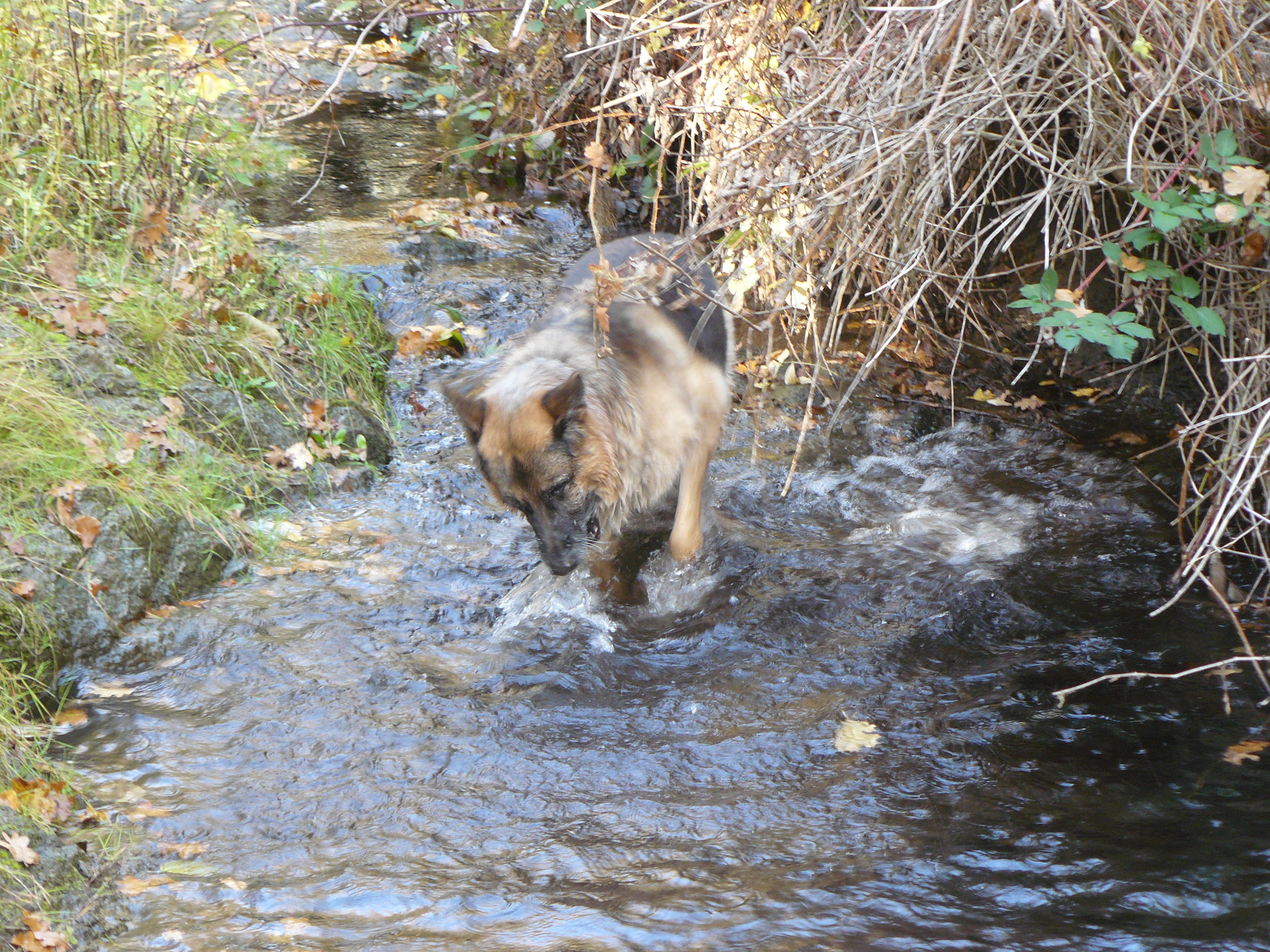
Rain had raised the flow of water in our creek and earlier on that Wednesday we had given the dogs a run in the rain.  Of course, they went immediately to the creek to play in the rushing waters.  The top picture shows Sweeny doing just that, Pharaoh equally having fun as below.

The simple joy of playing in the water.

Play is so important for humans as well as dogs.

Now watch the film and be amazed – the music is pretty cool as well.

Published on Dec 31, 2012

Music by…
* Lindsey Stirling:
** songs: Crystallize, Transcendence

* Niklas Aman:
** songs: Stirred Up, Momentum, Up A Storm

* Michael Marantz:
** song: Earth – The Pale Blue Dot

Directed by: Cedric Dahl
Produced by: Bennett Hoffman
Staring: Paul Whitecotton, Brian Orosco, David Agajanian, Lonnie Tisdale, Jacob Siel

Finally, after you have watched the film you will enjoy this interview with film director Cedric Dahl.  But watch the film first!!