Category: consciousness

None so blind as those who cannot see!

A story of a ship is just the tip of the iceberg!

This is the ship:

S.S. Nordic Orion
S.S. Nordic Orion

Just a ship out of many thousands that ply the trade routes across our oceans.  She was built in 2011 and is classified as a bulk carrier.  Her gross tonnage is 40,142 tons.  She is 738 feet long and 105 feet wide.

So what, you may ask?

To answer that question, let me turn to a recent post over on TomDispatch generously offered for republication on Learning from Dogs. (Thanks Tom.)

oooOOOooo

Tomgram: Rebecca Solnit, The Age of Inhuman Scale

Posted by Rebecca Solnit at 4:32pm, October 6, 2013.
Follow TomDispatch on Twitter @TomDispatch.

It was the stuff of fantasy, of repeated failed expeditions and dreams that wouldn’t die.  I’m talking about the Northwest Passage, that fabled route through Arctic waters around North America.  Now, it’s reality.  The first “bulk carrier,” a Danish commercial freighter with a load of coal, just traveled from Vancouver, Canada, to Finland, cutting a week off its voyage, skipping the Panama Canal, and even, according to the Finnish steel maker Ruukki Metals, for whom the coal was intended, “reducing its greenhouse gas emissions because of fuel savings.”

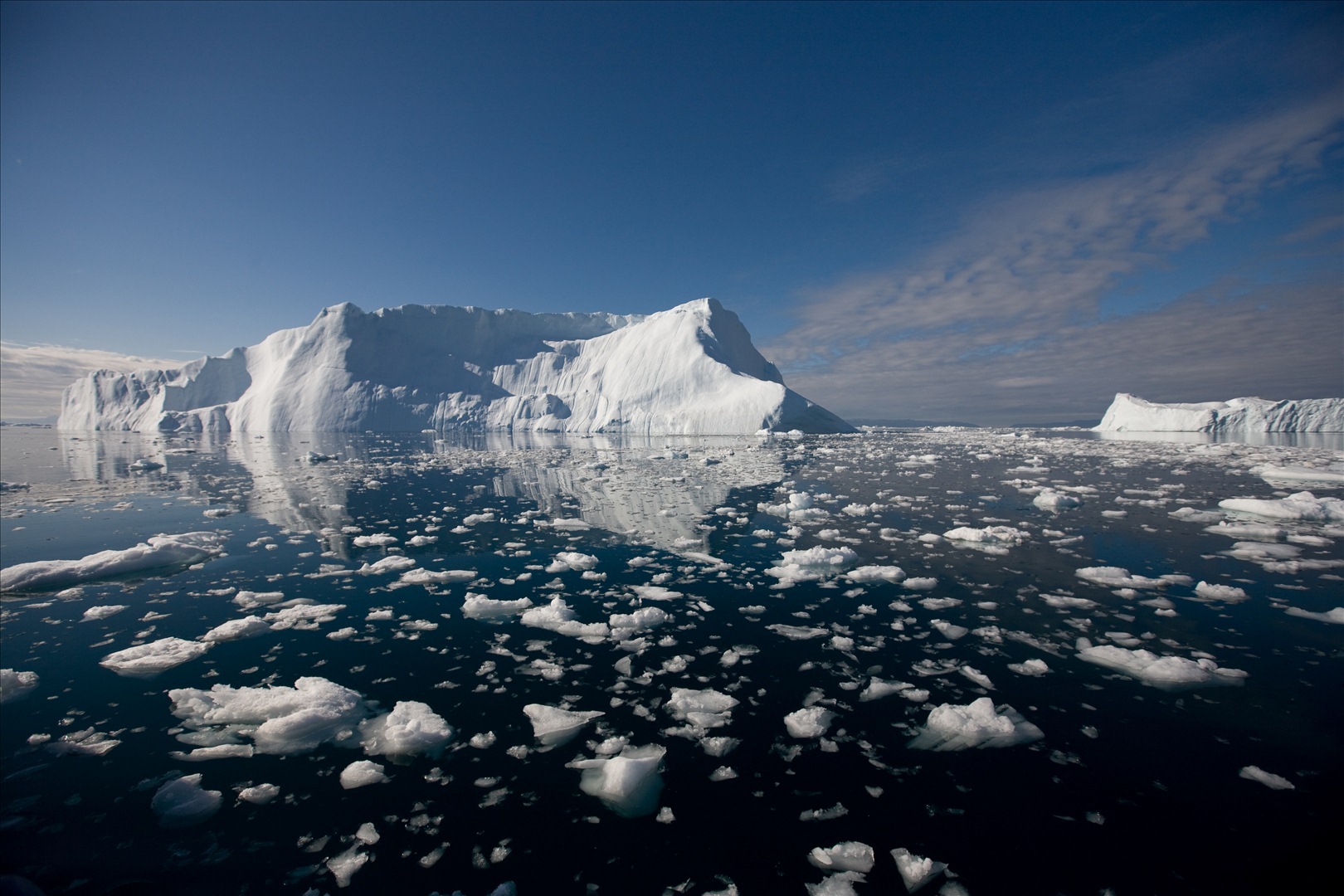
When dreams come true, it’s time to celebrate, no?  Only in this case, under the upbeat news of the immediate moment lies a far larger nightmare.  Those expeditions from the fifteenth to the twentieth centuries failed to find the Northwest Passage because Arctic sea ice made the voyage impossible.  There simply was no passage.  No longer.  Thanks to global warming, the melting of ice — glaciers are losing an estimated 303 billion tons of the stuff annually worldwide — staggers the imagination.  The Greenland ice shield is turning into runoff ever more rapidly, threatening significant sea level rise, and all of the melting in the cold north has, in turn, opened a previously nonexistent Northwest Passage, as well as a similar passage through Russia’s Arctic waters.

None of this would have happened, as the prestigious Intergovernmental Panel on Climate Change pointed out in its latest report, if not for the way the burning of fossil fuels (like that coal the Nordic Orion took to Finland) has poured carbon dioxide into the atmosphere.  In other words, we created that Arctic passage and made it commercially viable, thus ensuring that our world, the one we’ve known since the dawn of (human) time, will be ever less viable for our children and grandchildren.  After all, the Arctic with its enormous reservoirs of fossil fuels can now begin to be opened up for exploitation like so much of the rest of the planet.  And there can be no doubt about it: those previously unreachable reserves will be extracted and burned, putting yet more CO2 into the atmosphere, and anyone who tries to stop that process, as Greenpeace protestors symbolically tried to do recently at an oil rig in Arctic Russia, will be dealt with firmly as “pirates” or worse.  That dream of history, of explorers from once upon a time, is now not just a reality, but part of a seemingly inexorable feedback loop of modern fossil-fuel production and planetary heating, another aspect of what Michael Klare has grimly termed the Third Carbon Age (rather than a new Age of Renewables).

If we don’t need a little perspective on ourselves and our world now, then when? Fortunately, TomDispatch regular Rebecca Solnit is here to offer us both that perspective and some hope for what we can do in the face of well-funded climate denialism and fossil-fuel company boosterism. Tom

Bigger Than That 
(The Difficulty of) Looking at Climate Change 
By Rebecca Solnit

Late last week, in the lobby of a particularly unglamorous downtown San Francisco building, a group of passionate but polite activists met with a bureaucrat who stepped forward to hear what they had to say about the fate of the Earth. The activists wanted to save the world.  The particular part of it that might be under their control involved getting the San Francisco Retirement board to divest its half a billion dollars in fossil fuel holdings, one piece of the international divestment movement that arose a year ago.

Sometimes the fate of the Earth boils down to getting one person with modest powers to budge.

The bureaucrat had a hundred reasons why changing course was, well, too much of a change. This public official wanted to operate under ordinary-times rules and the idea that climate change has thrust us into extraordinary times (and that divesting didn’t necessarily entail financial loss or even financial risk) was apparently too much to accept.

The mass media aren’t exactly helping. Last Saturday, for instance, the New York Times gave its story on the International Panel on Climate Change’s six-years-in-the-making report on the catastrophic future that’s already here below-the-fold front-page placement, more or less equal to that given a story on the last episode of Breaking Bad. The end of the second paragraph did include this quote: “In short, it threatens our planet, our only home.” But the headline (“U.N. Climate Panel Endorses Ceiling on Global Emissions”) and the opening paragraph assured you this was dull stuff. Imagine a front page that reported your house was on fire right now, but that some television show was more exciting.

Sometimes I wish media stories were organized in proportion to their impact.  Unfortunately, when it comes to climate change, there is not paper enough on this planet to properly scale up a story to the right size.  If you gave it the complete front page to suggest its import, you would then have to print the rest of the news at some sort of nanoscale and include an electron microscope for reading ease.

Hold up your hand. It’s so big it can block out the sun, though you know that the sun is so much bigger. Now look at the news: in column inches and airtime, a minor controversy or celebrity may loom bigger than the planet. The problem is that, though websites and print media may give us the news, they seldom give us the scale of the news or a real sense of the proportional importance of one thing compared to another.  And proportion, scale, is the main news we need right now — maybe always.

As it happens, we’re not very good at looking at the biggest things. They may be bigger than we can see, or move more slowly than we have the patience to watch for or remember or piece together, or they may cause impacts that are themselves complex and dispersed and stretch into the future. Scandals are easier.  They are on a distinctly human scale, the scale of lust, greed, and violence. We like those, we understand them, we get mired in them, and mostly they mean little or nothing in the long run (or often even in the short run).

A resident in a town on the northwest coast of Japan told me that the black 70-foot-high wave of water coming at him on March 11, 2011, was so huge that, at first, he didn’t believe his eyes. It was the great Tohoku tsunami, which killed about 20,000 people. A version of such cognitive dissonance occurred in 1982, when NASA initially rejected measurements of the atmosphere above Antarctica because they indicated such a radical loss of ozone that the computer program just threw out the data.

Some things are so big you don’t see them, or you don’t want to think about them, or you almost can’t think about them. Climate change is one of those things. It’s impossible to see the whole, because it’s everything. It’s not just a seven-story-tall black wave about to engulf your town, it’s a complete system thrashing out of control, so that it threatens to become too hot, too cold, too dry, too wet, too wild, too destructive, too erratic for many plants and animals that depend on reliable annual cycles. It affects the entire surface of the Earth and every living thing, from the highest peaks to the depths of the oceans, from one pole to the other, from the tropics to the tundra, likely for millennia — and it’s not just coming like that wave, it’s already here.

It’s not only bigger than everything else, it’s bigger than everything else put together.  But it’s not a sudden event like a massacre or a flood or a fire, even though it includes floods, fires, heat waves, and wild weather.  It’s an incremental shift over decades, over centuries.  It’s the definition of the big picture itself, the far-too-big picture. Which is why we have so much news about everything else, or so it seems.

To understand climate change, you need to translate figures into impacts, to think about places you’ll never see and times after you’re gone. You need to imagine sea level rise and understand its impact, to see the cause-and-effect relations between coal-fired power plants, fossil-fuel emissions, and the fate of the Earth. You need to model data in fairly sophisticated ways. You need to think like a scientist.

Given the demands of the task and the muddle of the mainstream media, it’s remarkable that so many people get it, and that they do so despite massive, heavily funded petroleum industry propaganda campaigns is maybe a victory, if not enough of one.

Four months ago, two bombers in Boston murdered three people and injured hundreds in a way spectacularly calculated to attract media attention, and the media obeyed with alacrity. Climate change probably fueled the colossal floods around Boulder, Colorado, that killed seven people in mid-September, but amid the copious coverage, it was barely mentioned in the media. Similarly, in Mexico, 115 people died in unprecedented floods in the Acapulco area (no significant mention of climate change), while floods reportedly are halving Pakistan’s economic growth (no significant mention), and 166 bodies were found in the wake of the latest Indian floods (no significant mention).

Climate change is taking hundreds of thousands of lives in Africa every year in complex ways whose causes and effects are difficult to follow. Forest fires, very likely enhanced by climate change, took the lives of 19 firefighters facing Arizona blazes amid record heat waves in July.  Again, climate change generally wasn’t the headline on that story.

(For the record, climate change is clearly helping to produce many of the bigger, more destructive, more expensive, more frequent disasters of our time, but it is impossible to point to any one of them and say definitely, this one is climate change.  It’s like trying to say which cancers in a contaminated area were caused by the contamination; you can’t, but what you can say is that the overall rise in cancer is connected.)

Not quite a year ago, a climate-change-related hurricane drowned people when superstorm Sandy hit a place that doesn’t usually experience major hurricane impact, let alone storm surges that submerge amusement parks, the New York City subway system, and the Jersey shore. In that disaster, 148 people died directly, nearly that many indirectly, losses far greater than from any terrorist incident in this country other than that great anomaly, 9/11. The weather has now become man-made violence, though no one thinks of it as terrorism, in part because there’s no smoking gun or bomb — unless you have the eyes to see and the data to look at, in which case the smokestacks of coal plants start to look gun-like and the hands of energy company CEOs and well-paid-off legislators begin to morph into those of bombers.

Even the civil war in Syria may be a climate-change war of sorts: over the past several years, the country has been hit by its worst drought in modern times. Climate and Security analyst Francesco Femia says, “Around 75 percent of [Syrian] farmers suffered total crop failure, so they moved into the cities. Farmers in the northeast lost 80 percent of their livestock, so they had to leave and find livelihoods elsewhere. They all moved into urban areas — urban areas that were already experiencing economic insecurity due to an influx of Iraqi and Palestinian refugees. But this massive displacement mostly wasn’t reported. So it wasn’t factoring into various security analyses. People assumed Syria was relatively stable compared to Egypt.”

Column Inches, Glacial Miles

We like to think about morality and sex and the lives of people we’ve gotten to know in some fashion. We know how to do it. It’s on a distinctly human scale. It’s disturbing in a reassuring way.  We fret about it and feel secure in doing so. Now, everything’s changed, and our imaginations need to keep pace with that change. What is human scale anyway? These days, after all, we split atoms and tinker with genes and can melt an ice sheet. We were designed to think about human-scale phenomena, and now that very phrase is almost as meaningless as old terms like “glacial,” which used to mean slow-moving and slow to change.

Nowadays glaciers are melting rapidly or disappearing entirely, and some — those in Greenland, for example — have gushing rivers of ice water eating through their base. If the whole vast Greenland ice sheet were to melt, it could raise global sea levels by 23 feet.

We tend to think about climate change as one or two or five things: polar ice, glaciers melting, sea-level rise, heat waves, maybe droughts. Now, however, we need to start adding everything else into the mix: the migration of tropical diseases, the proliferation of insect pests, crop failures and declining crop yields leading to widespread hunger and famine, desertification and flooded zones and water failures leading to mass population shifts, resource wars, and so many other things that have to do with the widest systems of life on Earth, affecting health, the global economy, food systems, water systems, and energy systems.

It is almost impossibly scary and painful to contemplate the radical decline and potential death of the oceans that cover 70% of the Earth’s surface and the dramatic decrease of plankton, which do more than any other type of organism to sequester carbon and produce oxygen — a giant forest in microscopic form breathing in what we produce, breathing out what we need, keeping the whole system going. If you want to read something really terrifying, take a look at the rise of the Age of Jellyfish in this review of Lisa-Ann Gershwin’s book Stung!: On Jellyfish Blooms and the Future of the Ocean. Maybe read it even if you don’t.

Only remember that like so much about climate change we used to imagine as a grim future, that future is increasingly here and now. In this case, in the form of millions or maybe billions of tons of jellyfish proliferating globally and devouring plankton, fish eggs, small fish, and bigger creatures in the sea we love, we know, we count on, we feed on, and now even clogging the water-intake pipes of nuclear power plants. In the form of seashells dissolving in acidic waters from the Pacific Northwest to the Antarctic Ocean. In the form of billions of pine-bark beetles massacring the forests of the American West, from Arizona to Alaska, one bite at a time.

It’s huge. I think about it, and I read about it, following blogs at Weather Underground, various climate websites, the emails of environmental groups, the tweets of people at 350.org, and bits and pieces of news on the subject that straggle into the mainstream and alternative media. Then I lose sight of it. I think about everything and anything else; I get caught up in old human-scale news that fits into my frameworks so much more easily. And then I remember, and regain my sense of proportion, or disproportion.

The Great Wall, Brick by Brick

The changes required to address climate change are colossal, but they are made up of increments and steps and stages that are more than possible. Many are already underway, both as positive changes (adaptation of renewable energy, increased energy efficiency, new laws, policies, and principles) and as halts to destruction (for example, all the coal-fired plants that have not been built in recent years and the Tar Sands pipeline that, but for popular resistance, would already be sending its sludge from Alberta to the Gulf of Mexico). The problem is planetary in scale, but there is room to mitigate the worst-case scenarios, and that room is full of activists at work. Much of that work consists of small-scale changes.

As Sierra Club Executive Director Michael Brune put it last week, “Here’s the single most important thing you need to know about the IPCC report: It’s not too late. We still have time to do something about climate disruption. The best estimate from the best science is that we can limit warming from human-caused carbon pollution to less than 3.6 degrees Fahrenheit — if we act now. Bottom line: Our house is on fire. Rather than argue about how fast it’s burning, we need to start throwing buckets of water.”

There are buckets and bucket brigades. For example, the movement to get universities, cities, churches, and other entities to divest their holdings of the top 200 fossil-fuel stocks could have major consequences. If it works, it will be achieved through dedicated groups on this campus or in that city competing in a difficult sport: budging bureaucrats. It’s already succeeded in some key places, from the city of Seattle to the national United Church of Christ, and hundreds of campaigns are underway across the United States and in some other countries.

My heroes are now people who can remain engaged with climate change’s complex and daunting facts and still believe that we have some leeway to determine what happens. They insist on looking directly at the black wall of water, and they focus on what we can do about the peril we face, and then they do it. They do their best to understand scale and science, and their dedication and clarity comes from connecting their hearts to their minds.

I hear people who are either uninformed or who are justifying disengagement say that it’s too late and what we do won’t matter, but it does matter, because a rise in the global temperature of two degrees Celsius is going to be very, very different from, say, five degrees Celsius for almost everything living on Earth now and for millennia to come. And there are still many things that can be done, both to help us adapt to the radical change on the way and to limit the degree of change to which we’ll have to adapt. Because it’s already risen .8 degrees and that’s been a disaster — many, many disasters.

I spent time over the last several months with the stalwarts carrying on a campaign to get San Francisco to divest from its energy stocks. In the beginning, it seemed easy enough. City Supervisor John Avalos introduced a nonbinding resolution to the Board of Supervisors, and to everyone’s surprise it passed unanimously in April on a voice vote. But the board turned out only to have the power to recommend that the San Francisco Retirement Board do the real work of divesting its vast holdings of fossil-fuel stocks. The retirement board was a tougher nut to crack.

Its main job, after all, is to ensure a safe and profitable pension fund and in that sense, energy companies have, in the past, been good investments. To continue on such a path is to be “smart about the market.” The market, in the meantime, is working hard at not imagining the financial impact of climate change.

The failure of major food sources, including fishing stocks and agricultural crops, and the resultant mass hunger and instability — see Syria — is going to impact the market. Retirees in the beautiful Bay Area are going feel it if the global economy crashes, the region fills with climate refugees, the spectacularly productive state agricultural system runs dry or roasts, and the oceans rise on our scenic coasts. It’s a matter of scale.  Your investments are not independent of nature, even if fossil-fuel companies remain, for a time, profitable while helping destroying the world as humanity has known it.

Some reliable sources now argue that fossil-fuel stocks are not good investments, that they’re volatile for a number of reasons and due to crash. The IPCC report makes it clear that we need to leave most of the planet’s fossil fuel reserves in the ground in the coming decades, that the choice is either to fry the planet or freeze the assets of the carbon companies. Activists are now doing their best to undermine the value of the big carbon-energy corporations, and governments clued in to the new IPCC report will likely join them in trying to keep the oil, gas, and coal in the ground — the fossil fuel that is also much of the worth of these corporations on paper. If we’re lucky, we’ll make them crash. So divesting can be fiscally sound, and there is a very strong case that it can be done without economic impact. But the crucial thing here isn’t the financial logistics of divestment; it’s the necessity of grasping the scale of things, understanding the colossal nature of the problem and the need to address it, in part, by pressuring one small group or one institution in one place.

To grasp this involves a feat of imagination and, I think, a leap of faith: a kind of conviction about what matters, about living according to principle, about understanding what is too big to be seen with your own eyes, about correlating data on a range of scales. A lot of people I know do it. If we are to pull back from the brink of catastrophe, it will be because of their vision and their faith. You might want to thank them now, and while your words are nice, so are donations. Or you might want to join them.

That there is a widespread divestment movement right now is due to the work of a few people who put forth the plan less than a year ago at 350.org. The president has already mentioned it, and hundreds of colleges are now in the midst of or considering the process of divesting, with cities, churches, and other institutions joining the movement. It takes a peculiar kind of genius to see the monster and to see that it might begin to be pushed back by small actions — by, in fact, actions on a distinctly human scale that could still triumph over the increasingly inhuman scale of our era.

Hold up your hand. It looks puny in relation to the sun, but the other half of the equation of scale is seeing that something as small as that hand, as your own powers, as your own efforts, can matter. The cathedral is made stone by stone, and the book is written word by word.

If there is to be an effort to respond to climate change, it will need to make epic differences in economics, in ecologies, in the largest and most powerful systems around us. Though the goals may be heroic, they will be achieved mostly through an endless accumulation of small gestures.

Those gestures are in your hands, and everyone’s. Or they could be if we learned to see the true scale of things, including how big we can be together.

Rebecca Solnit writes regularly for TomDispatch, works a little with 350.org, and is hanging out a lot in 2013 with the newly arrived Martin, Thyri, Bija Milagro, and Camilo, who will be 80 in the unimaginable year of 2093. Her most recent book is The Faraway Nearby.

Follow TomDispatch on Twitter and join us on Facebook or Tumblr. Check out the newest Dispatch book, Nick Turse’s The Changing Face of Empire: Special Ops, Drones, Proxy Fighters, Secret Bases, and Cyberwarfare.

Copyright 2013 Rebecca Solnit

oooOOOooo

So back to me! And the blindness of present-day society.

Or try cause and effect.

One of many causes ...
One of many causes …

oooo

.... and the effect ....
…. and the effect ….

oooo

Interesting times!

The power of thinking

It’s easy to underestimate just how powerful the brain can be.

Last Friday’s post was called Instinctive behaviours and explored the notion of instinct, coming to the conclusion that almost everything the brain does is a result of learning rather than genetics.  Yet acknowledging the vast amount of brain activity that runs in ‘background’ mode or subconsciously.

That was brought home to me in spades as a result of being introduced to the flying of gliders, or sailplanes in American speak.  The year was 1981 and working near to me in my offices in Colchester, Essex was a gentlemen running his own company, like yours truly.  His name was Roger Davis and we were sharing a beer one day when the subject of flying came up.  It piqued my interest so, as my logbook declares, on the 7th June, 1981 I had the first of two flights in a glider with Roger at the controls.  The place was Rattlesden Airfield, an old wartime airfield near Felsham, Bury St. Edmunds in Suffolk.  The gliding club was Rattlesden Gliding Club.

RGC header

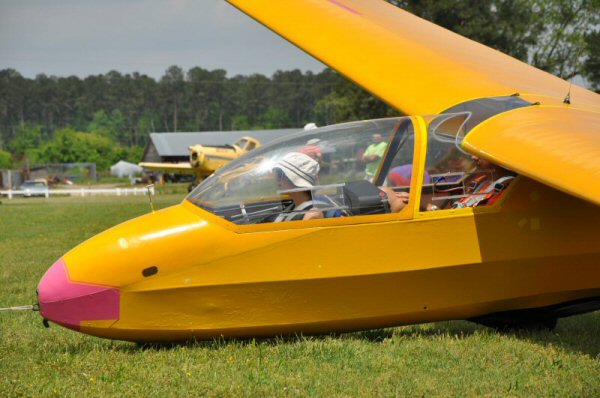
The glider we were in was known as a K-7, a high-wing, two-seater (naturally!) glider with the instructor sitting behind the student.
A K-7 typical of the glider I first flew in at Rattlesden GC.

Anyway, some 43 flights later, I was signed off to conduct my first solo flight in the K-7.  The date was 5th September, 1981 and my flight time was just 4 minutes!  I was hooked.

In over 10 years of flying amounting to more than 1,400 flights I had the great fortune to experience much of the magic of flying relying on nothing more than the currents of air.

Ahh! Memories!  Over 10 years of glider flying, amounting to more than 200 hours of flight-time, 17 different types of glider.  Longest flight was 5 hours, 16 minutes including a climb to over 6000 feet above sea-level on the 7th July, 1985 in a single-seater LS4 glider type.

So what’s this got to do with subconscious thinking?  Simply this.

One quickly learnt that once the decision had been made to land, most frequently because one was unable to find further, or any, rising air currents the brain had a major computing task in hand.  As the aircraft descends, the air currents change and the direction and velocity of the wind changes.  There is no engine to allow one to abort the landing; to do a ‘go round’!

One of the key visual judgments was determining the point of touchdown: not too early that might risk a ground contact before the start of the runway, and not too late which might risk running out of landing space.

Thus the brain was operating clearly in two modes.  Consciously, computing second by second where the touch-down point was going to be and, subconsciously, the flying of the glider as in operating the joystick and rudder pedals in support of the touch-down ‘computations’.

Moving on.

In last Friday’s post, I also wrote this: “Plus something that could just possibly be the key to mankind having a long-term sustainable future on this planet: The Power of Thinking.

That ‘something’ was me reflecting on an article in the October 7th edition of FORTUNE magazine.  Not something I read on a normal basis but just happened to come across that edition – and glad I did.  Because there was an article about IBM’s new supercomputer Watson.  The link to the summary is here, from which I republish this:

Dr. Mark Kris is among the top lung cancer specialists in the world. As chief of thoracic oncology at Memorial Sloan-Kettering (MSK) Cancer Center in New York City, he has been diagnosing and treating patients for more than 30 years. But even he is overwhelmed by the massive amount of information that goes into figuring out which drugs to give his patients — and the relatively crude tools he has to decipher that data. “This is the standard for treatment today,” he says, passing me a well-worn printout of the 2013 treatment guidelines in his office. We choose a cancer type. A paragraph of instructions says to pair two drugs from a list of 16. “Do the math,” he says. It means more than 100 possible combinations. “How do you figure out which ones are the best?”

It’s a huge problem. More than 230,000 Americans will be diagnosed with lung cancer this year. Almost all of them will receive chemotherapy. As crude as the existing guidelines are, says Kris, they won’t be followed more than half the time. If we bumped up adherence by just 10% to 20%, he says, as many as 30,000 people might live longer. Never mind curing cancer — shouldn’t we be able to get the best available combinations of medications to sick people now?

That’s the question that led Kris to IBM. He saw that more information was not the answer. What doctors needed was a better brain — one that could instantly vacuum up facts, draw deeper connections between data points, and remember everything. They needed Watson.

Just read that last paragraph again.  That it’s not about information, it’s about offering humanity computing power that can see things that humans might not easily see.

Thus, I mused that when mankind gets to the point where there is total and complete commitment to finding a non-carbon-burning way ahead for every living thing on this planet we won’t have the luxury of countless years working out the new journey directions.  Maybe, just maybe, computing power a la Watson might just be our saving grace.

Curious to learn more about IBM Watson?  Then here’s the relevant website.

Instinctive behaviours.

We see instinct as common across all species including man, so why is so little known about it.

There was an item seen on the BBC Capital website.  It was an article about intuition:

Trusting your gut: Smart management or a fool’s errand?

by Eric Barton*

Photographer Mindy Véissid woke up one winter morning in 2010 with a simple idea: dogs running in the snow.

“That’s all I had,” she recalled.

The Manhattan resident followed her gut and went across town to Central Park. There, Véissid found three dogs jumping around in a couple of inches of new snow covering the famed park’s Great Lawn. She plopped down in the field and waited. That’s when the dogs headed right for her. She snapped off a shot just before they barrelled over her.

The picture she took that morning, of happy-looking pups charging through a cloud of snow with the New York City skyline behind them, has become one of Véissid’s calling cards, maybe her most recognisable shot. It’s a photo she would have missed if she had not trusted her gut.

“What I realised is that if I follow my heart, if I follow my feelings, I get good photographs,” Véissid said. “We try to control everything in our lives, and sometimes you have to let go.”

It wasn’t long ago that decision-by-intuition would have been regarded as little more than magical thinking or a try at luck. But research has changed that and intuition has been embraced as a key component to business decision making.

There is, however, an inherent danger to it, and blindly following your gut can be worse than ignoring it altogether. For managers, that means learning how to trust your own instincts and encouraging employees to do the same. But it also means learning to recognise when careful planning trumps sudden inspiration.

Perhaps the thing that most changed the way businesses think about inspiration was a 2008 study co-authored by Gerard Hodgkinson, professor at Leeds University Business School in the United Kingdom. Hodgkinson found that intuition can be beneficial in specific circumstances. First, it’s best to rely on a gut feeling when you need to make a quick decision. Second, and this is the important part, trust your intuition only when you have extensive knowledge on the subject. In other words, the best intuition is pulled from a well of deep knowledge and expertise.

“A lot of people think intuition is general purpose, but intuition is actually domain specific,” said Massimo Pigliucci, a philosophy professor at City University of New York, and author of Answers for Aristotle: How Science and Philosophy Can Lead Us to A More Meaningful Life. “Intuition is the result of your subconscious brain picking up on clues and hints and calculating the situation for you, and that’s based solely on experience.”

(The rest of the story may be read here.)

Wrong to republish the whole piece, however I do want to republish the closing paragraphs as they are so relevant to today’s post.

Western cultures began to embrace intuition only recently, Pigliucci said, while research suggests Southeast Asian countries have long given credit to gut feelings being a good guide to decision making. Eastern managers, for instance, are more likely to rely on hunches and give them credit for successes afterward.

After photographer Véissid learned to rely on her gut feelings, she wanted to teach others how to do it. Her class, the Art of Intuitive Photography, teaches the photography basics, but her instruction is more about following hunches.

“You can get a good photograph and it will be technically correct,” she said. “But if you follow your heart, you can take photos that can be wonderful.”

Follow BBC Capital on Twitter @BBC_Capital or follow us and join the conversation about this or any other Capital story on Facebook: BBC Capital on Facebook.

—-

* Eric is a freelance journalist who lives in Fort Lauderdale, Florida. He is formerly a writer and editor at New Times in Fort Lauderdale and The Pitch in Kansas City, Missouri. His work has been featured by  the Florida Center for Investigative Reporting.

To my mind, what Eric Barton has written about is not instinctive.  That is if one believes that instinct is something that is ‘hard-wired’, so to speak, into our psyche at birth, a function of our genetic heritage.

When one reflects on the start of life, ergo for all warm-blooded species that are the result of a successful copulation between the two genders of that species, then one realises that there is little functioning at birth beyond those bodily functions vital to that new life.

But if we mean by instinctive those behaviours that are subconsciously acted out while the mind is engaged on other mental processes, then that’s different.

Read that last opening paragraph again [my emphasis]:

“A lot of people think intuition is general purpose, but intuition is actually domain specific,” said Massimo Pigliucci, a philosophy professor at City University of New York, and author of Answers for Aristotle: How Science and Philosophy Can Lead Us to A More Meaningful Life. “Intuition is the result of your subconscious brain picking up on clues and hints and calculating the situation for you, and that’s based solely on experience.

Think of when we drive a car how much of what we are doing in the ‘hand-eye’ department is being managed by our subconscious brain.  Think about the way we use a language, especially the language of our birth country.  One will immediately recognise that the brain is on auto-pilot.  Yet we were born unable to speak, or to drive a car!

Coincidentally, over at Patrice Ayme’s blog there was a post published yesterday on the same theme.  It was called Instinct is Fast Learning.  Here’s an extract:

INSTINCT IS FAST LEARNING.

SMALL ANIMALS, FAST MINDS.

HOW FORCE BECOMES THE TRUTH OF MAN.

Abstract: “Innate Knowledge” is a stupid idea. The truth is the exact opposite: KNOWLEDGE IS EVERYWHERE, OUT THERE.Knowledge is the opposite of innate. This insight has tremendous consequences on our entire prehension of the world.

(It will not escape the cognoscenti that Socrates, Plato, and Aristotle, were partisans of innateness. And that believing in the superiority of inheritance is a necessary condition for racism, fascism, slavery, and hereditary plutocracy as fairness. That makes the likes of Chomsky and Dawkins self contradictory)

Subjective time slows down in smaller brains.

Fastest Wings, Fastest Brains. Anna Hummingbird California
Fastest Wings, Fastest Brains.  Anna Hummingbird California

Those wings go at 100 Hertz, four time the human perception limit.

Thus time is relative; just as light-clock time slows down in a fast reference frame, or in a heavy gravitational field, neurological timeslows down in a small neurology.

(Interestingly, the deepest reason for the slowing of time… boils down to the same in the Relativity case as in the Neurological one! It’s all about energy.)

A lot of ideas on instinct came from studying insects: insects seem to know all, without having studied anything. However, if insect time flows slowly, insects actually have time to learn.

And that’s rendered easier by having brains adapted to their environment. If they have only a few tricks to learn, and what looks like ten seconds for us is an hour for them, no wonder they learn lots. Thus slow in small explains how “instinct” works.

Hence behaviors one describes as “instinctive” are just fast studies. A lot of the silliness about “genes” is thus dispelled, and the mind comes on top.

It’s an essay that deserves the full reading.  This is how it closes:

Conclusion:

Instinct As Fast Learning solves the nature-nurture problem. It also shows something else, even more important. It shows that the force of nature makes not just the force, but even the very geometry, of our minds.

(The construction of neuromorphology itself being forced by feedback from nature.)

The minds of sentient species, from bees to hummingbirds, are exquisitely tuned to be programmed by the (part of) nature they are made to respond to, all the way to the speed of time they need.

If we kill the environment, we kill out instruction set. The usual reason given to save the environment is that we would not want our descendants to live in a bad world. But what we see now is that a poor world gives poor minds, and that even time may go askew. Another, deeper than ever, reason to be a fanatical ecologist. Nature is not just our temple. Nature is where, and how, time itself is built, one neurological impulse at a time.

***

Patrice Ayme

On Monday, I have a sequel to this post.  It’s an insight into the conscious and unconscious skills that come from flying a glider, or sailplane in American speak!  Plus something that could just possibly be the key to mankind having a long-term sustainable future on this planet: The Power of Thinking.

But back to today.

You will recall that the item from the BBC website opened with photographer Mindy Véissid waking up one winter morning in 2010 with a simple idea: dogs running in the snow.  Too good not to miss for a blog called Learning from Dogs.

Mindy’s website is here and do go across there and browse.  You will quickly discover, for example:

we teach small sized group and private digital photography classes and workshops in fun locations throughout nyc, focusing on how to use your camera, how intuition can help guide you to images, and compositional improvement

So having given Mindy that small, but well-deserved, plug, I don’t feel too bad closing today with Mindy’s picture of those dogs running in the snow.

Picture by Mindy Veissid Photography

A return to integrity

Can we mend our broken ways? Just possibly.

Yesterday’s long rant was the outcome of me promising ‘a debate’ with Patrice Ayme.  Succinctly, I had disagreed with a comment from Patrice where he had written: “Force is the truth of man. Everything else is delusion, even the vegetarian style.” and wanted to respond within the space of a post rather than the more restrictive comment.

For my disagreement with Patrice had been essentially about his statement, ‘Force is the truth of man‘.  I don’t recall a war in the last 50 years that has been a force for good.

But then it was Alex’s comment, see below, that stopped me short.  For I realised that I was confusing ‘force’ with ‘war’ and that was probably a big mistake on my behalf.  Of course, I’m writing this without the benefit of knowing better what Patrice meant in his comment! Blogging, as powerful a media as it is, does not provide for immediate interaction!

Nevertheless, Alex’s comment yesterday was powerfully inspirational.  Because so many of us (and I include me in that ‘us’) all too often behave as though we are a species utterly divorced from Nature.

I closed yesterday’s post with these words;

So what to do?  Because I am fundamentally at odds with the sentiment expressed by Patrice Ayme; “Force is the truth of man. Everything else is delusion, even the vegetarian style.

The answer takes us to tomorrow’s post, A return to integrity.

And, yes, it does mention dogs!  Rather a lot as it happens!

Dogs are the one species that man has lived with longer than any other species.  So when we refer to the qualities of the dog it is simply because we are so familiar with them.  In no way does that exclude the numerous other species that bond with man and share the same wonderful qualities.

Qualities so easily seen: Love, Honesty, Loyalty, Trust, Openness, Faithfulness, Forgiveness and Affection. Together they are Integrity.

Of course dogs will kill a rabbit, for example, as readily as a cat will kill a mouse.  In this respect force is the truth of Nature.

The only way for species man to survive on this planet is for every element of man’s existence on this planet to be rethought of in terms of the natural order.  Read the comment left by Alex in yesterday’s post:

Hi Paul, what you highlight are examples of disconnection between humanity with nature and each other. I have on my own blog highlighted a concept of Ubuntu – “I am because we are” – which is only possible when the self realises they are part of an inter-connected network of life. Your example of islands of fragmented forest where disconnected wildlife are dying out is how it is with disconnected humanity, we are doomed to destruction because we are cut off from the life-giving connection to nature.

All the problems you highlight are symptoms of the disease of disconnection, until there is reconnection to nature none of these symptoms can be successfully addressed.

War is an integral part of nature, when people seek to dismiss this then they add to the disconnection from nature. I was stung in the face by a drunken wasp a few days ago, this is how it is with nature, it is beautiful but also brutal. Peace and balance are illusions, life is in a becoming because of unbalance and strife. I advocate harmony, like a downhill skier we do not seek to control our surroundings, but instead act in harmony by moving around the obstacles such as rock and tree.

Disconnection can be as large as destroying whole forests by ignorant energy policies to those idiots who kicked a puffball to pieces before I could harvest it, or the new owners of my former home who have taken a chainsaw to all the trees and bushes in the garden. People who are disconnected do not consider how their actions impact nature or people contrary to the philosophy of Ubuntu.

I am because we are!” Each and every one of us is where we are today, for good or ill, because of what we are: part of Nature.  It’s so incredibly obvious – we are a natural species – yet who reading this wouldn’t admit at times to behaving “as though we are a species utterly divorced from Nature.”

Millions of us have pets and animals that we love.  Yet we still miss the key truth of our pets.  That we are a part of Nature, subject to Natural order, just as much as our pets are.  We have so much to learn from our animals.

Take this rather sad story but, nonetheless, a formidable story of the integrity of one species for another.  Watch the video.

oooo

Take this rather happier story about the integrity of one species for another. Watch the video.

oooo

Thus when we see the extraordinary benefits that arise from love and trust, from loyalty and faithfulness, and much more, why oh why is so much of our society fundamentally broken?

As John Hurlburt wrote in a recent email, it is because, “we are spiritual bankrupt. We spend too much of our time thinking about ourselves and what we want and too little of our time thinking about other people and what we all need.”  John went on to add that this spiritual bankruptcy had preceded our moral and economical bankruptcy. He pointed out that the solution to our moral and financial problems, as well as our salvation as individuals and as a species, is spiritual. “We simply need to love the Nature of God, the earth and each other regardless of what we may believe God to be.”

Now whether you are a religious soul, or a heathen, or somewhere in the middle, it matters not.  For if we continue to defy Nature and the natural laws of this planet we are going to be dust before the end of this century.  Again in John’s powerful words:

Denying climate change is a death wish.

Nature always wins in the long run.

Nature is balanced. Are we?

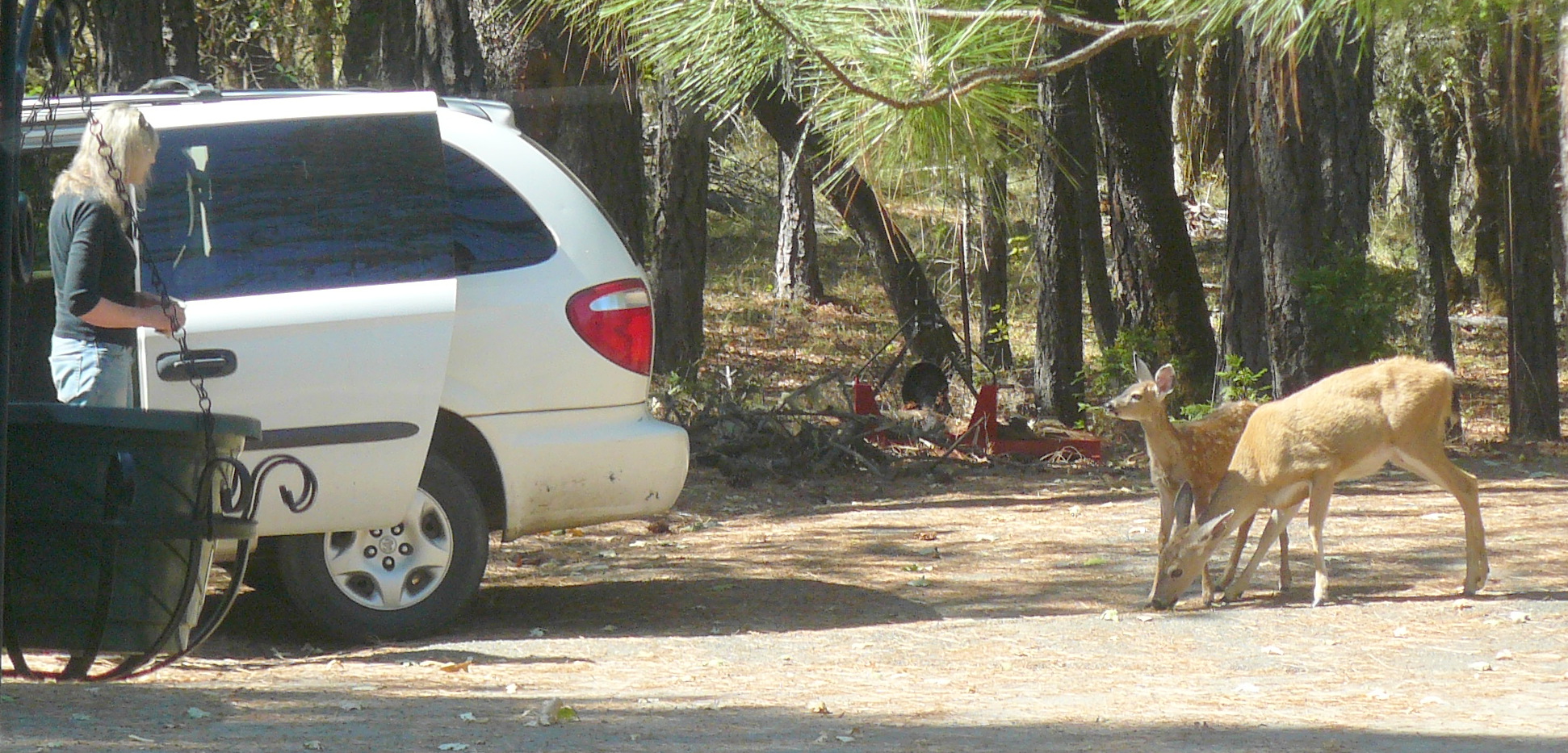
As if to endorse the great examples that Nature offers us in terms of the benefits of love and trust, take a look at these three recent photographs from here in Oregon.

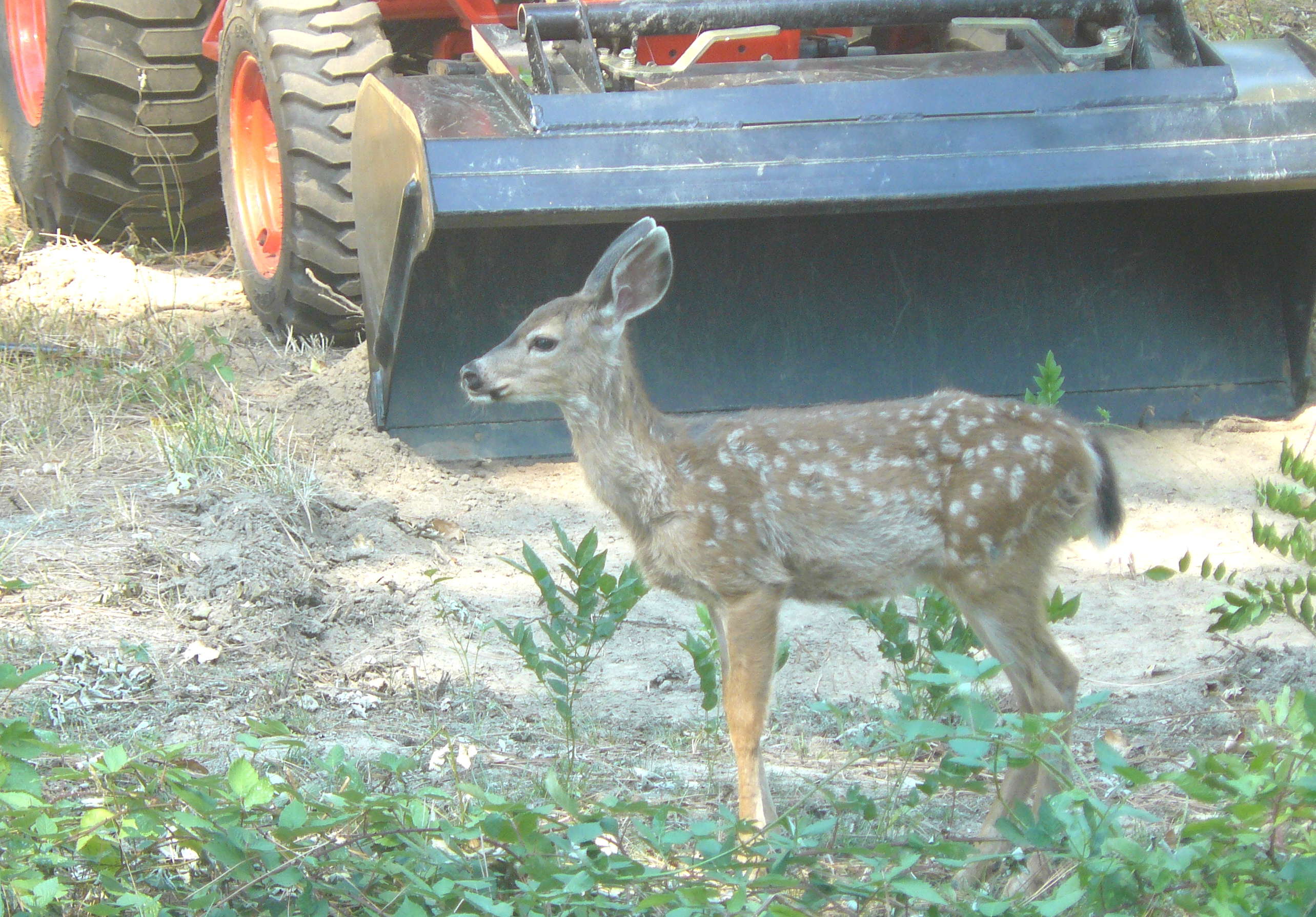
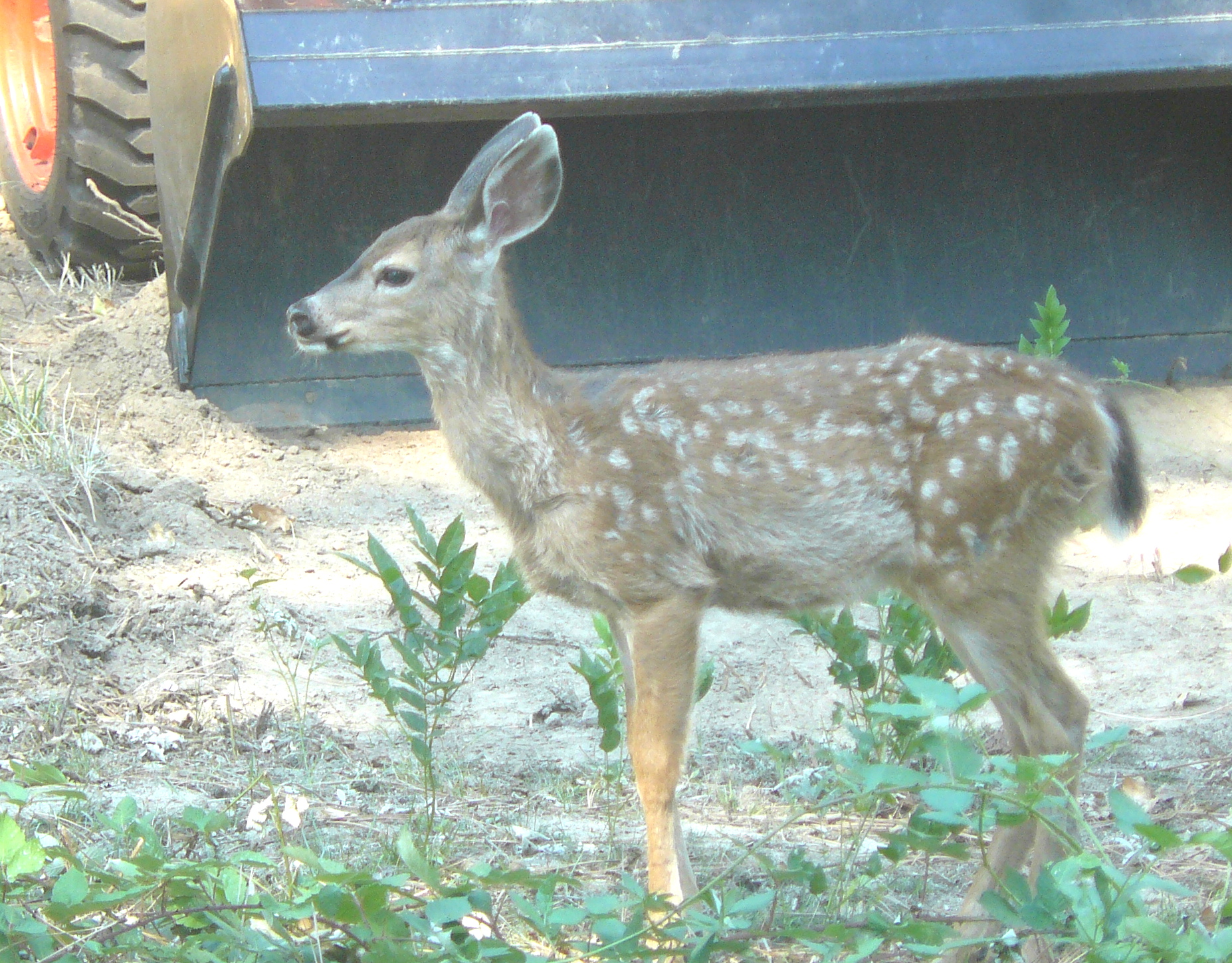
A young timid deer responding to me sitting quietly on the ground.
A young timid deer showing her trust of me as I sat quietly on the ground less than 30 feet away.

oooo

A mother and her fawn trusting Jean's love for them, and getting a good feed!
A mother and her fawn trusting Jean’s love for them, and getting a good feed!

oooo

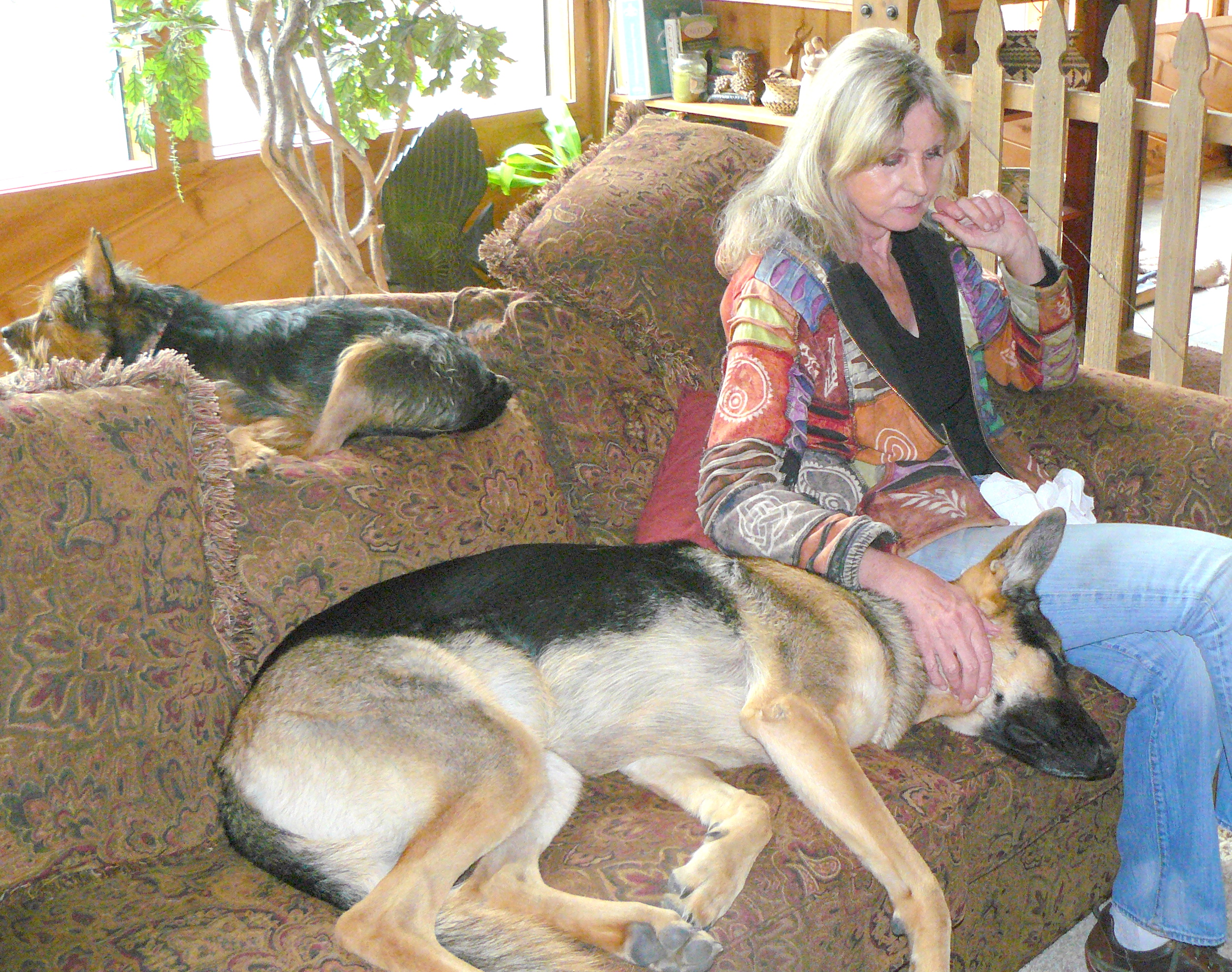
Sweeny, on back of settee, and Cleo in peace and comfort.
Little Sweeny and Cleo converting trust to peace and happiness.  (Not to mention Jean!)

Now these are not photographs to ‘ooh’ and ‘ah’ over, these are reminders that kindness, generosity, selflessness and trust are part of Nature.  All the great virtues and values of man do not come from a vacuum, they come to us via Nature.

We have been blessed by an evolution that has allowed mankind to achieve remarkable things.  Even to the point of leaving the confines of our planet and setting foot on the Moon and sending probes from out of our Solar System.  There’s a sense, a distinctly tangible sense, that man has conquered all; that we have broken the link from being part of Nature; from being of Nature.

And now Mother Earth is reminding all of her species, every single one of them including species man, that everything is bound by her Natural Laws.

Does this mean that man has to revert to some form of pre-civilised stone-age era?  Of course not!  Progress can be as much within the Natural order than in competition with it, as it has been in recent times.  In fact, Professor Pat Shipman explains our progress is benefited by being part of that Natural order.  Here’s how Amazon describe her book, The Animal Connection.

The Animal Connection: A New Perspective on What Makes Us Human

A bold, illuminating new take on the love of animals that drove human evolution.

Why do humans all over the world take in and nurture other animals? This behavior might seem maladaptive—after all, every mouthful given to another species is one that you cannot eat—but in this heartening new study, acclaimed anthropologist Pat Shipman reveals that our propensity to domesticate and care for other animals is in fact among our species’ greatest strengths. For the last 2.6 million years, Shipman explains, humans who coexisted with animals enjoyed definite adaptive and cultural advantages. To illustrate this point, Shipman gives us a tour of the milestones in human civilization-from agriculture to art and even language—and describes how we reached each stage through our unique relationship with other animals. The Animal Connection reaffirms our love of animals as something both innate and distinctly human, revealing that the process of domestication not only changed animals but had a resounding impact on us as well.

It’s a powerful read and greatly recommended.  Here’s an extract from the book [page 274, my emphasis]:

Clearly, part of the basis of our intimacy with tame or domesticated animals involves physical contact.  People who work with animals touch them.  It doesn’t matter if you are a horse breeder, a farmer raising pigs, a pet owner, a zoo keeper, or a veterinarian, we touch them, stroke them, hug them.  Many of us kiss our animals and many allow them to sleep with us.  We touch animals because this is a crucial aspect of the nonverbal communication that we have evolved over millennia.  We touch animals because it raises our oxytocin levels – and the animal’s oxytocin levels.  We touch animals because we and they enjoy it.

From the first stone tool to the origin of language and the most recent living tools, our involvement with animals has directed our course.

So to round this off.  These last two posts came from my need to debate with Patrice the statement that “Force is the truth of man.”  If Patrice’s meaning was that the truth of man is subject to the force of Nature, then I agree one-hundred percent.

For the time for man to recognise that the force of Nature is “the truth of man” is running out.

Each of us, whoever you are, for the sake of your children and for all of the children in the world, embrace today the qualities, the values of Nature.

Love, Honesty, Loyalty, Trust, Openness, Faithfulness, Forgiveness, Affection.

(Unknown author)

If you can resist treating a rich friend better than a poor friend,

If you can face the world without lies and deceit,

If you can say honestly that deep in your heart you have no prejudice against creed, colour, religion or politics,

Then, my friend, you are almost as good as your dog.

Let us learn from dogs.

Let us return to integrity.

Meditating.

A guest post from Sue Dreamwalker.

Last Monday, the post on Learning from Dogs was called Growing old!!

The essence of that post was to report on the following:

That’s why a recent item on the BBC News website jumped off the page at me.  It was an article called: Health kick ‘reverses cell ageing’ written by Michelle Roberts, Health editor, BBC News online.  Here is how the article opened:

Going on a health kick reverses ageing at the cellular level, researchers say.

The University of California team says it has found the first evidence a strict regime of exercise, diet and meditation can have such an effect.

But experts say although the study in Lancet Oncology is intriguing, it is too early to draw any firm conclusions.

The study looked at just 35 men with prostate cancer. Those who changed their lifestyle had demonstrably younger cells in genetic terms.

The full article should be read, by the way, because it covers much more than this opening paragraph.

Anyway, one of the comments to that post was left by Sue, of Sue Dreamwalker, Here is what she wrote:

Great information and learning to Meditate even for a few minutes helps heal and relax.. Dogs have it right…. No stress!

I wrote a complete exercise I used a lot both for myself and within my circle I used to run… Hope you enjoy as you take your roots down into the earth after bringing in the Light….
you can find it here http://wp.me/p16xW7-37

Namaste! :-)

I then asked Sue if I could republish her guidance on meditation as a guest post.  Sue kindly agreed.  Here it is.

oooOOOooo

A Meditation For My Friends

by Sue Dreamwalker

Meditation-1

Meditation.

Some Friends have been asking about Meditation and relaxation techniques, so I have put you a very simple little meditation here for starters.

You can buy books on meditation and read different techniques until your eyes pop out of your head, and you can find plenty about meditation on web sites too.  I always say there is no right or wrong way to Meditate. To meditate means finding that quiet place within your own mind, finding that peace and space to be at one with yourself.

When people say empty your mind, this is near enough impossible, as you will always have a train of thought that will pop in at times. So this is why we use the Breath.

The breath is used to bring your concentration back, so focusing on your breath may be one way in which you can stop the hum-drum of your thoughts that chatter away inside your head.

First you need to ensure you’re not going to be disturbed, so switch of the phone, find a comfortable chair, in a quiet room, and relax.  If you lie down you may find that you drift asleep, that’s ok also for that shows you have relaxed.  But preferably sit upright with your feet slightly apart and have them touching the ground. Take deep breaths breathing in and out through the nose, and close your eyes.

This is one of the meditations I do regularly.  It may seem long to read, but once you have it in your mind it will only take you 10 minutes to do. Read it through a couple of times until you have it clear in your mind, and then have a go.

meditation

Relax and take some nice deep breaths  breathing deeply and evenly, try to breath in to the count of five, hold for a few seconds and then breath out long and slow, Feel your breath rise from your solar plexus your stomach and feel your diaphragm rise and fall.

Do this for a few minutes until you feel comfortable with breathing this way. (Many of us do not breathe deep enough, so this may at first feel uncomfortable, but try not to force it, just try to get your breath into a natural rhythm).

One your breath is comfortable I want you to imagine a beautiful White light coming down in a column from up above  your head.  Almost like a search light in a darkened room.

As you breath in, I want you to breathe in this light. Imagine that it is flowing down inside your head through your crown, and it passes behind your eyes, relaxing your eyes. It then passes down over your throat, relaxing your throat.

You feel this Light which has healing properties cascading across your shoulders, relaxing your shoulders, taking all the burdens of the day with it.  You now see and feel this warm Light travel down your arms into your forearms relaxing your muscles as it goes, now it’s travelling into your finger tips, and your arms now feel heavy and relaxed.

You see the Light now travel through from your throat, down into your heart centre, feel the beat of your heart, and see the light now filling your heart and as it beats see the light dispersing throughout your veins into your whole being,

See the light travelling into your stomach relaxing your stomach muscles, down your thighs relaxing your thighs into your calves, relaxing your calves, and see the light now going into your feet relaxing your toes and feet.

And all the while you are breathing deeply and evenly, relaxing more and more.

meditation-2

Now you are relaxed and are full of healing light, I want you to now see that light coming out of the soles of your feet, as if they were roots from a tree. See these roots going down from your feet into Mother Earth, going down through the rocks, twisting and turning as they go deeper and deeper, and as they travel deeper so too you are feeling more and more relaxed.

You now see an underground cavern, with an underground pool, your roots of light emerge in the ceiling of this cavern, and illuminate it like the lights of a chandelier.

And as the light illuminates the Cavern you now see you are stood in a beautiful Crystal Cavern, The Light reflects the many luminous rainbow colours from the hundreds of giant crystals.. See the rainbow of pastel colours dance around the cavern reflection on the underground pool.

Now you can choose any colour you see, for whatever colour you choose this colour will intuitively be the right healing colour for your needs at this moment in time.

So once you see the colour you are attracted to, allow your roots to wrap themselves around that crystal, and as you breathe deeply in, see now that your roots have now turned into hollow straws, for you will now be able to breathe up that colour through your roots and as you do so, retract your roots back up through Mother Earth, breathe that  colour into your feet, feel the warmth of the healing.

Now draw it back up through your calves, up through your thighs, into your solar plexus. Breathing deeply and evenly. Feel the warmth of healing relax and heal all your worries and anxieties, breath it up into your lungs, into your heart, down your arms and into your fingers, see how relaxed and refreshed you now feel, see this colour cleansing your entire being taking with it all the debris that you have collected, all the negative thoughts, flushing you clean.

See this colour now rise and come up through your throat, see it helping you release all the words you have spoken in haste, and all the words you hold back, see them all now flow up past your eyes, helping you see that you are a Being of Light and whole and free, see that colour now rise out through the top of your head, see it cascading out into the Universe Like a fountain, and as it does so see it explode into a thousand stars, taking all your problems and negative debris with it, and know that God and the Universe will disperse this energy as it sees fit,

Give thanks to Mother Earth for her healing energy, and see the top of your head close and seal in your new vibration, and feel yourself glowing from within,

Slowly bring your awareness back to yourself sat in the chair, and open your eyes.

Sit for a moment or two and take a sip of water.

Know that you can go to your crystal cavern at any time for healing.


Soulfly

Hope you relax and Enjoy.

Dreamwalker x

oooOOOooo

And if you want any encouragement to find that deep, peaceful place, then just breath in this picture of young Cleo letting the world go by!

OLYMPUS DIGITAL CAMERA

Rethinking privacy?

Is the need for privacy a by-product of large society?

The other day, thanks to Naked Capitalism‘s regular set of web-links, I became aware of the website Popular Resistance.  To be exact, Naked Capitalism had linked to an article entitled, “New Intel Chips Contain Back-Door Processor, Hackable Even When Computer is Turned Off.

Regular readers of this place may well recall my decision to ditch Windows OS and buy a new Apple Mac Mini articulated in a post earlier in the month, Closing my Windows.  Here’s a brief extract from that post.

Muttering about this to friends who know a lot more about computing than I raised my awareness that the privacy and security of one’s computer was no longer to be assumed.  Then just recently, I read online,

A Special Surveillance Chip

According to leaked internal documents from the German Federal Office for Security in Information Technology (BSI) that Die Zeit obtained, IT experts figured out that Windows 8, the touch-screen enabled, super-duper, but sales-challenged Microsoft operating system is outright dangerous for data security. It allows Microsoft to control the computer remotely through a built-in backdoor. Keys to that backdoor are likely accessible to the NSA – and in an unintended ironic twist, perhaps even to the Chinese.

Then a few paragraphs later:

It would be easy for Microsoft or chip manufacturers to pass the backdoor keys to the NSA and allow it to control those computers. NO, Microsoft would never do that, we protest. Alas, Microsoft, as we have learned from the constant flow of revelations, informs the US government of security holes in its products well before it issues fixes so that government agencies can take advantage of the holes and get what they’re looking for.

Now I’m using Windows 7 so imagine my angst when I then read:

Another document claims that Windows 8 with TPM 2.0 is “already” no longer usable. But Windows 7 can “be operated safely until 2020.” After that other solutions would have to be found for the IT systems of the Administration.

That did it for me – time to move on from Windows.

OK, on to today’s thought.  The Popular Resistance article explained:

New Intel-Based PC’s Permanently Hackable

So you think no one can access your data because your computer is turned off. Heck it’s more than turned off, you even took the main hard drive out, and only the backup disk is inside. There is no operating system installed at all. So you KNOW you are safe.

Frank from across the street is an alternative operating systems hobbyist, and he has tons of computers. He has Free BSD on a couple, his own compilation of Linux on another, a Mac for the wife, and even has Solaris on yet another. Frank knows systems security, so he cannot be hacked . . . or so he thinks.

The government does not like Frank much, because they LOVE to look at everything. Privacy is a crime don’t you know, and it looks like Frank’s luck with privacy is about to run out.

The new Intel Core vPro processors contain a new remote access feature which allows 100 percent remote access to a PC 100 percent of the time, even if the computer is turned off. Core vPro processors contain a second physical processor embedded within the main processor which has it’s own operating system embedded on the chip itself. As long as the power supply is available and and in working condition, it can be woken up by the Core vPro processor, which runs on the system’s phantom power and is able to quietly turn individual hardware components on and access anything on them.

The author of the article, Jim Stone, later describing:

Accessing any PC anywhere, no matter what operating system is installed, even if it is physically disconnected from the internet. You see, Core vPro processors work in conjunction with Intel’s new Anti Theft 3.0, which put 3g connectivity into every Intel CPU after the Sandy Bridge version of the I3/5/7 processors. Users do not get to know about that 3g connection, but it IS there.

(The full article may be read here.)

Naturally, I huffed and puffed as I read the article.  However, later on came the thought that maybe this is a great journey of ‘ever-diminishing-returns’, as in this journey of ‘us’ versus ‘The State’.  A journey that misses something very fundamental.

This is what I mean.

I’m proposing that the drive for privacy is an inevitable by-product of the country that we live in being seeing as one huge society.  That in that huge society, we can only maintain our own unique individuality through a degree of privacy.  Otherwise, we are nothing more than an irrelevant tiny part in the big scheme of things.

But if one reflects on how smaller societies function; from local communities down to families, then that need for privacy is greatly reduced.  Because in those smaller communities, we are seen as an individual with all the associated hues of our own individual personality.  We get to know others, and those others get to know us, as individuals – that’s how communities function.  Then a much more important value comes into play; that of trust.  It’s my impression that we only properly engage with those that we trust.  Again, how communities function!

I continued to play with these thoughts.  Even putting the issue of privacy to one side, the range of benefits that flow from our local communities is over-whelming.  All the big issues facing humanity today can only be dealt with effectively at the local level;  the community level.

Coincidentally, echoed in an email from long-standing friend, Dan Gomez, in connection with a completely different topic.  He said:

Federal government is primarily for defense. Most other government can be pushed to local politicians.

…..

People need to be free and think free.  They need to hope. In too many countries around the world, there is little hope for a better life. People need to learn to be accountable and solve their own problems, first at local levels.

So, perhaps, worrying about our privacy and the increasing invasion of that privacy misses the point.

Because if in the next few years, a couple of decades at most, we do not adopt the core principles of a caring, sharing world; the lessening of a greedy, materialistic, me-me-me world, then I fear greatly for not only all of humanity but for the very future of the planet as an oasis of life circling a rather insignificant star in a very lonely cosmos.

So park privacy to one side.  See it as a symptom of these broken ‘focus-on-self’ times and look forward to a new caring, sharing world made up of countless conscious and mindful societies.  Embracing the values of animal societies, even to embrace the most successful species of animal ever; the dog. (As measured from the perspective of the dog’s association with man.)  Not only far back into ancient history but right now in these strange and troubling times. Embracing what millions of dog lovers across the world experience every day; the integrity of the dog.

Local societies and local communities are the only social structures where integrity makes sense, and can be seen to make sense.  Where the values of that society bring people together.  Where these qualities that we see in our dogs are mutually reinforcing.  I’m speaking of unconditional love, loyalty, stillness, play, openness, faithfulness, valuing the present, forgiveness, happiness, meditation, and sensitivity; all in that wrapper of integrity.

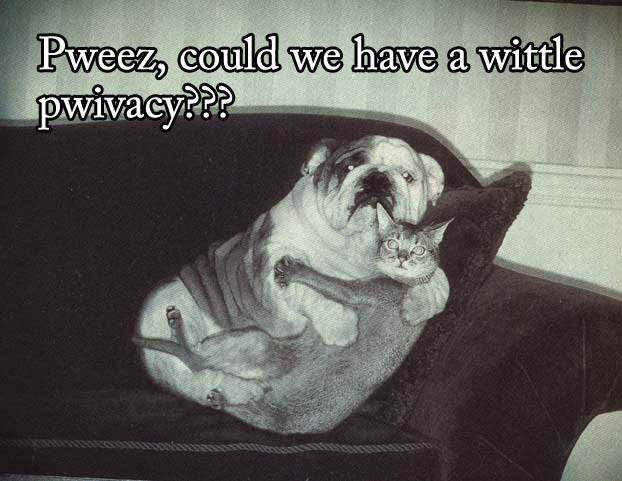
Think about it!  Do you ever see a dog worrying about privacy!

funny-dog-cat-photo-with-captions-08-could-we-have-a-little-privacy-please

Be in peace this day!

This International Day of Peace.

Have to thank Sue Dreamwalker for giving me a day’s notice that today, Saturday 21st September is the 2013 International Day of Peace.

PEACE-DAY


As the web site of the International Day of Peace (IDP) offers:

Anyone, anywhere can celebrate Peace Day. It can be as simple as lighting a candle at noon, sitting in silent meditation, or doing a good deed for someone you do not know. Or it can involve getting your co-workers, organization, community or government engaged in a large event.

The impact if millions of people in all parts of the world, coming together for one day of peace, is immense, and does make a difference.

International Day of Peace is also a Day of Ceasefire – personal or political. Take this opportunity to make peace in your own relationships as well as impact the larger conflicts of our time. Imagine what a whole Day of Ceasefire would mean to humankind.

Can’t argue with that or with this year’s UN Secretary-General Ban Ki-moon’s message for today’s International Day of Peace.


So don’t forget!

Wherever you are in the world, take a minute off at mid-day and be at peace.

wall_clock_twelve


Oh, and hug a dog!

Calmer thoughts.

A further reminder of the power of positive thinking!

So much for fine ambitions!  I’m recalling a post I published just one week ago; yes 7 tiny days past!  That was the post that I named ‘Staying positive – the test.‘  Where I opened it, as follows:

Where hope and inspiration meets the cold world of reality!

Yesterday’s post Don’t frighten the horses was all about reminding me that fear is a very bad motivator. I promoted the Transition message,  ”If we can’t imagine a positive future we won’t be able to create it.”

This small chastisement comes on the back of yesterday’s post where I had a ‘big dump’ of feelings about some of the madder aspects of our so-called modern life. 

Then later on in the day, I just happened to come across a flurry of positive stories that I wanted to share.

First, here’s a scan of the assessors map of our property, near Merlin, OR.

A little over 13 acres, orientated West-East.

NB: The blue line is the course of Bummer Creek, that historically has had a year-round flow, albeit a low flow during Summer months.  The rectangular green area to the West of the open land was a tennis court, now removed.  The main house is 200 feet West of that tennis court area, completely hidden by surrounding trees.  It is a beautiful place for us and all our animals!

The first positive story was as a result of watching that TED Talk by Marla Spivak.  Jean and I thought that as we have well over 4 acres of open grassland, let’s see what we can do to attract and assist our local bees.

Jean and I are supporters of Oregon Wild and a quick call to them about assisting local bees elicited this:

Hi Paul,
Nice speaking with you this morning. For your inquiries on how best to attract bees to your acreage, I would recommend the Xerces Society, a local Oregon group with a Pollinator Campaign. They have a lot of great info on their website, and you could also give them a call at 855.232.6639.

Also, Representative Earl Blumenauer here in Portland has been a big advocate for bee conservation and recently introduced the Save America’s Pollinators Act if you’re interested in bee conservation activism.

Hope this helps!
Cheers,

It was then an easy step to contact the Xerces Society, that very helpfully produced the following advice:

Hello Paul-

Thank you for calling the Xerces Society with your questions today. We have many resources available to landowners who wish to conserve pollinators and create habitat on their land. Here are links to several of our resources:

Attracting Native Pollinators

Pollinator Habitat Installation Guides

Regional guidance on site prep, planting, and management for pollinator habitat. We have guidelines for creating pollinator meadows and flowering hedgerows. Each guideline has an appendix with regionally appropriate bee magnet plants.

http://www.xerces.org/pollinator-conservation/agriculture/pollinator-habitat-installation-guides/

Pollinator Habitat Assessment Guide and Form

Use this guide to assess the currently habitat available to pollinators on your property and how to protect and enhance that habitat.

http://www.xerces.org/wp-content/uploads/2009/11/PollinatorHabitatAssessment.pdf

Pollinator Conservation Resource Center

Regional information about plant lists, habitat conservation guides, and more.

http://www.xerces.org/pollinator-resource-center/

Conserving Bumble Bees

Specific guidelines for land managers for conserving and managing good quality bumble bee habitat

http://www.xerces.org/bumblebees/guidelines/

I hope this information is helpful! Feel free to email or call me with additional questions about conserving pollinators.

Best,

Finally, John Hurlburt emailed this, and I use it to close the post.

One Way or Another

What’s happening to Faith?
What’s happening to Love?
What’s happening to Nature?
Whatever’s happening
Is happening
To all of us.
       an old lamplighter

“The world is a dangerous place to live; not because of the people who are evil,

but because of the people who don’t do anything about it.”

Albert Einstein

Dramatic new scientific discovery!

Conclusive evidence that mankind is part of nature!

Subtext = There are times when our arrogance and mindlessness beggars belief.

Sorry, if you pick up on a degree of emotion in today’s post.  It’s impossible to hide!

Here’s what has fed that.

A few days ago, I came across some stunning images of bees, over on the Flickr website.  Particularly, I was here and offer below a small sample of what was seen:

Chrysidid Wasp, U, Side, UT, Utah Co_2013-08-07-17.51.41 ZS PMax

oooo

Lasioglossum quebecense, F, Back, MD, PG County_2013-07-24-15.43.07 ZS PMax

Much more may be learned about bees by going to the USGS Bee Inventory and Monitoring Lab (BIML).  The BIML website is here.

Then coincidentally (seems to be happening much of this week!) Jean and I watched the latest TED Talk by Marla Spivak.  It was called: Why bees are disappearing.

Marla’s talk is just 15-minutes long, and I beg of you to watch it because the ramifications for all of warm-blooded life on this planet are frightening if we don’t amend our ways – and amend them pretty damn soon!

Honeybees have thrived for 50 million years, each colony 40 to 50,000 individuals coordinated in amazing harmony. So why, seven years ago, did colonies start dying en masse? Marla Spivak reveals four reasons which are interacting with tragic consequences. This is not simply a problem because bees pollinate a third of the world’s crops. Could this incredible species be holding up a mirror for us?

Marla Spivak researches bees’ behavior and biology in an effort to preserve this threatened, but ecologically essential, insect. Full bio »

You may also want to go across to the University of Minnesota‘s Bee Lab website, where there is much more from Marla about our bees.

What next?  Well may you ask!

I came across an article in the San Francisco Chronicle about a “Report links antibiotics at farms to human deaths“.  Here’s a taste of that article:

Washington — The Centers for Disease Control on Monday confirmed a link between routine use of antibiotics in livestock and growing bacterial resistance that is killing at least 23,000 people a year.

The report is the first by the government to estimate how many people die annually of infections that no longer respond to antibiotics because of overuse in people and animals.

CDC Director Thomas Frieden called for urgent steps to scale back and monitor use, or risk reverting to an era when common bacterial infections of the urinary tract, bloodstream, respiratory system and skin routinely killed and maimed.

“We will soon be in a post-antibiotic era if we’re not careful,” Frieden said. “For some patients and some microbes, we are already there.”

The SFC report later goes on to say:

At least 70 percent of all antibiotics in the United States are used to speed growth of farm animals or to prevent diseases among animals raised in feedlots. Routine low doses administered to large numbers of animals provide ideal conditions for microbes to develop resistance.

“Widespread use of antibiotics in agriculture has resulted in increased resistance in infections in humans,” Frieden said.

It concludes, thus:

Legislation goes nowhere

Organic certification prohibits antibiotic use, but raising such animals is costly, he said.

Rep. Henry Waxman, D-Los Angeles, first introduced legislation in 1980 to restrict antibiotic use in livestock. For the past decade, Rep. Louise Slaughter, D-N.Y., has introduced similar bills, joined in recent years by Sens. Dianne Feinstein, D-Calif., and Kirsten Gillibrand, D-N.Y., but the measures have gone nowhere.

“We constantly hear from the pharmaceutical and livestock industry that antibiotic use in livestock is not a problem and we should focus on human use,” said Avinash Kar, a staff attorney at the San Francisco office of the Natural Resources Defense Council, an environmental group that has sued the FDA to force it to ban using antibiotics to promote growth in livestock. The case is now pending before the 2nd U.S. Circuit Court of Appeals.

Carolyn Lochhead is the San Francisco Chronicle‘s Washington correspondent.clochhead@sfchronicle.com

See what I mean about mankind’s collective madness!

But I’m still not finished!

Because over at Alternet.org was this piece:

Americans Are 110 Times More Likely to Die from Contaminated Food Than Terrorism

September 17, 2013 – This article first appeared on  Truth-Out.org

One of the most important revelations from the international drama over Edward Snowden’s NSA leaks in May is the exposure of a nearly lunatic disproportion in threat assessment and spending by the US government. This disproportion has been spawned by a fear-based politics of terror that mandates unlimited money and media attention for even the most tendentious terrorism threats, while lethal domestic risks such as contaminated food from our industrialized agribusiness system are all but ignored. A comparison of federal spending on food safety intelligence versus antiterrorism intelligence brings the irrationality of the threat assessment process into stark relief.

In 2011, the year of Osama bin Laden’s death, the  State Department reported that 17 Americans were killed in all terrorist incidents worldwide. The same year, a single outbreak of listeriosis from  tainted cantaloupe killed 33 people in the United States. Foodborne pathogens also sickened 48.7 million, hospitalized 127,839 and caused a total of  3,037 deaths. This is a typical year, not an aberration.

See what I mean about our mindlessness!  That article continues:

We have more to fear from contaminated cantaloupe than from al-Qaeda, yet the United States spends $75 billion per year spread across  15 intelligence agencies in a scattershot attempt to prevent terrorism, illegally spying on its own citizens in the process. By comparison, the Food and Drug Administration (FDA) is  struggling to secure $1.1 billion in the 2014 federal budget for its food inspection program, while tougher food processing and inspection regulations passed in 2011  are held up by agribusiness lobbying in Congress. The situation is so dire that Jensen Farms, the company that produced the toxic cantaloupe that killed 33 people in 2011,  had never been inspected by the FDA.

I can’t stomach any more (whoops, pardon the pun!) so if you want to read to the end, it’s here.

OK, sufficient for today!  Need to find a dog to curl up with.

Damn, Jean’s beaten me to it!

One wonders how Dhalia copes! ;-)
One wonders how Dhalia copes! 😉

Passionate involvement!

This is beginning to look like a theme!

Regular followers will be aware that both Monday’s post, The growth of empathy, and Tuesday’s post, Questions without answers, had a common theme. That of “the rising consciousness of all the millions of ordinary people just trying to leave the world in a better place”, as I wrote on Monday, in contrast, even stark contrast, with the blindness, for want of a stronger term, of those charged with governing our societies.

Around 12:45 on Monday I received a note that there was another follower of Learning from Dogs. Here is that note:

dcardiff just started following you at http://learningfromdogs.com. They will receive an email every time you publish a post. Congratulations.

You might want to go see what they’re up to! Perhaps you will like their blog as much as they liked yours!

Like many other bloggers I try and go to whatever blog site that follower has and leave a ‘thank you’ message.

So off I went to Gotta Find a Home.  The blogsite is by Dennis Cardiff and the sub-title of the blog is The plight of the homeless.

Here’s how Dennis introduces his blog:

Throughout the past few years I have come to know many people, now friends, who for various reasons are, or were, homeless. Antonio, slept on a park bench and was beaten, had his teeth kicked out, for no other reason than his choice to sleep outdoors. He is a small, gentle man who has a phobia about enclosed spaces.

Craig, slept on the sidewalk in the freezing cold. I see him every morning and am never sure if, when I lift the corner of his sleeping bag, I will find him dead or alive. Sometimes, he confided, he would prefer never to awake.

Joy is a friend who fell on hard times. She slept behind a dumpster in back of Starbucks. I have seen her with blackened eyes, bruised legs, cracked ribs, cut and swollen lips. I usually see her sitting on the sidewalk ‘panning’ for change.

I can’t do much for these people except to show them love, compassion, an ear to listen, perhaps a breakfast sandwich and a coffee. I would like to do more. To know them is to love them. What has been seen cannot be unseen. I have started to write an account of their daily lives. I intend to turn this into a book and have it published. That is my goal.

I am writing articles and biographies of Joy and other street people. They have been informed that they don’t have to use their real names, that any profits would go back to the homeless and that it could be a vehicle to say whatever they want to the population at large.

Not only does that stir one’s heart and conscience but more so the fact that there are 6,069 followers of Dennis’s blog.

Please, please go along to Gotta Find A Home and embrace what wonderful people like Dennis and countless others are doing in this world. Go and read how the blogsite came about:

My lungs ached, as frost hung in the bitterly cold December morning air, making breathing difficult. I trudged in the falling snow toward Place Bell where I work, in the city’s gray, concrete, office tower canyon. I dodged other pedestrians, also trying to get to work on time, I noticed a woman seated cross-legged on the sidewalk with her back against the wall of the library. A snow-covered Buddha wrapped in a sleeping bag, shivering in the below freezing temperature. I guessed her to be in her forties. Everything about her seemed round. She had the most angelic face, sparkling blue eyes and a beautiful smile. A cap was upturned in front of her. I thought,There but for the grace of God go I. Her smile and blue eyes haunted me all day.

In the past I’ve been unemployed, my wife and I were unable to pay our mortgage and other bills, we went through bankruptcy, lost our house, my truck. Being in my fifties, my prospects looked dim. It could have been me, on the sidewalk, in her place.

I’ve been told not to give money to pan handlers because they’ll just spend it on booze. I thought to myself, What should I do, if anything? What would you do? I asked for advice from a friend who has worked with homeless people. She said, “The woman is probably hungry. Why don’t you ask her if she’d like a breakfast sandwich and maybe a coffee?”

That sounded reasonable, so the next day I asked, “Are you hungry? Would you like some breakfast, perhaps a coffee?”

“That would be nice,” she replied.

When I brought her a sandwich and coffee she said to me, “Thank you so much, sir. You’re so kind. Bless you.” I truly felt blessed.

This has become a morning routine for the past two and a half years. The woman (I’ll call Joy) and I have become friends. Often I’ll sit with her on the sidewalk. We sometimes meet her companions in the park. They have become my closest friends. I think of them as angels. My life has become much richer for the experience.

Reflect on how when you see a homeless person with so little, how so often they have a dog.

The power of love.
The power of love.

To close, let me tell you more about the photograph.  I saw it on the blogsite Erick’s Odyssey in the following post.

This is how a real man treats his best friend

A friend of mine posted this photo on their Facebook wall. Like most people when they first see it, I was overwhelmed with several emotions.

First of all, I felt a swell of compassion for these two. I don’t even know them, but I was immediately concerned with their wellbeing. I wanted them to be warm and fed, and protected.

Secondly, I was touched with the apparent love and friendship shared by the two, even though they are not even of the same species. I thought, “They may have nothing, but they have each other, so they have everything.” I don’t know by what circumstance this man and this dog came to be together, living on the streets, but I think it is a reflection of the callousness of our society.

Whatever the reason they are homeless, they are an opportunity for us, those who have the necessities of life in abundance, to show kindness and compassion. Remember this the next time you drive by a similar scene in your warm car. Remember that if you were in their shoes, you would want, or even if you would be too ashamed to ‘want,’ you would ‘need’ someone to help you.

Our apathy is what makes us truly destitute.

Yet another example of the power of this new world of interconnectedness and how, ultimately, those connections between all those millions who care will bring about a new caring era!