Category: consciousness

Celebrating Who I Am.

The journey towards knowing better who we are.

This may seem like a bit of an ‘odd-ball’ after Celebrating Ben and Ranger on Monday and Celebrating Pharaoh yesterday.  Indeed, when I had in mind those two posts, writing about self-awareness was nowhere on my mental horizon.  Then along came Shakti Ghosal after Monday’s post who left this comment:

Hi Paul,

Just came a visiting and was halted by these glorious photographs. Horses embody such great qualities of trust, grace and power don’t they? What is it that makes them such a great friend of Man, I wonder? Specially when the latter species, as we know it (and we should know!), can choose to behave quite contrary to those Equine qualities above….

Shakti

As Shakti was a new visitor inevitably I went across to his blog site, ESGEE musings, and then to the About page. Where I read, in part,

About Shakti Ghosal

Shakti

Born in New Delhi, India, Shakti Ghosal is an Engineer and Management Post Graduate from IIM, Bangalore. Apart from Management theory, Shakti remains fascinated with diverse areas ranging from World History, Global trends to Human Psychology & Development.

I was intrigued and starting reading some of Shakti’s posts.  That is how I came across The Audacity of Who I am and a day later had been offered permission to republish it.

However, before going on to Shakti’s post let me recap a little from yesterday’s post Celebrating Pharaoh.  This section:

The biggest, single reward of having Pharaoh as my friend goes back a few years.  Back to my Devon days and the time when Jon Lavin and I used to spend hours talking together.  Pharaoh always contentedly asleep in the same room as the two of us. It was Jon who introduced me to Dr. David Hawkins and his Map of Consciousness. It was Jon one day who looking down at the sleeping Pharaoh pointed out that Dr. Hawkins offered evidence that dogs are integrous creatures with a ‘score’ on that Map of between 205 and 210. (Background story is here.)

So this blog, Learning from Dogs, and my attempt to write a book of the same name flow from that awareness of what dogs mean to human consciousness and what Pharaoh means to me.  No, more than that!  From that mix of Jon, Dr. David Hawkins, and experiencing the power of unconditional love from an animal living with me day-in, day-out, came a journey into my self.  Came the self-awareness that allowed me to like who I was, be openly loved by this dog of mine, and be able to love in return.  As is said: “You cannot love another until you love yourself.

I will speak a little more about this but, first, to Shakti’s post.

ooOOoo

The Audacity of Who I am

“High above the noise and fear mongering of critics and cynics softly speaks your true self.”

– Mollie Marti, Psychologist, Lawyer & Coach, USA

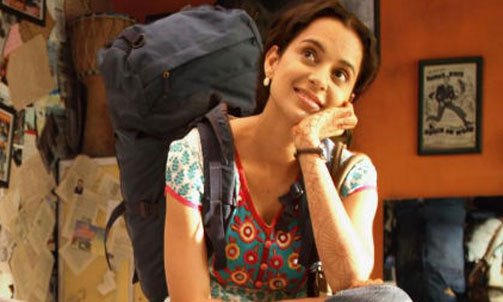
The other day, I watched the Bollywood movie Queen. In it Rani, a girl from Delhi, travels to Europe after being spurned by her fiancé. The movie then goes on to explore Rani’s ‘World view’ as dictated by her Indian middle class values and how that alters, as her biases and prejudices fall away, as she is confronted by radically different value systems and perspectives. A journey of self discovery in surroundings where she is no longer weighed down by others’ expectations and diktats. As she morphs, she confuses and pisses off many people including herself. Rani emerges from this crucible of experience as a more authentic human being. As she chooses to be ‘who she is for herself and for others’, she symbolises courage as well as resistance. Walking out of the theatre, I could not help but acknowledge how Rani’s awareness and acceptance of ‘who she is for herself and for others’ left her more empowered and in control of her destiny.

Kangana Ranaut in Queen

Who I am for myself and for others? How many of us are willing to make this query a daily practice as we loosen the constraints imposed by our world-view, let go of who we believe we should show up as and embrace who we really are?

What is it that makes me avoid being who I am for myself and for others? I can see this stemming from my desperation to be admired, liked and looking good. My life experiences have conditioned me to avoid being straightforward and veer towards being diplomatic if I perceive it is the latter which makes me look good. I have also been guilty of the corporate lie. On occasions I have stretched the truth about my company and its services, hidden what could have been embarrassing. On other occasions I have manipulated situations and people. All this to succeed, be admired, look good.

I muse. Have my efforts to gain admiration and look good empowered me to greater heights? Have I succeeded in engaging in my life from a place of worthiness? I remain increasingly unsure.

So if avoiding ‘who I am for myself and for others’ has not worked for me, how could I embrace it? As I think of this, I begin to see what being who I am for myself and for others could mean for me.

Shakti 2

It would mean the audacity to show up as the ‘imperfect me’ that I am and the willingness to be vulnerable.

It would mean the audacity to let my hair down and allow myself to truly belong with the folks I choose.

It would mean the audacity to be compassionate and loving even when I hold the fear of not being good enough.

It would mean the audacity to be authentic about my own inauthenticities.

Am I committed to being this audacious?

***

“Real isn’t how you are made,’ said the Skin Horse.’ It’s a thing that happens to you. When a child loves you for a long, long time, not just to play with, but REALLY loves you, then you become Real.’

‘Does it hurt?’ asked the Rabbit.

‘Sometimes,’ said the Skin Horse, for he was always truthful. ‘When you are Real you don’t mind being hurt.’

‘Does it happen all at once, like being wound up,’ he asked, ‘or bit by bit?’

‘It doesn’t happen all at once,’ said the Skin Horse. ‘You become. It takes a long time. That’s why it doesn’t happen often to people who break easily, or have sharp edges, or who have to be carefully kept. Generally, by the time you are Real, most of your hair has been loved off, and your eyes drop out and you get loose in the joints and very shabby. But these things don’t matter at all, because once you are Real you can’t be ugly, except to people who don’t understand.”

Excerpt from ‘The Velveteen Rabbit’ by Margery Williams

In Learning….. Shakti Ghosal

ooOOoo

Now Shatki’s post is spot on.  But it assumes one thing.  That is that each of us has sufficient self-awareness “to show up as the ‘imperfect me’”.  Sometimes, as in my case, that ‘imperfect me’ was well-hidden from the self.  Stay with me a little longer.

My father died of cancer in 1956.  Just 5 days before Christmas, 1956.  He was 55 and I had turned 12 just 6 weeks previously. I had completed my first term at the local (Preston Road, Wembley) grammar school.

For many reasons that do not need to be shared here, the effect of my father’s death and my subsequent decline in my school performance, left me with a long-term psychological ‘dysfunction’; namely a feeling that I had been emotionally rejected.  But that feeling was deeply hidden from me.  In fact, that hidden belief remained with me until 2007 when Jon Lavin brought it to the surface. (Jon is a UKCP accredited therapist and NLP Practitioner).

Reflect on that for just a moment.  For the thick end of fifty years, this psychological characteristic remained totally below my consciousness yet, nonetheless, influenced me in very real and tangible ways.

The negative influence was that I was drawn to any woman who offered me love and affection and, therefore, was emotionally unable to understand how good a partner she might or might not be for me. (Jean is my fourth wife!)

The positive influence was that I tried very hard to please others, to avoid their rejection, and had successful careers in selling for IBM UK, starting and building a successful business in the early days of personal computing and, later, when my company was sold in 1986 becoming a freelance journalist and business coach.

So back to Shakti’s essay.

I agree one-hundred-percent with what he says. With the proviso that in certain cases, spending time with a qualified counsellor could be your best investment ever.

How to round this off.

If you have been influenced by any of this then do give yourself time and space to counsel yourself.  Let your inner person reach out in peace to your outer person.

If that inner person suggests you could be a happier, more peaceful person then reach out to someone properly qualified to hold your hand as you open up to your inner feelings.

Which is why loving a dog and being loved in return by that beautiful creature means so much.  For in that private bond that animals offer us lays the truth.

I can do no better than offer this personal reason why being audacious about who you are is the supreme ‘investment’ of all in yourself.

A few months after Jon Lavin brought my fear of emotional rejection to my conscious surface, I met Jean in Mexico, Christmas 2007.  I have never loved a person as I love Jean.  I have never been loved by a person as Jean loves me.

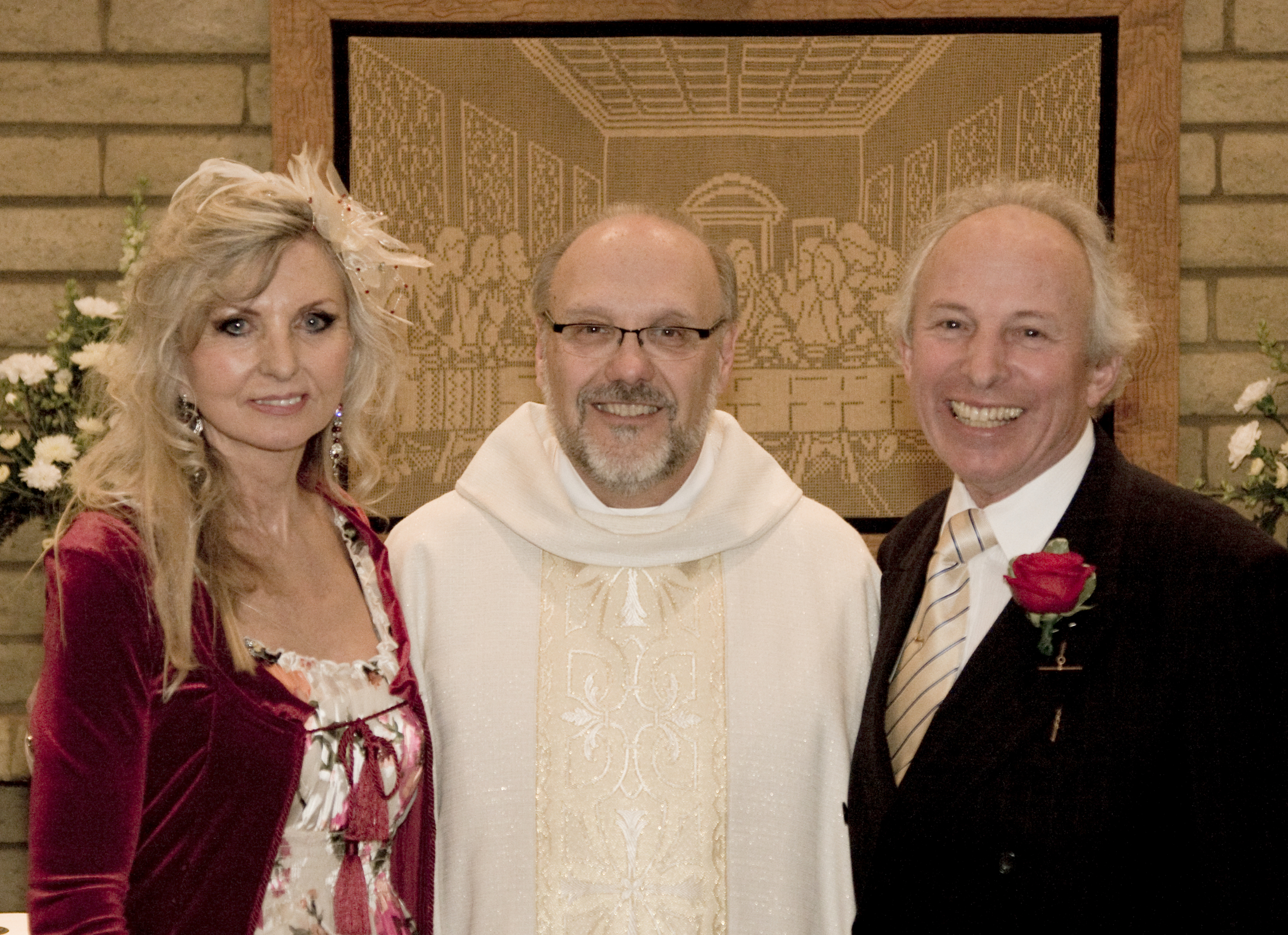
Jean, Father Dan and yours truly. St Paul's Episcopal Church, Payson, AZ. November 20th, 2010.
Jean, Father Dan and yours truly. St Paul’s Episcopal Church, Payson, AZ. November 20th, 2010.

Being at peace with who you are is the most important celebration.

Say no more!

The genuine you!

Do you or I know you or I?

OK, I accept that the sub-heading is slightly provocative but so what!

The fascination in truly knowing who we are is endless!

Back in January of this year, I penned an essay under the title of 20:20 self-awareness.  Here’s a snippet from that post:

The single biggest problem in communication is the illusion that it has taken place.” George Bernard Shaw is reputed to have once said!

Today’s essay on the challenges of speaking clearly to another, perhaps better described as communicating in a clear and unambiguous fashion, came out of a recent conversation with Jon Lavin, a good friend from my Devon days.  (Jon offers services for business owners and entrepreneurs under his business banner of The People Workshop.)

Jon was explaining that the number one hurdle for businesses that are managing change, and for so many businesses managing change is practically a constant, is having clear communications within the team.

The essence of that, and other posts over the years, is that knowing others, communicating with others, is so much easier when we know ourself well.

Not just relevant to us humans, by the way.  Dogs love knowing us sufficiently well that they can trust and understand our behaviours.

So all of that is an introduction to an article that was recently on the website of London-based Harley Therapy. The article is called How to Be Your Authentic Self. I have taken the liberty of republishing it in full here on Learning from Dogs. (See copyright statement at the end.)

ooOOoo

It’s a little after 6am.

I awoke this morning with the terrible realisation that I didn’t have permission to republish that article and, therefore, have ‘amended’ today’s post and removed the item..

Apologies to my readers.

Paul.

Not seeing the wood for the trees!

A postscript to the last two days.

This week is taking on a life of it’s own, so far as Learning from Dogs is concerned!

For when I penned Monday’s post, Running on Empty, I had not yet read George Monbiot’s essay Are We Bothered?. When I did so, it struck me as the perfect sequel to Monday’s post and formed the crux of yesterday’s post The nature of delusions.  That second post also included a personal account of my delusion with regard to ocean sailing and seemed sufficiently wordy not to be extended by my further reflections.

Thus the decision to run over to a third day!

Let me offer, first of all, my own reflections to George Monbiot’s concerns. That I distill, using his words, to: “The more we consume, the less we care about the living planet.” Expanded in his concluding paragraph:

So the perennially low level of concern, which flickers upwards momentarily when disaster strikes, then slumps back into the customary stupor, is an almost inevitable result of a society that has become restructured around shopping, fashion, celebrity and an obsession with money. How we break the circle and wake people out of this dreamworld is the question that all those who love the living planet should address. There will be no easy answers.

When I first read Mr. Monbiot’s essay, I found myself nodding in agreement. Yet, upon further reflection, I became less sure that “a society that has become restructured around shopping, fashion, celebrity and an obsession with money.” was the core of the issue.  I think it is a symptom.

Stay with me awhile I take a small deviation. To dogs, and other animals.

Many creatures have a powerful and instinctive means of assessing danger.  One only needs to observe the wild black-tailed deer that frequent our property to know that the slightest hint of danger or the unknown has them dashing away to safety.

A young black-tailed deer seen at home last September.

Dogs are the same in that they will run early on from a danger.

Humans also have the propensity to be cautious about a clear and present danger.  However, it’s my proposition that when the danger is unclear and when that danger threatens the very essence of who we are and the world that we have constructed around us, we can be blind to the point of madness. I can think of many examples in support of that thesis and I’m sure you can too.

Yes, we have “a society that has become restructured around shopping, fashion, celebrity and an obsession with money.” But I contend only because of the power of capitalism, of the power of modern marketing and advertising and the allure of being ‘one of the crowd’.

So back to my proposition.  It is this.

That when our lives are threatened by something unclear, complex and, ultimately, of devastating impact, we are very reluctant to embrace it and even more reluctant to both embrace it and escape to safety; whatever the latter implies.

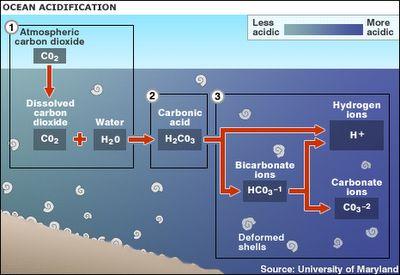
Mankind’s effect on the environment, the rising CO2 levels in the atmosphere, the increasing acidification of the oceans, the growing concerns about global weather, and on and on, are the most unclear, the most complex and the most devastating of futures to embrace.

(Thanks to Patrice for using this recently.)
(Thanks to Patrice for referring to this recently.)

So it really is no surprise to see mankind in general behaving as though this is a bit of a hangover, and an aspirin and a good night’s sleep will sort it! Especially when there is so much money and control invested in selling the same message; the message that there really is nothing to worry about.

There will be a so-called ‘tipping point’. A point in our awareness where the urgency to prevent the destruction of the biosphere will be paramount. And it will be a miracle if when that point arrives it isn’t far too late to save us.

I truly hope that I am wrong.

oooo

Remember what I wrote in yesterday’s post? About experiencing an Atlantic gale?

Fewer than 48-hours before my estimate of coming into Horta Marina on the Azores island of Faial, Songbird of Kent was struck by an early, fierce Winter gale. I seem to recall it was touching Force 10 Beaufort Scale (54 – 63 mph or 48 – 55 knots).

Anyway, it just about finished me off: literally as well as psychologically! I was so frightened, so utterly scared that I could think of nothing else other than getting to Horta and never going sailing again.

It revealed my delusion!

That was my ‘tipping point’ when it came to ocean sailing.

The gale subsided and I motor-sailed the 150-odd miles to Horta without any break for sleep or rest. Came into the harbour early in the morning after the second night since the gale. As soon as I was securely berthed, I closed the boat up and found a local hotel where a hot shower and a clean bed could restore a part of me.

Within a week, I had engaged a crew to sail the boat to Plymouth in South-West England and I flew back to England on a commercial airline.

Once Songbird of Kent arrived at Plymouth, she was put up for sale at a price that wouldn’t delay matters and that was that!

Oh, and I have never read any more books about single-handed ocean sailing. (But see my P.S.!)

oooo

P.S.

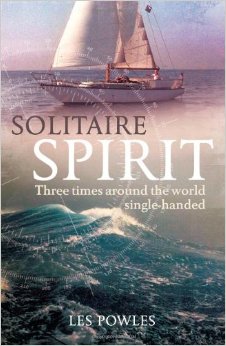
In yesterday’s post, I referred to Les Powells. Remember when I was in Larnaca, Cyprus? This is what I wrote:

Living on a boat close to me was Les Powles. Many will not have heard of Les but this quiet, softly-spoken man knows a thing or two about solo ocean sailing. As an article in The Guardian newspaper explained (in part):

In the 1980s and 90s a British man called Les Powles sailed three times round the world – always single-handedly, once non-stop. He couldn’t afford a radio transmitter, and on his greatest adventure he didn’t speak to anyone for 329 days. At 84, his ­circumnavigating days are now behind him, but he still lives on his boat, the Solitaire. What’s the ­appeal of sailing, I asked him. “It’s the solitude. When you’re out at sea on your own, there’s no government or bankers to worry about. You’re not ­responsible to anyone but yourself.”

Three times around the world – solo!

Thus getting to know Les was a great inspiration in getting me over the hurdle of can I really do this! (Les once said to me “the first three days are the worst!”)

Anyway, I have discovered that Les is living happily on his boat in Lymington, England and has written a book about his sailing life.

Les Powells book

It has been ordered and arrives today. This one will be read – from the comfort and safety of our rural home in Oregon!

Picture parade forty-four.

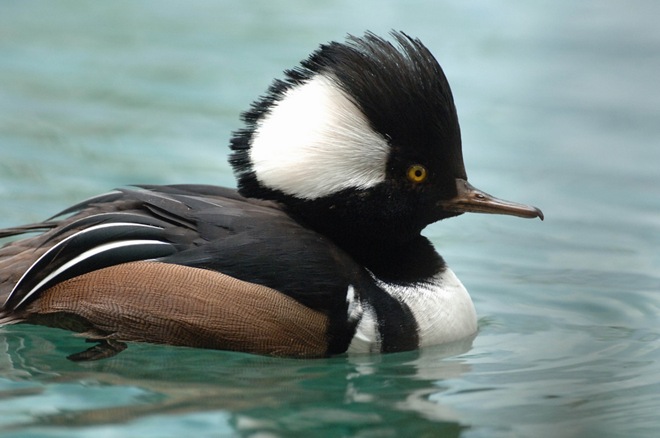
The final set of Bob’s adorable bird photographs.

(First set here, second set is here; last week’s set here.)

No, the brown part is not me, it is my “floatie cushion”.

oooo

bird25
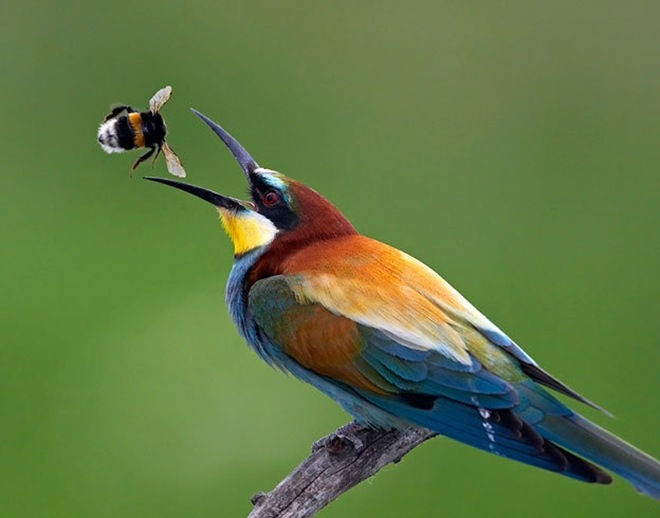
What an attractive hors d’oeuvre!

oooo

Were you eating blackberries when you sneezed on my wing?

oooo

Hey, don't blame me, my mother was a Cardinal and my father was a Magpie.
Hey, don’t blame me, my mother was a Cardinal and my father was a Magpie.

oooo

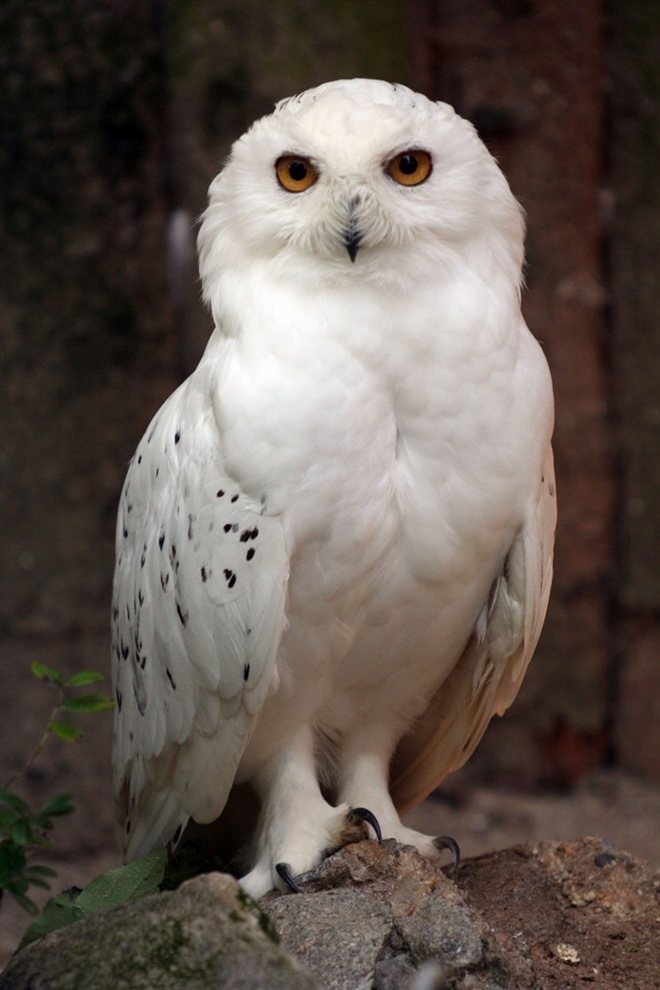
Oh WOW, what a hoot. You really bought the bit about us being wise?

oooo

Oh how I hate it when it itches there!

oooo

Really? My mother flew south without me?

oooo

You all have a good week!

Do animals fall in love?

Opening our minds to a beautiful concept!

One of the better things about my old home country, the United Kingdom, is The Open University.  As Wikipedia explains:

The OU was established in 1969 and the first students enrolled in January 1971. The University administration is based at Walton Hall, Milton Keynes in Buckinghamshire, but has regional centres in each of its thirteen regions around the United Kingdom. It also has offices and regional examination centres in most other European countries. The university awards undergraduate and postgraduate degrees, as well as non-degree qualifications such as diplomas and certificates or continuing education units.

With more than 250,000 students enrolled, including around 32,000 aged under 25 and more than 50,000 overseas students, it is the largest academic institution in the United Kingdom (and one of the largest in Europe) by student number, and qualifies as one of the world’s largest universities.

For reasons that I am unclear about, I subscribe to the OU’s newsletter.  Thus it was that a few weeks ago, this dropped into my ‘in-box’.

Do animals fall in love?

Do romantic relationships exist in the animal kingdom?

Throughout his lifetime, evolutionist and biologist Charles Darwin researched and wrote about how he felt that love can exist within the animal world. Particularly in his papers ‘The Expression of Emotions in Man and Animals’ and ‘Comparison of the Mental Powers of Man and the Lower Animals’, he explored how animals can display supposed ‘human emotions’ like pleasure, pain, happiness and misery. He investigated how animals could seemingly appear to feel ‘down’ when separated from their companions, and seemed to jump for joy and touch one another in a way similar to a human hug when reunited.

Although monogamy and lifelong pair bonds are generally rare in the animal kingdom, some animals seem to thrive on it. Recent research has shown that Gibbons, who were thought to mate for life, have more complicated relationships, with mates occasionally philandering, and even sometimes dumping a mate, suggesting some similarity to human relationships. Swans also form monogamous pair bonds that last for many years, and occassionally for life. Loyalty to their mates has made them a virtually universal symbol of love. But some researchers believe it isn’t as romantic as it first appears, and that they stay together because spending extra time attracting a new mate has the potential to impact on the otherwise reproductive time.

Darwin’s theories have paved the way for further studies. In this free article, Tim Halliday explores natural selection and evolution in the animal world.

Here is that article.

ooOOoo

Natural Selection and Evolution

Tim Halliday explores natural selection and evolution in the animal world

By: Professor Tim Halliday (Department of Life Sciences, The Open University)*

In the Rules of Life series, and its accompanying CD, Aubrey Manning looks at the behaviour of animals and describes many new discoveries about the way that this is beautifully adapted to meet the challenges which animals face in their daily lives. The scientific study of animal behaviour, or ethology, was founded some 50 years ago by Niko Tinbergen and Konrad Lorenz. Their most significant contribution was to bring together the study of natural history with an understanding of evolution by natural selection. Since then, the numerous studies that have been made of animal behaviour have revealed that animals do many things that challenge many of the ideas that people had about natural selection 50 years ago. Natural selection theory has developed enormously since that time, largely as the result of animal behaviour studies, and a number of popular misconceptions about evolution have been revealed to be false as a result.

One such misconception is embodied in the phrase ‘survival of the fittest’, first coined by Herbert Spencer, and often used to encapsulate the way natural selection works. It is misleading, because ‘survival’ is only part of the story. Evolutionary change comes about because some individuals are more successful in reproduction and so pass on their genes to succeeding generations. As a result, the characteristics that make individuals successful in reproduction become more common in the population. It is thus reproduction that is important in evolution, and survival becomes simply a means to that end.

The importance of this point becomes apparent when we appreciate that, for most animals, reproduction is a very costly and sometimes dangerous activity, as illustrated many times in the series. To engage effectively in reproductive activity requires a great deal of energy and other resources that could otherwise be put towards survival. This is apparent in the common observation that animals show a greatly reduced growth rate, or stop growing altogether, when they reach sexual maturity. The resources that they derive from feeding are diverted from growth to reproduction.

A second common misconception is that natural selection acts ‘for the good of the species’. There are numerous examples of animal behaviour that show that this cannot be the case. For example, African lions live in prides, consisting of several females and their cubs, controlled by a group of two or three males. Other mature males are excluded from living in a pride. From time to time, a coalition of excluded males is formed and they attempt to take over a pride, by attacking and driving away the current pride-holders. If they succeed in doing this, their first act is to kill any cubs in the pride that are still being suckled by their mothers. To kill the young of one’s own species cannot benefit the species. The adaptive value of this behaviour for males is that, deprived of the cubs they have been suckling, the females very quickly come on heat and can conceive cubs fathered by the new pride-holders.

This example illustrates another common misconception about evolution, that, when mating, males and females are acting cooperatively. While it is in the interests of both parents that reproduction is successful, the way that that success comes about is not necessarily the same for the two sexes. For male lions, it is of no reproductive benefit to them to guard females that give birth to cubs fathered by other males. Infanticide is of benefit to them because it ensures that cubs born in the pride are their offspring. Infanticide is costly for females because the considerable time and resources that they have put into producing cubs is wasted. There is thus a conflict between the sexes, even though they have to behave cooperatively if either is to reproduce at all.

The interplay of cooperation and conflict is also apparent in the relationship between parents and offspring. For animals that produce more than one young at a time, it is usually to the advantage of the parent to share food more or less equally among its progeny. For each individual progeny, however, it is to its advantage if it receives more food than its siblings. There is thus a great deal of competition among progeny. This takes a bizarre form in the European Fire Salamander, and in a species of shark described in one of the programmes. In these animals, the young develop within the mother and, as they grow, they eat one another until only one, very large young is left. It may be that producing one offspring at a time is a good strategy from the mother’s point of view, or it could be that she would have higher reproductive success if she produced more; it may be, however that she has no choice in the matter.

The key to understanding evolution by natural selection is to think of it, not in terms of an individual’s survival, but in terms of its effectiveness in passing on its genes, what in the series is referred to as ‘genetic accounting’. Natural selection favours those individuals that pass on the most copies of their genes. This enables us to explain many aspects of animal behaviour that are difficult to explain purely in terms of survival. For example, in many species, particularly among birds, certain adult individuals do not breed themselves, but help other adults to do so, for example by feeding their young. In almost all cases, helpers turn out to be close relatives of the parents they are helping and so they are, in an indirect way, helping to spread those genes that they share with their relatives.

* Tim Halliday is professor of biology at The Open University, where he has worked on newts, toads and frogs since 1977.

ooOOoo

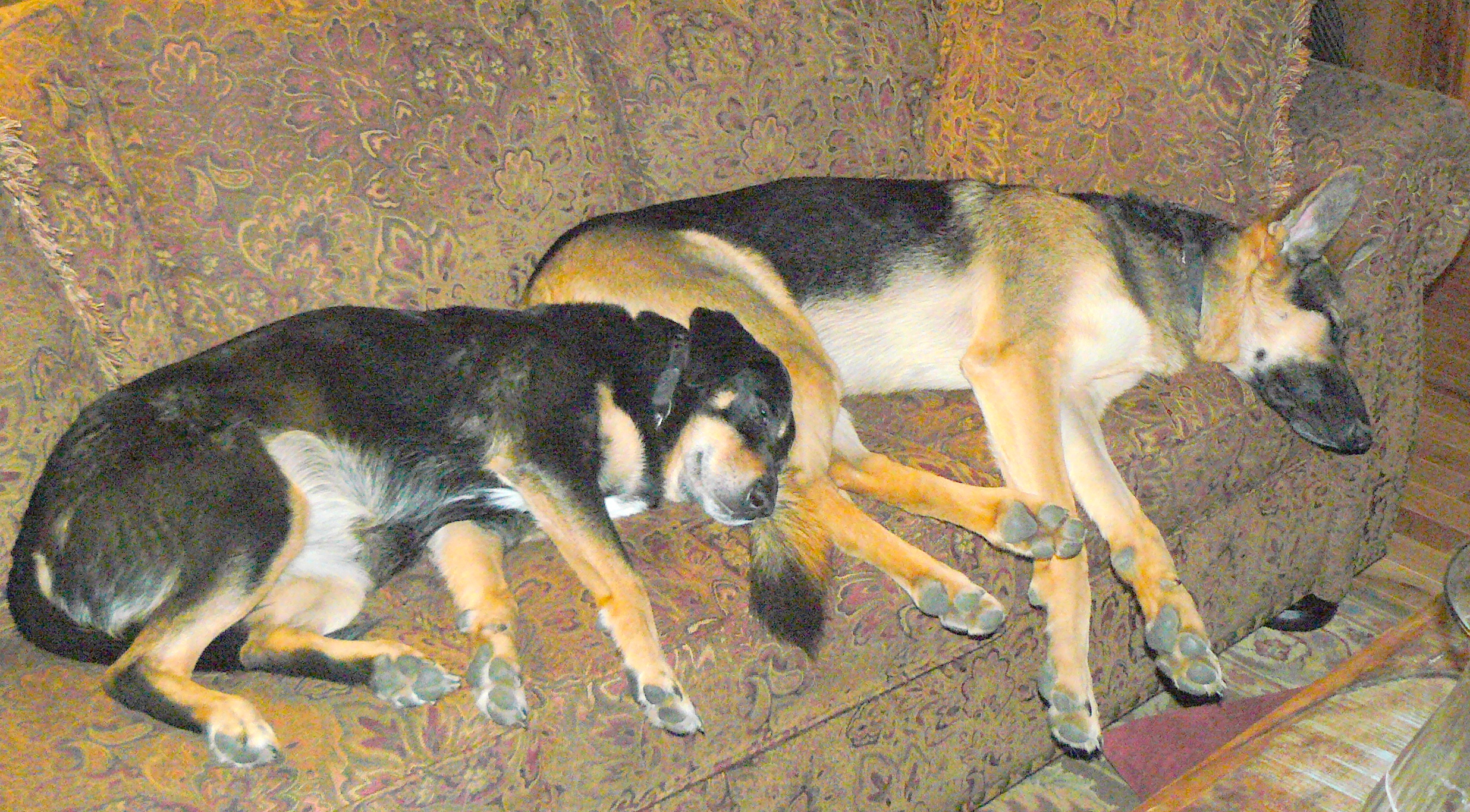
Two photographs that offer my answer to the question: Do animals fall in love?

animallove

oooo

Hazel asleep with her dear friend Cleo. (Hazel to the left.)

Progressing Wisdom – the preamble.

A reflection on intelligence, learning and knowledge.

Today’s essay has been prompted by a fascinating exchange of views and comments on a post recently published by Patrice Ayme.  More of that tomorrow.

Before getting to the heart of things, I feel compelled to offer a little background on my own educational journey. It is presented today as a preamble to tomorrow’s main essay.

By rights, I should have enjoyed a stunning academic journey as a young man.  My mother holds a double degree in French and German from Cambridge University.  My father was both a Chartered Architect and Chartered Surveyor and worked for Barclay Perkins & Co at their Anchor Brewery in Southwark, London all his working life.  My uncle, Christian Schiller, took up a mathematics scholarship at Sidney Sussex college at Cambridge University and ended up HM Inspector of Schools in the United Kingdom. Notably, he was a promoter of progressive ideas in primary education.

But it was not to be so.

My father died suddenly and with very little warning five days before Christmas in 1956.  I had turned 12-years-old some six weeks previously and just completed my first term at Preston Manor County Grammar School.  My secure, comfortable young life was thrown into emotional turmoil with one of the consequences being that instead of passing a clutch of GCE ‘O-Level’ exams, I barely managed to pass two subjects and was unable to continue on with a higher level of studying and the consequent sitting of GCE ‘A-Level’ exams, a pre-requisit for university.

Somehow, I then managed to win a place as a student at the Faraday House of Electrical Engineering, in those days based at Southampton Row, London.  It was to study for a Diploma in Electrical Engineering.  The requirement was that by the end of my first year at Faraday House I should pass two A-level examinations.

I was very happy as a college student.  That first year was spent entirely learning about engineering with much time ‘hands-on’ in the engineering workshop. Then came time for me to sit those two A-level exams. I failed both of them! There was no choice but for me to leave the college.

faradayhouseplaque
So that’s enough to demonstrate that academic prowess was not my speciality.

However, being unable to jump through the hoops needed for a degree or equivalent didn’t mean that I was a poor learner; far from it.

After my father’s death, my mother remarried and my ‘new’ Dad was very supportive.  He had a background in communications and quickly encouraged me to become a radio amateur.  I joined the nearby Radio Society of Harrow (still in existence!) and their encouragement enabled me to pass the full set of exams necessary to become a licensed radio amateur and a full member of the Radio Society of Great Britain.  My amateur call sign was (and still is) G3PUK. I was 17.


G3PUK0001
I can still whistle the alphabet in morse code, from A to Z, and the numbers 0 to 9!

Later on, when I was an apprentice at the British Aircraft Corporation’s site in Stevenage, Hertfordshire, one of the commercial staff, Jim Jenner, spent many hours preparing me for the Institute of Advanced Motorists examination. I passed that exam and became a full member of the IAM in May, 1966.

So there’s my background that, hopefully, will set the scene to a wonderful exchange of views and ideas that flowed from Patrice’s blog. Ideas that will be explored tomorrow.

For the reason, the powerful reason, that the intelligence and wisdom of humanity has always been important.  But now, in this time of the affairs of man, our collective intelligence and wisdom has never been more important.

Picture parade forty-three.

Yet more of Bob’s fabulous bird photographs.

Carrying on from last week’s Picture parade forty-two.

Yeh, well your eyes would get big too if someone had their fuzzy hands all over your bod!

oooo

Which way did you say it was to the Xtreme Games?

oooo

With this disguise, they'll never figure out who robbed their nest!
With this disguise, they’ll never figure out who robbed their nest!

oooo

The doctor said it wasn't malignant but I think I'll get a second opinion.
The doctor said it wasn’t malignant but I think I’ll get a second opinion.

oooo

So sorry to have to ask all of you to help but I really do need that contact I dropped.

oooo

Don't look at me like that, haven't you ever heard of Santa Bird?
Don’t look at me like that, haven’t you ever heard of Santa Bird?

oooo

Oh, how I love government handouts!!

oooo

The final set of these fabulous photographs next Sunday.


Creative reflections.

The power of re-finding oneself.

Terry Hershey

If you do a search on Learning from Dogs for Terry Hershey you will find that his name comes up from time to time. Way back in March, 2011, I published a post announcing a visit by Terry to Payson, AZ where Jean and I were then living.  Having had the opportunity to listen to Terry speaking and to meet him in person, I have maintained a subscription to his weekly Sabbath Moment ever since.

Thus it was that last Sunday in came the regular missive from Terry.  They are always good but last Sunday’s was spectacularly good. In response to my request to publish the full Sabbath Moment here on Learning from Dogs, there was a prompt reply to the affirmative.

Thus with no further ado, here is Terry’s Sabbath Moment for May 5th, 2014, in full.

ooOOoo

Artists

May 5, 2014

Hershey moon

It seems that in the spiritual world, we do not really find something until we first lose it, ignore it, miss it, long for it, choose, it, and personally find it again–but now on a new level. Richard Rohr

Mystery is at the heart of creativity. That, and surprise. Julia Cameron

I was born fragile, farther said. I was just born that way. He said I was a nervous baby. Just born like that. David Helfgott

I saw the angel in the marble and carved until I set him free. Michelangelo

oooo

Lorraine Hunt Lieberson began her career as an accomplished viola player. While on tour in Europe (in the late 1980s), her viola was stolen. She could have replaced it. As would be imagined, the theft threw her into a state of feeling lost and uncertain. She stopped playing. After awhile, Lorraine began to work with only instrument she had, her voice.

When asked, Lorraine stresses that her decision to go into singing happened quite naturally. “There were a lot of encouragements along the way, but no individual, earth-shaking event that made me change,” she says. “But, back in 1988, when my viola was stolen, I took that as a sort of omen.” (And although she hasn’t yet replaced her stolen viola, she avows that “the viola is always with me in spirit when I sing.”)

Interestingly, Lorraine is shy about being interviewed; she has no press agent. But when she sings she is known for an ever-widening swath of ardor and awe that she leaves in her wake. An intensity. Her voice–her singing–touches hearts and lives. The irony is that the gift–the artistry–she has given us all, began when life turned left.

Ask any class of kindergarten students, “How many of you are artists?
How many raise their hands? Every single one of them.
Ask fourth graders. Maybe half.
Seventh graders. A handful.
Seniors in high school. Maybe one.
It’s quite the educational system we have created.
We begin with artists, and we slowly wean it out of them.

I do know this: it is easy to lose sight of that artist that resides inside of each one of us. Whether lost or buried or stuck or forgotten or dismissed or ignored… or “stolen.” (Whenever I lead a retreat, Crayolas are mandatory–because it is an unwritten spiritual principle that you cannot learn about life unless you color. It is curious then, how many–otherwise secure adults–will say, “I’m not very good at coloring.” I will say, “Who said anything about being ‘good’ at it?” Our mind has already morphed from play and wonder to mastery and proficiency.)

When we tag or label or describe ourselves, “artist” is seldom used. Where I was raised, artist was a phase you went through (a dream), you know, to grow out of, to, move on to something more useful and sensible–in order to get a real job.

Yes, of course we are all inner artists, but the cynical part of me tells me that it all sounds too much like a mantra meant to be chanted standing in a circle at a “be all you can be” conference. Sure, it all sounds good.

But I’m not sure what it really means.

In the opening scenes of Shine, we first meet the middle-aged David Helfgott (played by acclaimed Australian stage actor Geoffrey Rush), babbling to himself incessantly and wandering in the rain, in a state of transition. Behind him is the isolated existence as a child piano prodigy whose emotional turmoil led to a nervous breakdown, and a series of stays in various mental institutions. Ahead of him is his eventual reconnection with the world around him, guided by both love and his virtuoso talent that has been long abandoned. We witness the awakening of the artist. In the movie (and in real life), David eventually moves toward that which gives life.

So, what is this artist? It is the place in our spirit that births…

creativity,
enchantment,
imagination,
play,
risk
and wonder.

There is no doubt that we hide it. We don’t believe it. Or we judge it as inadequate.

But here’s the deal: The artist in David did not reside only in the talent or prodigy or genius, but in the spontaneity, vitality, innocence, passion and delight. And the artist in Lorraine wasn’t detoured by life’s unkindness.

For me, the tragedy is that (in the name of love) David’s father (Peter) squeezes the artist out of the prodigy. But in truth, it doesn’t always require a pathological “love” to hide or extinguish the light.

In the movie rendition, there is a scene that stops my heart. David and his father are walking home after a competition. David has placed second.
(In his father’s eyes, anything other that first is a failure.) The father is seething, and there is no hiding his disgust. David has lived his entire life absorbing his father’s pathology, doing his very best to make his Daddy happy. The father walks ahead, hurried, his spirit heavy. David follows. On the sidewalk, in chalk, there is a hopscotch pattern.The camera follows from behind, and we see young David unconsciously, intuitively, childlike, hopping and skipping and jumping — the joy and the light (and the artistry) of his childhood still alive.

I don’t want to lose sight of that childlike artistry inside of me. I’m home for a week or so, and the garden is abounding and teeming with life and color and enchantment. The peony buds profligate, the bearded iris blooms beguiling, the columbine exquisite. The branches of the Japanese Maple, heavy with spring rain, deferentially bow. I once asked my analyst why I was in therapy. He told me it would make me a better gardener. Gardening can be strong medicine–an elixir that nurtures and shapes the soul. For that reason, it is a tonic seldom taken straight with no ice. Gardening has way of seeping into your soul, and one day you find yourself, in the words of poet May Sarton, spending the first half hour of the morning “enjoying the air and watching for miracles,” the joy and the light still alive.

oooo

I dip my pen in the blackest ink, because I’m not afraid of falling
into my inkpot. Ralph Waldo Emerson

ooOOoo

Hope you all enjoyed this just as much as I did!

But I can’t close without mentioning something that struck me the very first time I read the essay. It is this.

That list that describes artistry: creativity, enchantment, imagination, play, risk and wonder.  It’s not a million miles from describing the way our younger dogs behave when we take them for a walk around the property most days after lunch.

Dogs playing without a care in the world!

Once again, Terry’s website is here.

Picture parade forty-two

More of Bob’s beautiful bird photographs!

For those of you that missed the first set a week ago, then they are here.  To the twenty-seven of you who ‘Liked’ last Sunday’s set; thank you.

Bird9
But Honey, what makes you think I had a little too much at the office party?

oooo

I would have sworn the package said Swiss.

oooo

Hello, are you the photographer from Vogue?

oooo

Wow! That was one very elusive fish!

oooo

You idiot, don't you know you are supposed to pass on the left?
You idiot, don’t you know you are supposed to pass on the left?

oooo

No, I didn't read the part in the Bible about breaking bread together so just let go.
No, I didn’t read the part in the Bible about breaking bread together so just let go.

oooo

OK girls, I think we are ready for "Dancing With The Birds".
OK girls, I think we are ready for “Dancing With The Birds”.

oooo

Come on Willard, quit acting like an NFL defensive back!

oooo

Yet more stunning bird photographs in a week’s time.

Again, thanks Bob.

Pas de deux

The courage of sharing beautiful thoughts.

In a post published last Monday under the title of Having yourself as your best friend, I presented a poem from Kimberly that was published on her blog: Words4jp’s Blog.   As regular readers will recall that poem was an expression of personal sadness.

Then two days later, there was a further poem from Kimberly that just bowled me over with its beauty.  Kimberly generously allowed me to share it with you.

ooOOoo

a pas de deux


The tears of a rhapsody

glide slowly along the strings of a violin

as


He stands…

a single vision

under a dimly lit spot light


He waits…

for an essence of grace

to float by and awaken his spirit


He feels…

the melody

breathing life into his limbs


He hears…

the whisper of satin pointes wafting

from behind


He sees…

gossamer fingers embrace his hand

as


She leads…

him forth into a world which transcends reality.


ooOOoo

Stunningly beautiful.