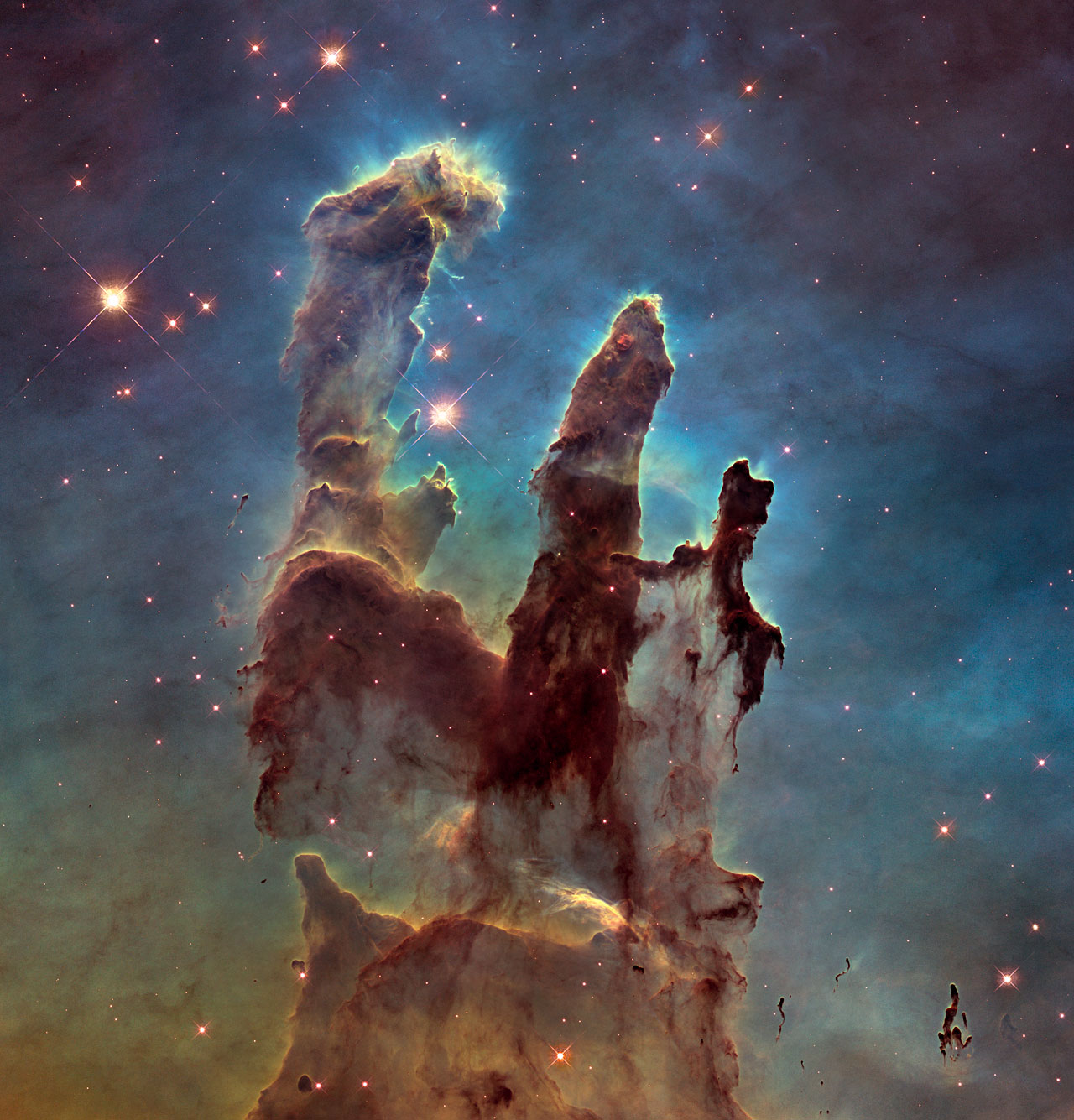
The NASA/ESA Hubble Space Telescope has revisited one of its most iconic and popular images: the Eagle Nebula’s Pillars of Creation. This image shows the pillars as seen in visible light, capturing the multi-coloured glow of gas clouds, wispy tendrils of dark cosmic dust, and the rust-coloured elephants’ trunks of the nebula’s famous pillars. The dust and gas in the pillars is seared by the intense radiation from young stars and eroded by strong winds from massive nearby stars. With these new images comes better contrast and a clearer view for astronomers to study how the structure of the pillars is changing over time.
I subscribe to EarthSky and the link to this image and background information was in yesterday’s daily summary. The mind-blowing facts are that the Eagle Nebula is found in the constellation Serpens and is 6,500 light-years away from our dear planet. To put that into context, that is 38,210 trillion miles from us. The star cluster associated with the nebula is about 5.5 million years old.
EarthSky has the very interesting text of the NASA Press Release regarding this new, high-resolution image.
For me, I just want to let that image wash over me. Not least because it reminds me that I am a very lucky person to be living at a time when one can lose oneself in such sights.
Here’s the image again, this time without the explanation.
The reason I am choosing to write about Ellesmere Island is because of a recent BBC film: Snow Wolf Family and Me.
This video offers a great insight into the film:
Published on Dec 29, 2014
A new BBC film, Snow Wolf Family and Me, explores the lives and habits of arctic wolves, revealing the family secrets of one of our most feared predators. Ellesmere Island is one of the most remote and beautiful places on Earth. This is the only place in the world where wolves are naive to man and have no fear. It allowed wildlife cameraman Gordon Buchanan and scientists an unparalleled opportunity to form bonds with a wild wolf family, revealing the remarkable story of their relationships and behaviour.
Here series producer Ted Oakes talks about some of the highlights and challenges of being accepted by a wild wolf pack.
Snow Wolf Family and Me will be broadcast on 29th and 30th December 2014 at 21:00 on BBC Two.
Music by Jean-Marc Petsas. Photofilm produced by Dualtagh Herr.
Family members back in England who did watch both episodes of the film said it was breath-taking, especially the scenes in the second episode where the wolves were filmed coming right up close to Gordon.
Gordon Buchanan and White wolf.
What captivated me, seeing how quickly the wolves acclimatised to Gordon and his two colleagues, was imagining that this must have been what it was like when, thousands of years ago, wild wolves bonded with early man providing the start of the glorious and beautiful relationship between canines and humans. A wonderful relationship experienced by millions of us around the world today.
The next short video illustrates that the ancient lineage, from wolf to dog, still resonates between both species.
Ellesmere Island Expedition 2008 – Howling Good Time
Bronwen is a UKCP-accredited psychotherapist with nine years experience and a practice in Cambridge, Suffolk and Hungary. She is trained in the Karuna Institute in Devon in core process psychotherapy, which was the first mindfulness-based therapy in the UK. She adds to this her unique understanding of western and eastern spiritual traditions, combined with findings in new science – to find ways of helping individuals align with their true destiny. She runs retreats and workshops and group work at different times of the year.
I was vaguely aware of the name. Perhaps unsurprisingly as I was familiar with the work of the Karuna Institute at their beautiful location at Widecombe-in-the-Moor, Dartmoor, Devon, some eighteen miles from where I used to live in Harberton, Devon.
Widecombe-in-the-Moor
Anyway, back to the theme of today’s post. Back to Jon Lavin’s email with the link. This is how that essay from Dr. Rees opened:
by Bronwen Rees on January 1, 2015
In the face of the on-going and now undeniable social, economic, environmental and political crises, there are plenty of seeds of ‘emergence’ that point to a new way forward. These are flowering in the area of sustainability, spirituality, and the reworking of ancient systems of wisdom. They point to a new way of being and relating where, it is implied, one can manifest at will one’s desires.
Whilst there is a distinct truth in much of this, and many examples where this can obviously work (vis the outpouring of new technological companies providing ever more zany products), they are very early developments fostering to individual satisfaction rather than being consciously channeled into the benefits of the collective. The scale of change in terms of consciousness has largely not yet been realized. One of the main reasons for this is the as yet imbalance in the relationship between the collective and the individual, and the lack of a conscious ethical foundation.
I sort of understood the central message but the words were getting in the way. Take this later paragraph, for instance:
Humanity is at a bifurcation point – a point of irreversible change – where conscious choice determines the future that is created. Neo-Darwinian theorists would argue that this is merely a point of survival, and given the current scientific data about the material conditions – peak oil, energy, economic chaos, severe mental health issues, the conditions would suggest that we are as a species heading for disaster. Balanced between over-population and yet greater and greater individualization with more and more apparent choice – how can the two perspectives be reconciled on this seemingly increasingly small planet?
Indeed, my email reply to Jon, having struggled through the full essay said: “Good day to you, Jon, Yes, what a fascinating essay albeit written in a manner that makes it a very tough read! Nevertheless, I have no doubt that the good Dr. is spot on in her analysis.”
The very next item opened in my email inbox was notification of a new post from Sue Dreamwalker: My Dream ∼ Translated I just had to share. Let me, in turn, share Sue’s post with you; with her kind permission, I should add.
ooOOoo
My Dream ∼ Translated I just had to share
“Don’t only practice your art, but force your way into its secrets, for it and knowledge can raise men to the divine.” ― Ludwig van Beethoven
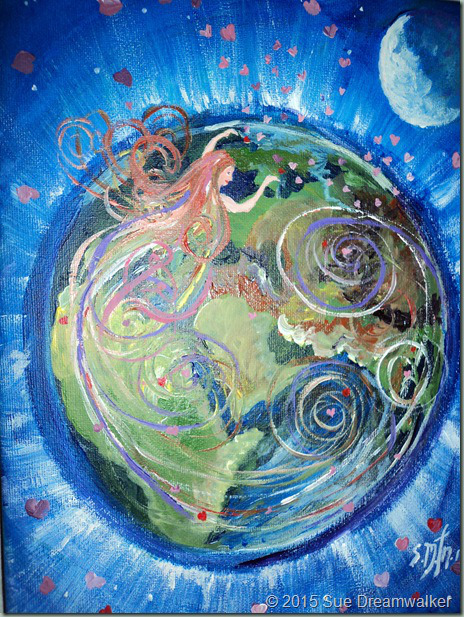
On Jan 3rd I had a Dream.. Please click on the music video below so you can get a sense of some of my experience.. .. Sunday I tried to capture some of the images I had in the dream… So I painted.. But I saw Oh so so much more………
In the beginning of the dream.. She was Me.. As I began to sing.. but then I became the observer.. This has to be the best Dream experience ever… .. So I had to share.. I heard the Music… Music like I have never heard upon this earth… the video music is about as close as I can get to that feeling of being exalted to a higher place.. I am still so excited I cannot tell you the Love I felt within this experience.. If this is the beginning of 2015.. Whoooooh… Let it roll……..
My Dream..
“She stood in a gown that was a rich golden brown. Its fabric shimmered catching the light that reflected from the crystals of natural quartz that sprang up around her. The gown was long and flowing not only did it reach the floor, but it spiralled out around her in a never ending dance as it became one with the sphere of the Earth.
Sue’s painting.
She took a deep breath; here she stood in the centre of the globe called Gaia.
Her hair was so long the wind picked it up to billow out behind her in long tresses. Birds flew in and amongst her strands of hair, Insects and butterflies danced within making it their home.
With breath still poised, she raised her arms like a conductor of an orchestra. She expanded her lungs and she began to Sing…. Her Soprano voice was pure. The moment her voice vibration raised higher the spiral of her gown buried deeper into the Earth. The Grass became part of her gown. Trees sprang forth from the folds of it swaying to her melody of love; Flowers opened their blooms, each petal giving separate notes in a wonderful exotic dance of harmonic ripples.. Love notes rippled like the keys of the piano. The buds on the trees open their leaves their notes sounded deeper like a million cello’s. Birds sang their flute like songs and the butterflies wings danced lighter than bell chimes.
Water trickled into streams, clear and sparking like the strings of the violin.. They swelled in a crescendo in waves that beat the rocks crashing in like kettle drums smashing like symbols into glistening spray..
The Whales joined in her song a mournful lament, while deep in the jungle the elephants gave a low rumble to acknowledge they had heard.. The roar of the Big Cats were heard above the cries of the orangutan’s
As the Thunderous machines of man cut swaths leaving deep scars that screeched like vultures circling over head, to give way to silence………. as they circled over the corpses of everything left dying in its wake..
She paused……………. ready to continue…….. Her arms raised high above her head, she Sang.. her voice becoming a crescendo with the Earth, her breath became the Spiral.. Her Hair became the Wind.. The notes she sang sprang forth from her mouth forming hearts and stars.. Every living creature now joined in her song…
She knew her Song of love was being joined by so many more.. She was ONE with ALL.. She was part of our Earth Mother..”
~~~~
I hope you enjoyed reading about this Dream and I hope you enjoyed listening to the wonderful music of the PianoGuys
See you all very soon…
~Sue~
ooOOoo
In a very strange way, I read the same messages from Dr. Rees and from Sue but presented in such opposite ways: one way so complex and one way to clear. So strongly reinforced by their respective closing words. Here’s Dr. Rees:
Whilst there is real potential for the expansion of consciousness, this does not by any means suggest that this will arise without individual effort and struggle. All the enlightened masters of the past needed to move through this gateway – the difference between then and now is that the conditions are far riper for more individuals to undergo this – and indeed can be seen as a biological necessity for the survival of the human species. Thus as individuals, we cannot avoid this, but what we can do, and indeed as a biological and spiritual imperative, we can support one another and help organize ourselves in dedication of this purpose, in a mutual recognition of each individual uniqueness yet shared destiny.
Here are Sue’s closing words: “She knew her Song of love was being joined by so many more.. She was ONE with ALL.. She was part of our Earth Mother..”
However, there is one uniting theme I read from both of them: Hope!
How the hard choices actually allow us to define who we are.
Jean and I watched a TED Talk a few evenings ago. The title of the talk was: How to make hard choices. It was delivered by philosopher Ruth Chang who one discovers from her website:
Ruth Chang
I am a philosopher at Rutgers University, New Brunswick. Before arriving at Rutgers, I was a Junior Research Fellow at Balliol College, Oxford where I was completing my dissertation. I’ve also held visiting positions in the philosophy department at the University of California, Los Angeles and the University of Chicago Law School. Before my life as a philosopher, I worked as a law associate on a (pro bono) death penalty case and several (non pro bono) product liability cases. I have a J.D. from Harvard Law School and an A.B. from Dartmouth College.
Now I am not going to pontificate about this talk; all I will say is that it is a) very interesting, and b) highly relevant to millions of us when, from time to time, we are faced with the tough decisions to make.
The video is a little less than 15 minutes long. I’m fairly certain that you will be enchanted by Ruth Chang’s proposition as much as Jean and I were.
Published on Jun 18, 2014
Here’s a talk that could literally change your life. Which career should I pursue? Should I break up — or get married?! Where should I live? Big decisions like these can be agonizingly difficult. But that’s because we think about them the wrong way, says philosopher Ruth Chang. She offers a powerful new framework for shaping who we truly are.
A reflection of the future year; this last day of 2014
I struggled for some time, wondering what to write for this day: December 31st, 2014. Part of me wanted to be light and cheerful. Yet, nothing came to mind in terms of what to write that wouldn’t be pointless or inane. Then dear Colin who writes the blog Wibble – just another glitch in the matrix posted yesterday: Are we ready for 2015? Here’s that post:
Are we ready for 2015?
I’m not sorry for sounding somewhat melodramatic, here: what we face is nothing less than the archetypical existential threat. You may well
Graph (hand-drawn in 2008) showing that carbon emissions must peak by 2015 to keep global warming to the internationally agreed upper limit of 2°C (the point beyond which we risk runaway climate change).
dismiss me as ‘alarmist’: but if you were in a crowded theatre and you were to hear me shout “FIRE!” — what would you do then?
When, in late 2009, I first saw The Age of Stupid, I was struck by one scene in which ‘a man in a shed’ stated, quite categorically, that humanity’s carbon emissions had to peak by around 2015 in order for us to avoid the risks of passing beyond 2°C above the average pre-industrial global temperature. Almost everyone agrees that two degrees centigrade of warming is the threshold beyond which we will face serious risk of uncontrollable planet-wide climate change effects of potentially catastrophic proportions. And I do mean ‘civilisation-ending’.
This is not histrionics; it’s based upon very solid science. The ‘man in the shed’ is Mark Lynas, author of ‘Six Degrees: Our Future on a Hotter Planet,’ which won the Royal Society’s science book of the year award in 2008. In the short video clip below he speaks from that same year, and his message is blunt: he says we have “seven years” to stabilise global carbon emissions to avoid the risk of climate change accelerating beyond our ability to control it.
The problem is that 2008 + 7 = 2015. Those seven years are up: we’ve squandered them.
Now, I don’t know if you’ve been paying attention — perhaps you’re more focused upon the fortunes of your favourite football team, or the latest antics on ‘Strictly’ or Eastenders; maybe your mind is firmly on your house or job move, or where your children are going to school next year, or any one of the myriad of (relative) trivia such as the ‘immigrant problem’, or the ‘war on terror’ — so in case you’re not familiar with the current situation:
Global carbon emissions are not slowing towards a peak in this coming year. On the contrary, emissions are soaring beyond anything humans have ever previously managed. I’m talking BIG numbers. Yay, us: we’re beating all records.
So… What are your new year resolutions?
On reading the blog post I found myself leaving a comment that seemed to encapsulate my inner fears, explaining why I was struggling to find a light and cheerful tone for today’s post. Here is that comment that I left for Colin:
I hesitate to offer a view. Not because I don’t agree with your article, agree totally, but because I’m afraid that I can’t offer any original thoughts. There is a growing awareness of the need to change, even some quasi-political ambitions that the world ‘needs to talk about climate change’, but no sign that we are anywhere close to a global response of emergency proportions.
Despite being a person with a naturally positive view of life, for reasons I can’t articulate, I have a profound sense of gloom about the New Year. Maybe a result of recently becoming aware of my own mortality. Maybe, an unspoken fear of some huge global catastrophe, natural or otherwise, just around the corner. I hope that I am wrong. Then if I am wrong, it is suggesting that 2015 will be more of the same and, as you so acutely point out, more of the same is the last thing this natural world of ours requires.
So make of that what you will! (And apologies for rambling on a tad!)
Happy New Year to you and all your loved ones.
Then something struck me. It’s no good just giving up and having a moan. Each and every one of us has to find a motivation for changing. Or, if the scale of global change required is just too overwhelming a prospect, then embrace these times as just one of the planet’s natural thresholds; global changes that have been going on for billions of years.
As we come to the end of 2014, it’s natural to reflect on the year that has gone by, as well as to look forward to the new year ahead. This is a time for “kind sight”.
Below are two journalling exercises to explore, now that the rush of the Holidays is over. I like to think of this as a Middle Ground pause. A time for being present, reflecting and allowing your inner wisdom to inspire you for whatever comes next.
Take a few moments to let yourself get settled and comfortable. Start by reflecting with “kind sight” on the past year. “Kind sight” means being kind to yourself, instead of being critical or judging. With “kind sight” we are able to see mistakes as lessons, and life’s challenges as times of resiliency and personal growth.
Ask yourself the following questions and write down your answers:
What happened during 2014…
What was a highlight?
What was a lowlight?
What was a surprise?
What do I feel proud of?
What do I feel grateful for?
What did I learn (or am still learning) from either the highlights or lowlights?
Some people do a month by month reflection, while others evaluate important areas in their lives. (For example – career, family, health, hobbies, learning, contribution, spirituality, travel, environment, self-care, personal growth).
Once you’ve reflected on 2014, write a Future Gratitude Letter:
This is a letter to yourself written a year in advance, describing all the things that you are grateful for during the year. Start with the date December 31st, 2015 and address it to yourself.
Include who you’ve become and what you now have or are moving towards. Be careful not to include anything that feels like a “have to” goal or something that you “should” achieve.
This is a letter of “kind sight” for the year ahead. The key is in the energy. If your energy feels uplifted when you think about the things you’re grateful for in a year’s time, then you are tapping into your own passion and inner wisdom.
This can be a revealing and inspiring process, letting the creative juices and intention begin it’s journey.
ooOOoo
Val’s recommendation is fabulous. Maybe, just maybe, I’ll have a go myself. And if I do write the letter, it will be published in this place.
So!
However you feel about yourself and about the future, whether you are gloomy and downcast, or upbeat and hopeful, never forget that you are a valid human being, a unique individual, and capable of amazing things.
So go and hug a dog and wish yourself the very best for 2015!
A Happy New Year to all – and thank you for your wonderful support of this blog these past years!
I’m sure that the human psyche lives in a bubble of delusion. Not always and not extremely so; of course. Clearly, if the level of delusion were abnormal then we couldn’t function properly as social animals. However, just take a quiet moment of self-reflection to muse over the ways that you ‘shelter’ from reality. In directing that last point to you, dear reader, trust me I don’t exclude myself!
There are times when going beyond the self, going out of oneself, is the only way to see the reality of who we are and the world around us; to be able to brush away our delusions. Perfectly expressed by the author, Aldous Huxley: “Experience is not what happens to you; it’s what you do with what happens to you.” Wise words, indeed!
But these fine expressions representing the peak of common sense have one grinding, searing fault. They do not assume the end of a person’s life. I am speaking of death, of the inevitability of our death! That largely unspoken truth no better expressed than through the words[1] of Sharon Salzberg in her book Faith.
What does it mean to be born in a human body, vulnerable and helpless, then to grow old, get sick and die, whether we like it or not?
Anyone who has lost a loved one knows that it is tough; incredibly tough. It is full of pain and anguish amidst a great churning of emotions, all in a very deep-seated and personal manner. That’s the perspective from the loved ones left behind with more life ahead of them. But if one thinks of it in reverse, turns it on its head, what are our fundamental wishes with respect to those we love; what we would want to leave behind when we die?
Fond memories, naturally, but they wouldn’t be our fundamental wishes. This is what those fundamental wishes would be. That our death does not leave pain and anguish in the hearts and souls of those left behind. That it doesn’t leave a pain that cannot be dealt with in a healthy way. Our wishes would be that those whom we loved and who loved us may embrace their loss and move on.
Anyone who has loved a dog has most likely been intimately involved in the end of that dog’s life. It is, to my mind, the ultimate lesson that dogs offer us: how to be at peace when we die and how to leave that peace blowing through the hearts of all the people who loved us.
Our beloved dogs have much shorter life spans than we do, thus almost everyone who has loved a dog will have had to say goodbye to that gorgeous friend at some point in their lives. Very sadly, perhaps, saying goodbye to more than one loved dog.
I see the most precious of parallels in the tragic death of a loved dog and our own death. The parallel between coping with our grief for the loss of a loved dog and reaching out to our loved ones so that they may cope with their grief at losing us.
In other words, knowing what to expect in emotional terms at the loss of our loved dog is helpful, very much so, to us helping our loved ones when comes our time to die.
There are five stages of mourning[2], of dealing with our grief, when we lose our beloved dog: Denial; Anger; Guilt; Depression and Acceptance.
Compare those stages to the five stages of mourning[3], perhaps of dealing with the knowledge that oneself is dying, or a person is dying who is very emotionally close to us. Those five stages are: Denial and Isolation; Anger; Bargaining; Depression and Acceptance.
The parallels are almost perfect.
Whether it is the impending or actual death of a loved dog, a loved person, or ourselves, the similarities between embracing the loss of the loved dog, or the loved person, are powerfully obvious. So, too, are the many different ways each of us embraces the death of a loved dog or a loved person. Let me expand on this last point.
Namely, that each of us will experience each stage of mourning at varying levels of intensity, for varying lengths of time, and sometimes in a different order. Some of the stages may converge and overlap each other. But however you experience the mourning, it is incredibly important to remember that your feelings are completely normal.
As the website of the American Animal Hospital Association points out, on their webpage entitled Life after Dog[4], “… we almost always outlive our beloved companions. Learning to live with loss is an essential part of life.”
That webpage imploring us to honour our emotions, to honour the memory of our dog, and critically, when a child is involved, to help that child cope with the loss of their loved dog. For all, young and old, helping to ease the pain through learning to cope with the loss. Easing the pain through changing one’s schedule, moving furnishings around to help distance the memory of your dog’s favourite sleeping spots, or creating a memorial in one form or another, even writing a letter (or blog post!) to your dog in which one describes all the feelings you have for your recently departed, loved dog.
I was born in 1944. I am therefore the ‘wrong’ side of seventy years old. I was born an Englishman and, according to life expectancy tables from 2012, a male Englishman’s life expectancy is 79.5 years. I am living happily in the USA and, according to those same tables, a male American’s life expectancy is 77.4 years. My mother is alive and an amazingly fit and healthy ninety-five-year-old, at the time of writing this book. My father died at the age of 56 just 5 days before Christmas in 1956. I do not believe in any form of spiritual life after death.
So take your pick!
All that I do know is that loving our dogs, welcoming all the wonderful qualities that our dogs possess, striving always to live peacefully ‘in the present’, just as our dogs do, and, ultimately, as with our faithful companions, taking that last breath in the knowledge that ours was a beautiful life, is what learning from dogs is all about.
“I’ve learned that people will forget what you said, people will forget what you did, but people will never forget how you made them feel.” Maya Angelou
In a poignant way, it seems appropriate to feature that quote from Maya Angelou in opening today’s post simply because this wonderful, spiritual woman died earlier on this year; on the 28th May, 2014.
Born in 1928 in St Louis, MO, Maya was, “… an American author, poet, dancer, actress and singer. She published seven autobiographies, three books of essays, and several books of poetry, and was credited with a list of plays, movies, and television shows spanning over 50 years.” (Wikipedia)
In case you are wondering why this post is reflective on life, and the inevitability of death, it is simply because in thirty-minutes time, the last (draft) chapter of ‘the book’ is being published in this place, and I was looking for something to ‘set the tone’, as it were. That last chapter is entitled: And show us the way to embrace death, and the companion to: How the dog offers us a way into our own soul, that was published yesterday.
To be precise, I had in mind two elements in setting the tone. The first being that powerful quotation that is today’s sub-heading and the second being the reposting of a recent item from Val Boyco.
As is the way in this interconnected world of blogging, I hadn’t previously heard of Val Boyco until she signed up to follow my humble scribblings in this place. Naturally, I went across to her blogsite, Find Your Middle Ground, and very quickly signed up to follow her, in return. That’s how I came to see ‘All Things Change‘; reposted here with Val’s very kind permission.
ooOOoo
All Things Change
All things arise
Suffer change
And pass away.
This is their nature.
When you know this …
…you become still.
It is easy.
The Ashtavakra Gita
—-
We spend so much time and energy avoiding the way life actually unfolds, and most of the time we are unaware that we are doing this.
We have created these habits over time to avoid facing the uncomfortable feelings that are a part of life.
When we pause and create spaciousness, the resistance begins to dissipate and our inner consciousness grows.
Each time we make space, trust grows.
The more we trust, the more we grow beyond our conditioning and habits and create more space.
With space, life flows freely.
Taking time to connect inwards will not save your life, but may save you from a life of struggle and discontent.
Namaste
ooOOoo
I’m going to close today’s post with a wonderful quote from Sharon Salzberg, taken from her book: Real Happiness: The Power of Meditation. It seems as relevant and as powerful as that opening quote from Maya Angelou.
It is never too late to turn on the light. Your ability to break an unhealthy habit or turn off an old tape doesn’t depend on how long it has been running; a shift in perspective doesn’t depend on how long you’ve held on to the old view.
May we all turn on the lights in ourselves so that we may better leave a light burning in the hearts and minds of others.








 This is a letter to yourself written a year in advance, describing all the things that you are grateful for during the year. Start with the date December 31st, 2015 and address it to yourself.


 Learning from Dogs