Category: consciousness

Forgive the introspection: Part Two

A good philosophical “coating of thought”.

In yesterday’s Part One, I focused on the hugely damaging effects of inequality in society. Reinforced only last Monday by an article by Professor Adam Levitin, a Professor of Law at Georgetown Law School. (Who also recently served on the Consumer Financial Protection Bureau’s Consumer Advisory Board and was Special Counsel to the Congressional Oversight Panel for the Troubled Asset Relief Program.) Levitin’s article was published by Naked Capitalism and opened with this statement:

A lot of Americans — right and left — are frustrated with what has happened to the middle class. The gap between the superrich and the rest of the country has widened, and it seems like everyone is having to work harder just to stay in place: wages have been stagnant, two-incomes are nearly mandatory (creating a subsidiary child care issue), and millions have lost their home equity in foreclosures. While there are a lot of people who bemoan the fate of the middle class, and even some want to do something about it, they don’t or can’t do the heavy lifting necessary to figure out why the system is broken and who wants to ensure it remains that way.

(I strongly encourage you to read the rest of the article.)

Trust me, as a good middle class Brit (albeit now living in America), it’s not just Americans who are frustrated!

However, one happening in this modern world is wonderful. I’m speaking of the ways that ideas can circulate around the world.

Better than that, the wonderful way we can “listen in” on the reflections of others in a manner that would have been impossible twenty years ago.

A few days ago, Patrice Ayme (PA) published a post called Human Kind, Yet Evil Rule. As so frequently happens, it attracted a clutch of fascinating responses.  One of those responses came from a PA reader who writes under the name of EugenR. EugenR offered in his response a fascinating dialogue between a group of persons, and I saw that dialogue as promoting the value of philosophising about the more challenging aspects of present life.

Eugene explained, “It was edited from a conversation in the past. I found it to be a relevant response to the essay.” It matters not the names of the people described by the initials, what matters so much more is the value of an introspective “coating of thought”.

ooOOoo

EugenR: The worst rule the world, because they are the worst.

GD: Not for long

EugenR: For ever

GD: What about Non Violent Civil Disobedience ?

EugenR: At the end the “Non Violent Civil Disobedience” is a human organization, and as such it will either die out, or in worse case will have an organizational structure in which the worst bullies will be on the top. There is nothing new under the sun.

GD: At the end the truth, that at the age of internet is a simple finger click away, will win.

EugenR: At the end the truth wins, the question is when and at what price. In between the lie and cruelty celebrates. Just remember the last century events (Hitler, Stalin, Mao Zedong, Pol Pot, Mugabe i mean Dr Mugabe, etc.). All of them are gone (except the least evil Dr Mugabe). Did you know Pol Pot studied in Paris? Don’t be upset by history but learn from it. And now you have the Islam fundamentalism, that is all about cultural and religious non tolerance, racism (Sudan, Darfur, etc.), legitimization of enslavement of the non Muslims, intellectual degradation of women, death penalty for apostasy (Under current laws in Islamic countries, the actual punishment for the apostate (or murtadd مرتد) ranges from execution to prison terms. Islamic nations with sharia courts use civil code to void the Muslim apostate’s marriage and deny child custody rights, as well as his or her inheritance rights for apostasy. Twenty-three Muslim-majority countries, as of 2013, additionally covered apostasy in Islam through their criminal laws.), etc.

GD: The real question is do we have less fear because we have more access to knowledge? Or more fear because the media has portrayed fear as the new normal? I am not sure that mass herd mentality works in modern society anymore. And that is how dictators ruled. The new fear is forced acceptance. It is worse. Or should I say financially forced acceptance.

AH: I believe that unarmed truth and unconditional love will have the final word in reality. This is why right, temporarily defeated, is stronger than evil triumphant. Take the example of Martin Luther King, Jr.

EugenR: Yes, they were in history few good leaders who won. Martin Luther King is among them, others are N.Mandela, M. Gandhi, V. Havel all of them won, but at what personal price. Two of them murdered, two served years in jail. And anyway after them came some scoundrels destroyed anyway their achievements. Still the strife for self evident justice (that’s what these leaders were after) must go on. But who are the new Mendelas, Gandhis, Kings or Havels? In the best case those who came after them are at the best Obamas.

AH: It is a process. In the last 500 years from time of Galileo (who was threatened by his Church for telling the truth about the nature of the planets) to today there has been tremendous progress on a global scale. We with progressive values and committed to the path of love, must remember that darkness is also part of human nature (perhaps an essential part) and remain vigilant — and hopeful.

EugenR: I assume you never lived in a country where the government terrorizes its citizens. Try to express your truth in one of the terror countries, like Saudi Arabia, Iran, Afghanistan, Pakistan, etc. Try to say there, it is wrong not to let women to have education (about 50% of them are illiterate). Try to say something about freedom of faith. Communism was wiped out only 20 year ago, its leftovers are regimes like the one in N. Korea but also Cuba. You say, ……darkness is also part of human nature…. The question is not if darkness is part……..it definitely is and nobody can deny it, but how do you fight it. In most of the cases the fight is with even more darkness.

AH: I have never lived in a terrorizing country. I did have terrorizing parents and an entrenched belief in a terrorizing Pentecostal God. I am a racial minority in a world that devalues everything I do because of my skin colour. We all have our challenges. In the end, it is arrogant for me to think you can make (force) people do what I think they should do or feel what I think they should feel. This is exactly the mindset of the dictator and I reject that thinking completely. The best I can do is look at my inner signaling. I seek to elevate my own consciousness and change myself for the better. The next step is the social conversation. I share my thinking and values with others in the hope that they too will be inspired to change themselves for the better.

Darkness cannot drive out darkness: only light can do that.
Hate cannot drive out hate: only love can do that.
Martin Luther King, Jr.

EugenR: Sorry Alexi, this time M.L.King had it wrong. The Nazis were defeated by Stalin, just because his cruelty did not have limits, while the Nazis limited their cruelty only to the non Germans. Without Stalin the Western powers would never stand against the Nazis.

AH: If you think about it carefully, the darkness of Hitler was replaced by the darkness of Stalin. This was true for the USSR, East Germany, East Berlin and most of East Europe. So Stalin did not drive out darkness, he just replaced it with his own dark shadow.
Alexi: Stalin was in control by 1923, ten years before Hitler (Lenin tried to stop him at the end of his life).

PA: The French started the nuclear bomb program in 1938. Nobel Laureate Irene Curie was certain that a bomb could be made. The program went to Manhattan, in total secret to the Nazis, and total opening to Stalin. Hitler would have been nuclear bombed into submission.

EugenR: If we speak about destiny probably Hitler would survive even the nuclear bomb, as he survived about 30 assassination attempts. If to believe in God here you have him. God is against humanism and humanity, and mainly against his “chosen people”. As he misled His Own People, some Jewish rabies made a trial of God in some extermination camp, and their verdict was, Death penalty. But then after the verdict they went to the next ceremonial pray. The religion is not about morality (mostly in contrary), not about reality or evidence, not about belief in truth (I know many skeptic believers), not even about tribalism since there are religious newcomers, who did not grow in the tribal tradition.

It is all this about some false answers to questions of eternal life? It can be right for some, but not for everyone. So tell me, what it is all about? The faith in communism did not include even belief in eternal life, and still it has so many followers. It seems religion or faith is a need of the human spices to believe in some fundamental dogma, be it even an obvious lie, all it needs is enough followers, and supporters of a false idea. In a way to be a football club fun is also a religion.

ooOOoo

As I said, I found the dialogue a compelling example of thinking ideas through.

There’s nowt so queer as folk!

George Monbiot offers some surprising ideas.

The title to today’s post is an old British expression that harks back to the days when “queer” meant strange. This blog has published no shortage of posts giving many examples of how “queer” we humans can be at times.

So the latest essay from Mr Monbiot is rather refreshing. I’ll say no more, apart from confirming that Monbiot’s post is republished with his kind permission.

ooOOoo

Human Kind

14th October 2015

Fascinating new lines of research suggest that we are good people, tolerating bad things.

By George Monbiot, published in the Guardian 14th October 2015

Do you find yourself thrashing against the tide of human indifference and selfishness? Are you oppressed by the sense that while you care, others don’t? That because of humankind’s callousness, civilisation and the rest of life on earth are basically stuffed? If so, you are not alone. But neither are you right.

A study by the Common Cause Foundation, due to be published next month, reveals two transformative findings. The first is that a large majority of the 1000 people they surveyed – 74% – identify more strongly with unselfish values than with selfish values. This means that they are more interested in helpfulness, honesty, forgiveness and justice than in money, fame, status and power. The second is that a similar majority – 78% – believes others to be more selfish than they really are. In other words, we have made a terrible mistake about other people’s minds.

The revelation that humanity’s dominant characteristic is, er, humanity will come as no surprise to those who have followed recent developments in behavioural and social sciences. People, these findings suggest, are basically and inherently nice.

A review article in the journal Frontiers in Psychology points out that our behaviour towards unrelated members of our species is “spectacularly unusual when compared to other animals”. While chimpanzees might share food with members of their own group, though usually only after being plagued by aggressive begging, they tend to react violently towards strangers. Chimpanzees, the authors note, behave more like the Homo economicus of neoliberal mythology than people do.

Humans, by contrast, are ultra-social: possessed of an enhanced capacity for empathy, an unparalleled sensitivity to the needs of others, a unique level of concern about their welfare and an ability to create moral norms that generalise and enforce these tendencies.

Such traits emerge so early in our lives that they appear to be innate. In other words, it seems that we have evolved to be this way. By the age of 14 months, children begin to help each other, for example by handing over objects another child can’t reach. By the time they are two, they start sharing things they value. By the age of three, they start to protest against other people’s violation of moral norms.

A fascinating paper in the journal Infancy reveals that reward has nothing to do with it. Three to five-year-olds are less likely to help someone a second time if they have been rewarded for doing it the first time. In other words, extrinsic rewards appear to undermine the intrinsic desire to help. (Parents, economists and government ministers, please note). The study also discovered that children of this age are more inclined to help people if they perceive them to be suffering, and that they want to see someone helped whether or not they do it themselves. This suggests that they are motivated by a genuine concern for other people’s welfare, rather than by a desire to look good. And it seems to be baked in.

Why? How would the hard logic of evolution produce such outcomes? This is the subject of heated debate. One school of thought contends that altruism is a logical response to living in small groups of closely related people, and evolution has failed to catch up with the fact that we now live in large groups, mostly composed of strangers. Another argues that large groups containing high numbers of altruists will outcompete large groups which contain high numbers of selfish people. A third hypothesis insists that a tendency towards collaboration enhances your own survival, regardless of the group in which you might find yourself. Whatever the mechanism might be, the outcome should be a cause of celebration.

So why do we retain such a dim view of human nature? Partly, perhaps, for historical reasons. Philosophers from Hobbes to Rousseau, Malthus to Schopenhauer, whose understanding of human evolution was limited to the Book of Genesis, produced persuasive, influential and catastrophically mistaken accounts of “the state of nature” (our innate, ancestral characteristics). Their speculations on this subject should long ago have been parked on a high shelf marked “historical curiosities”. But somehow they still seem to exert a grip on our minds.

Another problem is that – almost by definition – many of those who dominate public life have a peculiar fixation on fame, money and power. Their extreme self-centredness places them in a small minority, but, because we see them everywhere, we assume that they are representative of humanity.

The media worships wealth and power, and sometimes launches furious attacks on people who behave altruistically. In the Daily Mail last month, Richard Littlejohn described Yvette Cooper’s decision to open her home to refugees as proof that “noisy emoting has replaced quiet intelligence” (quiet intelligence being one of his defining qualities). “It’s all about political opportunism and humanitarian posturing,” he theorised, before boasting that he doesn’t “give a damn” about the suffering of people fleeing Syria. I note with interest the platform given to people who speak and write as if they are psychopaths.

The consequences of an undue pessimism about human nature are momentous. As the Common Cause Foundation’s survey and interviews reveal, those who have the bleakest view of humanity are the least likely to vote. What’s the point, they reason, if everyone else votes only in their own selfish interests? Interestingly, and alarmingly for people of my political persuasion, it also discovered that liberals tend to possess a dimmer view of other people than conservatives do. Do you want to grow the electorate? Do you want progressive politics to flourish? Then spread the word that other people are broadly well-intentioned.

Misanthropy grants a free pass to the grasping, power-mad minority who tend to dominate our political systems. If only we knew how unusual they are, we might be more inclined to shun them and seek better leaders. It contributes to the real danger we confront: not a general selfishness, but a general passivity. Billions of decent people tut and shake their heads as the world burns, immobilised by the conviction that no one else cares.

You are not alone. The world is with you, even if it has not found its voice.

www.monbiot.com

ooOOoo

Speaking of nice, happy souls, there’s only one way to close off this post.

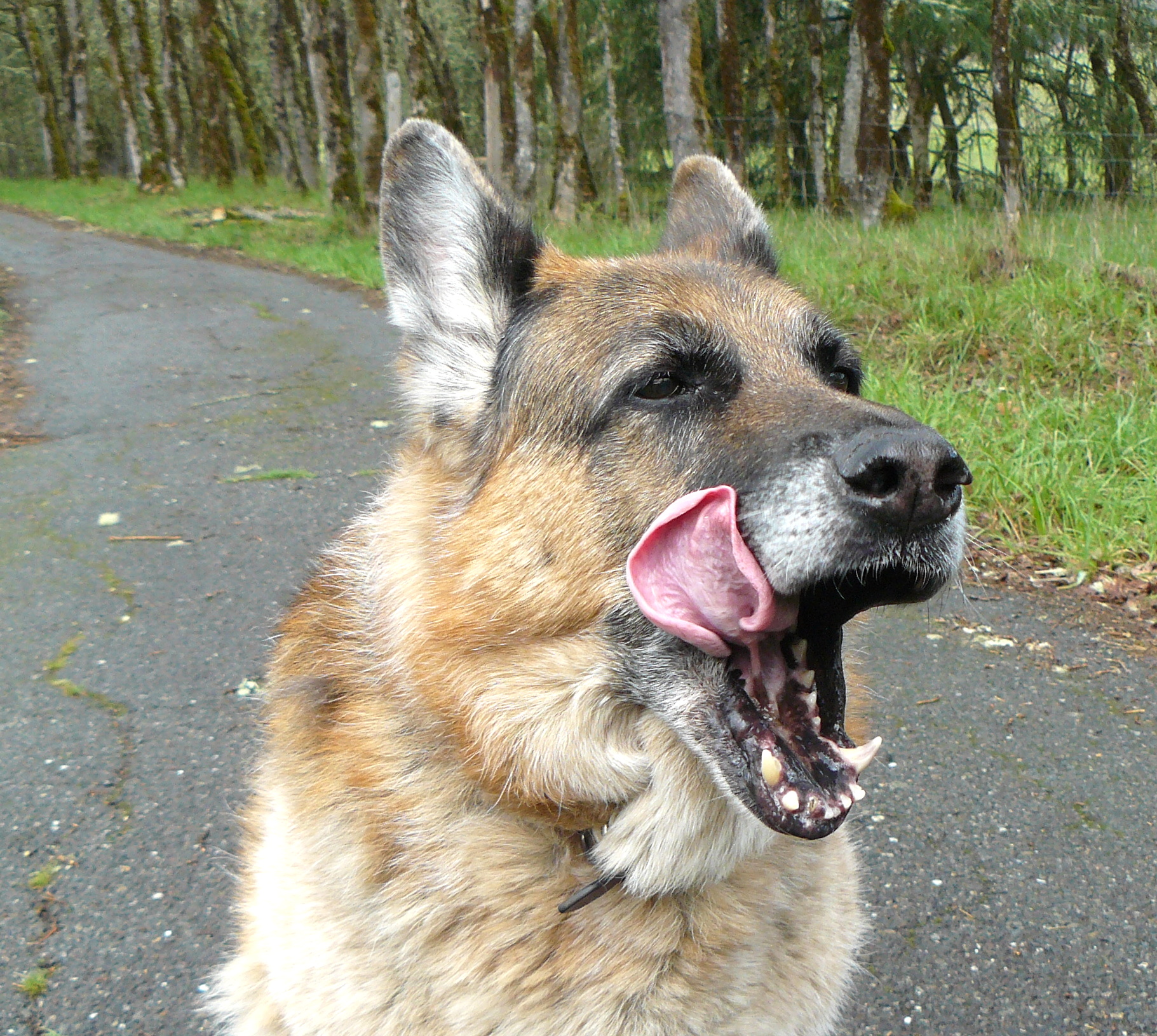
One happy, loving dog!

You all have a very happy, loving weekend.

Afraid of the light!

Back to learning from our wonderful dogs.

Last week, on the 9th to be exact, I published a post under the title of What a funny lot we all are! The thrust of that post was the republication of a recent Tom Dispatch essay by Michael Klare: Tipping Points and the Question of Civilizational Survival. Professor Michael T. Klare is professor of peace and world security studies at Hampshire College and the author, most recently, of The Race for What’s Left. Those who read his essay will have found it a gloomy report on the future of mankind on this planet.

Back to my sub-title.

One of the golden pieces of advice for all of us who succumb to a fear of the future is to live in the present. Living in the now, in the present, is what our dogs do so very well, and it is a fabulous example for us humans. Because there is such a volume of news about so many things going wrong in our world, that it is easy to become overly negative, possibly to the point of causing us ill health, for there is strong link between mind and body.

When circumstances actually do change then dogs are incredibly quick to adapt to those changed times. Dogs, however, do not worry about the future.

All of which is my preamble to an essay that was published under The Conversation header on Sunday. It was an essay by Melanie Randle, and the link goes to a page that offers:

Melanie is an Associate Professor of Marketing in the School of Management, Operations and Marketing in the Faculty of Business at the University of Wollongong. Her primary research areas are social and non-profit marketing, particularly in the areas of volunteering and foster care. Other research interests include marketing to children, obesity and gambling.

That profile doesn’t give much of a heads-up to the theme of her essay. That theme, to my way of thinking, is that right now change is underway. A change in the awareness of people that change has to take place.

Which is why I chose part of a saying attributed to Plato for the title to this post. The full saying being:

We can easily forgive a child who is afraid of the dark; the real tragedy of life is when men are afraid of the light.

So to Melanie’s essay.

ooOOoo

Many fear the worst for humanity, so how do we avoid surrendering to an apocalyptic fate?

Melanie Randle, October 11, 2015

A new, four-nation study has found people rate the risks of global threats to humanity surprisingly high. These perceptions are likely to be important, socially and politically, in shaping how humanity responds to the threats.

The study, of more than 2000 people in the US, UK, Canada and Australia, found:

  • 54% of people surveyed rated the risk of our way of life ending within the next 100 years at 50% or greater;
  • almost one in four (24%) rated the risk of humans being wiped out within a century at 50% or greater;
  • almost three in four (73%) believe there is a 30% or greater risk of our way of life ending (30% said that the risk is 70% or more); and
  • almost four in ten (39%) believe there is a 30% or greater danger of humanity being wiped out (10% said the risk is 70% or more).

Perceptions of risks to way of life and humanity by country

Percentage support for propositions that existing way of life and humanity have a 50% or more chance of ending in a century. University of Wollongong, Author provided

The study also asked people about different responses to the threats. These responses were categorised as nihilism (the loss of belief in a social or moral order; decadence rules), fundamentalism (the retreat to certain belief; dogma rules), or activism (the transformation of belief; hope rules). It found:

  • a large majority (78%) agreed “we need to transform our worldview and way of life if we are to create a better future for the world” (activism);
  • about one in two (48%) agreed that “the world’s future looks grim so we have to focus on looking after ourselves and those we love” (nihilism); and
  • more than one in three (36%) said “we are facing a final conflict between good and evil in the world” (fundamentalism).

Findings were similar across countries, age, sex and other demographic groups, although some interesting differences emerged. For example, more Americans (30%) believed the risk of humans being wiped out was high and that humanity faces a final conflict between good and evil (47%). This presumably reflects the strength in the US of Christian fundamentalism and its belief in the “end time”, a coming Apocalypse.

Perceptions of risk to way of life and humanity by generation

Percentage support for propositions that existing way of life and humanity have a 50% or more chance of ending in a century. University of Wollongong, Author provided

A world of threats coming to a head

There is mounting scientific evidence and concern that humanity faces a defining moment in history – a time when it must address growing adversities or suffer grave consequences. Reputable journals are canvassing the possibilities; the new study will be published in a special issue of Futures on “Confronting catastrophic threats to humanity”.

Most focus today is on climate change and its many, potentially catastrophic, impacts. Other threats include depletion and degradation of natural resources and ecosystems; continuing world population growth; disease pandemics; global economic collapse; nuclear and biological war and terrorism; and runaway technological change.

Many of these threats are not new. Scientists and other experts have warned of the dangers for decades. Nevertheless, the evidence is growing stronger, especially about climate change, and never before have actual events, including natural disasters and calamities, and their sustained and graphic media coverage so powerfully reinforced the possible impacts.

Not surprisingly, then, surveys reveal widespread public pessimism about the future of the world, at least in Western countries. This includes a common perception of declining quality of life, or that future generations will be worse off.

However, there appears to have been little research into people’s perceptions of how dire humanity’s predicament is, including the risk of collapse of civilisation or human extinction. These perceptions have a significant bearing on how societies, and humanity as a whole, deal with potentially catastrophic futures.

How does loss of faith in the future affect us?

People’s responses in our study do not necessarily represent considered assessments of the specific risks. Rather, they are likely to be an expression of a more general uncertainty and fear, a loss of faith in a future constructed around notions of material progress, economic growth and scientific and technological fixes to the challenges we face.

This loss of faith is important, yet hardly registers in current debate and discussion. We have yet to understand its full implications.

At best, the high perception of risk and the strong endorsement of an activist response could drive a much greater effort to confront global threats. At worst, with a loss of hope, fear of a catastrophic future erodes people’s faith in society, affecting their roles and responsibilities, and their relationship to social institutions, especially government.

It can deny us a social ideal to believe in – something to convince us to subordinate our own individual interests to a higher social purpose.

There is a deeply mythic dimension to this situation. Humans have always been susceptible to apocalyptic visions, especially in times of rapid change; we need utopian ideals to inspire us.

Our visions of the future are woven into the stories we create to make sense and meaning of our lives, to link us to a broader social or collective narrative. Historians and futurists have emphasised the importance of confidence and optimism to the health of civilisations and, conversely, the dangers of cynicism and disillusion.

Despite increasing political action on specific issues like climate change, globally the scale of our response falls far short of matching the magnitude of the threats. Closing this gap requires a deeper understanding of how people perceive the risks and how they might respond.

This article was co-authored by Richard Eckersley, founding director of Australia21.

ooOOoo

Now there’s nothing in the essay from Randle and Eckersley to say that these are not critically important times for all of humanity. Yet, I detect that among the many people one meets on a day-to-day basis there is a growing understanding that we can’t just lie down and let the future ride on over us. That living in the present and responding to the world around us here and now is the healthiest way to be, and the most effective. No more powerfully expressed than by Thich Nhat Hanh

“Fear keeps us focused on the past or worried about the future. If we can acknowledge our fear, we can realize that right now we are okay. Right now, today, we are still alive, and our bodies are working marvelously. Our eyes can still see the beautiful sky. Our ears can still hear the voices of our loved ones.”

The healing power of our beautiful dogs.

Forget about the big world out there, be loved by our dogs.

Monday’s post about the precariousness of man’s future on this planet if we don’t prevent the melting of the Antarctic ice sheet was a bit gloomy, however true it might be. The gloom continued with yesterday’s post about the VW scandal illustrating the “unethical culture endemic in business”.

So what a nice change to think about the way that our pets keep us bright, cheerful and healthy.

All of which is my way of introducing a guest post from Vee Cecil. Now I am fairly cautious about guest posts from those who want to promote their businesses, for obvious reasons. But Vee’s essay is so lovely that it truly deserves to be shared.

Firstly, here is the email that Vee sent me back in August,

Hi!

In the U.S., 91 percent of pet owners say they consider their pet to be a member of the family. And for good reason! Our pets are constant sources of comfort and companionship.

What many pet owners may not realize is how great their furry family members are for their physical and mental health. For example, studies have shown that pet owners have lower blood pressure than people who don’t have pets and that being around pets also makes us “less anxious and less stressed.” And that’s just the beginning. There are many other wonderful health benefits that result from owning a pet.

May I write an article for learningfromdogs.com on this topic? The article will be approximately 500 words, unique to your site, and complete with resources.

Please let me know – I am always looking to spread the word about how we can be healthier and happier and having a pet is a great way to achieve both!

Best,
Vee

Here then is that article.

ooOOoo

Feeling Under the Weather? Learn More About the Amazing Healing Powers of Pets

HappyTails

Ask any dog owner and you’ll find out just how remarkable a dog can be. They can turn a terrible day into an amazing one with one lick of the face or wag of the tail. But more and more studies are showing that our four-legged friends might be even more awesome than we previously thought.

As The Washington Post explains, research is showing that being around dogs can help us feel better and less stressed, while also improving our physical health. For example, the article cites studies which found that our pets can lead to “lower blood pressure, lower resting heart rates and less risk of hypertension.”

And that’s not all. Here are four other health issues and how dogs help their human companions:

Cancer. As this CBSNews.com article explains, a recent study at Mount Sinai Beth Israel found that therapy dogs had a very positive impact on patients receiving chemo therapy. The patients showed improvements in “emotional well-being and quality of life.” The director of the program that provided the therapy dogs also noted that patients felt less stressed and anxious. The article notes that this was a ground-breaking study as the impact of therapy dogs on cancer patients hadn’t been examined before.

Alzheimer’s Disease. Therapy dogs are also proving to be extremely helpful for patients with Alzheimer’s. In this article, a man with early on-set Alzheimer’s explains how his therapy dog helps him with daily tasks. Through the help of his therapy dog, the man says his stress and anxiety levels have significantly reduced.

Surgery recovery. Chances are if you were recovering from a painful surgery you wouldn’t turn down a snuggle from a pet. But, as The Telegraph shows, researchers have found that pets can do more than just provide you with a little tender loving care. A study led by a researcher from Loyola University found that pet therapy can reduce the amount of pain patients experience after surgery. In fact, according to the article, the patients in the study, who had had joint replacement surgery, “needed 50 per cent less pain medication if they used pet therapy.”

Diabetes. And perhaps most remarkable of all is what therapy dogs can be trained to do for diabetics. In this case, dogs put their acute sense of smell to good use. As this article explains, dogs exhibiting a better-than-average sense of smell can be trained to help diabetics. Once trained these dogs use their sense of smell to detect signs of hypoglycemia and low blood sugar (based on their human companion’s breath). They’re also trained to get a sugary food for their diabetic, get help if the person goes into diabetic shock, and more.

As more research is conducted to see the benefits of not only service dogs, but pets too, it will be interesting to see how dogs are woven into more medical treatments. They are truly amazing creatures, who can help us mind, body, and soul.
***

Vee Cecil keeps busy by being a wellness coach, personal trainer and bootcamp instructor in Kentucky. She also recently launched a blog where she shares her passion for health by writing about her favorite tips, activities and recipes.

ooOOoo

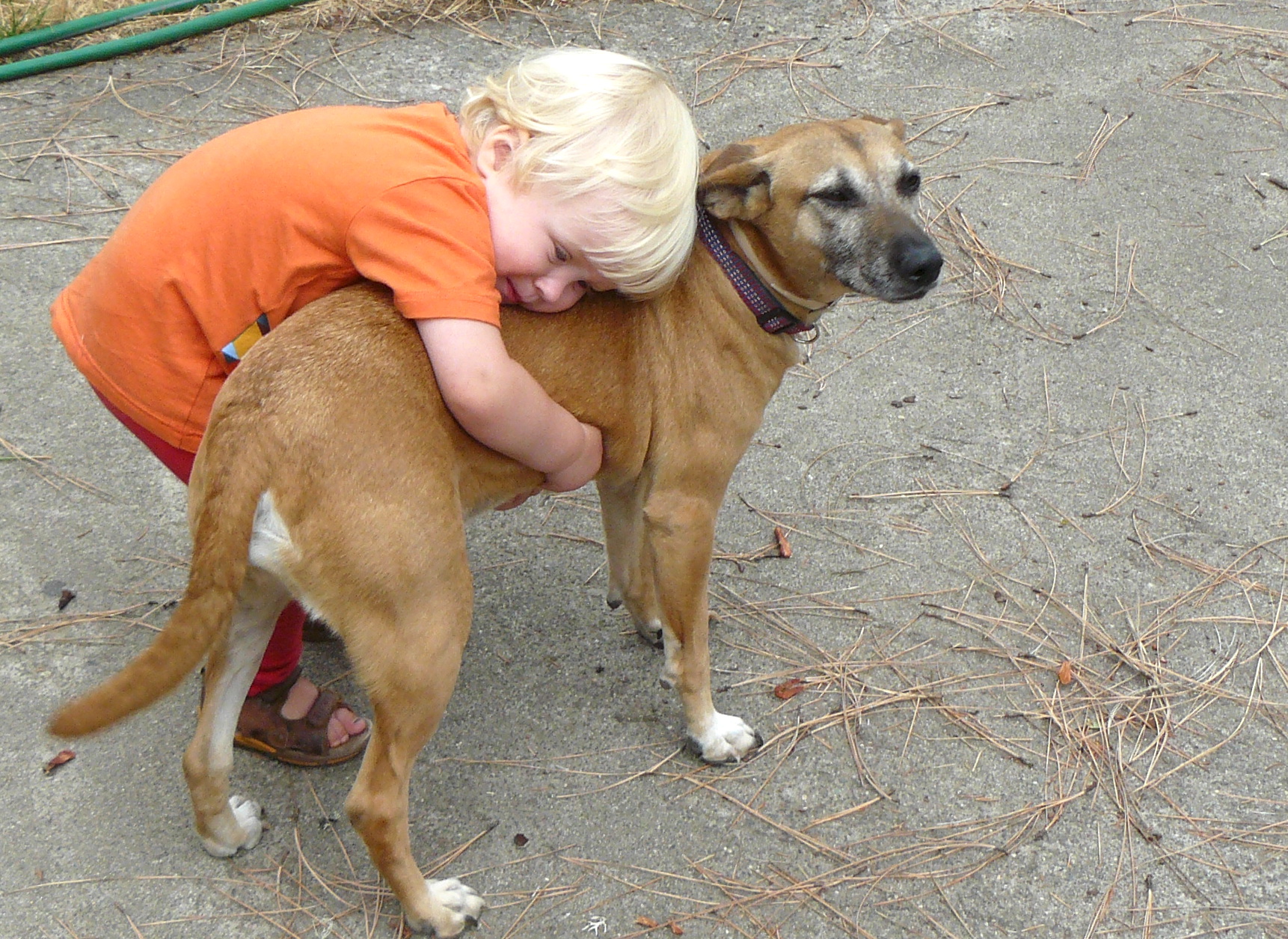
Here’s a republication of a picture from a recent Picture Parade. It has health stamped all over it, for the young boy and the Shepherd Dog!

Theo11

Of paradoxes, and headaches!

The interconnectedness of everything – even beyond our wildest imagination.

A while ago John Zande signed up to follow Learning from Dogs. Naturally, I went across to John’s blog to thank him. There I discovered that John is an animal lover and an author. For he states, referring to his book, that, “BUY IT. ALL PROCEEDS GO TO ANIMAL RESCUE AND SHELTER IN BRAZIL”. Fabulous!

John Zande cover_zpsz7wuq9cc

(I did buy the book, am about 20% through it and finding it very stimulating, – if you would like to buy it then click the image of the book on John’s home page.)

Anyway, a few days later we watched the BBC Horizon programme on multiple universes. Here’s how the BBC introduced the programme:

Which Universe Are We In?

Horizon, 2014-2015 Episode 17 of 19

Imagine a world where dinosaurs still walk the earth. A world where the Germans won World War II and you are president of the United States. Imagine a world where the laws of physics no longer apply and where infinite copies of you are playing out every storyline of your life.

It sounds like a plot stolen straight from Hollywood, but far from it. This is the multiverse.

Until very recently the whole idea of the multiverse was dismissed as a fantasy, but now this strangest of ideas is at the cutting edge of science.

And for a growing number of scientists, the multiverse is the only way we will ever truly make sense of the world we are in.

Horizon asks the question: Do multiple universes exist? And if so, which one are we actually in?

Horizon is always great to watch but this episode was incredibly stimulating and interesting. Later, in a exchange of comments to one of John’s posts, where I referred to that programme, John wrote:

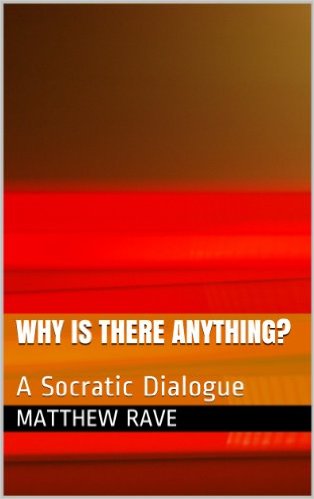
The mulitverse is actually the more reasonable explanation for why there is something, and although I don’t understand the maths, the people who do say its simplistically beautiful. Matt Rave is an associate professor of physics and comments here regularly. He has a great book on it all, Why is There Anything?

rave

That lead me to purchasing Matthew Rave’s book that, likewise, is a most fascinating and unusual approach to this topic. His Amazon author’s page reveals that, “Dr. Matthew Rave is an assistant professor of physics at Western Carolina University, in the mountains of North Carolina. His research interests include interpretations of quantum mechanics, the geometric phase, solid state physics, and physics education.” Matthew Rave’s blogsite is here.

Matthew Rave’s book further illustrates the paradox, to my mind, that comes from thinking about why are we here, are we here and, if so, how do we know we are here?

So if that isn’t enough for you and me, then very recently The Conversation blogsite published the following from Geraint Lewis who is Professor of Astrophysics at the University of Sydney. It is republished here within the terms of The Conversation. Did I mention paradoxes and headaches!

ooOOoo

We are lucky to live in a universe made for us

Geraint Lewis, University of Sydney

To a human, the universe might seem like a very inhospitable place. In the vacuum of space, you would rapidly suffocate, while on the surface of a star you would be burnt to a crisp. As far as we know, all life is confined to a sliver of an atmosphere surrounding the rocky planet we inhabit.

But while the origin of life on Earth remains mysterious, there are bigger questions to answer. Namely: why do the laws of physics permit any life at all?

Hang on, the laws of physics? Surely they are a universal given and life just gets on with it?

But remember that the universe is built of fundamental pieces, particles and forces, which are the building blocks of everything we see around us. And we simply don’t know why these pieces have the properties they do.

There are many observational facts about our universe, such as electrons weighing almost nothing, while some of their quark cousins are thousands of times more massive. And gravity being incredibly weak compared to the immense forces that hold atomic nuclei together.

Why is our universe built this way? We just don’t know.

But what if…?

This means we can ask “what if” questions. What if the electron was massive and quarks were fleeting? What if electromagnetism was stronger than the nuclear strong force? If so, what would that universe be like?

Let’s consider carbon, an element forged in the hearts of massive stars, and an element essential to life as we know it.

Initial calculations of such stellar furnaces showed that they were apparently inefficient in making carbon. Then the British astronomer Fred Hoyle realised the carbon nucleus possesses a special property, a resonance, that enhanced the efficiency.

But if the strength of the strong nuclear force was only fractionally different, it would wipe out this property and leave the universe relatively devoid of carbon – and, thus, life.

The story doesn’t end there. Once carbon is made, it is ripe to be transmuted into heavier elements, particularly oxygen. It turns out that oxygen, due to the strength of the strong nuclear force, lacks the particular resonance properties that enhanced the efficiency of carbon creation.

This prevents all of the carbon being quickly consumed. The specific strength of the strong force has thus resulted in a universe with an almost equal mix of carbon and oxygen, a bonus for life on Earth.

Death of a universe

This is but a single example. We can play “what if” games with the properties of all of the fundamental bits of the universe. With each change we can ask, “What would the universe be like?”

The answers are quite stark. Straying just a little from the convivial conditions that we experience in our universe typically leads to a sterile cosmos.

This might be a bland universe, without the complexity required to store and process the information central to life. Or a universe that expands too quickly for matter to condense into stars, galaxies and planets. Or one that completely re-collapses again in a matter of moments after being born. Any complex life would be impossible!

The questions do not end there. In our universe, we live with the comfort of a certain mix of space and time, and a seemingly understandable mathematical framework that underpins science as we know it. Why is the universe so predictable and understandable? Would we be able to ask such a question if it wasn’t?

Our universe appears to balance on a knife-edge of stability. But why?

We appear to be very lucky to live in a universe that accommodates life. Zdenko Zivkovic/Flickr, CC BY

One of a multiverse

To some, science will simply fix it all. Perhaps, if we discover the “Theory of Everything”, uniting quantum mechanics with Einstein’s relativity, all of the relative masses and strengths of the fundamental pieces will be absolutely defined, with no mysteries remaining. To others, this is little more than wishful thinking.

Some seek solace in a creator, an omnipotent being that finely-tuned the properties of the universe to allow us to be here. But the move from the scientific into the supernatural leaves many uncomfortable.

There is, however, another possible solution, one guided by the murky and confused musings at the edge of science. Super-strings or M-theory (or whatever these will evolve into) suggest that the fundamental properties of the universe are not unique, but are somehow chosen by some cosmic roll of the dice when it was born.

This gives us a possible explanation of the seemingly special properties of the universe in which we live.

We are not the only universe, but just one in a semi-infinite sea of universes, each with their own peculiar set of physical properties, laws and particles, lifetimes and ultimately mathematical frameworks. As we have seen, the vast majority of these other universes in the overall multiverse are dead and sterile.

They only way we can exist to ask the question “why are we here?” is that we happen to find ourselves in a universe conducive to our very existence. In any other universe, we simply wouldn’t be around to wonder why we didn’t exist.

If the multiverse picture is correct, we have to accept that the fundamental properties of the universe were ultimately dished out in a game of cosmic roulette, a spin of the wheel that we appear to have won.

Thus we truly live in a fortunate universe.

The ConversationGeraint Lewis, Professor of Astrophysics, University of Sydney

This article was originally published on The Conversation. Read the original article.

ooOOoo

12963392-An-image-of-a-man-with-a-headache--Stock-Vector-headache-earache-cartoon

Honouring our rescue dogs.

In this case, honouring one particular one.

As many know, yesterday was the fourteenth anniversary of when those two planes struck the towers of the World Trade Centre. Thus it seemed beautifully appropriate to recognise the life of the last living 9/11 rescue dog by republishing the article just published on Mother Nature News.

ooOOoo

Last living 9/11 rescue dog rewarded with epic day

Bretagne traveled to NYC to be honored for her weeks of service at Ground Zero.

By: Laura Moss, September 11, 2015.

At 16, Bretagne is a senior dog, but that hasn't slowed her down. She now volunteers at schools. (Photo: BarkPost)
At 16, Bretagne is a senior dog, but that hasn’t slowed her down. She now volunteers at schools. (Photo: BarkPost)

About 100 search-and-rescue dogs scoured the twisted steel beams and crumbled concrete of the World Trade Center in the aftermath of the 9/11 attacks, and today, Bretagne (pronounced “Brittany”) is the last known living 9/11 search-and-rescue dog. And she just had the best day ever.

To honor Bretagne for her service and celebrate her 16th birthday, BarkPost teamed up with the dog-friendly 1 Hotel Central Park to give the golden retriever a “Dog’s Best Day” that included a full day of treats and activities in New York City.

When Bretagne arrived in New York with her owner and handler Denise Corliss, she was greeted by a personalized billboard in Times Square.

Photo: BarkPost
Photo: BarkPost

Then she was off to play in the water at Hudson River Park, where she was presented with the doggie version of the Key to the City.

Former search-and-rescue teammates attended Bretagne’s sweet-16 party later that day, where she received a variety of toys and treats — and her very own birthday cake.

Photo: BarkPost
Photo: BarkPost

Corliss was also presented with a $1,000 donation for Texas Task Force 1, Bretagne’s search-and-rescue team, which is the most active one in the country.

In addition to her recovery work at Ground Zero, Bretagne and Corliss also worked in New Orleans following Hurricane Katrina, and today, the senior dog serves her community by volunteering at school programs that teach children to read.

Corliss adopted Bretagne as an 8-week-old puppy in 1999, and after undergoing rigorous training, the two joined Texas Task Force 1. Their first deployment was to Ground Zero, where a search for survivors quickly turned into a search for human remains.

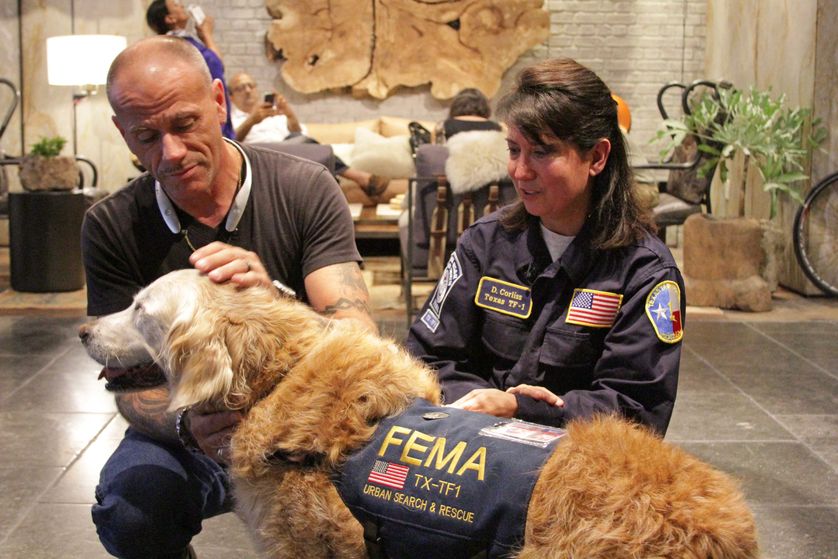
Bretagne with a firefighter and her owner and handler, Denise Corliss during her "Dog's Best Day." (Photo: BarkPost)
Bretagne with a firefighter and her owner and handler, Denise Corliss during her “Dog’s Best Day.” (Photo: BarkPost)

For two weeks, the golden retriever tirelessly worked 12-hour shifts at the former site of the World Trade Center, and one day, Bretagne walked away from Corliss, ignoring commands to come back. The 2-year-old dog made her way to a firefighter sitting on the ground, laid next to him and put her head in his lap.

“When we deploy to some of the disasters, what I didn’t anticipate is the role that they take on as a therapy dog,” Corliss told BarkPost. “It provides an opportunity for people to have support from the dog and comfort from the dog in a real difficult environment.”

Watch Bretagne enjoy her best day in the video below.

ooOOoo

Don’t these wonderful, fabulous animals just make your heart ache!

Jean and I salute Bretagne and all the other Search & Rescue dogs both here in America and all around the world.

Animal survival.

The wonderful way that animals have evolved to survive life on the go.

It is very easy to look at our wonderful domesticated dogs and forget that genetically they are still very much hunting dogs. Of all the dogs that we have had Dhalia seemed the most closely connected with those instincts, and she is still missed more than a year after she died. So much so that I’m going to republish part of the post that commemorated her life just after she died. Here it is:

Dhalia, as with so many other dogs, offered lasting lessons.
April 8th, 2014

Inevitably, as Jean and I went around our ‘stuff’ yesterday after burying Dhalia in the morning, there were moments of quiet contemplation and gentle discussion.  Interludes over a hot drink where we reflected on the special dog that she was.

Much has already been written in this place but there can’t be too many reminders for us quirky humans of how valuable are the qualities of trust and love given to us by our dogs.

We need reminding how dogs are so intuitive and can reach out to a stranger without a moment of hesitation.  As Jean described when recalling how she first came across Dhalia.

Dhalia - domesticated but still the wild dog shows through.
Dhalia – domesticated but still the wild dog shows through.

It was a Sunday around the middle of the month of September in the year 2005. My friend, Gwen, and I had set off for La Manga, a small fishing village three miles from San Carlos, Mexico.  As the trip would take us through areas of desolate desert and the day was forecast to be a sizzler, we left early. The purpose of the journey was to feed a pack of dogs that were living on the outskirts of La Manga. These wild dogs were gradually getting used to our presence and with the aid of a humane trap we had previously caught two of them, a small puppy and her mother. Those two dogs were at my home and were gradually becoming tame so that good homes could be found for them.

Half-way to our destination, we saw two dogs running by the side of the road.   It wasn’t unusual to see strays searching for road-kill. I stopped the car and prepared food and water for them. One dog took off almost immediately but the other just stood perfectly still looking intently at me. She was rail-thin and full of mange.  Her ears and chest were scabbed with blood, and I could see that previously she had had pups. Tentatively, I pushed the food towards her. She took a bite and sat on her haunches; her eyes never leaving mine. Then she lifted a paw and reached out to me. Immediately, I burst into tears and scooped her into my arms.  I carried her back to the car where she lay quietly in my lap whilst we went on to do our feeding.  She was bloody and very smelly. However, I didn’t care.

Dhalia was always a gentle dog.  One that would mix with any of the other dogs. A dog that loved people, of all types and ages.

Love and Trust - Grandson Morten hugging Dhalia.
Love and Trust – Grandson Morten hugging Dhalia, September 2013.

You can read the full post here.

The reason that my post from last year came to mind was as a result of a recent article on The Conversation blogsite. It was called Motion dazzle: spotting the patterns that help animals outsmart predators on the run and seemed ideal to share with all you good people who support this place.

ooOOoo

Motion dazzle: spotting the patterns that help animals outsmart predators on the run

Laura Kelley, University of Cambridge

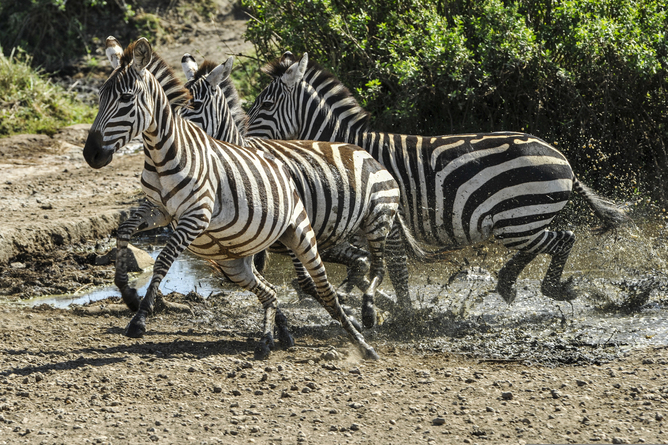
Zebra are seen running at the Serengeti National Park in Tanzania Nov. 14, 2013. (U.S. Navy photo by Mass Communication Specialist 1st Class Eric Dietrich/Released)

Many animals use the colours and patterns on their bodies to help them blend into the background and avoid the attention of predators. But this strategy, crypsis, is far from perfect. As soon as the animal moves, the camouflage is broken, and it is much easier for a predator to see and catch it. So how do animals protect themselves when they’re on the move?

Researchers are exploring whether high-contrast patterns during motion, such as stripes and zigzags, may be distorting the predator’s perception of where the animal is going. But, as little is known about such “motion dazzle”, we have built an online game to help shed light on it.

Lessons from war

The idea is that it may be more effective for animals to focus on preventing capture, rather then preventing detection or recognition, is actually more than 100 years old. It was naturalist Abbott Thayer who suggested that high-contrast patterns may distort the perceived speed or direction of a moving object, making it harder to track and capture.

Such motion dazzle patterns were actually used in World War I and II, where some ships were painted with black and white geometric patterns in an attempt to reduce the number of successful torpedo attacks from submarines. However, due to many other factors affecting wartime naval losses, it is unclear whether motion dazzle patterns actually had the desired effect.

HMS Argus displaying a coat of dazzle camouflage in 1918. wikimedia

What about the natural world? Zebras have bold stripes, and scientists have debated the function of their patterns since Darwin’s time. A recent modelling study suggested that when zebras move, their stripes create contradictory signals about their direction of movement that is likely to confuse predators. There are potentially two visual illusions responsible for this, which could form the basis of motion dazzle effects: the wagon wheel effect and the barber pole illusion.

The wagon wheel effect is named after Western movies, where the wheels on wagons often appear to be moving backwards. This is because the visual system takes “snapshots” over time and links them to create a continuous scene, in the same manner as recording film. If a wheel spoke moves forward rapidly between sampling events, it will appear to have moved backwards as it will be misidentified as the following spoke.

The barber pole illusion (also known as the aperture effect) occurs because the moving stripes provide ambiguous information about the true direction of movement. These illusory effects produced by stripes could therefore lead to difficulties in judging the speed and movement of a moving target. However, the zebra study was entirely theoretical and didn’t test whether striped patterns actually affected the judgements of real observers.

Dazzle Bug

Surprisingly, the first experimental tests of the effectiveness of motion dazzle patterns weren’t carried out until recently. Some studies have shown that strikingly patterned targets can be more difficult to catch than targets with other patterns in studies using humans as “predators” playing touch screen computer games. However, other studies have found no clear advantage for motion dazzle patterns So although patterns can affect our perception of movement, it’s still not clear which are most effective at doing so.

Can you see the spider? Crypsis can be pretty effective – as long as you don’t move. J Kelley, Author provided

We are addressing the question of which patterns are best for avoiding predators during movement using Dazzle Bug – an online game that asks players to imagine themselves as a predator, trying to catch a moving bug as fast as possible. Each bug has a different body pattern as well as a random pattern of movement. Bugs with easy to catch patterns will disappear, whereas those that are particularly tricky to catch will survive ––just like in nature. Over time, the patterns on the bugs’ body will evolve so that they become harder to catch with each successive generation.

This citizen science project will allow us to see what patterns are most effective at evading capture. We can then use these results to look at what visual effects these patterns have, and to see whether these patterns match up with those found on real animals in the wild.

Our findings will offer insight into the role of stripes, which are common in many species. While these patterns may have evolved to confuse the visual perception of a predator, they may also be a result of other selection pressures, such as attracting a mate or regulating body temperature. If striped patterns survive and evolve in the game, this would provide strong evidence that these patterns do act to confuse human predators, perhaps by producing the illusions described above. As motion perception seems to be highly conserved across a wide range of populations, these illusions may occur for many other predators too.

If we find that patterns other than stripes – such as speckles, splotches or zigzags – are most effective in preventing capture, this then leads to new and interesting questions about how these patterns may act to confuse or mislead. Whatever the outcome, Dazzle Bug will provide insight into how bodily patterns may have evolved to help animals to survive life on the go.

The ConversationLaura Kelley, Research Fellow, University of Cambridge

This article was originally published on The Conversation. Read the original article.

ooOOoo

 The natural world is so incredibly interesting.

Seeing the truth in our mirror.

A sombre reflection on the killing abilities of man.

I was in two minds as to whether to post this today for it is certainly a grim reminder of the less desirable aspects of our species.

In the end, I decided to so do because it needs to be shared and if it changes the mindset of just one person it will have been worthwhile. I was originally seen by me on the EarthSky blogsite.

ooOOoo

Want to see Earth’s super predator? Look in the mirror.

Our efficient killing technologies have given rise to the human super predator. Our impacts are as extreme as our behavior, says study.

Rope trawl for midwater trawling. Photo credit: NOAA

Extreme human predatory behavior is responsible for widespread wildlife extinctions, shrinking fish sizes and disruptions to global food chains, according to research published in the August 21 edition of the journal Science these are extreme outcomes that non-human predators seldom impose, according to the article.

Lead researcher Chris Darimont is a professor of geography at the University of Victoria. Darimont said:

Our wickedly efficient killing technology, global economic systems and resource management that prioritize short-term benefits to humanity have given rise to the human super predator. Our impacts are as extreme as our behavior and the planet bears the burden of our predatory dominance.

A coastal wolf is hunting salmon in British Columbia, Canada. Photo credit: Guillaume Mazille

The team’s global analysis indicates that humans typically exploit adult fish populations at 14 times the rate than do marine predators. Humans also hunt and kill large land carnivores such as bears, wolves and lions at nine times the rate that these predatory animals kill each other in the wild.

Researchers noted that in some cases, dwindling species of predatory land carnivores are more aggressively hunted for trophies, due to the premium placed on rare prey.

The result of human activity on wildlife populations is far greater than natural predation. Research suggests that socio-political factors can explain why humans repeatedly overexploit. Technology explains how: Humans use advanced killing tools, cheap fossil fuel, and professional harvesters – like high-volume commercial fishing fleets – to overcome the defensive adaptations of prey.

Humanity also departs fundamentally from predation in nature by targeting adult quarry.Co-author Tom Reimchen is a biology professor at University of Victoria. He said:

Whereas predators primarily target the juveniles or ‘reproductive interest’ of populations, humans draw down the ‘reproductive capital’ by exploiting adult prey.

During four decades of fieldwork on Haida Gwaii, an archipelago on the northern coast of British Columbia, Reimchen looked at how human predators differ from other predators in nature. Reimchen’s predator-prey research revealed that predatory fish and diving birds overwhelmingly killed juvenile forms of freshwater fish. Collectively, 22 predator species took no more than five per cent of the adult fish each year. Nearby, Reimchen observed a stark contrast: fisheries exclusively targeted adult salmon, taking 50 per cent or more of the runs.

The authors conclude with an urgent call to reconsider the concept of “sustainable exploitation” in wildlife and fisheries management. A truly sustainable model, they argue, would mean cultivating cultural, economic and institutional change that places limits on human activities to more closely follow the behavior of natural predators. Darimont said:

We should be protecting our wildlife and marine assets as an investor would in a stock portfolio.

Enjoying EarthSky? Sign up for our free daily newsletter today!

Bottom line: According to research published in the August 21, 2015 edition of Science, extreme human predatory behavior is responsible for widespread wildlife extinctions, shrinking fish sizes and disruptions to global food chains.

Read more from the University of Victoria

ooOOoo

Chris Darimont really put his finger on the spot in my opinion when he was quoted,”We should be protecting our wildlife and marine assets as an investor would in a stock portfolio.”

Going to close today’s post by repeating what is presented on the Welcome page of Learning from Dogs, namely:

As man’s companion, protector and helper, history suggests that dogs were critically important in man achieving success as a hunter-gatherer. Dogs ‘teaching’ man to be so successful a hunter enabled evolution, some 20,000 years later, to farming, thence the long journey to modern man. But in the last, say 100 years, that farming spirit has become corrupted to the point where we see the planet’s plant and mineral resources as infinite. Mankind is close to the edge of extinction, literally and spiritually.

Dogs know better, much better! Time again for man to learn from dogs!

My argument rests!

That most precious bond.

Why we turn to dogs when disaster strikes.

With the memory of Hurricane Katrina refreshed in our minds as we acknowledge the recent passing of the tenth anniversary of that ghastly disaster, a link to an item from May, 2013 that was published on Mother Nature Network seems perfect for this place.

ooOOoo

Why we turn to dogs when disaster strikes

From aiding search-and-rescue missions to lending a shoulder to cry on, man’s best friend can often be found at the site of tragedy.

By: Laura Moss, May 21, 2013.

Photo: K-9 Parish Comfort Dogs/Facebook

Disaster relief is flooding into Moore, Okla., but along with volunteers and supplies, there are dogs.

Some, including the 11 canine disaster search teams trained by the Search Dog Foundation or SDF, are scouring tornado debris for survivors. Others are en route to comfort the devastated city’s residents. Lutheran Church Charities, whose therapy dogs have worked with victims of the Boston bombings and the Newtown, Conn., shootings, is sending six dogs from its Chicago headquarters.

When disaster strikes, man’s best friend is often there, working on the frontlines of rescue efforts, as well as behind the scenes, helping people cope with trauma and loss.

Super sniffers

Experts estimate that one search-and-rescue (SAR) dog can accomplish the work of 20 to 30 human searchers. Because of these unparalleled abilities, the number of trained SAR dogs has been rising across the United States.

Dogs make efficient searchers due to their superior vision, hearing and sense of smell. A dog’s nose is about 100 times more sensitive than a human nose, and SAR dogs are trained to locate human scents amid countless other smells. They track our scents by the 30,000 to 40,000 dead skin cells we drop every minute.

“Dogs aren’t miracle workers, but their noses are so precious,” said SDF founder Wilma Melville. “They can find those people who survived a horrific ordeal.”

Air-scent dogs are trained to work in specific types of terrain. Some search in wilderness settings while others search urban environments, which often can involve scouring Moss2collapsed buildings.

Because they must navigate unstable terrain, urban SAR dogs are some of the most highly trained canines. The only national standards for such dogs are the Federal Emergency Management Agency’s certification standards for urban disaster work. Currently, fewer than 100 dog-handler teams in the U.S. have this certification.

In addition to air-scent dogs, there are dogs taught to seek out both skin cells and the smell of human decomposition. During major disasters, such as the 1995 Oklahoma City bombing and the 2001 collapse of the World Trade Center, both air-scent dogs and cadaver dogs were used to search for people.

This caused problems for SAR dogs because they became discouraged when they found only dead bodies. At both Oklahoma City and Ground Zero, handlers hid in rubble so that dogs could occasionally find a living person. The dogs’ desire to elicit a response from a found person may be a result of their training, which involves seeking feedback and rewards, but experts say it could also speak to a deeper connection with humans.

Man’s best friend

When disasters occur, dogs do much more than just aid search-and-rescue missions. They’re often there to provide a source of comfort for us in ways that only an animal can.

In an interview with American Thinker, Debra Tosch, executive director of SDF, explained how her SAR dog Abby was able to console a firefighter at Ground Zero. “When someone was found, work would stop, and I watched as the tears rolled down the firefighters’ faces. I remember one firefighter who hugged Abby and buried his face in her neck after just finding out a fellow firefighter was found,” she said.

Research show that petting dogs can lower anxiety, regulate breathing and decrease blood pressure, and a Japanese study found that simply looking at a dog can increase Moss3oxytocin levels. Oxytocin is a chemical released by the pituitary gland that’s associated with human bonding and affection.

But while the firefighter may have found comfort in Abby’s presence, was the dog able to empathize? Research says it’s very likely.

A 2012 study at Portugal’s University of Porto found that dogs yawn even when they hear only the sound of a person yawning, providing strong evidence that dogs are able to empathize with us.

And a study at the University of London Goldsmiths College found that dogs comforted people — both their owners and strangers — when the person pretended to cry.

“I think there is good reason to suspect dogs would be more sensitive to human emotion than other species,” Custance told Discovery News. “We have domesticated dogs over a long period of time. We have selectively bred them to act as our companions. Thus, dogs that responded sensitively to our emotional cues may have been the individuals that we would be more likely to keep as pets and breed from.”

ooOOoo

Time and time again, the facts support what the vast majority of those who care for and love dogs truly know: the bond between dog and human is the most special that there has ever been between an animal and mankind.


I’ll lead, you follow Mr Goose.

Stories like this are wonderful – more please!

This needs no further introduction from me other than to say that this gorgeous story is from Mother Nature Network.

ooOOoo

‘Lost’ goose follows pickup truck 6 miles to water

After a Canada goose started following his truck, forester Andre Bachman decided to lead it to a nearby lake — and to film a video out his window as the bird flew dutifully alongside.

By: Russell McLendon
August 20, 2015

If there’s a wild Canada goose following you, it often means you’re being chased angrily from a pond or harassed for bread crumbs. But as a new viral video illustrates, the famously surly birds can be surprisingly civil — even compliant.

Andre Bachman first realized a goose was tailing him as he drove along a gravel road in rural southwest Alberta. “The goose was flying above when it saw his truck and started flying beside him,” writes Reddit user Watchboy0, who posted a video of the encounter titled “A Canada Goose was following my dad in his truck.”

Curious why a goose would spontaneously follow a pickup truck, Bachman pulled over — as did the goose. He began filming with his smartphone as he stepped out to greet the goose, which was waddling nonchalantly toward him.

“Hi,” Bachman said. “What are you doing? Are you lost?”

The goose didn’t answer, aside from quiet honking. But its behavior spoke volumes, revealing a level of comfort with humans that suggests it may have been a pet at some point. Shooing it with “off you go, off you go” didn’t work, so Bachman decided to embrace the goose’s idea. Thinking it might need help finding water, he set out for Shining Bank Lake, which the CBC reports is about 10 kilometers (6 miles) away.

“Let’s go for a flight, OK?” he offered. As Bachman filmed through his truck window, he began driving and coaching the goose to follow. It started with a brisk trot — a pretty amusing sight on its own — and then flapped into flight, letting Bachman capture an endearing view of it flying alongside to the Beatles’ “Let It Be.”

A Canada goose flies alongside a pickup truck on its way to Alberta's Shining Bank Lake. (Photo: Andre Bachman/YouTube)
A Canada goose flies alongside a pickup truck on its way to Alberta’s Shining Bank Lake. (Photo: Andre Bachman/YouTube)

Bachman stopped at least once to check on the goose, saying “I almost hit you, didn’t I?” and noting its tameness when the bird let him pet it. As goose expert Sid Andrews of Inglewood Bird Sanctuary tells Canada’s Global News, even wild Canada geese accustomed to handouts rarely tolerate that.

“I would guess that because it allowed the fellow driving the truck to get very close, that at some point in time, it must have been imprinted on human beings,” Andrews says, adding that it also may have simply mistaken its reflection in the truck’s bumper for another goose. “It somehow got lost or estranged from the group and found, just by happenstance, another goose in the reflection in the bumper.”

Either way, the goose had little trouble keeping up. “My dad would just about stop for the corners after the first one to let it turn,” Watchboy0 writes on Reddit. “Also, at one point he wanted to see how fast it could go. At around 80 km/h [50 mph], the goose started flying above his truck on the air coming off his windshield.”

Once at the lake, the goose “seems happy and stays,” Bachman writes on YouTube, where the video has been watched more than 1.5 million times in about a week. The bird was probably never in serious distress, Andrews says, but Bachman may still have done it a favor by leading it to water. “I certainly would applaud [the driver’s] instincts to head to water because it’ll have a much better chance of finding food.”

ooOOoo

Well done that man: forester Andre Bachman. Well done, indeed!