Just a single image today!
That of 50 years ago.
In other words when Apollo 8 was in Lunar Orbit and William Anders, who died on June 7th, aged 90, captured Earth-rise.
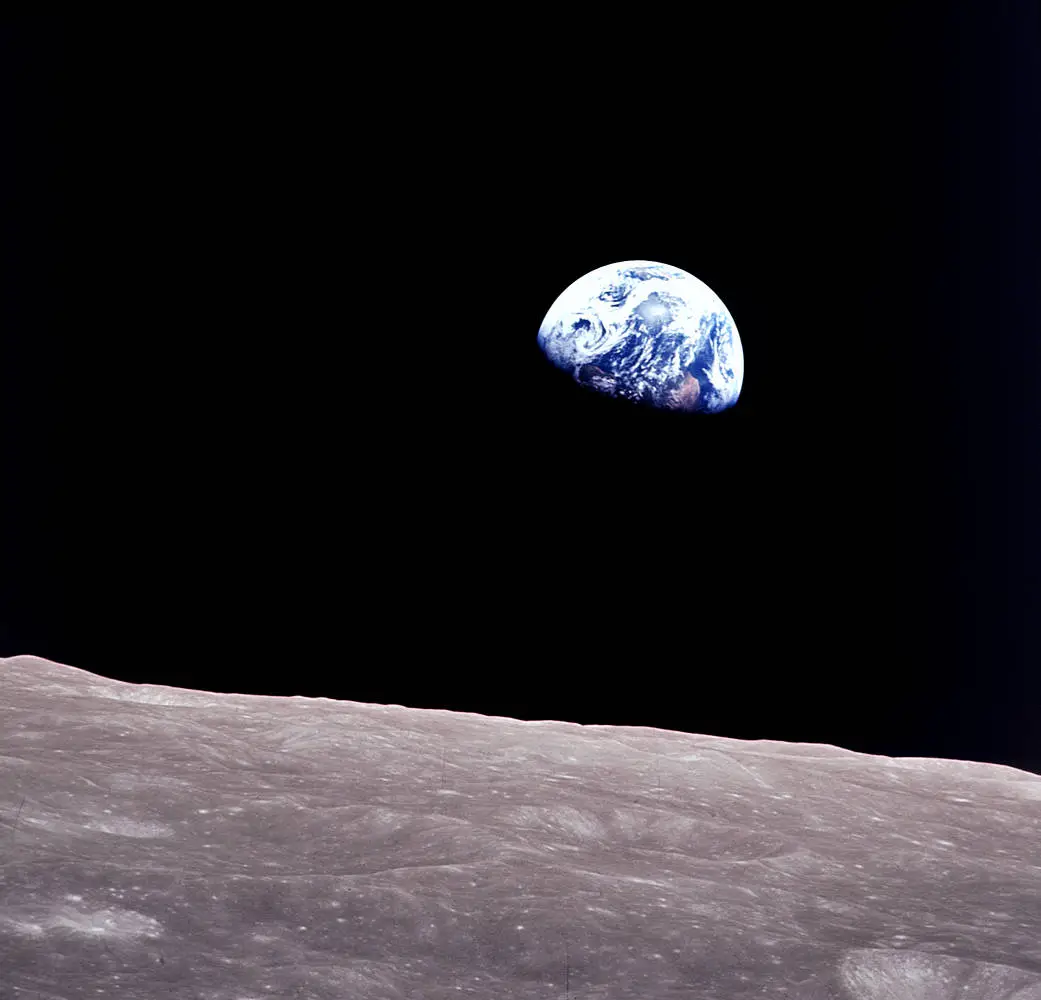
Image credit: NASA
What a photograph!
Dogs are animals of integrity. We have much to learn from them.
Category: consciousness
Just a single image today!
That of 50 years ago.
In other words when Apollo 8 was in Lunar Orbit and William Anders, who died on June 7th, aged 90, captured Earth-rise.
Image credit: NASA
What a photograph!
This is on the edge of my understanding!
Patrice Ayme recently posted an essay called Relativistic Length Contraction Busts Helium3! As I said in my comment to that post:
“This is far ahead of my knowledge of science. I applaud you for writing this despite me not understanding it”
So it may seem a little strange that I now publish the following. It was published originally on Skeptic. It is quite a long video but, please, settle down and watch it.
ooOOoo
Sean Carroll is creating a profoundly new approach to sharing physics with a broad audience, one that goes beyond analogies to show how physicists really think. He cuts to the bare mathematical essence of our most profound theories, explaining every step in a uniquely accessible way.
Quantum field theory is how modern physics describes nature at its most profound level. Starting with the basics of quantum mechanics itself, Sean Carroll explains measurement and entanglement before explaining how the world is really made of fields. You will finally understand why matter is solid, why there is antimatter, where the sizes of atoms come from, and why the predictions of quantum field theory are so spectacularly successful. Fundamental ideas like spin, symmetry, Feynman diagrams, and the Higgs mechanism are explained for real, not just through amusing stories. Beyond Newton, beyond Einstein, and all the intuitive notions that have guided homo sapiens for millennia, this book is a journey to a once unimaginable truth about what our universe is.

Sean Carroll is Homewood Professor of Natural Philosophy at Johns Hopkins University, and Fractal Faculty at the Santa Fe Institute. He is host of the Mindscape podcast, and author of From Eternity to Here, The Particle at the End of the Universe, The Big Picture, and Something Deeply Hidden. He has been awarded prizes and fellowships by the National Science Foundation, NASA, the American Institute of Physics, the Royal Society of London, and many others. He lives in Baltimore with his wife, writer Jennifer Ouellette. His new book series, The Biggest Ideas in the Universe, includes one volume on Space, Time, and Motion, and this new volume on Quanta and Fields.
Shermer and Carroll discuss:
ooOOoo
I’m assuming you have watched the video because in a world that is pre-occupied with the trivial this is just the opposite. Sean shares his physics in a profoundly different and powerful way!
Plenty of news stories to choose from.
NOAA presented a report for May 12th that said:
EVENT:
A coronal mass ejection (CME) is an eruption of solar material. When they arrive at Earth, a geomagnetic storm can result. Watches at this level are very rare.
TIMING:
Several CMEs are anticipated to merge and arrive at Earth on May 12th.
EFFECTS:
The general public should visit our webpage to keep properly informed. The aurora mav become
visible over much of the northern half of the country, and maybe as far south as Alabama to
northern California.
Meanwhile, Earth.com presented the following (and it is a long but extremely interesting report):
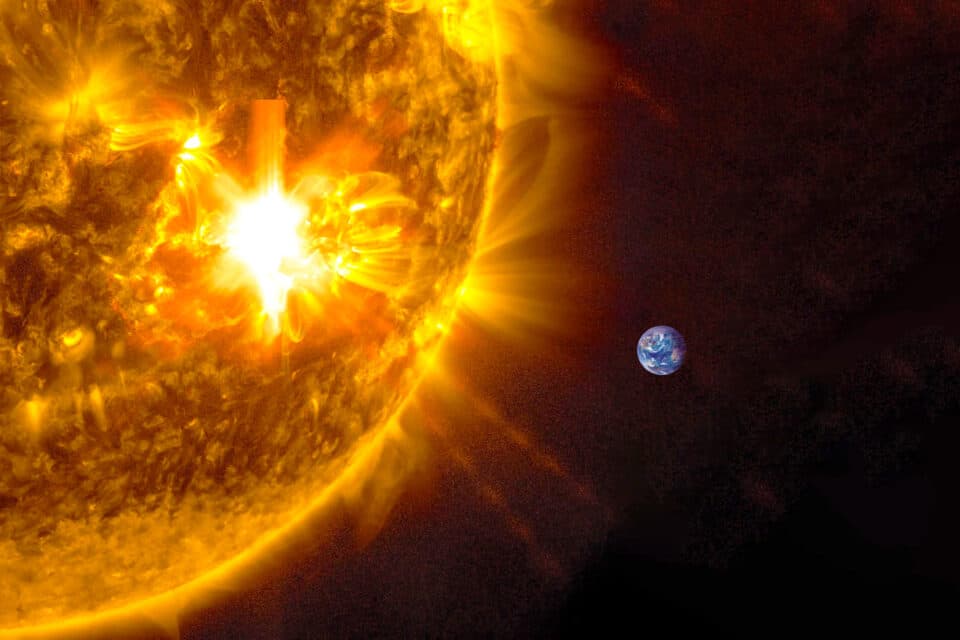
By Eric Ralls, Earth.com staff writer
The Sun released another powerful burst of energy today, known as a solar flare, reaching its peak intensity at 12:26 p.m. Eastern Time. The flare originated from a region on the Sun’s surface called sunspot Region 3664, which has been quite active lately.
NASA’s Solar Dynamics Observatory, a spacecraft that keeps a constant eye on our nearest star, was able to capture a striking image of this latest solar outburst.
Solar flares are immense explosions on the Sun that send energy, light and high speed particles into space. They occur when the magnetic fields in and around the Sun reconnect, releasing huge amounts of stored magnetic energy. Flares are our solar system’s most powerful explosive events.
The NOAA’s Space Weather Prediction Center (SWPC) has extended the Geomagnetic Storm Warning until the afternoon of May 13, 2024.
Today’s flare was classified as an X1.0 flare. Solar flares are categorized into classes based on their strength, with X-class flares being the most intense. The number provides additional information about the flare’s strength within that class. An X1 flare is ten times more powerful than an M1 flare.
These energetic solar eruptions can significantly impact Earth’s upper atmosphere and near-Earth space environment. Strong flares can disrupt high-frequency radio communications and GPS navigation signals. The particle radiation and X-rays from flares can also pose potential risks to astronauts in space.
Additionally, the magnetic disturbances from flares, if particularly strong, have the ability to affect electric power grids on Earth, sometimes causing long-lasting blackouts.
However, power grid problems are more commonly caused by coronal mass ejections (CMEs), another type of powerful solar eruption often associated with strong flares.
Scientists are always on alert, monitoring the Sun for these explosive events so that any potential impacts can be anticipated and prepared for. NASA’s Solar Dynamics Observatory, along with several other spacecraft, help provide this early warning system.
Stay tuned to Earth.com and the Space Weather Prediction Center (SWPC) for updates.
The ongoing geomagnetic storm is expected to intensify later today, Sunday, May 12, 2024. Several intense Coronal Mass Ejections (CMEs), traveling from the Sun at speeds up to 1,200 miles per second, are anticipated to reach the Earth’s outer atmosphere by late afternoon.
Over the past two days, preliminary reports have surfaced regarding power grid irregularities, degradation of high-frequency communications, GPS outages, and satellite navigation issues. These disruptions are likely to persist as the geomagnetic storm strengthens.
Weather permitting, auroras will be visible again tonight over most of the continental United States. This spectacular display of lights is a direct result of the ongoing geomagnetic storm.
The threat of additional strong solar flares and CMEs, which ultimately result in spectacular aurora displays, will persist until the large and magnetically complex sunspot cluster, NOAA Region 3664, rotates out of view of the Earth. This is expected to occur by Tuesday, May 14, 2024.
Solar activity has been at moderate levels over the past 24 hours. Region 3664 produced an M8.8/2b flare, the strongest of the period, on May 11 at 15:25 UTC. A CME signature was observed, but an Earth-directed component is not suspected.
Solar activity is expected to remain at high levels from May 12-14, with M-class and X-class flares anticipated, primarily due to the flare potential of Region 3664.
The greater than 10 MeV proton flux reached minor to moderate storm levels on May 10. Additional proton enhancements are likely on May 13-14 due to the flare potential and location of Region 3664.
The solar wind environment has been strongly enhanced due to continued CME activity. Solar wind speeds reached a peak of around 620 miles/second on May 12 at 00:55 UTC.
A strongly enhanced solar wind environment and continued CME influences are expected to persist on May 12-13, and begin to wane by May 14.
The geomagnetic field reached G4 (Severe) geomagnetic storm levels in the past 24 hours due to continued CME activity.
Periods of G3 (Strong) geomagnetic storms are likely, with isolated G4 levels possible, on May 12. Periods of G1-G3 (Minor-Strong) storming are likely on May 13, and periods of G1 (Minor) storms are likely on May 14.
As the geomagnetic storm rages on, we must remain vigilant and prepared for the potential consequences. Monitor official sources for updates on the storm’s progress and any further disruptions to our technological infrastructure.
Take a moment to step outside tonight and marvel at the incredible auroras painting the night sky — a stunning reminder of the raw power and beauty of our Sun.
While these solar storms can cause temporary inconveniences, they also provide us with an opportunity to reflect on our place in the universe and the awe-inspiring forces that shape our world.
Stay tuned to Earth.com and the Space Weather Prediction Center (SWPC) for updates.
Geomagnetic storms are disturbances in the Earth’s magnetic field caused by the interaction between the solar wind and the planet’s magnetosphere. These storms can have significant impacts on technology, infrastructure, and even human health.
Geomagnetic storms typically originate from the Sun. They are caused by two main phenomena:
When these events occur, they send charged particles streaming towards Earth at high speeds, which can take anywhere from one to five days to reach our planet.
As the charged particles from CMEs and solar flares reach Earth, they interact with the planet’s magnetic field. This interaction causes the magnetic field lines to become distorted and compressed, leading to fluctuations in the strength and direction of the magnetic field.
Geomagnetic storms can have significant impacts on various aspects of modern technology and infrastructure:
Aurora Foundation
One of the most visually striking effects of geomagnetic storms is the formation of auroras, also known as the Northern and Southern Lights.
As charged particles collide with Earth’s upper atmosphere, they excite oxygen and nitrogen atoms, causing them to emit light in various colors.
Scientists continuously monitor the Sun’s activity and use various instruments to detect and measure CMEs and solar flares.
This data helps them forecast the timing and intensity of geomagnetic storms, allowing for better preparedness and mitigation of potential impacts.
Some of the most notable geomagnetic storms in history include:
Understanding geomagnetic storms is crucial for protecting our technology-dependent world and mitigating the potential risks associated with these powerful space weather events.
—–
Like what you read? Subscribe to our newsletter for engaging articles, exclusive content, and the latest updates.
Check us out on EarthSnap, a free app brought to you by Eric Ralls and Earth.com.
A surprising find!
I shall be 80 in November and I find myself thinking about death more often than I did a few years ago. As an example of how my mind has changed, yesterday I was contemplating renewing my subscription to the Free Inquiry magazine and wondering if I should renew it for two or three years? In other words will I still be alive in three years time? Silly but it is the truth. And that is not taking into account that I go to the Club Northwest two days a week and try and bike ride another two or three times a week.
Then let us not get into the topic of whether I will die before Jean or the reverse. That is an enormous subject and, thank goodness, where we live in Oregon one has the choice to die: “Two states, Oregon and Washington, currently have statutes providing a procedure for a terminally ill patient to request medication to end his or her life. These laws are sometimes referred to as “death with dignity” or “physician-assisted suicide” laws.“
All of which is an introduction to a recent article published in The Conversation that I republish below:
ooOOoo

Frank J. Infurna, Arizona State University
Middle-aged Americans are lonelier than their European counterparts. That’s the key finding of my team’s recent study, published in American Psychologist.
Our study identified a trend that has been evolving for multiple generations, and affects both baby boomers and Gen Xers. Middle-aged adults in England and Mediterranean Europe are not that far behind the U.S. In contrast, middle-aged adults in continental and Nordic Europe reported the lowest levels of loneliness and stability over time.
We used survey data drawn from over 53,000 middle-aged adults from the U.S. and 13 European nations from 2002 to 2020. We tracked their reported changes in loneliness every two years across the midlife years of 45 to 65. This span provided us data from the so-called silent generation of people born between 1937 and 1945; baby boomers, born between 1946 and 1964; and members of Generation X, born between 1965 and 1974.
Our study makes clear that middle-aged Americans today are experiencing more loneliness than their peers in European nations. This coincides with existing evidence that mortality rates are rising for working-age adults in the U.S.
We focused on middle-aged adults for several reasons. Middle-aged adults form the backbone of society by constituting a majority of the workforce. But they also face increasing challenges today, notably greater demands for support from both their aging parents and their children.
Following the Great Recession from late 2007 to 2009, middle-aged adults in the U.S. reported poorer mental and physical health compared to same-aged peers in the 1990s. Compared to several European nations, U.S. middle-aged adults currently report more depressive symptoms and higher rates of chronic illness, pain and disability.
The desire to belong is an innate and fundamental need. When this is lacking, it can have downstream consequences.
Loneliness is bad for your health. Researchers have found that loneliness is as dangerous as smoking. Loneliness increases one’s vulnerability to sickness, depression, chronic illness and premature death.
Loneliness is considered a global public health issue. The U.S. surgeon general released an advisory report in 2023 documenting an epidemic of loneliness and a pressing need to increase social connection. Other nations, such as the U.K. and Japan, have appointed ministers of loneliness to ensure relationships and loneliness are considered in policymaking.
You can be lonely even when surrounded by people.
Why are middle-aged Americans exceptional when it comes to loneliness and poorer overall mental and physical health?
We did not directly test this in our study, but in the future we hope to zero in on the factors driving these trends. We think that the loneliness Americans are reporting compared to peer nations comes down to limited social safety nets and to cultural norms that prioritize individualism over community.
Individualization carries psychological costs, such as reductions in social connections and support structures, which are correlates of loneliness. Relative to the other nations in our study, Americans have a higher tendency to relocate, which is associated with weak social and community ties.
One of the reasons why we chose countries from across Europe is that they differ dramatically from the U.S. when it comes to social and economic opportunities and social safety nets. Social and economic inequalities likely increase one’s loneliness through undermining one’s ability to meet basic needs. Generous family and work policies likely lessen midlife loneliness through reducing financial pressures and work-family conflict, as well as addressing health and gender inequities.
Our findings on loneliness in conjunction with previous studies on life expectancy, health, well-being and cognition suggest that being middle-aged in America is a risk factor for poor mental and physical health outcomes.
The Research Brief is a short take on interesting academic work.
Frank J. Infurna, Associate Professor of Psychology, Arizona State University
This article is republished from The Conversation under a Creative Commons license. Read the original article.
ooOOoo
And on yesterday afternoon, the Sunday, I went for a bike ride of 22 miles. I loved the ride especially as I listened to music all the way; I have a portable speaker that clips near the front handlebars and plays tracks from my iPhone.
Then there was an article in March from the University of Bristol: “Happiness can be learnt, but we have to work at it – study finds.“
It reads:
Press release issued: 11 March 2024
We can learn to be happy, but only get lasting benefits if we keep practising, a first-of-its-kind study has revealed.
The team behind the University of Bristol’s ‘Science of Happiness’ course had already discovered that teaching students the latest scientific studies on happiness created a marked improvement in their wellbeing.
But their latest study found that these wellbeing boosts are short-lived unless the evidence-informed habits learnt on the course – such as gratitude, exercise, meditation or journaling – are kept up over the long-term.
Senior author Professor Bruce Hood said: “It’s like going to the gym – we can’t expect to do one class and be fit forever. Just as with physical health, we have to continuously work on our mental health, otherwise the improvements are temporary.”
Launched in 2018, the University of Bristol’s Science of Happiness course was the first of its kind in the UK. It involves no exams or coursework, and teaches students what the latest peer-reviewed studies in psychology and neuroscience say really makes us happy.
Students who took the course reported a 10 to 15% improvement in wellbeing. But only those who continued implementing the course learnings maintained that improved wellbeing when they were surveyed again two years on.
Published in the journal Higher Education, it is the first to track wellbeing of students on a happiness course long after they have left the course.
Professor Hood said: “This study shows that just doing a course – be that at the gym, a meditation retreat or on an evidence-based happiness course like ours – is just the start: you must commit to using what you learn on a regular basis.
“Much of what we teach revolves around positive psychology interventions that divert your attention away from yourself, by helping others, being with friends, gratitude or meditating.
“This is the opposite of the current ‘selfcare’ doctrine, but countless studies have shown that getting out of our own heads helps gets us away from negative ruminations which can be the basis of so many mental health problems.”
Professor Hood has distilled the Science of Happiness course into a new book, out on March 10. ‘The Science of Happiness: Seven Lessons for Living Well’ reveals an evidence-informed roadmap to better wellbeing.
The other paper authors are fellow University of Bristol academics Catherine Hobbs and Sarah Jelbert, and Laurie R Santos, a Yale academic whose course inspired Bristol’s Science of Happiness course.
Paper
‘Long‑term analysis of a psychoeducational course on university students’ mental well‑being‘ by Catherine Hobbs, Sarah Jelbert, Laurie R. Santos and Bruce Hood in Higher Education
I sincerely hope you find today’s post, a long post, of interest.
A story about a dog that was first thought to be dead.
Dear reader,
We had so much going on Wednesday afternoon that I was tempted to give this post a miss. But then I changed my mind considering how beautiful the story is.
ooOOoo
‘Dead’ Dog Abandoned In Amazon Box Turns Out To Be A Total Lovebug
By Maeve Dunigan, Published on the 7th March.
Earlier this year, on a sunny day in Pennsylvania, a woman stepped out onto her porch and found a horrifying package. Lying in an open cardboard box was a fluffy white dog — and he wasn’t moving.
Alarmed, the woman quickly called her daughter, who works for Speranza Animal Rescue.
“[M]y mom called me in a panic because she found a ‘dead’ dog dropped on her porch in an Amazon box,” the rescue wrote in a Facebook post about the event. “Turns out this boy wasn’t dead, he was just unconscious.”

When rescuers arrived, they were heartbroken to realize the pup was barely a year old. His pupils were cloudy, and he suffered from seizures. Rescuers moved the sick dog, later named G.I. Joe, into veterinary care, where he began receiving necessary treatment.

Within days, G.I. Joe’s gentle spirit began returning. He moved in with Karen Spangler, an experienced foster mom, and made friends with his new dog siblings. Though she immediately loved G.I. Joe, Spangler initially insisted that the situation would only be temporary.
“I didn’t want another permanent dog to add to my family,” Spangler told The Dodo. “I told multiple family and friends I would not become a foster fail.”

But as the weeks went on, Spangler realized G.I. Joe, or “Joey,” as she calls him, was too special to let go. The curious, quiet rescue pup had already bonded with her grandchildren and with her other two dogs. Spangler adored G.I. Joe, and she wanted him to feel safe and secure.
“I could not put him through another change,” Spangler said. “That was it. I became a foster fail.”

These days, Spangler can’t imagine her life without G.I. Joe. Her new pup has already proven to be a great influence on her other dogs, encouraging them to play and exercise. Spangler looks forward to G.I. Joe’s continued training and hopes to walk him on neighborhood country roads soon.
“They always say things happen for a reason, and this is so true,” Spangler said. “My family needed Joey. Never in a million years did I think he would turn out to be so sweet and smart. [I]m looking forward to seeing where he takes us.”
ooOOoo
Karen Spangler is a very kind soul and clearly loves dogs. Congratulations to her and to the Speranza Animal Rescue. Finally, many thanks to Maeve Dunigan for writing the story.
Today, he is taken in for cremation.

Brandy is being collected by Stephens Family Chapel at 10.00 PST.
Personal musings on what ‘live for the day’ means.
Jeannie wakes early on in the morning; it’s one of the characteristics of Parkinson’s Disease (PD). So last Sunday morning I was washed and dressed by 5am (PST), and listening to the BBC’s World at One. (No connection with today’s post.)
Later on I started writing this post with a first look at what ‘live for the day’ means in the eyes of others. At first I wanted to research the phrase; imagine my surprise when I found out there wasn’t a consistent meaning.
Dictionary.com came up with Concentrate on the present, with little or no concern for the future.
Merriam-Webster gave live for meaning one of three things: lived for; living for; lives for.
The English-Collins dictionary, according to Wikipedia: The dictionary uses language research based on the Collins Corpus, which is continually updated and has over 4.5 billion words. But it did not easily give me any answer to my question.
Quora was too complicated for me to easily search for this phrase.
Thus I abandoned that approach.
I also did not reach out to friends and ask them what they thought of the saying. But, to me, that meaning from Dictionary.com seemed the closest to what I had in mind. So let me settle on that.
Concentrate on the present, with little or no concern for the future.
But how can Jeannie and me live without ‘concern for the future‘?
The list of things that we think about that involve the future is enormous. Many of the things are relatively minor, such as do we have enough food in the house, or petrol in the car, going on to do have I enough COB (Corn, Oats, Barley) to feed the deer that come here each morning, etc., etc.
Then there are future plans such as keeping next Tuesday clear (that is today, in fact) for Jeannie and Dordie to be out together for a few hours. Plus, in a few months time, my son is coming over to stay with us in April, and Richard coming in May. (Richard is a great British friend who was diagnosed with PD the same time as Jean.)
Then there is the task of keeping the trees within fifty feet of the house safe. That involves cutting down the trees that are getting old and trimming off the lower branches in the others. This is part of our desire to stay safe if a forest fire comes through this part of Merlin. We would be evacuated if that happened and part of our preparation is to have an ‘exit pack’ at the ready. Something else that affects our ‘concern for the future‘.
Finally in this list of introspections comes the ultimate end! I am in my 80th year and Jean and I find ourselves talking about death more often than we did at a younger age. Is that normal? I do not know. We are both humanists; I hope I will outlive Jean because I love her to pieces and want to be the last person she sees and embraces. It is one of the reasons that I go bike riding on a regular basis and staying as healthy as we can embraces the fact that we are both pescatarian and attend the local Club Northwest two days a week. Jeannie goes to the Rock Steady Class held at the Club.
So that is a pretty good set of reasons why living for the day is not viable.
ooOOoo
Footnote
We lost our Brandy yesterday morning. He went out for his usual ‘whatever’ at a little after 5am and after he had been back in the house for no more than a minute, he shook his head and went to the front door to be let out again! I thought he had gone out for a poo.
After I was washed and dressed, but it was still dark, I started to look for him aided by my big torch. I could not see him anywhere. To cut a long story short here we are at 4pm and he hasn’t surfaced. My speculation was that his head shake was a brain problem and then he lost all sense of where he was. To continue that speculation, I believe he ended up being swept away in Bummer Creek, that crosses our property just in from the main gate, and was drowned.
But we just don’t know!

Poor, poor Brandy. We will miss you forever!
Man’s First Friend
Last Sunday Jean and I watched a Top Documentary Film about the origins of dogs. It was filmed in 2018 and was precious.
Here are the words that accompanied the film:
He has been an integral part of our existence for over 20,000 years. Throughout history, his contributions have been diverse and invaluable. He’s aided us in procuring sustenance, safeguarded our domesticated animals, served as a shield against adversaries, provided navigation during harsh conditions, and rescued us from imminent danger.
Presently, he offers solace, alleviating solitude and assisting us in managing the challenges of advancing age. He has evolved into an unwavering comrade. The origins of dogs raise intriguing questions: How did these remarkable creatures emerge? How did they ascend to such prominence in our lives? How did we forge a collaborative relationship, leveraging their distinct abilities? Moreover, what remarkable feats do they accomplish for us in contemporary times?
Prepare to embark on a journey that unveils the extraordinary escapades of these exceptional beings, showcasing their heroic deeds. Transitioning from wild wolves to beloved companions, from predatory instincts to steadfast friendship, we will traverse the globe to narrate the captivating narrative of how dogs earned their title: man’s first friend.
Director: Frédéric Fougea
Luckily the film, that runs for 90 minutes, is available on YouTube.
Here it is:
If you haven’t seen the film then, please, put some time aside to watch it. You will not be disappointed.
Another very interesting post courtesy of The Conversation.
First of all, let me quote the opening two paragraphs from the WikiPedia entry on ‘intellectual humility’:
Intellectual humility is the acceptance that one’s beliefs and opinions could be wrong. Other characteristics that may accompany intellectual humility include a low concern for status and an acceptance of one’s intellectual limitations.
Intellectual humility (IH) is often described as an intellectual virtue. It is considered along with other perceived virtues and vices such as open-mindedness, intellectual courage, arrogance, vanity, and servility. It can be understood as lying between the opposite extremes of intellectual arrogance/dogmatism and intellectual servility/diffidence/timidity.
Now to the article that was published by The Conversation.
ooOOoo
Daryl Van Tongeren, Hope College
Mark Twain apocryphally said, “I’m in favor of progress; it’s change I don’t like.” This quote pithily underscores the human tendency to desire growth while also harboring strong resistance to the hard work that comes with it. I can certainly resonate with this sentiment.
I was raised in a conservative evangelical home. Like many who grew up in a similar environment, I learned a set of religious beliefs that framed how I understood myself and the world around me. I was taught that God is loving and powerful, and God’s faithful followers are protected. I was taught that the world is fair and that God is good. The world seemed simple and predictable – and most of all, safe.
These beliefs were shattered when my brother unexpectedly passed away when I was 27 years old. His death at 34 with three young children shocked our family and community. In addition to reeling with grief, some of my deepest assumptions were challenged. Was God not good or not powerful? Why didn’t God save my brother, who was a kind and loving father and husband? And how unfair, uncaring and random is the universe?
This deep loss started a period where I questioned all of my beliefs in light of the evidence of my own experiences. Over a considerable amount of time, and thanks to an exemplary therapist, I was able to revise my worldview in a way that felt authentic. I changed my mind, about a lot things. The process sure wasn’t pleasant. It took more sleepless nights than I care to recall, but I was able to revise some of my core beliefs.
I didn’t realize it then, but this experience falls under what social science researchers call intellectual humility. And honestly, it is probably a large part of why, as a psychology professor, I am so interested in studying it. Intellectual humility has been gaining more attention, and it seems critically important for our cultural moment, when it’s more common to defend your position than change your mind.
Intellectual humility is a particular kind of humility that has to do with beliefs, ideas or worldviews. This is not only about religious beliefs; it can show up in political views, various social attitudes, areas of knowledge or expertise or any other strong convictions. It has both internal- and external-facing dimensions.
Within yourself, intellectual humility involves awareness and ownership of the limitations and biases in what you know and how you know it. It requires a willingness to revise your views in light of strong evidence.
Interpersonally, it means keeping your ego in check so you can present your ideas in a modest and respectful manner. It calls for presenting your beliefs in ways that are not defensive and admitting when you’re wrong. It involves showing that you care more about learning and preserving relationships than about being “right” or demonstrating intellectual superiority.
Another way of thinking about humility, intellectual or otherwise, is being the right size in any given situation: not too big (which is arrogance), but also not too small (which is self-deprecation).

I know a fair amount about psychology, but not much about opera. When I’m in professional settings, I can embrace the expertise that I’ve earned over the years. But when visiting the opera house with more cultured friends, I should listen and ask more questions, rather than confidently assert my highly uninformed opinion.
Four main aspects of intellectual humility include being:
Intellectual humility is often hard work, especially when the stakes are high.
Starting with the admission that you, like everyone else, have cognitive biases and flaws that limit how much you know, intellectual humility might look like taking genuine interest in learning about your relative’s beliefs during a conversation at a family get-together, rather than waiting for them to finish so you can prove them wrong by sharing your – superior – opinion.
It could look like considering the merits of an alternative viewpoint on a hot-button political issue and why respectable, intelligent people might disagree with you. When you approach these challenging discussions with curiosity and humility, they become opportunities to learn and grow.
Though I’ve been studying humility for years, I’ve not yet mastered it personally. It’s hard to swim against cultural norms that reward being right and punish mistakes. It takes constant work to develop, but psychological science has documented numerous benefits.
First, there are social, cultural and technological advances to consider. Any significant breakthrough in medicine, technology or culture has come from someone admitting they didn’t know something – and then passionately pursuing knowledge with curiosity and humility. Progress requires admitting what you don’t know and seeking to learn something new.

Relationships improve when people are intellectually humble. Research has found that intellectual humility is associated with greater tolerance toward people with whom you disagree.
For example, intellectually humble people are more accepting of people who hold differing religious and political views. A central part of it is an openness to new ideas, so folks are less defensive to potentially challenging perspectives. They’re more likely to forgive, which can help repair and maintain relationships.
Finally, humility helps facilitate personal growth. Being intellectually humble allows you to have a more accurate view of yourself.
When you can admit and take ownership of your limitations, you can seek help in areas where you have room to grow, and you’re more responsive to information. When you limit yourself to only doing things the way you’ve always done them, you miss out on countless opportunities for growth, expansion and novelty – things that strike you with awe, fill you with wonder and make life worth living.
Humility can unlock authenticity and personal development.
Despite these benefits, sometimes humility gets a bad rap. People can have misconceptions about intellectual humility, so it’s important to dispel some myths.
Intellectual humility isn’t lacking conviction; you can believe something strongly until your mind is changed and you believe something else. It also isn’t being wishy-washy. You should have a high bar for what evidence you require to change your mind. It also doesn’t mean being self-deprecating or always agreeing with others. Remember, it’s being the right size, not too small.
Researchers are working hard to validate reliable ways to cultivate intellectual humility. I’m part of a team that is overseeing a set of projects designed to test different interventions to develop intellectual humility.
Some scholars are examining different ways to engage in discussions, and some are exploring the role of enhancing listening. Others are testing educational programs, and still others are looking at whether different kinds of feedback and exposure to diverse social networks might boost intellectual humility.
Prior work in this area suggests that humility can be cultivated, so we’re excited to see what emerges as the most promising avenues from this new endeavor.
There was one other thing that religion taught me that was slightly askew. I was told that too much learning could be ruinous; after all, you wouldn’t want to learn so much that you might lose your faith.
But in my experience, what I learned through loss may have salvaged a version of my faith that I can genuinely endorse and feels authentic to my experiences. The sooner we can open our minds and stop resisting change, the sooner we’ll find the freedom offered by humility.
Daryl Van Tongeren, Associate Professor of Psychology, Hope College
This article is republished from The Conversation under a Creative Commons license. Read the original article.
ooOOoo
Nothing more to add to this most interesting article.
A fascinating subject.
We take it for granted! Of that I am sure. But the question of how oxygen first came to be built up in our atmosphere is fascinating. There was a recent article written by Elizabeth Swanner, who is Associate Professor of Geology, Iowa State University that was published in The Conversation. It makes for a very interesting read.
ooOOoo
Elizabeth Swanner, Iowa State University
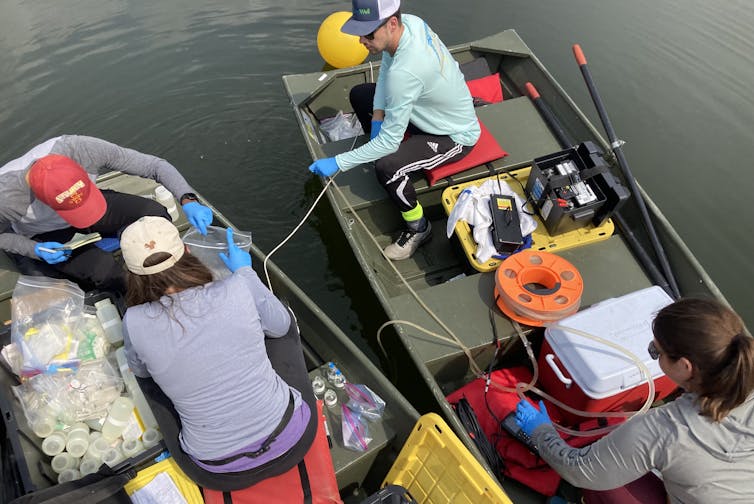
Little Deming Lake doesn’t get much notice from visitors to Itasca State Park in Minnesota. There’s better boating on nearby Lake Itasca, the headwaters of the Mississippi River. My colleagues and I need to maneuver hundreds of pounds of equipment down a hidden path made narrow by late-summer poison ivy to launch our rowboats.
But modest Deming Lake offers more than meets the eye for me, a geochemist interested in how oxygen built up in the atmosphere 2.4 billion years ago. The absence of oxygen in the deep layers of Deming Lake is something this small body of water has in common with early Earth’s oceans.
On each of our several expeditions here each year, we row our boats out into the deepest part of the lake – over 60 feet (18 meters), despite the lake’s surface area being only 13 acres. We drop an anchor and connect our boats in a flotilla, readying ourselves for the work ahead.
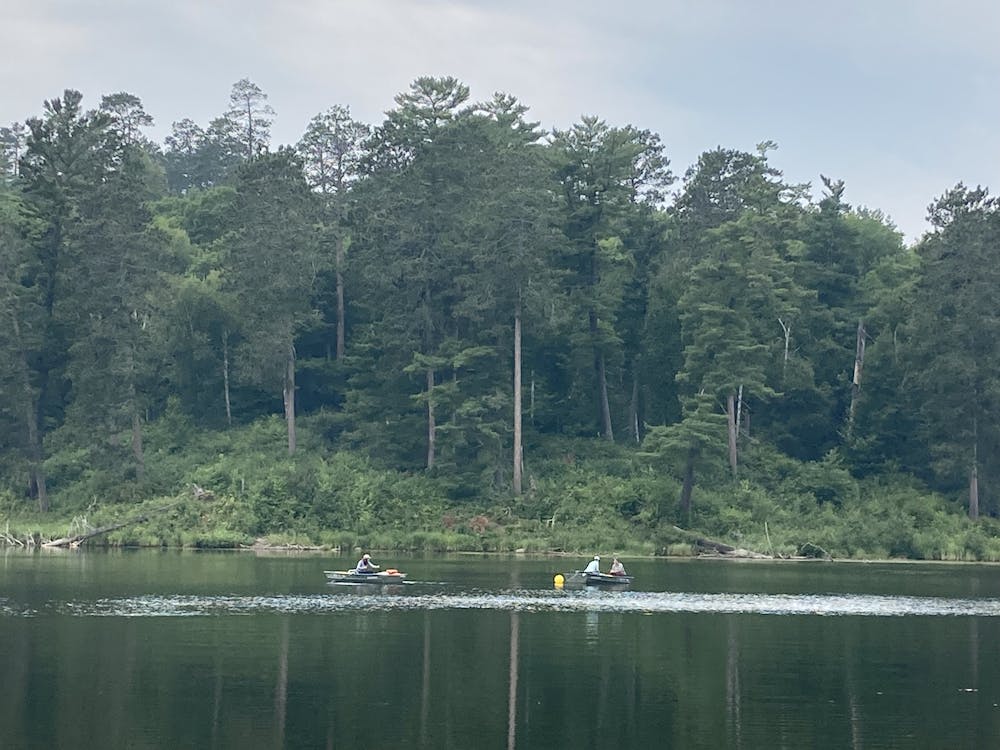
Deming Lake is meromictic, a term from Greek that means only partially mixing. In most lakes, at least once a year, the water at the top sinks while the water at the bottom rises because of wind and seasonal temperature changes that affect water’s density. But the deepest waters of Deming Lake never reach the surface. This prevents oxygen in its top layer of water from ever mixing into its deep layer.
Less than 1% of lakes are meromictic, and most that are have dense, salty bottom waters. Deming Lake’s deep waters are not very salty, but of the salts in its bottom waters, iron is one of the most abundant. This makes Deming Lake one of the rarest types of meromictic lakes.
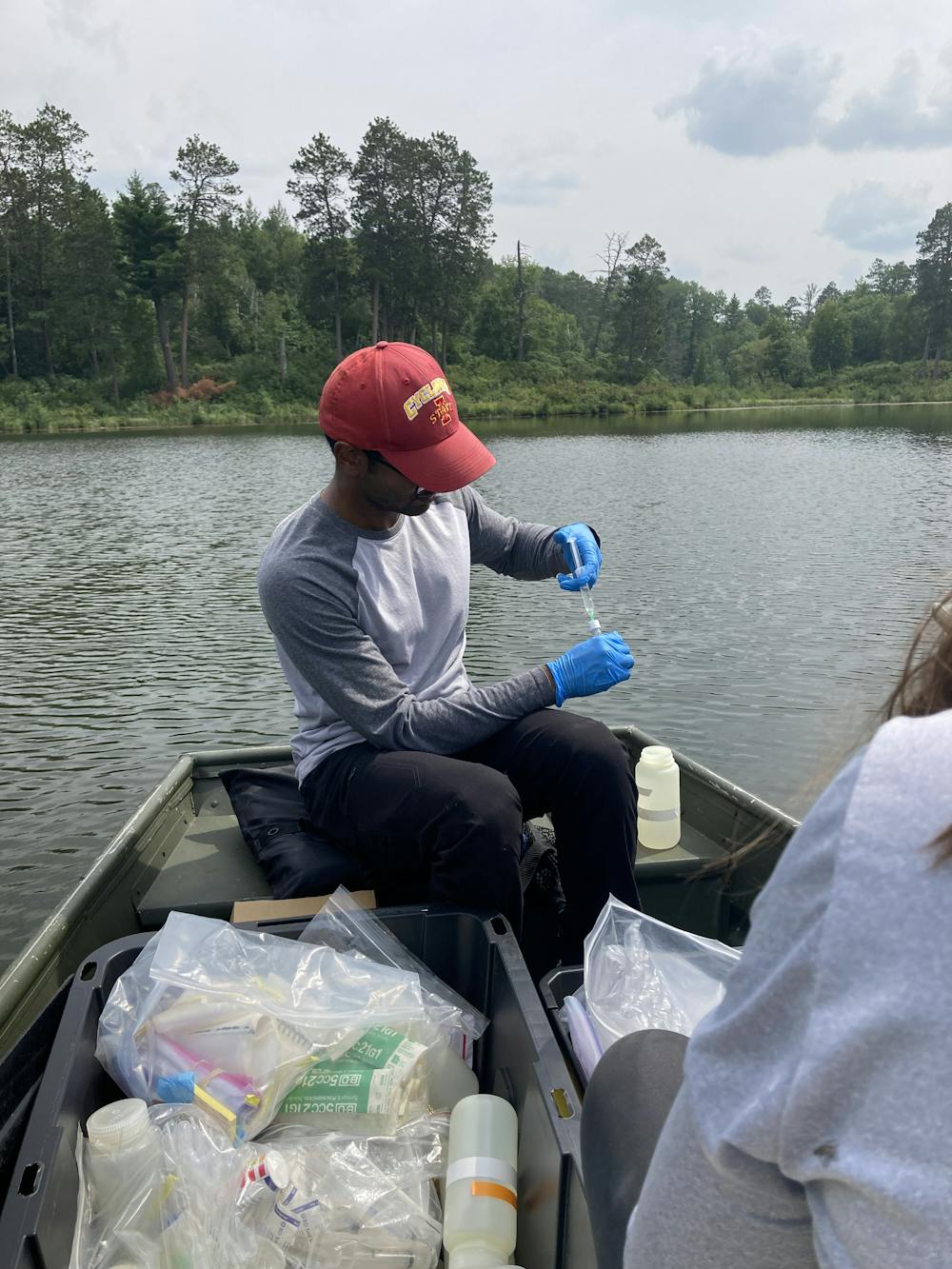
The lake surface is calm, and the still air is glorious on this cool, cloudless August morning. We lower a 2-foot-long water pump zip-tied to a cable attached to four sensors. The sensors measure the temperature, amount of oxygen, pH and amount of chlorophyll in the water at each layer we encounter. We pump water from the most intriguing layers up to the boat and fill a myriad of bottles and tubes, each destined for a different chemical or biological analysis.
My colleagues and I have homed in on Deming Lake to explore questions about how microbial life adapted to and changed the environmental conditions on early Earth. Our planet was inhabited only by microbes for most of its history. The atmosphere and the oceans’ depths didn’t have much oxygen, but they did have a lot of iron, just like Deming Lake does. By investigating what Deming Lake’s microbes are doing, we can better understand how billions of years ago they helped to transform the Earth’s atmosphere and oceans into what they’re like now.
Two and a half billion years ago, ocean waters had enough iron to form today’s globally distributed rusty iron deposits called banded iron formations that supply iron for the modern global steel industry. Nowadays, oceans have only trace amounts of iron but abundant oxygen. In most waters, iron and oxygen are antithetical. Rapid chemical and biological reactions between iron and oxygen mean you can’t have much of one while the other is present.
The rise of oxygen in the early atmosphere and ocean was due to cyanobacteria. These single-celled organisms emerged at least 2.5 billion years ago. But it took roughly 2 billion years for the oxygen they produce via photosynthesis to build up to levels that allowed for the first animals to appear on Earth.

At Deming Lake, my colleagues and I pay special attention to the water layer where the chlorophyll readings jump. Chlorophyll is the pigment that makes plants green. It harnesses sunlight energy to turn water and carbon dioxide into oxygen and sugars. Nearly 20 feet (6 meters) below Deming’s surface, the chlorophyll is in cyanobacteria and photosynthetic algae, not plants.
But the curious thing about this layer is that we don’t detect oxygen, despite the abundance of these oxygen-producing organisms. This is the depth where iron concentrations start to climb to the high levels present at the lake’s bottom.
This high-chlorophyll, high-iron and low-oxygen layer is of special interest to us because it might help us understand where cyanobacteria lived in the ancient ocean, how well they were growing and how much oxygen they produced.
We suspect the reason cyanobacteria gather at this depth in Deming Lake is that there is more iron there than at the top of the lake. Just like humans need iron for red blood cells, cyanobacteria need lots of iron to help catalyze the reactions of photosynthesis.
A likely reason we can’t measure any oxygen in this layer is that in addition to cyanobacteria, there are a lot of other bacteria here. After a good long life of a few days, the cyanobacteria die, and the other bacteria feed on their remains. These bacteria rapidly use up any oxygen produced by still photosynthesizing cyanobacteria the way a fire does as it burns through wood.
We know there are lots of bacteria here based on how cloudy the water is, and we see them when we inspect a drop of this water under a microscope. But we need another way to measure photosynthesis besides measuring oxygen levels.
The other important function of photosynthesis is converting carbon dioxide into sugars, which eventually are used to make more cells. We need a way to track whether new sugars are being made, and if they are, whether it’s by photosynthetic cyanobacteria. So we fill glass bottles with samples of water from this lake layer and seal them tight with rubber stoppers.
We drive the 3 miles back to the Itasca Biological Station and Laboratories where we will set up our experiments. The station opened in 1909 and is home base for us this week, providing comfy cabins, warm meals and this laboratory space.
In the lab, we inject our glass bottle with carbon dioxide that carries an isotopic tracer. If cyanobacteria grow, their cells will incorporate this isotopic marker.
We had a little help to formulate our questions and experiments. University of Minnesota students attending summer field courses collected decades worth of data in Itasca State Park. A diligent university librarian digitized thousands of those students’ final papers.
My students and I pored over the papers concerning Deming Lake, many of which tried to determine whether the cyanobacteria in the chlorophyll-rich layer are doing photosynthesis. While most indicated yes, those students were measuring only oxygen and got ambiguous results. Our use of the isotopic tracer is trickier to implement but will give clearer results.
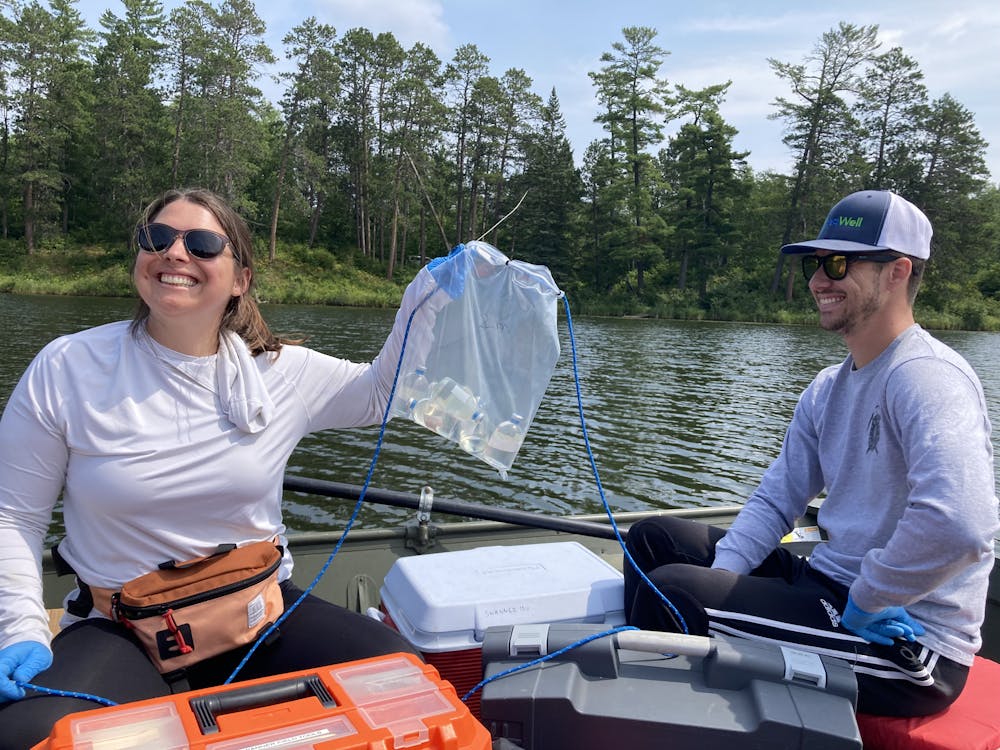
That afternoon, we’re back on the lake. We toss an anchor; attached to its rope is a clear plastic bag holding the sealed bottles of lake water now amended with the isotopic tracer. They’ll spend the night in the chlorophyll-rich layer, and we’ll retrieve them after 24 hours. Any longer than that and the isotopic label might end up in the bacteria that eat the dying cyanobacteria instead of the cyanobacteria themselves. We tie off the rope to a floating buoy and head back to the station’s dining hall for our evening meal.
The next morning, as we wait for the bottles to finish their incubation, we collect water from the different layers of the lake and add some chemicals that kill the cells but preserve their bodies. We’ll look at these samples under the microscope to figure out how many cyanobacteria are in the water, and we’ll measure how much iron is inside the cyanobacteria.
That’s easier said than done, because we have to first separate all the “needles” (cyanobacteria) from the “hay” (other cells) and then clean any iron off the outside of the cyanobacteria. Back at Iowa State University, we’ll shoot the individual cells one by one into a flame that incinerates them, which liberates all the iron they contain so we can measure it.
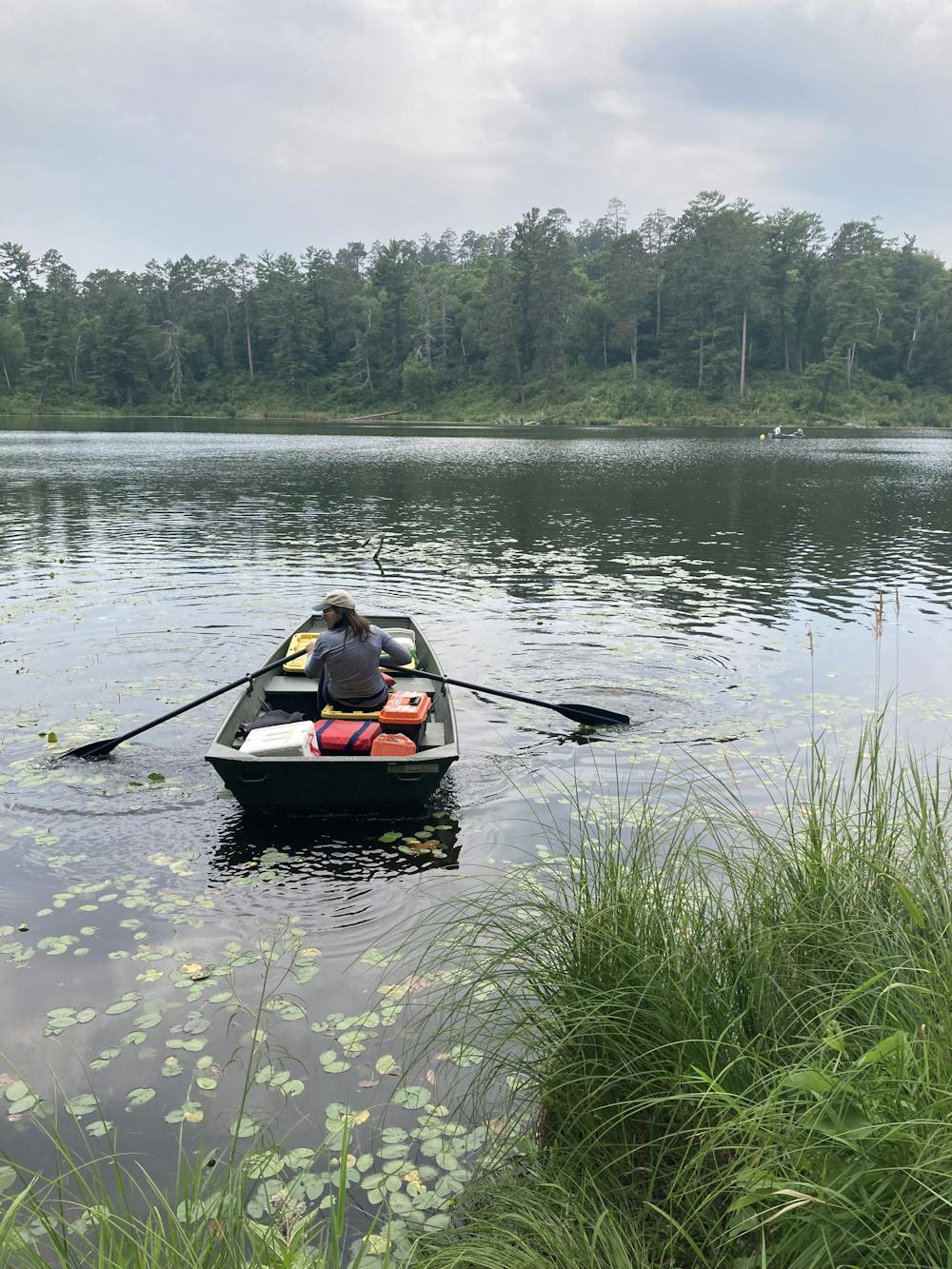
Our scientific hunch, or hypothesis, is that the cyanobacteria that live in the chlorophyll- and iron-rich layer will contain more iron than cyanobacteria that live in the top lake layer. If they do, it will help us establish that greater access to iron is a motive for living in that deeper and dimmer layer.
These experiments won’t tell the whole story of why it took so long for Earth to build up oxygen, but they will help us to understand a piece of it – where oxygen might have been produced and why, and what happened to oxygen in that environment.
Deming Lake is quickly becoming its own attraction for those with a curiosity about what goes on beneath its tranquil surface – and what that might be able to tell us about how new forms of life took hold long ago on Earth.
Elizabeth Swanner, Associate Professor of Geology, Iowa State University
This article is republished from The Conversation under a Creative Commons license. Read the original article.
ooOOoo
Nothing I can add to this very erudite article. Please read it and be fascinated by the findings.
 Learning from Dogs