Category: consciousness

The recycling of plastics.

It is not as straightforward as I thought it was.

ooOOoo

How single-stream recycling works − your choices can make it better

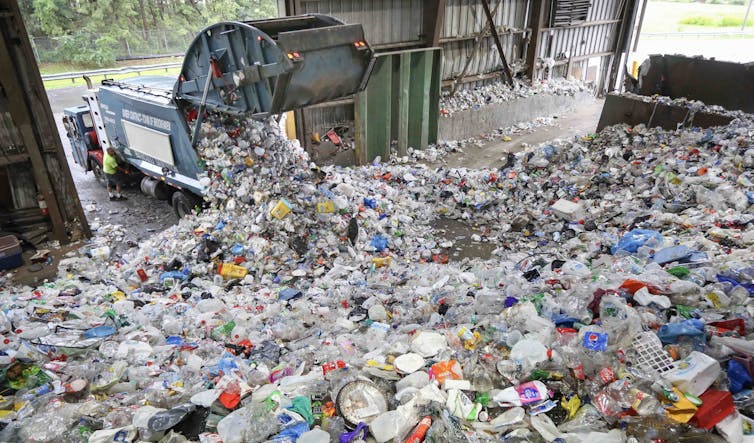
Successful recycling requires some care. Alejandra Villa Loarca/Newsday RM via Getty Images

Alex Jordan, University of Wisconsin-Stout

Every week, millions of Americans toss their recyclables into a single bin, trusting that their plastic bottles, aluminum cans and cardboard boxes will be given a new life.

But what really happens after the truck picks them up?

Single-stream recycling makes participating in recycling easy, but behind the scenes, complex sorting systems and contamination mean a large percentage of that material never gets a second life. Reports in recent years have found 15% to 25% of all the materials picked up from recycle bins ends up in landfills instead.

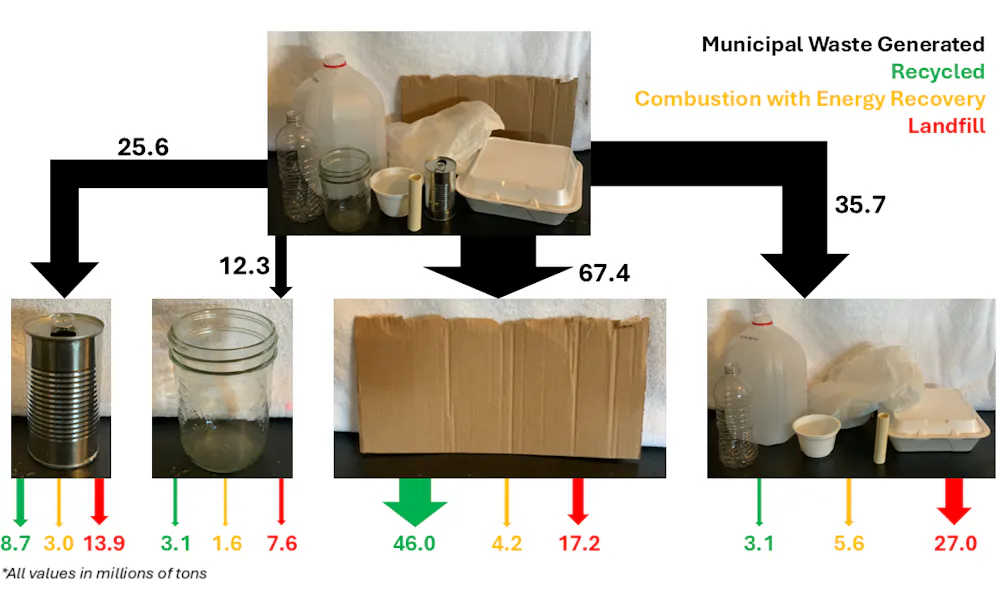
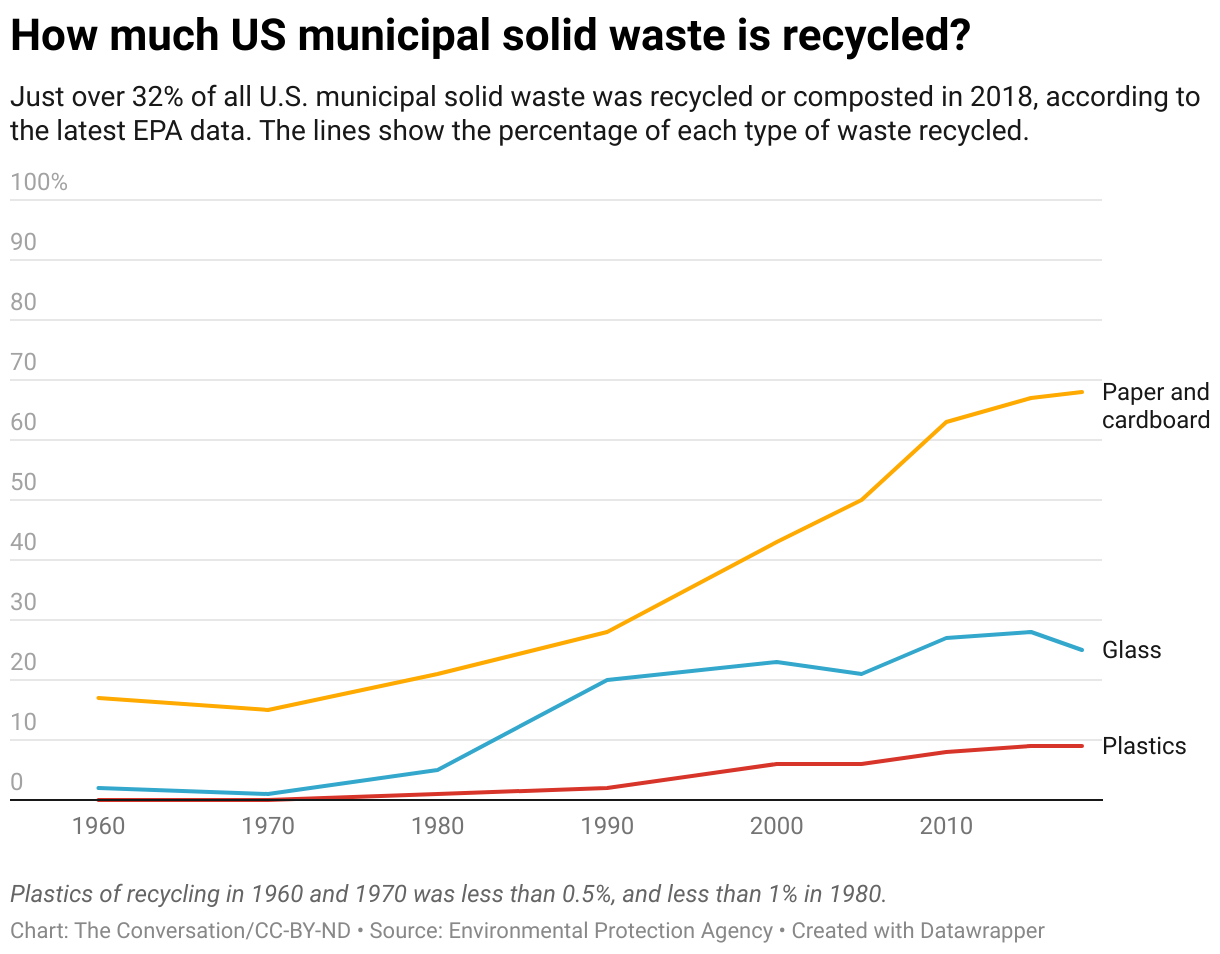
Plastics are among the biggest challenges. Only about 9% of the plastic generated in the U.S. actually gets recycled, according to the Environmental Protection Agency. Some plastic is incinerated to produce energy, but most of the rest ends up in landfills instead.

Photos and arrows show how much of each type of product is recycled.
A breakdown of U.S. recycling by millions of tons shows about two-thirds of all paper and cardboard gets a second life, but only about a third of metal, a quarter of glass and less than 10% of plastics do. Alex Jordan/University of Wisconsin-Stout

So, what makes plastic recycling so difficult? As an engineer whose work focuses on reprocessing plastics, I have been exploring potential solutions.

How does single-stream recycling work?

In cities that use single-stream recycling, consumers put all of their recyclable materials − paper, cardboard, plastic, glass and metal − into a single bin. Once collected, the mixed recyclables are taken to a materials recovery facility, where they are sorted.

First, the mixed recyclables are shredded and crushed into smaller fragments, enabling more effective separation. The mixed fragments pass over rotating screens that remove cardboard and paper, allowing heavier materials, including plastics, metals and glass, to continue along the sorting line.

The basics of a single-stream recycling system in Pennsylvania. Source: Van Dyk Recycling Solutions.

Magnets are used to pick out ferrous metals, such as steel. A magnetic field that produces an electrical current with eddies sends nonferrous metals, such as aluminum, into a separate stream, leaving behind plastics and glass.

The glass fragments are removed from the remaining mix using gravity or vibrating screens.

That leaves plastics as the primary remaining material.

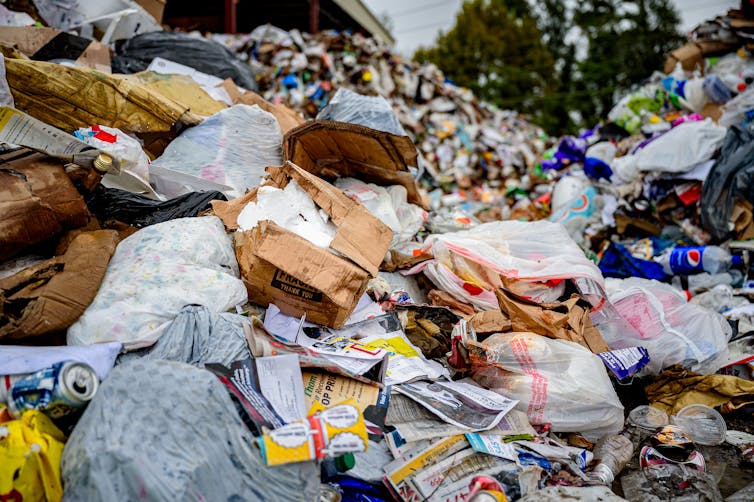
While single-stream recycling is convenient, it has downsides. Contamination, such as food residue, plastic bags and items that can’t be recycled, can degrade the quality of the remaining material, making it more difficult to reuse. That lowers its value.

Having to remove that contamination raises processing costs and can force recovery centers to reject entire batches.

A mound of items send for recycling includes a lot of plastic bags.
Plastic bags, food residue and items that can’t be recycled can contaminate a recycling stream. City of Greenville, N.C./Flickr

Which plastics typically can’t be recycled?

Each recycling program has rules for which items it will and won’t take. You can check which items can and cannot be recycled for your specific program on your municipal page. Often, that means checking the recycling code stamped on the plastic next to the recycling icon.

These are the toughest plastics to recycle and most likely to be excluded in your local recycling program:

  • Symbol 3 – Polyvinyl chloride, or PVC, found in pipes, shower curtains and some food packaging. It may contain harmful additives such as phthalates and heavy metals. PVC also degrades easily, and melting can release toxic fumes during recycling, contaminating other materials and making it unsafe to process in standard recycling facilities.
  • Symbol 4 – Low-density polyethylene, or LDPE, is often used in plastic bags and shrink-wrap. Because it’s flexible and lightweight, it’s prone to getting tangled in sorting machinery at recycling plants.
  • Symbol 6 – Polystyrene, often used in foam cups, takeout containers and packing peanuts. Because it’s lightweight and brittle, it’s difficult to collect and process and easily contaminates recycling streams.

Which plastics to include

That leaves three plastics that can be recycled in many facilities:

However, these aren’t accepted in some facilities for reasons I’ll explain.

Taking apart plastics, bead by bead

Some plastics can be chemically recycled or ground up for reprocessing, but not all plastics play well together.

Simple separation methods, such as placing ground-up plastics in water, can easily remove your soda bottle plastic (PET) from the mixture. The ground-up PET sinks in water due to the plastic’s density. However, HDPE, used in milk jugs, and PP, found in yogurt cups, both float, and they can’t be recycled together. So, more advanced and expensive technology, such as infrared spectroscopy, is often required to separate those two materials.

Once separated, the plastic from your soda bottle can be chemically recycled through a process called solvolysis.

It works like this: Plastic materials are formed from polymers. A polymer is a molecule with many repeating units, called monomers. Picture a pearl necklace. The individual pearls are the repeating monomer units. The string that runs through the pearls is the chemical bond that joins the monomer units together. The entire necklace can then be thought of as a single molecule.

During solvolysis, chemists break down that necklace by cutting the string holding the pearls together until they are individual pearls. Then, they string those pearls together again to create new necklaces.

Other chemical recycling methods, such as pyrolysis and gasification, have drawn environmental and health concerns because the plastic is heated, which can release toxic fumes. But chemical recycling also holds the potential to reduce both plastic waste and the need for new plastics, while generating energy.

The problem of yogurt cups and milk jugs

The other two common types of recycled plastics − items such as yogurt cups (PP) and milk jugs (HDPE) − are like oil and water: Each can be recycled through reprocessing, but they don’t mix.

If polyethylene and polypropylene aren’t completely separated during recycling, the resulting mix can be brittle and generally unusable for creating new products.

Chemists are working on solutions that could increase the quality of recycled plastics through mechanical reprocessing, typically done at separate facilities.

One promising mechanical method for recycling mixed plastics is to incorporate a chemical called a compatibilizer. Compatibilizers contain the chemical structure of multiple different polymers in the same molecule. It’s like how lecithin, commonly found in egg yolks, can help mix oil and water to make mayonnaise − part of the lecithin molecule is in the oil phase and part is in the water phase.

In the case of yogurt cups and milk jugs, recently developed block copolymers are able to produce recycled plastic materials with the flexibility of polyethylene and the strength of polypropylene.

Improving recycling

Research like this can make recycled materials more versatile and valuable and move products closer to a goal of a circular economy without waste.

However, improving recycling also requires better recycling habits.

You can help the recycling process by taking a few minutes to wash off food waste, avoiding putting plastic bags in your recycling bin and, importantly, paying attention to what can and cannot be recycled in your area.

Alex Jordan, Associate Professor of Plastics Engineering, University of Wisconsin-Stout

This article is republished from The Conversation under a Creative Commons license. Read the original article.

ooOOoo

Can we all learn to be better at recycling in the face of so much world ‘news’!

Improving equality

An extremely powerful new essay from George Monbiot.

While this post from G. Monbiot is about politics, I think it goes far beyond that. Hence my reason for republishing this essay, with George Monbiot’s permission. When I will die is not known but surely I will in the next ten years or so. I really want to leave this world seeing everything improving, from the lessening of the change in our climate, to a reduction in world fighting, to a greater equality for all.

Please, please be wrong, Mr. Monbiot.

ooOOoo

The Urge to Destroy

Posted on14th April 2025

It’s a cast-iron relationship: the more unequal a society becomes, the better the far right does. Here’s why. 

By George Monbiot, published in the Guardian  13th April 2025

“He’s really gone and done it this time. Now everyone can see what a disaster he is.” How many times have we heard this about Donald Trump? And how many times has it been proved wrong? Well, maybe this time he really has overstepped. After all, his clowning around with tariffs, sparking trade wars, then suddenly reversing his position, could provoke a global recession, perhaps even a depression. Surely his supporters will disown him? But I’m not banking on it, and this is why.

Already, Trump has waged war on everything that builds prosperity and wellbeing: democracy, healthy ecosystems, education, healthcare, science, the arts. Yet, amid the wreckage, and despite some slippage, his approval ratings still hold between 43 and 48%: far higher than those of many other leaders. Why? I believe part of the answer lies in a fundamental aspect of our humanity: the urge to destroy that from which you feel excluded.

This urge, I think, is crucial to understanding politics. Yet hardly anyone seems to recognise it. Hardly anyone, that is, except the far right, who see it all too well.

In many parts of the world, and the US in particular, inequality has risen sharply since the late 1970s. (The UK tracks this trend.) The world’s billionaires became $2tn richer last year, while the number of people living below the global poverty line is more or less unchanged since 1990.

There is strong evidence of a causal association between growing inequality and the rise of populist authoritarian movements. A paper in the Journal of European Public Policy found that a one-unit rise in the Gini coefficient (a standard measure of inequality) increases support for demagogues by 1%.

Why might this be? There are various, related explanations: feelings of marginalisationstatus anxiety and social threat, insecurity triggering an authoritarian reflex and a loss of trust in other social groups. At the root of some of these explanations, I feel, is something deeply embedded in the human psyche: if you can’t get even, get mean.

In the US, a high proportion of the population is excluded from many of the benefits I’ve listed. Science might lead to medical breakthroughs, but not, perhaps, for people who can’t afford health insurance. A university education might open doors, but only if you’re prepared to carry tens or hundreds of thousands of dollars of debt. Art and theatre and music improve our lives: good for those who can buy the tickets. So do national parks, but only if you can afford to visit them.

Democracy, we are told, allows people a voice in politics. But only, it seems, if they have a few million to give to a political party. As the political scientist Prof Martin Gilens notes in his book Affluence and Influence: “Under most circumstances, the preferences of the vast majority of Americans appear to have essentially no impact on which policies the government does or doesn’t adopt.” GDP growth was strong under Joe Biden, but as the economics professor Jason Furman points out: “From 2019 to 2023, inflation-adjusted household income fell, and the poverty rate rose.” GDP and social improvement are no longer connected.

All those good things? Sorry, they’re not for you. If you feel an urge to tear it all down, to burn the whole stinking, hypocritical, exclusive system to the ground, Trump is your man. Or so he claims. In reality his entire performance is both a distraction from and an accelerant of spiralling inequality. He can hardly lose: the more he exacerbates inequality, the more he triggers an urge for revenge against his scapegoats: immigrants, trans people, scientists, teachers, China.

But such killer clowns can’t pull this off by themselves. Their most effective recruiters are centrist parties paralysed in the face of economic power. In hock to rich funders, terrified of the billionaire media, for decades they have been unable even to name the problem, let alone address it. Hence the spectacular uselessness of the Democrats’ response to Trump. As the US journalist Hamilton Nolan remarks: “One party is out to kill, and the other is waiting for its leaders to die.”

In the UK, Labour, like the Democrats, has long assured itself that it doesn’t matter how wide economic disparities are, as long as the poorest are raised up. Now it has abandoned even that caveat: we can cut benefits, so long as GDP grows. But it does matter. It matters very much. A vast array of evidence, brought together in 2009 in The Spirit Level by Richard Wilkinson and Kate Pickett and updated in 2024, shows that inequality exerts a massive influence on social, economic, environmental and political outcomes, regardless of people’s absolute positions.

If there is a such a thing as Starmerism, it collapses in the face of a paper published by the political scientists Leonardo Baccini and Thomas Sattler last year, which finds that austerity increases support for the radical right in economically vulnerable regions. (My emboldening. PH) Austerity, they found, is the key variable: without it, less-educated people are no more likely to vote for rightwing demagogues than highly educated people are. In other words, Keir Starmer and Rachel Reeves are busily handing their core constituencies to Nigel Farage.

Of course, they deny they’re imposing austerity, using a technical definition that means nothing to those on the sharp end. Austerity is what the poor experience, while they must watch the rich and upper middle classes, under a Labour government, enjoy ever greater abundance.

Starmer and his minions suggest there’s nothing they can do: wealthy people are already taxed to the max. As private jets and helicopters cross the skies, anyone can see this is nonsense. Of all the remarkable things I stumbled across while researching this column, the following is perhaps the most jaw-dropping. On the most recent (2022) figures, once benefits have been paid, the Gini coefficient for gross income in the UK scarcely differs from the Gini coefficient for post-tax income. In other words, the gap between the rich and the poor is rougly the same after taxes are levied, suggesting that taxation has no further significant effect on income distribution. How could this possibly be true, when the rich pay higher rates of income tax? It’s because the poor surrender a much higher proportion of their income in sales taxes, such as VAT. So much for no further options. So much for Labour “realism”.

The one thing that can stop the rise of the far right is the one thing mainstream parties are currently not prepared to deliver: greater equality. The rich should be taxed more, and the revenue used to improve the lives of the poor. However frantically centrist parties avoid the issue, there is no other way.

www.monbiot.com

ooOOoo

George writes about Britain but my judgement is that this issue is not limited to that country; I suspect it is a far wider problem. Did you know that Finland is the world’s happiest country?

An extract of that article: “Finland has been ranked as the world’s happiest country for the eighth successive year, with experts citing access to nature and a strong welfare system as factors.

It came ahead of three other Nordic countries in this year’s UN-sponsored World Happiness Report, while Latin America’s Costa Rica and Mexico entered the top 10 for the first time.

Both the UK and the US slipped down the list to 23rd and 24th respectively – the lowest-ever position for the latter.”

A goodbye to Cleo

Cleo was put to sleep yesterday afternoon.

Cleo’s rear legs were really troubling her so we went with her to Lincoln Road Vet yesterday at 1:45pm.

Around 2pm the doctor injected Cleo with firstly a deep sleep injection then after Cleo was asleep then the final injection.

Cleo was thirteen and the staff at Lincoln Road remarked that was a grand age for a German Shepherd.

oooo

oooo

oooo

oooo

Goodbye sweet girl! You will be missed!

Venus and Valentine’s Day

The role of the planet today!

From that post: Venus, named for the Roman goddess of love, reaches its greatest brilliancy on Valentine’s Day, February 14. Venus is currently blazing, low in the west after sunset, with Saturn below.

Wherever you are, try spotting Venus.

Nutrition advice

An article on educating us on avoiding misinformation.

Many articles on nutrition are full of errors and for the lay person there’s no easy way to understand what is correct, or not.

That’s why a recent article appealed to me and I thought it worth sharing.

ooOOoo

Nutrition advice is rife with misinformation − a medical education specialist explains how to tell valid health information from pseudoscience

If a health claim about a dietary intervention sounds too good to be true, it probably is. Mizina/iStock via Getty Images Plus

Aimee Pugh Bernard, University of Colorado Anschutz Medical Campus

The COVID-19 pandemic illuminated a vast landscape of misinformation about many topics, science and health chief among them.

Since then, information overload continues unabated, and many people are rightfully confused by an onslaught of conflicting health information. Even expert advice is often contradictory.

On top of that, people sometimes deliberately distort research findings to promote a certain agenda. For example, trisodium phosphate is a common food additive in cakes and cookies that is used to improve texture and prevent spoilage, but wellness influencers exploit the fact that a similarly named substance is used in paint and cleaning products to suggest it’s dangerous to your health.

Such claims can proliferate quickly, creating widespread misconceptions and undermining trust in legitimate scientific research and medical advice. Social media’s rise as a news and information source further fuels the spread of pseudoscientific views.

Misinformation is rampant in the realm of health and nutrition. Findings from nutrition research is rarely clear-cut because diet is just one of many behaviors and lifestyle factors affecting health, but the simplicity of using food and supplements as a cure-all is especially seductive.

I am an assistant professor specializing in medical education and science communication. I also train scientists and future health care professionals how to communicate their science to the general public.

In my view, countering the voices of social media influencers and health activists promoting pseudoscientific health claims requires leaning into the science of disease prevention. Extensive research has produced a body of evidence-based practices and public health measures that have consistently been shown to improve the health of millions of people around the world. Evaluating popular health claims against the yardstick of this work can help distinguish which ones are based on sound science.

A white person's hands holding a smartphone with screen showing a health app, next to a cup of coffee.
To parse pseudoscientific claims from sound advice about health and nutrition, it’s crucial to evaluate the information’s source. tadamichi/Getty Images

Navigating the terrain of tangled information

Conflicting information can be found on just about everything we eat and drink.

That’s because a food or beverage is rarely just good or bad. Instead, its health effects can depend on everything from the quantity a person consumes to their genetic makeup. Hundreds of scientific studies describe coffee’s health benefits and, on the flip side, its health risks. A bird’s-eye view can point in one direction or another, but news articles and social media posts often make claims based on a single study.

Things can get even more confusing with dietary supplements because people who promote them often make big claims about their health benefits. Take apple cider vinegar, for example – or ACV, if you’re in the know.

Apple cider vinegar has been touted as an all-natural remedy for a variety of ailments, including digestive issues, urinary health and weight management. Indeed, some studies have shown that it might help lower cholesterol, in addition to having other health benefits, but overall those studies have small sample sizes and are inconclusive.

Advocates of this substance often claim that one particular component of it – the cloudy sediment at the bottom of the bottle termed “the mother” – is especially beneficial because of the bacteria and yeast it contains. But there is no research that backs the claim that it offers any health benefits.

One good rule of thumb is that health hacks that promise quick fixes are almost always too good to be true. And even when supplements do offer some health benefits under specific circumstances, it’s important to remember that they are largely exempt from Food and Drug Administration regulations. That means the ingredients on their labels might contain more or less of the ingredients promised or other ingredients not listed, which can potentially cause harms such as liver toxicity.

It’s also important to keep in mind that the global dietary supplements industry is worth more than US$150 billion per year, so companies – and wellness influencers – selling supplements have a financial stake in convincing the public of their value.

Misinformation about nutrition is nothing new, but that doesn’t make it any less confusing.

How nutrition science gets twisted

There’s no doubt that good nutrition is fundamental for your health. Studies consistently show that a balanced diet containing a variety of essential nutrients can help prevent chronic diseases and promote overall well-being.

For instance, minerals such as calcium and iron support bone health and oxygen circulation in the blood, respectively. Proteins are essential for muscle repair and growth, and healthy fats, like those found in avocados and nuts, are vital for brain health.

However, pseudoscientific claims often twist such basic facts to promote the idea that specific diets or supplements can prevent or treat illness. For example, vitamin C is known to play a role in supporting the immune system and can help reduce the duration and severity of colds.

But despite assertions to the contrary, consuming large quantities of vitamin C does not prevent colds. In fact, the body needs only a certain amount of vitamin C to function properly, and any excess is simply excreted.

Companies sometimes claim their supplement is “scientifically proven” to cure illness or boost brain function, with no credible research to back it up.

Some companies overstate the benefits while underplaying the hazards.

For example, wellness influencers have promoted raw milk over pasteurized milk as a more natural and nutritious choice, but consuming it is risky. Unpasteurized milk can contain harmful bacteria that leads to gastrointestinal illness and, in some cases, much more serious and potentially life-threatening diseases such as avian influenza, or bird flu.

Such dietary myths aren’t harmless. Reliance on nutrition alone can lead to neglecting other critical aspects of health, such as regular medical checkups and lifesaving vaccinations.

The lure of dietary myths has led people with cancer to replace proven science-backed treatments, such as chemotherapy or radiation, with unproven and misleading nutrition programs.

How to spot less-than-solid science

Pseudoscience exploits your insecurities and emotions, taking advantage of your desire to live the healthiest life possible.

While the world around you may be uncertain and out of your control, you want to believe that at the very least, you have control over your own health. This is where the wellness industry steps in.

What makes pseudoscientific claims so confusing is that they use just enough scientific jargon to sound believable. Supplements or powders that claim to “boost immunity” often list ingredients such as adaptogens and superfoods. While these words sound real and convincing, they actually don’t mean anything in science. They are terms created by the wellness industry to sell products.

I’ve researched and written about reliable ways to distinguish science facts from false health claims. To stay alert and find credible information, I’d suggest you follow a few key steps.

First, check your emotions – strong emotional reactions, such as fear and anger, can be a red flag.

Next, check that the author has experience or expertise in the field of the topic. If they’re not an expert, they might not know what they are talking about. It’s always a good idea to make sure the source is reputable – ask yourself, would this source be trusted by scientists?

Finally, search for references that back up the information. If very little or nothing else exists in the science world to back up the claims, you may want to put your trust in a different source.

Following these steps will separate the facts from fake news and empower you to make evidence-based decisions.

Aimee Pugh Bernard, Assistant Professor of Immunology and Microbiology, University of Colorado Anschutz Medical Campus

This article is republished from The Conversation under a Creative Commons license. Read the original article.

ooOOoo

Sound advice for the majority of us!

The Edwin Hubble Great Debate

The following is more than fascinating; it is an example of how far science has reached; both figuratively and literally.

ooOOoo

One large Milky Way galaxy or many galaxies? 100 years ago, a young Edwin Hubble settled astronomy’s ‘Great Debate’

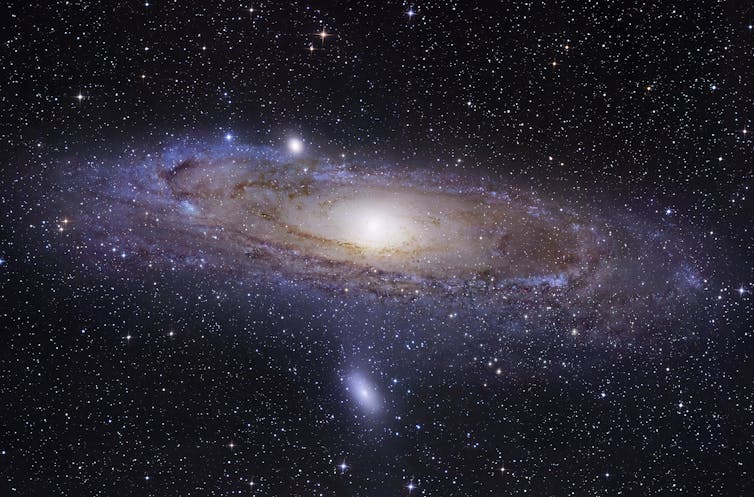
The Andromeda galaxy helped Edwin Hubble settle a great debate in astronomy. Stocktrek Images via Getty Images

Chris Impey, University of Arizona

A hundred years ago, astronomer Edwin Hubble dramatically expanded the size of the known universe. At a meeting of the American Astronomical Society in January 1925, a paper read by one of his colleagues on his behalf reported that the Andromeda nebula, also called M31, was nearly a million light years away – too remote to be a part of the Milky Way.

Hubble’s work opened the door to the study of the universe beyond our galaxy. In the century since Hubble’s pioneering work, astronomers like me have learned that the universe is vast and contains trillions of galaxies.

Nature of the nebulae

In 1610, astronomer Galileo Galilei used the newly invented telescope to show that the Milky Way was composed of a huge number of faint stars. For the next 300 years, astronomers assumed that the Milky Way was the entire universe.

As astronomers scanned the night sky with larger telescopes, they were intrigued by fuzzy patches of light called nebulae. Toward the end of the 18th century, astronomer William Herschel used star counts to map out the Milky Way. He cataloged a thousand new nebulae and clusters of stars. He believed that the nebulae were objects within the Milky Way.

Charles Messier also produced a catalog of over 100 prominent nebulae in 1781. Messier was interested in comets, so his list was a set of fuzzy objects that might be mistaken for comets. He intended for comet hunters to avoid them since they did not move across the sky.

As more data piled up, 19th century astronomers started to see that the nebulae were a mixed bag. Some were gaseous, star-forming regions, such as the Orion nebula, or M42 – the 42nd object in Messier’s catalog – while others were star clusters such as the Pleiades, or M45.

A third category – nebulae with spiral structure – particularly intrigued astronomers. The Andromeda nebula, M31, was a prominent example. It’s visible to the naked eye from a dark site.

The Andromeda galaxy, then known as the Andromeda nebula, is a bright spot in the sky that intrigued early astronomers.

Astronomers as far back as the mid-18th century had speculated that some nebulae might be remote systems of stars or “island universes,” but there was no data to support this hypothesis. Island universes referred to the idea that there could be enormous stellar systems outside the Milky Way – but astronomers now just call these systems galaxies.

In 1920, astronomers Harlow Shapley and Heber Curtis held a Great Debate. Shapley argued that the spiral nebulae were small and in the Milky Way, while Curtis took a more radical position that they were independent galaxies, extremely large and distant.

At the time, the debate was inconclusive. Astronomers now know that galaxies are isolated systems of stars, much smaller than the space between them.

Hubble makes his mark

Edwin Hubble was young and ambitious. At the of age 30, he arrived at Mount Wilson Observatory in Southern California just in time to use the new Hooker 100-inch telescope, at the time the largest in the world.

A black and white photo of a man looking through the lens of a large telescope.
Edwin Hubble uses the telescope at the Mount Wilson Observatory. Hulton Archives via Getty Images

He began taking photographic plates of the spiral nebulae. These glass plates recorded images of the night sky using a light-sensitive emulsion covering their surface. The telescope’s size let it make images of very faint objects, and its high-quality mirror allowed it to distinguish individual stars in some of the nebulae.

Estimating distances in astronomy is challenging. Think of how hard it is to estimate the distance of someone pointing a flashlight at you on a dark night. Galaxies come in a very wide range of sizes and masses. Measuring a galaxy’s brightness or apparent size is not a good guide to its distance.

Hubble leveraged a discovery made by Henrietta Swan Leavitt 10 years earlier. She worked at the Harvard College Observatory as a “human computer,” laboriously measuring the positions and brightness of thousands of stars on photographic plates.

She was particularly interested in Cepheid variables, which are stars whose brightness pulses regularly, so they get brighter and dimmer with a particular period. She found a relationship between their variation period, or pulse, and their intrinsic brightness or luminosity.

Once you measure a Cepheid’s period, you can calculate its distance from how bright it appears using the inverse square law. The more distant the star is, the fainter it appears.

Hubble worked hard, taking images of spiral nebulae every clear night and looking for the telltale variations of Cepheid variables. By the end of 1924, he had found 12 Cepheids in M31. He calculated M31’s distance as a prodigious 900,000 light years away, though he underestimated its true distance – about 2.5 million light years – by not realizing there were two different types of Cepheid variables.

His measurements marked the end of the Great Debate about the Milky Way’s size and the nature of the nebulae. Hubble wrote about his discovery to Harlow Shapley, who had argued that the Milky Way encompassed the entire universe.

“Here is the letter that destroyed my universe,” Shapley remarked.

Always eager for publicity, Hubble leaked his discovery to The New York Times five weeks before a colleague presented his paper at the astronomers’ annual meeting in Washington, D.C.

An expanding universe of galaxies

But Hubble wasn’t done. His second major discovery also transformed astronomers’ understanding of the universe. As he dispersed the light from dozens of galaxies into a spectrum, which recorded the amount of light at each wavelength, he noticed that the light was always shifted to longer or redder wavelengths.

Light from the galaxy passes through a prism or reflects off a diffraction grating in a telescope, which captures the intensity of light from blue to red.

Astronomers call a shift to longer wavelengths a redshift.

It seemed that these redshifted galaxies were all moving away from the Milky Way.

Hubble’s results suggested the farther away a galaxy was, the faster it was moving away from Earth. Hubble got the lion’s share of the credit for this discovery, but Lowell Observatory astronomer Vesto Slipher, who noticed the same phenomenon but didn’t publish his data, also anticipated that result.

Hubble referred to galaxies having recession velocities, or speeds of moving away from the Earth, but he never figured out that they were moving away from Earth because the universe is getting bigger.

Belgian cosmologist and Catholic priest Georges Lemaitre made that connection by realizing that the theory of general relativity described an expanding universe. He recognized that space expanding in between the galaxies could cause the redshifts, making it seem like they were moving farther away from each other and from Earth.

Lemaitre was the first to argue that the expansion must have begun during the big bang.

The Hubble telescope, which looks like a metal cylinder, floating in space.
Edwin Hubble is the namesake for NASA’s Hubble Space Telescope, which has spent decades observing faraway galaxies. NASA via AP

NASA named its flagship space observatory after Hubble, and it has been used to study galaxies for 35 years. Astronomers routinely observe galaxies that are thousands of times fainter and more distant than galaxies observed in the 1920s. The James Webb Space Telescope has pushed the envelope even farther.

The current record holder is a galaxy a staggering 34 billion light years away, seen just 200 million years after the big bang, when the universe was 20 times smaller than it is now. Edwin Hubble would be amazed to see such progress.

Chris Impey, University Distinguished Professor of Astronomy, University of Arizona

This article is republished from The Conversation under a Creative Commons license. Read the original article.

ooOOoo

So wonderful that in this modern era we can read articles from distinguished scientists in the comfort of our own homes.

Picture Parade Four Hundred and Fifty-Three

My son, Alex, took the following photographs of the Aurora..

oooo

oooo

oooo

They are fabulous. Especially so because as it happened we had mainly cloud cover here in Southern Oregon.

To close, here is an extract from yesterday’s BBC website:

On Thursday night, the stunning colours of the Northern Lights were visible once again even to the naked eye across much of the US.

Experts say the Northern Lights, or Aurora Borealis, are more visible right now due to the sun being at what astronomers call the “maximum” of its 11-year solar cycle.

What this means is that roughly every 11 years, at the peak of this cycle, the sun’s magnetic poles flip, and the sun transitions from sluggish to active and stormy. On Earth, that’d be like if the North and South Poles swapped places every decade. 

“At its quietest, the sun is at solar minimum; during solar maximum, the sun blazes with bright flares and solar eruptions,” according to Nasa, the US space agency.

The current 11-year cycle, the 25th since records began in 1755, started in 2019 and is expected to peak next year.

Ancient times

This attracted me very much, and I wanted to share it with you.

The opening paragraph of this article caught my eye so I read it fully. As it was published in The Conversation then that meant I could republish it.

ooOOoo

Centuries ago, the Maya storm god Huracán taught that when we damage nature, we damage ourselves

James L. Fitzsimmons, Middlebury

The ancient Maya believed that everything in the universe, from the natural world to everyday experiences, was part of a single, powerful spiritual force. They were not polytheists who worshipped distinct gods but pantheists who believed that various gods were just manifestations of that force.

Some of the best evidence for this comes from the behavior of two of the most powerful beings of the Maya world: The first is a creator god whose name is still spoken by millions of people every fall – Huracán, or “Hurricane.” The second is a god of lightning, K’awiil, from the early first millennium C.E.

As a scholar of the Indigenous religions of the Americas, I recognize that these beings, though separated by over 1,000 years, are related and can teach us something about our relationship to the natural world.

Huracán, the ‘Heart of Sky’

Huracán was once a god of the K’iche’, one of the Maya peoples who today live in the southern highlands of Guatemala. He was one of the main characters of the Popol Vuh, a religious text from the 16th century. His name probably originated in the Caribbean, where other cultures used it to describe the destructive power of storms.

The K’iche’ associated Huracán, which means “one leg” in the K’iche’ language, with weather. He was also their primary god of creation and was responsible for all life on earth, including humans.

Because of this, he was sometimes known as U K’ux K’aj, or “Heart of Sky.” In the K’iche’ language, k’ux was not only the heart but also the spark of life, the source of all thought and imagination.

Yet, Huracán was not perfect. He made mistakes and occasionally destroyed his creations. He was also a jealous god who damaged humans so they would not be his equal. In one such episode, he is believed to have clouded their vision, thus preventing them from being able to see the universe as he saw it.

Huracán was one being who existed as three distinct persons: Thunderbolt Huracán, Youngest Thunderbolt and Sudden Thunderbolt. Each of them embodied different types of lightning, ranging from enormous bolts to small or sudden flashes of light.

Despite the fact that he was a god of lightning, there were no strict boundaries between his powers and the powers of other gods. Any of them might wield lightning, or create humanity, or destroy the Earth.

Another storm god

The Popol Vuh implies that gods could mix and match their powers at will, but other religious texts are more explicit. One thousand years before the Popol Vuh was written, there was a different version of Huracán called K’awiil. During the first millennium, people from southern Mexico to western Honduras venerated him as a god of agriculture, lightning and royalty.

A drawing showing a reclining god-like figure with a large snake around him.
The ancient Maya god K’awiil, left, had an ax or torch in his forehead as well as a snake in place of his right leg. K5164 from the Justin Kerr Maya archive, Dumbarton Oaks, Trustees for Harvard University, Washington, D.C.

Illustrations of K’awiil can be found everywhere on Maya pottery and sculpture. He is almost human in many depictions: He has two arms, two legs and a head. But his forehead is the spark of life – and so it usually has something that produces sparks sticking out of it, such as a flint ax or a flaming torch. And one of his legs does not end in a foot. In its place is a snake with an open mouth, from which another being often emerges.

Indeed, rulers, and even gods, once performed ceremonies to K’awiil in order to try and summon other supernatural beings. As personified lightning, he was believed to create portals to other worlds, through which ancestors and gods might travel.

Representation of power

For the ancient Maya, lightning was raw power. It was basic to all creation and destruction. Because of this, the ancient Maya carved and painted many images of K’awiil. Scribes wrote about him as a kind of energy – as a god with “many faces,” or even as part of a triad similar to Huracán.

He was everywhere in ancient Maya art. But he was also never the focus. As raw power, he was used by others to achieve their ends.

Rain gods, for example, wielded him like an ax, creating sparks in seeds for agriculture. Conjurers summoned him, but mostly because they believed he could help them communicate with other creatures from other worlds. Rulers even carried scepters fashioned in his image during dances and processions.

Moreover, Maya artists always had K’awiil doing something or being used to make something happen. They believed that power was something you did, not something you had. Like a bolt of lightning, power was always shifting, always in motion.

An interdependent world

Because of this, the ancient Maya thought that reality was not static but ever-changing. There were no strict boundaries between space and time, the forces of nature or the animate and inanimate worlds.

People walking through knee-deep water on a flooded street with building on either side and electric wires overhead.
Residents wade through a street flooded by Hurricane Helene, in Batabano, Mayabeque province, Cuba, on Sept. 26, 2024. AP Photo/Ramon Espinosa

Everything was malleable and interdependent. Theoretically, anything could become anything else – and everything was potentially a living being. Rulers could ritually turn themselves into gods. Sculptures could be hacked to death. Even natural features such as mountains were believed to be alive.

These ideas – common in pantheist societies – persist today in some communities in the Americas.

They were once mainstream, however, and were a part of K’iche’ religion 1,000 years later, in the time of Huracán. One of the lessons of the Popol Vuh, told during the episode where Huracán clouds human vision, is that the human perception of reality is an illusion.

The illusion is not that different things exist. Rather it is that they exist independent from one another. Huracán, in this sense, damaged himself by damaging his creations.

Hurricane season every year should remind us that human beings are not independent from nature but part of it. And like Hurácan, when we damage nature, we damage ourselves.

James L. Fitzsimmons, Professor of Anthropology, Middlebury

This article is republished from The Conversation under a Creative Commons license. Read the original article.

ooOOoo

It is such a powerful message, that when we damage nature, we damage ourselves.

But I am unaware, no we are both unaware of a solution, and there doesn’t appear to be a government desire to make this the number one topic.

Please, if there is anyone who reads this post and has a more positive message then we would be very keen to hear from you.

Picture Parade Four Hundred and Fifty-One

A few photographs from home.

oooo

oooo

oooo

oooo

The three deer photos show them feeding from me putting out COB (corn, oats, barley) each morning soon after it is light.

Of course, typically the morning I took my camera out there were just four deer. Usually there between seven and fifteen and a couple of months ago a friendly stag in getting to the COB as I was pouring it out rubbed his right antler on my right leg.

Feeding my friends!

The Heart Wall in London

I love this!

I am writing this having listened to a programme on BBC Radio 4. (Was broadcast on Radio 4 on Tuesday, August 13th.) It shows how many, many people can have a really positive response to a dastardly negative occurrence such as the Covid outbreak or a pandemic.

ooOOoo

Photo by Nick Fewings on Unsplash

Why are those lost to COVID not formally memorialised? How politics shapes what we remember

Mark Honigsbaum, City, University of London

Every Friday, volunteers gather on the Albert Embankment at the River Thames in London to lovingly retouch thousands of red hearts inscribed on a Portland stone wall directly opposite the Houses of Parliament. Each heart is dedicated to a British victim of COVID. It is a deeply social space – a place where the COVID bereaved come together to honour their dead and share memories.

The so-called National Covid Memorial Wall is not, however, officially sanctioned. In fact, ever since activists from COVID-19 Bereaved Families for Justice (CBFFJ) daubed the first hearts on the wall in March 2021 it has been a thorn in the side of the authorities.

Featured in the media whenever there is a new revelation about partygate, the wall is a symbol of the government’s blundering response to the pandemic and an implicit rebuke to former prime minister Boris Johnson and other government staff who breached coronavirus restrictions.

As one writer put it, viewed from parliament the hearts resemble “a reproachful smear of blood”. Little wonder that the only time Johnson visited the wall was under the cover of darkness to avoid the TV cameras. His successor Rishi Sunak has been similarly reluctant to acknowledge the wall or say what might take its place as a more formal memorial to those lost in the pandemic.

Though in April the UK Commission on COVID Commemoration presented Sunak with a report on how the pandemic should be remembered, Sunak has yet to reveal the commission’s recommendations.

Lady Heather Hallett, the former high court judge who chairs the public inquiry into COVID, has attempted to acknowledge the trauma of the bereaved by commissioning a tapestry to capture the experiences of people who “suffered hardship and loss” during the pandemic. Yet such initiatives are no substitute for state-sponsored memorials.

What is remembered and what is forgotten?

This political vacuum is odd when you consider that the United Kingdom, like other countries, engages in many other commemorative activities central to national identity. The fallen of the first world war and other military conflicts are commemorated in a Remembrance Sunday ceremony held every November at the Cenotaph in London, for example.

But while wars lend themselves to compelling moral narratives, it is difficult to locate meaning in the random mutations of a virus. And while wars draw on a familiar repertoire of symbols and rituals, pandemics have few templates.

For instance, despite killing more than 50 million globally, there are virtually no memorials to the 1918-1919 “Spanish” influenza pandemic. Nor does the UK have a memorial to victims of HIV/AIDS. As the memory studies scholar Astrid Erll puts it, pandemics have not been sufficiently “mediated” in collective memory.

As a rule, they do not feature in famous paintings, novels or films or in the oral histories passed down as part of family lore. Nor are they able to draw on familiar cultural materials such as poppies, gun carriages, catafalques and royal salutes. Without such symbols and schemata, Erll argues, we struggle to incorporate pandemics into our collective remembering systems.

This lacuna was brought home to me last September when tens of thousands of Britons flocked to the south bank of the Thames to pay their respects to Britain’s longest serving monarch. By coincidence, the police directed the queue for the late Queen’s lying-in-state in Westminster Hall over Lambeth Bridge and along Albert Embankment.

But few of the people I spoke to in the queue seemed to realise what the hearts signified. It was as if the spectacle of a royal death had eclipsed the suffering of the COVID bereaved, rendering the wall all but invisible.

Waiting for answers

Another place where the pandemic could be embedded in collective memory is at the public inquiry. Opening the preliminary hearing last October into the UK’s resilience and preparedness for a pandemic, Lady Hallett promised to put the estimated 6.8 million Britons mourning the death of a family member or friend to COVID at the heart of the legal process. “I am listening to them; their loss will be recognised,” she said.

But though Lady Hallett has strategically placed photographs of the hearts throughout the inquiry’s offices in Bayswater and has invited the bereaved to relate their experiences to “Every Story Matters”, the hearing room is dominated by ranks of lawyers. And except when a prominent minister or official is called to testify, the proceedings rarely make the news.

This is partly the fault of the inquiry process itself. The hearings are due to last until 2025, with the report on the first stage of the process not expected until the summer of 2024. As Lucy Easthope, an emergency planner and veteran of several disasters, puts it: “one of the most painful frustrations of the inquiry will be temporal. It will simply take too long.”

The inquiry has also been beset by bureaucratic obfuscation, not least by the Cabinet Office which attempted (unsuccessfully in the end) to block the release of WhatsApp messages relating to discussions between ministers and Downing Street officials in the run-up to lockdown.

To the inquiry’s critics, the obvious parallel is with the Grenfell inquiry, which promised to “learn lessons” from the devastating fire that engulfed the west London tower in 2017 but has so far ended up blurring the lines of corporate responsibility and forestalling a political reckoning.

The real work of holding the government to account and making memories takes place every Friday at the wall and the other places where people come together to spontaneously mourn and remember absent loved ones. These are the lives that demand to be “seen”. They are the ghosts that haunt our amnesic political culture.

Mark Honigsbaum, Senior Lecturer in Journalism, City, University of London

This article is republished from The Conversation under a Creative Commons license. Read the original article.

plus Wikipedia have a long article on the National Covid Memorial Wall. That then takes us to the website for the wall.

ooOOoo

As was written in the last sentence of the article; ‘They are the ghosts that haunt our amnesic political culture.

Humans are a strange lot and I most certainly count myself in!