Personal musings on what ‘live for the day’ means.
Jeannie wakes early on in the morning; it’s one of the characteristics of Parkinson’s Disease (PD). So last Sunday morning I was washed and dressed by 5am (PST), and listening to the BBC’s World at One. (No connection with today’s post.)
Later on I started writing this post with a first look at what ‘live for the day’ means in the eyes of others. At first I wanted to research the phrase; imagine my surprise when I found out there wasn’t a consistent meaning.
Dictionary.com came up with Concentrate on the present, with little or no concern for the future.
Merriam-Webster gave live for meaning one of three things: lived for; living for; lives for.
The English-Collins dictionary, according to Wikipedia: The dictionary uses language research based on the Collins Corpus, which is continually updated and has over 4.5 billion words. But it did not easily give me any answer to my question.
Quora was too complicated for me to easily search for this phrase.
Thus I abandoned that approach.
I also did not reach out to friends and ask them what they thought of the saying. But, to me, that meaning from Dictionary.com seemed the closest to what I had in mind. So let me settle on that.
Concentrate on the present, with little or no concern for the future.
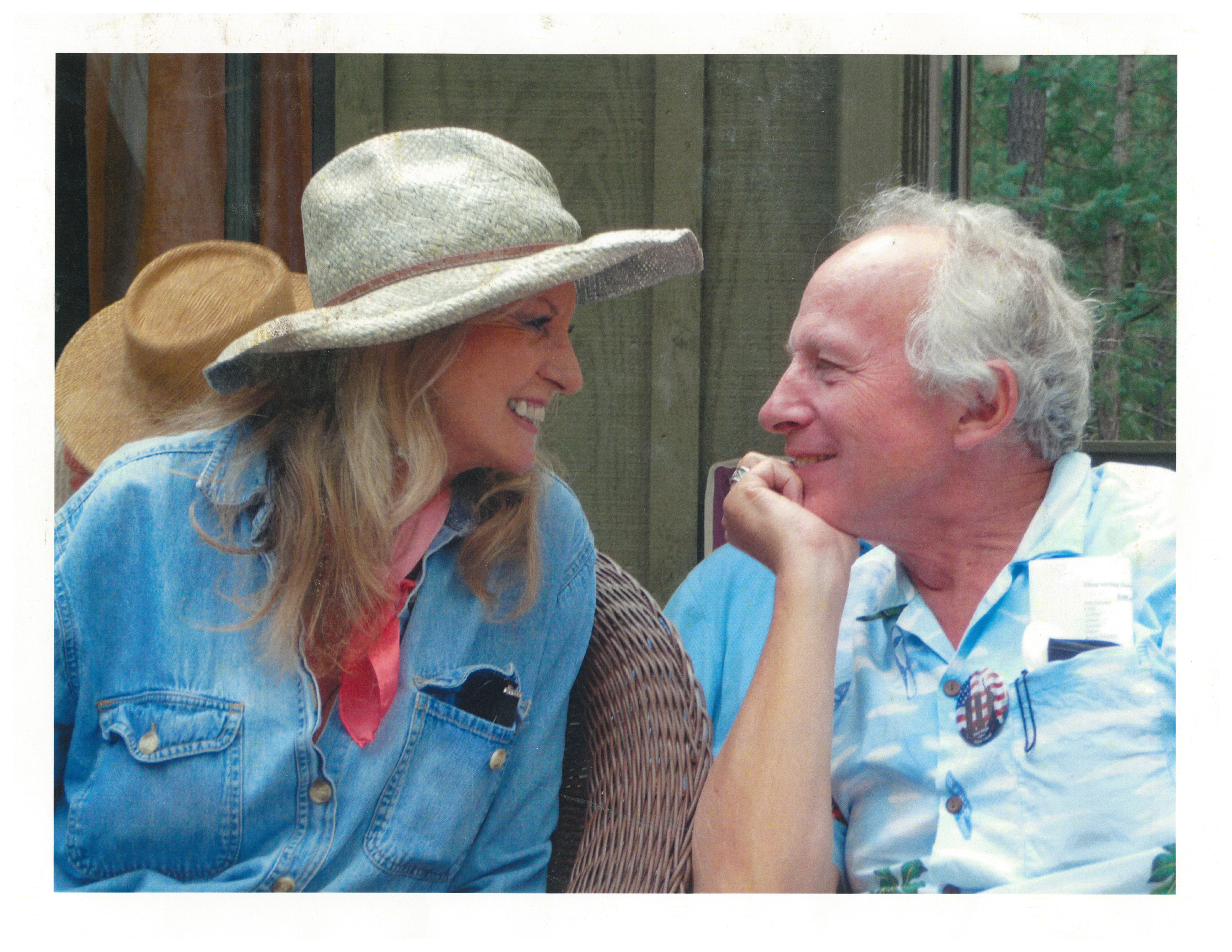
But how can Jeannie and me live without ‘concern for the future‘?
The list of things that we think about that involve the future is enormous. Many of the things are relatively minor, such as do we have enough food in the house, or petrol in the car, going on to do have I enough COB (Corn, Oats, Barley) to feed the deer that come here each morning, etc., etc.
Then there are future plans such as keeping next Tuesday clear (that is today, in fact) for Jeannie and Dordie to be out together for a few hours. Plus, in a few months time, my son is coming over to stay with us in April, and Richard coming in May. (Richard is a great British friend who was diagnosed with PD the same time as Jean.)
Then there is the task of keeping the trees within fifty feet of the house safe. That involves cutting down the trees that are getting old and trimming off the lower branches in the others. This is part of our desire to stay safe if a forest fire comes through this part of Merlin. We would be evacuated if that happened and part of our preparation is to have an ‘exit pack’ at the ready. Something else that affects our ‘concern for the future‘.
Finally in this list of introspections comes the ultimate end! I am in my 80th year and Jean and I find ourselves talking about death more often than we did at a younger age. Is that normal? I do not know. We are both humanists; I hope I will outlive Jean because I love her to pieces and want to be the last person she sees and embraces. It is one of the reasons that I go bike riding on a regular basis and staying as healthy as we can embraces the fact that we are both pescatarian and attend the local Club Northwest two days a week. Jeannie goes to the Rock Steady Class held at the Club.
So that is a pretty good set of reasons why living for the day is not viable.
ooOOoo
Footnote
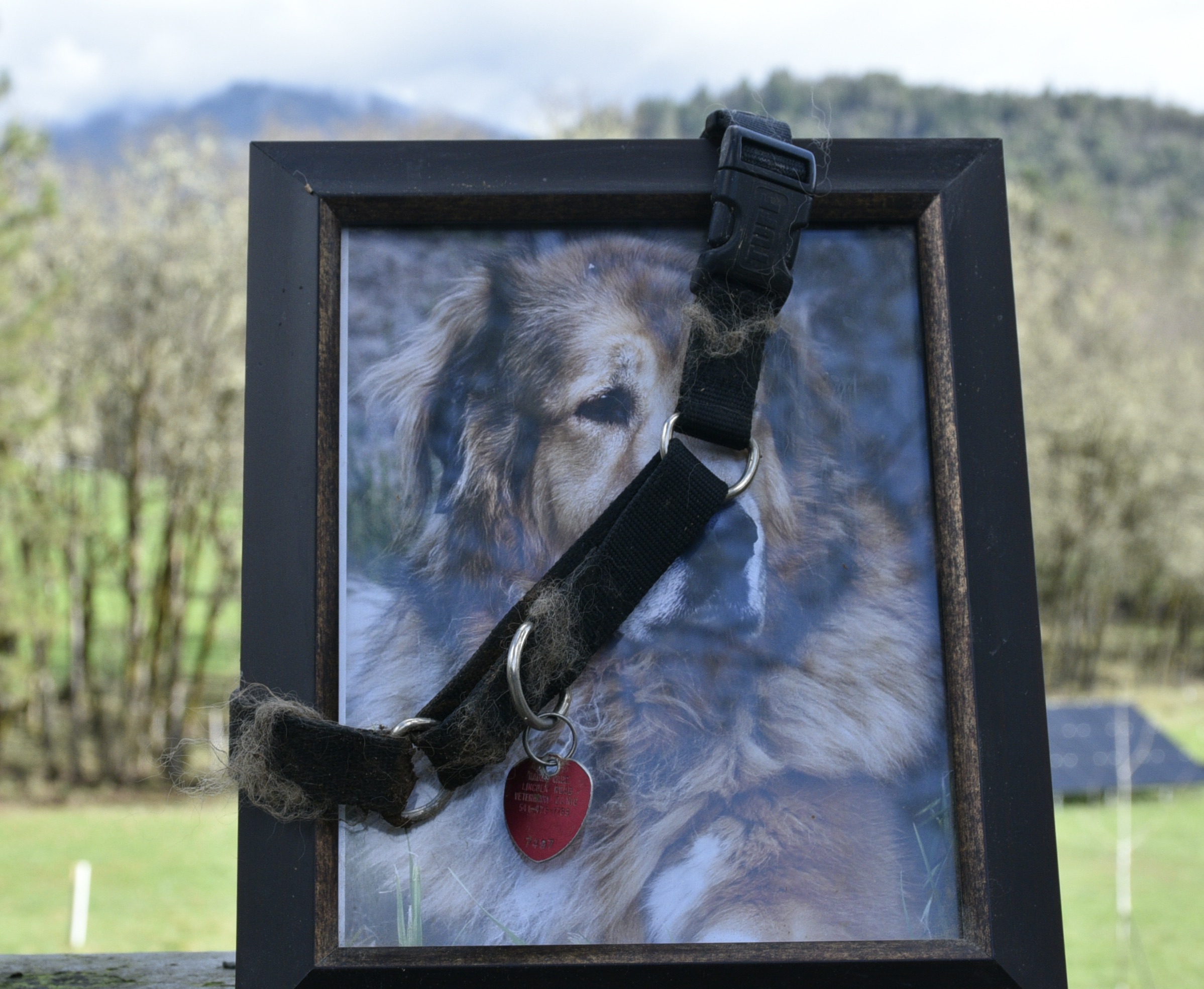
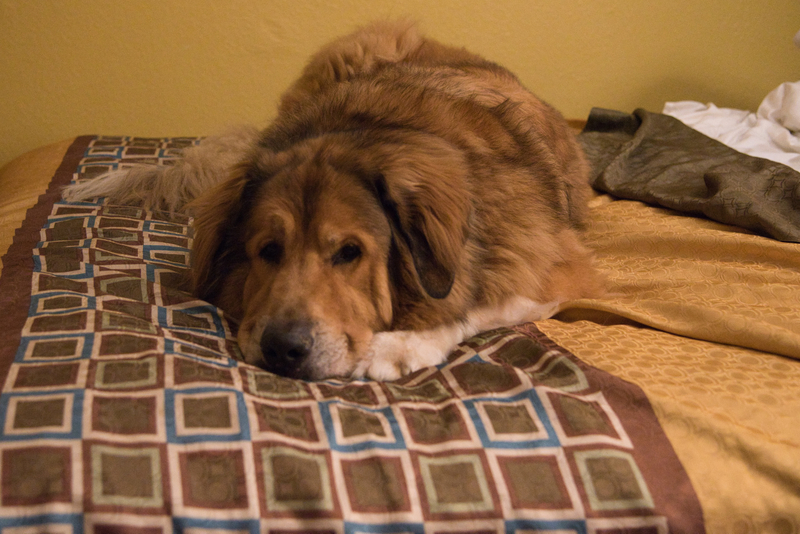
We lost our Brandy yesterday morning. He went out for his usual ‘whatever’ at a little after 5am and after he had been back in the house for no more than a minute, he shook his head and went to the front door to be let out again! I thought he had gone out for a poo.
After I was washed and dressed, but it was still dark, I started to look for him aided by my big torch. I could not see him anywhere. To cut a long story short here we are at 4pm and he hasn’t surfaced. My speculation was that his head shake was a brain problem and then he lost all sense of where he was. To continue that speculation, I believe he ended up being swept away in Bummer Creek, that crosses our property just in from the main gate, and was drowned.
Last Sunday Jean and I watched a Top Documentary Film about the origins of dogs. It was filmed in 2018 and was precious.
Here are the words that accompanied the film:
He has been an integral part of our existence for over 20,000 years. Throughout history, his contributions have been diverse and invaluable. He’s aided us in procuring sustenance, safeguarded our domesticated animals, served as a shield against adversaries, provided navigation during harsh conditions, and rescued us from imminent danger.
Presently, he offers solace, alleviating solitude and assisting us in managing the challenges of advancing age. He has evolved into an unwavering comrade. The origins of dogs raise intriguing questions: How did these remarkable creatures emerge? How did they ascend to such prominence in our lives? How did we forge a collaborative relationship, leveraging their distinct abilities? Moreover, what remarkable feats do they accomplish for us in contemporary times?
Prepare to embark on a journey that unveils the extraordinary escapades of these exceptional beings, showcasing their heroic deeds. Transitioning from wild wolves to beloved companions, from predatory instincts to steadfast friendship, we will traverse the globe to narrate the captivating narrative of how dogs earned their title: man’s first friend.
Director: Frédéric Fougea
Luckily the film, that runs for 90 minutes, is available on YouTube.
Here it is:
If you haven’t seen the film then, please, put some time aside to watch it. You will not be disappointed.
First of all, let me quote the opening two paragraphs from the WikiPedia entry on ‘intellectual humility’:
Intellectual humility is the acceptance that one’s beliefs and opinions could be wrong. Other characteristics that may accompany intellectual humility include a low concern for status and an acceptance of one’s intellectual limitations.
Mark Twain apocryphally said, “I’m in favor of progress; it’s change I don’t like.” This quote pithily underscores the human tendency to desire growth while also harboring strong resistance to the hard work that comes with it. I can certainly resonate with this sentiment.
I was raised in a conservative evangelical home. Like many who grew up in a similar environment, I learned a set of religious beliefs that framed how I understood myself and the world around me. I was taught that God is loving and powerful, and God’s faithful followers are protected. I was taught that the world is fair and that God is good. The world seemed simple and predictable – and most of all, safe.
These beliefs were shattered when my brother unexpectedly passed away when I was 27 years old. His death at 34 with three young children shocked our family and community. In addition to reeling with grief, some of my deepest assumptions were challenged. Was God not good or not powerful? Why didn’t God save my brother, who was a kind and loving father and husband? And how unfair, uncaring and random is the universe?
This deep loss started a period where I questioned all of my beliefs in light of the evidence of my own experiences. Over a considerable amount of time, and thanks to an exemplary therapist, I was able to revise my worldview in a way that felt authentic. I changed my mind, about a lot things. The process sure wasn’t pleasant. It took more sleepless nights than I care to recall, but I was able to revise some of my core beliefs.
I didn’t realize it then, but this experience falls under what social science researchers call intellectual humility. And honestly, it is probably a large part of why, as a psychology professor, I am so interested in studying it. Intellectual humility has been gaining more attention, and it seems critically important for our cultural moment, when it’s more common to defend your position than change your mind.
What it means to be intellectually humble
Intellectual humility is a particular kind of humility that has to do with beliefs, ideas or worldviews. This is not only about religious beliefs; it can show up in political views, various social attitudes, areas of knowledge or expertise or any other strong convictions. It has both internal- and external-facing dimensions.
Within yourself, intellectual humility involves awareness and ownership of the limitations and biases in what you know and how you know it. It requires a willingness to revise your views in light of strong evidence.
Interpersonally, it means keeping your ego in check so you can present your ideas in a modest and respectful manner. It calls for presenting your beliefs in ways that are not defensive and admitting when you’re wrong. It involves showing that you care more about learning and preserving relationships than about being “right” or demonstrating intellectual superiority.
Another way of thinking about humility, intellectual or otherwise, is being the right size in any given situation: not too big (which is arrogance), but also not too small (which is self-deprecation).
I know a fair amount about psychology, but not much about opera. When I’m in professional settings, I can embrace the expertise that I’ve earned over the years. But when visiting the opera house with more cultured friends, I should listen and ask more questions, rather than confidently assert my highly uninformed opinion.
Four main aspects of intellectual humility include being:
Open-minded, avoiding dogmatism and being willing to revise your beliefs.
Curious, seeking new ideas, ways to expand and grow, and changing your mind to align with strong evidence.
Realistic, owning and admitting your flaws and limitations, seeing the world as it is rather than as you wish it to be.
Teachable, responding nondefensively and changing your behavior to align with new knowledge.
Intellectual humility is often hard work, especially when the stakes are high.
Starting with the admission that you, like everyone else, have cognitive biases and flaws that limit how much you know, intellectual humility might look like taking genuine interest in learning about your relative’s beliefs during a conversation at a family get-together, rather than waiting for them to finish so you can prove them wrong by sharing your – superior – opinion.
It could look like considering the merits of an alternative viewpoint on a hot-button political issue and why respectable, intelligent people might disagree with you. When you approach these challenging discussions with curiosity and humility, they become opportunities to learn and grow.
Why intellectual humility is an asset
Though I’ve been studying humility for years, I’ve not yet mastered it personally. It’s hard to swim against cultural norms that reward being right and punish mistakes. It takes constant work to develop, but psychological science has documented numerous benefits.
First, there are social, cultural and technological advances to consider. Any significant breakthrough in medicine, technology or culture has come from someone admitting they didn’t know something – and then passionately pursuing knowledge with curiosity and humility. Progress requires admitting what you don’t know and seeking to learn something new.
For example, intellectually humble people are more accepting of people who hold differing religious and political views. A central part of it is an openness to new ideas, so folks are less defensive to potentially challenging perspectives. They’re more likely to forgive, which can help repair and maintain relationships.
Finally, humility helps facilitate personal growth. Being intellectually humble allows you to have a more accurate view of yourself.
When you can admit and take ownership of your limitations, you can seek help in areas where you have room to grow, and you’re more responsive to information. When you limit yourself to only doing things the way you’ve always done them, you miss out on countless opportunities for growth, expansion and novelty – things that strike you with awe, fill you with wonder and make life worth living.
Despite these benefits, sometimes humility gets a bad rap. People can have misconceptions about intellectual humility, so it’s important to dispel some myths.
Intellectual humility isn’t lacking conviction; you can believe something strongly until your mind is changed and you believe something else. It also isn’t being wishy-washy. You should have a high bar for what evidence you require to change your mind. It also doesn’t mean being self-deprecating or always agreeing with others. Remember, it’s being the right size, not too small.
Researchers are working hard to validate reliable ways to cultivate intellectual humility. I’m part of a team that is overseeing a set of projects designed to test different interventions to develop intellectual humility.
Some scholars are examining different ways to engage in discussions, and some are exploring the role of enhancing listening. Others are testing educational programs, and still others are looking at whether different kinds of feedback and exposure to diverse social networks might boost intellectual humility.
Prior work in this area suggests that humility can be cultivated, so we’re excited to see what emerges as the most promising avenues from this new endeavor.
There was one other thing that religion taught me that was slightly askew. I was told that too much learning could be ruinous; after all, you wouldn’t want to learn so much that you might lose your faith.
But in my experience, what I learned through loss may have salvaged a version of my faith that I can genuinely endorse and feels authentic to my experiences. The sooner we can open our minds and stop resisting change, the sooner we’ll find the freedom offered by humility.
We take it for granted! Of that I am sure. But the question of how oxygen first came to be built up in our atmosphere is fascinating. There was a recent article written by Elizabeth Swanner, who is Associate Professor of Geology, Iowa State University that was published in The Conversation. It makes for a very interesting read.
ooOOoo
A layered lake is a little like Earth’s early oceans − and lets researchers explore how oxygen built up in our atmosphere billions of years ago
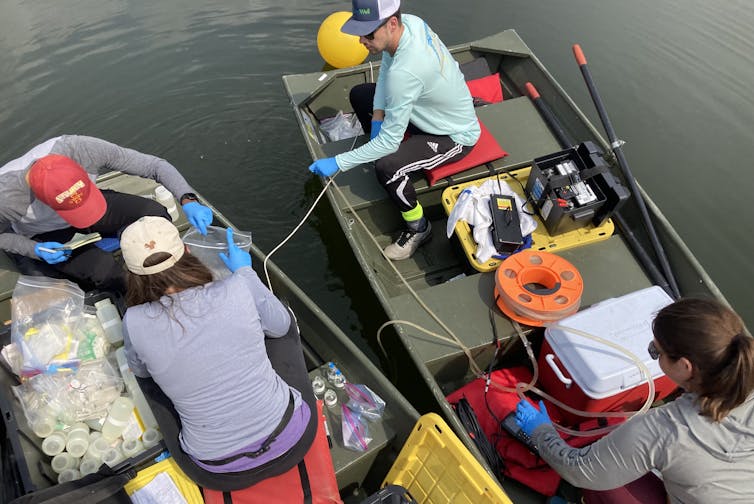
Researchers sample water from various layers to analyze back in the lab. Elizabeth Swanner, CC BY-ND
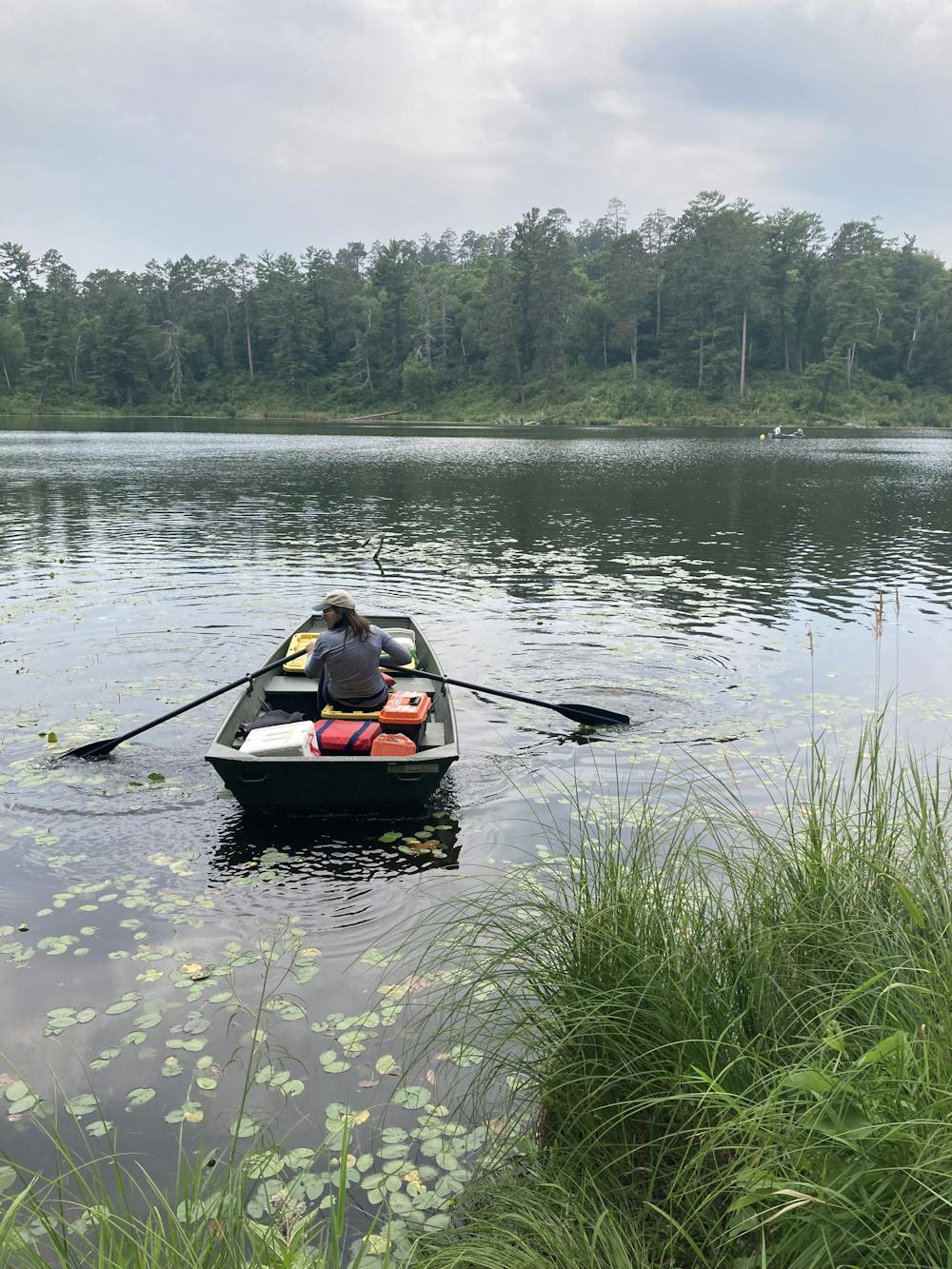
Little Deming Lake doesn’t get much notice from visitors to Itasca State Park in Minnesota. There’s better boating on nearby Lake Itasca, the headwaters of the Mississippi River. My colleagues and I need to maneuver hundreds of pounds of equipment down a hidden path made narrow by late-summer poison ivy to launch our rowboats.
But modest Deming Lake offers more than meets the eye for me, a geochemist interested in how oxygen built up in the atmosphere 2.4 billion years ago. The absence of oxygen in the deep layers of Deming Lake is something this small body of water has in common with early Earth’s oceans.
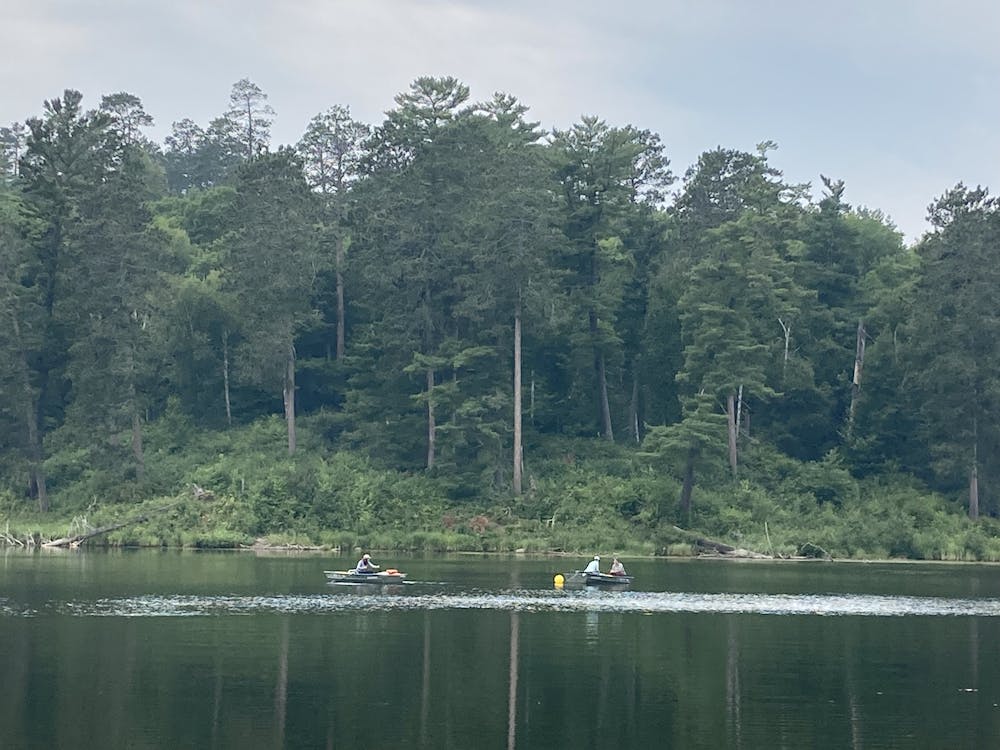
On each of our several expeditions here each year, we row our boats out into the deepest part of the lake – over 60 feet (18 meters), despite the lake’s surface area being only 13 acres. We drop an anchor and connect our boats in a flotilla, readying ourselves for the work ahead.
Researchers’ boats on Deming Lake. Elizabeth Swanner, CC BY-ND
Deming Lake is meromictic, a term from Greek that means only partially mixing. In most lakes, at least once a year, the water at the top sinks while the water at the bottom rises because of wind and seasonal temperature changes that affect water’s density. But the deepest waters of Deming Lake never reach the surface. This prevents oxygen in its top layer of water from ever mixing into its deep layer.
Less than 1% of lakes are meromictic, and most that are have dense, salty bottom waters. Deming Lake’s deep waters are not very salty, but of the salts in its bottom waters, iron is one of the most abundant. This makes Deming Lake one of the rarest types of meromictic lakes.
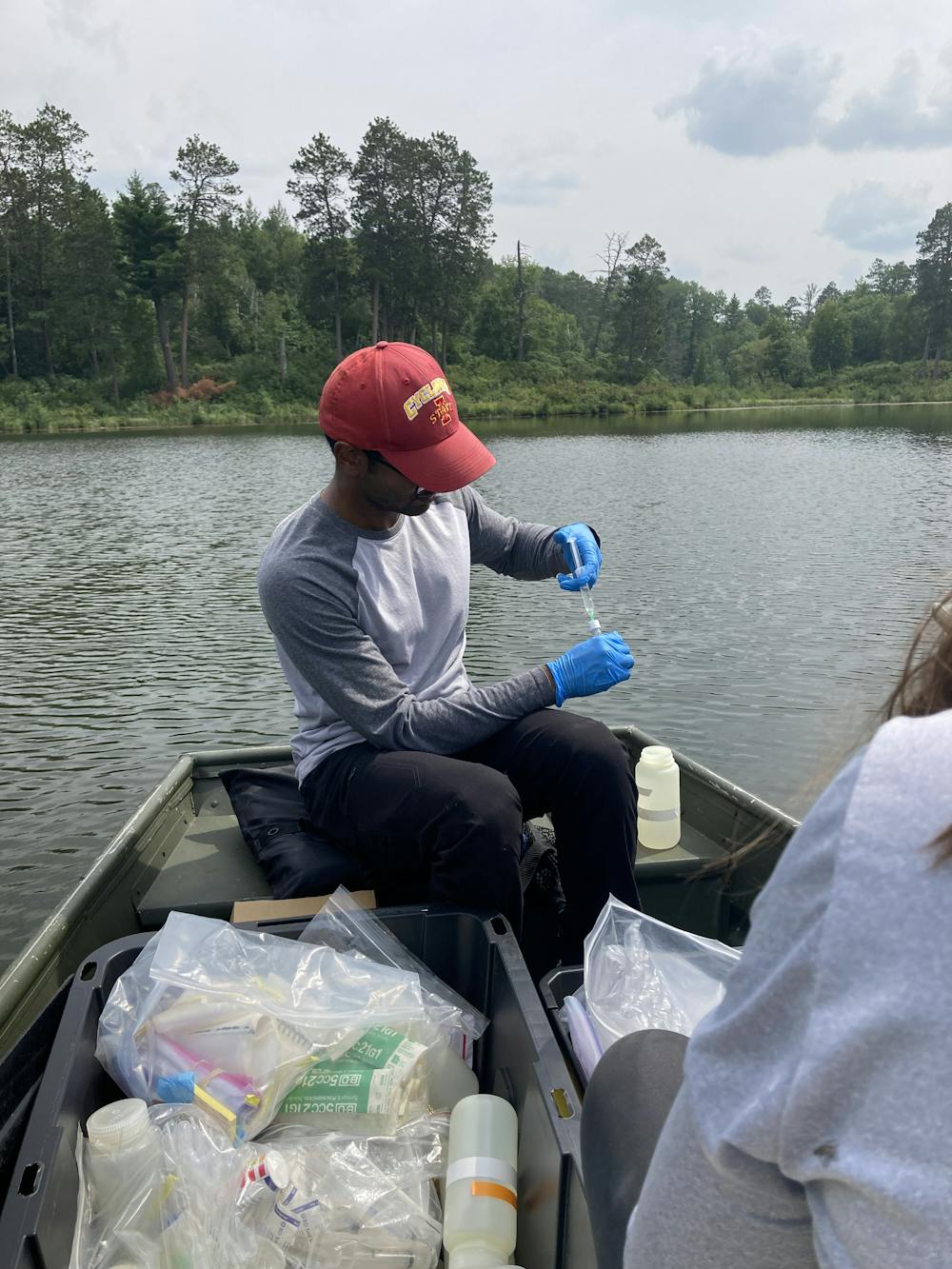
Postdoc researcher Sajjad Akam collects a water sample for chemical analysis back in the lab. Elizabeth Swanner, CC BY-ND
The lake surface is calm, and the still air is glorious on this cool, cloudless August morning. We lower a 2-foot-long water pump zip-tied to a cable attached to four sensors. The sensors measure the temperature, amount of oxygen, pH and amount of chlorophyll in the water at each layer we encounter. We pump water from the most intriguing layers up to the boat and fill a myriad of bottles and tubes, each destined for a different chemical or biological analysis.
My colleagues and I have homed in on Deming Lake to explore questions about how microbial life adapted to and changed the environmental conditions on early Earth. Our planet was inhabited only by microbes for most of its history. The atmosphere and the oceans’ depths didn’t have much oxygen, but they did have a lot of iron, just like Deming Lake does. By investigating what Deming Lake’s microbes are doing, we can better understand how billions of years ago they helped to transform the Earth’s atmosphere and oceans into what they’re like now.
Chlorophyll colors water from the lake slightly green. Elizabeth Swanner, CC BY-ND
At Deming Lake, my colleagues and I pay special attention to the water layer where the chlorophyll readings jump. Chlorophyll is the pigment that makes plants green. It harnesses sunlight energy to turn water and carbon dioxide into oxygen and sugars. Nearly 20 feet (6 meters) below Deming’s surface, the chlorophyll is in cyanobacteria and photosynthetic algae, not plants.
But the curious thing about this layer is that we don’t detect oxygen, despite the abundance of these oxygen-producing organisms. This is the depth where iron concentrations start to climb to the high levels present at the lake’s bottom.
This high-chlorophyll, high-iron and low-oxygen layer is of special interest to us because it might help us understand where cyanobacteria lived in the ancient ocean, how well they were growing and how much oxygen they produced.
We suspect the reason cyanobacteria gather at this depth in Deming Lake is that there is more iron there than at the top of the lake. Just like humans need iron for red blood cells, cyanobacteria need lots of iron to help catalyze the reactions of photosynthesis.
A likely reason we can’t measure any oxygen in this layer is that in addition to cyanobacteria, there are a lot of other bacteria here. After a good long life of a few days, the cyanobacteria die, and the other bacteria feed on their remains. These bacteria rapidly use up any oxygen produced by still photosynthesizing cyanobacteria the way a fire does as it burns through wood.
We know there are lots of bacteria here based on how cloudy the water is, and we see them when we inspect a drop of this water under a microscope. But we need another way to measure photosynthesis besides measuring oxygen levels.
Long-running lakeside laboratory
The other important function of photosynthesis is converting carbon dioxide into sugars, which eventually are used to make more cells. We need a way to track whether new sugars are being made, and if they are, whether it’s by photosynthetic cyanobacteria. So we fill glass bottles with samples of water from this lake layer and seal them tight with rubber stoppers.
We drive the 3 miles back to the Itasca Biological Station and Laboratories where we will set up our experiments. The station opened in 1909 and is home base for us this week, providing comfy cabins, warm meals and this laboratory space.
In the lab, we inject our glass bottle with carbon dioxide that carries an isotopic tracer. If cyanobacteria grow, their cells will incorporate this isotopic marker.
We had a little help to formulate our questions and experiments. University of Minnesota students attending summer field courses collected decades worth of data in Itasca State Park. A diligent university librarian digitized thousands of those students’ final papers.
My students and I pored over the papers concerning Deming Lake, many of which tried to determine whether the cyanobacteria in the chlorophyll-rich layer are doing photosynthesis. While most indicated yes, those students were measuring only oxygen and got ambiguous results. Our use of the isotopic tracer is trickier to implement but will give clearer results.
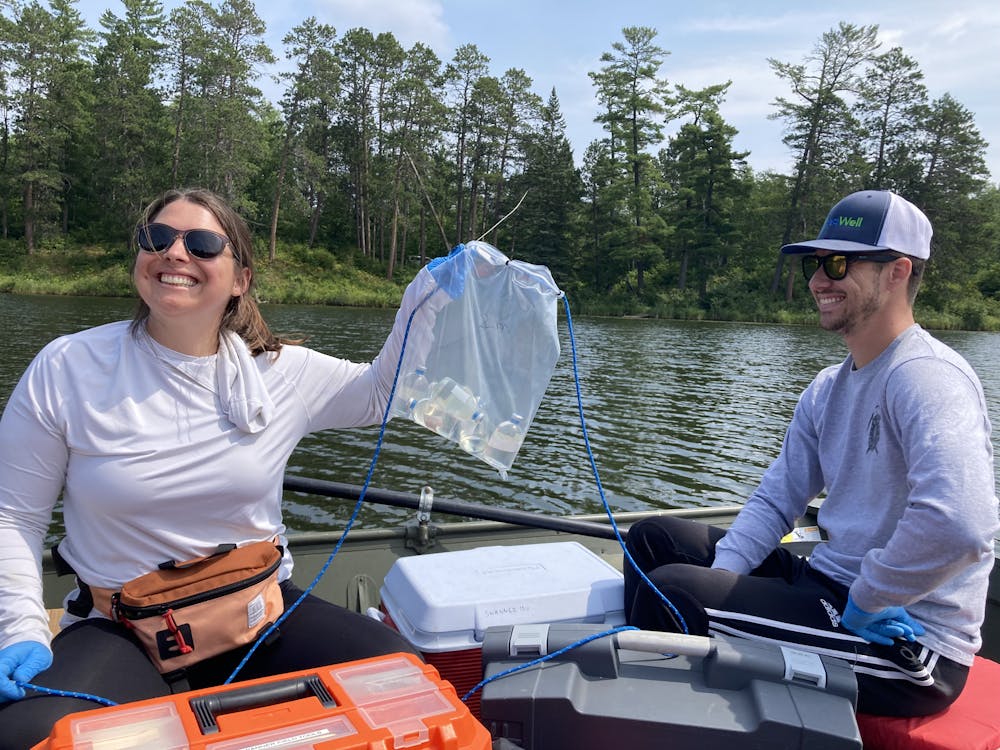
Graduate students Michelle Chamberlain and Zackry Stevenson about to sink the bottles for incubation in Deming Lake. Elizabeth Swanner, CC BY-ND
That afternoon, we’re back on the lake. We toss an anchor; attached to its rope is a clear plastic bag holding the sealed bottles of lake water now amended with the isotopic tracer. They’ll spend the night in the chlorophyll-rich layer, and we’ll retrieve them after 24 hours. Any longer than that and the isotopic label might end up in the bacteria that eat the dying cyanobacteria instead of the cyanobacteria themselves. We tie off the rope to a floating buoy and head back to the station’s dining hall for our evening meal.
Iron, chlorophyll, oxygen
The next morning, as we wait for the bottles to finish their incubation, we collect water from the different layers of the lake and add some chemicals that kill the cells but preserve their bodies. We’ll look at these samples under the microscope to figure out how many cyanobacteria are in the water, and we’ll measure how much iron is inside the cyanobacteria.
That’s easier said than done, because we have to first separate all the “needles” (cyanobacteria) from the “hay” (other cells) and then clean any iron off the outside of the cyanobacteria. Back at Iowa State University, we’ll shoot the individual cells one by one into a flame that incinerates them, which liberates all the iron they contain so we can measure it.
Biogeochemist Katy Sparrow rows a research vessel to shore. Elizabeth Swanner, CC BY-ND
Our scientific hunch, or hypothesis, is that the cyanobacteria that live in the chlorophyll- and iron-rich layer will contain more iron than cyanobacteria that live in the top lake layer. If they do, it will help us establish that greater access to iron is a motive for living in that deeper and dimmer layer.
These experiments won’t tell the whole story of why it took so long for Earth to build up oxygen, but they will help us to understand a piece of it – where oxygen might have been produced and why, and what happened to oxygen in that environment.
Deming Lake is quickly becoming its own attraction for those with a curiosity about what goes on beneath its tranquil surface – and what that might be able to tell us about how new forms of life took hold long ago on Earth.
I cannot easily put my words together about this iconic British rock band formed in 1960; I was 16 then.
‘Now and Then’
The final song from the iconic English rock band The Beatles was released yesterday, a track that relies on AI-enhanced vocals from former co-frontman John Lennon. Listen to the song, titled “Now and Then,” here. Regarded as one of the most influential bands of all time, The Beatles are the bestselling artists in music history, having shipped more than 180 million albums. Lennon, Paul McCartney, George Harrison, and (for most of the time) Ringo Starr, were nominated for 21 Grammys in the span of six years beginning in 1965. The group broke up in 1970, and Lennon was tragically killed by an angry fan in 1980. The new song was originally written by Lennon in 1977 and surfaced in 1994 by McCartney but was shelved due to Lennon’s voice being muffled by a piano. New technology reportedly allowed Lennon’s vocals to be isolated and enhanced to the point of being usable.
Now for some reason I cannot play that YouTube link but hopefully it will be alright when I publish it.
If you have not registered with the BBC then you will need to do so before the link at the bottom works.
This last time it is wood. Here it is:
In this episode – Wood – we visit the Woodwork for Wellbeing Workshop in Bethnal Green, London where every Tuesday people with mental health issues spend time making things with wood. They find it to be very therapeutic and fun. And Professor Miles Richardson of the University of Derby shares research from Japan which shows that simply touching wood is calming.
This is the last one of this series from the Beeb and if any of you have noticed I chose to present these programmes in a different order to that presented by the BBC.
‘chose‘ is only slightly accurate – the true reason is that I screwed up!
Another broadcast from BBC Radio 4 in this series!
As I said before, so far this has been a fascinating series of programmes and, hopefully, some of you have listened to the episodes.
In Episode 5 – Earth – we visit the Horticultural Therapy Trust allotment in Plymouth and discover how gardening can be soothing for people with severe mental illnesses. We also hear about how putting our hands in the earth can be good for our gut microbiome and potentially our mental health.
Produced and Presented by Helen Needham Research by Anna Miles and Maud Start Original Music by Anthony Cowie Mixed by Ron McCaskill and Malcolm Torrie
A BBC Scotland Production made in Aberdeen for BBC Radio 4
This is about breathing and is something I know about. Because Bruce at our local ClubNorthwest has a session with me when I spend five minutes or so taking in through the nose the deepest breath that I can.
If you have not registered with the BBC then you will need to do so before the link at the bottom works.
In Episode 4 – Air – we visit an infant school in Nottingham where young children regularly learn breathing techniques to reduce stress and anxiety. We also hear about research from Italy showing how slowing our breathing impacts positively on brain activity. Plus breath coach and founder of School Breathe, Aimee Hartley, shares her experience of learning to breathe well.
Produced and Presented by Helen Needham Research by Anna Miles and Maud Start Original Music by Anthony Cowie Mixed by Ron McCaskill and Malcolm Torrie
A BBC Scotland Production made in Aberdeen for BBC Radio 4
Continuing this fascinating series from BBC Radio 4.
Last week the BBC chose to present a programme called An Almanac for Anxiety. There were five episodes: Fire; Wood: Water: Air; Earth.
If you have not registered with the BBC then you will need to do so before the link below works.
The details of each episode were presented on the BBC website:
In Episode 3 – Water – we join a group of socially prescribed outdoor swimmers on Teignmouth Beach in Devon who find joy in immersing themselves in cold water. We also hear why spending time around blue spaces is so effective at promoting a sense of calm from Dr Catherine Kelly of the University of Brighton.
Produced and Presented by Helen Needham Research by Anna Miles and Maud Start Original Music by Anthony Cowie Mixed by Ron McCaskill and Malcolm Torrie
A BBC Scotland Production made in Aberdeen for BBC Radio 4






 Learning from Dogs