Jon’s post yesterday about how silence in more general terms is so important for good mental health got me musing about this.
The first thing that struck me was how good dogs are at doing nothing. They are naturals at being in the present, especially when being in the present means nothing more than just laying around.
Just doing - nothing!
OK, one could come up with an intellectual rebuff of that. Dogs aren’t humans, don’t have to go to work, don’t have to struggle to make one’s way in the world, etc., etc. No argument in that, is there. Or is there?
Let’s take monks. Clearly being a monk is a spiritual vocation that appeals to a very small number of people. But they prove that the ‘work, rush around, struggle with life’ scene is NOT hard-wired into mankind, ultimately it is a choice.
Just read this about a day in the life of a monk at Downside Abbey. Don’t react to what you read, just go through the text and notice how frequently words of silence, faith, reflection and prayer come up.
Now I am not suggesting that we all give up our present daily lives and become monks, but I am underlining the importance of balance, and for the sake of our private and public worlds that probably means spending more time doing nothing!
Let’s take North American Indians, in this case the Navajo. They too understood the huge importance of meditation and prayer. This video is just 3:40 long – see if you have the stillness in your mind to watch and listen to this for these few, short minutes.
How did you do?
Now let’s go back to 1966, the year when Simon & Garfunkel released the song, words written by Paul Simon, The Sound of Silence, that later became a huge, global hit. Here are the lyrics – read them slowly and reflect on the meaning in those words.
The Sound Of Silence (3:08)
P. Simon, 1964
Hello darkness, my old friend
I’ve come to talk with you again
Because a vision softly creeping
Left its seeds while I was sleeping
And the vision that was planted in my brain
Still remains
Within the sound of silence
In restless dreams I walked alone
Narrow streets of cobblestone
‘Neath the halo of a street lamp
I turn my collar to the cold and damp
When my eyes were stabbed by the flash of a neon light
That split the night
And touched the sound of silence
And in the naked light I saw
Ten thousand people maybe more
People talking without speaking
People hearing without listening
People writing songs that voices never shared
No one dared
Disturb the sound of silence
“Fools,” said I, “you do not know
Silence like a cancer grows
Hear my words that I might teach you
Take my arms that I might reach you”
But my words like silent raindrops fell
And echoed in the wells of silence
And the people bowed and prayed
To the neon god they made
And the sign flashed out its warning
In the words that it was forming
And the sign said “The words of the prophets are written on the subway walls
And tenement halls
And whispered in the sound of silence
For your sake, and therefore for the sake of all those around you – find your silence.
Like many others, I saw the first episode of the BBC2 television programme, The Big Silence. It clearly touched many people. (Useful links at the very end of this article.)
I wanted to throw a bit of light on this fascinating subject. As the five people in the TV programme all readily admit, real silence is rather scary to them.
Why would something so wished for by so many – an hour doing absolutely nothing – be sufficiently scary that, in reality, the majority will do everything in their power to avoid silence?
Let’s go to a video recorded by Abbot Christopher Jamison a couple of years ago in connection with the BBC Programme Finding Happiness. Here it is:
The points made by Abbot Jamison in that video apply just as much to the task finding peace through silence. Around the 3 minute mark, the Abbott says,
If we come to terms with our demons then we will find that we are not unhappy ….. face the unhappy demons.
We all have unhappy demons, OK some more than others. We start to hear them when we gift our bodies and minds the grace of real silence. I deliberately included the word ‘bodies’ even though silence is a ‘mind’ thing because resting our bodies with regular silence will also be very therapeutic for us.
What does coming to terms mean? It means giving space to those inner thoughts so that one can clearly hear them. You probably won’t make sense of them, indeed they may have a great unsettling effect, but they won’t hurt you.
Indeed, it’s when we try and stop those inner demons that they manifest themselves in many other ways: fidgeting, funny little unexplained aches, itchy skin, short-tempers, constant feeding of the ego, and on and on and on.
A good indication of what’s going on ‘under the bonnet’, so to speak, is to see if you can sit still in a relaxed manner for just 15 minutes.
Let’s go back to the website where you can buy the booklet on Growing into Silence. Here’s what is written there:
The Big Silence is a BBC TWO series about five men and women all of whom believed that they would benefit from finding more time for silence in their lives. They all felt that they needed to slow down and attend more to some of the deeper issues in life. They had little or no outward religious practice but all said that they were open to religious guidance. The result is a journey that took them into a deep silence and in that silence they discovered some powerful dynamics working in their own lives. – All of them were profoundly changed by the experience.
This 44-page booklet, Growing into Silence, offers you the chance to enter into that silence in your own life. You can undertake similar spiritual exercises to those which the volunteers undertook. To help you deepen some of the insights expressed in the series, there are also details of further resources, including a booklist and websites which you can explore.
Each of the exercises in this booklet is presented as a prayerful reflection. They assume that you are not alone as you reflect on your life. You carry out this process in the company of a loving God who looks over you, supports you, and who may well have something to add to your reflections. This is not a hidden way of persuading you to go to church, or sign up to any particular belief-system. Even if you have no idea about God, you can look at whatever most brings you to life or fills you with energy. That is always the most appropriate starting point.
Look at this sentence again, “The result is a journey that took them into a deep silence and in that silence they discovered some powerful dynamics working in their own lives.”
Self-awareness cannot come from outside, it has to come from inside, it has to come from what, in a spiritual sense, we call the soul. If you saw the BBC2 programme, you may recall the Abbot saying, “Silence is the route to the soul, the soul is the route to God.”
And now is not the time to have any form of reaction to the word, God. God, as it is said, works in mysterious ways and if those mysterious ways enable you to move towards your soul then don’t analyse it, just accept it as it is.
My co-author, Paul, wrote an article about Thinking about Truth on the 11th September. He wrote about Dr David Hawkins, another great-standing advocate of the importance of consciousness. Paul wrote in that article,
Think about what Hawkins is saying. He is saying that we intuitively know, without the need of intellectual argument or ‘proof’, the rightness, the beauty, the perfection of some deeply fundamental concepts.
It’s as if from the earliest moments of human awareness, gravity, sunlight, night and day, for example, were obvious despite eons of time needing to pass before science could ’explain’ these aspects of life.
In that blog article, Paul quotes Hawkins, “True power, then, emanates from consciousness itself; what we see is a visible manifestation of the invisible.”
It’s a simple step to connect what the Abbot is saying with that sentence from Hawkins. Silence is the way to hear our consciousness, and those sounds, those inner voices, are the manifestation of what, otherwise, we don’t ‘see’.
Here are the last three paragraphs from the article on truth:
A very well-known magical attribute of the human brain is what goes on in the sub-conscious, our ‘back-office’. Give the brain some space to process a dilemma such as deciding what to do for the best and it does come up with what is best for us. Often the best space we can provide for our brain is a good night’s sleep. It’s common folklore to ‘sleep’ on a problem.
My co-founder of Learning from Dogs, Paul, says that often in sleep we find the truth. I think the same could be said for meditation and prayer, as in a spiritual sense more than in a religious sense.
Just reflect again on the power of what comes out from those two paragraphs. Truth is not something external to us; it is within us, all the time. Our level of consciousness is the key to this truth. Our self-awareness is the tool by which we understand our level of consciousness – our mirror to our soul.
A reminder that man is not, by a long way, the only smart species.
Any dog owner will tell you immediately how clever dogs are. Time and time again, so far as I am concerned, one’s estimation of the ‘smartness’ of a dog is underestimated- they are very smart animals. It applies to many other creatures on this planet.
But this article is about dolphins – bit of a theme at present. In a post published on the 24th, I wrote about how scientists are revealing the incredible closeness between the DNA of dolphins and humans.
An item appeared on the BBC website on the 22nd October. (If I’m not mistaken, I saw the BBC reference on Naked Capitalism, once again!). Here was the BBC article:
Wild dolphins in Australia are naturally learning to “walk” on water.
Six dolphins have now been seen mastering the technique – furiously paddling their tail fluke, forcing their body out and across the water.
WDCS’s Dr Mike Bossley has been observing Adelaide’s Port River dolphins in Australia for the past 24 years and has documented spectacular tail walking in two adult female dolphins, Billie and Wave. But, amazingly, it seems that tail walking is spreading through the Port River dolphin community with four other individuals now having been seen perfecting their walking techniques in recent months.
The spread of tail walking in this way might seem, on the surface (excuse the pun) like a bit of fun, but there is a serious and fascinating cultural aspect linked to these strange goings-on.
Wave’s calf Tallula, Bianca and her calf Hope, and calf Bubbles have all taken up the pastime, and the fun they have had doing so has been recently documented by volunteer WDCS dolphin photographers, Marianna Boorman and Barbara Saberton.
Tail walking is very rare in the wild and in thousands of hours of observation only one other dolphin has ever been observed tail walking in the Port River, and then only once. The Port Adelaide dolphins are now tail walking many times each day.
“Culture in the wider sense of the term, defined as ‘learned behaviour characteristic of a community’, is now frequently on show in the Port River”, says Dr Bossley. “This cultural behaviour is of great significance for conservation.
The article is well worth reading in full – once again the link is here.
Bossley by Ritter
Google also quickly found this blogsite of Gerhard Ritter, FRSASA, an Australian artist with a great oil painting of Dr Bossley (that’s a pic of the painting above).
Here’s what Gerhard wrote on his blog:
For the last few months I’ve been involved with the Faces of the Port project which paired ten artists with ten subjects to produce a set of portraits for display during the 2009 Port Adelaide Festival. My subject was noted dolphin researcher, Dr. Mike Bossley, and the result of our collaboration is this portrait.
The project was co-ordinated by the Port Adelaide Council and the exhibition of finished works will be on display during the festival at the Port Dock Railway Museum from Saturday 10 October.
I enjoyed the project and was delighted to meet Mike. In a world that’s so preoccupied with profit and self agrandisment it is always a pleasure to find individuals who are motivated by higher ideals.
A lovely painting and a wonderful tribute to the man doing so much to increase our awareness and love for these magical animals. Now relax and be inspired …
On the 23rd October, I wrote a piece on Learning from Dogs about the innocence of dolphins and how some humans (not the correct term but it will do for now) sully the very soul of mankind by murdering these beautiful aquatic creatures.
Hopefully, the piece touched a folk with goodness in their hearts. Indeed, one such good person posted a lovely poem as a comment. That person was Sue of the Blogsite Dreamwalker’s Sanctuary. The poem deserved being made a post on here and so it’s an honour to do just that.
A Sanctuary for Inspirational Thoughts of Light, Love and Peace
Our Song, by Sue Dreamwalker
We are the giants that swim beneath the waves
Will you help our babies save?
Why do you Hunt us, why do you Kill?
Do you not realise what part we do play.
Singing our songs each and every day.
Vibration is what your world is held in
We balance your ocean along with Dolphin.
Now once again we are chased from the deep
Your awareness of us is what we do seek.
So painful a death as we face the harpoon.
Our calves are left orphaned to swim alone.
Our carcass is butchered, how long can we survive?
Our only escape is dive, dive, dive.
But connected to you we breathe the same air
Please listen to our despair.
For Our Song in lament we plead with you all.
For soon no longer will you hear our call.
Thanks Sue.
And do tune in next Monday (1st November) – another lovely story about dolphins.
This makes fascinating listening and thinking. I am referring to the BBC4 programme, Eureka Moment, first broadcast in March 2010.
Lovelock
Some frightening stuff to reflect on, however, he is a tremendously positive person. His level of thinking and orginality is breath taking. Painful and not pleasant, but a snapshot of a possible outcome.
Interesting from a David Hawkins point of view to measure his level of integrity on the scale of human consciousness that Hawkins developed.
I’m delighted to see that the BBC still has a huge amount available about Lovelock’s claims. A small extract from here.
The man who achieved global fame for his theory that the whole earth is a single organism now believes that we can only hope that the earth will take care of itself in the face of completely unpredictable climate change.
Interviewed by Today presenter John Humphrys, videos of which you can see below, he said that while the earth’s future was utterly uncertain, mankind was not aware it had “pulled the trigger” on global warming as it built its civilizations.
Here’s a video, taken quite recently, of the Professor explaining his approach to his science.
But whatever, don’t lose heart. Keep the faith in a better future, as Paul wrote yesterday.
“Faith is not simply a patience that passively suffers until the storm is past. Rather, it is a spirit that bears things – with resignations, yes, but above all, with blazing, serene hope.” Corazon Aquino.
Yes, I cheated. I looked for a quotation to suit the mood of this post and came across the above. Corazon Aquino was the woman who led the revolution which toppled the authoritarian regime of the late strongman Ferdinand Marcos and restored democracy in the Philippines.
Anyway, to the theme of this Post.
Those that are regular readers of Learning from Dogs know that at one level I am not optimistic about the future over the coming years. A quick trawl through this Blog will find quite a few articles showing that things are going to get a lot worse before they get better.
One of the forecasters who has consistently been on the money, so to speak, is Gerald Celente. He runs an organisation known as Trends Research Institute.
Here’s 14 minutes from a recent interview on the Alex Jones Show. Do watch it to the end.
Despite being US focussed this interview still has massive implications for the rest of the world.
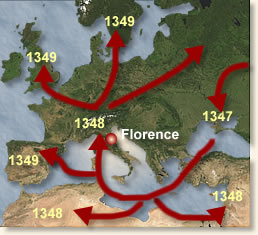
This Post is about faith. Around minute 10:30 in the above video, Celente talks of those people that have the faith in themselves to bring about change. Celente talks that from all great disasters comes change. He talks of the Black Death that in the three years from 1348 wiped out up to 50% of Europe’s population.
Coming out of the East, the Black Death reached the shores of Italy in the spring of 1348 unleashing a rampage of death across Europe unprecedented in recorded history. By the time the epidemic played itself out three years later, anywhere between 25% and 50% of Europe’s population had fallen victim to the pestilence.
Plague's progress
So here’s the point. In the Celente interview, he predicts that 20% of Americans will reject the way that they see their society going. Fascinating! That 20% figure.
Dr David Hawkins in his seminal book Power vs Force writes on page 77:
… 85% of the [world] race is below the critical level of 200, while the overall average level of human consciousness is approximately 204. The power of the relatively few individuals near the top counterbalance the weakness of the masses towards the bottom to achieve the overall balance.
Hawkins is saying that 15% of the world’s population has the integrity required to bring up the level of consciousness of all the rest.
I have the faith that we are on the verge of another renaissance for mankind, one based on integrity and truthfulness, honesty and love. In my faith, I see this next renaissance being born in America, still the land of the free.
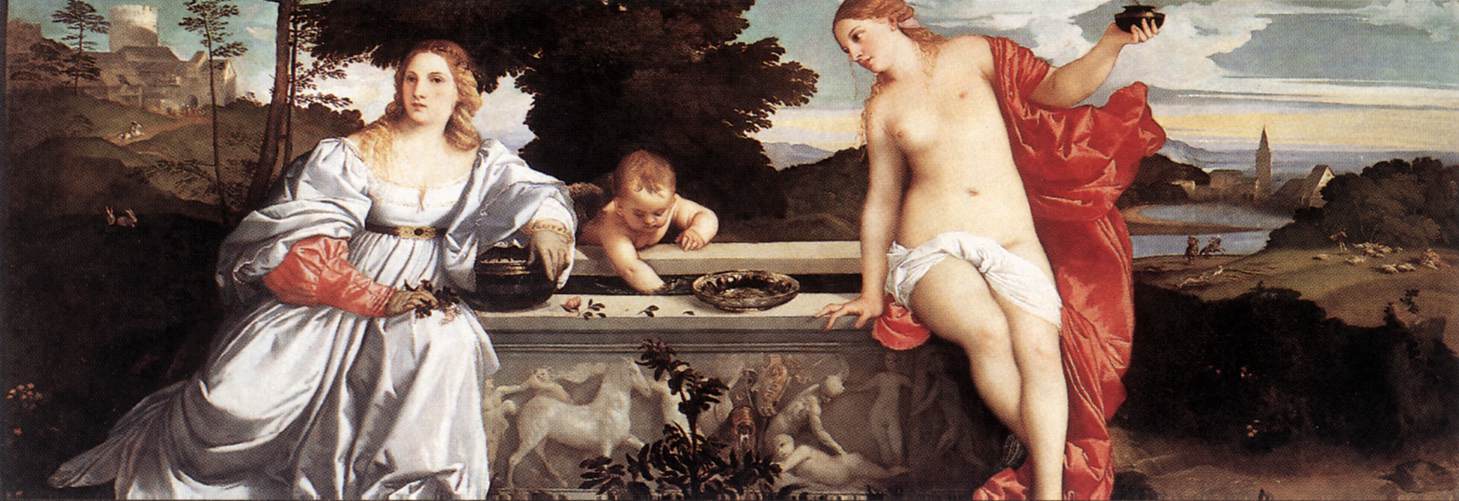
"Sacred and Profane Love" by Tiziano Vecellio, otherwise known as Titian
Titian was born in 1488 just 100 years after Europe was ravaged by the Plague.
Keep the faith – there is a wonderful new world just around the corner.
Well the first thing that raised a smile was me putting in the word ‘happiness’ into a Google search and noticing the response – About 50,000,000 results (0.15 seconds)!
50 million results – wow.
Let me tell you that I don’t propose to cast myself as anything other than an ordinary Joe. The simple motivation behind this Post is that if a single person reading these words gets some insight into seeing their own lives in a richer way, then it’s worth while.
Let’s come at the subject from the perspective of good mental health. What’s that then?
Here’s an extract from MIND – the leading mental health charity in the UK.
Good mental health isn’t something you have, but something you do. To be mentally healthy you must value and accept yourself. This means that:
You care about yourself and you care for yourself. You love yourself, not hate yourself. You look after your physical health – eat well, sleep well, exercise and enjoy yourself.
You see yourself as being a valuable person in your own right. You don’t have to earn the right to exist. You exist, so you have the right to exist.
You judge yourself on reasonable standards. You don’t set yourself impossible goals, such as ‘I have to be perfect in everything I do’, and then punish yourself when you don’t reach those goals.
If you don’t value and accept yourself, you are always frightened that other people will reject you. To prevent people seeing how unacceptable you are, you keep them at a distance, and so you are always frightened and lonely. If you value yourself, you don’t expect people to reject you. You aren’t frightened of other people. You can be open, and so you enjoy good relationships.
If you value and accept yourself, you are able to relax and enjoy yourself, without feeling guilty. When you face a crisis, you know that, no matter how difficult the situation is, you will manage. How we see ourselves is central to every decision we make. People who value and accept themselves cope with life.
The BBC, often so good at important public service issues, ran a series of programmes in 2008 under the banner of The Happiness Formula. Included in that web link is a simple test to measure one’s own happiness.
Psychologists say it is possible to measure your happiness.
NB: I just tried this test myself and wasn’t sure if the analysis part of the test was working – try it yourself. But the information offered is still well worth reading.
There’s more background on Prof. Diener here. And a short video below.
Perhaps more valuable is another excellent TEDtalks video Habits of Happiness.
In Japan, fishermen round up and slaughter hundreds and even thousands of dolphins and other small whales each year.In the small fishing village of Taiji, entire schools of dolphins are driven into a hidden cove after a prolonged chase. Once trapped inside the cove, the fishermen kill the dolphins, slashing their throats with knives or stabbing them with spears. The water turns red with their blood, and the air fills with their screams.
Pure luck in discovering things you were not looking for.
But the Buddhist belief is that there is no such thing as luck. See here:
The dictionary defines luck as ‘believing that whatever happens, either good or bad, to a person in the course of events is due to chance, fate or fortune.’ The Buddha denied this belief completely. Everything that happens has a specific cause or causes and there must be some relationships between the cause and the effect. (My italics.)
So you takes your choice! The Free Dictionary goes on to provide a fascinating account of the word history of serendipity:
Word History: We are indebted to the English author Horace Walpole for the word serendipity, which he coined in one of the 3,000 or more letters on which his literary reputation primarily rests. In a letter of January 28, 1754, Walpole says that “this discovery, indeed, is almost of that kind which I call Serendipity, a very expressive word.” Walpole formed the word on an old name for Sri Lanka, Serendip.He explained that this name was part of the title of “a silly fairy tale, called The Three Princes of Serendip:as their highnesses traveled, they were always making discoveries, by accidents and sagacity, of things which they were not in quest of….”
The work that the dedicated folks at WITNESS do is both humbling and uplifting and puts into perspective the value of what we do everyday.
Take 10 minutes from your busy day to view this video and then look at the WITNESS website to see what real change looks like. It will inspire you and enrich your life. It is important.
That reference to the charity WITNESS impressed me. Especially the fact that
Peter Gabriel
it was founded by that great musician Peter Gabriel.
Here’s the video mentioned in the extract above:
So how to close this particular post? Not sure, to be honest. But whether one believes in luck or not, there’s no doubt that we attract the world around us that we ‘deserve’.
As has been said before on this Blog, we get more of what we think about most. So really the Buddhist approach that there “must be some relationships between the cause and the effect” is more than sufficient reason to be a good and integrous member of this planet.
Your task is not to seek for love, but merely to seek and find all the barriers within yourself that you have built against it.Jala ad-Din Rumi 1207 – 1273
One would suspect that readers of this Post title would have many different responses to the word ‘love’. Perhaps in this harsh, economically challenged world, it seems a little quaint to think about love in anything other than a romantic sense.
But, trust me, there’s nothing quaint or ‘away with the fairies’ about reminding us all of both the power of love and the urgent need to bring that power further up the scale of human consciousness. Let’s even try and aim for where dogs are. Dogs intuitively demonstrate unconditional love to those around them that they trust.
Dog love!
Before we look at the effects of love, let’s remind ourselves of some of the outcomes from the stress and trauma generated by present times. A news item from the London School of Hygiene and Tropical Medicine published in July, 2009, said this:
Researchers at London School of Hygiene & Tropical Medicine and Oxford University estimated that soaring stress brought on by job losses could prompt a 2.4% rise in suicide rates in people under-64 years of age, a 2.7% rise in heart attack deaths in men between 30 and 44 years, and a 2.4% rise in homicides rates, corresponding to thousands of deaths in European Union countries, such as the UK.
Nor is the impact just economic. The sudden flipping from the wild optimism of the boom to the personal gloom and self-doubt of recession and system-wide financial crisis is bad for health and well-being.
So it appears as if there’s no shortage of reasons why engaging the power of love offers infinite possibilities for us all.
The BBC recently reported on research that shows that people in love can lower their levels of pain.
Love hurts, at least according to many a romantic songwriter, but it may also help ease pain, US scientists suggest.
Brain scans suggest many of the areas normally involved in pain response are also activated by amorous thoughts.
Stanford University researchers gave 15 students mild doses of pain, while checking if they were distracted by gazing at photos of their beloved.
He said: “One example is a footballer who has suffered quite a painful injury, but who is able to continue playing because of his emotionally charged state.”
He added that while the effect noticed by the Stanford researchers might only be short-lived in the early stages of a love affair, it may well be replaced by something similar later in a relationship, with a sense of comfort and wellbeing generating the release of endorphins.
“It’s important to recognise that people who feel alone and depressed may have very low pain thresholds, whereas the reverse can be true for people who feel secure and cared for.
Prof Gilbert states on his web page that “After years of exploring the processes underpinning shame and its role in a variety of psychopathologies,
Prof. Gilbert
my current research is exploring the neurophysiology and therapeutic effectiveness of compassion focused therapy.” (My italics.)
The old adage that you can’t love another if you don’t love yourself is based on very high levels of awareness. So the starting point to gaining the power of love is self-awareness. Here’s something from MIND:
Good mental health isn’t something you have, but something you do. To be mentally healthy you must value and accept yourself. This means that:
You care about yourself and you care for yourself. You love yourself, not hate yourself. You look after your physical health – eat well, sleep well, exercise and enjoy yourself.
You see yourself as being a valuable person in your own right. You don’t have to earn the right to exist. You exist, so you have the right to exist.
You judge yourself on reasonable standards. You don’t set yourself impossible goals, such as ‘I have to be perfect in everything I do’, and then punish yourself when you don’t reach those goals.
Finally, back to romantic love. The most glorious feeling in the world.
Again expressed so beautifully by Rumi: “The minute I heard my first love story I started looking for you, not knowing how blind that was. Lovers don’t finally meet somewhere. They’re in each other all along.”