Category: consciousness

Poppy, Be in Peace

A tragic loss of a wonderful dog.

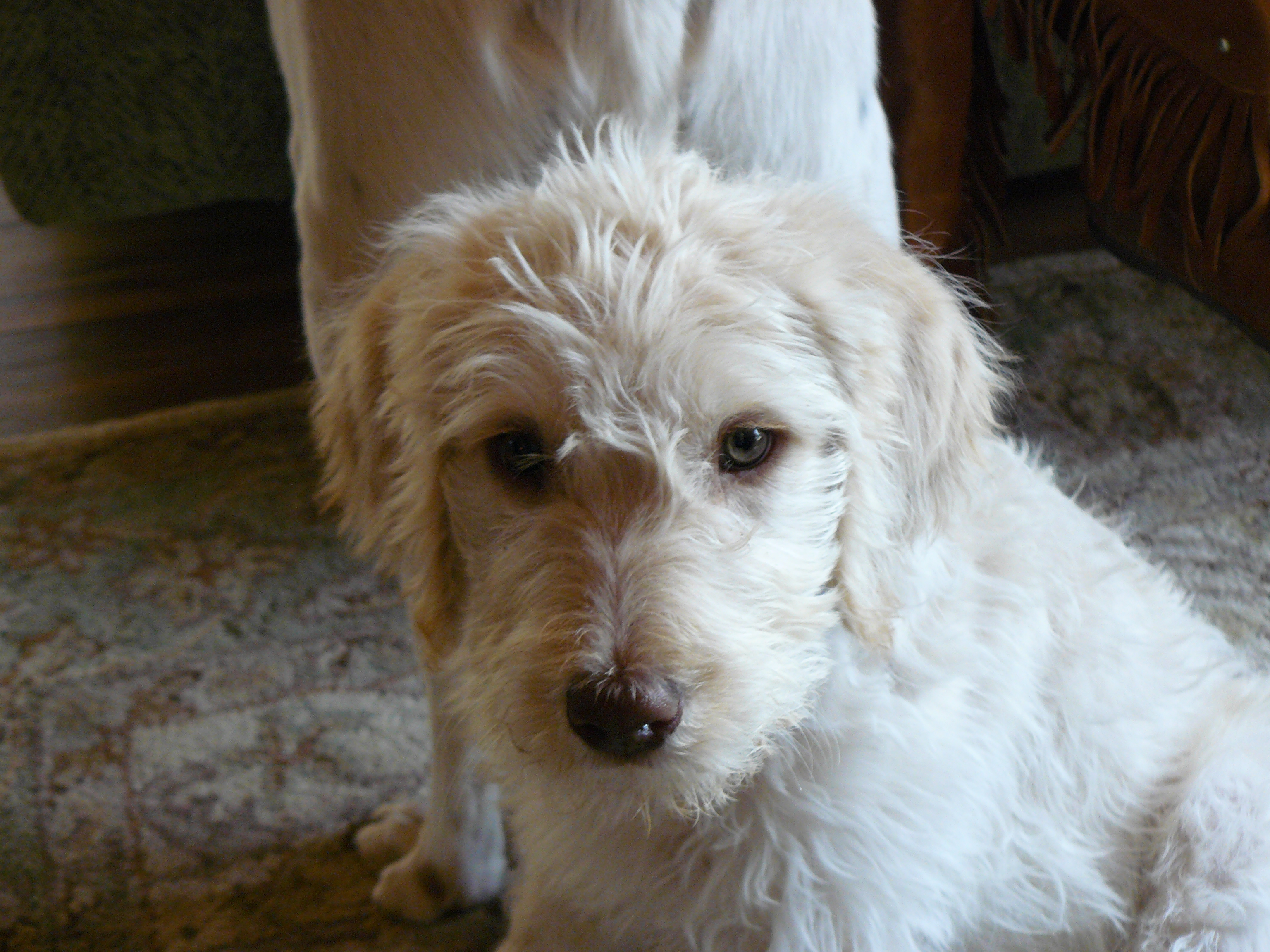
Little Poppy

On Friday afternoon, Jeannie and I were out on our usual walk along a trail through the Granite Dells.  This is spectacular scenery with magnificent granite boulders, escarpments and mountains all around.  The trail that we use is a Payson Area Trails System/United States Forestry Service designated walk.

As it happens it’s just over a mile from where we live and it has been a regular place to walk Pharaoh’s ‘pack’ most days.

Pharaoh’s little group of dogs includes Dhalia, Hazle and Poppy.  Poppy is a small terrier/poodle mix and like Dhalia and Hazle is a rescue dog.  Indeed Jean rescued Poppy many years ago from a Mexican rubble site practically hairless and surviving, just, off food scraps she could beg, steal or find.  Poppy, at 15 lbs, was also the closest buddy of Pharaoh, at 90 lbs!  Pharaoh is our German Shepherd dog whose face is the subject of the home page of this Blog.

We walk all four of them most days along the trail described above; Friday was no exception.  The only difference was that when we were almost back to the car we stopped and chatted to a neighbour, Bud, who was in his truck with a couple of his dogs.

Bud then drove off and we immediately noticed Poppy wasn’t with us.

One minute she was with us, the next Poppy had simply disappeared!

And that really is it.  I could go on about the hours spent going over and over the area, re-walking the trail, staying there until nightfall on Friday, going back at 06.30 am on Saturday morning, then again twice more on Saturday and again on Sunday with an inch of snow on the ground and with heavy sleet pelting down.  Not a sign, not a whimper, not a clue.

Thus she remains lost in weather that for the last 48 hours has been brutal; it is unrealistic to imagine that she survived despite us praying for a miracle.  Jeannie is devastated; I the same.  What hurts so much is not knowing what happened.

So dear little Poppy we hope you are at peace and we thank you for the great love you have given Jean and then later on me and Pharaoh.

“There is one best place to bury a dog.
“If you bury him in this spot, he will
come to you when you call – come to you
over the grim, dim frontier of death,
and down the well-remembered path,
and to your side again.

“And though you call a dozen living
dogs to heel, they shall not growl at
him, nor resent his coming,
for he belongs there.

“People may scoff at you, who see
no lightest blade of grass bent by his
footfall, who hear no whimper, people
who may never really have had a dog.
Smile at them, for you shall know
something that is hidden from them,
and which is well worth the knowing.

“The one best place to bury a good
dog is in the heart of his master.”

Ben Hur Lampman —
from the Portland Oregonian Sept. 11, 1925

Poppy is beautifully placed in the heart of Jeannie, me and all her doggie friends.

Total, utter madness, Pt 3.

The third chapter of Lester Brown‘s book, World on the Edge.

This pivotal book is being explore for you, dear reader, chapter by chapter.  Chapter One set the background, Chapter Two looked at Falling Water Tables and Shrinking Harvests, this next Chapter looks at the land itself.

Chapter Three, Eroding Soils and Expanding Deserts.

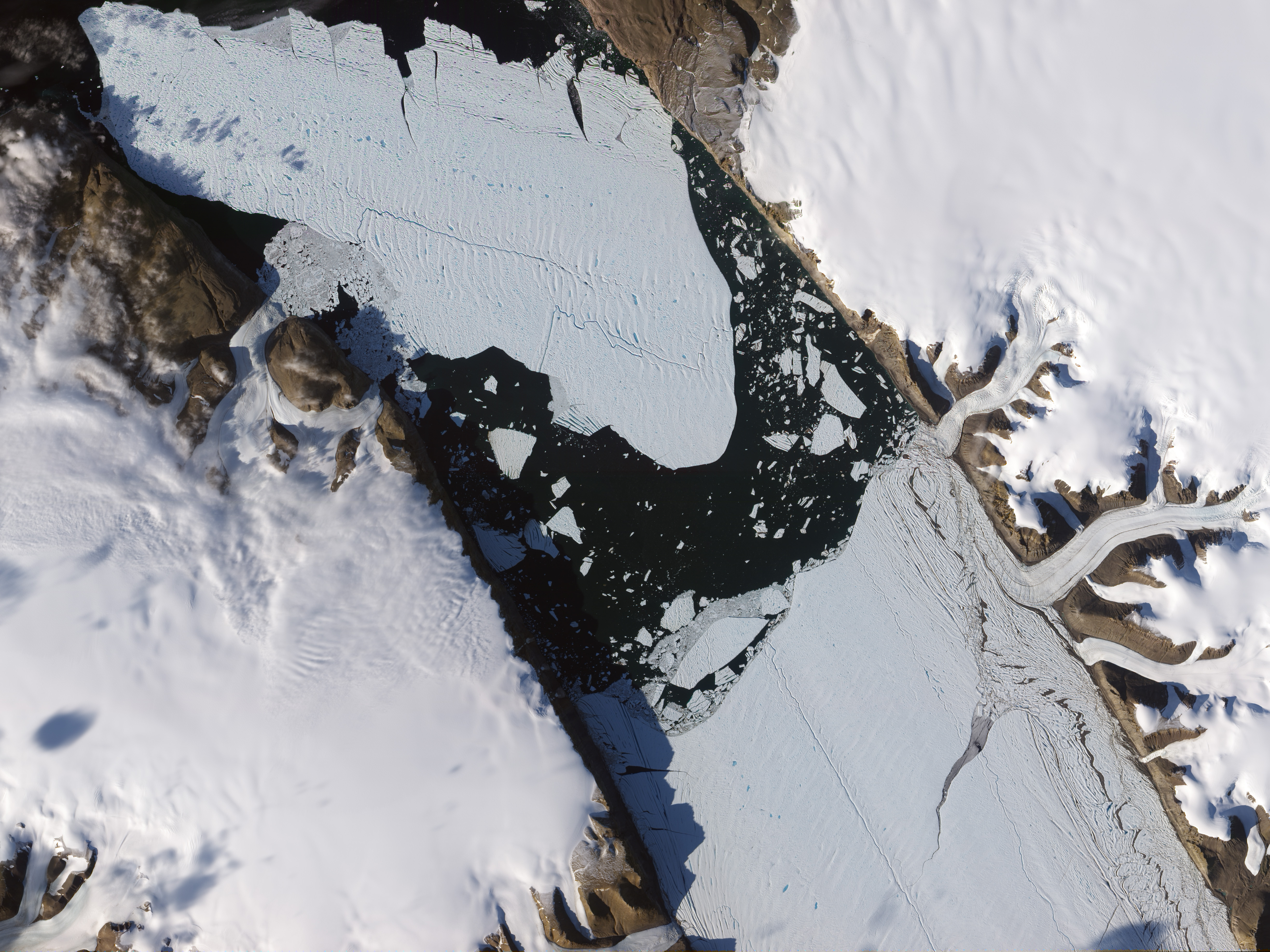
  • On March 20th, 2010 a huge and suffocating dust storm first affected 250 million people in Eastern China before moving on to
    No sustenance here!

    South Korea.  It was described by the Korean Meteorological Administration (KMA) as the worst dust storm on record.

  • The thin layer of topsoil that covers the earth’s land surface is typically measured in inches and is the foundation of our civilization.
  • Journalist Stephen Leahy writes in Earth Island Journal that soil erosion is “the silent global crisis.” A gradual, unobserved process that has potentially catastrophic consequences if ignored for too long.
  • Today, roughly a third of the world’s cropland is losing topsoil at an excessive rate.
  • Studies on soil erosion in the U.S. shows that for every inch of topsoil lost, wheat and corn crop yields declined by 6 percent.
  • A U.S. Embassy report entitled, “Desert Mergers and Acquisitions” describes satellite images showing two deserts in north-central China expanding and merging to form a single, larger desert overlapping Inner Mongolia and Gansu Provinces.
  • India, with scarcely 2 percent of the world’s land area, is struggling to support 17 percent of the world’s people and 18 percent of its cattle.
  • According to scientists at the Indian Space Research Organisation, 24 percent of India’s land area is slowly turning into desert.
  • As countries lose their topsoil, they eventually lose the capacity to feed themselves.
  • Countries facing this problem include Lesotho, Haiti, Mongolia, and North Korea.

As this chapter concludes, “the health of the people cannot be separated from the health of the land itself.”


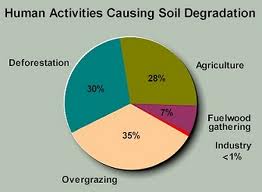
Human Activities


OK, another grim chapter covered in this series simply to underscore the grave seriousness that our beautiful planet faces if it is to continue to sustain all our peoples.  Lester Brown says that now, not tomorrow or the next day, now is the time to change direction, to stop the wholesale destruction of the very environment that we all, yes ALL OF US, depend on for our existence.  It has to be done radically and passionately.

But the book ultimately carries an extremely positive second half.  That there is a Plan B that is viable, achievable and cost-effective, and that many countries are committed to making a life-saving difference.  So while these posts carry some pretty grim messages, and will for a while, please remain hopeful and positive that you, and I, and all those around us, can make a difference once we know what to do.

Joseph Campbell, first taste

This is one remarkable man.

Really tight on time at this moment (Sunday afternoon) so all I want to do is to lightly introduce this great thinker to those that haven’t come across him before.

Joseph Campbell died in 1987 but his influence continues to be strong and powerful, positively increasing year by year.

His works, his life and his messages are wonderfully promulgated by the Joseph Campbell Foundation.  Becoming a JCF Associate is free!

Much more in due course!

Total, utter madness, Pt 2.

More on the way we are most likely treating Planet Earth.

At the start of the week the first of a shortish series of articles was published, reflecting my support of the book, World on the Edge.  Here’s what I wrote then:

I have mentioned before the Earth Policy Institute and Lester Brown’s latest book, World on the Edge.  Details of the book are here.

At the time of writing this Post (10am US Mountain Time on the 4th Feb.) I have read through to the end of Chapter 5 of the book and will have it completed soon.  It’s opening my eyes hugely!

I have decided over the next week or so to summarise each chapter, hoping that this encourages many readers of Learning from Dogs to reflect, go to the EPI website, buy the book or think about making a difference in any way that you can.

So today, I move on to the next chapter.

Chapter two, Falling Water Tables and Shrinking Harvests.

  • The term ‘fossil aquifer’ demonstrated that not all aquifers are the same.  Let me quote, “There are two sources of irrigation water: underground water and surface water.  Most underground water comes from aquifers that are regularly replenished with rainfall; these can be pumped indefinitely as long as water extraction does not exceed recharge.  But a distinct minority of aquifers are fossil aquifers – containing water put down eons ago.  Since these do not recharge, irrigation ends whenever they are pumped dry.
  • The big fossil aquifers are the Ogallala underlying the US Great Plains, the major aquifer in Saudi Arabia , and the deep aquifer under the North China Plain.
  • Saudi Arabia started drilling for water from their underground fossil aquifer when after the Arab oil-export in the 1970s, the Saudis realised that they were dependent on imported grain and set out to create self-sufficiency in grain by way of irrigation.
  • In January 2008 the Saudis announced that this huge aquifer was largely depleted!
  • From 2007 to 2010 the Saudi wheat harvest dropped from nearly 3 million tons to around 1 million tons.
  • The likelihood is that the last Saudi harvest will be around 2012.

One can’t imagine how the management of a fine and proud country such as Saudi Arabia could be so foolish!  But slightly closer to home …..

  • In most of the leading U.S. irrigation states, the amount of irrigated area has peaked and begun to decline.
  • California, historically the irrigation leader, has seen irrigated areas fall from nearly 9 million acres in 1997 to an estimated 7.5 million acres in 2010, that’s a 16% drop!  Why?
  • Aquifer depletion and diversion of water to fast-growing cities!
  • Then there’s Texas.  Their irrigated area peaked in 1978 at 7 million acres, now down to 5 million acres, a loss of 29%, as the Ogallala fossil aquifer under the Texas panhandle becomes depleted.
  • Colorado has seen its irrigated are shrink by 15%
  • Arizona’s irrigated area is shrinking.
  • Florida’s irrigated area is shrinking.

Then there’s India.  Then there’s Mexico.  And on and on.  I could quote so much more from this single chapter but – you get the message!

Here’s how the chapter ends.

Today more than half the world’s peoples live in countries with food bubbles.  The question for each of these countries is not whether the bubble will burst, but when – and how the government will cope with it. [Read that last sentence again, folks. Ed]

Will governments be able to import grain to offset production losses?  For some countries, the bursting of the bubble may well be catastrophic.  For the world as a whole, the near-simultaneous bursting of several national food bubbles, as aquifers are depleted could create unmanageable food shortages.

This situation poses an imminent threat to food security and political stability.  We have a choice to make.  We can continue with over-pumping as usual and suffer the consequences.  Or we can launch a worldwide effort to stabilise aquifers by raising water productivity – patterning the campaign on the highly successful effort to raise grainland productivity that was launched a half-century ago.

H’mmm.  Tough reading.

Amazon Drought in 2005.

The above photograph was taken from this website; here’s an extract from the accompanying article.

Food inflation is here and it’s here to stay.  We can see it getting worse every time we buy groceries. Basic food commodities like wheat, corn, soybeans, and rice have been skyrocketing since July, 2010 to record highs.  These sustained price increases are only expected to continue as food production shortfalls really begin to take their toll this year and beyond.

This summer Russia banned exports of wheat to ensure their nation’s supply, which sparked complaints of protectionism.  The U.S. agriculture community is already talking about rationing corn over ethanol mandates versus supply concerns. We’ve seen nothing yet in terms of food protectionism.

But as I wrote in the previous article, “Be worried, be concerned but don’t panic – you and I, all of us, have the collective power to sort this all out.”  Lester Brown’s book sets out some strong advice on the way forward.

To be continued, as they say.

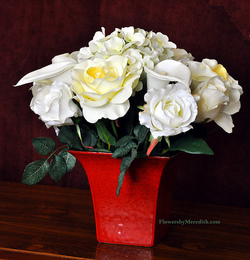
Flowers for your Valentine

This opened my eyes; thought I would share it with you.

I know that many of the several hundred readers of Learning from Dogs are not in the USA.  But many are.  Hence me deciding, after mulling it over, to publish in full the contents of an email that came in a short while ago from the organisation Change.

Here’s that email.

Dear Paul,

Valentine’s Day, which accounts for 40% of fresh flower sales annually, is fast approaching.

Not always a sweet smell.


If you’re planning to order a bouquet from 1-800-Flowers — the world’s largest florist — you should know where most of those flowers really come from.

At flower farms in Ecuador and Colombia — the countries that export the most to the U.S. — two-thirds of the workers are women. These women are routinely subjected to harassment and even rape from their male supervisors. They suffer eye infections and miscarriages from consistent contact with dangerous pesticides.

In the weeks leading up to Valentine’s Day and Mother’s Day, they’re routinely forced to work 80-hour weeks with no overtime pay. Attempts to form a union are met with opposition by police and armed forces.

Many retailers — such as Whole Foods and Stop & Shop — have taken the important first step of offering Fair Trade flowers to consumers who want no part of these abuses. Fair Trade certified farms must adhere to strict standards for workers’ rights, which prevents the abuses described above.

1-800-Flowers is the largest florist in the world. Yet they offer no Fair Trade flowers at all.

Tell 1-800-Flowers to join other major retailers in offering Fair Trade flowers.

1-800-Flowers uses a certifying agency called Florverde, which ensures that its flower farms measure up to certain environmental standards — this is a good thing. But Florverde has almost no labor standards: A farm can be certified even if it uses forced labor.Indeed, Florverde is owned by the Association of Colombian Flower Exporters, so it has a financial incentive to keep wages low and suppress workers’ rights.

This is the week before Valentine’s Day — more people will purchase flowers during the next seven days than any other week this year. This is our best opportunity to demand a promise from 1-800-Flowers to join its competitors in offering Fair Trade flowers. So after you sign the petition, please share this email widely and post on Facebook — do everything you can to pressure 1-800-Flowers to show a little respect for the women who toil in unbearable circumstances. The women without whom they’d have no flowers to sell.

Click the link below to tell 1-800-Flowers to make a promise this Valentine’s Day to sell Fair Trade flowers:

http://www.change.org/petitions/ask-1-800-flowers-to-offer-fair-trade-flowers-that-arent-picked-by-exploited-workers?alert_id=IiStMzHsCg_LCLOlfFAhl&me=aa

Since this campaign began, the company has emailed to tell us that it will post more information on its website about the farms that supply their flowers. But this is a far cry from selling fair trade products — and we have much more to do to make sure workers are protected. This is the week to do it.

Thanks for taking action,

Patrick and the Change.org team

If you feel so minded to sign the petition, which can be done by people outside the USA, then that may be done here.

Thanks.

Total, utter madness, Pt 1.

The way we are most likely treating Planet Earth is almost beyond comprehension.

I have mentioned before the Earth Policy Institute and Lester Brown’s latest book, World on the Edge.  Details of the book are here.

At the time of writing this Post (10am US Mountain Time on the 4th Feb.) I have read through to the end of Chapter 5 of the book and will have it completed soon.  It’s opening my eyes hugely!

I have decided over the next week or so to summarise each chapter, hoping that this encourages many readers of Learning from Dogs to reflect, go to the EPI website, buy the book or think about making a difference in any way that you can.

Chapter One, On the Edge, sets the background:

  • Summer of 2010 sees record-high temperates in Moscow, Russia’s grain harvest shrank by 40 million tons (40%) to 60 million tons.
  • Record high temperatures in south-central Pakistan were recorded. Snow and glaciers in the Himalayas melted fast, 20 million Pakistanis were affected by the resultant flooding, 2,000 died, 6 million acres of crops damaged.
  • A 2002 study by Mathis Wackernagel concluded that, “humanity’s collective demands first surpassed the earth’s regenerative capacity around 1980.  By 1999, global demand’s on the earth’s natural systems exceeded sustainable yields by 20 percent.  Ongoing calculations show it at 50 percent in 2007.  Stated otherwise, it would take 1.5 Earths to sustain our current consumption.” [my emphasis]
  • “No previous civilisation has survived the ongoing destruction of its natural supports.  Nor will ours.”

Let’s turn to NOAA.  A few salient points from there State of the Climate – Global Review for 2010.

  • For 2010, the combined global land and ocean surface temperature tied with 2005 as the warmest such period on record, at 0.62°C (1.12°F) above the 20th century average of 13.9°C (57.0°F). 1998 is the third warmest year-to-date on record, at 0.60°C (1.08°F) above the 20th century average.
  • The 2010 Northern Hemisphere combined global land and ocean surface temperature was the warmest year on record, at 0.73°C (1.31°F) above the 20th century average. The 2010 Southern Hemisphere combined global land and ocean surface temperature was the sixth warmest year on record, at 0.51°C (0.92°F) above the 20th century average.
  • The global land surface temperature for 2010 tied with 2005 as the second warmest on record, at 0.96°C (1.73°F) above the 20th century average. The warmest such period on record occurred in 2007, at 0.99°C (1.78°F) above the 20th century average.


Russian forest fires.


From the UK Guardian newspaper.

2010 is becoming the year of the heatwave, with record temperatures set in 17 countries.

Record highs have occurred in Russia, Belarus and Ukraine – the three nations at the centre of the eastern European heatwave which has lasted for more than three weeks – but also African, Middle Eastern and Latin American countries.

Temperatures in Moscow, which have been consistently 20C above normal, today fell to 31C (86F), and President Dmitry Medvedev cancelled a state of emergency in three out of seven Russian regions affected by forest fires.

Thousand of hectares of forest burned in the fires, killing 54 people and leaving thousands homeless. For days, Moscow was shrouded in smog, and environmentalists raised fears that the blaze could release radioactive particles from areas contaminated in the 1986 Chernobyl disaster.

Wildfires have also swept through northern Portugal, killing two firefighters and destroying 18,000 hectares (44,500 acres) of forests and bushland since late July. Some 600 firefighters were today struggling to contain 29 separate fires.

But the extreme heat experienced in Europe would barely have registered in Iraq, Saudi Arabia, Niger, Pakistan and Sudan, all of which have recorded temperatures of more than 47C (115F) since June. The number of record highs is itself a record – the previous record was for 14 new high temperatures in 2007.

The freak weather conditions, which have devastated crops and wildlife, are believed to have killed thousands of elderly people, especially in Russia and northern India. The 2003 European heatwave killed about 15,000 people.

Be worried, be concerned but don’t panic – you and I, all of us, have the collective power to sort this all out.  More about this soon.

So near, so far!

Mixed emotions about those other worlds out there.

In recent times, Learning from Dogs has been reflecting on the magic, and fragility, of the planet we all live on.

There was the photograph of the Earthrise that attracted quite a few comments.  That was followed up by the amazing photograph of the Earth from Voyager 1 taken in 1990 from 3,762,136,324 miles away!  Then the lovely poem from Sue.

So it was interesting to note my mixed emotions to a piece on the BBC News website yesterday.  Here’s a flavour.

Worlds away

Astronomers have identified some 54 new planets where conditions may be suitable for life.

Five of the candidates are Earth-sized.

The announcement from the Kepler space telescope team brings the total number of exoplanet candidates they have identified to more than 1,200.

The data release also confirmed a unique sextet of planets around a single star and 170 further solar systems that include more than one planet circling far-flung stars.

Read the rest of the item here. (and there’s a fuller version on NetworkWorld)

So here are those mixed emotions.

  • Man has been, and still continues to be, wonderfully curious to the point of spending huge sums of money on projects that appear to do nothing more than satisfy that curiosity. (The (Kepler) mission‘s life-cycle cost is estimated at US$600 million, including funding for 3.5 years of operation, from here.)  That’s a beautiful trait, in my humble opinion.
  • Homo Sapiens is a wonderfully innovative and creative species, as so wonderfully presented by Alan Alda on a recent PBS Programme called The Human Spark.  (See the YouTube intro at the end of this Post.)
  • Look at all the inventions and incredible advances to our species that are all around us – including the PC I am using and the World Wide Web that is aiding this message!
  • For such an intelligent species as us, why is it that we are treating Planet Earth in such a suicidal manner through greed, pollution and over-consumption!
  • As was reported yesterday, we could be on the verge of total and utter chaos in terms of food.  Then also yesterday was a small item about food prices reaching a new global record.
  • It always struck me as absurd to conclude that this planet is the only habitable planet in the universe – ‘Astronomers estimate there are 1021 stars in the universe. With a conservative estimate of three planets per star (some could have many more, some would have none at all) this puts the estimated number of planets into millions of billions.‘ From here.
  • So the data coming in from Kepler is truly astounding and, personally, underlines this era as a great time to be alive.
  • But there simply is no choice in that for decades ahead, if not centuries ahead, Planet Earth is all there is for us.  So why do we do it so much harm!
  • Our civilisation is likely to go to the very limits of survivability before the message that the existing ‘model’ is broken is picked up by every major political party in the world.  That is very, very scary to contemplate.
  • So it looks as though, soon, mankind will face the ultimate decision of all time.  Give up and let the chaos overwhelm us all, or … or what?  In other words millions of us will have to live with the consequences of our greed.
  • The ‘or what?’ can only be a faith that it will be OK.
  • A faith that mankind will use the power of dreams, imagination and energy to create a new future that will, at long last, be a new dawn of democratic and just, integrous existence.
  • And maybe, just maybe, that could be the Second Coming and maybe, just maybe, the world’s Churches and religions will be our saving grace.

But of that day and hour knoweth no man, no, not the angels of heaven, but my Father only. Matthew 24:36

Fascinating times – a Chinese proverb, ‘It’s better to be a dog in a peaceful time than be a man in a chaotic period.’

Finally, here’s that video of the series preview to The Human Spark.

Earth, a poem

A lovely comment and a beautiful poem.

On the 28th January, Learning from Dogs posted the second of two articles about Planet Earth.  The first one was here and the second here.  That second piece attracted a lovely comment from Sue of SueDreamwalker.  What follows from this point is all Sue’s work.

A very Good Post Paul.

I thought I might share a Poem of mine about Earth I was inspired to write this in 1995, long before we got the weather we are experiencing today… Appologies for its length..

I agree we need to respect… for we are along longs ways from Space hopping..

Earth


Earth gave her body; she gave it us to share
Her breath once sweet now pollutes the air
Her waterways of veins once were crystal clear
Now they hold our garbage lifeless pools and mires

Earth gave her body; she gave it us to share
She gave us animals for pleasure and yes for food
Not to be hunted to extinction penned up and abused
She gave us her Forests for shelter and for fuel
Not for mass developments using greed for cutting tools

Earth gave us her body; she gave it us to share
The soil she gave for harvest of plants that now are rare
For medicine and minerals, silver bronze and gold
Her treasure chests of beauty, we’ve pillaged raped and sold

Earth gave us her body; she gave it us to share
Now her tears are falling, can’t you see her pain?
The bombs that we are testing, fall out, Floods- the Rain.
Wars between each Nation, like stabbings in her back
Earthquakes——- Thunder, Lightning,
She’s Crying with each Crack..

“Enough” she cries “Enough”, as Planet Earth disrupts
Her breaking heart that Bleeds, Volcanoes then Erupts
Her breath now rages Anger, Tornadoes swirl revenge
Beware the Human Race, Planet Earth could still avenge

Earth gave her body she gave it us to share
The beauty is all around us, forever standing there
Let’s not take her for granted, for some day she will rebel
Treat her with some kindness, our fellow man as well.

Earth gave her body, she gives us Life
Let’s stop all our hating, stop the greed and strife
Earth gave us a garden, she gives us love
Love is the only answer, we are told so from above

Earth gave her body, Give her your respect
For she might rebel, turn her back sooner than you’d expect
So help her through her Torment, Heal her wounded sores,
We can start by healing each other around her windy shores
Love her and those upon her, take away her tears,
Her Promise in return,
Rebirth the “ Golden Years!”

By Dreamwalker..

Beautiful words!

and it’s so insignificant!

Yesterday’s post It’s all we have showing the famous Earthrise picture taken from Apollo 8 generated a lovely follow-up.

One of the comments was from Mike Turner who wrote,

It’s all we have and it’s so insignificant!

The Pale Blue Dot

Mike included a link to an entry on WikiPedia about the tiny, small dot of light in the universe that is Earth, shown in a photograph taken by spaceship Voyager 1 from the edge of the Solar System on February 14th, 1990.  Here’s that photograph,

Planet Earth from 3,762,136,324 miles

Can you see our planet home?  Earth appears as a tiny dot (the blueish-white speck approximately halfway down the brown band to the right) within the darkness of deep space. In a 2001 article by Space.comSTScI‘s Ray Villard and JPL‘s Jurrie Van der Woude selected this photograph as one of the top ten space science images of all time.

Carl Sagan later wrote about his deep feelings about this photograph.  That was almost 20 years ago and, as I reflected just a few days ago, human insanity still seems alive and well; it’s about time that the majority of us recognised the fragility and vulnerability of where we live.

Sagan’s words are reproduced here and should be read by every inhabitant of this planet.

From this distant vantage point, the Earth might not seem of particular interest. But for us, it’s different. Look again at that dot. That’s here, that’s home, that’s us. On it everyone you love, everyone you know, everyone you ever heard of, every human being who ever was, lived out their lives. The aggregate of our joy and suffering, thousands of confident religions, ideologies, and economic doctrines, every hunter and forager, every hero and coward, every creator and destroyer of civilization, every king and peasant, every young couple in love, every mother and father, hopeful child, inventor and explorer, every teacher of morals, every corrupt politician, every “superstar,” every “supreme leader,” every saint and sinner in the history of our species lived there – on a mote of dust suspended in a sunbeam.The Earth is a very small stage in a vast cosmic arena. Think of the rivers of blood spilled by all those generals and emperors so that, in glory and triumph, they could become the momentary masters of a fraction of a dot. Think of the endless cruelties visited by the inhabitants of one corner of this pixel on the scarcely distinguishable inhabitants of some other corner, how frequent their misunderstandings, how eager they are to kill one another, how fervent their hatreds.

Our posturings, our imagined self-importance, the delusion that we have some privileged position in the Universe, are challenged by this point of pale light. Our planet is a lonely speck in the great enveloping cosmic dark. In our obscurity, in all this vastness, there is no hint that help will come from elsewhere to save us from ourselves. [my italics, Ed]

The Earth is the only world known so far to harbor life. There is nowhere else, at least in the near future, to which our species could migrate. Visit, yes. Settle, not yet. Like it or not, for the moment the Earth is where we make our stand.

It has been said that astronomy is a humbling and character-building experience. There is perhaps no better demonstration of the folly of human conceits than this distant image of our tiny world. To me, it underscores our responsibility to deal more kindly with one another, and to preserve and cherish the pale blue dot, the only home we’ve ever known.

You may also wish to watch this video.

Thanks Mike for prompting this piece.

It’s all we have!

A bit tight on time for today’s Post so just feast your eyes on this image.


Earthrise, from the cabin of Apollo 8


This view of the rising Earth greeted the Apollo 8 astronauts as they came from behind the Moon after the lunar orbit insertion burn. The photo is displayed here in its original orientation, though it is more commonly viewed with the lunar surface at the bottom of the photo. Earth is about five degrees left of the horizon in the photo. The unnamed surface features on the left are near the eastern limb of the Moon as viewed from Earth. The lunar horizon is approximately 780 kilometers from the spacecraft. Height of the photographed area at the lunar horizon is about 175 kilometers.

The Apollo 8 mission was the first time man had left the orbit of the Earth.

The photograph was taken on the 24th December 1968 by NASA astronaut William Anders.  Within 18 months of this image being published, the environmental movement had started. Wilderness photographer Galen Rowell called it “the most influential environmental photograph ever taken.”