Category: consciousness

The Third Eye

A guest post from John Hurlburt.

Our living garden planet.

When we’re in love with God, the cosmos, our living garden planet and the steadily growing conscious interconnection between those who understand and serve, we live in awe and wonder and realize a peaceful natural serenity in the midst of our daily concerns and responsibilities.

As our world, our environment and our culture appear to be unraveling, it becomes increasingly necessary for human beings to slow down to re-energize. It’s clear that our species has recently lost spectacularly to natural forces in the Gulf of Mexico and Japan. It’s no coincidence that it’s our technology which continues to reveal the fundamental weakness of human ego. It’s more than a metaphor that our individual and species arrogance is our Achilles heel.

There are many people who fail to perceive, understand and appreciate parallel realities from a rational, sensory and unified perspective by learning to see through a mystical third eye. Mysticism may be misunderstood as simply thinking outside of the box. Forget about the box. Let go of self-centered fears. Become aware of being unaware. Nurture capabilities to perceive non-locally and act locally. What’s happening worldwide comes with the territory. We are each responsible for our collective destiny

Meditation reflects that imagination and creativity are necessary to invent and utilize tools. Creativity did not begin with humans and is not exclusive to humans. God’s nature precedes emerging technology. Morality derives from our common need for species unity.

The message is that God doesn’t care about money and the sky is no longer a human limit. The fact remains that except for occasional astronauts we all continue to live on the same planet. Those who understand need no explanation.

There is a need for productive use of intelligence and technology at our natural frontiers. We need to refuel world economies with clean energy visions that provide solutions for our present local planetary emergency.

We may choose to implement the changes necessary to avoid impending local ecosphere, cultural and technological meltdowns while preparing for a migration to the stars.

Unification is a common goal. Leaving the nest of our garden planet is a partial unifying solution for the problems of our exponentially expanding species. An alternative is that our obsession with the symbol of money will have the same dire consequences for those who are obsessed as for those whom are oppressed.

Please love God, maintain an even strain, follow your bliss, continue to learn, share and serve our common purpose under God, proceed as the way opens, cross the next bridge as we come to it, enjoy the journey and stay in touch.

Gratefully,

From an old lamplighter!

“Oh my ears and whiskers, how late it’s getting”

The quote that forms the title of this article is from Alice in Wonderland and is spoken by the Rabbit.

It's getting late!

At first, that quote seems quite mundane. However, most find ‘Alice’ quotes are rich in truisms and life’s great philosophies.  How about this?

Alice: “It would be so nice if something made sense for a change.”

So what drew me to these two illustrations from Lewis Carroll’s magical pen?  Just this sample of a few days of stuff coming into my email box!

1. Our environment.

From a recent piece on the BBC website.

Ice loss from Antarctica and Greenland has accelerated over the last 20 years, research shows, and will soon become the biggest driver of sea level rise.

From satellite data and climate models, scientists calculate that the two polar ice sheets are losing enough ice to raise sea levels by 1.3mm each year.

Overall, sea levels are rising by about 3mm (0.12 inches) per year.

2. Running on Oil

A recent email in my in-box from John Maudlin was all about Japan and oil.  But there were some stark messages about our use of oil across the planet.  Try this:

There are multiple sources for many of the metals Japan imports, so that if supplies stop flowing from one place it can get them from other places. The geography of oil is more limited. In order to access the amount of oil Japan needs, the only place to get it is the Persian Gulf. There are other places to get some of what Japan needs, but it cannot do without the Persian Gulf for its oil.

This past week, we saw that this was a potentially vulnerable source. The unrest that swept the western littoral of the Arabian Peninsula and the ongoing tension between the Saudis and Iranians, as well as the tension between Iran and the United States, raised the possibility of disruptions. The geography of the Persian Gulf is extraordinary. It is a narrow body of water opening into a narrow channel through the Strait of Hormuz. Any diminution of the flow from any source in the region, let alone the complete closure of the Strait of Hormuz, would have profound implications for the global economy. [My italics.]

3. Energy rethink

From Rob Dietz of CASSE, Centre for the Advancement of the Steady State Economy.

As if we really required more prompting, the unfolding nuclear accidents in Japan are confirming what we must do.  When a disaster strikes, the most urgent response is to help those who are suffering, prevent further calamities, and clean up the messes—it’s a time to get busy.  But the next critical step is to figure out what we might do differently—it’s a time to take a step back and contemplate how we got where we are and where we might go from here.  With each passing day, it is becoming increasingly clear that we need to rethink where and how we get our energy supplies.

And later in this article:

New York Times article provides an astonishing description of what happened at the Fukushima nuclear power plant where the backup generators failed to cool the overheating reactor:

The central problem arises from a series of failures that began after the tsunami. It easily overcame the sea walls surrounding the Fukushima plant. It swamped the diesel generators, which were placed in a low-lying area, apparently because of misplaced confidence that the sea walls would protect them.

The key phrase in that description is “misplaced confidence.”  Misplaced confidence sums up how we got to this point in history when it comes to selecting sources of energy to power our ever-expanding economy.  Regardless of what smooth-talking P.R. professionals say, a nuclear power facility has been the site of a serious accident about every 10 years: witness Three Mile Island in the U.S. in 1979, Chernobyl in Ukraine in 1986, Tokaimura in Japan in 1999, and now Fukushima in 2011.  “Safe nuclear power” is an offensive oxymoron.

Misplaced confidence also describes our failure to take big strides on phasing out fossil fuels.  We have misplaced confidence that we’ll find a technological solution to climate destabilization, that the market will take care of the problem, and that Mother Nature will continue to warehouse the emissions from our economy with no consequences.

Maybe millions of us should be adopting the same query as Alice; It would be so nice if something made sense for a change.”  Because continuing as we are without understanding the urgent need to make ‘sense’, to take heed, of the living, conscious planet that is our only home is utter nonsense!

Back to Mr Rabbit, “Oh my ears and whiskers, how late it’s getting!

Yes, Mr Rabbit, how late it’s getting!

Earth is a live conscious entity!

Yet another reflection of the precious planet upon which all life depends.

Watch this!

It comes towards the end of the fascinating documentary about the life of John Trudell.  If you would like to watch the complete documentary, then that is available on-line also.  It is described by the site Top Documentary Films thus:

At its most basic level, Trudell is an eye-opening documentary that challenges belief systems. At its loftiest, Trudell will inspire you to reawaken your spirit.

In the telling of Trudell, Rae invested more than 12 years chronicling John Trudell’s travels, spoken word, and politics. (The making of the movie, a journey in itself, is as much a story as the finished product).

The film combines archival, convert, and interview footage in a lyrical and naturally stylized manner, with abstract imagery mirroring the coyote nature of Trudell.

Pockmarked with adversity, counterbalanced by preservance, Trudell begins in the late sixties when John Trudell and a community group, Indians of All Tribes, occupy Alcatraz Island for 21 months. This creates international recognition of the American Indian cause and gives birth to the contemporary Indian people’s movement.

Rae revisits Alcatraz, returning to what John refers to as his birth. From Alcatraz, we follow John’s political journey as the national spokesman of the American Indian Movement (AIM).

During this tumultuous period, his work makes him one of the most highly politicalsubversives of the 1970′s, earning him one of the longest FBI files in history (more than 17,000 pages).

That beautiful moon

The moon is at her full, and riding high,

Floods the calm fields with light.

The airs that hover in the summer sky

Are all asleep to-night William Bryant


'Harvest' moon!


As many of you know, I wrote a piece last Monday about how close the moon will be to the Earth on the 19th, and some ideas about whether there was a correlation between close full moons and natural disasters.

Well tomorrow is the 19th and I wanted to remind everyone to take time off, be outside and just admire this wondrous object in our night sky.

A reader, thanks Suzann, pointed me to the NASA Science website where there is some good factual information about how special this moon is.  From that website, I quote:

Mark your calendar. On March 19th, a full Moon of rare size and beauty will rise in the east at sunset. It’s a super “perigee moon”–the biggest in almost 20 years.

“The last full Moon so big and close to Earth occurred in March of 1993,” says Geoff Chester of the US Naval Observatory in Washington DC. “I’d say it’s worth a look.”

Full Moons vary in size because of the oval shape of the Moon’s orbit. It is an ellipse with one side (perigee) about 50,000 km closer to Earth than the other (apogee): diagram. Nearby perigee moons are about 14% bigger and 30% brighter than lesser moons that occur on the apogee side of the Moon’s orbit.

“The full Moon of March 19th occurs less than one hour away from perigee–a near-perfect coincidence1that happens only 18 years or so,” adds Chester.

A perigee full Moon brings with it extra-high “perigean tides,” but this is nothing to worry about, according to NOAA. In most places, lunar gravity at perigee pulls tide waters only a few centimeters (an inch or so) higher than usual. Local geography can amplify the effect to about 15 centimeters (six inches)–not exactly a great flood.

Super Full Moon (moon illusion, 200px)

(The Moon looks extra-big when it is beaming through foreground objects–a.k.a. “the Moon illusion.”)

Indeed, contrary to some reports circulating the Internet, perigee Moons do not trigger natural disasters. The “super moon” of March 1983, for instance, passed without incident. And an almost-super Moon in Dec. 2008 also proved harmless.

Okay, the Moon is 14% bigger than usual, but can you really tell the difference? It’s tricky. There are no rulers floating in the sky to measure lunar diameters. Hanging high overhead with no reference points to provide a sense of scale, one full Moon can seem much like any other.

The best time to look is when the Moon is near the horizon. That is when illusion mixes with reality to produce a truly stunning view. For reasons not fully understood by astronomers or psychologists, low-hanging Moons look unnaturally large when they beam through trees, buildings and other foreground objects. On March 19th, why not let the “Moon illusion” amplify a full Moon that’s extra-big to begin with? The swollen orb rising in the east at sunset may seem so nearby, you can almost reach out and touch it.

Don’t bother. Even a super perigee Moon is still 356,577 km away. That is, it turns out, a distance of rare beauty.
Author: Dr. Tony Phillips | Credit: Science@NASA

Footnote: Less-perfect perigee moons occur more often. In 2008, for instance, there was a full Moon four hours from perigee. Many observers thought that one looked great, so the one-hour perigee moon of 2011 should be a real crowd pleaser.

Travel well.

It is better to travel well than to arrive.” Buddhist quote.

Those of you who are regular readers of Learning from Dogs, and I am flattered at how many there are now, will recall that on March 8th I posted an announcement of the Rev. Terry Hershey coming to Payson to give a couple of seminars based around his best-selling book, Soul Gardening.  Jean and I had the honour of having Terry stay with us for a couple of nights.

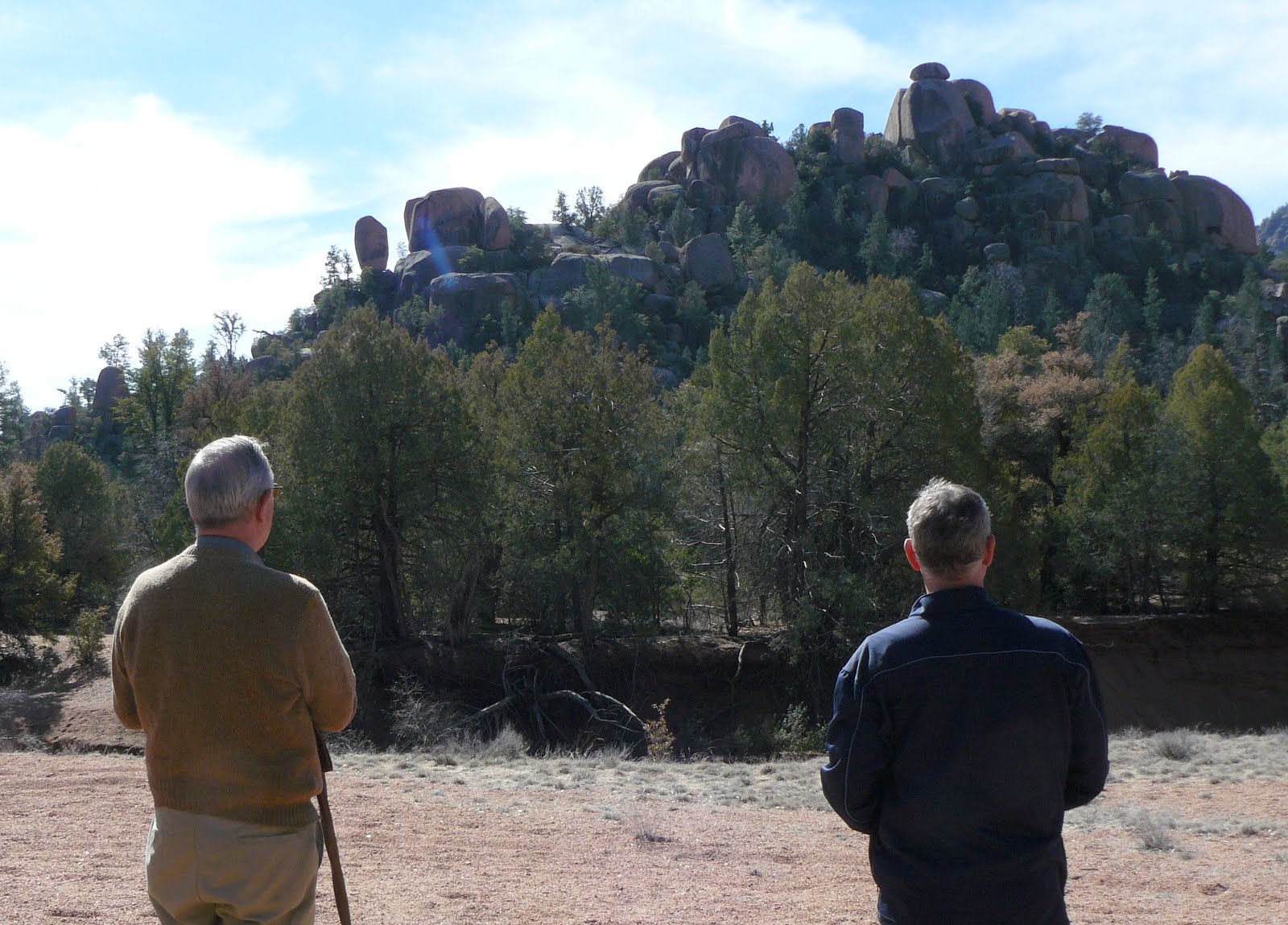
Anyway, on Monday morning, the day Terry was to give his talks, four of us took a couple of hours off in the morning to take a walk around the majestic granite boulders, a couple of miles on from our house.  These great boulders give rise to the name of the road that we live on; Granite Dells Rd.  Most afternoons, Jean and I take Pharaoh and his little pack of dogs for this three-mile walk so today was no different other than the walk being in the morning.

John H and Terry admiring the granite dells.

However, one of the benefits of having Terry with us on the walk was that he pointed out something really obvious that, so far, Jean and I had just taken for granted, i.e. missed!

It’s this. That dogs, when out for a walk off-leash, never travel the same journey, however many times they go on the same walk.  All dog-owners will be aware of this.

Dogs are all over the place, scurrying here and there, following sweet scents, totally absorbed in the intimacy of their relationship with their immediate experience.  There’s no ‘purpose’ to their behaviour, there’s no ‘clock’ running in their head as to what time it is and when they have to be somewhere else.  It is the epitome of travelling well, as from the quote at the start of this article.

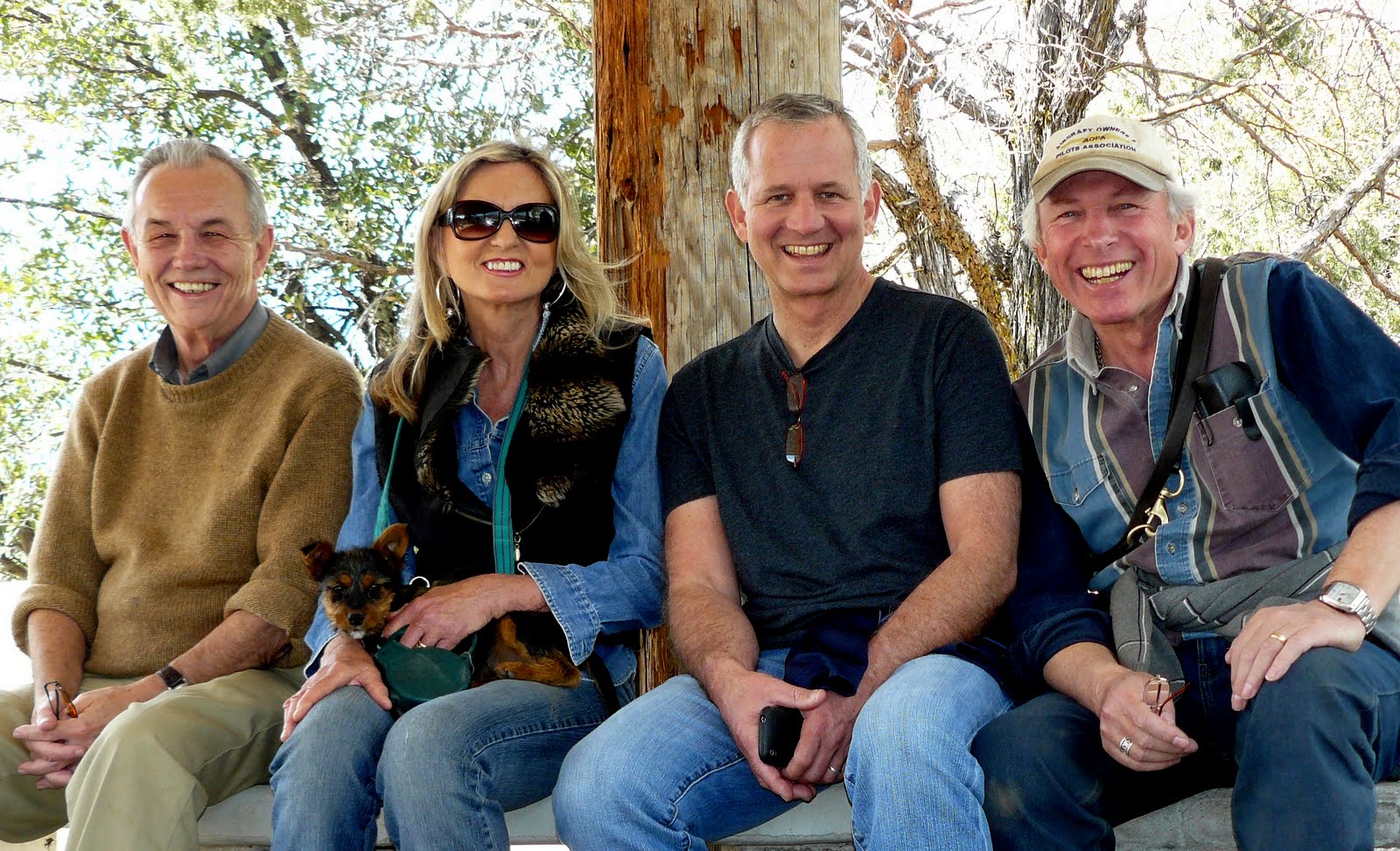
The metaphor of how dogs journey as a comparison to how so many of us humans travel with eyes closed, never stopping to smell the roses, was mentioned by Terry when we stopped for group photo towards the end of the walk.  Terry also touched on the importance of living in the present, as dogs do so very, very well, many times during his later talks.

As soon as we make our happiness conditional on ‘getting’ somewhere in the future, our journey rather becomes pointless.


John, Jean, Terry, Paul - being happy in the moment.

What a wonderful day this Monday was.


More with Joseph Campbell

When I posted my introductory piece on Joseph Campbell on the 14th February, I was tight on time.  So it was pretty brief, as a piece.

But I was amazed at the number of people who read that Post; clearly this man Campbell has reached out to many across the world.  Plus there was this comment from Michelle, better known as Dogkisses.

What a wonderful man! My hero. I cried when he passed on. He is the first person who reached me in my mid-twenties.

A friend of mine introduced me to “The Power of Myth,” and gave me a video series, which is so old now the VHS won’t play. Bill Moyers (I think I have that name right) interviewed him in the series.

The last book I had about him was, “Radio Interviews with Joseph Campbell.” I gave it to my teenage son. He loved it so much, but his girlfriend said reading that book made him act differently. I laughed and said thank goodness. He said the book disappeared. I wondered how. She said it made him not want to work full time. He was only barely seventeen, and I was trying to get him to take a different path in life.

The world would be a better place if everyone could appreciate what Joseph Campbell said and for the great work he did in his life.

Thank you. A very nice way to start a hectic Monday.

And in reply to me thanking DK for her comment and offering her the chance to guest post on Learning from Dogs, this further comment,

I certainly look forward to the future posts.

I’m having a hard time with my memory and mental fatigue lately. I would have to re-read myself to be able to write about what I learned from Joseph Campbell, which actually might help me and I know I would enjoy it.

I’ve been turning back for the past few months, looking back to when I stood on more solid ground spiritually. Hearing Joseph Campbell again would certainly help me remember that time in my life, because I was reading his work. I have daily quotes from him that come to my Google reader.

Thank you for the invitation and I am truly honored that you ask. I can do some reading and see if my brain gives me anything to share.

Peace,
Michelle.

So this Post today is for Michelle.

Terry Hershey, Payson Visit Announcement

Obviously only relevant to all those that are within reach of Payson, AZ. Apologies to my other readers.

Terry Hershey

Nationally Known Speaker and Writer will offer Free Seminars on March 14

Terry Hershey will visit Payson on Monday, March 14, to speak at Saint Paul’s Episcopal Church beginning at 2:00 p.m. and at the First Church of the Nazarene beginning at 7:00 p.m.

Mr. Hershey is an inspirational speaker, humorist and author who has been featured on The Hallmark Channel, CNN, and PBS.  He holds a mirror up to our fast-forward, disconnected lives, and invites us to share the wisdom of taking an intentional moment to help regain our personal and spiritual balance.

Terry lives, writes and teaches with passion, purpose, heart and grace. He captivates his audience with the motto: “Do less, live more”.  He creates an environment where we are given permission to become involved in the world around us, to want what we already have, to be embraced by moments of grace, to allow the child in us to play under a wide sky, to understand that laughter is a type of prayer and to take delight in our friends.

Terry Hershey is the author of ten books. The one that will be the focus of his inspirational presentation in Payson is “Soul Gardening”; winner of a “Book of the Year” award in 2010. Terry’s stories will nurture your soul and renew your sense of what it means to live fully alive.  To hear Terry speak is a life-affirming experience. Everywhere he appears, the feedback has been unanimously positive. For example:

Terry Hershey was truly humorous, enlightening and inspiring to one and all. He gave us permission to be embraced by grace.

He was truly the highlight of our year!

Terry’s lectures and books inspire one to see that happiness is already inside.

Terry Hershey will be speaking as follows:

Monday afternoon, March 14:

From 2 p.m. to 4 p.m. at Saint Paul’s Episcopal Church parish hall, located at 1000 N. Easy Street, in Payson at the corner of Sherwood Drive.  Note that seating and parking at St Paul’s is limited to about 50 people. If you plan to attend the afternoon session, please call 474-3834 to leave a message reserving a space.

Monday evening, March 14:

From 7 p.m. to 9 p.m. at the First Church of the Nazarene, 200 East Tyler Parkway, located at the northeast corner of Beeline Highway in northern Payson across from the Home Depot.  The parish hall will comfortably accommodate up to 200 people.  Please call 474-5890 to leave a message reserving a space.

These events are open to everyone at no charge.  Refreshments will be available at both sessions. Please plan to bring a friend with you.

Further information may be obtained from:

Paul Handover,  (928) 478 8612

John Hurlburt,   (928) 468 6572

Peter Russell

Life is such a learning experience!

A good friend of Jeannie and me in Payson is John H.  John has stimulated much wonderful thinking and reflection through conversation and the sharing of books and DVDs.  It was John H. who introduced us to Joseph Campbell about whom I wrote on the 14th February.

Well the other day, John handed us a DVD of Peter Russell giving three talks.  We watched it on Sunday evening. An amazing and inspiring experience.  But first some information about Peter Russell from, of course, his own website!  Peter describes himself as follows:


Peter Russell

Peter Russell is a fellow of the Institute of Noetic Sciences, of The World Business Academy and of The Findhorn Foundation, and an Honorary Member of The Club of Budapest

At Cambridge University (UK), he studied mathematics and theoretical physics. Then, as he became increasingly fascinated by the mysteries of the human mind he changed to experimental psychology. Pursuing this interest, he traveled to India to study meditation and eastern philosophy, and on his return took up the first research post ever offered in Britain on the psychology of meditation.

His principal interest is the deeper, spiritual significance of the times we are passing through. He has written several books in this area — The TM TechniqueThe UpanishadsThe Brain BookThe Global Brain AwakensThe Creative ManagerThe Consciousness RevolutionWaking Up in Time, and From Science to God.

As one of the more revolutionary futurists Peter Russell has been a keynote speaker at many international conferences, in Europe, Japan and the USA. His multi-image shows and videos, The Global Brain and The White Hole in Time have won praise and prizes from around the world. In 1993 the environmental magazine Buzzworm voted Peter Russell “Eco-Philosopher Extraordinaire” of the year.

Now in terms of the video that we watched, it contained three films: The Global Brain; The White Whole in Time; From Science to God.  In a very generous act the talk entitled The Global Brain is available to watch online – just click here. (Haven’t been over the website in detail but I suspect more of Peter’s material is available online.)  That online version is the full talk of 35 minutes but you will get lost in time as you watch it!

But if, for now, you want a feel for Peter’s approach then here are a couple of YouTube videos.  But a health warning, you may never look at the world around you in quite the same way!

and here are the first two parts of Waking up in Time (just over 6 minutes in total)


Truth, myth and meaning

A musing on Chief Seattle’s famous speech.

I came across this recently following a bit of a prowl through YouTube.   The YouTube video, although deeply moving, is more myth than factual record; as one finds out if even a small amount of probing is undertaken.

But does it matter?  Maybe those ideas that reach out to us in a spiritual sense are as powerful as myths, perhaps even more so, than as ‘facts’.

Here’s that YouTube video.

Did you watch it all?  I hope so. Did it disturb you to know that this wasn’t a factual rendition?  Probably not.

WikiPedia has a comprehensive account of Chief Seattle and in terms of the speech here’s an extract:

There is a controversy about a speech by Si’ahl concerning the concession of native lands to the settlers.

Even the date and location of the speech has been disputed,[8] but the most common version is that on March 11, 1854, Si’ahl gave a speech at a large outdoor gathering in Seattle. The meeting had been called by Governor Isaac Ingalls Stevens to discuss the surrender or sale of native land to white settlers.Doc Maynard introduced Stevens, who then briefly explained his mission, which was already well understood by all present.[3]

Si’ahl then rose to speak. He rested his hand upon the head of the much smaller Stevens, and declaimed with great dignity for an extended period. No one alive today knows what he said; he spoke in the Lushootseed language, and someone translated his words into Chinook jargon, and a third person translated that into English.

So in terms of looking for the truth, forget it.

But in terms of being inspired to regard the land, and all that depends on it, as sacred then the myth of Chief Seattle’s words is beautiful and powerful, a myth that modern man has just about rejected.

If you want to read the words that are supposed to be the most authentic recording of what the noble Chief said, then these follow.  They are taken from here and the introduction and footnotes are valuable background information.  You may also want to read this account of the speech from the Washington State Library.

The only known photograph of Chief Seattle, taken 1864.


Scraps from a Diary:
Chief SeattleA gentleman by Instinct
His Native Eloquence, etc., etc.

by Henry A. Smith
10th article in the series “Early Reminiscences”
Seattle Sunday Star, October 29, 1887

Yonder sky that has wept tears of compassion upon my people for centuries untold, and which to us appears changeless and eternal, may change. Today is fair. Tomorrow it may be overcast with clouds. My words are like the stars that never change. Whatever Seattle says, the great chief at Washington can rely upon with as much certainty as he can upon the return of the sun or the seasons. The white chief says that Big Chief at Washington sends us greetings of friendship and goodwill. This is kind of him for we know he has little need of our friendship in return. His people are many. They are like the grass that covers vast prairies. My people are few. They resemble the scattering trees of a storm-swept plain. The great, and I presume — good, White Chief sends us word that he wishes to buy our land but is willing to allow us enough to live comfortably. This indeed appears just, even generous, for the Red Man no longer has rights that he need respect, and the offer may be wise, also, as we are no longer in need of an extensive country.  

There was a time when our people covered the land as the waves of a wind-ruffled sea cover its shell-paved floor, but that time long since passed away with the greatness of tribes that are now but a mournful memory. I will not dwell on, nor mourn over, our untimely decay, nor reproach my paleface brothers with hastening it, as we too may have been somewhat to blame.

Youth is impulsive. When our young men grow angry at some real or imaginary wrong, and disfigure their faces with black paint, it denotes that their hearts are black, and that they are often cruel and relentless, and our old men and old women are unable to restrain them. Thus it has ever been. Thus it was when the white man began to push our forefathers ever westward. But let us hope that the hostilities between us may never return. We would have everything to lose and nothing to gain. Revenge by young men is considered gain, even at the cost of their own lives, but old men who stay at home in times of war, and mothers who have sons to lose, know better.

Our good father in Washington—for I presume he is now our father as well as yours, since King George has moved his boundaries further north—our great and good father, I say, sends us word that if we do as he desires he will protect us. His brave warriors will be to us a bristling wall of strength, and his wonderful ships of war will fill our harbors, so that our ancient enemies far to the northward — the Haidas and Tsimshians — will cease to frighten our women, children, and old men. The in reality he will be our father and we his children. But can that ever be? Your God is not our God! Your God loves your people and hates mine! He folds his strong protecting arms lovingly about the paleface and leads him by the hand as a father leads an infant son. But, He has forsaken His Red children, if they really are His. Our God, the Great Spirit, seems also to have forsaken us. Your God makes your people wax stronger every day. Soon they will fill all the land. Our people are ebbing away like a rapidly receding tide that will never return. The white man’s God cannot love our people or He would protect them. They seem to be orphans who can look nowhere for help. How then can we be brothers? How can your God become our God and renew our prosperity and awaken in us dreams of returning greatness? If we have a common Heavenly Father He must be partial, for He came to His paleface children. We never saw Him. He gave you laws but had no word for His red children whose teeming multitudes once filled this vast continent as stars fill the firmament. No; we are two distinct races with separate origins and separate destinies. There is little in common between us.

To us the ashes of our ancestors are sacred and their resting place is hallowed ground. You wander far from the graves of your ancestors and seemingly without regret. Your religion was written upon tablets of stone by the iron finger of your God so that you could not forget. The Red Man could never comprehend or remember it. Our religion is the traditions of our ancestors — the dreams of our old men, given them in solemn hours of the night by the Great Spirit; and the visions of our sachems, and is written in the hearts of our people.

Your dead cease to love you and the land of their nativity as soon as they pass the portals of the tomb and wander away beyond the stars. They are soon forgotten and never return. Our dead never forget this beautiful world that gave them being. They still love its verdant valleys, its murmuring rivers, its magnificent mountains, sequestered vales and verdant lined lakes and bays, and ever yearn in tender fond affection over the lonely hearted living, and often return from the happy hunting ground to visit, guide, console, and comfort them.

Day and night cannot dwell together. The Red Man has ever fled the approach of the White Man, as the morning mist flees before the morning sun. However, your proposition seems fair and I think that my people will accept it and will retire to the reservation you offer them. Then we will dwell apart in peace, for the words of the Great White Chief seem to be the words of nature speaking to my people out of dense darkness.

It matters little where we pass the remnant of our days. They will not be many. The Indian’s night promises to be dark. Not a single star of hope hovers above his horizon. Sad-voiced winds moan in the distance. Grim fate seems to be on the Red Man’s trail, and wherever he will hear the approaching footsteps of his fell destroyer and prepare stolidly to meet his doom, as does the wounded doe that hears the approaching footsteps of the hunter.

A few more moon, a few more winters, and not one of the descendants of the mighty hosts that once moved over this broad land or lived in happy homes, protected by the Great Spirit, will remain to mourn over the graves of a people once more powerful and hopeful than yours. But why should I mourn at the untimely fate of my people? Tribe follows tribe, and nation follows nation, like the waves of the sea. It is the order of nature, and regret is useless. Your time of decay may be distant, but it will surely come, for even the White Man whose God walked and talked with him as friend to friend, cannot be exempt from the common destiny. We may be brothers after all. We will see.

We will ponder your proposition and when we decide we will let you know. But should we accept it, I here and now make this condition that we will not be denied the privilege without molestation of visiting at any time the tombs of our ancestors, friends, and children. Ever part of this soil is sacred in the estimation of my people. Every hillside, every valley, every plain and grove, has been hallowed by some sad or happy event in days long vanished. Even the rocks, which seem to be dumb and dead as the swelter in the sun along the silent shore, thrill with memories of stirring events connected with the lives of my people, and the very dust upon which you now stand responds more lovingly to their footsteps than yours, because it is rich with the blood of our ancestors, and our bare feet are conscious of the sympathetic touch. Our departed braves, fond mothers, glad, happy hearted maidens, and even the little children who lived here and rejoiced here for a brief season, will love these somber solitudes and at eventide they greet shadowy returning spirits. And when the last Red Man shall have perished, and the memory of my tribe shall have become a myth among the White Men, these shores will swarm with the invisible dead of my tribe, and when your children’s children think themselves alone in the field, the store, the shop, upon the highway, or in the silence of the pathless woods, they will not be alone. In all the earth there is no place dedicated to solitude. At night when the streets of your cities and villages are silent and you think them deserted, they will throng with the returning hosts that once filled them and still love this beautiful land. The White Man will never be alone.

Let him be just and deal kindly with my people, for the dead are not altogether powerless.


Amen to that.

Magical nature

Big thanks to Dogkisses’ Blog for highlighting this video from National Geographic.

Nothing to add to the video – just watch it, be enthralled and reflect on our need to be in spiritual harmony with our beautiful planet Earth. (N.B. for whatever reason, I was unable to embed the code in this Post so you will have to click here to watch this short video.  But do it’s magical.)

Then if you want more, watch this: