A beautiful example of humans in the supreme invention and deployment of JWST.
(A reminder that Tuesday is a ‘non-doggie’ day.)
JWST is astounding. It will look back to the beginnings of the universe, just 200 million light-years after the Big Bang, or possibly further back in time. Because of the way that the universe stretches out and causes light to go red, as it were, JWST will be searching for images from the cosmos in the infrared.
I recently listened to a 30-minute programme on BBC Sounds. It was a BBC Discovery episode about the JWST. Recorded before the launch it was, nonetheless, a deeply fascinating programme about what JWST will be looking for.
This is a story about one of the islands in the Inner Hebrides of Scotland. But more than that it is an opportunity to share with you all a video that my son, Alex, and his partner, Lisa, took on a recent trip to that part of the world.
The Isle of Mull is the second largest island of the Inner Hebrides, off the west coast of Scotland in the council area of Argyll and Bute. Mull is the fourth largest Scottish island and has an area of 338 square miles. The coastline of Mull is almost 300 miles long. The population of Mull, Iona and Ulva is around 1,800 people which is probably doubled in the summer because of the many tourists that visit Mull each year. Much of the population lives in Tobermory, the only burgh on Mull until 1973, and its capital. Mull is surrounded by the Sound of Mull in the north, the Firth of Lorn in the south and east and the Atlantic Ocean in the west.
History of Mull
Mull has been inhabited since around 6000 BC. Bronze Age inhabitants built menhirs, brochs and a stone circle. In the 14th century Mull became part of the Lordship of the Isles. After the collapse of the Lordship in 1493 the island was taken over by the clan MacLean, and in 1681 by the clan Campbell. During the Highland Clearances in the 18th and 19th centuries, the population fell from 10,000 to less than 4000.
Wildlife on Mull
The island is home to over 250 different bird species including the White-tailed Eagle, which was reintroduced in the nearby Island of Rùm and migrated to Mull, where they now have a stronghold. Minke whales, porpoises and dolphins are among the sea life that can be seen on boat tours from Mull.
Now here is the video.
It is a beautiful review of what must be a magical place!
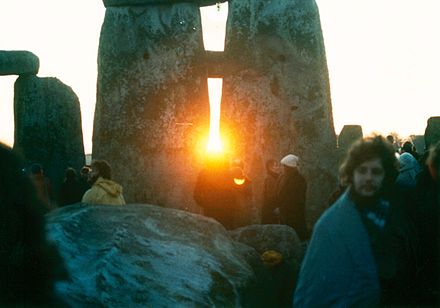
The winter solstice, also called the hiemal solstice, hibernal solstice, and brumal solstice, occurs when either of Earth‘s poles reaches its maximum tilt away from the Sun. This happens twice yearly, once in each hemisphere (Northern and Southern). For that hemisphere, the winter solstice is the day with the shortest period of daylight and longest night of the year, when the Sun is at its lowest daily maximum elevation in the sky. Either pole experiences continuous darkness or twilight around its winter solstice. The opposite event is the summer solstice. Depending on the hemisphere’s winter solstice, at the Tropic of Cancer or Capricorn, the Sun reaches 90° below the observer’s horizon at solar midnight, to the nadir.
The winter solstice occurs during the hemisphere’s winter. In the Northern Hemisphere, this is the December solstice (usually December 21 or 22) and in the Southern Hemisphere, this is the June solstice (usually June 20 or 21). Although the winter solstice itself lasts only a moment, the term sometimes refers to the day on which it occurs. Other names are the “extreme of winter” (Dongzhi), or the “shortest day”. Since the 18th century, the term “midwinter” has sometimes been used synonymously with the winter solstice, although it carries other meanings as well. Traditionally, in many temperate regions, the winter solstice is seen as the middle of winter, but today in some countries and calendars, it is seen as the beginning of winter.
Since prehistory, the winter solstice has been seen as a significant time of year in many cultures, and has been marked by festivals and rituals. It marked the symbolic death and rebirth of the Sun. The seasonal significance of the winter solstice is in the reversal of the gradual lengthening of nights and shortening of days.
Later on, that article speaks of the Celtic history:
Celtic
Prior to the arrival of Christianity, the Celtic people of Britain celebrated Yule in a similar fashion to the Germanic festival. It is alleged that Celtic Druids began the tradition of the Yule Log, with the intention of driving out darkness, evil spirits, and poor luck in the following year. The Yule Log was intended to be kept alight over the entire solstice period, twelve days over which the sun was believed to stand still. The log being extinguished symbolised poor luck in the following year. Additionally, evergreen plants were used in decoration – of key significance are “The Holly and the Ivy”, used in decoration, and Mistletoe, suspended over a doorway in a token gesture of goodwill to all who passed under it. These traditions have been adopted into the Christian winter celebrations, symbolised by a mistletoe wreath placed on the front door to a building.
It is a most ancient celebration because as soon as humans recognised that this was the shortest day they were deeply respectful of the forces of the universe.
There are many things we just take for granted including, if I may say, celebrating a birthday for our dog. Now I’ve no way to check with readers if what I just said is correct; it is an assumption.
Earlier in the year, July to be exact, The Dodo published ideas that might be useful for you. Here they are:
ooOOoo
7 Ways To Celebrate Your Dog’s Birthday
For the absolute best birthday (or adoption day) ever 🥳
There are lots of ways to celebrate your dog’s birthday. But different dogs might like to celebrate in different ways depending on their personality — some dogs are more social, and others might just want to spend the day lounging around.
With all the different ways to celebrate and all the different dogs out there, it might be hard for you to decide what to do to give your dog the best birthday.
To help you decide, The Dodo made a list of seven fun ideas for ways to celebrate your dog’s birthday.
Dog birthday party ideas
Throw a dog party
Invite all your dog’s friends to his birthday party! To make sure everyone’s included, send out invites like this one. You can personalize the template and add whatever you want to say to the front!
You’ll need some decorations for the party, too, so get this banner of your dog’s face! Just send in a pic of your dog, and you’ll get this banner to hang your pup’s face all over your house.
Give your dog’s guests some party favors before they go. Fill up these paw print party bags with little treats or toys to say thanks for coming. They come in a set of 20, so you’ll have plenty to go around.
Have a pool party
If your dog’s birthday is in the summer, let him cool off by taking a dip in the pool! This doggie poolcomes in multiple sizes and doesn’t need to be inflated, so it’s super easy to set up.
Obviously your dog will need a cool outfit for his party. Get him this Birthday Boy (or Birthday Girl) shirt that comes in multiple sizes and keeps your dog warm enough to wear on outdoor walks.
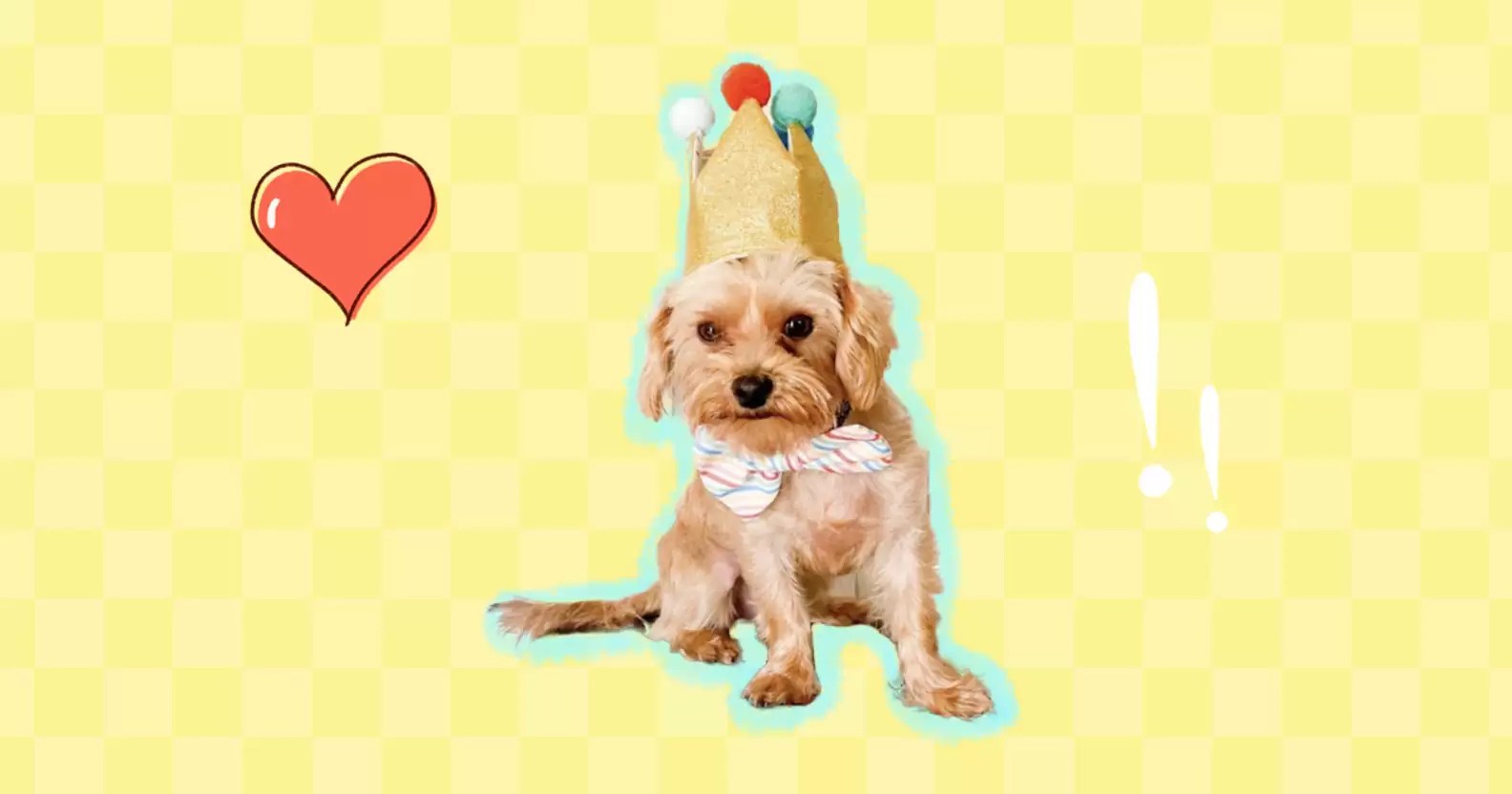
Get this birthday crown to complete the look. It’s sparkly gold with pom poms on top and has a chin strap, so it will stay put all day long (or as long as your dog will keep it on).
Have a photo booth
Set up a photo booth with props! These birthday-themed props will let you take lots of Instagram-worthy pictures with your dog. There are glasses, balloons, cake and hats, so you’ll have a lot of options.
Make pupcakes
Make homemade pupcakes for your pup with this dog cake mix. The recipe is all-natural and peanut butter flavored, comes with an icing mix and can be made in either the oven or microwave for easy baking.
Spend time with your dog
Spend quality time with your dog and give him some exercise by taking him on a long walk. You can still dress your pup up for his birthday walk with a fun harness and leash combo like this mix-and-match one that earned The Dodo’s Paw of Approval. The harness is adjustable, and there are tons of different colors. It also comes with a cute poop bag carrier to make cleaning up after your pup a little more fun.
Take time out of your day just to play with your dog. Whether it’s throwing a ball or playing with a squeaky toy or tug-of-war, your dog will love it. Get him some new toys that he can play with on his birthday too.
Let your dog pick out a gift
Take your pup to a pet store and let him pick out his own gift! You’ll probably be getting him tons of presents, but it’ll be fun for him to pick one out for himself too. Plus, dogs go crazy for all the sights, smells and sounds in pet stores, so it’ll be an adventure.
ooOOoo
You should be aware that if you choose to purchase an item from The Dodo website then their statement is applicable:
We independently pick all the products we recommend because we love them and think you will too. If you buy a product from a link on our site, we may earn a commission.
I think there are some brilliant ideas and, upon reading this article, maybe many fewer people will take it for granted when their dogs have a birthday!
Many years ago I found myself teaching at a unit attached to Exeter University. I was teaching sales and marketing. I can’t remember clearly the events that produced the meeting between myself and Chris Snuggs. But I recall the outcome.
Chris was the director of studies at a French institute named ISUGA. Let me borrow from their website:
The ISUGA Europe-Asia International BBA Bachelor’s degree is a 4-year cursus following the Baccalaureate or High School diploma which combines studying International Business and Marketing with learning an Asian or English language and comprising university exchange stays, as well as internships in French and International businesses.
ISUGA is located in Quimper, Western Brittany relatively close to Devon in England where I was living.
In Chris’ words: “It must have been through them that we got your name when we needed someone to teach Selling. Now I come to think of it, we HAD someone lined up for a whole week and he CANCELLED on us, so you were a last-minute replacement.”
For quite a few years I went across to Quimper to teach for Chris. Mainly by ferry from Plymouth to Roscoff. During the summer months I flew to Quimper from Exeter in our group-owned TB20. (The picture below is of the type only not our aircraft.)
A Socata TB20
Since that day we have remained in reasonable contact and I regard Chris as good friend.
A few days ago Chris published on his blog his account of his journey from Quimper back to Ramsgate, in east Kent. It was hilarious and I asked Chris if I could publish it and share with everyone.
Chris not only said yes but insisted on improving it (his words) including expanding it to what it is below.
So with no further ado, here is Chris’ post.
ooOOoo
“A DOG’s Travel Across Northern France” … as in “Doddering Old Git”
I am officially a “Senior Citizen”, but as such prefer much of what passes for “The Good Old Days” when in this case we were called “Old Age Pensioners” – MUCH less PC and wokeish AND more realistic – but DOGS sounds much better (and more informative) than OAPs.
A simple trip to Blighty to see the family for XMAS was not supposed to be a saga, but it turned out to be one:
Like ET, I was going home, though not quite as far – though it probably seemed like it.
I got about 3 hours sleep max Thursday night/Friday morning; worried about oversleeping even though I had THREE electronic wake-up devices.
I got up at 04:30 to finalize packing and clean up (the worst of) my mess.
I went out into the street in front of the house at 06:45 to await the taxi – it was raining, albeit not heavily.
The taxi was 5 minutes late, but the driver didn’t apologize. (I was going to say “woman driver” but I believe that sex differentiation is no longer allowed.)
I tried to help her (it, hir, shim?) load my heavy suitcase into *** boot (car, not footwear).
I lightly touched the car with the suitcase, and shim said: “Mind my car. Your suitcase is too heavy.”
I nearly said: “So are you, but it’s probably your hormones or your genes.” but decided that discretion was the better part of insult as I had to catch a train ……
We got to the station in plenty of time, only for me then to find that the train was due to go from platform C (usually it’s A as you leave the entrance hall).
I then found out/remembered that there is no lift at Quimper station. “This is not going to be my day,” I thought …
As I approached the stairs down to the access tunnel, I pretended to be a Doddery Old Git on the point of collapse (no comments please) and a nice young man helped me with the case.
Same procedure with a different bloke to go up to platform C. I actually tried this ploy with a pretty young lady first, but just got a funny look ….
Eventually got onto the right and very crowded train; my “This is not a gasmask” COVID mask was very reassuring as the virus probably had a field day circulating the carriage. I got some more funny looks, but two people asked me where I got my mask, so I am thinking of merchandising them ….
Got to Paris 4 hours later – showed a railway worker my little map where the taxi was supposed to be waiting and he pointed me in direction X saying authoritatively: “Tout au bout.” (“right at the end” for those who left school at 14).
Seemed a bit iffy to me (I vaguely remembered having gone somewhere else the last time I had done the journey, but couldn’t remember where. Does that happen to you?), but I followed his directions in the obviously-idiotic belief that someone actually working in a place would know where the taxis would be.
Of course, there was no sign of a taxi area at the distant far end of the HUGE Montparnasse Station, so I asked another railway bod.
He pointed in the 180° opposite direction and said the same as the first bloke, so I had to retrace my steps and go another 200 metres past where I had started to one of the no doubt multiple exits.
On exiting I was surrounded by some Middle Eastern gentlemen (without beards as it happens) who were desperate to take me somewhere.
I told them I had booked a taxi already and they suddenly lost interest.
I then got a call on my posh new mobile, but as with every other mobile I have ever owned it is specifically designed so that one cannot easily answer a call – first there is always some other leftover screen on the thing which by the time you have got rid of the caller has given up, and second you have to SWIPE to even see a green button which you then press – and I don’t know who invented SWIPE but hanging, drawing and quartering while being burned alive in oil over a period of several hours would be a suitable punishment.
This was all way beyond me, so I missed the call.
Miraculously, however, I did manage to call back and it was in fact the driver.
After two or three calls in each direction we managed to find each other physically as well as phonally.
We set off for La Gare du Nord, which should be about 15 minutes max by road – but it took us an hour and a quarter … (This was Paris in the rain on Friday at lunchtime – but I did learn a few new French swearwords from the driver.)
Fortunately, I had plenty of time between trains and so managed to find and embark on my TER to Calais.
This was an uneventful trip except that I was opposite a young mother with an inquisitive baby who kept looking at me for some reason (the baby not the woman ….).
I thought about playing with the baby but did not want to be arrested as a paedophile. I did plonk a small orange on the little table between us thinking she might want to play with it, but I got a funny look from her mother …. so I picked it up (the orange not the baby) and ate it – getting more funny looks. Strange … I get that all the time.
There was no internet on the TER so I tried to doze, but dozing with a high-decibel baby one metre away is a skill I have not yet mastered – and probably never will.
Arrived at Calais station – it took me 10 minutes to find the lift to get to the exit: in fact, one has to be led across an actual line by a railway bod and then take the lift – which is conveniently hidden.
But once outside the station I got a taxi right away. (a rare plus chalked up!)
I was dropped at the port outside a little hut marked “Billets”: (“tickets” for the linguistically-challenged).
This was weird – there used to be a big hall full of foot-passengers, but it has all changed – there IS a big hall, but it is empty except for two WWI biplanes. “Perhaps they want to fly us over?” I thought.
Went into the ticket office to be told my boat was cancelled (no explanation was offered) and they would try to get me on the next one. I never did understand why they would “try” (there was hardly anyone else there), but it seems they had to wait for a phone call.
It was a very small cabin with four guichets (Would you like a French dictionary for XMAS?) and three simple chairs, on one of which – after having my particulars scrutinized and recorded – I was invited to sit – which I did, not sure whether I should show appreciation or keep going with the scowl I could feel coming on ….
Behind the desks several women came and went, but spent all the time yacking to one another about women stuff while three of us sat waiting in stony and in my case exhausted silence (it was by now 18:00 and I had been up since 04:30).
I eventually got up and complained, something that comes naturally to we DOGs. I said I did not understand the delay, that I needed a coffee and a toilet break and that the least they could do was install some beds in their little office for those in my situation (and condition) who had to wait overnight for information about getting on a replacement ferry. I wanted to add a question about whether they had been trained in defibrillation techniques but by then I had run out of breath.
The charming young lady smiled and said they had none of the things that might alleviate my stress (adding the word “understandable” would have been nice) but that the large hall opposite might be open, and if not she could lend me a key to open it and visit the convenience.
I couldn’t be bothered to try to work out why she wouldn’t know whether the hall was open or not and that what I in fact most urgently needed was to get out of there without bothering with keys I would probably lose – which I did.
I then walked round the large hall three or four times admiring the WWI planes and wondering if the Red Baron had ever flown one of them. The fresh air and exercise refill renewed the oxygen supply to my needy brain.
I eventually staggered back to the ticket office and sat down on my hard chair again. I was tempted to feign a loud snore but as with the taxi driver in the morning decided that discretion was the better part of valour.
15 minutes later a phone call came and I was summoned to the guichet and given my ticket.
“Great,” I thought. “At last we can get outta here.”
THEN she told us that in 40 minutes someone would come to drive us to the boat.
I was fast losing the will to live, but thought that another dose of circling the large airplane hall might at least get my blood circulating again.
I told her where I was going and mentioned the hall and the planes (to be fair she did laugh at my joke about flying us across the Channel), but said: “That’s all run by the Chamber of Commerce.”, and of course we all know that no lunacy is beyond THAT organization.
I left after asking if she could send out a rescue party if I did not return – and she smiled again …. Smiles don’t of course achieve anything practical but they do at least make the pain somewhat more tolerable.
I came back half an hour later, having admired the bi-planes once again and wondered whether the Red Baron had ever flown one – and indeed a lady driver soon turned up as predicted to drive us to the boat. (another rare plus chalked up …)
We had to go up and down two or three kerbs (nowhere lowered for people to wheel their too-heavy suitcases) and eventually got onto a bus.
Had to go up a multiply-zig-zagged ramp to get onto the boat, but I played the Doddery Old Git card again and someone helped with my case.
I had thought of taking my walking-stick on this trip to boost the DOG sympathy factor, but could not work out how I could possibly carry it simultaneously with the rest of my baggage.
I asked a boatbod what time we would be leaving and then arrive in Dover, and he said: “in 15 minutes and 20:00.”
40 minutes later we still had not left, so I asked someone else when we would be leaving and was told in 15 minutes.
We actually left 30 minutes later, and I decided that being 100% wrong in a prediction was not actually that bad as these things go.
When I asked yet anOTHER bod WHY there had been another delay he just rolled his eyes and said something about the Captain which I didn’t understand – but was past caring.
Ten minutes later I asked the next available bod what time we would arrive in Dover and was told 20:30.
This was well past the time my taxi was booked, so I called to inform Eddy, the driver.
Fortunately, making calls on mobiles is easier than receiving them, so that was OK.
On the boat I got talking to a foot-passenger couple (there were only EIGHT of us!).
They were very nice and I gave them Taxi Supremo Andy’s phone number as they had nothing arranged for their arrival.
When we eventually got to Dover, there were no more checks (even though they made us walk through a maze of corridors in the totally empty border-control and customs instead of going straight to the taxi area – maybe they were filming us secretly?) and we eventually got to where I hoped to find Eddy the Driver.
However, there are huge roadworks going on just inside the port entrance and all the usual roads are blocked off and/or rerouted.
There was of course no sign of Eddy – OR any other taxis. Foot-passengers have a VERY low priority …..
Grateful for my phone once again, I called Eddy who said he was ALREADY in the port but had got lost.
Taxi-drivers getting lost is a bit ominous, so I assumed he was even more of a DOG than I am. Still, we DOGs have to stick together …..
I told him where we were ….. right near the entrance just past the roundabout at the bottom of the long clifftop descent to the port. For those who know Dover this is the easiest part of the entire port (or indeed of England) to find …..
Three exchanged calls later we finally met up physically as well as phonally – which was a reminder of Paris. In future, I am going to fix a GPS signal to myself and ensure my driver has military-standard tracking equipment. Perhaps Nathalie can arrange that?
Eddy was as suspected a bit of a DOG – but like me, very nice …… I asked if he could drop off my friends from the boat at Dover railway station before taking me back to Ramsgate – which he agreed to.
So we took them up the road to the station, where they unloaded their stuff from the boot.
I did think about getting out to check they didn’t take any of my four bits of luggage, but I was very tired and also thought that it would be impossible to confuse the grotty things I was carrying with any of their posh stuff from Parisian shops.
They gave Eddy an extra £8 for the slight detour. As I said they were very nice even if the lady’s perception and memory banks were highly undeveloped.
We then at last set off for Ramsgate, but Eddy took a wrong turn and we ended up driving towards Canterbury.
It takes a really advanced stage of dodderation to get lost driving from Dover to Ramsgate, so I will be contacting “The Guinness Book of Records”.
I decided against advising Eddy to do a U-turn in the pitch dark, and after driving four miles up a dual-carriageway we eventually got to a roundabout, retraced our wheels and made our way back to Dover.
Miraculously finding the right road to Ramsgate this time, we set off on the last lap. By now I was desperately hanging onto life by a thread.
Halfway to Ramsgate Eddy got a call from Taxiboss Andy’s Missus:
“The couple you dropped off at the station just rang; it seems they have got a package belonging to one of the other passengers.” ME! NO, I AM NOT MAKING THIS UP …..
…. but they were nice people and apparently said they would wait at the station for us to come and pick up the bag.
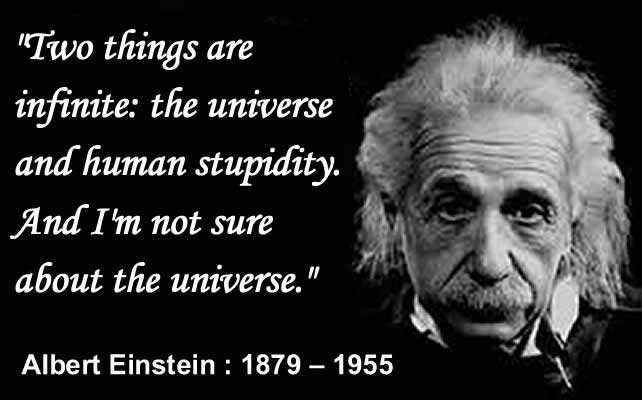
I tried to keep calm, but remembered Einstein’s famous dictum. (SEE BELOW)
We stopped to check the boot and I saw that they had taken a plastic bag with two boxes of wine for my sister Maggie and another box of boiled eggs and fishsticks essential for my diet.
I asked Eddy if he minded going back, and he agreed to instantly – even without being promised any more dosh.
So back we went to the station, picked up the bag and Eddy collected another £10 for his trouble. (As I said, nice people …)
Off we set for Ramsgate again, and this time Eddy did not get lost ……. even we DOGs are capable of learning.
I eventually got to Ramsgate around 22:30 instead of the anticipated 20:00 – and of course I felt obliged to give Eddy a generous tip even though he DID get lost twice. Actually, everything in France had gone pretty smoothly as planned; it only went really tits-up when we got to Dover. I of course blame BREXIT ……
How was your day?
PS No insult to real dogs is intended in this account. As we know, if the world were ruled by dogs we would all be safer and happier, though the absence of tv and the internet would be a shame.
PPS I was fortunate to be able to employ Paul for brief periods over a number of years to teach business students about Selling and Marketing during my time as Director of Studies of a business school in France. His teaching was highly impressive, but even more so his habit of flying his own plane to Quimper. In this and many other ways he was and remains unique. As I told the students: “Listen to Paul’s advice and one day you will fly your own plane.”
Let me say straight away that I am an atheist. Apart from a couple of wobbles in my life I have always been that way. I believe in the sanctity of the truth and wherever possible that is a scientific truth. Jean also is a non-theist. That’s why we enjoy so much the meetings of our local Rogue Valley Humanists & Freethinkers Group. Indeed, this video was first shown to the group at the last meeting.
Now Kurt Andersen, born August 1954, is an American writer and he has his own website as well as a long entry on Wikipedia.
In January, 2020 Kurt made a video. It is nearly 50 minutes long and it is on YouTube. I have inserted this video below. If you can, please watch it and, even better, give me your thoughts.
How can we make sense of America’s current “post-factual,” “post-truth,” “fake news” moment? By looking to America’s past. All the way back. To the wishful dreams and make-believe fears of the country’s first settlers, the madness of the Salem witch trials, the fantasies of Hollywood, the anything-goes 1960s, the gatekeeper-free internet, the profusion of reality TV….all the way up to and most especially including President Donald Trump. In this fascinating and lively talk, Kurt Andersen brings to life the deep research behind and profound implications of his groundbreaking, critically acclaimed and bestselling latest work. Connecting the dots in a fresh way to define America’s character—from the religious fanatics and New Age charlatans to talk-radio rabble-rousers and online conspiracy theorists—Andersen explains our national susceptibility to fantasy and how our journey has brought us to where we are today. Kurt Andersen is a brilliant analyst and synthesizer of historical and cultural trends, a bestselling novelist, a groundbreaking media entrepreneur, and the host of public radio’s Studio 360. Join CFI and find out how we are protecting critical thought and science by visiting: https://centerforinquiry.org This talk took place at the CSICon 2019 in Las Vegas on October 19, 2019
I saw this article on the Sustainability at Harvard website and read it with great interest. I wanted to republish it to share with you but couldn’t readily see a copyright statement or an instruction regarding republishing. I sent an email but I was warned that Harvard receive a great deal of emails every day and a reply might not be forthcoming.
So ….. I have made a decision. I will publish the article and hope that it doesn’t infringe the copyright.
Before I do that let me ‘promote’ Sustainability at Harvard by giving you a little from their About page.
Together we are building a healthier, more sustainable community
Harvard University is devoted to excellence in teaching, learning, and research, and to developing leaders in many disciplines making differences globally.While Harvard’s primary role is to address global challenges, such as climate change and sustainability, through research and teaching, the University is also focused on translating research into action. Harvard is using its campus as a living laboratory for piloting and implementing solutions that create a sustainable and resilient community focused on health and well-being.
ooOOoo
Do food miles really matter?
March 7, 2017
By Molly Leavens, College ’19
Leavens breaks down the nuances of how a food’s carbon footprint relates to the distance it travels from farm to plate.
The local food movement, with the goal of consuming food produced and grown within a close geographic region, has been gaining traction in recent years as a way of eating fresh and high quality foods and reducing one’s environmental impact. However, public messaging about the outcomes of this movement is divided and often leads to confusion and misunderstanding among consumers. This short article will attempt to break down some of the nuances of how a food’s carbon footprint relates to the distance it travels from farm to plate (commonly referred to as food miles).
So, do food miles really matter? Yes and no.
For most American diets, the carbon cost of transportation is slight compared to the carbon costs of production (running the tractors, producing chemical fertilizer, pumping irrigation…). Therefore, the most effective way for most Americans to reduce their diet’s carbon footprint is not by buying local, but rather eliminating or reducing their consumption of animal products.
the most effective way for most Americans to reduce their diet’s carbon footprint is not by buying local, but rather eliminating or reducing their consumption of animal products.
For a vegan, food miles contribute to a larger portion of their food’s carbon footprint. Plant-based foods have lower production footprints, so transportation is comparatively more significant. Even then, the raw mileage is hardly informative for determining carbon footprints; the mode of transportation is the key variable. Cargo ships are the most efficient, followed by trains, then trucks, and lastly planes.
That means a product flown from Chicago to Boston has a significantly larger carbon footprint than one shipped 11,000 miles from Asia to California.
Although exact numbers vary across analyses, flying one ton of food is close to 70 times more carbon intensive than transporting that same weight via a large cargo ship (source). That means a product flown from Chicago to Boston has a significantly larger carbon footprint than one shipped 11,000 miles from Asia to California. As a result, locality is more important for perishable foods that are often flown like raw fish, asparagus, and berries. Foods such as tomatoes, bananas, pears, and apples can all be harvested before ripening, stored for long periods of time, then inoculated with ethylene gas (the naturally occurring hormone produced by fruits that causes the change in color and flavor profile associated with ripening) before entering a supermarket. In many cases, these shelf-stable foods have lower carbon footprints when produced internationally because the carbon cost of production far outweighs that of transportation.
Another frequently cited comparison is that of lamb produced in England verses lamb produced in New Zealand. For a consumer in England, the New Zealand lamb actually has a lower carbon footprint. Our intuition failed us. Why? Sheep in New Zealand are generally raised on farms run by hydroelectric power. This energy saving is so immense that it overrides the fuel output of the 11,000 mile cruise to England (source).
A similar story unfolds here in Boston. Local meat production could be more carbon intensive because the animals must be housed in heated facilities during the cold winter months. For a large portion of the year, we are better off shipping in a tomato from South America than growing one in a local greenhouse.
A similar story unfolds here in Boston. Local meat production could be more carbon intensive because the animals must be housed in heated facilities during the cold winter months.
Looking exclusively at carbon footprints neglects other important issues like water usage and farmer rights but it is none the less a valuable metric. Purchasing local food has many social benefits like boosting local economies, and increasing community cohesion and self-reliance. In conclusion, local food is not ‘good’ or ‘bad’, but it is important for consumers to define the values they hope to support through their purchasing decisions and think critically about when and where local foods support those values.
Looking exclusively at carbon footprints neglects other important issues like water usage and farmer rights but it is none the less a valuable metric.
ooOOoo
Like so many things in life they are frequently more complicated than they first appear.
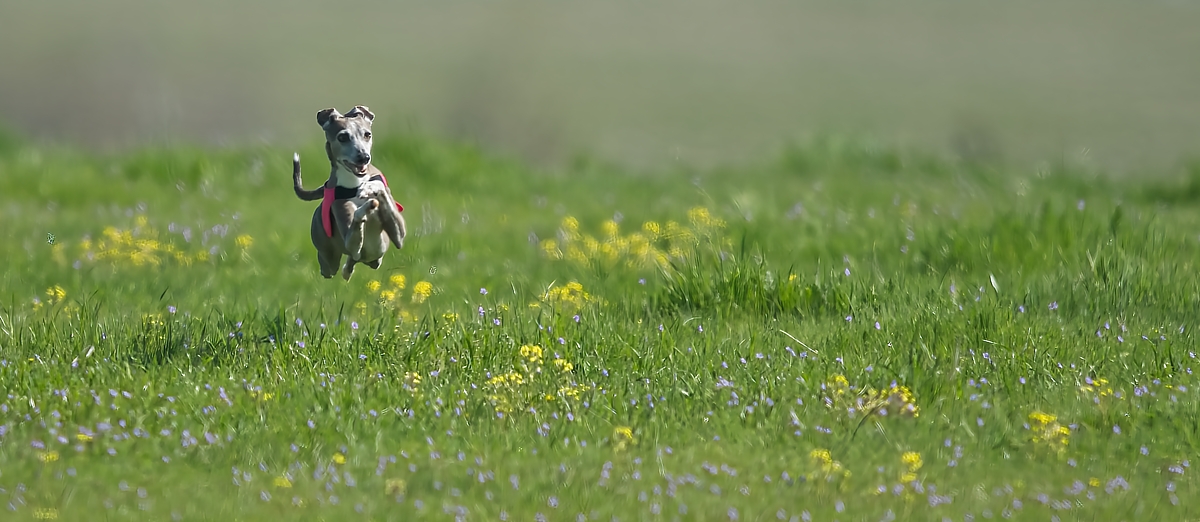
The last of the dog photographs from David Bozsik.
oooo
oooo
oooo
oooo
oooo
That is it, I am afraid. They have been a beautiful set of photographs and we have to thank David Bozsik for them.
I near forgot to mention that, again, these fabulous photographs are Copyright David L Bozsic. I have been given permission by David to republish them.
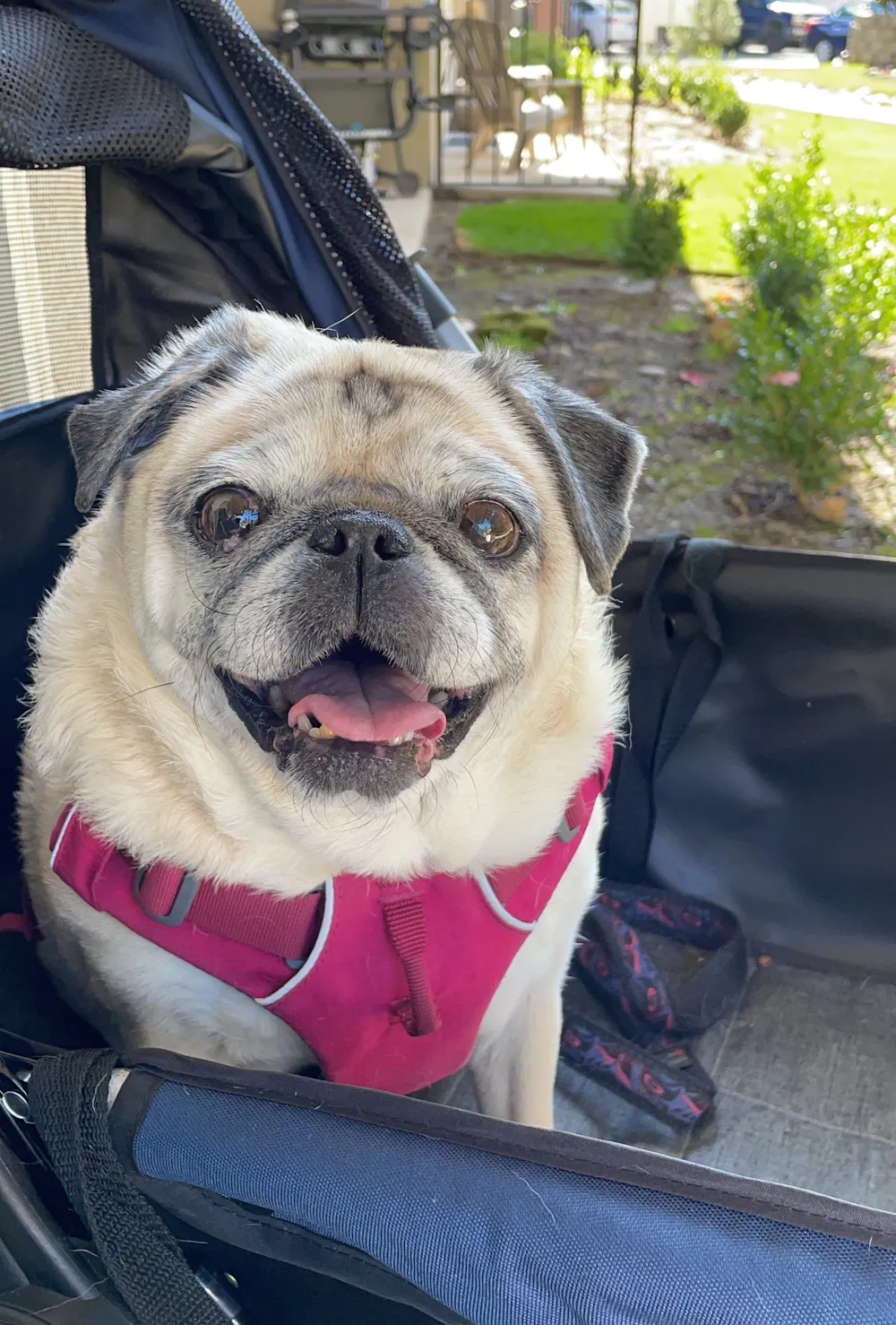
A pup out for a stroll, without paws touching the ground. Shelly Volsche, CC BY-ND
Have you noticed more cats riding in strollers lately? Or bumper stickers that read, “I love my granddogs”? You’re not imagining it. More people are investing serious time, money and attention in their pets.
It looks an awful lot like parenting, but of pets, not people.
Can this kind of caregiving toward animals really be considered parenting? Or is something else going on here?
I’m an anthropologist who studies human-animal interactions, a field known as anthrozoology. I want to better understand the behavior of pet parenting by people from the perspective of evolutionary science. After all, cultural norms and evolutionary biology both suggest people should focus on raising their own children, not animals of a completely different species.
More child-free people, more pet parents
The current moment is unique in human history. Many societies, including the U.S., are experiencing major changes in how people live, work and socialize. Fertility rates are low, and people have more flexibility in how they choose to live their lives. These factors can lead people to further their education and value defining oneself as an individual over family obligations. With basics taken care of, people can focus on higher order psychological needs like feelings of achievement and a sense of purpose.
The scene is set for people to actively choose to focus on pets instead of children.
In earlier research, I interviewed 28 self-identified child-free pet owners to better understand how they relate to their animals. These individuals pointedly shared that they had actively chosen cats and dogs instead of children. In many cases, their use of parent-child relational terms – calling themselves a pet’s “mom” for instance – was simply shorthand.
They emphasized fulfilling the species-specific needs of their dogs and cats. For example, they might fulfill the animal’s need to forage by feeding meals using a food puzzle, while most children are fed at the table. These pet owners acknowledged differences in the nutrition, socialization and learning needs of animals versus children. They were not unthinkingly replacing human children with “fur babies” by treating them like small, furry humans.
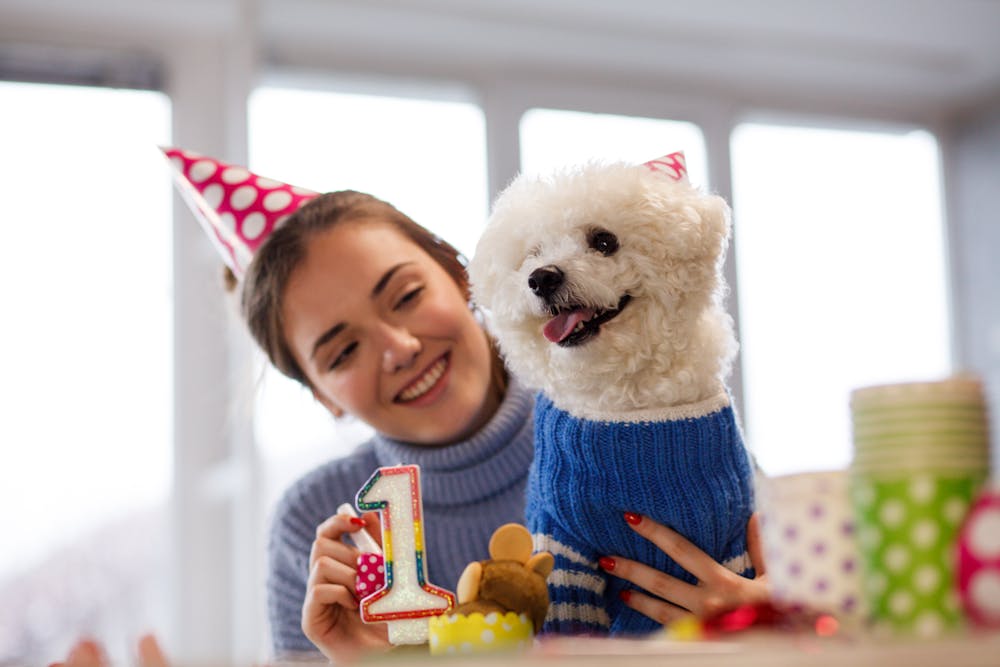
Pet parents might celebrate their dog’s big day – but with a doggy treat and not chocolate cake. fotostorm/E+ via Getty Images
Yet, these findings still do not answer this question: Are people who choose pets over children truly parenting their pets? To answer, I turned to the evolution of parenting and caregiving.
Evolutionary anthropologist Sarah Hardy wrote in 2009 that humans are cooperative breeders. This means it is literally in our DNA and our ancestral history to help care for offspring who are not our own. Anthropologists and biologists call this trait alloparenting. It is an evolutionary adaptation that helped human beings who cooperatively raised children survive. For early humans, this ancient environment was likely made up of small, foraging societies in which some people exchanged child care for food and other resources.
I propose that it is this evolutionary history that explains pet parenting. If people evolved to alloparent, and our environment is now making caring for children more difficult or less appealing to some, it makes sense for people to alloparent other species entering their homes. Alloparenting companion animals can offer a way to fulfill the evolved need to nurture while reducing the investment of time, money and emotional energy compared to raising children.
To further understand this phenomenon of child-free adults parenting pets, I launched an online survey via social media, seeking responses from U.S.-based dog and cat owners over the age of 18. The survey included questions about attachment and caregiving behaviors using the Lexington Attachment to Pets Scale. It also asked a series of questions I developed to probe specific human caretaking behaviors oriented toward pets – things like feeding, bathing and training – as well as how much autonomy companion animals had in the home.
The final sample of 917 respondents included 620 parents, 254 nonparents and 43 people who were undecided or did not answer. Most of the respondents were also married or in a domestic partnership for over one year (57%), between the ages of 25 and 60 (72%) and had at least a bachelor’s degree (77%). They were also mostly women (85%) and heterosexual (85%), a common situation in human-animal interactions research.
Both parents and nonparents reported high amounts of training and play with their pets. This finding makes sense given that all pet owners need to help their dogs and cats learn how to navigate a human world. Survey respondents reported socializing, training and enrichment, including play, for their animals.
Nonparents were more likely to be the one providing general care for the animal. This finding also makes sense since parents often adopt or purchase companion animals as a way to help their children learn responsibility and to care for others. Child-free animal owners invest time, money and emotional energy directly in their pets.
Nonparents reported higher rates of general attachment to their animals. They more frequently viewed their pets as individuals. Nonparents were also more likely to use family terms such as “parent,” “child,” “kids” and “guardians” when referring to their relationships with their pet.
It is this difference, combined with the evidence from my earlier research that these individuals address the species-specific needs of the dogs and cats in their care, that suggests pet parenting is, truly, parenting pets. Though the details may look quite different – attending training classes instead of school functions, or providing smell walks for dogs instead of coloring books for children – both practices fulfill the same evolved function. Whether child or pet, people are meeting the same evolved need to care for, teach and love a sentient other.
My colleagues and I continue to collect data from all over the world about how people live with animals. For now, this study provides evidence that, perhaps rather than being evolved to parent, humans are evolved to nurture. And as a result, who and when we parent is much more flexible than you might initially believe.
Shelly does a fabulous job of looking more closely at the science and it is a science that has a very wide appeal. For in the UK, according to the RSPCA, “In the UK, it’s estimated that 12 million (44 percent of) households have pets with around 51 million pets owned.“
Here in America The Washington Post reported that: “Google the U.S. pet population, and you’re quickly confronted with two oft-cited, and contradictory, sources. The American Pet Products Association (APPA) found that 68 percent of U.S. households owned some sort of pet in 2016 — “equal to the highest level ever reported,” it gushed in the executive summary. Among those pets were about 90 million dogs and 94 million cats, the group said.“
That is just two countries. The worldwide population of dogs and cats must be gigantic.







 Learning from Dogs