Following on from yesterday’s post that highlighted how Switzerland is legally protecting the rights of animals.
Apologies for the brief introduction but our internet service was up and down yesterday and I didn’t know how long I had to get today’s post completed.
Abused animals in Connecticut now have a voice in court, thanks to a new law passed by the state in late 2016.
Connecticut lawmakers passed “Desmond’s Law” in response to the horrific death of a sweet shelter dog called Desmond in 2012. The man who adopted him, Alex Wullaert, reportedly rarely fed Desmond and often beat him.
Ultimately, Wullaert killed the dog by hanging him, after Desmond made the mistake of urinating on Wullaert’s leg. Then he dumped the body in a garbage bag and left it on the street.
When prosecuted for the crime, Wullaert admitted what he’d done. The prosecutor recommended that he spend time behind bars for this shocking offense. Despite this recommendation, the court gave him nothing more than Accelerated Rehabilitation. That meant upon successful completion of probation, Wullaert’s record would be wiped clean.
That result outraged the animal-loving citizens of Connecticut. And they enacted “Desmond’s Law” to ensure that court decisions offer a better measure of justice following animal-related crimes.
Seven attorneys, a law professor and her law students are part of the program statewide. The law authorizes qualified pro-bono lawyers and volunteer law students to:
[P]rovide investigative insight not readily available to the court, resulting in a more fair and efficient process and more meaningful outcomes in animal abuse cases. It is intended to shine a bright light on the full extent of crimes committed under the animal cruelty statute.
In a nutshell, these animal advocates help the prosecution or defense team with tasks it often has no time for, especially in animal cases. The volunteers investigate, research issues and conduct interviews with veterinarians and other witnesses. As official parties to the case, they also write briefs, make arguments in court and submit recommendations to the judge.
A judge has to approve the participation of the animal advocates, who must be requested by either the prosecution or defense.
“The hope [of the law] was that providing courts with an extra resource to help handle these cases, at no cost, [is] that the cases could be more thoroughly handled,” University of Connecticut law professor Jessica Rubin told the Hartford Courant.
Prosecutors in Connecticut already commend the animal advocates for helping them do a better job in these cases. Often, they barely have time to do much of this legwork for cases involving human victims. We all know that when time is precious, the human cases will take precedence over those involving animals. Now, with professionals in place solely for the animal cases, that won’t be a problem anymore.
“We hope with this law in place, we will start to see much better procedural outcomes [in animal abuse cases],” Annie Hornish, director for the Humane Society of the United States in Connecticut, told the AP. “We are very excited that judges seem to be taking advantage of it.”
This is an incredible step forward for animal victims. In particular, it helps overburdened courts provide the same level of investigation and consideration to animal victims that they give to human victims.
Connecticut has given animals a legitimate, recognized voice in the state court system. Why can’t every other state do the same thing? From Maine to California, every state has animal-loving lawyers and law students who would be grateful and eager to volunteer their time as animal advocates.
Lawmakers from other states are reaching out to Rubin to request information on how they might be able to pass a similar law. There’s interest out there, and animal activists can help fan this flame.
It’s time for every jurisdiction to pass its own version of Desmond’s Law.
Photo credit: Thinkstock
ooOOoo
Once again everyone: It’s time for every jurisdiction to pass its own version of Desmond’s Law.
I am referring to the result of the British election that was held last Thursday.
Now I am well aware that many readers will not have the same relationship with the outcomes of British elections as your faithful scribe. But I am also aware that we live in a very connected world. I am also acutely aware that for many, many years I was a devoted listener to the 15-minute weekly radio broadcast on the BBC by Alistair Cooke Letter from America.
So for me, and many others I don’t doubt, the views of America as to what goes on across the pond are just as fascinating today as they have always been.
But in the absence of dear Mr. Cooke (20 November 1908 – 30 March 2004) passing on his experienced assessment on what the outcomes of British elections mean for America then I turn to a recent item on The Conversation site and republished here within the terms of that site.
ooOOoo
How populism explains May’s stunning UK election upset: Experts react
June 9, 2017 6.04am EDT
Editor’s note: U.K. Prime Minister Theresa May’s election gamble failed badly as her Conservatives lost 12 seats, leaving them with 318, shy of a majority. It was a stunning loss for a party earlier projected to gain dozens of seats. Without a majority, the Conservatives will have to rely on another party to govern – known as a hung Parliament. If they’re unable to forge a coalition, rival Labour leader Jeremy Corbyn – whose party gained 31 seats – would be able to give it a go. We asked two experts to offer their insights on what Americans should make of the election and its results.
May had a bad night and may face a struggle over her party’s leadership
The results of this election show how similar, and yet how different, British politics are from what is happening in America.
As in the United States, there has been an explosion of populism in Britain, most recently evidenced by the Brexit referendum. This new political force is translating into less liberal policies from the major parties.
In continental Europe, the new populism is mostly embodied by the resurgent far right. But in Britain, as in America, it is being filtered through the existing two-party system – though the U.K.‘s smaller parties do complicate the electoral map.
To accommodate the political winds, May and her Conservatives decided to shift their electoral strategy away from Margaret Thatcher’s pro-market economic approach toward a greater focus on immigration, security and economic nationalism.
Labour leader Jeremy Corbyn, for his part, deserted the more centrist “New Labour” ideas of Tony Blair in favor of a more robust form of social democracy.
The American left, like its British counterpart, has also become increasingly skeptical of unbridled markets. But among Republicans, a traditional hostility to “big government” makes pro-worker redistributive policies, some of which the Tories have adopted to win votes, hard to stomach. For this reason, populism on the American right has mostly taken the form of protectionist and anti-immigrant policies, as embodied by Donald Trump.
Yesterday’s results were devastating for May and indicate that the Conservatives were ultimately unable to balance their new populist message with their traditional support for neo-liberal policies.
Corbyn, for his part, will use this unexpected victory (of sorts) to solidify his hold over the Labour Party and to move it further to the left.
It remains to be seen whether the election will result in a minority or a coalition government, or whether the parties will be well and truly deadlocked. Whatever happens, the British electorate, like its cousin across the pond, has shown itself to be highly polarized.
Still, at a minimum, Britain’s parliamentary structure, along with the ability of the Labour leadership to co-opt disillusioned voters, seems to have spared Britain the fate of America – the takeover of government by a populist insurgent.
Corbyn and his Labour Party had reasons to smile on election night. AP Photo/Frank Augstein
May took a calculated political risk and lost. While the market reaction has been severe, with the pound plunging, it’s nothing new to companies, which take calculated risks like that every day – some pay off and some do not.
So first of all, U.S. corporate executives will need to take a deep breath. Assuming a combination of other parties do not cobble together at least 322 seats – despite winning seven seats, Northern Ireland’s Sinn Fein will not send MPs to London – the Conservatives will dominate a coalition government and have considerable sway over policy.
This means a “hard Brexit,” as outlined by May in January, and as seen in the European Union’s tough negotiating guidelines, is unlikely to change. But this is what most U.S. companies have been planning for anyway since last June’s Brexit vote. Many companies, particularly banks and financial institutions, are already planning to move some of their U.K. operations to other EU countries to take advantage of the single market rules.
This process will continue no matter who’s in power, since only the low-polling Liberal Democrat and Green parties promised a Brexit revote.
Second, a weakened Conservative Party will need more foreign friends, and that includes U.S. companies. Since Brexit, some foreign businesses have threatened to downsize or close their U.K. operations as leverage for obtaining government subsidies. Expect more companies to use this strategy with a weaker U.K. government.
As I argue in my recent book, the business environment of Europe is much more than the U.K. market, and U.S. companies have become increasingly aware of this since Brexit.
In other words, it’s business as usual, and that means the continued segmenting of companies’ U.K. and EU strategies, regardless of who is governing in London.
ooOOoo
Expect things to continue to be interesting for some time. Or as more eloquently put by Tariq Ramadan “Times have changed; so must the lenses through which we see the political future.”
Back to Alistair Cooke. There are many of his broadcasts available on the BBC Radio website and on YouTube.
I’m closing with just a small part of Charlie Rose interviewing Alistair Cooke in May, 1996.
Uploaded on Sep 25, 2011
Tuesday, May 7, 1996
Charlie Rose: An interview with Alistair Cooke
Alistair Cooke celebrates the 50 year anniversary of his BBC broadcast, “Letter from America”, a 15-minute talk about life in America for British listeners.
Recorded some twenty-one years ago. Somethings don’t seem to change!
As in how a primate chooses to communicate with humans.
In recent times there have been a couple of posts in this place about the science of communication between dogs and humans.
What about other animals?
What about a gorilla?
If you drop across to the YouTube site and search for Koko the Talking Gorilla you will be astounded by how many videos are to be seen.
Try this one:
A very moving account from Robin Williams.
If we then want more background information on this remarkable animal, Wikipedia is there to oblige (in part):
Hanabiko “Koko” (born July 4, 1971) is a female western lowland gorilla who is known for having learned a large number of hand signs from a modified version of American Sign Language (ASL).
Her instructor and caregiver, animal psychologist Francine “Penny” Patterson, reports that Koko is able to understand more than 1,000 signs of what Patterson calls “Gorilla Sign Language” (GSL).[2] In contrast to other experiments attempting to teach sign language to non-human primates, Patterson simultaneously exposed Koko to spoken English from an early age. Reports state that Koko understands approximately 2,000 words of spoken English, in addition to the signs.[3] Koko’s life and learning process has been described by Patterson and some of her collaborators in a number of books, peer reviewed articles, and on a website.
Koko got her birthday wish this July 4th — not only did one kitten come to visit, but a whole litter. Koko fell in love with one, and the other fell in love with her. Koko has adopted these two kittens into her family, and it has energized her world.
Not only have Koko’s maternal and play instincts kicked in, but she is signing more to her caregivers and generating new content everyday that can be used by The Gorilla Foundation to create empathy for great apes. This can have significant benefits to both endangered free-living great apes and those in captive environments, by encouraging the development of 2-way communication with their caregivers (which Koko has had since she was a baby).
The Gorilla Foundation is now working on a multimedia sequel to the classic book, “Koko’s Kitten,” which has already reached millions of children worldwide, and has the power to motivate millions more to learn how to make the world a better place for all of its conscious inhabitants.
You can support The Gorilla Foundation mission of Conservation through Communication by visiting http://www.koko.org
Thank you!
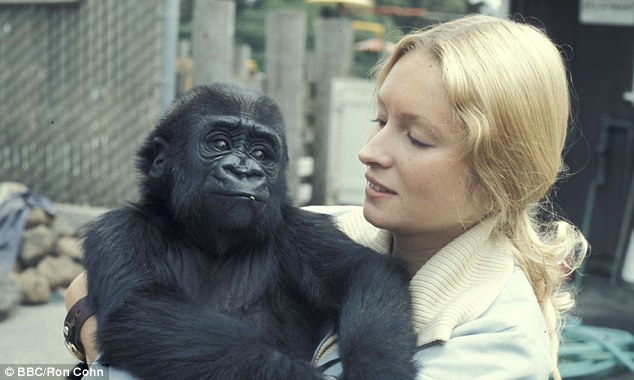
Will close with this photograph seen ‘on the web’.
Graduate student Penny Paterson with a young Koko on her back not long after they met in 1971 in San Francisco. (The Daily Mail newspaper 2nd June, 2016.)
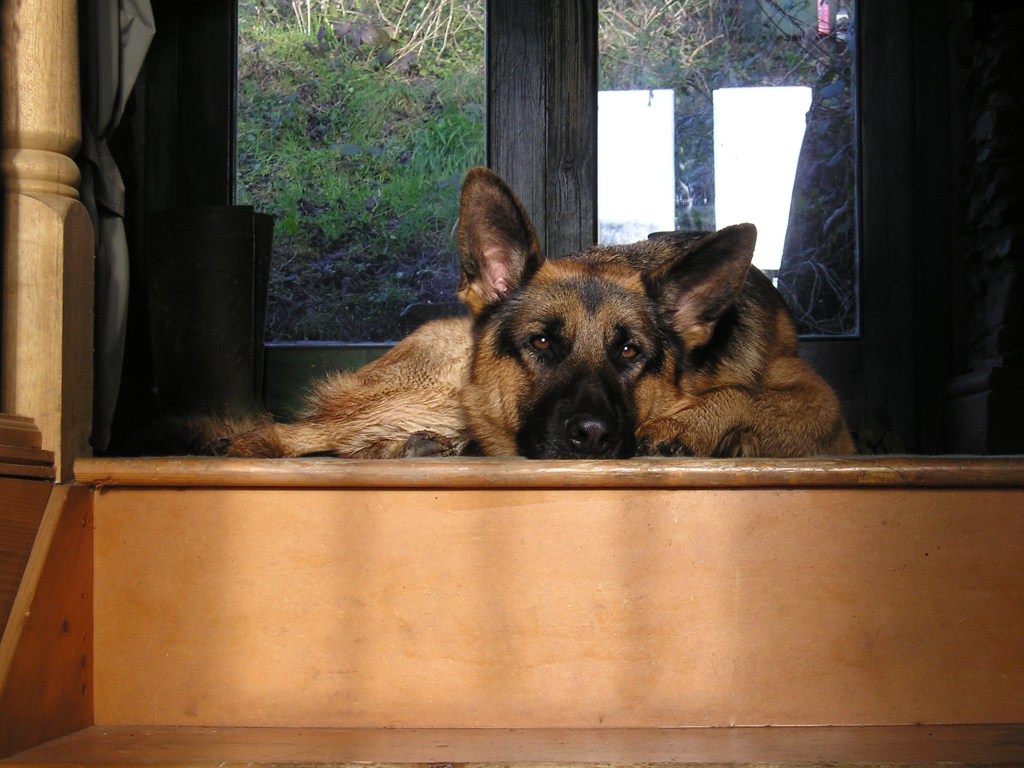
Here’s a photograph of Pharaoh taken on the 3rd December, 2005. Taken in my home in Harberton, Devon, some two years before I met Jeannie.
It’s not the world’s best photograph but I start today’s post with it simply because there is a look in Pharaoh’s eyes that spells out love to me in capital letters. Always has since the day I took that photograph.
Here’s an enlargement of the photo offering a closer look at Pharaoh’s expression in those eyes.
Right from the very first moment that I held Pharaoh I sensed the start of a loving bond. Did I choose to love Pharaoh? Well, of course I did! Was it a conscious decision? I don’t think so!
All of which is my introduction to a fascinating essay about the science of love that recently appeared on the Care2 site.
Love may often feel spontaneous and sometimes even out of control. But is it, really? Research is starting to show that you can change the intensity of love you feel towards others. Similar to emotions like fear or sadness, love can be influenced simply by how you think about a situation.
Is love under your control?
One study looked at altering love feelings in people who were either in a romantic relationship or had recently broken up from one. Each participant started by viewing pictures of their current lover or their ex-partner to bring up their current feelings towards them.
Then, researchers asked them to think about positive aspects of their partner, relationship or possible future scenarios. Their feelings towards their current or previous partners were assessed again.
The second part of the study asked participants to think of negative things about their partner, such as what’s wrong with them or their relationship.
Perhaps it’s not surprising that participants reported having greater love feelings after thinking positive thoughts. Whereas, they reported decreased lovingness after the negative thoughts. It was the same for everyone, whether they were in a relationship or had recently broken up.
Researchers felt this shows great potential for people to take more control of their emotional world, which could in turn benefit their lives and relationships.
Interestingly, thoughts also appeared to affect everyone’s overall mood and feelings about life in general. The positive thoughts improved people’s mood and disposition, whereas the negative thoughts brought everyone down.
This may highlight the importance of how positive and negative thoughts in general can affect our mental health.
How can you put this to use?
You can likely think of times in your own life when it would be helpful to either decrease or increase your love for another person.
Have you ever had an unwanted crush on someone? For instance, obsessing over a celebrity you’ll likely never meet can cause more frustration than joy in your life. Or maybe you’ve fallen for someone who’s not available, either physically or emotionally.
These are times when it’s in your best interest to end your attachment to the person and move on.
In addition, research has shown that thinking negatively about an ex-partner or your previous relationship helps you get over a break-up. The reverse is also true – if you think positively about an ex, it’s more difficult to heal and move on.
Keep this in mind if you’re going through a break-up, or need to reduce your feelings towards someone for another reason.
Try asking yourself questions like these:
What annoys me about this person?
Did we ever have a fight?
Why were we a bad match for each other?
What didn’t work in our relationship?
What could go wrong if we stayed together?
Reframing your thoughts is also a much healthier way to try to get over someone than taking self-destructive action to distract yourself, such as drinking too much.
On the other hand, the world always needs a lot more love to go around. Increasing your love towards others is often one of the best things you can do to help yourself and everyone in your life.
Unfortunately, the top reason married couples give for getting a divorce is growing apart and falling out of love. It’s true the intensity of love feelings usually fluctuates throughout a long-term relationship, but a decrease in feelings doesn’t have to mean the end.
If you’re starting to question whether or not you should stay in a long-standing relationship, take a closer look at your situation before making a final decision. Do you still respect and care for your partner? Do you still have lots in common? Is it possible you’re just in a temporary slump?
Questions like these may help to re-frame how you feel about your relationship:
What are some of your partner’s best qualities?
Why did you get together in the first place?
Are there things you’d like to do with your partner in the future?
What makes you a good match for each other?
Do you enjoy spending time with your partner?
Romantic partners who view each other in a positive light have been shown to actually have happier relationships. This is likely true for all relationships. Choosing more positive thoughts can go a long way towards creating greater harmony with all your loved ones.
Sharing your thoughts and telling others why you love them is even better.
ooOOoo
As my dearest Jeannie will confirm, I have never been the most comfortable person in terms of verbalising my love for her, despite Jean being the dream loving partnership of my life. Jean, on the other hand, expresses her love for me many times each day.
Maybe this essay offers an insight into the different ways we love?
For Jean also tells the dogs individually many times each day that she loves them. I feel the same but don’t say it anything like as often.
So is science showing us why the difference between Jean and me? I think so.
Yet another thing that we learn from dogs. Or more specifically that I have to learn from dogs!
I am sharing this with you again because it so nicely complements the posts of the previous two days.
The ways our dogs speak to the world.
First published August 8th, 2016.
Dogs are very vocal creatures.
Anyone who has been close to dogs in their lives knows that they are frequently very vocal creatures. Likewise, anyone who has been close to a dog or two quickly learns to understand the basic emotions being conveyed by a dog’s vocal sounds.
But, nonetheless, there was an item over on the Care2.com site recently that provided a comprehensive tutorial on listening and interpreting the sounds from our dogs. I wanted to share it with you today.
Your dog communicates with you and other dogs in a variety of ways — including growling. Depending on the context, a growl can be anything from a sign of enthusiastic play to a warning of an impending attack. It is important to understand why your dog growls and when you should be concerned about this behavior.
A growl doesn’t always signal an unfriendly dog. Here are some common reasons your dog might growl and some situations where you may need to seek outside help.
Growling in Play
Dogs often growl during friendly play with other canines. This type of growling is typically higher pitched and shorter in length than other growls. To ensure that play is friendly, watch for the proper play signals and keep arousal levels low by taking frequent breaks.
Your dog may also growl when he plays with you. Pay attention to your dog’s body language during play — sometimes growling can indicate discomfort. Avoid rough play with hands and physical wrestling. If you are unsure about the distinction between acceptable play interactions and aggression, seek help from a professional.
Growling as a Warning
A dog who is afraid of something may growl to fend off potential harm; the message he’s sending is that he will defend himself if necessary. Some dogs may growl at any unfamiliar person, while others may respond only to specific types of people, like men with beards, or to sights they are uncomfortable with, such as a horse. If your dog growls only at specific people or things, remedial socialization help is needed.
Or your dog may growl at another dog as a way to tell him to back off before a confrontation occurs. Many times, the other dog will heed the growl and give your dog the space he desires. There are dogs, however, who will not back down when they are growled at; in this situation, a fight may ensue.
If your dog’s warnings to back off go unheeded, his growling may increase into other aggressive behaviors, making it difficult for him to be around other canines. Some dogs do best with only select doggy playmates, while others should be limited to socializing only with humans.
Growling for Medical Reasons
If your dog suddenly starts to growl when he is approached or touched, it may be a sign that he is in pain. Dogs with arthritis, abscessed teeth or other forms of illness or injury may experience increased pain when they are moved or touched and may growl to avoid it. A pet in pain is also more likely to bite than a healthy pet.
Pregnant or lactating dogs, or dogs in false pregnancy, are more likely to be protective and defensive with people and other animals, and are also more likely to growl at approaching humans. If you think your dog is growling for medical reasons, talk to your veterinarian.
Growling Out of Frustration
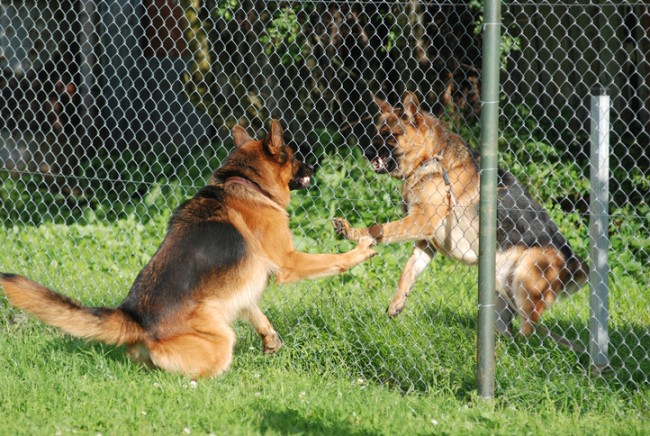
Your otherwise-friendly dog may growl as an expression of barrier frustration. A dog may growl or bark when he is on leash or behind a fence, even if he is comfortable with other dogs when he is off leash. Dogs who growl in these situations need to be trained to relax when on a leash or behind a fence, as territorial or frustration-based behavior can escalate over time. Your dog should never be chained up outside, as this can lead to extreme territorial and protective behavior, which puts the dog, other animals and people in danger.
When to Seek Outside Help
Growling is a way of communicating — for instance, his way of saying, “Give me space,” “Stop it,” or “Back off.” But certain situations — growling when approached or handled, and growling as part of resource guarding — require professional help. A dog who is engaging in resource guarding may be protecting food, toys or people, or his favorite places, like a sleeping space. Even with the best management plan in place, a guarding dog may escalate his aggression, which is why this behavior calls for professional intervention.
Your dog may also growl when he is handled, either because he is uncomfortable or afraid. He may growl when his collar is grabbed, his toenails are trimmed, his ears are touched or his mouth is opened. He may also be uncomfortable with direct eye contact, a person leaning over him, hugs or other forward greetings. Again, this behavior can escalate to something much more dangerous.
Talk with your veterinarian about these behaviors as soon as possible; have your pet’s health evaluated and, if necessary, ask for a referral to a behaviorist or trainer who can help you teach your dog strategies for coping with these situations.
By Mikkel Becker | Vetstreet.com
ooOOoo
You can imagine that with nine dogs here in the house there are times when Jean and I struggle to hear each other over the top of the doggy conversations.
But we wouldn’t have it any other way!
Back to today.
Just slightly sad that in those months since last August our doggie family has reduced to seven.
But on a brighter note, in just three days time, on June 3rd., we will be celebrating Pharaoh’s fourteenth birthday!
Yesterday, I shared an article that had appeared on the Care2 site on the topic of the latest scientific inquiries into how dogs understand what we humans say. That had originally been published in September of 2015.
Published just three days ago, again via the Care2 site, was another article about the language of communication between our beloved dogs and us.
Here is is:
ooOOoo
Humans Can Understand Dogs by the Sound of Their Growls
In this study, recordings of three different types of dog growls were taken from 18 different dogs of various breeds and sizes. They included aggressive guarding growls that were triggered when other dogs approached the growling dogs’ food, playful growls during a game of tug-of-war between dogs and threatened growls from dogs that were approached by strangers.
The guarding growls were typically longer and more drawn out than the playful growls, which were were shorter and more repetitive. The guarding growls could be differentiated from the threatened growls by their pitch and loudness, with the guarding growls having a lower and more intense pitch so that it sounded like it was coming from a bigger dog.
Forty participants were recruited to interpret the dog growls by listening to two sets of the recordings. For the first set, they were asked to judge the emotion behind each growl using a scale that measured the degree of aggressiveness, fear, sadness, happiness, and playfulness that they could pick up on. For the second set, they were asked to choose whether the dog growls came from a dog that was guarding food, playing, or feeling threatened.
It turns out that people can interpret dog growls accurately more often than not. The participants had a 63-percent overall accuracy rate for interpreting the dog growls. Playful growls were easiest to identify at an 81-percent accuracy rate while guarding growls had an accuracy rate of 60 percent followed by threatened growls at 50 percent.
The results suggest that humans are pretty good at interpreting dog growls in a broader context given that it was much easier to identify the playful growls from the other two. The guarding growls and the threatened growls both share displays of aggression, which could explain why it was a little more difficult for the participants to accurately identify them.
What’s even more interesting is that women and people who were already dog owners showed higher accuracy rates of identifying the growls. The researchers pointed out that women are known to have higher emotional sensitivity, which may help explain why their interpretations were more accurate. Likewise, dog owners probably used their experience to identify the growls, suggesting that people can be trained to get better at learning to understand dogs.
The researchers say that learning to identify the differences in dog growls could help reduce aggression in dogs as well as improve their behavior. So whether you’re a dog owner yourself or know someone who owns a dog, it might be an interesting experiment to tune in to the subtle sounds of their growls to see if you can understand what they’re trying to communicate.
A couple of weeks ago I wrote a post Talking to One’s Dog. Many of you stopped by and left your comments, all of which was to confirm how much speaking to your dogs (and cats) is part of normal life for you.
I finished that post writing:
Let me close by reminding all you good people of yet another wonderful aspect of the relationship between humans and dogs. In that we all know the dog evolved from the grey wolf. But had you pondered on the fact that wolves don’t bark! Yes, they howl but they do not bark.
There is good science to underpin the reason why dogs evolved barking; to have a means of communicating with us humans.
Every person who has a dog in their life will instinctively understand the meaning of most, if not all, of the barks their dog utters.
Anyway, I was going through some websites yesterday and, quite by chance, came across that science that I referred to above. It was in a Care2 article published last September and I am republishing it below.
ooOOoo
Yes, Dogs Apparently Do Understand What We’re Saying
You might want to start spelling out some words around your dog. According to a new study, not only do dogs comprehend what we’re trying to tell them by the tone of our voices, but they can also even understand what it is we’re saying — sort of.
Neuroscientist Attila Andics and his fellow researchers at the Eotvos Lorand University in Budapest discovered that just like human brains, a dog’s brain reacts to both the meaning of a word and how it is spoken. Just like us, the left hemisphere of a dog’s brain responds to meaning, while the right hemisphere responds to intonation.
The study, published August 30 in the journal Science, shows that even non-primate mammals who cannot speak can still comprehend the meanings of words in a speech-filled environment. This suggests that the ability of our brains to process words is not unique to humans, and may have evolved much earlier than previously thought.
Not only could these results help make communicating with our dogs more efficient, but the study sheds new light on the origin of words during language evolution. “What makes words uniquely human is not a special neural capacity, but our invention of using them,” Andics said in a press release.
While previous studies have observed dogs to see how they understand us, this is the first one that took a look inside their brains using magnetic resonance imaging (MRI). The 13 participants were all family pets. They included six border collies, five golden retrievers, a Chinese crested dog and a German shepherd.
To be tested, the dogs were first trained to lie still for eight minutes in the MRI machine while wearing headphones and a radio-frequency coil. (Based on the wagging tail of a Golden Retriever in the video below, this didn’t seem to bother at least one of the participants.) Their brain activity was recorded as they listened to a recording of their trainer saying, in both positive and neutral tones, words of praise – like “Good boy!” and “Well done!” – as well as neutral words like “however” and “as if.”
Not too surprisingly, the positively spoken positive words got a big reaction in the reward centers of the dogs’ brains. The positive words spoken neutrally and neutral words spoken with positive tones? Not so much.
Regardless of how they were spoken, the dogs processed the meaningful words in the left hemisphere of their brains. They processed intonation in the right hemisphere.
“There’s no acoustic reason for this difference,” Andics told Science. “It shows that these words have meaning to dogs. They integrate the two types of information to interpret what they heard, just as we do.”
Of course, this doesn’t mean dogs understand every single thing we say (although a Border Collie named Chaser understands over 1,000 words, which is pretty doggone remarkable).
Julie Hecht, a Ph.D. student studying canine behavior and cognition at City University of New York, offers this advice in Scientific American: “Before discussing this with your dog — ‘I knew you could understand me this whole time!’ — the caveat to this research is that a dog processing words — registering, ‘Ah! That’s familiar!’ — and a dog understanding words as you intend are not necessarily the same thing.”
Photo credit: Thinkstock
ooOOoo
I have recounted this example before about how well our dogs listen to Jean and me.
For we take our dogs out for some playtime each day after our lunch. Years ago we used to chat about whether or not to have a cup of tea before taking the dogs for a walk. But pretty quickly once they heard the word “walk’ spoken aloud they were all crowding around the front door.
Then it was a case of spelling out the word: “W – A – L – K”. That lasted for, oh, two or three days.
Then it was using a variety of phrases that we thought would be meaningless to the dogs. That didn’t work!
And on and on.
Now, as soon as we are finishing up our food they are at the door. Jean and I now delay our hot drink to later on!
The most beautiful human – animal relationship in the world!
Sound UK produces extraordinary musical encounters for all
That sub-heading is the banner statement you will read if you go across to the Sound UK website. You may recall that I featured Sound UK in a post last June under the title of Sonic Journeys. I also presented the fact that my daughter is one of two directors of Sound UK. As in:
Sound UK is run by Directors Polly Eldridge and Maija Handover. We work alongside a crack team of freelancers and consultants across production, marketing, design, participation and fundraising. These include Tim Hand (production), Becky Morris Knight at Shipshape Marketing (digital marketing), Beth Fouracre (participation), John Gilsenan at IWant (design), Sarah Coop (fundraising) plus many more.
The reason I am featuring Sound UK again is because I wanted to share with you an exciting new project. I am republishing this from the Sound UK site.
ooOOoo
Tom Phillips – Irma: an opera
Sound UK is a music charity developing a major new project to mark the 80th birthday of one of Britain’s most treasured artists
We need your support to produce the first multimedia production of Royal Academy artist Tom Phillips’ Irma: an opera at South London Gallery this September.An exquisite miniature opera and audio visual installation, Irma is drawn from his masterpiece A Humument, which he recently completed after 50 years. This unique production celebrates Phillips’ extraordinary output in art and music.
Tom Phillips RA: Phillips has had major exhibitions in national galleries, painted figures such as John Gielgud and Iris Murdoch and created works for the Imperial War Museum, Westminster Abbey and Westminster Cathedral. His work can also be seen on the streets of Peckham where he has lived and worked for most of his life. You may even own one of his artworks; the Benjamin Britten 50p piece.
Tom Phillips in his Peckham studio
In the 1960s, Phillips was at the centre of the vibrant art school scene where music and art collided. He brought over key composers of that era to the UK – Morten Feldman, John Cage, performed with Cornelius Cardew – and even taught Brian Eno, who he introduced to ideas that had a great influence on Eno’s music. This landmark event recognises Phillips’ work as a composer and wider influence on the world of music.
Excerpt from Irma: an opera full score 2014
The Creative team: Sound UK is working with one of the UK’s most gifted opera designer / directors Netia Jones and her company Lightmap, with music director Anton Lukoszevieze and his leading ensemble Apartment House.
“Netia Jones is the most imaginative director of opera working in Britain today” The Observer
“One of the most innovative and exciting chamber ensembles in Europe” Royal Philharmonic Society on Apartment House
We need YOU to be part of Irma!
We have already raised the majority of our funding with the generous support of Arts Council England and Hinrichsen Foundation. We are also grateful for major in kind support from South London Gallery, where Phillips first showed his work as a student.
YOU can play a key role in Phillips’ new artwork. We need to raise £5,000 to help pay for rehearsals and the creation of the video for this extraordinary artwork.
To thank you for your invaluable support, we have put together a selection of unique rewards based on Irma characters – view by scrolling up on the right of this page – including an exclusive limited edition print created by Tom Phillips and mementos of his work.
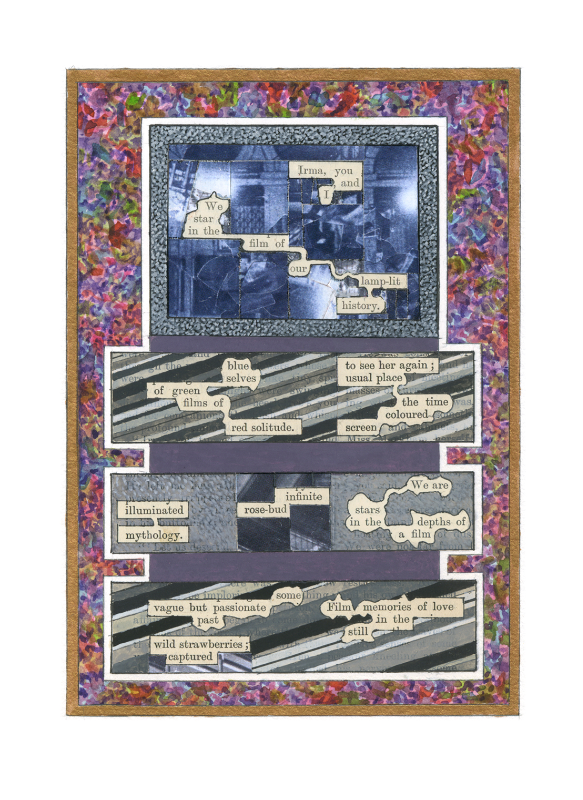
Image of Tom Phillips limited edition print – Irma: Our Lamplit History
Paper size h:28.4cm x w:21cm
Limited edition of 50
A unique print created by Tom Phillips in support of the world premiere full version of his opera Irma, at South London Gallery, September 2017, directed / designed by Netia Jones, musical direction Anton Lukoszevieze, performed by Apartment House with video by Lightmap.
Digital print with silkscreen 2017
All prints are sent signed and numbered by the artist.
The creators of “SKYGLOW,” a crowd-funded project showing the impact of urban light pollution through time-lapse videos, photos and a book, have another stunning video to share. In “Kaibab Elegy,” filmmakers Gavin Heffernan and Harun Mehmedinović visit Grand Canyon National Park and capture a rare weather event.
In the mesmerizing video, clouds build inside the canyon almost like bubbling water filling a jacuzzi as the sun rises and sets in the background, creating the pinkest sky you’ve ever seen. Those clouds roll like waves in the ocean and crash against the cliffs. This phenomenon is called full cloud inversion, and it happens when cold air is trapped in the canyon and topped by a layer of warm air, which combines with moisture and condensation.
“We were extremely lucky to be there to capture it, and it’s a collection of unique footage not found anywhere else,” Mehmedinović says.
He and Heffernan, who journeyed 150,000 miles around the globe for their new book and video series, work with the International Dark-Sky Association, a nonprofit fighting to preserve the dark skies around the world.












 Learning from Dogs