One of the many things that we adore about living here in Merlin, Southern Oregon is the closeness of nature. Not just the nature of the slopes and mountains but the nature of the trees, creeks, grasses and wild plants.
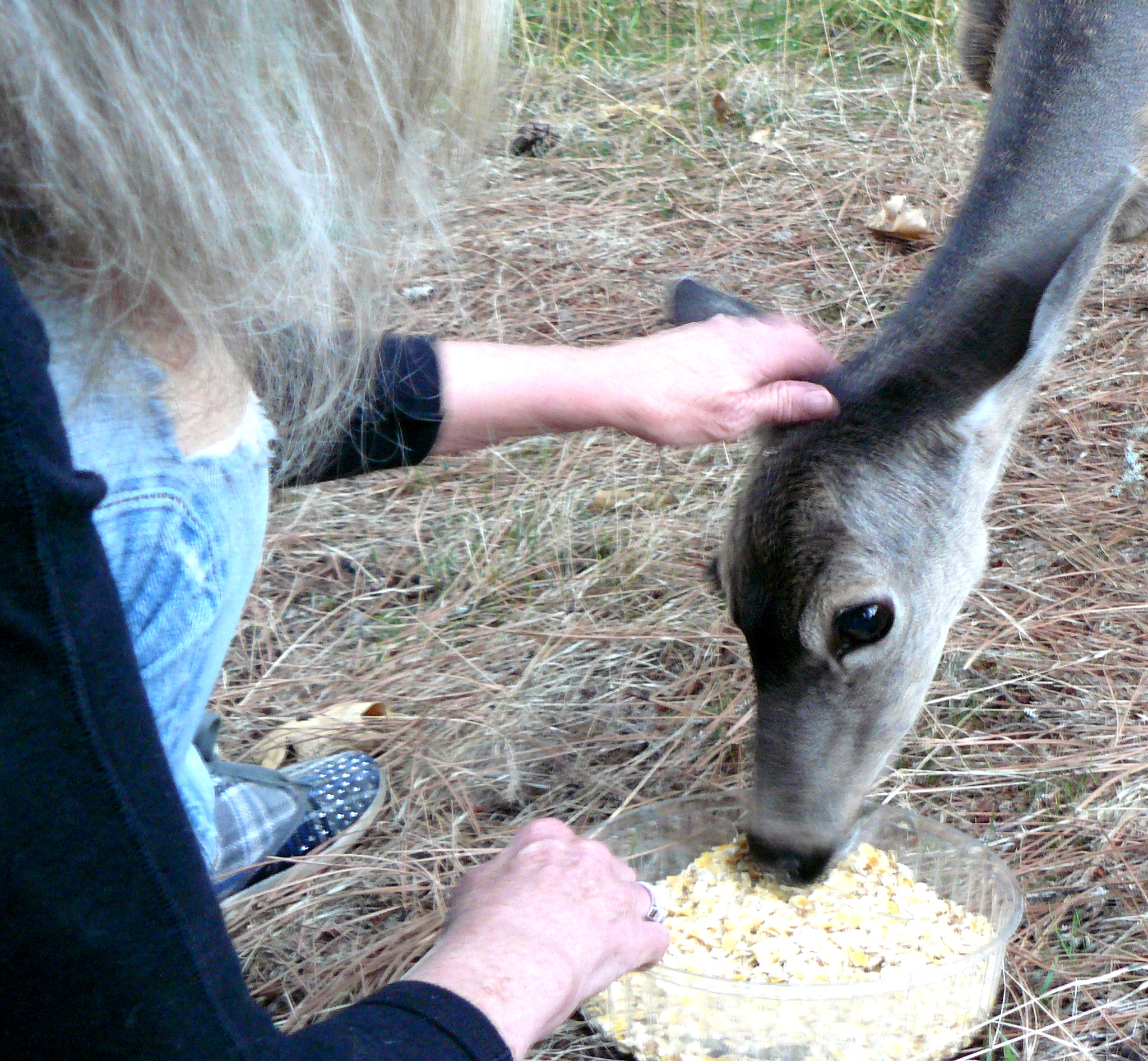
Plus the awareness over the 4+ years that we have been here of how easy it is to gain the trust of wild animals. I will go to my grave holding on to the sweet sensation of a wild deer trusting me and Jean to the point where we could stroke the deer’s neck when we were feeding her.
The trust between the deer and Jean then enabled the deer to feed from Jean’s hand.Then, unbelievably, the wild deer continues feeding as Jean fondles the deer’s ear.
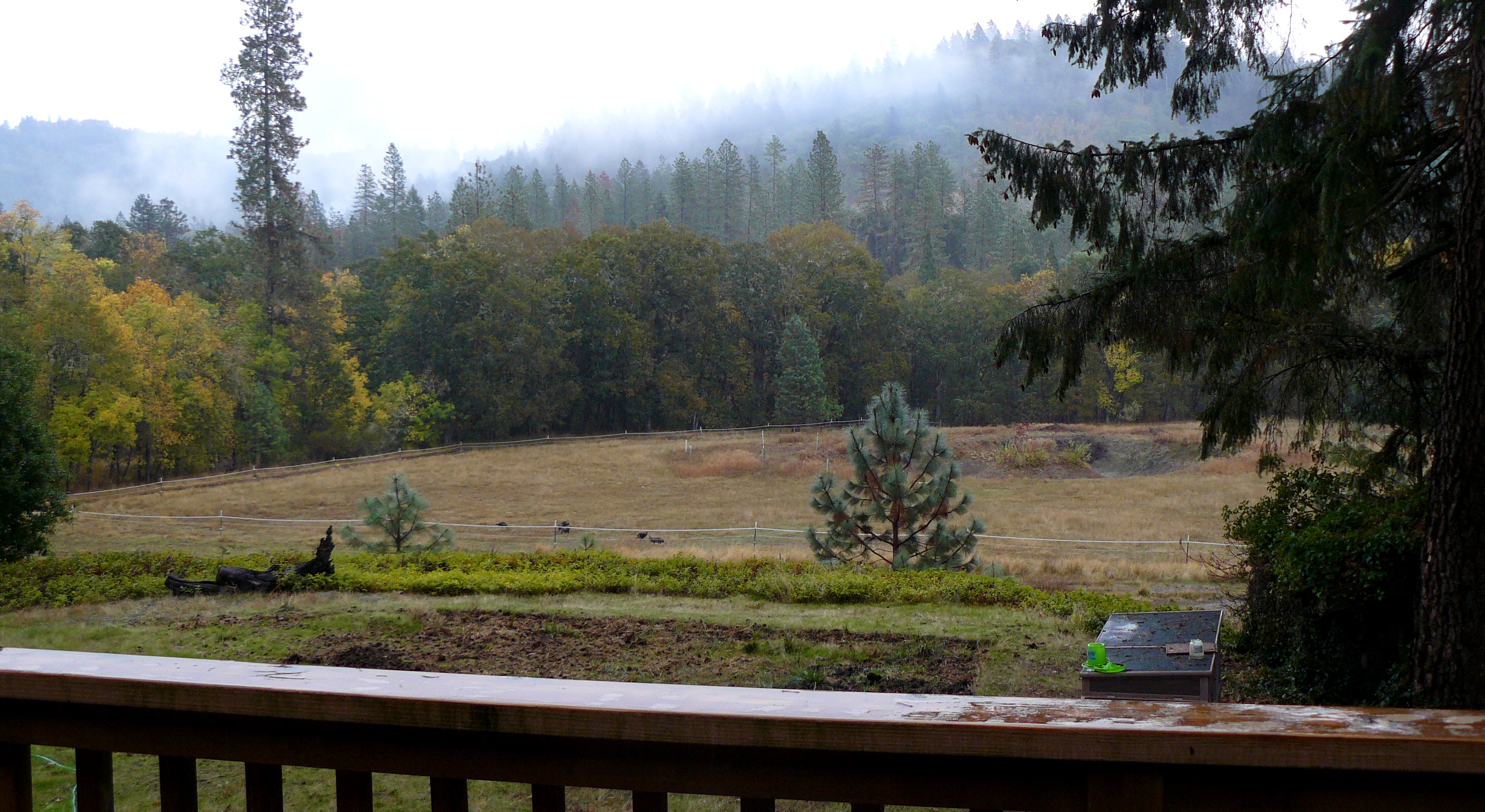
(Both photographs taken in October, 2014 in the area of grassland near to our stables.)
The measure of how we, as in humanity, really feel about the only home we have, as in Planet Earth, is how we regard our planet.
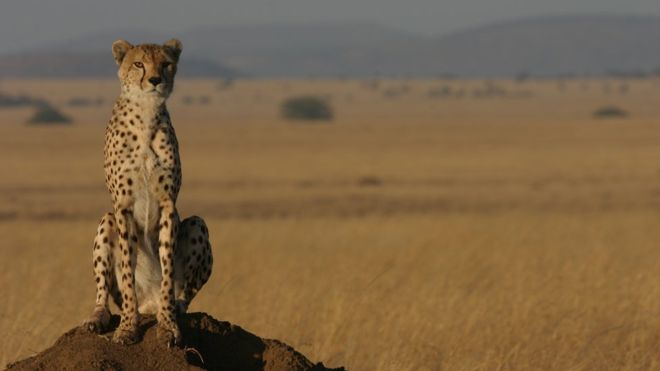
The pain that we feel when we read, as I did yesterday, about another animal species possibly heading towards extinction. In this case, an item on the BBC News website about Cheetahs.
Cheetahs heading towards extinction as population crashes
By Matt McGrath Environment correspondent
Protected parks and reserves for cheetahs are not sufficient as the animal ranges far beyond these areas.
The sleek, speedy cheetah is rapidly heading towards extinction according to a new study into declining numbers.
The report estimates that there are just 7,100 of the world’s fastest mammals now left in the wild.
Cheetahs are in trouble because they range far beyond protected areas and are coming increasingly into conflict with humans.
The authors are calling for an urgent re-categorisation of the species from vulnerable to endangered.
It’s no good tut-tutting; something different has to be done. For otherwise nature will have the last word to say about the future of vast numbers of species especially homo sapiens!
All of which leads me to the main theme of today’s post: holding nature in higher esteem as in higher legal esteem.
Read the following that was published on The Conversation blogsite on October 10th, 2016 and is republished here within their terms. The author is Chip Colwell , Lecturer on Anthropology, University of Colorado, Denver.
ooOOoo
What if nature, like corporations, had the rights and protections of a person?
October 10, 2016 8.16am EDT
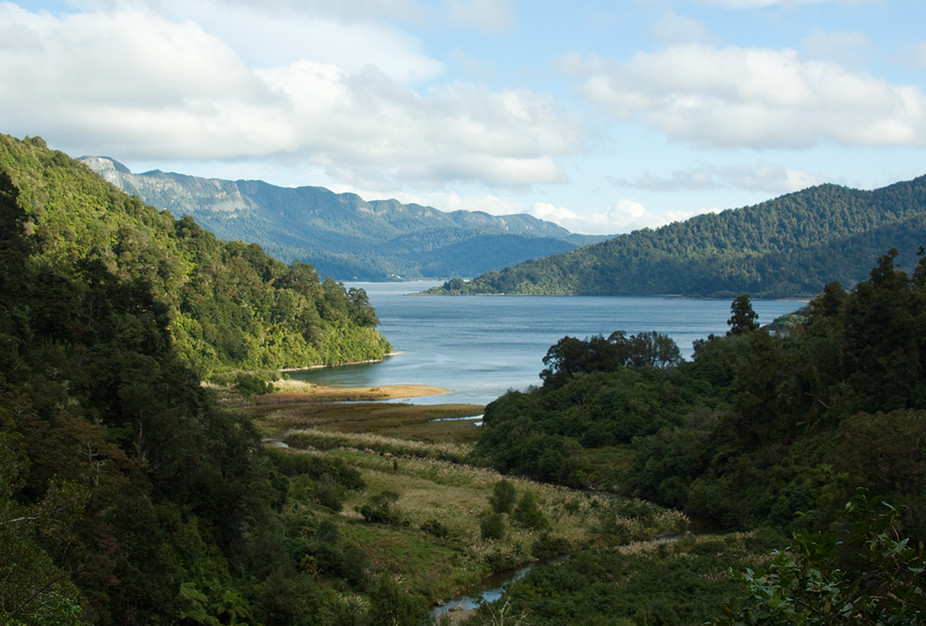
The forest around Lake Waikaremoana in New Zealand has been given legal status of a person because of its cultural significance. Paul Nelhams/flickr, CC BY-SA
In recent years, the U.S. Supreme Court has solidified the concept of corporate personhood. Following rulings in such cases as Hobby Lobby and Citizens United, U.S. law has established that companies are, like people, entitled to certain rights and protections.
But that’s not the only instance of extending legal rights to nonhuman entities. New Zealand took a radically different approach in 2014 with the Te Urewera Act which granted an 821-square-mile forest the legal status of a person. The forest is sacred to the Tūhoe people, an indigenous group of the Maori. For them Te Urewera is an ancient and ancestral homeland that breathes life into their culture. The forest is also a living ancestor. The Te Urewera Act concludes that “Te Urewera has an identity in and of itself,” and thus must be its own entity with “all the rights, powers, duties, and liabilities of a legal person.” Te Urewera holds title to itself.
Although this legal approach is unique to New Zealand, the underlying reason for it is not. Over the last 15 years I have documented similar cultural expressions by Native Americans about their traditional, sacred places. As an anthropologist, this research has often pushed me to search for an answer to the profound question: What does it mean for nature to be a person?
The snow-capped mountain
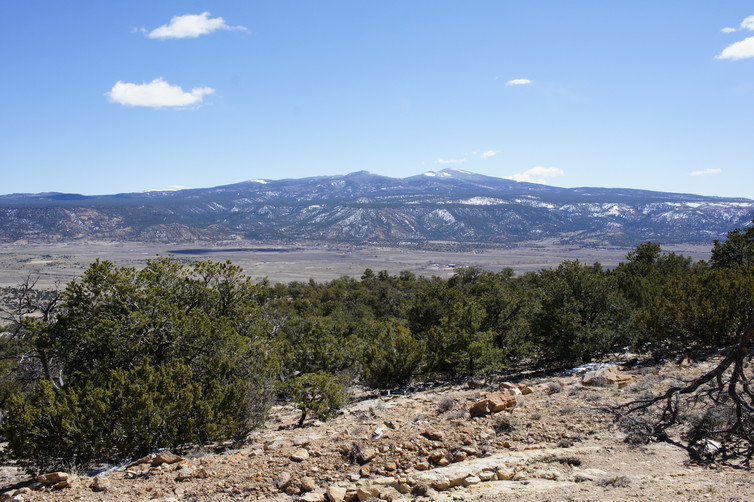
A majestic mountain sits not far northwest of Albuquerque, New Mexico. Like a low triangle, with long gentle slopes, Mount Taylor is clothed in rich forests that appear a velvety charcoal-blue from the distance. Its bald summit, more than 11,000 feet high, is often blanketed in snow – a reminder of the blessing of water, when seen from the blazing desert below.
The Zuni tribe lives about 40 miles west of Mount Taylor. In 2012, I worked with a team to interview 24 tribal members about the values they hold for Dewankwin K’yaba:chu Yalanne (“In the East Snow-capped Mountain”), as Mount Taylor is called in the Zuni language. We were told that their most ancient ancestors began an epic migration in the Grand Canyon.
Mount Taylor in New Mexico, a sacred site to the Zuni who believe it is a living being. Chip Colwell, Author provided.
Over millennia they migrated across the Southwest, with important medicine societies and clans living around Mount Taylor. After settling in their current pueblo homes, Zunis returned to this sacred mountain to hunt animals like deer and bear, harvest wild plants like acorns and cattails, and gather minerals used in sacrosanct rituals that keep the universe in order. Across the generations Dewankwin Kyaba:chu Yalanne has come to shape Zuni history, life, and identity no less than the Vatican has for Catholics.
But unlike holy places in the Western world, Zunis believe Mount Taylor is a living being. Zuni elders told me that the mountain was created within the Earth’s womb. As a mountain formed by volcanic activity, it has always grown and aged. The mountain can give life as people do. The mountain’s snow melts in spring and nourishes plants and wildlife for miles. Water is the mountain’s blood; buried minerals are the mountain’s meat. Because it lives, deep below is its beating heart. Zunis consider Mount Taylor to be their kin.
There is a stereotype that Native American peoples have a singular connection to nature. And yet in my experience, they do see the world in a fundamentally different way from most people I know. Whether it is mountains, rivers, rocks, animals, plants, stars or weather, they see the natural world as living and breathing, deeply relational, even at times all-knowing and transcendent.
In my work with Arizona’s Hopi tribe, I have traveled with cultural leaders to study sacred places. They often stop to listen to the wind, or search the sky for an eagle, or smile when it begins to rain, which they believe is a blessing the ancestors bestow upon them.
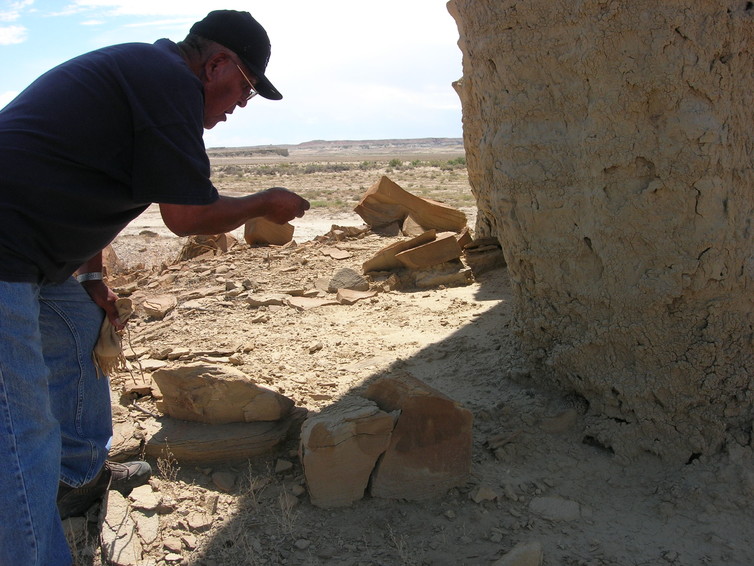
During one project with the Hopi tribe, we came across a rattlesnake coiled near an ancient fallen pueblo. “Long ago, one of them ancestors lived here and turned into a rattlesnake,” the elder Raleigh H. Puhuyaoma Sr. shared with me, pointing to the nearby archaeological site. “It’s now protecting the place.” The elders left an offering of corn meal to the snake. An elder later told me that it soon rained on his cornfield, a result from this spiritual exchange.
Violent disputes
Understanding these cultural worldviews matters greatly in discussions over protecting places in nature. The American West has a long history of battles over the control of land. We’ve seen this recently from the Bundy family’s takeover of the federal wildlife refuge in Oregon to the current fight over turning Bears Ears – 1.9 million acres of wilderness – into a national monument in Utah.
Yet often these battles are less about the struggle between private and public interests, and more about basic questions of nature’s purpose. Do wild places have intrinsic worth? Or is the land a mere tool for human uses?
A Hopi elder making an offering to a snake to protect a sacred space. Chip Colwell, Author provided.
Much of my research has involved documenting sacred places because they are being threatened by development projects on public land. The Zuni’s sacred Mount Taylor, much of it managed by the U.S. National Forest Service, has been extensively mined for uranium, and is the cause of violent disputes over whether it should be developed or protected.
Even though the U.S. does not legally recognize natural places as people, some legal protections exist for sacred places. Under the National Historic Preservation Act, for example, the U.S. government must take into consideration the potential impacts of certain development projects on “traditional cultural properties.”
This and other federal heritage laws, however, provide tribes a small voice in the process, little power, and rarely lead to preservation. More to the point, these laws reduce what tribes see as living places to “properties,” obscuring their inherent spiritual value.
In New Zealand, the Te Urewera Act offers a higher level of protection, empowering a board to be the land’s guardian. The Te Urewera Act, though, does not remove its connection to humans. With a permit, people can hunt, fish, farm and more. The public still has access to the forest. One section of the law even allows Te Urewera to be mined.
Te Urewera teaches us that acknowledging cultural views of places as living does not mean ending the relationship between humans and nature, but reordering it – recognizing nature’s intrinsic worth and respecting indigenous philosophies.
In the U.S. and elsewhere, I believe we can do better to align our legal system with the cultural expressions of the people it serves. For instance, the U.S. Congress could amend the NHPA or the American Indian Religious Freedom Act to acknowledge the deep cultural connection between tribes and natural places, and afford better protections for sacred landscapes like New Mexico’s Mount Taylor.
Until then, it says much about us when companies are considered people before nature is.
I deliberately planned for this post to be published at the precise moment, in Pacific Time that is, when the solstice occurs.
Welcome to the shortest day of 2016.
Winter Solstice at the Stonehenge Monument in Southern England.
I am now republishing much of what appeared on the EarthSky blog a few days ago.
Late dawn. Early sunset. Short day. Long night. For us in the Northern Hemisphere, the December solstice marks the longest night and shortest day of the year. Meanwhile, on the day of the December solstice, the Southern Hemisphere has its longest day and shortest night. This special day is coming up on Wednesday, December 21 at 10:44 UTC (December 21 at 4:44 a.m. CST). No matter where you live on Earth’s globe, a solstice is your signal to celebrate.
Want to know what time it is where you are living?
When is the solstice where I live? The solstice happens at the same instant for all of us, everywhere on Earth. In 2016, the December solstice comes on December 21 at 4:44 a.m. CST. That’s on December 21 at 10:44 Universal Time. It’s when the sun on our sky’s dome reaches its farthest southward point for the year. At this solstice, the Northern Hemisphere has its shortest day and longest night of the year.
This morning I read an interesting set of facts about the Solstice over on the Mother Nature Network. It included this:
The word “solstice” comes from the Latin solstitium, meaning “point at which the sun stands still.” Since when has the sun ever moved?! Of course, before Renaissance astronomer Nicolaus Copernicus (aka “super smartypants”) came up with the ‘ol heliocentric model, we all figured that everything revolved around the Earth, sun included. Our continued use of the word “solstice” is a beautiful reminder of just how far we’ve come and provides a nice opportunity to give a tip of the hat to great thinkers who challenged the status quo.
Regulars will recall that during the week I missed being able to publish a post and just quickly dropped a note to say that Rain Stopped Play commenting:
Sorry good people but the rain yesterday interfered with our Internet connection until early evening.
Then there just wasn’t time to post something for you.
Other than at 6:50 pm we had had 3.17 in of rain since midnight!
Well on Thursday morning our ‘on-property’ weather station was reporting that in the 30 hours since the start of Wednesday through to 6 am on that Thursday we had had a total of 4.78 inches of rain.
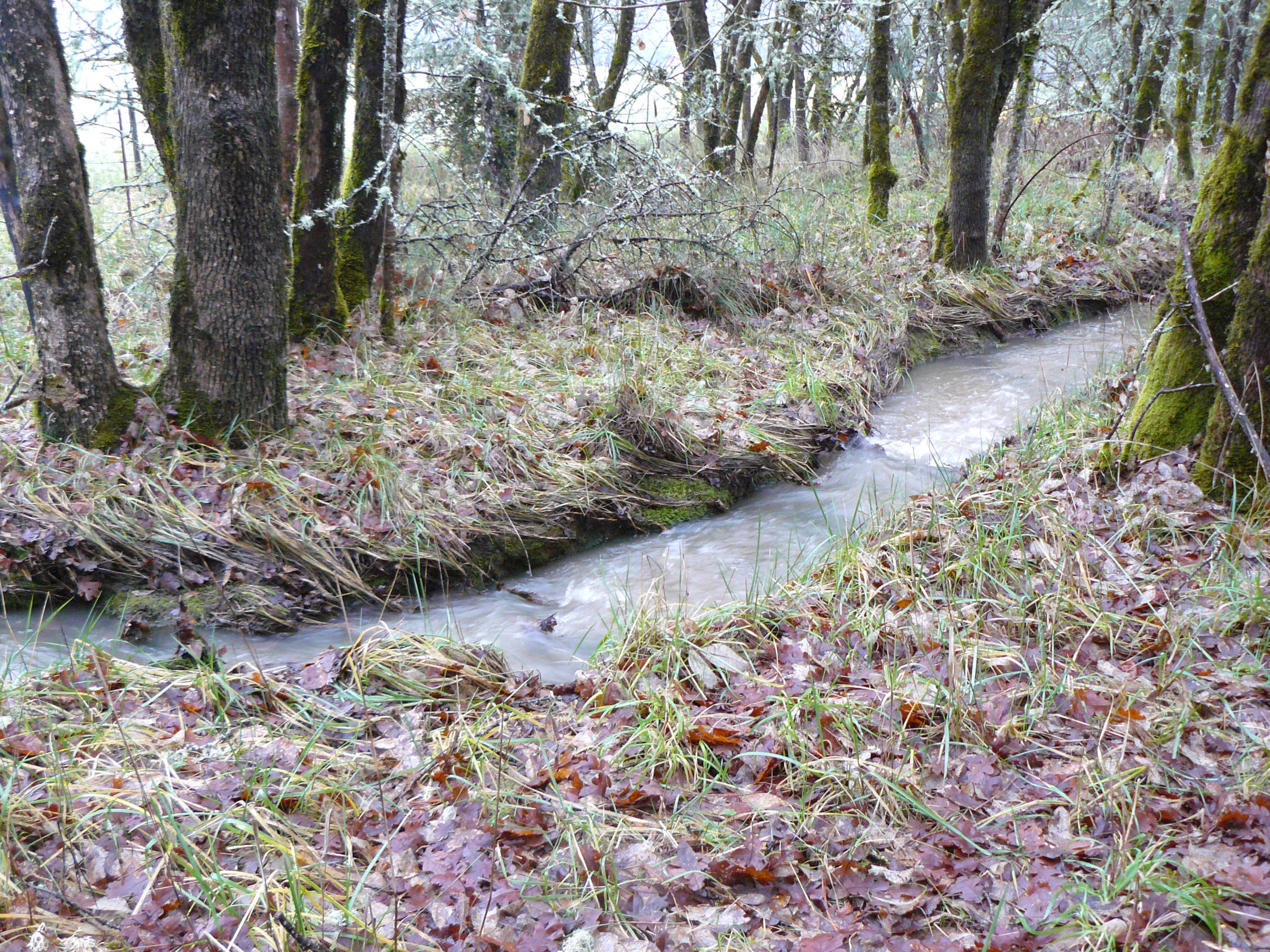
Cup Creek to the left of the driveway about 100 yards from the house.
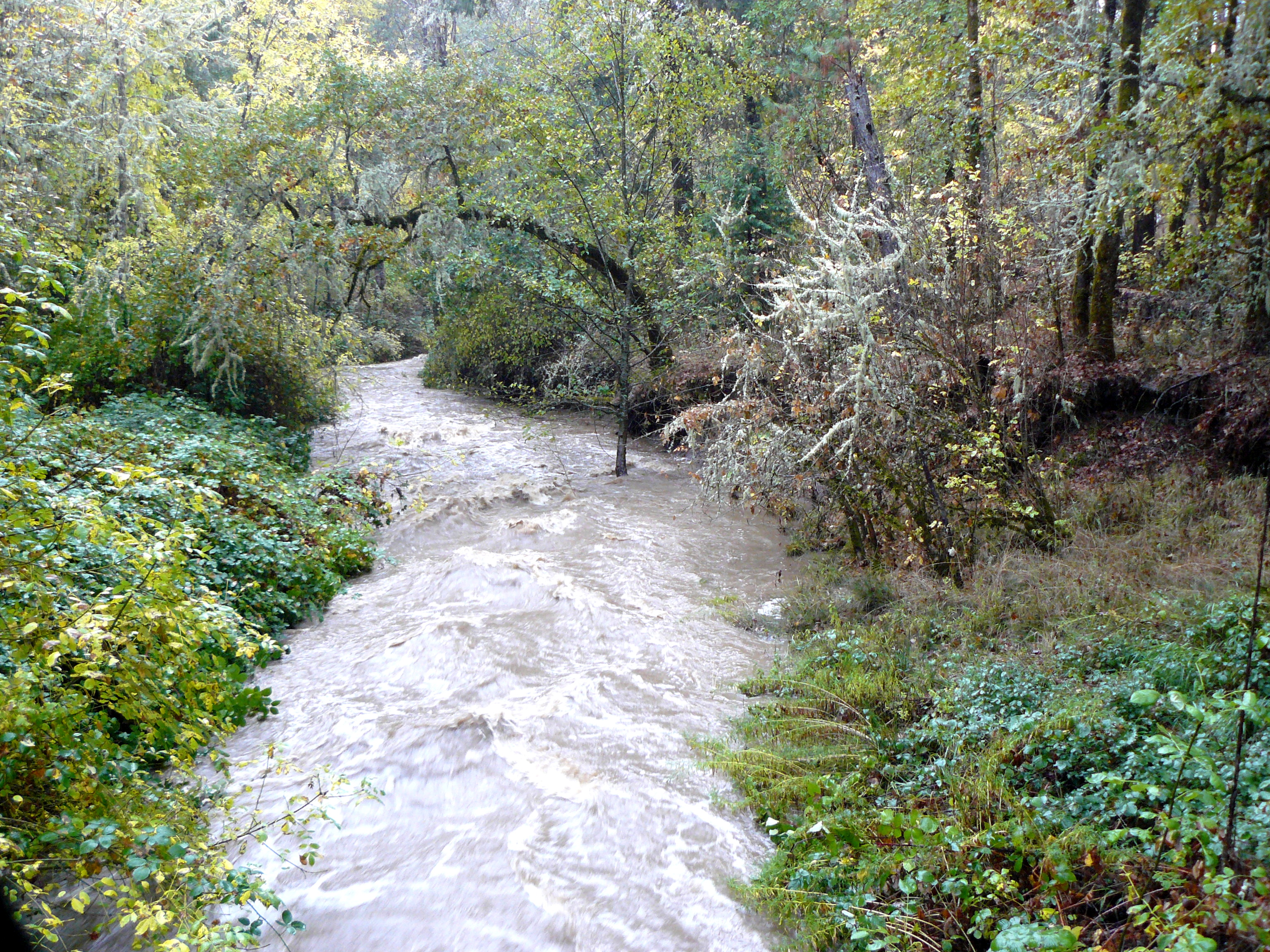
Later on Thursday morning I went down to our creek and the following photographs record the scene!Our driveway drops gently down for about 250 yards from the house to our bridge over Bummer Creek where I was heading with my camera. To the left of the driveway is a creek with no official name but the locals call it Cup Creek. For most of the year it is dry!
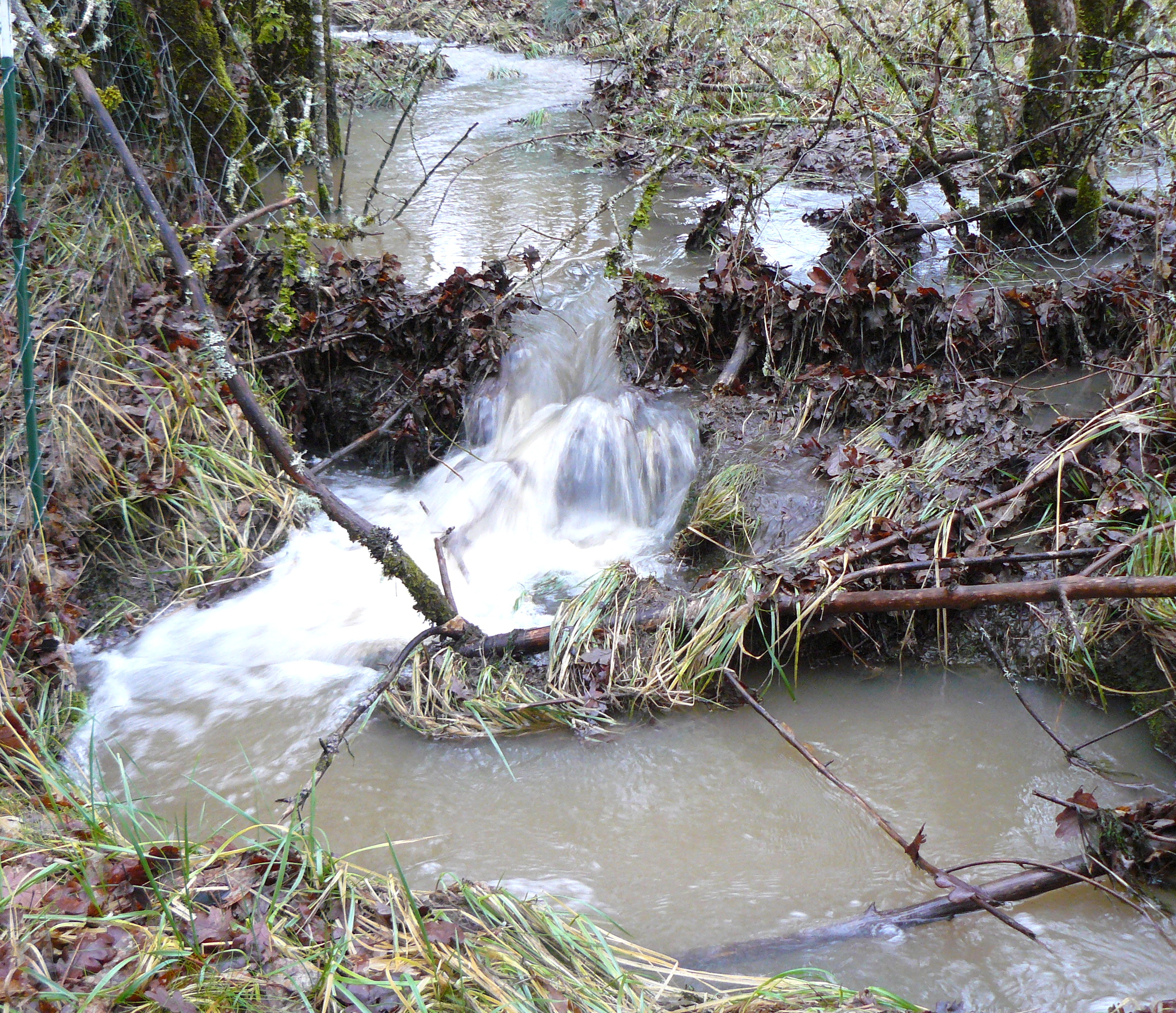
Another view of a very swollen Cup Creek.
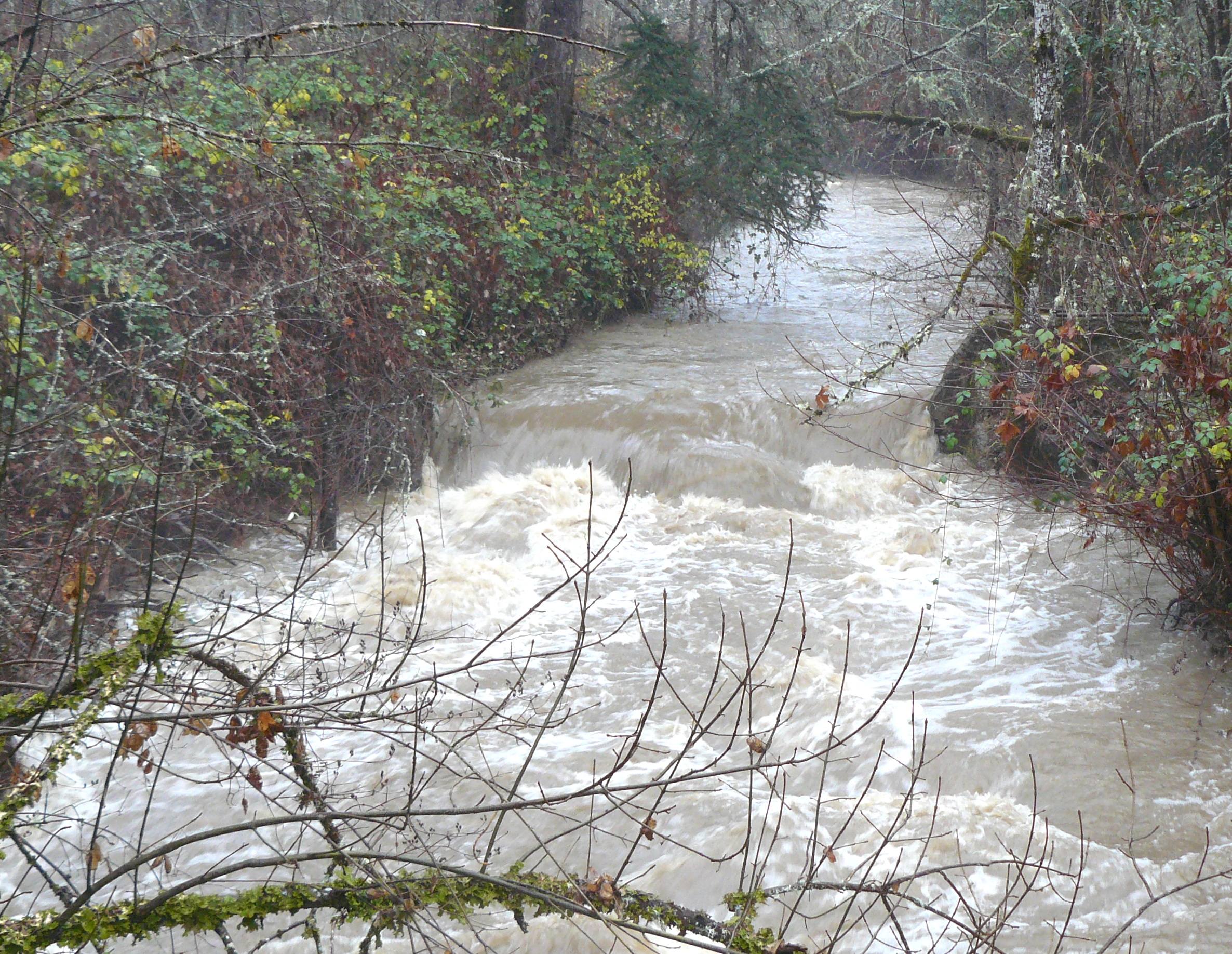
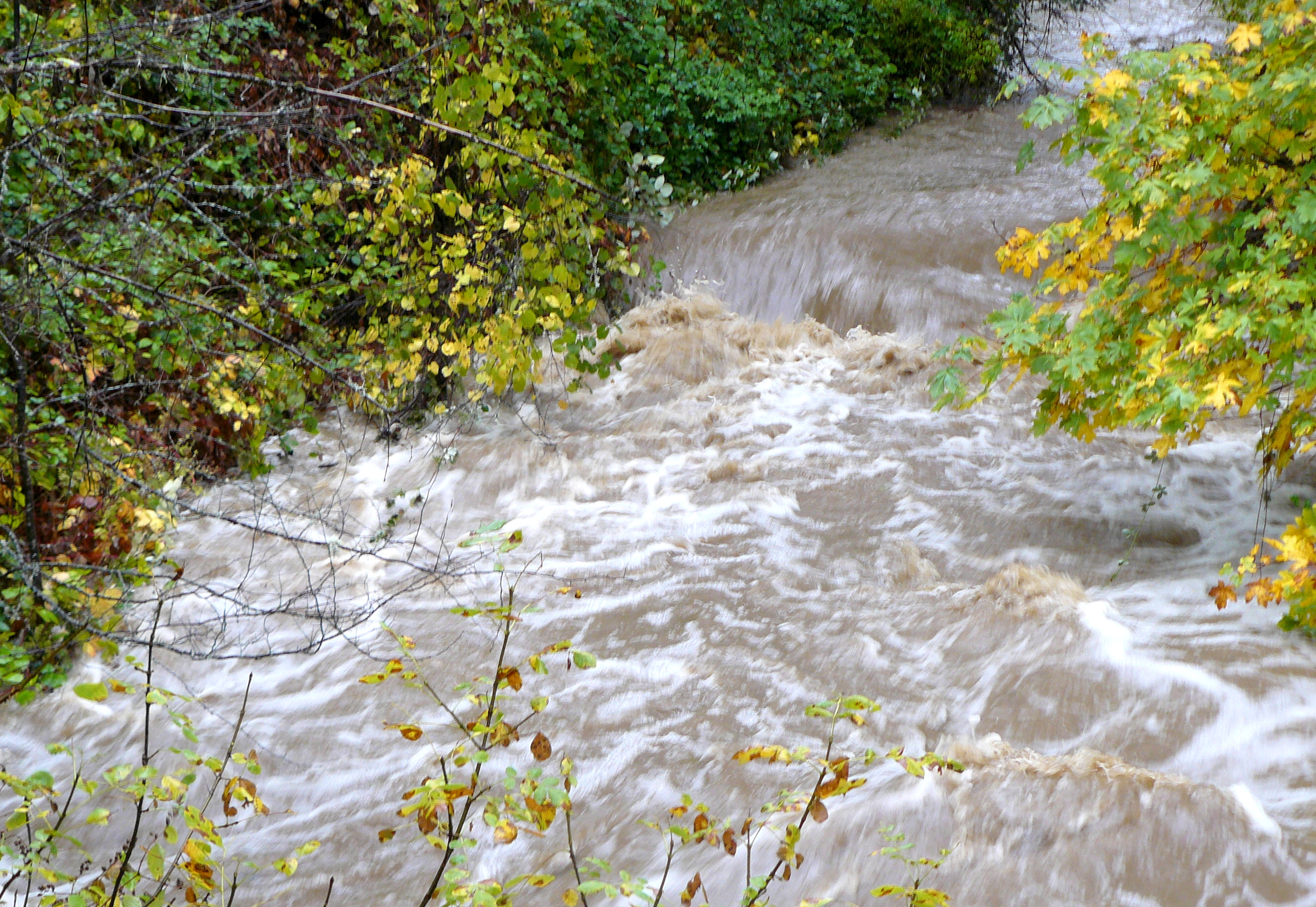
Then I arrived at our bridge that crosses Bummer Creek. Upstream years ago an irrigation dam was installed. It is just visible under the raging waters.
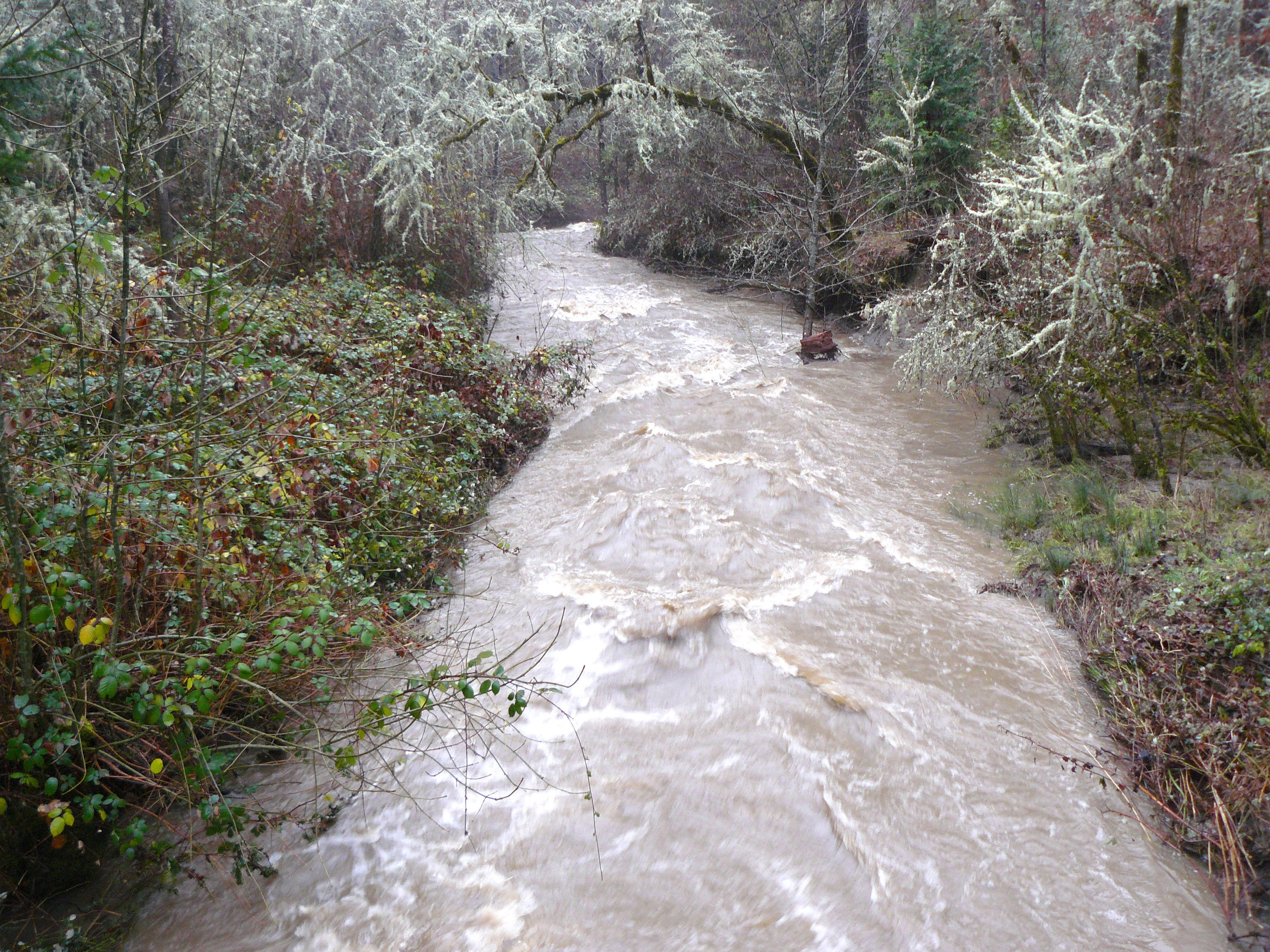
Bummer Creek looking upstream from the bridge.Bummer Creek looking downstream from the bridge.
Difficult to estimate how swollen the creek was but it was carrying many, many times more water than even the usual effects of a couple of rainy days.
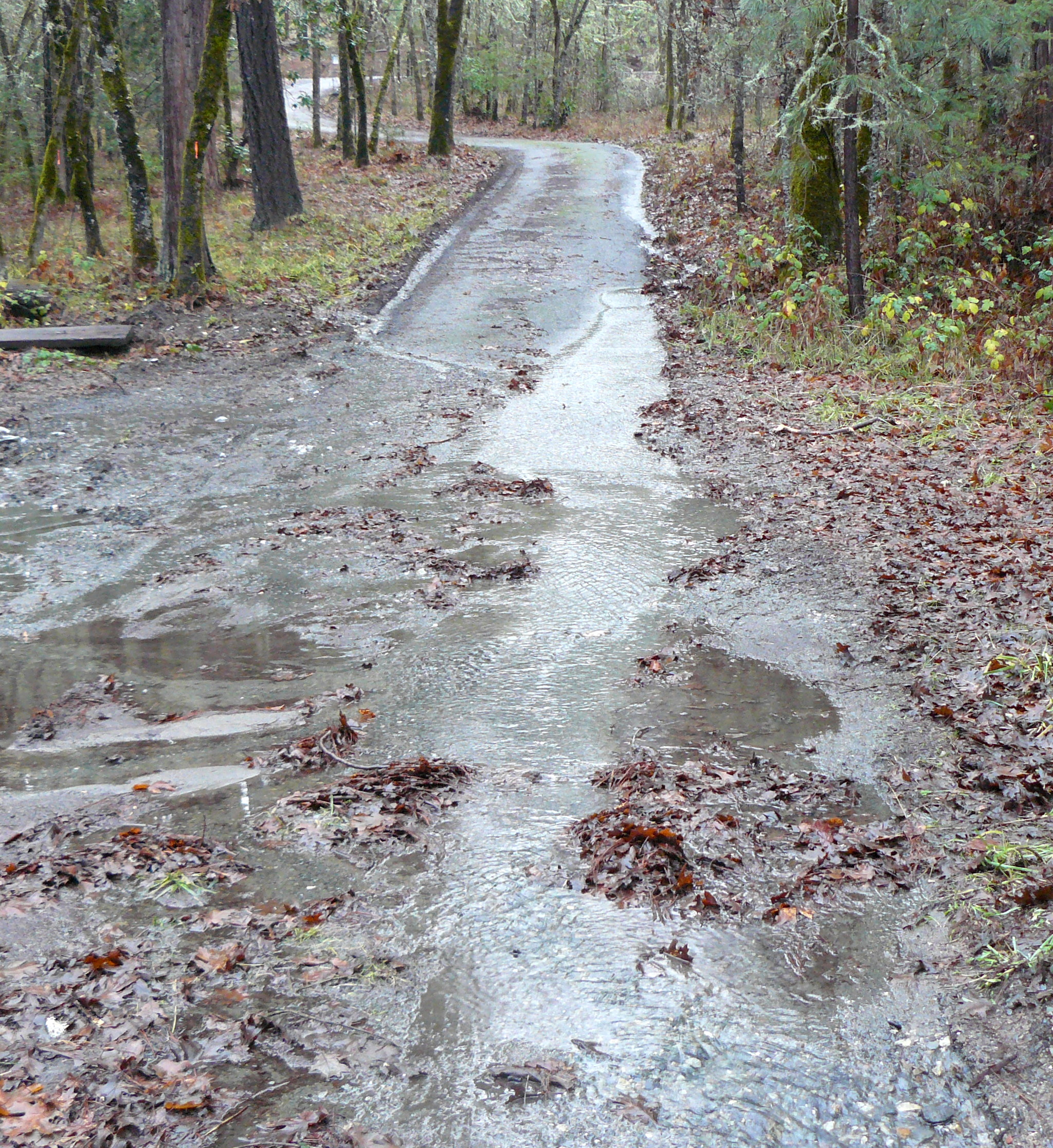
But then looking up from the bridge to where the driveway runs up to Hugo Road this mini-river met my eyes.
Our driveway gate onto Hugo Road is just visible at the top of the picture.
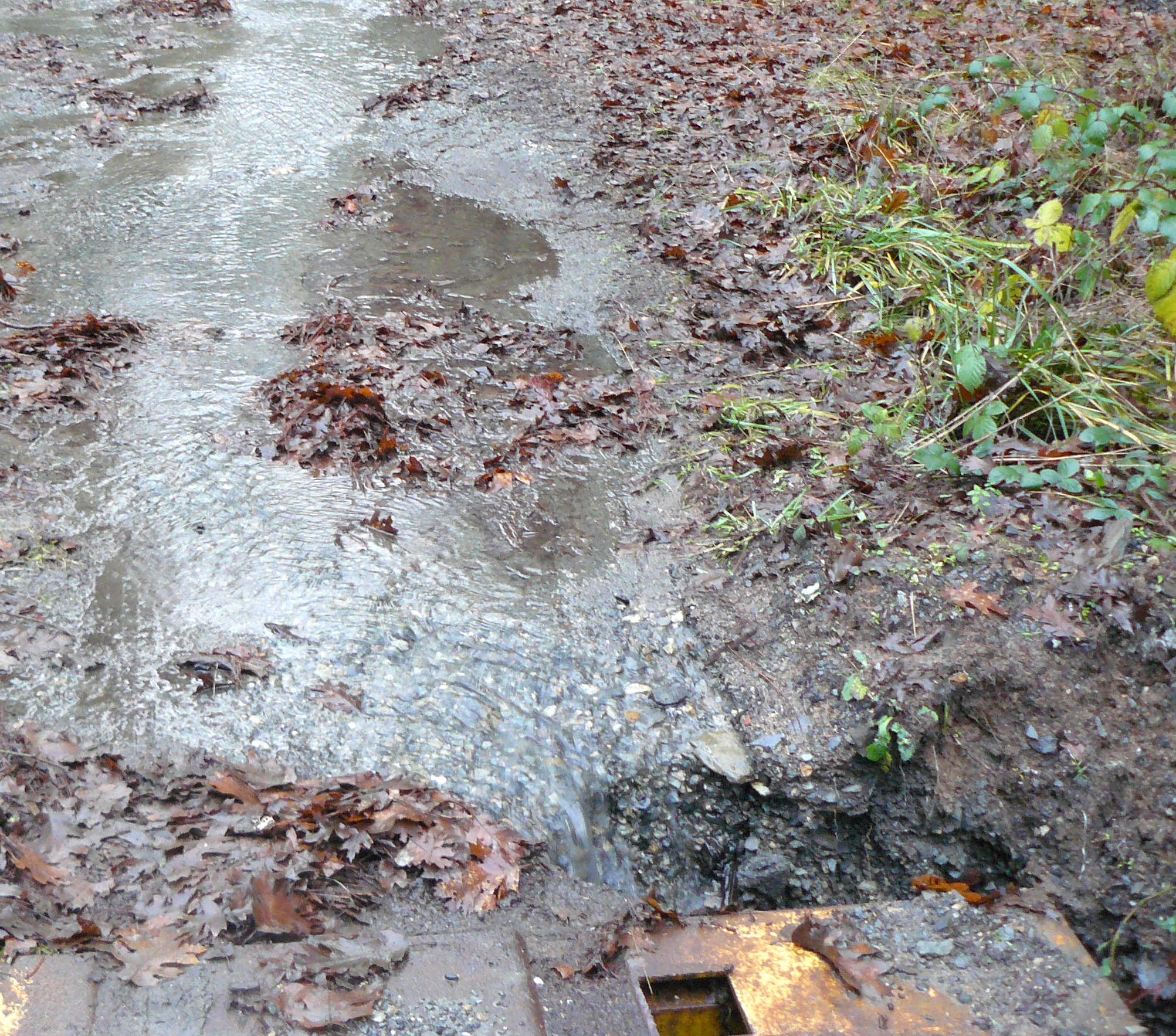
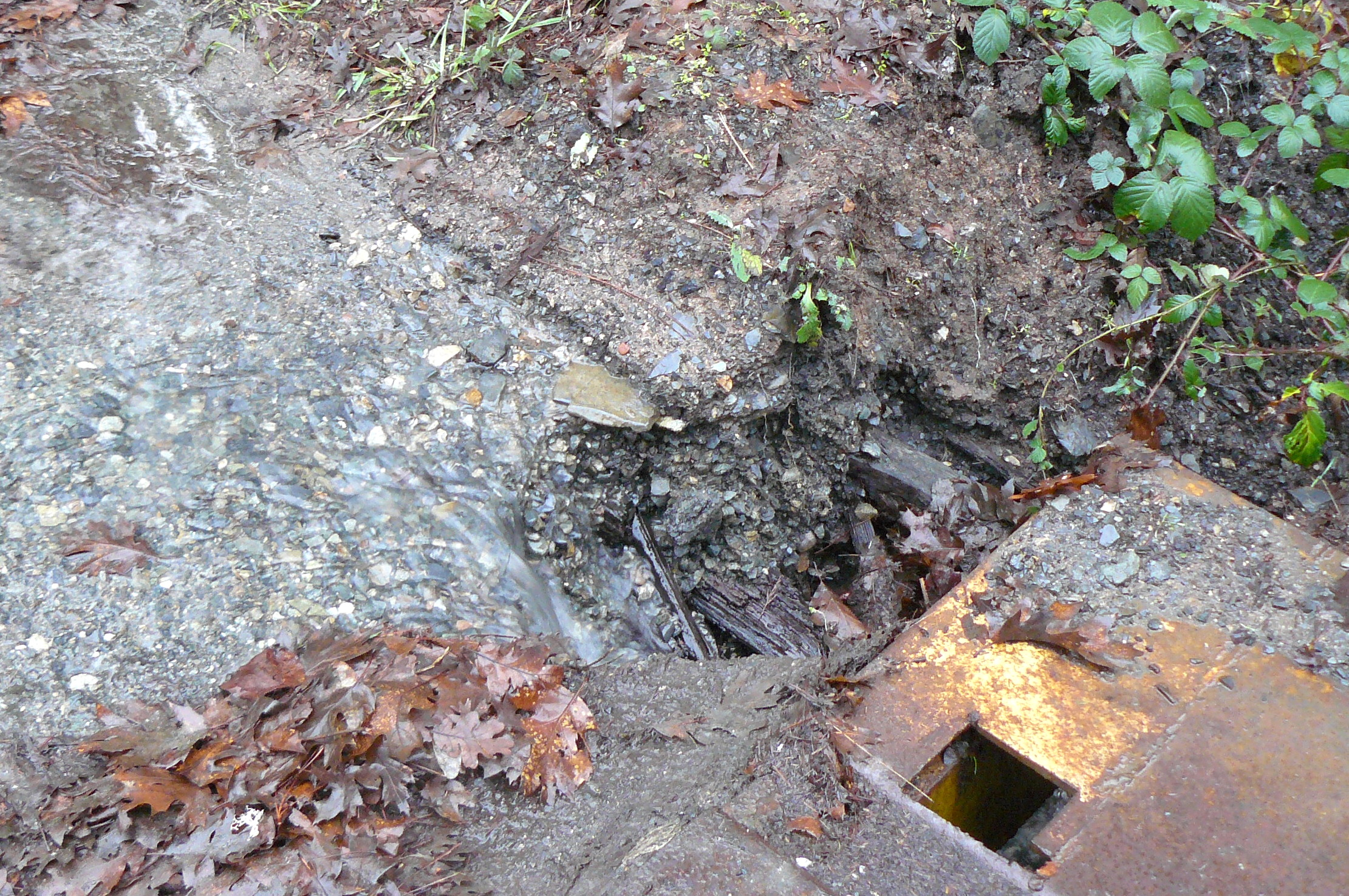
The gully to the side of the driveway had become blocked with leaves hence the surface water. But then I saw that where the driveway met the metal platform of the bridge the flowing water had carved out quite a section of the driveway.
No question this has to be repaired by yours truly that morning because the hole would have prevented anything larger than a standard car from coming across the bridge. So that was our rainy day; how was it for you!
I included in yesterday’s post the interview with Bill Kotke and his concern that humanity’s greed, and that’s the correct term in my view, focusing on each generation having more, howsoever one defines ‘more’, was utterly at odds with a sustainable future on the only home we have: Planet Earth. A finite planet in a finite solar system.
On Monday I was chatting with Roger D. back in the old country. It was Roger who introduced me to gliding back in the late 70s. Later we were in business together in Colchester, Essex and we still keep in touch.
Anyway, Roger was bemoaning the current state of affairs in the UK regarding Brexit and went on to say that every economic strategy offered by this or that UK Government was about growth. Whether we are talking economic growth, improvement in living standards or population growth why are there no leading figures in any leading government standing up and saying this can’t go on! Because it can’t!
We are presently a global population of 7.5 billion. This year alone, as of today, there have been 56,000,000 deaths. But also, as of today, there have been 133,000,000 births. (I rounded the figures but what difference does it make!) That’s a growth of 77 million persons in this one year. It cannot go on!
Bill Kotke also spoke of soil loss. Just last Sunday there was a Care2 item about soil loss. From which I extract:
Could soil ever actually run out?
Yes. If we continue to harm and degrade topsoil at the current rate, it’s estimated that the world could lose all its topsoil within 60 years.
Topsoil is the uppermost layer of soil on the surface of the earth. It’s the most fertile type of soil that typically contains lots of nutrient-rich organic matter from broken down plants and other organisms. Topsoil is also alive with beneficial microbes, fungi and critters like earth worms, which feed on the organic matter.
The deeper layers of soil beneath the topsoil are not nearly as rich. They are primarily made up of decomposing rock that provides the raw material for future topsoil as well as a substrate for deeply rooted plants to anchor in.
If the delicate ecosystem within topsoil is disrupted, it will essentially die. Plants can’t grow in topsoil that doesn’t have abundant organic matter and thriving populations of microbes.
Yes, there are street protests about this political action or that political action but why aren’t we seeing tens of thousands on the streets protesting about the loss of our topsoil!!
Moving on.
There was a recent essay from Patrice Ayme in which he wrote about the Australian Asthma Thunderstorm. Just read this long extract from that essay:
(November 29th, 2016 Italics are from the story as presented in the New York Times)
Mr. McGann was one of thousands of people in Melbourne having an attack of thunderstorm asthma. About 8,500 people went to hospitals. Eight have died, and one remains in intensive care more than a week after a thunderstorm surged across Melbourne, carrying pollen that strong winds and rain broke into tiny fragments.
Perennial ryegrass seeds were swept up in whorls of wind and carried from four million hectares of pasturelands (about 9.9 million acres) that lie to Melbourne’s north and west. If broken into fragments, they are so fine that they can be inhaled.”
Actually what also lie north and west of Melbourne are giant fields of canola. Consider the following propaganda picture:
Mr. McGann did not end up in the hospital. “Every breath I took made the next breath harder,” he said, adding that he had no family history of asthma. “I just didn’t realize it could have the effect it had.”
Grass pollen is the primary source of allergies in southern Australia, and tracking the data allowed scientists to forecast high levels of grass seeds in the atmosphere on Nov. 21. Still, Ms. Hennessy said, the government was taken by surprise.”
Surprise, indeed, this did not happen before, by two orders of magnitude. How come so much more severity?
My lawyer’s theory is different. It evolved from my own observations and theories of why asthma and allergies, let alone weird cancers, have been augmenting spectacularly. There are around 150,000 artificial, man-made chemical products in use. By medical drug standards, they are untested (in earlier essays, I mentioned 80,000, which is the number brandished in the USA; however, French specialists talk about 150,000 untested chemicals.).
Canola (or rapeseed), Brassica napus, is an oilseed crop which is cultivated for its high quality edible oil used in many foods (eg. margarines and cooking oil) and seed meal (the fibrous material left after the oil pressing process), which has a high protein content. That makes it highly desirable as a stock feed.
In 2010-11, the Australian state of Victoria, where Melbourne is located, produced 476 thousand tonnes of canola with a gross value of $293 million.
Control of weeds, particularly weeds from the Brassicaceae family (broadleaf), through herbicide application during the canola-growing season, significantly improves the quantity of the grain produced. Weeds compete for space, nutrients and sunlight. (African countries have dismissed that the quality of GMO seed is higher, in contradistinction with US propaganda; quite the opposite, they say)
Two genetically modified (GM) canola varieties have been developed in Australia, Roundup Ready® (by Monsanto Australia Ltd) and InVigor® (by Bayer CropSciences Pty Ltd). For maximum effect, each GM variety has been developed to be tolerant to and hence used with, a specific herbicide. The result is the mass poisoning of the planet, horizon to horizon.
The same poisoning trick is used for insecticides. To boot, the poison resistance spreads, demanding even higher doses of poison to be used in the grand outdoors..
In other words, massive quantities of poisons are put in the soil, and from there, are kicked up, in the air.
Exposed to this life destroying poisons, the body reacts by shutting down all pores. Asthma.
It cannot go on!
It is time for you and me and millions of others to be the change we want to see. Whether it’s the little things like recycling, or car sharing, or the bigger things like moving to an eco village we have to make a difference.
We have to learn from those communities that for thousands of years lived harmonious and sustainable lives on the planet. Doing so many thousands of years before farming man came on to the scene
In 1969 I spent a year in the outback of Australia as a correspondent for KotiPosti; a Finnish magazine. While I was out in the wilderness looking for Finns to write about it was impossible not to be drawn into the history of the aboriginal Australian.
ABORIGINAL AUSTRALIANS ARE descendents of the first people to leave Africa up to 75,000 years ago, a genetic study has found, confirming they may have the oldest continuous culture on the planet.
Professor Eske Willerslev of the University of Copenhagen, who led the study, says Aboriginal Australians were the first modern humans to traverse unknown territory in Asia and Australia. “It was a truly amazing journey that must have demanded exceptional survival skills and bravery,” he says.
A century-old lock of hair, given by a West Australian indigenous man to an anthropologist, has led to the discovery that ancestors of Aboriginal Australians reached Asia at least 24,000 years before another wave of migration that populated Europe and Asia.
It was back then that I truly understood the relationship that those early Australians had with the earth; with their planet. Forget religions and churches, the Aborigines had a spiritual relationship with the planet that sustained them.
I will never forget exploring quietly, just me and my wife of those days, the caves and darker recesses around the base of Ayers Rock, better called Uluru, the most amazing monolith right out there in the middle of the desert. The unmistakable signs of so many of those quiet recesses being spiritual places for those ancient people. Uluru, or Ayers Rock, is a massive sandstone monolith in the heart of the Northern Territory’s arid “Red Centre”. The nearest large town is Alice Springs, 450km away. Uluru is sacred to indigenous Australians and is thought to have started forming around 550 million years ago. It’s within Uluru-Kata Tjuta National Park, which also includes the 36 red-rock domes of the Kata Tjuta (colloquially “The Olgas”) formation.
It is just he same for the North American Indians. They have a spiritual relationship with the land.
Back to Bill Kotke’s talk. He spoke of how when each of us was the product of the fertilisation of the egg by the sperm in utero we grow first as a fish, then as a mammal and, finally, emerge as a human: “We are connected to the earth!”
As you all know I am a secular humanist. But that doesn’t mean that I don’t have deep, as in spiritual, feelings for the lands and the oceans and for the wildlife of this planet
So let me close by repeating what I said at that meeting where Bill was presenting. For Bill spoke of being connected, in a heartfelt manner, with the planet. For if one is so connected then it is natural for one to want to love and protect the planet.
This is what I said:
Bill,
In 1991 I departed Gibraltar Harbour solo on my yacht Songbird of Kent heading West out across the Atlantic.
After I had settled in to the routine of being at sea, better described as settling in to being connected to the ocean, I loved watching the dolphins come up to the boat, give it the once over, raise their heads and offer me a brief eye contact and then slip away.
Then I became aware that when I was laying down on my bunk in the cabin I could sense when the dolphins were close to my hull. Each time I had that sense I would come up to the deck, briefly pausing to clip on my safety harness lest I truly joined the dolphins, and one or two of those dolphins were always by my boat.
I called this post What To Say To The Kids. Not just my son and daughter, now both mature adults, but my grandson Morten son to my daughter and her husband.
Because I feel so strongly that waiting for our leaders and politicians to lead humanity in protecting our planet is pointless. They are driven by other values.
It cannot go on!
I want to be measured by my son and my daughter, and by my grandson in due time, as a person who made a difference; even just a small one.
For I truly believe that showing love for our planet will make a difference and that is what I want to say to my kids.
We have to return to community living; a twenty-first century version of such living. Even in the giant populations of big cities we have to reach out and form local communities. Groups of people who are driven by the imperative to curtail population growth, eager to share in as many ways as possible and totally committed to taking no more from the planet than they put in.
We, as in humanity, could be very close to the end!
Now my sub-title could be argued as being a tad provocative and, perhaps, it is. But I wanted to catch your attention and then hope that you stay with me for today’s post.
Jean and I belong to the Humanists & Freethinkers Group of Grants Pass. At last Saturday’s meeting the main item was a talk given by William Kötke: His website is here. Bill, as he was happy to be called, is the author of the books The Final Empire and Garden Planet (the links take you to the respective Amazon pages). Bill also has more details of his first book here.
The essence of Bill’s talk was that when we ‘evolved’ from a life of hunting and gathering to developing the land for agricultural purposes we lost our connection to the planet. For the simple reason that as foragers we depended on always being able to find edible wild plants and fruit, and therefore lived in balance with the land, but when we started to farm we became protective, materialistic and greedy. For having more land, even if one took it by force from another, equated to making more; making more food, using the surplus to buy favours, sell, etc.
Some of the facts that Bill presented in his talk were truly frightening such as soil loss; a topic I highlight in tomorrow’s post.
But for now just settle down and watch this interview of Bill filmed by Woodburn Community Access Television.
Published on Jan 10, 2016
Author and Futurist William H. Kotke shares with Woodburn his years of knowledge and understandings of the Human History and The Current Dilemma all of us face as a species.
Is there a way forward?
Yes, I think so and it’s all to do with communities; more on that in a later post.
Is this anything to do with dogs?
Here’s what the Welcome page of this blog says (in part):
As man’s companion, protector and helper, history suggests that dogs were critically important in man achieving success as a hunter-gatherer. Dogs ‘teaching’ man to be so successful a hunter enabled evolution, some 20,000 years later, to farming, thence the long journey to modern man. But in the last, say 100 years, that farming spirit has become corrupted to the point where we see the planet’s plant and mineral resources as infinite. Mankind is close to the edge of extinction, literally and spiritually.
Dogs know better, much better! Time again for man to learn from dogs!
We all could easily be drinking in ‘the last chance saloon’.
After I published my book, Learning From Dogs, last December I was invited to a number of book signing events. In each case I gave a short talk of about 20 minutes in which I explained the philosophy behind the book. Perhaps no better articulated than by Dr. Jim Goodbrod’s Foreword to the book. Take this paragraph, for instance, from that Foreword:
Dogs represent to me that innocence lost. Their emotions are pure. They live in the present. They do not suffer existential angst over what they are. They do not covet material wealth. They offer us unconditional love and devotion. Although they certainly have not reached the great heights of intellectual achievement of us humans (I know for a fact that this is true after having lived with a Labrador Retriever for several years), at the same time they have not sunk to the depths of depravity to which we are susceptible. It could be argued that I am being overly anthropomorphic, or that dogs are simply mentally incapable of these thoughts. But nevertheless, metaphorically or otherwise, I believe that dogs demonstrate a simple and uncorrupted approach to life from which we all could benefit.
During my opening talks on each occasion I would ask the audience: “So raise your hands if you are someone who is not worried about the future?”
There was never a raised hand!
My introduction to a recent essay published by George Monbiot that is republished here with Mr. Monbiot’s permission.
ooOOoo
The Drums of War
24th November 2016
The combination of automation, complexity and climate change is dangerous in ways we haven’t even begun to grasp.
By George Monbiot, published in the Guardian 23rd November 2016
Wave the magic wand and the problem goes away. Those pesky pollution laws, carbon caps and clean power plans: swish them away and the golden age of blue-collar employment will return. This is Donald Trump’s promise, in his video message on Monday, in which he claimed that unleashing coal and fracking will create “many millions of high-paid jobs”. He will tear down everything to make it come true.
But it won’t come true. Even if we ripped the world to pieces in the search for full employment, leaving no mountain unturned, we would not find it. Instead, we would merely jeopardise the prosperity – and the lives – of people everywhere. However slavishly governments grovel to corporate Luddism, they will not bring the smog economy back.
No one can deny the problem Trump claims to be addressing. The old mining and industrial areas are in crisis throughout the rich world. And we have seen nothing yet.
I have just re-read the study published by the Oxford Martin School in 2013 on the impacts of computerisation. What jumps out today, to put it crudely, is that jobs in the rustbelts and rural towns that voted for Trump are at high risk of automation; while the professions of many Clinton supporters are at low risk.
The jobs most likely to be destroyed are in mining, raw materials, manufacturing, transport and logistics, cargo handling, warehousing and retailing, construction (pre-fabricated buildings will be assembled by robots in factories), office support, administration and telemarketing. So what, in the counties that voted for Trump, will be left?
Farm jobs have mostly gone already. Service and care work, where hope for some appeared to lie, will be threatened by a further wave of automation, as service robots – commercial and domestic – take over. Yes, there will be jobs in the green economy, more and better than any that could be revived in the fossil economy. But they won’t be enough to fill the gaps, and many will be in the wrong places.
At lower risk is work that requires negotiation, persuasion, originality and creativity. The management and business jobs that demand these skills are comparatively safe from automation; so are lawyers, teachers, researchers, doctors, journalists, actors and artists. The jobs that demand the highest educational attainment are the least susceptible to computerisation. The divisions tearing America apart will only widen.
Even this bleak analysis does not capture in full the underlying reasons why good, abundant jobs will not return to the places that need them most. As Paul Mason argues in Postcapitalism, the impacts of information technology go way beyond simple automation: it is likely to destroy the very basis of the market economy and the relationship between work and wages.
And, as the independent thinker Paul Arbair notes in the most interesting essay I have read this year, beyond a certain level of complexity, economies become harder to sustain. There’s a point at which further complexity delivers diminishing returns; society is then overwhelmed by its demands and breaks down. He argues that the political crisis in Western countries suggests we may have reached this point.
In the same video address on Monday, Trump announced that he will withdraw America from the Trans-Pacific Partnership (TPP). He is right to do so, for the wrong reasons. Like TTIP and CETA, the TPP is a fake trade treaty, whose primary impact is to extend corporate property rights at the expense of both competition and democracy. But withdrawal will not, as he claims, “bring jobs and industry back to American shores”. The work in Mexico and China that Trump wants to reclaim will evaporate long before it can be repatriated.
As for the high-quality, high-waged working class jobs he promised, these are never handed down from on high. They are secured through the organisation of labour. But the unions were smashed by Ronald Reagan, and collective bargaining has been suppressed ever since by casualisation and fragmentation. So how is this going to happen? Out of the kindness of Trump’s heart? Kindness, Trump, heart?
But it’s not just Trump. Clinton and Sanders also made impossible promises to bring back jobs. Half the platform of both parties was based on a delusion. The social, environmental and economic crises we face require a complete reappraisal of the way we live and work. The failure by mainstream political parties to produce a new and persuasive economic narrative, that does not rely on sustaining impossible levels of growth and generating illusory jobs, provides a marvellous opening for demagogues everywhere.
Governments across the world are making promises they cannot keep. In the absence of a new vision, their failure to materialise will mean only one thing: something or someone must be found to blame. As people become angrier and more alienated; as the complexity and connectivity of global systems becomes ever harder to manage; as institutions like the European Union collapse and as climate change renders parts of the world uninhabitable, forcing hundreds of millions of people from their homes, the net of blame will be cast ever wider.
Eventually the anger that cannot be assuaged through policy will be turned outwards, towards other nations. Faced with a choice of hard truths or easy lies, politicians and their supporters in the media will discover that foreign aggression is among the few options for political survival. I now believe that we will see war between the major powers within my lifetime. Which ones it will involve, and on what apparent cause, remains far from clear. But something that once seemed remote now looks probable to me.
A complete reframing of economic life is needed not “just” to suppress the existential risk that climate change presents (a risk marked by a 20°C anomaly reported in the Arctic Ocean while I was writing this article), but other existential threats as well – including war. Today’s governments, whether they are run by Trump or Obama or May or Merkel, lack the courage and imagination even to open this conversation. It is left to others to conceive of a more plausible vision than trying to magic back the good old days. The task for all those who love this world and fear for our children is to imagine a different future, rather than another past.
On my desk in front of me is a small booklet of business quotations that was published by Speedwing Training Ltd, part of the British Airways Group of Companies. I have had it for years. I randomly opened the booklet and there on page 7 is this quotation (and the emboldening is mine):
Our task is not to fix the blame for the past, but to fix the course for the future.
John F. Kennedy
Mr. Monbiot speaks for the millions of people who need that course for the future NOW!
Wherever one is in the world there’s something that will always offer delight, interest and a bit of a weather forecast as a bonus. I’m speaking of clouds.
I have written about clouds before in this place but the reason that I just have to share another post about clouds with you is this image:
Earlier this month, a peculiar ring appeared in the clouds over Warwickshire, England. James Tromans, who photographed the formation, asked what might have caused it. Clearly, this was time for some cloud detective work.
The ring was actually more of a curve, or a ‘U’, as there was no other half to it. It appeared to consist of regular lumps, or lobes, hanging down from the underside of a cloud layer. We wondered if this layer was an Altostratus, but off in the distance to the right of the image there appeared to be showers, like those produced by a storm cloud. This suggested that the cloud layer might in fact have been part of the huge canopy that spreads out at the top of a Cumulonimbus storm cloud.
Sometimes, to the rear of a storm, lobes of cloud known as
1. Could ‘mamma’ be involved? Spotted over Wilton, Wiltshire, UK, by William Saberton,
mamma can be seen
hanging from the underside of the canopy (see image 1). There certainly was a general appearance of mamma in the cloud layer. But could some of these mamma cloud lobes have arranged themselves into this strange, regular curved formation? It seemed unlikely.
There was something decidedly unnatural about the cloud’s appearance – as if it were man-made. Then it occurred to us that the photograph was looking towards Coventry Airport. Might this cloud effect have been in some way caused by an aircraft?
As planes fly through clouds made of ‘supercooled’ water droplets, they can encourage these extremely cold droplets to freeze and fall below, leaving behind a gap, known as a dissipation trail, or ‘distrail’. Such formations are often seen in
2. Or was it to do with an aircraft ‘distrail’, like this spotted over Newcastle, Australia, by Jillian De Martin (Member 12801)?
straight lines where planes ascend or descend through the cloud. But they can also appear in circular shapes when one is flying in a holding pattern as it waits to land (see image 2). James’s cloud wasn’t quite a distrail, but we felt we were getting close.
It was then that we recognised the regular spacing of the lobes. These sometimes appear below aircraft condensation trails (see image 3). They are caused by the interaction between the two swirling vortices produced by the wings. As these rotate in opposite directions in the wake of an aircraft, the two turbulent flows interact and combine to form a periodic pattern of turbulent downdrafts. In the right conditions, they appear as lobes hanging below the condensation trail.
3. The clue was in the turbulence lobes that can appear hanging from an aircraft contrail. You can see these in this strip of contrail spotted over the Smokey Mountains, US, by Gary Smith.
This explained the formation. It was caused by an aircraft, which happened to be flying just above the base of the cloud layer as it turned in a holding pattern above the nearby airport. The plane’s condensation trail was hidden within the cloud layer, but the lobes of cloud descending below it, caused by the turbulence from its wings, appeared extending below the layer.
Phew! With that cleared up, we could finally relax once more.
Turbulence lobes beneath the contrail of an aircraft in holding pattern over Hampton Lucy, Warwickshire, UK, by James Tromans.
ooOOoo
How very interesting and hope I’m not the only one to think so.
Since the start of the rain on Thursday morning we have received over 9in of rain (23 cms). Since midnight this day, over 2 ins (5 cms) have fallen.
This was empty last Wednesday!
The internet connection is terrible and I have low confidence that it will stay up all day.
So please forgive me for leaving you with just this for now.
Normal service will be resumed as soon as possible!
Footnote!
By 3pm yesterday over 3 in (7.5 cms) of rain had fallen and Jean and I decided to go and rent a couple of movies to watch for the evening.
On the way of our driveway, that is a 1/4 mile long from the house to Hugo Road, it crosses over Bummer Creek. I took the following two pictures of the creek from the bridge.
Bummer Creek: looking upstream.
oooo
Bummer Creek: looking downstream.
Farewell the hazy, lazy, dry days of Summer!
Second footnote
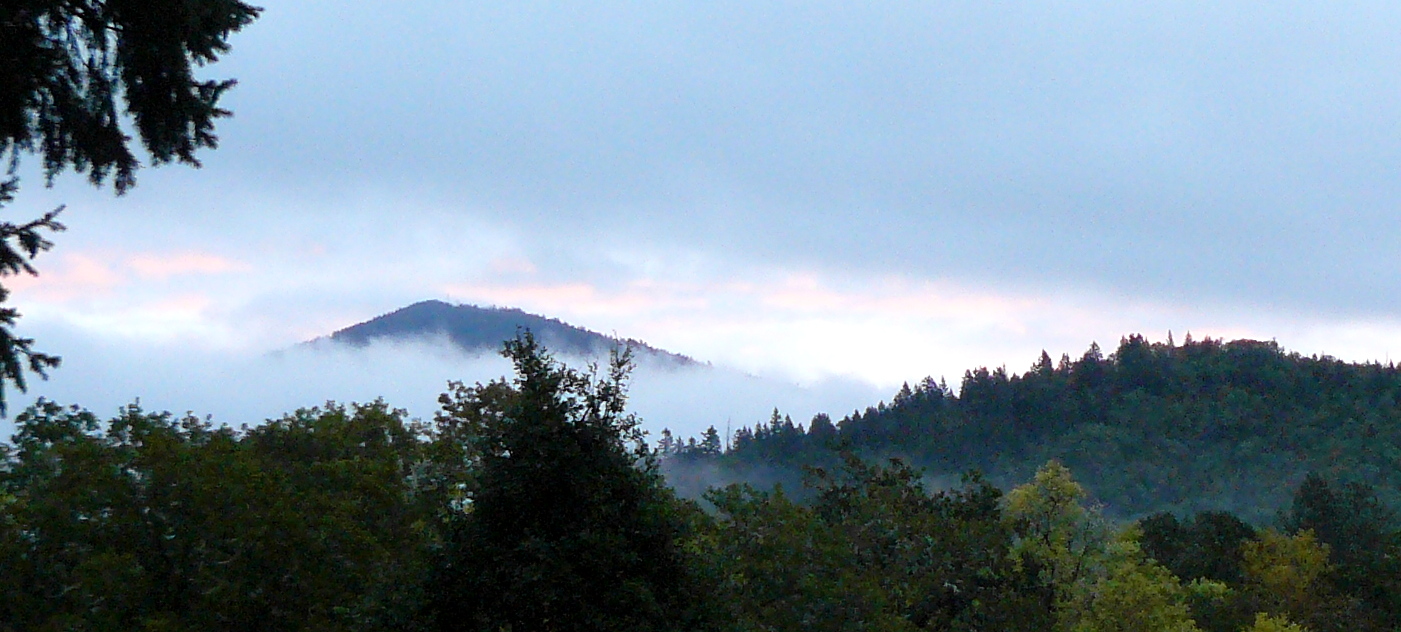
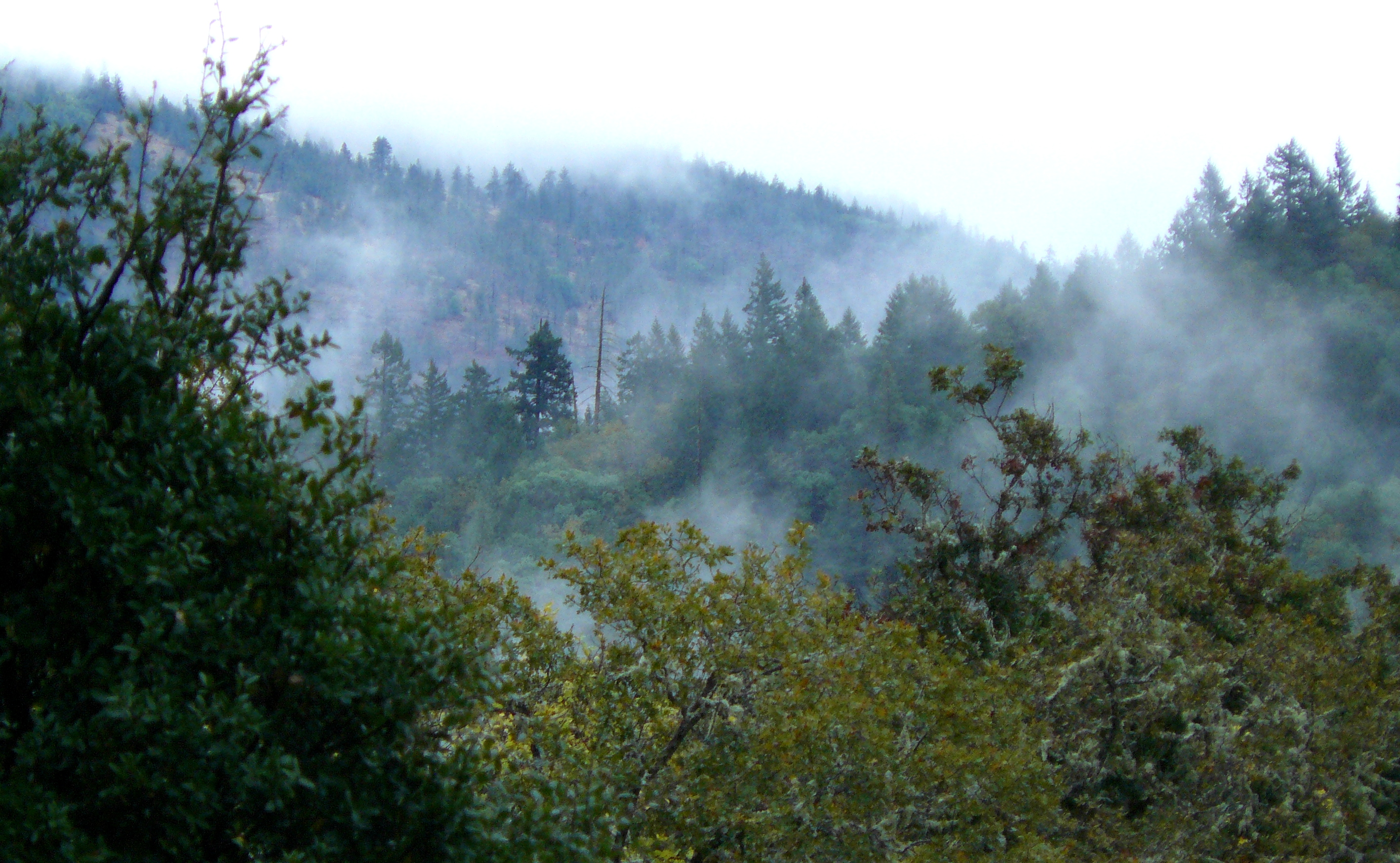
The rain paused a little after 5pm and I managed to snap the following rather evocative (well to me, anyway) scenes of a misty outlook.
Mount Sexton to the North-East of us.
oooo
Fairy-tale scene??
(Oh, and by 6pm the rain gauge was reading 3.6 in/9.14 cms)
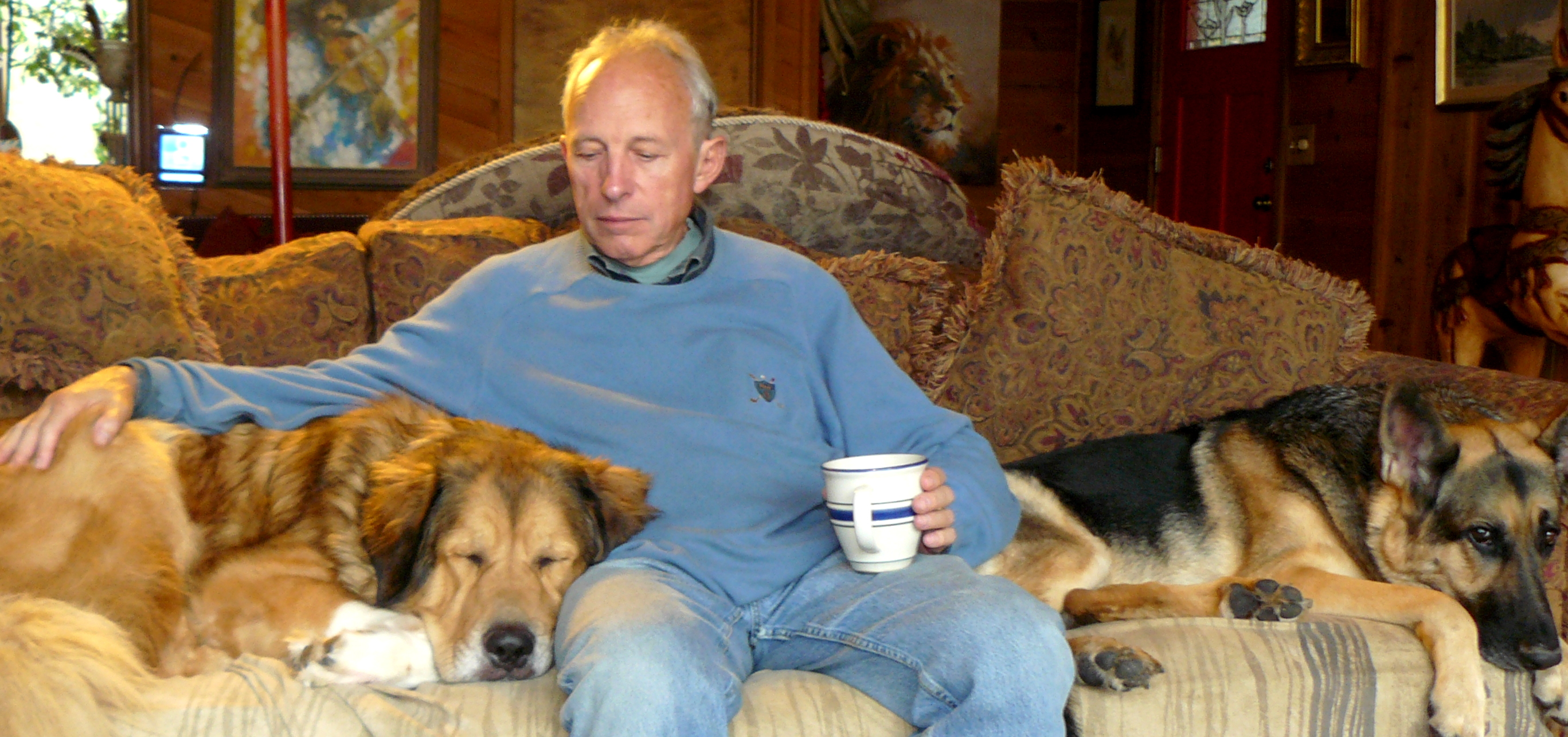
…. curling up on the settee keeping Dad company seems like the only sensible course of action!
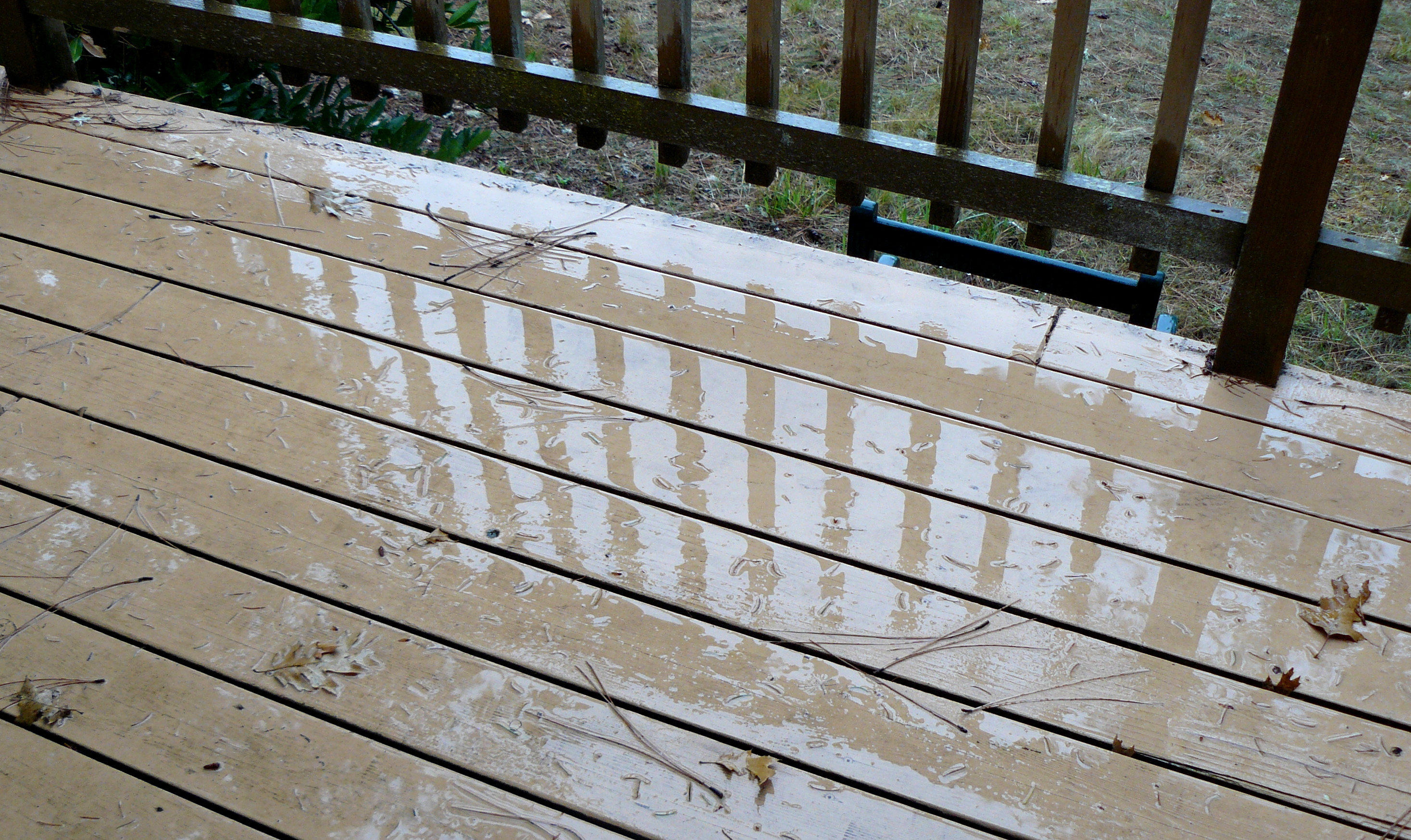
(These photographs were taken just ten minutes ago, Brandy to my right and Cleo to my left – the rain gauge now reading 0.27 in at 11:00 PDT. With the 1 in mark being passed at 15:45 PDT!)
Rain. High near 68. East wind 5 to 7 mph becoming calm. Chance of precipitation is 100%. New precipitation amounts between a half and three quarters of an inch possible.
Thursday Night
Rain. The rain could be heavy at times. Low around 51. South southeast wind 10 to 18 mph becoming southwest in the evening. Winds could gust as high as 28 mph. Chance of precipitation is 100%. New precipitation amounts between 1 and 2 inches possible.
Friday
Rain before 11am, then showers after 11am. High near 65. South southwest wind around 11 mph. Chance of precipitation is 90%. New precipitation amounts between a quarter and half of an inch possible.
Friday Night
A chance of showers before 11pm, then rain likely after 11pm. Cloudy, with a low around 53. Chance of precipitation is 70%.
Saturday
Rain. High near 65. Chance of precipitation is 100%.
Saturday Night
Rain. Cloudy, with a low around 51.
The hydrologic report from the National Weather Service even more interesting (my emphasis and we are in Josephine County about 80 miles inland from the coast):
HYDROLOGIC OUTLOOK
NATIONAL WEATHER SERVICE MEDFORD, OR
333 PM PDT TUE OCT 11 2016

Hydrologic Outlook for significant rises on rivers and streams in
Sisikyou and Modoc counties in California and Coos, Curry, Douglas,
Jackson, Josephine, Klamath and Lake counties in Oregon.

A series of storms will move through the region beginning Thursday.
A strong jet stream stretching across the Pacific Ocean will bring
a steady stream of moisture into the Pacific Northwest with these
storms. This will result in heavy rainfall across the region. The
heaviest rainfall will be with the storm on Saturday as the remnants
of Typhoon Songda are pulled into the stream. Rainfall amounts of
over 6 inches at the coast and western Siskiyou county,to over
thirteen inches on the extreme southern coast can be expected
through Monday. Three to six inches can be expected inland to the
Cascades with one to two inches east of the Cascades from Thursday
to Monday. These forecast totals across the region are equal to or
higher than the totals normally seen through the entire month of
October.

While main stem rivers will experience significant rises due to
these storms, they are not expected to flood. Small streams and
urban areas could experience high water or even flooding where there
is poor drainage. As this is the first large storm of the rainy
season, there is the potential for debris to clog storm drains,
ditches and culverts resulting in flooding.

Another concern is the heavy rain falling on recent burn scars. If
you live downstream of a recent burn scar, or if you are just
driving through a burn scar, stay alert as there is a high risk of
flash flooding and debris flows in and below burned areas.

The exact scenario for flooding and high water remains uncertain.
“These forecast totals across the region are equal to or higher than the totals normally seen through the entire month of October.”
As I said in the beginning, we most certainly need the rain, and with rain comes …

 My dreams of hope!