Category: Climate

Still in the month of May!

Figurative and literal cracks!

My rather cryptic sub-heading will make sense very soon.

Just ten days ago I published a post The Month of May. It explained why May had always been a special month in my life and then went on to introduce an article published by The Smithsonian Using a New Roadmap to Democratize Climate Change.

That article featured the former president of Iceland, Olafur Grimsson, and how he was encouraging new solutions to climate change. Primarily via a new organisation called RoadMap. (Did you sign up??)

There is change in the air. People are starting to make a better future. Cities across the USA (and elsewhere undoubtedly) are pledging to go 100 percent renewable. Here’s what Grist published on May 4th.

ooOOoo

Cities all over the U.S. are pledging to go 100 percent renewable.

Atlanta, Georgia (Shutterstock)

On Monday, Atlanta lawmakers voted unanimously to power the city entirely with clean energy sources by 2035.

Atlanta is the 27th city to make the pledge, according to the Sierra Club. These kinds of municipal promises have been popping up nationwide over the past few months. Here’s a recap:

“We know that moving to clean energy will create good jobs, clean up our air and water, and lower our residents’ utility bills,” said Kwanza Hall, an Atlanta City Council member and mayoral candidate, in a statement. “We have to set an ambitious goal or we’re never going to get there.”

A round of applause for local climate progress!

ooOOoo

Lovely to see the city of Portland on that list.

Keep it coming. For we need to see cracks of change; cracks of hope.

Cracks to counter literal cracks.

ooOOoo

The crack that’s redrawing the world’s map.

(From the BBC Culture Newsletter 5th May.)
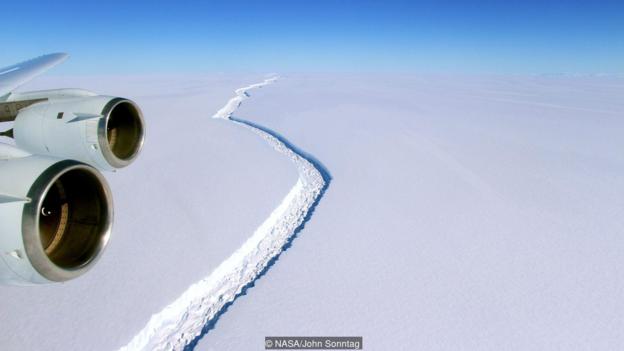
The shape of the world is hanging by a thread – or rather, according to experts, by a 110 mile-long (177km) rift. That’s the extent of a rapidly expanding crack in an enormous ice shelf in Antarctica. When the Larsen C shelf finally splits, the largest iceberg ever recorded (bigger than the US state of Rhode Island and a third the size of Wales) will snap off into the ocean. Widening each day by 3 ft (1 m), the groaning cleft is on the verge of dramatically redrawing the southern-most cartography of our planet and is likely to lead, climatologists predict, to an acceleration in the rise of sea levels globally.

 An aerial photo of the frigid fissure, taken late last year when it was discovered that the pace of the icy tear was quickening, was suddenly back in the news this week with the announcement that a second rift in the shelf had been detected. The fracture leads our eye along a zig-zagging path – from the backward gaze of the plane’s right engines to the pristine polar blue of the horizon in the distance. The jaggedness of the cleft, which takes our vision on a journey whose ultimate destination is unfathomable, seems at once monumental and terrifyingly fragile. The photo intensifies our helplessness in the face of cataclysmic change. It freezes the potential destruction in the blink of a camera’s shutter, while at the same time hinting at a catastrophe that we can witness unfolding but are utterly powerless to stop.
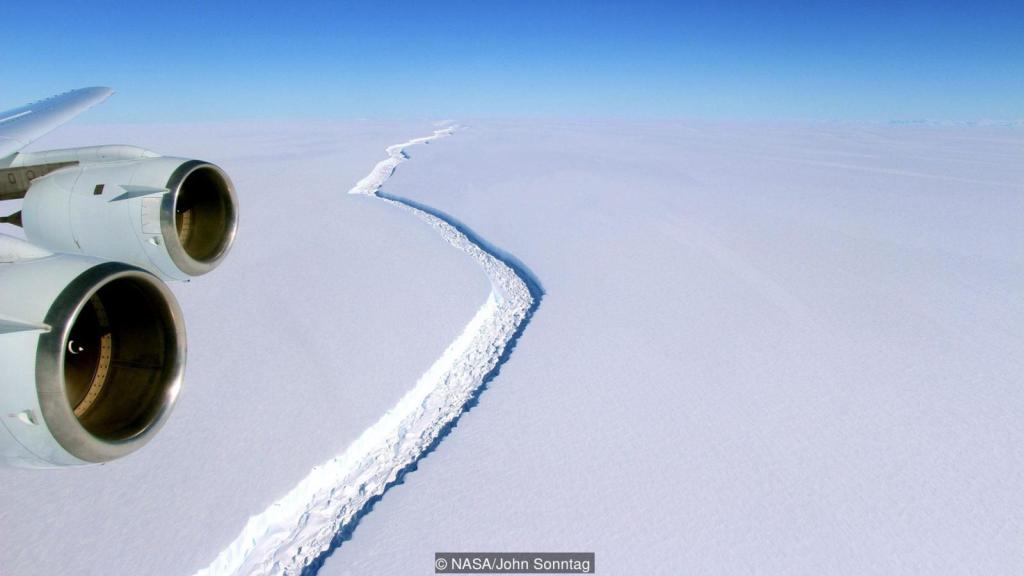
A second rift was recently discovered in the Larsen C ice shelf on the Antarctic peninsula (Credit: NASA/John Sonntag)

As a visual statement, the aerial photo of the Larsen C crack is, by definition, incomparable; never before has the world marked the glacial advance of such a sublime and fearsome fracture in its very fabric. Yet the reemergence of the image in the news anticipates the ten-year anniversary of one of the most intriguing and innovative large-scale works in contemporary art – a work whose power relies for its thought-provoking effect on the peculiar poetry of ruinous rifts. In October 2007, the Colombian-born artist Doris Salcedo unveiled in London an ambitious installation in the cavernous space of Tate Modern’s Turbine Hall – a piece that split reaction down the middle.

Inviting gallery-goers into the otherwise empty and austere interior of the former Bankside Power Station, Salcedo subverted expectations. Rather than offering visitors a hall of temporarily installed sculptures, she orchestrated the contemplation instead of a ragged subterranean breach that appeared to rip open the concrete floor of the structure – a crevice that extended from one end of the yawning space to the other.
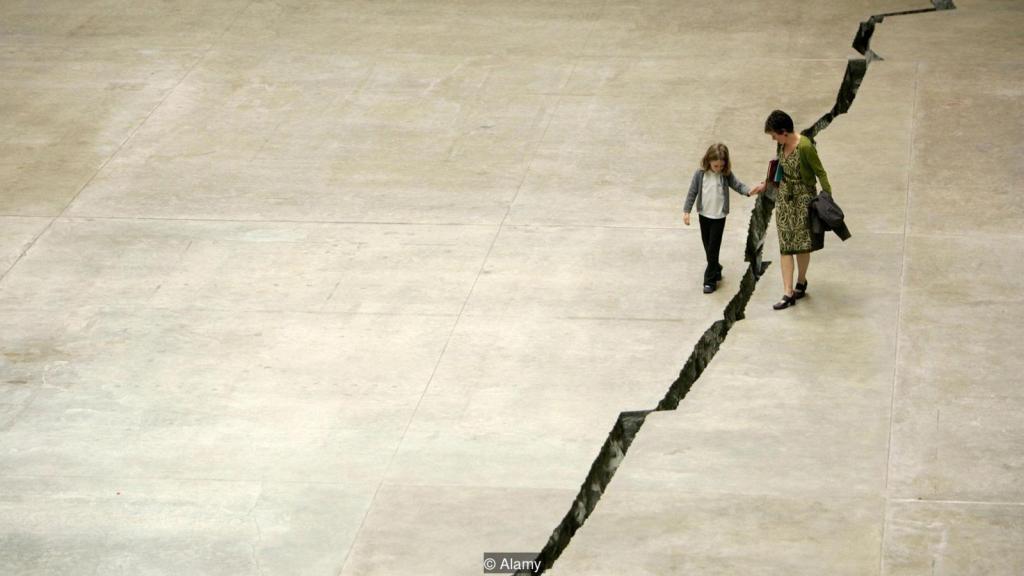
For the Colombian artist Doris Salcedo’s 2007 work, Shibboleth, a giant crack was made in the concrete floor of Tate Modern’s Turbine Hall (Credit: Alamy)

Salcedo deepened the mystery of her bold and experimental conceptual work by giving to it the curious title Shibboleth – a biblical word which, when mispronounced, was said to have exposed the outsider status of individuals. Complicating matters still further, the artist insisted that her work was a comment not on the folly of material ambitions, but on racism – that deep cultural scar that tears at the foundations of humanity. Placed side-by-side, this week’s photo from Antarctica and the image captured a decade ago of Doris Salcedo’s challenging Shibboleth share both a brutal beauty and a common theme: the brittleness of being.

If you would like to comment on this story or anything else you have seen on BBC Culture, head over to our Facebook page or message us on Twitter.

And if you liked this story, sign up for the weekly bbc.com features newsletter, called “If You Only Read 6 Things This Week”. A handpicked selection of stories from BBC Future, Earth, Culture, Capital and Travel, delivered to your inbox every Friday.

ooOOoo

“the brittleness of being.”

Please, all of us, let’s make a positive difference so that we can soften the edges of that brittleness.

Loyalty with a capital ‘L’.

This is almost too beautiful for words.

Recently Jean was sent a link to an item on Mother Nature Network by Trish, a close friend living down in Tucson, AZ. It shows the strength of character of one particular dog but easily serves as a reminder of the power of love, commitment, endurance and loyalty that thousands of dogs exhibit so many times. Qualities that we humans may so easily overlook because our dogs fit so comfortably into the relationship with us.

The article, on Mother Nature Network, was originally published in 2014 and, as the Editor explains:

Editor’s note: This story has been updated since it was originally published in November 2014.

The article is also presented with the enclosed video at the end of the text. But when Jean and I watched the video last night we were so taken by it that I am making an ‘executive’ decision to present the article slightly differently.

In that I think that watching this beautiful, incredible, video first is better.

Now on to the full article that was published on Mother Nature Network.

ooOOoo

Stray dog follows adventure race team for 430 miles

The harrowing story of how the dog finished the race with his adopted companions will melt your heart

Bryan Nelson    March 6, 2017

A stray dog named Arthur made an amazing trek with his new companions. (Photo: TrendingVideos/YouTube)

The Adventure Racing World Series might be the most fraught and challenging sports event in the world. It usually involves teams of four navigating through a vast wilderness terrain while utilizing adventure skills from a range of disciplines including trekking, adventure running, mountain biking, paddling and climbing.

During the 2014 competition, for the first time ever, an exception was made so that one team could finish the race with five members instead of four. That fifth member? A stray dog, named Arthur by his adopted companions, who decided to follow one team for 430 harrowing miles through the Amazon jungle, according to the Daily Mail. If this story doesn’t warm your heart, you don’t have one.

Team Peak Performance, hailing from Sweden, happened upon Arthur while sharing a meal in advance of a 20-mile race stage through rough terrain in Ecuador. Mikael Lindnord, one of the team’s members, felt sorry for the scruffy, lonely stray, and decided to share a meatball with him. It was an innocent gesture — Lindnord had no intention but to lift the poor pooch’s spirits — but it was a gesture that would earn him a friend for life.

As the team got up to continue their race, Arthur tagged along. The team suspected he would eventually turn back around, but Arthur kept following them. He trailed them through muddy jungle, across vast distances of the Amazon river, all the way to the finish line.

The sport of adventure racing is not for the faint of heart — no more for dogs than for humans. During the most harrowing stages of the race, the team tried to shrug off their canine companion over concerns for his safety, but Arthur would have none of it. He was determined to stick with his adopted companions.

For instance, one crucial stage of the race requires the team to kayak along the coast for 36 miles. Understandably, the team was required to leave Arthur behind on the shore. But as they paddled away, Arthur broke free and leaped into the water and began swimming after the team. Realizing that the dog was willing to drown in order to stay with his friends, the team lifted Arthur onto the kayak so the dog could complete the race with them, to sounds of ovation from bystanders watching from the shore.

Arthur’s loyalty paid off in the end; Lindnord was able to adopt him and bring him back to his home in Sweden, where the dog is currently living, healthy and happy.

“I almost cried in front of the computer, when receiving the decision from Jordbruksverket (Board of Agriculture) in Sweden!” reported Lindnord when he first heard that his request to adopt Arthur was granted. “I came to Ecuador to win the World Championship. Instead, I got a new friend.”

ooOOoo

Loyalty with a capital “L”.

Love with a capital “L”.

This picture of Arthur speaks for itself.

The Month of May!

For all my life this has felt like a very special month.

And, dear friends, at the risk of repeating myself to many of you, this is why the month of May is special for me.

Simply that I was born in London during the closing months of the Second World War. Inevitably, I was unaware of the number of German bombs that were falling on London during those last few months. But there were thousands.

On May 8th. 1945, the day that WWII ended and six months to the day from when I was born, my mother looked down at me and said aloud to me: “You are going to live”. Despite the fact that I don’t recall my mother saying that, it was verified many times later when I was growing up.

Now here we are approaching May 8th. 2017 and in a very real sense it seems that we are in another war.

A war of consequence.

A war that we have been engaged in for many, many years.

A war where we are inadvertently fighting on a global battlefield.

A war where 99.99% of us don’t consciously identify the weapons we are using. Weapons that are incredibly effective. So much so that we are in sight of winning the last battle; winning the war.

Yet a war where winning is no win at all. Indeed, where winning this war, this global war, spells the end. The end of life for 99.99% of us humans (and much else besides).

Now what on earth has got me so fired up?

Two things have:

The first is that I am living in my 73rd year of life. I have no idea of when my life comes to an end. But that death is a guarantee. Indeed, if one takes note of the average life expectancy of a male today in the USA (75.6 years) , it may not be that far away.

The second thing is that before my death I truly want to know that humankind has laid down its weapons of war against our planet and that there really is an unstoppable mission, a united wave of passion, to live in peace on this planet. Perhaps better put to live in peace with this planet.

Or in the words of an organization that I now want to introduce:

A mission which will require the hard work and dedication of each and every one of us as we do everything in our power as individuals, but also as we galvanize businesses, entrepreneurs, innovators, city planners, communities, people and politicians—all those who share our purpose.

OK! Thank you if you are still reading this! (Someone give Fred in that soft arm-chair over there a nudge; I can hear his snores from here!)

In the last Smithsonian electronic newsletter that I was reading yesterday morning there was a reference to an organization that I hadn’t previously come across. Here is the link to that item on The Smithsonian website. I am republishing it in full in this place. As you read it you will understand why I am republishing it.

ooOOoo

Using a New Roadmap to Democratize Climate Change

A new tool aims to bypass governments and put the power of climate action in the people’s hands

By Anne Glusker    Smithsonian.com     April 28, 2017

Olafur Grimsson, who was president of Iceland from 1996 to 2016 and saw his country through the worst economic crisis in its history, making headlines all over the world as banks collapsed and the country fell into a depression, is the very picture of an urbane statesman. Collected and poised, with a striking full head of white hair, as comfortable in English as in his native Icelandic, he seems an unlikely revolutionary, not the sort of person you’d look at and immediately find yourself thinking: “Power to the People.”

 But Grimsson is one of the primary architects of a quietly radical new idea whose aim is to facilitate action on climate change without any of the usual suspects—governments, countries, international bodies, negotiating parties.

He and several other veterans of the historic 2015 Paris Agreement on climate change were in Washington, D.C., last year, just before COP22, the climate meeting held in Marrakesh in 2016. They were pondering next steps when the conversation took a new and interesting turn, Grimsson says, addressing the question: “Was it possible to have the success of Paris without governments necessarily being in the leading role?”

The group included movers and shakers such as Peter Seligmann, the chairman of Conservation International; Laurene Powell Jobs, president of the philanthropic organization the Emerson Collective; and Andy Karsner, an assistant energy secretary during the administration of George W. Bush. Galvanized by their own query, they decided to try to answer it—to set about creating a new tool to aid in achieving the goals of the Paris accord.

At the Smithsonian’s Earth Optimism Summit, a gathering this past weekend of conservation-minded citizens, scientists and activists, Grimsson explained: “You get governments that are opposed or even hostile to climate action. We decided to bring together in Marrakesh a gathering of thinkers and scientists and innovators and policymakers from different countries in order to discuss a new model of securing the success of the future of the climate movement.”

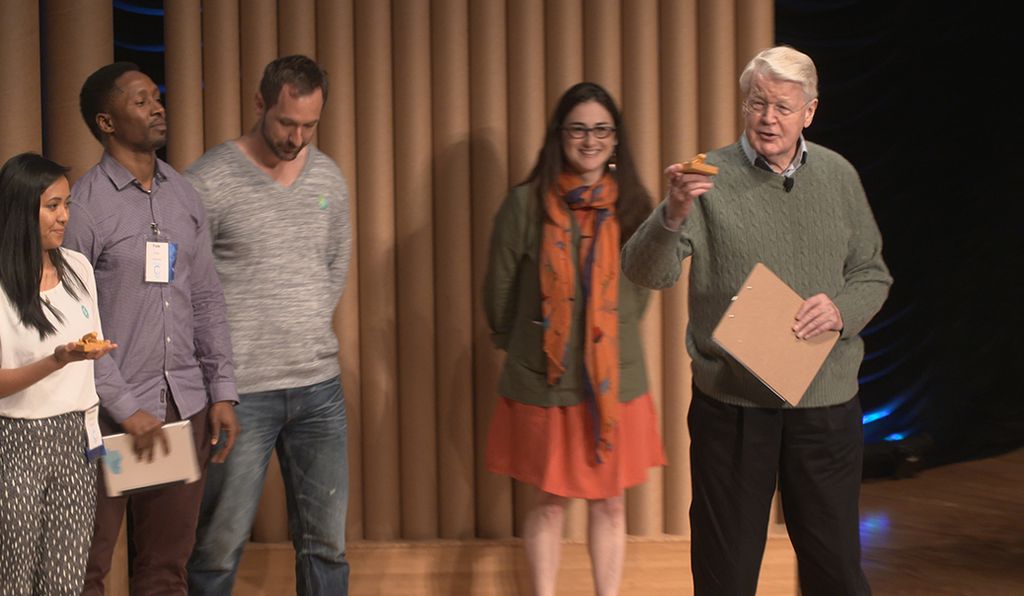
At the Smithsonian’s Earth Optimism Summit, the former president of Iceland Olafur Grimsson encouraged new solutions to climate change, awarding cash prizes to the winners of the “Make for the Planet” challenge. (The Roadmap)

Grimsson’s group felt that due to changes in information technology and social transformations, the large organizations and structures that used to be necessary to effect change were now not needed. And thus was born Roadmap, a new crowdsourcing tool for anyone and everyone interested in climate action. Still in its very early stages, Roadmap’s founders envision it as a platform for those working on climate issues—from scientist and policymaker to farmer and fisherman—to facilitate the sharing of knowledge and ideas, methods and techniques.

“A new political model is possible—where everyone can be a doer, where you no longer need big government or big enterprises to bring about success,” Grimsson says.

This new model for social change that skips the usual cumbersome channels and processes has been seen everywhere from public health, where the Bill & Melinda Gates Foundation has redefined the sector, to the hospitality industry, which is working to combat the human trafficking that plagues its businesses, to perhaps most famously the Arab Spring, where the role of social media in bringing about political change is still being debated today.

And this new model is complemented by technological changes. “The innovation in energy technology is such that we no longer have to wait for the big energy breakthrough,” Grimsson says. “We already have the available technologies. Every individual, home, village, community, town and region can execute change. The good news from the climate point of view is that, in addition to the information technology revolution, there has now also taken place an energy revolution. A house can be a power station: If the people who live in that house have extra energy, they can sell their energy through the smart grid. The notion that every house can be a power station is as revolutionary as saying that every mobile phone can be a media company.”

Grimsson admits that it may seem odd for someone in his position to be advocating that ordinary citizens take action apart from the conventional corridors of governmental power.

“For me to say that these traditional political organizations and positions are somewhat outdated is perhaps a strange statement: I was a professor of political science, I’ve been a member of parliament, I’ve been a minister of finance, I was president for 20 years,” he says.

It was during Iceland’s financial meltdown that he first experienced this new kind of social change: “I saw this very strongly through the financial crisis in my own country, which led to a big social economic uprising. All those activities were engineered by unknown people, people who were not part of a big organization, who used Facebook and the information media to bring thousands of people together in one day.”

Right now, Roadmap consists of a website and a lofty manifesto that speaks of raising the value of “moral currency” and creating a “best practices warehouse.” Visitors to the site can fill out a form if they want to become part of its community of “doers.” The practical part of the manifesto speaks of identifying the best methodologies and models; implementing a “real-time system of measurement” and a way to “gauge and understand what is working, what is not, and exactly what is being achieved.” As the platform develops, it will be interesting to see exactly what form these gauges, measurement systems, and warehouses take.

After the Paris Agreement, Grimsson says of himself and his Roadmap co-founders, “We were all optimistic, but we are all also realists.” It is his belief that if you “give people the tools, they can execute the transformation and the change—without governmental leadership.” Perhaps Roadmap will be one of those tools.

 ooOOoo

Here’s a video that spells it out in ways that I find impossible to ignore. (And, yes, I signed up, as in joining, yesterday afternoon.)

Because in hundreds of years time I want others to look at the following picture of Troutbeck Valley in England and know how precious is this one and only planet we live on.

Or in the words of Sue Dreamwalker that I read yesterday evening:

We are witnessing more storms, more unseasonal weather patterns, and I just hope that we wake up soon to the damage we are doing to our beloved Mother that has held us in her eternal arms for so long..

Photo credit: Getty Images

Enjoy the month of May wherever you are in the world!

Closing by repeating a key pronouncement in that RoadMap video above:

Why We? Who Else!

Thinking anew.

Humanity’s safe and viable future depends on seeing things very differently.

Next Tuesday is the 62nd anniversary of the death of Albert Einstein, the famous German theoretical physicist who died on the 18th April, 1955. He delivered many innovative ways of seeing our world way beyond his theory of relativity, one of the two pillars of modern physics (alongside quantum mechanics) (Ref: Wikipedia)

Why do I introduce today’s post with that reference to Mr. Einstein?

Because I wanted to share with you a recent essay from George Monbiot and an Einstein quotation seemed so apt an introduction.

We shall require a substantially new manner of thinking if mankind is to survive.

That essay from George Monbiot was published yesterday and is shared with you all with Mr. Monbiot’s full permission.

It is an essay that deserves being read slowly and carefully. Please take time aside to so do because it really does offer a new manner of thinking.

ooOOoo

Circle of Life

By reframing the economy, Kate Raworth’s Doughnut Economics changes our view of who we are and where we stand.

By George Monbiot, published in the Guardian 12th April 2017

So what are we going to do about it? This is the only question worth asking. But the answers appear elusive. Faced with a multifaceted crisis  – the capture of governments by billionaires and their lobbyists, extreme inequality, the rise of demagogues, above all the collapse of the living world – those to whom we look for leadership appear stunned, voiceless, clueless. Even if they had the courage to act, they have no idea what to do.

The most they tend to offer is more economic growth: the fairy dust supposed to make all the bad stuff disappear. Never mind that it drives ecological destruction, that it has failed to relieve structural unemployment or soaring inequality, that, in some recent years, almost all the increment in incomes has been harvested by the top 1%. As values, principles and moral purpose are lost, the promise of growth is all that’s left.

You can see the effects in a leaked memo from the UK’s foreign office: “Trade and growth are now priorities for all posts … work like climate change and illegal wildlife trade will be scaled down.” All that counts is the rate at which we turn natural wealth into cash. If this destroys our prosperity and the wonders that surround us, who cares?

We cannot hope to address our predicament without a new worldview. We cannot use the models that caused our crises to solve them. We need to reframe the problem. This is what the most inspiring book published so far this year has done.

In Doughnut Economics: seven ways to think like a 21st-century economist, Kate Raworth reminds us that economic growth was not, at first, intended as a measurement of well-being. Simon Kuznets, who standardised the measurement of growth, warned: “the welfare of a nation can scarcely be inferred from a measure of national income.” Economic growth, he pointed out, measures only annual flow, rather than stocks of wealth and their distribution.

Raworth points out that economics in the 20th Century “lost the desire to articulate its goals.” It aspired to be a science of human behaviour: a science based on a deeply flawed portrait of humanity. The dominant model – “rational economic man”, self-interested, isolated, calculating – says more about the nature of economists than it does about other humans. The loss of an explicit objective allowed the discipline to be captured by a proxy goal: endless growth.

The aim of economic activity, she argues, should be “meeting the needs of all within the means of the planet.” Instead of economies that need to grow, whether or not they make us thrive, we need economies that “make us thrive, whether or not they grow.” This means changing our picture of what the economy is and how it works.

The central image in mainstream economics is the circular flow diagram. It depicts a closed flow of income cycling between households, businesses, banks, government and trade, operating in a social and ecological vacuum. Energy, materials, the natural world, human society, power, the wealth we hold in common: all are missing from the model. The unpaid work of carers – principally women – is ignored, though no economy could function without them. Like rational economic man, this representation of economic activity bears little relationship to reality.

So Raworth begins by redrawing the economy. She embeds it in the Earth’s systems and in society, showing how it depends on the flow of materials and energy, and reminding us that we are more than just workers, consumers and owners of capital.

The Embedded Economy. Graphic by Kate Raworth and Marcia Mihotich

This recognition of inconvenient realities then leads to her breakthrough: a graphic representation of the world we want to create. Like all the best ideas, her Doughnut model seems so simple and obvious that you wonder why you didn’t think of it yourself. But achieving this clarity and concision requires years of thought: a great decluttering of the myths and misrepresentations in which we have been schooled.

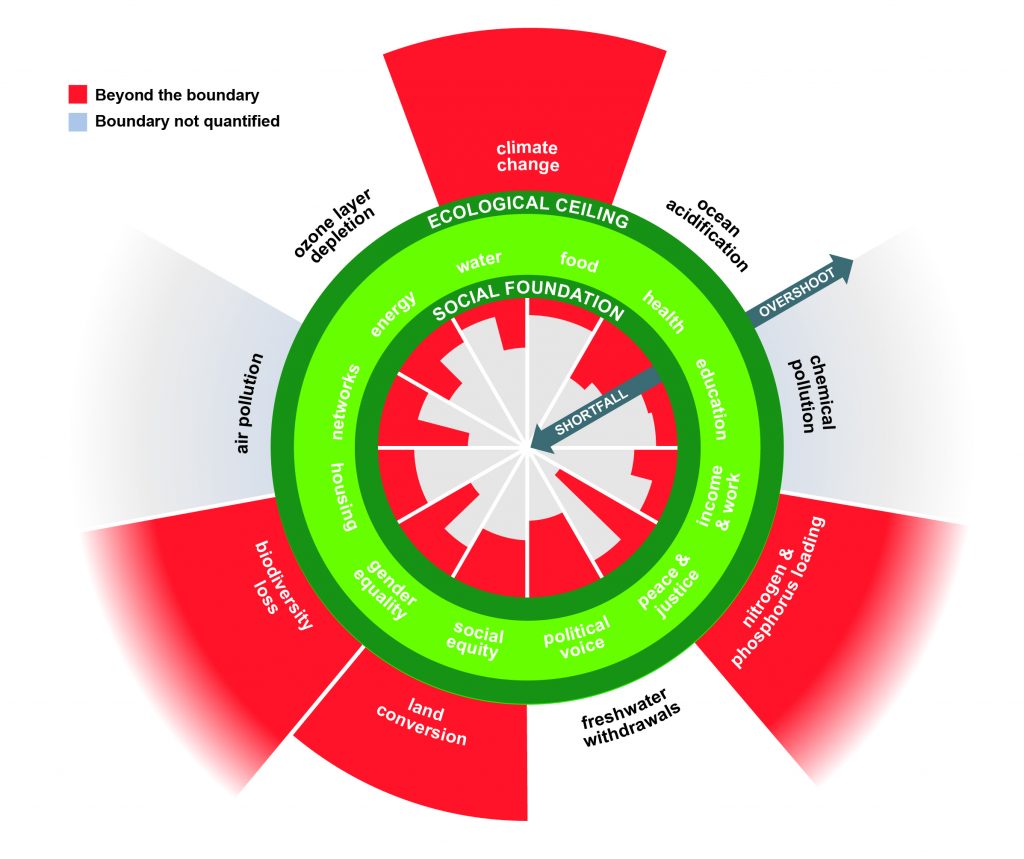
The diagram consists of two rings. The inner ring of the doughnut represents a sufficiency of the resources we need to lead a good life: food, clean water, housing, sanitation, energy, education, healthcare, democracy … . Anyone living below that line, in the hole in the middle of the doughnut, is in a state of deprivation.

The Doughnut. Graphic by Kate Raworth and Christian Guthier/The Lancet Planetary Health

The outer ring of the doughnut consists of the Earth’s environmental limits, beyond which we inflict dangerous levels of climate change, ozone depletion, water pollution, loss of species and other assaults on the living world. The area between the two rings – the doughnut – is the “ecologically safe and socially just space” in which humanity should strive to live. The purpose of economics should be to help us enter that space and stay there.

As well as describing a better world, the doughnut model allows us to see, in immediate and comprehensible terms, the state in which we now find ourselves. At the moment we transgress both lines. Billions of people still live in the hole in the middle. We have breached the outer boundary in several places.

Where we are now. Graphic by Kate Raworth and Christian Guthier/The Lancet Planetary Health

An economics that helps us to live within the doughnut would seek to reduce inequalities in wealth and income. Wealth arising from the gifts of nature would be widely shared. Money, markets, taxation and public investment would be designed to conserve and regenerate resources rather than squander them. State-owned banks would invest in projects that transform our relationship with the living world, such as zero-carbon public transport and community energy schemes. New metrics would measure genuine prosperity, rather than the speed with which we degrade our long-term prospects.

Such proposals are familiar, but without a new framework of thought, piecemeal solutions are unlikely to succeed. By rethinking economics from first principles, Raworth allows us to integrate our specific propositions into a coherent programme, and then to measure the extent to which it is realised. I see her as the John Maynard Keynes of the 21st-Century: by reframing the economy, she allows us to change our view of who we are, where we stand, and what we want to be.

Now we need to turn her ideas into policy. Read her book, then demand that those who wield power start working towards its objectives: human prosperity within a thriving living world.

www.monbiot.com

ooOOoo

 Please, wherever you are and whatever your plans are for this long weekend, do take great care of yourself and all your loved ones!

Another Firefighters’ Dog Rescue

Stories like this make my toes curl with pleasure!

Less than two weeks ago I shared an item that I had read about the firefighters of Santa Monica, CA, saving the life of a ten-year-old dog.

When Santa Monica firefighters were called to a burning apartment, they found the lifeless body of a tiny dog overcome by the heat and smoke on the floor of a bedroom. They pulled out the dog, named Nalu, but he wasn’t breathing and didn’t have a pulse.

Then two days ago, courtesy of the Care2 Causes blogsite, along comes another fabulous example of the care, love and generosity shown by firefighters.

ooOOoo

Firefighters Rescue Golden Retriever From Icy Pond

By: Laura S. April 9, 2017

About Laura

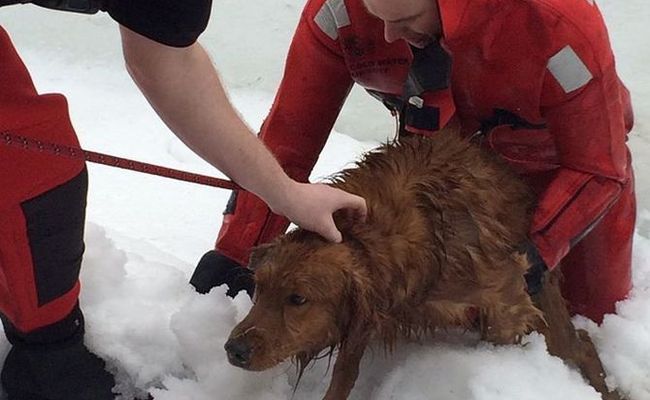
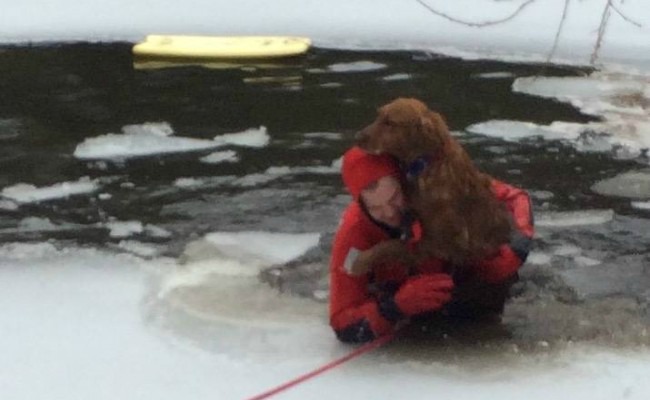
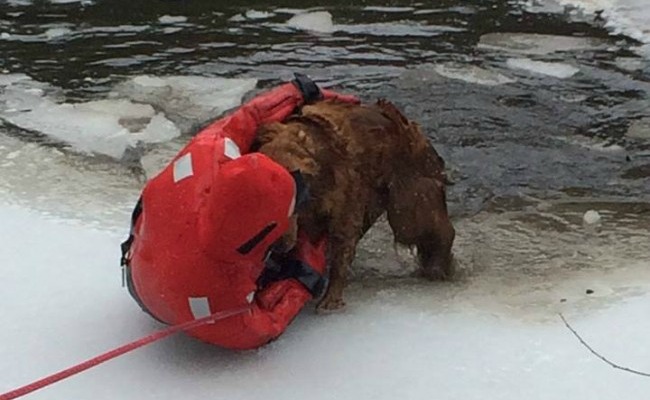
With perhaps just seconds to spare, North Hampton firefighter Will Taber barreled toward a dog who was barely clinging to thin ice last week in New Hampshire.

Photo Credit: North Hampton Professional Fire Fighters

Three-year-old Emmett ran out onto his family’s frozen backyard pond, suddenly falling through the ice. Although homeowner Kacey Eddinger started into the pond to rescue him, she had to turn back when she realized the water was simply too cold. Eddinger and her toddler son waited anxiously for help to arrive.

Photo Credit: North Hampton Professional Fire Fighters

The family isn’t certain exactly how long their golden retriever was in the water before they realized he’d fallen through, but by the time firefighters arrived, Emmett was exhausted and close to drowning.

In thermal ice rescue gear, firefighter Taber held a tethered line as he crossed the ice and entered the water. Once he reached Emmett, the other firefighters pulled the pair back to shore.

Photo Credit: North Hampton Professional Fire Fighters

“The canine was exhausted and scared and minutes from going completely under water and carried by the current under the ice,” the Fire Department posted on Facebook. “The rescue was made just in time where he was then immediately warmed, carried to a police cruiser and transported to North Hampton Animal Hospital.”

Though spring has officially arrived, ice rescues have escalated due to the thin ice that remains on some bodies of water.

Photo Credit: North Hampton Professional Fire Fighters

ooOOoo

Again and again, I find myself rating actions such as these from the North Hampton Fire Fighters (and not forgetting the Santa Monica Fighters) so gloriously uplifting. Again and again, they serve as a reminder that real people all around the world are so very often wonderful, generous and loving real people!

Snow time is smile time

These dogs are most definitely not suffering from depression!

Good people, I was late to my desk yesterday and was looking for something to present to you without it taking too much time.

The Care2 site came to the rescue with the following video. Plus, such a bonus following last Saturday’s article about dogs suffering from depression and how to cure them when they are down.

It doesn’t get farther from depression than this!

Hopefully back to normal tomorrow!

Smoke and Mirrors

Let me start with a quotation:

I’m not a pessimist, even though I do think awful things are going to happen.

James Lovelock

The author of that quote is fellow Englishman, albeit a tad older than yours truly, Mr. James Lovelock. WikiPedia describes him, thus (in part):

James Ephraim Lovelock CHCBEFRS[2] (born 26 July 1919) is an independent scientist, environmentalist and futurist who lives in Devon, England. He is best known for proposing the Gaia hypothesis, which postulates that the Earth functions as a self-regulating system.[5]

Moving on.

These times in this fine country, The United States of America, are troubling as Rebecca Gordon set out so compellingly in yesterday’s post.

But what is so terrible about these times is the failure to put integrity at the heart of every pronouncement that comes from a Government. And it would be grossly unfair to pick on the present US Government as the only example of this failure.

Because just a few mouse clicks can inform millions of us as to the real issues. Such as the effect that Climate Change is having on our health, as this recent Grist article so aptly put it in the opening paragraphs:

Here are 4 ways climate change is messing with our brains — for the worse.

We might think of climate change as purely physical: wildfires blazing through forests, rising seas lapping at the doors of coastal homes.

But those brutal conditions also affect our mental health, changing how we think and act. Mental health professionals are paying attention to the link between climate change and emotional health — and health insurance companies are, too.

Or take the issue of the state of America’s water. Recently the subject of an important essay just presented by Naked Capitalism:

America’s Hidden Water Affordability Crisis

Yves here. Grist has been doing an admirable job of keeping on top of this important yet oddly still-under-the-radar story. In the US, the big driver of rising water costs is the need to invest in aging, neglected water works. But water is going to become an issue in many places for differing reasons. As we have been saying for years, the natural resource that is projected to come under pressure first is potable water. And please don’t push desalination as a magic bullet. That costs money (both the plants and new transportation infrastructure, uses energy, plus has the not-trivial problem of how to dispose of the salt residues.

By Ciara O’Rourke, a freelance writer and 2015-16 Ted Scripps Fellow in Environmental Journalism at the University of Colorado Boulder. Originally published by Fusion and reproduced at Grist as part of the Climate Desk collaboration

When Elizabeth Mack wondered about a future in which Americans wouldn’t be able to pay for water, a couple of colleagues waved her off. “Don’t be ridiculous,” they said. But the idea niggled at Mack, an assistant professor at the Department of Geography, Environment, and Spatial Sciences at Michigan State University. And in January, in an article published in the science journal PLOS ONE, she asked a new question: Is there a burgeoning water affordability crisis in the United States?

Mack, along with research assistant Sarah Wrase, determined that if water rates increase at projected amounts over the next five years, the percentage of households that can’t pay their water bills could triple from 11.9 percent to more than a third. Nearly 14 million households nationwide already struggle to afford water services. An additional 27.18 million — or 8.5 percent of the country’s population — could soon face the same challenges.

Yes, integrity in politics is more, so much more, than a nice idea from this silly old Brit now living in Oregon. Here’s a post I published some four years ago that says it as clearly as it needs to be said.

ooOOoo

Reflections on Integrity.

Going back to basics.

Many will know the origins of this blog; a chance comment by Jon Lavin back in England in early 2007 that dogs were integrous, (a score of 210 as defined by Dr David Hawkins).

Way back in 2009, I wrote this:

“There is nothing to fear except the persistent refusal to find out the truth, the persistent refusal to analyse the causes of happenings.” Dorothy Thompson.

When I started Learning from Dogs I was initially rather vague but knew that the Blog should reflect the growing need for greater integrity and mindfulness in our planetary civilisation. Here are some early musings,

Show that integrity delivers better results … integrity doesn’t require force … networking power of a group … demonstrate the power of intention … cut through the power of propaganda and media distortion …

Promulgate the idea that integrity is the glue that holds a just society together … urgent need as society under huge pressures …. want a decent world for my grandchildren … for all our grandchildren …. feels like the 11th hour….

But as the initial, rather hesitant, start to the Blog settled into a reliable, daily posting, and as the minuscule number of readers steadily grew to the present level of many hundreds each day, the clarity of the purpose of Learning from Dogs also improved.

Because, while it may sound a tad grandiose and pompous, if society doesn’t eschew the games, half-truths and selfish attitudes of the last, say, 30 years or more, then civilisation, as we know it, could be under threat.

Or, possibly, it’s more accurate to say that our civilisation is under threat and the time left to change our ways, to embrace those qualities of integrity, truth and consciousness for the very planet we all live on, is running out.

Time left to change our ways is running out.

So what’s rattled my cage, so to speak, that prompted today’s reflection? I’ll tell you! (You knew I was going to anyway, didn’t you!)

I’m drafting these thoughts around noon Pacific Standard Time on Sunday, 17th. At the same time, tens of thousands of ordinary good folk (40,000 plus at the latest estimate) are gathering by the Washington Monument ready to march past the White House demanding that President Obama block the Keystone XL pipeline and move forward toward climate action.

Do I trust the US Government to take this action? On balance, no! That hurts me terribly to write that. I really want to trust and believe what the President of my new home country says.

State of the Union speech 2013. AP photo.

Here’s a snippet of what the President did say in his State of the Union speech on February 12th.

Now, it’s true that no single event makes a trend. But the fact is, the 12 hottest years on record have all come in the last 15. Heat waves, droughts, wildfires, floods, all are now more frequent and more intense.

We can choose to believe that Superstorm Sandy, and the most severe drought in decades, and the worst wildfires some states have ever seen were all just a freak coincidence. Or we can choose to believe in the overwhelming judgment of science and act before it’s too late.

A frank admission that the climate is changing in dramatic ways; the overwhelming judgment of science – fantastic!

The evidence that burning carbon-based fuels (coal, oil, gas) is the primary cause of today’s high CO2 levels is overwhelming. As a recent BBC radio programme reveals (being featured tomorrow) huge climate changes going back millions of years are a natural part of Earth’s history. However, as one of the scientists explains at the end of that radio programme, the present CO2 level, 395.55 ppm as of January, is now way above the safe, stable limit for the majority of life species on the planet.

But say you are reading this and are not yet convinced?

Let me borrow an old pilot’s saying from the world of aviation: If there’s any doubt, there’s no doubt!

That embracing, cautious attitude is part of the reason why commercial air transport is among the most safest forms of transport. If you had the slightest doubt about the safety of a flight, you wouldn’t board the aircraft.

If you had the slightest doubt about the future for civilisation on this planet likewise you would do something! Remember, that dry word civilisation means family, children, grandchildren, friends and loved ones. The last thing you would do is to carry on as before!

Which is where my lack of trust of leaders comes from!

Back to that State of the Union speech. Just 210 words after the spoken words “act before it’s too late” (I counted them!) Pres. Obama says, “That’s why my administration will keep cutting red tape and speeding up new oil and gas permits.

Here’s the relevant section:

I will direct my cabinet to come up with executive actions we can take, now and in the future, to reduce pollution, prepare our communities for the consequences of climate change, and speed the transition to more sustainable sources of energy.

Now, four years ago, other countries dominated the clean-energy market and the jobs that came with it. And we’ve begun to change that. Last year, wind energy added nearly half of all new power capacity in America. So let’s generate even more. Solar energy gets cheaper by the year. Let’s drive down costs even further. As long as countries like China keep going all-in on clean energy, so must we.

Now, in the meantime, the natural gas boom has led to cleaner power and greater energy independence. We need to encourage that. That’s why my administration will keep cutting red tape and speeding up new oil and gas permits.

We don’t require any more oil to be used. We are already using a staggering amount of it. Let me refer you to an essay on Nature Bats Last called Math. The scary kind, not the fuzzy kind. Prof. McPherson wrote:

I performed a little rudimentary math last week. A little because even a little pushes my limit for math, these days. And rudimentary for the same reason. The outcome was staggering: We’re using oil at the rate of 5,500 cubic feet per second (cfs).

5,500 cubic feet per second” Don’t know about you but I have some trouble in visualising that flow rate. Try this from later in the essay:

Here’s another shot of perspective: We burn a cubic mile of crude oil every year. The Empire State Building, the world’s ninth-tallest building, towers above New York at 1,250 feet. The world’s tallest building, Taipei 101, is 1,667 feet from ground to tip.

Put those buildings together, end to end, and you have one side of a cube. Do it again, and you have the second side. Once more, but this time straight up, and you have one big cube. Filling that cube with oil takes nearly 200 billion gallons … which is about one-sixth the size of the cube of oil we’re burning every year.

Burning a cubic mile every year! Yes, Mr. President, more oil permits is a wonderful way of taking action before it’s too late!

cubic mile
Image taken from http://www.flashevap.com/bigthings.htm

So let’s see what transpires? Let’s see if integrity is given the highest political focus. As in “adherence to moral and ethical principles; soundness of moral character; honesty.” Because if there’s ever been a time when all of us, from every spectrum of society need honesty about what we are doing to the planet, it’s now!

As the tag on the home page of this blog says, “Dogs are integrous animals. We have much to learn from them.

ooOOoo

Going to close with two more quotations from Mr. Lovelock.

The first:

You never know with politicians what they are really saying. And I don’t say that in a negative way-they have an appalling job.

And the second one to close today’s post:

If you start any large theory, such as quantum mechanics, plate tectonics, evolution, it takes about 40 years for mainstream science to come around. Gaia has been going for only 30 years or so.

The Cave of Crystal Giants

This will take us away from the daily beat of life!

On the 18th. February the BBC News website carried an article that I found incredible. It was the story of Naica’s crystal caves in Mexico.

oooo

Naica’s crystal caves hold long-dormant life

By Jonathan Amos, BBC Science Correspondent, Boston, 18 February 2017.

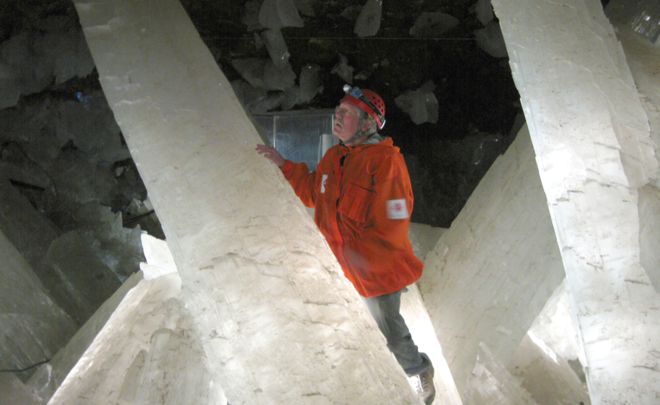
 The caves were discovered by miners 100 years ago
The caves were discovered by miners 100 years ago. Picture credit: Penelope J. Boston

It is a remarkable discovery in an amazing place.

Scientists have extracted long-dormant microbes from inside the famous giant crystals of the Naica mountain caves in Mexico – and revived them. [Ed: my emphasis]

The organisms were likely to have been encased in the striking shafts of gypsum at least 10,000 years ago, and possibly up to 50,000 years ago.

It is another demonstration of the ability of life to adapt and cope in the most hostile of environments.

“Other people have made longer-term claims for the antiquity of organisms that were still alive, but in this case these organisms are all very extraordinary – they are not very closely related to anything in the known genetic databases,” said Dr Penelope Boston.

The new director of Nasa’s Astrobiology Institute in Moffett Field, California, described her findings here at the annual meeting of the American Association for the Advancement of Science (AAAS).

oooo

I was delighted to find more details in many other places on the ‘web’.

Such as this one on the National Geographic website:

By Victoria Jaggard

PUBLISHED February 17, 2017

Boston, Massachusetts

Creatures that thrive on iron, sulfur, and other chemicals have been found trapped inside giant crystals deep in a Mexican cave. The microbial life-forms are most likely new to science, and if the researchers who found them are correct, the organisms are still active even though they have been slumbering for tens of thousands of years.

If verified, the discovery adds to evidence that microbial life on Earth can endure harsher conditions in isolated places than scientists previously thought possible. (See “Life Found Deep Under Antarctic Ice for First Time?”)

“These organisms have been dormant but viable for geologically significant periods of time, and they can be released due to other geological processes,” says NASA Astrobiology Institute director Penelope Boston, who announced the find today at a meeting of the American Association for the Advancement of Science. “This has profound effects on how we try to understand the evolutionary history of microbial life on this planet.”

Then there’s another article on that NatGeo website: (Apologies for some duplication in the message.)

By Neil Shea, National Geographic Staff
In a nearly empty cantina in a dark desert town, the short, drunk man makes his pitch. Beside him on the billiards table sits a chunk of rock the size of home plate. Dozens of purple and white crystals push up from it like shards of glass. “Yours for $300,” he says. “No? One hundred. A steal!” The three or four other patrons glance past their beers, thinking it over: Should they offer their crystals too? Rock dust on the green felt, cowboy ballads on the jukebox. Above the bar, a sign reads, “Happy Hour: 8 a.m. to 9 p.m.”

This remote part of northern Mexico, an hour or so south of Chihuahua, is famous for crystals, and paychecks at the local lead and silver mine, where almost everyone works, are meager enough to inspire a black market. “Thirty dollars.” He leans in. “Ten.” It’s hard to take him seriously. Earlier in the day, in a cave deep below the bar, I crawled among the world’s largest crystals, a forest of them, broad and thick, some more than 30 feet long and half a million years old. So clear, so luminous, they seemed extraterrestrial. They make the chunk on the pool table seem dull as a paperweight.

Nothing compares with the giants found in Cueva de los Cristales, or Cave of Crystals. The limestone cavern and its glittering beams were discovered in 2000 by a pair of brothers drilling nearly a thousand feet below ground in the Naica mine, one of Mexico’s most productive, yielding tons of lead and silver each year. The brothers were astonished by their find, but it was not without precedent. The geologic processes that create lead and silver also provide raw materials for crystals, and at Naica, miners had hammered into chambers of impressive, though much smaller, crystals before. But as news spread of the massive crystals’ discovery, the question confronting scientists became: How did they grow so big?

It takes 20 minutes to get to the cave entrance by van through a winding mine shaft. A screen drops from the van’s ceiling and Michael Jackson videos play, a feature designed to entertain visitors as they descend into darkness and heat. In many caves and mines the temperature remains constant and cool, but the Naica mine gets hotter with depth because it lies above an intrusion of magma about a mile below the surface. Within the cave itself, the temperature leaps to 112 degrees Fahrenheit with 90 to 100 percent humidity—hot enough that each visit carries the risk of heatstroke. By the time we reach the entrance, everyone glistens with sweat.

That article continues here.
Finally, lose yourself in this video. (If the voice doesn’t get to you!)

How to close today’s post?

Both by embracing the power of the natural order of things, life and death, and by reminding us all that there are in the order of over two billion stars in this universe.

That universe must be teeming with life, current and dormant, and the day when we truly confirm that will put everything into perspective!

oooo

Talk about synchronicity!

For yesterday, around 10am PST, the BBC News website carried this big news item: Earliest evidence of life on Earth ‘found’.

Here’s how that article opens:

Earliest evidence of life on Earth ‘found’

By Pallab Ghosh Science correspondent, BBC News
Scientists have discovered what they say could be fossils of some of the earliest living organisms on Earth.
They are represented by tiny filaments, knobs and tubes in Canadian rocks dated to be up to 4.28 billion years old.
That is a time not long after the planet’s formation and hundreds of millions of years before what is currently accepted as evidence for the most ancient life yet found on Earth.

The researchers report their investigation in the journal Nature.

As with all such claims about ancient life, the study is contentious. But the team believes it can answer any doubts.

The scientists’ putative microbes from Quebec are one-tenth the width of a human hair and contain significant quantities of haematite – a form of iron oxide or “rust”.

Matthew Dodd, who analysed the structures at University College London, UK, claimed the discovery would shed new light on the origins of life.

Do read the full article including viewing some wonderful photographs.

Stupendous!

From the sublime to the amazing!

First, the sublime.

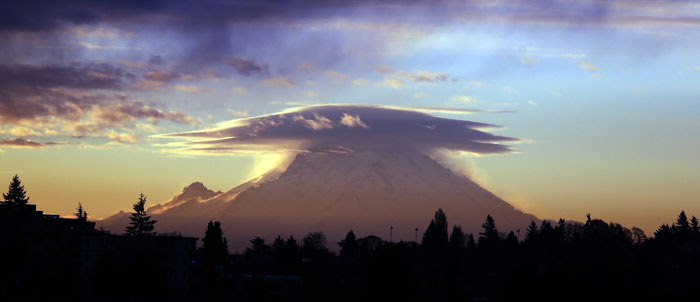
As in this stunning picture from the latest Cloud Appreciation Society newsletter.

A cap cloud at sunrise over Mount Rainier, spotted from Seattle, Washington, US, by Elaine Thompson (Member 41974).

“Though outwardly a gloomy shroud,
The inner half of every cloud
Is bright and shining:
I therefore turn my clouds about,
And always wear them inside out
To show the lining.”

[From ‘The Wisdom of Folly’ by Ellen Thorneycroft Fowler in Verses, Wise or Otherwise (1895)]

Then to the amazing!

It’s hard to comprehend the sheer size of objects in space, but take 2 minutes and give it a try!

This video is from the European Southern Observatory (ESO) comparing the sizes of Earth, our sun and stars.

Small miracles

It’s not just the rescuing of people that matters.

Last Thursday, the 26th January, the BBC News website published a short video under the heading of: Italian avalanche survivors tell how they stayed alive.

Colleen Barry and Eldar Emric of Associated Press reported in US News:

A couple among the nine survivors of an Italian avalanche that devastated a mountain hotel say they survived nearly 58 hours buried beneath feet of snow by sucking on glass- and mud-filled ice, comforting each other and those nearby, and praying.

Now there’s no way I am belittling that survival; far from it. But 58 hours is a tad under 3 days.

Now read the following that was published on the Care2 site.

ooOOoo

Puppies Rescued 5 Days After Devastating Avalanche in Italy

3199461-largeBy: Laura Goldman    January 26, 2017

After an avalanche buried central Italy’s luxury Hotel Rigopiano and its guests Wednesday, Jan. 18, rescue workers spent days digging in the snow in a desperate attempt to locate any survivors.

About 120,000 tons of snow, 16 feet deep, slammed into the hotel at 60 miles per hour. It took a while for emergency operators to believe the avalanche had occurred. The first man who called to report it was told that everything was fine at the hotel.

When they finally realized a disaster had in fact happened, first responders had to ski to the hotel, which took 12 hours. It took another day until the roads could be cleared with snowplows so emergency vehicles could finally get through.

Despite these circumstances, 11 survivors, including three children, were somehow able to keep themselves alive for over 40 hours by using their cellphones as flashlights to find water. The children, trapped in a game room, ate packets of Nutella and drank bottled water.

By Monday, rescuers were only pulling bodies from the snow and rubble. Discouraged and depressed, they were ready to give up hope.

The rescuers were told there were three puppies at the hotel. They had no idea where they were until they heard a noise in a boiler room inside what remained of the building. It was the three fluffy, white Abruzzo sheepdog puppies, only six weeks old, who had miraculously managed to survive both the avalanche and being stranded for five days.

“They just started barking very softly,” said Sonia Marini, one of the rescuers. “In fact, it was hard to find them right away because they were hidden. Then we heard this very tiny bark and we saw them from a little hole the firefighters had opened in the wall. We expanded the hole and we pulled them out.”

The puppies, born Dec. 4, had survived in an air pocket by eating snow, Walter Milan, the spokesman for Italy’s elite Alpine rescue squad, told the Daily Beast. They are the offspring of Nuvola (Cloud) and Lupo (Wolf), who lived at the hotel and were popular with guests.

Like their lucky litter, Nuvola and Lupo also survived the avalanche, according to a Facebook post by Martina Rossi, who was a bartender at the hotel.

Lupo e Nuvola, i pastori abruzzesi nati e cresciuti all'Hotel Rigopiano, non so come, sono riusciti a raggiungere la mia contrada, una frazione di Farindola (Villa Cupoli) sani e salvi. Questo non può di certo colmare il vuoto e la distruzione che attraversa un paese in ginocchio ancora speranzoso, nell'attesa soltanto di notizie positive, me in prima persona. Ma questi due bellissimi cagnoloni, rivedendoli, di certo sono riusciti a farmi tornare a battere il cuore, almeno per qualche secondo, riportando la speranza.
Lupo e Nuvola, i pastori abruzzesi nati e cresciuti all’Hotel Rigopiano, non so come, sono riusciti a raggiungere la mia contrada, una frazione di Farindola (Villa Cupoli) sani e salvi.
Questo non può di certo colmare il vuoto e la distruzione che attraversa un paese in ginocchio ancora speranzoso, nell’attesa soltanto di notizie positive, me in prima persona.
Ma questi due bellissimi cagnoloni, rivedendoli, di certo sono riusciti a farmi tornare a battere il cuore, almeno per qualche secondo, riportando la speranza.

The three puppies raised the hopes and spirits of the rescuers. “If the puppies survived, humans could as well,” Milan told the Daily Beast. Firefighter Fabio Jerman agreed. “It’s an important sign of life, which gives us hope,” he said.

Sadly, no one else has been found alive. A week after the disaster, 24 bodies have been found and five people are still missing.

In addition to unusually heavy snowfall, the avalanche may have been caused by a series of earthquakes that struck the area the day before.

Last year, devastating quakes killed more than 300 people in Italy. Another fortunate four-legged survivor, a border collie pulled from the rubble two days after an earthquake struck in late October, is being trained to pay it forward as a rescue dog.

Photo credit: YouTube

ooOOoo

Well done the team, as in Walter Milan the spokesman, and the rest of Italy’s elite Alpine rescue squad!

Stories like this put a real smile on my face!