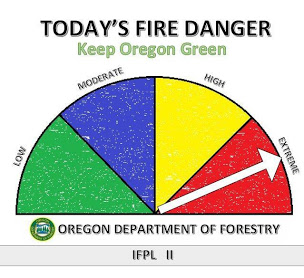
Jeannie and me reacting to the last report on the Oregon Department of Forestry (ODF) Southwest website:
Hugo Road Fire FINAL Update 09/06/18
Quick Facts:
Incident Start Date: 09/02/2018
Incident Start Time: Approx. 7:15 p.m.
Incident Type: Wildfire
Cause: Under Investigation
Incident Location: Hugo, which is roughly ten miles north-northwest of Grants Pass in Josephine County, Oregon
Land Threat: Private
Command Agency: ODF
Fire Size: 199 acres
Containment: 86%
Current Situation:This will be the final update for the Hugo Road Fire unless conditions significantly change.
Firefighters continue to boost containment on the Hugo Road Fire, now reaching 86 percent. The fire remains at 199 acres.
Overnight, crews were able to mop up 300 feet from the fire’s edge, adjacent to roadways, and surrounding the perimeter of homes. Within the mop up area, very few hot spots were found. All residences are at a Level 1 “Be Ready” evacuation notice, and will remain at such until Fire Season 2018 comes to a close, per the Josephine County Sheriff’s Office.
Local fire personnel will continue gridding the landscape for interior hot spots and conducting suppression repair throughout the next few days. It is normal to see light smoke during this process, but it is now well within the interior of the fire’s footprint which does not pose a threat to our community. There will still be fire apparatus present until the final mop up stages are complete. We encourage everyone to continue to use caution while traveling through the area.
Thank you again to every single partner agency and community member for the assistance and support throughout this firefight. It is an honor to serve and live in this community.
Evacuations:
Due to progress made by firefighters on the Hugo Road Fire all current evacuation levels are being downgraded to a Level 1 “BE READY” notice. Level 1’s will remain in effect until the end of the fire season.
For information regarding information, please contact the Josephine County Sheriff’s Office, or follow the Josephine County Emergency Management Facebook page as evacuation levels are anticipated to change shortly.
Assigned Resources:
Engines: 10
Water Tenders: 4
Helicopters: As needed
Hand Crews: 8
Dozers: 4
Total Personnel: 211
Air Tankers: As needed
The fire was listed late Monday as 30 percent contained, but not before it destroyed two houses, 13 outbuildings two recreational vehicles and 11 vehicles, according to the Oregon Department of Forestry. Fire also damaged three other residences, two out-buildings and a vehicle, according to ODF.
It is easy to read those words and not be greatly affected by them.
But the reality of having to evacuate one’s home in a hurry and then subsequently returning to find it burnt to the ground is terrible beyond imagination. Everything lost. A wiping clean of one’s life. Having to start all over again. Dreadful, truly dreadful.
A post that involves dogs but not what I had in mind!
Last Saturday I published a post The burning of our forests! that included a photograph of the nearby Klondike fire.
Courtesy Jeffersen Public Radio
Then last Sunday I was speaking to Maija, my daughter back in England, and she was asking how the fires were and I distinctly recall saying: “Sweetheart, I think we are over the worst!”
That same Sunday evening, around 9:45pm, in other words two evenings ago, one of our neighbours, Margo, who lives on 60 acres adjacent to the west of us, called with real alarm in her voice:
Paul, have you seen the fire that is burning just to the North-East of us?
I replied that I had not but immediately went to our deck that runs the whole Eastern length of our house. Mount Sexton is just a few miles to the North-East of us.
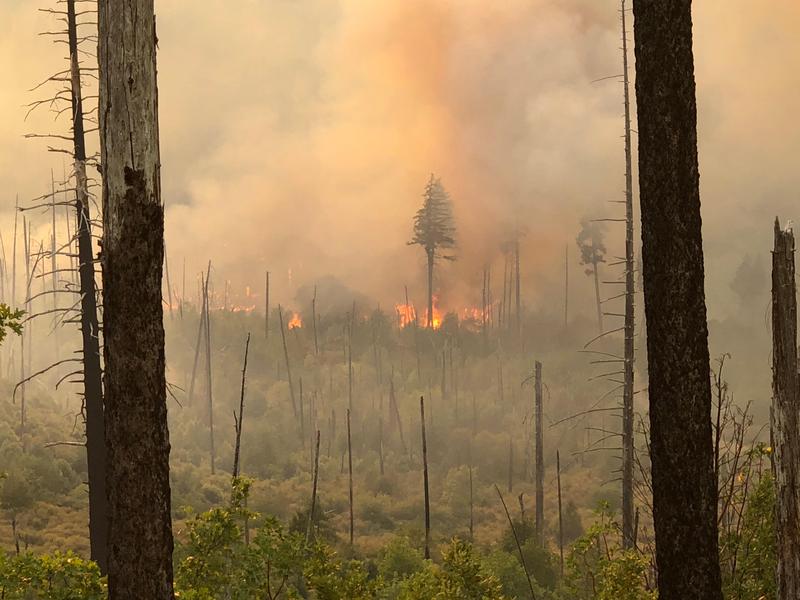
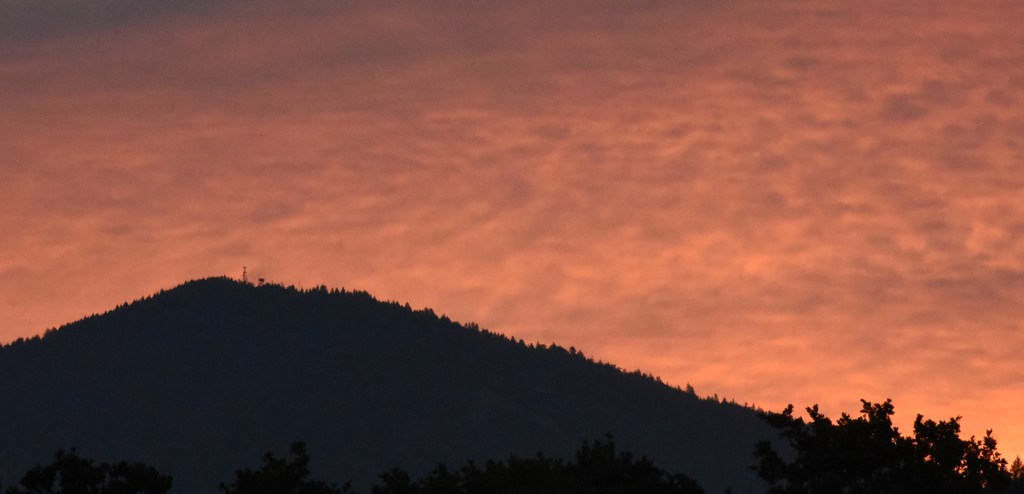
This is what I saw!
Taken on the 2nd September, 2018 at 21:44 PDT
Apparently, a short while previously the wind had blown down a tree that had fallen across some high-voltage power lines causing sparking that had, in turn, ignited the extremely dry grassland.
The fire was between Oxyoke Road and Three Pines Road and roughly 2 miles from us line of sight.
That explained why some thirty minutes before, in the last of the light of the setting sun, there had been a number of helicopter flights come across us en route to dropping fire retardant close by. It hadn’t occurred to me that it was an incident so close to us.
Many of us living nearby then called each other to spread the word.
Jeannie and I, in turn, drew up an evacuation checklist and started getting things ready. More importantly, getting ourselves psychologically prepared to have to vacate the property at very short notice: Jeannie and me: six dogs; two horses; two parakeets; three cats; two chickens!
Thankfully an order to evacuate did not come during the night.
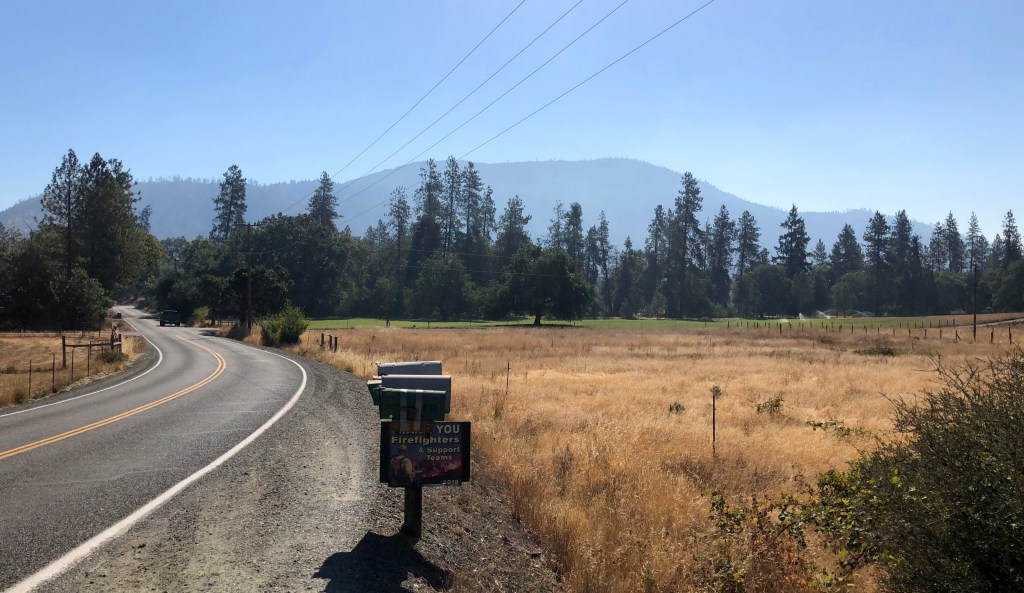
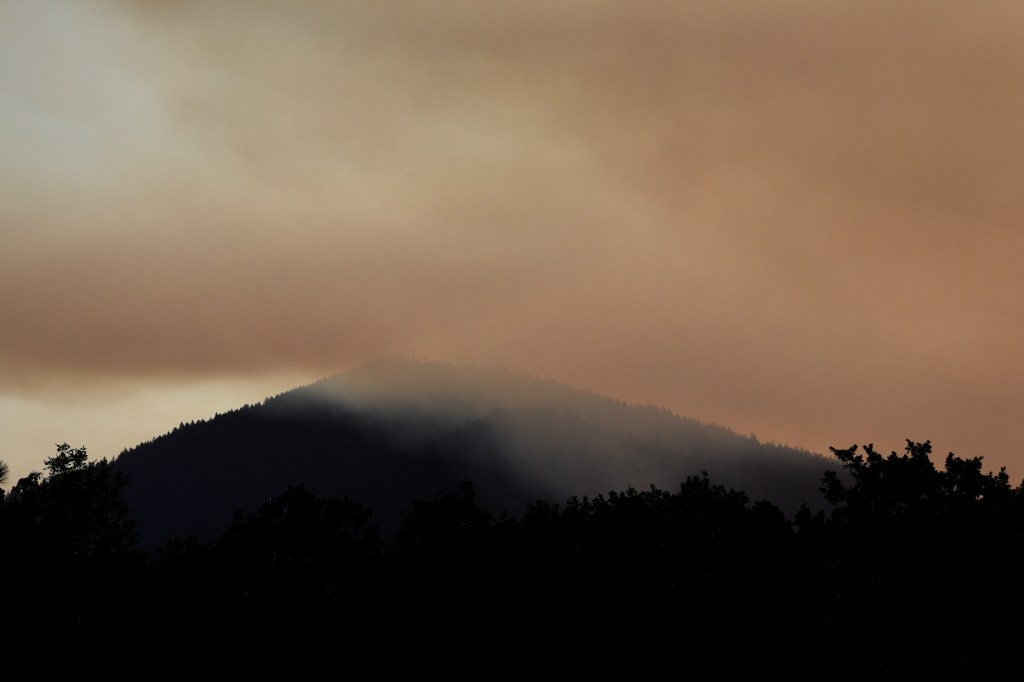
So yesterday morning I grabbed my bike and rode to Oxyoke Road. On the way I stopped to photograph the smoke in the air.
Three Pines Road looking to the East.
Once at Oxyoke Road I chatted to a search and rescue volunteer on duty controlling the traffic.
His report, as of 11:30 on September 3rd, was that the fire was just 15% contained, was “pretty active”, and that they were keeping an eye on the winds that were expected to be rather gusty later on that afternoon. I am writing this at 13:40 on the 3rd and the present winds are 6 mph, gusting 12 mph, from the North-West.
I rode back home to brief Jeannie and found her working her way through an idea for evacuating the dogs!
H’mmm! I am not sure Pedy is getting the message!
But a few words from Sweeny seemed to sort things out.
So there you are my good people, a post about dogs! Sort of!
Fingers crossed we will speak again tomorrow!
Assuming we don’t have a repeat of last night’s spectacular sights!!
Photo taken by Holmes Ariel of the Hugo Road Neighbourhood Watch group.
The latest news is that our Klondike Fire is now burning an area larger than 100,000 acres. Or to use the words from the incident webpage(my emphasis):
The Taylor Creek and Klondike Fires were split into zones on Saturday, Aug. 18. The fires are now referred to as “Taylor Creek Fire” and “Klondike Fire East,” managed by the Northwest Incident Management Team 12 out of Lake Selmac, and “Klondike Fire West” managed by California Interagency Incident Management Team 4 out of Gold Beach. A transfer of command of the Klondike West Zone will occur at 6:00 AM Friday when the Southern Area Red Team who arrived on Wednesday will take over.
As of the morning of Aug. 30, the Taylor Creek Fire is estimated 52,839 acres and is 95 percent contained. The Klondike Fire is estimated at 100,996 acres and is 40 percent contained. There are 1,214 personnel working on the Klondike Fire and 126 personnel assigned to the Taylor Creek Fire.
Courtesy Jeffersen Public Radio
Then just over a week ago, The Conversation blogsite published a reminder that I wanted to share with you today, under the permissions offered by The Conversation site.
ooOOoo
Many native animals and birds thrive in burned forests, research shows
But the idea that wildfires should be suppressed by logging the forest is far too simplistic. Most scientists agree that large hot wildfires produce many benefits for North American forests. Notably, they create essential habitat for many native species.
Fifteen years of research on Spotted Owls – a species that has played an oversized role in shaping U.S. forest management policies and practices for the past several decades – directly contradicts the argument that logging is needed to protect wildlife from fires. Wildlife biologists, including me, have shown in a string of peer-reviewed studies, that wildfires have little to no effect on Spotted Owls’ occupancy, reproduction or foraging, and even provide benefits to the owls.
The Northern Spotted Owl in the Pacific Northwest was listed as threatened under the Endangered Species Act in 1990. At that point, about 90 percent of U.S. old-growth forest had already been lost to logging. Every year in the 1980s the U.S. Forest Service sold about 7 to 12 billion board feet of public lands timber.
Figure 1. National forest timber sales (1905–2017). FY 1905-2017 National Summary Cut and Sold Data USDA Forest Service
Listing the owl drew attention to the dramatic decline of old-growth forest ecosystems due to 50 years of unsustainable logging practices. In response the U.S. Forest Service adopted new regulations that included fewer clearcuts, less cutting of trees over 30 inches in diameter and fewer cuts that opened up too much of the forest canopy. These policies, along with vast depletion of old-growth forests, reduced logging on Forest Service lands to about 2 billion board feet per year.
During the 1990s, national forest management policy for the Northern Spotted Owl included creating old-growth reserves and designating critical habitat where logging was restricted – mostly within half a mile of a Spotted Owl nest. In spite of these protections, populations of Northern Spotted Owls, as well as California and Mexican Spotted Owls, continued to decline on forest lands outside national parks. This was most likely due to ongoing logging outside of their protected nesting areas in the owls’ much larger year-round home ranges.
Fire and owls
Over the years the Forest Service shifted away from treating Spotted Owls as symbols of old-
Historical range (burgundy) of the Northern Spotted Owl, which also extended north into British Columbia. One hundred fifty years of logging, agriculture and urbanization have reduced the amount of old growth forest (potential Spotted Owl habitat) in this zone by 85-90 percent. NASA Earth Observatory
growth forest biodiversity, and instead started to cite them as an excuse for more logging. The idea that forest fires were a threat to Spotted Owls was first proposed in 1992 by agency biologists and contract researchers. In a status assessment of the California Spotted Owl, these scientists speculated that fires might be as damaging as clearcuts to the owls.
This perspective gained popularity within the Forest Service over the next 10 years and led to increased logging on public lands that degraded old-growth habitat for Spotted Owls.
Academic scientists, including some with Forest Service funding, published peer-reviewed studies of Spotted Owls and fire in 2002, 2009, 2011 and 2012. All four studies showed either no effects from fire or positive benefits from fire for Spotted Owls. Subsequent research on Spotted Owls in fire-affected forests has showed repeatedly that the owls can persist and thrive in burned landscapes.
(The U.S. Forest Service says wildfires harm wildlife habitat, but wildfires actually create rare and important habitat.)
Many wild species thrive in burned landscapes
I recently conducted a systematic review and meta-analysis that summarized all available scientific research on the effects of wildfires on Spotted Owl ecology. It found that Spotted Owls are usually not significantly affected by mixed-severity forest fire. Mixed-severity forest fire, which includes large patches with 100 percent tree mortality, is how wildfires in western forests naturally burn. The preponderance of evidence indicated that mixed-severity wildfire has more benefits than costs for Spotted Owls.
In 2017 I submitted an early version of this analysis with the same conclusions to the U.S. Fish and Wildlife Service during the agency’s peer-review process for its Conservation Objectives Report for the California Spotted Owl. My conclusions were not included in the final report.
Decades of science have shown that forest fires – including large hot fires – are an essential part of western U.S. forest ecosystems and create highly biodiverse wildlife habitat. Many native animals thrive in the years and decades after large intense fires, including deer, bats, woodpeckers and songbirds as well as Spotted Owls. Additionally, many native species are only found in the snag forest habitat of dead and dying trees created by high-severity wildfire.
Pileated woodpeckers excavate nests within snags, bringing life to charred forests in Oregon. NASA/S. Russell, CC BY-ND
Wildfires threaten homes, but wildlife and water supplies benefit
It is also time to reform Forest Service management goals to emphasize carbon capture, biodiversity, outdoor recreation and water supply as the most important ecosystem services provided by national forest lands. These services are enhanced by wildfires, not by logging.
ooOOoo
These last two paragraphs are key lessons: 1. Logging does not stop the biggest, hottest fires, and, 2. It is time to change the goals under which our forests are managed emphasising carbon capture, biodiversity, recreation and water supplies!
The idea that humanity will not prevent the approaching disaster is beyond belief!
One of the results of all you great people signing up to follow Learning from Dogs is that it encourages me to share things that strike me as so, so important.
Another of the results in there being, as of today, 3,349 following this place, is that I get the sense of what many of you good people also feel is important. Ergo, it is clear to me, clear beyond doubt, that caring and loving a dog or two makes you a person who cares and loves passionately this beautiful planet that is our home.
The emotion that is spilling out of me via these words to you is a result of having just read an essay published recently on The Conversation site and shared with you today.
Directly, it has nothing to do with our dear dogs. Yet, in a way, it does!
ooOOoo
7.5 billion and counting: How many humans can the Earth support?
By Andrew D. Hwang, Associate Professor of Mathematics, College of the Holy Cross, July 9th 2018.
Humans are the most populous large mammal on Earth today, and probably in all of geological history. This World Population Day, humans number in the vicinity of 7.5 to 7.6 billion individuals.
Can the Earth support this many people indefinitely? What will happen if we do nothing to manage future population growth and total resource use? These complex questions are ecological, political, ethical – and urgent. Simple mathematics shows why, shedding light on our species’ ecological footprint.
The mathematics of population growth
In an environment with unlimited natural resources, population size grows exponentially. One characteristic feature of exponential growth is the time a population takes to double in size.
Exponential growth of world population
It took 127 years for the world population to double from one billion to two. By contrast, it took only 47 years, from 1927 to 1974, to double from two billion to four. Since 1960, world population has grown by about one billion every 13 years. Each point represents an additional one billion people.
Exponential growth tends to start slowly, sneaking up before ballooning in just a few doublings.
To illustrate, suppose Jeff Bezos agreed to give you one penny on Jan. 1, 2019, two pennies on Feb. 1, four on March 1, and so forth, with the payment doubling each month. How long would his $100 billion fortune uphold the contract? Take a moment to ponder and guess.
After one year, or 12 payments, your total contract receipts come to US$40.95, equivalent to a night at the movies. After two years, $167,772.15 – substantial, but paltry to a billionaire. After three years, $687,194,767.35, or about one week of Bezos’ 2017 income.
The 43rd payment, on July 1, 2022, just short of $88 billion and equal to all the preceding payments together (plus one penny), breaks the bank.
Real population growth
For real populations, doubling time is not constant. Humans reached 1 billion around 1800, a doubling time of about 300 years; 2 billion in 1927, a doubling time of 127 years; and 4 billion in 1974, a doubling time of 47 years.
On the other hand, world numbers are projected to reach 8 billion around 2023, a doubling time of 49 years, and barring the unforeseen, expected to level off around 10 to 12 billion by 2100.
This anticipated leveling off signals a harsh biological reality: Human population is being curtailed by the Earth’s carrying capacity, the population at which premature death by starvation and disease balances the birth rate.
World population projections
In 2020, the UN predicts that there will be 7,795,482 people worldwide.
Humans are consuming and polluting resources – aquifers and ice caps, fertile soil, forests, fisheries and oceans – accumulated over geological time, tens of thousands of years, or longer.
According to the Worldwatch Institute, an environmental think tank, the Earth has 1.9 hectares of land per person for growing food and textiles for clothing, supplying wood and absorbing waste. The average American uses about 9.7 hectares.
These data alone suggest the Earth can support at most one-fifth of the present population, 1.5 billion people, at an American standard of living.
A man works recycling plastic bottles outside Hanoi, Vietnam. REUTERS/Kham
Water is vital. Biologically, an adult human needs less than 1 gallon of water daily. In 2010, the U.S. used 355 billion gallons of freshwater, over 1,000 gallons (4,000 liters) per person per day. Half was used to generate electricity, one-third for irrigation, and roughly one-tenth for household use: flushing toilets, washing clothes and dishes, and watering lawns.
If 7.5 billion people consumed water at American levels, world usage would top 10,000 cubic kilometers per year. Total world supply – freshwater lakes and rivers – is about 91,000 cubic kilometers.
World Health Organization figures show 2.1 billion people lack ready access to safe drinking water, and 4.5 billion lack managed sanitation. Even in industrialized countries, water sources can be contaminated with pathogens, fertilizer and insecticide runoff, heavy metals and fracking effluent.
Freedom to choose
Though the detailed future of the human species is impossible to predict, basic facts are certain. Water and food are immediate human necessities. Doubling food production would defer the problems of present-day birth rates by at most a few decades. The Earth supports industrialized standards of living only because we are drawing down the “savings account” of non-renewable resources, including fertile topsoil, drinkable water, forests, fisheries and petroleum.
The drive to reproduce is among the strongest desires, both for couples and for societies. How will humans reshape one of our most cherished expectations – “Be fruitful and multiply” – in the span of one generation? What will happen if present-day birth rates continue?
Population stays constant when couples have about two children who survive to reproductive age. In some parts of the developing world today, couples average three to six children.
We cannot wish natural resources into existence. Couples, however, have the freedom to choose how many children to have. Improvements in women’s rights, education and self-determination generally lead to lower birth rates.
As a mathematician, I believe reducing birth rates substantially is our best prospect for raising global standards of living. As a citizen, I believe nudging human behavior, by encouraging smaller families, is our most humane hope.
ooOOoo
This essay from Professor Hwang is one of those articles that one frequently sees online that comes across as really interesting but, in the end, only gets a skim read; at best.
So if you didn’t fully comprehend what the good Professor included then ‘Stop‘ and go back and read it all very carefully.
Don’t just be alarmed at Professor Hwang writing:
This anticipated leveling off signals a harsh biological reality: Human population is being curtailed by the Earth’s carrying capacity, the population at which premature death by starvation and disease balances the birth rate.
Or:
Though the detailed future of the human species is impossible to predict, basic facts are certain. Water and food are immediate human necessities. Doubling food production would defer the problems of present-day birth rates by at most a few decades. The Earth supports industrialized standards of living only because we are drawing down the “savings account” of non-renewable resources, including fertile topsoil, drinkable water, forests, fisheries and petroleum.
Be concerned that each and every one of us, as in you and me, can only prevent the train crash by making a change in how we live: Today!
Otherwise ….
In so many ways we are such a clever and inventive race, capable of exploring the farthest reaches of outer space and the innermost aspects of quantum mechanics. Surely we must learn to live sustainably on beautiful Planet Earth!
We have to keep banging this drum on behalf of our wildlife!
OK! This new essay from George Monbiot applies specifically to the United Kingdom. But there’s no question in my mind that awareness of what is going in the U.K. will be important for readers in many other countries.
ooOOoo
Incompetence By Design
As state bodies are dismantled, corporations are freed to rip the living world apart
By George Monbiot, published in the Guardian 4th July 2018
It feels like the collapse of the administrative state – and this is before Brexit. One government agency after another is losing its budget, its power and its expertise. The result, for corporations and the very rich, is freedom from the restraint of law, freedom from the decencies they owe to other people, freedom from democracy. The public protections that constrain their behaviour are being dismantled.
An example is the cascading decline in the protection of wildlife and environmental quality. The bodies charged with defending the living world have been so enfeebled that they now scarcely exist as independent entities. Natural England, for example, has been reduced to a nodding dog in the government’s rear window.
Its collapse as an autonomous agency is illuminated by the case that will be heard next week in the High Court, where two ecologists, Tom Langton and Dominic Woodfield, are challenging its facilitation of the badger cull. That the cull is a senseless waste of life and money is well established, but this is only one of the issues being tested. Another is that Natural England, which is supposed to assess whether the shooting of badgers causes wider environmental harm, appears incapable of discharging its duties.
As badger killing spreads across England, it intrudes upon ever more wildlife sites, some of which protect animals that are highly sensitive to disturbance. Natural England is supposed to determine whether allowing hunters to move through these places at night and fire their guns has a detrimental effect on other wildlife, and what the impact of removing badgers from these ecosystems might be. The claimants allege that it has approved the shooting without meaningful assessments.
Some of its decisions, they maintain, are farcical. In Dorset, for example, Natural England assumed that overwintering hen harriers and merlins use only one out of all the sites that have been designated for their protection, and never stray from it. It makes the same assumption about the Bewick’s swans that winter around the Severn estuary. That birds fly, enabling them to move from one site to another, appears to have been overlooked.
Part of the problem, the claimants argue, is that staff with specialist knowledge have been prevented from making decisions. The location of the badger cull zones is such a closely guarded secret that Natural England’s local staff are not allowed to see the boundaries. As a result, they can make no meaningful assessment of what the impact might be. Instead, the decisions are made in distant offices by people who have not visited the sites.
I wanted to ask Natural England about this, but its external communications have been shut down by the government: any questions now have to be addressed to Michael Gove’s environment department, Defra. Defra told me “staff carrying out this work have all the necessary information. It would be inappropriate to comment on an ongoing legal matter.” How can Natural England be an independent body when the government it is supposed to monitor speaks on its behalf?
Another example of how far Natural England has fallen is the set of deals it has struck with grouse moor owners, allowing them to burn protected habitats, kill protected species and build roads across sites that are supposed to be set aside for wildlife. For several years, the redoubtable conservationist Mark Avery has been fighting these decisions. This May, Natural England conceded, in effect, that he was right. The agency that is meant to protect our wild places has been colluding in their destruction.
A correspondent from within Natural England tells me its staff are so demoralised that it has almost ceased to function. “Enforcement, for example, is close to non-existent … Gove seems to have somehow both raised the profile of environmental issues whilst simultaneously stripping the resources … it has never been as bad as this.”
In March, the House of Lords reported that Natural England’s budget has been cut by 44% since it was founded in 2006. The cuts have crippled both its independence and its ability to discharge its duties. It has failed to arrest the catastrophic decline in our wildlife, failed to resist the housebuilders trashing rare habitats and abandoned its regulatory powers in favour of useless voluntary agreements. As if in response, the government cut the agency’s budget by a further 14%.
Dominic Woodfield, one of the claimants in the court case next week, argues that Natural England has been “on death row” since it applied the law at Lodge Hill in Kent, where the Ministry of Defence was hoping to sell Britain’s best nightingale habitat to a housing developer. Natural England had no legal choice but to designate this land as a site of scientific interest, hampering the government’s plans. As the government slashed its budget and curtailed its independence, the agency’s disastrous response has been to try to save itself through appeasement. But all this has done is to alienate its defenders, reduce its relevance and hasten its decline. “There are still good people in Natural England. But they’re broken. They talk very slowly because they’re thinking very carefully about everything they say.”
If this is happening before we leave the European Union, I can only imagine where we will stand without the protection of European law. The environmental watchdog that, according to Michael Gove, will fill the role now played by the European Commission, will know, like Natural England, that its budget is provided by the government and can be cut at the government’s discretion. What is to prevent it from being nobbled as other agencies have been?
Already, the deliberate mutilating of the administrative state, delivering incompetence by design, has released landowners, housebuilders and assorted polluters from regulatory restraint. Only through European law have government agencies been forced to discharge their duties. Brexit strips away this defence. And if, as some propose, it paves the way for One Nation Under Gove, we should, the evidence so far suggests, be even more alarmed.
But some of us are now mobilising to turn the great enthusiasm for wildlife and natural beauty in this country into political action, and to fight the dismantling of the laws that protect our precious wild places. Watch this space.
Mr. George Monbiot offers a deeply personal, deeply powerful reason to change!
I have long followed George Monbiot’s writings. Both for his writing skills and the many times he really spells it out. As in spelling out the madness of our present ways! Frequently I find him very inspiring. However, his latest essay In Memoriam is one of the best ones that I have read. It is a plea from George Monbiot to see what we are doing to our wildlife and our ecosystems.
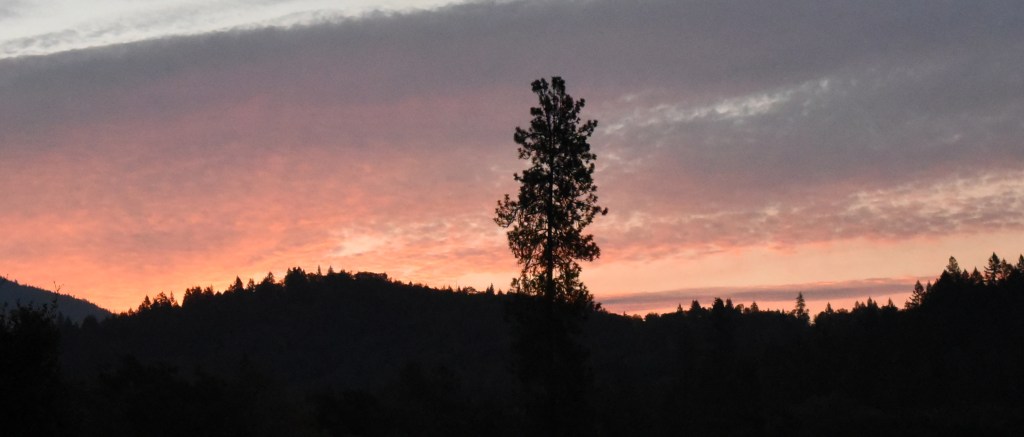
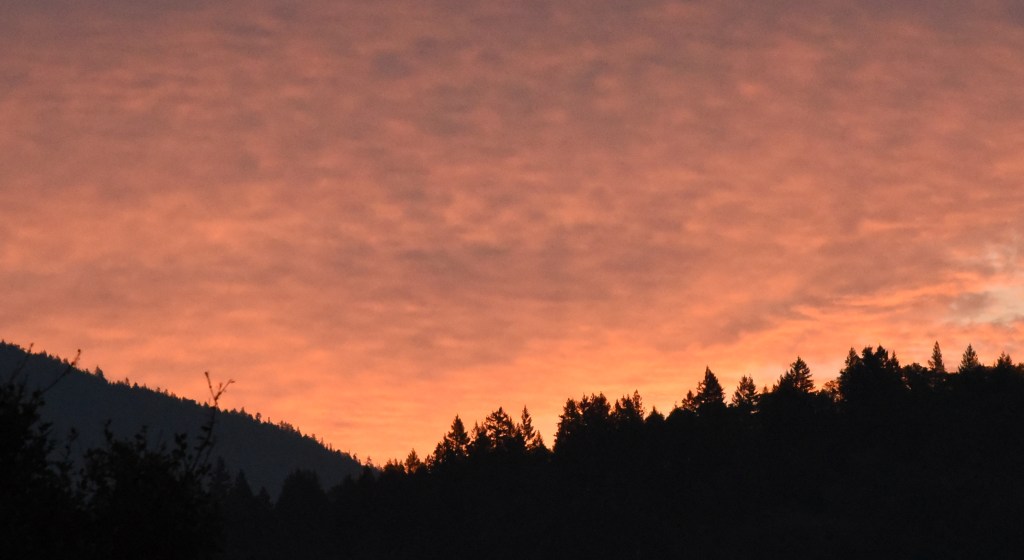
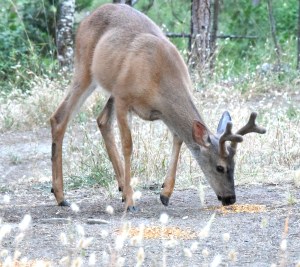
It is republished here with George Monbiot’s very kind permission. I have taken the liberty of including a few recent photographs of the wildlife that graces our acres here in Oregon.
ooOOoo
In Memoriam
As our wildlife and ecosystems collapse, remembering is a radical act.
By George Monbiot, published in the Guardian 29th June 2018
It felt as disorientating as forgetting my pin number. I stared at the caterpillar, unable to attach a name to it. I don’t think my mental powers are fading: I still possess an eerie capacity to recall facts and figures and memorise long screeds of text. This is a specific loss. As a child and young adult, I delighted in being able to identify almost any wild plant or animal. And now it has gone. This ability has shrivelled from disuse: I can no longer identify them because I can no longer find them.
Perhaps this forgetfulness is protective. I have been averting my eyes. Because I cannot bear to see what we have done to nature, I no longer see nature itself. Otherwise, the speed of loss would be unendurable. The collapse can be witnessed from one year to the next. The swift decline of the swift (down 25% in five years) is marked by the loss of the wild screams that, until very recently, filled the skies above my house. My ambition to see the seabird colonies of the Shetlands and St Kilda has been replaced by the intention never to visit those islands during the breeding season: I could not bear to see the empty cliffs, whose populations have crashed by some 90% this century.
I have lived long enough to witness the vanishing of wild mammals, butterflies, mayflies, songbirds and fish that I once feared my grandchildren would experience: it has all happened faster than even the pessimists predicted. Walking in the countryside or snorkelling in the sea is now as painful to me as an art lover would find her visits to a gallery, if on every occasion another Old Master had been cut from its frame.
The cause of this acceleration is no mystery. The United Nations reports that our use of natural resources has tripled in 40 years. The great expansion of mining, logging, meat production and industrial fishing is cleansing the planet of its wild places and natural wonders. What economists proclaim as progress, ecologists recognise as ruin.
We have a fatal weakness: a failure to perceive incremental change. As natural systems shift from one state to another, we almost immediately forget what we have lost. I have to make a determined effort to remember what I saw in my youth. Could it really be true that every patch of nettles, at this time of year, was reamed with caterpillar holes? That flycatchers were so common I scarcely gave them a second glance? That the rivers, around the autumn equinox, were almost black with eels?
Others seem oblivious. When I have criticised current practice, farmers have sent me images of verdant monocultures of perennial rye grass, with the message “look at this and try telling me we don’t look after nature”. It’s green, but it’s about as ecologically rich as an airport runway. One of my readers, Michael Groves, records the shift he has seen in the field beside his house, where the grass, that used to be cut for hay, is now cut for silage. Watching the cutters being driven at great speed across the field, he realised that any remaining wildlife would be shredded. Soon afterwards, he saw a roe deer standing in the mown grass. She stayed throughout the day and the following night. When he went to investigate, he found her fawn, its legs amputated. “I felt sickened, angry and powerless … how long had it taken to die?”. That “grass-fed meat” the magazines and restaurants fetishise? This is the reality.
When our memories are wiped as clean as the land, we fail to demand its restoration. Our forgetting is a gift to industrial lobby groups and the governments that serve them. Over the past few months, I have been told repeatedly that the environment secretary, Michael Gove, gets it. I have said so myself: he genuinely seems to understand what the problems are and what needs to be done. Unfortunately, he doesn’t do it.
He cannot be blamed for all of the fiascos to which he has put his name. The 25-year plan for nature was, it seems, gutted by the Prime Minister’s office. The environmental watchdog he proposed was defanged by the Treasury (it has subsequently been lent some dentures by Parliament). Other failures are all his own work. In response to lobbying from sheep farmers, he has allowed ravens, a highly intelligent and long-lived species just beginning to recover from centuries of persecution, to be killed once more. There are 24 million sheep in this country and 7400 pairs of ravens. Why must all other species give way to the white plague?
Responding to complaints that most of our national parks are wildlife deserts, Gove set up a commission to review them. But governments choose their conclusions in advance, through the appointments they make. A more dismal, backward-looking and uninspiring panel would be hard to find: not one of its members, as far as I can tell, has expressed a desire for significant change in our national parks, and most of them, if their past statements are anything to go by, are determined to keep them in their sheepwrecked and grouse-trashed state.
Now the lobbyists demand a New Zealand settlement for farming after Brexit: deregulated, upscaled, hostile to both wildlife and the human eye. If they get their way, no landscape, however treasured, will be safe from broiler sheds and mega-dairy units, no river protected from run-off and pollution, no songbird saved from local extinction. The merger between Bayer and Monsanto brings together the manufacturer of the world’s most lethal pesticides with the manufacturer of the world’s most lethal herbicides. Already the concentrated power of these behemoths is a hazard to democracy; together they threaten both political and ecological disaster. Labour’s environment team have scarcely a word to say about any of it. Similarly, the big conservation groups, as usual, have gone missing in inaction.
We forget even our own histories. We fail to recall, for example, that the Dower report, published in 1945, envisaged wilder national parks than we now possess, and that the conservation white paper the government issued in 1947 called for the kind of large-scale protection that is considered edgy and innovative today. Remembering is a radical act.
That caterpillar, by the way, was a six spot burnet: the larva of a stunning iridescent black and pink moth that once populated my neighbourhood and my mind. I will not allow myself to forget again: I will work to recover the knowledge I have lost. For I now see that without the power of memory, we cannot hope to defend the world we love.
Last Friday I published a post under the title of On Veganism. Earlier that same day I opened up an email promoting the latest essay from George Monbiot. It had been published in The Guardian newspaper two days previously.
I am delighted to republish it here with George Monbiot’s kind permission.
ooOOoo
Butchery of the Planet
Defending the living world and its people requires a shift from meat to a plant-based diet
By George Monbiot, published in the Guardian 8th June 2018
Whether human beings survive this century and the next, whether other lifeforms can live alongside us: above all this depends on the way we eat. We can cut our consumption of everything else close to zero and still drive living systems to collapse, unless we change our diets.
All the evidence now points in one direction: the crucial shift is from an animal to a plant-based diet. A paper published last week in Science reveals that while some kinds of meat and dairy production are more damaging than others, all are more harmful to the living world than growing plant protein. It shows that animal farming takes up 83% of the world’s agricultural land, but delivers only 18% of our calories. A plant-based diet cuts the use of land by 76% and halves the greenhouse gases and other pollution caused by food production.
Part of the reason is the extreme inefficiency of feeding livestock on grain: most of its nutritional value is lost in conversion from plant protein to animal protein. This reinforces my contention that if you want to eat less soya, you should eat soya: most of the world’s production of this crop, and the accompanying destruction of forest, savannah and marshland, is driven by the wasteful practice of feeding animals on food that humans can eat.
More damaging still is free range meat: the environmental impacts of converting grass into flesh, the paper remarks, “are immense under any production method practiced today”. This is because so much land is required to produce every grass-fed steak or lamb chop. Though roughly twice as much land is used for grazing worldwide than for crop production, it provides just 1.2% of the protein we eat. While much of this pastureland cannot be used to grow crops, it can be used for rewilding: allowing the many rich ecosystems destroyed by livestock farming to recover, absorbing carbon from the atmosphere, protecting watersheds and halting the sixth great extinction in its tracks. The land that should be devoted to the preservation of human life and the rest of the living world is used instead to produce a tiny amount of meat.
Whenever I raise the crucial issue of yield per hectare, I receive a barrage of vituperation and abuse. But I’m not having a go at farmers, just pointing out that the figures don’t add up. We can neither feed the world’s growing population nor protect its living systems through animal farming. Meat and dairy are an extravagance we can no longer afford.
There is no way out of this. Those who claim that “regenerative” or “holistic” ranching mimics nature deceive themselves. It relies on fencing, while in nature wild herbivores roam freely, often across vast distances. It excludes or eradicates predators, crucial to the healthy functioning of all living systems. It tends to eliminate tree seedlings, ensuring that the complex mosaics of woody vegetation found in many natural systems – essential to support a wide range of wildlife – are absent.
The animal industry demands ever greater assaults on the living world. Witness the badger slaughter in the UK, now spreading across the country in response to the misguided requests of dairy farmers. People ask how I would justify the return of wolves, knowing that they will kill some sheep. I ask how they justify the eradication of wolves and a vast range of other wildlife to make way for sheep. The most important environmental action we can take is to reduce the amount of land used by farming.
Unless you can cook well – and many people have neither the skills nor the space – a plant-based diet can be either boring or expensive. We need better and cheaper vegan ready meals and quick and easy meat substitutes. The big shift will come with the mass production of cultured meat. There are three main objections. The first is that the idea of artificial meat is disgusting. If you feel this way, I invite you to look at how your sausages, burgers and chicken nuggets are currently raised, slaughtered and processed. Having worked on an intensive pig farm, I’m more aware than most of what disgusting looks like.
The second objection is that cultured meat undermines local food production. Perhaps those who make this claim are unaware of where animal feed comes from. Passing Argentinian soya through a nearby pig before it reaches you does not make it any more local than turning it directly into food for humans. The third objection has greater merit: cultured meat lends itself to corporate concentration. Again, the animal feed industry (and, increasingly, livestock production) has been captured by giant conglomerates. But we should fight to ensure that cultured meat does not go the same way: in this sector as in all others, we need strong anti-trust laws.
This could also be a chance to break our complete dependence on artificial nitrogen. Traditionally, animal and plant farming were integrated through the use of manure. Losses from this system led to a gradual decline in soil fertility. The development of industrial fertilisers saved us from starvation, but at a high environmental cost. Today, the link between livestock and crops has mostly been broken: crops are grown with industrial chemicals while animal slurry stacks up, unused, in stinking lagoons, wipes out rivers and creates dead zones at sea. When it is applied to the land, it threatens to accelerate antibiotic resistance.
In switching to a plant-based diet, we could make use of a neat synergy. Most protein crops – peas and beans – capture nitrogen from the air, fertilising themselves and raising nitrate levels in the soil that subsequent crops, such as cereals and oilseeds, can use. While the transition to plant protein is unlikely to eliminate the global system’s need for artificial fertiliser, the pioneering work of vegan organic growers, using only plant-based composts and importing as little fertility as possible from elsewhere, should be supported by research, that governments have so far conspicuously failed to fund.
Understandably, the livestock industry will resist all this, using the bucolic images and pastoral fantasies that have beguiled us for so long. But they can’t force us to eat meat. The shift is ours to make. It becomes easier every year.
Thus, along with the argument presented last Friday that a vegan diet is critically important for one’s health and long-term fitness, Mr. Monbiot presents another argument: “Whether human beings survive this century and the next, whether other lifeforms can live alongside us: above all this depends on the way we eat.“
Already there are some places in the USA that are experiencing some pretty hot days. For instance, at the time of me writing this introduction, around 2pm last Friday, the temperature in Phoenix, Arizona is 97 deg F. (36 deg C.) That’s perfectly hot enough for us humans even before we think of dogs. Especially dogs that have thicker coats.
Over to Wendy!
ooOOoo
Regulating the Body Temperature of Your Thick-Haired Dog during the Summer.
by Wendy Lipscomb, May 9th, 2018
Summer brings in many outdoor activities such as hiking, swimming, running and going for a picnic or maybe going out just for a walk. There is nothing wrong with taking your dog out with you if you know how to regulate your pet’s body temperature.
Humans regulate their body temperature by sweating but animals do not have this property. Dogs do sweat very slightly from their nose and paws but that cannot help them regulate their body temperature. Dogs regulate their body temperature by panting; when a dog breathes through his mouth the saliva evaporates cooling down the blood in the veins. Put another way, the air that a dog breathes passes through its nasal passage before reaching its lungs. The air is cooled when it is passed through that nasal passage.
Therefore, it becomes even harder for dogs to regulate their body temperature when the sun is shining down, and also when the humidity in the air increases. This builds up a pressure on the dog’s lungs and heart as he breathes in and out more frequently to regulate his body temperature.
But you can take some measures to help your pet to regulate his body temperature during summer outdoors.
No doubt about it that dogs are super active animals and love to go outdoors. But while taking them out in those summer months it is easy to forget that the paws of our dogs are very sensitive and they can be burned by walking on the pavement and roads in the daytime. So, invest in good protective booties or apply paw wax to protect your dog’s paws.
In addition, your dog can also get sunburned by excessive exposure to the sun. Therefore, either limit the exposure of sun for your four footers or visit your vet clinic so that they can recommend a good sunscreen for your dog.
Another thing that you can consider while going out in the summer is that if you are traveling in a car and stop for rest never ever leave your furry companion in a locked or closed car. Because in summer your car becomes extremely hot by trapping the heat inside. If you leave your pet inside a hot car it can suffocate within minutes. Yes, within minutes!
Always carry a bottle of water to keep your dog hydrated. Create breeze for your dog to make the hot temperature tolerable for them. The breeze helps in cooling sweat and will make your dog feel relaxed. For this purpose buy a shop fan that is portable; a good option to create a breeze to keep yourself and your dog cool.
The above-mentioned tips are general tips that you must keep in your mind to implement in the summer. However, thick-haired dogs require a little more attention to maintain their safe body temperature.
People have the misconception that a dog with thick hair will suffer more during summer but let me tell you that thick-haired dogs are good at regulating their body temperatures. The fur of thick-coated dogs helps them to stay warm in winter and in summer their fur works as insulators and protects their skin from direct exposure to the sun. Bathing For Thick-Haired Dog:
Well, fleas and ticks are around all of the year. Fleas can survive outside for long periods of time, particularly in a warm and sticky climate. As mentioned previously, summer bring in more heat, humidity and more outdoor time. Thus, it is the peak time for your thick-haired dog to catch fleas or ticks. Therefore, bathing your dog regularly is as important as anything else because it will not only help your dog to regulate his body temperature but bathing will also help you and your puppy be rid of these tiny crawlies as flea bites can cause redness, irritation, allergy and even illness such as Lyme diseases. It is recommended to use a good quality flea shampoo to get rid of fleas. Always examine the ingredients of the shampoo to avoid buying one with harsh chemicals because it may cause a reaction to your dog’s skin. You should not Shave Your Dog in summer:
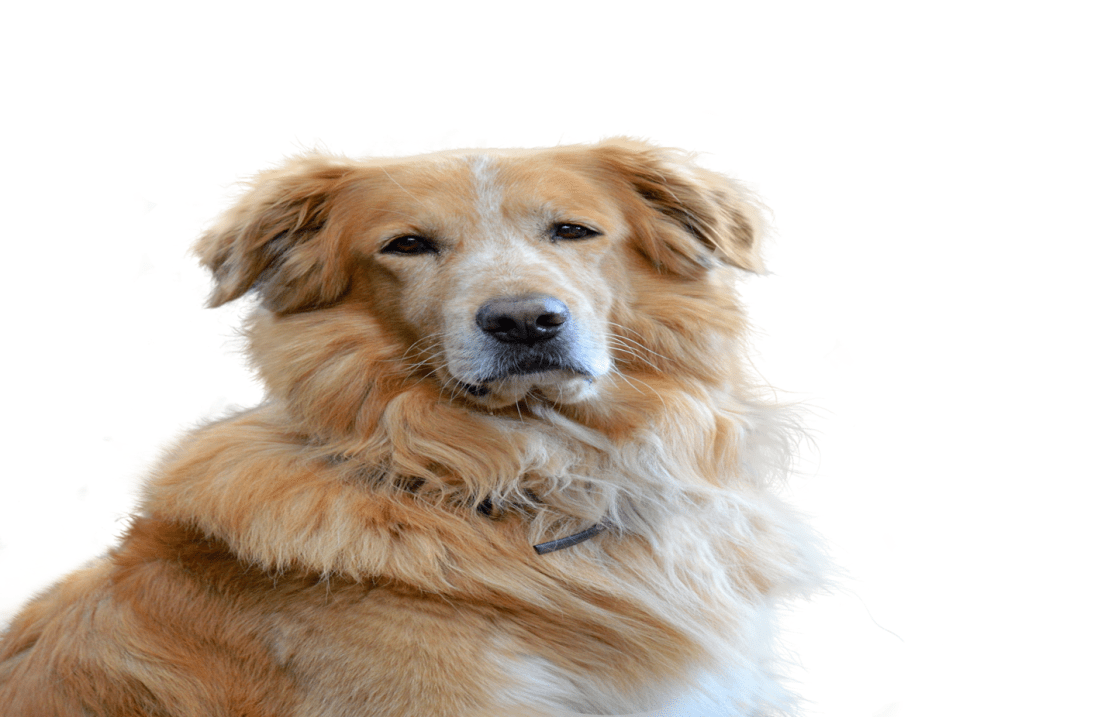
People ask me if I am going to shave my thick-haired dog in the summer? The answer to this question is “No”. Thick-haired dogs have two layers of hairs. The long-guard hairs protect the dogs in the winter from snow and the inner layer helps them to stay warm in those same winters. However, these dogs shed their undercoat in the summer and they are left with only long-guard hairs that insulate dogs from heat and protects them from sunburn.
Shaving your double-coated dog is not a good idea because shaving changes the texture of the coat. Your dog sheds off his inner coat in the summer. If you shave his coat his hair will soon start growing back and you will see that the soft and fluffy inner coat will grow first and later on the guard-hairs will combine with them. In addition to this, the texture of the new coat will be sticky and your dog will bring in whatever he passes through and that sticks to his new coat.
Moreover, the combination of the new growing inner and outer coat will also make your dog feel hotter on summer days. Brush Your Dog Frequently:
Instead of shaving your dog’s coat, try to brush it every alternate day. Brushing your dog’s coat with a fine-toothed comb will untangle the hairs and it will also help in removing the winter undercoat of your thick-haired four-footer. This will increase air circulation and will make your dog feel cool and comfortable.
ooOOoo
I asked Wendy for a little about herself. This is what she sent in:
Wendy is a self-employed beauty therapist, mother of two; life-long pet parent and lover of dogs who somehow manages to squeeze in the time to satisfy another of her loves – writing. Wendy is the founder, main contributor to and editor of TotallyGoldens.com
So no other way than to close this post with the message: Stay Cool Peeps!
(Brandy! Take Note!)
Jean and Brandy at a local yard sale back in June 2016.






 [Ed: Text taken from a chart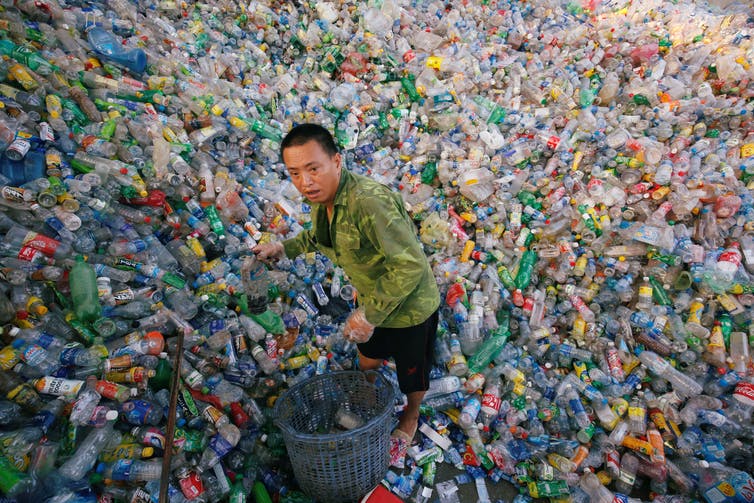

 see what we have done to nature, I no longer see nature itself. Otherwise, the speed of loss would be unendurable. The collapse can be witnessed from one year to the next. The swift decline of the swift (
 I have lived long enough to witness the vanishing of
  my readers, Michael Groves, records the shift he has seen in the field beside his house, where the grass, that used to be cut for hay, is now cut for silage. Watching the cutters being driven at great speed across the field, he realised that any remaining wildlife would be shredded. Soon afterwards, he saw a roe deer standing in the mown grass. She stayed throughout the day and the following night. When he went to investigate, he found her fawn, its legs amputated. “I felt sickened, angry and powerless … how long had it taken to die?”. That “grass-fed meat” the magazines and restaurants fetishise? This is the reality.

 Learning from Dogs