I have known John Zande for quite a few years. It has been, what they call, a virtual relationship for we have never met in person. I do have John’s book The Superstitious Naked Ape and it is a first-rate read.
John recently sent me an email. It read:
Hi Paul — How are you both, and the clan? Weather station up and going? Still has not stopped raining here. The ground is beyond saturated, and many of our big old trees around here are just falling over, which is horrible. Just got sent this link (below), and G asked me to send it on to people I know. To celebrate Betty White’s work with animals (and her 100th birthday, which sadly she’ll not have) her sister (in Australia) just started a short Gofundme for G and me here in Brazil. She’s good like that, and at this time of year (heaps of dumped dogs and cats after Christmas) everything helps.
If one opens the link then one reads the following:
ooOOoo
On 17/01 Betty White would turn 100 years old. Most of her life she was an advocate for the health & welfare of animals. As a tribute to her legacy, there’s a global movement to send monies to all animal shelters (thanks to my amazing friend Heather C who brought that to my attention). My sister and her husband John live in Brazil and have been working tirelessly to take stray cats & dogs off the streets for over 15 years.
Their amazing work, as much as is rewarding & noble have absolutely no financial help from the local Government. Stray animals are definitely a public health issue and depend practically solely on the private initiative.
So I’m asking my friends here to donate (any amount will help) to my sister’s VISTA VERDE ANIMAL FUND. Every cent in this campaign will go towards helping fund rescuing stray cats & dogs in the city of Sao Jose dos Campos, Brazil – where my family lives – have them spayed/neutered, nurtured back to health with whatever operations/medicines/treatment they need, house them, and, with luck, get them adopted out into loving homes.
As Betty White herself summed it up best: “Take responsibility and breathe kindness.” Thank you in advance. YOUR CONTRIBUTION WILL MAKE A HUGE DIFFERENCE.
ooOOoo
To view the photographs and, more importantly, to Donate! go here
We have joined thousands of others in making a modest donation!
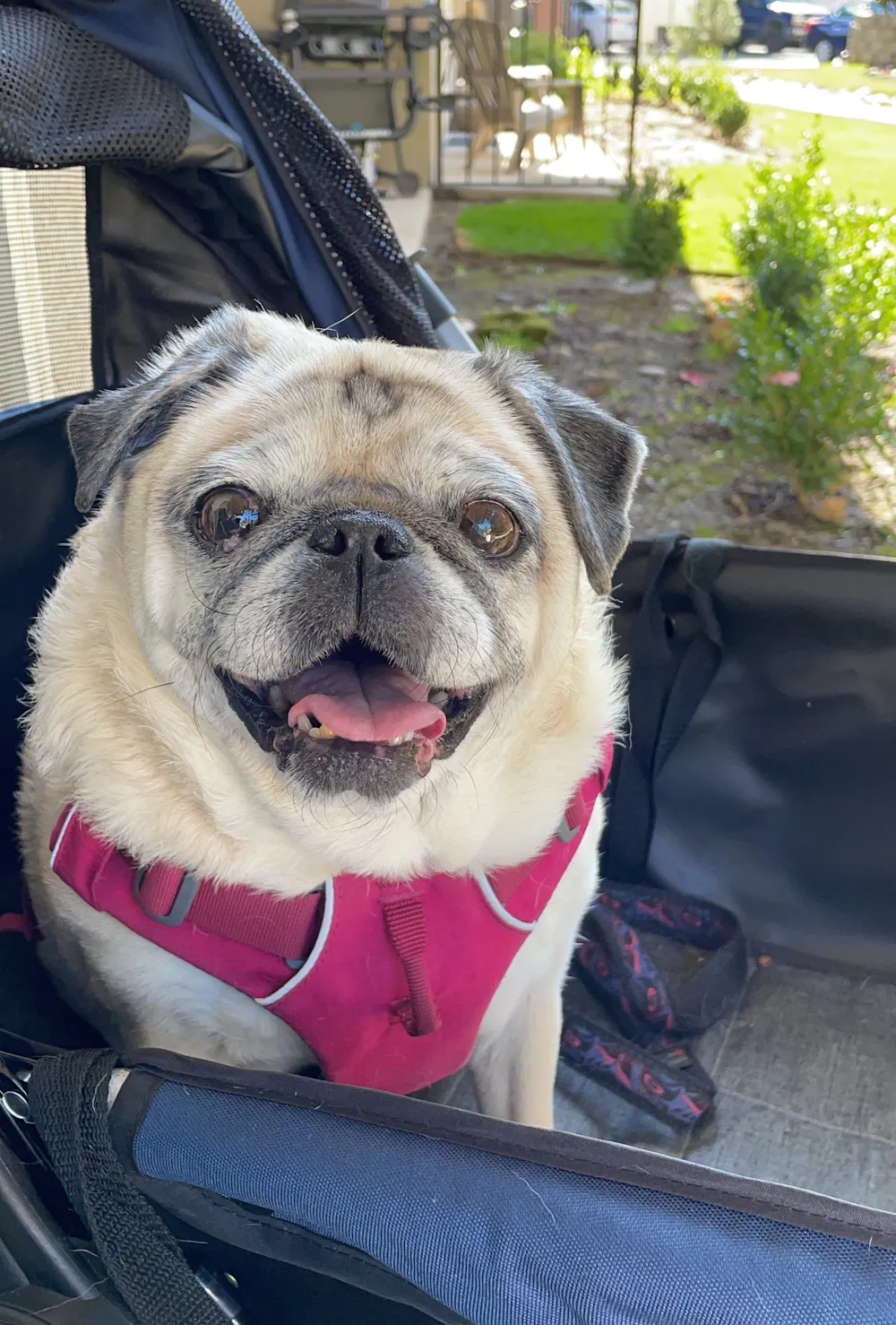
A pup out for a stroll, without paws touching the ground. Shelly Volsche, CC BY-ND
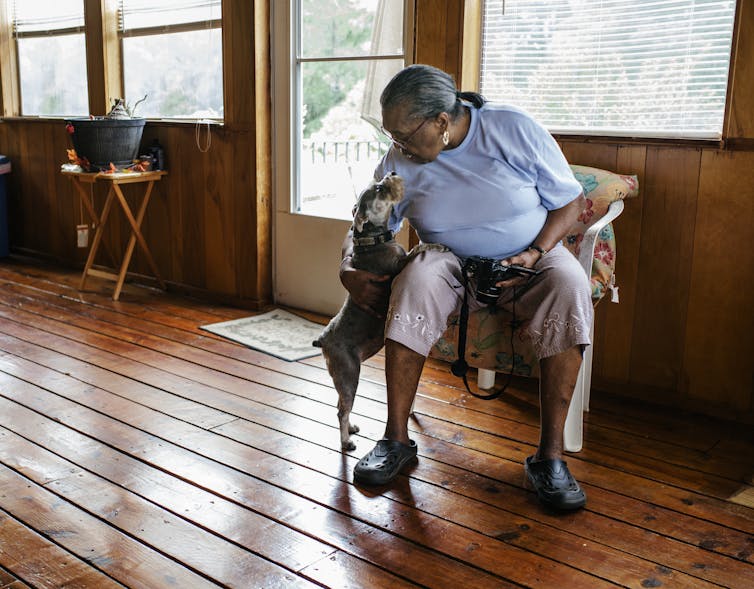
Have you noticed more cats riding in strollers lately? Or bumper stickers that read, “I love my granddogs”? You’re not imagining it. More people are investing serious time, money and attention in their pets.
It looks an awful lot like parenting, but of pets, not people.
Can this kind of caregiving toward animals really be considered parenting? Or is something else going on here?
I’m an anthropologist who studies human-animal interactions, a field known as anthrozoology. I want to better understand the behavior of pet parenting by people from the perspective of evolutionary science. After all, cultural norms and evolutionary biology both suggest people should focus on raising their own children, not animals of a completely different species.
More child-free people, more pet parents
The current moment is unique in human history. Many societies, including the U.S., are experiencing major changes in how people live, work and socialize. Fertility rates are low, and people have more flexibility in how they choose to live their lives. These factors can lead people to further their education and value defining oneself as an individual over family obligations. With basics taken care of, people can focus on higher order psychological needs like feelings of achievement and a sense of purpose.
The scene is set for people to actively choose to focus on pets instead of children.
In earlier research, I interviewed 28 self-identified child-free pet owners to better understand how they relate to their animals. These individuals pointedly shared that they had actively chosen cats and dogs instead of children. In many cases, their use of parent-child relational terms – calling themselves a pet’s “mom” for instance – was simply shorthand.
They emphasized fulfilling the species-specific needs of their dogs and cats. For example, they might fulfill the animal’s need to forage by feeding meals using a food puzzle, while most children are fed at the table. These pet owners acknowledged differences in the nutrition, socialization and learning needs of animals versus children. They were not unthinkingly replacing human children with “fur babies” by treating them like small, furry humans.
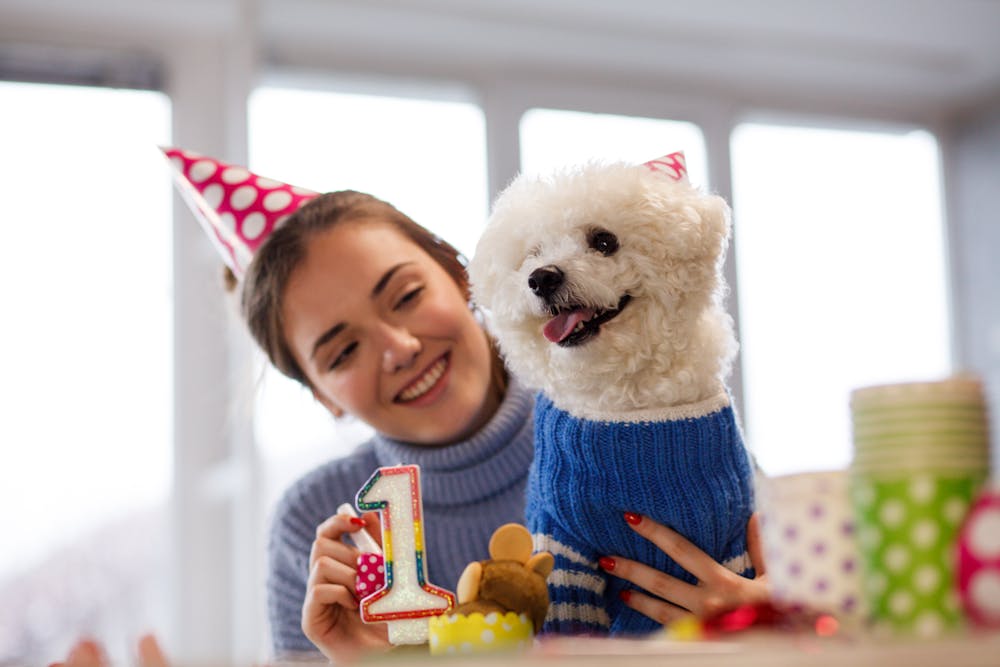
Pet parents might celebrate their dog’s big day – but with a doggy treat and not chocolate cake. fotostorm/E+ via Getty Images
Yet, these findings still do not answer this question: Are people who choose pets over children truly parenting their pets? To answer, I turned to the evolution of parenting and caregiving.
Evolutionary anthropologist Sarah Hardy wrote in 2009 that humans are cooperative breeders. This means it is literally in our DNA and our ancestral history to help care for offspring who are not our own. Anthropologists and biologists call this trait alloparenting. It is an evolutionary adaptation that helped human beings who cooperatively raised children survive. For early humans, this ancient environment was likely made up of small, foraging societies in which some people exchanged child care for food and other resources.
I propose that it is this evolutionary history that explains pet parenting. If people evolved to alloparent, and our environment is now making caring for children more difficult or less appealing to some, it makes sense for people to alloparent other species entering their homes. Alloparenting companion animals can offer a way to fulfill the evolved need to nurture while reducing the investment of time, money and emotional energy compared to raising children.
To further understand this phenomenon of child-free adults parenting pets, I launched an online survey via social media, seeking responses from U.S.-based dog and cat owners over the age of 18. The survey included questions about attachment and caregiving behaviors using the Lexington Attachment to Pets Scale. It also asked a series of questions I developed to probe specific human caretaking behaviors oriented toward pets – things like feeding, bathing and training – as well as how much autonomy companion animals had in the home.
The final sample of 917 respondents included 620 parents, 254 nonparents and 43 people who were undecided or did not answer. Most of the respondents were also married or in a domestic partnership for over one year (57%), between the ages of 25 and 60 (72%) and had at least a bachelor’s degree (77%). They were also mostly women (85%) and heterosexual (85%), a common situation in human-animal interactions research.
Both parents and nonparents reported high amounts of training and play with their pets. This finding makes sense given that all pet owners need to help their dogs and cats learn how to navigate a human world. Survey respondents reported socializing, training and enrichment, including play, for their animals.
Nonparents were more likely to be the one providing general care for the animal. This finding also makes sense since parents often adopt or purchase companion animals as a way to help their children learn responsibility and to care for others. Child-free animal owners invest time, money and emotional energy directly in their pets.
Nonparents reported higher rates of general attachment to their animals. They more frequently viewed their pets as individuals. Nonparents were also more likely to use family terms such as “parent,” “child,” “kids” and “guardians” when referring to their relationships with their pet.
It is this difference, combined with the evidence from my earlier research that these individuals address the species-specific needs of the dogs and cats in their care, that suggests pet parenting is, truly, parenting pets. Though the details may look quite different – attending training classes instead of school functions, or providing smell walks for dogs instead of coloring books for children – both practices fulfill the same evolved function. Whether child or pet, people are meeting the same evolved need to care for, teach and love a sentient other.
My colleagues and I continue to collect data from all over the world about how people live with animals. For now, this study provides evidence that, perhaps rather than being evolved to parent, humans are evolved to nurture. And as a result, who and when we parent is much more flexible than you might initially believe.
Shelly does a fabulous job of looking more closely at the science and it is a science that has a very wide appeal. For in the UK, according to the RSPCA, “In the UK, it’s estimated that 12 million (44 percent of) households have pets with around 51 million pets owned.“
Here in America The Washington Post reported that: “Google the U.S. pet population, and you’re quickly confronted with two oft-cited, and contradictory, sources. The American Pet Products Association (APPA) found that 68 percent of U.S. households owned some sort of pet in 2016 — “equal to the highest level ever reported,” it gushed in the executive summary. Among those pets were about 90 million dogs and 94 million cats, the group said.“
That is just two countries. The worldwide population of dogs and cats must be gigantic.
A Doberman pinscher shows off her caring attitude.
It strikes me dogs are loving animals. Certainly for the vast majority of animals that I write about and that we see in our daily lives. For example, on Thursday we had to take Cleo and Oliver for their annual check-ups at Lincoln Road Veterinary Clinic. They inevitably came into contact with a few other dogs and there was no friction whatsoever; just a lot of bum sniffing!
That is why I chose this article from The Dodo to share with you.
ooOOoo
Big Mama Dog Adopts Newborn Kitten And Carries Her Around In Her Mouth
“She’s just obsessed with this kitten” ❤️️
By Lily Feinn, Published on the 27th September, 2021
Three weeks ago, Brittany Callan wasn’t planning on adding more animals to her life. Then she heard meowing coming from the back of her aunt’s garage.
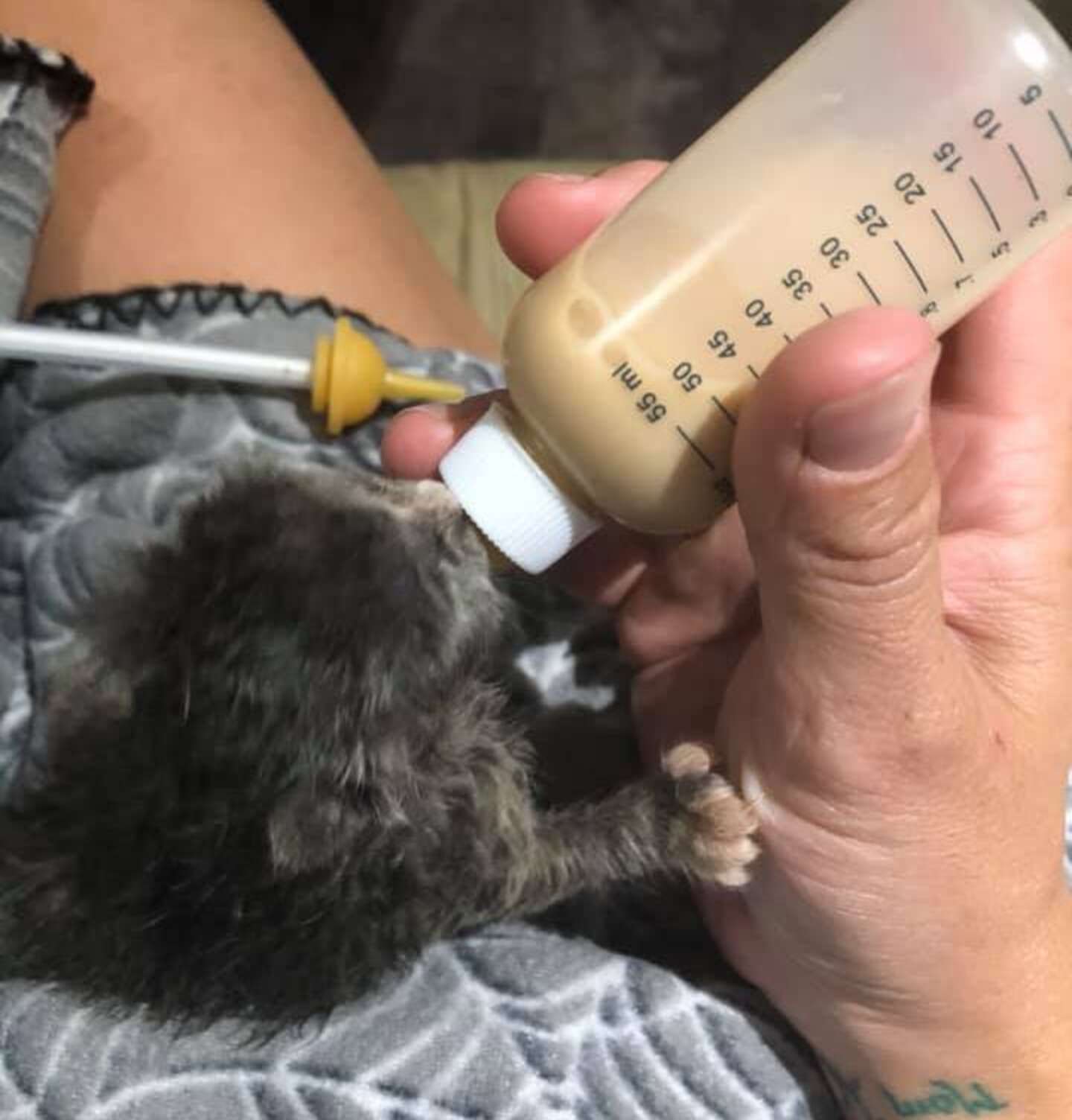
There, in the grass, was a newborn kitten. Callan placed the little animal on a soft blanket in the shade nearby, hoping the mom would return. But hours later, the kitten was still alone. She knew the little animal wouldn’t make it through the night, so she decided to take the little blind baby home.
BRITTANY CALLAN
Callan’s Doberman pinscher, Ruby, had just had puppies, and she hoped that the dog’s mothering instincts would kick in when she saw the helpless kitten.
“We’ve had baby bunnies and guinea pigs, and she just licks them like she’s their mom,” Callan told The Dodo. “She was carrying around the baby bunnies in her mouth and hiding them in the couch like they were hers — she even tried to nurse them when she was younger.”
BRITTANY CALLAN
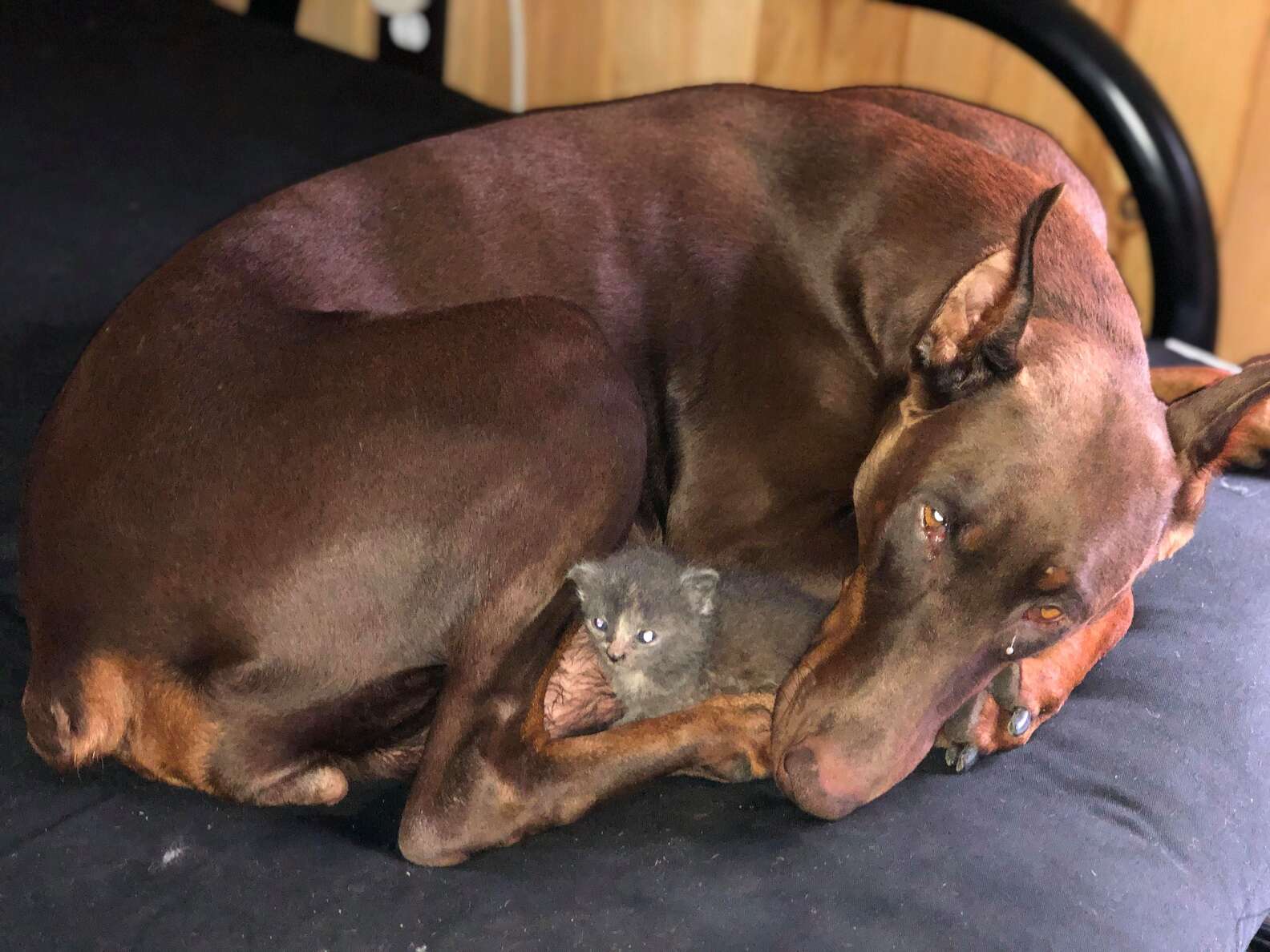
Ruby and the kitten couldn’t look more different, but none of that mattered when they met. Callan held the kitten out to her dog, and Ruby immediately accepted the new baby into her pack.
“She just started cleaning it and nudging it out of my hand,” Callan said. “Then I just opened up the kitten’s mouth and put it on Ruby’s smallest nipple, and it started eating right away. Ruby looked at it and laid her head down.”
BRITTANY CALLAN
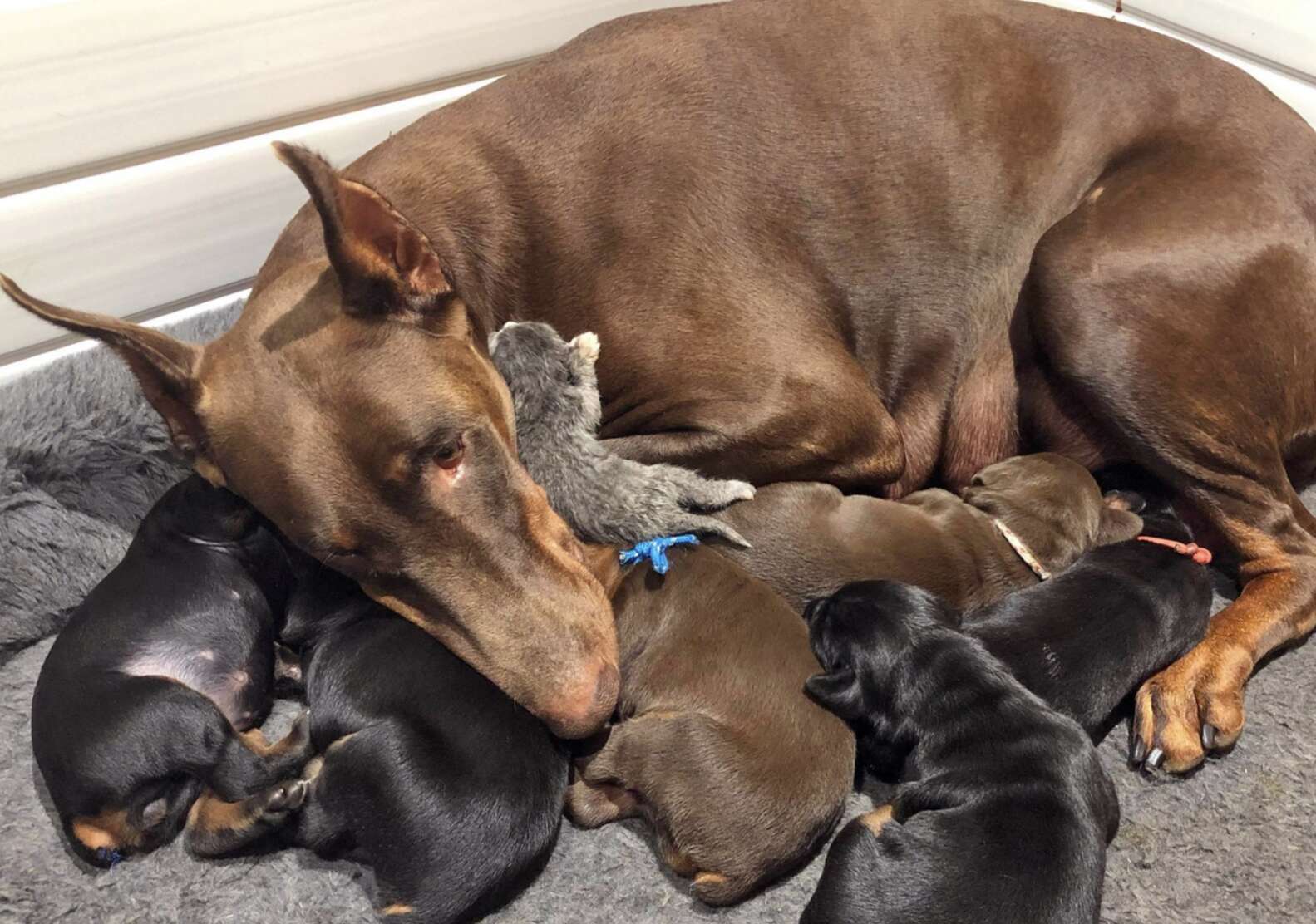
Rubys’ puppies were already three times her size, but that didn’t stop the kitten from crawling in to snuggle with her dog brothers and sisters.
And her new mom always makes sure the kitten is clean and safe. “She looks like the scruffiest kitten ever because she’s always wet from Ruby licking her or carrying her around in her mouth,” Callan said. “Her back end is either sopping wet or matted down from Ruby cleaning her so much.”
Ruby is now weaning her puppies, but refuses to be separated from her tiniest baby for more than a few minutes.
“She’s just obsessed with this kitten,” Callan said. “She doesn’t want to be outside — she’ll go to every door and whine and scratch until you let her in, and then she’ll just pick up the kitten and carry it around in her mouth.”
BRITTANY CALLAN
Under Ruby’s care, the little orphaned kitten is thriving, and when she’s old enough, she will travel to her forever home with Callan’s cousin.
But for now, the only mom the kitten needs is Ruby. It just goes to show when it comes to family, size doesn’t matter — it’s the love that counts.
ooOOoo
“it’s the love that counts.“
Lily Feinn has gone to the heart of Ruby’s care for this kitten: Love!
It is a great example to us humans as well. Nothing is ever gained from hate and war.
All dogs have a brilliant sense of smell. That comes from them having many times more scent receptors. As CareCredit write:
Dogs have a strong sense of smell Scientists guess the dog’s sense of smell is somewhere between 10,000 to 100,000 times more acute than ours. One of the reasons a dog has such better smelling ability than us is the number of scent receptors. For every scent receptor a human has, a dog has about 50.
So here is a story of a Husky using her sense of smell to good effect!
ooOOoo
Dog On Her Morning Walk Discovers A Cooler With Someone Inside
“Koda wouldn’t leave it. She was like, ‘There’s something in there. I want in there! Mom, look!’”
When a husky named Koda set out on her morning walk earlier this month, she had no idea she was about to save a life.
Around 5:45 a.m., Koda and her mom were walking on their regular route past the Fearless Kitty Rescue building. Koda usually stops to sniff around the area, but this time something was different.
“She made a beeline to our donation bench,” Teryn Jones, events and marketing coordinator at Fearless Kitty Rescue, told The Dodo. “On our donation bench was a cooler that was zipped up, no holes, and then wrapped up in a garbage bag. Koda wouldn’t leave it. She was like, ‘There’s something in there. I want in there! Mom, look!’”
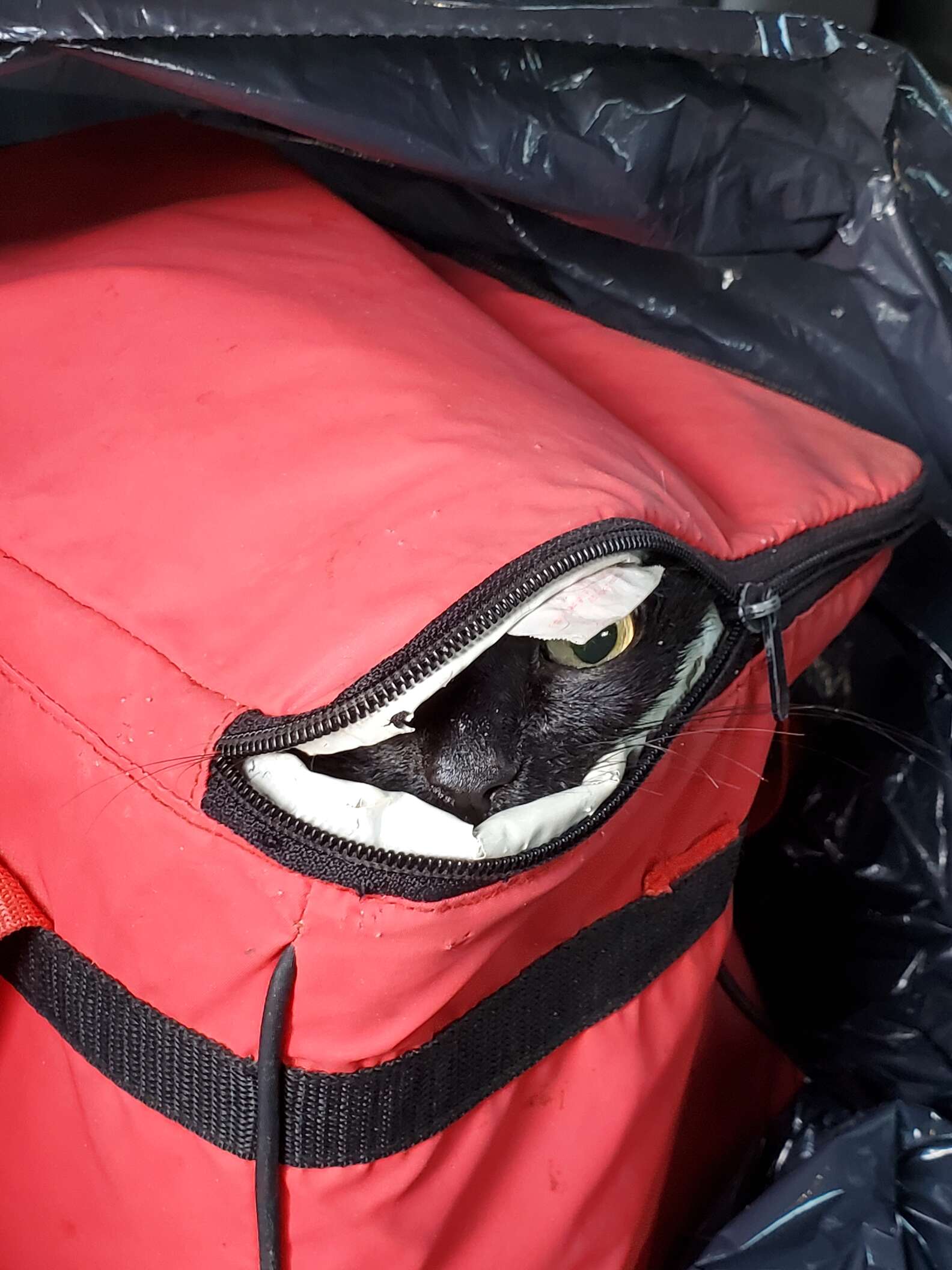
Koda’s mom was startled by her pup’s excited reaction and unzipped the cooler. A black cat popped her head out and began to gasp for air. Even though it was still early, it was already getting hot outside, and the cat seemed relieved to be free.
Koda’s mom contacted a volunteer at the rescue, who rushed over to welcome the cat inside and out of the sun.
“She was just shaken up and was kind of in freeze-mode,” Jones said. “And that’s how she’s been since.”
The little black cat, now known as Juliane, has been slowly acclimating to life at the rescue.
“She’s so sweet and very nervous and shy,” Jones said. “But she loves being pet — she purrs and rolls around on her belly. The resilience of her, in going through, what she went through is really amazing.”
“In the Danish culture, the name Juliane means ‘Fearless,’” Fearless Kitty Rescue wrote on Facebook. “And Fearless she is!”
But Juliane isn’t out of the woods just yet. A vet exam found a large mass on Juliane’s tail, which will require surgery. Once she’s healed and feeling better, Juliane will be ready to start her search for a loving forever home
“She’s very sweet and very clean — so she’s your ideal cat,” Jones said. “She sits and does her own thing, she doesn’t make a mess … She’s just very dainty.”
Thanks to Koda, Juliane has a second chance at a happy life — proving that guardian angels come in all shapes and sizes.
ooOOoo
I want to add another small remark that was on the website:
Humans are great inventors! Indeed, a better way to describe H. sapiens ever since we separated from the chimpanzees, some 5 or 6 million years ago, is to describe us as explorers both outwards and inwards constantly in search for new worlds and new insights into meaning.
Thus this naturally caught me eye as Doug Thron uses a modern device, a drone, to search for animals in distress, a very ancient behaviour!
ooOOoo
Drone Pilot Rescues Animals After Natural Disasters
Doug Thron goes to devastated areas to save pets and wildlife.
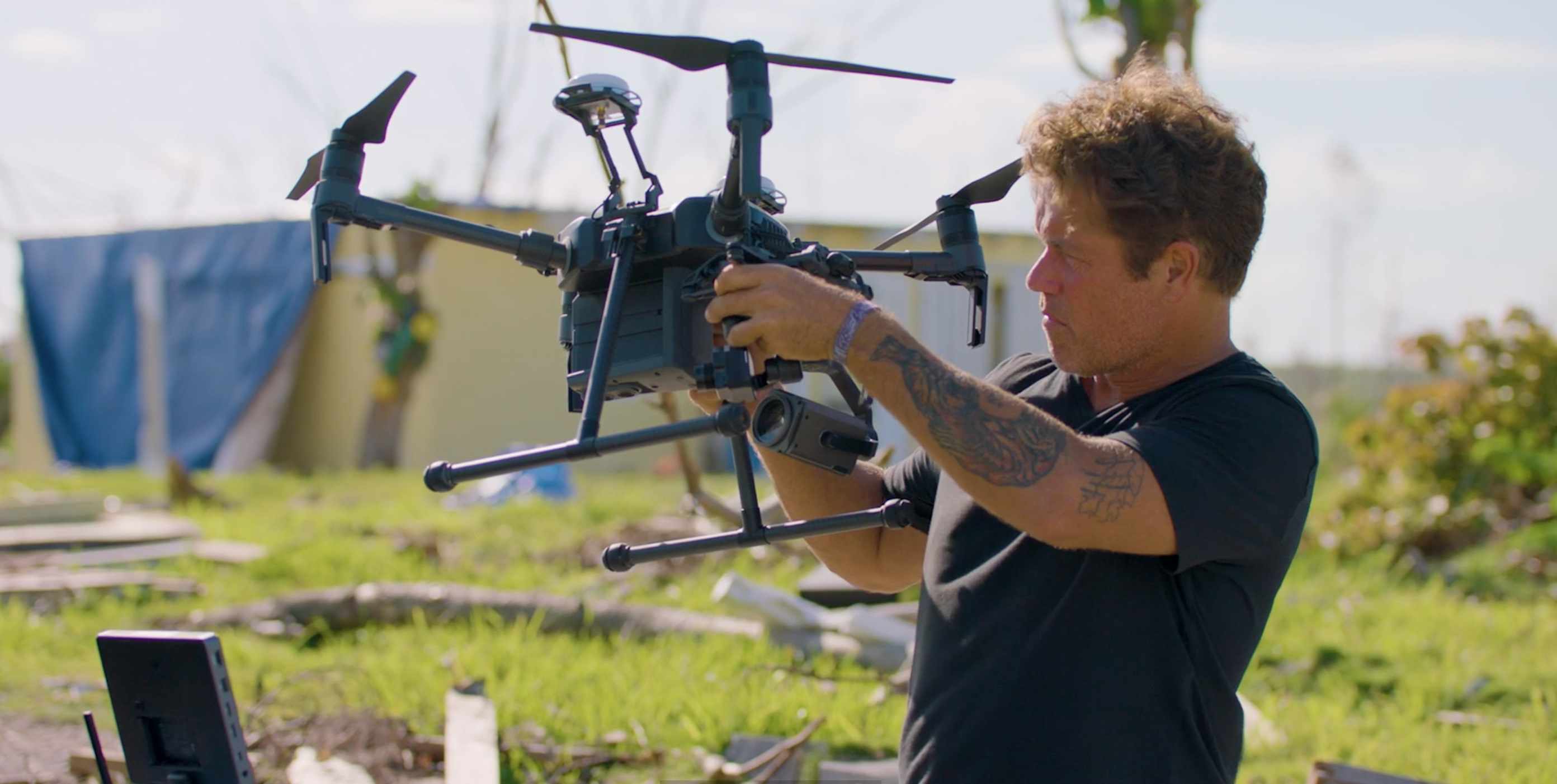
Doug Thron with Duke, a dog he rescued after California wildfires.”Doug to the Rescue”
For nearly three decades, seaplane and drone pilot Doug Thron has been a professional photographer and cinematographer, primarily for nature shows and magazines. A few years ago he was using his drone to film the devastation left behind after wildfires in California when he teamed up with rescuers to help find lost pets and reunite them with their owners.
A long-time animal lover and environmentalist, Thron realized he could combine those passions, using his aerial skills. He now travels wherever there is need, using his drone to help communities dealing with the destruction after natural disasters.
Thron is featured in a six-part documentary series “Doug to the Rescue”streaming on CuriosityStream beginning June 10.
He talked to Treehugger about his first animal rescues, his drones, and some of the challenges he’s faced.
Treehugger: Which came first: the animal rescue work or the drone?
Dough Thron: I was using drones for filming for TV shows, commercials, and real estate clients before doing the animal rescue work.
Were you involved in animal rescue and realized that your drone work could come in handy?
Definitely. I was doing animal rescue work after the wildfires in Paradise, California. I was working with an expert cat rescuer named Shannon Jay, and I saw him using an infrared scope at night to help find the cats. We talked about how incredible it would be to put one on a drone and when the opportunity came up about 10 months later in the Bahamas after the category 5 Hurricane Dorian, that’s what I did and it worked incredibly.
I had raised orphaned baby animals as a kid and worked with animals such as possums, raccoons, squirrels, beavers, and even mountain lions. I’ve been using drones since 2013 for cinematography, so I’ve used them for quite a while before I got involved in the actual rescuing of animals with drones.
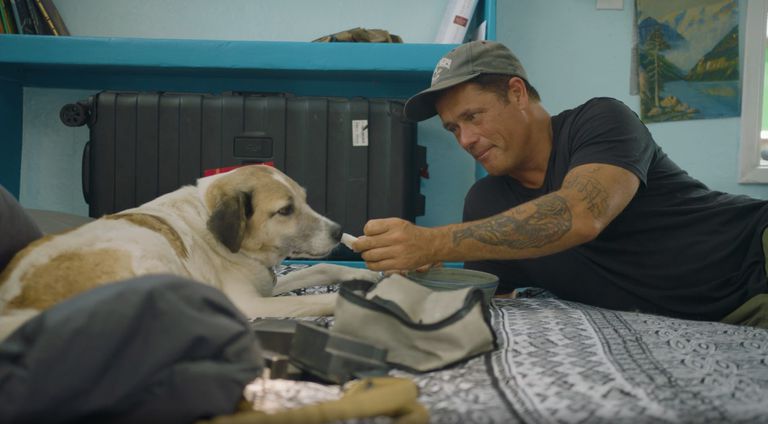
Duke in the Bahamas.Doug Thron / “Doug to the Rescue”
What was your first big rescue using a drone?
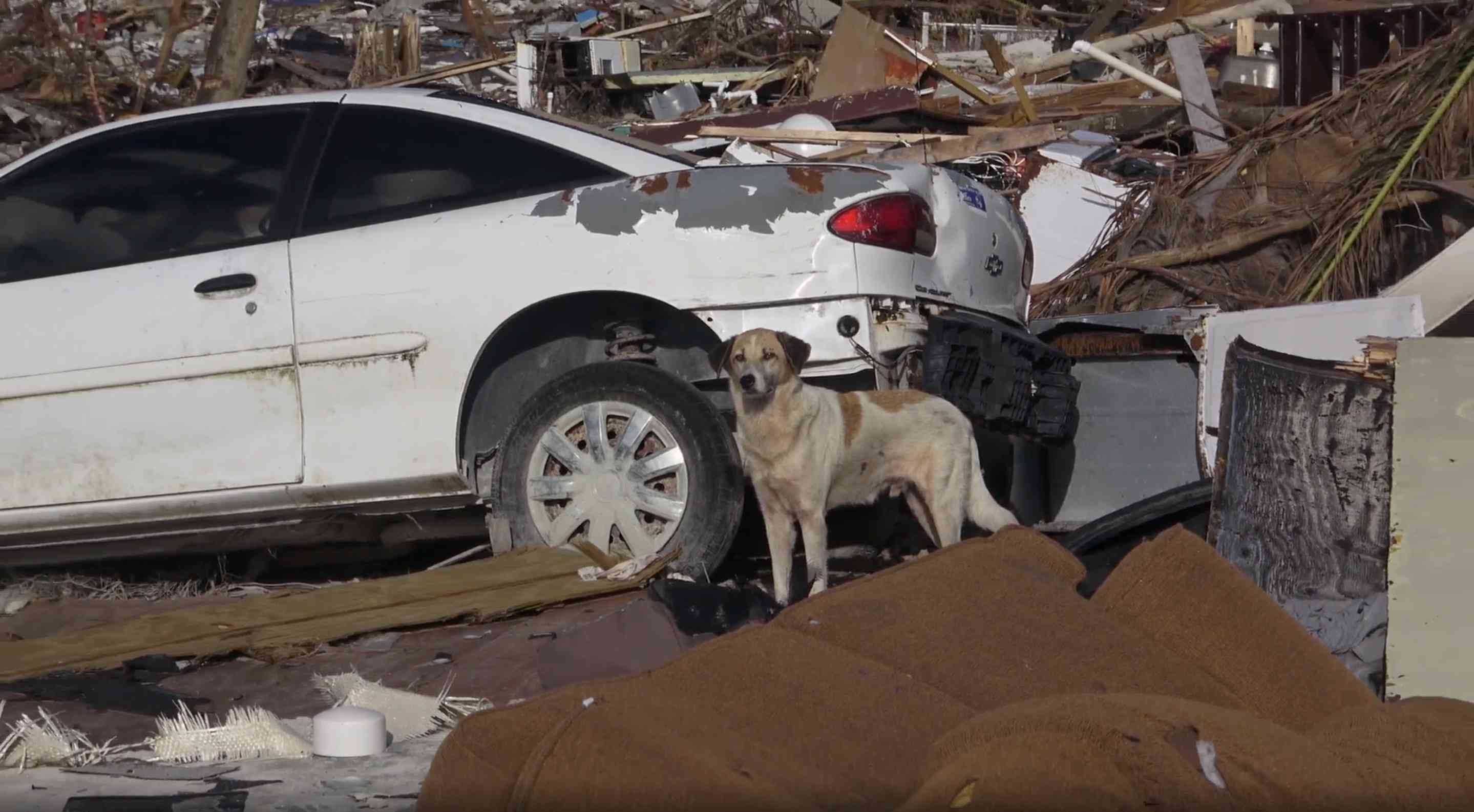
My first big rescue using a drone was in the Bahamas after Hurricane Dorian. I was there helping to deliver aid and film the destruction when I spotted a dog roaming around the mountains of debris. He obviously hadn’t had any water or much food for days. He was really apprehensive at first, but warmed up over the course of the day, as I just sat with him. Dog food and water helped! The next day, some animal rescuers came with me to get him. He’s such an incredible dog, and meant so much to me, so I adopted him and named him Duke after a sign I’d seen where I found him.
Where are some of the places you’ve gone to help stranded animals?
The Bahamas, Australia, Oregon, California, and Louisiana.
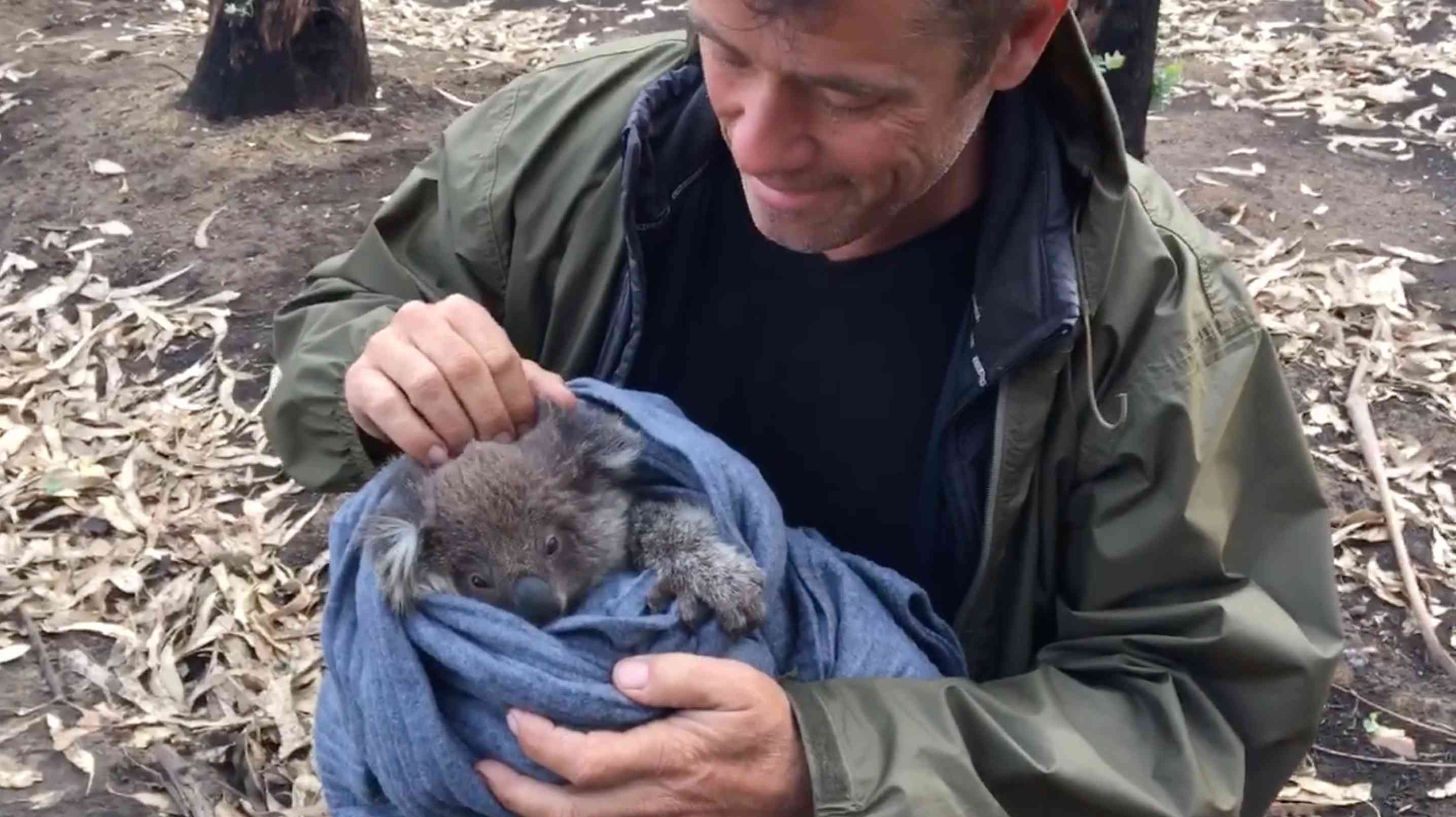
Thron with a rescued koala.”Doug to the Rescue”
What were some of the most challenging circumstances?
In Australia, it was challenging because the hurt koalas were deep in burnt out forests, often with a dense canopy. It was so hot out you had to fly strictly at night with spotlights and infrared and fly the drone pretty far and often drop it down through the trees to see the animals, which takes a lot of skill. Koalas are also very aggressive and strong, and not always thrilled when you go to grab them out of a tree to rescue them. On almost all these rescues, Australia and everywhere else, it’s countless long hours of work—generally about 20 hours a day—which can certainly wear you down day after day.
What is it like when you spot an animal in an area of devastation where there is no other sign of life?
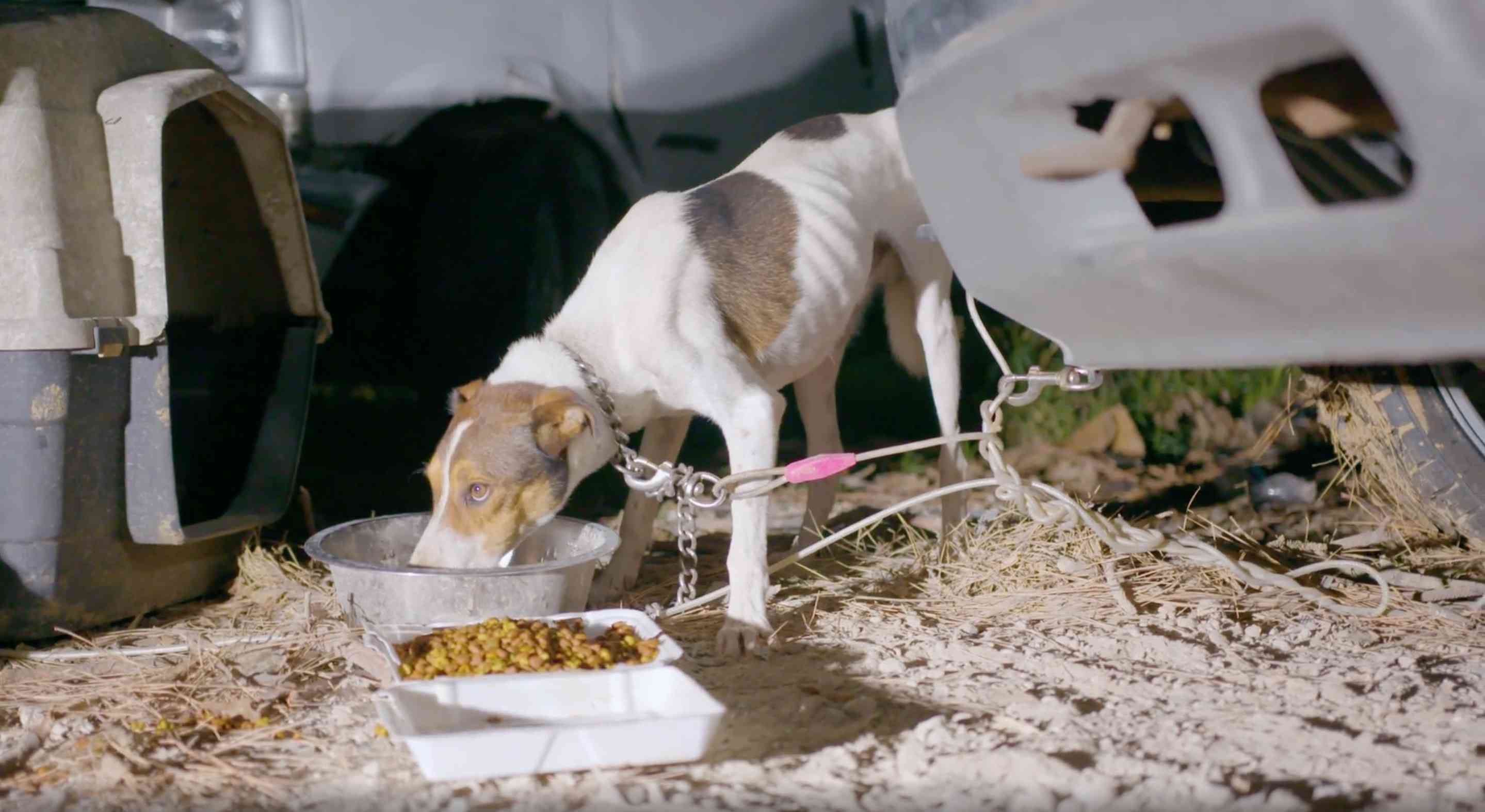
It’s great to be able to rescue these animals so much more efficiently and faster and, in many cases, find animals that never would have been found. It’s different everywhere I go—finding animals when there aren’t any others alive nearby is always really hard. But in places like Louisiana, where I was searching in so many neighborhoods, it gives you a feeling of hope when you find a cat or dog, knowing it was someone’s pet.
In other places, like Australia, I’d be covering dozens of miles a night, sometimes and only finding an occasional animal. It’s really sad because you realize how many thousands of animals didn’t make it. It’s also really hard to see how fires and other natural disasters as a result of climate change are taking out the last patches of unentered habitat and endangered animals.
A dog rescued in Louisiana.”Doug to the Rescue”
How heart-wrenching can it be?
It can be really heart-wrenching to find animals that are severely wounded, but it’s wonderful to be able to save them.
How euphoric is it when you make a great save?
It’s awesome to be able to save people’s cats and dogs because frequently, that might be the only thing they have left after a fire or hurricane. Obviously, for the animal’s sake, it’s so incredible because without the infrared drone, in many cases, the animal would have never been found and would have died, sometimes a slow and painful death.
Thron with his drone.”Doug to the Rescue”
What is your drone like?
The Matrice 210 V2 are the drones I use with an infrared camera, spotlight, and 180x zoom lens. The combination of using those three attachments for animal rescue has never been done before.
How much time do you spend doing animal rescue work? What else do you do?
The rescue work is pretty continuous for 9 to 10 months during the fire and hurricane seasons. After that, there are occasional lost pets to be found.
What else do you want to accomplish?
I hope to make using infrared drones for animal rescue as popular as helicopters are for rescuing people after a natural disaster. So many more animals can be saved when you can find them so much faster and find ones that never would have been found on foot because there is just too much area to cover.
ooOOoo
This account makes me want to choke up. Doug is clearly used to being a professional photographer and, also, works with others in the field of animal rescue. But this story is about Doug and he is engaged with animal rescue with his heart as well as his head!
Doug has been reported widely I am delighted to say and there’s a YouTube video that you can watch.
A report from BBC Future suggests there is a hidden reason
With six dogs feeding them is quite an exercise. I don’t really take much notice of what Jeannie does although I do know that we feed them kibbles, canned food and Jean cooks up beef for the dogs as well.
Recently BBC Future had a report saying that there is a hidden reason that processed foods are addictive. I am going to share that article with you.
ooOOoo
The hidden reason processed pet foods are so addictive
From potently smelly additives to offal concentrates, pet food companies turn to some surprising ingredients in the quest to make kibble delicious.
The cue might be a hand in a pocket, the opening of a cupboard door, or even a word said carelessly aloud – “dinner”. Before you know it, you’re tripping over a pet excitedly awaiting a portion of… dull-brown dried pellets. What’s in these mysterious morsels, that makes them as delectable as roasted chicken, wild salmon, or bundles of fresh herbs?
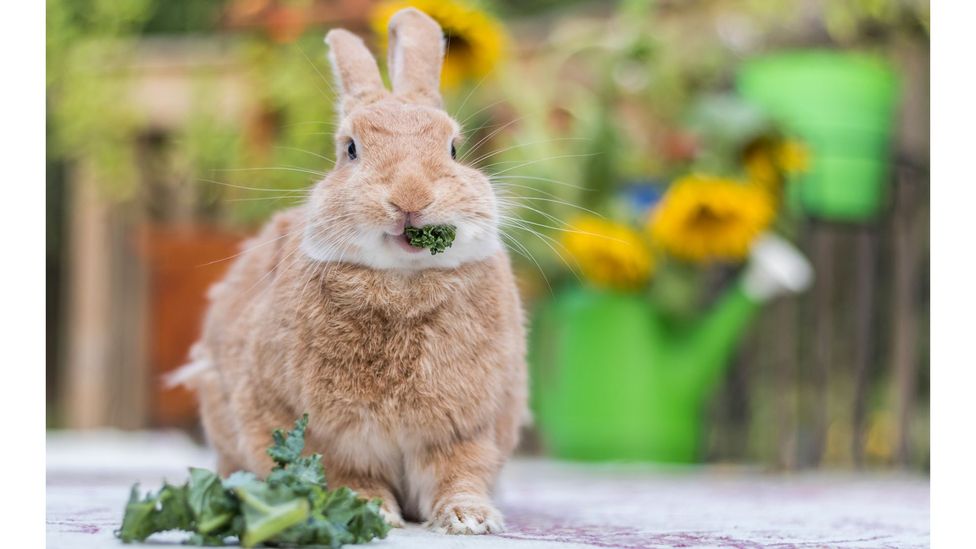
Take my flatmate, a small black rabbit. For a large part of every day, he can be found sitting attentively with his paws on his empty food bowl, awaiting his next portion of kibble – even though it looks like his droppings and smells equally unappetising. He used to have an automatic dispenser with a timer, but he learnt to throw it across the room to access its contents prematurely. No matter what delicacies I place before him – home-grown parsley, soft-cut hay, fresh carrot-tops, organic kale – he would always rather eat processed pet food.
It seems that this is not unusual. Anecdotes abound about pets whose thoughts are largely preoccupied with kibble, such as the cat that has a daily panic attack when it realises it has eaten all its pellets and the pragmatic German shepherd found carrying a bag of dog food around the streets of Houston after Hurricane Harvey.
As it happens, this addictive quality is carefully engineered. Big Pet Food is a multi-billion-dollar industry which invests heavily in research into “palatants” – ingredients that make our pets want to eat their products. And from potently smelly chemicalsusually found in rotting meat to an additive commonly added to potatoes to stop them discolouring, the quest to make the most scrumptious pet food has led to some surprising insights.
“Big [pet food] companies have huge departments that make palatants,” says Darren Logan, head of research at the Waltham Petcare Science Institute, part of the company Mars Petcare. “Just like we make them for humans, we make them for pets as well.”
Upper-class dogs
The first pet food was invented in 1860 by James Spratt, an enterprising lightning-rod salesman from the US state of Ohio. Legend has it that he had travelled to England for his business, and was looking out over the docks of Liverpool one day when he noticed stray dogs knocking back leftover hardtack biscuits.
This was a revelation for two reasons.
Rabbits eat fresh vegetables in the wild, but many kept as pets feast instead on processed pellets (Credit: Getty Images)
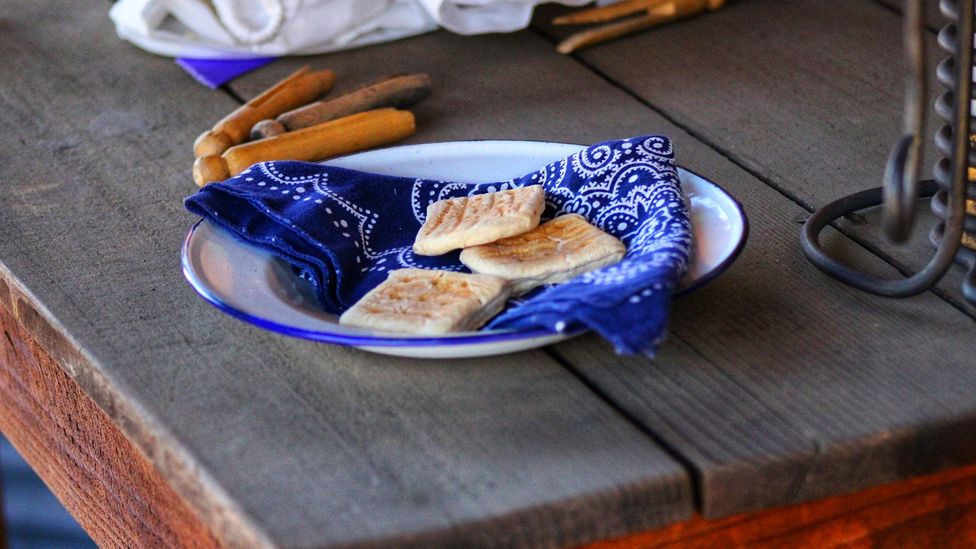
Firstly, hardtack were famously unappealing – loathed by generations of the soldiers and sailors who ate them, these simple slabs of baked flour and water were tougher than wood and sometimes hard enough to break your teeth. Their nicknames included “sheet iron” and “worm castles“, the latter because of the high proportion that were infested with maggots and weevils. The oldest piece of surviving hardtack was baked just nine years before Spratt’s dock visit, and still looks suspiciously well-preserved 170 years later.
Secondly, until that moment it hadn’t occurred to anyone to check what their pets would like to eat – or that this could be monetised. For as long as we had kept domesticated animals, they had been fed more or less the same food as humans, or expected to fend for themselves.
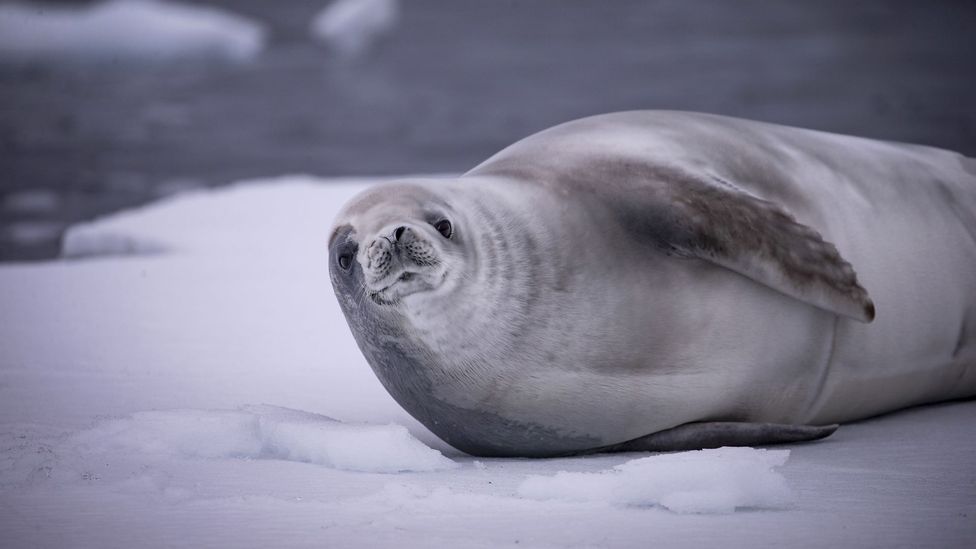
One striking example is the husky. In their native territory of Arctic Greenland, Canada and Alaska, Inuit hunter-gatherers have traditionally fed these dogs on seal meat, which comprises the majority of their own diet. Sled-dogs are so well-adapted to this that when the British Antarctic Survey brought them to Antarctica as a form of transport in 1945, they found that they struggled to digest commercial dog food. In the end, they had to kill a number of local seals each year, just to feed the dogs, before they were largely replaced with skidoos in the 1960s and 70s.
Spratt’s innovation coincided with a cultural revolution in the way people saw their pets
Meanwhile in Victorian London, dogs that were lucky enough to be looked after were either given table scraps or gruel. Even specialist exotic animals were fed everyday human food – the 20,000 or more tortoises imported from Morocco each year were mostly expected to survive on ordinary garden vegetables or bread soaked in water. Cats were considered street animals and rarely fed.
But Spratt had hit upon something entirely new. Over the coming months he developed the “Meat Fibrine Dog Cake”, a biscuit-like concoction of beetroot, vegetables, grains and beef of dubious origins that claimed to meet all the nutritional needs of his customers’ hounds. (While its packaging implied that it was the finest prairie beef, what it was actually made from was a secret he took to his grave.)
Spratt’s innovation coincided with a cultural revolution in the way people saw their pets – dogs and cats went from being viewed as mere utility animals or borderline-vermin to beloved family members to be coddled. Consequently, the Meat Fibrine Dog Cake was marketed as a luxury food for aristocratic pets.
The husky dogs taken on early Antarctic voyages had to be fed with freshly killed seals (Credit: Ozge Elif Kizil/Anadolu Agency/Getty Images)
The adverts labelled them “Dog’s Delight” and included gushing testimonials from wealthy customers. Ironically, Spratt’s also promoted the fact that they were chosen to feed the sled dogs on Captain Scott’s 1901 trip to the Antarctic, though we now know they would much rather have eaten seal.
Eventually the company branched out into cat food – “Spratt’s puts pussy into fine form!”, they said – and the rest is history. However, the science of pet food palatants still had some way to go.
Disgusting smells
Today it’s possible to buy specialised kibble for almost any kind of pet, from frogs to sugar gliders (a small marsupial). Most follow roughly the same formula – they usually contain some kind of base carbohydrate, assorted proteins and fats, sugars, a source of fibre, antioxidants or other preservatives, emulsifiers (which keep the fat in the food and prevent it from separating), vitamins and minerals, and colouring agents
More sophisticated versions may also contain probiotics or digestibility enhancers – such as chicory, which is often added to dog food – as well as enzymes, anti-parasitic compounds and minerals to prevent the build-up of tartar on teeth.
Oddly, there is very little relationship between how healthy a pet food is and its inherent deliciousness
To turn these ingredients into a dry pet food, it’s formed into a paste and “extruded” via a process that involves heating it up and forcing it through a plate with holes in it, to form an aerated product that matches the shape of the holes. It’s the same process that’s used to make puffed snack foods, with flavourings added in the final step – in the case of pet food, they’re either sprayed on or added as a powder.
Oddly, there is very little relationship between how healthy a pet food is and its inherent deliciousness. That’s because in the US, the EU and many other parts of the world, in order to describe one as “complete” – containing everything the body needs to be healthy – it must meet certain nutritional standards. These set out acceptable ranges for most ingredients, so manufacturers can’t just load up on sugar and fat to make it compelling.
“From my standpoint as a nutritionist, all pet foods are the same,” says Marion Nestle, professor emerita of nutrition, food studies, and public health at New York University.
The first processed dog foods were luxury products which ushered in the idea of the “pampered pet” (Credit: Kirn Vintage Stock/Corbis via Getty Images)
Instead, companies turn to chemistry.
Many animals rely heavily on smell to navigate the world around them, and this is often the main sense that’s targeted. While human noses contain around 50 million olfactory receptors, cats have 67 million, rabbits have 100 million and dogs have around 220 million. On the other hand, their sense of taste is generally less discriminating than ours – our relatively high density of taste receptors is thought to have evolved to help us cope with our diverse omnivorous diets.
The catch is that appealing to animals that find the smell of roadkill, sweaty socks, and vomit utterly enchanting – as carnivorous pets often do – while not making their human companions feel violently ill, is extremly tricky. “There is a slight paradox there, because the smells that cats particularly but also dogs seem to like are often the opposite of what humans like,” says Logan.
Nestle puts it more bluntly – “animals eat faeces”, she says. “They like strong animal odours and pet food manufacturers have a really difficult time, because they have to make it disgusting enough so that the animal will eat it, but not so disgusting that the owners won’t buy it.”
Pet food manufacturers have a really difficult time, because they have to make it disgusting enough so that the animal will eat it, but not so disgusting that the owners won’t buy it – Darren Logan
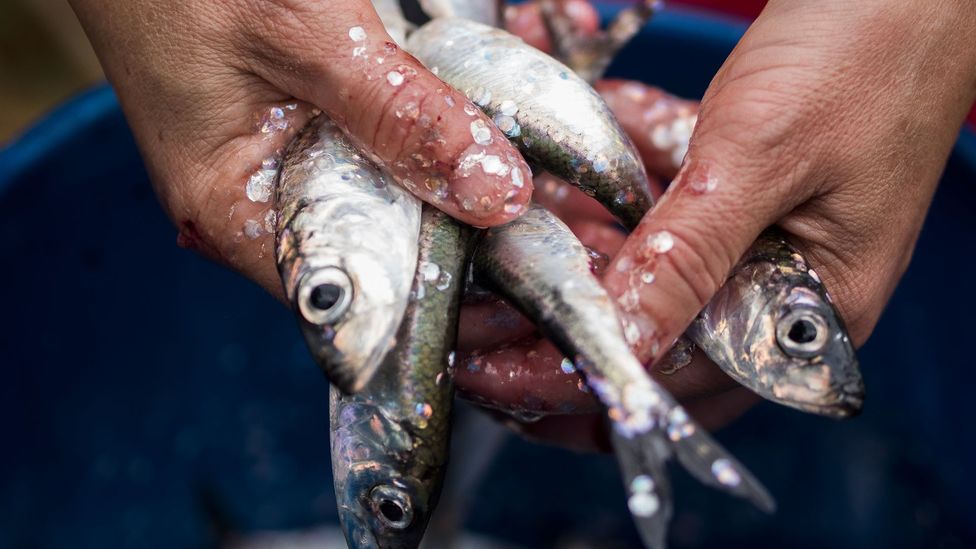
Examples include putrescine and cadaverine, colourless chemicals produced naturally by the breakdown of proteins. They’re largely responsible for the revolting smell of rotting flesh – and cats love them. While in human food, their levels are sometimes closely monitored as a way of ensuring the freshness and safety of meat, they’re often actively added to cat and dog food, either as offal extracts or lab-made additives.
In the case of naturally vegan animals, such as rabbits and guinea pigs, irresistible smells such as mint and oregano are sometimes added in the form of concentrates.
Japanese-inspired cuisine
Other insights are arguably more surprising. A recent study identified nine volatile compounds in common pet food flavourings that are linked to how delicious they are to dogs, including heptanal, nonanal, and octanal, which all have strong, fruity odours.
However, taste is also important – and here the preferences of carnivorous pets are not so different from ours.
One of the most popular additives in human food is the enigmatic “hydrolysed protein”, which is formed by breaking down the long strands of proteins into their constituent amino acids, usually using enzymes or hydrochloric acid. It imparts a flavour similar to that achieved by meat or vegetable stock, and often comes with MSG, which is produced as a by-product of the same reaction and is responsible for the savoury taste of tomatoes, cheese and Iberico ham.
Though hydrolysed proteins are produced artificially, the process is similar to what happens when you cook food for a long period of time – it’s a kind of pre-digestion, and is thought to contribute to the enticing smell of many brands of kibble.
Early processed dog food resembled the tooth-challenging hard-tack biscuits often taken on long sea voyages (Credit: Getty Images)
“The understanding of cat palatability is very similar to Japanese or Asian cuisine, where there’s a lot of focus on umami and another taste modality called kokumi,” says Logan.
Kokumi was discovered in Japan in 1989, and has been proposed as the sixth taste in humans, after sweetness, saltiness, bitterness, sourness and umami. It’s described as a kind of mouth-feel rather than a flavour per se – a texture that imparts richness and “thickness” to foods. Unlike the others, kokumi hasn’t yet been linked to a specific set of compounds, but foods that conjure this sensory experience include scallops, soy sauce, shrimp paste, yeast and beer.
While cats are particularly drawn to Japanese food, which is rich in meat and seafood, you’re unlikely to find them stealing ice-creams or doughnuts
The sixth taste is thought to be particularly popular with carnivorous animals, which may discern it via receptors in their mouths that evolved to detect calcium. And as you would expect, pet food companies have already begun targeting it with cocktails of flavour-enhancing chemicals.
But there are some flavours that you will never find in certain pet foods.
For example, most wild carnivorous animals lack the receptors for tasting sugar or carbohydrates. And unlike dogs, which have been living around humans and feasted off our scraps for up to 40,000 years, domestic cats have only been around for about 4,300. For the majority of that time, they were considered a kind of free pest-control that could fend for themselves.
So, while cats are particularly drawn to Japanese food, which is rich in meat and seafood, you’re unlikely to find them stealing ice-creams or doughnuts – unlike dogs, they simply haven’t been around humans for long enough to have evolved the ability to taste sugar.
Cats are irresistibly drawn to the chemical compounds found in rotting fish (Credit: Getty Images)
On the other hand, because vegan animals eat exclusively vegetable matter, which is often rich in fibre and carbohydrates, they tend to prefer sweeter pet food.
Finally, no list of palatants would be complete without pyrophosphate, described in Popular Science as “cat crack”. This common additive performs a number of roles in human food, such as preventing potato products from going dark after they’re cooked – none of which involve improving its taste. Nevertheless, cats go nuts for it, possibly because it intensifies the flavour of amino acids.
Pet food companies are now so successful at making food delicious that they’re increasingly encountering a dilemma – it’s almost too good. “The danger for cats and dogs today is the same as for people, it’s overconsumption,” says Andrew Knight, a professor of animal welfare and ethics at the University of Winchester.
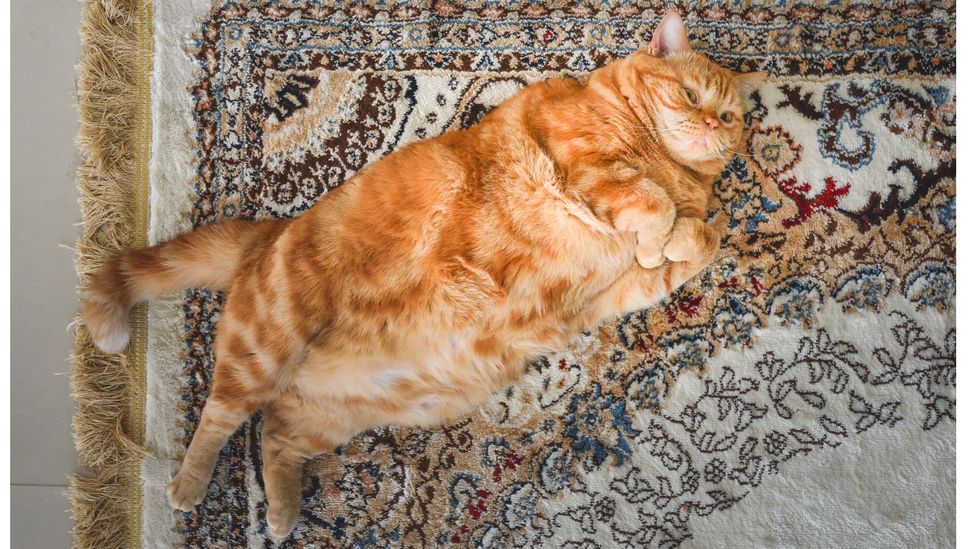
Pet obesity is a growing problem in the developed world, with one survey of veterinary professionals at a vet show in London suggesting that around 51% of dogs, 44% of cats and 29% of small mammals are now overweight or obese.
Pet foods made from more sustainable ingredients such as insects or soya are generally just as acceptable to carnivorous pets as the real deal
According to Logan, this is not down to the way pet food is formulated, but humans succumbing to their beloved pets’ pleading gazes. “The reason we make pet food palatable is that if they don’t eat all the food that we give them, it won’t meet the nutritional needs that they require,” he says. “The real problem is owners feeding them too much – pets can’t open the packets themselves.”
However, there is an upside. There are mounting concerns about the environmental impact of pet food, too – in 2009, two New Zealand scientists estimated the planetary cost of keeping a dog as roughly twice that of having a medium-sized SUV.
Pets given too much calorific processed food may, just like humans, put on extra weight (Credit: Getty Images)
This is where palatants come in. Because most pet foods comprise a fairly tasteless base that is spruced up with delicious flavourings and smells, pet foods made from more sustainable ingredients such as insects or soya are generally just as acceptable to carnivorous pets as the real deal. (Though cats cannot be fed a diet that is meat free.)
“According to this really large-scale study that we’ve just finished, the animals on vegan pet foods seem to be just as happy as animals on meat ones,” says Knight, who is hopeful about their future potential.
“There is a broad recognition that the need to be more sustainable will have a big impact on the pet food business,” says Logan, who explains that the pet food company he works for has just released its own brand of insect-based pet food.
So, why do our pets find pet food so addictive? Well, because it’s been made that way. Just like us, our pets find it hard to say no to the food we have designed to be tasty.
* Zaria Gorvett is a senior journalist for BBC Future and tweets at @ZariaGorvett
ooOOoo
That is a really useful article that goes a very long way to explaining how ‘big business’ interferes with the food that our pets eat.
And did you read right at the end of the article: “According to this really large-scale study that we’ve just finished, the animals on vegan pet foods seem to be just as happy as animals on meat ones,” says Knight.
I can’t remember when I first came to know Patrice Ayme; it was quite a few years ago. I followed him for years and then had to take a break simply because there weren’t enough hours in the day! Not because I disliked what he was writing – no siree!
Anyway, Patrice recently forwarded me an article that rightly deserved much attention. Here it is:
ooOOoo
Saving The Animals, Thus Ourselves
Animals die in great numbers trying to cross human transportation systems.
When one provides the animals with crossings, they rush to use them (so are used even before they are finished, by a Noah’s ark of species).
Respecting nature is not just about the beauty and naturalness it provides us with, it is about respecting how we became who we are, at our best. We have to learn to share the planet with animals. Not just because we are smart, but also because they are smart and our smarts evolved from interacting with their smarts. So interacting with wild animals is smart all around… and it has made our species smarter! Wildlife interaction is how we evolved our smarts.
Not book smarts, but the deepest smarts.
Hence by respecting animals, we respect how we became human… and it keeps on being human to do so. Economy means managing the house, in particular, managing earth, which is our common house. As the greenhouse heating proceeds at an accelerating pace, we then have to reserve an increasing part of our economic activity to save the animals by helping them to cope with the changes we have brought.
Morality comes from the mores, the old ways, the ways which perdured, and thus, insure survival. Having a natural environment, full of animals, is the ultimate morality. If we can’t save them, how can we learn to save ourselves?
So it is not just smart and economic to save the animals, but also moral. The money engaged so far is quite small. But the price of an unbalanced environment tottering towards ruin, is incomparably higher. For a nice article with nice videos of animals using their smarts crossing freeways and roads, consider:
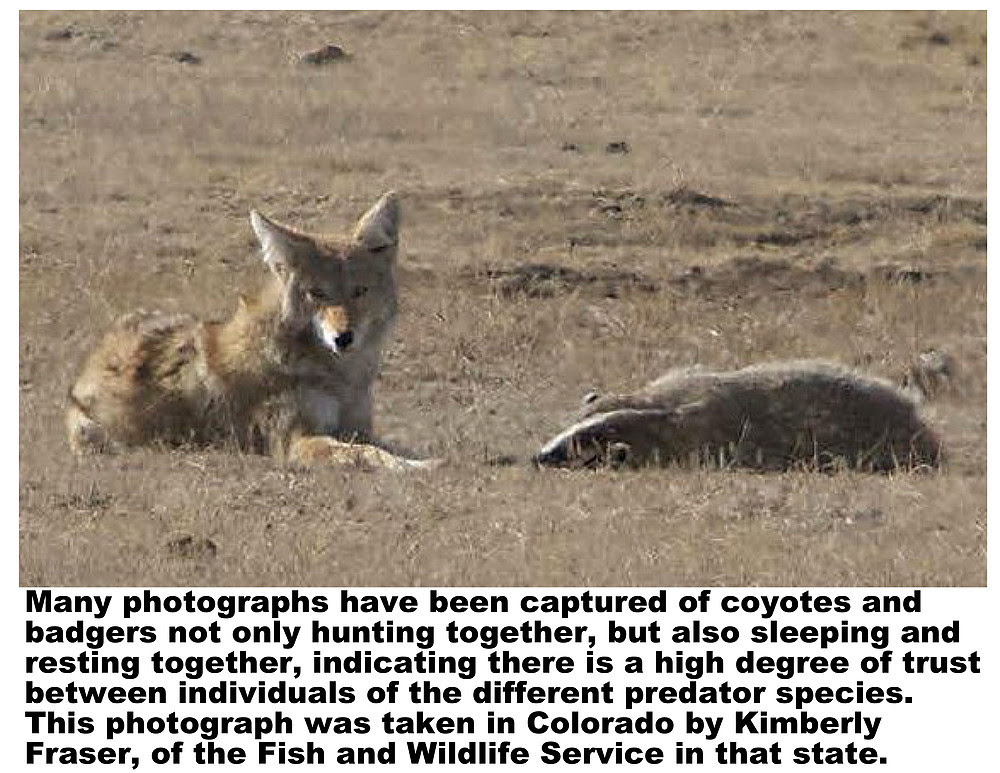
As a badger digs, say for ground squirrels whose burrows have many exits, could not it be that the coyote would seize a fleeing squirrel, and share the meal? This is basic economics and strategy, and it turns out that coyotes and badgers have figured out that behavior, and cooperate together.
The next question would be this: do the individuals concerned figure it out by themselves, as cephalopods do, or is the behavior culturally instigated, namely both badgers and coyotes learn elements of interspecific cooperation from teaching by their elders? I believe the latter.
After all, I trained the (wild) nesting birds on my balcony to benignantly ignore my weird and intrusive ways … which thus had to learn to be a bit more respectful than they usually are. But of course these ways tend to incite the red tail hawks to not land on this particular balcony on a determined culinary mission (as they have been seen doing…) And the birds know this [1].
Saving the animals is first of all about saving us… Not just our sense of beauty.
Patrice Ayme
[1] Hummingbirds set their nests below hawks’ nests, as this protects them from gays. Local hawks do attack nests of birds who are big enough (like gays, crows, etc). And I have seen them pass 10 feet from me, eyeing me suspiciously… Their feathers can be two feet long…
We are all connected as I said in the title to today’s post.
The only way we are going to survive as a species on this planet is for all of us to recognise this fundamental law of nature. Or should I say this fundamental law of Nature!
It is a little over fifty years since the inaugural celebration of the first Earth Day; on the 22nd April, 1970. In other words we are just over halfway through if one imagines the celebration of the one hundredth Earth Day: 22nd April, 2070. In 1970 the planet was home to 3.7 billion people. Today there are nearly 8 billion people. But more than that these 8 billion people are living to an average of 72 years, up from 59 years in 50 years.
Our failure to address climate change is harming the planet and all the species, including us humans, who live on Planet Earth. I shall be dead by 2070 and also a great many of my fellow humans. But for all those born in the year 2000 and later it is increasingly going to become the number one priority: Saving the planet from a total catastrophe!









:max_bytes(150000):strip_icc()/MaryJoDiLonardo-bw-d4a8600bf85f47c793a3a283f74ff222.jpg)