The unacceptable face of the big agricultural businesses
Another wonderful link from Naked Capitalism. This one refers to the way that the definition of ‘organic’ as in organic milk is being twisted and distorted to favour the huge indoor milking herds, up to 10,000 cattle, that in any sensible mind could never be regarded as the organic production of milk.
This to me is a picture of organic production of milk:
An English meadow
This to me is NOT! Yet the milk from these cows is defined as organic!
Organic milk?
This last picture is courtesy of The Cornucopia Institute, another web site worth a visit whether or not you take an interest in farming – after all, one presumes that you do eat!
A looming low point in the long history of the Greek empire
It seems the EU is considering whether to bail out Greece, in danger of defaulting on its loans, so high is its debt.
Athens
A spokesman has been quoted as saying “it is unthinkable” that Greece should default and that “something would have to be done.”
I imagine the rest of the EU countries (their citizens at least, those who actually pay the taxes) are not exactly slavering over the prospect of their money being used to bail out yet another organism living beyond its means.
And this is the point, we ALL have to start living within our means: individuals, countries, the planet. ANY other course leads to doom. And as an EU taxpayer I feel very hesitant about bailing out ANY country. Not though lack of fellow-feeling (it could be us next time) but because IF you bail them out then they WON’T change their habits. We bailed out the banks; have you seen THEM change their habits? I certainly haven’t, except that they won’t lend small businesses (the TOTALLY INNOCENT VICTIMS of all this) any money. The obscene fat-cat “bonuses” are starting up all over again like mushrooms in the meadow. No, let them go bust; only that will concentrate their minds.
And let us not forget that Greece LIED about its finances in order to qualify for the EU in the first place! An end to lies! An end to the easy option. An end to my taxes bailing out an indisciplined over-spender!
Keep in mind, even as the number of first-time claims for unemployment insurance rose again recently, that the 10% U.S. unemployment figure understates the actual number of unemployed. Even the 17% underemployment figure, which includes those who are either unemployed or who are working part-time but would like to work full-time, fails to include many of those who have lost their jobs but, because they fail to qualify for unemployment, are not being tracked. I know several such people personally; one has been unemployed for over a year.
My point? Structural unemployment is a serious economic issue. But the solution is not to funnel more unemployment benefits to the unemployed. The best thing the government can do is to reduce the barriers it has erected to a vibrant economy, including oppressive taxes, fees, paperwork, bureaucracy, and regulations that repress business productivity and raise prices. By reducing these explicit and implicit costs, there is absolutely no doubt that the private economy will be able to employ more workers as it produces more output at lower prices.
The best thing we can do as private citizens and neighbors is to treat each other right. Keep the economy moving. Put in a good day’s work. Volunteer or learn a new skill if you can’t find a job. Fill a need. Buy smart. And, finally, elect business-friendly local and national politicians. It matters.
In a new departure for Learning from Dogs, Sherry Jarrell publishes a three-part article on the Daimler-Chrysler merger. Learning from Dogs is indebted to Professor Jarrell for both giving so freely of her time to the Blog and for sharing such erudite material.
Here is Part Three, the concluding part. If you missed Part One then it is here and Part Two is here.
Where is DCX today?
The Daimler-Chrysler merger was troubled from the beginning.
Investors sued over whether the transaction was a ‘merger of equals’ or a Daimler-Benz takeover of Chrysler. A class action lawsuit was settled in August 2003 for $300 million. A lawsuit by activist investor Kirk Kerkorian was dismissed
Jürgen E. Schrempp
in April 2005, but claimed the job of the merger’s architect, Chairman Jürgen E. Schrempp, who resigned in response to the fall of the merged company’s share price. The merger was also the subject of a book Taken for a Ride: How Daimler-Benz Drove Off With Chrysler, (2000) by Bill Vlasic and Bradley A. Stertz.
It is questionable whether the merger ever delivered promised synergies or ever successfully integrated the two businesses. As late as 2002, Daimler-Chrysler appeared to run as two still-independent companies. In 2006, Chrysler reported losses of $1.5 billion. In 2007, it announced plans to lay off 13,000 employees, close a major assembly plant, and reduce production at other plants in order to try to restore profitability.
It was all for naught. In May of 2007 Daimler-Chrysler announced that it would sell 80.1% of Chrysler to Cerberus Capital Management of New York, a private equity firm specializing in troubled companies. Daimler continued to hold a 19.9% stake. Daimler paid Cerberus $650 million to take Chrysler and associated liabilities off its hands, an amazing development given the $36 billion Daimler paid to acquire Chrysler in 1998. Of the $7.4 billion purchase price, Cerberus Capital Management invested $5 billion in Chrysler Holdings and $1.05 billion in Chrysler’s financial unit. The de-merged Daimler AG received $1.35 billion directly from Cerberus but invested $2 billion in Chrysler LLC itself.
On April 27, 2009, Daimler AG agreed to give up its remaining 19.9% stake in Chrysler LLC to Cerberus and pay as much as $600 million into the auto-maker’s pension fund. On April 30, 2009, Chrysler LLC filed for Chapter 11 bankruptcy protection and announced a plan for a partnership with Italian automaker Fiat. On June 1, Chrysler LLC stated they were selling some assets and operations to the newly formed company Chrysler Group LLC, with Fiat retaining a 20% stake in the new company.
On June 10, 2009, the sale of most of Chrysler assets to “New Chrysler”, formally known as Chrysler Group LLC, was completed. The federal government financed the deal with $6.6 billion in financing, paid to the “Old Chrysler.” The transfer does not include eight manufacturing locations, nor many parcels of real estate, nor equipment leases. Contracts with the 789 U.S. auto dealerships who are being dropped were not transferred.
In a new departure for Learning from Dogs, Sherry Jarrell publishes a three-part article on the Daimler-Chrysler merger. Learning from Dogs is indebted to Professor Jarrell for both giving so freely of her time to the Blog and for sharing such erudite material.
Here is Part One
What does the Daimler-Chrysler merger demonstrate in broader terms?
In a paper co-authored with Rick Harris, Tom McInish and Bob Wood, we explored the Daimler-Chrysler merger of 1998 to examine the interplay between disclosure rules in the U.S. and corporate governance standards in Germany. Here is an overview of what we found.
Large shareholders typically control European and Asian industrial giants, leaving minority shareholders less than well protected. In several studies of the legal protection afforded minority shareholders across 27 countries, German shareholder protection ranked among the very worst. In the early 1990s, Daimler-Benz, one of the largest firms in Germany, was no exception. In 1993, with Deutsche Bank owning 24% of the equity, Mercedes AG Holding 25%, and the Emirate of Kuwait 14%, its controlling shareholders decided to cross-list Daimler-Benz on the New York Stock Exchange (NYSE).
1997 Daimler Mercedes
All foreign firms that cross-list [list their shares for sale in more than one country] in the U.S. subject themselves to stricter disclosure standards. In addition to listing on a major U.S. stock exchange, Daimler was required to file financial statements with the SEC and report any material non-financial information as well. Cross-listed firms are also followed more closely by U.S. stock analysts and the business press. These legal disclosure requirements and additional scrutiny by the investing community improved both the quantity and quality of information available to all shareholders about Daimler.
1997 Chrysler Town and Country Minivan
By early 1998, the cross-listed Daimler shares were widely held and actively traded worldwide, including significant volume originating in the United States. In September of 1998, Daimler and Chrysler shareholders, majority and minority owners alike, overwhelmingly approved a merger creating DaimlerChrysler AG (DCX) through an exchange of the cross-listed share for the first “global registered share” (GRS). The so-called “merger of equals” was widely expected to realize both operating efficiencies and, via the informational transparency of the GRS, improved access to international capital markets.
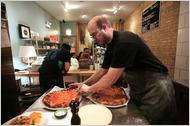
Here is a wonderful story of craftsmanship in the modern age and its interaction with business expectations. There is a very small, but reportedly excellent, pizza place in Chicago called “Great Lake”; and I learnt about it when a friend referred me to an article about its culture, its success and the consequences published by the New York Times.
The effect of extremely good reviews has been that they have been overwhelmed by demand and some customers have reacted unfavourably as a result. I think that they should stick to their guns and not compromise their principles and standards. However, this does not mean that they could not be doing some other things too!
The engine of world economic growth is sputtering. The most clear evidence of this is the lack of new business formation in developed nations across the globe. Over the last year, the number of entrepreneurs starting new businesses in the wealthiest of nations dropped 10% from the 2006-07 level; in the U.S., that number fell by 24%.
The contaminants in the fuel line are oppressive government policies that increase the cost of doing business, increase unemployment, and raise the risks to the current labor force of quitting their jobs to try to start new businesses.
At a time when government should be encouraging venture capitalists and the formation of new business, it is instead putting on the brakes to this source of economic growth in the form of cap and trade, compensation regulations, fees on banks, and myriad other explicit and implicit new taxes. In 2009, nearly half of U.S. employment was generated by small businesses; U.S. companies started through venture capital employed more than 12 million people, or 11 percent of private sector employment, and generated $2.9 trillion in revenues, or 21 percent of U.S. GDP.
Fully 100% of economic growth is created in private industry. Government simply redistributes that wealth, destroying some portion of it in the process. Never have we needed non-interventionist government policies more.
The latest from Washington on Health Care Reform is the Senate’s version which taxes insurance companies on plans valued at over $8,500 for individuals and $23,000 for couples.
President Obama has defended the tax as a way to drive down health costs. “I’m on record as saying that taxing Cadillac plans that don’t make people healthier but just take more money out of their pockets because they’re paying more for insurance than they need to, that’s actually a good idea, and that helps bend the cost curve,” the president said in an interview with National Public Radio just before Christmas. “That helps to reduce the cost of health care over the long term. I think that’s a smart thing to do.”
Huh? Mr. President, you need an Econ 101 primer. Let’s begin now, with supply and demand:
Supply is an upward-sloping marginal cost curve, and includes the taxes and fees a business must pay to the government. By imposing this tax, the supply curve of insurance companies will shift up and to the left, as shown in the graph, representing a higher cost per unit of insurance coverage. The demand curve slopes down, so when intersected by a more costly supply curve, the final price to consumers rise and the amount of insurance coverage falls. Period. End of story. Indisputable fact. And nothing Obama or the Senate says will change this fact, though they will try.
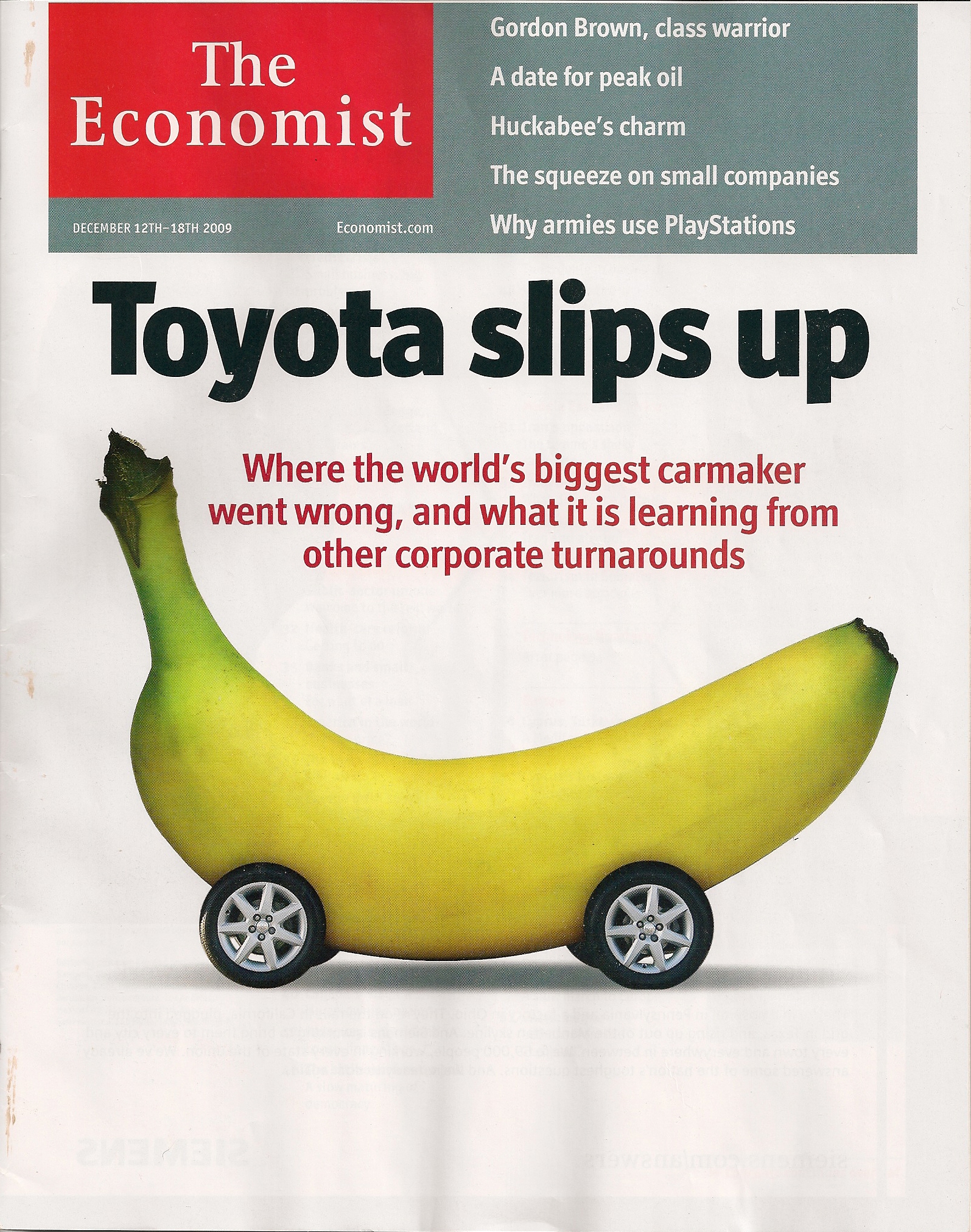
The Economist is a newspaper. It was first published in September 1843 which, of itself, makes it a notable newspaper. Many years ago, more than I can recall just now, I became a subscriber to the newsprint version of this weekly paper. It has become such a companion, so to speak, that when I left the UK in September 2008 to come to Mexico I made arrangements to continue receiving The Economist each week.
However, the Mexican postal system, despite being thoroughly reliable, is rather slow and, rather logically if you muse on it, the postman always only delivers when there is more than one item. Thus the particular copy of The Economist that carried the story about Toyota arrived late and with three other editions!
Is this really what the Founding Fathers had in mind for America?
This topic may seem to be more about politics than economics, but anything related to health care reform is squarely rooted in the most important of economic issues: the costs of doing business, the size of the government, and the potentially oppressive role of government in private industry.
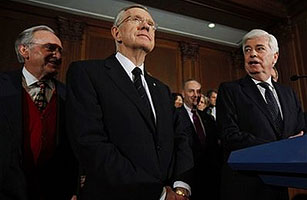
In this article, we see how the Senate Democrats are going to do whatever it takes to get their version of health care reform through, even if it comes down to ‘stealing’ votes. Could the timing of this Massachusetts special election, to replace the temporary replacement put in for the late Senator Edward Kennedy, be one of the reasons that the Senate wants to rush this reform through before the President’s State of the Union Address, typically set for mid-January, though the White House is curiously reluctant to commit to a date…. ?





 Learning from Dogs