“Son, your ego’s writing checks your body can’t cash.”
Well, this may be old hat for specialists but it surprised me. Is the same true for Britain? In either case, as Friedman says, it suggests we should explore more forcefully the ways we could aid business startups.
I always find Thomas Friedman excellent value for the time invested in reading him! See here:
“Here’s my fun fact for the day, provided courtesy of Robert Litan, who directs research at the Kauffman Foundation, which specializes in promoting innovation in America: “Between 1980 and 2005, virtually all net new jobs created in the U.S. were created by firms that were 5 years old or less,” said Litan. ‘That is about 40 million jobs. That means the established firms created no new net jobs during that period.’”
And if you want to know where the opening quote comes from, read the Friedman article!
This is the concluding part four of a multipart series on the factors that drive U.S. and foreign bond prices and yields.
[Part One is here, Part Two here, Part Three here Ed.]
Bond’s in a weak or faltering economy will generate a lower return to lenders than bonds in a strong economy, absent inflation or any other material changes in the purchasing power of the currency. Weak demand for goods and services means weak demand for financial capital which means low rates of return on financial capital.
The policies of the government can increase the borrowing costs of private industry. Fiscal policy that increases taxes reduces the profitability of projects and undermines the ability of companies to pay coupons and repay principal. Monetary policy that increases the money supply may lead to inflation, which also increases the cost of borrowing and reduces economic activity.
Lastly, and of the greatest concern of late, is the level of borrowing by the U.S. government. Debt levels are at record highs, with no relief in sight. The AAA rating of U.S. debt is reportedly in jeopardy (Chicago Tribune editorial).
Moody's Corporate Logo
Both existing and new lenders worry about the ability of the U.S. government to repay. Yes, the can simply roll over existing debt by raising taxes or creating money to retire old debt and replace it with new, but the interest rate required by new lenders goes up as the ability of the private economy to sustain tax revenues falls and the risk of inflation rises (Moody’s explains U.S. bond ratings).
Both factors are in play now: an anemic economy with little hope that this administration will undertake policies that support business, and a ballooning money supply and weak dollar that undermine the purchasing power of the returns to lenders. The returns to U.S. debt may still be healthy relative to those one can earn in other countries, but the spread is shrinking. The private economy remains fundamentally strong, thanks to the work ethic of the American people and the profit motive of the capitalistic system, but the policies of the U.S. government are straining those resources.
The yield on a bond is made up of several components. Some think of the return on a bond as the sum of the risk-free rate of interest (how impatient we are to get our money back, or how much we need to be compensated to delay consumption) and a risk premium (the additional return we require to compensate us for the risk of default, the risk the bond will be called, the risk of inflation reducing the purchase power of the repaid dollars, and many other sources of risk as outlined in the most recent article in this series).
Another useful way of thinking of the return on a bond is as the sum of the real rate of interest and the expected rate of inflation. But what is the real rate of interest? We never actually observe that rate, unless of course the inflation rate is zero and then the real rate is just the nominal rate set in the market.
It is useful, however, to think about what drives the ability of a company to generate a real rate of return to lenders, for this is essence of capitalism and risk-taking and creating economic value and growth.
Bond traders
A firm’s asset cash flows support the real returns to its lenders – all kinds of lenders (debt, equity, hybrid, and derivative security holders). A firm will want to borrow more, and is willing to pay a higher interest rate for those funds, the more profitable are the projects they want to undertake, or the greater the number of profitable projects. Profitability, in turn, is determined by the relationship between demand and supply: how much does society value a good or service, and how many resources does the business use in producing the good or service. As the marginal productivity or efficiency of a business goes up, it can afford to profitably fund more projects. So the core driver of the real return on bonds is the strength of the underlying economic activity of the private economy.
Or, when viewed from the investor’s side, note that an investor will purchase a bond, or lend money to a company, if they expect to earn a return sufficient to compensate them, first, for delaying consumption and, second, for bearing the various sources of risk or uncertainty associated with the bond’s cash flows or return.
The official unemployment rate of the U.S. economy remains at 9.7%, and the underemployment rate increased to 16.9%. These numbers represent a real tragedy for many Americans.
While the White House tries to celebrate the creation of 162,000 new jobs last month, at least 48,000 of these new jobs are government jobs, specifically temporary census workers, who are doing unproductive work and are being paid with taxes collected from the rest of the private economy.
Unemployment
Employment also increased in temporary help services and healthcare, but continued to decline in financial activities and in information, which is interesting given the recent comments by President Obama that the government takeover of the student loan program tucked into the health care bill “took $68 billion from banks and financial institutions.”(Obama’s April 1 remarks) That’s a lot of jobs, Mr. President.
Seems like there is more concrete evidence that, rather than creating jobs, the President’s policies are costing the economy jobs.
Crazy, outdated concept – adjusting clocks twice a year!
The whole concept of adjusting the clocks with the seasons, “Daylight Saving” as the Americans call it, seems increasingly ludicrous the more that one thinks about it. In the UK, it is called British Summer Time and is abbreviated to BST; I call it British Silly Time.
The expensive consequences for computer systems, airlines, railways and many other systems and organisations having to mess about with times and schedules are completely unnecessary. And I have lost count of the number of times I have heard of people missing calls or online meetings due to misinterpretations of time zones and distortions in the name of “daylight saving”.
One would have thought that people who spend the most time involved with nature would find it the most ludicrous and that among those would be farmers. However, it seems that this is not the case as there is a discussion about introducing permanent BST or even “double BST” on the UK National Farmers Union (NFU) website.
The news article is titled “Should we change the clocks?”. My answer is a simple “no”. In case the answer is unclear, I mean “no”! That is “do not change the clocks”! That is “leave the clocks alone”! That is “stop messing with the clocks”! In the UK that means “leave the clocks on GMT, the correct time”!
Does no one else understand this? Well, thankfully, many people do. For example, the whole of the aviation industry uses Zulu time (UTC) worldwide. Let’s be clear what that means. When pilots get a weather reports from any airport in the world (whether it is Heathrow or Los Angeles airport), the times are in Zulu time which is UTC/GMT. Yes everyone uses UTC.
The really funny part is that the NFU news article even states “analysts have claimed an extra hour’s daylight could be worth £3.5 billion a year to the economy”. This is the ultimate fallacy.
Let us be clear about something, in case you had not noticed: THERE IS NO EXTRA DAYLIGHT!! Where, on earth, did farmers get the idea that there is?!
Well, it is a Chinese saying, “May you live in interesting times”!
A couple of weeks ago on Learning from Dogs, there was an article reminding readers that the web has been around for 20 years and Sir ‘Tim’ Berners-Lee is still hard at it in terms of Internet innovations. And to support this, today accompanying this Post is one on what the BBC is doing to commemorate the event.
The Internet has completely reformed the way that ordinary people get access to information. Stratfor is a great example.
From their web site:
STRATFOR’s global team of intelligence professionals provides an audience of decision-makers and sophisticated news consumers in the U.S. and around the world with unique insights into political, economic, and military developments. The company uses human intelligence and other sources combined with powerful analysis based on geopolitics to produce penetrating explanations of world events. This independent, non-ideological content enables users not only to better understand international events, but also to reduce risks and identify opportunities in every region of the globe.
One can subscribe to a range of free reports and it came to pass that a Stratfor report on China came into my in-box.
Stratfor generously allow free distribution of this report and because the relationship between China and the USA has so many global implications, the report is published in full, as follows:
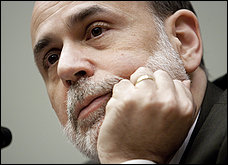
Ben Bernanke, Chairman of the U.S. Federal Reserve, announced that the Fed was likely to begin to sell some of the $1 trillion in mortgages, the so-called “toxic assets,” that it purchased over the last fifteen months to help stave off a total credit market meltdown. Those purchases essentially doubled the U.S. money supply, igniting fears of potential inflation should the underlying real economy recover before the money supply could be drawn back down. See earlier post.
Well, the process of tightening the money supply may be just around the corner. And increases in interest rates and the cost of everything purchased on credit – homes, cars, durable goods, and business capital expenditures – are not far behind. Increases in interest rates dampen economic activity, an unfortunate development given the current lethargic state of the U.S. economy. But it has to be done sometime – we cannot sustain such a huge increase in the money supply without paying an even higher price in terms of inflation and a weak dollar.
It will be interesting to see who buys the toxic assets and how much they will pay. Regardless, the sale will reduce the money supply which, if done in a slow, orderly manner, is a good thing for the economy. Getting the Fed out of the business of buying and selling private market securities will be an even better thing for the U.S. economy. Now more than ever we need a monetary authority that is focused on the best policies for our economy, not those that help Fannie Mae, the White House, or the Treasury Secretary save face.
Thinking about the concept of “less is more”, takes me back to a small and initially unpromising project that a maverick boss of mine persuaded me to get involved in many years ago. It provides an interesting example of counter-intuitive optimisation.
The scene…
There was a manufacturing plant which produced credit cards. The plastic cards were manufactured in sheets; this involved a lamination process which started with a “layup” of three plastic sheets and ended up with them laminated together as one sheet.
The lamination was done in a press which was heated and then cooled; this caused the plastic sheets to melt slightly and to become welded together as one. To produce cards with flat and clean surfaces, each layup also had shiny metal plates on either side to produce a smooth finish.
Behavioral Economist concludes that most people cheat.
In a very interesting video on the website TED, Dan Ariely, Professor of Behavioral Economics at Duke University, explains his research into why people think it is okay to cheat and steal.
Here is Ariely’s presentation from YouTube:
From his research, he concludes the following:
A lot of people will cheat.
When people cheat, however, they cheat by a little, not a lot.
The probability of being caught is not a prime motivation for avoiding cheating.
If reminded of morality, people cheat less.
If distanced from the benefits from cheating, like using “chips” instead of actual money in transactions, people cheat more.
If your in-group accepts cheating, you cheat more.
Dan Ariely
I quibble with the interpretation of some of his findings, which may justify a separate post on how people perceive what they do and do not know, but there are always issues of this sort with a given research project. Where I draw the line is when he expands his conclusions to include all of Wall Street and the stock market, which is totally beyond the scope and nature of his research.
On what basis does he draw this conclusion? As explained in this short video (as I have not read his book, though I’ve read excerpts and am familiar with the study upon which the book is based), Ariely claims that because stocks and derivatives are not in the form of money, they “distance people from the benefits of cheating,” which leads individuals who engage in the stock market to cheat more. He alludes to Enron as proof.
This is almost too silly to spend a lot of time on trying to discredit, but I fear that a lot of people who hear his talks or read his book may be lulled into accepting what he says about the stock market as true. But it is not! Enron is the exception, not the rule.
Companies who issue stocks are raising money to provide a good or service that is valued by society; they are rewarded by profits. Investors who buy and sell stocks, trade derivatives, and invest in portfolios are trying to make their money go further. They are trying to earn a return on their savings. Cheaters do not survive in the stock market, unlike the “consequences-free” classroom in Areily’s experiment.
On the other hand, these factors are in glaring abundance in the government: politicians never “see” the taxes they spend as the hard-earned income of the citizens. And the “benefits” of cheating, including power and privilege, are amorphous and vague, and couched in the so-called morality of “doing the greater good.” I’m surprised Ariely does not condemn the federal government using the same logic as his does the stock market.
His last take-away from this research project? That we find it “hard to believe that our own intuition is wrong.”
I think Dr. Ariely ought to apply that caveat to the conclusions he draws about his own research. Very interesting, very compelling, but his interpretation of the results as they apply to the stock market falls victim to the very same biases that he claims to find in others.
I apologise for the rather trite sub-heading but it was a bit of attention grabbing to promote the results of a recent conference called Let Markets Be Markets. It was published by the Roosevelt Institute and had one very impressive line of speakers.
One of the speakers was Simon Johnson of Baseline Scenario fame, a Blog that Learning from Dogs has followed since our inception.
Here’s 8 minutes of Simon pulling no punches.
If you want to read and watch other presentations, then Mike Konczal’s Blog Rortybomb is the place to go.
As this Blog has repeated from time to time, this present crisis is a long way from being over.




 Learning from Dogs