Thinking about the concept of “less is more”, takes me back to a small and initially unpromising project that a maverick boss of mine persuaded me to get involved in many years ago. It provides an interesting example of counter-intuitive optimisation.
The scene…
There was a manufacturing plant which produced credit cards. The plastic cards were manufactured in sheets; this involved a lamination process which started with a “layup” of three plastic sheets and ended up with them laminated together as one sheet.
The lamination was done in a press which was heated and then cooled; this caused the plastic sheets to melt slightly and to become welded together as one. To produce cards with flat and clean surfaces, each layup also had shiny metal plates on either side to produce a smooth finish.
Behavioral Economist concludes that most people cheat.
In a very interesting video on the website TED, Dan Ariely, Professor of Behavioral Economics at Duke University, explains his research into why people think it is okay to cheat and steal.
Here is Ariely’s presentation from YouTube:
From his research, he concludes the following:
A lot of people will cheat.
When people cheat, however, they cheat by a little, not a lot.
The probability of being caught is not a prime motivation for avoiding cheating.
If reminded of morality, people cheat less.
If distanced from the benefits from cheating, like using “chips” instead of actual money in transactions, people cheat more.
If your in-group accepts cheating, you cheat more.
Dan Ariely
I quibble with the interpretation of some of his findings, which may justify a separate post on how people perceive what they do and do not know, but there are always issues of this sort with a given research project. Where I draw the line is when he expands his conclusions to include all of Wall Street and the stock market, which is totally beyond the scope and nature of his research.
On what basis does he draw this conclusion? As explained in this short video (as I have not read his book, though I’ve read excerpts and am familiar with the study upon which the book is based), Ariely claims that because stocks and derivatives are not in the form of money, they “distance people from the benefits of cheating,” which leads individuals who engage in the stock market to cheat more. He alludes to Enron as proof.
This is almost too silly to spend a lot of time on trying to discredit, but I fear that a lot of people who hear his talks or read his book may be lulled into accepting what he says about the stock market as true. But it is not! Enron is the exception, not the rule.
Companies who issue stocks are raising money to provide a good or service that is valued by society; they are rewarded by profits. Investors who buy and sell stocks, trade derivatives, and invest in portfolios are trying to make their money go further. They are trying to earn a return on their savings. Cheaters do not survive in the stock market, unlike the “consequences-free” classroom in Areily’s experiment.
On the other hand, these factors are in glaring abundance in the government: politicians never “see” the taxes they spend as the hard-earned income of the citizens. And the “benefits” of cheating, including power and privilege, are amorphous and vague, and couched in the so-called morality of “doing the greater good.” I’m surprised Ariely does not condemn the federal government using the same logic as his does the stock market.
His last take-away from this research project? That we find it “hard to believe that our own intuition is wrong.”
I think Dr. Ariely ought to apply that caveat to the conclusions he draws about his own research. Very interesting, very compelling, but his interpretation of the results as they apply to the stock market falls victim to the very same biases that he claims to find in others.
I apologise for the rather trite sub-heading but it was a bit of attention grabbing to promote the results of a recent conference called Let Markets Be Markets. It was published by the Roosevelt Institute and had one very impressive line of speakers.
One of the speakers was Simon Johnson of Baseline Scenario fame, a Blog that Learning from Dogs has followed since our inception.
Here’s 8 minutes of Simon pulling no punches.
If you want to read and watch other presentations, then Mike Konczal’s Blog Rortybomb is the place to go.
As this Blog has repeated from time to time, this present crisis is a long way from being over.
There seems to be an upsurge of interest in the philosophy of “less is more”. A couple of recent articles about product design, in general and in a specific case, address relevant aspects of this phenomenon.
What do we know?
On one level, we tend to question: how can “less” be “more”? We know it makes no sense! This is true: it really does not make any sense, if all that we focus on is measurable, countable, sequenced information – the kind of information understood by the “left side” of our brains.
On a different level, we know that “less” really is “more”. Less complexity is more simplicity and fun; less distraction is more concentration; and so on. This makes sense when we are thinking about the whole picture – the kind of information which is handled by the “right side” of our brains.
At the moment and on this topic, there is a specific product which is exercising the minds of people who follow these things. Continue reading “Less is more!”→
The Celebrity Eclipse has recently left her construction dockyard at Papenburg, Germany bound for her home base. This enormous new ship attracted some news simply because the exercise of getting her from the dockyard to the open sea required some ‘shoe-horning’! This YouTube video shows why (amateur filming but a great soundtrack!):
The Celebrity Solstice leaving the dockyard (backwards!) at Papenburg
All would wish any ship that sets out to sea safe travel. But one wonders whether this huge ship, that must require such huge sums of money just to stay afloat, and that must have been conceived and ordered when times were much rosier, will ever be a commercial success?
As a follow-up to my last Post on Learning from Dogs “Managing in a mad world“, I got to thinking about the so called “Law of Attraction“.
I say that because I beginning to believe that this ‘Law’ is more about what we think about and focus our attention on than anything that has a tangible force of attraction. But it is well known that the brain (to protect our sanity!) filters out on a huge scale so this ‘attraction’ may be our minds remaining receptive or, as it were, allowing us to ‘resonate’ with others sharing our ideas and emotions.
Again, I notice this common ground between my psychotherapy clients and my business clients. Successful people tend to focus on the positive and usually have a strong belief in themselves and their abilities, and unsuccessful people who have suffered any sort of difficulty for an extended time, tend to be preoccupied with focussing on the negative and tend to have a negative self-view.
Naturally, we become orientated around our belief systems. This, I believe is where good, consistent parenting comes in because many of our beliefs are taken on from our parents. Even if the parenting style has been ‘tough’ as long as there’s consistency, balance is maintained and there is a solid reference point for the youngster to come away from.
Management styles resemble parenting styles, and why shouldn’t they, as the higher qualities of facilitating structured learning in a safe environment is exactly what good management is all about. Delegating is about empowering and confidence building. Parenting styles that are loose or have little or no structure or that are overbearing and dictatorial tend to be damaging.
Of course, there are no hard and fast rules here, just tendencies but it’s interesting how these are played out everywhere, in every situation where we are in relationship with others. Even more interesting in a recession where companies are really struggling!
How fascinating to clock the number of companies struggling badly who have an autocratic management style, where staff are told what to do and there is little empowerment, and then compare them to ones where the opposite is true and people are free to interact, communicate, feel they’re reasonably empowered and work together in an environment of mutual trust.
The correlation in this part of the South West UK where I mainly work is significant. It’s as if when we feel empowered and we’re working together with a group of like-minded people, all problems and challenges are solvable, because our self-belief is high and we visualise success. Also, adversity is seen as a challenge and one that can be mastered.
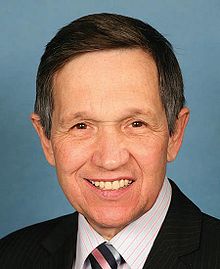
Representative Dennis Kucinich (Democrat – Ohio) is on the media circuit promoting his rather novel idea on how to “create” jobs for younger people who are trying to enter the work force but can’t because of the recession.
The Congressman has proposed legislation that would allow people to take voluntary early retirement at age 60 instead of age 62, as the law now stands.
Kucinich, who ran for the Democratic nomination for President in both 2004 and 2008, estimates that about 25% of those eligible to retire at age 62, or about 1 million people, would choose to take early retirement under his plan. He claims that this is a conservative estimate, since about 70% of those who can retire at 62 do so now.
These early retirees would, of course, collect social security earlier, after having worked fewer years and contributed less to Social Security. And then we’d have to assume that these workers would be replaced by the younger people now looking. And that they would generate the same tax revenues for the government that the early retirees did.
What a plan! Lock in higher costs, with no guarantee of any benefits. This is the kind of logic that put the U.S. into this pickle in the first place.
How does Mr. Kucinich propose to pay for this plan? Why, with government funds, of course! Specifically, with the “extra” unspent stimulus and TARP funds. This, despite the fact that he has spoken repeatedly about voting against the TARP funds because he opposes government interference in the private economy. But, hey, he goes on to say, “Since the money is lying around anyway, let’s use it!” You’d think tax revenues fall out of the sky!
I do not know which is worse, the hypocrisy or the ignorance. What folly! This man has absolutely no business talking about how to create jobs when he has no idea how the economy actually works.
Here’s an idea that is guaranteed to help the economy recover. Why doesn’tMr. Kucinich take voluntary early retirement!
How often does a great conference on an emerging subject attract local, national and global participants to a quiet corner of the UK? Not often, I suspect.
Nevertheless last Friday, 2010 February 26, it happened again at LikeMinds 2010! The first time it happened was in 2009 on October 16th. Back in February 2009, two people met having got to know each other using Twitter, the popular social media tool/service. Scott Gould is a Devon-based web and experience designer. Trey Pennington is an American social media and business consultant. They met in Exeter and set the date for a half-day event which became LikeMinds 09. A local conference centre was the venue. People came from far and wide to became part of the inaugural gathering. Afterwards, they knew that they’d started something and felt the need to repeat it.
This time, just over four months later. More came to LikeMinds 2010, in the same relatively small venue. The same loyal bunch of social media specialists came back and brought more with them. There was more buzz and activity. This time, it lasted a full day and was followed by a business-oriented summit event at a prestigious location.
It was good to be there. It was good to meet new people. It was good to get a real sense of what is going on in human social communication. And all of this in my local city of Exeter, Devon, England.
There is more to come on this conference! But to give you a flavour, here is the talk by Chris Brogan … after I’d had lunch with him!
And, I am sure, more LikeMinds conferences to come.
Growth in final GDP hides disturbing weaknesses in economy
The U.S. GDP grew at an annual rate of 5.9% in the last quarter of 2009 which may look good at first glance, but when we dig a little deeper, we find some concerns about the implications for sustainable growth. A large fraction of this reported growth came from businesses selling off accumulated inventories, which has more to say about past production than current. Exports were also a significant source of fourth quarter growth, driven in large part by a weak dollar.
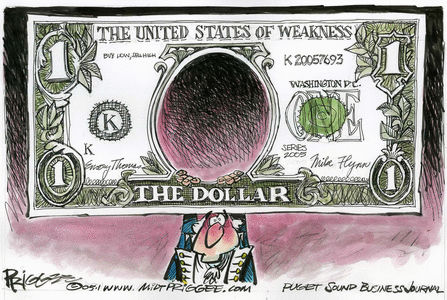
Weak dollar both helps and hurts the economy
Of course, a weak dollar is a very mixed blessing for the economy, and is hardly a sign of a strong or recovering economy.
Real residential fixed investment increased 5.0 percent, helped along by the extension of the home purchase tax credits from the federal government.
New housing helps spur growth in GDP
Real nonresidential fixed investment increased 6.5 percent. This figure nets out nonresidential structures, which decreased at a troubling rate of 13.9 percent, and equipment and software, which increased 18.2 percent. Investment in equipment and software consists of capital account purchases of new machinery, equipment, furniture, vehicles, and computer software; dealers’ margins on sales of used equipment; and net purchases of used equipment from government agencies, persons, and the rest of the world. Own-account production of computer software is also included, which is production performed by a businesses or government for its own use.
Again, the underlying figures show that those variables most associated with building a sustainable productive capital base for the economy – nonresidential fixed investment –are declining at an alarming rate. This, combined with a 9.7% unemployment rate and the specter of rising debt levels, energy prices, and taxes, paints a picture of a slow to non-existent recovery to a robust economy any time in the next year.
A friend on another site just posed this question.
Why is it that a recession is described as two or more successive quarters of “negative growth”, but being out of recession is just one quarter of (estimated) growth?
I felt emboldened to pen an answer as follows ….
In Britain, the definition of recession-emergence is from the same school of economics as growth predictions for next year (any year), which are always about 5 zillion% more than actually turns out to be the case.
Recession in Britain
The cunning idea is that future growth will be vast enough to cover the even vaster existing debts and commitments. And, of course, by the time we KNOW what the growth actually turned out to be, most people will have forgotten the predictions on growth from the financial and economic wizards running the country. That’s also one of the great things about a new mess or crisis; it always takes the mind off previous crises, which are likely to be ongoing but less in the media and therefore not to be bothered about too much.
This is, of course, in addition to the fact that growth in itself is incompatible with reducing global warming, but here we are getting a bit too technical.
Well, that’s how we do it in Britain anyway. How do you manage it over there?
by Chris Snuggs
A reply from a U.S. economist.
Hello there Chris!
Recession in the U.S. is also defined as two successive quarters of negative GDP growth. At least, that’s how its officially defined. And to add my answer to your friend’s question — either the economy is either in a recession — i.e., two or more consecutive quarters of negative GDP growth — or it isn’t, which means that the string of negative GDP growth rates is broken. And that only takes one quarter of positive growth.
Most of the economists I know personally tend to look at a bigger picture than the stated GDP figures, however. I focus on capital and labor utilization rates as I believe that they are more important measures of a well-functioning economy. The final GDP figures in both of our countries are national income accounting figures, and have all the weaknesses of any income statement variable. They are flow variables, which ignore the stock of economic wealth. For example, if you invest $100 this year in the stock market, and it grows in value by $20, only the $100 is counted. The increase in wealth is never captured in measures of GDP.
Another problem with current measures of GDP and GDP growth is that government spending is considered on par with private spending, which brings into question the sustainability of growth measures based on GDP, although President Obama and perhaps Prime Minister Brown are both fine with growth rates being fueled by large increases in government spending. Finally, a significant fraction of economic activity, like the value of work in the home — is not measured.
So, yes, the official measurement of GDP is all wrapped up in technicalities. But most economists I know pay little attention to it. They are more concerned with how well the economy is functioning, whether the growth is sustainable, and whether people who want to work can find work. If you are unemployed, the economy is in a recession, regardless of what the GDP figures say!
 The scene…






 Learning from Dogs