Category: Art

The art of stillness.

Another fabulous lesson we can learn from our dogs.

Stillness. It is a very simple, single word yet, somehow, it sounds as though it belongs to a different age. As though stillness is a very long way from the modern society that millions and millions of us subscribe to.

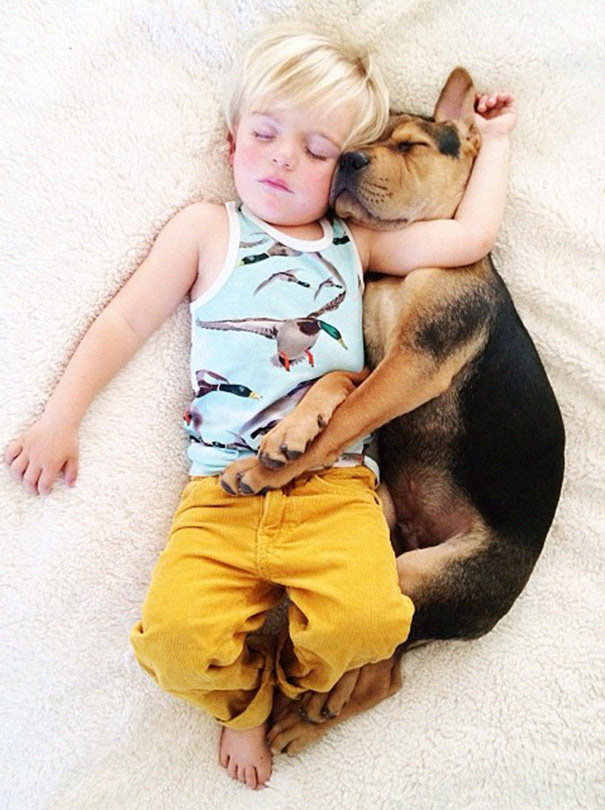
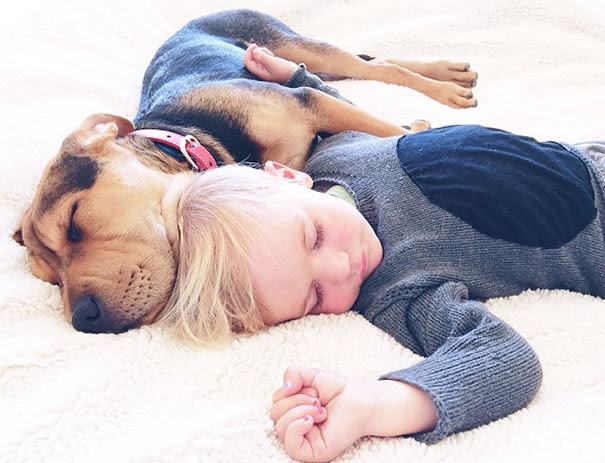
The dog is the master of being still. Being still, either from just laying quietly watching the world go by, or being still from being fast asleep. The ease at which they can find a space on a settee, a carpeted corner of a room, the covers of a made-up bed, and stretch out and be still, simply beggars belief. Dogs offer us humans the most wonderful quality of stillness that we should all practice. Dogs reveal their wonderful relationship with stillness.

Now watch this entrancing talk from Pico Iyer.

Published on Nov 26, 2014
The place that travel writer Pico Iyer would most like to go? Nowhere. In a counterintuitive and lyrical meditation, Iyer takes a look at the incredible insight that comes with taking time for stillness. In our world of constant movement and distraction, he teases out strategies we all can use to take back a few minutes out of every day, or a few days out of every season. It’s the talk for anyone who feels overwhelmed by the demands for our world.

Why you should listen.

Acclaimed travel writer Pico Iyer began his career documenting a neglected aspect of travel — the sometimes surreal disconnect between local tradition and imported global pop culture. Since then, he has written ten books, exploring also the cultural consequences of isolation, whether writing about the exiled spiritual leaders of Tibet or the embargoed society of Cuba.

Iyer’s latest focus is on yet another overlooked aspect of travel: how can it help us regain our sense of stillness and focus in a world where our devices and digital networks increasing distract us? As he says: “Almost everybody I know has this sense of overdosing on information and getting dizzy living at post-human speeds. Nearly everybody I know does something to try to remove herself to clear her head and to have enough time and space to think. … All of us instinctively feel that something inside us is crying out for more spaciousness and stillness to offset the exhilarations of this movement and the fun and diversion of the modern world.”

What others say

“[Iyer] writes the kind of lyrical, flowing prose that could make Des Moines sound beguiling.” — Los Angeles Times

Picture parade one hundred and eight

The last of the perfect puppy pictures.

Theo16


oooo

Theo17

oooo

Theo18

oooo

Theo19

oooo

For those of you that missed the first two sets of these puppy pictures, set number one is here and last week’s set is here.

You all take care out there.

Nothing to do with dogs, women or men!

Enough of this introspection!

Dear friend, Suzann, sent me the link to this video a few days ago, it’s just fabulous.

Here’s the description of what the video is about:

The KFPS Friesian Horse: beautiful, versatile, athletic, kind, willing, and able to do anything! May the world see that this breed is loved and enjoyed by all.  Too magnificent not to send on, you’ll love the music as well, beautifully played.

These horses were originally bred as “war horses” in the days of knights and armor. As armor got heavier, bigger horses were needed and the Friesian almost became extinct. They are black and are one of the most beautiful horses in stature as well as gait. What gorgeous animals! Just watching them becomes an emotional experience. Can you imagine what it would be like to ride one? Their manes and tails are the longest that I have seen and I noticed that when performing on grass, their hoofs do not kick up a divot, as they land flat footed. Creatures such as these are what makes this world so special. These horses are native to the Netherlands. Amazing Music is by E.S. Posthumus titled “Manju“.

The male of the species, Part One

Dogs, women and men.

I did warn you, my dear reader, at the end of yesterday’s post that my introspective mood continues!

Over today and tomorrow, I want to explore why we humans can be so incredibly clever, especially in a group sense, yet the males of our species find it so difficult to express themselves, and what that means for the future of humanity (at the risk of sounding a tad pompous).

More or less at random, a dip into yesterday’s selection of blogs brought to light some deeply disturbing items.

Professor William Even, Professor of Economics at the Farmer School of Business at Miami University was reported in The Conversation saying that:

As of 2014, there were approximately 39 million people aged 16-24 in the US, and 5.4 million of them were neither employed nor in school. That’s almost 14% of the age cohort, or more than two-and-a-half times the national rate of unemployment.

In that same bulletin from The Conversation, John Shepherd, a Professorial Research Fellow in Earth System Science at the University of Southampton in England, in writing about the challenges of directly removing CO2 from the atmosphere, stated (my emphasis):

A new paper in Nature Communications shows just how big the required rates of removal actually are. Even under the IPCC’s most optimistic scenario of future CO2 emission levels (RCP2.6), in order to keep temperature rises below 2℃ we would have to remove from the atmosphere at least a few billion tons of carbon per year and maybe ten billion or more – depending on how well conventional mitigation goes.

We currently emit around eight billion tonnes of carbon per year, so the scale of the enterprise is massive: it’s comparable to the present global scale of mining and burning fossil fuels.

Then Raúl Ilargi Meijer authored an item on The Automatic Earth blog, a blog that usually writes almost exclusively about money matters. His article was called: Power and Compassion. He opens his essay:

Time to tackle a topic that’s very hard to get right, and that will get me quite a few pairs of rolling eyes. I want to argue that societies need a social fabric, a social contract, and that without those they must and will fail, descend into chaos.

Then after referring to the European Union, he goes on to write (my emphasis):

Though it may look out of far left field for those of us -and there are many- who think in economic and political terms only, we cannot do without a conscious definition of a social contract. We need to address the role of compassion, morals, even love, in our societies. If Jesus meant anything, it was that.

There have been times through history when this subject would have been much easier to breach, but we today almost seem to think they are irrelevant, that we can do without them. We can’t. But in the US, people get killed at traffic stops every day, and in Europe, they die of sheer negligence. Developments like these will lead to ‘centers that cannot hold’.

In that part of the media whirlwind that we at the Automatic Earth expose ourselves to, virtually all discussions about our modern world, and what goes wrong with it, which is obviously a whole lot, are conducted in rational terms, in financial and political terminology.

But that’s exactly what we should not be doing. Because it’s never going to get us anywhere. In the end, let alone in the beginning too, we are not rational creatures. And if and when we resort to only rational terms to define ourselves, as well as our world and the societies we create in that world, we can only fail.

For a society to succeed, before and beyond any economic and political features are defined, it must be based solidly on moral values, a moral compass, compassion, humanity and simple decency among its members. And those should never be defined by economists or lawyers or politicians, but by the people themselves. A social contract needs to be set up by everyone involved, and with everyone’s consent. Or it won’t last.

How and why that most basic principle got lost should tell us a lot about where we are today, and about how we got here. Morals seem to have become optional. The 40-hour death struggle of Cecil the lion exemplifies that pretty well. And no, his is not some rare case. The lack of morals involved in killing Cecil is our new normal.

Let me now set the stage for what I want to write about tomorrow. And I’m going to do that by referring to a TED Talk that was recorded by historian and author Yuval Noah Harari. Here’s how that TED Talk was introduced:

Seventy thousand years ago, our human ancestors were insignificant animals, just minding their own business in a corner of Africa with all the other animals. But now, few would disagree that humans dominate planet Earth; we’ve spread to every continent, and our actions determine the fate of other animals (and possibly Earth itself). How did we get from there to here? Historian Yuval Noah Harari suggests a surprising reason for the rise of humanity.

Yuval Harari’s talk is based firmly on his thesis presented in his book: Sapiens: A Brief History of Humankind. (There’s a review of his book in The Guardian newspaper.) Namely:

The book surveys the history of humankind from the evolution of archaic human species in the Stone Age up to the twenty-first century. Its main argument is that Homo sapiens dominates the world because it is the only animal that can cooperate flexibly in large numbers. The book further argues that Homo sapiens can cooperate flexibly in large numbers, because it has a unique ability to believe in things existing purely in its own imagination, such as gods, nations, money and human rights. The author claims that all large scale human cooperation systems – including religions, political structures, trade networks and legal institutions – are ultimately based on fiction.

Other salient arguments of the book are that money is a system of mutual trust; that capitalism is a religion rather than only an economic theory; that empire has been the most successful political system of the last 2000 years; that the treatment of domesticated animals is among the worst crimes in history; that people today are not significantly happier than in past eras; and that humans are currently in the process of upgrading themselves into gods.

It is my contention that humankind’s evolution, our ability to “cooperate flexibly in large numbers”, is rooted in the gender differences between man and woman. A contention that I expand upon tomorrow.


Beware of the Dog – circa AD79

That very ancient relationship between man and dog.

The website Eye Witness to History has a lovely item on Mount Vesuvius:

On August 24, 79 Mount Vesuvius literally blew its top, spewing tons of molten ash, pumice and sulfuric gas miles into the atmosphere. A “firestorm” of poisonous vapors and molten debris engulfed the surrounding area suffocating the inhabitants of the neighboring Roman resort cities of Pompeii, Herculaneum and Stabiae. Tons of falling debris filled the streets until nothing remained to be seen of the once thriving communities. The cities remained buried and undiscovered for almost 1,700 years until excavation began in 1748. These excavations continue today and provide insight into life during the Roman Empire.

An ancient voice reaches out from the past to tell us of the disaster. This voice belongs to Pliny the Younger whose letters describe his experience during the eruption while he was staying in the home of his Uncle, Pliny the Elder. The elder Pliny was an official in the Roman Court, in charge of the fleet in the area of the Bay of Naples and a naturalist. Pliny the Younger’s letters were discovered in the 16th century.

If you are keen to read the full article then it may be found here.

My reason for quoting those opening paragraphs is because they offer a good historical introduction to another item from the BBC News website. That item is about a dog mosaic that is back on show after its restoration at Pompeii.

ooOOoo

Pompeii guard dog mosaic back on show

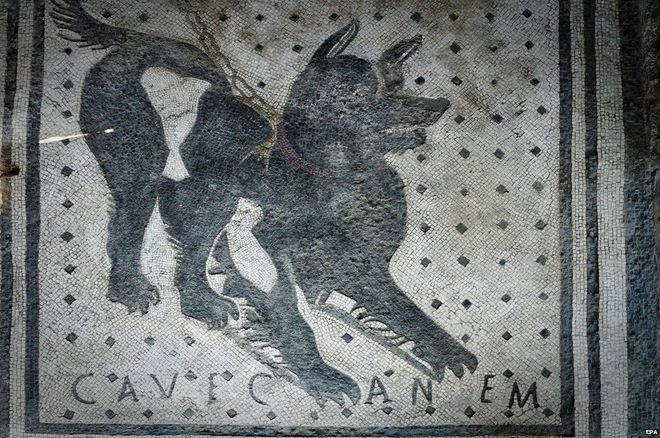
One of Pompeii's finest mosaics - a guard dog at the entrance to a villa.
One of Pompeii’s finest mosaics – a guard dog at the entrance to a villa.

A vivid Roman dog mosaic is back on show after restoration at Pompeii, despite Italy’s problems funding the historical site’s conservation.

A glass shield now protects the House of the Tragic Poet, where tourists can see the dog with the inscription “Cave Canem” – Latin for “Beware of the dog“.

Frescoes at the house’s entrance were also restored. Ash from a volcanic eruption buried Pompeii in AD79.

A staffing dispute caused long queues at Pompeii on Friday, in searing heat. Pompeii gives visitors an extraordinary insight into everyday life in ancient Rome because many buildings were protected from the elements under the thick blanket of ash from Mount Vesuvius.

_84512369_pompeiidogviewepa
The restored mosaic now has better protection.

The site, near the southern city of Naples, has suffered from funding problems for years. Staff unions at Pompeii have criticised a management reorganisation there.

The House of the Tragic Poet has some of Pompeii’s finest examples of interior decoration, including scenes from Greek mythology.

But the house’s owners remain unknown – they may have died in the eruption along with many other Pompeii citizens.

ooOOoo

Now we all know that the relationship between dogs and man goes way, way back before Pompeii but, nonetheless, it’s rather nice to see dogs commemorated in this way from 1,936 years ago.

A chance in love.

Our neighbourhood watch garage sale has Jean and me fully occupied for these next two days.

Plus much of yesterday afternoon was spent getting our ‘site’ all set up ready for today.

I have taken the opportunity of showing you two videos, one today and one tomorrow.

This was sent to me by Suzann and will melt your heart in a very big way.

►If watching the flowering of love could inspire love, then “The Story Of The Weeping Camel” would forever alter the world…

►The Story of the Weeping Camel.
Mongolian: Ингэн нулимс, Ingen nulims, “Tears of the Camel” is a 2003 German docudrama released internationally in 2004.

►During Spring, a family of nomadic shepherds in the Gobi Desert, South Mongolia, assists the births of their camel herd. The last camel to calve this season has a protracted labor that persists for two days. With the assistance and intervention of the family, a rare white bactrian camel (Camelus bactrianus) calf is born.
This is the mother camel’s first calving. Despite the efforts of the shepherds, the mother rejects the newborn, refusing it her milk and failing to establish a care-bond with it. The family resolve to secure the services of an indigenous ‘violinist’ to play the music for a Mongolian ‘Hoos’ ritual.

When repeatedly intoned the calming sounds and beautiful melody of the violin, the mother camel starts to weep, tears visibly streaming from her eyes. Immediately after the rite the mother and calf are reconciled and the calf draws milk from her teat.

►Added music: Sad Romance – Thao Nguyen Xanh

Picture parade one hundred and four.

The final set of these incredibly popular photographs.

Hiding in Plain Sight

Danny33

oooo

Danny34

oooo

Danny35

oooo

Danny37

oooo

Danny38

oooo

Danny39

oooo

Danny40

ooooDanny41

oooo

The first in the series was published here.

The photographs were sent to me by Dan Gomez, underlining the wonderful way that so much is shared in this funny old world of blogging. Thank you, Dan!

Dogs – What incredible companions!

Meet Lizzy The Dancing Dog and her Human Sandra Roth.

Last Saturday, I posted Let’s dance today!

It showed a dog dancing to music, or quite possibly, a dog scratching its back against a wall that someone had cleverly set to music.  The video had been sent to me by Chris Gomez.

Then Dan, a brother to Chris, and a close personal friend of mine for 35+ years, sent me the following. This is in a different league to Saturday’s little video. This raises questions as to how the dog was trained to perform like this? How long did it take? What’s the story behind the display?

All I could discover, from the blog Sun Gazing was, “This dog dance was performed at The Open European Championships and totally blew the crowd away.

Trust me, this is going to have you spellbound!

Enjoy!

If anyone can provide the answers to my earlier questions then Dan and I would love to hear from you.

Picture parade one hundred and three.

The penultimate set of Hiding in Plain Sight pictures.

Danny25


oooo

Danny26

oooo

Danny27

oooo

Danny28

oooo

Danny29

oooo

Danny30

oooo

Danny31

oooo

Danny32

oooo

That’s it for this week. All the very best to you all.

Let’s dance today!

What better way to celebrate July 4th!

(The following was sent to me by Chris Gomez!)