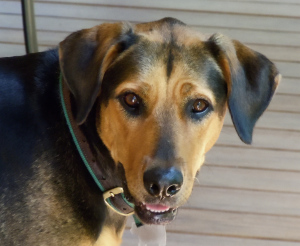
Recently, she posted a beautiful poem to commemorate the nine years of having Susami in their lives. It is republished here with Bela’s kind permission.
ooOOoo
There is a presence, here
and now; the bellows of breath,
warmth of blood, the feeling,
even if imagined,
that we are connected, one
to the other.
We each have our memories,
after all.
Your passing removes that utterly,
and somehow the same hand
lying on the same fur and flesh
will sense void, not even spirit,
not even that.
One can forgive the athiest,
or even theist their doubts,
props, religions. For this
at least is real:
This. Here. Now.
Tomorrow it will be gone.
And no matter in visions I linger
in the numinous; despite
in the garden I witness the alchemy
of decay transforming
into green and vibrant,
the loss of a loving companion
is egregious, indeed.
ooOOoo
Bela explained how Susami came to them:
This sweet being has been with us only nine years, since she was about 10-12 weeks old. Her previous steward, a multiply-pierced and -tattooed young woman, had to find a home for her. We were on our way to the east coast to deal with some business, and I had taken our good friend Kevin with me to the local feed store to get the horse stocked up on alfalfa pellets (it was during a long drought). I saw the pup with a bandage on her leg before, and asked the gal what was wrong with her. I later learned from the store owner (who thanked me many, many times for giving Susami a good home) that the dog had been severely abused. (She never did tell me specifics, so I was left to wonder.) The young woman tried her best, but there were forces beyond her control in her environment. When I saw Susami again, we had to take her, but how? I asked Kev if he would watch yet one more animal for us while we were gone, and he happily agreed! So she joined our chocolate Lab who we brought with us to Hawaii from northern Maine (a Non-rescue). He was Thrilled to have that little creature’s companionship.
Going to close with the exquisite words from Suzanne Clothier that Dr. Jim Goodbrod used in the foreword to my book:
There is a cycle of love and death that shapes the lives of those who choose to travel in the company of animals. It is a cycle unlike any other. To those who have never lived through its turnings or walked its rocky path, our willingness to give our hearts with full knowledge that they will be broken seems incomprehensible. Only we know how small a price we pay for what we receive. Our grief, no matter how powerful it may be, is an insufficient measure of the joy we have been given.
(Suzanne Clothier: Bones Would Rain from the Sky: Deepening Our Relationships with Dogs.)
Suzanne’s words cannot be bettered when it comes to the death of a beloved dog.
Huge thank you to Producer John Letz and the whole crew.
A week ago last Saturday Jean and I travelled down to Ashland and to the studios of Rogue Valley Community Television (RVTV). This is how RVTV describe themselves:
Based at the Southern Oregon Digital Media Center, RVTV provides access television and streaming media services for the citizens and local governments of Jackson and Josephine Counties. Please visit rvtv.sou.edu for more information.
John Letz, the Producer for Adventures in Education and Ramping Up your English, had read my book and thought it might make a good programme.
I’m both delighted and flattered to say that the programme is now available and published under a Commons Creative Licence. Here it is!
My dear, sweet wife is struggling with a personal issue that I am not going to share with you dear readers; for obvious reasons. The issue is not to do with our relationship, not at all, but part of the journey of getting a little older day by day.
Yesterday morning, sitting up in bed after breakfast, accompanied by many of our dogs fast asleep around us, Jean had a bit of a weepy session. Today Jean and I are off to see a medical consultant to ascertain the nature of the issue. Not going to say any more than that.
So back to yesterday morning, me reflecting on Jean’s tears, and me musing about what to write for today’s post. There in my email inbox was an item in the latest Big Think newsletter that was perfect. It was called The Science behind Maintaining a Happy Long-Term Relationship and it was by Dr. Helen Fisher, senior research fellow at the Kinsey Institute.
Here is how that article by Dr. Fisher opens:
Plenty of people are pessimistic about the state of relationships in society. Dr. Helen Fisher, senior research fellow at the Kinsey Institute, isn’t one of them. She sees trends like extended periods of cohabitation before marriage and a persistent fear of divorce not only as interrelated, but also signs of a healthy change in attitude toward love. While marriage was once the start of a long-term relationship, she says, today it’s the finale. And that’s a good way to cope with a brain whose primitive regions are driven intensely toward short-term relationships. Dr. Fisher also explains how to maintain novelty, the fuel of romantic love, and how to be aware of the brain regions that affect satisfaction in a relationship.
Now I don’t have permission to republish the full transcript but I see that the video, that was included in the Big Think article, is on YouTube.
I count myself incredibly lucky to have met Jean back in December, 2007 and that out of that meeting came a loving relationship that is more beautiful than words. Well more beautiful than my words so I will let E. E. Cummings say it how it should be said.
The way we can reach out to others in these modern times.
A fellow local author, Constance Frankland, who has been mentioned previously here on Learning from Dogs followed up last Sunday’s Picture Parade with a comment on my Facebook page:
You might enjoy the site of Dr. Charles Bergman. I was privileged to take writing classes from him when his features were just breaking into Audubon and National Geographic. He was researching the thought-to-be-extinct Trumpeter Swan when survivors were found. (“Wild Echoes: Encounters With the Most Endangered Animals”) http://www.charlesbergman.com/
It was then the matter of a moment to hop across to that website address and read this on the home page:
Charles Bergman
A writer, photographer and speaker who lives in the beautiful Pacific Northwest and is a prof at Pacific Lutheran University in Tacoma, Washington.
He’s twice been a Fulbright Scholar in Latin America–Mexico and Ecuador–traveled extensively around the world, especially in Latin America from Mexico to Tierra del Fuego. He writes and publishes extensively on animals, nature, and sustainability–with many cover stories in such magazines as Smithsonian, Audubon, All Animals (Humane Society),, Defenders, and many more. His photographs accompany his articles. He has written three books, and has won the Washington State Book Award, Southwest Book Award, and the Benjamin Franklin Book Award. He was a finalist for the PEN USA Literary Award.
He loves animals and wildlife of all kinds, and has developed a new-found love for Antarctica and Africa.
There seemed to be many interesting articles & essays on his site and despite the fact that Mr. Bergman is currently in Uganda, his reply to my request for permission to republish some of his posts came through promptly:
Greetings from Uganda! I’m here working in the Uganda Wildlife Education Center, back shortly. Yes, you may certainly republish my materials. I’ll be very interested to follow the process.
Warmly,
Charles Bergman
You can count on me picking out some of Professor Bergman’s writings to share with you soon.
This reaching to others, friends and strangers, is a wonderful aspect of present times.
Yesterday, a wonderful number of readers ‘Liked’ my set of photographs on the theme of being a wildlife photographer. Thus it was providential, when deliberating on what to write for today’s post, to see that George Monbiot had published an article covering his recent interview with Sir David.
Before republishing that interview, let’s take a look at the man; Sir David that is!
Wikipedia has a comprehensive and fulsome description of him, that opens, thus:
He is best known for writing and presenting the nine Life series, in conjunction with the BBC Natural History Unit, which collectively form a comprehensive survey of animal and plant life on the planet. He is also a former senior manager at the BBC, having served as controller of BBC Two and director of programming for BBC Television in the 1960s and 1970s. He is the only person to have won BAFTAs for programmes in each of black and white, colour, HD, and 3D.
From across YouTube, Twitter and Facebook, we’ve taken your comments during #AttenboroughWeek and made this video as a thank you to everyone who got involved. Click on the annotations to see each of the clips in full.
Now on to the George Monbiot interview, republished here with Mr. Monbiot’s kind and generous permission.
ooOOoo
Rare Specimen
23rd January 2016
My interview, in his 90th year, with Sir David Attenborough
By George Monbiot, published in the Guardian 23rd January 2016
You cannot meet David Attenborough without reflecting on the lottery of life. He bounces into the room unaccompanied, a little stiff in the lower back perhaps, but otherwise breezy and lithe. He is sound in wind and limb, vision and hearing, his eyes sparkle, his face is scarcely rumpled by time. Yet in three months he will celebrate his 90th birthday.
While other people’s worlds tend to shrink with age, his seems to expand. His curiousity ranges as widely as ever. His ability to understand and assimilate new information seems unabated. “Oh, I forget things,” he claims. When I press him for examples, he tells me, “Well, where I put my glasses, I had them about three minutes ago and they have simply evaporated, they’ve dematerialised. Oh yeah, and I forget engagements.”
But these, surely, are afflictions suffered by anyone immersed in the world of ideas. He has no diffulty remembering the things that fascinate him. When I ask him about his new project, his body bundles up with excitement.
“Luminous earthworms! Did you know about luminous earthworms? Aaah, aaah, yes, very interesting. I’m doing a thing on bioluminescence … and with a little research we discovered that there are earthworms in France that are luminous – in the earth! Why? Yes, why?! Well at the moment I am just thinking about it. As you well know there’s a gene for luminosity and it’s very widespread, and so you would like to suppose that it has some antiquity. So maybe luminosity was a by-product of digestive processes or energy processes or something.
“And if it is, the exciting thing is – what about all those graptolites, what if they were luminous?! In which case, now you suddenly realise that trilobites have bloody good eyes, so maybe they were there too! Wow!” (Graptolites and trilobites are long-extinct marine animals).
I mention his latest film, which will air on Sunday, about the excavation and reconstruction of the skeletons of Titanosaurs, the biggest terrestrial animals known to have walked the Earth. Why, I ask, do dinosaurs exert such a grip, especially on the minds of children?
“Partly because nearly all the adults have got it wrong. It’s one of the easiest subjects for a kid – or it was when I was a kid – for you to expose your parents, because you had just read the new cigarette card and there was a name there, a polysyllabic name, your parents had never heard of.”
And there he still was, I realised, the boy with his cigarette cards, his excitement about creatures that lived many millions of years ago undimmed by the passage of mere decades.
So this is what must have happened. On one of his early expeditions through a remote tract of rainforest, he stumbled across the elixir of life. He has been hoarding it ever since and surreptitiously sipping a little every day. Either that, or he is simply the luckiest man alive: fit, bright, relevant, in love with life, the last man standing.
He has the decency to be aware of his luck. “People sitting in corners doing nothing aren’t there because they want to sit in the corner doing nothing. They would much rather be doing [things]. And I am lucky enough to be able to do them. It would be very ungrateful to have that facility and not use it.” He has, of course, no intention of retiring.
There is only one lifeform he is reluctant to discuss, the scientific curiosity known as Sir David Attenborough. He created a powerful sense, when talking, of intimacy and candour, leaning in, holding my gaze, twinkling and gurning, speaking in his confidential whisper. But when I came to read the transcript of our interview I found that what had felt like frank confession was nothing of the kind. What he said with his body bore no relation to what he said with his words.
I pressed him several times on an issue with which I have long been struggling. How do those of us who love the natural world cope with its loss? He must have seen more than his fair share of devastation.
“Oh yes, of course. You go to Borneo and see oil palms everywhere where there was forest. You see people everywhere where there weren’t people.”
“And how does it affect you, seeing those changes?”
“Well you feel apprehensive for the future, of course you do.”
“So how do you cope?”
“I don’t have a rosy view of life, of the future, I look at my grandchildren and think ‘what are they going to have to deal with?’, of course I do. How could you not?”
But what about the emotional impact? Does he not get depressed? Does he have a mechanism for avoiding depression? He answered by bouncing the issue onto someone else.
“I once asked exactly the same question of Peter Scott [the great British conservationist, who died in 1989]. And he said, ‘Well you can only do what you can do.’ So what I do is what I can, but I wish to goodness I had done a tenth of what Peter did.”
While his self-deprecation is charming, it also seems defensive. I pictured those two quintessentially English men stroking their chins and repeating “you can only do what you can do” to each other, and thought of a scene in Monty Python’s The Meaning of Life. An army captain pays a call on one of his men, who is lying in bed, nonchalently reading a book. “What’s all the trouble, then?”. “Bitten, sir. During the night”. “Hmm. Whole leg gone, eh … Any idea how it happened?”. “None whatsoever. Complete mystery to me. Woke up just now, one sock too many.” Monty Python made their television debut on BBC2, commissioned by the controller at the time, a certain David Attenborough.
When talking in general terms, he uses the word “I”. When asked to talk about his feelings, he says “you”. Some of this is perhaps generational: it was once considered vulgar to discuss such matters. But perhaps his great fame has also obliged him to develop a carapace. I asked whether his public life has blurred the boundaries of his private self.
“There has always been the private and the public thing in you, in everybody”, he replies. “You are different things to different people, to your children, to your television producer.”
Can he go anywhere in public without being mobbed?
“I have to confess the ubiquity of the selfie is, er – On occasion when they say ‘do you mind’, I say ‘well, I am off duty at the moment’, and they say ‘oh are you?’, by which time I’m three yards down the road. But I do have to remember that they are the people who … listen to me, you know, and so you try not to be rude.”
I asked him if he ever gets lonely. His wife, Jane Oriel, died almost 20 years ago.
“Hmm? Oh. My daughter lives in the same house as me now and has done for many years. So once a day I see her, she runs my business affairs and, you know, I’m very lucky.”
He is just as discreet about the politics surrounding his work. On the day I met him, the controller of BBC2 and BBC4, Kim Shillinglaw, lost her post. He was plainly delighted, chuckling and winking and grinning when he asked me whether I had read that morning’s news. But he was careful to say nothing quotable. Television producers I know expressed intense frustration at her instant and unexplained dismissal of programmes they proposed on environmental themes.
But the problem, as I perceive it, is much wider than that: has there not been a systemic failure by television to cover the great crisis of our age: the gradual collapse of the Earth’s living systems?
“I am absolutely certain that the general public at large is more aware of the natural world than it was even before the industrial revolution,” he replies, “and that people are well informed about not only what the world contains but the processes that go on. Television has made a contribution to that. … I greatly regret the fact that there are no or very few regular – ”
He stops himself, and plunges into a more general discussion of scheduling. Surely, I persist, there’s a real problem here? Entire years have passed without a single substantial programme on environmental issues.
“Well,” he says, more crisply than at any other time in the interview, “you’ll have to take that up with the controllers.”
I suggest that his own interest in the state of the world appears to have intensified in recent years.
“That’s not an interest. I wish I didn’t have it. I wish there was no need to have it. It’s not an interest, it’s an obligation.”
But he has surely been more prominent as an environmental voice in the past twenty years than he was before?
“Well yeah, and that is very simple in that I have been in the BBC all my working life, practically, and you knew very well … that if you said something, just because you are on the damn box people thought it was true and you’d better be bloody well sure that it is true.”
(I used to curse this reticence, willing him to get off the fence and denounce the destruction of all he loved.)
He explains that his views on climate change crystallised when he attended a lecture – he could tell me when it was if he had his diary to hand – by the president of the US National Academy of Sciences, Ralph Cicerone. After that, he made two programmes, called Are We Changing Planet Earth? and Can We Save Planet Earth?
Attenborough is not just a master of the art of television, but also one of the medium’s pioneers, producing programmes almost from its launch in this country, and guiding the development of some of its treasured strands, first as controller of BBC2 (from 1965 to 1969), and then as the BBC’s director of programmes (until 1973). Has he helped to create a monster?
“Well it depends how you define a monster. And are all monsters malign?”
Has it not encouraged us to be more sedentary, I ask: to spend less time engaging with the world about us? He laughs and winks: “And we gave up sitting in pubs for three or four hours a day! How awful!”. Would he lay any ills at the door of television? “Oh yes, of course. Adipose tissue.” Anything else? “What you might call visual chewing gum, in that it stops you thinking about anything else. But then I feel that about music. I mean I cannot understand how people want to go round with -” he mimes a pair of headphones and shifts the conversation onto a safer subject.
I was packing my things after saying goodbye when suddenly he sprang back into the room, this time wearing his glasses and holding a small leather filofax. “I’ve found the details of that lecture by Ralph Cicerone. I thought you’d want to know.” He showed me the address and the date: 2004. The old scientific habit – record your facts, check your facts – had not deserted him. As I marvelled at his recollection that he had left something hanging, and his determination to resolve it, this remarkable specimen of life on earth skipped away to his next appointment.
So let me continue on a little more by offering a short clip of Sir David as millions will have seen him from the wonderful animal partnerships BBC series.
Then it’s only natural for this blog to offer this item:
Then I am going to close today’s post by presenting a video that was first shown in this place back in September 2012.
If you need a reminder of how beautiful our planet is (and I’m sure the majority of LfD readers don’t require that reminder) then go back and watch David Attenborough’s video and voice-over to the song What a Wonderful World. This short but very compelling video shows why the planet is so worth protecting. Enjoy!
So make a diary note to celebrate Sir David’s 90th birthday on May 8th.
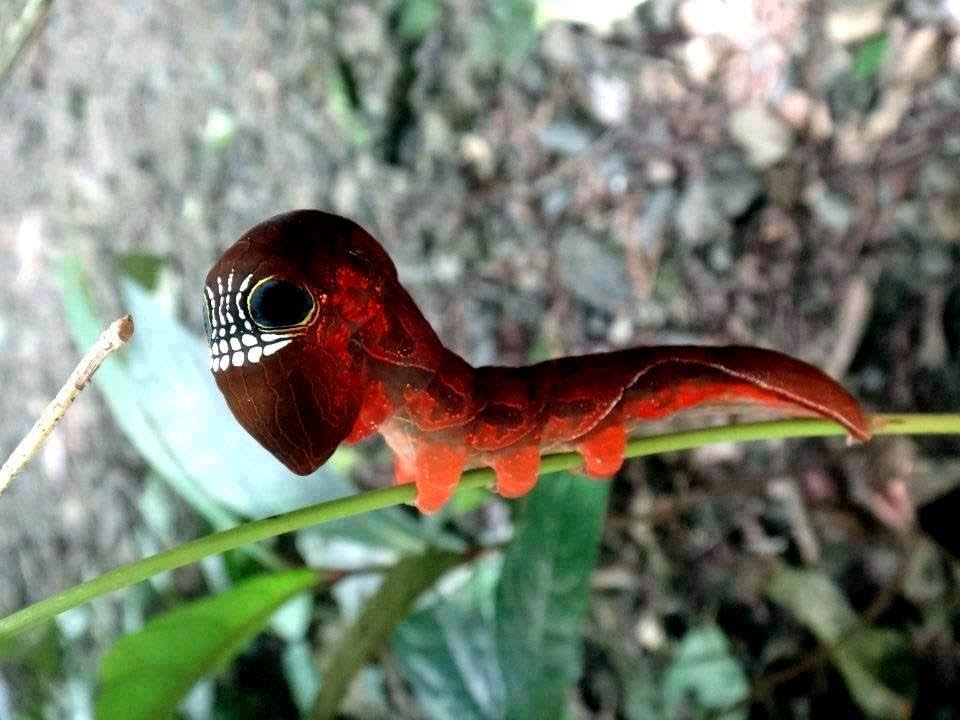
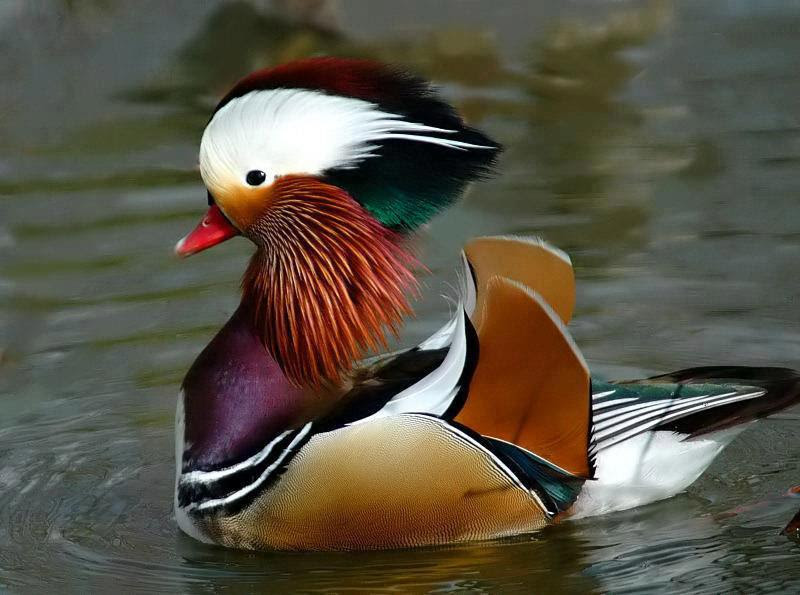
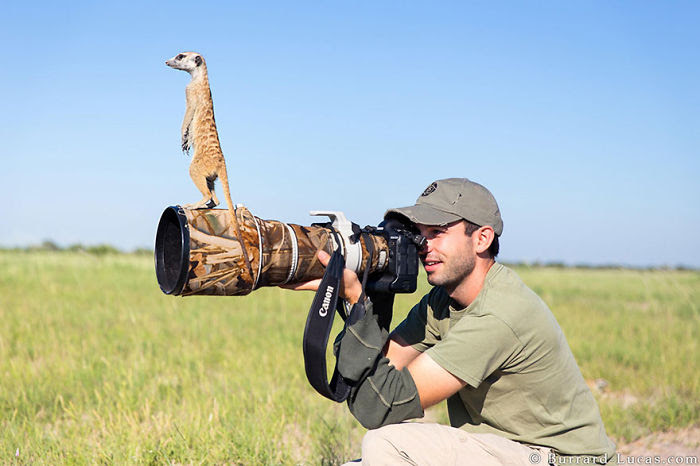
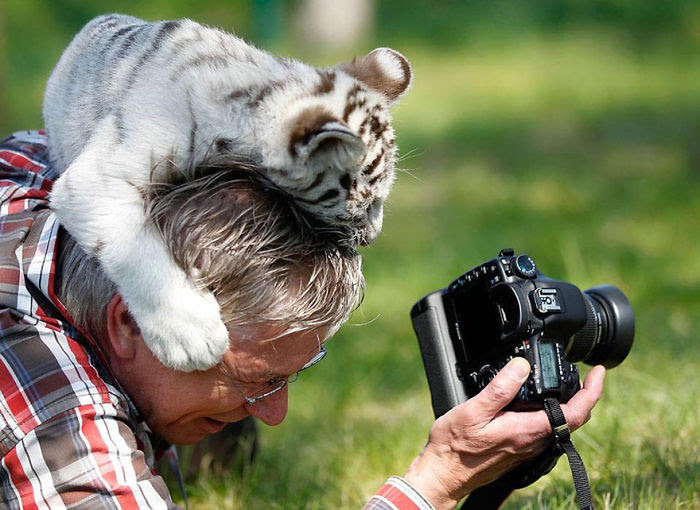
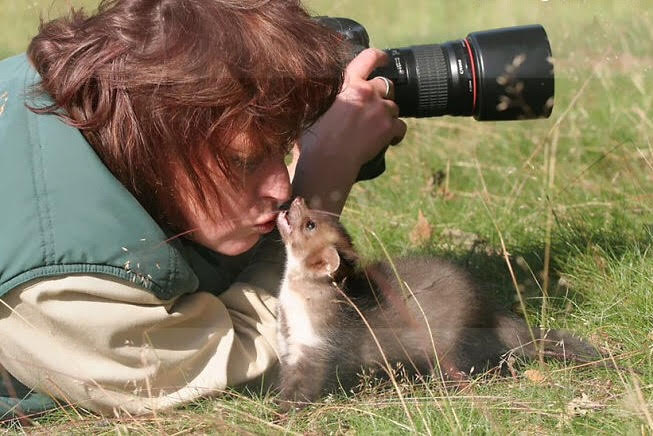
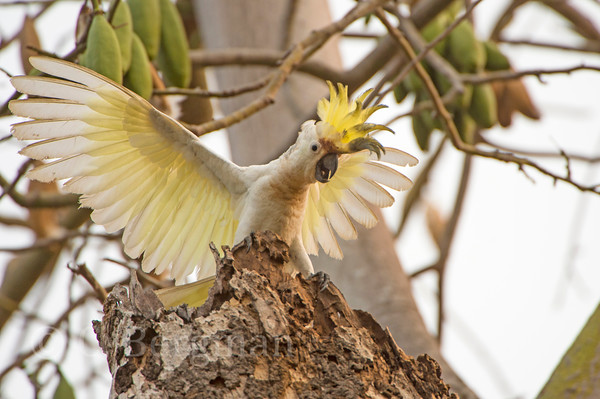
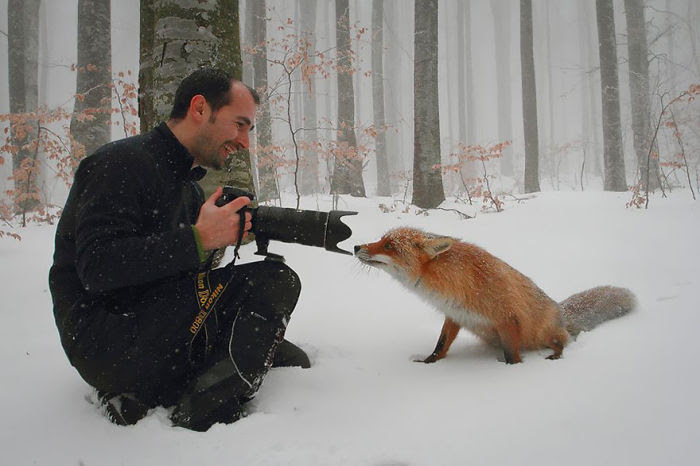
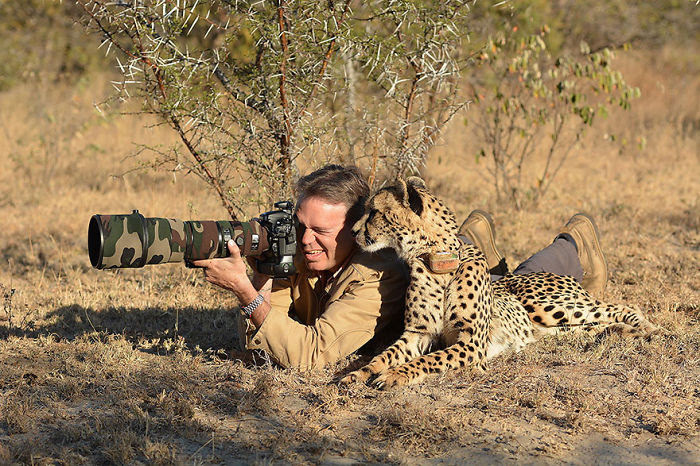
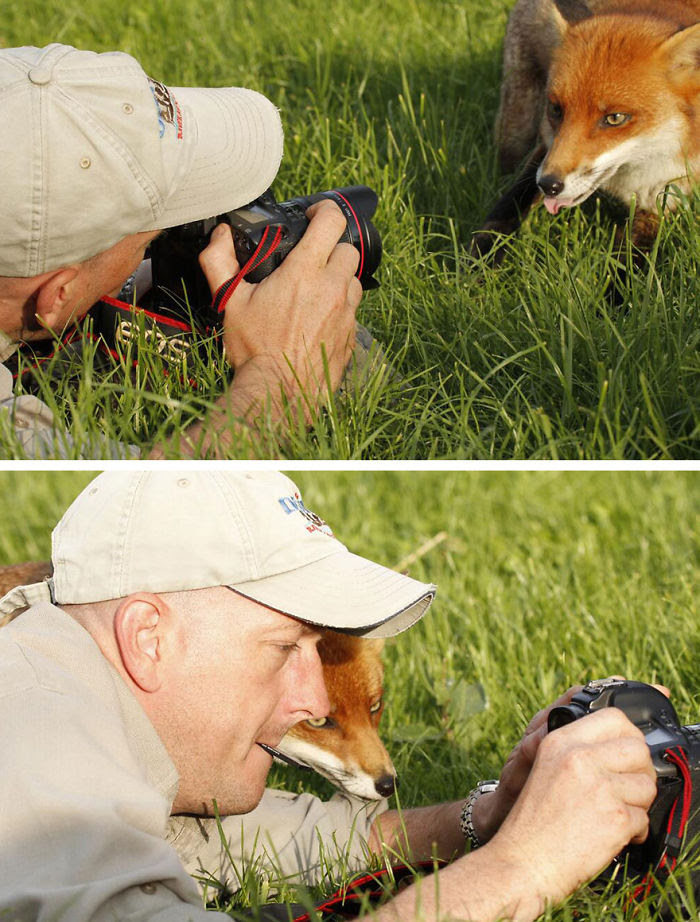
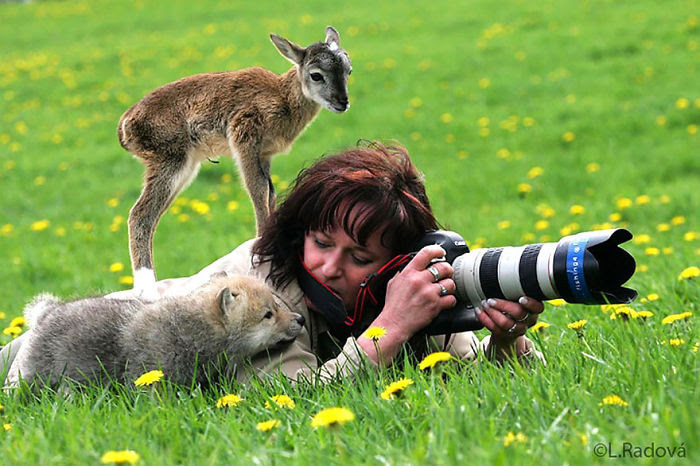
Why Being a Wildlife Photographer Is the Best Job in the World
These photographs were originally sent to me by Marg from Tasmania and they are just wonderful. Upon querying with Marg where they originally came from she found the source on a blog site called deMilked. That site explained:
You have to really love animals to go into nature photography. After all, it requires more patience to catch some deer in your lens than to photograph a mountain. Mountains don’t run away! Some animals don’t run either. In fact, some of them are really curious and come closer to check out the photographer. Quis custodiet ipsos custodes? Apparently, foxes and squirrels.
So here is the first batch of these gorgeous photographs.
Then the second is a video that was brought to my attention thanks to Neil in South Devon. As Neil so rightly said, “Leaving aside the captions it’s quite moving….”. (And, trust me, believers and non-believers alike, you are going to weep from start to finish, just as Jean and I did!)
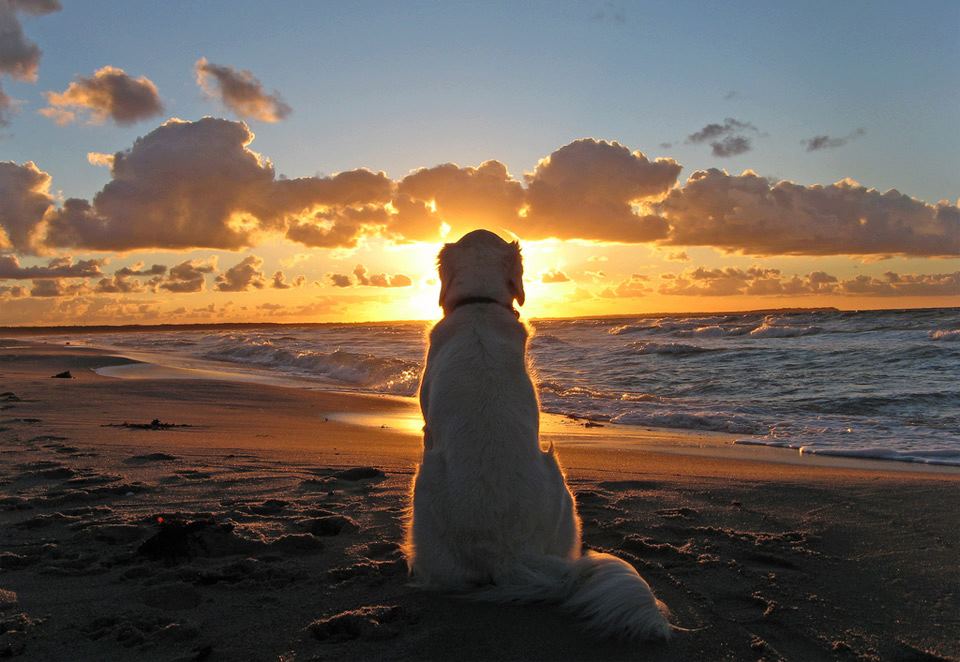
In a world where so much is so utterly screwed up it is the most blissful miracle that we have our dogs!




 Learning from Dogs