Category: Animal rescue

More on that nose!

An article in The Guardian is worth highlighting.

I have long been an admirer of The Guardian newspaper way back before I became a US resident. Thus an article that appeared on the website of The Guardian US newspaper seemed perfect for a mention in this place. It was an article entitled Cadaver dogs: attending camp with the canines trained to smell death and written by Liz Lucking.  Here’s a tiny extract from the article:

A dog’s sense of smell is estimated to be somewhere between 100 and 1,000 times greater than a human’s, depending on the breed. But despite their formidable noses, these dogs still need assistance, direction and training to reach their full potential.

The Penn Vet Working Dog Center does exactly that. Founded in 2007 and part of the University of Pennsylvania, the training centre and research program is dedicated to helping advance the success of working dogs.

I then went across to the Penn Vet Working Dog Centre website that was full of interesting information, including details of their Internships, Externships & Fellowships. So if that strikes a chord with a reader then that’s great.

That Guardian article also mentioned the American Rescue Dog Association and their website is full of fabulous information, as this extract from their welcome page endorses:

The American Rescue Dog Association® (ARDA®) is comprised of highly skilled volunteer search and rescue units across the United States that operate in conjunction with local law enforcement or other applicable emergency services agencies to assist in the location of missing persons. ARDA units provide specially trained dogs to locate missing persons in wilderness, disaster, human remains and water search and rescue/recovery missions. Each member unit is required to adhere to the Association’s rigid standards and undergo a rigorous two-day field evaluation every three years to ensure these standards are being maintained.

Units are available 24-hours a day to respond to requests for services from applicable local, state or federal responsible agencies.

Our search and rescue canine teams deploy in many circumstances, at several levels, at no cost to Federal and Local departments. ARDA resources operate solely as volunteers, and rely on donations for our continued operations.

Finally, searching YouTube for ARDA produced the following.

Another day: Another example of what our fabulous dogs provide to humans.

Seeing the truth in our mirror.

A sombre reflection on the killing abilities of man.

I was in two minds as to whether to post this today for it is certainly a grim reminder of the less desirable aspects of our species.

In the end, I decided to so do because it needs to be shared and if it changes the mindset of just one person it will have been worthwhile. I was originally seen by me on the EarthSky blogsite.

ooOOoo

Want to see Earth’s super predator? Look in the mirror.

Our efficient killing technologies have given rise to the human super predator. Our impacts are as extreme as our behavior, says study.

Rope trawl for midwater trawling. Photo credit: NOAA

Extreme human predatory behavior is responsible for widespread wildlife extinctions, shrinking fish sizes and disruptions to global food chains, according to research published in the August 21 edition of the journal Science these are extreme outcomes that non-human predators seldom impose, according to the article.

Lead researcher Chris Darimont is a professor of geography at the University of Victoria. Darimont said:

Our wickedly efficient killing technology, global economic systems and resource management that prioritize short-term benefits to humanity have given rise to the human super predator. Our impacts are as extreme as our behavior and the planet bears the burden of our predatory dominance.

A coastal wolf is hunting salmon in British Columbia, Canada. Photo credit: Guillaume Mazille

The team’s global analysis indicates that humans typically exploit adult fish populations at 14 times the rate than do marine predators. Humans also hunt and kill large land carnivores such as bears, wolves and lions at nine times the rate that these predatory animals kill each other in the wild.

Researchers noted that in some cases, dwindling species of predatory land carnivores are more aggressively hunted for trophies, due to the premium placed on rare prey.

The result of human activity on wildlife populations is far greater than natural predation. Research suggests that socio-political factors can explain why humans repeatedly overexploit. Technology explains how: Humans use advanced killing tools, cheap fossil fuel, and professional harvesters – like high-volume commercial fishing fleets – to overcome the defensive adaptations of prey.

Humanity also departs fundamentally from predation in nature by targeting adult quarry.Co-author Tom Reimchen is a biology professor at University of Victoria. He said:

Whereas predators primarily target the juveniles or ‘reproductive interest’ of populations, humans draw down the ‘reproductive capital’ by exploiting adult prey.

During four decades of fieldwork on Haida Gwaii, an archipelago on the northern coast of British Columbia, Reimchen looked at how human predators differ from other predators in nature. Reimchen’s predator-prey research revealed that predatory fish and diving birds overwhelmingly killed juvenile forms of freshwater fish. Collectively, 22 predator species took no more than five per cent of the adult fish each year. Nearby, Reimchen observed a stark contrast: fisheries exclusively targeted adult salmon, taking 50 per cent or more of the runs.

The authors conclude with an urgent call to reconsider the concept of “sustainable exploitation” in wildlife and fisheries management. A truly sustainable model, they argue, would mean cultivating cultural, economic and institutional change that places limits on human activities to more closely follow the behavior of natural predators. Darimont said:

We should be protecting our wildlife and marine assets as an investor would in a stock portfolio.

Enjoying EarthSky? Sign up for our free daily newsletter today!

Bottom line: According to research published in the August 21, 2015 edition of Science, extreme human predatory behavior is responsible for widespread wildlife extinctions, shrinking fish sizes and disruptions to global food chains.

Read more from the University of Victoria

ooOOoo

Chris Darimont really put his finger on the spot in my opinion when he was quoted,”We should be protecting our wildlife and marine assets as an investor would in a stock portfolio.”

Going to close today’s post by repeating what is presented on the Welcome page of Learning from Dogs, namely:

As man’s companion, protector and helper, history suggests that dogs were critically important in man achieving success as a hunter-gatherer. Dogs ‘teaching’ man to be so successful a hunter enabled evolution, some 20,000 years later, to farming, thence the long journey to modern man. But in the last, say 100 years, that farming spirit has become corrupted to the point where we see the planet’s plant and mineral resources as infinite. Mankind is close to the edge of extinction, literally and spiritually.

Dogs know better, much better! Time again for man to learn from dogs!

My argument rests!

That most precious bond.

Why we turn to dogs when disaster strikes.

With the memory of Hurricane Katrina refreshed in our minds as we acknowledge the recent passing of the tenth anniversary of that ghastly disaster, a link to an item from May, 2013 that was published on Mother Nature Network seems perfect for this place.

ooOOoo

Why we turn to dogs when disaster strikes

From aiding search-and-rescue missions to lending a shoulder to cry on, man’s best friend can often be found at the site of tragedy.

By: Laura Moss, May 21, 2013.

Photo: K-9 Parish Comfort Dogs/Facebook

Disaster relief is flooding into Moore, Okla., but along with volunteers and supplies, there are dogs.

Some, including the 11 canine disaster search teams trained by the Search Dog Foundation or SDF, are scouring tornado debris for survivors. Others are en route to comfort the devastated city’s residents. Lutheran Church Charities, whose therapy dogs have worked with victims of the Boston bombings and the Newtown, Conn., shootings, is sending six dogs from its Chicago headquarters.

When disaster strikes, man’s best friend is often there, working on the frontlines of rescue efforts, as well as behind the scenes, helping people cope with trauma and loss.

Super sniffers

Experts estimate that one search-and-rescue (SAR) dog can accomplish the work of 20 to 30 human searchers. Because of these unparalleled abilities, the number of trained SAR dogs has been rising across the United States.

Dogs make efficient searchers due to their superior vision, hearing and sense of smell. A dog’s nose is about 100 times more sensitive than a human nose, and SAR dogs are trained to locate human scents amid countless other smells. They track our scents by the 30,000 to 40,000 dead skin cells we drop every minute.

“Dogs aren’t miracle workers, but their noses are so precious,” said SDF founder Wilma Melville. “They can find those people who survived a horrific ordeal.”

Air-scent dogs are trained to work in specific types of terrain. Some search in wilderness settings while others search urban environments, which often can involve scouring Moss2collapsed buildings.

Because they must navigate unstable terrain, urban SAR dogs are some of the most highly trained canines. The only national standards for such dogs are the Federal Emergency Management Agency’s certification standards for urban disaster work. Currently, fewer than 100 dog-handler teams in the U.S. have this certification.

In addition to air-scent dogs, there are dogs taught to seek out both skin cells and the smell of human decomposition. During major disasters, such as the 1995 Oklahoma City bombing and the 2001 collapse of the World Trade Center, both air-scent dogs and cadaver dogs were used to search for people.

This caused problems for SAR dogs because they became discouraged when they found only dead bodies. At both Oklahoma City and Ground Zero, handlers hid in rubble so that dogs could occasionally find a living person. The dogs’ desire to elicit a response from a found person may be a result of their training, which involves seeking feedback and rewards, but experts say it could also speak to a deeper connection with humans.

Man’s best friend

When disasters occur, dogs do much more than just aid search-and-rescue missions. They’re often there to provide a source of comfort for us in ways that only an animal can.

In an interview with American Thinker, Debra Tosch, executive director of SDF, explained how her SAR dog Abby was able to console a firefighter at Ground Zero. “When someone was found, work would stop, and I watched as the tears rolled down the firefighters’ faces. I remember one firefighter who hugged Abby and buried his face in her neck after just finding out a fellow firefighter was found,” she said.

Research show that petting dogs can lower anxiety, regulate breathing and decrease blood pressure, and a Japanese study found that simply looking at a dog can increase Moss3oxytocin levels. Oxytocin is a chemical released by the pituitary gland that’s associated with human bonding and affection.

But while the firefighter may have found comfort in Abby’s presence, was the dog able to empathize? Research says it’s very likely.

A 2012 study at Portugal’s University of Porto found that dogs yawn even when they hear only the sound of a person yawning, providing strong evidence that dogs are able to empathize with us.

And a study at the University of London Goldsmiths College found that dogs comforted people — both their owners and strangers — when the person pretended to cry.

“I think there is good reason to suspect dogs would be more sensitive to human emotion than other species,” Custance told Discovery News. “We have domesticated dogs over a long period of time. We have selectively bred them to act as our companions. Thus, dogs that responded sensitively to our emotional cues may have been the individuals that we would be more likely to keep as pets and breed from.”

ooOOoo

Time and time again, the facts support what the vast majority of those who care for and love dogs truly know: the bond between dog and human is the most special that there has ever been between an animal and mankind.


I’ll lead, you follow Mr Goose.

Stories like this are wonderful – more please!

This needs no further introduction from me other than to say that this gorgeous story is from Mother Nature Network.

ooOOoo

‘Lost’ goose follows pickup truck 6 miles to water

After a Canada goose started following his truck, forester Andre Bachman decided to lead it to a nearby lake — and to film a video out his window as the bird flew dutifully alongside.

By: Russell McLendon
August 20, 2015

If there’s a wild Canada goose following you, it often means you’re being chased angrily from a pond or harassed for bread crumbs. But as a new viral video illustrates, the famously surly birds can be surprisingly civil — even compliant.

Andre Bachman first realized a goose was tailing him as he drove along a gravel road in rural southwest Alberta. “The goose was flying above when it saw his truck and started flying beside him,” writes Reddit user Watchboy0, who posted a video of the encounter titled “A Canada Goose was following my dad in his truck.”

Curious why a goose would spontaneously follow a pickup truck, Bachman pulled over — as did the goose. He began filming with his smartphone as he stepped out to greet the goose, which was waddling nonchalantly toward him.

“Hi,” Bachman said. “What are you doing? Are you lost?”

The goose didn’t answer, aside from quiet honking. But its behavior spoke volumes, revealing a level of comfort with humans that suggests it may have been a pet at some point. Shooing it with “off you go, off you go” didn’t work, so Bachman decided to embrace the goose’s idea. Thinking it might need help finding water, he set out for Shining Bank Lake, which the CBC reports is about 10 kilometers (6 miles) away.

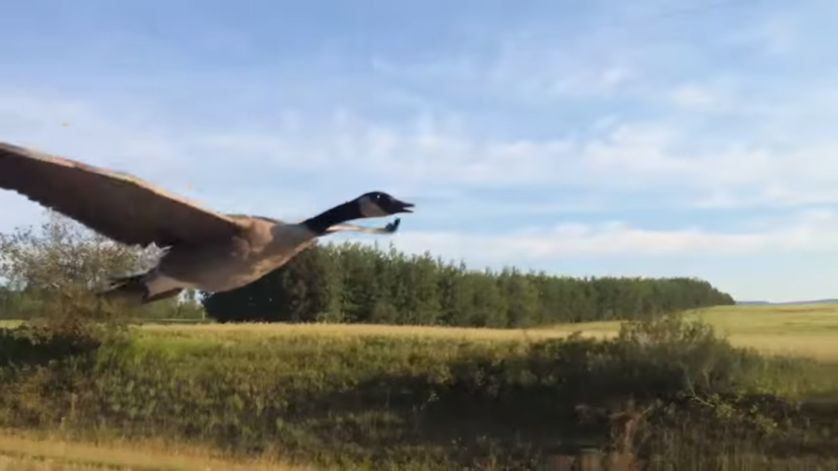
“Let’s go for a flight, OK?” he offered. As Bachman filmed through his truck window, he began driving and coaching the goose to follow. It started with a brisk trot — a pretty amusing sight on its own — and then flapped into flight, letting Bachman capture an endearing view of it flying alongside to the Beatles’ “Let It Be.”

A Canada goose flies alongside a pickup truck on its way to Alberta's Shining Bank Lake. (Photo: Andre Bachman/YouTube)
A Canada goose flies alongside a pickup truck on its way to Alberta’s Shining Bank Lake. (Photo: Andre Bachman/YouTube)

Bachman stopped at least once to check on the goose, saying “I almost hit you, didn’t I?” and noting its tameness when the bird let him pet it. As goose expert Sid Andrews of Inglewood Bird Sanctuary tells Canada’s Global News, even wild Canada geese accustomed to handouts rarely tolerate that.

“I would guess that because it allowed the fellow driving the truck to get very close, that at some point in time, it must have been imprinted on human beings,” Andrews says, adding that it also may have simply mistaken its reflection in the truck’s bumper for another goose. “It somehow got lost or estranged from the group and found, just by happenstance, another goose in the reflection in the bumper.”

Either way, the goose had little trouble keeping up. “My dad would just about stop for the corners after the first one to let it turn,” Watchboy0 writes on Reddit. “Also, at one point he wanted to see how fast it could go. At around 80 km/h [50 mph], the goose started flying above his truck on the air coming off his windshield.”

Once at the lake, the goose “seems happy and stays,” Bachman writes on YouTube, where the video has been watched more than 1.5 million times in about a week. The bird was probably never in serious distress, Andrews says, but Bachman may still have done it a favor by leading it to water. “I certainly would applaud [the driver’s] instincts to head to water because it’ll have a much better chance of finding food.”

ooOOoo

Well done that man: forester Andre Bachman. Well done, indeed!

Wild Dogs and Englishmen …

… go out in the mid-day sun!

Say the word ‘dog’ to me and my immediate thought would be of the domesticated animal, as I’m sure would be the first thought of thousands of others.

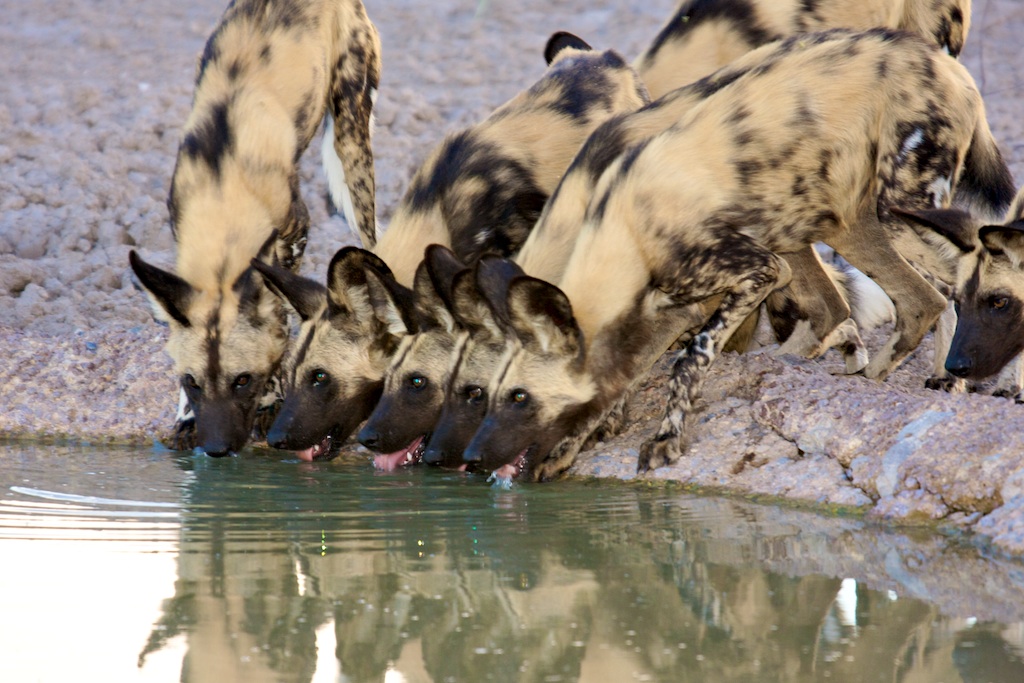
But our wonderful doggie companions came from the wild and in some countries wild dogs still are widely found. There was an article on the Mokolodi Nature Reserve blogsite in November, 2009 specifically about wild dogs, that included the following picture:

Wild hunting dogs drinking.

All of which is a wonderful reminder that wilderness is a critical and essential element in the overall health of our planet, and by extension, of ourselves.

The academic blogsite The Conversation yesterday published an article by William Lynn who is a Research Scientist in Ethics and Public Policy at Clark University. It proposes a wonderful way of keeping our populations of wild animals healthy and vibrant through rewilding.  It is republished here within the terms of The Conversation.

ooOOoo

Setting aside half the Earth for ‘rewilding’: the ethical dimension

August 26, 2015 5.50am EDT

image-20150821-31391-7a173d
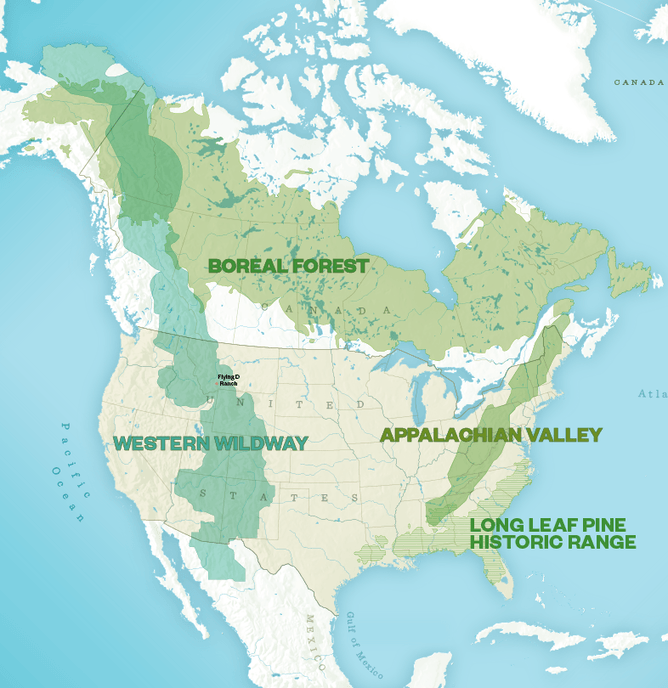
Wildlife corridors: four proposals to ‘rewild’ portions of North America. Smithsonian Institute, CC BY-NC

A much-anticipated book in conservation and natural science circles is EO Wilson’s Half-Earth: Our Planet’s Fight for Life, which is due early next year. It builds on his proposal to set aside half the Earth for the preservation of biodiversity.

The famous biologist and naturalist would do this by establishing huge biodiversity parks to protect, restore and connect habitats at a continental scale. Local people would be integrated into these parks as environmental educators, managers and rangers – a model drawn from existing large-scale conservation projects such as Area de Conservación Guanacaste (ACG) in northwestern Costa Rica.

The backdrop for this discussion is that we are in the sixth great extinction event in earth’s history. More species are being lost today than at any time since the end of the dinosaurs. There is no mystery as to why this is happening: it is a direct result of human depredations, habitat destruction, overpopulation, resource depletion, urban sprawl and climate change.

Wilson is one of the world’s premier natural scientists – an expert on ants, the father of island biogeography, apostle of the notion that humans share a bond with other species (biophilia) and a herald about the danger posed by extinction. On these and other matters he is also an eloquent writer, having written numerous books on biodiversity, science, and society. So when Wilson started to talk about half-Earth several years ago, people started to listen.

As a scholar of ethics and public policy with an interest in animals and the environment, I have been following the discussion of half-Earth for some time. I like the idea and think it is feasible. Yet it suffers from a major blind spot: a human-centric view on the value of life. Wilson’s entry into this debate, and his seeming evolution on matters of ethics, is an invitation to explore how people ought to live with each other, other animals and the natural world, particularly if vast tracts are set aside for wildlife.

The ethics of Wilson’s volte-face

I heard Wilson speak for the first time in Washington, DC in the early 2000s. At that talk, Wilson was resigned to the inevitable loss of much of the world’s biodiversity. So he advocated a global biodiversity survey that would sample and store the world’s biotic heritage. In this way, we might still benefit from biodiversity’s genetic information in terms of biomedical research, and perhaps, someday, revive an extinct species or two.

Not a bad idea in and of itself. Still, it was a drearily fatalistic speech, and one entirely devoid of any sense of moral responsibility to the world of nonhuman animals and nature.

What is striking about Wilson’s argument for half-Earth is not the apparent about-face from cataloging biodiversity to restoring it. It is the moral dimension he attaches to it. In several interviews, he references the need for humanity to develop an ethic that cares about planetary life, and does not place the wants and needs of a single species (Homo sapiens sapiens) above the well-being of all other species.

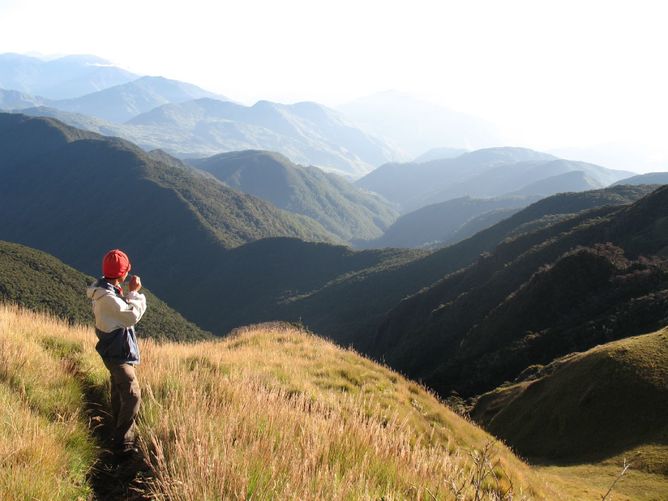
people to consider the role of humans in nature. jene/flickr, CC BY-NC-ND
The half-earth proposal prompts people to consider the role of humans in nature. jene/flickr, CC BY-NC-ND

To my ear, this sounds great, but I am not exactly sure how far it goes. In the past, Wilson’s discussions of conservation ethics appear to me clearly anthropocentric. They espouse the notion that we are exceptional creatures at the apex of evolution, the sole species that has intrinsic value in and of ourselves, and thus we are to be privileged above all other species.

In this view, we care about nature and biodiversity only because we care about ourselves. Nature is useful for us in the sense of resources and ecological services, but it has no value in and of itself. In ethics talk, people have intrinsic value while nature’s only value is what it can do for people – extrinsic value.

For example, in his 1993 book The Biophilia Hypothesis, Wilson argues for “the necessity of a robust and richly textured anthropocentric ethics apart from the issues of rights [for other animals or ecosystems] – one based on the hereditary needs of our own species. In addition to the well-documented utilitarian potential of wild species, the diversity of life has immense aesthetic and spiritual value.”

The passage indicates Wilson’s long-held view that biodiversity is important because of what it does for humanity, including the resources, beauty and spirituality people find in nature. It sidesteps questions of whether animals and the rest of nature have intrinsic value apart from human use.

His evolving position, as reflected in the half-Earth proposal, seems much more in tune with what ethicist call non-anthropocentrism – that humanity is simply one marvelous but no more special outcome of evolution; that other beings, species and/or ecosystems also have intrinsic value; and that there is no reason to automatically privilege us over the rest of life.

Consider this recent statement by Wilson:

What kind of a species are we that we treat the rest of life so cheaply? There are those who think that’s the destiny of Earth: we arrived, we’re humanizing the Earth, and it will be the destiny of Earth for us to wipe humans out and most of the rest of biodiversity. But I think the great majority of thoughtful people consider that a morally wrong position to take, and a very dangerous one.

The non-anthropocentric view does not deny that biodiversity and nature provide material, aesthetic and spiritual “resources.” Rather, it holds there is something more – that the community of life has value independent of the resources it provides humanity. Non-anthropocentric ethics requires, therefore, a more caring approach to people’s impact on the planet. Whether Wilson is really leaving anthropocentrism behind, time will tell. But for my part, I at least welcome his opening up possibilities to discuss less prejudicial views of animals and the rest of nature.

The 50% solution

It is interesting to note that half-Earth is not a new idea. In North America, the half-Earth concept first arose in the 1990s as a discussion about wilderness in the deep ecology movement. Various nonprofits that arose out of that movement continued to develop the idea, in particular the Wildlands Network, the Rewilding Institute and the Wild Foundation.

These organizations use a mix of conservation science, education and public policy initiatives to promote protecting and restoring continental-scale habitats and corridors, all with an eye to preserving the native flora and fauna of North America. One example is ongoing work to connect the Yellowstone to Yukon ecosystems along the spine of the Rocky Mountains.

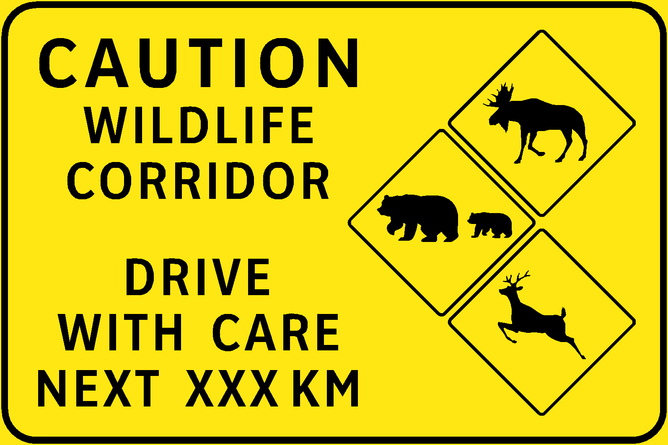
Take it up a notch? The British Columbia Ministry of Transportation recently started to add signs warning motorists when they are likely to encounter wildlife. British Columbia Ministry of Transportation, CC BY-NC-ND

When I was a graduate student, the term half-Earth had not yet been used, but the idea was in the air. My classmates and I referred to it as the “50% solution.” We chose this term because of the work of Reed Noss and Allen Cooperrider’s 1994 book, Savings Nature’s Legacy. Amongst other things, the book documents that, depending on the species and ecosystems in question, approximately 30% to 70% of the original habitats of the Earth would be necessary to sustain our planet’s biodiversity. So splitting the difference, we discussed the 50% solution to describe this need.

This leads directly into my third point. The engagement of Wilson and others with the idea of half-Earth and rewilding presupposes but does not fully articulate the need for an urban vision, one where cities are ecological, sustainable and resilient. Indeed, Wilson has yet to spell out what we do with the people and infrastructure that are not devoted to maintaining and teaching about his proposed biodiversity parks. This is not a criticism, but an urgent question for ongoing and creative thinking.

Humans are urbanizing like never before. Today, the majority of people live in cities, and by the end of the 21st century, over 90% of people will live in a metropolitan area. If we are to meet the compelling needs of human beings, we have to remake cities into sustainable and resilient “humanitats” that produce a good life.

Such a good life is not to be measured in simple gross domestic product or consumption, but rather in well-being – freedom, true equality, housing, health, education, recreation, meaningful work, community, sustainable energy, urban farming, green infrastructure, open space in the form of parks and refuges, contact with companion and wild animals, and a culture that values and respects the natural world.

To do all this in the context of saving half the Earth for its own sake is a tall order. Yet it is a challenge that we are up to if we have the will and ethical vision to value and coexist in a more-than-human world.

ooOOoo

I am sure many will agree that this is a very interesting idea and one that I hope is eventually adopted. For the sake of all our wild animals, including our dogs.

Staying with the memory of Lilly

A republication of a post from February, 2014

Yesterday, I offered the first of two previous posts about Lilly. Here is the second, originally published in February, 2014.

ooOOoo

Lilly, the second of our nine dogs.

Last week was the start of a series of posts giving you, dear reader, background on each of our nine dogs.  Thus last week, Jean wrote about Paloma.  Here is Jean’s account of how Lilly came into her life.

ooOOoo

Lilly

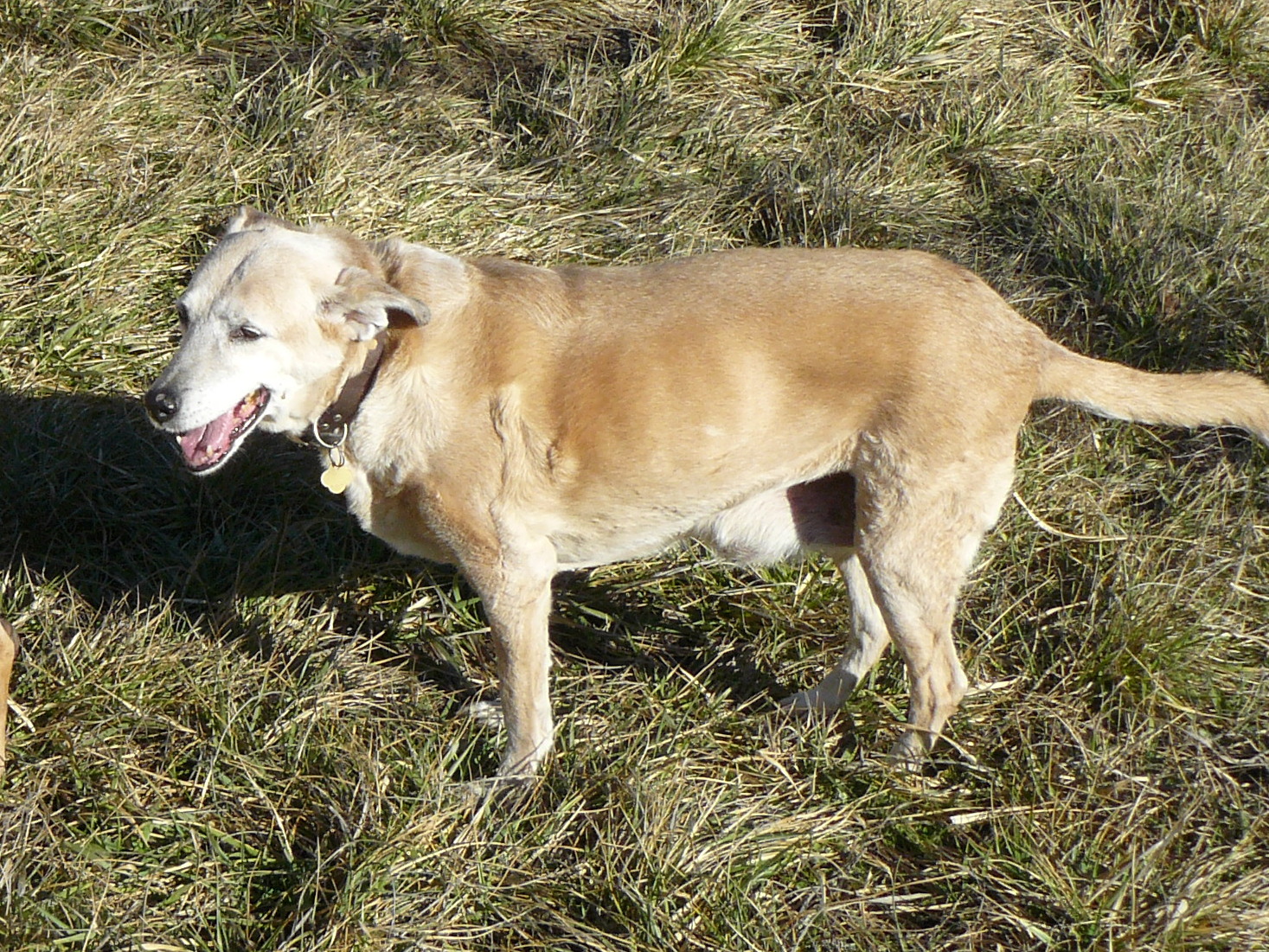
Lilly - Taken in the last two weeks.
Lilly – Taken 26th January, 2014

Lilly came into my life fourteen years ago. I had taken my car into the mechanics workshop in San Carlos, Mexico for an oil change and was beckoned over to an old junk car in their lot. It had no glass in the windows and in the hatch-back area lay a smallish dog with five young, suckling puppies. She had apparently walked in off the street and chosen the old airy car as a suitable ‘house’ in which to have her babies. The workers had supplied her with an old greasy towel for a mattress.

My girlfriend, Suze, and I immediately set about making her comfortable with a small quilt and plenty of water and good dog food. She had been dining on tacos and tamales scraps up until then.

Suze and I visited frequently and took plenty of food and at the same time went about looking for homes for the pups. However, one day we arrived and found all the beautiful babies gone. The mechanics had given them away. We were shattered and could only hope that they had gone to loving homes.

‘Rabbit’, as she was then called, continued hanging around the workshop and the men seemed to like her. Rabbit had this trick of leaping on her hind legs, twirling and landing on her four legs; hence her name Rabbit, I guess.

Suze and I would see her once a week on average and had also arranged for Rabbit to be spayed. All seemed well until Easter came (I think we are talking of the year 2000). As is common in Mexico, during Easter week in San Carlos everything shuts down. It’s carnival time. The streets are busy with tourists and there is much traffic. I was worried about Rabbit as the mechanic’s shop was locked up tight and Rabbit was outside in the lot by the street. I planned to take her home for the rest of the holiday but fate intervened. On my way to collect her, I was aghast to see her motionless by the side of the road, obviously having been hit by a car.  I gently picked her up and took her home.  On inspection, it was clear that she had two broken legs on her right-hand side.  Her injuries were so bad that I knew the local vet did not have the skills or instruments to heal her. My late husband, Ben, and I ended up driving her two hours South to Obregon where there was an orthopaedic vet. He put pins in both legs and she stoically set about mending herself. Rabbit became Lilly. Irrespective of name, she was an assertive but sweet young dog and settled in nicely with my burgeoning pack; I had twelve rescue dogs in those days.  Her legs healed nicely and she resumed her twirling.

Lilly became a particular favourite of Ben, my late husband. When in 2005 Ben lay dying at home, Lilly slept non-stop by his side on the bed, only leaving to eat or go outside.  I knew for sure that Ben had died in the night when one morning I awoke to feel Lilly beside me on my bed. Lilly sensed that now I needed her more.

Lilly is still with us.  Now a dowager old lady of at least fifteen years of age, she still enjoys going out with her buddies whom she tends to boss somewhat.  (Paul thinks that Lilly is an ‘alpha’ dog, in other words has pack leadership in her genes.) But one thing that Lilly doesn’t now do; she doesn’t twirl anymore, but then neither do I.

It will be a very sad day when Paul and I have to say goodbye to this treasure of a dog. [As indeed, it was] In the meantime we endeavour to make each day that she has left as rich as possible.

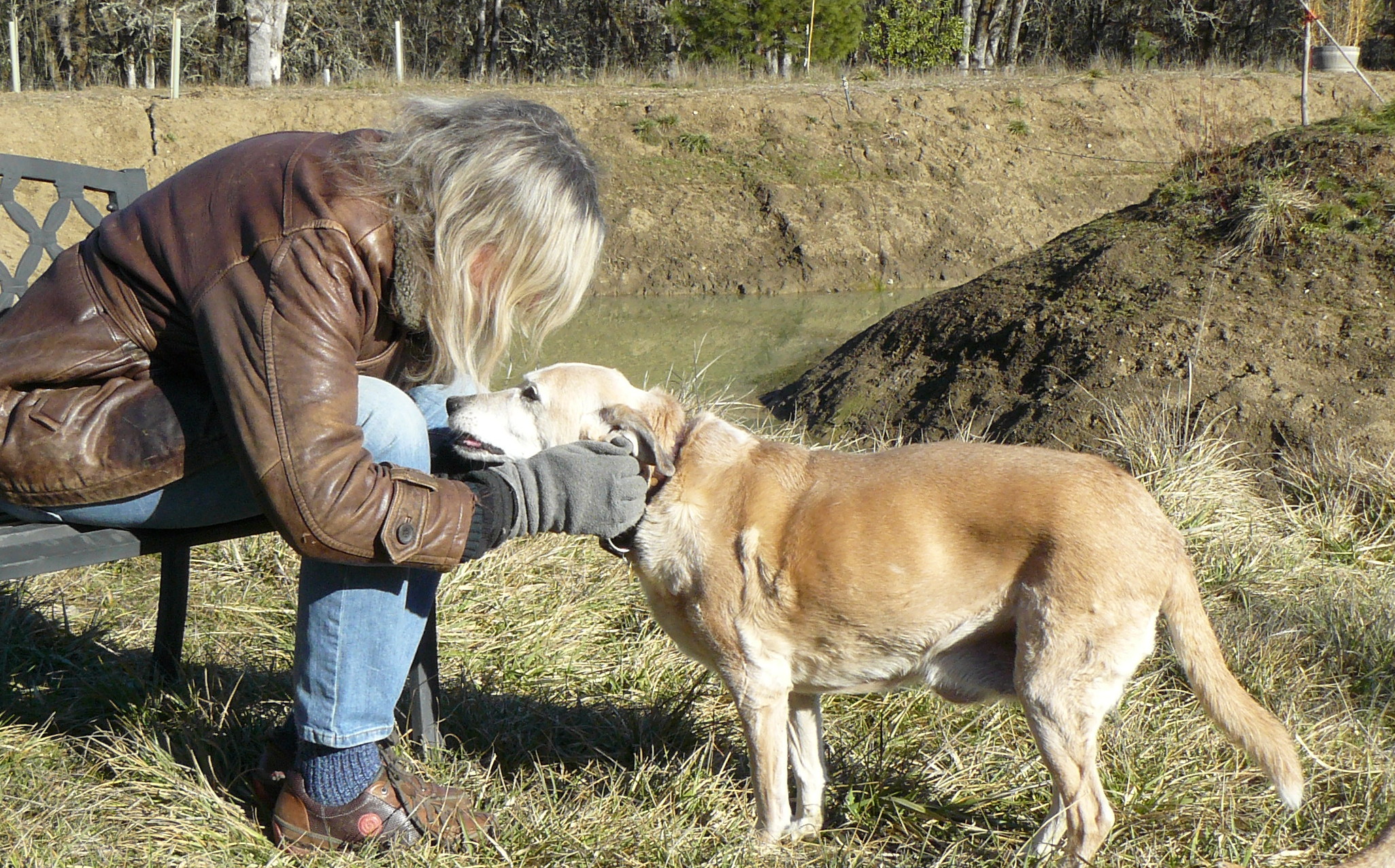
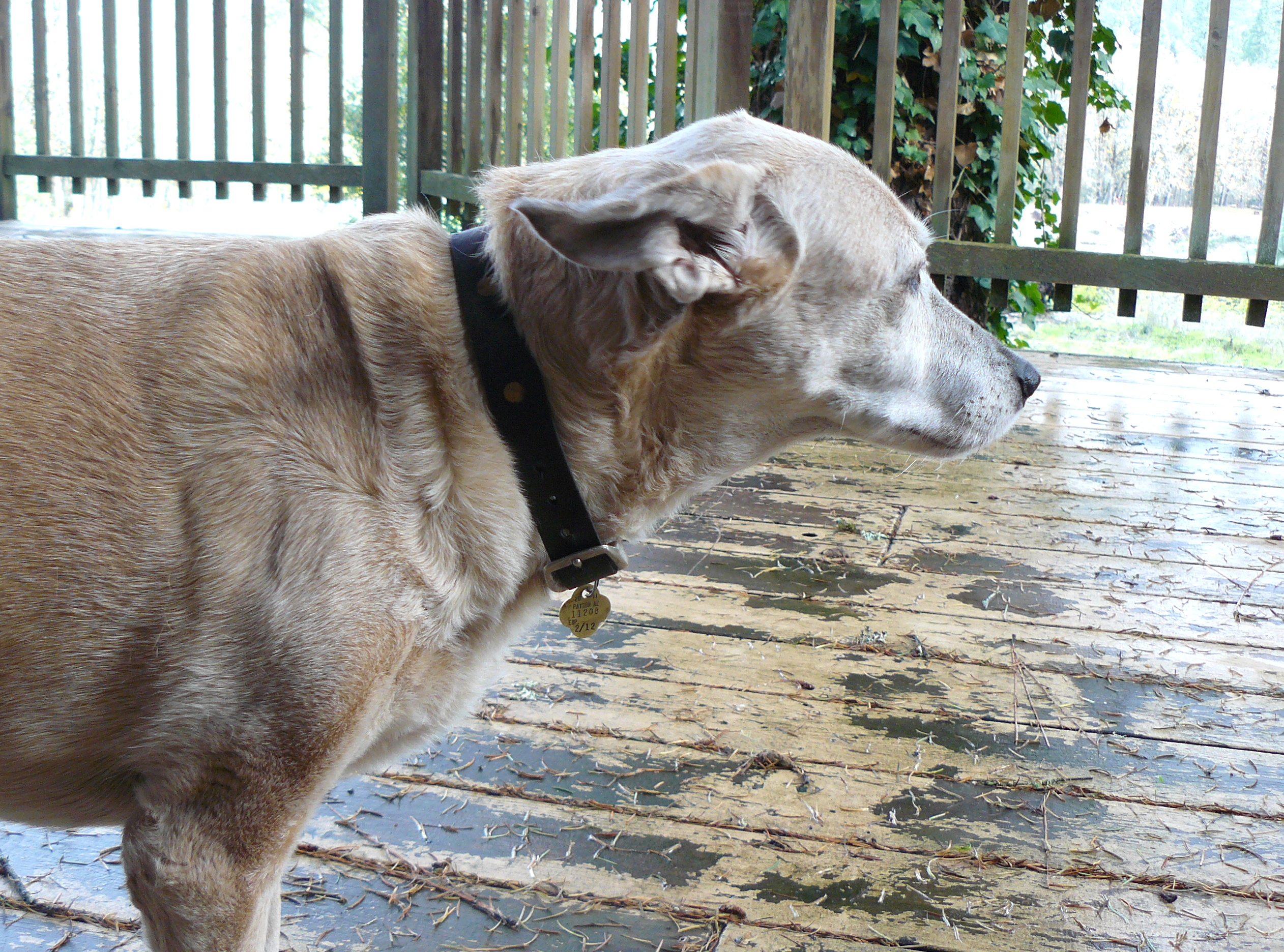
Another very recent photograph of Lilly.

ooOOoo

I think it would wonderful to also include a section from an email that Suzann Reeve, a good friend of this blog, sent to Jeannie yesterday.

The story of Lily and her origins:

(I of course burst into tears when reading your email, Paul.) I knew it was coming. I wish I could have seen her one more time.

Poor baby, I hope she did not suffer much.

In 1998, Don and I went to a junk yard, which at the time was next to the telephone company in San Carlos. As we were talking to the men, out of a shell of an old car behind us popped a small mama dog, heavy with milk. I of course went right over there after hearing puppies cry to see many little baby puppies were mewling for mommy’s milk! The dog was so sweet and jumped around like a rabbit. I brought food and water for her and found her a nice blanket for her and the pups.
I told Jeannie about them and we went back the next day to check it out. We told the men we would care for them, but one day when we came to feed, the puppies were gone! I begged Don to let me take her, but as I lived in an RV, he would not let me, and I also had 3 dogs at the time, Poncho, and his sister and Destina….., plus the men wanted her, which almost led to her death.
After Don and I left town for the summer sometime later, if i remember correctly, Jean and Ben were driving down the main road in town when they saw LLevre (rabbit in Spanish) injured on the road. I believe they took her down to Obregon for an operation right away, and after a successful operation, she was theirs! They saved her life!
She has lived a very full and happy life. I am so sad that she is gone.


In memory of Lilly

A republication of a post from November of last year.

Our dear Lilly offers her special thoughts.

Preface: Lilly is reaching an amazing age for a dog; trully amazing. Lilly was featured back in February this year when we did a series of posts under the generic heading of Meet the dogs.

Yesterday, Jean thought it would be wonderful to hear it from Lilly; so to speak.

So these are Lilly’s words; as whispered to Jeannie!

oooo

The World According to Lilly

Surveying her domain.

I am sixteen years old! That’s one hundred and twelve people years!

So no-one is going to tell me what to do; especially those bratty young dogs I live with.

I refuse to eat canned dog food and expect Mum to cook fresh meat on a daily basis or I will stop eating and give her the moon eyes. (No real issue as Mum does understand my demands! 😉 ) The only dry food that passes my lips is ‘Canidae’. It’s not cheap but, hey, I’m worth it!

No dog is allowed to snag my food or I will bite their nose; and well the others know that! OK, maybe young Oliver can sneak a nibble or two off my bowl; he is rather cute!

I will only take a pill if it is camouflaged in the fresh marrow of a bone – Mum, bless her, thinks I don’t know it’s there! Ha!

When it’s raining, I refuse to go out. Period! To make Mum happy, sometimes I let her use this sheepskin-lined sling thing to help me tackle the deck steps but many times I can manage on my own – hey! I’m only sixteen! But I know that it makes Mum’s day if she sees herself being useful!

It’s been a good life. OK, I’m rather creaky now but determined to make seventeen. Who knows maybe even eighteen!

Give Dad a run for his money any day!  Golly, he has only just turned seventy in people years and to hear him natter on you would think he feels old!

Now where’s my bed …..

Not a bad life for an old dog! (I'm speaking of Dad!)
Not a bad life for an old dog! (I’m speaking of Dad!)

Lilly’s long goodbye

Fewer than five minutes ago, at 11:52 PDT today, Sunday 23rd August 2015, Jim Goodbrod euthanised our Lilly.

Lilly, aged seventeen, started to decline about a year ago. In the last few weeks she had become progressively weaker, she was hardly eating and had lost much body mass, her kidneys were close to total failure and it was clear to Jean and me that she was close to what could in all likelihood be a painful end. So much better for Lilly that her end should be peaceful and pain-free, as it most clearly was.

Lilly was found by Jean sixteen years ago with her five young, suckling puppies in a car mechanics workshop in San Carlos, Mexico and has been loved and cared for by Jean right up to the end. Most Mexican street dogs barely live for a couple of years.

All of our dogs are special yet the odds of any other of our dogs living seventeen human years is very low.

I intend to republish tomorrow and Tuesday two posts of Lilly in homage of this wonderful, gentle and loving dog.

Let me leave you with this photograph of Jean and Lilly from earlier last year.

Another very recent photograph of Lilly.
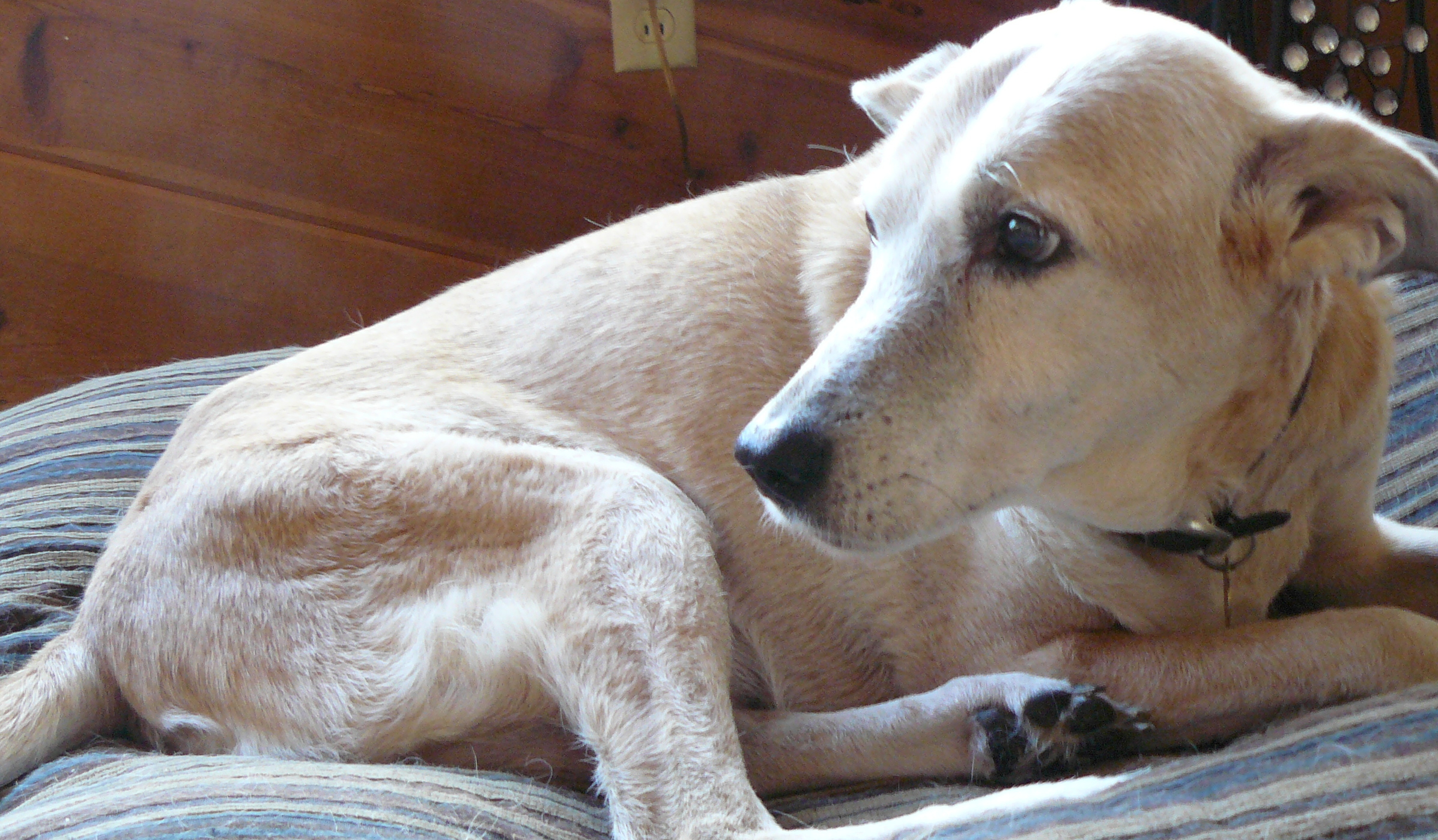
A photograph of Lilly taken in February, 2014.

The tale of a rescue dog.

We rarely get to know what a rescue dog has been through.

Of the ten dogs that we have here at home, two are pedigree dogs purchased from breeders, that’s Pharaoh and Cleo, two are rescue dogs that came from known sources, Oliver from neighbours who couldn’t cope with him and Pedy from the local Merlin dog pound, and the rest are all ex-rescue dogs that Jean took from the streets of San Carlos, Mexico.

The last rescue dog to be taken in by Jean before we both left Mexico was Hazel who was abandoned outside Jean’s house in San Carlos a few weeks before we left for Arizona. The picture below is of Hazel taken in March 2014.

Hazel is the most loving and adorable of dogs and the love that I feel coming from her towards me is real, tangible and precious. Yet this is a mother dog who very shortly before she was deposited in front of Jean’s house in Mexico had had all her puppies removed from her as Hazel was still in milk. (The poor in San Carlos frequently sell young puppies for a few Pesos.) It’s beyond the comprehension of us humans, especially women, to imagine what it must be like for a mother to so catastrophically lose her young babies.

That’s why a recent article over on Mother Nature Network really reached out to me. We never know what homeless dogs have to contend with before they find loving homes.

ooOOoo

Why our Great Dane is so scared to be alone

Most of us will never know what our rescue dogs have been through. We found out.

By: Ali Berman, August 12, 2015

Author Ali Berman discovered she had a new shadow when she met Cooper. (Photo: Ali Berman)

In February 2015, David and Glenda Berman — that’s my mom and dad — drove from New York to Connecticut to meet Cooper, a 13-month-old Great Dane. When they were introduced, 100-pound Cooper rushed over to give them an enthusiastic greeting, burying his head in their legs, leaning on them, and asking to be petted. My mom and dad fell in love, and Cooper took the two-hour drive back to their house, the place that would become his forever home.

During those first few weeks, my parents got to know Cooper. They went for walks in the snow, played together, and snuggled. (He’s a major snuggler.) But, in addition to those normal doggy behaviors, they noticed something else. Cooper was reluctant to leave their sides. If they left the room, he went with them. He took trip after trip to the kitchen, to the bathroom, to the laundry room. When they moved, he moved.

I didn’t believe the extent of it until I got the chance to meet him myself. I traveled back to New York to visit my family in May. For me and Coop, it was love at first sight. We played, we ran, we cuddled, and by the end of the first day, I found myself with a 115-pound shadow. As soon as I showed any sign of movement, his head perked up and he was ready to follow me. In the morning when he opened his eyes, he went directly to my room to wake me up. When I napped in the afternoon, he came with me, opting to sleep right next to the bed. And when I went out to dine with a friend, my parents distracted him so he wouldn’t see that I was leaving.

Now, when a small dog follows you everywhere, it’s not a big deal. But when a Great Dane follows you around, it’s not stealthy. Seeing how much he craved to be near people, I welcomed him wherever I went — even the bathroom. Still, I wondered: Why was he so reluctant to be alone? Did he not believe we’d come back?

If there's a hug going on, Cooper wants to be a part of it. (Photo: Ali Berman)
If there’s a hug going on, Cooper wants to be a part of it. (Photo: Ali Berman)

Thinking we knew the full story behind his upbringing, we all wrote it off as him being a little insecure. In just over a year he had experienced four different homes. After he left the breeder (his first home), Cooper went to live with a young woman who loved him very much. Unfortunately, they learned that while Cooper enjoys meeting other dogs on his walks, he has trouble living with other dogs. He got into fights with another pooch in the house and with great difficulty, the young woman sent Cooper to live with her uncle. As he also had animals at home, the problem repeated itself.

Cooper needed to live with a one-dog family. The uncle — who could easily have sold purebred Cooper for a handsome sum — instead decided to put him up for adoption to find the best family possible. My parents had been looking for a Great Dane to adopt, so they sent their references, along with pictures with their previous Great Dane who had died two years before, and a heartfelt message. They were chosen to be Cooper’s new and final family.

Because Cooper was loved and well treated in all of his homes, my parents thought the insecurity came from the many moves.

But that wasn’t the full story. Not even close.

In an email from the woman who originally took Cooper in, my mother learned the truth. Cooper had been born with the rest of his litter in the home of an Iowa breeder. One night, when the breeders were out bowling, their home caught on fire. Everything went up in flames. Cooper’s mother and siblings all tragically perished. Baby Cooper was found alone in the debris in the yard. In just one night, he had lost his entire family, suffering more trauma in an instant than most experience in a lifetime.

After the fire, the breeders had to rebuild their lives, so they put Cooper up for adoption. That’s when he started to move from house to house, finally finding his perfect match with my parents. Now, he starts out every day with a multi-mile walk, a nap in the office while my dad works, and then Cooper spends an hour or two playing with his friends in the dog park in the afternoon. If he’s not snoozing or walking, he’s out in the garden with my mom soaking up the sun.

Some serious trauma as a puppy made Cooper never want to be alone. (Photo: Ali Berman)

Just part of the story

When we rescue an animal, most of the time we never get to know their complete history. Why do some cry when their humans leave the house? Or some bark and growl at men who wear hats? Like people, animals remember the various difficulties and tragedies they have suffered. Those scars go through life with them, just like our own scars follow us. The only difference is they can’t tell us their fears, and we can’t explain to them that they are safe. The best we can do is show them they are loved and hope with enough repetition, they’ll get the message.

In an ideal world, every dog would only have good memories. Their first Frisbee catch or trip to the beach, their favorite person who knows how to pet the ears just right, and the safety of a single home where they will live their life right through to ripe old age. That’s not the case for every dog. Some need a little extra help from us as they learn to trust, move on from the past and accept that their new reality is the one they can count on.

With time, Cooper might just learn to keep snoozing while his mom or dad goes to get a cup of tea. Until then, we’ll all keep showing him that he’s loved, and that this home and this family are forever.

ooOOoo

When one thinks of how dogs, Cooper, Hazel and tens of thousands of others, so beautifully offer their unlimited love to us humans it is just a great shame that we humans haven’t emulated our beloved dogs across mankind in such a widespread manner.

Picture taken by our guest Don Reeve of Hazel (and me) Wednesday afternoon.

Gorgeous Hazel. Who would have thought from that smiling face of hers that she had ever suffered the catastrophic loss of her puppies that she had.


When dark shadows fall across our hearts.

One of the most important lessons we can learn from our dogs: coping with death.

In writing about the lesson of death that we can learn from our dogs I am, of course, speaking of our own death, of the inevitability of our death. That largely unspoken truth that Sharon Salzberg described in her book Faith: “What does it mean to be born in a human body, vulnerable and helpless, then to grow old, get sick and die, whether we like it or not?” [page 34.]

Anyone who has loved a dog has most likely been intimately involved in the end of that dog’s life. It is, to my mind, the ultimate lesson that dogs offer us: how to be at peace when we die and how to leave that peace blowing like a gentle breeze through the hearts of all the people who loved us.

Our beloved dogs have much shorter life spans than us, thus almost everyone who has loved a dog will have had to say goodbye to that gorgeous friend at some point in their lives. Very sadly, perhaps, saying goodbye to more than one loved dog.

All of which is my introduction to a recent essay published on The Conversation blogsite. The essay is written by Bernard Rollin, Professor of Philosophy, Animal Sciences and Biomedical Sciences at Colorado State University. The essay is called: When is it ethical to euthanise your pet?

ooOOoo

When is it ethical to euthanize your pet?

August 12, 2015 6.18am EDT

In the 1960s, I knew people who, before going on vacation, would take their dogs to a shelter to be euthanized. They reasoned that it was cheaper to have a dog euthanized – and buy a new one upon returning – than pay a kennel fee.

Two decades later, I was working at Colorado State’s veterinary hospital when a group of distraught bikers on Harley-Davidsons pulled up carrying a sick chihuahua. The dog was intractably ill, and required euthanasia to prevent further suffering. Afterwards, the hospital’s counselors felt compelled to find the bikers a motel room: their level of grief was so profound that the staff didn’t think it was safe for them to be riding their motorcycles.

These two stories illustrate the drastic change in how animals have been perceived. For thousands of years, humans have kept animals as pets. But only during the past 40 years have they come to be viewed as family.

While it’s certainly a positive development that animals are being treated humanely, one of the downsides to better treatment mirrors some of the problems the (human) health care system faces with end-of-life care.

As with humans, in many cases the lives of pets are needlessly prolonged, which can cause undue suffering for the animals and an increased financial burden for families.

The growth of veterinary medicine and ethics

In 1979, I began teaching veterinary medical ethics at Colorado State University’s veterinary school, the first such course ever taught anywhere in the world.

A year later, the veterinary school hired an oncologist to head up a new program on animal oncology. Soon, our clinic was applying human therapeutic modalities to animal cancer. The visionary head of the veterinary program also hired a number of counselors to help pet owners manage their grief – another first in veterinary circles.

I’d been under the impression that people would be reluctant to spend much money on animal treatments, so I was genuinely shocked when the following April, the Wall Street Journal reported individuals spending upwards of six figures on cancer treatments for their pets.

As a strong advocate for strengthening concern for animal welfare in society, I was delighted with this unprecedented turn of events. I soon learned that concern for treating the diseases of pets besides cancer had also spiked precipitously, evidenced by a significant increase in veterinary specialty practices.

One of the family

So what’s behind the shift in how pets are perceived and treated?

For one, surveys conducted over the last two decades indicate an increasing number of pet owners who profess to view their animals as “members of the family.” In some surveys, the number is as high as 95% of respondents, but in nearly all surveys the number is higher than 80%.

In addition, the breakdown of nuclear families and the uptick of divorce rates have contributed to singles forming tighter bonds with companion animals.

Such attitudes and trends are likely to engender profound changes in societal views of euthanasia. Whereas before, many owners didn’t think twice about putting down a pet, now many are hesitant to euthanize, often going to great lengths to keep sick animals alive.

Vets caught in the middle

However, veterinarians continue to experience extensive stress as they experience two opposite – but equally trying – dilemmas: ending an animal’s life too soon, or waiting too long.

In a paper that I published entitled Euthanasia and Moral Stress, I described the significant stress experienced by veterinarians, veterinary technicians and humane society workers. Many chose their profession out of a desire to improve the lot of animals; instead, they invariably ended up euthanizing large numbers of them, often for unethical reasons.

These ranged from “I got the dog to jog with me, and now it’s too old to run,” to “If I die, I want you to euthanize the animal because I know it can’t bear to live without me.”

In other cases, the animal is experiencing considerable suffering, but the owner is unwilling to let the animal go. With owners increasingly viewing pets as family members, this has become increasingly common, and many owners fear the guilt associated with killing an animal too soon.

Ironically this, too, can cause veterinarians undue trauma: they know the animal is suffering, but there’s nothing they can do about it unless the owner gives them permission.

The consequences are manifest. One recent study showed that one in six veterinarians has considered suicide. Another found an elevated risk of suicide in the field of veterinary medicine. Being asked to kill healthy animals for owner convenience doubtless is a major contribution.

How to manage the decision to euthanize

Here is my suggestion to anyone who is thinking about getting a pet: when you first acquire it, create a list of everything you can find that makes the animal happy (eating a treat, chasing a ball, etc). Put the list away until the animal is undergoing treatment for a terminal disease, such as cancer. At that point, return to the list: is the animal able to chase a ball? Does the animal get excited about receiving a treat?

If the animal has lost the ability to have positive experiences, it’s often easier to let go.

This strategy can be augmented by pointing out the differences between human and animal consciousness. As philosopher Martin Heidegger has pointed out, for humans much of life’s meaning is derived from balancing past experiences with future aspirations, such as wishing to see one’s children graduate or hoping to see Ireland again.

Animals, on the other hand, lack the linguistic tools to allow them to anticipate the future or create an internal narrative of the past. Instead, they live overwhelmingly in the present. So if a pet owner is reluctant to euthanize, I’ll often point out that the animal no longer experiences pleasant “nows.”

In the end, managing euthanasia represents a major complication of the augmented status of pets in society. Ideally, companion animal owners should maintain a good relationship with their general veterinary practitioner, who has often known the animal all of its life, and can serve as a partner in dialogue during the trying times when euthanasia emerges as a possible alternative to suffering.

ooOOoo

So much to learn from these beautiful creatures and so many ways to return the unlimited love we receive from them.