Category: Animal rescue

Embracing all those who care for our wild animals!

So many who devote so much time and energy, and money no doubt!

Let me state quite clearly my position with regard to hunting wild animals – I abhor it! Technically speaking if someone’s only means of feeding themselves, as in staying alive, is through hunting then I guess that is acceptable. But hunting for any other purposes is beyond the pale. I know that many people, including friends, who live in this part of America would heartedly disagree with my position on hunting. So be it.

Thus when Jean and I look at those who work so hard to protect, sustain and support wild animals we are almost speachless with our admiration for them.

So what’s brought all this on today?

For a long time I have been a follower of the blogsite Canis Lupus 101. On the home page of Canis Lupus 101, on the left-hand sidebar, one can read a plea from Maggie Caldwell, Press Secretary for @Earthjustice, that, in part, says:

For centuries, wolves have been viewed with suspicion and hostility, based in humankind’s deep-rooted fear of the unknown and need to control the natural world.

“The Fable of the Wolf,” a new animated short film produced by Earthjustice, explores this idea, celebrating the wild nature of a deeply misunderstood species.

The film offers an abbreviated history of the relationship between wolves and people—told from the wolf’s perspective—from a time when they coexisted to an era in which people began to fear and exterminate the wolves.

The return of wolves to the northern Rocky Mountains has been called one of America’s greatest conservation stories. But wolves are facing new attacks by members of Congress who are gunning to remove Endangered Species Act protections before the species has recovered.

The film encourages viewers to “join the pack” and sound the alarm about the political threats to this species. Please help us spread the message that wolves are to be celebrated, not feared, by watching this film and sharing it with your friends.

Sincerely,

Maggie Caldwell

Our millions of magnificient and adorable dogs owe their place in today’s world to the wolf. The fact that those who care are still fighting hard to save the wild wolf shows how disgraceful it is for those that see no harm in hunting wolves. Hunting a wolf in my book is hardly any different than going out and hunting a dog!

So with all that out of me, now read about the following glorious efforts to save the wild Mexican wolf. Originally published over on Canis Lupus 101.

ooOOoo

Thursday, January 28, 2016

Poaching slows Mexican wolf population recovery (video)

Brandon Loomis, The Republic | January 27, 2016

After the wild Mexican wolf population tops 100 for the first time, 15 illegal shootings may slow recovery.

(Photo: Mark Henle, Mark Henle/The Republic)

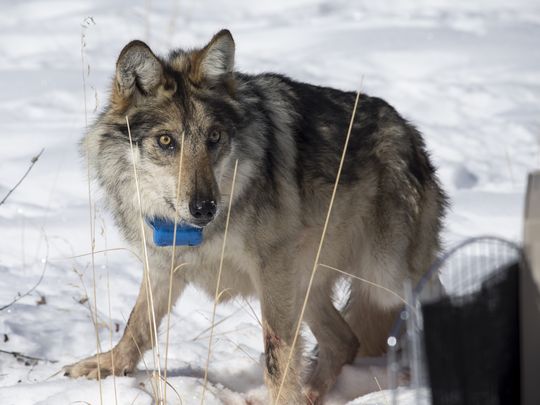
ALPINE — Biologists hauled a 60-pound Mexican gray wolf from the chopper on Monday, limp but healthy with a lush winter mane. They called it the wolf’s worst day in months — dazed from having been darted from above, still rapidly licking his nose through a blindfold muzzle — but the male wolf was one of the fortunate among a divisive and still-embattled breed that has weathered an especially perilous year of poachings.

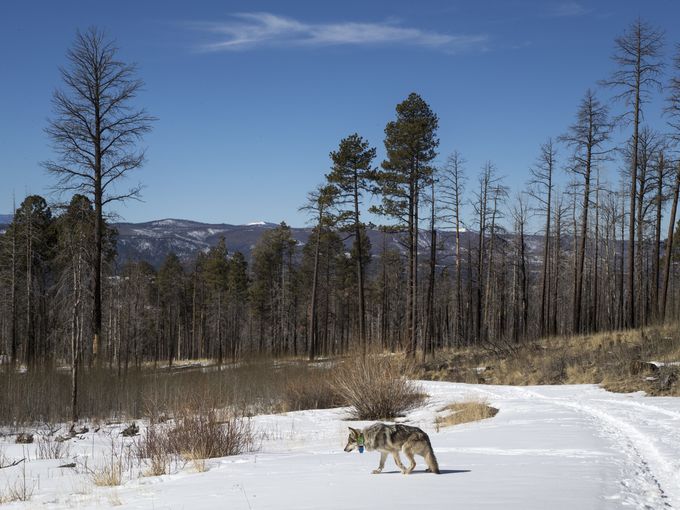
Unknown shooters have illegally killed at least 15 Mexican wolves since officials reported a year ago that a record 110 were roaming wild in eastern Arizona and western New Mexico, according to a lead state biologist on the recovery program.

The poaching losses tripled from 2014, and were likely unprecedented in the 18 years since the first captive-bred lobos brought their once-exiled howls back to the Blue Range spanning the Apache and Gila national forests.

Wolf-recovery specialists, like those in Alpine this week, are working to make sure the survivors flourish instead of backsliding to a more critically endangered status.

The team of federal and state biologists carried Wolf No. M1342 on a mesh sling. They brought the wolf inside their pine-ringed Alpine field station and slid him onto a slab wooden table for a checkup and shots to keep him robust for an important breeding season this spring. They injected a second sedative that would put the wolf out cold for about an hour.

The scientists gathered round the Elk Horn pack’s would-be alpha male, prodding veins for intravenous fluids and pushing an oxygen tube up his black nostrils.They were counting on the wolf to return healthy to his young mate on snowy Escudilla Mountain, and produce their first successful litter to help extend recent annual gains in a slow-recovering population.

As recently as five years ago, there were an estimated 50 Mexican wolves in the wild, less than half of last year’s count. Whether this year’s survey finds the population continuing to grow will depend on the 40 or so pups observed since last spring. Historically, about half of pups have survived their first year.

Besides the wolves that were shot, about a dozen more adults are missing, “fate unknown.”
M1342 was lucky to have a dart dangling from his paw, and not a trail of lead fragments through his chest. Shootings have always been a key threat since the 1998 reintroduction.

The anti-wolf mentality commonly known as “shoot, shovel and shut up” is hard to combat. Bullets typically pass through a wolf’s body and leave little useful evidence, said Jeff Dolphin, Mexican wolf field supervisor for the Arizona Game and Fish Department. “You just can’t be everywhere at once,” Dolphin said.

Only a handful of what may be dozens of shooters have faced charges related to killing one of the protected wolves since 1998. Federal, state and non-governmental organizations offer a combined reward of up to $58,000 for information leading to the arrest and conviction of a wolf poacher.

A controversial task

Susan Dicks, a U.S. Fish and Wildlife veterinarian examines Wolf No. M1342. (Photo: Mark Henle/The Republic)

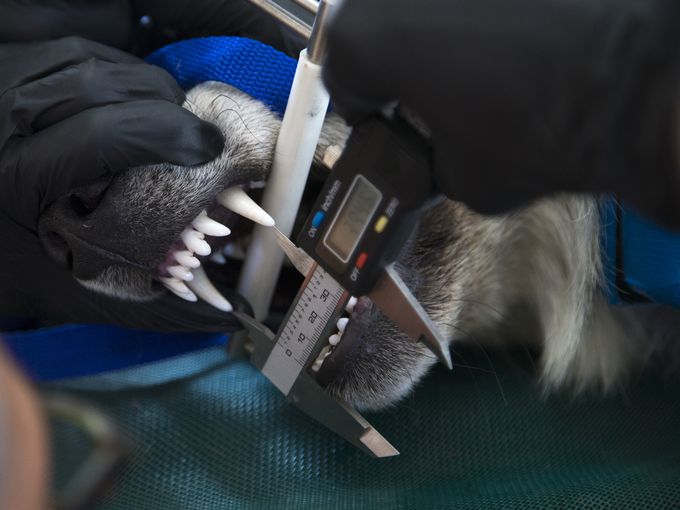
U.S. Fish and Wildlife Service veterinarian Susan Dicks coached the team of biologists and field technicians tending to M1342: how to draw blood for DNA and other tests; where to inject a rabies vaccine; how to determine age by measuring teeth; how to increase fluids or pour cooling alcohol on the paws if his temperature rises past 103 or so.

Besides the preventive medicine and data collection, the prime objective for M1342’s capture during a yearly aerial wolf survey was to fit it with a new transmitter collar. The collar he had received in a similar operation last year hadn’t functioned, so biologists only knew the wolf’s whereabouts by occasional observation. Uncollared wolves are difficult to track to ensure they’re not getting into trouble, such as by attacking livestock.

Not every wild Mexican wolf is collared, but scientists like to have them on a wolf of every generation in a pack. Last year’s survey counted 19 packs, including eight known to have a breeding pair.

Studies show that these free-ranging wolves eat elk upward of 80 percent of the time, but cows are also occasionally on the menu. A government and non-profit fund pays for the losses. So far, the wolf program has paid out $68,000 for 50 confirmed livestock losses in 2015, and another $25,000 in claims is awaiting action by a compensation council. “It’s such a controversial program, and (people) want us to manage these animals,” Dicks explained. “The way we manage is with that collar. It communicates and tells us what they’re doing.”

The latest in a string of political struggles over the lightweight cousin of more plentiful northern gray wolves involves where they should be allowed.
Wolf advocates say they need unoccupied territory such as the forests around the Grand Canyon to sustain a population large and dispersed enough to withstand sudden die-offs. The governors of Arizona, New Mexico, Colorado and Utah recently co-signed a letter to the federal program opposing such a northern expansion into previously undocumented wolf territory and instead backing a push south into Mexico.

The number of wolves needed to ensure long-term survival also is in dispute. Some want to hold the line around today’s numbers, but others say at least a sevenfold increase is needed.

Back to dogs and kittens.

As seen on the Care2 website.

Jack the dog somehow tolerates Julia the kitten’s limitless desire to play with him…even when that includes some kitty paws to the face! Impressed?

(Must admit the background music to this video seemed rather out of character!)

Charles Bergman

The way we can reach out to others in these modern times.

A fellow local author, Constance Frankland, who has been mentioned previously here on Learning from Dogs followed up last Sunday’s Picture Parade with a comment on my Facebook page:

You might enjoy the site of Dr. Charles Bergman. I was privileged to take writing classes from him when his features were just breaking into Audubon and National Geographic. He was researching the thought-to-be-extinct Trumpeter Swan when survivors were found. (“Wild Echoes: Encounters With the Most Endangered Animals”) http://www.charlesbergman.com/

It was then the matter of a moment to hop across to that website address and read this on the home page:

Charles Bergman

A writer, photographer and speaker who lives in the beautiful Pacific Northwest and is a prof at Pacific Lutheran University in Tacoma, Washington.
He’s twice been a Fulbright Scholar in Latin America–Mexico and Ecuador–traveled extensively around the world, especially in Latin America from Mexico to Tierra del Fuego. He writes and publishes extensively on animals, nature, and sustainability–with many cover stories in such magazines as Smithsonian, Audubon, All Animals (Humane Society),, Defenders, and many more.  His photographs accompany his articles. He has written three books, and has won the Washington State Book Award, Southwest Book Award, and the Benjamin Franklin Book Award. He was a finalist for the PEN USA Literary Award.
He loves animals and wildlife of all kinds, and has developed a new-found love for Antarctica and Africa.

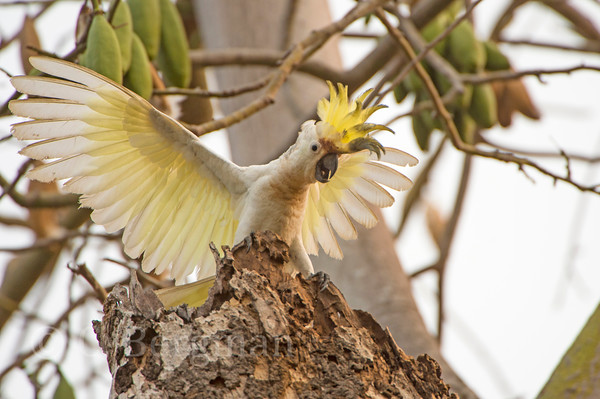
His home page includes this photograph:

Abbotti Cockatoo–Indonesia

Cockatoo--Abbotti--Nest 4 Display 4-MThere seemed to be many interesting articles & essays on his site and despite the fact that Mr. Bergman is currently in Uganda, his reply to my request for permission to republish some of his posts came through promptly:

Greetings from Uganda!  I’m here working in the Uganda Wildlife Education Center, back shortly.  Yes, you may certainly republish my materials.  I’ll be very interested to follow the process.

Warmly,

Charles Bergman

You can count on me picking out some of Professor Bergman’s writings to share with you soon.

This reaching to others, friends and strangers, is a wonderful aspect of present times.

Role model extraordinare!

In salute of Sir David Attenborough.

Yesterday, a wonderful number of readers ‘Liked’ my set of photographs on the theme of being a wildlife photographer. Thus it was providential, when deliberating on what to write for today’s post, to see that George Monbiot had published an article covering his recent interview with Sir David.

Before republishing that interview, let’s take a look at the man; Sir David that is!

Wikipedia has a comprehensive and fulsome description of him, that opens, thus:

Sir David Frederick Attenborough/ˈætənbʌrə/OMCHCVOCBEFRSFLSFZSFSAKt (born 8 May 1926)[2][3] is an English broadcaster and naturalist.

He is best known for writing and presenting the nine Life series, in conjunction with the BBC Natural History Unit, which collectively form a comprehensive survey of animal and plant life on the planet. He is also a former senior manager at the BBC, having served as controller of BBC Two and director of programming for BBC Television in the 1960s and 1970s. He is the only person to have won BAFTAs for programmes in each of black and white, colour, HD, and 3D.

Attenborough is widely considered a national treasure in Britain, although he himself does not like the term.[4][5][6] In 2002 he was named among the 100 Greatest Britons following a UK-wide vote.[7] He is the younger brother of director, producer and actor Richard Attenborough.[8]

Then I want you to view this short video:

Published on May 2, 2014

From across YouTube, Twitter and Facebook, we’ve taken your comments during #AttenboroughWeek and made this video as a thank you to everyone who got involved. Click on the annotations to see each of the clips in full.

Now on to the George Monbiot interview, republished here with Mr. Monbiot’s kind and generous permission.

ooOOoo

Rare Specimen

If you need a reminder of how beautiful our planet is (and I’m sure the majority of LfD readers don’t require that reminder) then go back and watch David Attenborough’s video and voice-over to the song  What a Wonderful World. This short but very compelling video shows why the planet is so worth protecting. Enjoy!

So make a diary note to celebrate Sir David’s 90th birthday on May 8th.

More Dogs and Dolphins

Can’t resist these videos.

I was looking up stories on German Shepherds, a breed we just adore, and quite by chance came across a lovely follow-up to my post last Tuesday Dogs and Dolphins.

Published on Mar 9, 2012

This is a video of a German Shepherd jumping in on some dolphins while we were underway in our boat. I guess he wanted to play with the dolphins lol
Thanks for watching

After that video had come to an end, YouTube then automatically went on to this one:

(The soundtrack quality is poor but, nevertheless, it was been viewed over six million times!)

You all have a great week-end.

Cute with a capital ‘K’.

Young animals are especially gorgeous.

Here’s a short video to watch:

And here’s the background story:

Published on Dec 22, 2015

Welcome to the world, tiny otter pup! A wild otter mom gave birth to her pup in our Great Tide Pool over the weekend.

It was then just a mouse click to go to the website of the Monterey Bay Aquarium and read this:

ooOOoo

The squee heard ‘round the world!

Sea Otter gives birth to newborn pup in Monterey Bay Aquarium Tide Pool

As you probably know by now, a wild baby sea otter was born this morning in our Great Tide Pool! For the last several days, a wild female sea otter had been using the protected basin of our Great Tide Pool to rest from the winter storms. Last night, just as the Aquarium closed, she was spotted once again slinking into the pool for some shut-eye. It’s rare for a healthy sea otter to visit the pool so frequently—we started to wonder if she was doing all right.

Sea Otter gives birth to newborn pup in Monterey Bay Aquarium Tide Pool

Well, mystery solved! Around 8:30 a.m., Aquarium staff witnessed a BRAND NEW pup resting on her belly, being furiously groomed by a proud momma. We’re talking umbilical-chord-still-attached, whoa-is-that-yep-that’s-the-placenta new-born otter pup!

Sea Otter gives birth to newborn pup in Monterey Bay Aquarium Tide Pool

In steady waves, Aquarium staff, volunteers, and then the days’ visitors made their way to the back deck to watch a conservation success story taking place—and become fluffier in front of their eyes. Not that long ago, sea otters were hunted to near extinction. Maybe 50 were left in all of California by the early 1800’s. But now, thanks to legislative protection and a change of heart toward these furriest of sea creatures, the otter population has rebounded to steady levels in the Monterey Bay, and with 3,000 total in central California.

Sea Otter gives birth to newborn pup in Monterey Bay Aquarium Tide Pool

We’ll keep you updated on this new otter family—mom may decide to head out any time. As of this writing though, she’s still grooming her pup and enjoying the comfort of our Great Tide Pool. The cute overload continues.

ooOOoo

“The cute overload continues.”

Just wonderful and a very long way from becoming an overload to this person!


The secret of our happiness.

It’s both obvious, and yet it is not!

Anyone who has more than a single dog around them knows how a group of dogs, even just a couple, are fantastic companions. Extending that line of thought brings one immediately to the realisation that a person who lives on their own yet has a dog never experiences the loneliness of a person who lives on their own ‘sans chien’.

So hold that notion in your mind as I introduce an item that was recently published on the Care 2 Living Healthy blogsite. It was called, in part, What really makes us happy and is republished here within the terms of Care 2.

ooOOoo

A 75-Year Study Reveals What Really Makes Us Happy

1372622.largeBy: Becky Striepe, January 8, 2016

Robert Waldinger directed a 75-year study looking at what makes us happy. It boils down to three things, and they’re not the things we tend to think are going to make us happy. His TED Talk about the study findings challenges our most common life goals.

When you ask most people what would make them happy, their answers tend to cluster around achievement. Maybe they think they’d be happier if they were rich or famous. Or maybe they feel like success in their careers would bring them true happiness.

Unlike many studies on happiness, the Harvard Study of Health Development happened in real time. The researchers didn’t rely on memories of past events. Instead, this project—passed down from research team to research team for 75 years—followed a group of 724 men through their lives. They were interviewed every two years, and got complete physicals at every check-in.

When the project began, 268 of the men were sophomores at Harvard University, where the study took place. The other 456 men were inner-city Boston high school students.

Waldinger was the study’s fourth director and in his talk he explains some of the interesting findings about happiness. He says happiness boils down to three things, but if you wanted to sum it up even more succinctly, you could say this: What really makes us happy is social connection.

Jogging

Waldinger says there are three main lessons about what really makes us happy that come from this study:

  1. Social connections are critical to our mental and physical health. Whether it’s relationships with family, friends or neighbors, people who have social connection are happier and healthier. In fact, he says, loneliness is toxic. People who want these relationships but lack them are not only not as happy but they experience worse health.
  2. Your number of friends doesn’t matter. What matters most is the quality of your relationships, not the quantity. People with loving relationships in their lives, not just from spouses, but friends or other family members, had overall better health. Quality of relationships was a better predictor of later-life health than markers we tend to focus on, like cholesterol levels.
  3. Quality relationships are good for brain health. People who have quality relationships in their lives have better memory as they age. People without quality relationships were more likely to experience cognitive decline as they grew older.

He defines a quality relationship as one where you feel like you can count on the other person. He says that doesn’t mean never fighting. It means an overall sense of security.

When you hear these results, they sort of seem like a no-brainer, right? But when the study began, 80 percent of participants said being rich would make them happy. We know on some level that relationships are a key to happiness, but we tend to discount their full importance. Why? Waldinger gets into that in his talk, as well (at around 12:15, if you want to skip ahead). You can watch it in full right here:

Published on Nov 30, 2015

What makes us happy and healthy as we go through life?
If you want to invest in “the good life,” where should you put your time and energy? Robert Waldinger answers these questions with lessons learned from a 75-year-long study of adult life that started in the late 1930s and continues to this day.
Robert Waldinger is a psychiatrist, psychoanalyst, and Zen priest. He directs the Harvard Study of Adult Development at Massachusetts General Hospital in Boston and teaches at Harvard Medical School.

ooOOoo

Thus while this study does not refer to dogs, nonetheless a dog or two (or nine!) does provide a wonderful social connection, as all those who know and love dogs will attest to.

As seen on BarkPost.

Cold Winter nights.

The last few nights have been so cold we have needed to put an extra dog on the bed!

From left-to-right: Cleo; Hazel, Pedy; Oliver; Sweeny.
From left-to-right: Cleo; Hazel, Pedy; Oliver; Sweeny. (Photograph taken at 09:40 last Thursday, 7th January.)

Private First Class Lingo.

Don’t worry son, you’re in the Army now!

Fellow author member of AIM (Authors Innovative Marketing), Constance Frankland, sent me a link to this news item over on Californian station KSBW. Here it is:

and here are the details that were presented on KSBW’s website:

MONTEREY, Calif. —Private First Class Lingo is in the Army now.

The 8-month-old shepherd mix enlisted in a formal doggy ceremony in Monterey on Tuesday, signing up to be treated like any other member of the service.

“He will be uniformed, he will be tracked, he will be documented,” said Defense Language Institute commandant Col. Philip Deppert.

The Private First Class will go down in DLI’s history books as its first-ever mascot. The Presidio of Monterey had a canine mascot back in the 40s, before DLI existed, and his name was Sgt. Tippy.

Lingo is starting at the bottom in his military career, but Deppert said he will have opportunities to move up in rank if he behaves.

“He will also have the opportunity to lose rank, should he misbehave, and not perform as we expect the rest of our service members to,” the colonel said.

But so far the pup has been toeing the line: getting up early for walks, exercising out on the field with the students, and most importantly learning the art of obedience.

Part of Private Lingo’s training is learning how to run in formation because in February he is scheduled to lead the commandant’s run with all the 2,000 plus service members at DLI.

Aside from his normal duties, the rescue dog was brought to the Presidio of Monterey for a special mission, to be the mascot, and so far he is knocking it out of the park.

“He has made about 2,000 new best friends; he is a magnet any place he goes, and it is exactly what he was intended to do,” Deppert said.

Lingo was adopted from the SPCA for Monterey County in November.

Here are two photographs from that story.

Private-Lingo-2-JPGoooo

Private-Lingo-3-JPGAnother example of our incredible dogs.

Big Dog Natural food recall

The first one of the New Year.

Dear Fellow Dog Lover,
Big Dog Natural of Brick, NJ, has announced it is voluntarily recalling select lots of its raw dehydrated dog food products because they have the potential to be contaminated with either Salmonella or Listeria monocytogenes bacteria.

To learn which products are affected, please visit the following link:

Big Dog Natural Dog Food Recall of January 2016

Please be sure to share the news of this alert with other pet owners.

Mike Sagman, Editor
The Dog Food Advisor

If you go to that link, you will read the following:

ooOOoo

January 4, 2015 — Big Dog Natural of Brick, NJ, has announced it is voluntarily recalling a select lot of its Big Dog Natural Chicken Supreme raw dehydrated dog food because it may be contaminated with Salmonella.

The company is also recalling its Fish Supreme product because it may be contaminated with Listeria monocytogenes.

The affected products were shipped to online customers during the period from October 31, 2015 through November 13, 2015.

big-dog-natural-chickenbig-dog-natural-fish

About Salmonella and Listeria

Salmonella and Listeria monocytogenes can affect animals eating the products.

And there is also risk to humans from handling contaminated pet products — especially if they have not thoroughly washed their hands after having contact with the products or any surfaces exposed to these products.

Healthy people infected with Salmonella and Listeria monocytogenes should monitor themselves for some or all of the following symptoms: nausea, vomiting, diarrhea or bloody diarrhea, abdominal cramping and fever.

Rarely, Salmonella and Listeria monocytogenes can result in more serious ailments, including arterial infections, endocarditis, arthritis, muscle pain, eye irritation, and urinary tract symptoms.

Consumers exhibiting these signs after having contact with this product should contact their healthcare providers.

Pets with Salmonella and Listeria monocytogenes infections may be lethargic and have diarrhea or bloody diarrhea, fever, and vomiting.

Some pets will have only decreased appetite, fever and abdominal pain.

Infected but otherwise healthy pets can be carriers and infect other animals or humans.

If your pet has consumed the recalled product and has these symptoms, please contact your veterinarian.

These products were sold directly to consumers through the company’s online website and in the US.

The recalled products include all weight volumes of the Big Dog Natural Chicken and Fish Supreme.

No additional products are affected by this recall.

What Caused the Recall?

Big Dog Natural became aware of a potential issue after receiving notification from the FDA that an investigative sample of Chicken Supreme tested positive for Salmonella.

And that an investigative sample of Fish Supreme tested positive for Listeria monocytogenes.

What to Do?

Consumers should discontinue feeding the affected product, monitor their pet’s health and contact their veterinarian if they have concerns.

Consumers who purchased the product can obtain a full refund or exchange by returning the product in its original packaging.

Consumers with questions should contact Big Dog Natural by calling 732-785-2600 from 9 AM to 4 PM ET.

U.S. citizens can report complaints about FDA-regulated pet food products by calling the consumer complaint coordinator in your area.

Or go to http://www.fda.gov/petfoodcomplaints.

Canadians can report any health or safety incidents related to the use of this product by filling out the Consumer Product Incident Report Form.

Get Dog Food Recall Alerts by Email

Get free dog food recall alerts sent to you by email. Subscribe to The Dog Food Advisor’s recall notification list.

ooOOoo

Please share this with all other dog owners – thank you!