That quote was one uttered by Harold Macmillan, the British Conservative politician and publisher, who served six years as Prime Minister from 1957 to 1963. It was in response to a question regarding what sort of thing was most likely to blow a government off course.
Why did that quotation come to my mind? Simply because all my grand plans for writing a post for you good people were stymied by our internet connection being down for much of the weekend.
So rather than get cut off half-way through a new post, I decided to re-post what I published on this blog five years ago to the day: on April 24th. 2012. Here it is.
ooOOoo
How lady luck brought joy for a ‘down-and-out’ Londoner and a cat called Bob!
I was chatting with my son yesterday and he happened to mention that perhaps I should write about a cat for a change! Alex mentioned a book recently published in the UK called A Street Cat Named Bob: How One Man and His Cat Found Hope on the Streets.
This is how the book is described on Amazon (UK site),
When James Bowen found an injured, ginger street cat curled up in the hallway of his sheltered accommodation, he had no idea just how much his life was about to change. James was living hand to mouth on the streets of London and the last thing he needed was a pet. Yet James couldn’t resist helping the strikingly intelligent tom cat, whom he quickly christened Bob. He slowly nursed Bob back to health and then sent the cat on his way, imagining he would never see him again. But Bob had other ideas. Soon the two were inseparable and their diverse, comic and occasionally dangerous adventures would transform both their lives, slowly healing the scars of each other’s troubled pasts. A Street Cat Named Bob is a moving and uplifting story that will touch the heart of anyone who reads it.
A quick web search found volumes of material.
As in the local London newspaper the Islington Tribune wrote this back in 2010,
Two cool cats… the Big Issue seller and a stray called Bob
Inseparable: musician James Bowen with Bob
Down-on-his-luck musician teams up with ‘wonderful loyal friend’ he rescued from streets
Published: 24 September, 2010
by PETER GRUNER
NOT since the legendary Dick Whittington has a man and his cat become such unlikely celebrities on the streets of Islington.
Big Issue seller James Bowen and his docile ginger cat Bob, who go everywhere together, have been attracting comments since they first appeared outside Angel Tube station.
The story of how they met – widely reported in blogs on the internet – is one of such extraordinary pathos that it seems only a matter of time before we get a Hollywood film.
James, 31, who lives off Seven Sisters Road, Holloway, is a musician who has fallen on hard times.
He ekes out a basic living selling the homeless people’s magazine Big Issue at Angel and Covent Garden.
Bob was a stray discovered by James outside his accommodation one day.
The cat was limping after apparently being attacked by another animal, possibly a fox.
After failing to discover the cat’s owner, James took him to the RSPCA hospital at Finsbury Park, which prescribed a course of antibiotics.
“I kept him for two weeks until he was well enough to go on his way,” said James. “But when I opened the front door to let him out Bob wouldn’t move. He seemed to me to be saying: ‘I want to stay with you.’
“Now we go everywhere together. I even have a cat harness when we go out and Bob gets really excited when I show it to him.”
Read the rest of the article here and if you want more information, a web search on Bob the Cat will finds loads more.
It’s a fabulous story with a great message of hope for not just for James and Bob but for all of us that find ourselves ‘up a creek without a paddle’ at points in our lives.
Here’s how the newspaper The Daily Mail wrote about it on their website,
[last half of the story]
But then Bob started following him and it became increasingly difficult to shoo him away, especially as there were dangerous roads to be crossed. One day there was nothing for it but to put Bob on a makeshift lead and take him along. Bob travelled sitting on James’s shoulders.
The trouble was, so many cat-mad passers-by stopped him to stroke the animal that James arrived late at his pitch, secretly cursing Bob for thereby costing him some of his usual £25-a-day takings. He couldn’t have been more wrong.
Within minutes, people who would normally have walked by without giving James a second glance were lingering to make a fuss of the cat sitting sedately in his guitar case, and most made a donation. By the end of the day, he’d racked up more than £60.
It was the beginning of a phenomenon as tourists and commuters befriended Bob and James, many bringing titbits for the cat. People were amazed at how placidly Bob would sit all day, quite happily watching the world go by while James earned a living. Not that it was always without a hitch; on a couple of occasions Bob bolted when startled, leading to a frantic chase through the crowded streets.
Bob’s popularity continued when James switched from busking to selling the Big Issue, the magazine produced and sold by homeless people. This change in direction was part of James’s growing sense of a need to get his life in order, which he puts down to the responsibility of looking after Bob, and the example the cat offered of the possibility of a second chance.
It enabled James to make the final push to end his drug dependency, going through the necessary cold turkey to get off heroin substitutes, and to mend broken contacts with his family. The final result of Bob’s influence came when a literary agent who passed the duo every day and had seen them on YouTube suggested James tell their story in a book. The result is this heart-warming tale with a message of hope that will appeal especially to the many cat obsessives out there.
(And, please, make a note of my final remark at the end of today’s post.)
Those who are regular visitors to this place will know that John Zande, who lives in Brazil, is a good friend, and, for that matter, I try to be a good friend of his place. (If you didn’t read my recent review of John’s latest book On The Problem of Good then it is here.)
So when a couple of days ago I received the following email from John you can imagine my positive response to his request.
Paul, hi, I have a favour to ask.
My wife’s sister, Dee (who lives in Australia) has started a gofundme campaign to help cover a rash of vet surgery bills we’ve had recently. These past few months (most of summer, really) has been appalling with the number of dumped animals in our area.
Together with a few other people in our loose group we rescued about ten and got them adopted out to good homes. Plus, we have three in temporary shelters as we nurse them back to health. We took one into our house, Nina, thus making eleven here now, who had her tail amputated last Tuesday. We were fortunate in that our vet worked for free (a 3hr operation) and only charged us for the anesthetist.
We’re lucky to have these wonderful people around, but we’re a tad snowed under right now with the accumulated surgeries and medicines, which is why Dee started this little campaign.
Now there was no question that Jean and I wanted to help. Not only by making a modest donation ourselves but by promoting Dee’s campaign. I emailed a reply to John saying just that.
John then responded with more details, including some photographs:
Dee is married to a very good friend of mine from Uni. She started this campaign to help Dionete, my wife, and I (and if possible a few other Vista Verde folk who’re in our rescue network) here in Brazil. Dee was here just before Christmas and saw the problem first hand. She actually helped us rescue a wonderful little fellow, Terrorista, who now lives a few streets away with a wonderful family.
I didn’t know, but Dionete was chatting to her a week or two ago and it came up just how many vet/surgery/medicine expenses we’d accumulated over the summer. Without either of us knowing, she, Dee, then started this gofundme campaign to lend a hand and help clear the vet bills. We’re not an NGO (we actually help four here in Sao Jose dos Campos, two in Sao Paulo, and Sandra’s Maxmello in another city south of Sao Paulo). Because we’re not an NGO we’ve never thought about doing a campaign ourselves, so was surprised when Dee started this one. It’s quite modest, $1,000 Australian dollars (the goal) converted to Brazilian Reis will make a sizable dent in our backlog of vet surgery bills. Our bills are tiny compared to a guy we know who does have an NGO and owes his network of vets 90,000. He’s a wonderful fellow and I’m actually working with him to try and get a mobile neutering unit started here in Sao Jose dos Campos. But that’s another story. So, to be clear, the campaign is for us here in Vista Verde, which is sadly a dumping ground for animals. Surrounding districts seem to think we’re all wealthy here and therefore they can dump their animals. It’s infuriating, and the animals never stop coming.
I am sure that Jean and I aren’t the only ones that want to help.
And John could offer no better reason for seeking some financial support from the wider world. Here’s some of his later email:
My apologies if there was some confusion. I’m actually heading out right now to feed a new fellow I found a few days ago and is sleeping outside a house in another district. When I get back I’ll send some more photos, OK.
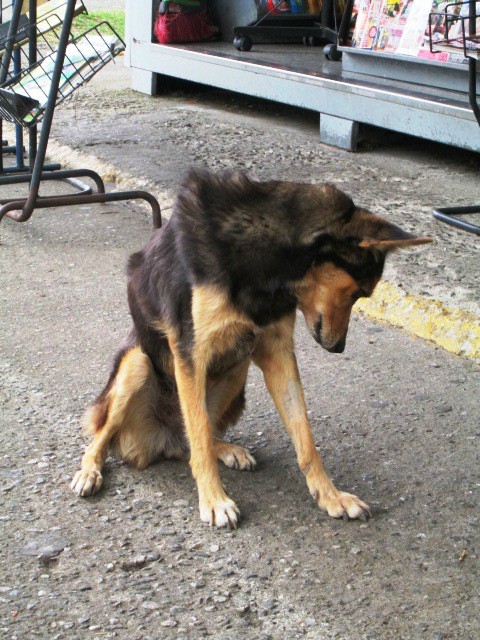
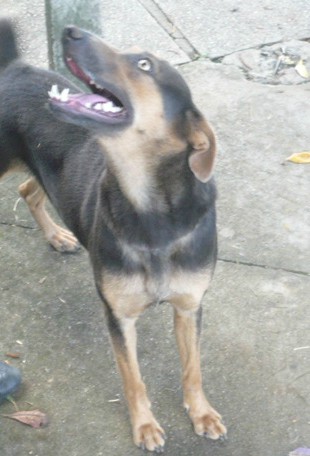
Let me close with some more photos of dogs that have been helped by John, Dionete and the rest of the great band of the Vista Verde Fund.
oooo
oooo
oooo
Finally!
Please offer whatever you can to help. Even the smallest amount makes a real difference.
April 17, 2017 — Party Animal, Inc. has announced it is recalling specific lots of two varieties of its Cocolicious canned dog foods because they have each tested positive for the euthanasia drug, pentobarbital.
What’s Being Recalled?
The following products are affected by the recall:
Cocolicious Beef and Turkey
Size: 12 ounce cans
Lot Number: 0136E15204 04
Best By Date: July 2019
Cocolicious Chicken and Beef
Size: 12 ounce cans
Lot Number: 0134E15 237 13
Best By Date: August 2019
What Caused the Recall?
According to a statement posted on the company’s website and its Facebook page:
The safety of pets is and always will be our first priority. We sincerely regret the reports of the discomfort experienced by the pet who consumed this food.
As pet parents ourselves, we take this matter seriously.
On April 13, a retailer in Texas notified us that their customer had presented samples of our Cocolicious Beef and Turkey Lot #0136E15204 04 and Cocolicious Chicken and Beef Lot #0134E15 237 13 to a testing lab, and that the results had tested positive for pentobarbital.
We have requested those results.
When we were notified, we immediately tracked the lot numbers of the food in question and determined that the food had been manufactured and distributed in 2015.
We then contacted the two probable retailers that had sold the customer the food and asked them to isolate all remaining cans from these lots.
We also requested that the retailers send all of the cans from those lots to us so that we can forward them on to an accredited independent laboratory for independent testing.
We expect to receive the receive the results in 7 to 10 days.
We first saw the formal report from the lab at Texas A&M regarding the customer’s samples, today, April 17.
Out of an abundance of caution, we are retrieving the remainder of these two lots nationwide.
We are working with our distributors and retailers to determine if any additional beef-flavored products manufactured during this 2015 production period remain on shelves and, if so, to retrieve them from shelves, immediately, as well.
What to Do?
Consumers with questions may contact the company by phone at 855-727-8926 or by email at info@partyanimalpetfood.com.
U.S. citizens can report complaints about FDA-regulated pet food products by calling the consumer complaint coordinator in your area.
Humanity’s safe and viable future depends on seeing things very differently.
Next Tuesday is the 62nd anniversary of the death of Albert Einstein, the famous German theoretical physicist who died on the 18th April, 1955. He delivered many innovative ways of seeing our world way beyond his theory of relativity, one of the two pillars of modern physics (alongside quantum mechanics) (Ref: Wikipedia)
Why do I introduce today’s post with that reference to Mr. Einstein?
Because I wanted to share with you a recent essay from George Monbiot and an Einstein quotation seemed so apt an introduction.
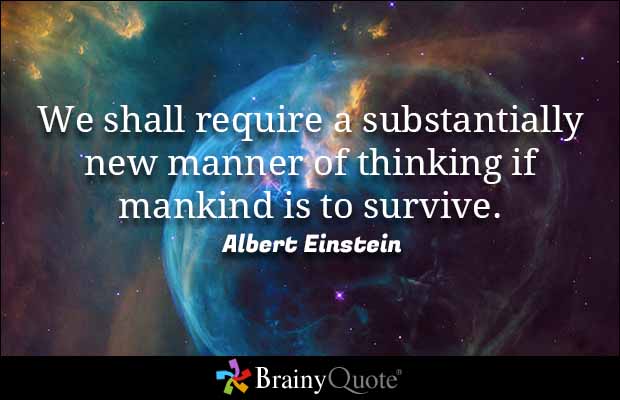
We shall require a substantially new manner of thinking if mankind is to survive.
That essay from George Monbiot was published yesterday and is shared with you all with Mr. Monbiot’s full permission.
It is an essay that deserves being read slowly and carefully. Please take time aside to so do because it really does offer a new manner of thinking.
ooOOoo
Circle of Life
13th April 2017
By reframing the economy, Kate Raworth’s Doughnut Economics changes our view of who we are and where we stand.
By George Monbiot, published in the Guardian 12th April 2017
So what are we going to do about it? This is the only question worth asking. But the answers appear elusive. Faced with a multifaceted crisis – the capture of governments by billionaires and their lobbyists, extreme inequality, the rise of demagogues, above all the collapse of the living world – those to whom we look for leadership appear stunned, voiceless, clueless. Even if they had the courage to act, they have no idea what to do.
The most they tend to offer is more economic growth: the fairy dust supposed to make all the bad stuff disappear. Never mind that it drives ecological destruction, that it has failed to relieve structural unemployment or soaring inequality, that, in some recent years, almost all the increment in incomes has been harvested by the top 1%. As values, principles and moral purpose are lost, the promise of growth is all that’s left.
You can see the effects in a leaked memo from the UK’s foreign office: “Trade and growth are now priorities for all posts … work like climate change and illegal wildlife trade will be scaled down.” All that counts is the rate at which we turn natural wealth into cash. If this destroys our prosperity and the wonders that surround us, who cares?
We cannot hope to address our predicament without a new worldview. We cannot use the models that caused our crises to solve them. We need to reframe the problem. This is what the most inspiring book published so far this year has done.
In Doughnut Economics: seven ways to think like a 21st-century economist, Kate Raworth reminds us that economic growth was not, at first, intended as a measurement of well-being. Simon Kuznets, who standardised the measurement of growth, warned: “the welfare of a nation can scarcely be inferred from a measure of national income.” Economic growth, he pointed out, measures only annual flow, rather than stocks of wealth and their distribution.
Raworth points out that economics in the 20th Century “lost the desire to articulate its goals.” It aspired to be a science of human behaviour: a science based on a deeply flawed portrait of humanity. The dominant model – “rational economic man”, self-interested, isolated, calculating – says more about the nature of economists than it does about other humans. The loss of an explicit objective allowed the discipline to be captured by a proxy goal: endless growth.
The aim of economic activity, she argues, should be “meeting the needs of all within the means of the planet.” Instead of economies that need to grow, whether or not they make us thrive, we need economies that “make us thrive, whether or not they grow.” This means changing our picture of what the economy is and how it works.
The central image in mainstream economics is the circular flow diagram. It depicts a closed flow of income cycling between households, businesses, banks, government and trade, operating in a social and ecological vacuum. Energy, materials, the natural world, human society, power, the wealth we hold in common: all are missing from the model. The unpaid work of carers – principally women – is ignored, though no economy could function without them. Like rational economic man, this representation of economic activity bears little relationship to reality.
So Raworth begins by redrawing the economy. She embeds it in the Earth’s systems and in society, showing how it depends on the flow of materials and energy, and reminding us that we are more than just workers, consumers and owners of capital.
The Embedded Economy. Graphic by Kate Raworth and Marcia Mihotich
This recognition of inconvenient realities then leads to her breakthrough: a graphic representation of the world we want to create. Like all the best ideas, her Doughnut model seems so simple and obvious that you wonder why you didn’t think of it yourself. But achieving this clarity and concision requires years of thought: a great decluttering of the myths and misrepresentations in which we have been schooled.
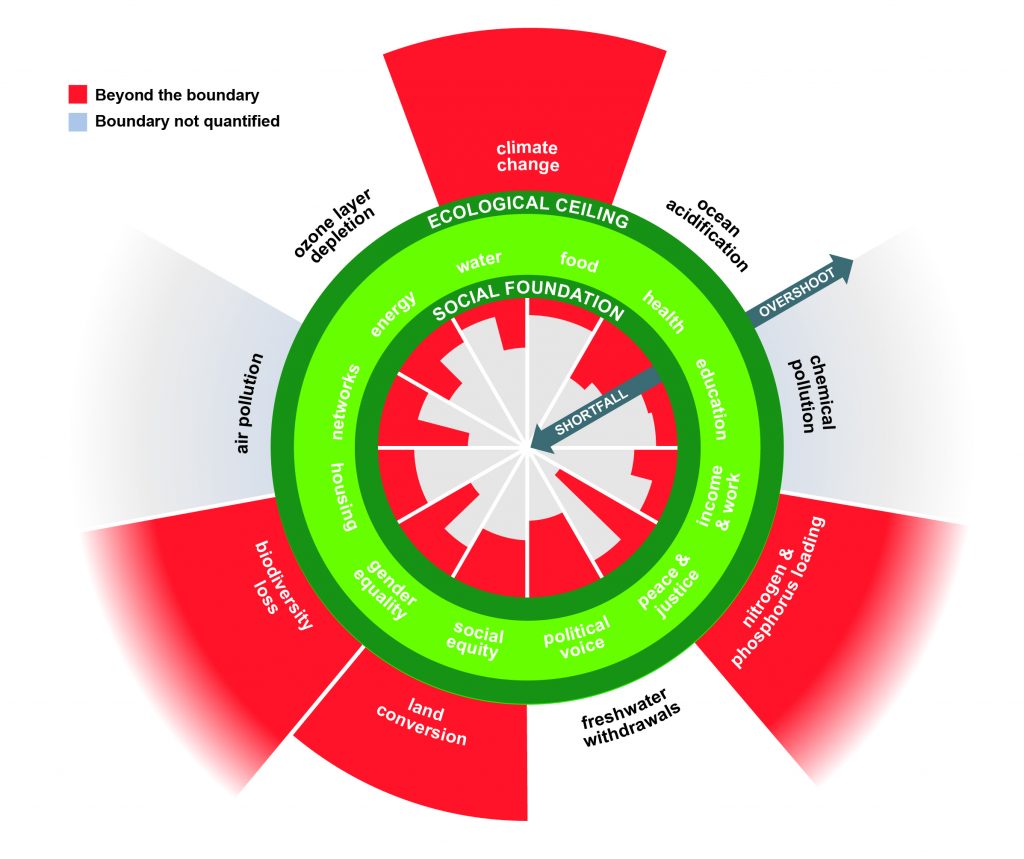
The diagram consists of two rings. The inner ring of the doughnut represents a sufficiency of the resources we need to lead a good life: food, clean water, housing, sanitation, energy, education, healthcare, democracy … . Anyone living below that line, in the hole in the middle of the doughnut, is in a state of deprivation.
The Doughnut. Graphic by Kate Raworth and Christian Guthier/The Lancet Planetary Health
The outer ring of the doughnut consists of the Earth’s environmental limits, beyond which we inflict dangerous levels of climate change, ozone depletion, water pollution, loss of species and other assaults on the living world. The area between the two rings – the doughnut – is the “ecologically safe and socially just space” in which humanity should strive to live. The purpose of economics should be to help us enter that space and stay there.
As well as describing a better world, the doughnut model allows us to see, in immediate and comprehensible terms, the state in which we now find ourselves. At the moment we transgress both lines. Billions of people still live in the hole in the middle. We have breached the outer boundary in several places.
Where we are now. Graphic by Kate Raworth and Christian Guthier/The Lancet Planetary Health
An economics that helps us to live within the doughnut would seek to reduce inequalities in wealth and income. Wealth arising from the gifts of nature would be widely shared. Money, markets, taxation and public investment would be designed to conserve and regenerate resources rather than squander them. State-owned banks would invest in projects that transform our relationship with the living world, such as zero-carbon public transport and community energy schemes. New metrics would measure genuine prosperity, rather than the speed with which we degrade our long-term prospects.
Such proposals are familiar, but without a new framework of thought, piecemeal solutions are unlikely to succeed. By rethinking economics from first principles, Raworth allows us to integrate our specific propositions into a coherent programme, and then to measure the extent to which it is realised. I see her as the John Maynard Keynes of the 21st-Century: by reframing the economy, she allows us to change our view of who we are, where we stand, and what we want to be.
Now we need to turn her ideas into policy. Read her book, then demand that those who wield power start working towards its objectives: human prosperity within a thriving living world.
Yet another wonderful saving of a dog from a frozen lake!
One of the ‘generalist’ blogs that I follow is Mother Nature Network (MNN) and yesterday MNN published the account of a dog in Canada being rescued from icy cold water.
Winter hasn’t let go of some parts of North America just yet, including St. Albert, Alberta, in Canada. Cold temperatures keep the lakes frigid and icy, as a local man and his dog discovered recently.
A French bulldog named Cosmo plunged into a lake in a park in St. Albert — it was a leash-free area of the park — and was struggling to pull himself out of the thin ice that covered the lake. Cosmo’s owner, Duncan McIver, jumped in to save his pup.
McIver was able to push Cosmo onto the ice and then, while carrying Cosmo, slowly walked across the ice, but not without plunging into the freezing cold water once more.
In a bit of serendipity, a CTV news crew was already at the park, filming a report on ice safety, and caught the whole episode on camera.
“As soon as the ice broke, I just went right in,” McIver told CTV Edmonton, “I think most people would do the same for their dog.”
The saying goes that a dog is man’s best friend, but we think moments like this prove the feeling is mutual.
ooOOoo
Yes, picking up on that remark by Duncan McIver, most people really would do what Duncan did!
Stories like this make my toes curl with pleasure!
Less than two weeks ago I shared an item that I had read about the firefighters of Santa Monica, CA, saving the life of a ten-year-old dog.
When Santa Monica firefighters were called to a burning apartment, they found the lifeless body of a tiny dog overcome by the heat and smoke on the floor of a bedroom. They pulled out the dog, named Nalu, but he wasn’t breathing and didn’t have a pulse.
Then two days ago, courtesy of the Care2 Causes blogsite, along comes another fabulous example of the care, love and generosity shown by firefighters.
ooOOoo
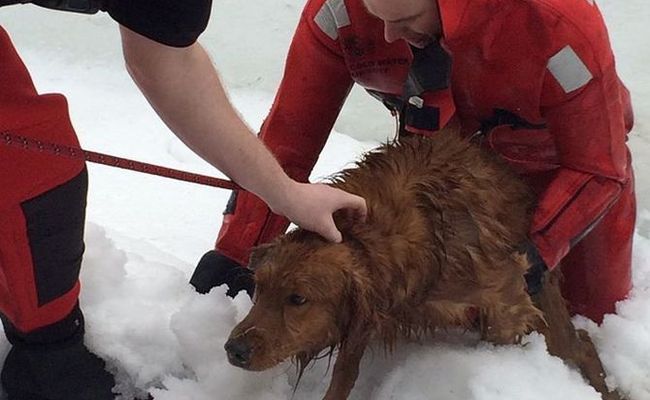
Firefighters Rescue Golden Retriever From Icy Pond
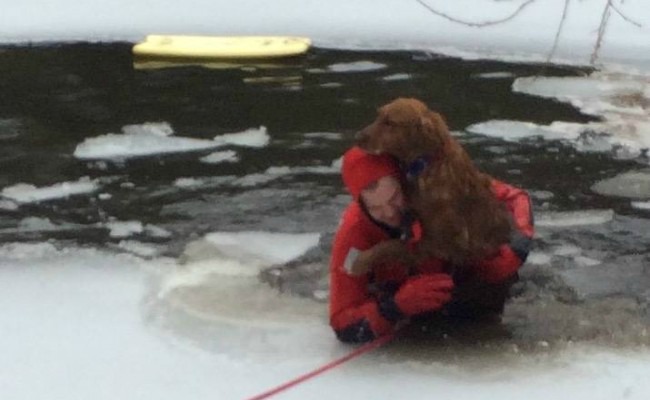
With perhaps just seconds to spare, North Hampton firefighter Will Taber barreled toward a dog who was barely clinging to thin ice last week in New Hampshire.
Photo Credit: North Hampton Professional Fire Fighters
Three-year-old Emmett ran out onto his family’s frozen backyard pond, suddenly falling through the ice. Although homeowner Kacey Eddinger started into the pond to rescue him, she had to turn back when she realized the water was simply too cold. Eddinger and her toddler son waited anxiously for help to arrive.
Photo Credit: North Hampton Professional Fire Fighters
The family isn’t certain exactly how long their golden retriever was in the water before they realized he’d fallen through, but by the time firefighters arrived, Emmett was exhausted and close to drowning.
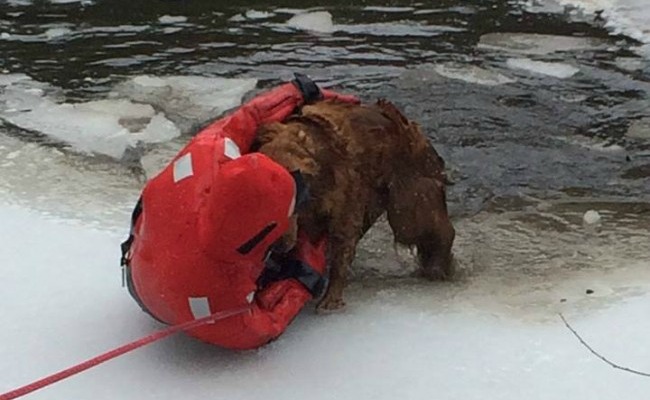
In thermal ice rescue gear, firefighter Taber held a tethered line as he crossed the ice and entered the water. Once he reached Emmett, the other firefighters pulled the pair back to shore.
Photo Credit: North Hampton Professional Fire Fighters
“The canine was exhausted and scared and minutes from going completely under water and carried by the current under the ice,” the Fire Department posted on Facebook. “The rescue was made just in time where he was then immediately warmed, carried to a police cruiser and transported to North Hampton Animal Hospital.”
Though spring has officially arrived, ice rescues have escalated due to the thin ice that remains on some bodies of water.
Again and again, I find myself rating actions such as these from the North Hampton Fire Fighters (and not forgetting the Santa Monica Fighters) so gloriously uplifting. Again and again, they serve as a reminder that real people all around the world are so very often wonderful, generous and loving real people!
According to the ASPCA, animal shelters take in 7.6 million dogs and cats each year. Unfortunately, only 2.7 million animals are adopted each year. I’d love to see that number increase.
I’ve been a pet owner for decades. I know the seemingly infinite joy and love that comes from having a pet. But I also remember how nervous I was when I adopted my first dog.
To ease first-time and potential pet owners’ anxiety about caring for a pet, I would love to offer advice on how to be a great pet parent. Tips will be culled from my own experience and the experience of my blog’s (OurBestFriends.pet) contributors.
Can I write a guest article for your readers? My hope is that the piece will encourage folks to adopt a loving animal. The content will be completely original and free of charge. Please let me know if you’d like to take part.
What a wonderful email and, of course, I was only too pleased to receive Jessica’s article.
Here it is:
ooOOoo
Survival Guide for First-Time Pet Owners: How to Be a Great Pet Parent
By Jessica Brody, 6th April, 2017
If you’re considering adopting a four-legged friend for the first time, you’re about to embark on an amazing journey. From learning your new pet’s unique personality traits to navigating the demands of providing the best care for your new family member, adopting a pet is a learning experience, but an enriching one. Here are a few essential tips to help you transition your new furry friend seamlessly into your family.
Make Arrangements for Regular Exercise
Dogs, in particular, require regular exercise. They say that a tired dog is a well-behaved dog. If you work long hours, consider hiring a dog walker who can take your pup out for a mid-day potty break and walk. Make sure your new pet – dog or cat – has plenty of toys to keep them occupied while you’re working or otherwise unable to devote your full attention to them while you’re at home.
From bones and dental chews to balls, bells, and feathers, there’s no shortage of unique and intriguing toys on the market to keep your pet entertained and healthy.
If you own your own home, you might also consider installing a fence around a section of your yard. That way your new pet will have a place to run and play without having to be on a leash. You can also use the space for training.
Choose a Veterinarian You Trust
First and foremost, your new pet will need to see a veterinarian. If you’re adopting from a shelter or rescue organization, your pet may come with veterinary records and may already be spayed or neutered. If you’re adopting a new pet from a pet store or breeder, however, you’ll most likely need to take care of initial vetting on your own.
Ask friends and family members for vet recommendations and call around to inquire about office policies and prices to make an informed decision. It’s important that you find a veterinarian that you trust to provide top-notch care for your beloved pet.
Choose a Quality Pet Food
All pet food is not created equal. If you want your pet to live a long, healthy life, you should choose a top-quality pet food that contains healthy ingredients and has a solid track record. There have been many pet food recalls in recent years, with some causing serious illness and even death in pets.
Do your research to determine what foods are the best and safest for your dog’s stage of life and health history. Puppies require different food than older dogs, for instance, and dogs with certain health conditions have special dietary requirements. Talk to your vet if you’re uncertain.
Establish Rules and Routines
Adopting a new pet for the first time requires a bit of playing by ear, as you don’t know exactly what your pet’s quirks will be. However, it’s a good idea to establish some general ground rules from the start. For example, what will you do to keep your pet out of storage areas where dangerous substances, such as yard care chemicals,anti-freeze, or pool chemicals are kept? Will you allow your dog on the furniture? Will your dog or cat sleep in your bed with you? Will you crate your dog while you’re at work?
Your pet will surely have a mind of her own, but knowing what general boundaries you want to set before introducing her to your home will help you be consistent with training.
Give Your Pet Plenty of Affection
While all of these tips are essential steps for being the best pet parent you can be, perhaps the most important is to give your pet plenty of love and affection. Dogs thrive on attention, while cats tend to be quite varied in their preferences. Some are lap cats, hopping on the nearest warm lap they can find; others are loners and generally prefer to be left to their own devices. Get to know your pet’s personality and make sure to shower him with as much love and affection as he wants.
Being a great pet parent isn’t hard, but these important tips will help you integrate your new furry friend into your family with ease. Setting boundaries and rules from the beginning with consistent reinforcement, making sure your pet gets plenty of exercise and has enough toys and activities to keep her engaged, and choosing top-quality pet food and a veterinarian you can trust will ensure that you and your pet can enjoy many joyful years together.
Naturally, I asked Jessica to write a few words about herself. This is what she sent me.
Jessica is the creator of OurBestFriends.pet. Jessica lives in Dallas, Texas with her loving family (which includes 2 dachshunds and a black lab). She is a certified dog lover, and believes dogs are just about the greatest creatures on earth. She loves collecting and sharing photos of them.
I know many will agree with me when I say that it would be good to receive some more articles from Jessica.
Last Tuesday, I published a guest post that had been sent to me by my sister, Eleanor, who lives in Johannesburg in South Africa.
Then a day later I read on the Care2 site about a therapy dog that alerted a group of schoolchildren to potentially very unsafe drinking water. I must share that with you as well.
ooOOoo
Therapy Dog Helps Alert School District to Lead in Water
A therapy dog belonging to a San Diego elementary school teacher proved to be a potential lifesaver – but not for what you might think.
When the teacher filled his bowl with water from the classroom sink on Jan. 26, the dog refused to drink it. The teacher took a good look at the water in his bowl and noticed a sheen on its surface. Concerned, she notified school officials.
After testing samples from around Emerson-Bandini Elementary and the San Diego Co-Operative Charter School 2, which share a campus, results showed the water was contaminated with lead, exceeding the allowable level in the state of California.
School officials contacted the City of San Diego Public Utilities Department, which supplies the water. Because that therapy dog that refused to drink it, the city is now testing the water at each of the school district’s 187 campuses.
The tests, however, won’t begin until April 4, San Diego Unified Chief Operations Officer Drew Rowlands announced last week. In the meantime, students are getting bottled drinking water.
A notice sent to the schools’ staff and parents said the water is safe for handwashing. Since cafeteria meals aren’t prepared on campus, they’re not affected by the contaminants in the water, according to the notice.
The testing of the water, which is expected to be completed by the end of the school year in June, will take place early in the morning, before school starts. At each campus, up to five samples will be taken from water fountains and cafeterias where food is prepared. The test results will be posted online.
If excessive lead is discovered, the contamination source will be determined and school district staff will take “appropriate action on a case-by-case basis,” said San Diego Unified Chief Operations Officer Drew Rowlands. Those appropriate actions could include replacing plumbing fixtures and making repairs.
Making Drinking Water Safe for Schoolchildren
Coincidentally, just one month before the therapy dog refused to drink the San Diego school’s water, the State Water Resources Control Board (SWRCB) Division of Drinking Water launched a program that requires water providers to test for lead in the drinking water at all K-12 schools in California.
“Recent events in the United States have shown that lead in drinking water remains an ongoing public health concern, particularly for children,” the SWRCB stated on its website.
How does lead end up in school water fountains? Although lead rarely occurs naturally in California’s drinking water sources, it can contaminate water that flows through old plumbing fixtures or the solder connecting them. It’s less likely that the water came from a contaminated source, as was the case in Flint, Mich.
Children younger than six are especially susceptible to the effects of lead poisoning. According to the Centers for Disease Control (CDC), about half a million children between the ages of one and five have blood lead levels above 5 micrograms per deciliter, the level at which the CDC recommends the initiation of public health actions – although no “safe” blood lead level in children has been identified.
A problem with lead poisoning is that there are no obvious symptoms. By the time children show the signs, such as weight loss, irritability and lack of appetite, dangerous amounts of lead may have accumulated in their bodies.
This is a compelling reason for more states to follow California’s lead and require water to be tested in schools. Thanks to a teacher’s therapy dog, students at two San Diego schools got a jump start on having safer water available.
At 11am this morning I am checking in to the local hospital in nearby Grants Pass for a colonoscopy. I am very hopeful that this routine examination will not find anything to worry about.
However, yesterday evening I had to take the first of two doses of Bowel Preparation ‘Kit’. That was after a full day staying off solids!! The second dose is being taken at 7am PDT this morning. One could take a tongue-in-cheek view that the results will not be a pretty site. Once back home a decent shower and a lovely meal will be the order of the day.
Getting pets into the bath can be a tricky endeavor, but these two dogs seem content to be in the tub. Now if they only had the same idea of how to behave there …
The husky on the right is just there for a relaxing soak and maybe a good shampooing. Its pal, on the other hand, wants to dig through the water the entire time as if there’s a bone somewhere buried just below the water.
To the husky’s credit, it allows its puppy companion to live in its own bath tub truth, but we all know that deep down it’s thinking, “I just wanted some quiet time and some cucumbers on my eyes. Is that too much to ask?”
Sometimes I think a particular Picture Parade series will be impossible to follow. So let’s see what I can find for next week. Dear Bob, thank you for these!


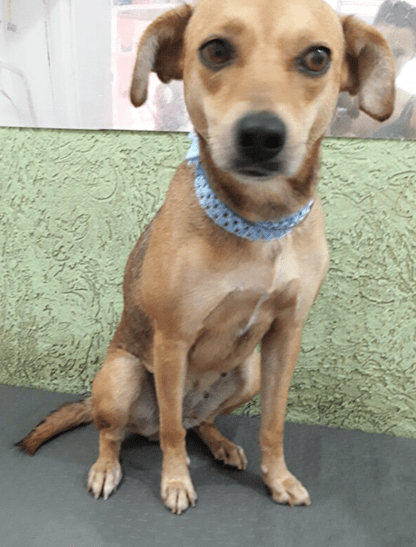
 Let me close with some more photos of dogs that have been helped by John, Dionete and the rest of the great band of the Vista Verde Fund.






 Learning from Dogs