A change from our dear dogs.
I really hope you enjoy these as much as we have!
There is quite a long introduction but it helps enormously in explaining the background to the photographs.
ooOOoo
This image is released as part of the Early Release Observations from ESA’s Euclid space mission. All data from these initial observations are made public on 23 May 2024 – including a handful of unprecedented new views of the nearby Universe.
The Dorado Group of galaxies is one of the richest galaxy groups in the southern hemisphere. Here, Euclid captures signs of galaxies evolving and merging ‘in action’, with beautiful tidal tails and shells visible as a result of ongoing interactions. As Dorado is a lot younger than other clusters (like Fornax), several of its constituent galaxies are still forming stars and remain in the stage of interacting with one another, while others show signs of having merged relatively recently. In size, it sits between larger galaxy clusters and smaller galaxy groups, making it a useful and fascinating object to study with Euclid.
This dataset is enabling scientists to study how galaxies evolve and collide over time in order to improve our models of cosmic history and understand how galaxies form within halos of dark matter, with this new image being a true testament to Euclid’s immense versatility. A wide array of galaxies is visible here, from very bright to very faint. Thanks to Euclid’s unique combination of large field-of-view and high spatial resolution, for the first time we can use the same instrument and observations to deeply study tiny (small objects the size of star clusters), wider (the central parts of a galaxy) and extended (tidal merger tails) features over a large part of the sky.
Scientists are also using Euclid observations of the Dorado Group to answer questions that previously could only be explored using painstakingly small snippets of data. This includes compiling a full list of the individual clusters of stars (globular clusters) around the galaxies seen here. Once we know where these clusters are, we can use them to trace how the galaxies formed and study their history and contents. Scientists will also use these data to hunt for new dwarf galaxies around the Group, as it did previously with the Perseus cluster.
The Dorado Group lies 62 million light-years away in the constellation of Dorado.
All images are: ESA/Euclid/Euclid Consortium/NASA, image processing by J.-C. Cuillandre (CEA Paris-Saclay), G. Anselmi

Composite image of five astronomical views, three at the top, two at the bottom. All are dotted with stars and galaxies against a black background. Striking features are three bright glowing structures in the first image. The second image has an orange veil-like structure spanning across. In the third we see a stunning spiral galaxy with many arms. The fourth image features light from galaxies lying behind a bright cluster distorted into arcs. And the fifth image shows a variety of galaxies in all shapes and sizes
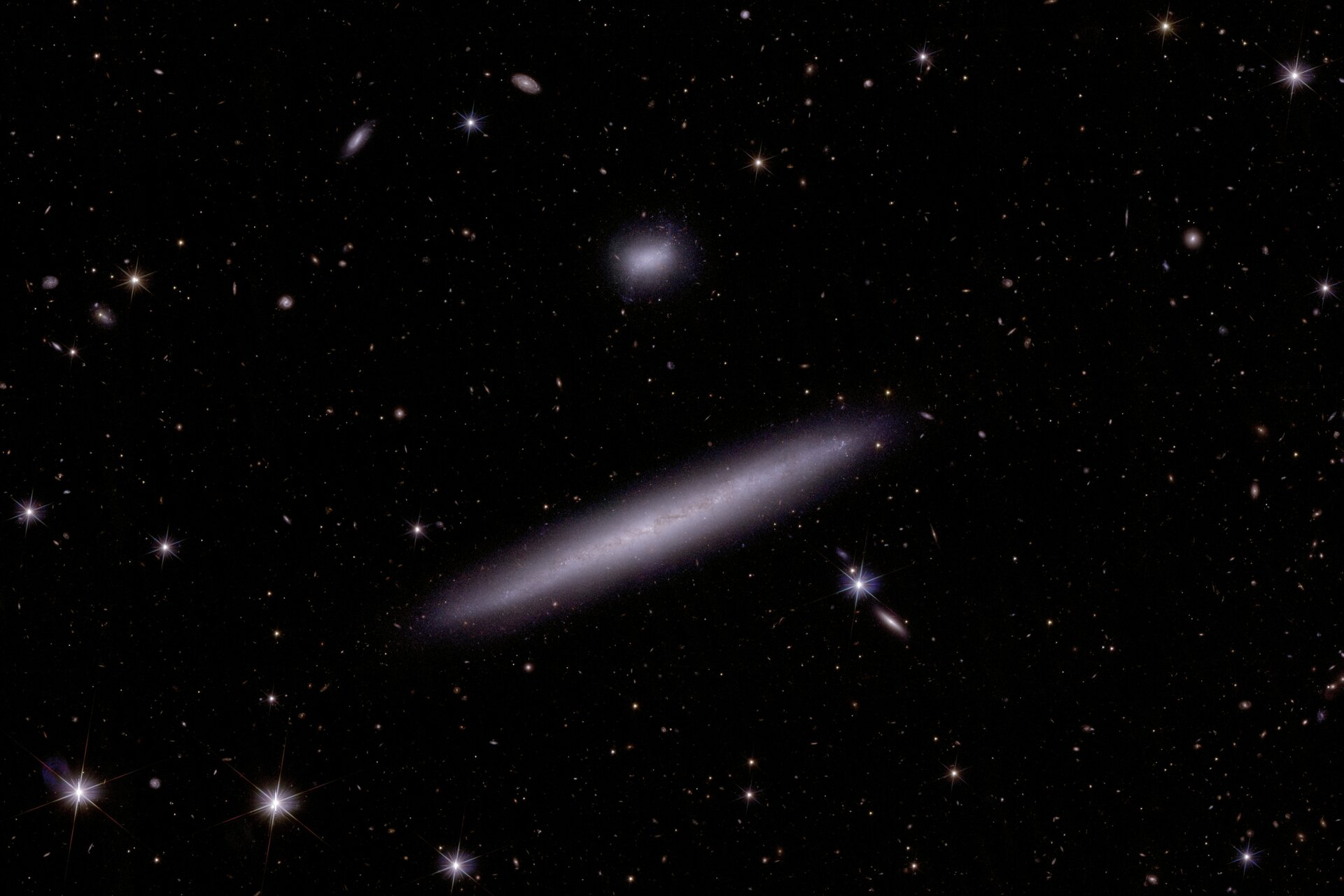
An elongated bright cloudy ellipse, tilted at a 45-degree angle in front a black background dotted with small white stars and galaxies. Above the ellipse floats a smaller, cloudy ellipsoid.

A dark orange filamentary structure seems to enclose stars. Centrally, three bright star-forming regions shine brightly through the orange veil in a traffic-light like formation.

The image shows hundreds of stars, some brighter than others. The stars seem to light up their cloud-like surroundings in purple. A darker structure spans the image in an arch from upper left to bottom right. The bottom of this arch runs into dense clouds forming the darkest part of the image.

This breathtaking image features Messier 78 (the central and brightest region), a vibrant nursery of star formation enveloped in a shroud of interstellar dust. This image is unprecedented – it is the first shot of this young star-forming region at this width and depth.
ooOOoo
Fabulous. It is an example of just how clever the science is getting!
I can only look at these images in awe. For example, Messier 78 is part of the Orion constellation, has a radius of five light-years, and is only 1,600 light-years from Planet Earth. (Using the figure from below of the distance of a single light-year, that puts Messier 78 as 1,600 times 6 trillion miles from our planet or 9,600 trillion miles.)
And in case you forgot it, one light year is:
The light-year is a measure of distance, not time. It is the total distance that a beam of light, moving in a straight line, travels in one year. To obtain an idea of the size of a light-year, take the circumference of the earth (24,900 miles), lay it out in a straight line, multiply the length of the line by 7.5 (the corresponding distance is one light-second), then place 31.6 million similar lines end to end. The resulting distance is almost 6 trillion (6,000,000,000,000) miles!
 Learning from Dogs
Wow indeed! What a great share Paul. Thank you 💐
LikeLike
Thanks Val! These images are incredible. The distances are unimaginable to the great majority of people. A real wow indeed!
LikeLiked by 1 person