Yes, December 20th., 1956. Just five days before Christmas Day.
I had turned 12 on November 8th that year and my dear sister, Elizabeth, was then 7-years-old.
Ten years ago this very day, in other words on the fiftieth anniversary of my father’s death, something happened to me when I was living in the small South Devon village of Harberton; just three miles from Totnes. That ‘something’ started a chain of events that led to me meeting Jeannie in Mexico and us becoming married in Arizona on November 20th, 2010.
Upper Barn, Harberton: My home until early 2007.
I accept that this is of little interest to you, dear reader, but I wanted to put the following ‘out there’.
December 20th will always be a poignant day, until I take my last breath.
But it will also be the most precious day in the year for, again, until I take my last breath December 20th. will always mark the start of my journey to meeting Jean.
Loving Jean and being loved so much in return is as much an immovable marker in my life as was my father’s death.
I have a good understanding of the commercial pilot’s world, both inside and outside of my family. For many years as an active private pilot I held a British Instrument Rating (IR) that allowed me to fly in the commercial airways. Studying for the IR required a good appreciation of the safety culture that was at the root of commercial flying especially surrounding one’s departure and arrival airports.
So when I read a recent item from the Smithsonian Magazine proposing that airline pilots were more depressed than the average American my first reaction was one of disbelief. I forwarded the link to Bob D., an experienced British airline Captain and a good friend for years. Here is that article:
ooOOoo
Think Your Job Is Depressing? Try Being an Airline Pilot
New study suggests pilots are more depressed than the average American
Being a pilot for a commercial airline has its perks—travel to exotic places, a cool uniform and those breathtaking views of the sky. But that job can come with a side of something much more sobering: depression. As Melissa Healy reports forThe Los Angeles Times, the mental health of airline pilots is coming into sharp focus with the revelation that nearly 13 percent of them could be depressed.
A new study of the mental health of commercial airline pilots, recently published in the Journal of Environmental Health, suggests that depression is a major problem for pilots. The first to document mental health for this particular field, the study relied on a 2015 web survey of international pilots that contained a range of questions about their condition over the prior two weeks. Questions included whether they felt like failures, had trouble falling or staying asleep, or felt they were better off dead. (Those questions are part of a depression screening tool called the PHQ-9.) Other questions involved pilots’ flight habits, their use of sleep aids and alcohol, and whether they have been sexually or verbally harassed on the job.
Of the 1,848 pilots who responded to the depression screening portions of the questionnaire, 12.6 percent met the threshold for depression. In addition, 4.1 percent of those respondents reported having suicidal thoughts at some point during the two weeks before taking the survey. The researchers found that pilots who were depressed were also more likely to take sleep aids and report verbal or sexual harassment.
Airline pilot organizations and occupational safety experts assure Healy that airline travel is still safe. But the study continues a conversation about pilot psychology that has been in full swing since a German pilot committed suicide by crashing his plane in 2015—an incident that inspired the current study.
Since then, calls for better statistics on pilot suicide have grown louder. As Carl Bialik notes forFiveThirtyEight, those statistics do exist—and do suggest that the number of actual suicides among pilots are very small. However, limitations in data, the possibility of underreporting, and infrequent data collection all challenge a complete understanding of that facet of pilots’ mental health.
This latest mental health study has its own limitations, including the fact that it relies on self-reporting and a relatively small sample size compared to total pilot numbers worldwide (in the U.S. alone, there are over 70,000 commercial airline pilots). The cause of the reported depression also remains unclear.
But if the depression rate for commercial airline pilots really is nearly 13 percent, it’s almost double the national rate of about seven percent. Though future work is necessary to confirm these results, this study provides an initial glimpse into the health of the people who make the nation’s airlines tick and emphasizes the importance of figuring out ways to improve their mental health and quality of life.
As the article points out the study contains a number of flaws that really reduce it from an erudite analysis to an eye-catching news item. (Better than reading about politics; that’s for sure!)
I know these are busy times for Captain Bob even without it being Christmas. But if Bob finds time to comment on this study then I will publish it later on.
However, Bob did find a moment to forward me copies of some of the many placards that are a necessary part of the flight deck.
Regulars will recall that during the week I missed being able to publish a post and just quickly dropped a note to say that Rain Stopped Play commenting:
Sorry good people but the rain yesterday interfered with our Internet connection until early evening.
Then there just wasn’t time to post something for you.
Other than at 6:50 pm we had had 3.17 in of rain since midnight!
Well on Thursday morning our ‘on-property’ weather station was reporting that in the 30 hours since the start of Wednesday through to 6 am on that Thursday we had had a total of 4.78 inches of rain.
Cup Creek to the left of the driveway about 100 yards from the house.
Later on Thursday morning I went down to our creek and the following photographs record the scene!Our driveway drops gently down for about 250 yards from the house to our bridge over Bummer Creek where I was heading with my camera. To the left of the driveway is a creek with no official name but the locals call it Cup Creek. For most of the year it is dry!
Another view of a very swollen Cup Creek.
Then I arrived at our bridge that crosses Bummer Creek. Upstream years ago an irrigation dam was installed. It is just visible under the raging waters.
Bummer Creek looking upstream from the bridge.Bummer Creek looking downstream from the bridge.
Difficult to estimate how swollen the creek was but it was carrying many, many times more water than even the usual effects of a couple of rainy days.
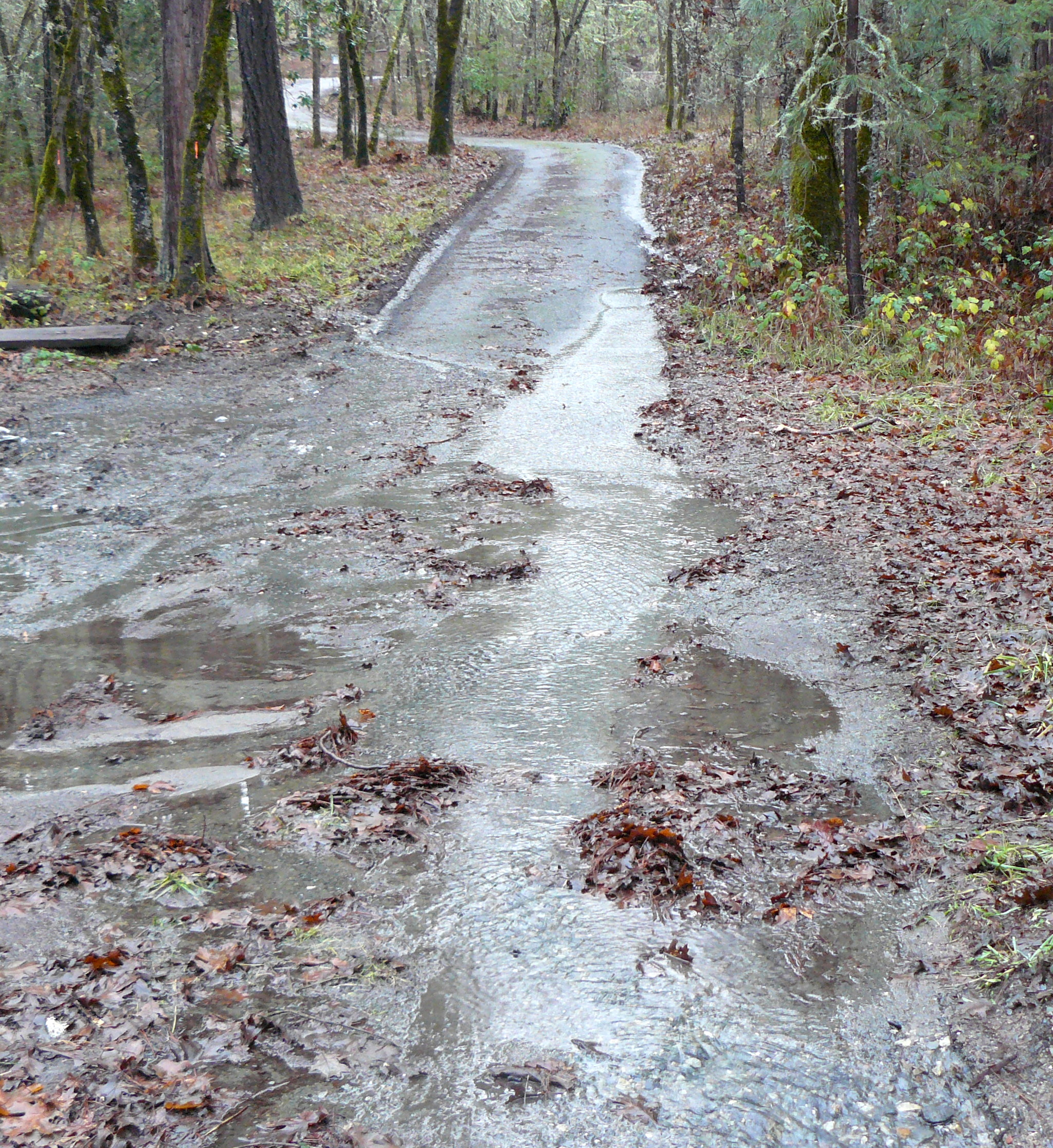
But then looking up from the bridge to where the driveway runs up to Hugo Road this mini-river met my eyes.
Our driveway gate onto Hugo Road is just visible at the top of the picture.
The gully to the side of the driveway had become blocked with leaves hence the surface water. But then I saw that where the driveway met the metal platform of the bridge the flowing water had carved out quite a section of the driveway.
No question this has to be repaired by yours truly that morning because the hole would have prevented anything larger than a standard car from coming across the bridge. So that was our rainy day; how was it for you!
Not long before my mother died we contracted with a local landscaper, Leif Monchallin, to do quite an extensive improvement to the area of land that is to the front of the house. One of the improvements is putting in a dry-stone wall at the top of the driveway just before it splits into a turning circle. The photograph below shows the early stages of that wall.
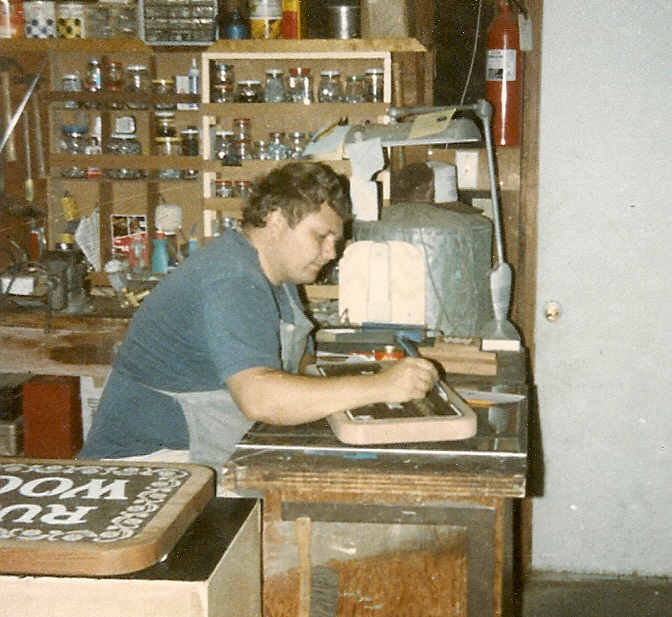
Anyway, Jeannie came up with the idea of putting in some sort of engraved stone right in the centre of the wall. Leif knew of a local stone mason, Oregon Valley Sign Company, and off Jean and I went to meet Bryan Schram, who with his wife, run the business.
Bryan Schram at work.
Between the three of us we came up with a form of words that seemed highly appropriate.
But first off Jean and I had to locate a suitable stone for the engraving and take it over to Bryan’s premises.
Once that was done then it was about a week before we went to collect the engraved stone with the lettering also painted (that was Bryan’s wife’s area of expertise).
Finally, Leif placed the engraved stone in the wall after taking meticulous care to ensure it was perfectly positioned.
Here’s the result.
My mother was a musician and music teacher for most of her life and Jeannie’s Mum, Florence, was a great lover of music and dancing. Hence the clefs either side of the wording.
A rather special reminder of our mothers; don’t you think!
Giving from the heart; in this case a dog’s heart.
As many readers know we have nine dogs here at home, divided into the ‘kitchen’ group (Paloma, Casey and Ruby) and the ‘bedroom’ group (Pharaoh, Brandy, Cleo, Sweeny, Pedy and Oliver). Inevitably the latter group are closer to us because they share the bulk of the home with Jeannie and me, and sleep in our bedroom. Don’t get me wrong, I am not saying that the kitchen group are any less affectionate than the bedroom group it’s just that, for me especially, I am able to be emotionally and physically closer to our bedroom group because for most of the hours of each day they are close to me.
Brandy, Cleo and Oliver seem to be incredibly sensitive to Jeannie’s and my feelings. If something makes me cry then one of them will be next to me in seconds. When Jeannie and I hug, Oliver will stand on his rear legs, place his front legs on our bodies above our waists and act as if he is hugging us. Even the mention of the word “out” has Cleo running to the front door.
So many more examples but you get the drift!
Last Friday The Washington Post published a heart-breaking story. It concerned a young man, just 33-years-old, who was dying from a brain hemorrhage. Here’s an extract from that story:
Ryan Thomas Jessen had gone to the hospital for what he thought was a migraine, but it turned out to be a brain hemorrhage, his sister, Michelle Jessen, wrote on Facebook earlier this month.
The hemorrhage, which doctors believe may have been brought on by high blood pressure, would prove fatal.
But before Jessen died, the 33-year-old Californian’s family wanted to let his dog, Mollie, see him one last time.
Michelle Jessen filmed that last visit by Mollie and, as one might expect, the video has been shared right across the world.
So very often words come so difficult when one wants to reflect on what we have just watched.
I have lost count of the times in the last year that I have said the following:
Thank goodness that when we were younger we really didn’t understand what it was to be old!
Now being old is to a great extent as much as a thing of the mind as it is of the body. As the saying goes: “One is only as old as you feel!” (Or as many men know it: One is only as old as the woman you feel.)
Moving swiftly on!
Dogs offer us many lessons including what it is to become old, then old and infirm, and then pass away. Which is why so many owners of their beloved dogs spend as much time and care on keeping their elderly dogs as fit as possible as they do on themselves; probably in many cases spending more care and attention on their dogs than on themselves.
Those of us who love and have dogs know that senior years always approach too fast. Sanchez, my 13 1/2 year old yellow Lab, has had his health challenges this year, but now that he’s gained back his strength and has recovered from E. coli, he’s acting younger than he has in years. I’ve noticed this not only in his energy level, but also in his cognitive abilities and in his engagement with dogs and people around him. I cherish his golden years and am always looking for ways to keep his mind active and alert, and keep him connected with life.
1. Adopt a second, younger dog.
Admittedly, I’ve been a single dog person my entire life… up until five years ago. When it felt like I was agonizing on the decision to expand my canine household, my vet said to me, “Bringing a younger dog into your household will help keep Sanchez younger as he ages.” Sanchez was only seven at the time, and that perspective had never occurred to me. It’s shown itself to be true.
2. Give daily spoonfuls of coconut oil.
I’ve written about the benefits of coconut oil for pets, everything from fur conditioner to paw protection. But, I hadn’t realized that coconut oil helps with canine cognition until I read this Cambridge study. I’ve been giving both Sanchez and Gina a tablespoon of coconut oil nightly for a couple of months. Not only do they love the taste, but I have definitely noticed an improvement in Sanchez’s cognitive abilities.
3. Train him often.
An old dog not only can learn new tricks, but also loves the attention and benefits from the mental stimulation as much as any age dog. Dogs love to learn, no matter their age. I still spend time training every night with Sanchez. As you can see in the video above, I’ve come up with ways to make his training less physical. But, he still gets rewarded for being involved and staying still. If it gets late, he starts whining and begging for his training time with me. The bonding time is precious and it stimulates him to keep learning and being challenged. He has no complaints about his yummy rewards either.
4. Mix it up.
Although dogs love consistency and build confidence through their routines, it’s sometimes good to mix up that routine as well. I recently was staying with friends and their three Golden Retrievers. While there, Sanchez loved the new smells in their backyard, neglected all of his daily naps and really enjoyed their multi-pet household, including the cats. Our routine completely changed as my friends generally rise much earlier than me and their dogs are fed right away. I decided to allow my dogs the same privilege while we were there. Of course, Sanchez just loved it. I was surprised how quickly he reverted back to our normal routine when we got home. While he’s making up for his missed naps now, he really enjoyed the change of scenery, people, pets, and general surroundings.
5. Add variety to diet, and consider nutritional needs.
I also add variety to Sanchez’s dog food. While the base is the same (organic meat), the variety comes in the extras. Sometimes I add in canned sardines, other times it’s salmon oil. I alter between any of the following additions: sweet potatoes, carrots, pumpkin, green beans, spinach, kale, apples, and bananas. He’s a Lab and LOVES his food. Surprising him adds to his olfactory delight as well.
6. Add environmental enrichment.
Ohio State University College of Veterinary Medicine defines environmental or behavior enrichment as “the process of manipulating an animal’s environment to increase physical activity & normal species typical behavior that satisfies the animal’s physical and psychological needs.” Music created for senior dogs, with their hearing sensitivities in mind, is a great way to provide auditory stimulation that engages their senses.
7. Incorporate nose work.
Dogs often lose hearing and sight in their senior years. But, as long as they can still smell, they can still find their way around. I’ve honestly met blind and deaf dogs that were still retrieving balls, and I barely noticed any impairment to their sight or hearing. Engage a dog’s nose, and you’ll keep him stimulated.
K9 Nose Work defines this sport as “the fun search and scenting activity for virtually all dogs and people. This easy to learn activity and sport builds confidence and focus in many dogs, and provides a safe way to keep dogs fit and healthy through mental and physical exercise.” I enrolled Sanchez in classes a couple of years ago, and now we play “find” games at home. I hide pieces of liver in boxes spread throughout the living room. He searches for the piece of liver and is rewarded with more liver in the box when he finds it. He LOVES this search game.
8. Play often.
No matter the age, dogs enjoy and benefit from playtime. Even if they don’t have the same physical abilities as their younger canine friends, they can still engage in play. Try a game of hide and seek. Actually, all training and nose-work games should also feel like play to them. Pretend you’re a kid again, and they’ll pick up on your energy and thank you for it.
9. Walk them in new areas.
Again, engaging their nose helps keep them stimulated and interested in their surroundings. Bringing them to a new area for a walk is another way to do that. Sanchez is still often with me in the car. So, once a week, I try and stop in a new area for him to explore.
10. Take time to smell the roses.
Walks may no longer be about physical activity. Move at his pace. Allow him to use his nose as much as he chooses. I’ve learned that it’s not only good for Sanchez, but it’s good for me. He’s teaching me the importance of taking time to slow down and enjoy nature. Honestly, does it ever get any better?
ooOOoo
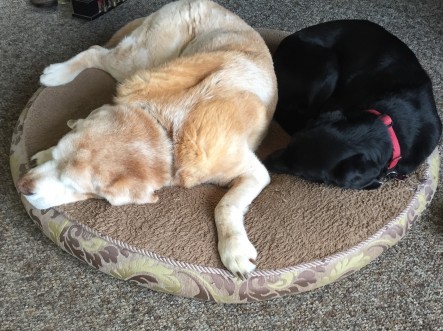
Our wonderful Pharaoh is getting pretty old now; he was 13 1/2 years-old on December 3rd which is a grand age for a German Shepherd. When he was a young puppy I was advised to get a younger playmate for him when his years were building up. For two reasons. The first being that the younger dog keeps the elderly dog playing and interested in the world. The second reason being that the elder dog will teach the younger dog all the owner’s commands.
Pharaoh demonstrating his benevolent status with puppy Cleo. April 2012.
Cleo has proved both points. Pharaoh in living with so many dogs around him is most definitely kept engaged and despite his rear hips being so very fragile and weak he still doesn’t miss a turn in going out with the other dogs.
Just to underline how fantastic Pharaoh is doing, his age at the conversion ratio of 1 dog year to 8 human years makes him 108! Or 36 years my senior!
Dear Fellow Dog Lover,
Because you signed up on our website and asked to be notified, I’m sending you this special recall alert. If you no longer wish to receive these emails, please click to unsubscribe.
Blue Ridge Beef of Eatonton, Georgia, has announced it is voluntarily recalling 2 of its raw frozen products due to their potential to be contaminated with Salmonella and Listeria bacteria.
To learn which products are affected, please visit the following link:
If you visit that Blue Ridge link you will read the following:
ooOOoo
December 8, 2016 — Blue Ridge Beef of Eatonton, Georgia has announced it is voluntarily recalling two of its frozen products due to their potential to be contaminated with Salmonella and/or Listeria monocytogenes.
What’s Being Recalled?
The affected products are sold in 2 pound chubs and can be identified with the following manufacturing codes:
Lot #mfd ga8516
Beef for dogs
UPC code 8542980011009
Lot #mfd ga81216
Kitten grind
UPC code 854298001016
Where Was It Sold?
The affected products were distributed to retail stores in the following states:
Arizona
Florida
Georgia
North Carolina
South Carolina
Texas
About Salmonella and Listeria
Salmonella and Listeria can affect animals eating the product.
There is a risk to humans from handling contaminated pet products, especially if they have not thoroughly washed their hands after having contact with the products or any surface exposed to these products.
Healthy people infected with Salmonella and/or Listeria should monitor themselves for some or all of the following symptoms:
Nausea
Vomiting
Diarrhea
Bloody disarrhea
Abdominal cramping
Fever
Consumers exhibiting these signs after having contact with this product should contact their healthcare provider. Consumers should also follow the simple handling tips on the package.
What Caused the Recall?
This recall was initiated after the FDA received two complaints associated with these products, including one complaint of two kitten illnesses and one complaint of a puppy death.
Subsequent testing by the FDA of a 2 pound chub of beef for dogs and kitten grind collected at a veterinary office revealed the presence of Salmonella and Listeria monocytogenes.
There is no direct evidence linking these unfortunate instances to contaminated product.
This recall is being made with the knowledge of the U.S. Food and Drug Administration.
What to Do?
Consumers who have purchased the above lots of beef for dogs or kitten grind are urged to stop feeding them and return products to the place of purchase for a full refund.
Or dispose of them immediately. Those with questions can email the company at blueridgebeefga@yahoo.com
U.S. citizens can report complaints about FDA-regulated pet food products by calling the consumer complaint coordinator in your area.






























 Learning from Dogs