A peek at a very interesting article in the February issue of National Geographic magazine.
Big thanks to Bob T. here in Payson for sending me a recent email that contained the one line, “There is a lengthy article entitled “Mix, Match, Morph” in the February issue of National Geographic. I strongly suspect you will find it of interest.” Understatement big time! The article is wonderful. It is also available online! 🙂
The premise behind the article is, as the opening words reveal,
Three breeds, Copyright National Geographic, photo by Robert Clark
How to Build a Dog
Scientists have found the secret recipe behind the spectacular
variety of dog shapes and sizes, and it could help unravel the
complexity of human genetic disease.
As is made clear early on in Evan Ratcliff’s text, the huge variety in the breeds of dogs is a very recent occurence,
For reasons both practical and whimsical, man’s best friend has been artificially evolved into the most diverse animal on the planet—a staggering achievement, given that most of the 350 to 400 dog breeds in existence have been around for only a couple hundred years.
And later Ratcliff writes,
The breeders gave no thought, of course, to the fact that while coaxing such weird new dogs into existence, they were also tinkering with the genes that determine canine anatomy in the first place. Scientists since have assumed that underneath the morphological diversity of dogs lay an equivalent amount of genetic diversity. A recent explosion in canine genomic research, however, has led to a surprising, and opposite, conclusion: The vast mosaic of dog shapes, colors, and sizes is decided largely by changes in a mere handful of gene regions.
What is critically being discovered is,
Already, more than a hundred dog diseases have been mapped to mutations in particular genes, many of them with human counterparts. Those diseases may have a whole array of mutations leading to a risk of disease in dogs, as they do in us.
It would be wrong, without permission to reproduce the article, to include more but you can quickly go here and read it yourself. Except I can’t resist closing with the last sentence from the article,
After all, he points out, there are millions of dog lovers out there willing and eager to help with the fieldwork.
Ain’t that the truth!
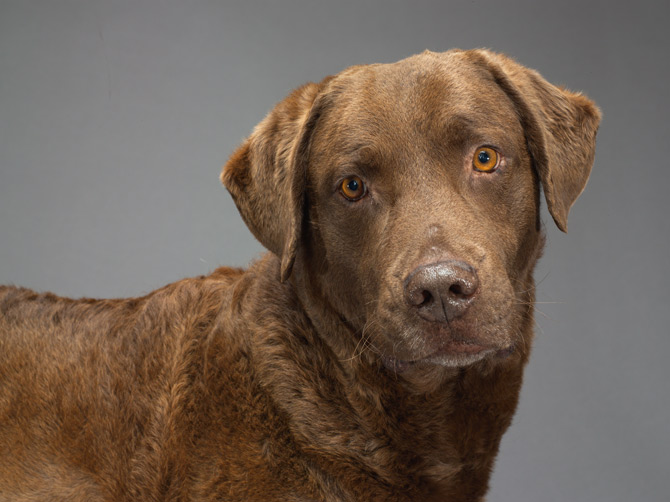
And don’t miss the fabulous photographs of dogs taken by Robert Clark which you can see here, another example of which is below. Robert Clark’s website is here.
Chesapeake Bay retriever, 48, Photograph by Robert Clark

 Learning from Dogs
Now who could resist the look that Dog gave you…? 🙂
LikeLike