Tag: YouTube

The unexplored shores of the future

A focus on Tim Bennett’s movie, What a Way To Go: Life at the end of Empire

We first came across this film, made by independent film-maker Tim Bennett, on the Top Documentary Films website, see here.  The title to this article comes from that introduction, from which is quoted,

Tim Bennett, middle-class white guy, started waking up to the global environmental nightmare in the mid-1980s. But life was so busy with raising kids and pursuing the American dream that he never got around to acting on his concerns. Until now…

Bennett journeys from complacency to consciousness in his feature-length documentary, What a Way To Go: Life at the End of Empire. He reviews his Midwestern roots, ruthlessly examines the stories he was raised with, and then details the grim realities humans now face: escalating climate change, resource shortages, degraded ecosystems, an exploding global population and teetering global economies.

Now to be honest, this is a film that is both captivating and, in parts, pretty grim.  A couple of trailers and other background material were posted on Learning from Dogs back in February.

The film also has an excellent web site What a Way To Go Movie which contains much background material including the opportunity to watch the film for free, click here.  Or a quick YouTube search will bring you to here.

My own view is that this is a ‘must see’ film.  Not because I want all of you to wallow in doom and gloom, far from it, but because, as Paul Gilding writes in his book, The Great Disruption, the quicker that mankind recognises the massive levels of denial presently in place, the quicker that mankind will commit to the scale of change that is required.  That’s where Paul Gilding’s approach differs from the movie, The End of Empire.  Gilding is optimistic that man will bring about change simply because fairly soon, in just a few years, it will be obvious at all levels in our societies that there simply is no choice!

Global climate confusion, ongoing

Herman Daly, Ph.D, makes some very powerful points at his keynote address to the AMS workshop on Federal Climate Policy, 13th November, 2007.

Note: This video is only the first 8 minutes from what is clearly a longer address.  I have struggled to find the subsequent parts of this address, although there appear to be other versions of the address on YouTube.  However, the points raised in these first few minutes are compelling,

  • Complexity stifles policy
  • The danger of overwhelming the decision of what to do now
  • Leave it until it’s perfectly clear and the likelihood is that it will be too late
Enjoy this most stimulating speech.
If you are stimulated to dig a little deeper into Hermon E. Daly here are some snippets I came across.

Herman Daly’s Ecological Economics – An Introductory Note

By John Attarian

Mainstream opinion has it that economic growth, the democratization of affluence, and ever-increasing consumption are the formula for individual and social happiness. A thoughtful and well-informed minority emphatically disagrees. Few have contributed more to this dissent than Herman E. Daly, widely regarded as the founding father of ecological economics.

Born in 1938, Daly earned his B.A. at Rice University (1960) and Ph.D. at Vanderbilt University (1967). From 1968 to 1988 he taught economics at Louisiana State University. Then he served as Senior Economist in the World Bank’s Environmental Department until 1994, when he became a professor at the University of Maryland’s School of Public Affairs, his current position.

As a graduate student, Daly believed that growth would solve mankind’s problems, but three experiences radically transformed his outlook. He studied under the economist Nicholas Georgescu-Roegen (1906-1994), whose book The Entropy Law and the Economic Process (1971) explained the decisive economic importance of the second law of thermodynamics (the entropy law) in a closed system, the availability of useful energy always declines. Georgescu-Roegen argued that the economic process transforms natural resources into waste — that is, transforms matter-energy from a state of low entropy into a state of high entropy. Georgescu-Roegen’s great contribution, Daly observes, was “reuniting economics with its biophysical foundations.” Teaching in Brazil in the late 1960s, Daly observed explosive population growth firsthand. Reading Rachel Carson’s Silent Spring was also influential.

Wrong to publish more but if this catches your eye, then the full article is here.  Oh, perhaps I can just include the last two paragraphs of John Attarian’s fine piece ….

Daly co-founded the scholarly journal Ecological Economics in 1989 and still serves as an associate editor. His thought is slowly attracting appreciative notice, and some honors have come his way. For the Common Good won the 1991 Grawenmeyer Award for Ideas for Improving World Order, and in 1996 Daly received the Honorary Right Livelihood Award and the Royal Netherlands Academy of Arts and Sciences Heineken Prize for Environmental Science.

Integrating theology, ethics, science, and economics, Daly’s ecological economics is the kind of comprehensive vision we too seldom see, and one of the most important and promising intellectual developments of our time. Our selection of Daly’s works is a concise yet comprehensive introduction to his thought. May he find the audience he deserves.

Scamp and other dog’s incredible sense of smell

Almost beyond a human’s ability to comprehend.

On the 24th June, I wrote a piece from the Extraordinary Animals series from the UK’s Channel Five TV station.  In particular, the article focussed on Scamp’s ability to detect when people in care were dying.

Scamp is a little Schnauzer who resides at The Pine nursing home in Canton, Ohio. Like many live-in pets at nursing homes, Scamp brings companionship to the residents but he also does more than that. Scamp seems to have a gift that tells him when the end is near for one of the residents and he loyally stays with them during their final hours.

Jim & Diane Walker

The first of the three YouTube videos, some ten minutes long, examined how Scamp knew that a patient was dying and how scientists Jim and Diane Walker believed it was due to the incredible sense of smell that dogs possess.  From The Examiner of June 1st, 2009,

An amazing scientist, Dr. James Walker of the Sensory Research Institute at Florida State University, documented the power of a dog’s nose in 2002. Using n-amyl acetate (nAA), Dr. Walker documented that a dog can detect chemicals at one ten-thousandth to one hundred-thousandth the concentrations that humans can. In other words, at a minimum, dogs can smell 10,000 times better than a human.

OK, back to that YouTube video.

If you didn’t watch it on the 24th, do watch it again.  Watch it this time to pick up just what Scamp is doing.  At minute 6:30 hear how Dr. Bob Andrysco describes how the sense of smell of a dog is 100,000 times more powerful than that of a human.

Then stay with the video until minute 9:20 when Jim & Diane Walker show how a dog can detect a substance as diluted as 2 parts in a trillion.  That is so diluted as to be beyond comprehension; well to a non-scientist like me!

As the presenter describes, “That’s the equivalent of a teaspoonful of sugar in ten billion cups of tea!”  To me that is utterly mind-boggling.  Let me try and demonstrate the power of 2 parts per trillion, which is the equivalent of 1 part per half-trillion (500,000 million). Half-a-trillion fluid ounces is 522,189,675.651 ft³ – just over 522 million cubic feet.  What does that volume look like?

Here’s the picture of twelve fluid ounces – you’ll just have to imagine what one fluid ounce would look like!

Standard Coke can = 12 fluid ounces

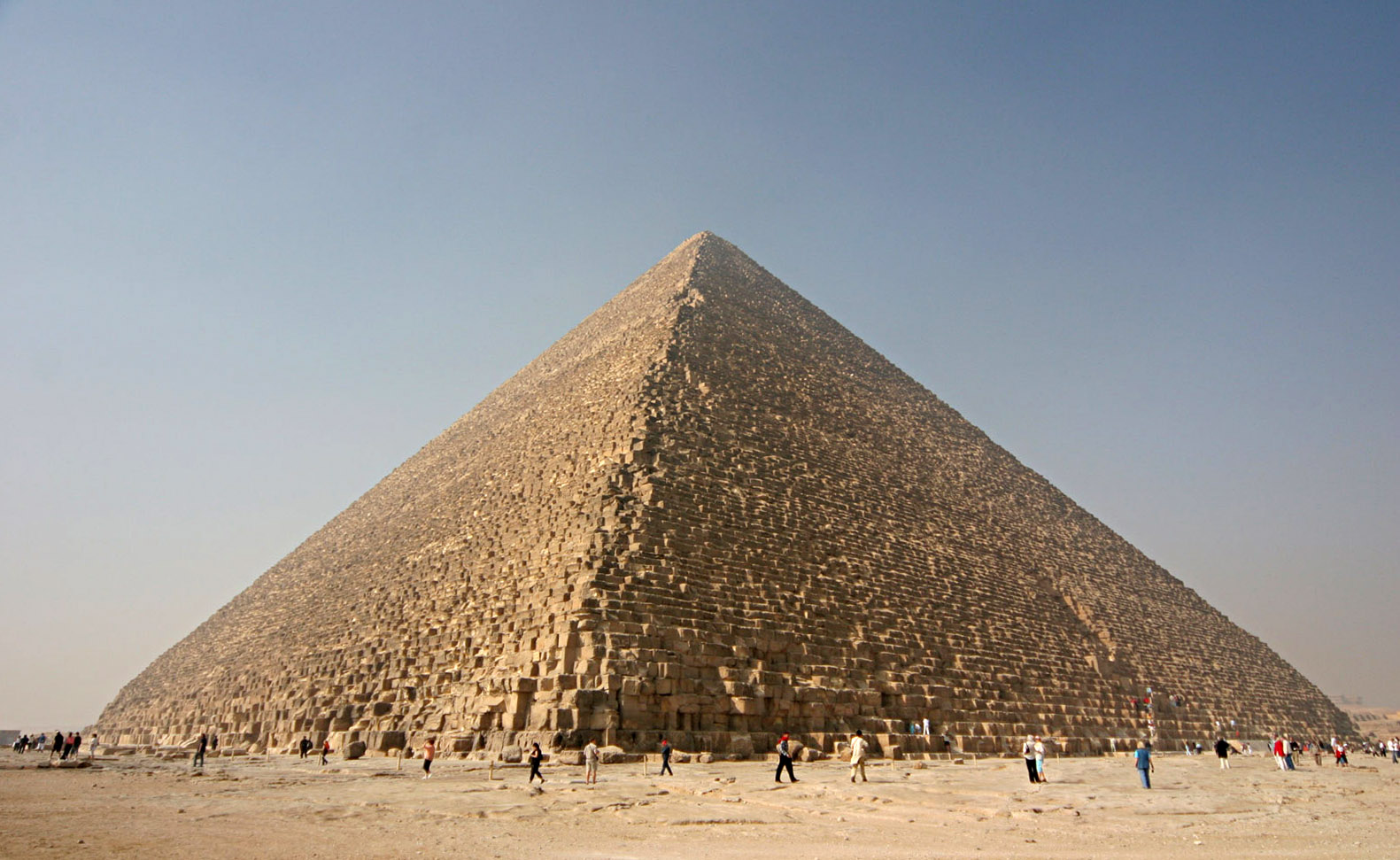
Here’s a picture of ninety million cubic feet – you’ll just have to imagine what five hundred and twenty-two million look like!

Great Pyramid of Giza = 90 million cubic feet

OK, last one from me to allow us all to really, really appreciate the magical ability of that dog’s nose.

Two parts per trillion is the equivalent of smelling that can of Coke (12 fluid ounces) in a volume the equivalent of seventy, yes seventy, Great Pyramids (6,264,000,000 cubic feet).

Think I need to lie down in a darkened room for a while!

The BBC

A remarkably fine institution

Having now been living in Arizona for 18 months, I can say with some degree of certainty that there are few British things that I miss.  One of them is draft English beer, of course, but another one is the BBC.  Luckily modern internet technology means that quite a few of the great BBC television programmes ‘leak’ outside the UK.

The BBC Horizon science series has been one such example of a really well-produced programme.

Recently, a BBC Horizon programme about genetically modified (GM) foods aired by the BBC found its way onto YouTube and thence to the website Top Documentary Films.  Not only is it an interesting programme but it also reveals how the facts of new advances in science are often difficult to understand by us; the general public.

The link to the film on the TDF website is here but if you want to watch it directly from YouTube then here it is.

Anthropocene era gaining legs

We really may be on the verge of a new geological period.

Just a couple of weeks ago, on the 16th May, I wrote an article called The Anthropocene period.  It was based on both a BBC radio programme and a conference called “The Anthropocene: A New Epoch of Geological Time?”

So imagine my surprise when I collected this week’s copy of The Economist from my mail-box last Saturday.  The cover page boldly illustrated a lead article within, as this picture shows.

US edition, May 28th

The leader is headlined, ‘Humans have changed the way the world works.  Now they have to change the way they think about it, too.’  The first two paragraphs of that leader explain,

THE Earth is a big thing; if you divided it up evenly among its 7 billion inhabitants, they would get almost 1 trillion tonnes each. To think that the workings of so vast an entity could be lastingly changed by a species that has been scampering across its surface for less than 1% of 1% of its history seems, on the face of it, absurd. But it is not. Humans have become a force of nature reshaping the planet on a geological scale—but at a far-faster-than-geological speed.

A single engineering project, the Syncrude mine in the Athabasca tar sands, involves moving 30 billion tonnes of earth—twice the amount of sediment that flows down all the rivers in the world in a year. That sediment flow itself, meanwhile, is shrinking; almost 50,000 large dams have over the past half- century cut the flow by nearly a fifth. That is one reason why the Earth’s deltas, home to hundreds of millions of people, are eroding away faster than they can be replenished.

There’s also a video on The Economist website of an interview with Dr. Erle Ellis, associate professor of geography and environmental systems at the University of Maryland.  That video link is here.

That Economist lead article concludes,

Recycling the planet

How frightened should people be about this? It would be odd not to be worried. The planet’s history contains many less stable and clement eras than the Holocene. Who is to say that human action might not tip the planet into new instability?

Some will want simply to put the clock back. But returning to the way things were is neither realistic nor morally tenable. A planet that could soon be supporting as many as 10 billion human beings has to work differently from the one that held 1 billion people, mostly peasants, 200 years ago. The challenge of the Anthropocene is to use human ingenuity to set things up so that the planet can accomplish its 21st-century task.

Increasing the planet’s resilience will probably involve a few dramatic changes and a lot of fiddling. An example of the former could be geoengineering. Today the copious carbon dioxide emitted to the atmosphere is left for nature to pick up, which it cannot do fast enough. Although the technologies are still nascent, the idea that humans might help remove carbon from the skies as well as put it there is a reasonable Anthropocene expectation; it wouldn’t stop climate change any time soon, but it might shorten its lease, and reduce the changes in ocean chemistry that excess carbon brings about.

More often the answer will be fiddling—finding ways to apply human muscle with the grain of nature, rather than against it, and help it in its inbuilt tendency to recycle things. Human interference in the nitrogen cycle has made far more nitrogen available to plants and animals; it has done much less to help the planet deal with all that nitrogen when they have finished with it. Instead we suffer ever more coastal “dead zones” overrun by nitrogen-fed algal blooms. Quite small things, such as smarter farming and better sewage treatment, could help a lot.

For humans to be intimately involved in many interconnected processes at a planetary scale carries huge risks. But it is possible to add to the planet’s resilience, often through simple and piecemeal actions, if they are well thought through. And one of the messages of the Anthropocene is that piecemeal actions can quickly add up to planetary change.

We are living in interesting times!

Finally, more of Dr. Ellis may be watched on the following YouTube video.

Racing in the Rain

A dog story for a man.

Thanks to Steve D. from the congregation here in Payson for mentioning this book.  Certainly one for my next Amazon order.

There’s a trailer on YouTube concerning the book, which is summarised as follows,

A heart-wrenching but deeply funny and ultimately uplifting story of family, love, loyalty, and hope, The Art of Racing in the Rain is a beautifully crafted and captivating look at the wonders and absurdities of human life . . . as only a dog could tell it.

So who is Garth Stein?  Well, of course, he has his own website, from which may be read,

Garth Stein is the author of the New York Times best selling literary novel, The Art of Racing in the Rain (Harper, 2008). Now published in 23 languages, The Art of Racing in the Rainwas the #1 BookSense selection for June, 2008, the Starbucks spring/summer 2008 book selection, and has been on the IndieBound™ bestseller list since its publication. Stein’s previous novel, How Evan Broke His Head and Other Secrets (Soho Press, 2005) won a Pacific Northwest Booksellers Association Award, and was a BookSense Pick in both hardcover and paperback. Raven Stole the Moon (Harper, 2010) was Stein’s first novel. He has also written a full-length play, Brother Jones, and produced a number of award-winning documentaries.

With an M.F.A. in film from Columbia University (1990), Garth worked as a documentary film maker for several years, and directed, produced, or co-produced several award winning films.

Born in Los Angeles and raised in Seattle, Garth’s ancestry is diverse: his mother, a native of Alaska, is of Tlingit Indian and Irish descent; his father, a Brooklyn native, is the child of Jewish emigrants from Austria. After spending his childhood in Seattle and then living in New York City for 18 years, Garth returned to Seattle, where he currently lives with his wife, three sons, and their dog, Comet.

There is also an adaptation for young persons,

Have you ever wondered what your dog is thinking?

Meet one funny dog—-Enzo, the lovable mutt who tells this story. Enzo knows he is different from other dogs. Every dog loves to chase cars, but Enzo longs to race them. He learns by watching TV and by listening to his best friend, Denny, an up-and-coming race-car driver, and his daughter, Zoe, his constant companion. Enzo finds that life just like being on the racetrack. For he sees that life, like racing, isn’t simply about going fast. And, by learning the tricks of racing against all odds, he takes on his family’s challenges and emerges a hero. Enzo holds in his heart the dream that Denny will go on to be a racing champion with his daughter right by his side. For theirs is an extraordinary friendship—one that reminds us all to celebrate the triumph of the human (and canine) spirit.

“The race is long. It is better to drive within oneself and finish the race behind the other than it is to drive too hard and crash.”

That’s the wisdom of Enzo, a dog with a lot to say about cars and life. When THE ART OF RACING IN THE RAIN — Garth Stein’s novel about Enzo and his owners — was published in 2008, readers immediately fell in love with Enzo, and the book has been a New York Times bestseller ever since. That’s because, once people finish reading the novel, they want to tell everybody about it.

Here’s a video of about 3 minutes where Garth Stein explains how he came to write the book.

Plus if you want a longer version, then the following is an  interview of Garth with Stacey Cochran on “The Artist’s Craft” on Raleigh Television Network Channel 10.

Time for a rethink!

Things do not change; we change. Henry David Thoreau

To a great extent, my thoughts in this article will make less sense if one hasn’t watched the Rupert Sheldrake video included in the Post on the 10th January, 2011.  It’s 1 hour 20 minutes long but every minute will captivate you, trust me.

But if, for whatever reason, you don’t watch that video then the following YouTube videos are offered where Sheldrake speaks of the evidence supporting telepathy between cats and dogs and humans.  The demonstration of a dog knowing when their owner is coming home is enthralling.

The science behind this link between, for example, the dog and its owner, is what Dr. Sheldrake calls an example of Morphic Fields.

I must confess that if someone had said to me, say 10 or even 5 years ago, that some form of energy field links the brains of dogs and their owners, or of cats and their owners, I would have been at least confused, at best very skeptical.  Then comes the evidence, statistically valid, that being rung on the ‘phone by someone close to you can be anticipated frequently before the phone is picked up creates even more uncertainty.

Settle down and listen to these videos (they are sound recordings only but nonetheless fascinating),

The Extended Mind, Part One

The Extended Mind, Part Two

The Extended Mind, Part Three, final part.

Think you understand money?

This documentary may, probably WILL,  enlighten you.

On the 30th March I wrote about the film Inside Job.  Then a few days ago James Kwak of Baseline Scenario, a blog that I have been reading for some time now, also wrote a piece about the film, opening his Post thus,

I finally saw Inside Job at a friend’s house tonight. I don’t have anything original to say about it. I thought it was a very, very good movie. There were lots of little things that weren’t quite right (many of which were probably conscious decisions to simplify details for the sake of comprehension), but I don’t think any of them were substantively misleading.

As always with Baseline Scenario, the comments are as interesting and educational as the article, and that was just as valid in this case.  One of the comments was from Carla who wrote,

I think Inside Job is no longer available to view for free now that the DVD is for sale at Amazon (well worth the purchase, BTW).

But at the same site I found “The Money Fix,” which you can watch for free: http://topdocumentaryfilms.com/money-fix/

Also, there’s another site with some good free docs:http://www.freedocumentaries.org.

Anyway, we watched the film on Tuesday evening and, boy oh boy, was it an eye-opener.

I promise you, the full film is so well worth watching.   (And do read to the end of this Post!)

The film also makes reference to the website The Money Fix which has a great number of resources for those that wish to explore further this fascinating subject.  Thanks Carla.


What a Way to Go

An interesting companion to the World on the Edge book

Regular readers of the Blog will know that yesterday an article was published, the first of a series, looking more closely at the book by Lester Brown of EPI called World on the Edge.  That article followed on from this Post, Group Human Insanity, and yesterday’s Post, Total, Utter Madness, Pt 1.

Today, if you will forgive the emotional battering that the book and this film create, I want to draw your attention to a film that was produced in 2007, called What A Way To Go: Life at the End of Empire.

It was lent to us by John Hulburt, who lives in Payson, and holds many views that are close to the views of the founders of Learning from Dogs.  John has offered to write the odd guest article for the Blog, which is fantastic.

Anyway, back to the film.  Here are a couple of trailers.

A 2-minute trailer giving an overview of the film ..

and another one dipping into more detail.

And if you still want more, then here’s an interview of the two behind the film, Producer Sally Erickson and Writer/Director Tim Bennett.  Twenty-seven minutes long but so what.  Watch it!

We really do have so much to learn from dogs! (Before it’s too late!)


So near, so far!

Mixed emotions about those other worlds out there.

In recent times, Learning from Dogs has been reflecting on the magic, and fragility, of the planet we all live on.

There was the photograph of the Earthrise that attracted quite a few comments.  That was followed up by the amazing photograph of the Earth from Voyager 1 taken in 1990 from 3,762,136,324 miles away!  Then the lovely poem from Sue.

So it was interesting to note my mixed emotions to a piece on the BBC News website yesterday.  Here’s a flavour.

Worlds away

Astronomers have identified some 54 new planets where conditions may be suitable for life.

Five of the candidates are Earth-sized.

The announcement from the Kepler space telescope team brings the total number of exoplanet candidates they have identified to more than 1,200.

The data release also confirmed a unique sextet of planets around a single star and 170 further solar systems that include more than one planet circling far-flung stars.

Read the rest of the item here. (and there’s a fuller version on NetworkWorld)

So here are those mixed emotions.

  • Man has been, and still continues to be, wonderfully curious to the point of spending huge sums of money on projects that appear to do nothing more than satisfy that curiosity. (The (Kepler) mission‘s life-cycle cost is estimated at US$600 million, including funding for 3.5 years of operation, from here.)  That’s a beautiful trait, in my humble opinion.
  • Homo Sapiens is a wonderfully innovative and creative species, as so wonderfully presented by Alan Alda on a recent PBS Programme called The Human Spark.  (See the YouTube intro at the end of this Post.)
  • Look at all the inventions and incredible advances to our species that are all around us – including the PC I am using and the World Wide Web that is aiding this message!
  • For such an intelligent species as us, why is it that we are treating Planet Earth in such a suicidal manner through greed, pollution and over-consumption!
  • As was reported yesterday, we could be on the verge of total and utter chaos in terms of food.  Then also yesterday was a small item about food prices reaching a new global record.
  • It always struck me as absurd to conclude that this planet is the only habitable planet in the universe – ‘Astronomers estimate there are 1021 stars in the universe. With a conservative estimate of three planets per star (some could have many more, some would have none at all) this puts the estimated number of planets into millions of billions.‘ From here.
  • So the data coming in from Kepler is truly astounding and, personally, underlines this era as a great time to be alive.
  • But there simply is no choice in that for decades ahead, if not centuries ahead, Planet Earth is all there is for us.  So why do we do it so much harm!
  • Our civilisation is likely to go to the very limits of survivability before the message that the existing ‘model’ is broken is picked up by every major political party in the world.  That is very, very scary to contemplate.
  • So it looks as though, soon, mankind will face the ultimate decision of all time.  Give up and let the chaos overwhelm us all, or … or what?  In other words millions of us will have to live with the consequences of our greed.
  • The ‘or what?’ can only be a faith that it will be OK.
  • A faith that mankind will use the power of dreams, imagination and energy to create a new future that will, at long last, be a new dawn of democratic and just, integrous existence.
  • And maybe, just maybe, that could be the Second Coming and maybe, just maybe, the world’s Churches and religions will be our saving grace.

But of that day and hour knoweth no man, no, not the angels of heaven, but my Father only. Matthew 24:36

Fascinating times – a Chinese proverb, ‘It’s better to be a dog in a peaceful time than be a man in a chaotic period.’

Finally, here’s that video of the series preview to The Human Spark.