We had to put one of our dogs to sleep on Friday, not a GSD, but one of Jean’s rescued dogs from way back. At this moment in time (11am US Mountain Time, Saturday) I’m writing a piece about this wonderful dog that will appear tomorrow.
Thus not in the mood to post my usual light-hearted item for a Sunday. So I resorted to looking up an appropriate dog video on YouTube.
Came across this,
Of course, that reminded me of how precious our Pharaoh is and it only took a few moments to find a couple of earlier pics of him.
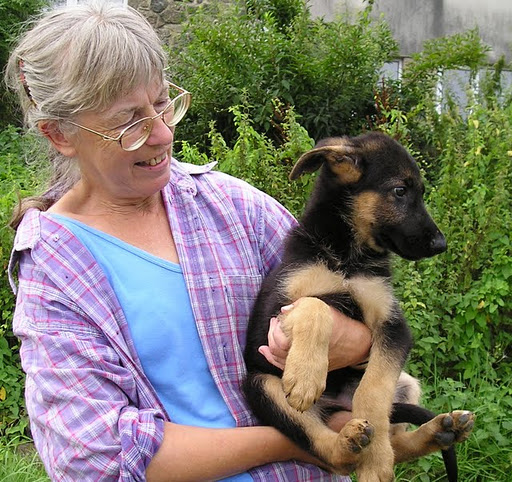
Here’s Pharaoh the day I collected him from GSD breeders Jutone‘s in Dartmoor, SW England. That’s Sandra Tucker, the owner of Jutone, with Pharaoh; the date being 12th August 2003 when Pharaoh was then just over 8 weeks old.
Sandra Tucker holding young Pharaoh
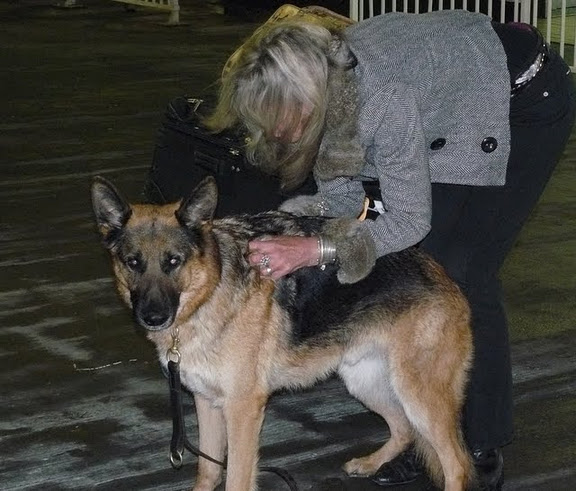
The next photograph was taken on the 11th March, 2008 at London’s Heathrow Airport. The occasion being the time that Jean came across to England from her home in Mexico. Jean came to see if the romance that had blossomed between us at Christmas in 2007 in San Carlos, Mexico was alive and well. Luckily, it was!
Jean meeting Pharaoh for the very first time!
Thus it came to pass that in September, 2008, Pharaoh and I travelled out from Devon, England to Mexico where we lived until February, 2010, when Jean and I, Pharaoh and 12 other dogs and 6 cats relocated to Payson, Arizona.
(For my regular readers, indeed, for all of you, just a reminder that I’m giving the Blog a small rest until later this week – just filling in with silly things!)
According to YouTube, over 78 million have viewed this. But if you are like me and hadn’t seen it before, watch and be very amused.
(For my regular readers, indeed, for all of you, just a reminder that I’m giving the Blog a small rest until later this week – just filling in with silly things!)
Dear friend, senior airline Captain, Bob D., sent me this video to demonstrate that not all flying is from one enormous hub to another.
I am indebted to Merci O. who regularly comments on Learning from Dogs for sending me the first film, see below. In my efforts to find a YouTube link (there didn’t appear to be one) I came across the second film. Both are good for the soul.
So click here to watch the first film. The film is comprised of a series of slides melded together with a beautiful music track. Do watch and listen.
Then here is the YouTube video, Morcheeba’s Enjoy The Ride.
Have a peaceful day wherever you are in the world.
Over the last week we have watched all three 0ne-hour films made by the BBC, aired in 2011, under the title of the heading of this post, All Watched Over by Machines of Loving Grace. The films are available on the website Top Documentary Films, the direct link is here. As that website explains,
A series of films about how humans have been colonized by the machines they have built. Although we don’t realize it, the way we see everything in the world today is through the eyes of the computers. It claims that computers have failed to liberate us and instead have distorted and simplified our view of the world around us.
1. Love and Power. This is the story of the dream that rose up in the 1990s that computers could create a new kind of stable world. They would bring about a new kind global capitalism free of all risk and without the boom and bust of the past. They would also abolish political power and create a new kind of democracy through the Internet where millions of individuals would be connected as nodes in cybernetic systems – without hierarchy.
2. The Use and Abuse of Vegetational Concepts. This is the story of how our modern scientific idea of nature, the self-regulating ecosystem, is actually a machine fantasy. It has little to do with the real complexity of nature. It is based on cybernetic ideas that were projected on to nature in the 1950s by ambitious scientists. A static machine theory of order that sees humans, and everything else on the planet, as components – cogs – in a system.
3. The Monkey in the Machine and the Machine in the Monkey. This episode looks at why we humans find this machine vision so beguiling. The film argues it is because all political dreams of changing the world for the better seem to have failed – so we have retreated into machine-fantasies that say we have no control over our actions because they excuse our failure.
As was eluded, the three films are deeply thought-provoking. There is a ‘taster’ to the first film on YouTube, as below,
Adam Curtis, the film maker, has a blog site under the BBC Blogs umbrella. The entry on that blog-site by Adam in connection with these films is here, and makes interesting reading. It also includes a longer trailer than the one from YouTube, above.
Finally, there are comprehensive writings on all three films on the WikiPedia website here. To give you a taste, here’s what was written about the third film,
The Monkey In The Machine and the Machine in the Monkey
In 1960 Congo had become independent from Belgium, but governance promptly collapsed, and towns became battle grounds as soldiers fought for control of the mines. America and the Belgians organised a coup and the elected leader was assassinated, creating chaos. The Western mining operations were largely unaffected however.
Bill Hamilton was a solitary man, and he saw everything through the lens of Darwin’s theory of evolution. When he wanted to know why some ants and humans gave up their life for others, he went to Waterloo station and stared at humans for hours, and looked for patterns. In 1963 he realised that most of the behaviours of humans was due to genes, and looking at the humans from the genes’ point of view. Humans were machines that were only important for carrying genes, and that it made sense for a gene to sacrifice a human if it meant that another copy of the gene elsewhere would prosper.
In the 1930s Armand Denis made films that told the world about Africa. However, his documentary gave fanciful stories about Rwanda’s Tutsis being a noble ruling elite originally from Egypt, whereas the Hutus were a peasant race. In reality they were racially the same and the Belgian rulers had ruthlessly exploited the myth. But when it came to create independence, liberal Belgians felt guilty, and decided that the Hutus should overthrow the Tutsi rule. This led to a blood bath, as the Tutsis were then seen as aliens and were slaughtered.
So, all in all, this is a great personal recommendation and, it goes without saying, those of you that do watch the films and want to comment, would love to hear from you.
Maybe less is more is really at the heart of our thirst for something more
A number of disparate recent experiences seem to have an underlying common thread.
See if these strike you in a similar fashion.
Yesterday, Joelle Jordan wrote about joy, about the wonderful relationship that dogs have with the world around them. As Joelle wrote,
Joy is a difficult commodity to come by these days. I don’t mean entertainment, I don’t mean a good laugh, I mean pure joy, where, even just for a single moment, all worries and doubts, frustration and anger are lifted as though by Atlas.
Like so many other humans in our world, I often find myself in a constant state of stress. There always seems to be something to worry about, whether it’s money, job fulfilment, the state of my relationships, getting the house cleaned, finding time to get to the market, and more. If given the chance, I know we all could spend nearly all of our waking hours (and some of our sleeping hours, too) worrying about something. We spend so much time on the many things that inevitably work themselves out, and so little time on things that will create a memory and a crystal moment of joy.
My little dog Charlie spends his time in the completely opposite fashion; spending his waking hours seeking joy, and committing less time to things that worry him.
Charlie seems to exist normally in three states of being; content, happy and utterly joyful.
How many of us can echo Charlie’s existance in our own lives?
Then last Sunday, Father D’s sermon spoke about our tendency to develop habitual behaviours and rarely challenge the point of them.
The truth is that we get used to doing things a certain way and keep doing them without ever thinking of what we are doing. We say things in the liturgy without even thinking of what we are saying. I’m sure many people utter the words in the Book of Common Prayer without thinking of the theology behind the words, or the relationship between church and state that they express.
Later on,
There was a desire for “something more” but it was hard to put a finger on what it was. I realized from these conversations that we are involved today in a time of intense searching. Few of us are satisfied with what the church and society have served up.
The honest among us will readily admit we lead fractured lives – with a disembodied spirituality on one side, and a soulless daily existence on the other. We are desperate for something more, for a faith with the power to transform both ourselves and our world.
“…. we are involved today in a time of intense searching“! That smacked me right in the eye!
These are clearly challenging times with mankind facing increasing odds of an ecological disaster of Old Testament proportions, and much of the western world on the cusp of a long and difficult recession. It is so easy to go on “doing things a certain way and keep doing them without ever thinking of what we are doing” while we wait for the leaders of our societies to fix our problems.
The truth is that we have to be the first to change, to question what we do on a daily basis and amend it if it is not truly healthy for us and for the planet. As was said in that sermon, “It means bringing forth each day the fruits of the Spirit: Love, joy, patience, kindness, generosity, faithfulness, gentleness and self-control.”
Go back and read yesterday’s Post and reflect on how many of those ‘fruits’ are the ways of dogs.
My final connection with the theme of today’s essay is with a recent series from the BBC called ‘Status Anxiety’. The programmes are still on YouTube and the first 10 minutes is below,
Status Anxiety discusses the desire of people in many modern societies to “climb the social ladder” and the anxieties that result from a focus on how one is perceived by others. De Botton claims that chronic anxiety about status is an inevitable side effect of any democratic, ostensibly egalitarian society. De Botton lays out the causes of and solutions to status anxiety.
Or if you prefer, all 2 hours 23 minutes may be watched on Top Documentary Films, described thus,
De Botton's book
Why doesn’t money (usually) buy happiness? Alain de Botton breaks new ground for most of us, offering reasons for something our grandparents may well have told us, as children.
It is rare, and pleasing, to see a substantial philosophical argument sustained as well as it is in this documentary. De Botton claims that we are more anxious about our own importance and achievements than our grandparents were. This is status anxiety.
Alain quotes philosophical writings, such as Democracy in America, a report by Alexis de Tocqueville on his visit to the USA in 1831. De Tocqueville noted that American equality, notable in those times, was accompanied by a climate of envy.
We jump to present-day USA, and see what, to de Botton, are some awful examples ofThe American Way. A Christian preaches get rich. A steelworker tells of his insecure life in an industry being closed down through others’ love of money.
Our protagonist points out the advantage of high status: those with high status will enjoy the care and attention of the world. Then joins this advantage with the illusion, orattempt at meritocracy in the USA, mentioning Jefferson’s notion of an aristocracy of talent.
Some of the messages towards the end of the programme are very thought-provoking indeed. Let me draw this all together.
If you own a dog, or a cat, or any pet, stop a while today and see how their simplicity of life brings them so much more. Naturally, we can never live life in the same way that our pet does but there are strong metaphors that carry equally strong messages for us. Less is more.
Now watch the last part of Status Anxiety even if you didn’t watch the first segment above, Reason? Watch and it will become clear.