This article has some deeper implications.
As 99% of you know, Jean, my wife, has Parkinson’s Disease. One of the characteristics of the disease is the effect it has on sleeping; Jean frequently has a bad night. Plus, our two dogs, Cleopatra and Oliver sleep in the bedroom on dog beds.
But if I was on my own I would find it difficult not to encourage our dogs to sleep on our double bed. That’s my assessment, at least! Over to The Conversation on the topic.
ooOOoo
Could sharing a bedroom with your pets be keeping you from getting a good night’s sleep?
Brian N. Chin, Trinity College
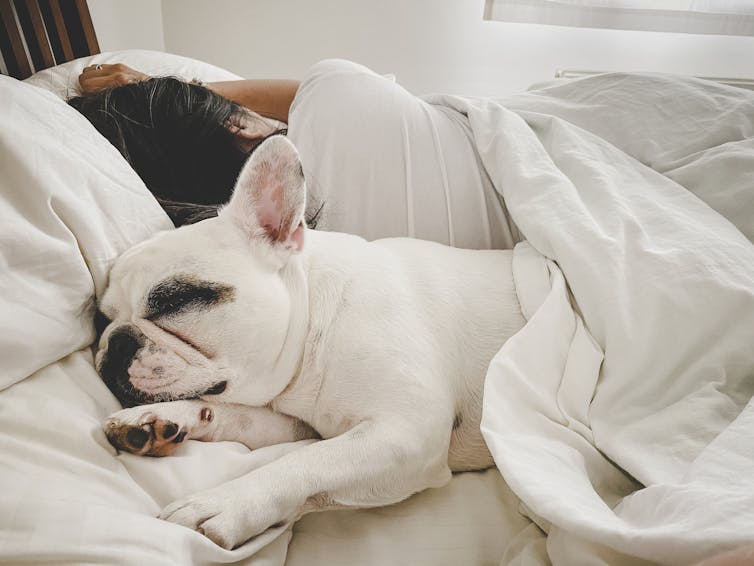
Sleeping with your dog in the same room could be negatively affecting your sleep quality, according to my team’s recently published research in Scientific Reports.
We recruited a nationally representative sample of more than 1,500 American adults who completed questionnaires assessing their sleep habits. Overall, about half of the participants reported co-sleeping with pets – defined in our study as sleeping in the same room with your pet for at least part of the night.
Next, our research team compared the sleep habits of people who did and didn’t co-sleep with pets. Our analyses revealed that participants who co-slept with pets had poorer sleep quality and more insomnia symptoms than those who did not. These findings persisted even after accounting for demographic differences between these groups. When considering pet type, we found evidence for a negative effect on sleep when co-sleeping with dogs but no evidence for a negative effect on sleep when co-sleeping with cats.
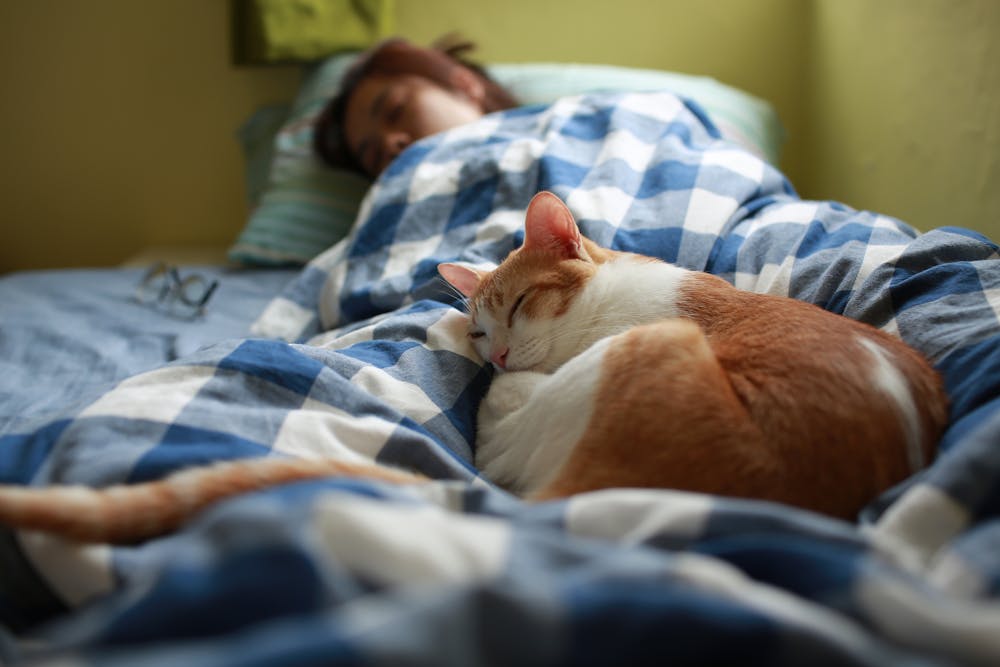
Surprisingly, 93% of people in our study who co-slept with their pets believed that their pets had either a positive or neutral overall effect on their sleep. Although more research is needed, these findings could suggest that most people are unaware of the potential negative effects their pets may have on their sleep.
Why it matters
Most pet owners report that their pets have a generally positive effect on their mental health. Pets can improve their owners’ health in numerous ways during the day, such as by encouraging physical activity, promoting a daily routine and providing love and companionship.
However, our study fills an important knowledge gap by indicating that co-sleeping with pets can affect sleep quality. Good sleep is a pillar of health and wellness. Even though pets may have an overall positive effect on mental health, it is possible that some of this benefit may be undermined if they are also causing you to lose sleep at night.
Although some people report that co-sleeping with their pets can provide them with a sense of comfort or intimacy, it is important for people sharing a bedroom with their pets to be aware of their potential to serve as a source of nighttime noise, heat or movement that can disrupt your ability to fall or stay asleep.
What still isn’t known
Survey-based studies like ours are unable to prove that co-sleeping with pets causes disrupted sleep, although there is some evidence suggesting that this could be the case.
One important factor that our study did not assess was whether participants were also co-sleeping with other people like a spouse or child. Previous research suggests that sharing a bed with other people can also affect our sleep and that the mental health benefits of pet ownership could be stronger for people with a romantic partner.
What’s next
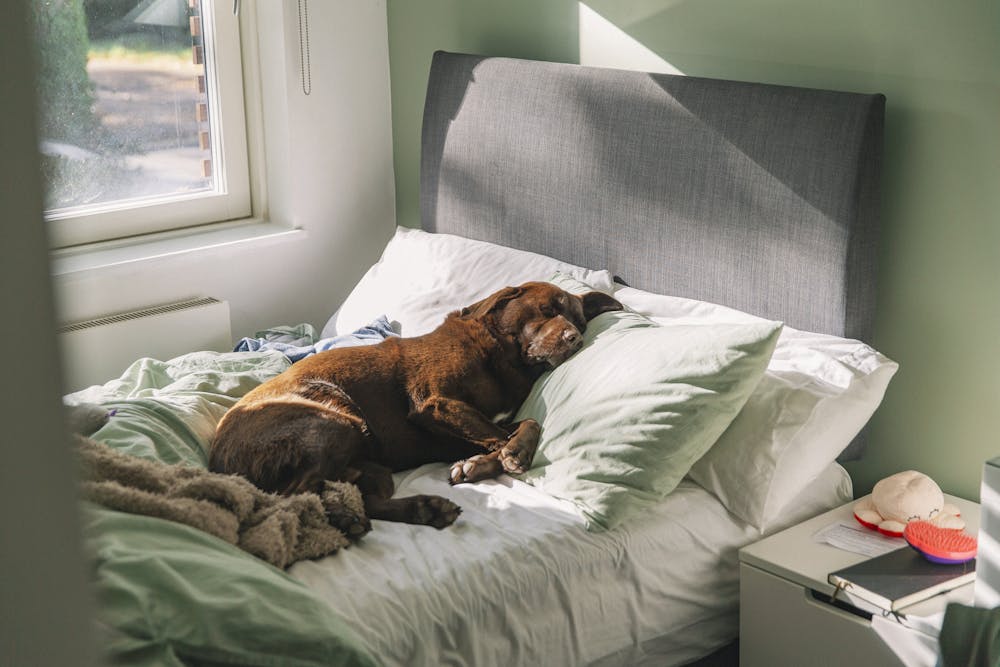
It probably isn’t realistic for most people to just stop co-sleeping with their pets. So, what should someone do to improve their sleep if they already share a bed with their pets?
Some expert tips include choosing a mattress that is large enough for you and your pets, washing and changing your bedding regularly, and establishing and maintaining a consistent bedtime routine with your pets. Further research is needed to identify more specific habits and routines that pet owners can adopt to ensure a good night’s sleep when sharing the bedroom with their pets.
The Research Brief is a short take about interesting academic work.
Brian N. Chin, Assistant Professor of Psychology, Trinity College
This article is republished from The Conversation under a Creative Commons license. Read the original article.
ooOOoo
Coming back to Jean and me at least we have a pretty regular routine with us going to our bedroom around 7pm to 8pm. In the morning over our daily coffees I always ask Jean what sort of night she had. Yesterday morning Jean replied that she had had a poor night. My judgement is that Jean has roughly one in two poor nights.

 Learning from Dogs