Tag: Tom Engelhardt

The more it changes, the more it’s the same thing.

Tom Engelhardt’s essay on the recent US Presidential election.

Introduction

Regular readers will be aware that republishing essay’s from Tom Engelhardt’s superb blog site TomDispatch has been a regular event on Learning from Dogs.  Again, readers will surely be aware that shortly after this blog got under way and I requested permission to republish a TomDispatch essay, Tom not only promptly gave me permission but added that I was free to republish any others that caught my fancy.  That was very generous and, by way of example, here are links to the last three that have appeared here.  There was the essay on Ernest Callenbach in May, Magic and the Machine in June, and The West in flames at the end of July.

So on to this essay that was recently published by Tom and is called The Meaning of a Do-Nothing Election.  As someone who is not entitled to vote in American elections and is far from understanding local cultures let alone American politics, reading an essay like this is deeply educational and I trust is for you as well.  The full essay including the introduction now follows:

oooOOOooo

[Note for TomDispatch Readers: Recently, I went back to a piece I wrote just days after the 2008 election titled “Don’t Let Barack Obama Break Your Heart.”  It reminded me that sometimes a good deal about our American future can be mined from the post-election moment.  So today, I’ve tried my hand at it again.  I’ll have to check it out in November 2016.  In the meantime, if you want to read more of my writings about the years in between, pick up a copy of The United States of Fear — or for $75 that will help this website stay afloat, you can get a signed, personalized copy (with my appreciation) via our donation page. Tom]

The Mandate of Hell 
How Not to Change the World 
By Tom Engelhardt

In the fall of 1948, Harry Truman barnstormed the country by train, repeatedly bashing a “do-nothing Congress,” and so snatched victory from the jaws of defeat in that year’s presidential campaign.  This year, neither presidential candidate focused on blasting a do-nothing Congress or, in Obama’s case, “Republican obstructionism,” demanding that the voters give them a legislative body that would mean an actual mandate for change.

We now know the results of such a campaign and, after all the tumult and the nation’s first $6 billion election, they couldn’t be more familiar.  Only days later, you can watch a remarkably recognizable cast of characters from the reelected president and Speaker of the House John Boehner to the massed pundits of the mainstream media picking up the pages of a well-thumbed script.

Will it be bipartisanship or the fiscal cliff?  Are we going to raise new revenues via tax reform or raise tax rates for the wealthiest Americans?  Will the president make up with Israeli Prime Minister Benjamin Netanyahu or not?  Will it be war or something less with Iran?  And so on and so forth.  It’s the moment the phrase déjà vu all over again was made for.

A Hell of Our Own Making

When a new Chinese dynasty came to power, it was said that it had received “the mandate of heaven.”  We’ve just passed through an election campaign that, while the noisiest in memory, was enveloped in the deepest of silences on issues that truly matter for the American future.  Out of it, a “mandate” has indeed been bestowed not just on Barack Obama, but on Washington, where a Republican House of Representatives, far less triumphant but no less fully in the saddle than the president, faces media reports that its moment is past, that its members are part of “the biggest loser demographic of the election,” and that its party — lacking the support of young peoplesingle women, those with no religious affiliationHispanicsAfrican Americans, and Asian Americans — is heading for the trash barrel of history.

If true, that does sound like a mandate for something, sooner or later — assuming you happen to have years of demographic patience.  In the meantime, there will be a lot more talk about how the Republicans need to reorient their party and about a possible “civil war” over its future.  And while we’re at it, bet on one thing: we’re also going to hear a ton more talk about how much deeply unhappy Americans — the very ones who just reinstalled a government that’s a senatorial blinkaway from the previous version of the same — really, really want everyone to make nice and work together.

But isn’t it time to cut the b.s., turn off those talking heads, and ask ourselves: What does election 2012 really mean for us and for this country?

Let’s start with one basic reality: we’ve just experienced a do-nothing election that represents a mandate from a special American kind of hell. (Admittedly, Mitt Romney’s election, which would have put the House of Representatives and Big Energy in the Oval Office, undoubtedly represented a more venal circle of that fiery establishment.)

That, in turn, ensures two different but related outcomes, both little discussed during the campaign: continuing gridlock on almost any issue that truly matters at home and a continuing damn-the-Hellfire-missiles, full-speed-ahead permanent state of war abroad (along with yet more militarization of the “homeland”).  The only winners — and don’t believe the outcries you’re hearing about sequestration “doom” for the military — are likely to be the national security complex, the Pentagon, and in a country where income inequality has long been on the rise, the wealthy.  Yes, in the particular circle of hell to which we’re consigned, it’s likely to remain springtime for billionaires and giant weapons manufacturers from 2012 to 2016.

How do we know that gridlock and a permanent state of war are the only two paths open to the people’s representatives, that Washington is quite so constrained?  Because we’ve just voted in a near-rerun of the years 2009-2012, which means that the power to make domestic policy (except at the edges) will continue to slowly seep out of the White House, while the power of the president and the national security state to further abridge evaporating liberties at home and make war abroad will only be enhanced.  The result is likely to be stasis for the globe’s last superpower at a moment when much of the world — and the planet itself — is in the process of tumultuous transformation.

Here are things not to expect: a major move to rebuild the country’s tattered infrastructure; the genuine downsizing of the American global military mission; any significant attempt to come to grips with a changing planet and global warming; and the mobilization of a younger generation that, as Hurricane Sandy showed, is ready to give much and do much to help others in need, but in the next four years will never be called to the colors.

In other words, this country is stuck in a hell of its own making that passes for everyday life at a moment when the world, for better and/or worse, is coming unstuck in all sorts of ways.

Fiddling While the Planet Burns

The United States remains a big, powerful, wealthy country that is slowly hollowing out, breaking down.  Meanwhile, on planet Earth, the global economy is up for grabs.  Another meltdown is possible, as the European, Chinese, Japanese, and Indian economies all continue to take hits.  Power relations have been changing rapidly, from the rise of Brazil in what was once Washington’s “backyard” to the Chinese miracle (and the military muscle that goes with it).  A largely American system that long helped keep the Greater Middle East, the energy heartlands of the globe, under grim, autocratic control is unraveling with unknown consequences.  Above all, from increasingly iceless Arctic waters to ever more extreme weather, rising sea levels, and the acidification of the oceans, this planet is undergoing a remarkably rapid transformation based largely on the release into the atmosphere of carbon dioxide from the burning of fossil fuels.

Other than a few curious Republican comparisons of an American economy under the Democrats to “Greece,” a near obsessive focus on the death of Ambassador J. Christopher Stephens and three other Americans in Libya, and various denunciations of China as a currency manipulator, not a single one of these matters came up in any meaningful way in the election campaign.  In other words, election 2012 boiled down to little more than a massive case of Washington-style denial.  And don’t for a second think that that’s just an artifact of election year artifice.

Take climate change, which like the Arab Spring blasted its way into our unprepared midst in 2011-2012.  There was the wildfire season of all seasons in a parching Southwest and West, a devastating drought that still hasn’t fully lifted in the Midwestern breadbasket (or corncob) of the country, and a seemingly endless summer that may make this the hottest year on record for the continental United States.  It was staggering and, if opinion polls are to be believed, noted by increasing numbers of concerned Americans who could literally feel the world changing around them.

And yet none of this made global warming an election issue.  Month after month, it was The Great Unmentionable.  The silence of emboldened Republicans plugging their drill-baby-drill and lay-those-pipelines policies and of cowed Democrats who convinced themselves that the issue was a no-win zone for the president proved deafening — until the campaign’s last days.  It was then, of course, that Hurricane Sandy, the “Frankenstorm,” swept through my town and devastated New Jersey.  It provided the extreme weather coup de grâce of 2012.  (And yes, there’s little doubt that climate-change-induced rising sea levels contributed to its fury.)  Superstorm Sandy also revealed just how unprepared the U.S. infrastructure is for predicted climate-change events.

The extremity of Sandy and its 14-foot storm surge was stunning enough that global warming was suddenly forced out of the closet.  It made magazine covers and gubernatorial press conferences.  There was even a last-minute Romney vs. Sandy web ad (“Tell Mitt Romney: Climate Change Isn’t a Joke”), and in his victory statement on election night, President Obama did manage to briefly acknowledge the changed post-Sandy moment, saying, “We want our children to live in an America that isn’t… threatened by the destructive power of a warming planet.”

Still, in just about every sense that matters in Washington, real planning for climate change is likely to remain off that table on which all “options” always sit.  Expect the president to offer Shell further support for drilling in Arctic waters, expect a new push for the Keystone XL pipeline which will transport some of the “dirtiest” energy from Canada to the Gulf of Mexico, and so on.

Don’t count on anyone doing the obvious: launching the sort of Apollo-style R&D program that once got us to the moon and might speed the U.S. and the planet toward an alternative energy economy, or investing real money in the sort of mitigation projects for the new weather paradigm that might prevent a coastal city like New York — or even Washington — from turning into an uninhabitable disaster zone in some not so distant future.

Climate science is certainly complex and filled with unknowns.  As it happens, many of those unknowns increasingly seem focused on two questions: How extreme and how quickly?  It’s suggested that sea levels are already rising faster than predicted and some recent scientific studies indicate that, by century’s end, the planet’s average temperature could rise by up to eight degrees Fahrenheit, an almost unimaginable disaster for humanity.

Whatever the unknowns, certain things are obvious enough.  Here, for instance, is a simple reality: any set of attempts, already ongoing, to make North America the “Saudi Arabia” of the twenty-first century in energy production are guaranteed to be a climate-change disaster.  Unfortunately, this election ensures once again that, no matter what the planetary realities or the actual needs of this country, no significant money will flow into alteration or mitigation projects.

Among the truly bizarre aspects of this situation, one stands out: thanks in part to a long-term climate-change-denial campaignwell-funded by the giant energy companies, the subject has become “political.”  The idea that it is a liberal or left-wing “issue,” rather than a global reality that must be dealt with, is now deeply embedded.  And yet there may never have been a more basic conservative issue (at least in the older sense of the term): the preserving, above all else, of what is already most valuable in our lives.  And what qualifies more for that than the health of the planet on which humanity “grew up”?

The phrase “fiddling while Rome burns” seems to catch something of the essence of this post-election moment — and it has special meaning when the fiddlers turn out to be slipping matches to the arsonists.

Mobilize Yourself

Just a week after the election, the Republican Party is already gearing up to produce a new, better-looking, more “diverse,” better-marketed version of itself for the 2014 and 2016 Hispanic and Asian American “markets.”  The Democratic Party is no doubt following suit.  In American politics these days, presidential elections last at least four years.  The first poll for Iowa 2016 is already out.  (Hillary’s way ahead).  Elections are the big business, sometimes just about the only significant political business Washington focuses on with any success, aided and abetted by the media.  So look forward to the $7 billion or $8 billion or $9 billion elections to come and the ever-greater hoopla surrounding them.

But stop waiting for change, “big” or otherwise, to come from Washington.  It won’t.  Don’t misunderstand me: as the residents of the Midwestern drought zone and the Jersey shore now know all too well, change is coming, like it or not.  If, however, you want this country to be something other than its instigator and its victim, if you want the U.S. to engage a world of danger (and also of opportunity), you’d better call yourself and your friends and neighbors to the colors.  Don’t wait for a Washington focused on its own well-being in 2014 or 2016.  Mobilize yourself.  It’s time to occupy this country before it’s blown away in a storm.

Tom Engelhardt, co-founder of the American Empire Project and author of The United States of Fear as well as The End of Victory Culture, his history of the Cold War, runs the Nation Institute’s TomDispatch.com. His latest book, co-authored with Nick Turse, is Terminator Planet: The First History of Drone Warfare, 2001-2050.  You can see his recent interview with Bill Moyers on supersized politics and election 2012 by clicking here.

Follow TomDispatch on Twitter @TomDispatch and join us on Facebook.  Check out the newest Dispatch book, Nick Turse’s The Changing Face of Empire: Special Ops, Drones, Proxy Fighters, Secret Bases, and Cyberwarfare.

Copyright 2012 Tom Engelhardt

oooOOOooo

So what made me select the heading?  Well, it’s the English translation of the well-known French saying, “plus ça change, plus c’est la même chose” that translates to “The more things change, the more they stay the same.”  As Wikipedia tells us, “An epigram by Jean-Baptiste Alphonse Karr in the January 1849 issue of his journal Les Guêpes (“The Wasps”). Literally “The more it changes, the more it’s the same thing.”  Seems to pick up Tom’s theme very nicely.

What goes up?

Civilizations die from suicide, not by murder. Arnold J Toynbee

I’m not sure where to start but as a result of finishing a particular book, plus a recent essay on Tom Dispatch, then another recent essay from Simon Johnson of Baseline Scenario fame, there were so many thoughts bumping around this aged brain that I had no alternative than to offer them to you, dear reader.  You should also be warned that this is going to be two posts, covering today and tomorrow.

So let’s start with the book: The United States of Fear by Tom Engelhardt.  To be brutally honest, I purchased the book more as a gesture of support to Tom who has been very supportive of Learning from Dogs, in particular allowing me permission to reproduce any essays that were published on TomDispatch, as a number have so been.  What an error of judgment!  Tom’s book provided another one of those rare but inspirational occasions where you know the world will never look quite the same again!

The back cover page of the book sets out the theme, thus,

Published 2011

In 2008, when the US National Intelligence Council issued its latest report meant for the administration of newly elected President Barack Obama, it predicted that the planet’s “sole superpower” would suffer a modest decline and a soft landing fifteen years hence. In his new book The United States of Fear, Tom Engelhardt makes clear that Americans should don their crash helmets and buckle their seat belts, because the United States is on the path to a major decline at a startling speed. Engelhardt offers a savage anatomy of how successive administrations in Washington took the “Soviet path”—pouring American treasure into the military, war, and national security—and so helped drive their country off the nearest cliff.This is the startling tale of how fear was profitably shot into the national bloodstream, how the country—gripped by terror fantasies—was locked down, and how a brain-dead Washington elite fiddled (and profited) while America quietly burned.

Think of it as the story of how the Cold War really ended, with the triumphalist “sole superpower” of 1991 heading slowly for the same exit through which the Soviet Union left the stage twenty years earlier.

One of the fascinating aspects of the book is that it was put together from 32 essays previously published online by Tom; the complete list with titles and dates is on pps. 205 & 206.  So giving you a real feel for the book is easy!  I’m going to do that by linking to one of those essays available in the archives of TomDispatch here.  That essay was called Washington’s Echo Chamber and appears in the book starting on page 170 under the sub-heading of Five Ways to Be Tone Deaf in Washington. Let me quote you a little,

So much of what Washington did imagine in these last years proved laughable, even before this moment swept it away.  Just take any old phrase from the Bush years.  How about “You’re either with us or against us”?  What’s striking is how little it means today.  Looking back on Washington’s desperately mistaken assumptions about how our globe works, this might seem like the perfect moment to show some humility in the face of what nobody could have predicted.

It would seem like a good moment for Washington — which, since September 12, 2001, has been remarkably clueless about real developments on this planet and repeatedly miscalculated the nature of global power — to step back and recalibrate.

As it happens, there’s no evidence it’s doing so.  In fact, that may be beyond Washington’s present capabilities, no matter how many billions of dollars it pours into “intelligence.”  And by “Washington,” I mean not just the Obama administration, or the Pentagon, or our military commanders, or the vast intelligence bureaucracy, but all those pundits and think-tankers who swarm the capital, and the media that reports on them all.  It’s as if the cast of characters that makes up “Washington” now lives in some kind of echo chamber in which it can only hear itself talking.

As a result, Washington still seems remarkably determined to play out the string on an era that is all too swiftly passing into the history books.  While many have noticed the Obama administration’s hapless struggle to catch up to events in the Middle East, even as it clings to a familiar coterie of grim autocrats and oil sheiks, let me illustrate this point in another area entirely — the largely forgotten war in Afghanistan.  After all, hardly noticed, buried beneath 24/7 news from Egypt, Bahrain, Libya, and elsewhere in the Middle East, that war continues on its destructive, costly course with nary a blink.

That was published by Tom a little over 18 months ago!  Seems as relevant today as then!  Let me stay with perspectives from 2011.

Chomsky, visiting Vancouver, Canada in March 2004

On the 24th August 2011 Noam Chomsky wrote an essay entitled American Decline: Causes and Consequences.  Chomsky, as Wikipedia relates, is Professor (Emeritus) in the Department of Linguistics & Philosophy at MIT, where he has worked for over 50 years.  Here is how that essay opens,

In the 2011 summer issue of the journal of the American Academy of Political Science, we read that it is “a common theme” that the United States, which “only a few years ago was hailed to stride the world as a colossus with unparalleled power and unmatched appeal — is in decline, ominously facing the prospect of its final decay.” It is indeed a common theme, widely believed, and with some reason. But an appraisal of US foreign policy and influence abroad and the strength of its domestic economy and political institutions at home suggests that a number of qualifications are in order. To begin with, the decline has in fact been proceeding since the high point of US power shortly after World War II, and the remarkable rhetoric of the several years of triumphalism in the 1990s was mostly self-delusion. Furthermore, the commonly drawn corollary — that power will shift to China and India — is highly dubious. They are poor countries with severe internal problems. The world is surely becoming more diverse, but despite America’s decline, in the foreseeable future there is no competitor for global hegemonic power.

So, according to Chomsky, it’s not as ‘black and white’ as Engelhardt sets out.  But do read the full essay.

Nevertheless, the idea that the USA is ‘fiddling while Rome burns’ is supported in an essay published by Mattea Kramer on TomDispatch on the last day of September.  I’m going to end Part One by republishing the essay in full.  (Note that this is being published here after the first ‘debate’ had taken place.)

oooOOOooo

Tough Talk for America

A Guide to the Presidential Debates You Won’t Hear 
By Mattea Kramer

Five big things will decide what this country looks like next year and in the 20 years to follow, but here’s a guarantee for you: you’re not going to hear about them in the upcoming presidential debates. Yes, there will be questions and answers focused on deficits, taxes, Medicare, the Pentagon, and education, to which you already more or less know the responses each candidate will offer. What you won’t get from either Mitt Romney or Barack Obama is a little genuine tough talk about the actual state of reality in these United States of ours. And yet, on those five subjects, a little reality would go a long way, while too little reality (as in the debates to come) is a surefire recipe for American decline.

So here’s a brief guide to what you won’t hear this Wednesday or in the other presidential and vice-presidential debates later in the month. Think of these as five hard truths that will determine the future of this country.

1. Immediate deficit reduction will wipe out any hope of economic recovery: These days, it’s fashionable for any candidate to talk about how quickly he’ll reduce the federal budget deficit, which will total around $1.2 trillion in fiscal 2012. And you’re going to hear talk about the Simpson-Bowles deficit reduction plan and more like it on Wednesday. But the hard truth of the matter is that deep deficit reduction anytime soon will be a genuine disaster. Think of it this way: If you woke up tomorrow and learned that Washington had solved the deficit crisis and you’d lost your job, would you celebrate? Of course not. And yet, any move to immediately reduce the deficit does increase the likelihood that you will lose your job.

When the government cuts spending, it lays off workers and cancels orders for all sorts of goods and services that would generate income for companies in the private sector. Those companies, in turn, lay off workers, and the negative effects ripple through the economy. This isn’t atomic science. It’s pretty basic stuff, even if it’s evidently not suitable material for a presidential debate. The nonpartisan Congressional Research Service predicted in a September report, for example, that any significant spending cuts in the near-term would contribute to an economic contraction. In other words, slashing deficits right now will send us ever deeper into the Great Recession from which, at best, we’ve scarcely emerged.

Champions of immediate deficit reduction are likely to point out that unsustainable deficits aren’t good for the economy. And that’s true — in the long run. Washington must indeed plan for smaller deficits in the future. That will, however, be a lot easier to accomplish when the economy is healthier, since government spending declines when fewer people qualify for assistance, and tax revenues expand when the jobless go back to work. So it makes sense to fix the economy first. The necessity for near-term recovery spending paired with long-term deficit reduction gets drowned out when candidates pack punchy slogans into flashes of primetime TV.

2. Taxes are at their lowest point in more than half a century, preventing investment in and the maintenance of America’s most basic resources: Hard to believe? It’s nonetheless a fact. By now, it’s a tradition for candidates to compete on just how much further they’d lower taxes and whether they’ll lower them for everyone or just everyone but the richest of the rich. That’s a super debate to listen to, if you’re into fairy tales. It’s not as thrilling if you consider that Americans now enjoy the lightest tax burden in more than five decades, and it happens to come with a hefty price tag on an item labeled “the future.” There is no way the U.S. can maintain a world-class infrastructure — we’re talking levees, highways, bridges, you name it — and a public education system that used to be the envy of the world, plus many other key domestic priorities, on the taxes we’re now paying.

Anti-tax advocates insist that we should cut taxes even more to boost a flagging economy — an argument that hits the news cycle nearly every hour and that will shape the coming TV “debate.” As the New York Times recently noted, however, tax cuts might have been effective in giving the economy a lift decades ago when tax rates were above 70%. (And no, that’s not a typo, that’s what your parents and grandparents paid without much grumbling.) With effective tax rates around 14% for Mitt Romney and many others, further cuts won’t hasten job creation, just the hollowing out of public investment in everything from infrastructure to education. Right now, the negative effects of tax increases on the most well-off would be small — read: not a disaster for “job creators” — and those higher rates would bring in desperately-needed revenue. Tax increases for middle-class Americans should arrive when the economy is stronger.

Right now, the situation is clear: we’re simply not paying enough to fund the basic ingredients of prosperity from highways and higher education to medical research and food safety. Without those funds, this country’s future won’t be pretty.

3. Neither the status quo nor a voucher system will protect Medicare (or any other kind of health care) in the long run: When it comes to Medicare, Mitt Romney has proposed a premium-support program that would allow seniors the option of buying private insurance. President Obama wants to keep Medicare more or less as it is for retirees. Meanwhile, the ceaseless rise in health-care costs is eating up the wages of regular Americans and the federal budget. Health care now accounts for a staggering 24% of all federal spending, up from 7% less than 40 years ago. Governor Romney’s plan would shift more of those costs onto retirees, according to David Cutler, a health economist at Harvard, while President Obama says the federal government will continue to pick up the tab. Neither of them addresses the underlying problem.

Here’s reality: Medicare could be significantly protected by cutting out waste. Our health system is riddled with unnecessary tests and procedures, as well as poorly coordinated care for complex health problems. This country spent $2.6 trillion on health care in 2010, and some estimates suggest that a staggering 30% of that is wasted. Right now, our health system rewards quantity, not quality, but it doesn’t have to be that way. Instead of paying for each test and procedure, Medicare could pay for performance and give medical professionals a strong incentive to provide more efficient and coordinated care. President Obama’s health law actually pilot tests such an initiative. But that’s another taboo topic this election season, so he scarcely mentions it. Introducing such change into Medicare and the rest of our health system would save the federal government tens of billions of dollars annually. It would truly preserve Medicare for future generations, and it would improve the affordability of health coverage for everyone under 65 as well. Too bad it’s not even up for discussion.

4. The U.S. military is outrageously expensive and yet poorly tailored to the actual threats to U.S. national security: Candidates from both parties pledge to protect the Pentagon from cuts, or even, in the case of the Romney team, to increase the already staggering military budget. But in a country desperate for infrastructure, education, and other funding, funneling endless resources to the Pentagon actually weakens “national security.” Defense spending is already mind-numbingly large: if all U.S. military and security spending were its own country, it would have the 19th largest economy in the world, ahead of Saudi Arabia, Taiwan, and Switzerland. Whether you’re counting aircraft carriers, weapons systems, or total destructive power, it’s absurdly overmatched against the armed forces of the rest of the world, individually or in combination. A couple of years ago, then-Secretary of Defense Robert M. Gates gave a speech in which he detailed that overmatch. A highlight: “The U.S. operates 11 large carriers, all nuclear powered. In terms of size and striking power, no other country has even one comparable ship.” China recently acquired one carrier that won’t be fully functional for some time, if ever — while many elected officials in this country would gladly build a twelfth.

But you’ll hear none of this in the presidential debates. Perhaps the candidates will mention that obsolete, ineffective, and wildly expensive weapons systems could be cut, but that’s a no-brainer. The problem is: it wouldn’t put a real dent in national defense spending. Currently almost one-fifth of every dollar spent by the federal government goes to the military. On average, Americans, when polled, say that they would like to see military funding cut by 18%.

Instead, most elected officials vow to pour limitless resources into more weapons systems of questionable efficacy, and of which the U.S. already owns more than the rest of the world combined. Count on one thing: military spending will not go down as long as the U.S. is building up a massive force in the Persian Gulf, sending Marines to Darwin, Australia, and special ops units to Africa and the Middle East, running drones out of the Seychelles Islands, and “pivoting” to Asia. If the U.S. global mission doesn’t downsize, neither will the Pentagon budget — and that’s a hit on America’s future that no debate will take up this month.

5. The U.S. education system is what made this country prosperous in the twentieth century — but no longer: Perhaps no issue is more urgent than this, yet for all the talk of teacher’s unions and testing, real education programs, ideas that will matter, are nonexistent this election season. During the last century, the best education system in the world allowed this country to grow briskly and lift standards of living. Now, from kindergarten to college, public education is chronically underfunded. Scarcely 2% of the federal budget goes to education, and dwindling public investment means students pay higher tuitions and fall ever deeper into debt. Total student debt surpassed $1 trillion this year and it’s growing by the month, with the average debt burden for a college graduate over $24,000. That will leave many of those graduates on a treadmill of loan repayment for most or all of their adult lives.

Renewed public investment in education — from pre-kindergarten to university — would pay handsome dividends for generations. But you aren’t going to hear either candidate or their vice-presidential running mates proposing the equivalent of a GI Bill for the rest of us or even significant new investment in education. And yet that’s a recipe for and a guarantee of American decline.

Ironically, those in Washington arguing for urgent deficit reduction claim that we’ve got to do it “for the kids,” that we must stop saddling our grandchildren with mountains of federal debt. But if your child turns 18 and finds her government running a balanced budget in an America that’s hollowed out, an America where she has no chance of paying for a college education, will she celebrate? You don’t need an economist to answer that one.

Mattea Kramer is senior research analyst at National Priorities Project and a TomDispatch regular. She is lead author of the new book A People’s Guide to the Federal Budget.

Copyright 2012 Mattea Kramer

oooOOOooo

Let me close with another quote from Arnold J. Toynbee:

Of the twenty-two civilizations that have appeared in history, nineteen of them collapsed

when they reached the moral state the United States is in now.

Part Two continues tomorrow.

The West in flames

Yet another stunningly powerful essay on TomDispatch.

Introduction

I do hope that as a result of Tom Engelhardt giving me written blanket permission to republish essays that appear on TomDispatch, for which I am ever grateful, many readers have gone across to the TomDispatch website and, consequently, quite a few of you have subscribed.  The regular flow of essays from major names across the many fields of life is impressive.

Plus I want to harp back to a theme that I touched on during my introduction to Dianne Gray’s guest post on the 25th last, Dogs and life.  That is that the vision of Learning from Dogs is to remind all of us that we have no option in terms of the long-term viability of our species than to acknowledge the power of integrity, so beautifully illustrated by our closest animal companion for tens of thousands of years, the domestic dog.

So with that in mind, settle back and read,

Tomgram: William deBuys, The West in Flames

Posted by William deBuys at 9:20AM, July 24, 2012

[Note for TomDispatch Readers: Check out my hour on Media Matters with Bob McChesney on Sunday, where he and I talked about the militarization of the U.S. and of American foreign policy, and I discussed my latest book, The United States of Fear, as well as the one I co-authored with Nick Turse, Terminator Planet: The First History of Drone Warfare, 2001-2050.  Tom]

The water supply was available only an hour a day and falling.  People — those who hadn’t moved north to cooler climes — were dying from the heat.  Food was growing ever scarcer and the temperature soaring so that, as one reporter put it, you could “cook eggs on your sidewalk and cook soup in the oceans.”  The year was 1961 and I was “there,” watching “The Midnight Sun,” a Twilight Zone episode in which the Earth was coming ever closer to the sun.  (As it was The Twilight Zone, you knew there would be a twist at the end: in this case, you were inside the fevered dreams of a sick woman on a planet heading away from the sun and growing ever colder.)

In 1961, an ever-hotter planet was a sci-fi fantasy and the stuff of entertainment.  No longer.  Now, it’s the plot line for our planet and it isn’t entertaining at all.  Just over a half-century later, we are experiencing, writes Bill McKibben in Rolling Stone, “the 327th consecutive month in which the temperature of the entire globe exceeded the 20th-century average, the odds of which occurring by simple chance were 3.7 x 10-99, a number considerably larger than the number of stars in the universe.”

Speaking personally, this summer, living through a staggering heat wave on the East coast (as in much of the rest of the country), I’ve felt a little like I’m in that fevered dream from The Twilight Zone, and a map of a deep-seated drought across 56% of the country and still spreading gives you a feeling for just why.   Never in my life have I thought of the sun as implacable, but that’s changing, too.  After all, the first six months of 2012 in the U.S. were 4.5 degrees Fahrenheit above the long-term norm and Colorado, swept by wildfires, was a staggering 6.4 degrees higher than the usual.  TomDispatch regular William deBuys, author of A Great Aridness: Climate Change and the Future of the American Southwest, catches the feel of living in a West that’s aflame and drying out fast.  (To catch Timothy MacBain’s latest Tomcast audio interview in which deBuys discusses where heat, fire, and climate change are taking us, click here or download it to your iPod here.) Tom

oooOOOooo

The Oxygen Planet Struts Its Stuff 
Not a “Perfect Storm” But the New Norm in the American West 
By William deBuys

Dire fire conditions, like the inferno of heat, turbulence, and fuel that recently turned 346 homes in Colorado Springs to ash, are now common in the West. A lethal combination of drought, insect plagues, windstorms, and legions of dead, dying, or stressed-out trees constitute what some pundits are calling wildfire’s “perfect storm.”

They are only half right.

This summer’s conditions may indeed be perfect for fire in the Southwest and West, but if you think of it as a “storm,” perfect or otherwise — that is, sudden, violent, and temporary — then you don’t understand what’s happening in this country or on this planet. Look at those 346 burnt homes again, or at the High Park fire that ate 87,284 acres and 259 homes west of Fort Collins, or at the Whitewater Baldy Complex fire in New Mexico that began in mid-May, consumed almost 300,000 acres, and is still smoldering, and what you have is evidence of the new normal in the American West.

For some time, climatologists have been warning us that much of the West is on the verge of downshifting to a new, perilous level of aridity. Droughts like those that shaped the Dust Bowl in the 1930s and the even drier 1950s will soon be “the new climatology” of the region — not passing phenomena but terrifying business-as-usual weather. Western forests already show the effects of this transformation.

If you surf the blogosphere looking for fire information, pretty quickly you’ll notice a dust devil of “facts” blowing back and forth: big fires are four times more common than they used to be; the biggest fires are six-and-a-half times larger than the monster fires of yesteryear; and owing to a warmer climate, fires are erupting earlier in the spring and subsiding later in the fall. Nowadays, the fire season is two and a half months longer than it was 30 years ago.

All of this is hair-raisingly true. Or at least it was, until things got worse. After all, those figures don’t come from this summer’s fire disasters but from a study published in 2006 that compared then-recent fires, including the record-setting blazes of the early 2000s, with what now seem the good old days of 1970 to 1986. The data-gathering in the report, however, only ran through 2003. Since then, the western drought has intensified, and virtually every one of those recent records — for fire size, damage, and cost of suppression — has since been surpassed.

New Mexico’s Jemez Mountains are a case in point. Over the course of two weeks in 2000, the Cerro Grande fire burned 43,000 acres, destroying 400 homes in the nuclear research city of Los Alamos. At the time, to most of us living in New Mexico, Cerro Grande seemed a vision of the Apocalypse. Then, the Las Conchas fire erupted in 2011 on land adjacent to Cerro Grande’s scar and gave a master class in what the oxygen planet can do when it really struts its stuff.

The Las Conchas fire burned 43,000 acres, equaling Cerro Grande’s achievement,in its first fourteen hours. Its smoke plume rose to the stratosphere, and if the light was right, you could see within it rose-red columns of fire — combusting gases — flashing like lightning a mile or more above the land. Eventually the Las Conchas fire spread to 156,593 acres, setting a record as New Mexico’s largest fire in historic times.

It was a stunning event. Its heat was so intense that, in some of the canyons it torched, every living plant died, even to the last sprigs of grass on isolated cliff ledges. In one instance, the needles of the ponderosa pines were not consumed, but bent horizontally as though by a ferocious wind. No one really knows how those trees died, but one explanation holds that they were flash-blazed by a superheated wind, perhaps a collapsing column of fire, and that the wind, having already burned up its supply of oxygen, welded the trees by heat alone into their final posture of death.

It seemed likely that the Las Conchas record would last years, if not decades. It didn’t. This year the Whitewater Baldy fire in the southwest of the state burned an area almost twice as large.

Half Now, Half Later?

In 2007, Tom Swetnam, a fire expert and director of the laboratory of Tree-Ring Research at the University of Arizona, gave an interview to CBS’s 60 Minutes.Asked to peer into his crystal ball, he said he thought the Southwest might lose half its existing forests to fire and insects over the several decades to come. He immediately regretted the statement.  It wasn’t scientific; he couldn’t back it up; it was a shot from the hip, a WAG, a wild-ass guess.

Swetnam’s subsequent work, however, buttressed that WAG. In 2010, he and several colleagues quantified the loss of southwestern forestland from 1984 to 2008. It was a hefty 18%. They concluded that “only two more recurrences of droughts and die-offs similar or worse than the recent events” might cause total forest loss to exceed 50%. With the colossal fires of 2011 and 2012, including Arizona’s Wallow fire, which consumed more than half-a-million acres, the region is on track to reach that mark by mid-century, or sooner.

But that doesn’t mean we get to keep the other half.

In 2007, the Intergovernmental Panel on Climate Change forecast a temperature increase of 4ºC for the Southwest over the present century. Given a faster than expected build-up of greenhouse gases (and no effective mitigation), that number looks optimistic today. Estimates vary, but let’s say our progress into the sweltering future is an increase of slightly less than 1ºC so far. That means we still have an awful long way to go. If the fires we’re seeing now are a taste of what the century will bring, imagine what the heat stress of a 4ºC increase will produce. And these numbers reflect mean temperatures. The ones to worry about are the extremes, the record highs of future heat waves.  In the amped-up climate of the future, it is fair to think that the extremes will increase faster than the means.

At some point, every pine, fir, and spruce will be imperiled. If, in 2007, Swetnam was out on a limb, these days it’s likely that the limb has burned off and it’s getting ever easier to imagine the destruction of forests on a region-wide scale, however disturbing that may be.

More than scenery is at stake, more even than the stability of soils, ecosystems, and watersheds: the forests of the western United States account for 20% to 40% of total U.S. carbon sequestration. At some point, as western forests succumb to the ills of climate change, they will become a net releaser of atmospheric carbon, rather than one of the planet’s principle means of storing it.

Contrary to the claims of climate deniers, the prevailing models scientists use to predict change are conservative. They fail to capture many of the feedback loops that are likely to intensify the dynamics of change. The release of methane from thawing Arctic permafrost, an especially gloomy prospect, is one of those feedbacks. The release of carbon from burning or decaying forests is another. You used to hear scientists say, “If those things happen, the consequences will be severe.” Now they more often skip that “if” and say “when” instead, but we don’t yet have good estimates of what those consequences will be.

Ways of Going

There have always been droughts, but the droughts of recent years are different from their predecessors in one significant way: they are hotter. And the droughts of the future will be hotter still.

June temperatures produced 2,284 new daily highs nationwide and tied 998 existing records. In most places, the shoe-melting heat translated into drought, and the Department of Agriculture set a record of its own recently by declaring 1,297 dried-out counties in 29 states to be “natural disaster areas.” June also closed out the warmest first half of a year and the warmest 12-month period since U.S. record keeping began in 1895. At present, 56% of the continental U.S. is experiencing drought, a figure briefly exceeded only in the 1950s.

Higher temperatures have a big impact on plants, be they a forest of trees or fields of corn and wheat. More heat means intensified evaporation and so greater water stress. In New Mexico, researchers compared the drought of the early 2000s with that of the 1950s. They found that the 1950s drought was longer and drier, but that the more recent drought caused the death of many more trees, millions of acres of them. The reason for this virulence: it was 1ºC to 1.5ºC hotter.

The researchers avoided the issue of causality by not claiming that climate changecaused the higher temperatures, but in effect stating: “If climate change is occurring, these are the impacts we would expect to see.” With this in mind, they christened the dry spell of the early 2000s a “global-change-type drought” — not a phrase that sings but one that lingers forebodingly in the mind.

No such equivocation attends a Goddard Institute for Space Studies appraisal of the heat wave that assaulted Texas, Oklahoma, and northeastern Mexico last summer. Their report represents a sea change in high-level climate studies in that they boldly assert a causal link between specific weather events and global warming. The Texas heat wave, like a similar one in Russia the previous year, was so hot that its probability of occurring under “normal” conditions (defined as those prevailing from 1951 to 1980) was approximately 0.13%. It wasn’t a 100-year heat wave or even a 500-year one; it was so colossally improbable that only changes in the underlying climate could explain it.

The decline of heat-afflicted forests is not unique to the United States. Global research suggests that in ecosystems around the world, big old trees — the giants of tropical jungles, of temperate rainforests, of systems arid and wet, hot and cold — are dying off.

More generally, when forest ecologists compare notes across continents and biomes, they find accelerating tree mortality from Zimbabwe to Alaska, Australia to Spain. The most common cause appears to be heat stress arising from climate change, along with its sidekick, drought, which often results when evaporation gets a boost.

Fire is only one cause of forest death. Heat alone can also do in a stand of trees. According to the Texas Forest Service, between 2% and 10% of all the trees in Texas, perhaps half-a-billion or so, died in last year’s heat wave, primarily from heat and desiccation. Whether you know it or not, those are staggering figures.

Insects, too, stand ready to play an ever-greater role in this onrushing disaster. Warm temperatures lengthen the growing season, and with extra weeks to reproduce, a population of bark beetles may spawn additional generations over the course of a hot summer, boosting the number of their kin that that make it to winter. Then, if the winter is warm, more larvae survive to spring, releasing ever-larger swarms to reproduce again. For as long as winters remain mild, summers long, and trees vulnerable, the beetles’ numbers will continue to grow, ultimately overwhelming the defenses of even healthy trees.

We now see this throughout the Rockies. A mountain pine beetle epidemic has decimated lodgepole pine stands from Colorado to Canada. About five million acres of Colorado’s best scenery has turned red with dead needles, a blow to tourism as well as the environment. The losses are far greater in British Columbia, where beetles have laid waste to more than 33 million forest acres, killing a volume of trees three times greater than Canada’s annual timber harvest.

Foresters there call the beetle irruption “the largest known insect infestation in North American history,” and they point to even more chilling possibilities. Until recently, the frigid climate of the Canadian Rockies prevented beetles from crossing the Continental Divide to the interior where they were, until recently, unknown. Unfortunately, warming temperatures have enabled the beetles to top the passes of the Peace River country and penetrate northern Alberta. Now a continent of jack pines lies before them, a boreal smorgasbord 3,000 miles long. If the beetles adapt effectively to their new hosts, the path is clear for them to chew their way eastward virtually to the Atlantic and to generate transformative ecological effects on a gigantic scale.

The mainstream media, prodded by recent drought declarations and other news, seem finally to be awakening to the severity of these prospects. Certainly, we should be grateful. Nevertheless, it seems a tad anticlimactic when Sam Champion, ABC News weather editor, says with this-just-in urgency to anchor Diane Sawyer, “If you want my opinion, Diane, now’s the time we start limiting manmade greenhouse gases.”

One might ask, “Why now, Sam?” Why not last year, or a decade ago, or several decades back? The news now overwhelming the West is, in truth, old news. We saw the changes coming. There should be no surprise that they have arrived.

It’s never too late to take action, but now, even if all greenhouse gas emissions were halted immediately, Earth’s climate would continue warming for at least another generation. Even if we surprise ourselves and do all the right things, the forest fires, the insect outbreaks, the heat-driven die-offs, and other sweeping transformations of the American West and the planet will continue.

One upshot will be the emergence of whole new ecologies. The landscape changes brought on by climate change are affecting areas so vast that many previous tenants of the land — ponderosa pines, for instance — cannot be expected to recolonize their former territory. Their seeds don’t normally spread far from the parent tree, and their seedlings require conditions that big, hot, open spaces don’t provide.

What will develop in their absence? What will the mountains and mesa tops of the New West look like? Already it is plain to see that scrub oak, locust, and other plants that reproduce by root suckers are prospering in places where the big pines used to stand. These plants can be burned to the ground and yet resprout vigorously a season later. One ecologist friend offers this advice, “If you have to be reincarnated as a plant in the West, try not to come back as a tree. Choose a clonal shrub, instead. The future looks good for them.”

In the meantime, forget about any sylvan dreams you might have had: this is no time to build your house in the trees.

(Buy from Amazon)

William deBuys, a TomDispatch regular, is the author of seven books, most recently A Great Aridness: Climate Change and the Future of the American Southwest (Oxford, 2011). He has long been involved in environmental affairs in the Southwest, including service as founding chairman of the Valles Caldera Trust, which administers the 87,000-acre Valles Caldera National Preserve in New Mexico. To listen to Timothy MacBain’s latest Tomcast audio interview in which deBuys discusses where heat, fire, and climate change are taking us, click here or download it to your iPod here.

Copyright 2012 William deBuys

I feel a headache coming on!

A bit of a personal rant about complacency!

But before I get my blood up, let me reflect on a small passage of time.  I first started writing this Blog on July 15th, 2009, coming up to three years ago.  The idea came from a previous conversation with Jon Lavin of The People Workshop when we were chatting about Dr. David Hawkins’ Map of Consciousness and Jon pointed out that dogs had a ‘score’ of about 210, i.e. were positively above the boundary between truth and falsehood.  As I wrote here,

Dogs:

  • are integrous ( a score of 210) according to Dr David Hawkins
  • don’t cheat or lie
  • don’t have hidden agendas
  • are loyal and faithful
  • forgive
  • love unconditionally
  • value and cherish the ‘present’ in a way that humans dream of achieving
  • are, by eons of time, a more successful species than man.

That’s why the blog is called Learning from Dogs!

Stay with me just a little longer.

The picture of Pharaoh on the Home page, this one:

Dogs know better, much better! Time again for man to learn from dogs!

is a picture of a ‘beta’ dog.  The beta dog is the second-in-command, so to speak, in a wild dog pack.  A dog pack, about 40 to 50 dogs in the wild, has three dogs of special rank, although rank is not really the correct word, role is a better one.  The leader of the pack is the alpha dog; always a female dog.  The next role dog is the beta; always a male.  The third role dog is the ‘clown’ dog and can be either sex.

In reverse order, the clown dog is there to keep the pack happy (in dog terms), the beta dog’s role is to break up fights within the pack and to ‘teach’ the puppies their social skills (which is why a beta dog is always a dominant male) and the alpha’s primary role is to ensure that the pack’s territory is not compromised by other animals and that there is plenty of food for the pack.

Ergo, the single most important decision of the alpha dog is to move the pack to a new territory when she judges that the present one is unsustainable!

OK, to my ‘rant’!

Why isn’t mankind learning from dogs and realising that our present ‘territory’, Planet Earth, is not capable of sustaining mankind for very much longer.

I don’t believe that man is intrinsically stupid!  Many know the famous quotation from Einstein, “Insanity: doing the same thing over and over again and expecting different results.”  So if most of us ‘nod’ our heads when we read that quote, why are most of us seemingly content to keep doing the same thing?  Why isn’t there such a huge outpouring of anger at the complacency of the world’s leaders?  How far does the collapse of the conditions, both social and physical, as in biosphere, have to go before we get real, urgent change?

Last Thursday, in a post I called Denialists standing up for insanity, I quoted Tom Engelhardt in his introduction to an article by Bill McKibben thus,

It’s true that no single event can be pinned on climate change with absolute certainty.  But anyone who doesn’t think we’re in a fierce new world of weather extremes — and as TomDispatch regular Bill McKibben has suggested, on an increasingly less hospitable planet that he calls Eaarth – is likely to learn the realities firsthand soon enough.  Not so long ago, if you really wanted to notice the effects of climate change around you, you had to be an Inuit, an Aleut, or some other native of the far north where rising temperatures and melting ice were visibly changing the landscape and wrecking ways of life — or maybe an inhabitant of Kiribati.  Now, it seems, we are all Inuit or Pacific islanders.  And the latest polling numbers indicate that Americans are finally beginning to notice in their own lives, and in numbers that may matter.

Well it’s good that Americans are starting to get the picture but it’s all too gentile – we all have to get much more excited about making our leaders understand that we want action to curb CO2 emissions, and we want action NOW!

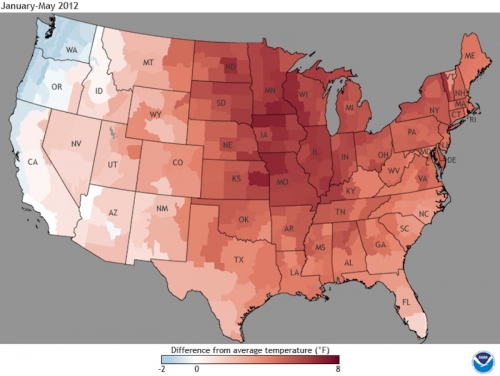
Just look at this chart from NOAA as seen on the Climate Central website:

Year-to-Date divisional temperature rankings from NOAA.

More about that tomorrow!

OK, only a short rant!  Which is immediately followed by an apology!  Because you will have to wait 24 hours before reading my next Post about fracking, about how some ‘leaders’ expect the CO2 emissions in the earth’s atmosphere to stabilise at 650 ppm and how very close we are to losing control!

Think I need to go and lie down!

Denialists standing up for insanity!

Bill McKibben spells it out that climate-change deniers are on the ropes — But So Is the Planet !

Once again, I am deeply indebted to Tom Englehardt of Tom Dispatch fame for his permission allowing me reproduce a recent post.

But before so doing, let me natter on for a few words about why I am motivated to write a daily post for Learning from Dogs.  As I say on the Welcome page, “Mankind is close to the edge of extinction, literally and spiritually. Dogs know better, much better! Time again for man to learn from dogs!

To expand on that, I write about the purpose of this Blog, “... if society doesn’t eschew the games, half-truths and selfish attitudes of the last, say, 30 years or more, then civilisation, as we know it, could be under threat.”  Which is why the quotation on that page is so powerful:

There is nothing to fear except the persistent refusal to find out the truth, the persistent

refusal to analyse the causes of happenings.” Dorothy Thompson.

Stay with me for just a little longer.  Here’s an article that was published on the BBC’s News website on Tuesday (I’ve taken just a small extract and slightly re-arranged the order),

Virginia’s dying marshes and climate change denial

By Daniel Nasaw

BBC News Magazine, York River, Virginia

Trees die as rising salt water soaks their roots, Watts says

Dying wetland trees along Virginia’s coastline are evidence that rising sea levels threaten nature and humans, scientists say – and show the limits of political action amid climate change scepticism.

Dead trees loom over the marsh like the bones of a whale beached long ago.

In the salt marshes along the banks of the York River in the US state of Virginia, pine and cedar trees and bushes of holly and wax myrtle occupy small islands, known as hummocks.

But as the salty estuary waters have risen in recent years, they have drowned the trees on the hummocks’ lower edges. If – when – the sea level rises further, it will inundate and drown the remaining trees and shrubs, and eventually sink the entire marsh.

That threatens the entire surrounding ecosystem, because fish, oysters and crabs depend on the marsh grass for food.

“These are just the early warning signs of what’s coming,” says avian ecologist Bryan Watts, stepping carefully among the fallen pines.

And a little later in the article comes this,

“Here in Virginia there is very little political will to address the mitigation side of things – reducing our carbon footprint, reducing greenhouse gas emissions,” says Carl Hershner, who studies coastal resources management at the Virginia Institute of Marine Science.

So you can see what I can see and what a majority of the US population can see – denying the truth of dangers to our biosphere is nothing more than insane!

OK, now that’s off my chest, on to the Tom Dispatch essay from Bill McKibben introduced, as always by Tom.

oooOOOooo

Tomgram: Bill McKibben, Climate-Change Deniers Have Done Their Job Well

Posted by Bill McKibben

Here’s the thing about climate-change deniers: these days before they sit down to write their blog posts, they have to turn on the AC.  After all, it might as well be July in New York (where I’m writing this), August in Chicago (where a century-old heat record was broken in late May), and hell at the Indy 500.  Infernos have been raging from New Mexico and Colorado, where the fire season started early, to the shores of Lake Superior, where dry conditions and high temperatures led to Michigan’s third largest wildfire in its history.  After a March heat wave for the record books, we now have summer in late spring, the second-named tropical storm of the season earlier than ever recorded, and significant drought conditions, especially in the South and Southwest.  In the meantime, carbon dioxide (and other greenhouse gases) continue to head for the atmosphere inrecord quantities.  And in case anyone living in a big city doesn’t know it, heat can kill.

It’s true that no single event can be pinned on climate change with absolute certainty.  But anyone who doesn’t think we’re in a fierce new world of weather extremes — and as TomDispatch regular Bill McKibben has suggested, on an increasingly less hospitable planet that he calls Eaarth — is likely to learn the realities firsthand soon enough.  Not so long ago, if you really wanted to notice the effects of climate change around you, you had to be an Inuit, an Aleut, or some other native of the far north where rising temperatures and melting ice were visibly changing the landscape and wrecking ways of life — or maybe an inhabitant of Kiribati.  Now, it seems, we are all Inuit or Pacific islanders.  And the latest polling numbers indicate that Americans are finally beginning to notice in their own lives, and in numbers that may matter.

With that in mind, we really do need a new term for the people who insist that climate change is a figment of some left-wing conspiracy or a cabal of miscreant scientists.  “Denial” (or the more active “deniers”) seems an increasingly pallid designation in our new world.  Consider, for instance, that in low-lying North Carolina, a leading candidate for disaster from globally rising sea levels, coastal governments and Republicans in the state legislature are taking action: they are passing resolutions against policies meant to mitigate the damage from rising waters and insisting that official state sea-level calculations be made only on the basis of “historic trends,” with no global warming input.  That should really stop the waters!

In the meantime, this spring greenhouse-gas monitoring sites in the Arctic have recorded a startling first: 400 parts per million of carbon dioxide in the atmosphere.  It’s an ominous line to cross (and so quickly).  As in the name of McKibben’s remarkable organization, 350.org, it’s well above the safety line for what this planet and many of the species on it, including us, can take in the long term, and heat-trapping gases in the atmosphere are still on the rise.  All of this is going to get ever harder to “deny,” no matter what resolutions are passed or how measurements are restricted.  In the meantime, the climate-change deniers, McKibben reports, are finally starting to have troubles of their own. Tom

The Planet Wreckers
Climate-Change Deniers Are On the Ropes — But So Is the Planet

By Bill McKibben

It’s been a tough few weeks for the forces of climate-change denial.

First came the giant billboard with Unabomber Ted Kacynzki’s face plastered across it: “I Still Believe in Global Warming. Do You?” Sponsored by the Heartland Institute, the nerve-center of climate-change denial, it was supposed to draw attention to the fact that “the most prominent advocates of global warming aren’t scientists. They are murderers, tyrants, and madmen.” Instead it drew attention to the fact that these guys had over-reached, and with predictable consequences.

A hard-hitting campaign from a new group called Forecast the Facts persuaded many of the corporations backing Heartland to withdraw $825,000 in funding; an entire wing of the Institute, devoted to helping the insurance industry, calved off to form its own nonprofit. Normally friendly politicians like Wisconsin Republican Congressman Jim Sensenbrenner announced that they would boycott the group’s annual conference unless the billboard campaign was ended.

Which it was, before the billboards with Charles Manson and Osama bin Laden could be unveiled, but not before the damage was done: Sensenbrenner spoke at last month’s conclave, but attendance was way down at the annual gathering, and Heartland leaders announced that there were no plans for another of the yearly fests. Heartland’s head, Joe Bast, complained that his side had been subjected to the most “uncivil name-calling and disparagement you can possibly imagine from climate alarmists,” which was both a little rich — after all, he was the guy with the mass-murderer billboards — but also a little pathetic.  A whimper had replaced the characteristically confident snarl of the American right.

That pugnaciousness may return: Mr. Bast said last week that he was finding new corporate sponsors, that he was building a new small-donor base that was “Greenpeace-proof,” and that in any event the billboard had been a fine idea anyway because it had “generated more than $5 million in earned media so far.” (That’s a bit like saying that for a successful White House bid John Edwards should have had more mistresses and babies because look at all the publicity!) Whatever the final outcome, it’s worth noting that, in a larger sense, Bast is correct: this tiny collection of deniers has actually been incredibly effective over the past years.

The best of them — and that would be Marc Morano, proprietor of the website Climate Depot, and Anthony Watts, of the website Watts Up With That — have fought with remarkable tenacity to stall and delay the inevitable recognition that we’re in serious trouble. They’ve never had much to work with.  Only one even remotely serious scientist remains in the denialist camp.  That’s MIT’s Richard Lindzen, who has been arguing for years that while global warming is real it won’t be as severe as almost all his colleagues believe. But as a long article in the New York Times detailed last month, the credibility of that sole dissenter is basically shot.  Even the peer reviewers he approved for his last paper told the National Academy of Sciences that it didn’t merit publication. (It ended up in a “little-known Korean journal.”)

Deprived of actual publishing scientists to work with, they’ve relied on a small troupe of vaudeville performers, featuring them endlessly on their websites. Lord Christopher Monckton, for instance, an English peer (who has been officially warned by the House of Lords to stop saying he’s a member) began his speech at Heartland’s annual conference by boasting that he had “no scientific qualification” to challenge the science of climate change.

He’s proved the truth of that claim many times, beginning in his pre-climate-change career when he explained to readers of the American Spectator that “there is only one way to stop AIDS. That is to screen the entire population regularly and to quarantine all carriers of the disease for life.” His personal contribution to the genre of climate-change mass-murderer analogies has been to explain that a group of young climate-change activists who tried to take over a stage where he was speaking were “Hitler Youth.”

Or consider Lubos Motl, a Czech theoretical physicist who has never published on climate change but nonetheless keeps up a steady stream of web assaults on scientists he calls “fringe kibitzers who want to become universal dictators” who should “be thinking how to undo your inexcusable behavior so that you will spend as little time in prison as possible.” On the crazed killer front, Motl said that, while he supported many of Norwegian gunman Anders Breivik’s ideas, it was hard to justify gunning down all those children — still, it did demonstrate that “right-wing people… may even be more efficient while killing — and the probable reason is that Breivik may have a higher IQ than your garden variety left-wing or Islamic terrorist.”

If your urge is to laugh at this kind of clown show, the joke’s on you — because it’s worked. I mean, James Inhofe, the Oklahoma Republican who has emerged victorious in every Senate fight on climate change, cites Motl regularly; Monckton has testified four times before the U.S. Congress.

Morano, one of the most skilled political operatives of the age — he “broke the story” that became the Swiftboat attack on John Kerry — plays rough: he regularly publishes the email addresses of those he pillories, for instance, so his readers can pile on the abuse. But he plays smart, too. He’s a favorite of Fox News and of Rush Limbaugh, and he and his colleagues have used those platforms to make it anathema for any Republican politician to publicly express a belief in the reality of climate change.

Take Newt Gingrich, for instance.  Only four years ago he was willing to sit on a love seat with Nancy Pelosi and film a commercial for a campaign headed by Al Gore.  In it he explained that he agreed with the California Congresswoman and then-Speaker of the House that the time had come for action on climate. This fall, hounded by Morano, he was forced to recant again and again.  His dalliance with the truth about carbon dioxide hurt him more among the Republican faithful than any other single “failing.”  Even Mitt Romney, who as governor of Massachusetts actually took some action on global warming, has now been reduced to claiming that scientists may tell us “in fifty years” if we have anything to fear.

In other words, a small cadre of fervent climate-change deniers took control of the Republican party on the issue.  This, in turn, has meant control of Congress, and since the president can’t sign a treaty by himself, it’s effectively meant stifling any significant international progress on global warming.  Put another way, the variousright wing billionaires and energy companies who have bankrolled this stuff have gotten their money’s worth many times over.

One reason the denialists’ campaign has been so successful, of course, is that they’ve also managed to intimidate the other side. There aren’t many senators who rise with the passion or frequency of James Inhofe but to warn of the dangers of ignoring what’s really happening on our embattled planet.

It’s a striking barometer of intimidation that Barack Obama, who has a clear enough understanding of climate change and its dangers, has barely mentioned the subject for four years.  He did show a little leg to his liberal base in Rolling Stoneearlier this spring by hinting that climate change could become a campaign issue.  Last week, however, he passed on his best chance to make good on that promise when he gave a long speech on energy at an Iowa wind turbine factory without even mentioning global warming. Because the GOP has been so unreasonable, the President clearly feels he can take the environmental vote by staying silent, which means the odds that he’ll do anything dramatic in the next four years grow steadily smaller.

On the brighter side, not everyone has been intimidated.  In fact, a spirited counter-movement has arisen in recent years.  The very same weekend that Heartland tried to put the Unabomber’s face on global warming, 350.org conducted thousands of rallies around the globe to show who climate change really affects. In a year of mobilization, we also managed to block — at least temporarily — the Keystone pipeline that would have brought the dirtiest of dirty energy, tar-sands oil, from the Canadian province of Alberta to the Gulf Coast.  In the meantime, our Canadian allies are fighting hard to block a similar pipeline that would bring those tar sands to the Pacific for export.

Similarly, in just the last few weeks, hundreds of thousands have signed on to demand an end to fossil-fuel subsidies. And new polling data already show more Americans worried about our changing climate, because they’ve noticed the freakish weather of the last few years and drawn the obvious conclusion.

But damn, it’s a hard fight, up against a ton of money and a ton of inertia. Eventually, climate denial will “lose,” because physics and chemistry are not intimidated even by Lord Monckton. But timing is everything — if he and his ilk, a crew of certified planet wreckers, delay action past the point where it can do much good, they’ll be able to claim one of the epic victories in political history — one that will last for geological epochs.

Bill McKibben is Schumann Distinguished Scholar at Middlebury College, founder of the global climate campaign 350.org, a TomDispatch regular, and the author, most recently, of Eaarth: Making a Life on a Tough New Planet.

Follow TomDispatch on Twitter @TomDispatch and join us on Facebook.

Copyright 2012 Bill McKibben

Ernest Callenbach’s last words.

A moving, insightful postscript to the life of the late Ernest Callenbach.

This is a continuation of the republication of a recent TomDispatch Tomgram.  As I explained in Part One published yesterday I have been a follower of Tom Dispatch for some time and frequently find the essays most interesting.  However, reading the words of Ernest Callenbach touched me in many ways, some of which are still evolving.  Callenbach was clearly a man who many years ago not only foresaw how our world was heading but via his writings was able to articulate the solutions.  Today, as the video at the end of the Post so clearly exemplifies, those solutions are spot on.

The other point that strikes me is that in leaving this ‘message’ on his computer asking for it to be released after his death, Callenbach isn’t trying to prove anything.  We are reading the words of a person who feels so strongly about the fate of mankind that he wants those words to be his epitaph for ever more.  Trust me.  When you read the words below you will be as touched as I was, indeed still continue to be.  It is a rare privilege to republish them.

Ernest ‘Chick’ Callenbach

Epistle to the Ecotopians 

By Ernest Callenbach[This document was found on the computer of Ecotopia author Ernest Callenbach (1929-2012) after his death.]

To all brothers and sisters who hold the dream in their hearts of a future world in which humans and all other beings live in harmony and mutual support — a world of sustainability, stability, and confidence. A world something like the one I described, so long ago, in Ecotopia and Ecotopia Emerging.

As I survey my life, which is coming near its end, I want to set down a few thoughts that might be useful to those coming after. It will soon be time for me to give back to Gaia the nutrients that I have used during a long, busy, and happy life. I am not bitter or resentful at the approaching end; I have been one of the extraordinarily lucky ones. So it behooves me here to gather together some thoughts and attitudes that may prove useful in the dark times we are facing: a century or more of exceedingly difficult times.

How will those who survive manage it? What can we teach our friends, our children, our communities? Although we may not be capable of changing history, how can we equip ourselves to survive it?I contemplate these questions in the full consciousness of my own mortality. Being offered an actual number of likely months to live, even though the estimate is uncertain, mightily focuses the mind. On personal things, of course, on loved ones and even loved things, but also on the Big Picture.

But let us begin with last things first, for a change. The analysis will come later, for those who wish it.

Hope. Children exude hope, even under the most terrible conditions, and that must inspire us as our conditions get worse. Hopeful patients recover better. Hopeful test candidates score better. Hopeful builders construct better buildings. Hopeful parents produce secure and resilient children. In groups, an atmosphere of hope is essential to shared successful effort: “Yes, we can!” is not an empty slogan, but a mantra for people who intend to do something together — whether it is rescuing victims of hurricanes, rebuilding flood-damaged buildings on higher ground, helping wounded people through first aid, or inventing new social structures (perhaps one in which only people are “persons,” not corporations). We cannot know what threats we will face. But ingenuity against adversity is one of our species’ built-in resources. We cope, and faith in our coping capacity is perhaps our biggest resource of all.

Mutual support. The people who do best at basic survival tasks (we know this experimentally, as well as intuitively) are cooperative, good at teamwork, often altruistic, mindful of the common good. In drastic emergencies like hurricanes or earthquakes, people surprise us by their sacrifices — of food, of shelter, even sometimes of life itself. Those who survive social or economic collapse, or wars, or pandemics, or starvation, will be those who manage scarce resources fairly; hoarders and dominators win only in the short run, and end up dead, exiled, or friendless. So, in every way we can we need to help each other, and our children, learn to be cooperative rather than competitive; to be helpful rather than hurtful; to look out for the communities of which we are a part, and on which we ultimately depend.

Practical skills. With the movement into cities of the U.S. population, and much of the rest of the world’s people, we have had a massive de-skilling in how to do practical tasks. When I was a boy in the country, all of us knew how to build a tree house, or construct a small hut, or raise chickens, or grow beans, or screw pipes together to deliver water. It was a sexist world, of course, so when some of my chums in eighth grade said we wanted to learn girls’ “home ec” skills like making bread or boiling eggs, the teachers were shocked, but we got to do it. There was widespread competence in fixing things — impossible with most modern contrivances, of course, but still reasonable for the basic tools of survival: pots and pans, bicycles, quilts, tents, storage boxes.

We all need to learn, or relearn, how we would keep the rudiments of life going if there were no paid specialists around, or means to pay them. Every child should learn elementary carpentry, from layout and sawing to driving nails. Everybody should know how to chop wood safely, and build a fire. Everybody should know what to do if dangers appear from fire, flood, electric wires down, and the like. Taking care of each other is one practical step at a time, most of them requiring help from at least one other person; survival is a team sport.

Organize. Much of the American ideology, our shared and usually unspoken assumptions, is hyper-individualistic. We like to imagine that heroes are solitary, have super powers, and glory in violence, and that if our work lives and business lives seem tamer, underneath they are still struggles red in blood and claw. We have sought solitude on the prairies, as cowboys on the range, in our dependence on media (rather than real people), and even in our cars, armored cabins of solitude. We have an uneasy and doubting attitude about government, as if we all reserve the right to be outlaws. But of course human society, like ecological webs, is a complex dance of mutual support and restraint, and if we are lucky it operates by laws openly arrived at and approved by the populace.

If the teetering structure of corporate domination, with its monetary control of Congress and our other institutions, should collapse of its own greed, and the government be unable to rescue it, we will have to reorganize a government that suits the people. We will have to know how to organize groups, how to compromise with other groups, how to argue in public for our positions. It turns out that “brainstorming,” a totally noncritical process in which people just throw out ideas wildly, doesn’t produce workable ideas. In particular, it doesn’t work as well as groups in which ideas are proposed, critiqued, improved, debated. But like any group process, this must be protected from domination by powerful people and also over-talkative people. When the group recognizes its group power, it can limit these distortions. Thinking together is enormously creative; it has huge survival value.

Learn to live with contradictions. These are dark times, these are bright times. We are implacably making the planet less habitable. Every time a new oil field is discovered, the press cheers: “Hooray, there is more fuel for the self-destroying machines!” We are turning more land into deserts and parking lots. We are wiping out innumerable species that are not only wondrous and beautiful, but might be useful to us. We are multiplying to the point where our needs and our wastes outweigh the capacities of the biosphere to produce and absorb them. And yet, despite the bloody headlines and the rocketing military budgets, we are also, unbelievably, killing fewer of each other proportionately than in earlier centuries. We have mobilized enormous global intelligence and mutual curiosity, through the Internet and outside it. We have even evolved, spottily, a global understanding that democracy is better than tyranny, that love and tolerance are better than hate, that hope is better than rage and despair, that we are prone, especially in catastrophes, to be astonishingly helpful and cooperative.

We may even have begun to share an understanding that while the dark times may continue for generations, in time new growth and regeneration will begin. In the biological process called “succession,” a desolate, disturbed area is gradually, by a predictable sequence of returning plants, restored to ecological continuity and durability. When old institutions and habits break down or consume themselves, new experimental shoots begin to appear, and people explore and test and share new and better ways to survive together.

It is never easy or simple. But already we see, under the crumbling surface of the conventional world, promising developments: new ways of organizing economic activity (cooperatives, worker-owned companies, nonprofits, trusts), new ways of using low-impact technology to capture solar energy, to sequester carbon dioxide, new ways of building compact, congenial cities that are low (or even self-sufficient) in energy use, low in waste production, high in recycling of almost everything. A vision of sustainability that sometimes shockingly resembles Ecotopia is tremulously coming into existence at the hands of people who never heard of the book.

___________________

Now in principle, the Big Picture seems simple enough, though devilishly complex in the details. We live in the declining years of what is still the biggest economy in the world, where a looter elite has fastened itself upon the decaying carcass of the empire. It is intent on speedily and relentlessly extracting the maximum wealth from that carcass, impoverishing our former working middle class. But this maggot class does not invest its profits here. By law and by stock-market pressures, corporations must seek their highest possible profits, no matter the social or national consequences — which means moving capital and resources abroad, wherever profit potential is larger. As Karl Marx darkly remarked, “Capital has no country,” and in the conditions of globalization his meaning has come clear.

The looter elite systematically exports jobs, skills, knowledge, technology, retaining at home chiefly financial manipulation expertise: highly profitable, but not of actual productive value. Through “productivity gains” and speedups, it extracts maximum profit from domestic employees; then, firing the surplus, it claims surprise that the great mass of people lack purchasing power to buy up what the economy can still produce (or import).

Here again Marx had a telling phrase: “Crisis of under-consumption.” When you maximize unemployment and depress wages, people have to cut back. When they cut back, businesses they formerly supported have to shrink or fail, adding their own employees to the ranks of the jobless, and depressing wages still further. End result: something like Mexico, where a small, filthy rich plutocracy rules over an impoverished mass of desperate, uneducated, and hopeless people.

Barring unprecedented revolutionary pressures, this is the actual future we face in the United States, too. As we know from history, such societies can stand a long time, supported by police and military control, manipulation of media, surveillance and dirty tricks of all kinds. It seems likely that a few parts of the world (Germany, with its worker-council variant of capitalism, New Zealand with its relative equality, Japan with its social solidarity, and some others) will remain fairly democratic.

The U.S., which has a long history of violent plutocratic rule unknown to the textbook-fed, will stand out as the best-armed Third World country, its population ill-fed, ill-housed, ill-educated, ill-cared for in health, and increasingly poverty-stricken: even Social Security may be whittled down, impoverishing tens of millions of the elderly.

As empires decline, their leaders become increasingly incompetent — petulant, ignorant, gifted only with PR skills of posturing and spinning, and prone to the appointment of loyal idiots to important government positions. Comedy thrives; indeed writers are hardly needed to invent outrageous events.

We live, then, in a dark time here on our tiny precious planet. Ecological devastation, political and economic collapse, irreconcilable ideological and religious conflict, poverty, famine: the end of the overshoot of cheap-oil-based consumer capitalist expansionism.

If you don’t know where you’ve been, you have small chance of understanding where you might be headed. So let me offer a capsule history for those who, like most of us, got little help from textbook history.

At 82, my life has included a surprisingly substantial slice of American history. In the century or so up until my boyhood in Appalachian central Pennsylvania, the vast majority of Americans subsisted as farmers on the land. Most, like people elsewhere in the world, were poor, barely literate, ill-informed, short-lived.  Millions had been slaves. Meanwhile in the cities, vast immigrant armies were mobilized by ruthless and often violent “robber baron” capitalists to build vast industries that made things: steel, railroads, ships, cars, skyscrapers.

Then, when I was in grade school, came World War II. America built the greatest armaments industry the world had ever seen, and when the war ended with most other industrial countries in ruins, we had a run of unprecedented productivity and prosperity. Thanks to strong unions and a sympathetic government, this prosperity was widely shared: a huge working middle class evolved — tens of millions of people could afford (on one wage) a modest house, a car, perhaps sending a child to college. This era peaked around 1973, when wages stagnated, the Vietnam War took a terrible toll in blood and money, and the country began sliding rightward.

In the next epoch, which we are still in and which may be our last as a great nation, capitalists who grew rich and powerful by making things gave way to a new breed: financiers who grasped that you could make even more money by manipulating money. (And by persuading Congress to subsidize them — the system should have been called Subsidism, not Capitalism.) They had no concern for the productivity of the nation or the welfare of its people; with religious fervor, they believed in maximizing profit as the absolute economic goal. They recognized that, by capturing the government through the election finance system and removing government regulation, they could turn the financial system into a giant casino.

Little by little, they hollowed the country out, until it was helplessly dependent on other nations for almost all its necessities. We had to import significant steel components from China or Japan. We came to pay for our oil imports by exporting food (i.e., our soil). Our media and our educational system withered. Our wars became chronic and endless and stupefyingly expensive. Our diets became suicidal, and our medical system faltered; life expectancies began to fall.

And so we have returned, in a sort of terrible circle, to something like my boyhood years, when President Roosevelt spoke in anger of “one third of a nation ill-housed, ill-fed, ill-clothed.” A large and militant contingent of white, mostly elderly, Anglo-Saxon, Protestant right wingers, mortally threatened by their impending minority status and pretending to be liberty-lovers, desperately seek to return us still further back.

Americans like to think of ours as an exceptional country, immune through geographical isolation and some kind of special virtue to the tides of history. Through the distorted lens of our corporate media, we possess only a distorted view of what the country is really like now. In the next decades, we shall see whether we indeed possess the intelligence, the strength, and the mutual courage to break through to another positive era.

No futurist can foresee the possibilities. As empires decay, their civilian leaderships become increasingly crazed, corrupt, and incompetent, and often the military (which is after all a parasite of the whole nation, and has no independent financial base like the looter class) takes over. Another possible scenario is that if the theocratic red center of the country prevails in Washington, the relatively progressive and prosperous coastal areas will secede in self-defense.

Ecotopia is a novel, and secession was its dominant metaphor: how would a relatively rational part of the country save itself ecologically if it was on its own? AsEcotopia Emerging puts it, Ecotopia aspired to be a beacon for the rest of the world. And so it may prove, in the very, very long run, because the general outlines of Ecotopia are those of any possible future sustainable society.

The “ecology in one country” argument was an echo of an actual early Soviet argument, as to whether “socialism in one country” was possible. In both cases, it now seems to me, the answer must be no. We are now fatally interconnected, in climate change, ocean impoverishment, agricultural soil loss, etc., etc., etc. International consumer capitalism is a self-destroying machine, and as long as it remains the dominant social form, we are headed for catastrophe; indeed, like rafters first entering the “tongue” of a great rapid, we are already embarked on it.

When disasters strike and institutions falter, as at the end of empires, it does not mean that the buildings all fall down and everybody dies. Life goes on, and in particular, the remaining people fashion new institutions that they hope will better ensure their survival.

So I look to a long-term process of “succession,” as the biological concept has it, where “disturbances” kill off an ecosystem, but little by little new plants colonize the devastated area, prepare the soil for larger and more complex plants (and the other beings who depend on them), and finally the process achieves a flourishing, resilient, complex state — not necessarily what was there before, but durable and richly productive. In a similar way, experiments under way now, all over the world, are exploring how sustainability can in fact be achieved locally. Technically, socially, economically — since it is quite true, as ecologists know, that everything is connected to everything else, and you can never just do one thing by itself.

Since I wrote Ecotopia, I have become less confident of humans’ political ability to act on commonsense, shared values. Our era has become one of spectacular polarization, with folly multiplying on every hand. That is the way empires crumble: they are taken over by looter elites, who sooner or later cause collapse. But then new games become possible, and with luck Ecotopia might be among them.

Humans tend to try to manage things: land, structures, even rivers. We spend enormous amounts of time, energy, and treasure in imposing our will on nature, on preexisting or inherited structures, dreaming of permanent solutions, monuments to our ambitions and dreams. But in periods of slack, decline, or collapse, our abilities no longer suffice for all this management. We have to let things go.

All things “go” somewhere: they evolve, with or without us, into new forms. So as the decades pass, we should try not always to futilely fight these transformations. As the Japanese know, there is much unnoticed beauty in wabi-sabi — the old, the worn, the tumble-down, those things beginning their transformation into something else. We can embrace this process of devolution: embellish it when strength avails, learn to love it.

There is beauty in weathered and unpainted wood, in orchards overgrown, even in abandoned cars being incorporated into the earth. Let us learn, like the Forest Service sometimes does, to put unwise or unneeded roads “to bed,” help a little in the healing of the natural contours, the re-vegetation by native plants. Let us embrace decay, for it is the source of all new life and growth.

Ernest Callenbach, author of the classic environmental novel Ecotopiaamong other works, founded and edited the internationally known journal Film Quarterly.  He died at 83 on April 16th, leaving behind this document on his computer.

Copyright Ernest Callenbach 2012

The above video is 56 minutes long.  It consists of Ernest Callenbach and Harvey Wasserman chatting together in front of a camera.  But please don’t let that put you off watching it.  The video is deeply fascinating.  In it Ernest Callenbach (ECOTOPIA, 1975) and Harvey Wasserman (SOLARTOPIA, 2007) discuss the role of the visionary novelist in opening public discourse to ‘outside the box’ possibilities. They look at the many elements of Callenbach’s Ecotopian vision that have actually come into being (and some that haven’t yet) and explore the catalytic power of realistic hope to shape the present and the future. They agree the time has come to democratically enlarge our vision of sustainable society from local, national and regional spheres to the planetary context.

For more information here are their websites: www.ErnestCallenbach.com and www.Solartopia.org

Finally, I was delighted to come across a review recently written in The New York Times that is recommended to you.  Here’s how NYT author Mark Bittman closed that review:

Callenbach, who grew up in central Pennsylvania and lived to be 83, led a life as “American” — whatever that means — as any of us. The messages I take from him are these: hope is necessary, organizing is imperative, and a government by and for the vast majority of the people must not be considered impossible.

Hope is so necessary.

TomDispatch and Ernest Callenbach

A remarkable insight into our present world and hopes for the future.

As many of you dear readers will know, I am incredibly fond of the essays that Tom Engelhardt of TomDispatch fame publishes on a regular basis.  Indeed, it was just a week ago that I published a Tomgram from Bill McKibben.  Had it not been for Tom querying if I had read his Ernest Callenbach last-words piece I might have missed what, for me, has been one of the most profound ‘mind-stretching’ reads for a very long time.

I pondered for most of a morning as to whether to publish Tom’s essay in one piece, as Tom presented it, or to break it down into two.  Our much shorter attention-spans as a result of the world we now live in worked against it being two parts.  But I also wanted to include other materials that give an insight into the late Ernest Callenbach so, in the end, this TomDispatch is republished as two pieces.  I trust that works for you.

So without further ado, here is Tom’s introduction to the last words of Ernest Callenbach.

Tomgram: Ernest Callenbach, Last Words to an America in Decline

Thirty-five years later, it was still on my bookshelf in a little section on utopias (as well it should have been, being a modern classic).  A friend had written his name inside the cover and even dated it: August 1976, the month I returned to New York City from years of R&R on the West Coast.  Whether I borrowed it and never returned it or he gave it to me neither of us now remembers, but Ecotopia, the visionary novel 25 publishers rejected before Ernest Callenbach published it himself in 1975, was still there ready to be read again a lifetime later.

Callenbach once called that book “my bet with the future,” and in publishing terms it would prove a pure winner.  To date it has sold nearly a million copies and been translated into many languages.  On second look, it proved to be a book not only ahead of its time but (sadly) of ours as well.  For me, it was a unique rereading experience, in part because every page of that original edition came off in my hands as I turned it.  How appropriate to finish Ecotopia with a loose-leaf pile of paper in a New York City where paper can now be recycled and so returned to the elements.

Callenbach would have appreciated that.  After all, his novel, about how Washington, Oregon, and Northern California seceded from the union in 1979 in the midst of a terrible economic crisis, creating an environmentally sound, stable-state, eco-sustainable country, hasn’t stumbled at all.  It’s we who have stumbled.  His vision of a land that banned the internal combustion engine and the car culture that went with it, turned in oil for solar power (and other inventive forms of alternative energy), recycled everything, grew its food locally and cleanly, and in the process created clean skies, rivers, and forests (as well as a host of new relationships, political, social, and sexual) remains amazingly lively, and somehow almost imaginable — an approximation, that is, of the country we don’t have but should or even could have.

Callenbach’s imagination was prodigious.  Back in 1975, he conjured up something like C-SPAN and something like the cell phone, among many ingenious inventions on the page.  Ecotopia remains a thoroughly winning book and a remarkable feat of the imagination, even if, in the present American context, the author also dreamed of certain things that do now seem painfully utopian, like a society with relative income equality.

“Chick” — as he was known, thanks, it turns out, to the chickens his father raised in Appalachian central Pennsylvania in his childhood — was, like me, an editor all his life.  He founded the prestigious magazine Film Quarterly in 1958.  In the late 1970s, I worked with him and his wife, Christine Leefeldt, on a book of theirs, The Art of Friendship.  He also wrote a successor volume to Ecotopia (even if billed as a prequel), Ecotopia Emerging.  And as he points out in his last piece, today’s [tomorrow’s, Ed.] TomDispatch post, he, too, has now been recycled.  He died of cancer on April 16th at the age of 83.

Just days later, his long-time literary agent Richard Kahlenberg wrote me that Chick had left a final document on his computer, something he had been preparing in the months before he knew he would die, and asked if TomDispatch would run it.  Indeed, we would.  It’s not often that you hear words almost literally from beyond the grave — and eloquent ones at that, calling on all Ecotopians, converted or prospective, to consider the dark times ahead.  Losing Chick’s voice and his presence is saddening.  His words remain, however, as do his books, as does the possibility of some version of the better world he once imagined for us all. Tom

Let’s find out a bit more about ‘Chick’ ahead of his words tomorrow.

This is the Wikipedia entry from which I quote:

Born April 3, 1929 in Williamsport, Pennsylvania, he attended the University of Chicago, where he was drawn into the then ‘new wave’ of serious attention to film as an art form. After six months in Paris at the Sorbonne, watching four films a day, he returned to Chicago and earned a Master’s degree in English and Communications.

Callenbach then moved to California. From 1955 to 1991, he was on the staff of the University of California Press (Berkeley). A general copywriter for a number of years, he edited the Press’s Film Quarterly from 1958 until 1991. He also occasionally taught film courses at U.C. and at San Francisco State University.

For many years Callenbach edited the Natural History Guides at the U.C. Press. He began to take environmental issues and their connections to human value systems, social patterns, and lifestyles just as seriously as he had taken film. He was heavily influenced by Edward Abbey. He is therefore known as an author of green books, namely as author of the ecological utopias Ecotopia (1975) and Ecotopia Emerging (1981). (While his novel popularized the term “ecotopia,” it was actually coined by the ethnographer E. L. Anderson.)

In terms of concepts of human involvement with the ecology, as well as some of the economic and social concepts, the Ecotopia books are related to what is known as the sustainability movement. Callenbach’s Ecotopian concept is not “Luddite” — he does not reject high technology, but rather his fictional society shows a conscious selectivity about technology. As an example, with its emphasis on personal rather than impersonal interaction, Callenbach’s Ecotopian society anticipates the development and liberal usage of videoconferencing.

Indeed, for all his involvement with print publications, Callenbach remained quite interested in visual media. Aspects of his book Ecotopia in some ways anticipated “reality TV” — which emerged into recognition, and was given a label as a genre, 20 or more years later — because in the story the daily life of the legislature and some of that of the judicial courts is televised in this fictional society, and televised debates (including technical debates concerning ecological problems) met a need and desire among citizens.

Callenbach has been a part of the circle of West Coast technologists, architects, social thinkers, and scientists which has included such luminaries as Ursula K. Le GuinStarhawk (Miriam Simos), Sim Van der RynPeter CalthorpeStewart BrandKevin KellyJ. Baldwin, and John Todd. As with a number of these others, he has been a speaker, discussion panellist, and essayist.

Here is Chick’s website which is worth a careful peruse including his biographical details and some of his talks.

Finally, there are a number of good videos featuring Ernest Callenbach’s visionary ideas and one of his longer ones will be included tomorrow.

To close today’s Post let me leave you with this.

THE TEN COMMANDMENTS OF MOTHER EARTH
by Ernest Callenbach

I. Thou shall love and honor the Earth for it blesses thy life and governs thy survival.
II. Thou shall keep each day sacred to the Earth and celebrate the turning of its seasons.
III. Thou shall not hold thyself above other living things nor drive them to extinction.
IV. Thou shall give thanks for thy food, to the creatures and plants that nourish thee.
V. Thou shall educate thy offspring for multitudes of people are a blessing unto the Earth when we live in harmony.
VI. Thou shall not kill, nor waste Earth’s riches upon weapons of war.
VII. Thou shall not pursue profit at the Earth’s expense but strive to restore its damaged majesty.
VIII. Thou shall not hide from thyself or others the consequences of thy actions upon the Earth.
IX. Thou shall not steal from future generations by impoverishing or poisoning the Earth.
X. Thou shall consume material goods in moderation so all may share the Earth’s bounty.

Music: Marcome, “All Alone”
http://www.marcome.com

Planet Earth is whispering to us!

Just because it’s non-verbal doesn’t mean it isn’t clear!

This is another full republication of a recent Tomgram from Tom Engelhardt.  As I have said previously, I count myself as very lucky to have had Tom give me blanket permission to reproduce his excellent essays.  This one is no exception to the others that I have presented on Learning from Dogs.

But before I go to the Tomgram that was published on Tom Dispatch last Thursday, let me gently expand on what was on my mind when I wrote the sub-heading: Just because it’s non-verbal doesn’t mean it isn’t clear!

The animals that man forms close relationships with are able to ‘read’ us in many exquisite ways.  Dogs, in particular, seem to sense the mood and temperament of humans especially well.  Indeed, I am frequently open-mouthed at the way that Pharaoh senses, almost before I am conscious of it, that I am a little mentally ‘pre-occupied’.  Most of the dogs that live around me and Jean show very clearly that they know when life isn’t running normally.

The reason I have strayed into this rather subjective place is that it doesn’t take too much to drift away and imagine that our beautiful planet is ‘speaking’ to us that she is hurting.  OK, better stop there and let Tom and Bill McKibben speak better sense!

Oh, and because this was written ahead of the global day of action last Saturday, you will need to take that into account about two-thirds of the way through.

oooOOOooo

Tomgram: Bill McKibben, The Most Important Story of Our Lives

Posted by Bill McKibben at 9:39am, May 3, 2012.

By now, it’s already deep election season, the beginning of the culmination of a cycle that commenced the day after (or even the day before) the previous presidential election. In the meantime, the endless polls appear — you can check Obama’s approval rating or the state of the presidential horserace any time, night or day — and the media goes ballistic handicapping the odds or discussing the presidential cat fight.  Each side’s handlers take out after the other’s, and increasingly, the corporate dollars pour in (another form of handicapping, or maybe just plain old knee-capping).  You know the routine.  These days, with the election a mere six months away, Romney/Obama “analysis” and prediction is already in the stratosphere and no issue, from war to a blind self-taught Chinese lawyer escaping to the American embassy in Beijing, is election-proof.

It’s all grist for the mill and who in Washington isn’t reading the polls the way a New Ager might read Tarot cards?  So when President Obama suddenly starts talking — quite voluntarily — about global warming as a campaign issue, you know something’s up.  What’s up, it turns out, is public concern over climate change after years of polling in which Americans claimed to be ever less worried about the phenomenon.

No one should be surprised, given this overheated year in North America, as Bill McKibben points out in today’s post.  In fact, in the latest climate-change polling, 63% of respondents believe “the United States should move forward to reduce greenhouse gas emissions, regardless of what other countries do.”  In another recent poll, 65% of Americans backed the idea of “imposing mandatory controls on carbon dioxide emissions/other greenhouse gases” (as 75% now support regulating carbon dioxide as a “pollutant”).

This is something new in America.  Times, like the weather, are evidently a-changin’. And the president has noticed this, especially since he’s facing an opponent who, last fall, went on the record this way: “My view is that we don’t know what’s causing climate change on this planet.  And the idea of spending trillions and trillions of dollars to try to reduce CO2 emissions is not the right course for us.”

So this may be a bullish campaign season for climate change.  “I suspect,” said the president, “that over the next six months, this is going to be a debate that will become part of the campaign, and I will be very clear in voicing my belief that we’re going to have to take further steps to deal with climate change in a serious way.”  It could even help win him the election, if this summer and fall prove just as weather-freaky as our North American winter and spring have been, leaving Republican climate-change deniers and prevaricators in the dust.

If, in a far less propitious political moment, one person put climate change back on the White House agenda and made the president attend to it, that would be TomDispatch regular Bill McKibben.  The campaign of mass action he launched against the Keystone XL Pipeline and the particularly “dirty” form of energy it was slated to bring from Canada to the U.S. Gulf coast proved crucial. Let’s hope, like the cavalry, that he arrived in the nick of time. Tom

Too Hot Not to Notice?
A Planet Connected by Wild Weather 

By Bill McKibben

The Williams River was so languid and lovely last Saturday morning that it was almost impossible to imagine the violence with which it must have been running on August 28, 2011. And yet the evidence was all around: sand piled high on its banks, trees still scattered as if by a giant’s fist, and most obvious of all, a utilitarian temporary bridge where for 140 years a graceful covered bridge had spanned the water.

The YouTube video of that bridge crashing into the raging river was Vermont’s iconic image from its worst disaster in memory, the record flooding that followed Hurricane Irene’s rampage through the state in August 2011.  It claimed dozens of lives, as it cut more than a billion-dollar swath of destruction across the eastern United States.

I watched it on TV in Washington just after emerging from jail, having been arrested at the White House during mass protests of the Keystone XL pipeline.  Since Vermont’s my home, it took the theoretical — the ever more turbulent, erratic, and dangerous weather that the tar sands pipeline from Canada would help ensure — and made it all too concrete. It shook me bad.

And I’m not the only one.

New data released last month by researchers at Yale and George Mason universities show that a lot of Americans are growing far more concerned about climate change, precisely because they’re drawing the links between freaky weather, a climate kicked off-kilter by a fossil-fuel guzzling civilization, and their own lives. After a year with a record number of multi-billion dollar weather disasters, seven in ten Americans now believe that “global warming is affecting the weather.” No less striking, 35% of the respondents reported that extreme weather had affected them personally in 2011.  As Yale’s Anthony Laiserowitz told theNew York Times, “People are starting to connect the dots.”

Which is what we must do. As long as this remains one abstract problem in the long list of problems, we’ll never get to it.  There will always be something going on each day that’s more important, including, if you’re facing flood or drought, the immediate danger.

But in reality, climate change is actually the biggest thing that’s going on every single day.  If we could only see that pattern we’d have a fighting chance. It’s like one of those trompe l’oeil puzzles where you can only catch sight of the real picture by holding it a certain way. So this weekend we’ll be doing our best to hold our planet a certain way so that the most essential pattern is evident. At 350.org, we’re organizing a global day of action that’s all about dot-connecting; in fact, you can follow the action at climatedots.org.

The day will begin in the Marshall Islands of the far Pacific, where the sun first rises on our planet, and where locals will hold a daybreak underwater demonstration on their coral reef already threatened by rising seas. They’ll hold, in essence, a giant dot — and so will our friends in Bujumbura, Burundi, where March flooding destroyed 500 homes. In Dakar, Senegal, they’ll mark the tidal margins of recent storm surges.  In Adelaide, Australia, activists will host a “dry creek regatta” to highlight the spreading drought down under.

Pakistani farmers — some of the millions driven from their homes by unprecedented flooding over the last two years — will mark the day on the banks of the Indus; in Ayuthaya, Thailand, Buddhist monks will protest next to a temple destroyed by December’s epic deluges that also left the capital, Bangkok, awash.

Activists in Ulanbataar will focus on the ongoing effects of drought in Mongolia.  In Daegu, South Korea, students will gather with bags of rice and umbrellas to connect the dots between climate change, heavy rains, and the damage caused to South Korea’s rice crop in recent years. In Amman, Jordan, Friends of the Earth Middle East will be forming a climate dot on the shores of the Dead Sea to draw attention to how climate-change-induced drought has been shrinking that sea.

In Herzliya, Israel, people will form a dot on the beach to stand in solidarity with island nations and coastal communities around the world that are feeling the impact of climate change. In newly freed Libya, students will hold a teach-in.  In Oman, elders will explain how the weather along the Persian Gulf has shifted in their lifetimes. There will be actions in the cloud forests of Costa Rica, and in the highlands of Peru where drought has wrecked the lives of local farmers.  In Monterrey, Mexico, they’ll recall last year’s floods that did nearly $2 billion in damage. In Chamonix, France, climbers will put a giant red dot on the melting glaciers of the Alps.

And across North America, as the sun moves westward, activists in Halifax, Canada, will “swim for survival” across its bay to highlight rising sea levels, while high-school students in Nashville, Tennessee, will gather on a football field inundated by 2011’s historic killer floods.

In Portland, Oregon, city dwellers will hold an umbrella-decorating party to commemorate March’s record rains. In Bandelier, New Mexico, firefighters in full uniform will remember last year’s record forest fires and unveil the new solar panels on their fire station.  In Miami, Manhattan, and Maui, citizens will line streets that scientists say will eventually be underwater. In the high Sierra, on one of the glaciers steadily melting away, protesters will unveil a giant banner with just two words, a quote from that classic of western children’s literature, The Wizard of Oz. “I’m Melting” it will say, in letters three-stories high.

This is a full-on fight between information and disinformation, between the urge to witness and the urge to cover-up. The fossil-fuel industry has funded endless efforts to confuse people, to leave an impression that nothing much is going on.  But — as with the tobacco industry before them — the evidence has simply gotten too strong.

Once you saw enough people die of lung cancer, you made the connection. The situation is the same today.  Now, it’s not just the scientists and the insurance industry; it’s your neighbors. Even pleasant weather starts to seem weird.  Fifteen thousand U.S. temperature records were broken, mainly in the East and Midwest,in the month of March alone, as a completely unprecedented heat wave moved across the continent.  Most people I met enjoyed the rare experience of wearing shorts in winter, but they were still shaking their heads. Something was clearly wrong and they knew it.

The one institution in our society that isn’t likely to be much help in spreading the news is… the news. Studies show our papers and TV channels paying ever less attention to our shifting climate.  In fact, in 2011 ABC, CBS, NBC, and Fox spent twice as much time discussing Donald Trump as global warming. Don’t expect representatives from Saturday’s Connect the Dots day to show up on Sunday’s talk shows.  Over the last three years, those inside-the-Beltway extravaganzas have devoted 98 minutes total to the planet’s biggest challenge. Last year, in fact, all the Sunday talk shows spent exactly nine minutes of Sunday talking time on climate change — and here’s a shock: all of it was given over to Republican politicians in the great denial sweepstakes.

So here’s a prediction: next Sunday, no matter how big and beautiful the demonstrations may be that we’re mounting across the world, “Face the Nation” and “Meet the Press” won’t be connecting the dots. They’ll be gassing along about Newt Gingrich’s retirement from the presidential race or Mitt Romney’s coming nomination, and many of the commercials will come from oil companies lying about their environmental efforts. If we’re going to tell this story — and it’s the most important story of our time — we’re going to have to tell it ourselves.  

Bill McKibben, TomDispatch regular, and the author, most recently, of Eaarth: Making a Life on a Tough New Planet, is the founder of 350.org, which is coordinating Saturday’s Connect the Dots day.  You can find the event nearest you by checking climatedots.org.

Follow TomDispatch on Twitter @TomDispatch and join us on Facebook.

Copyright 2012 Bill McKibben

Couple of footnotes from yours truly.

Here’s that video that Bill mentions earlier,


This is an email that came from Bill McKibben earlier on Sunday morning (Arizona time).

Dear Friends,

This is a thank you note, a thank you note to the whole planet.

Except for the hours when I went out to the events nearest my home in Vermont, I’ve been by the computer, transfixed by the images streaming in.

From every corner of the earth people have been doing their best to Connect the Dots on climate change. And their best has been pretty amazing — we have photos from beneath the ocean waves and from high-altitude glaciers, from the middle of big cities fighting sea level rise and remote deserts battling drought.

Here’s one of the most vivid photos of the bunch — just a taste of what it feels like to have the water rising around you, and the tip of the iceberg of the creative masterworks of the past 24 hours:

Click here to see the amazing photos from the daywww.climatedots.org

We’re going to need you soon to fight the political battles that will make use of these images, but for the next day or two just relax, and enjoy the feeling of solidarity that comes from knowing there are millions of people thinking the same way, harboring the same fears and, more importantly, the same hopes.

On we go together.

With such gratitude,

Bill McKibben

P.S. There’s still time to submit photos for our slideshow and compilation video — just send your best photo as an email attachment to photos@350.org. Make your city and country the subject line of the email, and put your story and description in the body. So many thanks in advance!

More wisdom!

Further reflections on where next for US Energy policy.

Pumping our way to extinction!

On the 28th March, I republished a powerful essay from Patrice Ayme under my Post title of Questions are never stupid.  In fact, Patrice’s essay was called Energy Question For The USA and concluded thus:

Total oil sales, per day are about 100 million barrels (in truth the cap is lower, see graph above), at, say $100, so ten billion dollars a day, 3.6 trillion a year. The USA uses about 25% of that. Some have incorporated the price of the part of the gigantic American war machine and (what are truly) bribes to feudal warlords insuring Western access to the oil fields, and found a much higher cost up to $11 a gallon.

Ultimately, and pretty soon, in 2016, specialists expect oil prices to explode up, from the exhaustion of the existing oil fields. Then what?

Moreover, in 2016, the dependence upon OPEC, or, more exactly Arab regimes, is going to become much greater than now. What’s the plan of the USA? Extend ever more the security state, and go occupy the Middle East with a one million men army? To occupy, or not to occupy, that is the question.

Is it time for a better plan? And yes, any better plan will require consumers to pay higher energy prices. As consumers apparently want the army to procure the oil, they ought to pay for it.

So when Michael Klare published an essay just two days ago on TomDispatch entitled, Welcome to the New Third World of Energy, the U.S. it seemed highly relevant to have that follow-on from Patrice’s essay.  Again I am very grateful to Tom Engelhardt for giving me permission to republish.  Readers may like to know a little of Michael Klare’s background, from here:

Michael T. Klare is a professor of peace and world security studies at Hampshire College and the author of Resource Wars and Blood and Oil. Consider this essay a preview of his newest book, Rising Powers, Shrinking Planet: The New Geopolitics of Energy, which has just been published by Metropolitan Books. A brief video of Klare discussing key subjects in his new book can be viewed by clicking here.

So here is that essay.  I’m going to include Tom’s introduction because it’s fair to so do!

Tomgram: Michael Klare, Welcome to the New Third World of Energy, the U.S.

[Note for TomDispatch Readers:With today’s Michael Klare piece, you get your last chance to receive a signed, personalized copy of his new book, The Race for What’s Left: The Global Scramble for the World’s Last Resources, in return for a contribution of $100 or more to this website.  (Visit our donation page to check it out.)  The offer will end later this week.  Many thanks to those of you who have already given.  Klare’s book is little short of prophetic and the dollars you so generously send in really do help keep TomDispatch afloat! Tom]

Here’s a simple rule of thumb when it comes to energy disasters: if it’s the nuclear industry and something begins to go wrong — from Three Mile Island in Pennsylvania in 1979 to Fukushima, Japan, after the 2011 tsunami — whatever news is first released, always relatively reassuring, will be a lie, pure and simple.  And as the disaster unrolls, it’s not likely to get much better.  The nuclear industry is incapable of telling the truth about the harm it does.  So when the early stories appear about the next nuclear plant in trouble, whatever you hear or read, just assume that you don’t know the half, not even the quarter, of it.

When it comes to the oil and gas industry and disasters, a similar rule of thumb follows: however bad it first sounds, the odds are it’s going to sound a lot worse before it’s over.  (See BP, Deepwater Horizon.)  So when you first hear about an oil leak from a Chevron well off the coast of Brazil or from a natural gas well in the North Sea operated by the French oil giant Total and you getthose expectable reassurances, they, too, are likely to be nothing but gas.

And here’s the sad thing, you’re going to get all too many chances to test out these simple rules when it comes to bad energy news.  After all, as Michael Klare has been writing at this site for years, we’re entering the “tough energy” era.  The big energy companies are going to be extracting hydrocarbons in ever more hazardous, difficult-to-reach places like the Arctic and they’re going to be using ever uglier methods to do so.

It’s a guarantee that, however bad the environmental damage we’ve seen so far, it’s only going to get worse as the energy industry despoils various regions to give us our fossil-fuel fix and theirmega-profits.  As Klare points out, one of those regions is slated to be not in distant Africa, the Persian Gulf, or the Caspian Sea, but right here in the U.S.  Klare has been ahead of the energy curve ever since, in the late 1990s, he suggested that we would soon be on a planet embroiled in“resource wars.”  His new book, The Race for What’s Left: The Global Scramble for the World’s Last Resources, catches the nightmarish nature of the planet’s last energy boom in a way no one else has.  And don’t be surprised if that nightmare lands squarely in your backyard. Tom

A New Energy Third World in North America?
How the Big Energy Companies Plan to Turn the United States into a Third-World Petro-State 

By Michael T. Klare

The “curse” of oil wealth is a well-known phenomenon in Third World petro-states where millions of lives are wasted in poverty and the environment is ravaged, while tiny elites rake in the energy dollars and corruption rules the land.  Recently, North America has been repeatedly hailed as the planet’s twenty-first-century “new Saudi Arabia” for “tough energy” — deep-sea oil, Canadian tar sands, and fracked oil and natural gas.  But here’s a question no one considers: Will the oil curse become as familiar on this continent in the wake of a new American energy rush as it is in Africa and elsewhere?  Will North America, that is, become not just the next boom continent for energy bonanzas, but a new energy Third World?

Once upon a time, the giant U.S. oil companies — Chevron, Exxon, Mobil, and Texaco — got their start in North America, launching an oil boom that lasted a century and made the U.S. the planet’s dominant energy producer.  But most of those companies have long since turned elsewhere for new sources of oil.

Eager to escape ever-stronger environmental restrictions and dying oil fields at home, the energy giants were naturally drawn to the economically and environmentally wide-open producing areas of the Middle East, Africa, and Latin America — the Third World — where oil deposits were plentiful, governments compliant, and environmental regulations few or nonexistent.

Here, then, is the energy surprise of the twenty-first century: with operating conditions growing increasingly difficult in the global South, the major firms are now flocking back to North America. To exploit previously neglected reserves on this continent, however, Big Oil will have to overcome a host of regulatory and environmental obstacles.  It will, in other words, have to use its version of deep-pocket persuasion to convert the United States into the functional equivalent of a Third World petro-state.

Knowledgeable observers are already noting the first telltale signs of the oil industry’s “Third-Worldification” of the United States.  Wilderness areas from which the oil companies were once barred are being opened to energy exploitation and other restraints on invasive drilling operations are being dismantled.  Expectations are that, in the wake of the 2012 election season, environmental regulations will be rolled back even further and other protected areas made available for development.  In the process, as has so often been the case with Third World petro-states, the rights and wellbeing of local citizens will be trampled underfoot.

Welcome to the Third World of Energy

Up until 1950, the United States was the world’s leading oil producer, the Saudi Arabia of its day. In that year, the U.S. produced approximately 270 million metric tons of oil, or about 55% of the world’s entire output. But with a postwar recovery then in full swing, the world needed a lot more energy while America’s most accessible oil fields — though still capable of growth — were approaching their maximum sustainable production levels.  Net U.S. crude oil output reached a peakof about 9.2 million barrels per day in 1970 and then went into decline (until very recently).

This prompted the giant oil firms, which had already developed significant footholds in Indonesia, Iran, Saudi Arabia, and Venezuela, to scour the global South in search of new reserves to exploit — a saga told with great gusto in Daniel Yergin’s epic history of the oil industry, The Prize. Particular attention was devoted to the Persian Gulf region, where in 1948 a consortium of American companies — Chevron, Exxon, Mobil, and Texaco — discovered the world’s largest oil field, Ghawar, in Saudi Arabia.  By 1975, Third World countries were producing 58% of the world’s oil supply, while the U.S. share had dropped to 18%.

Environmental concerns also drove this search for new reserves in the global South. On January 28, 1969, a blowout at Platform A of a Union Oil Company offshore field in California’s Santa Barbara Channel produced a massive oil leak that covered much of the area and laid waste to local wildlife. Coming at a time of growing environmental consciousness, the spill provoked an outpouring of public outrage, helping to inspire the establishment of Earth Day, first observed one year later. Equally important, it helped spur passage of various legislative restraints on drilling activities, including the National Environmental Policy Act of 1970, theClean Water Act of 1972, and the Safe Drinking Water Act of 1974. In addition, Congress banned new drilling in waters off the Atlantic and Pacific coasts and in the eastern Gulf of Mexico near Florida.

During these years, Washington also expanded areas designated as wilderness or wildlife preserves, protecting them from resource extraction. In 1952, for example, President Eisenhower established the Arctic National Wildlife Range and, in 1980, this remote area of northeastern Alaska was redesignated by Congress as theArctic National Wildlife Refuge (ANWR). Ever since the discovery of oil in the adjacent Prudhoe Bay area, energy firms have been clamoring for the right to drill in ANWR, only to be blocked by one or another president or house of Congress.

For the most part, production in Third World countries posed no such complications. The Nigerian government, for example, has long welcomed foreign investment in its onshore and offshore oil fields, while showing little concern over the despoliation of its southern coastline, where oil company operations have produced a massive environmental disaster. As Adam Nossiter of the New York Timesdescribed the resulting situation, “The Niger Delta, where the [petroleum] wealth underground is out of all proportion with the poverty on the surface, has endured the equivalent of the Exxon Valdez spill every year for 50 years by some estimates.”

As vividly laid out by Peter Maass in Crude World, a similar pattern is evident in many other Third World petro-states where anything goes as compliant government officials — often the recipients of hefty bribes or other oil-company favors — regularly look the other way. The companies, in turn, don’t trouble themselves over the human rights abuses perpetrated by their foreign government “partners” — many of them dictators, warlords, or feudal potentates.

But times change.  The Third World increasingly isn’t what it used to be.  Many countries in the global South are becoming more protective of their environments, ever more inclined to take ever larger cuts of the oil wealth of their own countries, and ever more inclined to punish foreign companies that abuse their laws. In February 2011, for example, a judge in the Ecuadorean Amazon town of Lago Agrio ordered Chevron to pay $9 billion in damages for environmental harm caused to the region in the 1970s by Texaco (which the company later acquired).  Although the Ecuadorians are unlikely to collect a single dollar from Chevron, the case is indicative of the tougher regulatory climate now facing these companies in the developing world.  More recently, in a case resulting from an oil spill at an offshore field, a judge in Brazil hasseized the passports of 17 employees of Chevron and U.S. drilling-rig operator Transocean, preventing them from leaving the country.

In addition, production is on the decline in some developing countries like Indonesia and Gabon, while others have nationalized their oil fields or narrowed the space in which private international firms can operate. During Hugo Chávez’s presidency, for example, Venezuela has forced all foreign firms to award a majority stake in their operations to the state oil company, Petróleos de Venezuela S.A.  Similarly, the Brazilian government, under former President Luiz Inácio Lula da Silva, instituted a rule that all drilling operations in the new “pre-salt” fields in the Atlantic Ocean — widely believed to be the biggest oil discovery of the twenty-first century — be managed by the state-controlled firm, Petróleo de Brasil (Petrobras).

Fracking Our Way to a Toxic Planet

Such pressures in the Third World have forced the major U.S. and European firms — BP, Chevron, ConocoPhillips, ExxonMobil, Royal Dutch Shell, and Total of France — to look elsewhere for new sources of oil and natural gas.  Unfortunately for them, there aren’t many places left in the world that possess promising hydrocarbon reserves and also welcome investment by private energy giants. That’s why some of the most attractive new energy markets now lie in Canada and the United States, or in the waters off their shores.  As a result, both are experiencing a remarkable uptick in fresh investment from the major international firms.

Both countries still possess substantial oil and gas deposits, but not of the “easy” variety (deposits close to the surface, close to shore, or easily accessible for extraction).  All that remains are “tough” energy reserves (deep underground, far offshore, hard to extract and process). To exploit these, the energy companies must deploy aggressive technologies likely to cause extensive damage to the environment and in many cases human health as well.  They must also find ways to gain government approval to enter environmentally protected areas now off limits.

The formula for making Canada and the U.S. the “Saudi Arabia” of the twenty-first century is grim but relatively simple: environmental protections will have to be eviscerated and those who stand in the way of intensified drilling, from landowners to local environmental protection groups, bulldozed out of the way.  Put another way, North America will have to be Third-Worldified.

Consider the extraction of shale oil and gas, widely considered the most crucial aspect of Big Oil’s current push back into the North American market. Shale formations in Canada and the U.S. are believed to house massive quantities of oil and natural gas, and their accelerated extraction is already helping reduce the region’s reliance on imported petroleum.

Both energy sources, however, can only be extracted through a process known as hydraulic fracturing (“hydro-fracking,” or just plain “fracking”) that uses powerful jets of water in massive quantities to shatter underground shale formations, creating fissures through which the hydrocarbons can escape. In addition, to widen these fissures and ease the escape of the oil and gas they hold, the fracking water has to be mixed with a variety of often poisonous solvents and acids. This technique produces massive quantities of toxic wastewater, which can neither be returned to the environment without endangering drinking water supplies nor easily stored and decontaminated.

The rapid expansion of hydro-fracking would be problematic under the best of circumstances, which these aren’t.  Many of the richest sources of shale oil and gas, for instance, are located in populated areas of Texas, Arkansas, Ohio, Pennsylvania, and New York. In fact, one of the most promising sites, the Marcellus formation, abuts New York City’s upstate watershed area.  Under such circumstances, concern over the safety of drinking water should be paramount, and federal legislation, especially the Safe Drinking Water Act of 1974, should theoretically give the Environmental Protection Agency (EPA) the power to oversee (and potentially ban) any procedures that endanger water supplies.

However, oil companies seeking to increase profits by maximizing the utilization of hydro-fracking banded together, put pressure on Congress, and managed to get itself exempted from the 1974 law’s provisions. In 2005, under heavy lobbying from then Vice President Dick Cheney — formerly the CEO of oil services contractor Halliburton — Congress passed the Energy Policy Act, which prohibited the EPA from regulating hydro-fracking via the Safe Drinking Water Act, thereby eliminating a significant impediment to wider use of the technique.

Third Worldification

Since then, there has been a virtual stampede to the shale regions by the major oil companies, which have in many cases devoured smaller firms that pioneered the development of hydro-fracking. (In 2009, for example, ExxonMobil paid $31 billion to acquire XTO Energy, one of the leading producers of shale gas.)   As the extraction of shale oil and gas has accelerated, the industry has faced other problems. To successfully exploit promising shale formations, for instance, energy firms must insert many wells, since each fracking operation can only extend several hundred feet in any direction, requiring the establishment of noisy, polluting, and potentially hazardous drilling operations in well-populated rural and suburban areas.

While drilling has been welcomed by some of these communities as a source of added income, many have vigorously opposed the invasion, seeing it as an assault on neighborhood peace, health, and safety. In an effort to protect their quality of life, some Pennsylvania communities, for example, have adopted zoning laws that ban fracking in their midst. Viewing this as yet another intolerable obstacle, the industry has put intense pressure on friendly members of the state legislature to adopt a law depriving most local jurisdictions of the right to exclude fracking operations. “We have been sold out to the gas industry, plain and simple,” saidTodd Miller, a town commissioner in South Fayette Township who opposed the legislation.

If the energy industry has its way in North America, there will be many more Todd Millers complaining about the way their lives and worlds have been “sold out” to the energy barons.  Similar battles are already being fought elsewhere in North America, as energy firms seek to overcome resistance to expanded drilling in areas once protected from such activity.

In Alaska, for example, the industry is fighting in the courts and in Congress to allow drilling in coastal areas, despite opposition from Native American communities which worry that vulnerable marine animals and their traditional way of life will be put at risk. This summer, Royal Dutch Shell is expected to begin test drilling in the Chukchi Sea, an area important to several such communities.

And this is just the beginning. To gain access to additional stores of oil and gas, the industry is seeking to eliminate virtually all environmental restraints imposed since the 1960s and open vast tracts of coastal and wilderness areas, including ANWR, to intensive drilling. It also seeks the construction of the much disputed Keystone XL pipeline, which is to transport synthetic crude oil made from Canadian tar sands — a particularly “dirty” and environmentally devastating form of energy which has attracted substantial U.S. investment — to Texas and Louisiana for further processing. According to Jack Gerard, president of the American Petroleum Institute (API), the preferred U.S. energy strategy “would include greater access to areas that are currently off limits, a regulatory and permitting process that supported reasonable timelines for development, and immediate approval of the Keystone XL pipeline.”

To achieve these objectives, the API, which claims to represent more than 490 oil and natural gas companies, has launched a multimillion-dollar campaign to sway the 2012 elections, dubbed “Vote 4 Energy.” While describing itself as nonpartisan, the API-financed campaign seeks to discredit and marginalize any candidate, including President Obama, who opposes even the mildest version of its drill-anywhere agenda.

“There [are] two paths that we can take” on energy policy, the Vote 4 Energy Web site proclaims. “One path leads to more jobs, higher government revenues and greater U.S. energy security — which can be achieved by increasing oil and natural gas development right here at home. The other path would put jobs, revenues and our energy security at risk.” This message will be broadcast with increasing frequency as Election Day nears.

According to the energy industry, we are at a fork in the road and can either chose a path leading to greater energy independence or to ever more perilous energy insecurity. But there is another way to characterize that “choice”: on one path, the United States will increasingly come to resemble a Third World petro-state, with compliant government leaders, an increasingly money-ridden and corrupt political system, and negligible environmental and health safeguards; on the other, which would also involve far greater investment in the development of renewable alternative energies, it would remain a First World nation with strong health and environmental regulations and robust democratic institutions.

How we characterize our energy predicament in the coming decades and what path we ultimately select will in large measure determine the fate of this nation.

Michael T. Klare is a professor of peace and world security studies at Hampshire College, a TomDispatch regular, and the author of The Race for What’s Left: The Global Scramble for the World’s Last Resourcesjust published by Metropolitan Books.  To listen to Timothy MacBain’s Tomcast audio interview in which Klare discusses his new book and what it means to rely on extreme energy, click here, or download it to your iPod here.  Klare can be followed on Facebook.

Follow TomDispatch on Twitter @TomDispatch and join us on Facebook.

Copyright 2012 Michael T. Klare

Fascinating times indeed!

Climate and truth, footnote.

So many vested opinions!

Regular readers will know that I published recently, in two parts, a post with the heading of Climate, truth and integrity, the first part being here and the second part here.

To me the arguments supporting the premise that mankind is engaged in the process of destroying our very being are powerful and convincing.  But if there is any serious scientific doubt, then I am reminded of that saying in aviation circles about a risk to the safety of an aircraft, “If there’s any doubt, there’s no doubt!”  Surely, that’s the stance the climate change skeptics should be taking!  Because when the evidence of global warming, pollution, natural resource depletion, species extinctions, and habitat destruction is drawn together and there are no skeptics left, then will the last person left alive please switch the lights off!

Anyway, I’m going to republish, with permission, a recent Post that appeared on Tom Engelhardt‘s powerful blogsite, Tom Dispatch.  It was written by Bill McKibben of 350.org fame.  Here it is,

Tomgram: Bill McKibben, Why the Energy-Industrial Elite Has It In for the Planet

Posted by Bill McKibben at 9:39am, February 7, 2012.

Introduction

Two Saturdays ago, I was walking with a friend in a park here in New York City.  It was late January, but I was dressed in a light sweater and a thin fall jacket, which I had just taken off and tied around my waist.  We were passing a strip of bare ground when suddenly we both did a double-take.  He looked at me and said, “Crocuses!”  Dumbfounded, I replied, “Yes, I see them.”  And there they were, a few clumps of telltale green shoots poking up from the all-brown ground as if it were spring.  Such a common, comforting sight, but it sent a chill through me that noticeably wasn’t in the air.  Even the flowers, I thought, are confused by our new version of weather.

Later that same week, as temperatures in the Big Apple crested 60 degrees, I was chatting on the phone with a friend in Northampton, Massachusetts.  I was telling him about the crocuses, when he suddenly said, “I’m looking out my window right now and for the first time in my memory of January, there’s not a trace of snow!”

Of course, our tales couldn’t be more minor or anecdotal, even if the temperatures that week did feel like we were on another planet.  Here’s the thing, though: after a while, even anecdotes add up — maybe we should start calling them “extreme anecdotes” — and right now there are so many of them being recounted across the planet.  How could there not be in a winter, now sometimes referred to as “Junuary,” in which, in the United States, 2,890 daily high temperature records have either been broken or tied at last count, with the numbers still rising?  Meanwhile, just to the south of us, in Mexico, extreme anecdotes abound, since parts of the country are experiencing “the worst drought on record.”  Even cacti are reportedly wilting and some towns are running out of water (as they are across the border in drought-stricken Texas).  And worst of all, the Mexican drought is expected to intensify in the months to come.

And who can doubt that in Europe, experiencing an extreme cold spell the likes of which hasn’t been seen in decades — even Rome had a rare snowfall and Venice’s canals were reported to be freezing over — there are another set of all-too-extreme anecdotes.  After all, in places like Ukraine, scores of the homeless are freezing to death, pipes are bursting, power cuts are growing, and maybe even an instant energy crisis is underway (at a moment when the European Union is getting ready to cut itself off from Iranian oil).

That’s just to begin a list.  And yet here’s the strange thing.  At least in this country, you can read the “freaky” weather reports or listen to the breathless TV accounts of unexpected tornadoes striking the South in January and rarely catch a mention of the phrase “climate change.”  Given the circumstances, the relative silence on the subject is little short of eerie, even if worries about climate change lurk just below the surface.  Which is why it’s good to have TomDispatch regular Bill McKibben, author of Eaarth: Making a Life on a Tough New Planet, take a clear-eyed look at American denialism and just what it is we prefer not to take in. Tom

The Great Carbon Bubble
Why the Fossil Fuel Industry Fights So Hard

By Bill McKibben

If we could see the world with a particularly illuminating set of spectacles, one of its most prominent features at the moment would be a giant carbon bubble, whose bursting someday will make the housing bubble of 2007 look like a lark. As yet — as we shall see — it’s unfortunately largely invisible to us.

In compensation, though, we have some truly beautiful images made possible by new technology.  Last month, for instance, NASA updated the most iconic photograph in our civilization’s gallery: “Blue Marble,” originally taken from Apollo 17 in 1972. The spectacular new high-def image [see below, Ed] shows a picture of the Americas on January 4th, a good day for snapping photos because there weren’t many clouds.

It was also a good day because of the striking way it could demonstrate to us just how much the planet has changed in 40 years. As Jeff Masters, the web’s most widely read meteorologist, explains, “The U.S. and Canada are virtually snow-free and cloud-free, which is extremely rare for a January day. The lack of snow in the mountains of the Western U.S. is particularly unusual. I doubt one could find a January day this cloud-free with so little snow on the ground throughout the entire satellite record, going back to the early 1960s.”

In fact, it’s likely that the week that photo was taken will prove “the driest first week in recorded U.S. history.” Indeed, it followed on 2011, which showed the greatest weather extremes in our history — 56% of the country was either in drought or flood, which was no surprise since “climate change science predicts wet areas will tend to get wetter and dry areas will tend to get drier.” Indeed, the nation suffered 14 weather disasters each causing $1 billion or more in damage last year. (The old record was nine.) Masters again: “Watching the weather over the past two years has been like watching a famous baseball hitter on steroids.”

In the face of such data — statistics that you can duplicate for almost every region of the planet — you’d think we’d already be in an all-out effort to do something about climate change. Instead, we’re witnessing an all-out effort to… deny there’s a problem.

Our GOP presidential candidates are working hard to make sure no one thinks they’d appease chemistry and physics. At the last Republican debate in Florida, Rick Santorum insisted that he should be the nominee because he’d caught on earlier than Newt or Mitt to the global warming “hoax.”

Most of the media pays remarkably little attention to what’s happening. Coverage of global warming has dipped 40% over the last two years. When, say, there’s a rare outbreak of January tornadoes, TV anchors politely discuss “extreme weather,” but climate change is the disaster that dare not speak its name.

And when they do break their silence, some of our elite organs are happy to indulge in outright denial. Last month, for instance, the Wall Street Journal published an op-ed by “16 scientists and engineers” headlined “No Need to Panic About Global Warming.” The article was easily debunked. It was nothing but a mash-up of long-since-disproved arguments by people who turned out mostly not to be climate scientists at all, quoting other scientists who immediately said their actual work showed just the opposite.

It’s no secret where this denialism comes from: the fossil fuel industry pays for it. (Of the 16 authors of the Journal article, for instance, five had had ties to Exxon.)Writers from Ross Gelbspan to Naomi Oreskes have made this case with such overwhelming power that no one even really tries denying it any more. The open question is why the industry persists in denial in the face of an endless body of fact showing climate change is the greatest danger we’ve ever faced.

Why doesn’t it fold the way the tobacco industry eventually did? Why doesn’t it invest its riches in things like solar panels and so profit handsomely from the next generation of energy? As it happens, the answer is more interesting than you might think.

Part of it’s simple enough: the giant energy companies are making so much money right now that they can’t stop gorging themselves. ExxonMobil, year after year, pulls in more money than any company in history. Chevron’s not far behind. Everyone in the business is swimming in money.

Still, they could theoretically invest all that cash in new clean technology or research and development for the same. As it happens, though, they’ve got a deeper problem, one that’s become clear only in the last few years. Put briefly: their value is largely based on fossil-fuel reserves that won’t be burned if we ever take global warming seriously.

When I talked about a carbon bubble at the beginning of this essay, this is what I meant. Here are some of the relevant numbers, courtesy of the Capital Institute: we’re already seeing widespread climate disruption, but if we want to avoid utter, civilization-shaking disaster, many scientists have pointed to a two-degree rise in global temperatures as the most we could possibly deal with.

If we spew 565 gigatons more carbon into the atmosphere, we’ll quite possibly go right past that reddest of red lines. But the oil companies, private and state-owned, have current reserves on the books equivalent to 2,795 gigatons — five times more than we can ever safely burn. It has to stay in the ground.

Put another way, in ecological terms it would be extremely prudent to write off $20 trillion worth of those reserves. In economic terms, of course, it would be a disaster, first and foremost for shareholders and executives of companies like ExxonMobil (and people in places like Venezuela).

If you run an oil company, this sort of write-off is the disastrous future staring you in the face as soon as climate change is taken as seriously as it should be, and that’s far scarier than drought and flood. It’s why you’ll do anything — including fund an endless campaigns of lies — to avoid coming to terms with its reality. So instead, we simply charge ahead.  To take just one example, last month the boss of the U.S. Chamber of Commerce, Thomas Donohue, called for burning all the country’s newly discovered coal, gas, and oil — believed to be 1,800 gigatons worth of carbon from our nation alone.

What he and the rest of the energy-industrial elite are denying, in other words, is that the business models at the center of our economy are in the deepest possible conflict with physics and chemistry. The carbon bubble that looms over our world needs to be deflated soon. As with our fiscal crisis, failure to do so will cause enormous pain — pain, in fact, almost beyond imagining. After all, if you think banks are too big to fail, consider the climate as a whole and imagine the nature of the bailout that would face us when that bubble finally bursts.

Unfortunately, it won’t burst by itself — not in time, anyway. The fossil-fuel companies, with their heavily funded denialism and their record campaign contributions, have been able to keep at bay even the tamest efforts at reining in carbon emissions. With each passing day, they’re leveraging us deeper into an unpayable carbon debt — and with each passing day, they’re raking in unimaginable returns. ExxonMobil last week reported its 2011 profits at $41 billion, the second highest of all time. Do you wonder who owns the record? That would be ExxonMobil in 2008 at $45 billion.

Telling the truth about climate change would require pulling away the biggest punchbowl in history, right when the party is in full swing. That’s why the fight is so pitched. That’s why those of us battling for the future need to raise our game. And it’s why that view from the satellites, however beautiful from a distance, is likely to become ever harder to recognize as our home planet.

Bill McKibben is Schumann Distinguished Scholar at Middlebury College, founder of the global climate campaign 350.org, a TomDispatch regular, and the author, most recently, of Eaarth: Making a Life on a Tough New Planet.

Follow TomDispatch on Twitter @TomDispatch and join us on Facebook.

Copyright 2012 Bill McKibben

This photo was taken on January 4, 2012.

Most Amazing High Definition Image of Earth – Blue Marble 2012

January 25, 2012

*Updated February 2, 2012: According to Flickr, “The western hemisphere Blue Marble 2012 image has rocketed up to over 3.1 million views making it one of the all time most viewed images on the site after only one week.”

A ‘Blue Marble’ image of the Earth taken from the VIIRS instrument aboard NASA’s most recently launched Earth-observing satellite – Suomi NPP. This composite image uses a number of swaths of the Earth’s surface taken on January 4, 2012. The NPP satellite was renamed ‘Suomi NPP’ on January 24, 2012 to honor the late Verner E. Suomi of the University of Wisconsin.

Suomi NPP is NASA’s next Earth-observing research satellite. It is the first of a new generation of satellites that will observe many facets of our changing Earth.

Suomi NPP is carrying five instruments on board. The biggest and most important instrument is The Visible/Infrared Imager Radiometer Suite or VIIRS.

To read more about NASA’s Suomi NPP go to: www.nasa.gov/npp

Credit: NASA/NOAA/GSFC/Suomi NPP/VIIRS/Norman Kuring