There was a recent TED Talk that really made me sit up and think. Before I introduce the talk, let me offer a personal view. I’m speaking about the changing nature of the Earth’s climate.
On balance I believe that the climate of our planet is changing and, again on balance, I believe that mankind’s activities especially with regard to CO2 emissions are the primary cause.
But here’s the rub! I’m not a scientist.
So when scientist Gavin Schmidt, a climate scientist no less, recently gave a twelve-minute TED Talk about the complexity of Planet Earth’s climate I found it compelling.
Here is is.
Published on May 1, 2014
You can’t understand climate change in pieces, says climate scientist Gavin Schmidt. It’s the whole, or it’s nothing. In this illuminating talk, he explains how he studies the big picture of climate change with mesmerizing models that illustrate the endlessly complex interactions of small-scale environmental events.
Then just two days later, on May 3rd, Alex Jones, he of the blog The Liberated Way, posted Unpredictable nature, that I have the pleasure in republishing in full. Read it and then reflect on Alex’s post and the talk given by Gavin Schmidt.
ooOOoo
Unpredictable nature
Posted on May 3, 2014 Nature is always full of surprises.
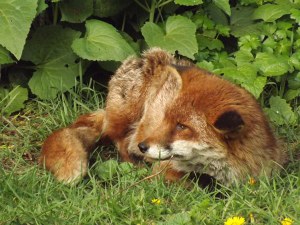
Amber the fox reflects the unpredictable face of nature showing up in my garden by surprise on random days.
I went camping and woke to frost on the ground. I wrote yesterday that summer had arrived in Britain. A pool of water from recent rains had frozen over.
One thing you quickly learn about nature is its unpredictability. Everything in nature has its own free will, and will determine its own unpredictable path regardless of what humanity thinks. Those that are able to let go of control enjoy a nature full of surprises.
ooOOoo
Thanks to the modern-day internet, it takes only a moment to find a relevant quotation to close today’s post.
“It is always wise to look ahead, but difficult to look further than you can see.” Sir Winston Churchill.
Nature imposes herself on us humans in absolute terms.
I do not believe in any form of life after death. Jean is uncertain. Many good people do believe in some form of spiritual afterlife.
However, one thing is sure. Our living mind and body will die.
These few words are an introduction to the first essay under the broad title of The Natural order. On the 23rd April I introduced the idea of writing a regular essay “about the past, present and future of man’s relationship with Nature.”
Thus it did seem entirely appropriate to ‘kick off’ the essays with reflections about life and death.
Posted on April 27, 2014 | Nature reminds me life and death is a circle.
The circle of life and death.
I visit a house, the noise of hungry little birds emanating from a nest hidden in the roof, busy parents flying in and out feeding their brood. Less than a week before summer (1st May) I encounter life all about me, like a vast fountain of creativity, as plant and animal erupt into growth and creation. I feel a sense of joy at the life all about me, like dipping my feet in crystal clear spring waters.
Amongst this carnival of life a reminder that with life there is also death. Helix our cat is an effective hunter, a blue tit is found dead upon the ground. I feel no sadness for the death, it is a natural part of the cycle of nature, my animistic viewpoint is of a small spirit returning to the source, and from then renewing. No anger for Helix, since this is the nature of cats, despite being fed, a cat must follow the primal instinct of its nature to hunt. I carry the dead blue tit to an overgrown spot of trees and grass, here I place the blue tit to decay and thus become part of the life of plant and animal of that place, such is the circle of life and death.
ooOOoo
There can’t be a single person on this planet who does not understand that our human life is finite.
Life span of early man: Until fairly recently, little information existed about how long prehistoric people lived. Too few fossilized human remains made it tough for historians to estimate the demographics of any population. Anthropology professors Rachel Caspari and Sang-Hee Lee chose instead to analyze the relative ages of skeletons found in archeological digs in eastern and southern Africa, Europe, and elsewhere. Comparing the proportion of those who died young, with those who died at an older age, the team concluded that longevity only began to significantly increase (that is, past the age of 30 or so) about 30,000 years ago – quite late in the span of human evolution.
In an article published in 2011 in Scientific American, Caspari calls the shift the “evolution of grandparents”, as it marks the first time in human history that three generations might have co-existed. ( Source: Longevity Throughout History.)
Thus given that living much past the age of thirty years is a relatively recent experience, it baffles me beyond comprehension that we, as in mankind, have become so short-sighted about reinvesting in the one and only natural planet that sustains us.
Beautifully expressed in another wonderful essay from John Hurlburt.
ooOOoo
Notes on the Human Dilemma
The metanexus of Faith, Nature and Science form an integral vision of the reality in which we exist. We are components of Creation living in an emerging universe. As consciously aware life forms we are each and all responsible to the Nature of God in a steadily emerging universe. Change is both constant and inevitable. Species that don’t adapt, do not survive.
Our human problems are obvious.
The essential growth of human conscious awareness remains questionable.
There is a blatant disregard for Nature. The rate of Natural disasters is increasing everywhere on Earth
Civil unrest is bordering on a second Civil War and is already in that state in many other nations of the world.
Imminent economic collapse remains probable as long our world economy is based on a foundation that has been leveraged at least twenty-five times above any realistic material foundation on Earth.
Are we a moral species?
A steady increase in natural disasters worldwide is inevitable until we change in response to Nature’s warnings or become extinct. The collapse of morality threatens the existence of global civilization.
The virtual extinction of the human race in its present state is all but assured within the next century unless we adapt to the Reality we presently blithely ignore or chose to vilify.
We still have a choice.
Our alternative to what has been euphemistically referred to as “new reality” is the process of education, reformation and transformation on a personal level. The objectives are an obvious need to adapt to constant natural change and create a species renaissance in harmony with the reality of God, Nature and Science.
There is clearly a need for a global economy that is based on our primal need for clean air, clean water, clean food and clean energy. We need to maintain our balance through gratitude for the blessings of the life we share and equal justice for all. We need to remember that we are not in charge of anything except our responsibilities to God, Nature and each other.
Under these simple guidelines, a healthy, growing future remains possible as we prepare to migrate from our home planet and relieve the consumptive consequences of an exponentially growing and ravenous demographic ruled by the artificial symbol of Money.
Sound impossible? Au contraire…
The world is being forced to re-evaluate its economic premises. Here are a few proven solutions to help create a naturally invigorated economy.
We can cut air pollution dramatically overnight by converting commercial diesel engines to far more cost-effective bio-fuels without a single change to the diesel mechanisms.
Bio-diesel distillation plants can filter and recycle the clean water we need to live.
We are capable of growing our own food with recycled organic fertilizers.
We have begun the process of harnessing the limitless clean renewable energy provided by the sun, the wind and hydraulic power.
Electric cars that may be fueled by solar energy are winning world class races.
The list of what we are capable of doing is only limited by our imaginations.
The questions to ask ourselves are:
Are we at the beginning of a new world or at the end of an old world?
“Are we a part of the problem or part of a realistic solution?”
Hardly seems necessary to say this but natural forces are ‘top of the pyramid‘!
As is so often the case, a few outwardly disconnected events offered a deeper picture; well they did for me!
The first was a recently published post by Alex Jones over on his blog The Liberated Way. Alex lives in Colchester, Essex, North-East of London, a place where I ran a business way back in the ’80’s’ and lived not far away in the village of Great Horkesley. Many people, including many Brits are unaware that Colchester, or Camulodunon as the Celtics called it, meaning “the Fortress of Camulos” (Camulos was the Celtic god of war), was the Capitol city in Roman days and that evidence of man’s settlement goes back 3,000 years.
Anyway, back to the thread of today’s post.
That first post from Alex. A post under the title of Catching a fox. Alex has generously given me permission to republish it.
Catching a fox.
After two years of hunting I catch a fox with my camera.
After two years of frustration I finally photograph a fox, which appeared out of nowhere in my garden.
Nature is a shifting tapestry of life, often catching me by surprise with magical manifestations of wildlife that abruptly vanish before I can catch a brief record of its passing through my life. It is a matter of chance that I get lucky with my camera, and I was in luck today.
This morning a fox manifested in my garden. The fox sat looking at me, it had a forlorn look about it, but the fox was content to sit and watch me as it sun bathed in the warmth of a tranquil garden. I had my camera with me, so I made up for two years of frustration by firing off dozens of photographs of my elusive wary model. The fox made my day.
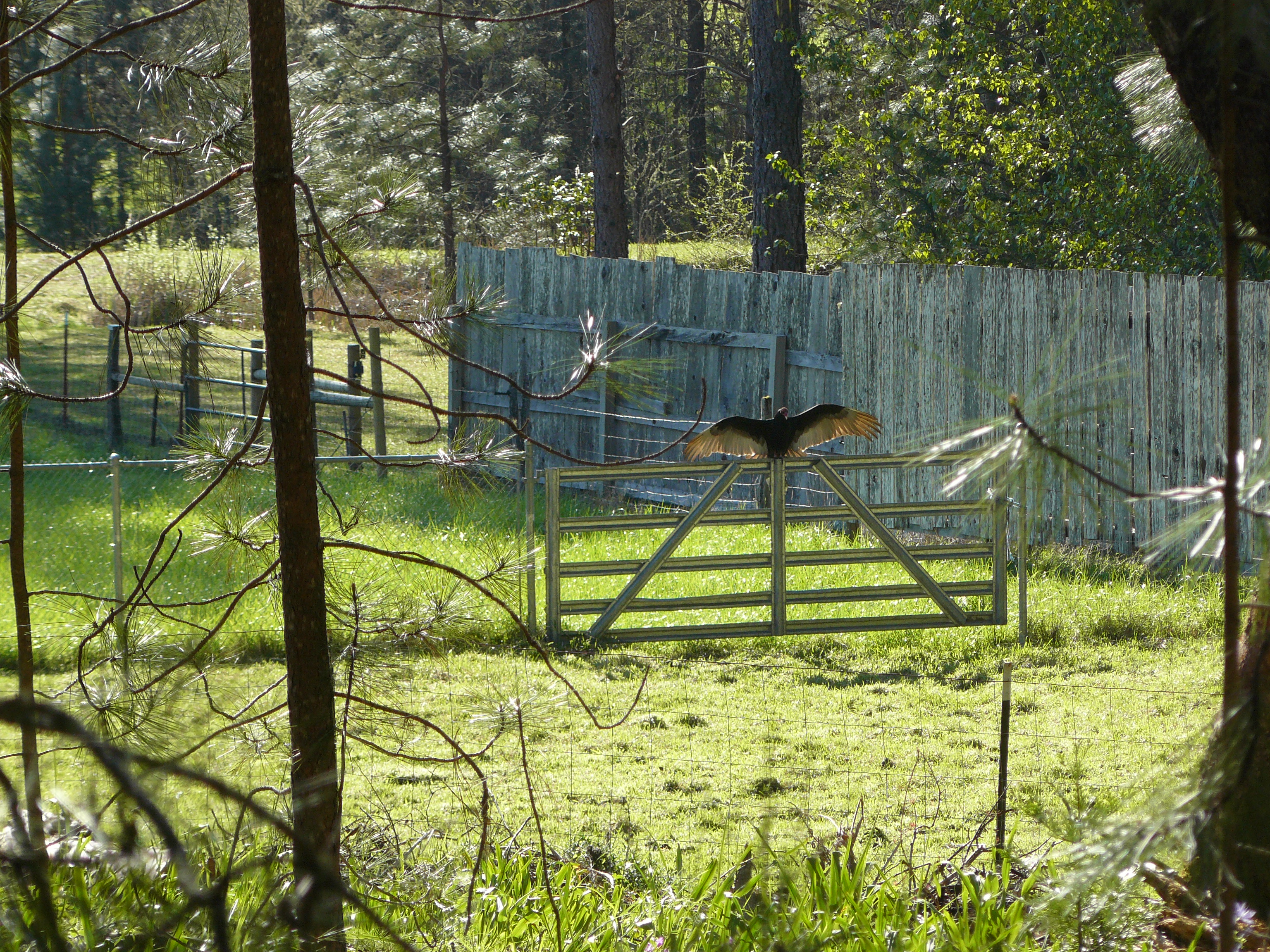
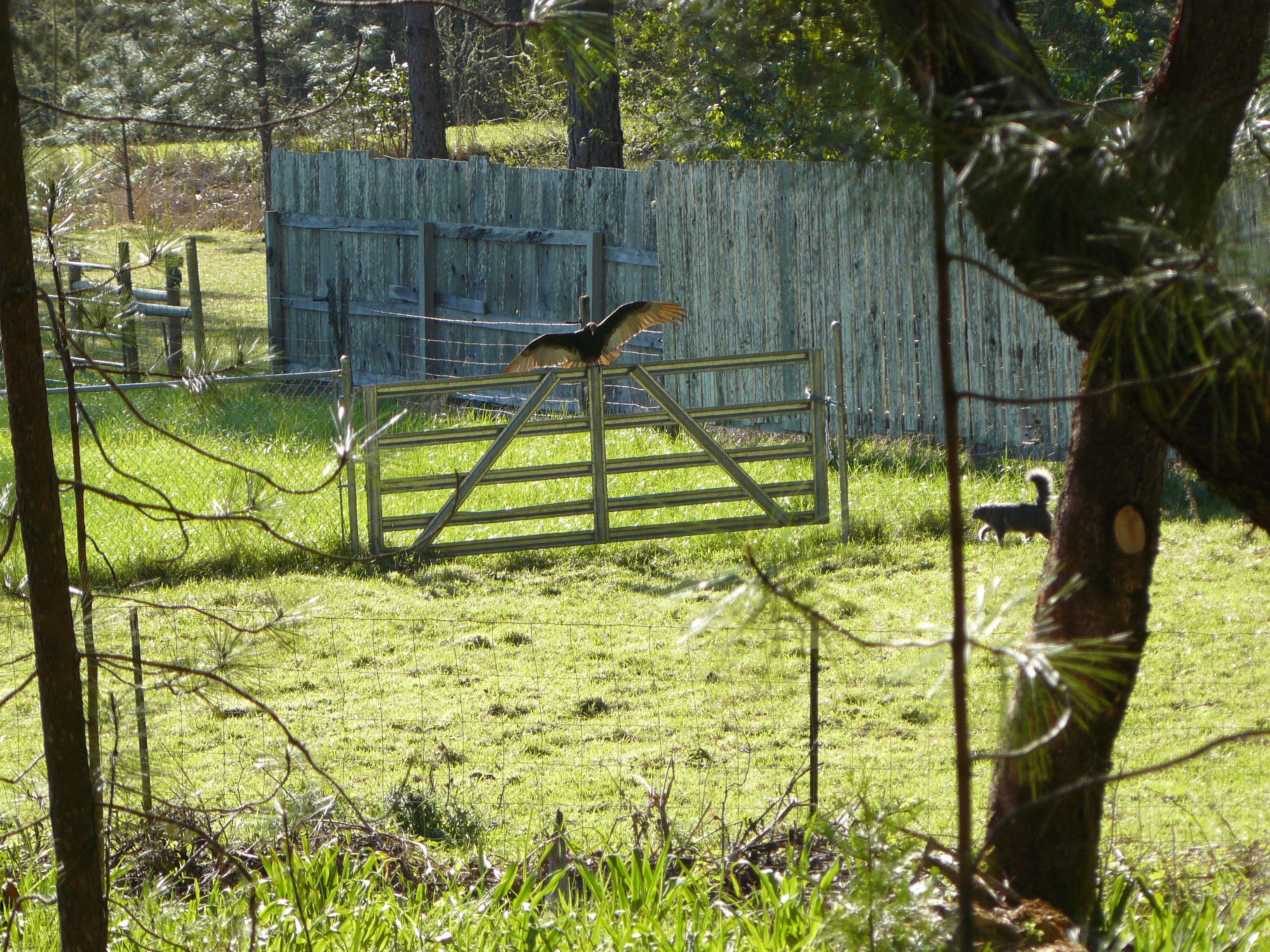
The second event was a chance photograph of a vulture taken two days ago here at home.
Ah, that early morning sun feels good on my back feathers!
oooo
Damn! Thought it was too good to last!
Now I’m sure that readers so far will find these three photographs, of the fox and the vulture, are producing feelings of pleasure; feelings of wonderment about the natural world around us.
That world of nature ‘speaks’ to us. If we are prepared to listen.
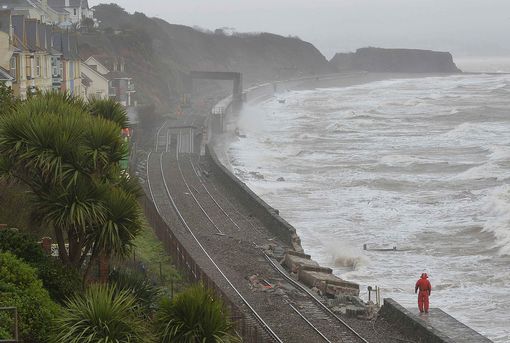
It spoke to South-West England in February earlier this year:
Dawlish – Rail emergency workers inspect damaged track along the seafront.
There are signs that Mother Nature will be speaking to us again; fairly soon. From EarthSky:
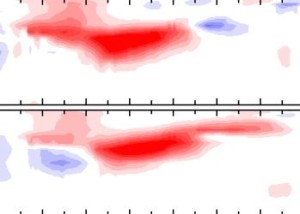
Warm water in Pacific could spark a monster El Nino in 2014
Scientists are watching a giant mass of sub-surface water in the Pacific. When this water reaches the sea surface, it could set off a powerful El Nino.
The giant red blob in this image is a huge, unusual mass of warm water that currently spans the tropical Pacific Ocean. Eric Holthaus, a meteorologist who writes about weather and climate for Slate, says the volume of water is big enough to cover the United States 300 feet deep. And that’s a lot of warm water, he says. Holthaus also says that, as the sub-surface warm water in the Pacific moves eastward – propelled by anomalous trade winds – it’s getting closer to the ocean’s surface. Once the warm water hits the sea surface, it will begin to interact with the atmosphere. Why? Because Earth’s oceans and atmosphere are always interacting. In this case, the warm water will likely boost temperatures and change weather patterns … and possibly bring on a monster El Nino in 2014. There are signs this is already beginning to happen. Read more at Slate.
If one clicks on the link to that Slate article, one then reads:
By Eric Holthaus
The odds are increasing that an El Niño is in the works for 2014—and recent forecasts show it might be a big one.
As we learned from Chris Farley, El Niños can boost the odds of extreme weather (droughts, typhoons, heat waves) across much of the planet. But the most important thing about El Niño is that it is predictable, sometimes six months to a year in advance.
That’s an incredibly powerful tool, especially if you are one of the billions who live where El Niño tends to hit hardest—Asia and the Americas. If current forecasts stay on track, El Niño might end up being the biggest global weather story of 2014.
The most commonly accepted definition of an El Niño is a persistent warming of the so-called “Niño3.4” region of the tropical Pacific Ocean south of Hawaii, lasting for at least five consecutive three-month “seasons.” A recent reversal in the direction of the Pacific trade winds appears to have kicked off a warming trend during the last month or two. That was enough to prompt U.S. government forecasters to issue an El Niño watch last month.
Forecasters are increasingly confident in a particularly big El Niño this time around because, deep below the Pacific Ocean’s surface, off-the-charts warm water is lurking:
Now I’m not going to post the whole of that article so for that reason strongly recommend you read the rest here. However, I am going to offer a couple more extracts.
Like this:
The warm water just below the ocean’s surface is on par with that of the biggest El Niño ever recorded, in 1997-98. That event caused $35 billion in damages and was blamed for around 23,000 deaths worldwide, according to the University of New South Wales. The 1997-98 El Niño is also the only other time since records begin in 1980 that sub-surface Pacific Ocean water has been this warm in April.
Or like this:
One of the theories put forth by the mainstream scientific community to explain the slow-down since 1998 has been increased storage of warm water in the Pacific Ocean. If that theory is true, and if a major El Niño is indeed in the works, the previously rapid rate of global warming could resume, with dramatic consequences.
As I wrote last fall, the coming El Niño could be enough to make 2014 the hottest year in recorded history, and 2015 could be even warmer than that. The 1997-98 super El Niño was enough to boost global temperatures by nearly a quarter of a degree Celsius. If that scale of warming happens again, the world could approach a 1ºC departure from pre-industrial times as early as next year. As climate scientist James Hansen has warned, that’s around the highest that temperatures have ever been since human civilization began.
Now I’m not trying to be a ‘drama queen’ but there are times when one does wonder what it will take for those who govern us to wake up to the fact that Mother Nature is getting more and more restless.
There’s been a couple of posts that I want to refer to because they underline the fact that humans are so prone to forgetting that we are of the wild, from the wild and connected to the wild.
The first of those posts was a recent essay by Patrice Ayme under the title of Rewilding Us and is republished on Learning from Dogs with the kind permission of Patrice.
oooOOOooo
Rewilding Us.
REALITY IS WILD & FEROCIOUS. IGNORING IT IS INHUMAN.
And Presents A Civilizational Risk.
Princeton is freaking out. Flesh devouring aliens are lurking out in the woods, threatening academia’s fragile thoughts. Krugman:
A growing population of coyotes in the wooded area bordering the Institute for Advanced Study has motivated the Princeton Animal Control Advisory Committee to recommend that sharpshooters be hired to help handle the problem. “There is a big pack over at the Institute Woods,” officer Johnson said this week. “I’m having a lot of complaints that they follow people around.”‘
You Can’t Always Eat Who You Want
The “Mountain Lion”, is a relative of the Cheetah (erroneously put in the cat family, felis, until last year or so). It has 40 names, in English alone, and is found from the American Arctic to Patagonia, from the sea shore to the high mountains. The weight above is that of the female. Males are heavier (typically up to 100 kilograms). The heaviest puma shot in Arizona was 300 pounds (136 kilos).
The lion/cougar/puma is capable of jumping up twenty feet from a standstill (yes, 6 meters; horizontally, 14 meters). It is capable of killing a grizzly (pumas and ‘golden bears’ were famous for their naturally occurring furious fights to death in California). The feline’s crafty method consisted into jumping on top of the bear, and blinding him with furious pawing. Top speed: 50 mph, 80 km/h. (By the way, there used to be pure cheetahs in North America, recently exterminated by man. I propose to re-install the Asian cheetah in the USA, in a sort of cheetah diplomacy with Iran.)
The philosophical question here is: what is this world all about? Is it about living on our knees, or ruling among animals and wilderness?
Why would Princeton panic about small canids? Because they don’t obey the established order?
Coyotes are totally clever, and not at all dangerous (being so clever). They have very varied voices, when in packs. Going out and shooting them is really primitive, and misses the main point of having nature around. That is: to teach humility, and teach the richness of our planet, visit hearts with emotional diversity, and minds with complexity.
Bears and Mountain Lions are a completely different matter. They are both extremely clever too, but can be very dangerous.
Running and hiking in the Sierra, I got charged by scary bears several times. I view this dangerosity as a plus, but it never loses my mind, and I got scared nearly out my wits more than once.
Once, in a national Park on the coast, I literally ran into two large lions in 30 minutes! Then I got charged by a large elk before he realized I was not a lion. Other high notes were finding a bear cub on the trail in the near vertical mountain side, on the way down, as dusk was coming.
Another high point was the large bear by the trail, who was lying like a bear rug, at 9pm, in an apparent ruse to let me approach until he could jump at his prey, as he did, before realizing that I was not a deer, something that obviously infuriated him. He was torn between making the human into dinner, and the instinct that this would turn badly for him.
In Alaska I was charged by a moose with her progeny… although I did not go as fast as an experienced mountain biker who happened to be there too, the anti-grizzly cannister in my hand emboldened me to succeed in a circuitous move to proceed towards my distant destination, something facilitated by the calf’s crash into some obstacle, drawing his mother’s concern. Mountain running often requires to proceed, no matter the obstacles in the way, when one is too far to turn around.
Bears know rocks, they have been hurt by them, and so they fear airborn rocks (throw the rock on something noisy, to impress; I had to hit, with a very large rock, a charging bear directly, once; it fled; it was killed by rangers later after he caused a flesh wound to somebody else; some will find all this very violent; well, it is, that’s part of the whole point).
Mountain Lions are better charged and/or, roared or barked at. They fear insane behavior.
In general making lots of noise helps, with bears and lions. I don’t have clever tricks to suggest for bathing safely in the murky icy Pacific. Although I assume that the presence of sea lions bobbing on the surface placidly is indicative of the absence of an obvious white shark prowling… In any case the pacific is so cold, you will probably die of cardiac arrest before you are devoured.
In Africa, there are about 500,000 elephants. 25,000 to 30,000 are killed, a year, to send the ivory to east Asia (China, Vietnam). So African elephants may disappear. This is beyond tragic, it’s irreplaceable. Elephants understand people’s gestures, without any learning (they apparently learn to use trunk gestures among themselves). One is talking about extremely intelligent animals here. (In contrast, chimpanzees have great difficulties understanding human gestures.)
Intelligence and culture are dominant among apex mammals. That’s what makes them so superior. Washington State had the smart idea to shoot full grown adult male mountain lions. Thus mountain lion society and culture collapsed, uneducated teenagers took over, and incidents with humans exploded (something about the quiet macho society!).
A Japanese specialist of chimpanzee intelligence who happens to have a bear in his lab, found that the bear did not underperform chimpanzees on mental tasks (that’s actually a problem with bears; being so clever, they can be unpredictable, one can never know what they have up their sleeve, like the one who mimicked a bear rug, above, or one who drove a car in Tahoe). A number of social mentally advanced animals (sea mammals, parrots) use advanced languages.
So what are my recommendations? The Princeton Institute for Advanced Studies ought to realize that, if it wants to become really brainy, it ought to give our fellow species a chance. They are part of what make our minds, in full.
Elephants and rhinoceroses used to be all over Europe and North America. They ought to be re-introduced right away, using Indian and African species (rare camels too; later, thanks to genetic engineering, part of those could be replaced by re-engineered ancient species, such as the Mammoth). Lions and leopard like species ought to be reintroduced too.
It can work: in the San Francisco Bay Area, there is an impressive population of mountain lions. I had many close calls (in the most recent incident, a few weeks ago, a lion peed an enormous and dreadfully smelling amount on a trail I was making a loop on, obviously to show me he owned the territory, a total wilderness reserve a few miles from Silicon Valley… especially at dusk).
However, the lions are extremely good at avoiding people (although one got killed by police in downtown Berkeley in the wee hours of the morning). They will all be collared in the next ten years, to find out what is going on. With modern technology (collars!) and sophisticated human-animal culture, there is no reason why extremely dangerous, but clever species could not live in reasonable intelligence with humans.
So rewilding is possible. It’s also necessary. Why? So we humans can recover our hearts, and our minds.
Whether we like it or not, we are made for this wild planet. By forgetting how wild it is, by shooting it into submission, we lose track of the fact human life, and civilization itself, are much more fragile than they look.
And thus, by turning our back to the wilds, we lose track of what reality really is. Worse: we never discover all what our minds can be, and how thrilling the universe is. We are actually bad students who refuse to attend the most important school, that taught by reality itself.
Rewilding is necessary, not just to instill a mood conducive to saving the planet, but also to remake us in all we are supposed to be.
Expect Evil, And Don’t Submit.
These are the times when, once again, the plutocratic phenomenon is trying to take over. That’s when the few use the methods of Pluto to terrorize and subjugate the many (to constitute what is variously named an elite, oligarchy, or “nomenklatura“, or aristocracy, that is, a plutocracy).
And how is that possible? because the many have been made into a blind, stupid, meek herd (I refer to Nietzsche for the condemnation of the herd mentality).
How do we prevent that? Nietzsche advocated the mentality of the “blonde beast“. That meant the lion (and not what the Nazis claimed it was; few were as anti-Nazi as Nietzsche). Why lion? Because lions are domineering. I learned in Africa that one could go a long way with wild lions, as long as one gave them respect, and time to get out of the way. However, disrespecting a lion means death.
Lions don’t accept to live on their knees. When abominable forces from the giant Persian theocratic plutocracy put the tiny Athenian democracy in desperate military situations, Athenians fought like lions. And democracy won.
Yet, 150 years later, when fascist, plutocratic, but apparently not as abominable, Macedonian forces put Athens in a difficult situation, Athenians surrendered. They did not fight like lions. Democracy would not come back to Athens for 23 centuries (and only thanks to the European Union).
We will not defeat plutocracy if we do not rewild ourselves. First. Let there be lions.
***
Patrice Ayme
oooOOOooo
What I read in Patrice’s essay is this. Man is, by definition, part of nature. Yet man, uniquely of all the natural species on this planet, has contrived to ‘evolve’ a set of beliefs that run counter to the core integrity of nature. Perhaps more accurately put: sections of modern man have evolved this way.
I have a background piece on Learning from Dogs called Dogs and integrity. Here’s an extract:
value and cherish the ‘present’ in a way that humans can only dream of achieving
are, by eons of time, a more successful species than man.
And have poetry written for them:
Inner Peace
If you can start the day without caffeine,
If you can always be cheerful, ignoring aches and pains,
If you can resist complaining and boring people with your troubles,
If you can eat the same food every day and be grateful for it,
If you can understand when your loved ones are too busy to give you any time,
If you can take criticism and blame without resentment,
If you can conquer tension without medical help,
If you can relax without liquor,
If you can sleep without the aid of drugs,
You are probably the family dog!
Those words apply equally to all the animals on this planet; all of Nature’s animals. In other words, integrity must be and has to be the one and only framework within which we live.
I occasionally read sad stories in my local media of senseless cruelty against wildlife around my town of Colchester: the smashing of barn owl eggs; people suffocated badgers by closing their den up. People have no opportunity to expose themselves to nature, and thus connect with nature, some experts call “Nature Deficit Disorder.”
Technology, far from liberating, enslaves the individual to a relentless need for entertainment and personal validation, backed by demands of television, homework, cellphones and money earning. Many view nature as a health and safety risk, so that it is either managed or avoided. The situation is best illustrated in a satirical YouTube video called“The discovery of the last child in the woods.”
The solution is simple: expose yourself to nature.
The indigenous Native American expresses a connection to nature in this video:
Here is that video. Watch it without interruption. In less that 3 minutes it spells out everything that we humans have to relearn about the world we live in; the world we are part of. The integrous world we must fight for. Fight for as lions!
When all the trees have been cut down,
when all the animals have been hunted,
when all the waters are polluted,
when all the air is unsafe to breathe,
only then will you discover you cannot eat money. ~ Cree Prophecy ~
You may wonder about the title of this post? Stay with me for a moment.
As has been written before on Learning from Dogs, when dogs were living in the wild just three animals had pack roles. The leader of the pack, always a female animal, was the alpha dog. Second in command was the beta dog, always a dominant male, and the third role was the omega or clown dog. The wild dog pack was thought to have consisted, typically, of about 50 animals.
The wisdom of thousands of years showing clearly in Pharaoh’s eyes, our very own beta dog.
As leader of her pack an alpha dog had two primary functions . One was having first choice as to the male dog she was going to mate with – thus demonstrating how women always choose! 😉
Her second important duty was deciding that her pack’s home range was insufficient for the needs of her ‘family’. As wolves still do, wild dogs lived within small, well-defined territories when food was abundant. When food became less abundant then it was time to move to more fertile grounds. As an aside, research in South Africa as to the area requirements for a small pack of African wild dogs (Lycaon pictus) shows they require from 65 square kilometers (25 square miles) to 150 sq. km. (58 sq. mi.). (See footnote.)
Dogs, like all wild animals, instinctively live in harmony with nature. So the call from the alpha dog to find a new range didn’t mean they left their old one as a barren disaster area. You can see where this is heading!
Wild dogs were in contact with early man at least 50,000 years ago. (Just reflect for a moment on the length of that relationship between man and dog.) So each specie has had plenty of time to learn from the other.
Thus, as mankind is on the verge of discovering that our existing ‘territory’ is becoming unsustainable for the healthy life of the species, one fundamental learning point from dogs appears to have escaped us: Mankind doesn’t have a new range available to our species.
This preamble came to mind when I recently read a short but powerful essay on Alex Jones’ blog The Liberated Way. The essay was called A global leaky bucket. Alex has very kindly given me permission to republish it.
A global leaky bucket
Global weather extremes will force people to hard choices.
Nature will have the last word in the debate over sustainability.
I write this in despair, it is snowing again here in Colchester UK. I admit envy for those of you who live in California or Hong Kong area, I see your photographs where the seasons always seem to be warm and sunny. The northern Jet Stream refuses to move, Greenland enjoys growing strawberries as the lambs die in the fields of Britain from the winter that refuses to let go.
The extremes of weather are noted in the South of the world as well as the North. Argentina has had the worst floods in decades last week. The cause is that the systems such as the Jet Stream are paralysed in one place, thus everyone suffers flood, drought or winter in excess. Nobody is sure why this paralysis is going on with systems like the Jet Stream, some say it is climate change, the point is that we are experiencing this, and it appears to be more than a temporary issue.
My opinion is that these weather extremes are here to stay for the long duration. One is then left with a harsh reality of does one seek to control the weather or adapt to the weather? How does one control the weather, a chaotic energy system where even a small change can have great consequences? Perhaps adaptation is the better option, but does one know how huge those adaptations will have to be where drought and flood could be lasting decades?
Lets say food, water and energy are all contained in a bucket. We take a jug and scoop out from the bucket what we need. There is a tap that is constantly running filling the bucket with the food, water and energy. We waste those resources so the bucket leaks. We disrupt or destroy the renewal systems in the ecosystems so the tap is no longer running as fast as it should. We are greedy consumers so we take more than we need from the bucket with our jug. How will the bucket look now? Is this a sustainable future to you?
If our global weather extremes continue as they are it will be like a storm rocking the bucket spilling its contents, will our bucket future look even less sustainable? Extreme weather destroys harvests, kills animals, sends already distressed ecosystems into the abyss. What happens when the bucket is so empty that people can no longer enjoy their lifestyle of wasteful excess, or worse that people grow cold, hungry and thirsty? Do they sit there and do nothing but die? Will they fight? Who will fight who? As the bucket contents get ever smaller, who will win in the fighting for what is left?
Copyright (c) Alex Jones 2011-2013.
Colchester has a place in my past as I started and ran a business there between the years of 1978 to 1986. More about that some other day.
Back to Alex’s essay. It strongly resonated with a recent item on Peter Sinclair’s excellent blog Climate Denial Crock of the Week which I will refer to tomorrow.
So I will leave you with this tragic, emotional thought – where, oh where, is our alpha dog?
Footnote: The figures for the ranges of wild dogs were taken from a fascinating paper published by Lindsay, du Toit and Mills that may be read here.




 Learning from Dogs